Contents lists available atScienceDirect
Physics
Letters
B
www.elsevier.com/locate/physletb
Measurement
of
the
CP-violating
weak
phase
φ
s
and
the
decay
width
difference
s
using
the
B
0
s
→
J/ψ φ (1020)
decay
channel
in
pp
collisions
at
√
s
=
8 TeV
.
CMS
Collaboration
CERN,Switzerland
a
r
t
i
c
l
e
i
n
f
o
a
b
s
t
r
a
c
t
Articlehistory:
Received 27 July 2015
Received in revised form 11 March 2016 Accepted 16 March 2016
Available online 23 March 2016 Editor: M. Doser
Keywords:
CMS Physics B-physics CP violation
The CP-violating weak phase φs of the B0s meson and the decay width difference s of the B0s
lightand heavy masseigenstates are measuredwith theCMS detectoratthe LHCusingadata sam-ple ofB0
s→J/ψ φ (1020)→
μ
+μ
−K+K− decays.The analysed data set corresponds to an integrated luminosity of 19.7 fb−1 collected in pp collisions at a centre-of-mass energy of 8 TeV. A total of 49 200 reconstructedB0s decays are used toextract the values ofφs and s by performinga time-dependentand flavour-taggedangularanalysisofthe
μ
+μ
−K+K− finalstate.Theweakphaseis mea-sured to be φs= −0.075±
0.097(stat)±
0.031(syst) rad, and the decaywidth difference is s= 0.095±0.013(stat)±0.007(syst)ps−1.©2016CERNforthebenefitoftheCMSCollaboration.PublishedbyElsevierB.V.Thisisanopenaccess articleundertheCCBYlicense(http://creativecommons.org/licenses/by/4.0/).FundedbySCOAP3.
1. Introduction
Whilenodirectevidenceofphysicsbeyondthestandardmodel (SM)hasyetbeenfoundattheCERNLHC,theB0s mesonprovides arich source ofpossibilities to probeits consistency. In this Let-ter,ameasurementoftheweakphase
φ
softheB0s mesonandthe decaywidthdifferencesbetweenthelightandheavyB0s mass eigenstatesis presented,usingthedata collectedby theCMS ex-perimentinppcollisionsattheLHCwithacentre-of-massenergy of8TeV,correspondingtoanintegratedluminosityof19.7fb−1.
The CP-violating weak phase
φ
s originates from theinterfer-ence betweendirect B0s meson decays into a CP eigenstate ccss and decays through B0s–B0s mixing to the same final state.
Ne-glectingpenguin diagram contributions [1,2],
φ
s isrelatedto theelementsoftheCabibbo–Kobayashi–Maskawaquarkmixingmatrix by
φ
s−
2βs,whereβ
s=
arg(−
VtsVtb∗/
VcsVcb∗).
Thepredictionfor2βs, determined via a global fit to experimental data within the
SM, is 2βs
=
0.0363−+00..00160015 rad [3]. Since the value predicted bytheSM isvery precise,anysignificant deviationofthe measured value fromthispredictionwouldbe particularlyinteresting, asit wouldindicate apossiblecontributionofnew,unknown particles to the loop diagrams describing B0
s mixing. The theoretical pre-dictionforthedecaywidthdifference
s betweenthelight and
E-mailaddress:[email protected].
heavyB0s masseigenstatesBLandBH,assumingnonewphysicsin
B0s–B0s mixing,is
s
=
L
−
H
=
0.087±
0.021 ps−1[4].Theweak phase
φ
s was firstmeasured bytheTevatronexper-iments [5–8], and then at the LHC by the LHCb and ATLAS ex-periments[9–13],usingB0
s
→
J/ψ φ(1020),B0s→
J/ψf0(980),
andB0
s
→
J/ψπ
+π
−decaysto + −h+h−,where denotesamuoninthepresentanalysisandhstandsforakaonorapion.Finalstates thatdonothaveasingleCPeigenvaluerequireanangularanalysis to disentangle the CP-odd and CP-even components. The time-dependent angular analysis can be performed by measuring the decayanglesofthefinal-stateparticles + −h+h−andtheproper decay time of the B0s multiplied by the speed of light [14], re-ferredtoasctinwhatfollows.InthisLetter,theB0s
→
J/ψ φ(1020) decaytothefinalstateμ
+μ
−K+K−isanalysed,andpossible ad-ditional contributions to the result from the nonresonant decay B0s→
J/ψK+K− aretakenintoaccountbyincludingatermforan additionalamplitude(S-wave)inthefit.In this measurement the transversity basis is used [14]. The three angles
=
(θ
T,
ψ
T,
ϕ
T)
of the transversity basis areillus-tratedinFig. 1.Theangles
θ
Tandϕ
T arethepolarandazimuthalangles,respectively,ofthe
μ
+intherestframeoftheJ/ψ where thexaxisisdefinedbythedirectionoftheφ (1020)
mesoninthe J/ψrestframe,andthex–yplaneisdefinedbythedecayplaneof theφ (1020)
→
K+K−.Thehelicityangleψ
TistheangleoftheK+in the
φ (1020)
restframe with respectto the negative J/ψ mo-mentumdirection.http://dx.doi.org/10.1016/j.physletb.2016.03.046
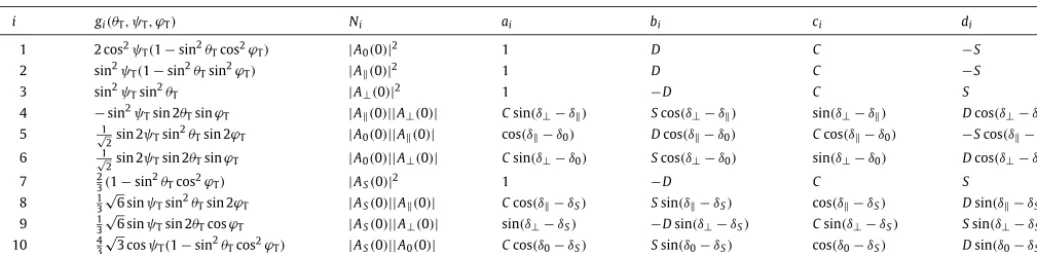
Table 1
Angular and time-dependent terms of the signal model.
i gi(θT, ψT,ϕT) Ni ai bi ci di
1 2 cos2
ψT(1−sin2θTcos2ϕT) |A0(0)|2 1 D C −S
2 sin2ψT(1−sin2θTsin2ϕT) |A(0)|2 1 D C −S
3 sin2ψ
Tsin2θT |A⊥(0)|2 1 −D C S
4 −sin2ψTsin 2θTsinϕT |A(0)||A⊥(0)| Csin(δ⊥−δ) Scos(δ⊥−δ) sin(δ⊥−δ) Dcos(δ⊥−δ)
5 √1
2sin 2ψTsin 2
θTsin 2ϕT |A0(0)||A(0)| cos(δ−δ0) Dcos(δ−δ0) Ccos(δ−δ0) −Scos(δ−δ0)
6 √1
2sin 2ψTsin 2θTsinϕT |A0(0)||A⊥(0)| Csin(δ⊥−δ0) Scos(δ⊥−δ0) sin(δ⊥−δ0) Dcos(δ⊥−δ0)
7 23(1−sin 2
θTcos2ϕT) |AS(0)|2 1 −D C S
8 1
3 √
6 sinψTsin2θTsin 2ϕT |AS(0)||A(0)| Ccos(δ−δS) Ssin(δ−δS) cos(δ−δS) Dsin(δ−δS)
9 1
3 √
6 sinψTsin 2θTcosϕT |AS(0)||A⊥(0)| sin(δ⊥−δS) −Dsin(δ⊥−δS) Csin(δ⊥−δS) Ssin(δ⊥−δS)
10 43 √
3 cosψT(1−sin2θTcos2ϕT) |AS(0)||A0(0)| Ccos(δ0−δS) Ssin(δ0−δS) cos(δ0−δS) Dsin(δ0−δS)
Fig. 1.Definition of the three angles θT, ψT, and ϕTdescribing the decay topology
of B0
s→J/ψ φ(1020). See text for details.
ThedifferentialdecayrateofB0s
→
J/ψ φ(1020) isrepresented usingthefunction f(,
ct,
α
)
asinRef.[15]:d4
B0s
d
d
(
ct)
=
f(,
ct,
α
)
∝
10
i=1
Oi
(
ct,
α
)
gi(),
(1)where Oi aretime-dependent functions, gi areangularfunctions, and
α
isasetofphysicsparameters.Thefunctions Oi(ct
,
α
)
are:Oi
(
ct,
α
)
=
Nie−ct/cτaicosh
st
2
+
bisinhst
2
+
cicos(
mst)
+
disin(
mst)
,
where
msisthemassdifferencebetweentheheavyandlightB0s masseigenstates,c
τ
isdefinedastheproductofthelifetimeand thespeedoflight,thefunction gi()andthetermsNi,ai,bi,ci, anddiaregiveninTable 1.ThetermsC,S,andD aredefinedas:
C
=
1− |
λ
|
2
1
+ |
λ
|
2,
S= −
2
|
λ
|
sinφ
s1
+ |
λ
|
2,
D= −
2
|
λ
|
cosφ
s 1+ |
λ
|
2,
using the same sign convention as the LHCb experiment [10]. Equation(1)representsthemodelforB0
s.ThemodelforB0s is
ob-tainedbychangingthesignoftheciandditerms.Theparameters
|
A⊥|
2,|
A0
|
2,and|
A|
2arethemagnitudessquaredoftheperpen-dicular,longitudinal,andparallel P-waveamplitudes,respectively;
|
AS|
2 is the magnitude squared of the S-wave amplitude repre-sentingthefractionofnonresonantdecayB0s
→
J/ψK+K−;thepa-rameters
δ
⊥,δ
0,δ
,andδS
aretheircorrespondingstrongphases. Thecomplexparametersλ
f aredefinedasλ
f=
(
q/
p)(
Af/
Af),
wheretheamplitudesAf(
Af)
describethedecayofaB0s (B0s)me-sontoafinalstate f,andtheparameters pandqrelatethemass andflavoureigenstatesasBH
=
pB0s−
qBs0 andBL=
pB0s+
qB0s [16].Assumingpolarisation-independentCP-violationeffects,
λ
f canbesimplifiedas
λ
f=
η
fλ,
whereη
f istheCPeigenvalue.Theamount ofCPviolationinmixingisassumedtobenegligible[17].Thus,no|
q/
p|
termsareusedinEq.(1)whengoingfromtheB0s modelto theB0s model.SincedirectCPviolationisexpectedtobesmall the-oretically[3]andismeasuredtobesmall[9],
|
λ
|
issetto1.0.2. TheCMSdetector
ThecentralfeatureoftheCMSapparatusisa13 m long super-conductingsolenoidof6 m internaldiameter,providingamagnetic field of3.8 T. Withinthe solenoidvolumeare a siliconpixeland strip tracker,a lead tungstatecrystalelectromagneticcalorimeter, andabrassandscintillatorhadroncalorimeter,eachcomposedof a barrel and two endcap sections. Muons are measured in gas-ionisationdetectorsembeddedinthesteelflux-returnyokeoutside thesolenoid.Extensiveforwardcalorimetrycomplementsthe cov-erageprovidedbythebarrelandendcapdetectors.
The main subdetectors used for the present analysis are the silicon tracker and the muon detection system. The sili-contrackermeasures chargedparticles withinthe pseudorapidity range
|
η
|
<
2.5.Itconsistsof66million100×
150μm2siliconpix-elsandmorethan9millionsiliconstrips.Fornonisolatedparticles oftransversemomentum1
<
pT<
10GeV and|
η
|
<
1.4,thetrackresolutionsaretypically1.5%in pT and25–90(45–150)μminthe
transverse(longitudinal)impactparameter[18].
Muons are measured in the pseudorapidity range
|
η
|
<
2.4, withdetectionplanesmadeusing threetechnologies:drift tubes, cathode strip chambers, and resistive plate chambers. The rel-ative pT resolution for low transverse momentum muons with pT<
10GeV isbetween0.8%and3.0%dependingon|
η
|
[19].Thefirstlevel(L1)oftheCMStriggersystem,composedof cus-tom hardware processors,uses informationfromthecalorimeters andmuondetectorstoselectthemostinterestingeventsinafixed timeintervaloflessthan4μs.Thehigh-leveltrigger(HLT) proces-sor farm furtherreduces theevent ratefromaround 100 kHz to around 400 Hz,beforedatastorage.At theHLTstagethereis full accesstoall theeventinformation,includingtracking,and there-foreselectionssimilartothoseappliedofflinecanbeused.
AmoredetaileddescriptionoftheCMSdetector,togetherwith a definitionofthecoordinatesystemusedandtherelevant kine-maticvariables,canbefoundinRef.[20].
3. Eventselectionandsimulatedsamples
A trigger optimised for the detection of B hadrons decaying to J/ψ is used to collect the data sample. The L1 trigger used in this analysis requires two muons, each with pT greater than
3 GeV and
|
η
|
<
2.1.The HLTrequires aJ/ψ candidatedisplaced from the luminous region. Each muon pT is required to be atgreaterthan 6.9 GeV.The J/ψ candidates are reconstructedfrom themuon pairsselectedbythetriggerintheinvariantmass win-dow2.9–3.3 GeV. The three-dimensional(3D) distanceof closest approachofthetwomuonstoeachotherisrequiredtobesmaller than 0.5 cm. The two muon trajectoriesare fittedto a common decayvertex.The transversedecaylength significance Lxy/
σ
Lxy isrequiredtobe greaterthan 3,whereLxy isthe distancebetween thecentreoftheluminousregionandthesecondaryvertexinthe transverseplane, and
σ
Lxy isthe Lxy uncertainty.Thesecondary-vertexfitprobability,calculatedusing the
χ
2 andthenumberofdegreesof freedom of the vertex fit, must be greater than 10%. Theangle
ρ
betweenthedimuontransverse momentumandthe Lxydirectionisrequiredtosatisfycosρ
>
0.9.Offline selection criteria are applied to the sample. The indi-vidual muon candidates are required to lie within a kinematic acceptance region of pT
>
4 GeV and|
η
|
<
2.1. Two oppositelychargedmuoncandidatesarepairedandrequiredtooriginatefrom acommonvertex.Dimuon candidateswithinvariantmass within 150 MeV of the world-average J/ψ mass [21] are selected. Can-didate
φ (1020)
mesonsarereconstructedfrompairsofoppositely chargedtracks withpT>
0.7GeV,afterremovingthe muon can-didatetracksforming the J/ψ.Eachselected trackis assumedto beakaon,andtheinvariantmassofatrackpairisrequiredtobe within10 MeV oftheworld-averageφ (1020)
mass[21].TheB0s candidatesare formed bycombining J/ψ and
φ (1020)
candidates.A kinematic fit ofthe two muon andtwo kaon can-didatesisperformed,withacommonvertex,andthedimuon in-variantmass is constrained to the nominal J/ψ mass [21]. A B0s candidateisretainediftheJ/ψ φ(1020)pairhasaninvariantmass between5.20 and 5.65 GeV and theχ
2 vertex fit probability isgreaterthan2%.
Multiple pp collisions can occur in the same beam crossing (pileup).Theaveragenumberofprimaryverticesinaneventis ap-proximately16,andeachselectedeventisrequiredtohaveatleast one reconstructed primary vertex. If there are multiple vertices, theonethatminimisestheanglebetweentheflightdirectionand themomentumoftheB0
s isselected.Theselectedprimary vertex isusedtomeasurect.Thequantityctiscalculatedfromthe
trans-versedecaylengthvector oftheB0s, L
B0 s
xy,asct
=
mB0 s
PDGL B0
s xy
·
pT/
p2T,wheremB0s
PDG isthe world-average B0s mass [21] and pT isthe B0s transversemomentumvector.Thedecaylengthiscalculatedinthe transverseplanetominimiseeffectsduetopileup.
Simulatedeventsareproduced usingthepythiav6.424Monte Carloeventgenerator[22].TheBhadrondecaysaremodelledwith theevtgensimulation package[23].FortheB0s signalgeneration, theevtpvvcplhmoduleisused,whichsimulatesthedoublevector decaytakinginto accountneutralmesonmixingandCP-violating time-dependent asymmetries. Final-state radiation is included in evtgen throughthe photos package[24,25].The eventsare then passed through a detailed Geant4-based simulation [26] of the CMSdetector.Thepredicteddistributionsfromsimulationofmany kinematic and geometric variables are compared to those from data and found to be in agreement. The simulated samples are used to determine the signal reconstruction efficiencies, and to studythebackgroundcomponentsintheB0s signalmasswindow.
The main backgroundfor the B0s
→
J/ψ φ(1020) decays origi-natesfromnonprompt J/ψ mesonsfromthe decayofB hadrons, suchasB0,B±,b,andBc.SincetheBccrosssectionissmall[21]
comparedtothat ofthe B0s [21],the Bc decays canbe neglected.
Thecontributionofthe
b
→
J/ψX channelstotheselectedeventsisalsofoundtobesmall,anditsmassdistributionintheselected massrangeisobservedtobeflat.Theeffectofbackgroundwitha similarsignalsignatureonthephysicsobservablesisstudiedusing simulatedevents, andfound to be negligible. The mass
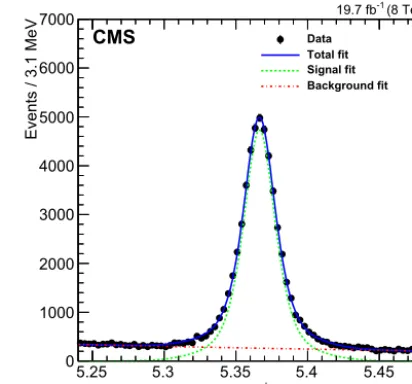
distribu-Fig. 2.The J/ψK+K−invariant mass distribution of the B0
scandidates. The solid line
is a fit to the data (solid markers), the dashed line is the signal component and the dot-dashed line is the background component.
tioninthesignalregionisshowninFig. 2,andthedistributionof ctanditsuncertainty
σ
ct inFig. 3.Efficiencycorrectionsowingtothedetectoracceptance,trigger selection, and selection criteria applied in the data analysis are taken into account in the modelling of the angular observables. The angular efficiency
()
is calculated using a fully simulated sample ofB0s→
J/ψ φ(1020)→
μ
+μ
−K+K− decays. Inthis sam-ple,thesparameterissettozerotoavoidcorrelationsbetween
thedecay timeandthe angularvariables.The
()
is fittedtoa 3D function ofto properly account forthe correlation among theangularobservables.
Thetriggerincludesadecaylengthsignificancerequirementfor the J/ψ candidates.Accordingly, thevalue ofct is requiredtobe greaterthan200 μminordertoavoidalifetimebiascomingfrom theturn-oncurveofthetriggerefficiency.Theefficiencyhistogram ofct isthenfittedwithastraightlineplusasigmoidfunction.
4. Flavourtagging
The flavour of each B0
s candidate atproduction time is deter-minedwithanopposite-side(OS)flavourtaggingalgorithm.Since b quarks are produced as b¯b pairs, the flavour of the signal B0
s mesonatproductiontimecan beinferredfromtheflavour ofthe other B hadron in the event. The tagging algorithm used in this analysisrequiresanadditionalmuonorelectronintheevents con-taining a reconstructed B0
s
→
J/ψ φ(1020) decay. The additionallepton is assumed to originate froma semileptonic decay ofthe OSB hadron,b
→
ν
X decay, with=
e,μ
.Forallthe eventsin whichanOStagleptonisfound thealgorithmprovidesatag de-cisionξ
basedon thecharge ofthelepton:ξ
= +
1 forsignalB0s, and
ξ
= −
1 forsignalB0s. [image:3.612.334.540.69.261.2]di-Fig. 3.The ct distribution (top) and its uncertainty σct (bottom) of the B0s
candi-dates. The solid line is a fit to the data (solid markers), the dashed line is the signal component and the dot-dashed line is the background component. For the ct dis-tribution the pull, defined as the difference between the observed events and the fit function applied to the sum of the signal and background, divided by the statis-tical uncertainty in the observed events, is displayed in the histogram in the lower panel.
lutionfactorD
=
(1
−
2ω
).
Thevalueofω
isestimatedfromdata onaper-eventbasis,asdescribedbelow.Thetaggingalgorithm isoptimised bymaximisingthe tagging power
P
tag=
ε
tag(1
−
2ω
)
2,which representstheequivalenteffi-ciencyofa sample withperfecttagging (
ω
=
0).The termε
tag isthetaggingefficiency,definedasthefractionofeventstowhicha tagdecisionisfoundbythetaggingalgorithm.
Opposite-sidemuonsandelectrons arereconstructed withthe particle-flow algorithm [27,28]. In each event, the muons (elec-trons) that are not part of the reconstructed B0
s
→
J/ψ φ(1020)decay are required to be identified withloose identification cri-teria.Iftherearemultiplemuons(electrons)intheevent,theone withthehighest pT is chosenatthisstage. Thetag lepton
selec-tionsarethenoptimisedseparatelyformuonsandelectronsusing simulatedsignalsamplesofB0
s
→
J/ψ φ(1020)decays.Acut-basedopposite-side lepton selection is applied to reduce the number ofleptons not originatingfromB-hadron decays.To optimise the selection, severalvariables arestudied, anda setof five
discrim-inating variables (pT,
η
, dxyz,R,
Isolation) is identified. A totalnumber of more than four million alternative cut configurations have been tested to determine the configuration that maximises the tagging power, independently for muons and electrons. The tag muon is thus required to have pT
>
2.2 GeV, the3D impactparameterdxyzwithrespecttotheprimaryvertexassociatedwith the signal B0s isrequired tobe smaller than 0.1 cm, andthe an-gular separation,
R
=
(φ)
2+
(
η
)
2, betweenthemuon andthesignalB0s isrequiredtobegreaterthan0.3,where
φ
andη
are the azimuthal angle and pseudorapidity differences between the directions of the tag muon and the B0s candidate. Electrons are requiredtohave pT
>
2.0GeV,dxyz<
0.1 cm,andR
>
0.2. Inaddition,amultivariatediscriminator(MVAe−π)tunedtosepa-rategenuineelectronsreconstructedbytheparticle-flowalgorithm from pions and photons is applied to tag electrons by requiring thatthediscriminatorisgreaterthan0.2[28].
Amultilayerperceptronneuralnetwork(MLP-NN)oftheTMVA toolkit [29] is usedto further separate theright- and wrong-tag leptons. Training and testing is performed using approximately 24 000 and 20 400 simulated B0s
→
J/ψ φ(1020) events for themuon andelectronMLP-NNs,respectively,andtwoindependently optimised setsofvariables.Halfofeach sampleis usedfor train-ing andtheother halffortesting.Theinput variablescommonto bothMLP-NNsare pT,
η
,anddxyz ofthetaglepton,andtwo vari-ables related toactivity ina cone around thelepton direction: a particle-flowrelativeisolationvariable[28]anda pT-weightedav-erageofthechargesoftheparticlesinthecone.Specificvariables are further introducedin theMLP-NNs separately formuonsand electrons.Formuons,thepTrelativetotheaxisofthejet
contain-ingthemuonisused,whileforelectronstheMVAe−π isexploited.
Themistagprobabilitiesareobtainedfromdatausingthe self-tagging channel B±
→
J/ψK±, where the charge of the recon-structedkaondeterminestheflavouroftheB±and,intheabsence ofmixing,oftheopposite-sideBhadronaswell.Themistag prob-abilitiesareparametrisedseparatelyformuonsandelectronswith analytic functions ofthe MLP-NN discriminatorsin orderto pro-vide a per-eventvalue ofthepredictedmistagprobabilityω
.The functional forms of the parametrisations are obtained from the simulated B0s sample. The candidate B± mesons are required to pass a selectionassimilar aspossible tothat applied forthe re-construction of the signal B0s candidates. The same trigger and J/ψ reconstruction requirements as forthe B0
s signal sample are applied. A charged particle with pT
>
2 GeV, assumed to be akaon,iscombinedwiththedimuonpairinakinematicfit.An un-binned extended maximum-likelihoodfit to the invariant J/ψK± massisperformed,yieldingatotalof
(707
±
2)×
103 reconstructed B±→
J/ψK± events. The tagging efficiency evaluated with the B±→
J/ψK± data sample is(4.56
±
0.02)% and(3.92
±
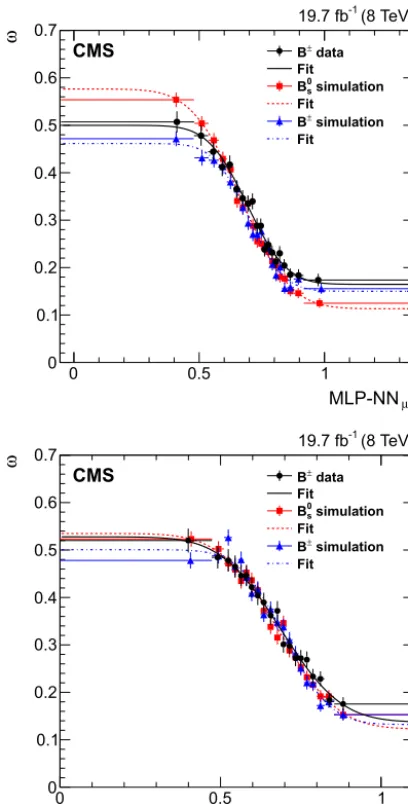
0.02)% formuonsandelectrons,respectively,wheretheuncertainties are statistical.Themistagparametrisationcurvesevaluated withtheB± con-trolchannel for muonsandelectrons are showninFig. 4,where the parametrisations for the B± and B0s simulated samples are shownforcomparison.
Most tagged events have only a single electron or muon tag. If both tags are available fora specific event (about 3.5% of the cases), thetag leptonwith thegreatestvalue of thedilution fac-torisretained,andthetagdecisionandtheestimatedmistagare takenfromthistaglepton.The overallleptontaggingefficiencyis
(8.31
±
0.03)%, asmeasured in data withthe B±→
J/ψK± data sample.To correctfor potential effects induced by thedependence of the tagging algorithm on the B0
s
→
J/ψ φ(1020) simulation, the [image:4.612.47.267.73.472.2]Fig. 4.The mistag probabilities ω, defined as the ratio of the number of wrongly
tagged events divided by the total number of tagged events, as a function of the MLP-NN discriminators for muons (top) and electrons (bottom). The data points (solid markers) are placed at the average weighted value of the events in each bin. The vertical bars show the statistical uncertainties and the horizontal bars the bin width. The solid line represents the parametrisation curve extracted from the background-subtracted B±data; the dashed and dot-dashed lines refer to the parametrisations extracted from the simulated B0
sand B±samples, respectively.
data control channel. This is then fit to the function
ω
meas=
p0+
p1(
ω
−
ω
),
chosentolimitthecorrelationbetweenthefunc-tionparameters p0 and p1. Theparameter
ω
is fixedto a valueroughlycorrespondingtothemeanofthecalculatedmistag prob-ability,
ω
=
0.35. The resulting calibration parameters are p0=
0.348
±
0.003 and p1=
1.01±
0.03, and their uncertainties arepropagatedasastatisticaluncertaintyintheOStagger.
Thesystematic uncertainties relatedto the calibration param-eters p0 and p1 are dominated by the dependenceof these
pa-rameters on the flavour of the signal-side B hadron. The uncer-taintiesareestimatedfromB± dataandsimulatedsamplesofB0
s andB± events.Systematicuncertaintiesoriginatingfrompossible variationsinthe CMSdata-takingconditions,thesignal B hadron kinematics,theanalytic formofthemistag parametrisation func-tions,andthemodelusedtofittheB±invariantmassdistribution aretestedandfoundtobenegligible.
The overall tagging power of the OS lepton tagger, mea-suredwith a sample of B±
→
J/ψK± events, isP
tag=
(1.307
±
0.031
(stat)
±
0.007(syst))%,
correspondingtothecombinedmistag probabilityω
=
(30.17
±
0.24(stat)
±
0.05(syst))%.
5. Maximum-likelihoodfit
Anunbinnedmaximum-likelihoodfitto thedataisperformed by includingtheinformationon theB0
s invariant mass(mB0 s), the three decay angles () of the reconstructed B0s candidates, the flavour tag decision (ξ), ct, and
σ
ct, obtained by summing in quadraturethedecaylengthuncertaintyandtheuncertaintyinthe transversemomentum. Thefit isappliedto thesample of70500 events,outofwhich5650 aretaggedevents,selectedinthemass range 5.24–5.49 GeV andct=
200–3000μm. From this multidi-mensional fit,the physics parameters of interests,
φ
s, theB0s mean lifetime cτ
,|
A⊥|
2,|
A0|
2,|
AS|2, and the strong phasesδ
,δ
⊥,andδS
⊥ are determined, whereδS
⊥ is definedas the differ-enceδS
−
δ
⊥.The P-waveamplitudes arenormalised to unityby constraining|
A|
2 to1− |
A⊥|
2− |
A0|
2.Thefitmodelisvalidatedwith simulated pseudo-experimentsand with simulated samples withdifferentparametersets.
Thelikelihoodfunctioniscomposedofprobabilitydensity func-tions(pdf)describingthesignalandbackgroundcomponents.The likelihood fit algorithm is implemented using the RooFit pack-age from the ROOT framework [30]. The signal and background pdfs are formed as the product ofpdfs that modelthe invariant mass distribution andthe time-dependent decayrates of the re-constructed candidates. In addition, the signal pdf also includes the efficiencyfunction. The eventlikelihood function
L
is repre-sented as:L
=
Ls+
Lbkg,
Ls
=
Ns˜
f
(,
ct,
α
)
⊗
G(
ct,
σ
ct)
()
×
Ps(
mB0s
)
Ps(
σ
ct)
Ps(ξ ),
Lbkg
=
NbkgPbkg(
cosθ
T,
ϕ
T)
Pbkg(
cosψ
T)
Pbkg(
ct)
×
Pbkg(
mB0s
)
Pbkg(
σ
ct)
Pbkg(ξ ),
whereLsandLbkgarethepdfsthatdescribetheB0s
→
J/ψ φ(1020)signal andbackgroundcontributions, respectively. Thenumber of signal(background)eventsisNs (Nbkg).Thepdf
˜
f(,
ct,
α
)
isthedifferentialdecayratefunction f
(,
ct,
α
)
definedinEq.(1), mod-ified to include the flavour tagging information and the dilution term(1
−
2ω
),
whichare applied toeach ofthe ci anddi terms oftheequation.Inthe˜
f expression,thevalueofδ
0issettozero,following ageneral convention. Thefunction
()
isthe angular efficiency and G(
ct,
σ
ct)
isa Gaussian resolution function, which makesuseoftheevent-by-eventdecaytimeuncertaintyσ
ct,scaled byafactorκ
.Theκ
factorisafunctionofct andisintroducedas a correctionto take careofresidual effectswhen thedecaytime uncertaintyisusedtomodelthect resolution.The functionκ
(
ct)
is measured using simulated samples and, on average, its value equals1.0towithinafewpercent.Theaveragedecaytime uncer-taintyincludingtheκ
(
ct)
factorequals23.4 μm.Alltheparameters of the pdfs are left free to float in the final fit, unless explicitly statedotherwise. The value ofs is constrainedto be positive,
basedonrecentmeasurements[31]. Thesignalmasspdf Ps
(
mB0s
)
isthesumofthreeGaussian func-tions witha common mean; the two smaller widths, the mean, andthefractionofeachGaussian functionarefixed tothevalues obtainedinaone-dimensionalmassfit.Thebackgroundmass dis-tribution Pbkg(
mB0s
)
is described by an exponential function. The background decay time component Pbkg(
ct)
is described by thesumoftwo exponentialfunctions. Theangularparts ofthe back-groundspdfs Pbkg
(cosθ
T,
ϕ
T)
and Pbkg(cos
ψ
T)
aredescribedTable 2
Results of the fit to the data. Uncertainties are statistical only.
Parameter Fit result φs[rad] −0.075±0.097
s[ps−1] 0.095±0.013 |A0|2 0.510±0.005 |AS|2 0.012+−00..009007 |A⊥|2 0.243±0.008 δ[rad] 3.48+0.07
−0.09
δS⊥[rad] 0.37+−00..2812
δ⊥[rad] 2.98±0.36
cτ[μm] 447.2±2.9
andsinusoidalfunctionsfor
ϕ
T.Forthe cosθT andϕ
T variablesatwo-dimensional pdf isused to take intoaccount the correlation amongthevariables.
Thesignal decaytime uncertaintypdf Ps
(
σ
ct)
isa sumoftwo Gammafunctions,withalltheparametersfixed tothevalues ob-tained by fitting a sample of background-subtracted events. The backgrounddecaytimeuncertaintypdf Pbkg(
σ
ct)
isrepresentedby aGammafunction.Alltheparameters arefixed tothevalues ob-tainedby fitting the B0s invariant masssideband regions, defined bythemassrangesmB0
s
=
5.24–5.28GeV and 5.45–5.49 GeV.The functions Ps(ξ )
and Pbkg(ξ )
are the tag decisionξ
pdfs, whichhavebeenobtainedfromthedata.
6. Resultsandsystematicuncertainties
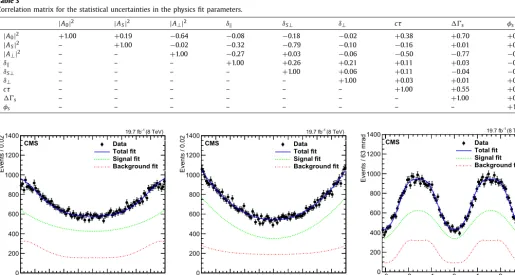
The results of the fit are given in Table 2, where the quoted uncertainties are statistical only. The corresponding correlation matrix forthe statistical uncertainties in the physics fit
parame-ters is showninTable 3. Sincethe likelihood profiles of
δ
,δS
⊥, and|
AS|
2 are not parabolic, the statistical uncertainties quoted for these parameters are found from the increase in−
logL
by 0.5. In the fit, the value ofms is allowed to vary following a
Gaussian distribution with mean and standard deviation set to
(17.69
±
0.08)×
1012h¯
/s
[32].Asacross-check,them
s valueis
alsoleftfreetofloatanditsbestfitvalueisfoundtobein statis-ticalagreementwiththe setvalue.The variousdatadistributions and the fit projections are shown in Figs. 2, 3, and 5. The drop inthecos
θ
T distributionattherangelimitsisidentified asbeingcausedby close-by,high-angle kaontracks.Thecentral valueand the68%,90%,and95%confidencelevel(CL)likelihoodcontoursof thefitinthe
s–φsplaneareshowninFig. 6.
Severalsourcesofsystematicuncertaintiesintheprimary mea-sured quantities are investigated by testing the various assump-tions made in the fit model and those associated with the fit procedure.
The systematic uncertaintyassociated withthe assumption of aconstantefficiencyasafunctionofctisevaluatedbyfittingthe datawithanalternativect efficiencyparametrisation,whichtakes into account a small contribution of the decay time significance requirement at small ct and first-order polynomial variations at highct.Thedifferencesfoundinthefitresultswithrespecttothe nominalfitareusedassystematicuncertainties.
The uncertainties associatedwith the variables cos
θ
T,
ϕ
T,andcos
ψ
T ofthe3D angularefficiencyfunctionarepropagatedtothefit results by varying the corresponding parameters within their statisticaluncertainties,accountingforthecorrelationsamongthe parameters. The maximum variation of the parameters extracted fromthefitistakenasthesystematicuncertainty.Thesystematic uncertaintyowingtoasmalldiscrepancyinthekaonpT spectrum
[image:6.612.37.552.447.722.2]betweendataandsimulationisevaluatedbyweightingtheevents tomakethesimulatedkaonpTspectrummatchthatindata.
Table 3
Correlation matrix for the statistical uncertainties in the physics fit parameters.
|A0|2 |AS|2 |A⊥|2 δ δS⊥ δ⊥ cτ s φs
|A0|2 +1.00 +0.19 −0.64 −0.08 −0.18 −0.02 +0.38 +0.70 +0.11
|AS|2 – +1.00 −0.02 −0.32 −0.79 −0.10 −0.16 +0.01 +0.03
|A⊥|2 – – +1.00 −0.27 +0.03 −0.06 −0.50 −0.77 −0.11
δ – – – +1.00 +0.26 +0.21 +0.11 +0.03 −0.02
δS⊥ – – – – +1.00 +0.06 +0.11 −0.04 −0.06
δ⊥ – – – – – +1.00 +0.03 +0.01 +0.01
cτ – – – – – – +1.00 +0.55 +0.10
s – – – – – – – +1.00 +0.10
φs – – – – – – – – +1.00
Fig. 5.The angular distributions (cosθT, cosψT, ϕT) of the B0s candidates from data (solid markers). The solid line is the result of the fit, the dashed line is the signal
Fig. 6.The CMS measured central value and the 68%, 90%, and 95% CL contours in
the sversus φsplane, together with the SM prediction[3,4]. Uncertainties are
statistical only.
Theuncertaintyinthectresolutionassociatedwiththe
κ
factor ispropagatedtotheresults.Asetoftestsamplesisproducedwith theκ
(
ct)
factor varying within their uncertainty, assumed to be Gaussian.Onestandarddeviationofthedistributiondescribingthe differencebetweenthectresolutionwiththenominalfitandwith a varyingκ
(
ct)
is takenas the systematicuncertainty. Since theκ
(
ct)
factorisobtainedfromsimulation,theassociatedsystematic uncertaintyis assessed by using a sample of prompt J/ψ decays obtainedwithanunbiasedtriggerandcomparingthemtosimilarly processed simulateddata. In this way the decay time resolution forct≈
0 isobtained.Theκ
(
ct)
factorisvariedwithin thevalues observed in data and simulation. The resulting variations of the physicsparametersaretakenassystematicuncertainties.Although the likelihood function makes use of a per-event mistagparameter,itdoesnot containapdf modelforthemistag distribution. The associated systematic uncertainty is estimated bygeneratingsimulatedpseudo-experimentswithdifferentmistag distributionsforsignalandbackgroundandfittingthemwiththe nominalfit.
The dominant tagging systematic uncertainty originates from theassumption that thesignal andcalibrationchannels havethe sametaggingperformance.Itisevaluatedusingacalibrationcurve, obtainedfromsimulatedsamples,thatdescribesthemistag prob-abilityof B0s asfunction of the mistag probability of B±. The fit
tothe dataisrepeated, re-calibratingthemistagprobability with the B0s–B± calibration curve, andthe differencesfound in the fit resultswithrespecttothenominalfitareusedasthesystematic uncertainties.
Possiblebiasesintrinsictothefitmodelarealsotakeninto ac-count. The nominalmodel function is testedby using simulated pseudo-experiments, andtheaverage ofthepulls(defined asthe differencebetweentheresultoffittothepseudo-experiment sam-pleandthenominalvalue)isusedasasystematicuncertaintyifit exceedsonestandarddeviationstatisticaluncertainty.
Thevarioushypothesesthathavebeenassumedwhenbuilding thelikelihoodfunctionaretestedbygeneratingsimulated pseudo-experiments with different hypotheses and fitting the samples withthenominallikelihoodfunction.Theobtainedpullhistograms ofthephysicsvariablesarefittedwithGaussianfunctions,andthe averageofthepullisusedasasystematicuncertaintyifthe differ-encewithrespect to the averageexceeds one standard deviation statisticaluncertainty.Concerningthe modellingoftheJ/ψK+K− invariant mass distribution, the background model ischanged to a Chebyshev function from the nominal exponential pdf. The ct backgroundpdfis changedtothesumofthreeexponential func-tions insteadofthetwo exponentialfunctionsofthe nominalfit. Theangularbackgroundpdfisgeneratedbyusingthebackground simulationangularshapesinsteadofthefitones.Theeffectofnot includingthe angularresolution isalso tested, usingtheresidual distributions obtained from simulations. The RMS of the angular resolutions were found to be 5.9, 6.3, and 10 mrad, for cos
θT
, cosψT
,andϕ
T respectively.Thecontributiontothesystematic un-certaintyfromthebackgroundtaggingasymmetryisnegligible.The hypothesis that
|λ|
=
1 is tested by leaving that param-eter free in the fit. The obtained value of|
λ
|
is consistent with 1.0within onestandarddeviation.Thedifferencesfoundinthefit resultswithrespecttothenominalfitareusedassystematic un-certainties.Thealignment systematicuncertaintyaffectsthevertex recon-structionandthereforethedecaytimes.Thateffectisestimatedto be1.5 μm fromstudiesofknownBhadronlifetimes[33].The sys-tematic effectowing to the very small numberof B0
s originating fromB+c
→
B0s
π
+feed-down,whichwouldbereconstructedwith largevaluesofct,hasbeenfoundtobenegligible.The measured values for the weak phase
φ
s and the decaywidthdifference
s are:
φ
s= −
0.
075±
0.
097(
stat)
±
0.
031(
syst)
rad,
s
=
0.
095±
0.
013(
stat)
±
0.
007(
syst)
ps−1.
ThesystematicuncertaintiesaresummarisedinTable 4.The uncer-taintiesinthe
φ
sands resultsaredominatedbythestatistical
uncertainties.
Table 4
Summary of the uncertainties in the measurements of the various B0
s parameters. If no value is reported, then the systematic uncertainty is negligible with respect to the
statistical and other systematic uncertainties. The total systematic uncertainty is the quadratic sum of the listed systematic uncertainties.
Source of uncertainty φs[rad] s[ps−1] |A0|2 |AS|2 |A⊥|2 δ[rad] δS⊥[rad] δ⊥[rad] cτ[μm]
ctefficiency 0.002 0.0057 0.0015 – 0.0023 – – – 1.0
Angular efficiency 0.016 0.0021 0.0060 0.008 0.0104 0.674 0.14 0.66 0.8 KaonpTweighting 0.014 0.0015 0.0094 0.020 0.0041 0.085 0.11 0.02 1.1
ctresolution 0.006 0.0021 0.0009 – 0.0008 0.004 – 0.02 2.9
Mistag distribution modelling 0.004 0.0003 0.0006 – – 0.008 0.01 – 0.1
Flavour tagging 0.003 0.0003 – – – 0.006 0.02 – –
Model bias 0.015 0.0012 0.0008 – – 0.025 0.03 – 0.4
pdf modelling assumptions 0.006 0.0021 0.0016 0.002 0.0021 0.010 0.03 0.04 0.2
|λ|as a free parameter 0.015 0.0003 0.0001 0.005 0.0001 0.002 0.01 0.03 –
Tracker alignment – – – – – – – – 1.5
[image:7.612.40.565.618.747.2]7. Summary
Using pp collision data collected by the CMS experiment at a centre-of-mass energy of 8 TeV and corresponding to an inte-grated luminosity of 19.7 fb−1, 49 200 B0s
→
J/ψ φ(1020) signal candidateswere usedtomeasurethe weakphaseφ
s andthede-cay width difference
s. The analysiswas performed by using
opposite-side lepton tagging of the B0s flavour atthe production time.Bothmuonandelectrontagswereused.
Themeasured valuesfortheweak phaseandthedecaywidth difference between the B0
s mass eigenstates are
φ
s= −
0.075±
0.097
(stat)
±
0.031(syst)
rad ands
=
0.095±
0.013(stat)
±
0.007
(syst)
ps−1, respectively. The measured values areconsis-tent with those obtained by the LHCb Collaboration using B0
s
→
J/ψK+K− decays[34].Ourmeasured valueof
φ
s agrees withtheSM prediction.Ourresultconfirms
s to be nonzero, witha value consistent with
theoreticalpredictions.Theuncertaintiesinour
φ
s ands
mea-surements are dominated by statisticaluncertainties. Ourresults provideindependentreferencemeasurements of
φ
s ands,and
contribute to improving the overall precision of these quantities andtherebyprobingtheSMfurther.Sinceourmeasurement preci-sionisstill limitedbystatisticaluncertainty,substantial improve-mentisexpectedfromLHC
√
s=
13TeV high-luminosity running thatwillbeavailableoverthenextfewyears.Acknowledgements
WecongratulateourcolleaguesintheCERNaccelerator depart-ments for the excellent performance of the LHC and thank the technicalandadministrativestaffs atCERN andatother CMS in-stitutes for their contributions to the success of the CMS effort. Inaddition,wegratefullyacknowledgethecomputingcentresand personneloftheWorldwideLHCComputingGridfordeliveringso effectivelythe computinginfrastructureessential to ouranalyses. Finally, we acknowledge the enduring support for the construc-tionandoperation oftheLHCandthe CMSdetectorprovidedby thefollowingfundingagencies:BMWFWandFWF(Austria);FNRS and FWO (Belgium); CNPq, CAPES, FAPERJ, and FAPESP (Brazil); MES(Bulgaria);CERN;CAS,MOST,andNSFC(China);COLCIENCIAS (Colombia);MSESandCSF(Croatia);RPF(Cyprus);MoER,ERCIUT andERDF(Estonia);Academy ofFinland,MEC,andHIP(Finland); CEA and CNRS/IN2P3 (France); BMBF, DFG, and HGF (Germany); GSRT (Greece); OTKA and NIH (Hungary); DAE and DST (India); IPM (Iran); SFI (Ireland); INFN (Italy); MSIP and NRF (Republic of Korea); LAS (Lithuania); MOE and UM(Malaysia); CINVESTAV, CONACYT,SEP,andUASLP-FAI(Mexico);MBIE(NewZealand);PAEC (Pakistan);MSHEandNSC(Poland);FCT(Portugal);JINR(Dubna); MON,RosAtom,RASandRFBR(Russia);MESTD(Serbia);SEIDIand CPAN(Spain);SwissFundingAgencies(Switzerland);MST(Taipei); ThEPCenter,IPST,STARandNSTDA(Thailand);TUBITAKandTAEK (Turkey);NASUandSFFR(Ukraine); STFC(United Kingdom);DOE andNSF(USA).
Individuals have received support from the Marie-Curie pro-grammeandthe European ResearchCouncil andEPLANET (Euro-peanUnion);theLeventisFoundation;theAlfredP.Sloan Founda-tion; the Alexander von Humboldt Foundation; the Belgian Fed-eral Science Policy Office; the Fonds pour la Formation à la Recherche dans l’Industrie et dans l’Agriculture (FRIA-Belgium); the Agentschap voor Innovatie door Wetenschap en Technolo-gie (IWT-Belgium); the Ministry of Education, Youth and Sports (MEYS)oftheCzechRepublic;theCouncilofScienceandIndustrial Research,India;theHOMING PLUSprogrammeoftheFoundation forPolishScience,cofinancedfromEuropean Union,Regional De-velopment Fund;the Compagnia di SanPaolo (Torino); the
Con-sorzio per la Fisica (Trieste); MIUR project 20108T4XTM (Italy); theThalisandAristeiaprogrammescofinancedbyEU-ESFandthe Greek NSRF; the National Priorities Research Program by Qatar NationalResearch Fund;theRachadapisekSompot Fund for Post-doctoral Fellowship,Chulalongkorn University (Thailand);andthe WelchFoundation.
References
[1] B. Bhattacharya, A. Datta, D. London, Reducing penguin pollution, Int. J. Mod. Phys. A 28 (2013) 1350063, http://dx.doi.org/10.1142/S0217751X13500632. [2] S. Faller, R. Fleischer, T. Mannel, Precision physics with B0
s→J/ψφ at the
LHC: the quest for new physics, Phys. Rev. D 79 (2009) 014005, http://dx.doi. org/10.1103/PhysRevD.79.014005, arXiv:0810.4248.
[3] J. Charles, O. Deschamps, S. Descotes-Genon, R. Itoh, H. Lacker, A. Menzel, S. Monteil, V. Niess, J. Ocariz, J. Orloff, S. T’Jampens, V. Tisserand, K. Tra-belsi, Predictions of selected flavour observables within the standard model, Phys. Rev. D 84 (2011) 033005, http://dx.doi.org/10.1103/PhysRevD.84.033005,
arXiv:1106.4041.
[4]A.Lenz,U.Nierste,Numericalupdatesoflifetimesandmixingparametersof Bmesons,in:T.Gershon(Ed.),Proceedingsofthe6thInternationalWorkshop ontheCKMUnitarityTriangle,UniversityofWarwick,UnitedKingdom,2010, arXiv:1102.4274.
[5] T. Aaltonen, et al., CDF Collaboration, First flavor-tagged determination of bounds on mixing-induced CP violation in B0
s→J/ψφdecays, Phys. Rev. Lett.
100 (2008) 161802, http://dx.doi.org/10.1103/PhysRevLett.100.161802, arXiv: 0712.2397.
[6] V.M. Abazov, et al., D0 Collaboration, Measurement of B0
s mixing parameters
from the flavor-tagged decay B0
s→J/ψφ, Phys. Rev. Lett. 101 (2008) 241801, http://dx.doi.org/10.1103/PhysRevLett.101.241801, arXiv:0802.2255.
[7] T. Aaltonen, et al., CDF Collaboration, Measurement of the CP-violating phase βJs/ψ φin B0s→J/ψφ decays with the CDF II detector, Phys. Rev. D 85 (2012)
072002, http://dx.doi.org/10.1103/PhysRevD.85.072002, arXiv:1112.1726.
[8] V.M. Abazov, et al., D0 Collaboration, Measurement of the CP-violating phase φJs/ψ φusing the flavor-tagged decay B0s→J/ψφin 8 fb−1of pp collisions, Phys.
Rev. D 85 (2012) 032006, http://dx.doi.org/10.1103/PhysRevD.85.032006, arXiv:
1109.3166.
[9] LHCb Collaboration, Measurement of the CP-violating phase φs in B0s →
J/ψπ+π− decays, Phys. Lett. B 736 (2014) 186, http://dx.doi.org/10.1016/ j.physletb.2014.06.079, arXiv:1405.4140.
[10] LHCb Collaboration, Measurement of CP violation and the B0
s meson
de-cay width difference with B0
s →J/ψK+K− and B0s →J/ψπ+π− decays,
Phys. Rev. D 87 (2013) 112010, http://dx.doi.org/10.1103/PhysRevD.87.112010,
arXiv:1304.2600.
[11] LHCb Collaboration, Measurement of the CP-violating phase φs in B0s →
J/ψπ+π− decays, Phys. Lett. B 713 (2012) 378, http://dx.doi.org/10.1016/ j.physletb.2012.06.032, arXiv:1204.5675.
[12] ATLAS Collaboration, Time-dependent angular analysis of the decay B0 s→
J/ψφ and extraction of s and the CP-violating weak phase φs by ATLAS,
J. High Energy Phys. 12 (2012) 072, http://dx.doi.org/10.1007/JHEP12(2012)072,
arXiv:1208.0572.
[13] ATLAS Collaboration, Flavor tagged time-dependent angular analysis of the B0
s→J/ψφdecay and extraction of δγsand the weak phase φsin ATLAS, Phys.
Rev. D 90 (2014) 052007, http://dx.doi.org/10.1103/PhysRevD.90.052007. [14] A.S. Dighe, I. Dunietz, R. Fleischer, Extracting CKM phases and B0
s− ¯Bsmixing
parameters from angular distributions of non-leptonic B decays, Eur. Phys. J. C 6 (1999) 647, http://dx.doi.org/10.1007/s100529800954, arXiv:hep-ph/9804253.
[15] A.S. Dighe, I. Dunietz, H.J. Lipkin, J.L. Rosner, Angular distributions and life-time differences in B0
s→J/ψφdecays, Phys. Lett. B 369 (1996) 144, http://dx. doi.org/10.1016/0370-2693(95)01523-X, arXiv:hep-ph/9511363.
[16]G.Branco,L.Lavoura,J.Silva,CPViolation,Int.Ser.Monogr.Phys.,vol. 103, ClarendonPress,Oxford,1999.
[17] LHCb Collaboration, Measurement of the flavour-specific CP-violating asymme-try asslin B0s decays, Phys. Lett. B 728 (2014) 607, http://dx.doi.org/10.1016/ j.physletb.2013.12.030, arXiv:1308.1048.
[18] CMS Collaboration, Description and performance of track and primary-vertex reconstruction with the CMS tracker, J. Instrum. 9 (2014) P10009,
http://dx.doi.org/10.1088/1748-0221/9/10/P10009, arXiv:1405.6569.
[19] CMS Collaboration, Performance of CMS muon reconstruction in pp collision events at √s=7 TeV, J. Instrum. 7 (2012) P10002, http://dx.doi.org/10.1088/ 1748-0221/7/10/P10002, arXiv:1206.4071.
[20] CMS Collaboration, The CMS experiment at the CERN LHC, J. Instrum. 3 (2008) S08004, http://dx.doi.org/10.1088/1748-0221/3/08/S08004.
[21] Particle Data Group, K.A. Olive, et al., Review of particle physics, Chin. Phys. C 38 (2014) 090001, http://dx.doi.org/10.1088/1674-1137/38/9/090001. [22] T. Sjöstrand, S. Mrenna, P.Z. Skands, PYTHIA 6.4 physics and manual, J. High
Energy Phys. 05 (2006) 026, http://dx.doi.org/10.1088/1126-6708/2006/05/026,
[23] D.J. Lange, The EvtGen particle decay simulation package, Nucl. Instrum. Meth-ods Phys. Res., Sect. A, Accel. Spectrom. Detect. Assoc. Equip. 462 (2001) 152,
http://dx.doi.org/10.1016/S0168-9002(01)00089-4.
[24] E. Barberio, B. van Eijk, Z. Was, PHOTOS – a universal Monte Carlo for QED ra-diative corrections in decays, Comput. Phys. Commun. 66 (1991) 115, http://dx. doi.org/10.1016/0010-4655(91)90012-A.
[25] E. Barberio, Z. W ˛as, PHOTOS – a universal Monte Carlo for QED radiative cor-rections: version 2.0, Comput. Phys. Commun. 79 (1994) 291, http://dx.doi.org/ 10.1016/0010-4655(94)90074-4.
[26] S. Agostinelli, et al., GEANT4 Collaboration, GEANT4—a simulation toolkit, Nucl. Instrum. Methods Phys. Res., Sect. A, Accel. Spectrom. Detect. Assoc. Equip. 506 (2003) 250, http://dx.doi.org/10.1016/S0168-9002(03)01368-8.
[27] CMS Collaboration, Particle–flow event reconstruction in CMS and performance for jets, taus, and Emiss
T , CMS Physics Analysis Summary CMS-PAS-PFT-09-001, http://cdsweb.cern.ch/record/1194487, 2009.
[28] CMS Collaboration, Commissioning of the particle-flow event reconstruction with the first LHC collisions recorded in the CMS detector, CMS Physics Anal-ysis Summary CMS-PAS-PFT-10-001, http://cdsweb.cern.ch/record/1247373,
2010.
[29] H. Voss, A. Höcker, J. Stelzer, F. Tegenfeldt, TMVA, the toolkit for multivari-ate data analysis with ROOT, in: XIth International Workshop on Advanced Computing and Analysis Techniques in Physics Research (ACAT), 2007, p. 40,
http://pos.sissa.it/archive/conferences/050/040/ACAT_040.pdf, arXiv:physics/ 0703039.
[30] I. Antcheva, et al., ROOT — A C++ framework for petabyte data storage, sta-tistical analysis and visualization, Comput. Phys. Commun. 180 (2009) 2499,
http://dx.doi.org/10.1016/j.cpc.2009.08.005.
[31] LHCb Collaboration, Determination of the sign of the decay width differ-ence in the B0
s system, Phys. Rev. Lett. 108 (2012) 241801, http://dx.doi.org/ 10.1103/PhysRevLett.108.241801, arXiv:1202.4717.
[32] Particle Data Group, J. Beringer, et al., Review of particle physics, Phys. Rev. D 86 (2012) 010001, http://dx.doi.org/10.1103/PhysRevD.86.010001.
[33] CMS √ Collaboration, Measurement of the 0b lifetime in pp collisions at s=7 TeV, J. High Energy Phys. 07 (2013) 163, http://dx.doi.org/10.1007/ JHEP07(2013)163.
[34] LHCb Collaboration, Precision measurement of CP violation in B0 s →
J/ψk+k−decays, Phys. Rev. Lett. 114 (2015) 041801, http://dx.doi.org/10.1103/ PhysRevLett.114.041801, arXiv:1411.3104.
CMSCollaboration
V. Khachatryan,
A.M. Sirunyan,
A. Tumasyan
YerevanPhysicsInstitute,Yerevan,Armenia
W. Adam,
E. Asilar,
T. Bergauer,
J. Brandstetter,
E. Brondolin,
M. Dragicevic,
J. Erö,
M. Flechl,
M. Friedl,
R. Frühwirth
1,
V.M. Ghete,
C. Hartl,
N. Hörmann,
J. Hrubec,
M. Jeitler
1,
V. Knünz,
A. König,
M. Krammer
1,
I. Krätschmer,
D. Liko,
T. Matsushita,
I. Mikulec,
D. Rabady
2,
B. Rahbaran,
H. Rohringer,
J. Schieck
1,
R. Schöfbeck,
J. Strauss,
W. Treberer-Treberspurg,
W. Waltenberger,
C.-E. Wulz
1InstitutfürHochenergiephysikderOeAW,Wien,Austria
V. Mossolov,
N. Shumeiko,
J. Suarez Gonzalez
NationalCentreforParticleandHighEnergyPhysics,Minsk,Belarus
S. Alderweireldt,
T. Cornelis,
E.A. De Wolf,
X. Janssen,
A. Knutsson,
J. Lauwers,
S. Luyckx,
S. Ochesanu,
R. Rougny,
M. Van De Klundert,
H. Van Haevermaet,
P. Van Mechelen,
N. Van Remortel,
A. Van Spilbeeck
UniversiteitAntwerpen,Antwerpen,Belgium
S. Abu Zeid,
F. Blekman,
J. D’Hondt,
N. Daci,
I. De Bruyn,
K. Deroover,
N. Heracleous,
J. Keaveney,
S. Lowette,
L. Moreels,
A. Olbrechts,
Q. Python,
D. Strom,
S. Tavernier,
W. Van Doninck,
P. Van Mulders,
G.P. Van Onsem,
I. Van Parijs
VrijeUniversiteitBrussel,Brussel,Belgium
P. Barria,
H. Brun,
C. Caillol,
B. Clerbaux,
G. De Lentdecker,
H. Delannoy,
G. Fasanella,
L. Favart,
A.P.R. Gay,
A. Grebenyuk,
G. Karapostoli,
T. Lenzi,
A. Léonard,
T. Maerschalk,
A. Marinov,
L. Perniè,
A. Randle-conde,
T. Reis,
T. Seva,
C. Vander Velde,
P. Vanlaer,
R. Yonamine,
F. Zenoni,
F. Zhang
3UniversitéLibredeBruxelles,Bruxelles,Belgium
K. Beernaert,
L. Benucci,
A. Cimmino,
S. Crucy,
D. Dobur,
A. Fagot,
G. Garcia,
M. Gul,
J. Mccartin,
A.A. Ocampo Rios,
D. Poyraz,
D. Ryckbosch,
S. Salva,
M. Sigamani,
N. Strobbe,
M. Tytgat,
W. Van Driessche,
E. Yazgan,
N. Zaganidis
GhentUniversity,Ghent,Belgium
S. Basegmez,
C. Beluffi
4,
O. Bondu,
S. Brochet,
G. Bruno,
R. Castello,
A. Caudron,
L. Ceard,
V. Lemaitre,
A. Mertens,
C. Nuttens,
L. Perrini,
A. Pin,
K. Piotrzkowski,
A. Popov
6,
L. Quertenmont,
M. Selvaggi,
M. Vidal Marono
UniversitéCatholiquedeLouvain,Louvain-la-Neuve,Belgium
N. Beliy,
G.H. Hammad
UniversitédeMons,Mons,Belgium
W.L. Aldá Júnior,
G.A. Alves,
L. Brito,
M. Correa Martins Junior,
M. Hamer,
C. Hensel,
C. Mora Herrera,
A. Moraes,
M.E. Pol,
P. Rebello Teles
CentroBrasileirodePesquisasFisicas,RiodeJaneiro,Brazil
E. Belchior Batista Das Chagas,
W. Carvalho,
J. Chinellato
7,
A. Custódio,
E.M. Da Costa,
D. De Jesus Damiao,
C. De Oliveira Martins,
S. Fonseca De Souza,
L.M. Huertas Guativa,
H. Malbouisson,
D. Matos Figueiredo,
L. Mundim,
H. Nogima,
W.L. Prado Da Silva,
A. Santoro,
A. Sznajder,
E.J. Tonelli Manganote
7,
A. Vilela Pereira
UniversidadedoEstadodoRiodeJaneiro,RiodeJaneiro,Brazil
S. Ahuja
a,
C.A. Bernardes
b,
A. De Souza Santos
b,
S. Dogra
a,
T.R. Fernandez Perez Tomei
a,
E.M. Gregores
b,
P.G. Mercadante
b,
C.S. Moon
a,
8,
S.F. Novaes
a,
Sandra S. Padula
a,
D. Romero Abad,
J.C. Ruiz Vargas
aUniversidadeEstadualPaulista,SãoPaulo,Brazil bUniversidadeFederaldoABC,SãoPaulo,Brazil
A. Aleksandrov,
R. Hadjiiska,
P. Iaydjiev,
M. Rodozov,
S. Stoykova,
G. Sultanov,
M. Vutova
InstituteforNuclearResearchandNuclearEnergy,Sofia,Bulgaria
A. Dimitrov,
I. Glushkov,
L. Litov,
B. Pavlov,
P. Petkov
UniversityofSofia,Sofia,Bulgaria
M. Ahmad,
J.G. Bian,
G.M. Chen,
H.S. Chen,
M. Chen,
T. Cheng,
R. Du,
C.H. Jiang,
R. Plestina
9,
F. Romeo,
S.M. Shaheen,
J. Tao,
C. Wang,
Z. Wang,
H. Zhang
InstituteofHighEnergyPhysics,Beijing,China
C. Asawatangtrakuldee,
Y. Ban,
Q. Li,
S. Liu,
Y. Mao,
S.J. Qian,
D. Wang,
Z. Xu,
W. Zou
StateKeyLaboratoryofNuclearPhysicsandTechnology,PekingUniversity,Beijing,China
C. Avila,
A. Cabrera,
L.F. Chaparro Sierra,
C. Florez,
J.P. Gomez,
B. Gomez Moreno,
J.C. Sanabria
UniversidaddeLosAndes,Bogota,Colombia
N. Godinovic,
D. Lelas,
I. Puljak,
P.M. Ribeiro Cipriano
UniversityofSplit,FacultyofElectricalEngineering,MechanicalEngineeringandNavalArchitecture,Split,Croatia
Z. Antunovic,
M. Kovac
UniversityofSplit,FacultyofScience,Split,Croatia
V. Brigljevic,
K. Kadija,
J. Luetic,
S. Micanovic,
L. Sudic
InstituteRudjerBoskovic,Zagreb,Croatia
A. Attikis,
G. Mavromanolakis,
J. Mousa,
C. Nicolaou,
F. Ptochos,
P.A. Razis,
H. Rykaczewski
M. Bodlak,
M. Finger
10,
M. Finger Jr.
10CharlesUniversity,Prague,CzechRepublic
M. El Sawy
11,
12,
E. El-khateeb
13,
T. Elkafrawy
13,
A. Mohamed
14,
A. Radi
12,
13,
E. Salama
12,
13AcademyofScientificResearchandTechnologyoftheArabRepublicofEgypt,EgyptianNetworkofHighEnergyPhysics,Cairo,Egypt
B. Calpas,
M. Kadastik,
M. Murumaa,
M. Raidal,
A. Tiko,
C. Veelken
NationalInstituteofChemicalPhysicsandBiophysics,Tallinn,Estonia
P. Eerola,
J. Pekkanen,
M. Voutilainen
DepartmentofPhysics,UniversityofHelsinki,Helsinki,Finland
J. Härkönen,
T. Jarvinen,
V. Karimäki,
R. Kinnunen,
T. Lampén,
K. Lassila-Perini,
S. Lehti,
T. Lindén,
P. Luukka,
T. Mäenpää,
T. Peltola,
E. Tuominen,
J. Tuominiemi,
E. Tuovinen,
L. Wendland
HelsinkiInstituteofPhysics,Helsinki,Finland
J. Talvitie,
T. Tuuva
LappeenrantaUniversityofTechnology,Lappeenranta,Finland
M. Besancon,
F. Couderc,
M. Dejardin,
D. Denegri,
B. Fabbro,
J.L. Faure,
C. Favaro,
F. Ferri,
S. Ganjour,
A. Givernaud,
P. Gras,
G. Hamel de Monchenault,
P. Jarry,
E. Locci,
M. Machet,
J. Malcles,
J. Rander,
A. Rosowsky,
M. Titov,
A. Zghiche
DSM/IRFU,CEA/Saclay,Gif-sur-Yvette,France
I. Antropov,
S. Baffioni,
F. Beaudette,
P. Busson,
L. Cadamuro,
E. Chapon,
C. Charlot,
T. Dahms,
O. Davignon,
N. Filipovic,
A. Florent,
R. Granier de Cassagnac,
S. Lisniak,
L. Mastrolorenzo,
P. Miné,
I.N. Naranjo,
M. Nguyen,
C. Ochando,
G. Ortona,
P. Paganini,
P. Pigard,
S. Regnard,
R. Salerno,
J.B. Sauvan,
Y. Sirois,
T. Strebler,
Y. Yilmaz,
A. Zabi
LaboratoireLeprince-Ringuet,EcolePolytechnique,IN2P3-CNRS,Palaiseau,France
J.-L. Agram
15,
J. Andrea,
A. Aubin,
D. Bloch,
J.-M. Brom,
M. Buttignol,
E.C. Chabert,
N. Chanon,
C. Collard,
E. Conte
15,
X. Coubez,
J.-C. Fontaine
15,
D. Gelé,
U. Goerlach,
C. Goetzmann,
A.-C. Le Bihan,
J.A. Merlin
2,
K. Skovpen,
P. Van Hove
InstitutPluridisciplinaireHubertCurien,UniversitédeStrasbourg,UniversitédeHauteAlsaceMulhouse,CNRS/IN2P3,Strasbourg,France
S. Gadrat
CentredeCalculdel’InstitutNationaldePhysiqueNucleaireetdePhysiquedesParticules,CNRS/IN2P3,Villeurbanne,France
S. Beauceron,
C. Bernet,
G. Boudoul,
E. Bouvier,
C.A. Carrillo Montoya,
R. Chierici,
D. Contardo,
B. Courbon,
P. Depasse,
H. El Mamouni,
J. Fan,
J. Fay,
S. Gascon,
M. Gouzevitch,
B. Ille,
F. Lagarde,
I.B. Laktineh,
M. Lethuillier,
L. Mirabito,
A.L. Pequegnot,
S. Perries,
J.D. Ruiz Alvarez,
D. Sabes,
L. Sgandurra,
V. Sordini,
M. Vander Donckt,
P. Verdier,
S. Viret,
H. Xiao
UniversitédeLyon,UniversitéClaudeBernardLyon1,CNRS-IN2P3,InstitutdePhysiqueNucléairedeLyon,Villeurbanne,France
T. Toriashvili
16GeorgianTechnicalUniversity,Tbilisi,Georgia