eurostat
VERKEHR
JÄHRLICHE STATISTIKEN 1970-1989
TRANSPORT
ANNUAL STATISTICS 1970-1989
L
eurostat
STATISTISCHES AMT DER EUROPÄISCHEN GEMEINSCHAFTEN
STATISTICAL OFFICE OF THE EUROPEAN COMMUNITIES
OFFICE STATISTIQUE DES COMMUNAUTÉS EUROPÉENNES
L-2920 Luxembourg — Tél. 43 01-1 — Télex: Comeur Lu 3423
B-1049 Bruxelles, bâtiment Berlaymont, rue de la Loi 200 (bureau de liaison) — Tél. 235 1 1 1 1
Eurostat hat die Aufgabe, den
Informa-tionsbedarf der Kommission und aller
am Aufbau des Binnenmarktes
Beteilig-ten mit Hilfe des europäischen
statisti-schen Systems zu decken.
Um der Öffentlichkeit die große Menge
an verfügbaren Daten zugänglich zu
machen und Benutzem die Orientierung
zu erleichtern, werden zwei Arten von
Publikationen angeboten: Statistische
Dokumente und Veröffentlichungen.
Statistische Dokumente sind für den
Fachmann konzipiert und enthalten das
ausführliche Datenmaterial:
Bezugsda-ten, bei denen die Konzepte allgemein
bekannt, standardisiert und
wissen-schaftlich fundiert sind. Diese Daten
werden in einer sehr tiefen Gliederung
dargeboten. Die Statistischen
Doku-mente wenden sich an Fachleute, die in
der Lage sind, selbständig die
benötig-ten Dabenötig-ten aus der Fülle des
dargebote-nen Materials auszuwählen. Diese Daten
sind in gedruckter Form und/oder auf
Diskette, Magnetband, CD-ROM
verfüg-bar. Statistische Dokumente
unterschei-den sich auch optisch von anderen
Veröffentlichungen durch den mit einer
stilisierten Graphik versehenen weißen
Einband.
Die zweite Publikationsart, die
Veröffent-lichungen, wenden sich an eine ganz
bestimmte Zielgruppe, wie zum Beispiel
an den Bildungsbereich oder an
Ent-scheidungsträger in Politik und
Verwal-tung. Sie enthalten ausgewählte und auf
die Bedürfnisse einer Zielgruppe
abge-stellte und kommentierte Informationen.
Eurostat übernimmt hier also eine Art
Beraterrolle.
Für einen breiteren Benutzerkreis gibt
Eurostat Jahrbücher und periodische
Veröffentlichungen heraus. Diese
enthal-ten statistische Ergebnisse für eine erste
Analyse sowie Hinweise auf weiteres
Datenmaterial für vertiefende
Untersu-chungen. Diese Veröffentlichungen
werden in gedruckter Form und in
Datenbanken angeboten, die in
Menü-technik zugänglich sind.
Um Benutzern die Datensuche zu
erleichtem, hat Eurostat Themenkreise,
d. h. eine Untergliederung nach
Sachge-bieten, eingeführt. Daneben sind sowohl
die Statistischen Dokumente als auch
die Veröffentlichungen in bestimmte
Reihen, wie zum Beispiel „Jahrbücher",
„Konjunktur", „Methoden",
unterglie-dert, um den Zugriff auf die statistischen
Informationen zu erleichtern.
It is Eurostat's responsibility to use the
European statistical system to meet the
requirements of the Commission and all
parties involved in the development of
the single market.
To ensure that the vast quantity of
accessible data is made widely
avail-able, and to help each user make proper
use of this information, Eurostat has set
up two main categories of document:
statistical documents and publications.
The statistical document is aimed at
specialists and provides the most
com-plete sets of data: reference data where
the methodology is well established,
standardized, uniform and scientific.
These data are presented in great detail.
The statistical document is intended for
experts who are capable of using their
own means to seek out what they
re-quire. The information is provided on
paper and/or on diskette, magnetic tape,
CD-ROM. The white cover sheet bears a
stylized motif which distinguishes the
statistical document from other
publica-tions.
The publications proper tend to be
com-piled for a well-defined and targeted
public, such as educational circles or
political and administrative
decision-makers. The information in these
docu-ments is selected, sorted and annotated
to suit the target public. In this instance,
therefore. Eurostat works in an advisory
capacity.
Where the readership is wider and less
well defined, Eurostat provides the
infor-mation required for an initial analysis,
such as yearbooks and periodicals
which contain data permitting more
in-depth studies. These publications are
available on paper or in Videotext
data-bases.
To help the user focus his research,
Eurostat has created 'themes', i.e. a
subject classification. The statistical
documents and publications are listed
by series: e.g. yearbooks, short-term
trends or methodology in order to
facili-tate access to the statistical data.
Y. Franchet
Director-General
Pour établir, évaluer ou apprécier les
différentes politiques communautaires,
la Commission des Communautés
euro-péennes a besoin d'informations.
Eurostat a pour mission, à travers le
système statistique européen, de
répon-dre aux besoins de la Commission et de
l'ensemble des personnes impliquées
dans le développement du marché
unique.
Pour mettre à la disposition de tous
l'importante quantité de données
acces-sibles et faire en sorte que chacun
puisse s'orienter correctement dans cet
ensemble, deux grandes catégories de
documents on? été créées: les
docu-ments statistiques et les publications.
Le document statistique s'adresse aux
spécialistes. Il fournit les données les
plus complètes: données de référence
où la méthodologie est bien connue,
standardisée, normalisée et scientifique.
Ces données sont présentées à un
niveau très détaillé. Le document
statis-tique est destiné aux experts capables
de rechercher, par leurs propres
moyens, les données requises. Les
informations sont alors disponibles sur
papier et/ou sur disquette, bande
magnétique, CD-ROM. La couverture
blanche ornée d'un graphisme stylisé
démarque le document statistique des
autres publications.
Les publications proprement dites
peu-vent, elles, être réalisées pour un public
bien déterminé, ciblé, par exemple
l'en-seignement ou les décideurs politiques
ou administratifs. Des informations
sélectionnées, triées et commentées en
fonction de ce public lui sont apportées.
Eurostat joue, dès lors, le rôle de
con-seiller.
Dans le cas d'un public plus large, moins
défini, Eurostat procure des éléments
nécessaires à une première analyse, les
annuaires et les périodiques, dans
les-quels figurent les renseignements
adé-quats pour approfondir l'étude. Ces
publications sont présentées sur papier
ou dans des banques de données de
type vidéotex.
VERKEHR
JÄHRLICHE STATISTIKEN 1970-1989
TRANSPORT
ANNUAL STATISTICS 1970-1989
TRANSPORTS
STATISTIQUES ANNUELLES 1970-1989
Bibliographische Daten befinden sich am Ende der Veröffentlichung
Cataloguing data can be found at the end of this publication.
Une fiche bibliographique figure à la fin de l'ouvrage.
Manuskript abgeschlossen im August 1991
Manuscript completed ¡n August 1991
Manuscrit terminé en août 1991
Luxembourg: Office des publications officielles des Communautés européennes, 1991
ISBN 92-826-2960-0
Kat./Cat.: CA-71-91-776-3A-C
© CECA — CEE — CEEA, Bruxelles · Luxembourg, 1991
1970-1989
Zusammenfassende Übersichten
General tables
Tableaux généraux
Eisenbahn
Railways
Chemins de fer
Straße
Road
Routes
1
2
3
Binnenschiffahrt
Inland waterways
Navigation intérieure
Seeschiffahrt
Merchant shipping
Navigation maritime
Luftverkehr
Aviation
Navigation aérienne
Vorwort
m
Das Statistische Amt der Europäischen Gemeinschaften
(Eurostat) legt hiermit die 23. Ausgabe des Verkehr —
Jährliche Statistiken (das Jahrbuch) vor, in dem die
wichtigsten Ergebnisse der Verkehrsstatistik der
Euro-päischen Gemeinschaft und ihrer Mitgliedstaaten in
historischen Reihen für den Zeitraum von 1970 bis 1989
dargestellt sind. Gegenüber der vorhergehenden Ausgabe
sind die Jahre 1988 und — soweit verfügbar — auch die
ersten Ausgaben für das Jahr 1989 hinzugefügt worden.
Die von den Mitgliedstaaten als vorläufig angegebenen
Daten können in den folgenden Ausgaben überarbeitet
werden.
Das Jahrbuch enthält im einzelnen die wichtigsten
Anga-ben über die Infrastruktur, die Fahrzeugbestände und die
Verkehrsleistungen der verschiedenen Verkehrszweige
(Eisenbahn, Straße, Binnenschiffahrt, Seeschiffahrt und
Rohrleitungen) sowie einige ausgewählte Ergebnisse
über Verkehrsunfälle. Aus technischen Gründen enthält
diese Ausgabe keine Daten des Luftverkehrs, mit
Ausnah-me von einigen Grunddaten in Tabelle 1-6.
In der 18. Ausgabe des Jahrbuches (1983) sind
ausführ-liche „Definitionen und Erläuterungen" zu den hier
ausge-wählten Reihen in allen Sprachen der Gemeinschaft
ver-öffentlicht worden, auf die die Benutzer dieses
Jahrbu-ches im Hinblick auf die methodischen Grundlagen der
Statistiken verwiesen werden. Die ausgewählten Reihen
entstammen den verschiedensten Quelle, die am Ende
der Veröffentlichung nachgewiesen sind. Am Ende jedes
Kapitels werden die wichtigsten Erläuterungen als
Fuß-noten aufgeführt.
Im übrigen werden in den Sammelveröffentlichungen von
Eurostat Statistische Grundzahlen (internationaler
Ver-gleich) und Eurostat Review (langfristige Reihen) die
wichtigsten verkehrsstatistischen Reihen übernommen.
Die Ergebnisse über die Verkehrsleistungen im
Güterver-kehr der drei VerGüterver-kehrszweige Eisenbahn, Straße und
Bin-nenschiffahrt werden seit 1981 in Anwendung von drei
EG-Richtlinien nach einheitlichen Methoden erhoben.
Eurostat legt seit 1979 die Ergebnisse der Richtlinien in
gesonderten Veröffentlichungen vor (1979: Straße; 1981:
Binnenwasserstraßen; 1982: Eisenbahn) und publiziert
eine größere Anzahl dieser Daten im Jahrbuch
(1970—1989).
Die Angaben wurden in erster Linie von den statistischen
Ämtern oder den zuständigen Ministerien der
Mitglied-staaten sowie von internationalen Organisationen zur
Verfügung gestellt. Eurostat möchte allen beteiligten
nationalen und internationalen Stellen für ihre Mitarbeit
danken.
Luxemburg, August 1991.
Diese Veröffentlichung wurde hergestellt in der Direktion „Betriebsstatistiken"
Verkehr.
Weitere Auskünfte: Tel. 4301-3406.
Inhaltsverzeichnis
Q!
Verwendete Zeichen und Abkürzungen
Einheitliches Güterverzeichnis für die Verkehrsstatistik
N ST/R
1 ZUSAMMENFASSENDE ÜBERSICHTEN
1-1 Grunddaten
1-2 Eisenbahnen
1-3 Straße
1-4 Binnenschiffahrt
1-5 Seeschiffahrt
1-6 Luftverkehr
1-7 Ausgaben für die Infrastruktur von drei
Verkehrs-zweigen
2 EISENBAHN
2-1 Mittlere Betriebslänge der Strecken nach der
Anzahl der Gleise und dem Zugförderungssystem
2-2 Mittlere Betriebslänge nach dem
Zugförderungs-system und der Art der Verkehrsbedienung
2-3 Streckenlänge nach den verwendeten
Strom-systemen
2-4 Triebfahrzeugsbestand nach der Betriebsart
2-5 Zugkraft der Triebfahrzeuge
2-6 Bestand an Personen- und Güterwagen
2-7 Bestand an Personenfahrzeugen und
Sitzplatz-angebot
2-8 Güterwagenbestand nach Fahrzeugtypen
2-9 Fahrleistung der Triebfahrzeuge
2-10 Fahrleistung der Wagen
2-11 Fahrleistung der Züge nach Verkehrsbedingungen
und Betriebsart
2-12 Leistungstonnenkilometer der Züge nach der
Verkehrsbedienung und der Betriebsart
2-13 Personenverkehr
2-14 Grenzüberschreitender Personenverkehr
2-15 Güten/erkehr nach Verkehrsbeziehungen
2-16 Grenzüberschreitende Gütertransporte nach
Ver-kehrsbeziehungen und Kapiteln der NST/R
2-17 Güterverkehr nach Art der Verladung
2-18 Güterverkehr nach Entfernungsstufen
2-19 Verkehr von begleitenden Kraftfahrzeugen
2-20 Brennstoff- und Energieverbrauch der
Triebfahr-zeuge
2-21 Mittlerer Personalbestand der Verwaltungen
2-22 Im Eisenbahnverkehr verunglückte Personen
2-23 Sonstige Netze
3 STRASSE
3-1 Länge des Straßennetzes nach der
Verwaltungs-gliederung
3-2 Bestand an Fahrzeugen nach Fahrzeugarten
3-3 Erste Anmeldung von Kraftfahrzeugen
Seite
VIII
IX
3
5
6
8
10
11
12
3-6
3-7
3-8
3-9
3-10
3-11
3-12
3-13
3-14
3-15
3-16
17
19
21
22
23
25
27
31
33
35
36
38
40
42
46
48
52
53
54
56
C^7 0/58
60
71
73
76
4-6
4-7
4-8
4-9
4-10
4-11
4-12
5
5-1
5-2
5-3
5-4
5-5
5-6
5-7
Seite
3-5 Bestand an Fahrzeugen des Güterverkehrs nach
Verkehrs- und Fahrzeugarten und Nutzlastklassen 79
Güten/erkehr nach Verkehrsbeziehungen 83
Innerstaatlicher Güterverkehr nach Kapiteln der
NST/R (t) 84
Innerstaatlicher Güterverkehr nach Kapiteln der
NST/R (tkm) 87
Innerstaatlicher Güterverkehr 90
Grenzüberschreitende Gütertransporte nach
Ver-kehrsbeziehungen und Kapiteln der NST/R 91
Energieverbrauch im Straßenverkehr 95
Energie — Tankstellenpreise pro 100 I 97
Unfälle mit Personenschaden 98
Verunglückte nach dem benutzten Verkehrsmittel 100
Verunglückte nach Altersgruppen und Geschlecht 103
Verunglückte Im Straßenverkehr pro 10 000
Einwoh-ner nach Altersgruppen und Geschlecht 107
3-17 Verunglückte Im Straßenverkehr nach dem
benutz-ten Verkehrsmittel und nach Altersgruppen 111
3-18 Verkehrsunfälle mit einem oder zwei
Verkehrsteil-nehmern 115
4 BINNENSCHIFFAHRT
4-1 Länge und Verkehrsdichte einiger Flüsse und
Kanäle 131
4-2 Länge der Binnenwasserstraßen nach der
Wasser-straßenklasse 133
4-3 Bestand an Güterschiffen, Schleppern und
Schub-booten nach Schiffsarten (Anzahl) 135
4-4 Bestand an Güterschiffen, Schleppern und
Schub-booten nach Schiffsarten (Tragfähigkeit) 136
4-5 Bestand an Güterschiffen nach Schiffsarten und
Tragfähigkeitsklassen (Anzahl) 137
Bestand an Güterschiffen nach Schiffsarten und
Tragfähigkeitsklassen (t) 139
Bestand an Güterschiffen nach Schiffsarten und
Baujahr 141
Veränderungen des Schiffsbestandes nach der
Ursache und der Schiffsart 142
Anzahl der Unternehmen des Güterverkehrs 146
Güter/erkehr nach Verkehrsbeziehungen (t) 147
Güter/erkehr nach Verkehrsbeziehungen (tkm) 148
Grenzüberschreitende Gütertransporte nach
Ver-kehrsbeziehungen und Kapiteln der NST/R 149
SEESCHIFFAHRT
Alle Dampf- und Motorschiffe 159
Weltflotte nach Schiffsart und Flagge 160
Handelsflotte 162
Handelsflotte nach Tonnageklasse 163
Tonna-5-13
5-14
5-15
5-16
5-17
Grenzüberschreitender Verkehr nach Flaagen
Prozentuale Verteilung der Flaggen im
Internatio-nalen Verkehr
Güterverkehr
Gelöschte Erdöl- und Mineralölerzeugnisse im
grenzüberschreitenden Verkehr
Grenzüberschreitender Güterverkehr nach Flaggen
Grenzüberschreitender Güterverkehr nach Kapiteln
der NST/R und Verkehrsbeziehungen
Binnen- und grenzüberschreitender Güterverkehr
nach Verkehrsbeziehungen und Kapiteln der
NST/R
Verkehr nach Häfen
Verkehr von Großcontainern nach Häfen
170
173
180
181
182
202
220
224
230
6 LUFTVERKEHR
Anmerkung für den Leser 237
7 ROHRLEITUNGEN
7-1 Länge der Ölleitungen 241
7-2 Transport von Rohöl und Mineralölprodukten nach
Verkehrsbeziehungen (t) 242
7-3 Transport von Rohöl und Mineralölprodukten nach
Verkehrsbeziehungen (tkm) 243
Verzeichnis der wichtigsten statistischen
Veröffentlichun-gen über Verkehr und Nachrichtenübermittlung 245
Verwendte Zeichen und Abkürzungen
Angabe weniger als die Hälfte der letzen
verwendeten Dezimale
Nichts, oder Fragestellung trifft nicht zu,
oder kein Nachweis vorhanden
Weniger als
Mehr als
Million
<
>
Mio
Milliarde Mrd
Metrische Tonne t
Europäische Währungseinheit ECU
Einheitliches Güterverzeichnis für die Verkehrsstatistik NST/R
E l
Aufgrund einer Empfehlung der Kommission der
Europäi-schen Wirtschaftsgemeinschaft an die Mitgliedstaaten
wurde 1961 das Einheitliche Güterverzeichnis für die
Ver-kehrsstatistik, das unter der Kurzbezeichnung NST
(No-menclature uniforme de marchandises pour les
Statisti-ques de Transport) bekannt ist, in Kraft gesetzt.
Die NST entstand in enger Zusammenarbeit mit den
Sachverständigen der Mitgliedstaaten der Europäischen
Gemeinschaften und der Wirtschaftskommission für
Europa der Vereinten Nationen in Genf (ECE/UNO) sowie
weiterer internationaler Gremien. Sie befindet sich in
vollkommener Übereinstimmung mit der von der
ECE/UNO erstellten „Classification des marchandises
pour les Statistiques de Transport en Europe (CSTE)".
Lediglich sechs Grundpositionen wurden für die
besonde-ren Bedürfnisse der Europäischen Gemeinschaften weiter
aufgeteilt.
Die verwendeten Codes wurden 1962 geändert, um die für
die Veröffentlichungen von zusammengefaßten
Ergebnis-sen erforderlichen Umstellungen festzulegen. Nach
vier-jähriger Erfahrung waren einige leichte Korrekturen
anzu-bringen, die am 1. Januar 1967 in Kraft traten.
Das Verzeichnis heißt seitdem NST/R und wird jetzt von
den sechs ursprünglichen Mitgliedstaaten sowie von
eini-gen internationalen Einrichtuneini-gen bei ihren
Veröffentli-chungen über den Verkehr benutzt.
Die NST/R besteht aus einem Verzeichnis von 176
Güter-positionen, in dem die Güter hauptsächlich nach ihrer Art,
dem Verarbeitungsgrad, ihren Transportbedingungen und
den beförderten Mengen eingeteilt sind.
Die Klassifizierungsmerkmale wurden entsprechend der
Bedeutung der einzelnen Güter in der Verkehrswirtschaft
ausgewählt. Die Güterpositionen, die den besonderen
Bedürfnissen des EGKS-Vertrages entsprechen, sind mit
„(EGKS)" bezeichnet.
Die Systematik der NST/R faßt die 176 Positionen des
Verzeichnisses in 10 Kapiteln und 52 Gruppen zusammen
nach einem Code, der 3 Stellen umfaßt, wobei
Systematik der NST/R
(Revidiert. Stand 1.1. 1967)
0 LAND- UND FORSTWIRTSCHAFTLICHE ERZEUGNISSE
UND LEBENDE TIERE
00 Lebende Tiere
001 Lebende Tiere
01
Getreide
011 Weizen, Spelz, Mengkorn
012 Gerste
013 Roggen
014 Hafer
015 Mals
016 Reis
019 Anderes Getreide a. n. g.
02 Kartoffeln
020 Kartoffeln
03
031
035
039
04
041
042
043
045
049
05
051
052
055
056
057
Frische Früchte, sonstiges frisches und gefrorenes
Gemüse
Zitrusfrüchte
Anderes Obst und Nüsse, frisch
Anderes Gemüse, frisch gefroren
Spinnstoffe und Textilabfälle
Wolle, Tierhaare
Baumwolle
Künstliche oder synthetische Textilfasern
Seide, Flachs, Jute, Hanf und andere pflanzliche
Spinn-stoffe
Lumpen, Textilabfälle
Holz und Kork
Papier- u. a. Faserholz
Grubenholz
Anderes Rohholz
Holzschwellen und anderes Holz, behauen oder gesägt
Brennholz, Holzkohle, Holzabfälle, Rohkork, Korkabfälle
06
Zuckerrüben
060 Zuckerrüben
132 Kakao und Kakaoerzeugnisse
133 Tee, Mate, Gewürze
134 Rohtabak und Tabakabfälle
135 Tabakwaren
136 Glucose, Dextrose, andere Zucker, Zuckerwaren, Honig
139 Nahrungsmittelzubereitungen a. n. g.
14 Nicht haltbare oder vorübergehend haltbare
Nahrungsmit-tel und Konserven
141 Fleisch, frisch, gekühlt, gefroren
142 Fische, Schal- und Weichtiere, frisch, gefroren, getrocknet,
gesalzen, geräuchert
143 Milch und Sahne, frisch
144 Butter, Käse und andere Molkereierzeugnisse
145 Margarine, Schmalz, Speisefette
146 Eier
147 Fleisch, getrocknet, gesalzen, geräuchert,
Fleischzuberei-tungen und Fleischkonserven
148 Konserven und andere Zubereitungen von Fischen,
Schal-und Weichtieren
16 Nicht verderbliche Nahrungsmittel (Konserven) und
Hopfen
161 Mehl, Grieß, Grütze aus Getreide
162 Malz
163 Andere Getreideerzeugnisse
164 Getrocknetes und gefrorenes Obst, Obstkonserven und
andere Obsterzeugnisse
165 Hülsenfrüchte, getrocknet
166 Gemüsekonserven und Gemüsezubereitungen
167 Hopfen
17 Futtermittel und Nahrungsmittelabfälle
171 Stroh, Heu, Spreu
172 Ölkuchen und Rückstände der Pflanzenölgewinnung
179 Kleie und Abfälle, andere Futtermittel a. n. g., Abfälle der
Nahrungsmittelindustrie
18 Ölsaaten, Ölfrüchte und Fette
181 Ölsaaten und Ölfrüchte
182 Öle und Fette, tierischen und pflanzlichen Ursprungs,
Derivate
09
091
092
099
Andere pflanzliche, tierische und verwandte Rohstoffe
Häute und Felle, roh, Abfälle
Naturkautschuk, synthetischer Kautschuk, roh oder
rege-neriert
Pflanzliche oder tierische Rohstoffe a. n. g. nicht zur
Ernäh-rung
2 FESTE MINERALISCHE BRENNSTOFFE
21 Steinkohle
211 Steinkohle (EGKS)
213 Steinkohlenbriketts (EGKS)
I ANDERE NAHRUNGS· UND FUTTERMITTEL
I I Zucker
I I I Rohzucker
112 Zucker, raffiniert
113 Melasse
12 Getränke
121 Traubenwein, Traubenmost
122 Bier
125 Andere alkoholische Getränke
128 Alkoholfreie Getränke
13
131
Genußmittel und Nahrungsmittelzubereitungen
Kaffee
22 Braunkohle und Torf
221 Braunkohle (EGKS)
223 Braunkohlenbriketts (EGKS)
224 Torf
23 Koks
231 Steinkohlenkoks einschl. Schwelkoks (EGKS)
233 Braunkohlenkoks einschl. Schwelkoks (EGKS)
3 ERDÖL, MINERALÖLERZEUGNISSE
31 Rohes Erdöl
Systematik der NST/R
(Revidiert. Stand 1. 1. 1967)
32 Kraftstoffe und Heizöl
321 Motorbenzin
323 Leuchtpetroleum, Kerosin, Motorenpetroleum, white spirit
325 Dieselkraftstoff, Gasöle, leichte Heizöle
327 Schweröle zum Heizen
33 Gasförmige energetische Kohlenwasserstoffe, auch
ver-flüssigt oder verdichtet
330 Gasförmige energetische Kohlenwasserstoffe, auch
ver-flüssigt oder verdichtet
34 Sonstige Mineralölerzeugnisse a. n. g.
341 Schmieröle, Schmierfette
343 Bitumen und bituminöse Gemische
349 Andere Mineralölerzeugnisse a. n. g.
54
542
543
545
546
55
Stahlbleche, Bandstahl
Gewalzte Stahlbleche In flachen Tafeln oder In Rollen,
Breitflachstahl (EGKS)
Andere Stahlbleche (nicht-EGKS)
Bandstahl, Weißblech (EGKS)
Anderer Bandstahl (nicht-EGKS)
Rohre u. ä.; rohe Gießereierzeugnisse und
Schmiede-stücke
551 Rohre und Verbindungsstücke
552 Rohe Gießereierzeugnisse und Schmiedestücke aus Eisen
oder Stahl
56 NE-Metalle und NE-Metallhalbzeug
561
Kupfer und Kupferlegierungen, roh
562 Aluminium und Al-Legierungen, roh
563 Blei urd Bleilegierungen, roh
564 Zink und Zinklegierungen, roh
565 Andere NE-Metalle und Legierungen, roh
568 NE-Metallhalbzeug
ERZE UND METALLABFALLE
41
410
Eisenerze
Eisenerze
(EGKS)
und Konzentrate, außer Schwefelkiesabbrände
STEINE UND ERDEN UND BAUSTOFFE
45 NE-Metallerze und Abfälle von NE-Metallen
451 Abfälle von NE-Metallen
452 Kupfererz und Konzentrate, Kupfermatten
453 Aluminiumerz und Konzentrate, Bauxit
455 Manganerze und Konzentrate (EGKS)
459 Andere Erze von NE-Metallen und Konzentrate
61 Sand, Kies, Bims, Ton, Schlacken
611 Industriesand
612 Gewöhnlicher Sand und Kies
613 Bimsstein, Bimssand und Bimskies
614 Lehm und Ton
615 Schlacken und Aschen nicht zur Wiederverhüttung
46 Eisen- und Stahlabfälle und -schrott, Hochofenstaub,
Schwefelkiesabbrände
462 Schrott zum Wiedereinschmelzen (EGKS)
463 Abfälle von Eisen und Stahl, nicht zum
Wiedereinschmel-zen (nicht-EGKS)
465 Schlacken zur Wiederverhüttung (nicht-EGKS)
466 Hochofenstaub (EGKS)
467 Schwefelkiesabbrände (nicht-EGKS)
62 Salz, Schwefelkies, Schwefel
621 Salz, roh und raffiniert
622 Schwefelkies, nicht geröstet
623 Schwefel
63 Sonstige Steine, Erden und verwandte Rohmaterialien
631 Schotter, Kiesel, Makadam, Teermakadam
632 Natursteine, auch Bausteine, roh
633 Gips- und Kalkstein für industrielle Zwecke
634 Kreide
639 Andere Rohmaterialien
5
EISEN, STAHL UND NE-METALLE (EINSCHL. HALBZEUG)
51 Roheisen, Ferrolegierungen und Rohstahl
512 Roheisen, Spiegeleisen, kohlenstoffreiches Ferromangan
(EGKS)
513 Ferrolegierungen, außer K-Ferromangan (nicht EGKS)
515 Rohstahl (EGKS)
52 Halbzeug aus Stahl
522 Halbzeug aus Stahl gewalzt, Knüppel, Blöcke, Brammen,
Platinen, Stürze für Bleche In Rollen (coils) (EGKS)
523 Anderes Halbzeug aus Stahl (nicht-EGKS)
64
641
642
65
651
Zement, Kalk
Zement
Kalk
Gips
Gips
69 Andere bearbeitete Baustoffe
691 Bimsbaustoffe, Beton- und Zementbauteile und dgl.
692 Backstein, Ziegel u. a. Baustoffe aus Ton und feuerfeste
Baustoffe
53 Stabstahl, Formstahl, Draht und
Eisenbahnoberbau-material
532 Warmgewalzter Stab- und Formstahl (EGKS) 7
533 Kaltgewalzter Stab- und Formstahl oder geschmiedet
(nicht-EGKS) 71
535 Walzdraht (EGKS) 711
536 Draht aus Eisen und Stahl (nicht-EGKS) 712
DÜNGEMITTEL
Natürliche Düngemittel
Systematik der NST/R
(Revidiert. Stand 1.1. 1967)
72
721
722
723
724
729
Chemische Düngemittel
Thomasphosphatschlacken
Sonstige Phosphatdüngemittel
Kalidüngemittel
Stickstoffdüngemittel
Mischdünger und sonstige bearbeitete Düngemittel
8 CHEMISCHE ERZEUGNISSE
81 Chemische Grundstoffe
811 Schwefelsäure, Oleum
812 Ätznatron und Natronlauge
813 Natriumkarbonat
814 Kalziumkarbid
819 Andere chemische Grundstoffe
82 Aluminiumoxyd und -hydroxyd
820 Aluminiumoxyd und -hydroxyd
83 Grundstoffe der Kohle- und Petrochemie
831 Benzole
839 Peche, Teere und andere Gas- und Steinkohlenderivate
84 Zellstoff, Altpapier
841 Holzschliff, Zellstoff
842 Altpapier, Papierabfälle
89
891
892
893
894
895
896
Sonstige chemische Erzeugnisse
Kunststoffe, unbearbeitet
Farbstoffe, Farbern und Gerbstoffe
Medizinische und pharmazeutische Erzeugnisse,
Riechmit-tel, Reinigungsmittel
Sprengstoffe, Feuerwerk, Jagd- und Sportmunition
Stärke, Stärkemehl, Kleber
Sonstige chemische Stoffe und Erzeugnisse
9 FAHRZEUGE, MASCHINEN, SONSTIGE HALB- UND
FER-TIGWAREN SOWIE BESONDERE TRANSPORTGÜTER
91 Fahrzeuge und Beförderungsmittel
910 Fahrzeuge und Beförderungsmittel, auch zerlegt und
Ein-zelteile
92 Landwirtschaftliche Traktoren, Maschinen und Apparate
920 Landwirtschaftliche Traktoren, Maschinen und Apparate,
auch zerlegt und Einzelteile
93 Elektrotechnische Erzeugnisse, andere Maschinen
931 Elektrische Maschinen, Apparate, Motoren und Einzelteile
939 Andere nichtelektrische Maschinen, Apparate, Motoren
und Einzelteile
94 Metallwaren, einschl. EBM-Waren
941 Metallische Baukonstruktionen und Bauteile
949 EBM-Waren
95 Glas, Glaswaren, keramische und andere mineralische
Erzeugnisse
951 Glas
952 Glaswaren, Tonwaren und sonstige Fertigwaren aus
mine-ralischen Stoffen
96 Leder, Textilien, Bekleidung
961 Leder, Lederwaren und Pelzfelle
962 Garne, Gewebe, Textilwaren und verwandte Erzeugnisse
963 Bekleidung, Wirk- und Strickwaren, Schuhe, Reiseartikel
97 Sonstige Halb· und Fertigwaren
971 Kautschuk-Halbwaren und Kautschukwaren
972 Papier, Pappe, unbearbeitet
973 Waren aus Papier und Pappe
974 Druckereierzeugnisse
975 Möbel und Einrichtungsgegenstände, neu
976 Holzwaren und Korkwaren, ohne Möbel
979 Sonstige Fertigwaren a. n. g.
99 Besondere Transportgüter (einschl. Stück· und
Sammel-gut)
991 Gebrauchte Verpackungen
992 Baugerätschaften, Zirkusfahrzeuge und -material,
ge-braucht
993 Umzugsgut
994 Gold, Münzen, Gedenkmünzen
999 Güter, die nach ihrer Art nicht einzugruppieren sind
(einschl. Stück- und Sammelgut)
Preface
This ist the 23rd edition of Transport - Annual Statistics
(the yearbook), published by the Statistical Office of the
European Communities (SOEC). It contains the most
important figures on transport statistics in the European
Economic Community and its Member States in
time-series for the period 1970-89. Figures for 1988 and — so
far as they are available — preliminary data for 1989 have
been added to those of previous editions. Data
consi-dered as provisional by the Member States may be
revised in the following editions of the yearbook.
The yearbook contains in detail the most important data
on infrastructure, mobile equipment, the distances
cov-ered by the various modes of transport (rail, road, inland
waterway, merchant shipping and pipelines), and
sel-ected data for traffic accidents. For technical reasons
this edition does not include data on aviation, with the
exception of some basic data in Table 1-6.
In the 18th edition of the yearbook, 1983, extensive
'definitions and explanations' of the selected series were
published in all Community languages, and users are
referred to this yearbook for the methodological basis of
the statistics. The series are selected from a wide variety
of sources, named at the end of the publication. At the
end of each chapter, the most important explanations
have been added as footnotes.
In addition, compilations containing the most important
series on transport statistics are published by the SOEC
under the titles Basic statistics (international
compari-son) and Eurostat Review (long-term series).
Since 1981, the results on distances covered by goods
traffic for three modes of transport — rail, road and
inland waterway — have been collected according to
uniform methods, as required under three EC directives.
The SOEC has been publishing the results of these
directives since 1979 in special publications (1979: Road;
1981: Inland waterways; 1982: Railways) and a great
number of these data have been included in the yearbook
(1970-1989).
The statistics have been supplied principally by the
national statistical institutes, the responsible ministries
in the Member States and by international organizations.
The Statistical Office wishes to acknowledge the
cooper-ation it has received from all the ncooper-ational and
inter-national bodies concerned.
Luxembourg, August 1991.
Contents
Symbols and abbreviations
Analytical structure of the standard goods classification
for transport statistics NST/R
1 GENERAL TABLES
1-1 Basic data
1-2
Railways
1-3 Road
1-4 Inland waterways
1-5 Merchant shipping
1-6 Aviation
1-7 Infrastructure expenditures for three modes of
transport
2 RAILWAYS
2-1 Average length of lines by number of tracks and by
type of traction
2-2 Average length of lines worked by type of traction
and nature of traffic
2-3 Length of lines by current systems in use
2-4 Tractive stock by type of traction
2-5 Tractive power
2-6 Rolling stock for passenger and goods transport
2-7 Rolling stock for passenger transport and number
of seats
2-8 Rolling stock for goods transport by type of
wagon
2-9 Tractive stock km
2-10 Hauled vehicles km
2-11 Train km by type of traffic and mode of traction
2-12 Gross tonne km worked by type of traffic and mode
of traction
2-13 Passenger traffic
2-14 International passenger traffic
2-15 Goods traffic by type of traffic
2-16 International goods transport by traffic relations
and NST/R chapte-s
2-17 Goods traffic by type of loading
2-18 Goods traffic by distance
2-19 Accompanied motor vehicles traffic
2-20 Fuel and energy consumption for tractive stock
2-21 Average staff strength
2-22 Railway casualties
2-23 Other networks
3 ROAD
3-1 Length of road network category
3-2 Stock of vehicles by category
3-3 First registration of motor vehicles
3-4 Stock of goods vehicles and tractors by category
and by type of transport
3-5 Stock of goods vehicles by category, type of
trans-Page
XVI
XVII
3
5
6
8
10
11
12
17
19
21
22
23
25
27
31
33
35
36
38
40
42
46
48
52
53
54
56
57
58
60
71
73
76
78
3-7 National goods traffic by NST/R chapter (t)
3-8 National goods traffic NST/R chapter (tkm)
3-9 National goods traffic
3-10 lnterna:ional goods transport by traffic relations
and NST/R chapters
3-11 Energy consumption of road transport
3-12 Energy — retail prices per 100 I
3-13 Accidents involving personal injury
3-14 Traffic casualties by their means of transport
3-15 Traffic casualties by age group and sex
3-16 Road traffic casualties per 10 000 inhabitants by
age group and sex
3-17 Traffic casualties by means of transport and by
age
3-18 Road traffic accidents with one or two implicated
elements
4
4-1
INLAND WATERWAYS
Length and density of traffic of some inland
water-ways
4-2 Length of navigable waterways by group
4-3 Goods-carrying vessels, tugs and pushers by type
(number)
4-4 Goods-carrying vessels, tugs and pushers by type
(load-carrying capacity)
4-5 Goods-carrying vessels by type and load-carrying
capacity (number)
4-6 Goods-carrying vessels by type and load-carrying
capacity (t)
4-7 Total goods-carrying vessels by type and by year of
construction
4-8 Changes in the fleets by cause and by type of
vessels
4-9 Number of enterprises for goods transport
4-10 Goods traffic by type of traffic (t)
4-11 Goods traffic by type of traffic (tkm)
4-12 International goods transport by traffic relations
and NST/R chapters
5 MERCHANT SHIPPING
5-1 All steam and motor ships
5-2 World fleet by type and flag
5-3 Merchant fleet
5-4 Merchant fleet by size group
5-5 Merchant fleet by age and country
5-6 Merchant fleet by type and age
5-7 Fishing vessels and factory trawlers by size and
flag
5-8 Arrivals of ships
5-9 International traffic by flag
5-10 Relative part of flags In international traffic
5-11 Goods traffic
Page
84
87
90
91
95
97
98
100
103
107
111
115
131
133
135
136
137
139
141
142
146
147
148
149
5-13 International goods traffic by flag 182
5-14 International goods traffic by NST/R chapter and
by relation 202
5-15 National and foreign goods traffic by traffic
rela-tion and NST/R chapter 22C
5-16 Traffic by port 224
5-17 Large container traffic by port 230
6 AVIATION
Note to readers 237
7 PIPELINES
7-1 Length of oil pipelines 241
7-2 Transport of crude oil and petroleum products by
type of traffic (t) 242
7-3 Transport of crude oil and petroleum products by
type of traffic (tkm) 243
List of the main publications of official statistics on
transport and communications 245
Symbols and abbreviations used
datum less than half of unit used 0
Nil, or not applicable, or not available :
less than <
more than >
million Mio
'000 million
tonne
European currency unit
gross register ton
net register ton
tonne kilometre
Terajoule = 109 kilojoules
tonne of oil equivalent
Mrd
t
ECU
GRT/TJB
NRTHJN
Standard goods classification for transport statistics NST/R
The standard goods classification for transport statistics,
abbreviated as NST, came into use following a
recom-mendation in 1961 by the Commission of the European
Communities.
The NST was prepared in close cooperation with experts
from the Member States of the European Communities,
the United Nations Economic Commission for Europe
in Geneva (ECE/UNO), and other international bodies.
There is complete correspondence between it and the
Commodity Classification for Transport Statistics in
Europe (CSTE) prepared by the ECE/UNO, except for six
basic headings where a further breakdown was required
to meet specific Community requirements
The codes used where modified in 1962 for the purpose of
selecting the groups required for the publication of
sum-marized results. After four years of use, certain minor
modifications became necessary and were put into effect
on 1 January 1967.
The classification has since been called NST/R and it is
now used by the six original Member States and by
certain international bodies in their publications on the
transport sector.
The NST/R takes the form of a list with 176 headings for
goods which are classified as far as possible on the basis
of their nature, processing stage, methods of transport
and total tonnage transported.
The criteria were selected on the basis of the importance
of the relevant goods traffic within the transport sector.
The headings that were adopted specifically to meet the
requirements of the ECSC Treaty are denoted by the
inclusion of '(ECSC)'
The analytical structure of the NST/R divided the 176
headings of the classification into 10 chapters and 52
main groups, according to a system which consists of:
1 digit for the chapters,
Analytical structure of NST/R
(Revised. Situation at 1. 1, 1967)
0
AGRICULTURAL PRODUCTS AND LIVE ANIMALS
00 Live animals
001 Live animals
01 Cereals
011 Wheat, spelt and mesiin
012 Barley
013 Rye
014 Oats
015 Maize
016 Rice
019 Other cereals
02 Potatoes
020 Potatoes
03 Other fresh or frozen fruit and vegetables
031 Citrus fruit
035 Other fruit and nuts, fresh
039 Other fresh vegetables, frozen
04 Textiles, textile articles and man-made fibres
041 Wool and other animal hair
042 Cotton
043 Man-made fibres
045 Silk, flax, jute, true hemp and other vegetable textile
materials
049 Rags and waste of textile materials
05
051
052
055
056
057
Wood and cork
Paper pulp wood
Pit-props
Other wood in the round
Railway or tramway sleepers of wood and other wood
roughly squared, half squared or sawn
Fuel wood, wood charcoal, wood waste, cork unworked,
waste cork
132
133
134
135
136
139
14
141
142
143
144
145
146
147
148
16
161
162
163
164
165
166
167
17
171
172
179
Cocoa and chocolate
Tea, maté, spices
Unmanufactured tobacco and tobacco refuse
Manufactured tobacco
Glucose, dextrose; other sugars; sugar confectionery,
honey
Food preparations not elsewhere specified
Perishable foodstuffs
Meat, fresh, chilled or frozen
Fish, crustaceans and molluscs, fresh, frozen, dried, salted
or smoked
Milk and cream, fresh
Butter, cheese, other dairy produce
Margarine, lard and edible fats
Eggs
Meat, dried, salted, smoked; prepared or preserved meat
Crustaceans and molluscs, fish, prepared or preserved
Other non-perishable foodstuffs and hops
Flour, cereal meal and groats
Malt
Other cereal preparations
Fruit, frozen, dried, dehydrated; prepared and preserved
fruit
Dried vegetables
Prepared and preserved vegetables
Hops
Animal food and foodstuff waste
Cereal straw, hay and husks
Oil-cake and residues resulting from the extraction of
vegetable oils
Bran, cereal by-products and other animal food not
else-where specified;
18 Oil-seeds and oleaginous fruit and fats
181 Oil-seed fats, oilnuts and oil kernels
182 Animal and vegetable fats and oils and products derived
therefrom
06 Sugar beet
060 Sugar beet
09 Other raw animal and vegetable materials
091 Raw hides and skins, raw furskins, waste
092 Rubber, natural and synthetic, raw or reclaimed
099 Other non-edible raw vegetable and animal materials not
elsewhere specified
2 SOLID MINERALS FUELS
21 Coal
211 Coal
213 Coal, briquettes
I FOODSTUFFS AND ANIMAL FODDER
I I Sugars
I I I Raw sugar
112 Refined sugar
113 Molasses
12 Beverages
121 Wine of fresh grapes, grape must
122 Beer made from malt
125 Other alcoholic beverages
128 Non-alcoholic beverages
22 Lignite and peat
221 Lignite
223 Lignite, briquettes
224 Peat
23
Coke
231 Coke and semi-coke of coal
233 Coke and semi-coke of lignite
PETROLEUM PRODUCTS
13 Stimulants and spices
Analytical structure of NST/R
(Revised. Situation at 1. 1. 1967)
32 Fuel derivatives
321 Motor spirit
323 Kerosene, jet fuel and white spirit
325 Distillate fuels
327 Residual fuel oils
33
Gaseous hydrocarbons, liquid or compressed
330 Gaseous hydrocarbons, liquid or compressed
56 Non-ferrous metals
561 Copper and copper alloys, unwrought
562 Aluminium and aluminium alloys, unwrought
563 Lead and lead alloys, unwrought
564 Zinc and zinc alloys, unwrought
565 Other non-ferrous metals and alloys thereof, unwrought
568 Finished and semi-finished products of non-ferrous metals
(except manufactures)
34 Non-fuel
derivatives
341 Lubricating oils and greases
343 Petroleum bitumen and bituminous mixtures
349 Other non-fuel petroleum derivatives
CRUDE AND MANUFACTURED MINERALS,
MATERIALS
BUILDING
4 ORES AND METAL WASTE
41
Iron ore
410 Iron ore and concentrates; except roasted iron pyrites
45 Non-ferrous ores
and
waste
451 Non-ferrous metal waste
452 Copper ore and concentrates, copper matte
453 Bauxite and concentrates
455 Manganese ore and concentrates
459 Other non-ferrous ores and concentrates
61 Sand, gravel, clay and slag
611 Sand for industrial use
612 Ordinary sand and gravel
613 Pumice stone, including pumiceous sand and gravel
614 Clay and clay earth
615 Slag not for recovery of metals; ash; dross
62 Salt, iron pyrites, sulphur
621 Salt, crued or refined
622 Unroasted iron pyrites
623 Sulphur
46 Iron
and
steel waste
and
blast-furnace dust
462 Iron and steel waste for re-melting
463 Iron and steel waste not for re-melting
465 Iron slag for re-melting
466 Blast-furnace dust
467 Roasted iron pyrites
63 Other stone earths and minerals
631 Crushed or broken stone, pebbles, macadam, tarred
macadam
632 Building and monumental stone, unworked
633 Calcareous stone for industrial purposes
634 Chalk
639 Other crude minerals
5
METAL PRODUCTS
51
Pig iron and crude steel; ferro-alloys
512 Pig iron, spiegeleisen and carburized ferro-manganese
513 Ferro-alloys other than carburized ferro-manganese
515 Crude steel
52 Semi-finished rolled steel products
522 Semi-finished rolled steel products (blooms, billets, slabs,
sheet bars, coils)
523 Other semi-finished steel products
64 Cement lime
641 Cement
642 Lime
65
Plasters
650 Plasters
69 Other manufactured building materials
691 Pumice stone agglomerates; concrete, cement and similar
building materials
692 Bricks, roofing tiles and other ceramic building materials,
refractory building materials
53
Bars, sections, wire rod, railway and tramway track
con-struction material of iron or steel
532 Hot-rolled or shaped steel
533 Cold-rolled or shaped or forged steel
535 Wire rod
536 Steel iron and steel wire
537 Steel rails and railway and tramway track construction
material
54 Steel sheets, plates, hoop and strip
542 Sheets and plates of steel for re-rolling; universal plates
543 Other steel plates and sheets
545 Steel hoop and strip; tinplate
546 Steel hoop and strip
55
Tubes, pipes, iron and steel castings and forgings
7 FERTILIZERS
71 Natural fertilizers
711 Sodium nitrate, natural
712 Phosphates, crude, natural
713 Potassium salts, crude, natural
719 Other natural fertilizers
72 Chemical fertilizers
I
Analytical structure of NST/R
(Revised. Situation at 1.1. 1967)
8
CHEMICALS
81 Basic chemicals
811 Sulphuric acid; oleum
812 Caustic soda and soda lye
813 Sodium carbonate (soda ash)
814 Calcium carbide
819 Other basic chemicals
82 Aluminium oxide and hydroxide
820 Aluminium oxide and hydroxide
83 Coal chemicals
831 Benzole
839 Pitch, mineral tar and other crude chemical derivatives
from coal and natural gas
84 Paper pulp and waste paper
841 Paper pulp
842 Waste paper and scrap articles of paper
89 Other chemical products
891 Plastic materials, unworked
892 Dyeing, tanning and colouring materials
893 Medicinal and pharmaceutical products; perfumery and
cleansing preparations
894 Manufactured explosives, fireworks and other pyrotechnic
articles, sporting ammunition
895 Starches and gluten
896 Other chemical products and preparations
MACHINERY, TRANSPORT EQUIPMENT,
MANUFAC-TURED ARTICLES AND MISCELLANEOUS ARTICLES
91 Transport equipment
910 Transport equipment,
thereof
whether or not assembled, parts
93
931
939
94
941
949
95
951
952
96
961
962
963
97
971
972
973
974
975
976
979
99
991
992
993
994
999
92 Tractors; agricultural machinery and equipment
920 Tractors; agricultural machinery and equipment, whether or
not assembled, parts thereof
Other machinery apparatus and appliances, engines, parts
thereof
Electrical machinery, apparatus and appliances, engines,
parts thereof
Non-electrical machinery, apparatus and appliances,
engines, parts thereof
Manufactures of material
Finished structural parts and structures
Other manufactures of metal
Glass, glassware, ceramic products
Glass
Glassware, pottery and other manufactures of minerals
Leather, textiles and clothing
Leather, manufactures of leather and raw hide and skins
Textile yarn, fabrics, made-up articles and related
pro-ducts
Travel goods, clothing, knitted and crocheted goods,
foot-wear
Other manufactured articles
Semi-finished products and manufactured articles of
rubber
Paper and paperboard, unworked
Paper and paperboard manufactures
Paper matter
Furniture, new
Wood and cork manufactures, excluding furniture
Other manufactured articles not elsewhere specified
Miscellaneous articles
Packing containers, used
Construction materials, fairground vehicles and equipment,
used
Removal equipment
Gold, coins, medals
Other manufactured goods not classified according to
kind
Avant-propos
Avec ce volume, l'Office statistique des Communautés
européennes (Eurostat) présente la 23
eédition de
Trans-ports — Statistiques annuelles (l'annuaire) qui contient,
sous forme de séries historiques pour la période allant de
1970 à 1989, les principaux résultats des statistiques des
transports de la Communauté européenne et de ses États
membres. Par rapport à l'édition précédente, l'année 1988
et, dans la mesure où elles étaient disponibles, les
pre-mières données relatives à 1989 ont été ajoutées. Les
données considérées comme provisoires par les États
membres pourront faire l'objet d'une révision dans le
cadre des éditions suivantes.
L'annuaire contient les principales données relatives à
l'infrastructure, à l'équipement mobile et aux différents
modes de transport (chemins de fer, routes, navigation
intérieure, navigation maritime et conduites), ainsi que
certains résultats sélectionnés afférents aux accidents.
Pour des raisons techniques, à l'exception de quelques
données de base au tableau 1-6, il ne nous a pas été
possible d'inclure les données de la navigation aérienne
dans cette édition.
Dans la 18
eédition de l'annuaire, parue en 1983, nous
avons publié, dans toutes les langues de la Communauté,
des «définitions et explications» détaillées concernant les
séries présentées; l'utilisateur de l'annuaire y trouvera
des précisions sur les bases méthodologiques des
statis-tiques. Les séries sélectionnées proviennent des sources
les plus diverses, dont une liste figure à la fin de la
publication. Quant aux principales explications, elles
figurent sous forme de notes à la fin de chaque
cha-pitre.
En outre, Eurostat présente, dans ses publications
géné-rales Statistiques de base (comparaison internationale) et
Eurostat Revue (séries à long terme), les principales
séries statistiques relatives aux transports.
Depuis 1981, les résultats relatifs aux transports de
mar-chandises, par chemins de fer, route et navigation
inté-rieure sont établis selon des méthodes uniformes, en
application de trois directives communautaires.
Eurostat publie depuis 1979 les résultats des directives
(1979: route; 1981: navigation intérieure; 1982: chemins de
fer) et publie dans l'annuaire (1970-1987) un grand nombre
de données reprises de ces publications.
Les données nous ont été communiquées principalement
par les offices statistiques ou les ministères compétents
des États membres, ainsi que par des organisations
internationales. Eurostat tient à remercier tous les
services nationaux et internationaux qui lui ont apporté
leur précieuse collaboration.
Luxembourg, août 1991.
Table des matières
Ρ
Signes et abréviations employés
Nomenclature uniforme des marchandises pour les statis
tiques de transports NST/R
1
TABLEAUX GÉNÉRAUX
11
Données de base
12
Chemins de fer
13
Routes
14
Navigation intérieure
15
Navigation maritime
16
Navigation aérienne
17
Dépenses d'infrastructure de trois modes de trans
port
2
CHEMINS DE FER
21
Longueur moyenne des lignes exploitées par nom
bre de voles et équipement pour la traction
22
Longueur moyenne des lignes exploitées par équi
pement pour la traction et nature de trafic
23
Longueur des lignes exploitées par système de
courant utilisé
24
Matériel de traction par mode de traction
25
Puissance du matériel de traction
26
Matériel de transport voyageurs et marchandises
27
Matériel de transport voyageurs et nombre de
places assises
28
Matériel de transport marchandises par type de
wagon
29
Parcours du matériel de traction
210
Parcours de véhicules remorqués
211
Parcours des trains par nature de trafic et mode de
traction
212
Tonnage kilométrique brut complet par nature de
trafic et mode de traction
213
Trafic voyageurs
214
Trafic international de voyageurs
215
Trafic marchandises par catégorie de trafic
216
Trafic international de marchandises par relation et
chapitre NST/R
217
Trafic marchandises par mode de chargement
218
Trafic marchandises par tranche de distance
219
Trafic de véhicules automobiles accompagnés
220
Consommation de combustibles et d'énergie du
matériel de traction
221
Effectifs moyens de personnel des administra
tions
222
Victimes d'accidents des chemins de fer
223
Autres réseaux
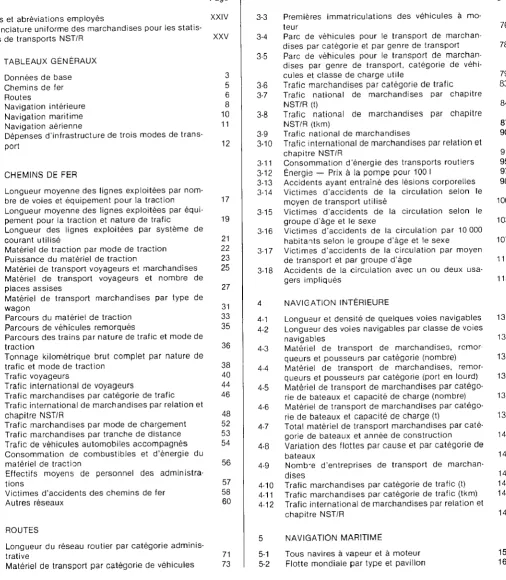
3
ROUTES
Page
XXIV
XXV
3
5
6
8
10
11
12
17
19
21
22
23
25
3-3
3-4
3-5
3-6
3-7
3-8
3-9
3-10
3-11
3-12
3-13
3-14
3-15
3-16
3-17
3-18
27
31
33
35
36
38
40
44
46
48
52
53
54
56
57
58
60
41
42
4-3
4-4
4-5
4-6
4-7
4-8
4-9
4-10
4-11
4-12
Premières immatriculations des véhicules à mo
teur
Parc de véhicules pour le transport de marchan
dises par catégorie et par genre de transport
Parc de véhicules pour le transport de marchan
dises par genre de transport, catégorie de véhi
cules et classe de charge utile
Trafic marchandises par catégorie de trafic
Trafic national de marchandises par chapitre
NST/R (t)
Trafic national de marchandises par chapitre
NST/R (tkm)
Trafic national de marchandises
Trafic international de marchandises par relation et
chapitre NST/R
Consommation d'énergie des transports routiers
Énergie — Prix à la pompe pour 100 I
Accidents ayant entraîné des lésions corporelles
Victimes d'accidents de la circulation selon le
moyen de transport utilisé
Victimes d'accidents de la circulation selon le
groupe d'âge et le sexe
Victimes d'accidents de la circulation par 10 000
habitants selon le groupe d'âge et le sexe
Victimes d'accidents de la circulation par moyen
de transport et par groupe d'âge
Accidents de la circulation avec un ou deux usa
gers impliqués
NAVIGATION INTÉRIEURE
Longueur et densité de quelques voies navigables
Longueur des voies navigables par classe de voies
navigables
Matériel de transport de marchandises, remor
queurs et pousseurs par catégorie (nombre)
Matériel de transport de marchandises, remor
queurs et pousseurs par catégorie (port en lourd)
Matériel de transport de marchandises par catégo
rie de bateaux et capacité de charge (nombre)
Matériel de transport de marchandises par catégo
rie de bateaux et capacité de charge (t)
Total matériel de transport marchandises par caté
gorie de bateaux et année de construction
Variation des flottes par cause et par catégorie de
bateaux
Nombe d'entreprises de transport de marchan
dises
Trafic marchandises par catégorie de trafic (t)
Trafic marchandises par catégorie de trafic (tkm)
Trafic international de marchandises par relation et
chapitre NST/R
NAVIGATION MARITIME
Page
76
78
79
83
84
87
90
91
95
97
98
100
103
107
111
115
131
133
135
136
137
139
141
142
146
147
148
[image:25.595.42.549.186.767.2]\
:
5-3
5-4
5-5
5-6
5-7
5-8
5-9
5-10
5-11
5-12
5-13
5-14
5-15
Flotte marchande
Flotte marchande par tranche de tonnage
Flotte marchande par groupe d'âge et par pays
Flotte marchande par type et par groupe d'âge
Chalutiers usine et bateaux de pêche par tranche
de tonnage et pavillon
Navires arrivés
Trafic international par pavillon
Importance relative des pavillons en trafic
inter-national
Trafic de marchandises
Produits pétroliers déchargés en trafic
internatio-nal
Trafic international de marchandises par pavillon
Trafic international de marchandises par chapitre
de la NST/R et par relation
Trafic national et international de marchandises
par relation et chapitre NST/R
162
163
165
167
168
169
170
178
180
181
163
202
220
5-16 Trafic par port
5-17 Trafic de grands conteneurs par port
6 NAVIGATION AÉRIENNE
Remarques
CONDUITES
7-1
7-2
7-3
224
230
237
241
Longueur de oléoducs
Transport de pétrole brut et de produits pétroliers
par catégorie de trafic (t)
242
Transport de pétrole brut et de produits pétroliers
par catégorie de trafic (tkm)
243
Liste des principales publications statistiques relatives
aux transports et communications
245
Signes et abréviations employés
donnée inférieure à la moitié de l'unité utilisée
néant, ou ne s'applique pas, ou donnée
non disponible
plus petit que
plus grand que
million
<
>
Mio
milliard
tonne métrique
unité de compte européenne
tonne de jauge brute
tonne de jauge nette
tonne-kilomètre
térajoule = 109 kilojoules
tonne-équivalent pétrole
Mrd
t
ECU
GRT/TJB
NRT/TJN
tkm
TJ
Nomenclature uniforme des marchandises
pour les statistiques des transports NST/R
La nomenclature uniforme des marchandises pour les
statistiques des transports, désignée par l'abréviation
NST, est entrée en application à la suite d'une
recomman-dation prise en 1961 par la Commission des
Communau-tés européennes.
La NST a été élaborée en étroite collaboration avec les
experts des États membres des Communautés
européen-nes et avec la Commission économique pour l'Europe des
Nations unies à Genève (CEE-ONU) ainsi qu'avec d'autres
organismes internationaux. Elle se trouve en parfaite
concordance avec la «classification des marchandises
pour les statistiques des transports en Europe» (CSTE),
établie par la CEE-ONU. Ce n'est que pour six positions
de base qu'un fractionnement supplémentaire a été
nécessaire pour répondre à certains besoins des
Commu-nautés.
Les codes employés furent modifiés en 1962 afin d'arrêter
les regroupements nécessaires pour la publication de
résultats condensés. Quatre années d'expérience
néces-sitèrent quelques légères modifications, qui furent mises
en vigueur au 1
e rjanvier 1967.
La nomenclature est depuis lors appelée NST/R et est
maintenant utilisée par les six États membres originaux
ainsi que par certains organismes internationaux dans
leurs publications relatives aux transports.
La NST/R se présente sous la forme d'une liste de 176
positions relatives à des marchandises regroupées autant
que possible selon leur nature, leur degré de
transforma-tion, leurs conditions de transport et le volume des
tonnages transportés.
Ces critères de classification ont été choisis en fonction
de l'intérêt que les marchandises présentent dans
l'éco-nomie des transports. Les positions particulières créées
pour les besoins du traité CECA sont désignées par
l'indication «(CECA)».
La structure analytique de la NST/R regroupe les 176
positions de la nomenclature en 10 chapitres et en 52
groupes suivant un code qui se présente comme suit:
1 chiffre pour les chapitres,
Structure analytique de la NST/R
(Révisée. Situation au 1e r janvier 1967)
0 PRODUITS AGRICOLES ET ANIMAUX VIVANTS
00 Animaux vivants
001 Animaux vivants
01
Céréales
011 Froment, épeautre, méteil
012 Orge
013 Seigle
014 Avoine
015 Maïs
016 Riz
019 Autres céréales n.d.a.
02 Pommes de terre
020 Pommes de terre
03 Autres légumes frais ou congelés et fruits frais
031 Agrumes
035 Autres fruits et noix, frais
039 Autres légumes frais, congelés
04 Matières textiles et déchets
041 Laine et autres poils d'origine animale
042 Coton
043 Fibres textiles artificielles ou synthétiques
045 Soie, lin, jute, chanvre et autres fibres textiles végétales
049 Chiffons, déchets des textiles
05 Bois et liège
051 Bois à papier, bois à pulpe
052 Bois de mines
055 Autres bois en grumes
056 Traverses en bois pour voies ferrées et autres bois équarris
ou sciés
057 Bois de chauffage, charbon de bois, déchets, liège brut et
déchets
06 Betteraves à sucre
060 Betteraves à sucre
09 Autres matières premières d'origine animale ou végétale
091 Peaux et pelleteries brutes, déchets
092 Caoutchouc, naturel et synthétique, brut ou régénéré
099 Matières premières et autres produits bruts, non
comesti-bles, d'origine animale ou végétale n.d.a.
132 Cacao et chocolat
133 Thé, maté, épices
134 Tabacs bruts et déchets
135 Tabacs manufacturés
136 Glucose, dextrose, autres sucres, confiserie, sucreries,
miel
139 Préparations alimentaires n.d.a.
14 Denrées alimentaires périssables ou semi-périssables et
conserves
141 Vainde fraîche, réfrigérée et congelée
142 Poissons, crustacés, mollusques, frais, congelés, séchés.
salés, fumés
143 Lait frais et crème fraîche
144 Beurre, fromage, autres produits laitiers
145 Margarine, saindoux, graisses alimentaires
146 Œufs
147 Viande séchée, salée, fumée, préparations et conserves de
viande
148 Préparations et conserves de poisson, crustacés ou
mol-lusques
16 Denrées alimentaires non périssables et houblon
161 Farines, semoules, gruaux de céréales
162 Malt
163 Autres produits à base de céréales
164 Fruits congelés, séchés ou déshydratés, préparations et
conserves de fruits
165 Légumes secs
166 Préparations et conserves à base de légumes
167 Houblon
17 Nourritures pour animaux et déchets alimentaires
171 Paille, foin, balles de céréales
172 Tourteaux et résidus de l'extraction des huiles végétales
179 Sons et issues, autres nourritures pour animaux n.d.a.,
déchets des industries alimentaires
18 Oléagineux
181 Graines oléagineuses, noix, amandes oléagineuses
182 Huiles et graisses d'origine animale ou végétale et produits
dérivés
2 COMBUSTIBLES MINÉRAUX SOLIDES
21 Houille
211 Houille (CECA)
213 Agglomérés de houille (CECA)
I DENREES ALIMENTAIRES ET FOURRAGES
I I Sucres
I I I
Sucre brut
112 Sucre raffiné
113 Mélasses
12
121
122
125
128
13
131
Boiss