COMMISSION OF THE EUROPEAN COMMUNITIES
SEC(91) 554 final Brusse Is, 2 Apr i I 1991
REPORT ON EIB OPERATIONS
1. EIB operations outside the COmmunity
A. Genera I framework ... 1
B. How the EIB operates outside the Community? ...•..•... 2
1. Individual authorlsatlons ... 2
2. Global authorisations ... 4
3. Participation In other Development Banks ... 6
c.
Historical analysls ...•... 611. Points to be taken Into account for consideration of future EIB operations outside the COmmunity A. The EIB, a Community Bank: ... 12
B. Financial aspects : capital, garantles ... 13
C. Administrative and Institutional aspects ... 14
I I I . Cone I us I ons . . . 1 5 Annex 1 FINANCING IN ACP COUNTRIES ... I Annex 2 FINANCING IN THE MEDITERRANEAN COUNTRIES ..•... vi Annex 3 FINANCING IN CENTRAL ANP EASTERN EUROPE ... VI II Annex 4 STATISTICS ... X
1
-INTRODUCTION
On (25 February 1991) the Ecofln Council decided to extend the Community guarantee for EIB operations In Poland and Hungary to operations In the CSFR, Bulgaria and Romania. The discussions In the Councl 1 revealed that It was considered desirable to have a general discussion about the EIB's role outside the Community. To this end, the Council made the following declaration:
The Council has noted the Commission's wll 1/ngness to prepare, In conjunction with the EIB, an overall report on the external role of the EIB and In particular on the possible extension of the Bank's activities to the various third countries or regions which do not yet
benefit from them and with which the Community has concluded co-operat /on agreements. This report will be submitted to the General Affairs and ECOFIN Councils In March 1991.
The Council undertakes to examine the report carefully, together with any suggestions It may receive either from the Commlsslo·n and the EIB or from the delegations.
The Council states that this decision In no way prejudges the future activities of the EIB In the various parts of the world.
The present report Is the follow-up to this reQuest from the Council to the Commission and has been drafted by the Commission services with close co-operation of the services of the EIB for the factual part of the text. However, the Board of Directors of the Bank not having had an opportunity to pronounce on this matter, the EIB .Is not yet In a position to comment on the conclusions of the report.
The report starts by considering the operations of the EIB outside the CommunIty thus far. In the second part some elements that shou I d be taken Into account In con~lderlng extension of these activities are discussed. The annexes provide more detal led Information about the different operations of the Bank outside the Community so far, as wei I as some useful statistical Information.
I. EIB OPERAJIONS OUTSIPE THE OQMMUNITY
A. General framework
Article 18 of the Statute of the European Investment Bank reads:
"(1) Within the framework of the task set out In Article 130 of this
Howavar. by way oi' cleroga~lon au~horlsad by ~ha Board oi' Govarnors, acting unanimously on a ~roposal from tha Soarol of DlrGctorm. tha Bank may grant loans for lnvastmant ~roJacts to ~a carrlaol ou~. In whola or In part. outside the Europaan ~arrltorles oi' Member Statas.~
-
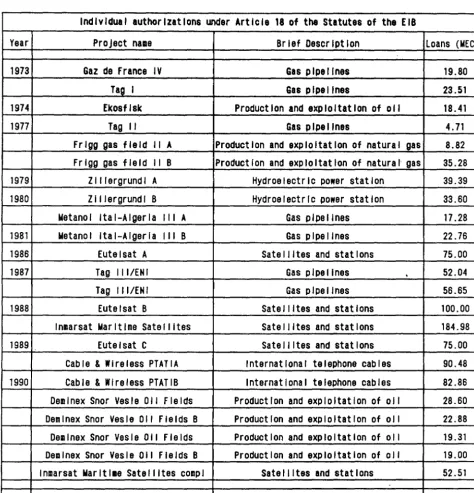
~-Table 1
Individual authorizations under Article 18 of the Statutes of the EIB
Year Project name Brief Description Loans (t.IECU
1973 Gaz de France IV Gas p lpe lines 19. 8{)
Tag I Gas pipelines 23.51
1974 Ekosflsk Production and exploitation of oil 18.41
1977 Tag II Gas pipelines 4.71
Frlgg gas field II A Production and exploitation of natural gas 8.82 Frlgg gas field II B Production and exploitation of natural· gas 35.28
1979 Z lllergrund I A Hydroelectric power station 39.39
1980 Zlllergrundl B Hydroelectric power station 33.60
Metanot ltai-Aigerla Ill A Gas pIpe II nes 17.28
1981 Metanol ltai-Aigerla Ill B Gas p lpe lines 22.76
1986 Eutelsat A Satellites and stations 75.00
1987 Tag Ill/EN I Gas p I pe I I nes
.
52.04Tag Ill/EN I Gas pIpe II nes 56.65
1988 Eutelsat B Satellites and stations 100.00
lnmarsat Maritime Satellites Satellites and stations 184.98
1989 Eutelsat C Satellites and stations 75.00
Cable & Wireless PTATIA International telephone cables 90.48
1990 Cable & Wireless PTATIB International telephone cables 82.86
Demlnex Snor Vesle 011 Fields Production and exploitation of oil 28.60
Demlnex Snor Vesle 011 Fields B Production and exploitation of oil 22.88
Demlnex Snor Vesle Oil Fields Production and exploitation of oil 19.31 Demlnex Snor Vesle 011 Fields B Production and exploitation of oil 19.00
lnmarsat Warltlle Satellites compl Satellites and stations 52.51
[image:5.558.37.512.94.587.2]The ~~~r~v ~rojecte ~are financed on the grounds of lm~rovln~ su~pl Iss to ~he European Community. !Examples of ~hesa arlll: the development of the Frlgg and IE~oflsk ~as fields and the Vaslafrl~~ ol I fllllld In the Norwegian sGc~or of ~he Nor~h sea. ~nd the construction of ~lpallnes In
Austrl~ and Tunisia ~ringing ~~tural gas suppll~s from th~ Soviet Union
and Algeria Into tha Community gas grid.
Projects sup~ortlng ~~n~£~no~s Include ~h~ purchase. launching and
o~aratlon of ne~ gen~ratlon satallltes ~Y IEUTELSAT (!European
Telecommunications Satelllt~ Organisation. ~arts) and INMARSAT (International Maritima Satel I Ita Organisation. london) and a Transatlantic optlcC~I fibre cable link batt:Jaan U1a Community and the United Sta~~s and thill Carlbbaan.
The common characteristics of these operations arG:
a. the maIn reason for them saems to ~ill that 'Haasa !)rejects sll provide a direct and clearly Identifiable economic benefit to the Coflll'i'lunlty. contrl~utlng to the rraallsatlon of Community policy obJectives
b. the projects tend to have a strong (~hysical) link with Community territory;
c. the ~rojects tend to be located on the perl~hery of the
CommunIty;
The scala of these operations Is Increasing; since 1988 the number of projects and the amounts I nvo I vad has r I san cons I darab I y : an annua I average of 36 Mecus during 1981-1983. mora than 225 Macus 1988-1990 (sea chart 1). Individual authorisations under Article 18 of sola Interest to European operators and which ara assimilated ~o o~aratlons In the Community are not considered any 1urther In this report.
The bulk of EIB operations outside the Coii'IMunlty ara basad on global authorisations by the Board of Governors. These ~:,~era given In response to specific Invitations from the Council of the EC ~o ~ha Ban~. In order to ~rovlda loans as part of Community cooperation ~lth third countries. Ment lon should also lbe rnada of those countr las (for example Greece, Portugal and S~aln) which received ~ra-adhaslon aid ~lth a view to their becoming member states of the Community.
Reasons to enable loan finance from the EIB are:
a> Loans are. usually but not always. a com~l~m9nt to other more concaS$Ionai forms of Community assistance an~ c~n lbe combined ~lth grant aid (which can take Ula form. for eump!e. o'l lnterl!:)st-rate subsidies);
b) Loans have a ~otentlally Important leverage ef~eet on Investment at normally I !mlted budget cost. even If thGY may create latent
I labll ltles on the budgets of Member States and/or the Community; c) Loan finance Imposes a certain discipline on the borrower,
5
-The five main characteristics of these operations are:
a. the authorisations are for set periods and amounts, which are generally laid down In agreements negotiated between the Community and Individual countries or groups of countrles<1>; b. as far as the EIB's own resources are concerned,- the amounts
foreseen (cell lngs) are for projects to be financed according to the EIB's normal lending criteria as defined In Its Statute; c. the Bank always benefits from a partial or full guarantee from
the Community or Its Member States;
d. the EIB loans (out of own resources> are generally part of packages which may also Include concesslonal funds drawn from the budgetary resources of the Community and the Member States;
e. because of c and d, each of these authorisations has Involved a specific Invitation from the Council to the Bank to make the
loans available.
Thus far, global authorisations have been given for EIB operations In the ACP countries, the Mediterranean countries and the Central and East European countries (see annexes 1, 2 and 3 for more detal Is).
The EIB loans to the (now 69) ACP countries and the Overseas countries and Territories find their origin In the Initial provisions made In 1958 (see Part Four of the Treaty and Annex ,IV to the Treaty), for the colonies and territories of Member States (Belgium, France, Italy and the Netherlands) mainly In Africa. As the colonies subseQuently became Independent, the provisions relating to EIB loans were adapted and over time extended to benefit more countries, culminating In the now relevant fourth Lome Convention. EIB finance Is only one part of Community assistance, the other being the resources from European Development Fund (EDF). The EIB acts also as agent for operations of a different nature carried out on behalf of the Community. Those operations are not discussed In this report. Under a five year protocol attached to the fourth Lome Convention, which comes Into force In 1991, the Bank Is to lend up to 1200 MECU from Its own resources and manage 825 MECU as risk capital In the 69 ACP countries. The Member States act as guarantor for the Bank. This guarantee Is restricted to 75% of the total amount of the credits opened by the Bank under alI the loans contracts; It applies to cover a II r lsks.
Tha loans to ~~ ~~O~Qrr@~Q~ countrlras (~36 MECU - 1990) ar~ also govrarnrad !by f I nanc I a I B')rotoco Is ~~ hlChi&d ~o cooper at I on or association agrGsrnente alma~ at fostering ciosa r~latlone ~et~aen the Ccmm!.mlty and thasa ntalgh~ourlng countriGs and ranhanclng raconomlc gro~th and B')OIItleal $ta~lllty. lhra COmmunl~y ~rovl~as thra EIS ~lth a lbl&m!cat guarantee of 75%. In thra cont~lit of ti11® draclslons h!can
concGrnlng ~hra r®n®~al o~ ~~@ agrraramen~~ ~~~~ ~h@SG countrl®s for the period 1e91-~99S It has lbraan ~ael~ed that t~@ ~~~ $houl~ ~ra able to lntrarvran!Sl ouhlde~ ~ha eontrant of th~ fliUlli"'CI!ili BJii"Otoc:ols. It ~Ill
c:onc~rn ~roJac:ts In ~hlch the Community ~~$ a common !ntrarrast(1) and raglonal ~rojacts ~hlc:h bGnGflt several c:ountrlras.
In tha light of tha racrant raconomlc and political r®constructlon of ~~~rQO Qli"'~ ~QS~~r~ ~~r@~~ an~ thra Community coopraratlon ~ol!cy ~lth thssa countr!as. tha Govarnors authorised thra ~ante to ffiS!cG loans (up to 1.700 MECU) avallabla ~o Poland. Hungary. ezrachosiova~la. ~omanla and Bulgaria, bac~ad by a iul I guaran~ae ~rom ~ha Communl~y ~udga~.
Al~hough ~hase loans are no~ Included In a qlnanclal Dro~ocol
iramawortc. they ara navar'theless closely lln!craol ~o the Communl~y·s
programma oi assistance ~o 'thass coun~rlas (Ph~r~).
In conclusion one can say thai£ 'iha EIB loans ~hleh are mada available under global authorisations. are ~ar" and parcal of a wider Communl~y development ~ollcy. Furthermore. 'tha loans given to projac~s In countries
pro~lmata to the EC (Mediterranean and Central ~urope). could be
considered to be of more dirac~ economic significance to tha Community.
A maJor Innovation Is 'the direct partlclpa~lon of tha EIB (and Indeed of
~he Community as such) In the share capital of tha newly created ~uropean
8ank for ~econstructlon and Development. Through this participation the Community can ensure Its prasenca and enhance the European character o1
this Bank and give expression to tha responslbl I lty It feels In an Indirect way.
7
-C. HISTORICAL ANALYSIS
1. An overview of the development of EIB operations (out of own resources) outside the Community as discussed In the preceding paragraphs Is given In the chart below and table 3.
EIB OPERATIONS OUTSIDE THE COWYUNITY out of own resources In mecu
Chart 1
Amount of loans out of own resources
I
Of
total
EIB
loans
1000
r---"--==··--==-=---=---- - - ,25
20
15
10
200
5
0
0
1960
1965
1970
1975
1980
1985
1990
Year
•
specltlc proJects
fZJ
Medl terranean
lml
ACP/OCT
~
Eastern Europe
~I
ot
total
EIB
loans
2. A few comments are appropriate on this development:
Greece.-b. of the total EIB loans given to projects In the Mediterranean, as at 31.12.1985, Greece, Spain and Portugal, before their respective accession to the Community (In 1981 and 1986), accounted for 58~;
c. so far, 66% of all the EIB operations out of own resources and under global authorizations (thus excluding the typical art.18 projects) In third countries have been of benefit to the Mediterranean countries;
d. the relative scale of EIB operations Cas~ of the total activity on own resources) outside the Community has fluctuated over the years; the wl Jd fluctuations In the 60s were mainly the result of the Bank's low overal I activity; In the 70s the relative Importance of these operatIons grew as the CommunIty· s cooperation with notably the Uedlterranean countries developed; finally, due to a large Increase In EIB operations within the Community, the relative weight has dropped over the last decade; e. the Importance of the specific EIB projects under Individual
authorizations Is Increasing, almost 80% of loans were signed since 1986;
f. In 1990 the fIrst loans were sIgned for projects In Eastern Europe (of which 120 MECU for Hungary and 95 MECU for Poland). The Chart below shows the relative Importance of operations outside EC-12 when adjustment Is made for EIB operations In the now Community members Spain, Portugal and Greece.
Chart 2
EIB operations outside the Community
on own resources
20
15
10
5
0~~~~~~-L~~J_~~~~~~~~~~~~
1960 1965 1970 1975 1980 1985 1990
Year
___. 'lo of total EIB loana --+-'lo of total EJB•
"Wllb.O'III Greece, lpCilD CIDd Port'IIGCil
9
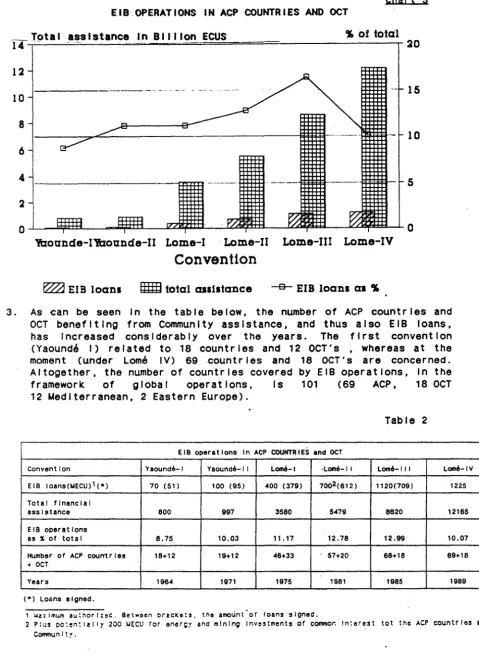
-chart 3
EIB.OPERATIONS IN ACP COUNTRIES AND OCT
___ Jotal assistance In Billion ECUS 14
ex.
of total12
10
8
6
4 .. ---1:1:1:~1---t:n-;t:.
r::tl--2
Yaoande-IYaounde-II Lome-I Lome-li Lome-III Lome-IV
Convention
~ EIB loans
!Rm
total assistance -a- EIB loans as 1ft20
15
10
5
3. As can be seen In the table below, the number of ACP countries and OCT benefiting from Community assistance, and thus also EIB loans, has Increased considerably over the years. The first convention (Yaounde I) related to 18 countries and 12 OCT's , whereas at the moment (under Lome IV) 69 countrIes and 18 OCT's are concerned. Altogether, the number of countries covered by EIB operations, In the framework of global operations, Is 101 (69 ACP, 18 OCT
12 Mediterranean, 2 Eastern Europe).
Table 2
EIB oporatlons In ACP COUNTRIES and OCT
Convontlon 'Yaounde- I Yaounde-It Lome- I _,Lome-It Lome-ttl Lome- IV
EIB loans(t.IECU)1(•) 70 (51) 100 (95) 400 (379) 7002(612) 1120(709) 1225
Total financial
asslstanco 800 997 3580 5479 8620 12165
EIB operations
as X of total 6.75 10.03 11.17 12.76 12.99 10.07
Numbor of ACP coun1r1es 18+12 19+12 46+33 57+20 66+18 69+18
+ OCT
Years 1964 1971 1975 1981 1985 1969
(•) Loans algned.
1 ~a:tmum au:nortz,c. Between br~cko:s. tno amount-of loans signed.
2 Plus po:enttetty 200 UECU for enercr and mining Investments of commor. ln:orest tot tho ACP countries and tile
[image:11.554.43.523.77.743.2]4. The geographical spreact of ~be EIB's ex~arnal operations - under global ~uthor lzat Ions - has followed the development policy of the EEC as wei 1 as political priorities. In the flr~t Yaounde convention, only the former African colonies of Belgium, Italy and France and the Dutch An~ II les were eligible for the EIB loans; In the Lome Conventions, when a maJority of the Commonwealth developing countries were Included (India and Pakistan were left.outalde) other countries of black Africa were also admitted. This eligibility was later on extended to other countries of the Pacific and the Caribbean Ocean. At the beginning of 1990, EIB's new external operations were targeted at Eastern Europe. When the Councl I decision (Febr. 1991) Is Implemented, Asia and Latin America wl II remain- within the LDC's-the main areas outside LDC's-the scope of Bank's activities.
With regard to the financial Instruments, the EIB, from Its own resources, only gives loans (conventional or global) In Its external activities. Those loans are associated with Interest rate subsidies for the use of ACP countries. As agent, the EIB carries out other kinds of financial operations, such as risk capital, both In the Mediterranean (excluding Yugoslavia, Turkey and Israel) and In several ACP countries. (See Chart 4 below).
Chart 4
EIB operations outside the Community ·
Special Section in MECU
Amount ol operat1o111
26B.---~---~260
200 200
160' -· --··. · - · . 160
100 100
1960 1966 1970 1975 19110 19115
Year
~ Medllerl'CIIlocm !mil N:.P/OCT
rl1:t CGPIIIII lllld apecllll 1DCI1ll
5. On ~he basis of the political decisions already h!cen (Lome IV; renewal of Mediterranean protocols; decisions concerning Central and Eastern Europe). It can be foreseen that during ~he g>srlod '91-'95
loans on own resources outside the Community as a percentage of total lending operatIons Inside tha Community could grow In Importance. From the present level of 5.2 % the relative share of thi2il 121lxtarnal operations vis-a-vis total lending could reach about S% In 1992 and
l. OWN RESOURCES
:-·-- !..OAMS OUTSIDE HiE COMMUNITY SiGNED BY THE EIB FROM 1959 TO 1990 (million ecu) ON THE BASIS OF GLOBAL AUTHORIZATIONS (UNDER ! (CONVENTIONS, PROTOCOLS OR PROGRAMMES) OR INDIViDUAL AUTHORIZATIONS OF THE BOARD OF GOVERNORS PURSUANT TO ARTICLE 18
ANNEE
I
EASTERtl MEDITER- of lihlch EUROPE RANEAN Greece ·Spain Portugal accession
{1) (2)
r
1959 1360I
19s1 1962I
1963 15.0 15.01964 8.0 8.0
1965 13.8 13.8
1966 18.5 18.5
1967 15.9 15.9
1968 1909 1970 1971 1972 1973
1974 25.0
1975 47.2 47.2
1976 90.0 90.0
1977 85.0 60.0
1978 83.0 55.0
1979 347.7 150.0
1980 247.0 171.0
1981 219.5 119.0
1982 288.0 185.0
1983 336.0 190.0
1984 531.6 220.0
1985 409.6 260.0
1988 205.8
1987 27.7
1988 391.0
1989 330.8
1990 215.0 336.5
TOTAL 215.0 4070.6 1616.4
(*)
(0) of which Hungary : ECU 120 ml II lon
of which Poland : ECU 95 ml II lon
OF THE STATUTE
of lfhlch AASM of which other APC-OCT Yaound~
countries 1
(3)
2.2 2.2
14.7 14.7
4.1 4.1
12.4 12.4
15.5 15.5
2.3 2.3
22.5 12.8 10.9
25.0 36.0
1.8
52.4
25.0 67.0
28.0 90.0
197.7 73.2
78.0 124.4
100.5 158.4
103.0 117.2
146.0 90.0
311.6 79.1
149.6 167.8
205.8 150.7
27.7 156.8
391.0 129.1
330.8 155.1
336.5 117.5
2454.2 1864.4 51.1
~ - - - ---~
of which of which of which of which INDIVIDUAL TOTAL
Yaound~ Lom~ Lom~ LOll~ AUTHORIZA- EXTERNAL 2 1 2 3 TION CLASSED LENDING
AS OPERAT. WITHIN THE COMMUNITY
: (**)( 4) (1) A (4)
15.0 8.0 16.0 31.2 20.0 12.4 15.5 2.3
22.5 22.5
12.8 12.8
10.9 43.3 54.2
36.0 18.4 79.5
1.8 48.9
10.9 41.5 142.4
67.0 48.8 200.8
90.9 173.9
73.2 39.4 460.3
124.4 50.9 422.3
158.4 22.8 400.7
117.2 605.2
90.0 426.0
79.1 610.7
167.8 577.4
150.7 75.0 431.5
.
156.8 108.7 293.1129.1 285.0 805.1
155.1 165.5 651.4
117.5 225.1 894.1
95.0 397.0 612.5 709.2 1082.8 7233.2
-(**)see annexed list.
TOTAL EIB ACTIVITY OWN RESOURCES 34.1 25.5 86.5 66.4 71.2 118.3 100.9 135.4 168.2 184.9 263.4 340.8 491.5 518.8
707.7 I _.
875.7 ~
966.5 1207.9 1542.8 2140.4 2702.1 3109.8 2901.7 3851.2 4669.5 5617.7 6218.1 7034.6 7151.6 9549.0 11992.5 13325.9
II. POINTS RELEVANT IN CONSIDERING EIB OPERATIONS OUTSIDE THE COWUNITY
When an sxtens ton o'i the E IB operat tons outs I de thtil EEC has to be considered, soma points should, as In the past, be borntil In mind. It Is necessary to take Into account, 11rstly, the roiG the Sank must play, according to the Treaty, within the EEC and secondly, the technical and 'ilnanclal constraints to which the EIB, as a credit Institution. Is subject. The financial constraints of the Community linked to the guarantees that would be necessary should also be taken Into consideration. Finally, certain elements of an administrative or
Institutional natura should also be considered. A. The EIB. a CommunitY Bank
The Bank's primary statutory rasponslbl llty Is to the financing of Investments within the Community. Article 130 of the Treaty of Rome cal Is on It to finance projects on Community territory to develop less developed regions; projects necessary to the progressive establishment of the common market; and projects of common Interest to sever a I Uember States.
The demand for EIB loans within the Community has grown very rapidly during the past few years and the prospects are for further substantial
Increases In demand to meet priority Community objectives:
In the field of regional development, which Is the Bank's main priority (nearly two-thirds of loans granted In 1990) the Bank wl II be called upon to play a growing rOle In support of the Community's commItment to economIc and soc I a I cohos I on. both a I ongs I de and In conjunction with the Community's Structural Funds.
the Bank Is already contributing substantially to the financing of environmental Investment (1.7 bl II ton ECU In 1989) and the needs are
Increasing rapidly.
the proper functioning of the Internal Uarkat will require massive Investments In transauropean communications natwor~s - major Infra-structure projects In the fields of transport, telecommunications and anergy. The Bank has been closely associated with the development of a Community strategy In this field In which It can be expected to play a leading financing r61a. It already has considerable experience (EUROTUNNEL Is the most vivid example);
13
-These four objec.t lves are at the centre of the Bank's agenda for the 1990s. They reflect key community Investment priorities In the framework of the completion of the Internal Market as well as the needs arising
from progress towards EMU as outlined In the Commission's document on EMU of 21.8.90 (SEC(90) 1659 final).
B. Financial aspects; capital. guarantees
The EIB Is a financial Institution whose credit rating and status In the financial markets depend on the soundness of Its financial structure and the efficiency of Its staff and Its operations. The Bank's triple A rating Is proof that Its financial soundness Is beyond doubt and should be guarded Jealously.
1. According to the EIB Statute, Its loan and guarantee activity may not exceed 2.5 times Its subscribed capital. For this reason, Its capital has been Increased several times, In the past, In proportion to the Increase In loan activity. Concerning Its paid-In capital, the Bank's reserves were, on the last occasion, used to back Its loan activity, but fresh capital from the Member States was also ca I I ed upon.
It Is obvious, therefore, that this statutory capital requirement Is the first point of a financial nature to be taken Into ac~ount for a decision on an extension, If substantial, of EIB loans outside the EEC.
2. The EIB requires guarantees for Its operations outside the Community. Up unt"ll now, these guarantees have been provided by either the Community or the Member States. If EIB operations outside the CommunIty were to be extended cons I derab I y. the guarantees to be provided by the Community budget might also have to be reconsidered. It Is evident that there are limits to the capacity of the General Budget to provide guarantees to the EIB. (The total of outstanding
loans guaranteed by the General Budget amounted to 10.6 bl II lon Ecu on 31.12.90). The financial position of several actual and potential beneficiary countries does not give the Impression that a guarantee for their llabl I ltles to the EIB would just be a pro forma obi lgatlon for the community budget.C1) In fact the Community Budget guarantee has a I ready been ca 1 I ed upon for an amount of more than 30 m I I I I on ECU for defaults on EIB loans In Syria and the Lebanon.
c.
Admlnlstratlya and lnstlty~lonal aspects1. A number of admlnlstrat lye conseguences have to be considered as well. In terms of number of staff. the Bank Is a relatively small Institution (with as a consequence a high turnovar per head). The Bank Is therefore not yet fully prepared to scrutinise and control directly a large number of promoters and projects. This Is already the case for operations within the Community and has led In the past to the creation of the global loan system.
This argument has also to be considered In the case of a new future development of Its operations outside the Convnunlty. Already, the costs. In terms of staff, of operations outside the EEC are higher than those within the EEC.
In order to overcome these problems, the EIB could, as Is normally the case. take advantage of existing local financial Intermediaries, when possible or necessary.
On the other hand, It Is obvious that such a problem would only become relevant If the Increase In that external activity was very substantial. The previous extensions of EIB loans did not create maJor problems In this field.
2. Finally, with regard to EIB policy In relation to other International financial Institutions, It should be noted that In general. with the exception of the lt.4F and the World Bank, International financial lnstltutlons<1> each focus on different regions In the world with their specific needs and circumstances. The obvious reason for this Is that they are thus able to attain the highest possible effectiveness and efficiency.
Politically It seems evident that the "European" mark of Community aid would be much more "visible" If. as It Is the case In the ACP countries. It were channelled through the EIB rather than through other International Institutions. t.4oreover. given the close relations between the EIB and other Community Institutions, the coherence of the European ass I stance m lght be better assured. But both the "European" mark and the coherence might be Improved by having a Community representation In e~latlng International
Institutions during the process towards EMU.
In any future extension of Its external activities. the EIB should ensure close cooperation and coordination with aulstlng International Institutions (the same question arises between the EBRD and the EIB In Eastern Europe).
15
-Ill. CONCLUSIONS .
1. The EIB, In Its external activities, Is both an Instrument for providing loan finance at favourable terms and a symbol of the Community's presence In the world. For this reason, It has been and will be the external and cooperation policy (In general) which the Community decides to develop In the years ahead which will largely determine the scale and the geographical spread of the Bank's activities outside the Community, In the light of past support and experience.
2. The first part of this report has shown that the EIB activity outside the Community has been guided by two major considerations :
the direct economic Interest of Community countries and the real lsatlon of Community pol Icy obJectives:
complementarity to other Community measures of cooperation with third countries.
In the first case, many of the Investments have been geographically c I ose or phys I ca I I y II nked to the terrI tory of the CommunIty. In the second case, hI stor 1 ca I and poI 1 t I ca I I Inks have had a major
Influence on the geographical spread of operations.
3. The second part of this report argues that certain points would, as In the past, have to be taken Into account If It were decIded to expand further EIB loans outside the Community.
(I) Considering the EIB's available resources, the proportion (In relation to the balance sheet total) of the EIB's non-CommunIty loans wIll depend on the I eve I of lendIng whIch will be needed for It to attain Its Intra-Community objectives. Nevertheless It should be noted that the current relative level of EIB external Interventions Is lower than In the past.
(II) The EIB Is a financial Institution, and as such, It Is subject to technical constraints, fixed In Its Statutes. A considerable expansion of Its external activity could have
Implications for Its capital base.
(IV) 'Vh~ qutae~lon of afflclancy i!llso has to bra consldarac:L The EIB Is well aqul~ped for l~s prasan~ ac~lvl~las. An extension of l~s geographical comml~rnen~ ~111 nraad adaptation
In ~he wor~lng methods and organisation.
(v) There Is already a network of very varied International cred I~ lnst I tut Ions. H1e prIme task oV whIch ! s to f lnance the development of third countrlras. Yhe relationship between the activities of the EIB and those of the other Institutions
In the field ~I I I have to be taken !~to consideration.
(VI) It Is always possible for the EIB using Its usual criteria to finance Investments on an ad hoc basis. outside the
·I
-Annex 1 1. FINANCING IN THE ACP COUNTRIES
Development cooperation between the Community and developing countr les, Involving the European Investment Bank, dates back to the first Yaounde Convention which came Into effect In 1964. Not counting the fourth Lome convention, which has been signed but has yet to be rat If I ed. there have been fIve convent Ions provIdIng grant aid and concessionary loans (Including risk capital managed by the E I B > from the European Deve I opment Fund ( EDF > as we I I as loans from the Bank's own resources (essentially .funds raised on the capital market> : Yaounde 1 (1963-1968) and Yaounde 11 (1969-1974). and Lome 1
c
1975-1979), Lome 11c
1980-1984), and Lome 111(1985-1990).
Each of these conventions was supplemented by a separate decision of the Councl I of the European Communities making development funds available for the Overseas Countries and Territories (up to and Including Lome I : Overseas Countries, Territories and Departments) with historical ties to EC Member States. The amounts below refer only to loans from the EIB's own resources and Include both the maximum of such loans laid down by the conventions and by the special Councl I decisions.
The Yaounde Conventions were signed by 18 African countries. The first Convention offered a financial package of ECU 800 ml I I lon of which up to ECU 50 ml II Jon In EIB loans (Official Journal N" L 93, 11 June 1964). A 3% Interest subsidy was available for these loans with a maturity of up to 25 years, to be paid out of the EDF.
The Second Yaounde Convention offered ECU 1 billion In financial assistance of which up to ECU 90 million In EIB loans (Official Journal N" L 282, 28 December 1970). for a maximum maturity of 25 years Interest rate subsidies were provided from EDF resources to reduce the Interest charged to the beneficiary to less than 3%, with the proviso that Interest on loans granted to Intermediary
Institutions for on-lending would not be below 2%.
Th~ S~cond lom~ conven~lon numbsr~d 57 01@nQ~orls~. Ccmmuni~Y ~lnanclal asslstanc~ lncr~asta~ to ECU 5.~9~ mill lon
or
~hlch up ~o IECU Q$85 million In EII?J loans (plus. !POten'Ually. IECU 200 million i'or «Jnaq~y and mining lnvastm~mh of 4::00t1il0i'l ln~ar@st to U1a ACPcountrlras and tha Community). The lnter~st ~ubsl~y ~rovlslons ~ere ~h® sams as for lom~ 1. ~h~ sol® lnvr<llstmai11h liliOt'J ~ttcluded '!'rom
lnt«Jr@st subsldlss being ~rojscts In ~~® oil ~actor (Official Journ{ill N" l 3&.17. 22 D~cGJmbrar 1980; for OCYs : OUiclal Journal N' l 361. 31 Dac~mber 1980).
The Thlr~ Lom6 Conv~ntlon. signed by 83 African. Carlbbaan and PCilclflc Statas. provides 'i'or ~ '(ohl of 8.600 rnll!lon ecus In financial asslstanc~ of ~hlch up to 1.100 mill h>n In EIB loans. lnter®st rate subsldl®s ar® the~ same al.i! for lome II (0Hicl2i!l Journal N' L 88. 31 March 1986; for OCTs O'i'flclal Journal N' l 175. 1 July 1986).
Thra fourth lema Convention was signed on 15 Decamb~r 1989 batw~ran ~he Member States and the European Community on one slda and on the
oth~r by the 86 African, Caribbean an~ ~aclflc (ACP) Stat~s which
ware el~na~orlras oi' ~ha previous Convantlon : th~sa werG Joln~d by
~wo newcomers, HaTti and ~he Dominican Rapubllc. ~rovlslon t'Jas also made for the accession oi' Namibia onee the country ~acame
Independent. While previous Conven~lons t'Jara concluded i'or five years. lome IV wl II cover a period of 10 years and Is ~ccompanled
by a 'i'lrst Financial Pro~ocol spannln~ ~ha ~lrst ~Iva years. It w1 II enter ln~o force as soon as ratli'lca~!on procedures have bean completed by the EEC coun~rles and two ~h!rds o'i' ~~a ACP States, probably In the second half of 1991; ~urlng the tr~nsltlonal period. operations continue under the i'ramswor!< and ~lti"iln the
a~reed financing cal I lngs o'i' the Third Lorn~ Convention.
Before looking at the broad lines of prospective EIB activity under Lome IV It might be useful to consider some oi' the basic background '!'acts about the EIB's role In the Implementation of the Community's development aid policy. The finance provided by the ~an~ Is of two
~!nels loans from own resources. essentially the proceeds of
borrowings on the capital markets. and risk capital drawn '!'rom the European Development Fund <EDF) financed by EEC Member Shtas' budgetary contributions.
Loans from the Bank's own resources ar@ ~sad ~rlnclpally for financing viable projects In countries whose economic and financial situation Is such that they can shoulder tha debt Involved and ensure that service payments are maintained. Unciler Lome !V all loans from the EIB's own resources will attract an lntsrast rata subsidy from the grant aid laid down under the Convantlo~.
Ill
-are raised on the International capital markets, and provide an opportunity to fund operations which It would be Inappropriate to finance from borrowed funds. They give tha Bank gr0ater flexlbll lty In Its f Inane lng operatIons as they are often ut Ill sed a longs I de loans from the Bank's own resources for different components of a project's financing plan so that the overall terms and conditions are more favourable and thus better suited to Investment In the ACP environment. This type of assistance has gone from strength to strength with each successive convention, the amounts set aside for such operations having been Increased and the terms and conditions developed and fine-tuned. Risk capital may be deployed either for funding equity participations or as quasi-capital. Acting In the name of the Community, the EIB may subscribe equity In the capital of companies or development banks In the ACP countries. The holding must be a minority, acquired on a temporary basis for sale at the appropriate time, preferably to nationals of, or Institutions based In the ACP countries In question. Quasi-capital may take the form either of subordinated loans, repayment of which Is subject to the prior fulfilment of other debt obi lgatlons, or, more frequently, of conditional loans, whose terms of repayment and Interest rates are linked to the extent to which financial or technical targets agreed during negotiations of the loan are achieved. Risk capital may also be used for financing feaslbll lty studies and, In some cases, other pre-Investment or start up expenditure.
There Is a clear division of responslbl I lty between the two Institutions that administer Community aid, the European Commission and the EIB. It Is the Bank that has primary responsibility for financing long-term Investment projects In the Industrial sector ( Inc I ud I ng agro-1 ndust rIa I ventures), mIn I ng, tourIsm and energy schemes. Revenue-generating Infrastructure projects such as ports, telecommunications and water supply, are also eligible for EIB financing.
In the Industrial sector the EIB provides Individual loans for larger projects and finances small and medium-sized ventures Indirectly through global loans to development banks or other financial lntermedlalrles. The choice and appraisal of projects to be financed Is handled by the Intermediaries but the EIB has to approve each allocation on the basis of detailed documents provided by them. In many ACP countries the development banks are the sole Institutions providing long-term finance and foreign exchange for project Investment.
admlnl~~sr~d by ~h~ Coffifflllllslon ~~II ~e ~o~-r~lrn~urma~l~. For loans </rom rllll~ eapl~al. ~ha ra~~ of ln~~r~s~ ohoul~ ~@ l~o® ~~an 3%
~:.~IlliG provision h&s baen BiiCild® for 1ihG eucl'llangGJ riB!c teo toe shared
~et~:JG~n ~ha Community and tha o~h~r partiGs co~c~r~Gd. 1hG ln~ar~s~ ratG subel dy for loans fr~ tha ~an!c 'o o~n rGJ®O&Arealll &las foGJen
I ncrsas~Sd froo 3% under 1L001th Ill ~o ~% unclif81r ~h® n'll®I:J Co11want I on.
~utharrnora the COnvention lll~lpulatGJs ~hat ~h~ nn~~rGs~ ra~@ ~orne
roy ~he ~orro~ar shoul~ no~ ~orrnally ro~ IGss ~~an~% or ~r@ ~han 6% (comparad ~:JI~h ~%to 8% under lorn~ II!). 1~00 fln11anca ~:Jiii ~hus lOa on more concsS~Illl onar y terms. For ~he <I I rllli'( f I VG );f@ar ~rc~oco I of
~ha n~S~ Convention ECU 280 million from ~he ~Df havG ~san @armar~~d for lntarast ra~® subsldlas.
The ~an!c wll I again partlclpat® ~:JI~h tha Commission In the
[Orogrammlng axGrclse. charactrsrlead blf l9l OJ!&liOeJU® ~:JIUI tth~ ACP Stat~$ on th~Sir drsvalopms~t obJsctlvGs ~nd ~r!orlttl®s, a~~ ~eslensd ~o &Jchlavs the optimal utilisation oi' the fln~ncl~e~l rGeourcas of the Convention. As shown In the tabla ~slow ttha ~agree of concasslonal lty of the resourcas administered by tha EIB has lncraasad over time, due to the growing proportions oi' risk capital.
LO!.iE I LOME II LOME Ill LO~E IV(O)
(o ecu)(~) (c ecu)(~) (o ecu)(Z) (q ecu)(~)
O~:~n resources 390 80 685 71 100 65 1 200 59
Rlsl< capital 96 20 274 29 600 35 825 41
Total loan assistance 486 100 959 100 1 700 100 2 025 100
Furthermore under Lome IV the concasslonal lty has ~een Increased by a higher Interest subsidy.
In order to respond to the economic and i'lnanclal crisis besetting numerous ACP States, funds for structural adjustment support admlnlstarsd by the Commission have bean Included In the new Convention, In order to complement long-term ~avalopmsnt measures. Futharmore. the Convention ~lac0s greater ~mphasls on the private sector and Its role In promoting the growth and dlver$lflcatlon of the ACP States' economies.
Bullollng on past exparlance, the Fourth Lom~ Corwantlon entrusts the Ban!c with largely the same spheres of ~ctlvlty and emphasises not only new projec~ financing, ~ut rahabl lltatlon
v
-schemes as wei I. The Convention underscores the need for restoring the capacity of economically viable enterprises and for maintaining productive assets. As part of the focus on the private sector and smal I and medium-sized enterprises, restructuring and rehabl I ltatlng of ACP development finance Institutions, which have been adversely affected by the economic difficulties experienced by many ACP countries and particularly by large fluctuations In exchange rates, Is foreseen.
As stated above, productive projects and programmes In Industry, agricultural processing, tourism, mining, energy and - where they are reI a ted to the aforement loned sectors - water, transport and telecommunications Infrastructures will continue to be financed first and foremost through loans from the EIB. However, to ensure that a substantial portion of risk capital Is devoted to Investment In the private sector and especially to supporting smal I and medium-sized enterprises (SMEs), the scope for applying this already highly flexible Instrument has been broadened stl II further and for the first time, the EIB may use European development finance Institutions as Intermediaries for channelling assistance to SMEs In the ACP countries.
In conclusion, the Fourth Lom~ Convention largely confirms the thrust of the previous Conventions and impl les no major changes as far as the European Investment Bank Is concerned. Nevertheless, It Is significant that under Lom~ IV, the EIB wl I I be the sole Community Institution providing reimbursable finance. Under the new Convention the EIB faces challenges that will require an Imaginative response and a particular mix of financial assistance to satisfy a much more varied range of proJect proposals from the ACP states, many of which wish to accord greater Importance to the
role of the private sector In their economies.
Annex 2
FINANCJNG IN THE MfQITEBBANEAN CQUNIBIE$
EIB lending In thlm area hllces !)l~ce In ~ha 1ramaworlc of financial protocols, ~hlch normally run for five yaare, and 1orm ~art of
CooDer~tlon or Association Agreements ~at~~en ~ha ~uropean Community and the countrl0s concernelcL Financial eoog>araHon eomprl5les loans from th~a IEIB'm ot'.fn resources ae t'.fell as from COfflmunl'\cy risk capital resources (managed ~Y the IEIB) &~nell, I~ most casas, gr&~n~ &~!d. In the past loans on special conditions (mana9ad ~Y thG lEI~ or the Commission) welra also a feature.
Agreamsnh In which loan ii'lruilnca Is supplema~taol ~Y @rcant &~lc!l have
~san concludsd ~:Jitl'l nina of the twelve MaCili~Grran@arn countries In which the Banlc opsrates : the MatiJhrra~ coLmtrlreH~ (Pdearla, l'Jlorocco, TunIs I a) • the Mashrsca (Egypt. Jordan. La~anon. Syr I a) , Cyprus and
Malta. ~hen negotiating ths protocols, thssa nina countries can choose to usa g:>art of tha {ilrant aid for Interest subslc!las on EIB loans. Grant aid has not ~aen envisaged for Israel and Yugoslavia and, In the cass of Turlcey, only ths last protocol, ~:Jhlch negotiated In the early sight Iss ~ut has not yat i:>ssn signed, malces grant aid av~llabla.
ConseQuently, a decision on how the {ilrcmt aid will be used has not baen talcen. In thoss casas where Interest suB>®Iolles reoulcll ~nd have
~ean optsd for. thsy are specified In thG l!)r©tocol. At 'fllmas. the protocols have lndlcatsd that lnvsstment In the oil e~&ctor Is not
el lgl~le for such su~sldles. (References to the Official Journal only
relats to the last protocols signed.)
The Maghreb
There havs ~esn three successIve protoco Is wIth each of the Maghrsb countries sines 1978, the ones now In force covering the years 1988 to
1991. In the case of Algeria they provided for a total of IECU 360
ml I I lon In loans. The first two protocols foresaw 2% Interest subsIdIes. A I gar I a dec I dsd not to usa the subsIdy opt I on under the prasant protocol (Official Journal N" L 22, 27 January 1988). For Morocco the protocols have provldsd for loans total 1 lng ECU 297
million. Under ths first t~o protocols 2% Interest subsidies ware avallabls; the prassnt protocol does not Include subsidies (Official Journal N" L 224, 13 August 1988). The protocols for Tunisia hava provided for a total of ECU 250 mil 1 lon In loans. All three protocols Include 2% Interest subsidies (Official Journal N" L 22, 27 January
1988).
The Masb.ul.g
yll
-provided for a total of ECU 118 million In .Joans. In all three protoccols 2% Interest subsidies were specified (same. Official Journal). For Lebanon three financial protocols and two emergency aid packages have provIded a tot a I of ECU 177 mIll Jon In loans (same Official Journal). No grant aid was available In the emergency aid packages and only the first financial protocol (1978-1981) Included 2% Interest subsidies. In the case of Syria, two protocols provided for a loan total of ECU 98 ml Ilion between 1978 and 1986. The first protocol specified a 2% Interest subsidy, the second 3% (Official Journal
N" L 337, 29 November 1982). Negotiations on a third protocol have
been suspended.
Financial cooperation between Cyprus and the EC Is laid down In three protocols providing for loans totalling ECU 92 mill lon over the years 1979 to 1993. The first and the second protocols specified Interest subs Idles of 2% max I mum; the thIrd protoco I, now In force, Inc Judas subsidies of 1.5%. (Official Journal N" C 53, 5 March 1989.)
Ann§J 3
FINANCING IN CENTRAL ANP EASTERN EUROPE LENDING IN POLAND AND HUNGARY
On 9 October 1989, the Council of the European COmmunities Invited the European Investment Bank to Initiate the necessary procedures for the financing of Investment projects In Poland and Hungary In accordance wl th Its norma I I end lng crIterIa. ThIs request followed on from the decision taken by the Council on 3 October to Implement a Community programme designed to assist those countries In establishing market-oriented economies.
On 29 November, the EIB's Board of Governors approved lending of up to ECU 1 billion for such projects In these two countries under Article
18 of the EIB's Statute which a! lows the Governors, acting unanimously on a proposal from the Board of Directors, to authorise the Bank to grant loans for projects outside the Community. On 12 February 1990,
the Council decided to provide a full guarantee under the General Budget of the European Communities In respect of loans made aval lable by the EIB In Poland and Hungary.
Contacts already establ !shed with the International Monetary Fund, the World Bank and the Commission of the European Communlt)es should ensure rapid Implementation of Initial operations In the Infrastructure sector In support of co-ordinated projects complying with the commitments entered Into by both countries In relation to the
!ME.
The European Investment Bank has begun operations In Poland and Hungary with loans to help modernise Hungarian electricity distribution and the Polish railways. A ECU 15 million loan has been advanced to the Hungarian Electric Works Trust (Magyar VI I lamos Muvek Troszt) to modernise loan management facll ltles and Introduce a ripple control system for the national grid. A second loan may be advanced for a further phase of the scheme to bring EIB finance to ECU 35 million.
The Investment enables a more rational use of energy and will be of benefit to the environment by allowing the retirement of obsolete and polluting generating plant and the more efficient Yss of remaining capacity.
Part of the loan Is also for a feasibility study on the benefits of lntGrconnectlng the Hungarian and West European power grids to Improve efficiency, security and stability of suppllas and an6rgy Gnchanges. The power sector supplies 30% of ~ungary's anergy re~ulrements, g,laylng an Important role In the content of thG country's
- IX
-The first phase of a programme to modernise the Polish State railway (PKP - Polskle Koleje Panstwowe) Is being supported with ECU 20 ml II lon. The EIB's funds go towards three electric locomotive workshops at Mlnstc Mazowleckl near Warsaw, Olenlca near Wroclaw and Gllwlce near Katowice, and a railway wagon repair shop at Bydgoszcz. Repair of col llery wagons will also benefit the environment by reducing substantial losses of coal dust from wagons and contamination of track during coal haulage.
The Pol Ish economy Is particularly heavl ly dependent on the ral lways, which form the backbone of the transport sector, with a high demand for freight, especially from the heavy manufacturing and mining Industries. The railways carry about 70X (some 120 bll lion ton-kilometres) of the country's freight and about 1 billion passengers (30% of total passenger traffic) a year. The PKP transports approximately as much freight as the French and German ral lways combined. Restructuring and Improvement of PKP wl I I yield significant economic benefits.
Having laid the basis of a framework for future activity and established the necessary relationships and contacts with Interested public and private sector enterprises, the EIB expects shortly to final lse other loans for Investment projects In the two countries. The orientation of Its lending wl I I be In the priority areas of.energy and communications as wei I as for private sector Initiatives, particularly joint-ventures with EC companies. Emphasis Is being given to Investment that helps to Improve and protect the environment. Possible projects In the plpel lne In both countries Include telecommunications schemes, oil and gas development, the promotion of small and medium-sized private sector Industry ventures through global loans to be
Implemented In cooperation with Pol Ish and Hungarian financial Intermediaries, as well as the financing of larger Industrial Investment.
partlcloatlon In the Eurooean Bank for Reconstruction and Deyelooment Under the consensus reached In Apr II 1990 on establishment of the EBRD, the EIB as well as the European Economic Community are founder members of this Institution; the EIB has subscribed 3% of the EBRD's capital and appoints one Director and one Alternate. There are also plans for the EIB to provide specific assistance for the EBRD to start
Its operatIons.
The Agreement establishing the EBRD will have to be ratified by the participant States, whl lethe EIB's participation wl II be covered by a decision of Its Board of Governors.
OPerations In the former German pemocratlc Beoubllc
Financing provided outside the Community In 1989
(million .cus)
S.ctor
Industry, Agriculture, Services
EIB own Budgetary Intra- lndividutll Global
Total resources resources Energy structure 1011na loans
Mediterranean 342.8 330.8 12.0 97.3 168.5 28.0 49.0
Algeria 73.0 73.0 73.0
Morocco 39.0 30.0 9.0 30.0 9.0
Tunisia 17.0 17.0 17.0
Egypt 130.3 127.3 3.0 67.3 35.0 28.0
Jordan 2.5 2.5 2.5
Israel 23.0 23.0 23.0
Yugoslavia 58.0 58.0 58.0
ACP-OCT 269.1 155.1 114.0 10.0 104.8 101.6 52.7
Africa 193.4 97.5 95.9 10.0 71.3 100.9 112
Caribbean 44.4 31.0 13.4 17.5 0.4 26.5
Pacific 21.3 21.0 0.3 13.0 0.3 8.0
OCT 10.0 5.6 4.4 3.0 7.0
Total 611.9 485.9 126.0 107.3 273.3 129.6 101.7
Amounts of Community financial aid provided for In conventions, financial and decisions In force or under negotiation at 1 May 1990 protocols
(milhon ecus)
Operations mounted from budgetary resources
Loans from Risk Loans on
own capital Grant special
Agreement Ourallon resources ( •) operations (2) Bid (3) conditions To tat
Mediterranean Countries
Yugoslavia Second Fananc••• Protocol 1988-1991 550 550
Turkey Fourtn Fananoal Protocol await.ng ••ona1ure 225 50 325(2) 600
Algeria 183 4 52 239
Morocco Tntrd Financial Protocots 1988-1991 151 11 162
324
Tunisia 131 6 87 224
Egypt 249 11 189 449
Jordan Third F•nanc:&al Prolocola 1988-1991 63 2 35
100
Lebenon 53 19 73
Israel Tturd F1nanoa1 Protocol 1988-1991 63 63
Malta Thud Financeal Protocol 1988-1993 23 2.5 12.5 38
Cyprus Tlmd Fonanclal Protocol 1988-1993 44 5 13 62
Lebanon EAQ~pbonmt Aid 50 50
ACP Statn-OCT
ACP Third L.om6 Convention (1
) 1986-1990 1 100 600 4860 600(4) 7160
Fourth LomO Convantoon (') 1990-1995
1 200 825 9975 12000
OCT Counol Ooc&;~aon 198&-1990 20 15 55 . 25 (4) 115
Counc•l OocuUon
1990-1995 25 140 165
(1) Loans anracting interest subsidies from the European Davolopment Fund in tho caso of projocts in tho ACP States and the OCT and from the Genoral Budget ol the Europoan Communitias in tha C<Jse ol prOjEJCts in cortain Mad1terronoan countrios. Amounts roQuirod lor interost subsidoes oro linanced lrom
grant 01d.
(2) Fonancong granted and managed by the Bank.
(3) Aid granted and managed by the Commossion.
(4) Loans granted and managed by the Commission.
(5) Excluding transfers from STABEX. tho lund for the stabilisation ol export earnings for the ACP Stoles and the OCT. and fro;, SYSMIN. the special hnancong tacility tor monong products in tho ACP States; financong granted by tha Commission.
xi
-FOURTH LOME CONVENTION: FINANCIAL PROTOCOL 1991-1995
.tlt12!12gmy the Commission of the European Communities: (from EDF resources)
Grants
(million ecus)
7715
of which -grants for national and regional programmes -structural adiustment
- emergency/refugee aid
STAB EX (grants for the stabilisation o.f export earnings) SYSMIN (grants for special financing facility
for mining products) TOTAL
Mgngg~y~
loans from the EIB's own resources (ceiling amount) . Risk capital from EDF resources
Interest subsidies from EDF resources Total
GRAND TOTAl
6215 1150 350
1500
480
1200
825 280
9695
2305 12000
Tolal Lome 1 + 11 Lome 111 Total Lomol+ll Lome 111 Total Lome 1 + 11 Lome 111
AFRICA 2 059.04 1135.24 922.8 1259.6 1112.5 M7.1 199.4-oe 323.74 475.7
West Africa 833.5 461.2 372.3 534.7 348.6 186.1 298.8 112.6 186.2
Nigeria 208.0 90.0 118.0 208.0 90.0 118.0
COte-d'lvoire 145.1 104.0 41.1 139.7 98.6 41.1 5.4 5.4
Ghana . 71.3 34.3 37.0 33.0 16.0 17.0 38.3 18.3 20.0
Senegal 70.5 46.7 23.8 33.0 33.0 37.5 13.7 23.8
Regional 49.8 16.8 33.0 15.0 5.0 10.0 34.8 11.8 23.0
Mauritania 48.5 32.0 16.5 25.0 25.0 23.5 7.0 16.5
Togo 37.8 28.5 9.3 20.7 20.7 17.1 7.8 9.3
Guinea 37.7 15.1 22.6 11.9 11.9 25.8 3.2 22.6
Burkina Faso 33.7 23.2 10.5 8.0 8.0 25.7 152 10.5
Benin 31.8 18.3 13.5 13.5 13.5 . 18.3 4.8 13.5
Niger 31.2 16.9 14.3 16.0 16.0 152 0.9 14.3
Mali 30.3 9.8 20.5 30.3 9.8 20.5
Liberia 14.0 14.0 10.9 10.9 3.1 3.1
Cape Verde 8.4 5.4 3.0 8.4 5.4 3.0
The Gambia 8.1 2.4 5.7 8.1 2.4 5.7
Guinea-Bissau 7.3 3.8 3.5 7.3 3.8 3.5
Central & Equatorial Africa . 390.54 260.54 130.0 246.0 191.0 55.0 144.54 69.54 75.0
Cameroon 133.3 133.3 128.3 128.3 5.0 5.0
Zaire 76.2 26.2 50.0 50.0 50.0 262 26.2
Congo 57.9 31.9 26.0 28.1 28.1 29.8 3.8 26.0
Gabon 34.5 34.5 32.0 32.0 2.5 2.5
Burundi 20.7 8.7 12.0 20.7 8.7 12.0
Chad 17.7 9.5 8.2 17.7 9.5 8.2
Rwanda 17.7 5.7 t2.0 17.7 5.7 12.0
Central African Republic 15.1 5.1 10.0 15.1 5.1 10.0
Regional 9.3 3.6 5.7 7.6 2.6 5.0 1.7 1.0 0.7
Equatorial Guinea 6.0 2.0 4.0 6.0 2.0 4.0
Sao Tome and Principe 2.14 0.04 2.1 2.14 0.04 2.1
East Afnca 359.1 182.7 176.4 179.4 102.9 76.5 179.7 79.8 99.9
Kenya 177.4 100.9 76.5 166.9 97.9 69.0 10.5 3.0 7.5
Ethiopia 44.0 13.0 31.0 44.0 13.0 31.0
Tanzania 42.2 23.7 18.5 5.0 5.0 37.2 187 18.5
The Sudan 38.5 16.5 22.0 38.5 16.5 22.0
Somalia 25.2 9.8 15.4 25.2 9.8 15.4
Uganda 12.3 10.3 2.0 12.3 10.3 2.0
Seychelles 7.6 4.6 3.0 1.5 1.5 6.1 4.6 1.5.
Regional 6.5 0.5 6.0 6.0 6.0 0.5 0.5
Djibouti 5.4 3.4 2.0 5.4 3.4 2.0
Southern Africa 460.9 231.8 229.1 299.5 170.0 129.5 161.4 61.8 99.6
Zimbabwe 102.4 40.4 62.0 97.0 35.0 62.0 5.4 5.4
Zambia 70.6 47.4 23.2 42.0 42.0 28.6 5.4 232
Botswana 66.3 37.3 29.0 59.5 35.5 24.0 6.8 1.8 5.0
Malawi 60.5 39.0 21.5 31.5 22.0 9.5 29.0 17.0 12.0
Mauritius 51.5 17.0 34.5 44.5 16.5 28.0 7.0 0.5 6.5
Madagascar . 48.6 24.2 24.4 48.6 24.2 24.4
Swaziland 33.2 20.2 13.0 25.0 19.0 6.0 62 1.2 7.0
Lesotho 12.6 6.1 6.5 12.6 6.1 6.5
Mozambique 9.0 9.0 9.0. 9.0
Angola 4.0 4.0 4.0 4.0
Comoros . 2.2 0.2 2.0 22 02 2.0
Multiregional project 15.0 15.0 15.0 15.0
CARIBBEAN 196.6 92.9 103.7 143.5 68.1 75.4 53.1 24.8 28.3
Trinidad and Tobago . 56.9 42.0 14.9 54.0 42.0 12.0 2.9 2.9
Jamaica 40.3 9.0 31.3 35.3 4.0 31.3 5.0 5.0
Barbados 21.1 17.1 4.0 20.1 17.1 3.0 1.0 1.0
Bahamas . 17.7 0.1 17.6 17.6 17.6 0.1 0.1
Guyana 112 7.2 4.0 112 72 4.0
Saint Lucia 9.2 1.2 8.0 6.0 6.0 32 1.2 2.0
St Vincent & Grenadines 8.8 3.0 5.8 3.0 3.0 5.8 3.0 2.8
Suriname . 7.3 4.3 3.0 7.3 4.3 3.0
Belize 6.1 2.6 3.5 4.5 2.0 2.5 1.6 0.6 1.0
Grenada 52 2.4 2.8 52 2.4 2.8
Regional . 5.0 3.0 2.0 3.0 3.0 2.0 2.0
Dominica . 4.8 1.0 3.8 4.8 1.0 3.8
St Christopher & Nevis 1.5 1.5 1.5 1.5
Antigua 1.5 1.5 1.5
PACIFIC 203.7 139.7 64.0 160.4 106.9 53.5 43.3 32.8 10.5
Papua New Guinea 103.1 70.6 32.5 83.9 54.9 29.0 192 15.7 3.5
Fiji 83.5 60.0 23.5 74.5 52.0 22.5 9.0 8.0 1.0
Western Samoa 7.5 3.3 4.2 7.5 3.3 42
Tonga 6.1 2.3 3.8 2.0 2.0 4.1 2.3 1.8
Vanuatu 3.0 3.0 3.0 3.0
Kiribati 0.2 0.2 0.2 0.2
Solomon Islands 0.2 0.2 02 0.2
Tuvalu . 0.1 0.1 0.1 0.1
Totm: :ACP Stat~tl' ... ;:::J • .
2459.34 13S8.84 1 OOD.S 15aa.S m.s S7G.O 005.1!4 38U4 514.5
Geographical. breakdown (cont'd)
.:.... ··x·l.l
r
(m•lhon ecus) Total ftnanctng From E IS own resources · .from budgele:ry resol.tfces Total Lome I+ II Lome Ill Total Lome 1 + 11 Lome 111 To tat Lome 1 + 11 Lome 111
OCT 55.7 30.1 25.6 37.7 22.0 15.7 18.0 8.1 9.9
Frencll Polynesia 16.3 6.3 10.0 11.0 4.0 7.0 5.3 2.3 3.0
Netherlands Anttlles 15.6 9.5 6.1 12.8 7.1 5.7 2.8 2.4 0.4
New Caledonia 11.0 8.0 3.0 7.0 7.0 4.0 1.0 3.0
British Virgin Islands 4.0 4.0 3.0 3.0 1.0 1.0
Cayman Islands 3.0 3.0 3.0 3.0
Anguilla 1.5 1.5 1.5 1.5
Montserrat 1.2 1.2 0.9 0.9 0.3 0.3
Regional - West Indies 1.0 1.0 1.0 1.0
St Christopher & Nevis 1.0 1.0 1.0 1.0
Aruba 1.0 1.0 1.0 1.0
Falkland Islands 0.1 0.1 0.1 0.1
Orand Total 2 515.0 1398.2 1118.1 1 601.2 1009.5 591.7 913.8 389.4 524.4
Certain countries figure under both ACP-Canbbean and OCT, as their status has changad dunng the period coverad.
ACP States and OCT from 1976 to 1989
Financing provided and allocations from ongoing global loans
Lome 111 Lome I + II F1nanc1ng GtoDal toan Ftnanc•ng GtoDal loan operations allocat•ons operauons allocations
m•ll•on Number m111ton m&lllon Number million
ecus 'to ecus ecus % ecus
Energy 204.8 18.3 1 0.3 378.5 27.1 7 3.8
Production 93.0· 8.3 1 0.3 309.5 22.1 6 3.2
Conventional thermal power stations 46.6 4.2 98.1 7.0 3 1.8
Hydroelectric power stations 46.4 4.2 0.3 169.9 1?.1 2 0.3
Geothermal power stations 9.0 0.6
Oil and natural gas deposits 32.5 2.3 1.0
Transmission end supply 111.8 10.0 69.0 4.9 0.6
Electricity 98.8 8.9 69.0 4.9
Oil 13.0 1.2 0.6
Infrastructure 293.5 26.3 0.1 121.9 8.7 2 1.6
Transport 62.7 5.6 1 0.1 27.2 1.9 0.6
Railways 10.0 0.7
Shipping 46.2 4.1 0.1 17.2 1.2 0.6
Airlines 16.5 1.5
Telecommunications 95.4 8.5 63.1 4.5 1.0
Water catchment, treatment, supply 135.4 12.1 31.6 2.3
Industry, agriculture, services 617.8 55.4 181 49.1 898.5 64.2 581 234.1
Industry . 389.4 34.9 114 31.4 564.7 40.4 .458 199.5
Mining and quarrying 94.0 8.4 4 0.4 149.7 10.7 13 8.1
Metal production and semi-processing 13.0 1.2 31.5 2.3 9 4.0
Construction materials 13.6 1.2 9 1.7 59.3 4.2 17 8.4
Woodworking 4.5 0.4 6 2.5 25.2 1.8 36 12.9
Glass and ceramics . 4.0 0.3 11 6.6
Chemicals 12.3 1.1 8 1.4 54.5 3.9 28 17.3
Metalworking and mechanical engineering 18 2.5 0.5 30 10.3
Transport equipment 8 1.6 7.3 0.5 14 5.7
Electrical engineering. electronics 4 0.6 12 5.6
Foodstuffs 134.2 12.0 22 7.8 165.3 11.8 122 52.7
Textiles and leather 67.8 6.1 15 7.8 42.9 3.1 66 22.6
Paper and pulp, printing 19.0 1.7 4 0.7 43 20.1
Rubber and plastics processing 2.0 0.2 8 2.5 24.6 1.8 46 22.8
Other manufacturing industries 1 0.1 8 1.9
Civil engineering __:_ building . 4.0 0.4 7 1.8 3 0.5
Support for industry . 25.0 2.2
Agriculture, forestry, fisheries 3.5 0.3 3 0.8 13 4.8
Services 12.5 1.1 64 16.9 42.4 3.0 99 25.7
Tourism 4.5 0.4 50 13.8 19.3 1.4 67 21.3
Other services 8,0 0.7 14 3J 23.1 1.7 32 4.4
Global loans 201.4 18.0 268.0 19.2
Development banks 11.0 1.0 23.3 1.7 11 4.1
Total 1116.1 100.0 183 49.5 1398.9 100.0 590 239.5