UNIVERSITI TEKNIKAL MALAYSIA MELAKA
DEVELOPMENT OF CASING AND VENTILATION SYSTEM IN
3D PRINTER, PRUSA I3 BY USING INTEGRATED
APPROACH
This report is submitted in accordance with the requirement of the Universiti Teknikal Malaysia Melaka (UTeM) for the Bachelor’s Degree in Manufacturing
Engineering Technology (Product Design) with Honours.
by
ROBIATUL AQIRAH ZAINUDIN B071410794
930702-08-6330
UNIVERSITI TEKNIKAL MALAYSIA MELAKA
BORANG PENGESAHAN STATUS LAPORAN PROJEK SARJANA MUDA
TAJUK: Development of Casing and Ventilation System in 3D Printer, Prusa i3 by using Integrated Approach
SESI PENGAJIAN: 2017/2018 Semester 1
Saya ROBIATUL AQIRAH BINTI ZAINUDIN
mengaku membenarkan Laporan PSM ini disimpan di Perpustakaan Universiti Teknikal Malaysia Melaka (UTeM) dengan syarat-syarat kegunaan seperti berikut:
1. Laporan PSM adalah hak milik Universiti Teknikal Malaysia Melaka dan penulis. 2. Perpustakaan Universiti Teknikal Malaysia Melaka dibenarkan membuat salinan
untuk tujuan pengajian sahaja dengan izin penulis.
3. Perpustakaan dibenarkan membuat salinan laporan PSM ini sebagai bahan pertukaran antara institusi pengajian tinggi.
4. **Sila tandakan ( )
SULIT
TERHAD
TIDAK TERHAD
(Mengandungi maklumat yang berdarjah keselamatan atau kepentingan Malaysia sebagaimana yang termaktub dalam AKTA RAHSIA RASMI 1972)
(Mengandungi maklumat TERHAD yang telah ditentukan oleh organisasi/badan di mana penyelidikan dijalankan)
Alamat Tetap:
No. 85 A, Lorong Intan 14,
Taman Intan Mas 2,
36000 Teluk Intan, Perak.
Tarikh: ________________________
Disahkan oleh:
Cop Rasmi:
Tarikh: _______________________
FAKULTI TEKNOLOGI KEJURUTERAAN Tel : +606 234 6623 | Faks : +606 23406526
Rujukan Kami (Our Ref) : Rujukan Tuan (Your Ref) :
22 JANUARY 2018
Pustakawan
Perpustakaan UTeM
Universiti Teknikal Malaysia Melaka Hang Tuah Jaya,
76100 Durian Tunggal, Melaka.
Tuan/Puan,
PENGKELASAN LAPORAN PSM SEBAGAI SULIT/TERHAD LAPORAN PROJEK SARJANA MUDA TEKNOLOGI KEJURUTERAAN PEMBUATAN (BETD): ROBIATUL AQIRAH BINTI ZAINUDIN
Sukacita dimaklumkan bahawa Laporan PSM yang tersebut di atas bertajuk “Development of Casing and Ventilation System in 3D Printer, Prusa i3 by using Integrated Approach” mohon dikelaskan sebagai *SULIT / TERHAD untuk tempoh LIMA (5) tahun dari tarikh surat ini.
Sekian dimaklumkan. Terima kasih.
Yang benar,
________________
Tandatangan dan Cop Penyelia
DECLARATION
I hereby, declared this report entitled “PSM Title” is the results of my own research except as cited in references.
Signature : ……….
Author’s Name : Robiatul Aqirah Binti Zainudin
APPROVAL
This report is submitted to the Faculty of Engineering Technology of UTeM as a partial fulfillment of the requirements for the degree of Bachelor’s Degree in Manufacturing Engineering Technology (Product Design) with Honours. The member of the supervisory is as follow:
i
ABSTRAK
ii
ABSTRACT
iii
DEDICATION
iv
ACKNOWLEGEMENT
First of all, I am very thankful to Allah S.W.T the Most Gracious, Most Merciful because of the strength and opportunity that He giving me in order to completing this final year project.
I would like to thank to my supervisor, En. Mohd Nazri Bin Ahmad for always help and provide a guidance to complete this project. His supervision and support that gave me truly helps during the period of conducting my project. He has given all as he can to help me to finish my project successfully with his time and knowledge.
Thousands of thanks to my parents, Mr. Zainudin Bin Abdul Aziz and Mrs. Zalila Binti Hairuddin and all of my siblings for always give their support and motivation for completing this degree. I would like to acknowledge and pay deep appreciation to Universiti Teknikal Malaysia Melaka (UTeM) for allowing me to conduct my final year project and providing any assistance requested.
Next, I am so happy to present my gratefully acknowledge to the assistant engineer, Mr. Basri Bin Bidin and Mr. Muhammad Zuhri Bin Shari, who has been so warmth and kind to provide sincere assistance and good cooperation during this project. I am also would like to convey thanks to FTK lecturers for their assistance which really spend their time to teach me a lots of knowledge regarding to the design development.
v
TABLE OF CONTENT
Abstrak i
Abstract ii
Dedication iii
Acknowledgement iv
Table of Content v
List of Tables ix
List of Figures x
List Abbreviations, Symbols and Nomenclatures xii
CHAPTER 1: INTRODUCTION 1.0 Introduction 1
1.1 Background 1
1.2 Problem Statement 2
1.3 Objectives 2 1.4 Work Scopes 3
1.5 Project Planning 3 1.6 Expected Results 3 CHAPTER 2: LITERATURE REVIEW 2.0 Introduction 5
2.1 3D Printing 5
2.1.1 Fused Deposition Modelling (FDM) 7
2.1.2 Stereolithography (SLA) 9 2.1.3 Selective Laser Sintering (SLS) 10
2.1.4 Direct Metal Laser Sintering (DMLS) 12
2.1.5 Binder Jetting 13
2.1.6 Laminated Object Manufacturing (LOM) 15
2.2 Prusa i3 18
vi
2.3.1 Design 20
2.3.2 Design Selection 20
2.3.3 Material Selection 21
2.4 System of Ventilation 21
2.4.1 Fumes 21
2.4.2 Toxic Fumes 22
2.4.3 Types of Fumes 22
2.4.4 Carbon Filtering 22
2.4.4.1 Activated Carbon Filter 23 2.4.5 Types of Air Purifier 24
2.4.5.1 High Efficiency Particulate Air (HEPA) 24 2.4.5.2 Ozone 25
2.4.5.3 Negative Ion 26
2.4.6 Temperature Sensor 26
2.4.6.1 Resistor Temperature Detector (RTD) 27 2.4.6.2 Semiconductor-Based Sensors 28 2.4.6.3 Thermocouple 29 2.4.6.4 Negative Temperature Coefficient (NTC) Thermistor 31 2.4.6.5 IR Sensor 31 2.5 Material 32
2.5.1 Material Properties 33
2.5.2 Polylactic Acid (PLA) 34
2.5.3 Acrylonitrile Butadiene Styrene (ABS) 34
2.6 Integrated Approach 35
2.7 Summary 37
CHAPTER 3: METHODOLOGY 3.0 Introduction 39
3.1 Project Planning 39
3.1.1 Gantt Chart 40
vii
3.2 Identify the Problem 42
3.3 Information Gathering 42
3.3.1 Primary Source 42
3.3.2 Secondary Source 43
3.4 Design Development 43
3.4.1 Design Process 44
3.4.1.1 Brainstorming 44
3.4.1.2Product Design Specification (PDS) 45
3.4.1.3Product Conceptual Design 46
3.4.1.4Product Design Selection 48
3.4.1.5Prototype Fabrication 49
3.5 Evaluation of the Design by Decision Matrix 49
3.6 Finalize the Design 50
3.7 Previous Phase 52
3.8 Current Phase 52
3.9 Material Selection 53
3.9.1 Acrylic 53
3.9.2 Temperature Controller 53
3.9.3 Thermocouple 54
3.9.4 Exhaust Fan 55
3.9.5 Air Filter and Carbon Filter 55
3.10 Fabrication Process 56
3.11 Testing 62
CHAPTER 4: RESULT AND DISCUSSION
4.1 Introduction 63
4.2 Result 63
4.3 Discussion 70
CHAPTER 5: CONCLUSION AND RECOMMENDATION
5.1 Introduction 71
5.2 Conclusion 71
viii APPENDICES
A Gantt Chart 80
B Part Drawing of Casing 81
1) Part 1 82
2) Part 2 83
3) Part 3 84
4) Part 4 and Part 5 85
5) Part 6 86
6) Part 7 87
7) Part 8 88
8) Top of Casing 89
C Exploded View of Casing and Ventilation System 90
D Drawing of Bracket 92
1) Corner Bracket 93
2) Outer Bracket 94
3) Side Bracket 95
4) Side Bracket (Outer) 96
ix
LIST OF TABLES
2.1 Characteristics of FDM 8
2.2 Characteristics of SLA 9
2.3 Characteristics of SLS 11
2.4 Characteristics of DMLS 12
2.5 Characteristics of Binder Jetting 14
2.6 Characteristics of LOM 15
2.7 3D Printing Technologies Comparison 17
2.8 Specifications of Prusa i3 19
2.9 Pros and cons of Prusa i3 19
2.10 Types of sensors 27
2.11 The British colour code for standard thermocouples 30
2.12 Comparison between PLA and ABS 33
2.13 The findings by previous user 36
3.1 Comparison for design selection using Pugh method 50
4.1 The parameter of printing process 64
4.2 Result for PLA material without casing 65
4.3 Result for PLA material with casing 65
4.4 PLA result based on observation 67
4.5 Result for ABS without casing 68
4.6 Result for ABS material with casing 68
x 2.1 The process of 3D printing by builds up layering 6
2.2 The diagram of FDM 8
2.3 The diagram of SLA 10
2.4 The diagram of SLS 11
2.5 The diagram of DMLS 13
2.6 The diagram of Binder Jetting 14
2.7 The diagram of LOM 16
2.8 3D printer for Prusa i3 18
2.9 Activated carbon in granular and powdered block form 24
2.10 HEPA Technology 25
2.11 Resistor Temperature Detector 28
2.12 Semiconductor-based sensors 28
2.13 Thermocouple 29
2.14 Thermistor 31
2.15 IR sensor 32
2.16 Differences surface roughness between material ABS and PLA 35
3.1 Project Planning 41
3.2 Planning for design process 44
3.3 Design concept 1 47
3.4 Design concept 2 47
3.5 Design concept 3 48
3.6 Design concept selected 51
3.7 Overview of assemble part in Solidworks 52
3.8 Acrylic 53
3.9 Temperature controller 54
3.10 Specification tag of the temperature controller 54
3.11 Thermocouple type K 55
3.12 Exhaust fan 55
xi
3.14 Cutting the raw material 56
3.15 Laser Cut Machine 57
3.16 Arrangement of parts in drawing 57
3.17 Laser cut process 58
3.18 Pieces of acrylic after cutting process 58
3.19 Chloroform 58
3.20 Sweeping chloroform process 59
3.21 Use L square ruler 59
3.22 Bracket 59
3.23 Ventilation system 60
3.24 Fume extraction tied with O-ring brass 60
3.25 Place the air filter 60
3.26 Installation of the temperature controller 61
3.27 Electric circuit for controller temperature 61 3.28 Final product of casing and ventilation system 62
3.29 Testing part 62
4.1 Printing process 64
4.2 Comparison when printing using PLA filament between with casing and
without casing 66
4.3 Comparison when printing using ABS filament between with casing and
without casing 69
xii
NOMENCLATURES
3D printing - Three Dimensional printing ABS - Acrylonitrile Butadiene Styrene AM - Additive manufacturing
CAD - Computer-aided design DMLS - Direct Metal Laser Sintering FDM - Fused Deposition Modelling FFF - Fused Filament Fabrication HEPA - High Efficiency Particulate Air
HVAC - Heating, ventilation and air conditioning ICs - Integrated Circuits
LOM - Laminated Object Manufacturing NTC - Negative Temperature Coefficient PLA - Polylactic Acid
RTD - Resistance Temperature Detector SLA - Stereolithography
xiii UV light - Ultraviolet light
VOCs - Volatile Organic Carbon
1
1.0 Introduction
The first chapter in this report explains about the background of this project, problem statement, objectives, work scope and project planning as well as the expected result from this project.
1.1 Background
Currently, 3D printing is one of the modern technology used to create any physical product from prototypes and simple parts to highly technical final products such as airplane parts, eco-friendly buildings, life-saving medical implants and even artificial organs using layers of human cells. This technology is very useful.
By heating the nozzle, the material melted and moved in both horizontal and vertical directions by a numerically controlled mechanism. After extrusion from the nozzle, the extruding melted material produced the object in form layers and turn immediately to the material hardens. Basically, this technology is mostly used with two types of material for plastic filament which is Acrylonitrile Butadiene Styrene (ABS) and Polylactic acid (PLA).
The purpose of this project is to develop a casing and the system of ventilation that can help to decrease the temperature around the printed parts especially at the end of the parts from getting warped. On the other hand, casing is needed due to types of
2 3D printing is open source and to make sure that the condition of the 3d printing are always well. Besides that, it is important to avoid the fumes of the material from being exposed to the external environment.
1.2 Problem Statement
3D printing or additive manufacturing (AM) is a process of creating physical objects from digital models by layer-wise material deposition or hardening. For 3D printer, Prusa i3 is the newest design of upgradable with many improvements and all parts of this 3D printer are open source. However, the main problem on this project is to improve the end part of the products from warped due to inconsistence of temperature.
Generally, the material used in this 3D printer which is Fused Deposition Modelling (FDM) is ABS and PLA. Both materials released toxic fumes known as VOCs (Volatile Organic Carbon). Since 3D printers are projected to enter people’s daily lives, environmental and health risk posed by these filaments during the printing process are now drawing attentions from researchers. Actually, not all VOCs are toxic, but ABS released unpleasant odour during filament extrusion and it would be a serious health issue if untreated. In addition, it may cause eye, skin, and respiratory track irritation, and if overexposed, it also could cause nausea and headache.
1.3 Objectives
The objective of this project is to improve the condition of printed parts by using integrated approach. This objective can be achieved by following specific goals. The objectives of this project are:
3 The scopes of this project are specifically aiming to improve the 3D printing for Prusa i3 in terms of physical and quality of the printed parts. This project focuses on the design of the casing and also the ventilation system used in the casing. The design concept of the casing should remain the temperature of the inside casing.
1.5 Project Planning
First of all, the title of this project is defined to ease the writing of this report followed by the search of project sources which include the primary and secondary source. The primary sources are integrated approach which is from the problem that faced by the previous user.
Besides that, it is regards from the problem statements, objectives, and scopes of the project. While secondary sources come from journals, articles, newspapers as well as trusted sources from the internet. Last but not least, the related case studies regarding this project will be included in the literature review.
To ensure this project proceed well and smoothly, the plans that will be implemented during the final year project 1 and 2 have been set up well by using the Gantt chart. The Gantt chart can be referred at Appendix A. This project divided into two phase. For phase 1 which is for final year project 1 (PSM 1), the focused more on the findings of this project and to find out the methodology used in this project. In phase 2 (PSM 2), it will came out with the outcomes and result of the project.
1.6 Expected Results
4 of the printed part from warped due to inconsistency of temperature. Besides that, it will control the air exchange and guarantee a hygienically indoor air quality.
5
2.0 Introduction
Meanwhile in this chapter will explain deeply about the theory needed to acquire design of casing and ventilation system. Generally, this chapter contains introduction to 3D printing, introduction to Prusa i3, the casing for Prusa i3, the ventilation system used in Prusa i3 and the material used in 3D printing. This chapter enlighten the tools that will be used for this research, which is the integrated approach.
2.1 3D Printing
Text In the manufacturing sector, forms of 3D printing have been in use for more than a decade. It is known as an “additive manufacturing process” where “a three-dimensional object is created by laying down successive layers of material that adhere to one another, creating a three-dimensional output” (Kurt and Colegrove, 2012).
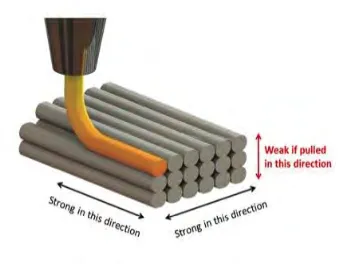
The 3D printer starts the process at the bottom of the design and builds up successive layers of material until the object is finished. Each of these layers can be seen as a thinly sliced horizontal cross-section of the eventual object as shown in Figure 2.1. It has a strong bonding between the filament when printing in x or y direction. Additionally, it is essential in the formation of the 3D object.
6 Figure 2.1: The process of 3D printing by builds up layering.
(Source: <http://blog.capinc.com/2014/12/design-for-3d-printing-success/> 12/5/2017)
Furthermore, 3D printing can produce almost anything from toys, accessories, sneakers, guns, wheelchairs and even organs like hearts. It is one of the growing industries today. This technology can be used to create everything from prototypes and simple parts to highly technical final products.
In the past, 3D printing was very expensive and not feasible for the general market. However, the development of desktop 3D printers has made the technology more accessible allowing 3D printers to find their way to a more affordable market because of costs drastically dropped. Before 3D printers existed, creating a prototype was time-consuming and expensive, requiring skilled craftsmen and specific machinery.