This is a repository copy of Design and Evaluation of a Digital Theatre Wind Machine
.
White Rose Research Online URL for this paper:
http://eprints.whiterose.ac.uk/151265/
Version: Published Version
Proceedings Paper:
Keenan, Fiona orcid.org/0000-0003-2046-9036 and Pauletto, Sandra
orcid.org/0000-0002-9404-851X (2017) Design and Evaluation of a Digital Theatre Wind
Machine. In: Proceedings of the International Conference on New Interfaces for Musical
Expression. NIME New Interfaces for Musical Expression Conference, 15-19 May 2017,
Copenaghen. Proceedings of the International Conference on New Interfaces for Musical
Expression . , pp. 431-435.
[email protected]
https://eprints.whiterose.ac.uk/
Reuse
This article is distributed under the terms of the Creative Commons Attribution (CC BY) licence. This licence
allows you to distribute, remix, tweak, and build upon the work, even commercially, as long as you credit the
authors for the original work. More information and the full terms of the licence here:
https://creativecommons.org/licenses/
Takedown
If you consider content in White Rose Research Online to be in breach of UK law, please notify us by
Design and Evaluation of a Digital Theatre Wind Machine
Fiona Keenan
Department of Theatre, Film, Television and Interactive Media
University of York Baird Lane, Heslington East
York, UK
Sandra Pauletto
Department of Theatre, Film, Television and Interactive Media
University of York Baird Lane, Heslington East
York, UK
ABSTRACT
This paper presents the next stage of an investigation into the potential of historical theatre sound effects as a resource for Sonic Interaction Design (SID). An acoustic theatre wind machine was constructed, and a digital physical modelling-based version of this specific machine was programmed using the Sound DesignerÕs Toolkit (SDT) in Max/MSP. The acoustic wind machine was fitted with 3D printed gearing to mechanically drive an optical encoder and control the digital synthesis engine in real time. The design of this system was informed by an initial comparison between the acoustic wind machine and the first iteration of its digital counterpart [8]. To explore the main acoustic parameters and the sonic range of the acoustic and digital wind machines in operation, three simple and distinct rotational gestures were performed, with the resulting sounds recorded simultaneously, facilitating an analysis of the real-time performance of both sources. The results are reported, with an outline of future work.
Author Keywords
Sonic Interaction Design, physical modeling synthesis, real-time performance, acoustic analysis, historical sound effects, Max/MSP, 3D printing
ACM Classification
[500] Applied Computing Ð Sound and Music Computing [300] Human Centred Computing Ð User Interface Design
1.
INTRODUCTION
Theatre has a long history of the design and live performance of sound with mechanical devices and acoustic materials. This area is therefore a potentially rich resource for Sonic Interaction Design (SID), which researches tactile, multisensory and performative aspects of sonic experience with the aim of designing new sonic interactions [4]. This paper presents the next stage of an investigation into a theatre wind machine, a device first used in the nineteenth century [12]. A wind machine consists of a wooden slatted cylinder and axle mounted on a frame and rotated with a crank handle. The cylinder rotates against an encompassing cloth, and the friction between the slats and cloth creates a wind-like sound. The wind machine was chosen for closer investigation as it makes it possible to explore a continuous action-sound coupling [5] in an experimental setting.
Serafin and de Gštzen [13] have already undertaken relevant research in this area focused on Luigi RussoloÕs intonarumori
family of mechanical noise intoners created for early twentieth century Futurist musical performances. An analysis of the sound production of these devices informed the creation of a user interface controlling a digital synthesis engine, replicating the original enactive workings of the historical devices. This research aims to extend this method to the area of historical theatre sound effects, and replicate a historical acoustic device as a digital synthesis engine and user interface. It is proposed that this replication will facilitate a fuller examination of the action-sound coupling in an experimental setting.
The wind machine is a simple single-gesture acoustic interface, but it affords the user rich multisensory feedback in the performance of a complex and continuous sound. It is proposed that through an examination of the subtleties that create this experience (sensation of weight and inertia, effort, continuously varying sound, etc.) new strategies can be devised for closing the space between the perceived complexity of the multisensory feedback afforded by the acoustic wind machine and simple digital interfaces affording the same rotational gesture [9]. This process begins by fitting the acoustic wind machine itself with a sensor and using it as the initial performance interface for the digital synthesis engine to ensure that performance of the digital sound reproduces as closely as possible the richness of performance of the acoustic sound. This work will then inform the creation of another interface offering less complex tactile feedback while controlling the digital sound, allowing comparisons to be made between the experiences of performing the same sound with different levels of tactile feedback in an experimental setting. It is proposed that this research has the potential to inform the design of other interfaces affording simple gestures but reliable action-sound couplings for the real-time performance of complex digital sounds.
1.1
Initial System Design and First Analysis
An acoustic wind machine was first constructed according to historical design instructions [7], making a specific example available to model in software. An evaluation of this acoustic device deconstructed the mechanical process behind its stages of sound production using an entity-action model [3], and this formed the basis for the creation of a synthesis engine in Max/MSP1 using the Sound DesignerÕs Toolkit (SDT)2 suite of objects [11]. Twelve instances of the most recent iterations of the SDTÕs dynamic friction model [2], using the sdt.scraping~,
sdt.friction~, sdt.inertial~ and sdt.modal~ objects, were used to model each slat in rotation, combining a simulation of a probe sliding on a surface with a nonlinear friction model between
1
http://www.cycling74.com/
2
one inertial and one modal object. The acoustic wind machine was fitted with an Inertial Measurement Unit (IMU) sensor and a wireless system was implemented with an Arduino and XBee to transfer real-time acceleration and velocity data from its rotation about its central axle to the computer. This first iteration of the digital synthesis engine, and its control by the IMU sensor, was compared to the sonic response of the acoustic machine [8], revealing that further calibration of the friction model was required to produce a frequency response more closely resembling the acoustic wind. Similarly, the digital synthesis engine did not respond as expected to variability in the speed of the rotational gesture. An issue with latency was also highlighted, as there was a perceivable delay between the onset of the acoustic sound and that of the digital sound, pointing to the need to review the efficiency of the Max/MSP patch and flow of data from the IMU sensor.
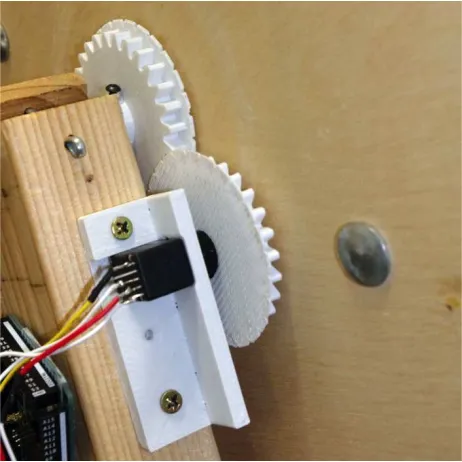
Figure 1: 3D printed gearing coupling the acoustic wind machine's motion to an optical encoder connected to an
Arduino.
2.
SYSTEM DEVELOPMENT
A discussion of the development and improvement of the digital wind machine system informed by the first acoustical analysis [8] now follows.
2.1
Sensor and Control Data
To translate the rotational movement of the acoustic wind machine into more accurate rotational data, the IMU sensor was abandoned in favour of an optical rotary encoder3 mechanically coupled to the wind machineÕs cylinder. Some simple prototype gearing was 3D printed to facilitate this coupling (see Figure 1). As the encoder was mounted to the acoustic wind machineÕs a-frame stand rather than a moving part of the mechanism, the Arduino reading its movement could be directly connected to the computer via USB, removing the need for a wireless system and increasing the speed of data transfer via the serial bus. Data from the encoder was mapped to a 360¡ rotation in Max/MSP, representing the trajectory of the point of origin (slat F). Using
3
The optical encoder used was Bourns type ENA1J-B28-L00128L.
[image:3.595.56.287.254.485.2]the degree values of the slat placement on the acoustic wind machine, this data was placed out of phase a further eleven times, creating a separate stream of control data for the position of each of the twelve slats (see Figure 2). The velocity and acceleration of the encoder were also calculated to inform further parameters to the sound model.
Figure 2: Side view of the acoustic wind machine, showing slat positions in a 360¡ rotation from their position of origin
(slat F).
The mapping strategy focused on creating complexity from the encoderÕs smooth data stream in order to reflect the gesture afforded by the acoustic wind machine. This clockwise rotational gesture is far from smooth, and is in fact comprised of two distinct parts due to the influence of gravitational force and the way the cloth has been fixed to the machine, i.e. one side hangs freely while one side is coupled to the acoustic wind machineÕs a-frame (Figure 3). The first half of the rotation (from bottom to top) requires much more effort on the part of the performer and generally produces a signal with higher amplitude, while the second half (from top to bottom) requires a less forceful movement. This gestural shape creates a variable envelope in the resulting acoustic sound:
1. The first half of the rotational gesture produces a sound with slightly higher amplitude, while the second half of the gesture produces a sound with lower amplitude.
2. A slower rotational speed produces a sound of lower overall amplitude.
3. A faster rotational speed produces a sound of higher overall amplitude.
4. Variations in the overall speed of rotation will produce a corresponding variation in overall amplitude.
Figure 3: Diagram of the two-part rotational gesture afforded by the acoustic wind machine in a clockwise motion, and the difference in the cloth tension on each side.
To recreate this behavior in the digital domain, the control data for each slat position was first converted to signal rate, and then passed through an inertia model created with a 10ms delay and logarithmic filtering using slide~.4 This data then passed through to the velocity parameter of each sdt.scraping~ (Table 1), forming the trajectory of the ÔscrapeÕ for each slat. To add further variation to the resulting sound, the grain parameter to
sdt.scraping~ was subtly modulated according to the position of each digital slat during rotation, with the values rising during the first half of the rotational gesture and falling during the second half, reflecting the angle of the slat in relation to the encompassing cloth. Acceleration data from the encoder was used to modulate the force parameter to sdt.scraping,
increasing the force as the rotation accelerated. The overall amplitude envelope of the digital synthesis engine was controlled with velocity data from the encoderÕs rotation, ensuring lower amplitudes at slower speeds. Changes in the encoderÕs data stream were monitored in real time, allowing a
line~ object to be triggered to stop and start the overall sound appropriately in time with the movement of the crank handle on the acoustic wind machine.
2.2
Sound Model
[image:4.595.60.281.74.237.2]Parameters to the digital slat model were re-calibrated following the initial evaluation of the digital synthesis engine [8]. The revised settings are outlined in the tables below. These parameters were chosen to produce a sound that reflected the roughness of the acoustic wind machine sound, which is perceivably ÔnoisyÕ in operation, as accurately as possible.
Table 1: Parameters to sdt.scraping~
Surface profile (a signal) noise~
Grain [density of micro-impacts] 0.080596, modulated by encoder data
Velocity (m/s) Real-time optical encoder data
Force (N) 0.546537, modulated by encoder data
4
The inertia model was developed from code by jvkr on the Cycling Õ74 forum ( https://cycling74.com/forums/topic/line-with-inertia/).
Table 2: Parameters to sdt.inertial~
Mass of inertial object (Kg) 0.01
[image:4.595.301.544.136.343.2]Fragment size (to simulate crumpling) 1
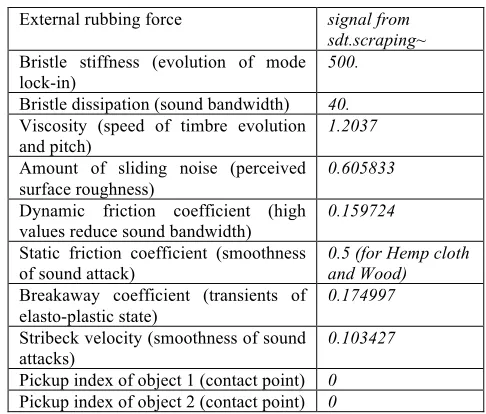
Table 3: Parameters to sdt.friction~
External rubbing force signal from sdt.scraping~
Bristle stiffness (evolution of mode lock-in)
500.
Bristle dissipation (sound bandwidth) 40.
Viscosity (speed of timbre evolution and pitch)
1.2037
Amount of sliding noise (perceived surface roughness)
0.605833
Dynamic friction coefficient (high values reduce sound bandwidth)
0.159724
Static friction coefficient (smoothness of sound attack)
0.5 (for Hemp cloth and Wood)
Breakaway coefficient (transients of elasto-plastic state)
0.174997
Stribeck velocity (smoothness of sound attacks)
0.103427
Pickup index of object 1 (contact point) 0
Pickup index of object 2 (contact point) 0
Table 4: Parameters to sdt.modal~
Frequency factor 1
Frequency of each mode (Hz) 380, 836, 1710 Decay factor 0.005 Decay of each mode (s) 0.8, 0.45, 0.09 Pickup factor 2.2
Pickup0_1 50 Pickup0_2 100. Pickup0_3 80. Fragment size 1 Active modes 3
[image:4.595.47.289.610.711.2]machineÕs Ôbridge.Õ Dispersion through the freely hanging side of the cloth was modeled using the most basic method, without damping, of a delay line in series with an all-pass filter [14].
3.
EVALUATION
To evaluate the effectiveness of the new real-time synthesis engine and sensor configuration, three distinct rotational gestures were performed while the acoustic and digital wind machines were simultaneously recorded. This procedure followed that of the initial analysis [8], with simple gestures chosen to give as complete a picture as possible of the of both systems in performance to facilitate their comparison:
1. A single rotation.
2. Five rotations to produce a continuous sound. 3. Ten rotations that start at speed, but then diminish in
energy.
These gestures were repeatedly recorded, giving a total of 30 examples for each. Representative audio clips were then chosen for analysis using the MIR Toolbox in Matlab [10].
3.1
Results
3.1.1
Amplitude Envelope
[image:5.595.311.542.70.236.2]In the following graphs, the acoustic sound is shown in blue and the digital sound is shown in red.
Figure 4: Envelopes for 1 Rotation of the Acoustic and Digital Wind Machines
Figure 5: Envelopes for 5 Rotations of the Acoustic and Digital Wind Machines
Figure 6: Envelopes for 10 Rotations (diminishing in energy) of the Acoustic and Digital Wind Machines
[image:5.595.307.543.283.647.2]3.1.2
Spectrum
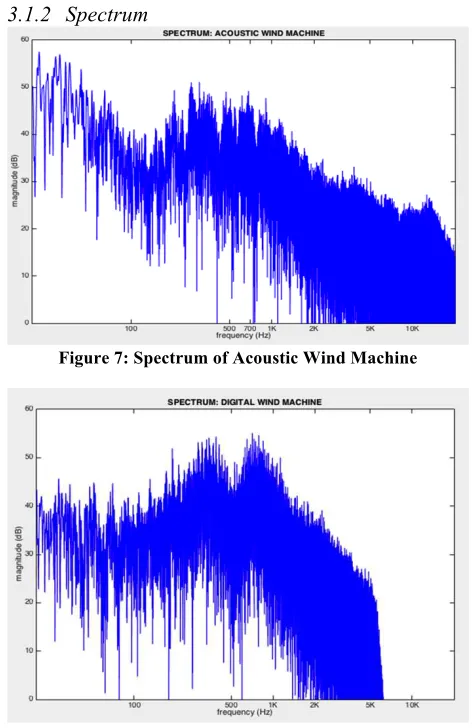
[image:5.595.55.288.366.525.2]Figure 7: Spectrum of Acoustic Wind Machine
Figure 8: Spectrum of Digital Wind Machine
4.
DISCUSSION
[image:5.595.58.287.562.724.2]Similarly, the amplitude envelope of the digital wind machine has improved. The system is now capable of some variability in performance due to the inertia model giving shape to the rotational control data from the optical encoder, and the modulation of the amplitude of the digital sound according to the velocity of rotation (Figure 6). The progress of the digital sound is now closer to that of its acoustic counterpart, and sounds like the output of a rotating machine when the performance gesture is regular and repetitive. The envelope will require some further calibration to ensure that the inertia model is not overly delaying the progress of the digital wind machine, particularly during repeated rotations (Figure 5).
The spectrum of the digital synthesis engine is now closer to that of the acoustic wind machine. The digital sound is perceivably wind-like, but contains some of the same roughness of the acoustic sound created by the texture of the encompassing cloth. The digital spectrum does lack power at those higher frequencies that are responsible for the acoustic wind machineÕs characteristic Ôwhistling,Õ which varies in pitch according to the speed of rotation. Further real-time modulation of parameters to the SDT objects will be investigated, as well as control over the delay time to the bidirectional cloth model, to brighten the digital sound and create the same characteristic Ôwhistling.Õ Pitch control via changes in a digital waveguideÕs delay time is a method informed by Karplus-Strong synthesis [6]. This work will continue with perceptual testing in an experimental setting with participants. A listening test to compare the acoustic and digital wind sounds, as well as a study of the acoustic wind machine in operation as a sounding object and as a controller for the digital wind machine engine will be undertaken. The results of these experiments will inform further calibration of the digital system parameters, as well as the design of a crank controller with less tactile feedback to facilitate a purely digital performance, enabling an investigation into the perceived complexity of the acoustic wind machine in operation compared with a simpler digital interface affording the same rotational gesture [9]. The potential of a simple gesture of rotation to control a complex synthesis system will be further explored through the application of the digital wind machineÕs mapping model to the performance of other digital sounds.
5.
CONCLUSION
The current development of the design of a digital model of a theatre wind machine has been described, in addition to its comparison with the acoustic version on which it is based. Future work in this area, including perceptual testing of the system, was also outlined.
6.
ACKNOWLEDGMENTS
This research is supported by the Arts and Humanities Research Council (AHRC) through the White Rose College of the Arts and Humanities (WRoCAH) Doctoral Training Partnership. The authors would like to thank Dr James Hilder at York Robotics Laboratory, Department of Electronics & Computer Science, University of York, for our 3D printed gearing.
7.
REFERENCES
[1] Avanzini, F., Serafin, S. and Rocchesso, D., Modeling interactions between rubbed dry surfaces using an elasto-plastic friction model. in International Conference on Digital Audio Effects (DAFX) (Hamburg, Germany, 2002).
[2] Delle Monache, S., Drioli, D.D.C., Fontana, F., Papetti, S., Polotti, P. and Rocchesso, D. Closing the loop of sound evaluation and design (CLOSED): Deliverable 2.1, algorithms for ecologically-founded sound synthesis: Library and documentation, Technical report, UNIVERONA (Verona), 2007.
[3] Farnell, A. Designing Sound. MIT Press Cambridge, 2010. [4] Franinović, K. and Serafin, S. Sonic Interaction Design.
MIT Press, 2013.
[5] Jensenius, A.R. Action-sound: Developing Methods and Tools to Study Music-Related Body Movement. PhD thesis, Department of Musicology, University of Oslo. 2007. [6] Karjalainen, M., VŠlimŠki, V. and Tolonen, T.
Plucked-string models: From the Karplus-Strong algorithm to digital waveguides and beyond. Computer Music Journal,
22 (3). 17-32.
[7] Keenan, F. A Theatre Wind Machine as Interactive Sounding Object International Conference on Live Interfaces (ICLI) Doctoral Colloquium (University of Sussex, Brighton, UK, 2016).
[8] Keenan, F. and Pauletto, S. An Acoustic Wind Machine and its Digital Counterpart: Initial Audio Analysis and Comparison Interactive Audio Systems Symposium (IASS)
(University of York, York, UK, 2016).
[9] Keenan, F. and Pauletto, S. "ÔListening BackÕ: Exploring the Sonic Interactions at the Heart of Historical Sound Effects Performance," The New Soundtrack, vol. 7, pp. 15-30, 2017.
[10]Lartillot, O. and Toiviainen, P., A Matlab toolbox for musical feature extraction from audio. in International Conference on Digital Audio Effects (DAFX) (Bordeaux, France, 2007), 237-244.
[11]Monache, S.D., Polotti, P. and Rocchesso, D., A Toolkit for Explorations in Sonic Interaction Design. in
Proceedings of the 5th Audio Mostly Conference: A Conference on Interaction with Sound, (PiteŒ, Sweden 2010), 1.
[12]Moynet, J., Jackson, A.S. and Wilson, M.G. French Theatrical Production in the Nineteenth Century: "L'Envers du ThŽatre" by M.J. Moynet, 1873. Max Reinhardt Foundation with the Center for Modern Theatre Research, State University of New York, USA, 1976. [13]Serafin, S. and De Gštzen, A. An Enactive Approach to
the Preservation of Musical Instruments Reconstructing Russolo's Intonarumori. Journal of New Music Research,
38 (3). 231-239.