This is a repository copy of GPU-Based Data Processing for 2-D Microwave Imaging on MAST.
White Rose Research Online URL for this paper: http://eprints.whiterose.ac.uk/99842/
Version: Accepted Version
Article:
Chorley, J., Akers, R. J., Brunner, K.J. et al. (6 more authors) (2016) GPU-Based Data Processing for 2-D Microwave Imaging on MAST. Fusion science and technology. pp. 643-654. ISSN 1536-1055
10.13182/FST15-188
[email protected] https://eprints.whiterose.ac.uk/ Reuse
Items deposited in White Rose Research Online are protected by copyright, with all rights reserved unless indicated otherwise. They may be downloaded and/or printed for private study, or other acts as permitted by national copyright laws. The publisher or other rights holders may allow further reproduction and re-use of the full text version. This is indicated by the licence information on the White Rose Research Online record for the item.
Takedown
If you consider content in White Rose Research Online to be in breach of UK law, please notify us by
GPU-BASED DATA PROCESSING FOR 2D MICROWAVE
IMAGING ON MAST
J.C. Chorley,1 R.J. Akers,2 K.J. Brunner,1, 2 N.A. Dipper,1 S.J. Freethy,2
R.M. Sharples,1 V.F. Shevchenko,2 D.A. Thomas,2, 3 and R.G.L. Vann3
1Centre for Advanced Instrumentation, Department of Physics,
Durham University, Durham DH1 3LE
2Culham Centre for Fusion Energy, Abingdon, Oxfordshire, OX14 3DB
3York Plasma Institute, Department of Physics,
University of York, York, YO10 5DD
Abstract
The Synthetic Aperture Microwave Imaging (SAMI) diagnostic is a Mega Amp Spherical
Toka-mak (MAST) diagnostic based at Culham Centre for Fusion Energy. The acceleration of the SAMI
diagnostic data processing code by a graphics processing unit (GPU) is presented, demonstrating
acceleration of up to 60x compared to the original Interactive Data Language (IDL) data
process-ing code. SAMI will now be capable of inter-shot processprocess-ing allowprocess-ing pseudo-realtime control so
that adjustments and optimisations can be made between shots. Additionally, for the first time
the analysis of many shots will be possible.
This work was presented at IAEA TM FDPVA Nice Proceedings, June 2015.
I. INTRODUCTION
For current and certainly next generation fusion devices such as the International Ther-monuclear Experimental Reactor (ITER), specialised hardware and techniques need to be employed in data processing tasks as the amount of data produced in experiments be-comes large and difficult to handle with traditional approaches. This work aims to assess the suitability of one such technology, the graphics processing unit (GPU) as applied to the Synthetic Aperture Microwave Imaging (SAMI) diagnostic installed on the Mega Amp Spherical Tokamak (MAST). SAMI acquires 4GB raw data per shot and an existing Inter-active Data Language (IDL) data processing code which calculates the cross-correlations between antenna pairs takes approximately 20-30 minutes per shot to run and as such is unsuitable for inter-shot processing. To improve on this situation, a GPU-based Compute Unified Device Architecture (CUDA) code has been developed demonstrating a significant acceleration of the data processing, making it possible for inter-shot processing in future campaigns on National Spherical Torus Experiment (NSTX-U) and MAST-U and greatly improving the capabilities of the SAMI diagnostic on these machines. Further, the GPU code will enable data-mining of many MAST shots from previous campaigns which has until now been impossible due to the runtime of the existing IDL code. The benefits of using GPUs for processing large data sets relevant for next generation fusion diagnostics is clearly demonstrated by the new accelerated GPU CUDA code for the high data rate SAMI diag-nostic and a cost/benefit analysis is presented to emphasise the advantages of a GPU-based approach to data processing.
II. REVIEW OF NOVEL HARDWARE USED FOR LARGE DATA-PROCESSING
TASKS
coprocessor; it is clear this is the direction in which computational science is going. Often on these machines, it is a heterogeneous programming model featuring GPU, MPI and OpenMP that achieves the best performance.11
Large data experiments such as the SKA are looking towards alternative technologies and specialised hardware such as the GPU, in order to ease the big data problem. Beam forming in radio astronomy has higher performance and is more energy efficient on a GPU system compared to a multi-core CPU system12 and a recent analysis13 concluded that for SKA, novel hardware and system architectures need to be developed to achieve the required power efficiency and compute capabilities. The European Organization for Nuclear Re-search (CERN) and LHC have investigated the potential of using GPUs in the high-level trigger algorithms used to select the interesting data to reduce the raw data obtained from this experiment at the nominal LHC collision rate of 40MHz or every 25 nanoseconds.14 For tokamaks such as NSTX, in 2004 camera data amounted to 300 MB/pulse, or 600 MB/pulse if all the data had been archived whereas shortly afterwards in 2006, one camera alone can acquire 2GB/pulse.15 For next generation tokamaks such as ITER, between 160GB/pulse, extrapolating from existing devices, to 100TB/pulse if physics reasoning and predicted ac-quisition rates are considered will be produced.16 It is therefore worthwhile to investigate the suitability of hardware like the GPU for massive data processing tasks such as those in real-time fast control systems,17 the GPU being more developed than FPGAs in high performance computing.
III. SAMI DIAGNOSTIC
III.A. Data processing requirements
III.B. Description of the diagnostic
III.C. Data processing
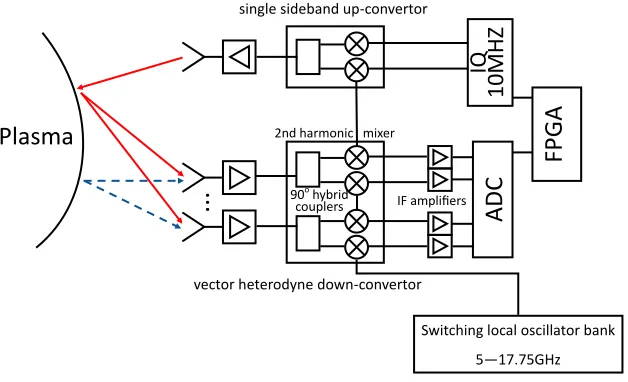
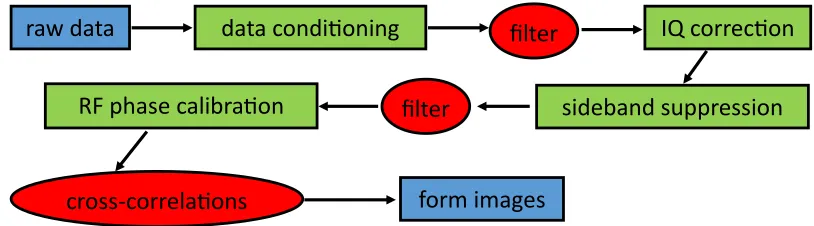
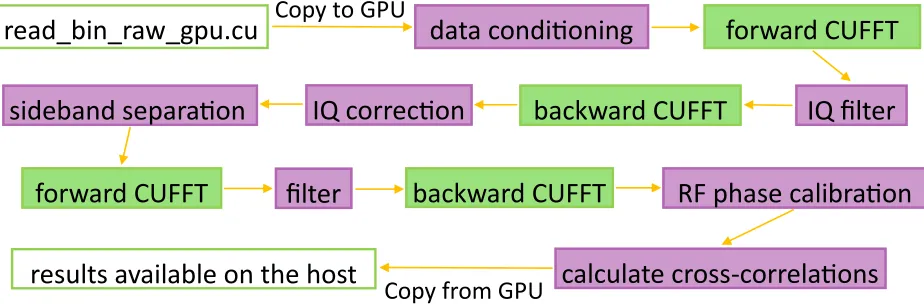
The raw data SAMI collects needs extensive processing to: i.) correct for phase drift between I and Q components, ii.) correct for phase differences between antennas due to RF electrical lengths and iii.) perform sideband separation. Better sideband suppression is obtained if the phase dispersion between I and Q signals introduced by the IF signal cables and filters is corrected first. Once the sidebands are successfully separated, the phase difference between antenna channels can be corrected. This phase is affected by differences in path lengths giving rise to unknown phases between the RF signals. Once the raw data has been corrected for these effects, the cross-correlations between each antenna pair are calculated from which the images can be formed. This process is shown schematically in FIG. 3 with the most significant system bottlenecks enclosed in circles. The Fourier filter operations and the cross-correlation steps dominate the data processing.
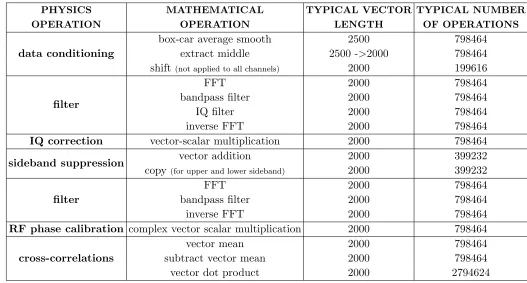
The numerical operations carried out in the data processing chain are presented in TABLE I for a typical MAST shot and the data is processed as a series of many independent vectors. At the start of the processing chain we have 16 real signals and for a typical MAST shot 16 frequency channels and 3119 time sweeps containing 2500 time points. After extracting the middle of each time sweep to remove noise introduced by switching frequency channel, each time sweep contains 2000 points. With sideband separation 16 real signals get converted to 8 complex signals and there are now two data arrays for upper and lower sideband. There are nAnt×(nAnt−1)/2 = 28 unique cross-correlations to calculate where nAnt = number
of antennas, and therefore there are 28 associated baselines. The image is then formed by aperture synthesis as the sum of the products of antenna cross correlations and associated basis functions.
IV. GRAPHICS PROCESSING UNITS
computation on a GPU because non-graphics computations needed to be expressed with a graphics API such as OpenGL.27
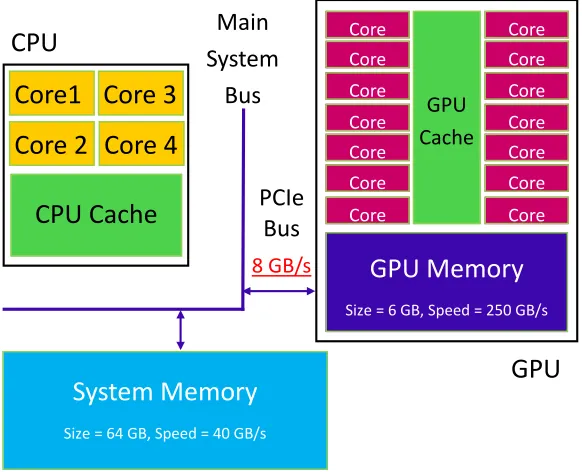
A GPU is attached to a CPU via PCIe (see FIG. 4) and expensive parts of a computation are offloaded to the GPU. GPUs work by making massive use of long vector units. In software, each CUDA thread is mapped to one element of a hardware vector unit. A full vector unit is 32 threads, or a warp, and a warp is processed in parallel by the hardware. GPUs are essentially designed to do massive parallel computations and provide the largest acceleration for data parallel problems with all threads executing the same instructions on different data. Many problems in computational science such asn-body problems, collision detection, probabilistic Potts model simulations and Cellular Automata simulations, are data parallel and ideal for acceleration with a GPU.29 The larger problem can be broken down into many independent smaller problems which can be solved simultaneously with a single instruction operating on multiple data (SIMD). Iterative solvers where the next iteration depends on results from the previous iteration do not follow the SIMD model and as such are poor candidates for acceleration with a GPU.
V. GPU DATA PROCESSING CODE
V.A. Motivation for GPU code
up the processing time. The accelerated GPU code has enabled overnight data processing. More impressively, data can be processed between shots on MAST moving into a new regime of inter-shot data processing.
Given the long runtime of the IDL code, processing the raw data for many shots and performing many-shot analysis has previously been impossible. The SAMI multi-shot cross-correlation data could help derive scaling laws; for example early analysis indicates a de-pendence between electron Bernstein wave power and D-alpha emission so it is essential to investigate many shots to find correlations between plasma parameters. Many-shot analysis has previously proved to be vital in the derivation of scaling laws such as ITER98Y2 (Ref. 30) which is now the commonly used model for ITER design. This is based entirely on empirical scaling from regression analysis of data in the ITPA (Ref. 31) database which includes a large number of shots from a number of different tokamaks.
V.B. Suitability of SAMI for GPU acceleration
V.C. Description of the GPU code
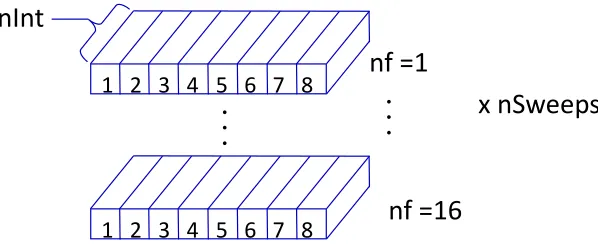
The raw data is stored in binary files where the frequency channels are multiplexed in time. The read bin raw gpu.cu function reads in the data. The different frequency com-ponents are demultiplexed by looping over each frequency channel,nf, and sweep,nSweeps, readingnInt*nAnt points from the two data files (one for channels 0-7, one for channels 8-15) and placing it in the correct location in the data array for efficient processing. Since the switching period and frequency order may vary from shot to shot abootconfig.rfctrl.ini file is consulted which informs where to start reading the binary file from on each iteration. The data is then copied to the GPU and the necessary signal processing tasks and data conditioning are performed. The noise of the local oscillator switch is removed, a smoothing box-car average is performed on each set of nInt points, the middle of each set of nInt points is taken to avoid any residual switching noise and unsmoothed subtraction and the data corresponding to channel 0, channel 1, channel 8 and channel 9 is shifted to correct for ADC timing errors. The data is then filtered with a bandpass and notch filter to remove some unwanted signals from each block of nInt and the IF dispersion between I and Q components caused by cable lengths is corrected. Performing sideband separation converts 16 real signals into 8 complex signals and another filter is performed for upper and lower sideband with calibration data correcting for phase offsets and balancing amplitudes be-tween the I and Q components. Calibration of the RF phase is also performed to correct the phase drifts in the RF channels after sideband suppression. Finally, once these corrections have been made, the cross-correlations between the signals for each antenna pair, frequency sweep and upper and lower sideband are calculated. This process is illustrated in FIG. 6. In total, 14 CUDA kernels were constructed to process the data and the CUFFT library was used to perform Fourier transforms.
However, there is a problem with this model for the SAMI computation and for any large data problem such as those expected in the next generation of fusion diagnostics. GPUs have limited memory available and very few models have enough to process an entire 4GB shot at once. Each SAMI shot is 4GB of 14 bit (or two byte) integers. Immediately in software, the amount of data is doubled as each two byte integer is converted to a four byte float to perform scientific computation, so each SAMI shot is actually an 8GB data processing problem. It is necessary for big data problems like SAMI to carve the data up into chunks and process each, exploiting CUDA streams and concurrency which means to overlap a memory copy to the GPU with kernel execution on the GPU. The GPU can be effectively kept busy by copying the next chunk of data to the GPU whilst computing on the previous chunk. The high-end GPUs such as the Tesla K40C do even better as these GPUs have two copy engines to facilitate bi-directional memory copies. The resulting chunki−1 can be copied from the GPU, whilst computation is being performed on chunki and the copying
VI. ACCELERATION RESULTS AND ACCURACY
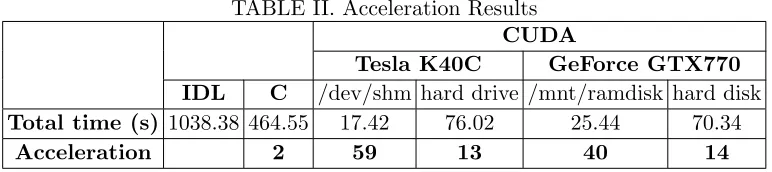
Code development was carried out on a machine with an Intel (R) Xeon(R) CPU E5-2670 @ 2.60 GHz with a Tesla K40C GPU with 12GB GDDR5 and PCIe 3.0 x16 lanes, which is independent to the SAMI data storage machine. The data for a few shots was made available on this machine to verify correctness and obtain some preliminary acceleration results, shown in TABLE II. The original IDL code averaged a time of 17 minutes and 18 seconds to calculate the cross-correlation data for a full shot. The serial C version as an intermediate step to the CUDA version was able to complete in 7 minutes and 44 seconds, giving an acceleration of 2.2x over the IDL. The raw data for both the IDL and C implementations was loaded in /dev/shm shared memory in the form of a RAM disk. Accelerating further with CUDA on the Tesla K40C gave a time of just 17 seconds, an acceleration of 26x over the serial C and 59x over the original IDL. The total run time of 17 seconds for the Tesla K40C is for raw data loaded in /dev/shm. If the data is retrieved from the hard drive, the run time of the code is significantly increased to 76 seconds. After demonstrating this acceleration on the Tesla K40C, a dedicated GPU card was obtained for SAMI, a GeForce GTX770 with 4GB GDDR5. Running the code and retrieving the raw data from hard disk gives a runtime of 70 seconds for one shot and if we mount the data in a RAM disk, again the run time is significantly reduced to 25 seconds which is comparable to the Tesla K40C system. It is evident that as the GPU processes the data so quickly, retrieving the data from hard disk creates a serious bottleneck.
The CUDA times given in TABLE II are the total time taken for the code to run which can be further split up into CPU time and GPU time as shown in TABLE III for the GeForce GTX770. The time taken to read the raw data dominates the run time. The GPU time, including memory copies to and from the GPU, is consistent between the two cases but if the data is mounted in a RAM disk, the time taken to read all of the raw data from file is significantly reduced by 3.7x. The unaccounted for time contributing to the total run time is due to the setup of the correction data and filter functions used to calibrate and condition the data which is shot dependent. The GeForce GTX770 on the SAMI system then cycled through SAMI data for 1837 shots in 30 hours, averaging a total run time of 58 seconds per shot.
kernel execution and memory copies is evident. TABLE IV shows the execution times for a single stream implementation and multi-stream implementations on the Tesla K40C. For a single stream, the total GPU time, including memory copies is 12 seconds where as if multiple CUDA streams are used the GPU time is nearly halved to between six and seven seconds. In this case, increasing the number of streams further provides no reduction to the GPU time. TABLE V shows the division of GPU time for the single stream case. The GPU time is dominated by the kernel execution and copying the result from the GPU is fast as we are reducing the amount of data by calculating the cross-correlations by two orders of magnitude. By referring to the multi-stream times in TABLE IV it is clear that successful overlap of the memory copies has been achieved as the latency of the memory copies is hidden by the kernel execution time. The total GPU time including memory copies for multi-stream implementations is approximately equal to the kernel execution time for a single CUDA stream.
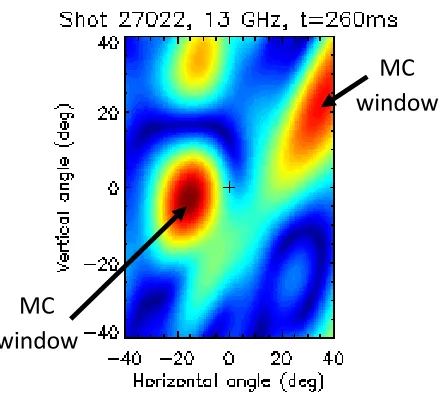
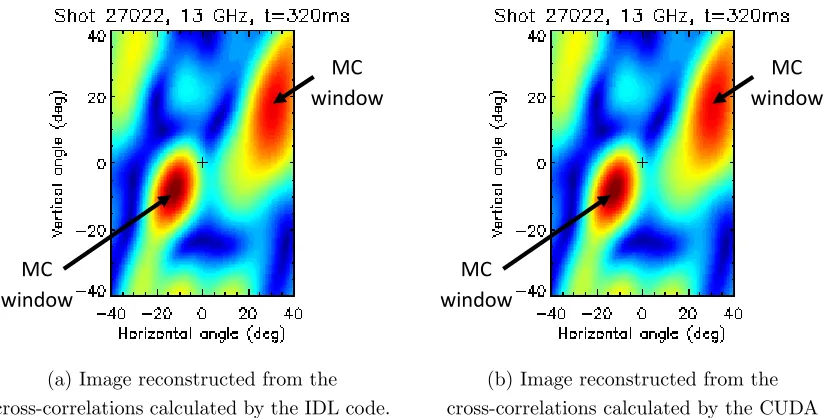
Having achieved a nearly 60x acceleration over the IDL, it is important to ensure the CUDA calculation is accurate. Using shot 27022 as an example, the cross-correlations were calculated by the IDL code and the CUDA code respectively. FIG. 8 shows the images of microwave emission on MAST at 13GHz and 320ms reconstructed from the cross-correlation data. The images produced for the IDL calculation and the CUDA calculation match well. In fact, the absolute error between the IDL cross-correlations and the CUDA cross-correlations is less than 10−8 and the relative error is less than 10−4. The relative error is greater than the absolute error as some of the cross-correlations are smaller than machine precision.
VII. DISCUSSION
VII.A. Cost-performance analysis
perfect scaling would occur and the multi-core times would be worse than this in reality so the GPU implementation maintains the best performance. Looking at the cost of each device, at launch in October 2013 the Tesla K40C with 12GB GDDR5 was $7699 and has a double precision peak performance of 1.4 TFlops where as the E5-2670 had a launch price in March 2012 of $1552 and peak performance of 166.4 GFlops based on a clock speed of 2.6 GHz, eight cores and eight instructions per cycle. In addition, the cost of 12GB DDR3 RAM must be included to the E5-2670 processor to make this a fair comparison; four 3GB cards can be purchased for approximately $80. Therefore, the Tesla K40C has a slightly better performance per dollar of 0.181 GFlops/$ compared to the E5-2670 system which has a performance per dollar of 0.102 GFlops/$. However, since the launch of each device the price of the Tesla K40C has fallen considerably and if it was purchased today, it would cost approximately $4600 where the cost of the E5-2670 has remained roughly constant and only fallen by $100 or so. Therefore, at current prices, the Tesla K40C GPU has a much better performance per dollar of 0.298 GFlops/$. For SAMI, as the amount of resulting data being copied from the device has been reduced, the benefit of moving to the high-end Tesla K40C with bi-directional memory copies is small as can be seen by comparing the GPU run times of the Tesla K40C and GeForce GTX770 in TABLE III and TABLE IV. The performance gain by moving to the Tesla K40C is only one second. However, the GeForce GTX770 with 4GB GDDR5 costs approximately $460, an order of magnitude less than the Tesla K40C, so the performance per dollar for the GeForce GTX770 is an order of magnitude greater in the SAMI case.
VII.B. Further improvements to the code
an efficient order for processing on the GPU.
The GPU processing time could also be improved by examining the benefit of a multi-GPU system, where different multi-GPUs process different chunks of the data simultaneously. As the data is carved up into multiple chunks currently and the chunks are processed essentially serially (except for the added parallelism provided by using multiple CUDA streams and concurrency) by a single GPU, the next logical step would be to demonstrate multi-GPU parallelism. For example, if there was one GPU, six data chunks and three CUDA streams, the data would be processed as illustrated in FIG. 7 (b) but if there were two GPUs, each with three CUDA streams, the first three chunks could be processed by the first GPU and the last three chunks could be processed simultaneously by the second GPU, significantly reducing the GPU compute time of the application. This could easily be achieved in software by simply looping over the number of GPUs, selecting the GPU to switch between contexts and executing the same code on each GPU with different data chunks. As seen from TABLES III, IV and V, the kernel execution time is between six and seven seconds and the total run time of the code is dominated by data movement which will still be a limiting factor in a multi-GPU implementation.
Features provided on GPUs with the highest compute capability such as dynamic paral-lelism (compute capability 3.5) may further accelerate the SAMI data processing code. The SAMI GeForce GTX770 has a compute capability of 3.0 and can not implement dynamic parallelism. The SAMI GPU code could be profiled with Nvidia Visual Profiler to identify hotspots and areas to focus further acceleration efforts on. The acceleration provided by the SAMI GPU code is sufficient for the current SAMI data processing requirements but these features could be exploited in the future to achieve further acceleration.
VII.C. Limitations of GPU approach
more GDDR5, up to 32GB which will significantly improve on this situation.
For scientific applications, it is essential to have confidence in results of calculations and GPUs have the option to enable ECC memory to ensure accuracy. With ECC on, some of the available memory is used for the ECC bits, 6.25% in the Tesla K40C, further reducing the limited available memory but protection against memory corruption errors is gained.
Additionally, the benefit provided by using a RAM disk has been demonstrated which significantly reduces the CPU time of the application compared to using the hard disk where the data is stored. The advantage gained by using a GPU to process the data is not as great if data is retrieved from hard disk as the time taken to do this dominates the total run time.
VII.D. Alternative approaches
Reducing the run time of the code to reach the real-time scale for SAMI data processing would be beneficial to real-time identification of the location of B-X-O mode conversion windows in over-dense plasmas such as those in MAST and is essential for potential fu-ture multi-megawatt electron Bernstein wave (EBW) current drive and heating systems.32,33 Further acceleration of the GPU based SAMI data processing code could potentially make this possible. If the data could be streamed directly from the acquiring FPGAs to the GPU significant speed gains could be achieved. The direct streaming from a GPU to an FPGA has been demonstrated.34 Alternatively, the field of HPC on FPGAs, whilst still in its infancy, is gaining in popularity and this provides potential for reaching the real-time data processing scale for SAMI. Similar cross-correlation computation has been done on an FPGA for a passive millimetre wave aperture synthesis imager35 so there is potential the SAMI data processing could be done on FPGA technology. The SAMI data processing chain is well suited to being recast onto the Maxeler hardware discussed in section II and this is an area to potentially investigate in the future once the field has become well established in the scientific community.
VIII. CONCLUSION
many shots. In the future, inter-shot processing will be able to be performed on NSTX-U and MAST-U. The GPU code has fulfilled the current SAMI data processing requirements.
The suitability of a GPU data processing code has been assessed for SIMD data problems using the SAMI diagnostic as a test case and the assessment of the cost-performance benefit of a GPU solution has been provided. In this case the runtime of the SAMI data processing code has been accelerated almost 60x and the ability to perform multi-shot analysis of the SAMI data, previously impossible due to the computational power required to process the data and essential to find correlations between plasma parameters has been provided. It is likely large data processing tasks for other diagnostics will experience these benefits with a GPU processing code. The usefulness and desirability of data processing with a GPU for the next generation of tokamak and diagnostic operation where large amounts of data will be produced has been illustrated.
ACKNOWLEDGEMENTS
This work is funded by EPSRC grant EP/K504178 for the Fusion Doctoral Training Network, the SAMI grant EP/H016732, the UK Magnetic Fusion Research Programme EP/I501045 and the EUROfusion pedestal grant ER-WP15 CCFE-03. This work has been carried out within the framework of the EUROfusion Consortium and has received funding from the Euratom research and training programme 2014-2018 under grant agreement No 633053. The views and opinions expressed herein do not necessarily reflect those of the European Commission.
REFERENCES
[1] L. YANG et al., “High Performance Data Clustering: A Comparative Analysis of Performance
for GPU, RASC, MPI and OpenMP Implementations”, The Journal of Supercomputing,70,
284 (2014)
[2] K. THOUTI and S.R. SATHE, “Comparison of OpenMp and OpenCL Parallel Processing
Technologies”, International Journal of Advanced Computer Science and Applications, 3, 56
[3] E. MONTEIRO et al., “Parallelization of Full Search Motion Estimation Algorithm for Parallel
and Distributed Platforms”, International Journal of Parallel Programming,42, 239 (2014)
[4] G.A. NAYLOR, “An FPGA based control unit for synchronization of laser Thomson scattering
measurements to plasma events on MAST”, Fusion Engineering and Design,85, 280 (2010)
[5] P. THIAGARAJ et al., “FPGA processing for High Performance Computing”,Emerging
Tech-nology Conference, Manchester, 30th June - 1st July (2015)
[6] N. GARELLI, “The Evolution of the Trigger and Data Acquisition System in the ATLAS
Experiment”, Journal of Physics: Conference Series,513, 012007 (2014)
[7] X.YUE et al., “Fast equilibrium reconstruction for tokamak discharge control based on GPU”,
Plasma Physics and Controlled Fusion,55, 085016 (2013)
[8] O. PELL and V. AVERBUKH, “Maximum Performance Computing with Dataflow Engines”,
Computing in Science and Engineering,14, 98 (2012)
[9] J.D. CAPPELLO and D. STRENSKI, “A Practical Measure of FPGA Floating Point
Acceler-ation for High Performance Computing”,IEEE 24th International Conference on
Application-Specific Systems, Architectures and Processors,24, 160 (2013)
[10] “Top500 Lists June 2015”, www.top500.org/lists/2015/06 (June 2015)
[11] C. XU et al., “Collaborating CPU and GPU for large-scale high-order CFD simulations with
complex grids on the Tianhe-1A supercomputer”, Journal of Computational Physics, 278,
275, (2014)
[12] A. SCLOCCO et al., “Radio Astronomy Beam Forming on Many-Core Architectures”, IEEE
26th International Parallel and Distributed Processing Symposium,26, 1105 (2012)
[13] E. VERMIJ et al., “Challenges in exascale radio astronomy: can the SKA ride the
technol-ogy wave?”, The International Journal of High Performance Computing Applications,29, 37
(2015)
[14] P. LUJAN et al., “GPU Enhancement of the Trigger to Extend Physics Reach at the LHC”,
Journal of Physics: Conference Series,513, 012019 (2014)
[15] W.M. DAVIS et al., “Storage and analysis techniques for fast 2-D camera data on NSTX”,
Fusion Engineering and Design,81, 1975 (2006)
[16] J.B. LISTER et al., “The ITER project and its Data Handling Requirements”,Proceedings of
the International Conference on Accelerator and Large Experimental Physics Control Systems,
[17] R. CASTRO et al., “Soft real-time EPICS extensions for fast control: A case study applied
to a TCV equilibrium algorithm”, Fusion Engineering and Design,89, 638 (2014)
[18] B.K. HUANG et al., “FPGA-based embedded Linux technology in fusion: The MAST
mi-crowave imaging system”, Fusion Engineering and Design,87, 2106 (2012)
[19] S.J. FREETHY et al., “Optimization of wide field interferometric arrays via simulated
an-nealing of a beam efficiency function”, IEEE transactions on antennas and propagation, 60,
5442 (2012)
[20] S.J. FREETHY et al., “Lensless passive and active microwave imaging on MAST”, Plasma
Physics and Controlled Fusion,55, 124010 (2013)
[21] V.F. SHEVCHENKO et al., “Synthetic aperture microwave imaging with active probing for
fusion plasma diagnostics”, Journal of Instrumentation,7, P10016 (2012)
[22] D.A. THOMAS et al., “2D Doppler backscattering using synthetic aperture microwave imaging
of MAST edge plasmas”, Nuclear Fusion,56026013 (2016)
[23] P.H. VAN CITTERT, “Die Wahrscheinliche Schwingungsverteilung in Einer von Einer
Lichtquelle Direkt Oder Mittels Einer Linse Beleuchteten Ebene”,Physica,1, 201 (1934)
[24] F. ZERNIKE, “The concept of degree of coherence and its application to optical problems”,
Physica,5, 785 (1938)
[25] J.D. OWENS et al., “GPU Computing”,Proceedings of the IEEE,96, 879 (2008)
[26] E. WYNTERS, “Parallel processing on Nvidia graphics processing units using CUDA”,
Jour-nal of Computing Sciences in Colleges,26, 58 (2011)
[27] J. NICKOLLS and W.J. DALLY, “The GPU Computing Era”, IEEE Computer Society,30,
56 (2010)
[28] NAG,Accelerating Applications with CUDA,CCFE, Nov (2013)
[29] C.A. NAVARRO et al., “A Survey on Parallel Computing and its Applications in
Data-Parallel Problems Using GPU Architectures”, Communications in Computational Physics,
15, 285 (2014)
[30] “ITER Physics Basis”,Nuclear Fusion,39, 2175 (1999)
[31] N.W. EIDIETIS et al., “The ITPA disruption database”, Nuclear Fusion,55, 063030 (2015)
[32] J. URBAN et al., “A survey of electron Bernstein wave heating and current drive potential
[33] V.F. SHEVCHENKO et al.,“Two dimensional studies of electron Bernstein wave emission in
MAST”, Fusion Science and Technology 59, 663 (2011)
[34] R. BITTNER et al., “Direct GPU/FPGA communication Via PCI express”, Cluster
Computing-The Journal of Networks Software Tools and Applications,17, 339 (2014)
[35] N.A. SALMON et al., “Minimising the costs of next generation aperture synthesis passive
millimetre wave imagers”, SPIE Proceedings on Millimetre Wave and Terahertz Sensors and
LIST OF FIGURES
1 A schematic of the SAMI data acquisition system showing both active probing
(solid arrows) and passive imaging (dashed arrows) modes. 21 2 The typical image reconstruction showing the brightness distribution for shot
27022 at 13 GHz and 260ms. The location and size of B-X-O mode conversion
(MC) windows are clearly identified by peaks in the brightness distribution. 22 3 The data processing chain. Computationally expensive calculations are
en-closed in circles and refer to the Fourier filter and cross-correlation steps. 23 4 A schematic of a hybrid CPU-GPU system adapted from Ref. 28. 24 5 A schematic of the SAMI data structure highlighting the SIMD nature. The
data is processed as a series of vector operations on vectors of size nInt. 25 6 A schematic of the SAMI CUDA data processing code showing an initial data
copy to the GPU, all data processing performed on the GPU and finally a
resulting data copy back to the CPU. 26
7 A schematic showing (a) the order of execution using a single CUDA thread where the total time to process the data is 18 units of time, and (b) using three CUDA streams to process the data reduces the units of time required
to process the data to eight. 27
8 The images reconstructed for shot 27022 at 13GHz and 320ms for (a) the IDL code and (b) the CUDA code . The images are in good agreement with
AD
C
IQ MH
Z
FP
GA
S
GH
-IF
P
[image:22.612.154.468.88.279.2]MC
[image:23.612.198.421.73.271.2]MC
IQ
RF
[image:24.612.97.504.74.187.2]
C C C C C C C C C C C C C C GPU C
GPU M
S GB S GB
C
C
C
C
CPU C
S
M
[image:25.612.160.451.78.314.2]S GB S GB
CPU
GPU
M S B PCI B GB
.
. .
. . .
S
I
[image:26.612.152.451.84.208.2]CUFFT
IQ
CUFFT
IQ
RF
CUFFT
CUFFT
C
GPU
[image:27.612.78.540.87.240.2]C
GPU
S
(a) The order of execution with a single CUDA thread.
S
S
S
T
[image:28.612.73.531.77.163.2](b) The benefit of exploiting three CUDA streams and concurrency is illustrated.
MC
MC
(a) Image reconstructed from the cross-correlations calculated by the IDL code.
MC
MC
(b) Image reconstructed from the cross-correlations calculated by the CUDA
[image:29.612.99.513.72.281.2]code.
LIST OF TABLES
I Numerical operations and typical size 30
II Acceleration Results 31
III Read times on SAMI system 32
TABLE I. Numerical operations and typical size
PHYSICS OPERATION
MATHEMATICAL OPERATION
TYPICAL VECTOR LENGTH
TYPICAL NUMBER OF OPERATIONS
data conditioning
box-car average smooth 2500 798464 extract middle 2500 ->2000 798464
shift (not applied to all channels) 2000 199616
filter
FFT 2000 798464
bandpass filter 2000 798464
IQ filter 2000 798464
inverse FFT 2000 798464
IQ correction vector-scalar multiplication 2000 798464
sideband suppression vector addition 2000 399232
copy(for upper and lower sideband) 2000 399232
filter
FFT 2000 798464
bandpass filter 2000 798464
inverse FFT 2000 798464
RF phase calibration complex vector scalar multiplication 2000 798464
cross-correlations
vector mean 2000 798464
TABLE II. Acceleration Results
CUDA
Tesla K40C GeForce GTX770
IDL C /dev/shm hard drive /mnt/ramdisk hard disk
Total time (s) 1038.38 464.55 17.42 76.02 25.44 70.34
TABLE III. Read times on SAMI system
/mnt/ramdisk hard disk
CPU read (s) 16.38 60.81
GPU incl. memcopies (s) 7.32 7.40
TABLE IV. Runtimes for different numbers of streams on Tesla K40C
Number of streams
1 2 3 4
CPU read (s) 12.77 12.86 12.94 12.94
GPU incl. memcopies (s) 11.96 6.32 6.82 6.85
TABLE V. Split of GPU time on the Tesla K40C for one stream implementation
Time (s)
Copying to device 4.85
Kernel execution 6.94