Performance Prediction for Subsea Structures
during Lowering Operations
By Wei Zhang
National Centre for Maritime Engineering and Hydrodynamics Australian Maritime College
Academic Supervisors A/Prof. Shuhong Chai
Dr. Hung Nguyen
Submitted in fulfilment of the requirement for the Master of Philosophy (Maritime Engineering).
i
Thesis for Master of Philosophy (Maritime Engineering)
ii
Abstract
Accurate predictions of the hydrodynamic loads experienced by offshore structures with large horizontal surface are crucial for offshore installation operations, especially when the structures are crossing the splash zone. The structures may encounter various wave conditions and experience significant impact forces which lead to unexpected impulsive loads on the hoisting system, and subsequently, the operation window may be limited by the impulsive loads.
The numerical simulations of the water entry process for different objects, such as a cylinder and a wedge, have undergone substantial development in recent years. However, there have not been studies conducted on perforated plates in terms of quantifying the slamming coefficients for various layout configurations. The main objective of this work is to find a viable solution to predict the impact force acting on subsea structures, to improve the safety of offshore lowering operations, especially during the water entry process. To achieve the research objective, the Unsteady Reynolds-averaged Navier-Stokes equations (URANS) solver STAR-CCM+ has been used to predict the slamming coefficients for perforated plates of various perforation ratios and layout configurations (i.e. phase one). OrcaFlex was then used to model the splash zone crossing under different sea states, using the slamming coefficients obtained via STAR-CCM+ and DNV-RP-H103 (i.e. phase two).
In phase one, the URANS solver was verified and validated by predicting the slamming coefficient of a circular cylinder during the water entry process. A good agreement has been achieved between the numerical and experimental results. Upon validating the numerical model, the water entry of perforated plates has been simulated to predict the slamming coefficient and free surface profile at full-scale, where the influence of different layout configurations was investigated. In addition, the effect of air compressibility was found to be important when studying the water entry of the flat plate.
iii with a large horizontal surface, such as the perforated plate in this study. In addition, the influence of a passive heave compensator (PHC) has been investigated through a series of deployment simulations for the perforated plate with and without a PHC. Based on the results, the presence of the PHC is crucial for installation operations where the wave period ranges from 3 to 10 seconds in order to achieve a safe operation.
Thesis for Master of Philosophy (Maritime Engineering)
iv
Statements and Declarations
Declaration of Originality
This thesis contains no material which has been accepted for a degree or diploma by the University or any other institution, except by way of background information and duly acknowledged in the thesis, and to the best of my knowledge and belief no material previously published or written by another person except where due acknowledgement is made in the text of the thesis, nor does the thesis contain any material that infringes copyright.
Authority of Access
This thesis may be made available for loan and limited copying and communication in accordance with the Copyright Act 1968.
Signed:
Wei Zhang
v
Statement Regarding Published Work Contained in Thesis
The publishers of the papers comprising Chapters three to five hold the copyright for that content, and access to the material should be sought from the respective journals or conference paper. The remaining non-published content of the thesis may be made available for loan and limited copying and communication in accordance with the Copyright Act 1968.
Statement of Co-Authorship
The following people and institutions contributed to the publication of work undertaken as part of this thesis:
Wei Zhang, University of Tasmania (Candidate)
A/Prof. Shuhong Chai, University of Tasmania (Co-Author 1)
Dr. Hung Nguyen, University of Tasmania (Co-Author 2)
Mr Yuting Jin, University of Tasmania (Co-Author 3)
Publication list and proportion of work details:
Chapter 3-4 (Paper 1)
URANS predictions of the slamming coefficients for the perforated plates during water entry
Paper was accepted by Part A – International Journal of Maritime Engineering [Candidate: 80%, Author 1: 10%, Author 2: 5%, Author 3: 5%]
Chapter 5 (Paper 2)
Lowering Perforated Plate through Splash Zone under Different Sea States
Paper was presented at the 6th Society for Underwater Technology Technical Conference [Candidate: 80%, Author 1: 10%, Author 2: 5%, Author 3: 5%]
Thesis for Master of Philosophy (Maritime Engineering)
vi Signed:
Associate Professor Shuhong Chai Primary Supervisor
National Centre for Maritime Engineering and Hydrodynamics University of Tasmania
Doctor Hung Nguyen Co-Supervisor
National Centre for Maritime Engineering and Hydrodynamics University of Tasmania
Yuting Jin Co-Author
National Centre for Maritime Engineering and Hydrodynamics University of Tasmania
vii
Acknowledgments
This thesis has been carried out for the Master of Philosophy (Maritime Engineering), under the supervision of A/ Prof Shuhong Chai and Dr Hung Nguyen. The work is performed at the Australian Maritime College, University of Tasmania.
I would like to thank my primary supervisor A/ Prof Shuhong Chai for inspiring me and sharing her knowledge with me about this research topic. I would also like to thank Dr Hung Nguyen for his constant support for my research. I also want to express my thanks to my fellows Yuting Jin and Jun Yi Lee for their proofreading. I also like to acknowledge Duncan Roy and Alistair Arnott from Orcina Ltd. for their kind advice about the modelling of environmental loading during lowering operations.
Next, I would like to thank my parents for their constant support during my postgraduate study period. Their encouragement and love motivate me pursuing my study further.
viii
Table of Contents
List of Figures………viii
List of Tables..……….xi
Abbreviations..………..……….……xii
Nomenclature..………...…………xiii
1 Introduction ... 1
1.1 Background ... 1
1.2 Objectives and research questions ... 4
1.3 Novel aspects ... 4
1.4 Outline of thesis ... 5
2 Theoretical Background ... 6
2.1 URANS method - STAR-CCM+ ... 6
2.1.1 Basic governing equation ... 6
2.1.2 Multiphase fluid modelling ... 7
2.2 Dynamic modelling - OrcaFlex ... 9
2.2.1 Slamming load modelling ... 9
2.2.2 Environment load and solver... 9
2.2.3 Dynamic modelling setup... 11
2.3 Numerical uncertainty assessment ... 13
3 Water Entry of Quasi-2D Circular Cylinder ... 16
ix
3.2 Benchmark experiment ... 17
3.3 Computational domain, boundary condition, meshing and physical model selection ………18
3.4 Verification assessment-grid and time-step size independence study ... 25
3.5 Validation assessment... 34
3.6 Turbulence models ... 34
3.7 Summary of water entry of circular cylinder ... 37
4 Water Entry of Perforated Plate ... 38
4.1 Model description ... 38
4.2 Results and discussion ... 40
4.3 Summary of numerical simulation ... 49
5 Lowering Operation Simulation ... 51
5.1 Modelling methodology ... 51
5.2 Case study and results discussion ... 55
5.3 Summary of splash zone crossing modelling ... 63
6 Conclusions ... 65
7 Further Work ... 67
References… ... 68
Appendix A: Moving Average ... 71
Appendix B: Validation Assessment ... 72
Appendix C: Batch Script Excel Sheet for Pre-Processing ... 73
Thesis for Master of Philosophy (Maritime Engineering)
x
List of Figures
Figure 2-1: A general lowering model in OrcaFlex ... 11
Figure 3-1: Overview of simulation process ... 18
Figure 3-2: Computational fluid domain ... 19
Figure 3-3: Boundary condition of domains ... 20
Figure 3-4: Illustration of computational domain and meshing grid for water entry of cylinder ... 22
Figure 3-5: Prism layer model (LEAP, 2012) ... 23
Figure 3-6: Prism layer: Red region shows smooth cell transition between trimmer and prism layer... 24
Figure 3-7: Physics models ... 25
Figure 3-8: Raw time history of slamming coefficient for three grid sizes during the whole water entry period ... 28
Figure 3-9: Smoothed time history of slamming coefficient for three grid sizes during the initial water entry period ... 28
Figure 3-10: Flow separation at submergence of VST/R=1 (a) M1P17T1 (b) M2P18T1 (c) M3P19T1 ... 31
Figure 3-11: Smoothed time history of slamming coefficient for three time-step sizes during initial water entry period ... 33
Figure 3-12: Smoothed Time history of slamming coefficient for turbulence models versus laminar model ... 36
Thesis for Master of Philosophy (Maritime Engineering)
xii Figure 4-14: Contour plots of free surface velocity distribution with respect to different gap configurations at 0.2s: (a) 2-gap; (b) 4-gap; (c) 6-gap; (d) 8-gap ... 49 Figure 5-1: Lowering system modelling for perforated plate ... 52 Figure 5-2: Typical passive heave compensator (Cranemaster, 2016) and its schematic diagram ... 52 Figure 5-3: Three load cases for perforated plate lowered through free surface ... 54 Figure 5-4: Drag coefficient of flat plate for steady flow (DNV, 2011) ... 56 Figure 5-5: Probability distribution of slack comparison for different slamming coefficients (one value is recommended by DNV code, the other value was determined from STAR-CCM+) ... 59 Figure 5-6: Wireframe model for perforated plate passing through splash zone at three sea states (from top to bottom, lowering time is the 40s, 40.5s, 45s and 47s, respectively) ... 61 Figure 5-7: Time history of crane wire effective tension for perforated plate with and without PHC, HS=1.5m, TZ=7s, same wave seed number ... 62
xiii
Table 3-1: Dimensions of each domain ... 19
Table 3-2: Mesh details for each domain ... 21
Table 3-3: Summary of prism layer ... 23
Table 3-4: Monitored max. Courant number ... 26
Table 3-5: Mesh inputs for analysis ... 27
Table 3-6: Numerical results of mesh sizes ... 29
Table 3-7: Estimation of the convergence condition ... 29
Table 3-8: Uncertainty and error for mesh size study ... 30
Table 3-9: Numerical results of time-step sizes ... 32
Table 3-10: Estimation of the convergence condition ... 33
Table 3-11: Uncertainty and error for time-step study ... 33
Table 3-12: Validation investigation ... 34
Table 4-1: Simulation cases for layout configuration and perforation ratio ... 39
Table 4-2: Uncertainty study for case 2 ... 40
Table 5-1: Analytical added mass coefficient for flat plate in infinite fluid (DNV, 2010) ... 57
Table 5-2: Parameters for example case study ... 58
Table D-1: Simulation stages and durations……….74
xiv
Abbreviations
Symbol Description
URANS Unsteady Reynolds-averaged Navier-Stokes CFD Computational Fluid Dynamics
DAF Dynamic Amplification Factor FVM Finite Volume Method
PHC Passive Heave Compensator SST Shear-Stress Transport
VOF Volume of Fluid
VIV Vortex-induced Vibrations RAO Response Amplitude Operator
Nomenclature
Roman symbols:
Symbol Description Unit
p
A The project area of object normal to the direction of
oscillation m
2
s
C Slamming coefficient -
k
C Correction factor -
D/Sc Benchmark value -
E Comparison error -
F Fetch length m
s
F Slamming impact force N
f frequency Hz
fm Peak frequency Hz
GB Base size m
g Acceleration due to gravity 9.81m/s2
h Perforated plate height m
H Dropping height m
Hs Significant wave height m
xv
n Unit vector in water surface outward normal
direction -
ns The number of the slack condition -
N The total number of simulation cases -
p Pressure Pa
p Time-averaged pressure Pa
k
p Order of accuracy -
kest
p Limiting order of accuracy -
Pslack Probability of slack condition %
Q Volume energy sources -
k
r Uniform parameter refinement ratio -
R Cylinder radius m
Re Reynolds number -
Rk Convergence ratio -
ij
S
Mean strain rate tensor -Sk Solution result -
i
s
Source of sink of the each phase -S1 Finest solution result -
SU/SL Maximum and minimum oscillation numerical results -
T Temperature °C
t Time s
TZ Zero crossing period s
i
u Time-averaged velocity m/s
D
U Experimental data uncertainty -
/ /
I GC T
U U U Parameter uncertainty (iteration, grid size and
time-step size) -
SN
U Total Numerical uncertainty -
V
U Validation uncertainty -
reqd
U Programmatic validation requirement -
U10 Wind speed at a height of 10m above the free surface m/s
T
V Total volume m3
VS Impact velocity m/s
1
y The distance between wall and first mesh node m
Thesis for Master of Philosophy (Maritime Engineering)
xvi
Greek symbols:
Symbol Description Unit
Density of seawater kg/m3
Spectral energy parameter -
i
Volume fraction -
Peak enhancement factor -
Spectral width parameters -
k
Solution change -
Total prism layer thickness m
1
k
/
SN
Numerical error -
1
k
RE
One-term estimates for error -
D
Data error -
SM
Modelling error -
Turbulent viscosity Kg/m-1s-1v Kinematic viscosity m2/s
t
Time-step s
M
t
Time increment for moving averaging s
x
Smallest grid size m
x Distance downstream from the start of the boundary layer m
u Velocity field in Cartesian coordinates -
∇ ( / x, / y, / z) -
e Specific sensible energy J
-C
hapter 1-4
ha
ve
been
removed
for
copyright or
proprietary reasons.
Content contained in them is incorporated in an article
published as
:
Zhang,
W., Chai, S., Nguyen, H., Jin, Y., 2018. URANS prediction of the slamming
C
hapter
5
ha
s
been
removed
for
copyright or
proprietary reasons.
It has been published as: Zhang, W., Chai, S., Nguyen, H. D., Jin, Y., 2017.
Lowering Perforated Plate through Splash Zone under Different Sea States,
Proceedings of the 6th Society for Underwater Technology Technical
65 In this study, two different numerical simulation programs have been used for the performance prediction of perforated plates for splash zone crossing modelling. The first program is the URANS solver STAR-CCM+, which has been employed for calculating the slamming coefficient of the perforated plates. The second program is a non-linear time domain finite element solver OrcaFlex, which is employed to simulate the splash zone crossing of the perforated plate coupled with ship motion and a hoisting system.
To demonstrate the feasibility and accuracy of STAR-CCM+, the water entry of a circular cylinder is simulated. The numerical results have a good agreement with the experimental results. It has been found that the background domain should be large enough to avoid flow reflection. Volumetric control should be applied to the free surface and bottom of objects to refine the mesh to better model the sharp interface between air and liquid. It has been shown that the laminar flow model is the appropriate flow model to predict the slamming event after comparing with other turbulent flow models. Also, it is necessary to achieve a Courant number of 1 or less in the refined mesh region.
Based on the findings from the verification and validation studies, the water entry of perforated plates with various configurations has been investigated. For perforated plates with different ratios, the evacuation of trapped air between the bottom of the plate and free surface through gaps is found to be similar for each perforated plate when the gaps have a small length/width ratio (i.e. smaller than 1.625). For perforated plates with different layout configurations, it is found that the slamming coefficient increased with the increase in length/width ratio until it reaches 19.5. However, a further increase in length/width ratio may impose a negative impact on the escape of air due to the increase in gap number.
Thesis for Master of Philosophy (Maritime Engineering)
66 Applying the slamming coefficients predicted using the URANS approach, time domain simulations of splash zone crossing has been carried out using OrcaFlex. The characteristics of a hoisting system and ship motions are taken into account. A case study for the perforated plate has been performed under different wave conditions. In addition, the influence of having a PHC has been investigated through a series of deployment simulations, involving a perforated plate with and without PHC.
67 The numerical research for slamming coefficients of perforated plates has proven the advantages of STAR-CCM+ to simulate the water entry process. It has been found that available experiment results of complex structures are very limited for validation purpose, especially for offshore and subsea structures. Therefore, the need for new experiments to be conducted for further work, structures including perforated plate or more complex structures are suggested.
In the current study, only constant drop velocity test has been investigated, while the free drop condition is another important research aspect. Due to the limited computational resources and time constraints during my study period, the free drop CFD simulation could not be performed for perforated plates to gain a better understanding of water entry process. The slamming coefficients prediction for other types of offshore structures with more complex geometries and configurations are suggested to be conducted if more computational resources can be provided.
Regarding the splash zone modelling, all the results of lowering operation performance are based on using the default RAO values of a typical tank vessel provided by OrcaFlex. Therefore, further comparison study is suggested to carry out if the hydrodynamic responses of different offshore installation vessels are available.
68
References
Anderson Jr, J. D. 2010. Fundamentals of aerodynamics, Tata McGraw-Hill Education. Campbell, I. & Weynberg, P. 1980. Measurement of parameters affecting slamming. Cd-Adapco 2014. User guide StarCCM+ version 9.02.
Chuang, S.-L. 1966. Experiments on flat-bottom slamming. Journal of Ship Research, 10, 10-17.
Chuang, S.-L. 1970. Investigation of impact of rigid and elastic bodies with water. DTIC Document.
Cranemaster 2016. Installation of PLEM modules in the South China Sea. In: SUBSEA, P. M. I. P. H. C. O. (ed.). Norway: Ernst-B. Johansen AS
Dnv 2010. Recommended Practice DNV_RP-C205. Environmental condition and environmental loads.
Dnv 2011. Recommended Practice DNV_RP-H103. Modelling and analysis of marine operations.
Fairlie-Clarke, A. & Tveitnes, T. 2008. Momentum and gravity effects during the constant velocity water entry of wedge-shaped sections. Ocean Engineering, 35, 706-716. Faltinsen, O. M. 1990. Sea loads on ships and offshore structures, UK, Cambridge University
Press.
Gordon, R. B., Grytøyr, G. & Dhaigude, M. Modeling Suction Pile Lowering Through the Splash Zone. ASME 2013 32nd International Conference on Ocean, Offshore and Arctic Engineering, 2013. American Society of Mechanical Engineers, V001T01A010-V001T01A010.
Greenhow, M. & Lin, W.-M. 1983. Nonlinear-free surface effects: experiments and theory. DTIC Document.
Hasselmann, K., Barnett, T., Bouws, E., Carlson, H., Cartwright, D., Enke, K., Ewing, J., Gienapp, H., Hasselmann, D. & Kruseman, P. 1973. Measurements of wind-wave growth and swell decay during the Joint North Sea Wave Project (JONSWAP). Deutches Hydrographisches Institut.
Huera-Huarte, F., Jeon, D. & Gharib, M. 2011. Experimental investigation of water slamming loads on panels. Ocean Engineering, 38, 1347-1355.
Ittc 2008. Uncertainty Analysis in CFD Verification and Validation Methodology and Procedures. 25th International Towing Tank Conference-Recommended Procedures and Guidelines.
69 Jasak, H. 1996. Error analysis and estimation for finite volume method with applications to
fluid flow.
Keprate, A. 2015. Impact of passive heave compensator on offshore lifting. Journal of Shipping and Ocean Engineering, 5, 14.
Korobkin, A. 1996. Acoustic approximation in the slamming problem. Journal of Fluid Mechanics, 318, 165-188.
Lasrsen, E. 2013. Impact loads on circular cylinders. Master Norwegian university of science and technology.
Leap. 2012. Tips & Tricks: Turbulence part 2-Wall function and Y+ requirement [Online]. LEAP Australia. Available: http://www.computationalfluiddynamics.com.au/tips-tricks-turbulence-wall-functions-and-y-requirements/.
Mathworks. 2016. Smooth [Online]. Available:
http://au.mathworks.com/help/curvefit/smooth.html?searchHighlight=smooth.
Næss, T., Havn, J. & Solaas, F. 2014. On the importance of slamming during installation of structures with large suction anchors. Ocean Engineering, 89, 13.
Nam, B., Hong, S., Kim, Y. & Kim, J. Analysis of Heave Compensator Effects on Deepwater Lifting Operation. The Tenth ISOPE Pacific/Asia Offshore Mechanics Symposium, 2012. International Society of Offshore and Polar Engineers.
Nam, B. W., Hong, S. Y., Kim, Y. S. & Kim, J. W. 2013. Effects of passive and active heave compensators on deepwater lifting operation. International Journal of Offshore and Polar Engineering, 23.
Orcina 2016. OrcaFlex Manual. Cumbria, UK: Orcina Ltd.
Orcina Ltd. 2017. F02 Passive Compensation. OrcaFlex Examples - F Payload Handling.
Sarkar, A. & Gudmestad, O. T. Splash zone lifting analysis of subsea structures. ASME 2010 29th International Conference on Ocean, Offshore and Arctic Engineering, 2010. American Society of Mechanical Engineers, 303-312.
Stern, F., Wilson, R. V., Coleman, H. W. & Paterson, E. G. 2001. Comprehensive approach to verification and validation of CFD simulations—part 1: methodology and procedures. Journal of fluids engineering, 123, 793-802.
Stringer, R., Zang, J. & Hillis, A. 2014. Unsteady RANS computations of flow around a circular cylinder for a wide range of Reynolds numbers. Ocean Engineering, 87, 1-9. Swidan, A., Amin, W., Ranmuthugala, D., Thomas, G. & Penesis, I. 2013. Numerical
prediction of symmetric water impact loads on wedge shaped hull form using CFD.
World Journal of Mechanics, 3, 311.
Thesis for Master of Philosophy (Maritime Engineering)
70 Tveitnes, T., Fairlie-Clarke, A. & Varyani, K. 2008. An experimental investigation into the constant velocity water entry of wedge-shaped sections. Ocean Engineering, 35,
1463-1478.
Van Nuffel, D., Vepa, K., De Baere, I., Lava, P., Kersemans, M., Degrieck, J., De Rouck, J. & Van Paepegem, W. 2014. A comparison between the experimental and theoretical impact pressures acting on a horizontal quasi-rigid cylinder during vertical water entry. Ocean Engineering, 77, 42-54.
Verhagen, J. 1967. The impact of a flat plate on a water surface. J. Ship Res, 11, 211-223. Von Karman, T. 1929. The impact on seaplane floats during landing.
Wagner, H. 1932. Über Stoß‐und Gleitvorgänge an der Oberfläche von Flüssigkeiten.
ZAMM‐Journal of Applied Mathematics and Mechanics/Zeitschrift für Angewandte Mathematik und Mechanik, 12, 193-215.
White, F. M. 2011. Fluid Mechanics, McGraw-Hill.
Wilson, R. V., Stern, F., Coleman, H. W. & Paterson, E. G. 2001. Comprehensive approach to verification and validation of CFD simulations—Part 2: Application for RANS simulation of a cargo/container ship. Journal of Fluids Engineering, 123, 803-810. Zhang, W., Chai, S., Nguyen, H. & Jin, Y. 2017. URANS predictions of the slamming
coefficients for perforated plates during water entry. Transactions of RINA, Part A: International Journal of Maritime Engineering.
Zhao, R. & Faltinsen, O. 1993. Water entry of two-dimensional bodies. Journal of Fluid Mechanics, 246, 593-612.
71 The moving average is a method to analyse data by averaging series of points, the smoothing function can be easily applied using MatLab for the post-processing of numerical simulation.
It is a default standard smoothing function, and can be summarized as follows:
( , )
yysmooth y Span (A.1)
yy is returned vector results after averaging the vector y. The first few elements of yy are (MathWorks, 2016):
(1) (1)
(2) ( (1) (2) (3)) / 3
(3) ( (1) (2) (3) (4) (5)) / 5 (4) ( (2) (3) (4) (5) (6)) / 5 ...
yy y
yy y y y
yy y y y y y
yy y y y y y
(A.2)
Thesis for Master of Philosophy (Maritime Engineering)
72
Appendix B: Validation Assessment
With the aim of validating the numerical results against experimental results, a comparison between the comparison error E and validation uncertainty UV is shown as
following steps:
Step 1: calculate the comparison error:
( )
D SM SN
E D S (B.1)
( )
c D SM SN
E D S (B.2)
where D is benchmark data, D is data error, SM is modelling error and SN is numerical
error.
Step 2: calculate the validation uncertainty:
2 2 2
V D SN
U U U (B.3)
2 2 2
c
V D S N
U U U (B.4)
where UD is the data uncertainty and USNis the numerical uncertainty. The equation (B.2) and (B.4) are corrected solutions. In this section, the validation procedure is presented through interpretation of the validation results.
There will be six combinations if we consider the three variablesE,UV andUreqd:
1. 2. 3. 4. 5. 6. V reqd reqd V reqd V V reqd V reqd reqd V
E U U
E U U
U E U
U E U
U U E
U U E
(B.5)
73
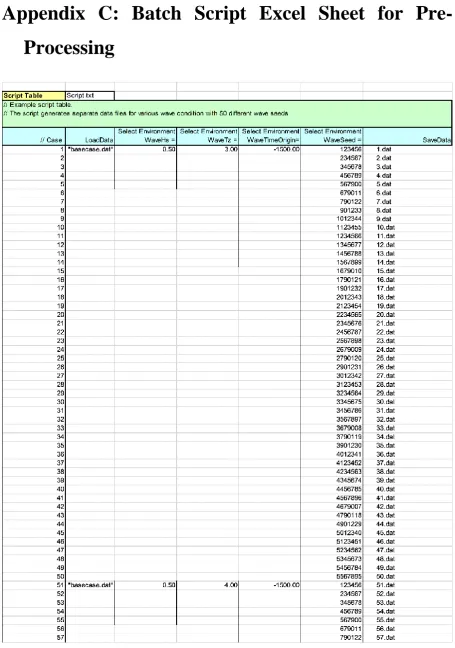
Appendix C: Batch Script Excel Sheet for
[image:28.595.70.526.71.720.2]Pre-Processing
Thesis for Master of Philosophy (Maritime Engineering)
74
Appendix D: Other Parameters for Inputs to Model
Splash Zone Crossing
Operation stages
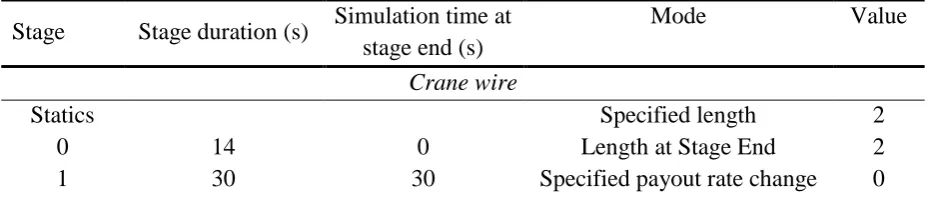
[image:29.595.142.453.310.423.2]The splash zone crossing simulation is made up of several stages, each is given a specified duration. To ensure a smooth transient when starting a simulation, a built-up stage is required and numbered stage 0. The duration of this stage should be set to at least one wave period. The detailed stage information is shown as follows:
Table D-1: Simulation stages and durations
Stage no. Duration (s) Simulation time at stage end (s)
0 14 0
1 30 30
2 5 35
3 5 40
4 10 50
Crane payout when lowering object through free surface
To lower the perforated plate through the free surface, the length control for winches was applied on the crane wire of hoisting system. The tension control was also applied on the tugger winch to stabilize the perforated plate during the splash zone crossing. In addition, the winches were all set by the individual stage, which means that the different control modes can be switched between different stages during the simulation. The winch data is listed as follows:
Table D-2: Control modes for crane wire and tugger winch
Stage Stage duration (s) Simulation time at stage end (s)
Mode Value
Crane wire
Statics Specified length 2
0 14 0 Length at Stage End 2
[image:29.595.66.532.668.769.2]75
2 5 35 Specified payout rate change 0.5
3 5 40 Specified payout rate 0.5
4 10 50 Specified payout rate 0.5
Tugger winch 1&2
Statics Specified tension 5
0 14 0 Specified tension 5
1 30 30 Specified tension 5
2 5 35 Specified tension 0
3 5 40 Specified payout 0
4 10 50 Specified payout 0
Note: Tensions and tension changes are in kN; lengths and payout are in m; payout rates in m/s; tension rates of change are in kN/s.
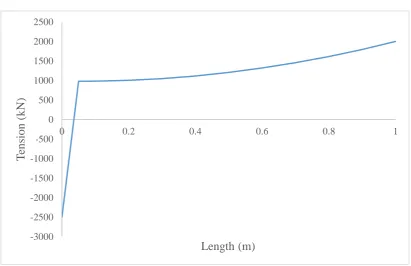
[image:30.595.92.504.353.619.2]Stiffness profile of passive heave compensator
Figure D-2: Stiffness characteristics for passive heave compensator
-3000 -2500 -2000 -1500 -1000 -500 0 500 1000 1500 2000 2500
0 0.2 0.4 0.6 0.8 1
T
ension
(kN
)