i
Predicting the Content of Facebook Status Updates with an Extended Theory of Planned Behaviour
Emma Brown
ii
Statement of Sources
I declare that this report is my own work and that the contributions of others have been duly acknowledged.
……… ………
iii
Acknowledgements
iv
Abstract ... 1
Introduction ... 2
Status Updates on Facebook ... 2
The Theory of Planned Behaviour ... 5
Extending the TPB in the Context of Status Updates ... 7
The Present Study ... 11
Method ... 13
Participants ... 13
Design and Analytical Approach ... 13
Status Update Posting Behaviour. ... 14
Control variables. ... 14
Analysis... 15
Content Analysis ... 15
A priori power analysis. ... 17
Materials ... 17
Procedure ... 21
Results ... 22
Preliminary Data Screening and Assumption Checks ... 22
Descriptive Statistics ... 24
Bivariate Correlations ... 26
Inferential Statistics ... 31
Behavioural Data ... 39
v
Theory of Planned Behaviour ... 41
Extension Variables ... 43
Behaviour from Intention ... 45
Limitations and Additional Considerations for Future Research ... 48
Implications of the Current Research ... 49
Conclusion ... 51
References ... 52
Appendix A ... 62
Appendix A1: Demographic Questionnaire ... 62
Appendix A2: Facebook Intensity Scale ... 62
Appendix A3: TPB Attitude Subscales ... 63
Appendix A4: TPB Subscales ... 64
Appendix A5: Extraversion and Emotionality Subscale ... 66
Appendix A6: Self-Esteem Scale ... 67
Appendix A7: Interpersonal Orientation Scale ... 68
Appendix A8: Social Desirability Scale ... 70
Appendix B ... 72
vi
Table 1……….25 Descriptive Statistics of All Variables
Table 2……….27 Bivariate Correlations of Positive Intention Variables
Table 3……….29 Bivariate Correlations of Negative Intention Variables
Table 4……….33 Multiple Hierarchical Regression Results Predicting Positive Intentions
Table 5……….37 Multiple Hierarchical Regression Results Predicting Negative Intentions
vii
Predicting the Content of Facebook Status Updates with an Extended Theory of Planned Behaviour
Emma Brown
Abstract
The exchange of socioemotional information on the social networking site Facebook is often facilitated through status updates: short messages posted on the user’s wall. This study investigated Facebook users’ intentions to post positively or negatively valenced content in their status updates (Time 1, N= 154), and in turn to examine the relationship between Time 1 intentions and subsequent posting behaviour (Time 2, n= 39). An extended Theory of Planned Behaviour (TPB) approach was taken, with extraversion, neuroticism, self-esteem and need to belong included additional to attitude, subjective norm, and perceived behavioural control. Facebook intensity and social desirability were included as control variables. The final models significantly predicted intentions to post both positively and negatively valenced content in status updates. Positive status update intention was significantly predicted by less social desirability, more favourable subjective norms, greater perceived behavioural
Facebook is the most utilised social networking site, supporting 1.32 billion daily active users worldwide (Facebook Newsroom, 2017). The Facebook platform encourages social connection through ‘status updates’, short messages which express the Facebook user’s current thoughts, feelings and emotions (Winter, 2014). The aim of the current research was to explore the mechanisms that underpin the posting of positively and negatively valenced content in Facebook status updates through the theoretical framework of Ajzen’s Theory of Planned Behaviour (Ajzen, 1991). The TPB has been employed to identify important predictors of internet related
behaviours in past research (Baker & White, 2010), however it has not yet been used to predict users’ intentions to post posively or negatively valenced content in
Facebook status updates. Extension variables (extraversion, neuroticism, self-esteem and need to belong) were added to the TPB model to increase its predictive ability. In addition, the current study measured posting behaviours by viewing participants’ actual Facebook status updates.
Status Updates on Facebook
acquaintances, co-workers, or even strangers and celebrities. Subsequently, social contexts that would remain separate in the face-to-face world are collapsed on Facebook (Utz, 2015)
Posting frequent status updates benefits Facebook users by facilitating social connection with others (Verduyn, Ybarra, Résibois, Jonides, & Kross, 2017). The benefits and resources obtained from one’s social relationships are referred to as “social capital” (Putnam, 1995). Social capital is often considered as comprising two subtypes: bridging and bonding (N. B. Ellison, Vitak, Gray, & Lampe, 2014).
Bridging social capital refers to socially heterogeneous links and is mainly provided through acquaintances or “weak ties”. Bonding social capital is provided by close relationships or “strong ties” and is characterised by increased levels of social support, trust, and companionship (N. B. Ellison et al., 2014). Social support derived from Facebook is associated with subjective well-being (Indian & Grieve, 2014; Verduyn et al., 2017). For example, J. Kim and Lee (2011) found that when
participants shared honest personal information about themselves on Facebook, they perceived greater social support from their friend-network and experienced an increase in subjective wellbeing as a result.
elicits forms of bonding social capital such as social and emotional support (Huang, 2016).
Intimate self-disclosures can be negatively or positively valenced. Shen, Brdiczka, and Liu (2015) found that participants who disclosed more negative and personal experiences in status updates, as identified through the use of more negative and subjective language, had greater success in soliciting social support and empathy from their friend-network than those who refrained from negative self-disclosures. In contrast, Blight, Jagiello, and Ruppel (2015) conducted a study to examine the features of support-seeking status updates on Facebook. Participants provided the researchers with a copy of their status updates and the most supportive comment each status received. Results showed that positively valenced status updates were associated with the greatest perceived social support (Blight et al., 2015). The greater number of positive status updates in the study by Blight et al. (2015) however, may be reflective of Facebook’s positivity norm.
self-disclosures in status updates can be considered too inappropriate for public sharing (Bazarova, 2012). Posting negative status updates in the presence of many weak ties is therefore risky because the friend network may enforce social sanctions to discourage the behaviour such as disapproval, rejection, or betrayal of the
discloser’s confidences (Forest & Wood, 2012). Facebook users are more likely to express negative emotions when their friend-network contains a greater proportion of strong ties because the network is made up of trusting relationships that encourage intimate and honest emotional expression (Lin, Tov, & Qiu, 2014).
The valence of the content posted in Facebook status updates appears to be an important factor in successfully obtaining social capital through Facebook use (Shen et al., 2015). Individual differences that influence emotional expression may influence Facebook users likelihood of sharing positive or negative content in their status updates (Reinecke & Trepte, 2014; Winter, 2014). Due to the consequences of inappropriate emotional disclosure on Facebook, such as social rejection (Forest & Wood, 2012), identifying the variables that predict intention to post positive or negative content may help to improve understanding of how users can obtain social capital (such as social and emotional support) online.
The Theory of Planned Behaviour
behaviour is influenced by three factors; attitude, subjective norms and perceived behavioural control. Attitudes refer to whether the individual feels favourably or unfavourably towards the behaviour, subjective norms describes ones perceived social pressure to perform the behaviour, and perceived behavioural control
describes one’s belief in the likelihood that they will perform the behaviour (Ajzen, 1991).
The TPB model has been used to predict performance of a range of
behaviour. It is therefore possible that the target behaviour for this study, posting of positive or negative content in status updates, is better predicted by the addition of supplementary variables which reflect positive and negative emotional expression. Ajzen (1991) promotes the addition of variables that are supported by sound theoretical justification and account for additional variance beyond that accounted for by the model. In order to improve the TPB’s predictive ability in the current study, measures of neuroticism, extraversion, and self-esteem were included in the model.
Extending the TPB in the Context of Status Updates
Extraversion and Neuroticism. It has been theorised that personality can influence Facebook use through social enhancement and social compensation mechanisms. The social enhancement hypothesis indicates that Facebook users’ online social behaviour is similar to their face-to-face behavior (Hollenbaugh & Ferris, 2014). The opposing theory however, the social compensation hypothesis, suggests that introverted and neurotic individuals benefit from Facebook use because the platform compensates for their social deficits (Stronge et al., 2015).
Personality is considered a leading factor in understanding individual’s Internet related behaviours (Błachnio, Przepiorka, Senol-Durak, Durak, & Sherstyuk, 2017). Both extraversion and neuroticism have been associated with high levels of social media use (Moore & McElroy, 2012) and emotional disclosure on Facebook (Pentina & Zhang, 2016; Seidman, 2013). Extraversion relates to positive
extraverts are likely to have more friends, higher quality friendships, and more satisfying romantic relationships than introverts (Seidman, 2013) which may explain why extraverts tend to have more Facebook friends (Dupuis, Khadeer, & Huang, 2017), make more contact with their Facebook friends (Moore & McElroy, 2012), and post more status updates (Shen et al., 2015). Neuroticism relates to emotional stability and can be defined as the degree of control one has over their emotions (Dupuis et al., 2017). Neurotic individuals are more vulnerable to negative affect, express more negativity, and are more sensitive to threat (Ashton & Lee, 2009). Individuals high in neuroticism tend to experience higher levels of social anxiety and have difficulty socialising in face-to-face environments (Seidman, 2013). On
Facebook, neuroticism is associated with having small friend-networks that consist of a greater proportion of strong ties (Shen et al., 2015) and increased social support seeking (Marshall, Lefringhausen, & Ferenczi, 2015).
considerable limitation of this study however was that the instrument measured participant’s perceived likelihood of engaging in the behaviour but was not a reflection of their actual behaviour (Dupuis et al., 2017).
Shen et al. (2015) avoided this limitation through the use of an online application which directly retrieved data from the profiles of Facebook users, alongside a survey that measured aspects of the users’ personalities. Results
suggested that Facebook users high in neuroticism wrote longer status updates, used more negative words, and shared more personal information in their status updates than extraverts. Alternatively, extraverted Facebook users shared more videos and photos, wrote a higher number of status updates, and were less likely to use negative words in their status updates than neurotic users (Shen et al., 2015).
Self-Esteem. Self-esteem is an evaluation of one’s own worth which
individuals are motivated to improve or maintain (Rosenberg, Schooler, Schoenbach, & Rosenberg, 1995). Individuals with low esteem have an overall
self-evaluation that is mainly negative whilst those with high self-esteem have more positive overall self-evaluations (Wood, Heimpel, & Michela, 2003). Individuals with high self-esteem experience more positive affect and were found by
Hollenbaugh and Ferris (2015) to make more positive self-disclosures on Facebook. Individuals with low self-esteem tend to experience more negative affect, have less satisfying relationships, feel lonelier, and are more likely to experience anxiety or depressive disorders than those with high self-esteem (Forest & Wood, 2012).
participant’s posted on Facebook was determined by coding the valence (positive of negative) of participants’ 10 most recent status updates. Results showed that
Facebook users low in self-esteem expressed more negativity and less positivity in their status updates (Forest & Wood, 2012).
Need to Belong. The belongingness hypothesis states that humans are driven to form and maintain intimate social bonds with others (Stronge et al., 2015), which is a key motivation for Facebook use (Nadkarni & Hofmann, 2012). Status updates facilitate a sense of belonging as they are a means for affiliation, maintaining connections with weak ties, and forming a sense of community (Winter, 2014). Tobin, Vanman, Verreynne, and Saeri (2015) found that when frequent Facebook users were prohibited from sharing any form of information (including status
updates) on Facebook for 48 hours, they had lower levels of belonging than they had prior to the experiment.
The Present Study
This study aimed to investigate the variables that influence Facebook user’s intentions regarding the content of their status updates (positive or negative). The theoretical framework of the TPB with the addition of extension variables
(extraversion, neuroticism, self-esteem and need to belong) was used to determine the variables that predict intentions to post positively and negatively valenced Facebook status updates.
A major limitation of past research engaging the TPB to investigate Facebook related behaviours is that there is no measure of Facebook users actual behaviour (Baker & White, 2010; Tariq, Sajjad, Usman, & Amjad, 2017). Most research examining behaviours on social media rely on self-report (Dupuis et al., 2017; Seidman, 2013). The current study intended to amend this by viewing
Facebook users’ status updates from their personal Facebook walls. Viewing actual Facebook content to obtain a measure of behaviour has been found to provide a more effective and accurate reflection of behaviour (Moore & McElroy, 2012) and allows for stronger conclusions to be drawn.
The TPB has effectively predicted intention and actual performance of Facebook related behaviours in past research (Baker & White, 2010; Pelling & White, 2009; Tariq et al., 2017). Therefore, the following hypotheses were made:
Hypothesis 1a: The TPB variables (attitudes, subjective norms, perceived behavioural control) would significantly predict intention to post positive content in status updates.
Facebook users high in extraversion tend to experience and express more positive affect and use the Facebook platform to supplement their offline social lives (Moore & McElroy, 2012). Facebook users high in neuroticism tend to experience and express more negative affect and use the Facebook platform to obtain social capital that cannot be obtained offline (Shen et al., 2015). Based on these finding the following hypotheses were made:
Hypothesis 2a: High levels of extraversion would predict intention to post positive content in status updates.
Hypothesis 2b: High levels of neuroticism would predict intention to post negative content in status updates.
Self-esteem levels influence the expression of positively or negatively valenced status updates in that low self-esteem is associated with experiencing and expressing more negative affect than high self-esteem (Forest & Wood, 2012). These patterns of emotional expression were expected to appear in status updates in the current study. Therefore, the following was hypothesised:
Hypothesis 3a: High levels of self-esteem would predict intention to post positive content in status updates.
Hypothesis 3b: Low levels of self-esteem would predict intention to post negative content in status updates.
Hypothesis 4a: High levels of the need to belong factors (positive stimulation, emotional support, social comparison and attention) would predict positive content in status updates.
Hypothesis 4b: Low levels of the need to belong factors (positive stimulation, emotional support, social comparison and attention) would predict positive and negative content in status updates.
Finally, as behavioural intention predicts a variety of behaviours, including Facebook related behaviours (Tariq et al., 2017), it was therefore hypothesised that:
Hypothesis 5a: Intention to post positive content would predict actual posting of positive content in status updates.
Hypothesis 5b: Intention to post negative content would predict actual posting of negative content in status updates.
Method
Participants
The sample comprised of 142 (114 female, 28 male) participants with a mean age of 30.05 years (SD = 13.3, range 18 - 66). Eligible participants were 18 years of age or over and were Facebook users.
Design and Analytical Approach
attention, positive stimulation, and social comparison), and the outcome variable intention to post status updates (positive and negative). At Time 2, the content of each participant’s status updates were recorded to obtain an objective measure of whether participant’s post positively or negatively valenced content in their status updates. This was the behavioural outcome measure.
Status Update Posting Behaviour. The target behaviour was defined as posting frequent status updates on Facebook that contained positively or negatively valenced content. Frequent posting was operationalised as posting a status update once a week or more often (Tokunaga & Quick, 2017) .
Direct observation of participants’ status updates on their personal Facebook wall provided an objective measure of status update valence for content analysis. With participant consent, status updates were recorded by using the screenshot feature on a computer to capture the status update, the date the status update was posted, and the number of likes and reacts collected by the status update. Each status update was pasted directly into a word document together with the participant’s name and their number of Facebook friends. The document was then stored in a secure, password protected computer file and labeled numerically (e.g. Participant1) to protect confidentiality.
Participants were not informed of an exact date on which their status updates would be accessed and recorded. This was to reduce the likelihood that participants would monitor their status update posting behaviour, reducing social desirability effects. However, all Facebook profiles were accessed approximately 3 weeks after completion of the Time 1 questionnaires.
intensity was included in the regressions. As individuals high in social desirability tend to present themselves more positively to obtain social approval (King & Bruner, 2000), and mindful that the Facebook platform encourages positive expressions of the self (Reinecke & Trepte, 2014), social desirability was also entered as a control variable.
Analysis. Two hierarchical multiple regression analyses were conducted to predict intention to post positive content in status updates and intention to post negative content in status updates. Control variables (social desirability and Facebook intensity) were entered in the first block, the TPB variables (attitudes, subjective norms, perceived behavioural control) were entered in the second block, and the extension variables (extraversion, emotionality, self-esteem, emotional support, attention, positive stimulation, and social comparison) were entered in the third block to identify whether they explained additional variance in the model beyond variance explained by the TPB variables. Pearson’s correlation analyses examined whether intention to post positive content in status updates related to actual posting of positive content, and whether intention to post negative content in status updates related to actual posting of negative content.
Status updates were coded as strong positive when they expressed extreme positivity. An example strong positive status update was “Got engaged! I’ve never been happier!”. Status updates coded as positive and slight positive encompassed the topics: happiness, excitement, sharing accomplishments, expressing love or appreciation, participating in an enjoyable activity (Dupuis et al., 2017), and sharing content considered funny, pleasant, or interesting including images, videos, or memes. Memes are a genre of items (video, text, cartoon, or images), that are considered humorous and shared widely throughout social media (Wiggins, 2015).
A neutral status update contained information but was not positively or negatively valenced. For example, “Does anyone want cardboard boxes?”
Status updates coded as slightly negative or negative comprised of the following topics: feeling lonely, sad, angry, mad or depressed, describing a situation that is stressful, scary or frustrating, major world events that have had negative outcomes, and sharing content considered upsetting, or unjust (Dupuis et al., 2017). Status updates were coded as strong negativity when they expressed extreme negativity. For example; “I am emotionally wrecked…I’ve been keeping myself so busy to try and ignore the misery that is my existence, but I’m very quickly burning out”.
was only included in the analysis if the participant contributed their own thoughts, opinions, ideas or emotions in the post.
To ensure inter-coder reliability, a subset of 122 status updates was
independently coded by a second rater. Scores between the two raters were strongly,
positively correlated, r(120)=.845, p<.001.
A priori power analysis. The appropriate sample size for a regression model with 10 predictor variables was determined using the G*Power analysis program (Faul, Erdfelder, Buchner, & Lang, 2009). Medium to large effect sizes were expected based on past research on internet related behaviours (Al-Debei et al., 2013; Baker & White, 2010; E. Kim, Lee, Sung, & Choi, 2016; Tariq et al., 2017). Based on finding a medium effect size (f2= .15, Cohen, 1997) with alpha set at .05 and a desired power of .8, the recommended sample size was 118. The sample size exceeded this recommendation.
Materials
Copies of all items are presented in Appendix A.
measure of intensity of Facebook use (Burke, Marlow, & Lento, 2010), with very good internal consistency (α = .85, (Lowe-Calverley & Grieve, in press).
Social Desirability. The short form Social Desirability Scale (Crowne & Marlowe, 1960) was used (13 items). Participants indicate whether each item was true or false as it pertained to them. An example item was, ‘I sometimes feel resentful when I don’t get my way’. The 13 item short form scale was found by Reynolds (1982) to be a reliable and valid measure of social desirability. The
Kuder-Richardson formula 20 coefficient is .76 indicating satisfactory internal consistency (Reynolds, 1982).
Theory of Panned Behaviour Questionnaire. Items were developed to measure TPB (Ajzen, 1991) variables in regards to posting both positive and negative status updates, and were written per Ajzen’s recommendations (2002) and in line with other research examining antecedents to online behaviour (E. Kim et al., 2016; Tariq et al., 2017).
Attitude items measured the participant’s overall evaluation of performing the target behaviour (Ajzen, 2002), evaluating both experiential (feelings towards performing the behaviour) and instrumental (beliefs regarding the results of
behaviour) aspects. Attitudes were assessed using eight 7-point semantic differential response scales (four each for positive and negative status updates). Participants responded to the statements; ‘For me to post a status update that contains positive [negative] emotions would be’ with anchors ranging from Harmful (1) to Beneficial (7), Pleasant (1) to Unpleasant (7), Bad (1) to Good (7), and Worthless (1) to
Subjective norms items measured perceived social pressure to perform the target behaviour. Six items reflected both injunctive norms (perceptions of which behaviours are approved of and disapproved of) and descriptive norms (perceptions of which behaviours are typically performed by others). For example, items included ‘The people in my life whose opinions I value think that I should post status updates containing positive [negative] emotions on Facebook’ and ‘Most people who are important to me post status updates on Facebook that contain positive [negative] emotions’. Participants rated their agreement on a Likert scale with anchors ranging from Strongly agree (7) to Strongly disagree (1). Higher scores indicated greater perceived pressure to perform the behaviour.
Perceived behavioural control items measured the participant’s confidence in their ability to perform the behaviour. Three items reflected the participant’s sense of self-efficacy with regards to performing the behaviour, for example; ‘If I wanted to I could post a status update containing positive [negative] emotion on Facebook’. A further three items measured participant’s control over performing the behaviour, for example; ‘I have complete control over whether I post a status update containing positive [negative] emotion on Facebook’. Participants rated their agreement with each item with anchors ranging from Strongly agree (7) to Strongly disagree (1) with higher scores indicated higher levels of perceived behavioural control over performing the behaviour.
containing positive [negative] emotion within the next two weeks?. Higher scores indicate stronger behavioural intention.
Extraversion and Neuroticism. The extraversion and emotionality
subscales from the HEXACO-60 (Ashton & Lee, 2009) were used. Subscales consist of ten items each, some of which were reversed. Sample items are ‘I feel reasonably satisfied with myself overall’ (extraversion) and ‘I sometimes can’t help worrying about little things’(emotionality). Participants responded using a 5-point Likert scale with anchors ranging from Strongly Agree (5) to Strongly Disagree (1). Higher scores on the subscales indicated higher levels of the construct. The HEXACO-60 is a valid measure of personality (Lee & Ashton, 2004) and both the extraversion and emotionality subscales have good internal consistency (α = .78 and .77 respectively; (R. Grieve, 2012).
Self Esteem. The Rosenberg Self-Esteem Scale was assessed trait self-esteem (Rosenberg, 1979). The scale consists of 10 items including, ‘On the whole, I am satisfied with myself’. Participants responded on a 4-point Likert scale with anchors ranging from Strongly agree (4) to Strongly disagree (1). Some items in the scale were reversed to reduce bias. Higher scores indicated higher levels of trait self-esteem. The Rosenberg Self-Esteem scale has been found to be a valid measure of self-esteem across genders and ethnicities. Cronbach’s alpha indicates good internal consistency (α = .88, Greenberger, Chen, Dmitrieva & Farruggia, 2002).
contact with others more than most people realise”. The emotional support subscale (six items) measures the extent to which social contact reduces negative affect. For example; “One of my greatest sources of comfort when things get rough is being with other people”. The social comparison subscale comprises five items measuring desire to reduce stress by looking to similar others for behavioural cues in
ambiguous social situations. An example item is “I prefer to participate in activities alongside other people rather than by myself because I like to see how I am doing on the activity”. The attention subscale consists of six items that reflect the desire to be viewed positively and approved of by others. For example; “I mainly like people who seem strongly drawn to me and who seem infatuated with me”. Participants responded using a 5-point Likert scale to indicate how true they perceive each statement to be of them, with anchors ranging from Not at all true (5) to Completely true (1). Higher scores indicated less need to belong. Cronbach’s alpha coefficient of the subscales ranged from α = .77 - .84 (Leary, Kelly, Cottrell, & Schreindorfer, 2013) indicating good internal consistency.
Procedure
Ethics approval was obtained from the Tasmanian Human Research and Ethics Committee (reference number H0016679, Appendix B). Participants were recruited via word of mouth, advertisements on social media, posters, as well as on the SONA research participation system. Participation was voluntary.
updates to Facebook were invited to send a Facebook ‘friend request’ from their personal Facebook account to the research project’s Facebook page so that their status updates could be accessed and recorded. The research Facebook page was called ‘Emma Brown (Facebook Status Update Study)’. In line with Moore and McElroy’s (2012) methodology, the research Facebook page was created specifically for the study and was clearly identifiable to participants as being for research
purposes only.
Each participant’s friend request was accepted three weeks after submission of the survey (i.e., Time 2). When a friend request was accepted the participant’s Facebook wall became publically viewable by the researcher. All status updates within the 3-week time period were recorded verbatim. The participant was then sent a private message on Facebook thanking them for their participation and they were ‘unfriended’ by the research Facebook page. Following participation, all participants were invited to enter the draw to win one of six $50 gift vouchers or to receive 30 minutes of research credit if applicable.
When data collection and coding of status updates was complete, each
participant’s survey responses and their behavioural measures were linked in a single data set. At this point the participant’s names were deleted from the file so that no identifying information remained, ensuring anonymity for data analysis.
Results
Preliminary Data Screening and Assumption Checks
influential to the model predicting negativity intentions. This violates the assumption of homoscedasticity which assumes that the residuals have a constant variance at each level of the predictors (Tabachnick & Fidell, 2014). Partial plots of the
residuals were viewed and, after the removal of outliers, the residuals vary randomly and evenly around zero suggesting the assumption was met (Tabachnick & Fidell, 2014). Removed these cases left separate data sets for the analysis of positivity intentions and negativity intentions.
Probability plots for each variable showed that the residuals did not deviate from the diagonal suggesting a normal distribution (Field, 2013).
Linearity assumes that the outcome variable is linearly related to the
predictor variables (Tabachnick & Fidell, 2014). Scatterplots showed that residuals were randomly and evenly scattered around zero which indicated linear relationships between intentions to post positive status updates and the predictor variables and between intentions to post negative status updates and the predictor variables (Tabachnick & Fidell, 2014)
The assumption of independent errors is that the residual terms are not correlated. The Durbin-Watson test revealed values greater than 1 and less than 3 for both the model predicting positivity intentions (1.52) and the model predicting negativity intentions (1.73). Based on recommendations by (Tabachnick & Fidell, 2014) this assumption was considered met.
Descriptive Statistics
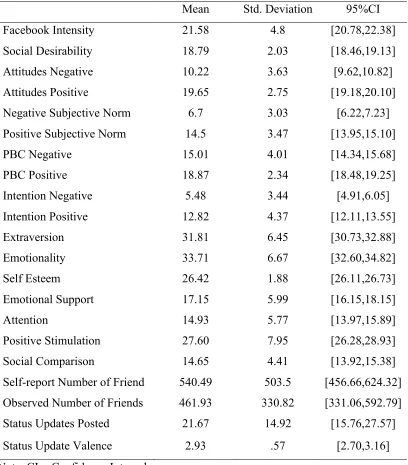
The means, standard deviations, and 95% Confidence Intervals of all variables are presented in Table 1. Participants in the present study reported similar levels of extraversion and neuroticism as reported in Grieve and Watkinson (2016). Self-esteem scores were found to be within the expected range for the sample population based on norms reported by Sinclair et al. (2010). Attention, positive stimulation, social comparison and emotional support means and standard deviations were comparable to means and standard deviations reported by Hill (1987). Internal consistency reliabilities (Cronbach’s α) of the TPB scales were generally between good and excellent except for the subjective norms scales which suggested
Table 1
Descriptive Statistics of All Variables
Mean Std. Deviation 95%CI
Facebook Intensity 21.58 4.8 [20.78,22.38]
Social Desirability 18.79 2.03 [18.46,19.13]
Attitudes Negative 10.22 3.63 [9.62,10.82]
Attitudes Positive 19.65 2.75 [19.18,20.10]
Negative Subjective Norm 6.7 3.03 [6.22,7.23]
Positive Subjective Norm 14.5 3.47 [13.95,15.10]
PBC Negative 15.01 4.01 [14.34,15.68]
PBC Positive 18.87 2.34 [18.48,19.25]
Intention Negative 5.48 3.44 [4.91,6.05]
Intention Positive 12.82 4.37 [12.11,13.55]
Extraversion 31.81 6.45 [30.73,32.88]
Emotionality 33.71 6.67 [32.60,34.82]
Self Esteem 26.42 1.88 [26.11,26.73]
Emotional Support 17.15 5.99 [16.15,18.15]
Attention 14.93 5.77 [13.97,15.89]
Positive Stimulation 27.60 7.95 [26.28,28.93]
Social Comparison 14.65 4.41 [13.92,15.38]
Self-report Number of Friend 540.49 503.5 [456.66,624.32] Observed Number of Friends 461.93 330.82 [331.06,592.79]
Status Updates Posted 21.67 14.92 [15.76,27.57]
Status Update Valence 2.93 .57 [2.70,3.16]
Bivariate Correlations
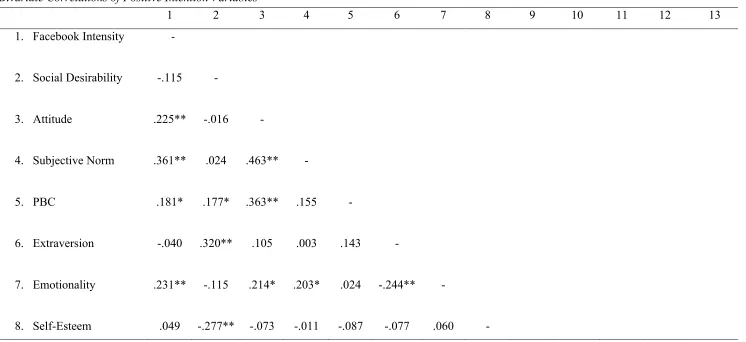
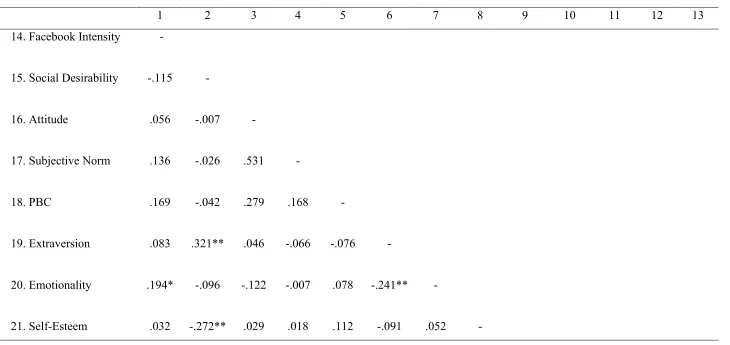
All effect sizes are interpreted in line with Cohen’s (1992) recommendations. The correlation matrices containing the predictor variables for intention to post positive content and intention to post negative content are presented in Table 2 and 3 respectively. All TPB subscales (attitude, subjective norms, PBC) showed weak to moderate relationships with one another. There were also moderate to strong relationships between the TPB variables and intention variables (except for PBC with intention to post negative content). Validation of the TPB in past research has found similar patterns of correlation (Armitage & Conner, 2001).
27
1 2 3 4 5 6 7 8 9 10 11 12 13
1. Facebook Intensity -
2. Social Desirability
-.115 -
3. Attitude .225** -.016 -
4. Subjective Norm .361** .024 .463** -
5. PBC .181* .177* .363** .155 -
6. Extraversion -.040 .320** .105 .003 .143 -
7. Emotionality .231** -.115 .214* .203* .024 -.244** -
[image:34.842.63.809.155.497.2]8. Self-Esteem .049 -.277** -.073 -.011 -.087 -.077 .060 - Table 2
28 9. Emotional Support .243** -.131 .173* .152 -.017 .185* .510** .214* -
10. Attention .332** -.252** -.002 .258** .033 -.043 .256** .217** .719** -
11. Positive Stimulation .217** -.015 .220** .148 .063 .178* .358** .186* .687** .499** -
12. Social Comparison .274** -.138 .038 .141 .023 -.012 .332** .202* .243** .673** .709** -
13. Positive Intention .219** -.114 .485** .638** .300* -.025 .164 .059 .113 .140 .189* .069 -
Note. PBC = Perceived behavioural control.
29
1 2 3 4 5 6 7 8 9 10 11 12 13
14. Facebook Intensity -
15. Social Desirability -.115 -
16. Attitude .056 -.007 -
17. Subjective Norm .136 -.026 .531 -
18. PBC .169 -.042 .279 .168 -
19. Extraversion .083 .321** .046 -.066 -.076 -
20. Emotionality .194* -.096 -.122 -.007 .078 -.241** -
[image:36.842.73.803.155.500.2]21. Self-Esteem .032 -.272** .029 .018 .112 -.091 .052 - Table 3
30 Note. PBC = Perceived behavioural control.
*p < .01, **p < .001.
1. Emotional Support .308** -.135 -.036 .106 -.041 .181* .492** .221** -
2. Attention .324** -.270** .032 .166* -.025 -.055 .283** .239** .526** -
3. Positive Stimulation .273** -.028 -.002 .116 -.012 .183* .358** .183* .727** .530** -
4. Social Comparison .687** -.137 -.054 .084 -.066 .011 .318** .210* .687** .694** .719** -
Inferential Statistics
Hierarchical Multiple Regression Predicting Intention to Post Positive
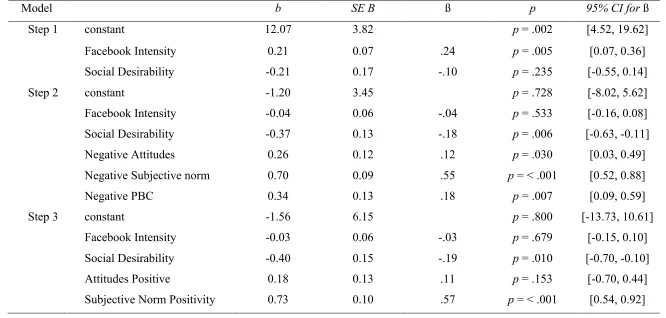
Status Updates. Table 4 presents the results of the three step hierarchical multiple
regression analysis predicting intentions to post positive content in Facebook status updates from the TPB variables (attitude, social norms, and PBC) and the extension variables (extraversion, neuroticism, self-esteem, attention, positive stimulation, social comparison, and emotional support), controlling for Facebook intensity and social desirability.
In Step One, Facebook intensity and social desirability explained 7.1% of variance of intentions to post positive status updates, R = .26, adjusted R2 = .057, F (2, 141) = 5.36, p = .006, and showed a small effect ƒ2 = .07. Facebook intensity significantly predicted a stronger intention to post positive status updates in the future, however social desirability was not a significant individual predictor.
Step Two included attitude, subjective norms, and PBC in the model,
R = .69, F (5,138) = 26.43, p < .001. The variables explained an additional 41.9% of variance, a significant improvement in the model, adjusted ∆R2 = .47, F∆ (3, 138) = 37.69, p = < .001, and showed a large effect ƒ2 = .96. Less social desirability, higher attitudes, higher subjective norms and higher PBC significantly predicted a stronger intention to post positive status updates in the future but Facebook intensity did not.
Step Three included extraversion, neuroticism, self-esteem, attention,
33 Table 4
Multiple Hierarchical Regression Results Predicting Positivity Intentions
Model b SE B ß p 95% CI for ß
Step 1 constant 12.07 3.82 p = .002 [4.52, 19.62]
Facebook Intensity 0.21 0.07 .24 p = .005 [0.07, 0.36]
Social Desirability -0.21 0.17 -.10 p = .235 [-0.55, 0.14]
Step 2 constant -1.20 3.45 p = .728 [-8.02, 5.62]
Facebook Intensity -0.04 0.06 -.04 p = .533 [-0.16, 0.08]
Social Desirability -0.37 0.13 -.18 p = .006 [-0.63, -0.11]
Negative Attitudes 0.26 0.12 .12 p = .030 [0.03, 0.49]
Negative Subjective norm 0.70 0.09 .55 p = < .001 [0.52, 0.88]
Negative PBC 0.34 0.13 .18 p = .007 [0.09, 0.59]
Step 3 constant -1.56 6.15 p = .800 [-13.73, 10.61]
Facebook Intensity -0.03 0.06 -.03 p = .679 [-0.15, 0.10]
Social Desirability -0.40 0.15 -.19 p = .010 [-0.70, -0.10]
Attitudes Positive 0.18 0.13 .11 p = .153 [-0.70, 0.44]
34
PBC Positive 0.37 0.13 .20 p = .005 [0.11, 0.62]
Extraversion -0.03 0.05 -.05 p = .514 [-0.14, 0.07]
Emotionality -0.01 0.05 -.02 p = .794 [-0.12, 0.09]
Self-esteem 0.08 0.15 .04 p = .581 [-0.22, 0.38]
Emotional Support -0.04 0.08 -.05 p = .639 [-0.20, 0.12]
Attention -0.04 0.07 -.05 p = .570 [-0.18, 0.10]
Positive Stimulation 0.14 0.06 .25 p = .018 [0.02, 0.25]
Social Comparison -0.13 0.11 -.13 p = .226 [-0.35, 0.08]
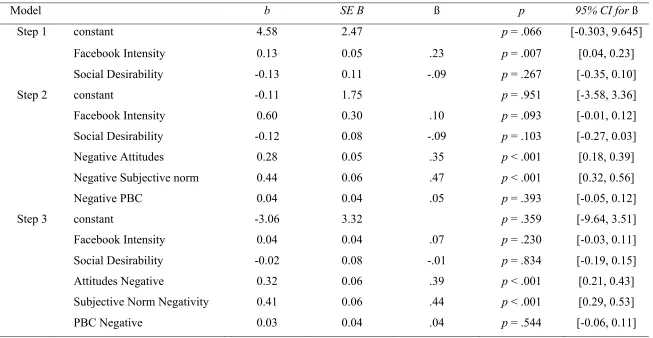
34 Hierarchical Multiple Regression Predicting Intention to Post Negative
Status Updates. Table 5 presents the results of the three step hierarchical multiple
regression analysis predicting intentions to post negative content in Facebook status
updates from the TPB variables (attitude, social norms, and PBC) and the extension
variables (extraversion, neuroticism, self-esteem, attention, positive stimulation,
social comparison, and emotional support), controlling for Facebook intensity and
social desirability.
In Step One, Facebook intensity and social desirability explained 5.2% of
variance of positivity intentions, R = .26, adjusted R2 = .052, F (2, 138) = 4.86, p = .009, and showed a moderate effect ƒ2 = .34. Facebook intensity significantly
predicted a stronger intention to post positive status updates in the future however
social desirability was not a significant individual predictor.
Step Two included attitude, subjective norms and PBC in the model, R = .77,
F (5,135) = 4.86, p < .001. The variables explained an additional 52.6% of variance,
a significant improvement in the model, adjusted R2 = .057, ∆R2 = .57, F∆ (3, 135) =
57.90, p < .001, and showed a large effect ƒ2 = 3.33. Attitudes and subjective norms
significantly predicted a stronger intention to post positive status updates in the
future but Facebook intensity, social desirability and PBC did not contribute
significantly to the model.
Step Three included extraversion, neuroticism, self-esteem, attention,
positive stimulation, social comparison, and emotional support in the model, R = .79,
F (12,128) = 17.7, p < .001. The variables explained an additional 3.4% of variance and this change was not significant, adjusted R2 = .059, ∆R2 = .59, F∆ (7, 128) =
34 When all predictors were entered into the model, more favourable attitudes and
higher subjective norms positively predicted negativity intentions. No other
37 Table 5
Multiple Hierarchical Regression Results Predicting Negativity Intentions
Model b SE B ß p 95% CI for ß
Step 1 constant 4.58 2.47 p = .066 [-0.303, 9.645]
Facebook Intensity 0.13 0.05 .23 p = .007 [0.04, 0.23]
Social Desirability -0.13 0.11 -.09 p = .267 [-0.35, 0.10]
Step 2 constant -0.11 1.75 p = .951 [-3.58, 3.36]
Facebook Intensity 0.60 0.30 .10 p = .093 [-0.01, 0.12]
Social Desirability -0.12 0.08 -.09 p = .103 [-0.27, 0.03]
Negative Attitudes 0.28 0.05 .35 p < .001 [0.18, 0.39]
Negative Subjective norm 0.44 0.06 .47 p < .001 [0.32, 0.56]
Negative PBC 0.04 0.04 .05 p = .393 [-0.05, 0.12]
Step 3 constant -3.06 3.32 p = .359 [-9.64, 3.51]
Facebook Intensity 0.04 0.04 .07 p = .230 [-0.03, 0.11]
Social Desirability -0.02 0.08 -.01 p = .834 [-0.19, 0.15]
Attitudes Negative 0.32 0.06 .39 p < .001 [0.21, 0.43]
Subjective Norm Negativity 0.41 0.06 .44 p < .001 [0.29, 0.53]
38
Extraversion -0.06 0.03 -.13 p = .065 [-0.11, 0.00]
Emotionality -0.01 0.03 -.01 p = .886 [-0.07, 0.06]
Self-esteem 0.08 0.09 .05 p= .388 [-0.10, 0.25]
Emotional Support 0.01 0.05 .02 p = .862 [-0.87, 0.10]
Attention 0.02 0.04 .04 p = .645 [-0.06, 0.10]
Positive Stimulation -0.02 0.03 -.05 p = .594 [-0.08, 0.05]
Social Comparison 0.09 0.06 .13 p = .184 [-0.04, 0.21]
Behavioural Data
From the 141 participants who completed the measures at Time 1, 39
participants contributed data at Time 2 (5 male, 34 female, age = 26.64, range 18 -
53). Out of the participants at Time 2, data on the number of friends in the
participant’s friend network could only be obtained from 27 participants due to the
use of privacy settings restricting the viewership of this information. Descriptive
statistics for the behavioural data are presented in Table 1. Behavioural variables
include valence of Facebook status updates, the number of status updates posted in
the three-week period, and the number of friends in the friend network.
On average, participants in the sample posted 3 status updates per week and
had an average of 462 people in their friend-network.
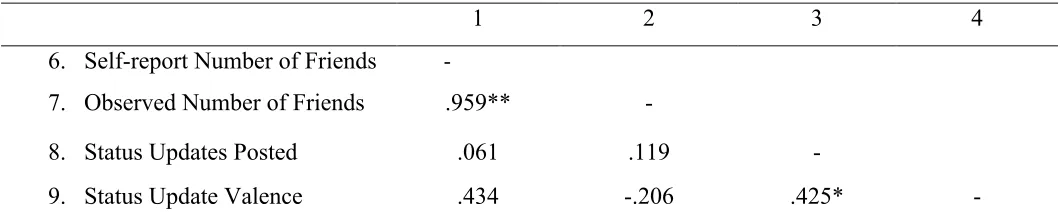
A correlation matrix containing the behavioural variables is presented in
Table 6.
A Pearson correlation analyses showed that there was no significant
relationship between the number of friends in the friend-network and the number of
status updates posted, (n= 27), r(25) = .12, 95% CI [-.27, .47], p = .555. A further
analysis showed a strong positive relationship between self-reported number of
friends and actual number of friends in the friend-network, (n= 27), r(25) = .96, 95%
40 Table 6
Correlations between Behavioural Variables.
1 2 3 4
6. Self-report Number of Friends -
7. Observed Number of Friends .959** -
8. Status Updates Posted .061 .119 -
9. Status Update Valence .434 -.206 .425* -
40
Relationship between Intentions and Status Update Valence
Pearson correlation analyses showed the relationship between intentions and
actual behaviour. As previously described, status updates were coded using a 7-point
Likert scale (1= Strong positive to 7= Strong negative). Overall, status updates in
the sample tended to be positive to slightly positive. There was no significant
relationship between self-reported intention to post positive status updates at Time 1
and actual positively valenced status updates as collected at Time 2, (n= 39), r(37) =
.03, 95% CI [-0.28, 0.34], p = .846. Only a small effect was evident (Cohen, 1992),
and only 0.09% of variance in actual positive status update posting behaviour was
explained by intention to post positive status updates. There was a significant
relationship between self-reported intention to post negative status updates at Time 1
and actual negatively valenced status updates as collected at Time 2, (n= 39), r(37)=
.56, 95% CI [0.29, 0.74], p < .001. This represented a large effect (Cohen, 1992),
with 31.36% of variance in negative status update posting behaviour explained by
intentions to post negative status updates.
Discussion
This study tested the utility of an extended TPB model, incorporating
extraversion, neuroticism, self-esteem, and the need to belong, to predict intentions
to post positively or negatively valenced content in Facebook status updates. The
study also investigated whether intentions to post positively or negatively valenced
content in status updates anticipated actual performance of the behaviour.
Theory of Planned Behaviour
The first hypothesis, that the TPB variables of attitude, subjective norms and
40 positive (hypothesis 1a) and negative (hypothesis 1b) content in status updates was
supported. In the final model, attitudes were a significant predictor of both intentions
to post positively valenced and negatively valenced status updates, with favourable
attitudes towards posting positive or negative content in status updates positively
influencing the behavioural intention. This finding was in line with numerous
studies examining attitudes towards intentions in Internet behaviour (Baker &
White, 2010; E. Kim et al., 2016; Pelling & White, 2009; Tariq et al., 2017).
Subjective norms were the strongest predictors of both intentions to post
positively and negatively valenced status updates. These findings are inconsistent
with some past research which have found subjective norms to be a weak or
non-significant predictor of behaviour (Armitage & Conner, 2001; Baker & White,
2010). Armitage and Conner (2001) suggest that a weak effect of subjective norms
in the TPB is a consequence of no explicit social pressure to perform a particular
behaviour. The role of subjective norms in the current study is therefore indicative of
the strong role of social norms on Facebook. The most prominent social norm on
Facebook, the positivity bias, indicates that Facebook users’ prefer to post positive
content in status updates as negative content carries social risks such as disapproval
or rejection from the friend network (Forest & Wood, 2012). The current findings
suggest that Facebook users consider these social pressures when making decisions
about what content to post in status updates.
Perceived behavioural control was a significant predictor of intention to post
positive, but not negative content. Relevant research shows inconsistencies in the
predictive ability of PBC for internet related behaviours (Al-Debei et al., 2013;
Pelling & White, 2009; Tariq et al., 2017). Variabilities in research findings are
40 users typically write status updates to ‘update’ their friend-networks about recent
thoughts and experiences (Dupuis et al., 2017). As posting positively valenced status
updates is the norm on Facebook (Reinecke & Trepte, 2014), the current findings
may reflect participant’s beliefs that posting positive content in a status update is
easy and under one’s control, whilst posting negative content is in reaction to a
negative experience and hence, not under volitional control.
The current study also controlled for social desirability, which was found to
be a significant negative predictor of positive status updates. This result was
unexpected as social desirability is associated with the desire to present the self
positively. This highlights the utility of incorporating the social desirability scale as a
control in TPB experiments which rely heavily on self-report data (Armitage &
Conner, 2001).
Large effect sizes were evident for each regression including the TPB and
control variables. Overall, it seems that the TPB is an effective model for predicting
intentions to post positively or negatively valenced content in Facebook status
updates.
Extension Variables
An interesting finding was the non-significance of the extension variables in
predicting the intention to post positive or negative status updates. Hence,
hypotheses 2a and 2b were not supported in that extraversion did not predict
intention to post positive content and neuroticism did not predict intention to post
negative content. Hypotheses 3a and 3b were also not supported in that high
self-esteem did not predict intention to post positive content and low self-self-esteem did not
predict intention to post negative content. The hypothesis that high levels of the need
40 attention) would predict positive content in status updates (4a) was only partially
supported. Positive stimulation predicted intention to post positive status updates.
This finding is in line with the theoretical implications of the social enhancement
hypothesis which states that Facebook users’ online social behaviour is similar to
their face-to-face behaviour (Hollenbaugh & Ferris, 2014). The current data indicate
that Facebook users might use positive updates to augment existing social ties.
Facebook, therefore, provides an additional channel through which users’ can benefit
from interpersonal relationships. Research supports this theory in that sharing status
updates with the friend-network allows users’ to derive positive stimulation from
feeling socially connected on Facebook (Blight et al., 2015).
Hypothesis 4b, that low levels of the need to belong variables will predict
negative and positive content in status updates was not supported. This hypothesis
was based on the theoretical implications of the positivity bias. If Facebook users are
not motivated to belong on Facebook then they would be less likely to conform to
the positivity bias because they are not impacted by social pressures to act in a
socially acceptable way (Reinecke & Trepte, 2014). It is also possible however, that
Facebook users not motivated to seek belonging on Facebook post infrequent status
updates (Phua, Jin, & Kim, 2017). When not motivated to maintain social ties,
Facebook users’ may instead use Facebook passively for information gathering,
viewing content posted on Facebook but not contributing to or interacting with the
content (Davenport, Bergman, Bergman, & Fearrington, 2014).
Broadly, the findings that the extension variables do not predict emotional
valence in status updates is in line with the sufficiency assumption; that the TPB
variables are sufficient to predict intention and behaviour and additional variables to
40 challenged as past research has identified additional variables which account for
variance in behaviour beyond that accounted for by intention and PBC (Tariq et al.,
2017). In the current study, the non-significance of the extensions variables perhaps
indicates that they were not specific enough to status update posting behaviour
(Ajzen, 2011). Personality and self-esteem are considered global traits because their
effects remain stable over time and varying situations (Ashton & Lee, 2009; Scheier,
Carver, & Bridges, 1994). The influence of the personality and self-esteem variables
therefore, were likely mediated by the TPB variables (Conner & Abraham, 2001).
For example, in Darvell, Walsh and White’s (2011) study using the TPB to predict
partner monitoring behaviour on Facebook, the self-esteem variable was not a
significant variable because it measured general self-worth as opposed to ones
perceived self-worth within a relationship (Darvell et al., 2011).
Future research incorporating the TPB to predict emotional disclosure in
status updates should build on these findings and identify variables that are
behaviour-specific to posting Facebook status updates. For example, instead of
personality as a predictor of emotional disclosure, future research may consider
emotional state. For example, experiencing psychological distress such as depression
has been identified in past research to predict expression of more negative emotions
on Facebook (Bazarova, Choi, Whitlock, Cosley, & Sosik, 2017).
Behaviour from Intention
A strength of this study was that behavioural data was obtained through
examination of participants’ actual Facebook status updates. Intentions were
measured at Time 1, with behaviours measured at Time 2 (three weeks later). This
method provided a more reliable measure of status update posting behaviour than
40 actual behaviour was a novel contribution of the current study as much of the
research incorporating the TPB relies on self-report (Baker & White, 2010; Pelling
& White, 2009). Viewing actual behaviour is especially important in the study of
online domains due to social desirability pressures experienced by Facebook users
(Utz, 2015).
Participants in the current study tended to post more positively valenced than
negatively valenced status updates. These results provide support for the Facebook
positivity bias observed in past research wherein Facebook users tend to post more
positive than negative content in their Facebook status updates (Reinecke & Trepte,
2014).
Hypothesis 5a was not supported in that intention to post positive content did
not significantly predict actual posting of positive content in status updates. Further,
the effect size was extremely small. Hypothesis 5b, however, was supported in that
intention to post negative content predicted actual posting of negative content in
status updates. A large effect was evident and intentions explained 31.36% of the
variance in posting negatively valenced status updates.
These findings reflect the positivity bias in that posting positively valenced
status updates is the default behaviour for most Facebook users. As Facebook users
are expected and encouraged to post positive content in status updates (Forest &
Wood, 2012), Facebook users perform this behaviour without much hesitation and
do not make strong intentions to perform the behaviour. Posting negative status
updates diverge from positivity norms and intention to perform the behaviour has a
greater effect because Facebook users have to weigh up the costs and benefits of
40 as social support, however the cost is the possibility of embarrassment or social
rejection (Forest & Wood, 2012).
Intentions in the current study were measured in terms of valence to capture
the effect of the positivity bias. However, whilst the content of status updates was
generally code-able as positive or negative on a continuum using existing
methodologies (große Deters et al., 2016), there were subthemes that could also
warrant attention in future studies with a broader scope. For example, a subtheme of
humour is warranted as status updates are major vessels for the dissemination of
memes. Memes as a genre of content are typically humourous and relatable (Wiggins
& Bowers, 2015) however, memes are highly specific to social and cultural contexts
and therefore their inherent humour may be interpreted differently depending on the
structure of the friend network. Future research would benefit from delineating
between different categories of humour on social networking platforms.
Activism is also prevalent on Facebook with users engaging in the political
landscape by sharing articles and opinions in their status updates (Mackay, White, &
Obst, 2016). In the current study, status updates were obtained from July to October
2017 which corresponded with the conduct of a marriage equality plebiscite in
Australia, a divisive social issue (Bongiorno, 2017). The status updates from a
number of participants’ in the current study reflected their beliefs regarding marriage
equality, and this may have diverged from their usual patterns of emotional
disclosure. Activism may be approved of or disapproved of by social networks
depending on factors outside of whether they express positive or negative emotions,
such as whether the majority of the friend network agree with the purpose of the
40
Limitations and Additional Considerations for Future Research
A limitation of the current research was attrition for the behaviour measure.
A drop off in completion of the behavioural measure is common in TPB research
(Baker & White, 2010; Mackay et al., 2016). For example, in a recent study by
Mackay et al. (2016), only 63 out of 171 participants completed the subsequent
behavioural measure. Behavioural data from a greater number of participants in the
current study would have allowed for more in-depth statistical analysis and larger
sample sizes should be a focus for future research in this area.
It is also important to note that the current study focused only on Facebook.
Although it is the most popular social networking site (Alexa.com, 2017), Facebook
is only one of many social networking sites. It follows that the current findings
should not be overgeneralised to apply to all social media, and that additional
explicit investigation of other social media is warranted. In particular, as Snapchat
(an image-based instant messaging service) use is predicted by social norms (Bayer,
Ellison, Schoenebeck, & Falk, 2016) and a drive to form connections with others
(Rachel Grieve, 2017) it would be interesting to examine the extent to which the
positivity bias might influence Snapchatting exchanges. It has also been noted that
Instagram (a photo-sharing application) allows users to selectively present
themselves in a more positive light (Sheldon & Bryant, 2016) thus it would be
similarly prudent to examine the role of the positivity bias on that platform as well.
The prospective study design used in the current research allowed for
inferences to be made between intentions and subsequent behaviour. An
improvement to this design would be a longer-term longitudinal research method in
which the predictors and behaviour are repeatedly measured over an extended time
40 behaviour. A longitudinal design may identify the effect of situational factors that
produce changes in status update posting behaviour.
Accordingly, the internal validity of the current study may have been
influenced by a history effect- unplanned events that occur between Time 1 and
Time 2 measurements (Christensen, Johnson, & Turner, 2014). The marriage
equality plebiscite in Australia, which was not pre-empted during the design phase of
the current study, may have impacted on the emotional disclosures made by
participants, possibly attenuating the utility of the predictor variables examined.
Implications of the Current Research
The most important predictor of participant’s intentions was subjective
norms. Past research have identified that Facebook’s most prominent social norm,
the positivity bias, has important consequences for the wellbeing of Facebook users.
Most pointedly, the effects of the positivity bias have disproportionate consequences
for Facebook users with low levels of subjective wellbeing than for users with high
levels (Forest & Wood, 2012; Reinecke & Trepte, 2014). According to Reinecke and
Trepte (2014) individuals experience increased psychological wellbeing from having
their “authentic self” realised and validated by others. Being ones’ authentic self
involves expressing the qualities that are important to one’s sense of identity (Grieve
& Watkinson, 2016). Grieve and Watkinson (2016) found that better psychological
wellbeing was experienced when individuals expressed authenticity on the Facebook
platform. However, the current data highlights that the positivity bias on Facebook
may (for some individuals) cause undue pressure to engage in unhealthy
self-presentation.
A series of studies by Forest and Wood (2012) examined the effect of the
40 users low in self-esteem were found to express more negativity and less positivity in
their status updates. Building on these findings, Forest and Wood (2012) sought to
determine how participants’ actual friends responded to the content of their status
updates. Status updates from participants were coded for valence (positive or
negative) and the number of likes and comments on each status update was recorded.
Results showed that when individuals with high self-esteem expressed negativity
they received more support from their friend-network but individuals with low
self-esteem received more support when they expressed positivity, possibly to encourage
the positive disclosure behaviour. The findings from Forest and Wood’s (2012)
study showed that Facebook users could obtain social support from expressing
negative self-disclosures in status updates but when they express negativity
constantly and indiscriminately the positivity bias impacts their access to social
support (Forest & Wood, 2012). The current study meaningfully contributes to these
findings. This was the first study to employ the TPB to predict intentions to post
positive or negative content in Facebook status updates. The current findings
confirm that social pressure is pervasive and extend to behaviour in the online
environment. The TPB in the current study can identify Facebook user’s intentions
to post negative content in their Facebook status updates and can therefore be used to
identify Facebook users who may benefit from further social support. This is
important because the Facebook positivity bias has been shown to restrict access to
social support for Facebook users who express large amounts of negativity on
Facebook.
Increasing online connectivity in the modern world highlights the need to
40 novel behaviour, this study adds to evidence for the utility of the TPB in predicting
intentions in the online context.
Conclusion
The TPB model in the current research effectively predicted intentions to
post positively and negatively valenced content in status updates. Facebook users’
intentions to post negatively valenced content also anticipated actual posting of
negatively valenced content. The current findings also emphasise the role of
subjective norms as a major predictor of online social behaviours. Results of the
current study, together with extant research identifying the impact of social norms on
Facebook promoting positive emotional disclosures (e.g. reference), contribute to
our understandings of the variables that predict social behaviour on the social
40
References
Ajzen, I. (1991). The theory of planned behavior. Organizational behavior and
human decision processes, 50(2), 179-211.
Ajzen, I. (2011). The theory of planned behaviour: reactions and reflections: Taylor
& Francis.
Al-Debei, M. M., Al-Lozi, E., & Papazafeiropoulou, A. (2013). Why people keep
coming back to Facebook: Explaining and predicting continuance
participation from an extended theory of planned behaviour perspective.
Decision support systems, 55(1), 43-54.
Alexa.com. (2017). The top 500 sites on the web. Retrieved 19th October 2017
https://www.alexa.com/topsites
Altman, I., & Taylor, D. A. (1973). Social penetration: The development of
interpersonal relationships: Holt, Rinehart & Winston.
Armitage, C. J., & Conner, M. (2001). Efficacy of the theory of planned behaviour:
A meta-analytic review. British journal of social psychology, 40(4), 471-499.
Ashton, M. C., & Lee, K. (2009). The HEXACO–60: A short measure of the major
dimensions of personality. Journal of personality assessment, 91(4),
340-345. doi:10.1080/00223890902935878
Baker, R. K., & White, K. M. (2010). Predicting adolescents’ use of social
networking sites from an extended theory of planned behaviour perspective.
Computers in Human Behavior, 26(6), 1591-1597.
Bayer, J. B., Ellison, N. B., Schoenebeck, S. Y., & Falk, E. B. (2016). Sharing the
small moments: ephemeral social interaction on Snapchat. Information,
Communication & Society, 19(7), 956-977.
40 Bazarova, N. N. (2012). Public intimacy: Disclosure interpretation and social
judgments on Facebook. Journal of Communication, 62(5), 815-832.
Bazarova, N. N., Choi, Y. H., Whitlock, J., Cosley, D., & Sosik, V. (2017).
Psychological distress and emotional expression on Facebook.
Cyberpsychology, Behavior, and Social Networking, 20(3), 157-163.
doi:10.1089/cyber.2016.0335
Bazarova, N. N., Taft, J. G., Choi, Y. H., & Cosley, D. (2013). Managing
impressions and relationships on Facebook: Self-presentational and relational
concerns revealed through the analysis of language style. Journal of
Language and Social Psychology, 32(2), 121-141.
doi:10.1177/0261927X12456384
Błachnio, A., Przepiorka, A., Senol-Durak, E., Durak, M., & Sherstyuk, L. (2017).
The role of personality traits in Facebook and Internet addictions: A study on
Polish, Turkish, and Ukrainian samples. Computers in Human Behavior, 68,
269-275. doi:10.1016/j.chb.2016.11.037
Blight, M. G., Jagiello, K., & Ruppel, E. K. (2015). “Same stuff different day:” A
mixed-method study of support seeking on Facebook. Computers in Human
Behavior, 53, 366-373. doi:10.1016/j.chb.2015.07.029
Bongiorno, F. (2017). On marriage equality, Australia’s progressive instincts may
have been crushed by political failure. . Retrieved 19th of October 2017