LiMA: a study protocol for a
randomised, double-blind, placebo
controlled trial of lisdexamfetamine for
the treatment of methamphetamine
dependence
Nadine Ezard,1,2 Adrian Dunlop,3,4 Michelle Hall,3 Robert Ali,2,5 Rebecca McKetin,6 Raimondo Bruno,7,8 Nghi Phung,9 Andrew Carr,1,2 Jason White,7
Brendan Clifford,1,10 Zhixin Liu,2 Marian Shanahan,11 Kate Dolan,11 Amanda L Baker,4 Nicholas Lintzeris10,12
To cite: Ezard N, Dunlop A, Hall M, et al. LiMA: a study protocol for a randomised, double-blind, placebo controlled trial of lisdexamfetamine for the treatment of methamphetamine dependence. BMJ Open 2018;8:e020723. doi:10.1136/ bmjopen-2017-020723
►Prepublication history for this paper is available online. To view these files, please visit the journal online (http:// dx. doi. org/ 10. 1136/ bmjopen- 2017- 020723).
Received 15 March 2018 Revised 25 May 2018 Accepted 19 June 2018
For numbered affiliations see end of article.
Correspondence to
Michelle Hall;
michelle. hall@ hnehealth. nsw. gov. au
© Author(s) (or their employer(s)) 2018. Re-use permitted under CC BY-NC. No commercial re-use. See rights and permissions. Published by BMJ.
AbstrACt
Introduction Methamphetamine dependence is a growing public health concern. There is currently no pharmacotherapy approved for methamphetamine dependence. Lisdexamfetamine (LDX) dimesylate, used in the treatment of attention-deficit hyperactivity disorder and binge eating disorder, has potential as an agonist therapy for methamphetamine dependence, and possible benefits of reduced risk of aberrant use due to its novel formulation.
Methods and analysis A double-blind randomised controlled trial will be used to evaluate the efficacy of LDX in reducing methamphetamine use. The target sample is 180 participants with methamphetamine dependence of ≥2 years, using ≥14 days out of the previous 28, who have previously attempted but not responded to treatment for methamphetamine use. Participants will be randomly assigned to receive either a 15-week intervention consisting of induction (1 week of 150 mg LDX or placebo), maintenance (12 weeks of 250 mg LDX or placebo) and reduction (1 week of 150 mg LDX or placebo and 1 week of 50 mg LDX or placebo). All participants will be given access to four sessions of cognitive–behavioural therapy as treatment as usual and receive a 4-week follow-up appointment. The primary outcomes are efficacy (change from baseline in days of methamphetamine use by self-report for the last 28 days at week 13 and urinalyses confirmation of methamphetamine use) and safety (treatment-related adverse events). Secondary outcomes are total number of days of self-report methamphetamine use over the 12-week active treatment, longest period of abstinence during treatment period, percentage of achieving ≥21 days abstinence, craving, withdrawal, dependence, retention, bloodborne virus transmission risk behaviour, criminal behaviour, as well measures of abuse liability, physical and mental health, other substance use, cognitive performance, psychosocial functioning, treatment retention and satisfaction. Additionally, the study will assess the cost-effectiveness of LDX relative to the placebo control.
Ethics and dissemination The study has been approved by the Human Research Ethics Committee of St. Vincent’s Hospital, Sydney, Australia (HREC/16/SVH/222). Contact the corresponding author for the full trial protocol.
trial registration number ACTRN12617000657325; Pre-results.
bACkground
Methamphetamine is a synthetic stimulant of growing global public health importance and an important contributor to the global burden of disease.1 There are an estimated
34 million people worldwide who use the drug, and an estimated 17 million who are dependent on methamphetamine.2
Australia has one of the highest documented rates of methamphetamine dependence in the world, with 160 000 people estimated to be dependent during 2013/2014.1
Meth-amphetamine dependence is estimated to cost Australia around $A5 billion a year, an economic impact which could be reduced by
strengths and limitations of this study
► The study design is a prospective, randomised con-trolled trial.
► Strength in methods includes allocation conceal-ment, blinding, compliance measuring, drop-out measuring and analyses of results by intention to treat.
► The fixed-dose design is a limitation; if efficacious, further dose–response relationship studies may be indicated.
effective treatments.3 4 Methamphetamine dependence
is associated with a range of negative health outcomes including psychosis, depression, anxiety, bloodborne virus transmission, sexually transmissible infections, and cardiovascular and cerebrovascular events.5 These
prob-lems are most prevalent among people who use metham-phetamine on a heavy or regular basis,6 highlighting the
need for effective treatments for this group.
There is no approved medication for the treatment of methamphetamine dependence. The current stan-dard treatment for methamphetamine dependence relies on psychosocial interventions, primarily cogni-tive–behavioural therapy (CBT)-based approaches.7 Such
approaches produce small to medium reductions in methamphetamine use in controlled studies (d=0.538).
However, CBT approaches require a substantial invest-ment by trained therapists, there is often poor engage-ment with counselling by methamphetamine users, and cognitive impairment associated with severe methamphet-amine dependence may limit CBT effectiveness.7 Poorer
treatment outcomes are seen in methamphetamine users who use frequently (those using methamphetamine at least 15 days out of the previous 30 days at treatment entry), than in less frequent users,9 highlighting the
need for more effective treatment approaches for such individuals.
Many authors have highlighted the potential role of substitution agonist treatment for methamphetamine dependence.10 The theoretical base for agonist
prescrip-tion is consistent with the raprescrip-tionale for existing agonist substitution for nicotine and opioid dependence. Agonist substitution therapies aim to replace harmful drug use with safer alternatives in terms of dose, route of admin-istration and adverse effects. Long-acting agonists can reduce amphetamine withdrawal,11 craving12 and
decrease the euphoriant and reinforcing effects of extra (illicit) stimulant use due to cross-tolerance.13 Agonist
treatment also provides a framework for regular ongoing healthcare and psychosocial interventions with this high-risk population, enabling patients to distance themselves from illicit drug networks and related crime.
Agonist therapies for methamphetamine depen-dence show promise. A number of ‘weak’ stimulant agonist therapies have been studied, including methyl-phenidate and modafinil.14 A recent systematic review
showed no benefit over placebo for any of these medi-cations, noting limitations in retention and power of published studies.15 Dexamphetamine (DXA), a more
direct monoamine agonist that more closely mimics the effects of methamphetamine, has been used clinically for amphetamine and methamphetamine dependence in the UK (in doses ranging from 20 to 200 mg) for some time,16 17 and in New South Wales (NSW), Australia,
since 2006, at doses up to 80 mg.18 This experience
suggests DXA substitution treatment may be useful in retaining a difficult to engage group of severely depen-dent methamphetamine users who do not respond to stand-alone psychosocial interventions. Previous studies
from methamphetamine dependent19–21 subjects found
no serious consequences of DXA in doses from 30 to 110 mg/day.22
While a statistically significant benefit on methamphet-amine use has not been established with DXA pharma-cotherapy, feasibility has been demonstrated with 60 mg DXA/day (equivalent to 150 mg lisdexamfetamine).19
Studies with sustained-release (SR)-DXA formulations have shown increased retention in treatment at up to 110 mg SR-DXA/daily (mean dose of 80 mg SR-DXA daily),20 and decreased craving and withdrawal symp-toms in a study using 60 mg SR-DXA.21 This latter study
(n=60) with a treatment duration of 8 weeks concluded that further studies should test a longer treatment dura-tion, that higher doses of DXA could be warranted due to possible physiological tolerance, and that larger sample sizes are required.21
Lisdexamfetamine, a pharmacologically inactive prodrug, is absorbed after oral administration and is hydrolysed to inactive l-lysine and active DXA by red blood cells.23 It has a slower onset, lower peak
concen-tration and longer duration of action than DXA.24 It is
metabolised rapidly to DXA: the peak plasma concen-tration occurs 3 hours after dosing. The plasma half-life (t½) of DXA is 10 hours,25 with plasma DXA
concen-trations reaching steady state at day 5 of once daily lisdexamfetamine dosing.24 There is no plasma accumu-lation of lisdexamfetamine.24 The conversion time from
lisdexamfetamine to DXA results in a more blunted effect on brain dopamine than immediate release DXA26 and, as a consequence, it has a more moderate
reinforcing effect in self-administration studies due to the slower onset of peak effects than other stimulant drugs.27
Abuse liability studies of lisdexamfetamine with doses of up to 150 mg indicate it has significantly less propensity for abuse-related ‘liking’ when compared with DXA or diethylpropion.28 The lower abuse liability of
lisdexamfet-amine, due to its rate-limited hydrolysis, attenuated onset and intensity of amphetamine-like effects, and more moderate reinforcing properties thus reduce the need for supervised dosing.
There have been no published randomised controlled trials of lisdexamfetamine for methamphetamine depen-dence. Mooney et al29 were unable to show a significant
change in cocaine use, though the study used a lower dose of 70 mg lisdexamfetamine, and failed to reach its planned sample size. The maintenance dose of 250 mg lisdexamfetamine represents equivalence to current DXA regimens for methamphetamine dependence.30 This dose
has also been tolerated by non-methamphetamine depen-dent volunteers in a pharmacokinetic study,31 as well as in
a study in participants with schizophrenia receiving anti-psychotic pharmacotherapy.32 A recent safety
dose-esca-lating trial of methamphetamine dependent participants with high frequency of use33 successfully escalated 14 out
objECtIvEs
The objective of the current trial was to test the efficacy of lisdexamfetamine for reducing methamphetamine use among people with methamphetamine dependence, who had not previously responded to psychosocial treatments.
We hypothesise that treatment with oral lisdexamfet-amine will result in significantly reduced methamphet-amine use at 13 weeks compared with placebo in people who are dependent on methamphetamine. The primary objectives of the study are efficacy and safety of 250 mg of lisdexamfetamine in reducing methamphetamine use after 13 weeks of treatment. Secondary objectives are to examine the changes in physical and mental health, cognitive and psychosocial functioning and well-being between lisdexamfetamine and placebo groups, as well as differences in retention rates, craving and withdrawal symptoms, and severity of dependence. Other secondary objectives are to examine differences in bloodborne virus transmission risk behaviour, criminality and in use of alcohol and other drugs between groups, as well as the abuse liability profile of lisdexamfetamine and the cost-ef-fectiveness of lisdexamfetamine relative to the placebo control.
MEthods trial design
This project is a randomised double-blind placebo controlled fixed dose parallel design comparing a 12-week maintenance course of 250 mg lisdexamfetamine daily to placebo.
sample size
The sample size calculation is based on data from the existing NSW Stimulant Treatment Program clients30
who meet the inclusion criteria. Such clients showed a reduction from a mean of 19 days of use out of 28 days at pretreatment to a mean of 9 days/28 days with SD of 9 days at 12 weeks post-treatment. To detect a mean difference of 4.5 days (9 days in control vs 4.5 days in the lisdexamfetamine group out of 28 days) at week 13 (12 weeks post-treatment), assuming a pooled SD of 9 days (ie, d=0.5, a median clinically relevant effect size), with over 80% power at two-sided significance level of 0.05, a sample size of 126 (63 per group) is required.10
Conserva-tively estimating a 30% attrition from research follow-up (previous trials have achieved follow-up of 81% at 12 weeks,26 90 participants per group will be recruited—180
in total.
Participants
This study is being conducted in sites experienced in delivering and evaluating interventions in people who are dependent on methamphetamine. The participating sites are located in NSW and South Australia (SA).
The study population is treatment-seeking adults with long-standing (≥12 months) methamphetamine dependence who have failed to respond to previous
methamphetamine treatment attempts. Participants will be aged 18–65 years, meet International Statistical Clas-sification of Diseases and Related Health Problems 10th Revision (ICD-10) criteria for methamphetamine depen-dence and self-report methamphetamine use of ≥14 days out of the previous 28. Prior use of methamphetamine will be verified by urinalysis. Failure to respond to previous treatment is defined as relapse to dependent use within 1 month of completing treatment. Participants must be willing and able to comply with study requirements, be able to store study medications securely, and be able to provide written, informed consent.
Exclusion criteria are sensitivity or previous adverse reac-tion to lisdexamfetamine, concurrent use or use within the previous 14 days of medications with possible interac-tion with lisdexamfetamine. Known contraindicainterac-tions for lisdexamfetamine are also exclusion criteria. Individuals with severe medical disorders, including cardiovascular disease, untreated hypertension and peripheral vascular disease, will be ineligible, as will those with severe psychi-atric disorders. Those currently in counselling for meth-amphetamine dependence or who have been prescribed DXA or modafinil (in the 4 weeks prior to assessment) will be ineligible. Other exclusion criteria are dependent use of alcohol or other drugs, exposure to another inves-tigational drug within the 4 weeks prior to screening, unavailability for follow-up, pregnant or lactating women and receipt of current pharmacotherapy treatment for opioid dependence.
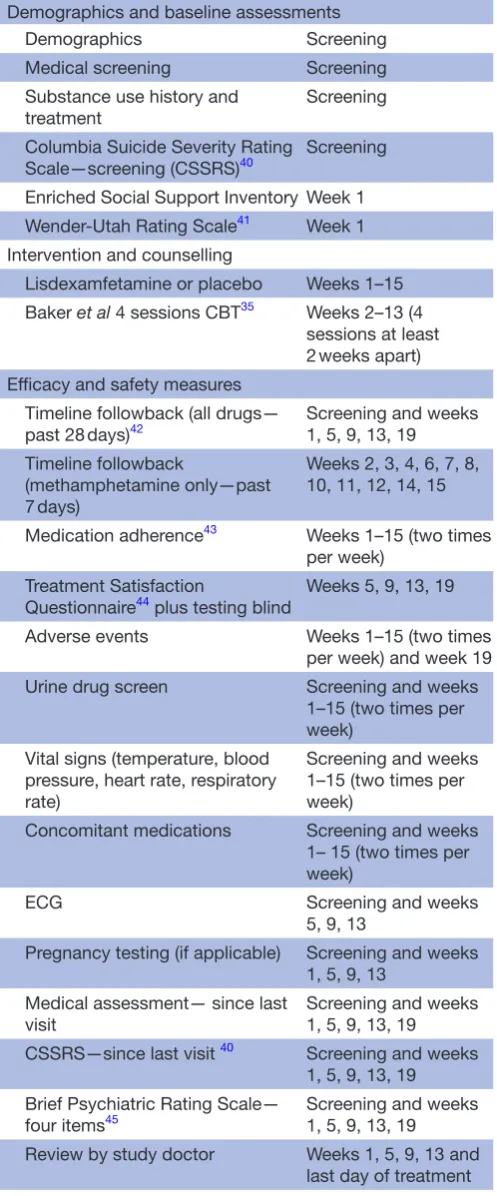
Four specialist outpatient stimulant treatment centres in NSW and SA will recruit participants. Potential partici-pants will be prescreened in person or by telephone by a researcher, and if potentially eligible invited to attend for a formal eligibility assessment by a specialist in addiction medicine. The assessment schedule, including eligibility assessments, is outlined in table 1.
randomisation
Eligible participants will be randomised to receive either the lisdexamfetamine or a placebo medication (see
figure 1). A computer-generated randomisation schedule
has been developed by an independent statistician and uploaded to the study database. Randomisation will be performed by the trial site pharmacist within the study database. The randomisation component of the database has been safe guarded with specific user rights allowing only the trial site pharmacist, the statistician and the chair of the Independent Data and Safety Monitoring Committee (IDSMC) to access randomisation allocations. Study participants, investigators, clinical and research staff will be blinded to the treatment condition allocated to reduce the risk of bias. Emergency unbinding will be permitted if required for safety of a participant, ongoing safe conduct of the trial or in the case of pregnancy.
Intervention
will be obtained, prepacked in child resistant blister packs, stored and transported to participating sites by a contracted good manufacturing practice registered facility in accor-dance with the Poisons and Therapeutic Goods Act 1966 and the Poisons and Therapeutic Goods Regulation 2008.
[image:4.595.41.290.90.689.2] [image:4.595.307.553.275.514.2]The active drug (lisdexamfetamine dimesylate) and the placebo shall be provided in identical capsules to ensure the study blind.
Table 1 Assessments and procedures: eligible participants will be required to attend the clinic daily for the first 5 days of treatment
Demographics and baseline assessments
Demographics Screening
Medical screening Screening
Substance use history and
treatment Screening
Columbia Suicide Severity Rating
Scale—screening (CSSRS)40 Screening
Enriched Social Support Inventory Week 1
Wender-Utah Rating Scale41 Week 1
Intervention and counselling
Lisdexamfetamine or placebo Weeks 1–15
Baker et al 4 sessions CBT35 Weeks 2–13 (4 sessions at least 2 weeks apart) Efficacy and safety measures
Timeline followback (all drugs—
past 28 days)42 Screening and weeks 1, 5, 9, 13, 19 Timeline followback
(methamphetamine only—past 7 days)
Weeks 2, 3, 4, 6, 7, 8, 10, 11, 12, 14, 15
Medication adherence43 Weeks 1–15 (two times
per week) Treatment Satisfaction
Questionnaire44 plus testing blind Weeks 5, 9, 13, 19
Adverse events Weeks 1–15 (two times
per week) and week 19
Urine drug screen Screening and weeks
1–15 (two times per week)
Vital signs (temperature, blood pressure, heart rate, respiratory rate)
Screening and weeks 1–15 (two times per week)
Concomitant medications Screening and weeks
1– 15 (two times per week)
ECG Screening and weeks
5, 9, 13
Pregnancy testing (if applicable) Screening and weeks 1, 5, 9, 13
Medical assessment— since last visit
Screening and weeks 1, 5, 9, 13, 19
CSSRS—since last visit 40 Screening and weeks
1, 5, 9, 13, 19 Brief Psychiatric Rating Scale—
four items45 Screening and weeks 1, 5, 9, 13, 19
Review by study doctor Weeks 1, 5, 9, 13 and
last day of treatment Measures of physical and mental health and cognitive and psychosocial functioning
Patient Health Questionnaire-1546 Weeks 1, 5, 9, 13, 19 Continued
Depression Anxiety Stress
Scales-2147 Weeks 1, 5, 9, 13, 19
WHO Quality of Life-BREF Weeks 1, 5, 9, 13, 19
Insomnia Severity Index48 Weeks 1, 5, 9, 13, 19
Neurocognitive testing batteries (combinations of the following): (MOCA),49 (WTAR),50 RAVLT,51–53 RVIP,53 54 N-Back,55 trail making test,56–59 flankers,54 60 digit symbol61 62
Screening and weeks 1, 5, 9, 13, 19
Measures of cravings, withdrawal and severity of dependence
Amphetamine Withdrawal
Questionnaire63 Weeks 1, 5, 9, 13, 19
Visual Analogue Scale for
cravings64 Weeks 1, 5, 9, 13, 19
Severity of Dependence Scale65 Weeks 1, 5, 9, 13, 19 Measures of abuse liability, other drug use, risk behaviour and crime
Drug Evaluation Questionnaire-5 Weeks 1, 5, 9, 13, 19 Timeline followback (all drugs—
past 28 days)42 Screening and weeks 1, 5, 9, 13, 19
Urine drug screen Weeks 1–15 (two times
per week) Opiate Treatment Index-Injecting
Practices (OTI-I) Weeks 1, 5, 9, 13, 19
OTI-Crime (OTI-C) Weeks 1, 5, 9, 13, 19
Substance Use and Sex Index Weeks 1, 5, 9, 13, 19
Measures for the cost-effectiveness analysis
EuroQol-5 dimension66 Weeks 1, 5, 9, 13, 19
Health service utilisation Weeks 1, 5, 9, 13, 19
Work Productivity Questionnaire67 Weeks 1, 5, 9, 13, 19 OTI-C – additional questions Weeks 1, 5, 9, 13, 19
Travel time and costs Week 5
On day 5, they will be provided with 2 days supply of study medication to take at home.
For the remainder of the treatment period, participants will attend the clinic two times per week for supervised dosing, safety assessments, provision of urine sample and collection of take home doses. Research visits will occur every 4 weeks until week 19.
CBT, Cognitive behavioural therapy; MOCA, Montreal Cognitive Assessment; RAVLT, Rey Auditory Verbal Learning Task; RVIP, Rapid Visual Information Processing; WTAR, Wechsler Test of Adult Reading.
Eligible participants enrolled in the study will commence with 7 days of 150 mg lisdexamfetamine or placebo daily (the induction phase).33 34 They will attend
the clinic for the first 5 days for supervised administration of the study medication, recording of blood pressure, pulse and temperature, monitoring of adverse events and medication adherence counselling. On the fifth day, the participant will be provided with two additional doses self-administer orally once a day. If the induction phase
is tolerated, the participant will progress to the 250 mg lisdexamfetamine/placebo 12-week maintenance phase.
[image:5.595.99.498.44.569.2]During the maintenance phase, participants will visit the clinic two times per week for a nursing review where vital signs will be recorded, adverse events monitored and medication adherence counselling undertaken. On the visit days, the administration of the dose for that day will be observed by the study nurse and participants will be provided with 2 or 3 days supply of the lisdexamfetamine/
placebo to take home for self-administration until the next clinic visit. Participants will be required to return study medication packs for pill counts. A urine sample will be provided at each of the two times per week visits, one of which will be randomly selected according to a predetermined randomised schedule and sent for testing at the end of the study for the presence of methamphet-amine, and the other stored for future use. Once each week study personnel will collect self-reported metham-phetamine use for the previous week.
Participants will undergo a medical review every 4 weeks during the maintenance phase (weeks 5, 9 and 13), as well as neurocognitive testing and questionnaire comple-tion as outlined in table 1.
If the participant experiences a grade 2 or 3 adverse event at any time that is considered to be related to the study drug, the study doctor shall consult with the trial chairperson about the option of withholding one dose. If a dose is withheld the participant will be reviewed by the study doctor the following day, or sooner as clinically indi-cated. If the adverse event is resolved the following day, the dose can be recommenced and the participant will be reviewed the subsequent day. If the adverse event is not resolved or recurs after recommencing, the study doctor will then consult with the trial chairperson with regard to ceasing the medication and withdrawing the participant from the treatment component of the study.
During the reduction phase the dose will be tapered so as to minimise any drug discontinuation effects. The dose will be reduced to 150 mg lisdexamfetamine or placebo daily for 1 week, then 50 mg lisdexamfetamine or placebo daily for 1 week and then ceased.
Lisdexamfetamine will not be available for the manage-ment of methamphetamine dependence following completion of the study. However, ongoing treatment will be individualised to the participant and outlined in a treatment plan which will be developed at week 13 by the study doctor.
Subjects will have a follow-up visit 4 weeks after cessa-tion of the reduccessa-tion phase (week 19).
Participants will be reimbursed with a supermarket voucher (that cannot be spent on alcohol or cigarettes) at weeks 1, 5, 9, 13 and 19. Reimbursements will start at $A20 and increase by $A10 each month until the follow-up visit.
All participants will be offered counselling representing best practice treatment as usual. This will consist of four sessions of CBT of up to 1 hour per session,35 specially
designed for and validated in the study population and delivered by trained therapist who will receive supervision monthly.
In addition to safety concerns (including acute psychosis, suicidal or homicidal ideation) or pregnancy, participants may be withdrawn from the study if they are absent from study treatment for more than two consec-utive weeks. They will also be withdrawn from the study if they become subject to drug testing for legal or occu-pational reasons (due to the risk of unblinding to group allocation).
Participants who have discontinued protocol treatment will be offered the opportunity continue to participate in all remaining research interviews and assessments. For those participants who revoke their consent for the entire study, no further data will be collected from the participant.
statistical methods
All efficacy analyses will use an intention-to-treat (ITT) approach. ITT will be defined as all randomised patients who received at least one dose of the prescribed medica-tion. The primary efficacy measure is the change from baseline in days of methamphetamine use self-reported for the last 28 days at week 13. A likelihood-based mixed model of repeated measures (MMRM) approach will be used for the primary efficacy analysis. The differ-ence between two groups at week 13 will be the primary comparison, and differences at week 5, 9 and 19 will also be examined. No imputation of missing data will be performed under MMRM approach, the MMRM analysis makes use of all available data and is reliable for effect and SE estimates under missing at random (MAR) assump-tion.36 Sensitivity analysis including baseline observation
carried forward imputation will be performed to investi-gate the robustness of results to the departure from MAR assumption.
Secondary measures of the intervention effect will include total number of days of self-report MA use over the 12-week active treatment period; longest period of abstinence during treatment period; percentage of achieving ≥21 days abstinence; percentage of MA nega-tive urines 4 weeks prior to week 12; craving, withdrawal, dependence, retention, bloodborne virus transmission risk behaviour, criminal behaviour, as well measures of abuse liability, physical and mental health, other substance use, cognitive performance, psychosocial functioning and treatment satisfaction. Statistical analysis strategies (t-test, Mann-Whitney U test, X2 test, linear/generalised linear
regression and mixed-model analysis) will be used for secondary outcomes based on the type and distribution of the outcome measures. Kaplan-Merrier curve, log rank test and Cox proportional hazard model will be applied in the time to event data analysis.
Analysis of urine drug screen (UDS) results will follow established techniques for similar drug trials (Treatment Effectiveness Score37), calculated as a proportion (%) of
UDS negative for methamphetamine out of total of 12 possible UDS (with missing tests counted as positive).
All patients enrolled in the study will be evaluated with respect to safety-related outcomes. Safety data will be analysed according to the treatment that the patients actually received. Safety analyses will include summaries of the incidence of all adverse events that are possibly or probably treatment related, that occur during the study treatment period or within 30 days of the last dose of study treatment.
The primary outcome will be quality-adjusted life years measured by the five-level version of the EuroQol five-di-mensional (EQ-5D) descriptive system (EQ-5D-5L). Costs will include clinical resources, other healthcare, crime, productivity and personal costs. The costs will be summed and combined with the outcome measure, and the incre-mental cost-effectiveness ratio calculated.
All tests of the treatment effect will be conducted at a two-sided alpha level of 0.05.
Interim analyses will be performed when the 50th patient has completed treatment or 6 months after the commencement of recruitment, whichever comes first.
An IDSMC will monitor the progress of the study with the aim of safeguarding trial participants by assessing the safety and efficacy of the drug being investigated in the trial. The IDSMC may recommend stopping the trial if the number and/or severity of adverse events justify discontinuation of the study; on the basis of a positive efficacy result only when the primary endpoint (meth-amphetamine use) data are truly compelling and the risk of a false positive conclusion is acceptably low (p<0.001 for primary endpoint); if accrual rates are too low and/ or that non-compliance is too great to provide adequate power for identifying the specified benefit; it becomes clear that successful completion of the study is not feasible.
data statement
Study data will be collected and managed using Research Electronic Data Capture (REDCap) tools hosted at Hunter New England Local Health District). REDCap38 is a secure, web-based application designed to
support data capture for research studies, providing: (1) an intuitive interface for validated data entry; (2) audit trails for tracking data manipulation and export proce-dures; (3) automated export procedures for seamless data downloads to common statistical packages and (4) procedures for importing data from external sources.
Ethics and dissemination
Prior to an individual’s participation in the trial, he/ she shall be fully informed about the research and given ample time and opportunity to inquire about details and decide whether or not to participate. If they agree to participate, they will be asked to sign the study-specific consent form. Participants will also be invited to consent for their urine samples to be stored for future research
To ensure anonymity and to limit disclosure, partici-pants will be assigned a unique identifier at the time of randomisation. Results arising from the main study will be published in peer-reviewed journals, and disseminated at international conferences. Results will be reported in such a manner that participants will not be identifiable in any way.
All data will be considered the property of the trial chairperson who, in consultation with the trial manage-ment committee, will be responsible for presentations and publications arising from this trial.
Patient involvement
The initial concept of investigating the use of lisdexamfe-tamine in reducing methamphelisdexamfe-tamine use in people who are dependent on methamphetamine was proposed by a patient who prefers to be unnamed. No other patients were involved in setting the research question or the outcome measures, nor have they been involved in devel-oping plans for design or implementation of the study.
dIsCussIon
This is the first phase III trial of lisdexamfetamine for methamphetamine dependence. The strength of this study is in its proposed sample size, powered to detect a medium effect size in between group differences in the primary outcome (days of methamphetamine use), using a higher dose of agonist medication (more than triple) used typically for the treatment of atten-tion-deficit hyperactivity disorder. Participants will be closely monitored with two times per week clinic visits and nursing reviews and monthly medical reviews. Two times per week, dispensing will promote retention in the study, and prevent high drop-out rates experienced in other studies.39 The study protocol proposes to deliver
the medication in an outpatient setting allowing partici-pants take-home dosing to more closely mimic the service delivery situations in which the medication may be used and provide some indication. Limitations of the study include the fixed-dose design, active treatment restricted to 12 weeks and two times per week observed dosing. If efficacious further dose–response relationship studies may be indicated to explore optimum duration of treat-ment and a reducing regimen. If successful the interven-tion will provide a much needed therapeutic adjunct for people who are dependent on methamphetamine.
Author affiliations
1Alcohol and Drug Service, St Vincents Hospital, Sydney, New South Wales, Australia 2University of New South Wales, Randwick, New South Wales, Australia
3Drug and Alcohol Clinical Services, Hunter New England, Newcastle, New South
Wales, Australia
4School of Medicine and Public Health, University of Newcastle, Newcastle, New
South Wales, Australia
5University of Adelaide, Adelaide, South Australia, Australia 6Curtin University, Perth, Western Australia, Australia
7University of South Australia, Adelaide, South Australia, Australia 8University of Tasmania, Hobart, Tasmania, Australia
9Western Sydney Local Health District, Sydney, New South Wales, Australia 10University of Sydney, Sydney, New South Wales, Australia
11National Drug and Alcohol Research Centre, UNSW Sydney, Sydney, New South
Wales, Australia
12South East Sydney Local Health District, Sydney, New South Wales, Australia
Acknowledgements We thank Andrew Dawson (Royal Prince Alfred Hospital), Anthony Gill and Craig Rodgers (St. Vincent’s Hospital Sydney, Australia), James Ward and Michael Farrell (UNSW Sydney, Australia), Mark Montebello (Northern Sydney Local Health District Drug and Alcohol Service, St Leonards, Australia) and Ian Richards and Will Liaw (Drug and Alcohol Services South Australia) for insightful comments on the protocol of the study.
contributed to the design of the protocol. BC and MH wrote the first draft of the article with significant input from NE. RM, ZL, MS and ALB critically revised the article for intellectual content.
Funding This study is funded largely by the National Health and Medical Research Council (NHMRC), Australia (APP1109466) and the St Vincent’s Curran Foundation, Australia.
disclaimer The contents of the published material are solely the responsibility of the individual authors and do not reflect the views of the NHMRC nor the Curran Foundation.
Competing interests AC reports grants, personal fees and non-financial support from Gilead Sciences, grants, personal fees and non-financial support from ViiV Healthcare, grants and personal fees from MSD and personal fees from Mayne Healthcare, outside the submitted work. RB has received investigator-initiated untied educational grants from Reckitt Benckiser/Indivior for the development of an opioid-related behaviour scale and a study of opioid substitution therapy uptake among chronic non-cancer pain patients and has received an untied educational grant from Mundipharma for a postmarket study of oxycodone. NL reports personal fees from Indivior, personal fees from Mundipharma, grants from Braeburn Pharmaceuticals outside the submitted work. AD reports grants from Braeburn Pharmaceuticals during the conduct of the study.
Patient consent Not required.
Ethics approval The study has been approved by the Human Research Ethics Committee of St. Vincent’s Hospital, Sydney, Australia (HREC/16/SVH/222). Contact the corresponding author for the full trial protocol.
Provenance and peer review Not commissioned; externally peer reviewed.
open access This is an open access article distributed in accordance with the Creative Commons Attribution Non Commercial (CC BY-NC 4.0) license, which permits others to distribute, remix, adapt, build upon this work non-commercially, and license their derivative works on different terms, provided the original work is properly cited, appropriate credit is given, any changes made indicated, and the use is non-commercial. See: http:// creativecommons. org/ licenses/ by- nc/ 4. 0/.
rEFErEnCEs
1. Degenhardt L, Larney S, Chan G, et al. Estimating the number of regular and dependent methamphetamine users in Australia, 2002-2014. Med J Aust 2016;204:153.
2. Degenhardt L, Baxter AJ, Lee YY, et al. The global epidemiology and burden of psychostimulant dependence: findings from the Global Burden of Disease Study 2010. Drug Alcohol Depend 2014;137:36–47.
3. Moore T. Working estimates of the social costs per gram and per user for cannabis, cocaine, opiates and amphetamines: National Drug and Alcohol Research Centre, 2007.
4. Whetton S, Shanahan M, Cartwright K, et al. The Social Costs of Methamphetamine in Australia 2013/14. Perth, Western Australia: National Drug Research Institute, Curtin University, 2016.
5. Darke S, Kaye S, McKetin R, et al. Major physical and psychological harms of methamphetamine use. Drug & Alcohol Review. Drug and Alcohol Review 2008;27:253–62.
6. McKetin R, Lubman DI, Baker AL, et al. Dose-related psychotic symptoms in chronic methamphetamine users: evidence from a prospective longitudinal study. JAMA Psychiatry 2013;70:319–24. 7. Lee NK, Rawson RA. A systematic review of cognitive and
behavioural therapies for methamphetamine dependence. Drug Alcohol Rev 2008;27:309–17.
8. Baker A, Boggs TG, Lewin TJ. Randomized controlled trial of brief cognitive-behavioural interventions among regular users of amphetamine. Addiction 2001;96:1279–87.
9. Hillhouse MP, Marinelli-Casey P, Gonzales R, et al. Predicting in-treatment performance and post-treatment outcomes in methamphetamine users. Addiction 2007;102(Suppl 1):84–95. 10. Grabowski J, Shearer J, Merrill J, et al. Agonist-like, replacement
pharmacotherapy for stimulant abuse and dependence. Addict Behav 2004;29:1439–64.
11. McGregor C, Srisurapanont M, Mitchell A, et al. Symptoms and sleep patterns during inpatient treatment of methamphetamine withdrawal: a comparison of mirtazapine and modafinil with treatment as usual. J Subst Abuse Treat 2008;35:334–42.
12. Newton TF, Roache JD, De La Garza R, et al. Bupropion reduces methamphetamine-induced subjective effects and cue-induced craving. Neuropsychopharmacology 2006;31:1537–44.
13. De La Garza R, Zorick T, London ED, et al. Evaluation of modafinil effects on cardiovascular, subjective, and reinforcing effects of methamphetamine in methamphetamine-dependent volunteers. Drug Alcohol Depend 2010;106:173–80.
14. Shearer J, Darke S, Rodgers C, et al. A double-blind, placebo-controlled trial of modafinil (200 mg/day) for methamphetamine dependence. Addiction 2009;104:224–33.
15. Pérez-Mañá C, Castells X, Torrens M, et al. Efficacy of
psychostimulant drugs for amphetamine abuse or dependence. The Cochrane Collaboration, 2013.
16. Bradbeer TM, Fleming PM, Charlton P, et al. Survey of
amphetamine prescribing in England and Wales. Drug Alcohol Rev 1998;17:299–304.
17. Myton T, Carnwath T, Crome I. Health and psychosocial consequences associated with long-term prescription of dexamphetamine to Amphetamine Misusers in Wolverhampton 1985–1998. Drugs 2004;11:157–66.
18. Ezard N, Francis B, Brown A, et al. What do we know about
dexamphetamine in the treatment of methamphetamine dependence? 8 years of the NSW Stimulant Treatment Program in Newcastle and Sydney. Australian Drug Conference; Melbourne, Victoria 2014. 19. Shearer J, Wodak A, Mattick RP, et al. Pilot randomized controlled
study of dexamphetamine substitution for amphetamine dependence. Addiction 2001;96:1289–96.
20. Longo M, Wickes W, Smout M, et al. Randomized controlled trial of dexamphetamine maintenance for the treatment of methamphetamine dependence. Addiction 2010;105:146–54. 21. Galloway GP, Buscemi R, Coyle JR, et al. A Randomized,
Placebo-Controlled Trial of Sustained-Release Dextroamphetamine for Treatment of Methamphetamine Addiction. Clinical Pharmacology & Therapeutics 2011;89:276–82.
22. Jasinski D, Krishnan S, 2006. Pharmacokinetics of oral
lisdexamfetamine dimesylate (LDX; NRP104) vs d-amphetamine in healthy adults with a history of stimulant abuse. US Psychiatric and Mental Health 19th Annual Congress, New Orleans, LA;15–19 Nov 2006.
23. Pennick M. Absorption of lisdexamfetamine dimesylate and its enzymatic conversion to d-amphetamine. Neuropsychiatr Dis Treat 2010;6:317.
24. Krishnan SM, Stark JG. Multiple daily-dose pharmacokinetics of lisdexamfetamine dimesylate in healthy adult volunteers. Curr Med Res Opin 2008;24:33–40.
25. Krishnan SM, Pennick M, Metabolism SJG. Distribution and elimination of lisdexamfetamine dimesylate: open-label, single-centre, phase i study in healthy adult volunteers. Clinical Drug Investigation 2008;28:745–55.
26. Hutson PH, Pennick M, Secker R. Preclinical pharmacokinetics, pharmacology and toxicology of lisdexamfetamine: A novel d-amphetamine pro-drug. Neuropharmacology 2014;87:41–50. 27. Heal DJ, Buckley NW, Gosden J, et al. A preclinical evaluation of
the discriminative and reinforcing properties of lisdexamfetamine in comparison to d-amfetamine, methylphenidate and modafinil. Neuropharmacology 2013;73:348–58.
28. Jasinski DR, Krishnan S. Abuse liability and safety of oral
lisdexamfetamine dimesylate in individuals with a history of stimulant abuse. J Psychopharmacol 2009;23:419–27.
29. Mooney ME, Herin DV, Specker S, et al. Pilot study of the effects of lisdexamfetamine on cocaine use: A randomized, double-blind, placebo-controlled trial. Drug Alcohol Depend 2015;153:94–103. 30. Ezard N, Francis B, Brown A, Robertson B, Holland R, et al, eds.
What do we know about dexamphetamine in the treatment of methamphetamine dependence? 8 years of the NSW Stimulant Treatment Program in Newcastle and Sydney. Melbourne, VIC: Australian Drug Conference, 2014.
31. Ermer J, Homolka R, Martin P, et al. Lisdexamfetamine Dimesylate: Linear Dose-Proportionality, Low Intersubject and Intrasubject Variability, and Safety in an Open-Label Single-Dose Pharmacokinetic Study in Healthy Adult Volunteers. The Journal of Clinical Pharmacology 2010;50:1001–10.
32. Martin P, Dirks B, Gertsik L, et al. Safety and pharmacokinetics of lisdexamfetamine dimesylate in adults with clinically stable schizophrenia: a randomized, double-blind, placebo-controlled trial of ascending multiple doses. Journal of clinical psychopharmacology 2014;34:682–9.
33. Ezard N, Dunlop A, Clifford B, et al. Study protocol: a dose-escalating, phase-2 study of oral lisdexamfetamine in adults with methamphetamine dependence. BMC Psychiatry 2016;16:428. 34. Ezard NDA, Clifford B, Bruno R, et al. Abstract: a
35. Baker A, Lee NK, Claire M, et al. Brief cognitive behavioural interventions for regular amphetamine users: a step in the right direction. Addiction 2005;100:367–78.
36. Mallinckrodt CH, Clark WS, David SR. Accounting for dropout bias using mixed-effects models. J Biopharm Stat 2001;11:9–21. 37. Ling W, Shoptaw S, Wesson D, et al. Treatment effectiveness score
as an outcome measure in clinical trials. NIDA research monograph 1997;175:208–20.
38. Harris PA, Taylor R, Thielke R, et al. Research electronic data capture (REDCap)—A metadata-driven methodology and workflow process for providing translational research informatics support. J Biomed Inform 2009;42:377–81.
39. Mancino MJ, Thostenson JD, Guise JB, et al. Impact of lisdexamfetamine on retention of
methamphetamine-dependent patients in a residential facility. Drug Alcohol Depend 2017;171:e128.
40. Posner K, Brown GK, Stanley B, et al. The Columbia–Suicide severity rating scale: initial validity and internal consistency findings from three multisite studies with adolescents and adults. Am J Psychiatry 2011;168:1266–77.
41. Ward MF, Wender PH, Reimherr FW. The Wender Utah Rating Scale: an aid in the retrospective diagnosis of childhood attention deficit hyperactivity disorder. Am J Psychiatry 1993;150:885–90.
42. Sobell LC SM. Assessing alcohol problems: a guide for clinicians and researchers: DIANE Publishing, 1995.
43. Pettinati HM, Anton RF, Willenbring ML. The COMBINE Study—: an overview of the largest pharmacotherapy study to date for treating alcohol dependence. Psychiatry 2006;3:36–9.
44. Atkinson MJ, Sinha A, Hass SL, et al. Validation of a general measure of treatment satisfaction, the Treatment Satisfaction Questionnaire for Medication (TSQM), using a national panel study of chronic disease. Health Qual Life Outcomes 2004;2:12.
45. Overall JE, Gorham DR. The brief psychiatric rating scale. Psychol Rep 1962;10:799–812.
46. Kroenke K, Spitzer RL, Williams JBW. The PHQ-15: validity of a new measure for evaluating the severity of somatic symptoms. Psychosom Med 2002;64:258–66.
47. Sinclair SJ, Siefert CJ, Slavin-Mulford JM, et al. Psychometric evaluation and normative data for the Depression, Anxiety, and Stress Scales-21 (DASS-21) in a Nonclinical Sample of U.S. Adults. Eval Health Prof 2012;35:259–79.
48. Bastien C, Vallieres A, Morin CM. Validation of the Insomnia Severity Index as an outcome measure for insomnia research. Sleep Med 2001;2:297–307.
49. Nasreddine ZS, Phillips NA, Bédirian V, et al. The Montreal Cognitive Assessment, MoCA: a brief screening tool for mild cognitive impairment. J Am Geriatr Soc 2005;53:695–9.
50. Carter A. Wechsler Test of Adult Reading. In: FR V, ed. Encyclopedia of autism spectrum disorders. New York: Springer New York, 2013:3364–5.
51. Rey A. L’examen clinique en psychologie [Clinical psychological examination]. Paris: Presses universitaires de France, 1958.
52. Hoffman WF, Moore M, Templin R, et al. Neuropsychological function and delay discounting in methamphetamine-dependent individuals. Psychopharmacology 2006;188:162–70.
53. Scott JC, Woods SP, Matt GE, et al. Neurocognitive effects of methamphetamine: a critical review and meta-analysis. Neuropsychol Rev 2007;17:275–97.
54. Eriksen BA, Eriksen CW. Effects of noise letters upon the identification of a target letter in a nonsearch task. Percept Psychophys 1974;16:143–9.
55. Jonides J, Schumacher EH, Smith EE, et al. Verbal working memory load affects regional brain activation as measured by PET. J Cogn Neurosci 1997;9:462–75.
56. Roberts C, HORTON, JR. AM. Brief communication derived trail making test indices in a sample of amphetamine abusers: demographic effects. Int J Neurosci 2002;112:575–84.
57. Tombaugh T. Trail making test A and B: normative data stratified by age and education. Archives of Clinical Neuropsychology 2004;19:203–14.
58. Reitan RM. The relation of the trail making test to organic brain damage. J Consult Psychol 1955;19:393–4.
59. Reitan RM. Validity of the trail making test as an indicator of organic brain damage. Percept Mot Skills 1958;8:271–6.
60. Dean AC, Groman SM, Morales AM, et al. An evaluation of the evidence that methamphetamine abuse causes cognitive decline in humans. Neuropsychopharmacology 2013;38:259–74.
61. Mattila MJ, Mattila-Evenden ME. Effects of alcohol and
hypnosedative drugs on digit-symbol substitution: comparison of two different computerized tests. J Psychopharmacol 1997;11:313–7. 62. Cameron E, Sinclair W, Tiplady B. Validity and sensitivity of a
pen computer battery of performance tests. J Psychopharmacol 2001;15:105–10.
63. Srisurapanont M, Jarusuraisin N, Jittiwutikan J. Amphetamine withdrawal: i. reliability, validity and factor structure of a measure. Australian & New Zealand Journal of Psychiatry 1999;33:89–93. 64. Lee JW BE, Perantie DC, Bobadilla L. A comparison of
single-item Visual Analog Scales with a multisingle-item Likert-type scale for assessment of cocaine craving in persons with bipolar disorder. Addictive Disorders & Their Treatment 2002;1:140–2.
65. Gossop M, Darke S, Griffiths P, et al. The Severity of Dependence Scale (SDS): psychometric properties of the SDS in English and Australian samples of heroin, cocaine and amphetamine users. Addiction 1995;90:607–14.
66. Herdman M, Gudex C, Lloyd A, et al. Development and preliminary testing of the new five-level version of EQ-5D (EQ-5D-5L). Quality of Life Research 2011;20:1727–36.