1
Two-year outcomes of ab interno trabeculectomy with the Trabectome for Chinese primary
open angle glaucoma: a retrospective multicenter study
Authors: Yalong Dang, 1,2,3, # Xiao Wang, 1, # Yujie Cen, 1 Ying Hong, 1,2 Ping Huang, 1 Nils Loewen, 2 Chun Zhang1
# these authors contributed equally to this work.
Affiliations:
1. Department of Ophthalmology, Peking University Third Hospital, Beijing, China
2. Department of Ophthalmology, University of Pittsburgh, Pittsburgh, Pennsylvania, USA
3. Department of Ophthalmology, Sanmenxia Central Hospital, Henan University of Science and Technology,
Henan, China
* Corresponding author:
Chun Zhang
49 Huayuan N Rd, Haidian District,
Beijing 100191, China
Email: [email protected]
Abstract
To evaluate the 2-year efficacy and safety of ab interno trabeculectomy with the Trabectome in Chinese
primary open-angle glaucoma (POAG) patients.This was a multicenter, retrospective study and included POAG
patients with or without visually-significant cataracts. The primary outcome was intraocular pressure (IOP)
reduction. Secondary outcomes included reduction of glaucoma medications, surgical complications, and
success at 2-years. Success was defined as: 1) IOP < 21 mmHg and at least 20% IOP reduction from baseline
after 3 months at any two consecutive visits, and 2) no additional glaucoma surgery required.A total of 42
patients were enrolled; thirteen had a history of failed glaucoma surgery. Twelve patients underwent
Trabectome surgery combined with phacoemulsification while the remainder underwent Trabectome surgery
alone. Overall, the mean preoperative IOP was 21.4±1.23 mmHg. The Trabectome lowered IOP to 18.5± 0.94
mmHg at 2 years (P<0.05). The number of glaucoma medications also decreased from a baseline of 2.0±0.9 to
1.2± 0.21 at 2 years (P=0.04). The overall success was 78%, with patients undergoing combined surgery having
a higher success than those with Trabectome surgery alone (100% vs. 76%). No major complications were
seen. The Trabectome appears to be an efficient and safe procedure in Chinese POAG patients in the
long-term.
Keywords: primary open-angle glaucoma; minimally invasive glaucoma surgery; ab interno trabeculectomy;
intraocular pressure; success rate
Introduction
Primary open-angle glaucoma (POAG) is a leading cause of irreversible blindness[1], affecting more than 40
millions of people worldwide[2]. Intraocular pressure (IOP) is the only modifiable risk factor for POAG[3].
Traditional trabeculectomy and tube-shunt surgery efficiently reduce IOP in patients with moderate to
contrast, microincisional glaucoma surgery provides a safe IOP reduction with a short recovery time[7], has
become an ideal option for early to moderate POAG[8].
Most minimally invasive glaucoma surgeries can be combined with cataract surgery through an ab interno
approach. These procedures reduce IOP by different mechanisms: 1) ablate or bypass the trabecular
meshwork (TM) using instruments such as the Trabectome (Neomedix Corporation, Tustin, CA, USA)[9–11],
iStent (Glaukos Corp., Laguna Hills, CA, USA)[12], or the Hydrus mini-stent (Ivantis Inc., Irvine, CA, USA)[13]; 2)
establish a new route for suprachoroidal drainage (CyPass Micro-Stent; Transcend Medical, Menlo Park, CA,
USA[14]; 3) reduce the production of aqueous humor[15]; or 4) create a subconjunctival filtration route [16].
Developed by Neomedix (Tustin, CA, USA) more than a decade ago[9], the Trabectome ablates 60–120
degrees of TM and the inner wall of Schlemm's canal by high-frequency electrosurgery [17]. The Trabectome
provides active irrigation and aspiration, which maintains better stability and temperature in the anterior
chamber, compared with passive chamber management [18]. No hypotony or bleb-related complications
occur[10,11,19,20].
First introduced in China in 2013, the Trabectome shows promise for open-angle glaucoma patients[19,21].
Our previous study suggested that Trabectome surgery significantly reduced IOP from a baseline of 22.5 ± 8.1
mm Hg to 17.6 ± 6.4 mm Hg 1 year postoperatively[19], while the number of glaucoma medications was
reduced by 40.0% with no major complications [19]. However, in that study, we included different types of
open-angle glaucomas, which might have different responses [10,22]. Also, the follow-up in that study was
only 1 year. The aim of the current study was to evaluate the 2-year efficacy and safety of ab interno
Methods
This was a multicenter, retrospective, observational study approved by the Institutional Review Board of
Peking University Third Hospital in compliance with the Declaration of Helsinki. The need for patient informed
consent was waived. POAG patients undergoing Trabectome surgery included those with or without
visually-significant cataract except those who: 1) has concurrent keratitis, conjunctivitis or uveitis in the study eye,
and, 2) has other abnormalities preventing reliable applanation tonometry, and, 2) had a follow-up of less
than 3 months.
The Trabectome surgery was performed as we described previously [10,19]. IOP was measured by Goldmann
applanation tonometry. The target IOP was determined individually by the treating physician. Patients with a
visually-significant cataract underwent phacoemulsification after the Trabectome surgery. Visual field defects
were categorized as mild, moderate, and advanced based on Humphrey visual field testing. Gonioscopy,
Snellen visual acuity, and stereoscopic optic nerve evaluation were performed routinely before surgery.
The primary outcome was IOP reduction, while the secondary outcomes included reduced number of
glaucoma medications, surgical complications, and 2-year success rate. Success was defined as: 1) IOP < 21
mm Hg and at least 20% IOP reduction from baseline after 3 months at any two consecutive visits, and 2) no
additional glaucoma surgery required.
Quantitative data were presented as mean ± standard error and were statistically analyzed using R (statistical
package version 3.0.0, Free Software Foundation, Boston, MA, USA) [23]. The Wilcoxon’s test was used to
compare postoperative IOPs and the number of glaucoma medications with their respective baseline values.
We computed Kaplan-Meier curves and compared them using the log-rank test. We could not determine the
risk factors associated with Trabectome surgery failure by logistic regression because of the small sample size.
Results
After excluding 2 cases without postoperative information, a total of 42 POAG patients from three
independent glaucoma centers (Peking University Third Hospital, Beijing Tongren Hospital, and Peking
University People's Hospital) were enrolled in this study. Patients’ demographics and characteristics are
summarized in Table 1. The mean age was 55 ± 21 years, and more patients were male. Half of the patients
had preoperative best-corrected visual acuity better than 20/40; 76% of these patients (n=32) were phakic and
12 underwent combined surgery of Trabectome and phacoemulsification. Thirteen patients with a history of
previous failed glaucoma surgery were considered complicated cases, and had previously undergone
trabeculectomy (n=10), or Trabectome (n=2) or tube-shunt surgery (n=1) (Table 1).
Table 1. Demographics
Primary open angle glaucoma (n=42)
Age (years)
Mean±SD 55±21
Range 19 - 87
Gender
Female 11/42 (26%)
Male 31/42 (74%)
Pre-Op Snellen visual acuity
>20/20 0/42 (0%)
20/20-20/40 21/42 (50%)
20/50-20/70 6/42 (14%)
20/80-20/100 4/42 (10%)
20/200-20/400 5/42 (12%)
<20/400 1/42(2%)
NR 6/42 (14%)
Visual field
Mild 6/42 (14%)
Advanced 11/42 (26%)
MD/Other 16/42 (38%)
Disc C/D ratio
<0.7 6/42 (14%)
0.7 to 0.8 20/42 (48%)
>0.8 13/42 (31%)
NR 3/42 (7%)
Lens Status
Phakic 32/42 (76%)
Pseudophakic 4/42 (10%)
Aphakic 0/42 (0%)
NR 6/42 (14%)
Shaffer angle grade
I 0/42 (0%)
II 0/42 (0%)
III 0/42 (0%)
IV 26/42 (62%)
NR 16/42 (38%)
Prior glaucoma surgery
SLT 0/42 (0%)
ALT 0/42 (0%)
Shunt 1/42 (2%)
Trabeculectomy 10/42 (24%)
Trabectome 2/42 (5%)
Surgery combination
Trabectome + Phaco 12/42 (29%)
Trabectome alone 30/42 (71%)
Mean preoperative IOP was 21.4 ± 1.23 mm Hg, and on the first day post-surgery, the mean value dropped to
its lowest value of 15.5 ± 1.06 mm Hg (P<0.01, compared with baseline). Then, mean IOP increased slightly but
Figure 1. Intraocular pressure reduction. A total of 42 POAG patients were enrolled in this study. Mean preoperative intraocular
pressure (IOP) was 21.4 ± 1.23 mm Hg. After Trabectome™, mean IOP decreased significantly to its lowest value of 15.5± 1.06 mm
Hg on the first postoperative day (P<0.01), then increased slightly but remained statistically lower than baseline throughout the
study (all comparisons, P<0.05). Wilcoxon’s test was used to compare postoperative IOPs with baseline values. * and ** indicate
P<0.05 and P<0.01, respectively.
Trabectome surgery also decreased patients’ number of glaucoma medications from a baseline of 2.0 ± 0.9 to
0.5 ± 0.7 on the first postoperative day. At the last follow-up at 24 months, the number of glaucoma
Figure 2. Reduction in the number of glaucoma medications. Trabectome™ dramatically decreased the number of glaucoma
medications from a baseline of 2.0 ± 0.9 to 1.2 ± 0.21, 2 years postoperatively (P=0.04). Wilcoxon’s test was used to compare the
number of postoperative glaucoma medications with the number at baseline. * and ** indicate P<0.05 and P<0.01, respectively.
Based on the success criteria (IOP ≤ 21 mmHg and > 20% IOP reduction from baseline without additional
glaucoma surgery), the overall success rate was 78% at 24 months (Fig. 3). Patients undergoing combined
Trabectome surgery and phacoemulsification (n=12) had a higher success rate than did those undergoing
Trabectome surgery alone (n=30) (100% vs. 76%, respectively). Patients who underwent prior Trabectome
surgery (n=2) achieved their target IOP at 24 months while 2/10 patients undergoing previous trabeculectomy
suffered surgical failure; one patient at 9 months and one at 15 months.
Figure 3. Two-year success rate. Applying the success criteria, defined as IOP < 21 mm Hg and at least 20% IOP reduction from
baseline without secondary glaucoma surgery at any two consecutive visits, the overall success rate was 78% at 24 months.
Kaplan-Meier curves were used for survival analysis.
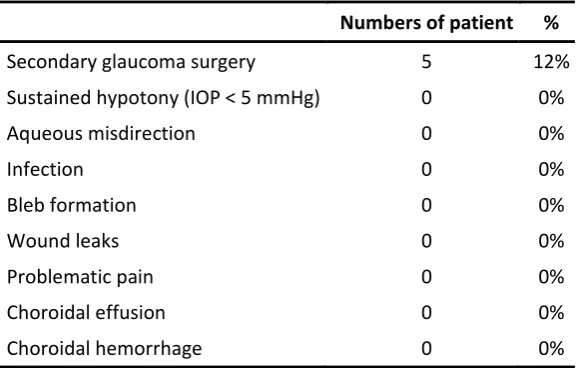
patients had achieved their IOP goals at the last visit. No vision-threatening complications were encountered,
and no patients experienced visual acuity loss of more than two lines (Table 2).
Table 2. Postoperative observations.
Numbers of patient %
Secondary glaucoma surgery 5 12%
Sustained hypotony (IOP < 5 mmHg) 0 0%
Aqueous misdirection 0 0%
Infection 0 0%
Bleb formation 0 0%
Wound leaks 0 0%
Problematic pain 0 0%
Choroidal effusion 0 0%
Choroidal hemorrhage 0 0%
Discussion
TM is a complex multilayer structure that regulates aqueous outflow in a pressure dependent fashion[24]. In
glaucomatous eyes, diseased TM has a reduced facility and shows reduced phagocytosis[25,26], increased
stiffness[27], and stress fiber formation[26]. Either removing TM surgically[28] or rehabilitating TM function by
stem cells[29] can restore normal outflow and decrease IOP in previous studies. In the current study, our
results showed that ab interno trabeculectomy with the Trabectome efficiently reduced IOP and the number
of glaucoma medications with an overall success rate of 76% during a 2-year follow-up. No major
complications were seen highlighting the safety aspects of this procedure.
Open-angle glaucoma (except neovascular glaucoma) is the main indication for ab interno trabeculectomy
with the Trabectome. A retrospective cohort study by Jordan et al showed that IOP decreased from a mean
baseline of 24 ± 5.5 mm Hg to 18 ± 6.1 mm Hg 204 days after Trabectome surgery for a consecutive 261 POAG
colleagues[31]. In POAG, the Trabectome has comparable or better IOP-lowering effects on secondary
open-angle glaucoma, depending on the preoperative IOP. Akil et al found that with similar preoperative values, IOP
reduction in pigmentary glaucoma cases was similar to that in POAG[22]. In our previous studies, patients with
pseudoexfoliative- and steroid-induced glaucoma with higher preoperative IOP finally obtained more IOP
reduction than age- and gender-matched POAG controls[10,32,33]. Even though preoperative IOP was higher
in these patients, the overall success rate was unchanged[10,22,34,35] or even better[34,36] than for POAG
patients. This is likely because the causes of secondary open-angle glaucoma are mostly TM-related diseases
while POAG has a more complicated mechanism, including dysfunction of downstream outflow tracts.
In this study, 12 patients underwent Trabectome surgery combined with phacoemulsification. All of these
patients achieved the success criteria at the 2-year follow-up, in contrast with only 76% in the Trabectome
only group. This is consistent with previous findings by other groups showing that combined surgery has a
lower risk of failure than for Trabectome alone[33,37]. However, it is worth noting that a higher success rate in
patients undergoing combined surgery does not mean a greater IOP reduction. In fact, patients undergoing
combined surgery consistently have less IOP reduction compared with the Trabectome only group because of
the low preoperative IOP in the combined group[7,32,33,36,37]. A recent study by Tojo et al suggested that a
low preoperative IOP and combined surgery contribute to success with the Trabectome[37].
Trabectome was once thought suitable only for mild or moderate glaucoma. Our previous studies indicated
that patients with higher glaucoma severity achieved greater IOP reduction[11,38]. In the current study, we
included 10 patients with advanced POAG and a history of previous trabeculectomy. Eight of these patients
met the success criteria at the end of the 24-month follow-up. In another study, Wecker et al found that the
Trabectome efficiently decreased IOP in patients with previously failed trabeculectomy from 24.5 ± 3.5 mm Hg
Reducing the number of medications is another benefit of Trabectome surgery; 0.99 ± 0.54 fewer medications
are expected following Trabectome alone and 0.76 ± 0.35 fewer medications following Trabectome combined
with phacoemulsification[7]. Consistent with our previous work[19], the POAG patients in this study obtained
an average of 0.8 fewer medications (40% reduction) compared with baseline.
Similar to other microincisional glaucoma procedures, Trabectome surgery has a desirable safety profile. The
most common complication is transient blood reflux[40] and transient hypotony (< 5 mm Hg)[22], which
usually spontaneously resolves within a few days of surgery. Less than 1% vision-threatening complications
were reported[7], including one case of endophthalmitis[41], and four cases of aqueous
misdirection[28,30,42,43]. Previous studies suggested approximately 6.1% to 34.9% of patients required a
secondary glaucoma surgery[34,36,39]. In this study, no serious complications were seen, and only five
patients underwent additional glaucoma surgery; one patient underwent repeat Trabectome surgery and four
underwent a lumenal control glaucoma filtration device (EX-PRESS, Alcon Laboratories, Inc., Fort Worth, TX,
USA) implantation.
This study has several limitations. First, the small sample size was insufficient to determine the risk factors
associated with Trabectome failure by logistic regression. Second, we focused on IOP reduction but not on
restoration or improved visual function. A recent study by Caprioli et al indicated that trabeculectomy might
reverse the glaucomatous dysfunction of retinal ganglion cells and their central projections[44].
In conclusion, our data suggested that ab interno trabeculectomy with the Trabectome is an efficient and safe
procedure in Chinese POAG patients in the long-term. In future, a large-sample-size clinical trial with more
Acknowledgement
This study was supported by the National Natural Science Foundation of China (No. 81670851) (Prof. Chun
Zhang); the Wiegand Fellowship of the Eye and Ear Foundation (Dr. Yalong Dang); We also thank Jane
Charbonneau, DVM, from Liwen Bianji, Edanz Editing China (www.liwenbianji.cn/ac), for editing the English
text of a draft of this manuscript.
Ethical Statement
This study was approved by the Institutional Review Board of Peking University Third Hospital in compliance
with the Declaration of Helsinki. Because of the retrospective study design, the informed consent from patient
was not required.
Author Contributions
Yalong Dang: data acquisition, data analysis, figure creation, manuscript preparation, manuscript review; Xiao
Wang: data acquisition, data analysis; Yujie Cen: data acquisition, data analysis; Ping Huang: data acquisition,
data analysis, manuscript preparation; Ying Hong: data acquisition, data analysis; Chun Zhang: funding, study
design, data acquisition, data analysis, manuscript preparation, manuscript review. Nils Loewen: manuscript
preparation, manuscript review.
Conflicts of Interest
N.A.L. has received honoraria for wet labs and lectures from Neomedix Inc. All other authors declared no
References
1. Cedrone C, Mancino R, Cerulli A, Cesareo M, Nucci C. Epidemiology of primary glaucoma: prevalence, incidence, and blinding effects. Prog Brain Res. 2008;173: 3–14.
2. Tham Y-C, Li X, Wong TY, Quigley HA, Aung T, Cheng C-Y. Global prevalence of glaucoma and
projections of glaucoma burden through 2040: a systematic review and meta-analysis. Ophthalmology. 2014;121: 2081–2090.
3. Lusthaus JA, Goldberg I. Investigational and experimental drugs for intraocular pressure reduction in ocular hypertension and glaucoma. Expert Opin Investig Drugs. 2016;25: 1201–1208.
4. Razeghinejad MR, Havens SJ, Katz LJ. Trabeculectomy bleb-associated infections. Surv Ophthalmol. 2017; doi:10.1016/j.survophthal.2017.01.009
5. Borisuth NS, Phillips B, Krupin T. The risk profile of glaucoma filtration surgery. Curr Opin Ophthalmol. 1999;10: 112–116.
6. Casson R, Rahman R, Salmon JF. Long term results and complications of trabeculectomy augmented with low dose mitomycin C in patients at risk for filtration failure. Br J Ophthalmol. 2001;85: 686–688.
7. Kaplowitz K, Bussel II, Honkanen R, Schuman JS, Loewen NA. Review and meta-analysis of ab-interno trabeculectomy outcomes. Br J Ophthalmol. 2016;100: 594–600.
8. Kerr NM, Wang J, Barton K. Minimally invasive glaucoma surgery as primary stand-alone surgery for glaucoma. Clin Experiment Ophthalmol. 2017;45: 393–400.
9. Francis BA, See RF, Rao NA, Minckler DS, Baerveldt G. Ab interno trabeculectomy: development of a novel device (Trabectome) and surgery for open-angle glaucoma. J Glaucoma. 2006;15: 68–73.
10. Dang Y, Kaplowitz K, Parikh HA, Roy P, Loewen RT, Francis BA, et al. Steroid-induced glaucoma treated with trabecular ablation in a matched comparison with primary open-angle glaucoma. Clin Experiment Ophthalmol. 2016;44: 783–788.
11. Roy P, Loewen RT, Dang Y, Parikh HA, Bussel II, Loewen NA. Stratification of phaco-trabectome
surgery results using a glaucoma severity index in a retrospective analysis. BMC Ophthalmol. 2017;17: 30.
12. Spiegel D, García-Feijoó J, García-Sánchez J, Lamielle H. Coexistent primary open-angle glaucoma and cataract: preliminary analysis of treatment by cataract surgery and the iStent trabecular micro-bypass stent. Adv Ther. 2008;25: 453–464.
13. Camras LJ, Yuan F, Fan S, Samuelson TW, Ahmed IK, Schieber AT, et al. A novel Schlemm’s Canal scaffold increases outflow facility in a human anterior segment perfusion model. Invest Ophthalmol Vis Sci. 2012;53: 6115–6121.
14. Saheb H, Ianchulev T, Ahmed IIK. Optical coherence tomography of the suprachoroid after CyPass Micro-Stent implantation for the treatment of open-angle glaucoma. Br J Ophthalmol. 2014;98: 19–23.
2007;11: 10–11.
16. Lewis RA. Ab interno approach to the subconjunctival space using a collagen glaucoma stent. J Cataract Refract Surg. 2014;40: 1301–1306.
17. Fallano K, Bussel I, Kagemann L, Lathrop KL, Loewen N. Training strategies and outcomes of ab interno trabeculectomy with the trabectome. F1000Res. 2017;6: 67.
18. Wang C, Dang Y, Waxman S, Xia X, Weinreb RN, Loewen NA. Angle stability and outflow in dual blade ab interno trabeculectomy with active versus passive chamber management. PLoS One. 2017;12:
e0177238.
19. Huang P, Wang H, Wu H, Sun Y, Wang M, Cui Y, et al. [Preliminary investigation on the safety and efficacy of Trabectome]. Zhonghua Yan Ke Za Zhi. 2015;51: 115–119.
20. Bussel II, Kaplowitz K, Schuman JS, Loewen NA, Trabectome Study Group. Outcomes of ab interno trabeculectomy with the trabectome by degree of angle opening. Br J Ophthalmol. 2015;99: 914–919.
21. Lee JWY, Yick DWF, Tsang S, Yuen CYF, Lai JSM. Efficacy and Safety of Trabectome Surgery in Chinese Open-Angle Glaucoma. Medicine . 2016;95: e3212.
22. Akil H, Chopra V, Huang A, Loewen N, Noguchi J, Francis BA. Clinical Results of Ab Interno
Trabeculotomy Using the Trabectome in Patients with Pigmentary Glaucoma compared to Primary Open Angle Glaucoma. Clin Experiment Ophthalmol. 2016; doi:10.1111/ceo.12737
23. Ihaka R, Gentleman R. R: A Language for Data Analysis and Graphics. J Comput Graph Stat. Taylor & Francis; 1996;5: 299–314.
24. Llobet A, Gasull X, Gual A. Understanding trabecular meshwork physiology: a key to the control of intraocular pressure? News Physiol Sci. 2003;18: 205–209.
25. Dang Y, Waxman S, Wang C, Loewen RT, Loewen NA. Intraocular pressure elevation precedes a phagocytosis decline in a model of pigmentary glaucoma [Internet]. bioRxiv. 2017. p. 175695. doi:10.1101/175695
26. Dang Y, Waxman S, Wang C, Loewen RT, Sun M, Loewen N. Trabecular Meshwork Failure In A Model Of Pigmentary Glaucoma [Internet]. bioRxiv. 2017. p. 118448. doi:10.1101/118448
27. Wang K, Read AT, Sulchek T, Ethier CR. Trabecular meshwork stiffness in glaucoma. Exp Eye Res. 2017;158: 3–12.
28. Ahuja Y, Ma Khin Pyi S, Malihi M, Hodge DO, Sit AJ. Clinical results of ab interno trabeculotomy using the trabectome for open-angle glaucoma: the Mayo Clinic series in Rochester, Minnesota. Am J
Ophthalmol. 2013;156: 927–935.e2.
29. Zhu W, Gramlich OW, Laboissonniere L, Jain A, Sheffield VC, Trimarchi JM, et al. Transplantation of iPSC-derived TM cells rescues glaucoma phenotypes in vivo. Proc Natl Acad Sci U S A. 2016;
doi:10.1073/pnas.1604153113
for primary and secondary open angle glaucomas. Graefes Arch Clin Exp Ophthalmol. 2013;251: 2753– 2760.
31. Chow JTY, Hutnik CML, Solo K, Malvankar-Mehta MS. When Is Evidence Enough Evidence? A Systematic Review and Meta-Analysis of the Trabectome as a Solo Procedure in Patients with Primary Open-Angle Glaucoma. J Ophthalmol. 2017;2017: 2965725.
32. Dang Y, Roy P, Bussel II, Loewen RT, Parikh H, Loewen NA. Combined analysis of trabectome and phaco-trabectome outcomes by glaucoma severity. F1000Res. 2016;5: 762.
33. Okeke CO, Miller-Ellis E, Rojas M, Trabectome Study Group. Trabectome success factors. Medicine . 2017;96: e7061.
34. Shoji N, Kasahara M, Iijima A, Takahashi M, Tatsui S, Matsumura K, et al. Short-term evaluation of Trabectome surgery performed on Japanese patients with open-angle glaucoma. Jpn J Ophthalmol. 2016;60: 156–165.
35. Mizoguchi T, Nishigaki S, Sato T, Wakiyama H, Ogino N. Clinical results of Trabectome surgery for open-angle glaucoma. Clin Ophthalmol. 2015;9: 1889–1894.
36. Ting JLM, Damji KF, Stiles MC, Trabectome Study Group. Ab interno trabeculectomy: outcomes in exfoliation versus primary open-angle glaucoma. J Cataract Refract Surg. 2012;38: 315–323.
37. Tojo N, Abe S, Hayashi A. Factors That Influence of Trabectome Surgery for Glaucoma Patients. J Glaucoma. 2017; doi:10.1097/IJG.0000000000000743
38. Loewen RT, Roy P, Parikh HA, Dang Y, Schuman JS, Loewen NA. Impact of a Glaucoma Severity Index on Results of Trabectome Surgery: Larger Pressure Reduction in More Severe Glaucoma. PLoS One. 2016;11: e0151926.
39. Wecker T, Neuburger M, Bryniok L, Bruder K, Luebke J, Anton A, et al. Ab Interno Trabeculectomy With the Trabectome as a Valuable Therapeutic Option for Failed Filtering Blebs. J Glaucoma. 2016;25: 758–762.
40. Hashemian SJ, Miraftabi A, Jafari ME, Hemami MR. Combined cataract extraction and trabeculotomy by the internal approach for coexisting cataract and open-angle glaucoma. J Curr Ophthalmol. 2017;29: 17–22.
41. Kaplowitz K, Chen X, Loewen N. Two year results for 180 degree trabectome ablation. American Glaucoma Society Annual Meeting. 2013.
42. Mosaed S, Rhee DJ, Filippopoulos T, Tseng H, Deokule S, Weinreb RN. Trabectome outcomes in adult open-angle glaucoma patients: one-year follow-up. Clin Surg Ophthalmol. 2010;28: 5–9.
43. Minckler D, Mosaed S, Dustin L, Ms BF, Trabectome Study Group. Trabectome (trabeculectomy-internal approach): additional experience and extended follow-up. Trans Am Ophthalmol Soc. 2008;106: 149–59; discussion 159–60.