This is a repository copy of Development of a Cycling Policy for York Technical Report.
White Rose Research Online URL for this paper: http://eprints.whiterose.ac.uk/2363/
Monograph:
Waring, D.A. and May, A.D. (1984) Development of a Cycling Policy for York Technical Report. Working Paper. Institute of Transport Studies, University of Leeds , Leeds, UK.
Working Paper 176
[email protected] https://eprints.whiterose.ac.uk/ Reuse
See Attached Takedown
If you consider content in White Rose Research Online to be in breach of UK law, please notify us by
White Rose Research Online
http://eprints.whiterose.ac.uk/Institute of Transport Studies University of Leeds
This is an ITS Working Paper produced and published by the University of Leeds. ITS Working Papers are intended to provide information and encourage discussion on a topic in advance of formal publication. They represent only the views of the authors, and do not necessarily reflect the views or approval of the sponsors.
White Rose Repository URL for this paper: http://eprints.whiterose.ac.uk/2364/
Published paper
Waring, D.A. and May, A.D. (1984) Development of a Cycling Policy for York Technical Report. Institute of Transport Studies, University of Leeds, Working Paper 176
Working Paper 176
June 1984
DEVELOPMENT OF A CYCLING POLICY
~ . -. .
FOR YORK TECHNICAL
REPORT
-
d.
A.
Waring and A. D. May
. .
ITS Working Papers a r e intended t o provide information and enco
. ~ ,. . . .
discussion on a topic in adva hey represent
. . ,
only the views of the authors and do not necessarily r e f l e
DEVELOPMENT OF A CYCLING POLICY FOR YORK
C O N T E N T S
Introduction
,Surveys
-
data collectionIntroduction
Origin and destination survey
Rowntree Mackintosh and British Rail Engineering Limited surveys
Cyclists' opinion survey Cycle parking opinion survey Cycle parking volume survey Public opinion survey
Publicity and incentives Other sources of information
Surveys
-
data preparation and analysis3.1 Introduction
3.2 Origin and destination survey 3.3 Cyclists' opinion survey 3.4 Public opinion survey
3.5 Cycle parking opinion survey 3.6 Cycle parking volume survey
S u r v e y r e s u l t s
Introduction
Origin and destination survey Rowntree Mackintosh cycling survey
British Rail Engineering Ltd. cycling survey Cyclists' opinion survey
Public opinion survey
Cycle parking opinion survey Cycle parking volume survey
The basis for design
5.1 Solutions to problem locations
5.2 The development of a cycle route network 5.3 The treatment of parking problems
Page
-
3
References
1. INTRODUCTION
In early 1983 York City Council and North Yorkshire County Council commissioned the Institute for Transport Studies to carry out a study of cycling in York. The terms of reference were to:
i) Include an origin and destination survey of current movements by trip purpose and an assessment of future demand, indicating the likely mode from which any transfer will occur;
-
ii) Identify problem areas following discussions with various cycling groups and a study of accident statistics;
iii) Take into consideration any previous decisions of the City Council for investigation;
Assess the appropriateness of the recommended standards for cycle facilities to a compact urban area;
v Propose various solutions to problems where
appropriate, assess the effect on other road users, and formulate a basic cycling plan for York.
vi) Advise the Council on the most appropriate type and location of cycle parking facilities at places of attraction.
The Institute for Transport Studies at the University of Leeds was appointed to carry out the study, with Professor
A.D.
May as the Director of the Study and Mr. D.A. Waring as Research Engineer. Work commenced on this project in June 1983 and was completed in May 1984.This report describes the technical conduct of the study. Section 2 describes the design of the surveys which were conducted, section 3 their conduct, and section 4 the results obtained. Section 5 outlines the ways in which the results were used in the formulation of proposals and provides references to the main sources of design literature. Appendices which are available separately from the Institute provide fuller details of the survey results.
2. SURVEYS
-
DATA COLLECTION-
-
2.1) INTRODUCTION
This chapter describes the surveys that have been carried out as part of the York Cycling Study. It explains why surveys were needed and the reasons why particular types of survey were ertaken. The designs of the individual surveys are described in &.ail and data relating to the design and execution of the & m e y s is presented.
,
~'--j2-1.1)---
The Need for Surveys.At the beginning of the study all the available existing information on cycling in the city was assembled and reviewed. At the same time an appeal was made through Radio York and local newspapers for groups and organisations in the city to come forward with their views and ideas on cycling in York.
An Origin and Destination survey had been carried out in 1976 as part of the Greater York Transport Study. However the original data that had been collected for this survey had been destroyed and no detailed data on cycle flows and movements was available.
The interviews with interest groups and the response from the general public revealed differences of opinion regarding the problems that cyclists face and the locations of the problems that were said to exist. Furthermore it was considered important to discover whether cyclists in general shared the same views as the cycling interest groups. There appeared to be a lack of understanding of the relative priorities of cyclists, and of the trade-offs they were making between travel time, travel cost, and security. There seemed to be differing views on cycling and cycling problems between different groups of road users.
These considerations demonstrated the need for additional information and formed the basis for the survey design.
2.1.2) Types
-
of survey undertakenAs part of this study the following surveys were carried out which involved the collection of new data by the study team.
1) Origin and Destination Survey
2) ~owntree/Mackintosh Cycling Survey &
British Rail Engineering Ltd Cycling Survey 3) Cyclists' Opinion Survey
4) Cycle Parking Opinion Survey 5 ) Cycle Parking Volume Survey 6 ) Public Opinion Survey
2.1.3) Origin
-
and Destination-
Survey (incorporating the Rowntree/Mackintosh-
and BritishRail-
Englneering Cycling S u r v e y rcarried out between 2 p.m. and 7 p.m. at 4 4 sites. The police assisted at the busiest sites. An alternative questionnaire survey was also carried out a t Y h e Rowntree Mackintosh factory to ensure adequate coverage o f this important generator of cycle trips (see section 2.1.4 ) During April 1984 supplementary surveys were carried out t o improve the coverage of British Rail Engineering Limited, and to replace data that had been lost in transit.
In general, an excellent response from the cyclists was obtained and a total of about 7000 interviews were obtained.
4) ~owntree/Mackintosh
-
and British-
Rail Engineering Limited Surveys.These surveys were carried out as an integral part of the
-
Origin and Destination Survey in order to ensure adequate coverage of these two important generators of cycle trips. The Rowntree/ Mackintosh Cycling Survey was carried between Thursday 13th October 1983 and Wednesday 19th October 1983. Questionnaires concerned with destination and routeing were left on bicycles parked within the factory perimeter. Some bicycles received Cyclists' Opinion Survey questionnaires instead. A total number of parked bicycles was also counted. The response rate for this survey was about 50%.The British Rail Engineering Limited Survey was carried out on Monday 16th April 1984. The survey was similar to the Rowntree/ Mackintosh Cycling Survey and the questions were identical. The only difference was that no Cyclists' Opinion Survey questionnaires were distributed. The response rate for this survey was about 35%.
2.1.5) Cycle Parking Opinion Survey
This survey was carried out on Thursday 20th October 1983 and repeated on Saturday 22nd October 1983. On both days the survey was undertaken in the morning and repeated in the afternoon. It was carried out concurrently with the Cycle Parking Volume Survey. The area covered by this survey comprised the shopping and commercial centre of the city including the Rougier Street area and the railway station. Over 1000 questionnaires were placed on parked bicycles and the response rate was about 45%.
2.1.6) Cycle Parking Volume Survey
This survey was carried out concurrently with the Cycle Parking Opinion Survey and the survey area was identical (see section 2.1.5). The number of bicycles parked in every publicly accessible place in the survey area was counted and recorded.
2.1.7) Cyclists' Opinion Survey
Over 1,000 questionnaires were distributed and the response rate was about 60%.
2.1.8) Public Opinion Survey
This survey was a postal questionnaire survey. About 1,000 questionnaires were sent by post to a random sample of residents, aged 18 years or over, in the study area. The response rate for this survey was about 25%.
2.2) ORIGIN AND DESTINATION SURVEY
-
-9,8".1) Purpose of survey
-
An Origin and Destination Survey was needed to provide the
a*c@l'lowing information:
i The origins and destinations of cycle trips
ii) The numbers of cycle trips being made
iii) The purpose of the cycle trips being made
iv) The routes that are heavily used by cyclists
2.2.2) Existing Origin
-
and Destination InformationInformation from the Greater York Travel Study reports indicated that the main generators of cycle trips were the City Centre, the University, the carriage works of British Rail
Engineering Limited, and the confectionery factories of
Rowntree/Mackintosh and Terry's.
2.2.3) Screenlines
-
and Cordons.The design of the survey incorporated a number of
screenlines and cordons that divided the city into distinct areas which, as far as possible, isolated these major generators. Cordons were placed around the city centre following the line of the city walls, and around the University and Heslington village. Screenlines were drawn as follows:
i) River Ouse
ii) Track bed of Dement Valley railway
iii) Selby
-
Scarborough railway lineiv) Clifton Bridge
-
Acomb-
KnavesmireWhere possible these followed barriers to movement.
Because it was not possible to survey movements from the
factories of ~owntree/~ackintosh and British Rail Engineering
Limited using cordon crossing surveys, these sites were covered by
alternative questionnaire surveys (see section 2.3). Census
points were located at every crossing point of the cordons and screenlines likely to be used by cyclists. m e s e points included locations where cycling or pushing a bicycle was either illegal or of doubtful legality. The locations of the cordons,screenlines and census points are show3 .on figures 2.1 and 2.2.
2.2.4) Interviews
-
and associated cycle counts-
data was collected on one day only from 2pm until 7pm. The time period was selected to cover roughly half a day's trips, on the assumption that those before 2pm were a mirror image of those after. This enabled data to be obtained for the whole of the evening peak period. and for a proportion of the off-peak period.
The total number of cyclists passing the census point was counted, with separate counts for each direction. Subsidiary totals were kept o f numbers of cyclists for each 15 minute period. Concurrently with the cycle counts, interviewers were questioning as many cyclists as possible about the journey they were making at that time. Cyclists were often observed to appear
. , bunches probably due to the effect of traffic signals
eviously encountered en route. With the manpower resources ilable it was not possible to interview every cyclist. The pling procedure adopted was to interview the first cyclist that gved after the cyclist previously interviewed had left. The proportion of cyclists interviewed at any census point was dependent upon
i) whether the census point was attended by the police ii) the number of interviewers present
iii) the willingness of cyclists to stop iv) the variation in flow of cyclists v) the degree on bunching
The number of successful interviews depended upon the willingness of cyclists to answer the questions fully once they had stopped.
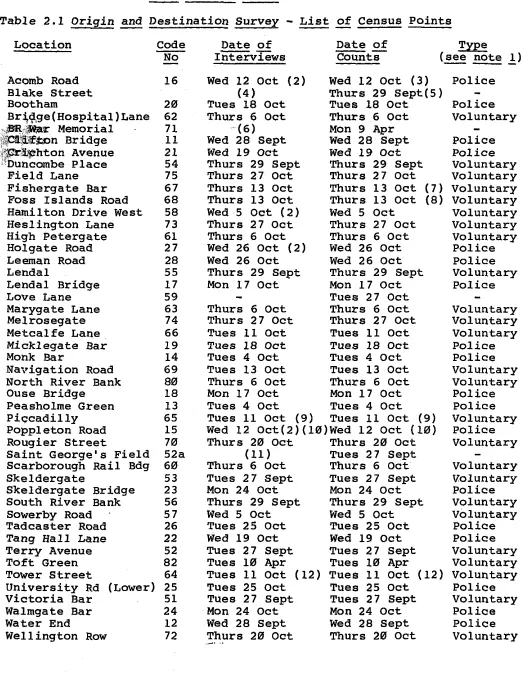
The interviewing took place for one direction of cycle flow only and this was usually the direction of maximum peak hour flow. The names and reference numbers of census points together with the dates on which interview and associated count data was collected is given in Table 2.1. The direction for which interview data was obtained is indicated by the arrows in figures 2.1 and 2.2. A copy of the interview form is to be found in Appendix 1.
2.2.5) Types
-
of Census PointAt the 18 most heavily trafficked census points a policeman was present to stop a sample of cyclists, and to ensure the safety of the cyclist being interviewed and the rest of the traffic. At the remaining points where interview data was collected no police officer was present and the cyclists were encouraged to stop of their own free will to help the study. In general cyclists were willing to stop once the purpose of the survey was generally known through road warning signs, publicity, and past experience.
2.2.6) Information
--
from the InterviewThe object of the roadside interview was to obtain the minimum amount of information about the trip being made that was absolutely necessary. This was to ensure that the time taken per interview was as short as possible, that each cyclist interviewed was delayed as little possible, and that the maximum number o f cyclists could be interviewed during the five hour survey period.
i) The destination address ii) The origin address
iii) The purpose of the journey classified as work/education or otherwise
iv) If the journey purpose was work/education
whether an additional journey home was made at mid-day
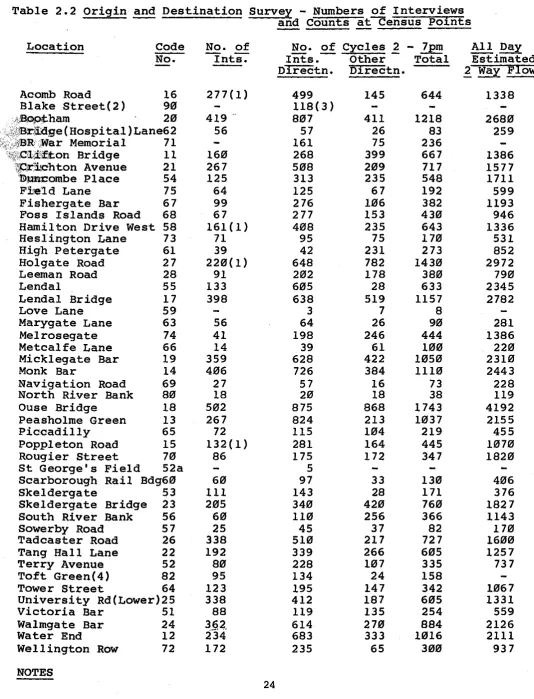
The time of the interview was also recorded. The numbers of erviews obtained at each census point together with the :-:iated cycle flows are gi-yen in Table 2.2
.,.:@he main survey commenced on Monday 26th September 1983 and
nd,M on Friday 28th October 1983. Data was collected on Monday to riday throughout this five week period.
2.2.7) Expandinq
-
the sample t o All-day flow----
Although the five hour time period was considered to be representative of cycle trip making throughout the day it was necessary to have additional information to be able to convert this sample of trip making into an estimate of a full day's trips for an average day.
2.2.8) Variations
-
in cycle flow during-
the survey period.It was anticipated that the volume of cycle trips would vary with the day of the week, and with the week that the interviews and count took place. In order to compensate, if necessary, for these variations a series of counts lasting from 9am until lpm and from 2pm until 6pm were carried out at the following five census points that were considered to be representative of all the other census points:
i Lendal Bridge ii) Tadcaster Road iii) Crichton Avenue iv) Fishergate Bar
V) Melrosegate
The time period was selected to cover the most important part of the day that could be covered by one person in an eight hour working day. These counts were extended in duration on Thursdays and lasted from 6am until l0pm in order to provide information on cycle flows to convert the five hour sample flow to a full 2 4 hour flow. It was assumed that the number of cyclists between l0pm and 6am was negligible.
The sites selected for these longer counts, together with the dates on which the counts took place are given in Table 2.3.
2.2.9) Seasonal variations
-
in cycle flowIt was also considered that the extent o f cycle trip making might vary with the time of year. In order to detect any such variation a count at the eame five representative sites mentioned above was carried out once a month £ran September until April
Lendal Bridge 9.00
-
10.00Crichton Avenue 10.30
-
11.30Tadcaster Road 12.00
-
13.00Fishergate Bar 14.30
-
15.30Melrosegate 16.00
-
18.00The overall time period (9am
-
6pm) was the same for thissurvey as for the Monday to Friday counts. The breaks between one
~ i t e and the next were to enable one enumerator to carry out the
, . ..~:;?WqpIete day's work allowing for travelling and meal breaks.
/MACKINTOSH
-
AND
BRITISH RAIL ENGINEERING LIMITED2 . 3 1 Background
It had originally been hoped that the Origin and Destination Survey census points would give adequate coverage of British Rail Engineering Limited. From the outset the close proximity of the
~owntree/Mackintosh factory to the Crichton Avenue census point
dictated that an alternative method would be needed to collect the trip information.
During the Origin and Destination Survey it became clear
that there would be inadequate coverage of British Rail
Engineering Limited and that an additional survey, similar to the
one carried out at
own tree/
Mackintosh, would be needed.The main reason for the poor coverage was that when data was collected at the Holgate Road census point it was dark by the time cyclists were leaving the carriage works. In the interests of safety the police would not permit interviewing to take place during this crucial time period.
2.3.2)
Type
-
of surveyA self-completion questionnaire survey seemed the most
appropriate means of obtaining the trip information that was required.
2.3.3) Sample size
-
As these surveys took place on private property negotiations were necessary before the surveys could be carried out. Therefore circumstances did not permit a pilot survey to be undertaken. However the pilot surveys for the Cyclists Opinion Survey and Cycle Parking Opinion Survey indicated that the likely reponse rate would be in the order of 25%. The managements estimated the number of cyclists at their respective factories and it was considered both practical and desirable to sample as many cyclists
as possible. Therefore it was decided to aim for a 100% sample
and distribute 1000 questionnaires at
own tree/
Mackintosh and 400questionnaires at British Rail Engineering Limited.
2.3.4) Questionnaire design
The questionnaire was-originally intended solely for use at Rowntree/Mackintosh but, with very minor modifications, was also used at British Rail Engineering Limited. It was designed to be as
of both versions of the questionnaire are to be found in Appendix 1.
2.3.5) Questions asked
- -
in the surveyThe cyclists were asked simply to give their destination, the route they took, and how many round trips to and from work they made each day.
.6) Disribution o f
-
questionnaires
As the two surveys took place on private property it was cessary to seek the approval of the factories concerned before e surveys could take place. The study team wishes to record the llling co-operation shown by the management, unions and employees of Rowntree/Mackintosh and British Rail Engineering Limited in connection with these surveys.
O f the various methods of distributing the questionnaires the one most likely to achieve the highest response rate was considered to involve placing questionnaires on parked bicycles within the factory perimeter. Every cyclist would receive a questionnaire, and he would be able to read it, and learn about the purpose of the survey before starting his journey home. The pilot studies in the city centre demonstrated that the response rate would be acceptable and that there would be no litter problem. The main alternative method that was considered was to hand out questionnaires to cyclists on the move at the factory gates during their journey home. It was considered that a large number o f people would be necessary to ensure that an adequate sample size could be achieved and it was considered doubtful that many cyclists would be interested in taking a questionnaire.
A total of 1000 questionnaires were distributed at Rowntree/ Mackintosh between Thursday 13th October 1983 and Wednesday 19th October 1983. As an alternative, some cyclists were given a Cyclists' Opinion Survey questionnaire in order that Rowntree/~ackintosh cyclists could be adequately represented in that survey also.
The British Rail Engineering Cycling Survey took place on Monday 16th April 1984 when 400 questionnaires were placed on parked bicycles. There were more bicycles than was anticipated and the resulting sample was about 80%. As this survey took place rather late in the study it was decided not to distribute any cyclist opinion questionnaires but to concentrate solely on obtaining the essential origin and destination information.
2 . 3 . 7 ) Returning
-
the questionnaires2.4) CYCLISTS' OPINION SURVEY
2.4.1) Purpose
-
of surveyDuring August discussions on cycling issues had taken place with representatives o f cyclists' organisations in the city. The purpose of the Cyclists' Opinion Survey was to obtain the views on cycling of a representative cross-section of the city's cyclists.
2.4.2) Type of Survey
--
It was considered that a relatively unbiased sample of the y's cyclists could be obtained from the cyclists who were pped and questionned at the roadside census points. It would ave been impractical to have questionned cyclists at length by the roadside and therefore a sample of interviewed cyclists were invited to take a questionnaire away with them t o be completed at the end of their journey.
2.4.3) Pilot Survey
A small scale pilot survey was carried out during August primarily to test the questionnaire. Because the pilot Origin and Destination Survey had already taken place, and because this pilot survey was carried out simultaneously with the Cycle Parking questionnaire survey, the questionnaires were placed on bicycles parked in the city centre rather than distributed to passing
cyclists at the roadside.
2.4.4) Sample size
The pilot survey suggested that the response rate would be of the order of 25%. In order to be able to subdivide the completed questionnaires into smaller groups for the purposes of analysis, it was considered that a total of about 250 fully completed questionnaires would be necessary. Therefore it was decided to distribute 1000 questionnaires for the main survey.
2.4.5) Questionnaire Design
The questionnaire contained two sections. The first section contained questions about the journey that was being made when the questionnaire was received. The other section was concerned with cycling issues in general. A copy of the questionnaire can be
found in Appendix 1.
2.4.6) Questions about
-
the journey being made.i) Journey details
The origin and destination were recorded as a check on sampling bias and to identify the route taken.
Journey purpose and duration were used to help in assessing the trade-offs that are being made between journey time, journey distance, and safety.
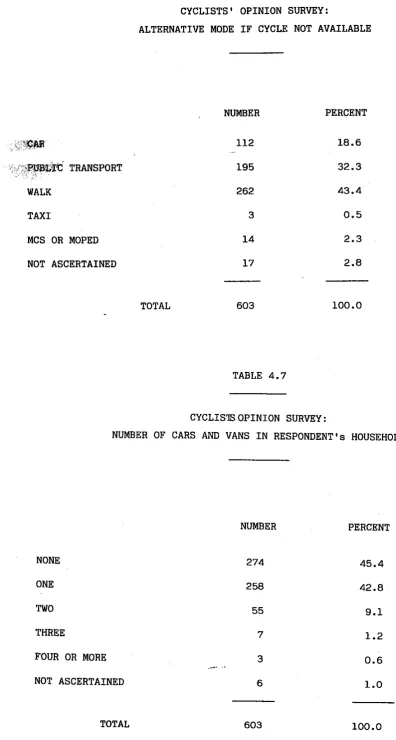
ii) Choice of mode
--
In order to examine the attractiveness, or otherwise, of cycling it is helpful to know why a bicycle was used for the
journey rather than any other mode and what alternative means of
transport would have been used if the journey had not been made by bicycle.
iii) Problems
-
and problem locations.The assumption was made, as a result of discussions with cycling groups, that cyclists.do face problems on their journeys. Lists were prompted to list any locations where they felt
a.fe. The most frequently mentioned locations could be
ntified and studied to see what improvements could be
gested. The origin and destination information is helpful if location is a junction in determining the manoeuvre that has
made.
iv)
-
The trade-off between time, distance and safety.-
-
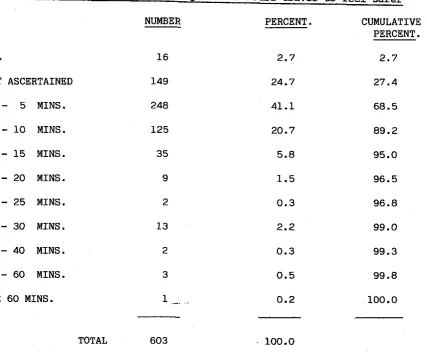
Cycle priority measures are often designed to increase cycle safety. However they sometimes increase travel time for cyclists. When considering the advisability of such measures it is necessary to have some indication of the willingness of cyclists to extend their journey time, or increase their journey distance in order to feel safer.
v) Directness
-
of routeingIn many instances there are physical barriers to movement that make a journey less direct, or more circuitous, than it need be. The local knowledge of cyclists is useful in identifying any such barriers to movement.
vi) Cycle parking
Although it is easier to find a place to park a bicycle than it is a car, there are problems associated with cycle parking. Unless the cyclist takes strict precautions it is relatively easy for the bicycle to be stolen. It is even more difficult to protect bicycle fittings, and any belongings that may have been left on the bicycle. It was considered desirable to have some indication of how bicycles were parked, whether any problems were encountered when parking the bicycle, and the willingness to spend time, or money, in order to park securely.
2.4.7 Questions about-
-
in generali) Popularity of cycling in York
-
--
Cycling is very popular in York. An understanding of the reasons for this might enable the attractions of cycling to be borne in mind when proposals are being formulated. Similarly some knowledge of the things tha.t people do not like about cycling would also be useful.
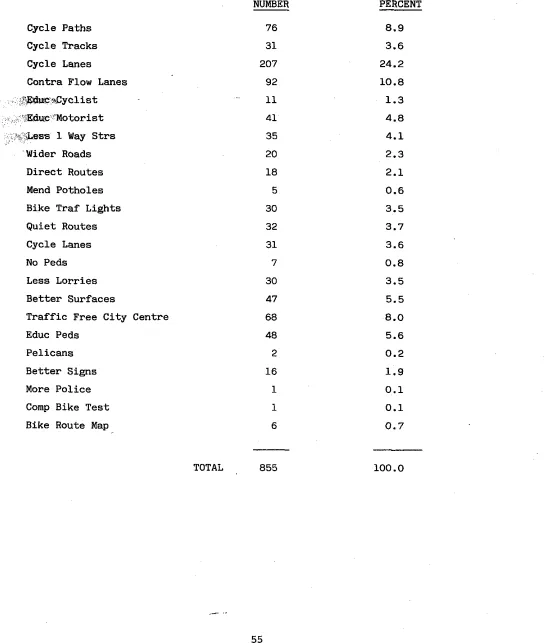
Although it is the task of the study team to make proposals and recommendations on ways of helping cyclists, it is helpful to know what types of measure would be popular with cyclists and where they suggest these measures should be implemented.
iii) Cycling safety and the perception o f safety.
--
-
In the section of the questionnaire dealing with the journey being made cyclists were asked to list any locations on their journey where they felt unsafe (section 2.4.6 (iii)). The general
tion of safety w a s being related to specific problem sites. ny cyclists injure themselves when riding their bicycles cause no motor vehicle is involved the accident is not d to the police and is therefore not included in the t statistics. To get some indication of the frequency of clist injuries they were asked whether they had had any recent jury accidents.
iv) Theft
-
o f bicycles, bicycle fittings-
and personal belongings.In the section of the questionnaire dealing with the journey being made cyclists were asked how far they would be prepared to walk to park their bicycles securely. To get some idea of the severity of the problem of bicycle theft, and theft from bicycles, the cyclists were also asked whether they had been recent victims of this type of crime.
v) Highway Maintenance
Cycling interest groups both locally and nationally draw attention to the fact that because bicycles have poor suspension, the quality of the road surface used by cyclists needs to be good. Cyclists were asked whether they had had their bicycles damaged recently as a result of uneven road surfaces or potholes.
vi) Cycle training
For many years school children have received cycle training under the Cycling Proficiency Scheme. It was considered useful to know what proportion of cyclists had receive such training. The views of cyclists who had received cycle training could be c m p a r e d with those who had not.
vii) Average weekly cycle mileage
In order to obtain an idea of the amount of cycling that takes place cyclists were asked to estimate their average weekly cycle mileage.
viii) Driving licence holding
--
and car availablity.ix) Personal details
In order to be able to compare the views of different groups of the cycling population, cyclists were asked to give their sex, age group and age group, and their address or postcode.
2.4.8) Distribution
-
of questionnairesA total of approximately 1000 questionnaires was distributed to cyclists who were stopped and interviewed at the roadside as part of the Origin andDestination Survey. After the Origin and stination Survey interview was completed a sample of cyclists
me
asked whether they would be prepared to take a questionnaire with them, complete it at the end of their journey, and rn it. It was made clear to the cyclist that no postage would needed to return the completed questionnaire as the srcompanying envelope was marked "Freepost". Very few cyclists refused to take a questionnaire especially when they learned of the chance of winning a 25 cash prize (see section 2.8).Cyclists were chosen on the basis of stratified random sampling. The Origin and Destination Survey interviewers were given an equal number of Cyclists' Opinion Survey questionnaires to distribute. They were instructed to sample the population of cyclists principally on the basis of cycle flow, but they were asked to make sure that cyclists of both sexes and all age groups were included where appropriate.
The volume of cyclists passing each census point was not known when this survey was designed. Time did not permit these counts to be made before the survey was carried out. As an alternative an assessment was made o f each census point and it was classified as indicated below. The number of questionnaires distributed at each census point depended on its flow
classification and this is also indicated below.
Flow Classification of Census Points
-
Class
Heavy flow Medium flow LOW flow
Very low flow
Number o f Questionnaires ~ G t r i b u t e d
Each census point is listed in Table 2.4 giving its flow classification, the number of questionnaires actually distributed and the number returned.
2.5 ) CYCLE PARKING OPINION SURVEY
2.5.1) Purpose o f survey
-
2.5.2) ~ y p e
-
of surveyIt was considered that the most appropriate survey method would be a self-completion questionnaire survey with the questionnaires placed on parked bicycles, in conjunction with a count of the numbers of bicycles parked (see section 2.6). In order to investigate variations in cycle parking problems by the day of the week, and by the time of day, the questionnaires were distributed on a Thursday and on a Saturday both in the morning and in the afternoon.
5 Definition of survey area
-
-
A visual study of cycle parking in York, together with the
:. ..,yresults of discussions with cycling groups indicated that cycle
,:.
., , : -
- 1 .
. .
parking problems were limited to the city centre, the Rougier..,.,, ,
. .
. ,
Street area, and the station. The area covered by the Cycle Parking Survey is indicated on figure 2.3.
2.5.4) Pilot Survey
A small scale pilot survey was carried out during August primarily to test the questionnaire, in conjunction with a pilot survey for the Cyclists' Opinion Survey. Questionnaires were placed on a random sample of bicycles parked within the defined survey area. Resources did not permit a pilot study for the beat survey.
2.5.5) Sample size
-
The pilot survey suggested that the response rate would be of the order o f 25%. In order to be able to subdivide the completed questionnaires into smaller groups for the purposes of anal sis, it was considered that a total o f about 250 fully
Y
comp eted questionnaires would be necessary. Therefore it was decided to distribute 1000 questionnaires for the main survey.
2.5.6) Questionnaire Design
The questionnaire was designed to be self-expanatory and easily understood. A copy of the questionnaire can be found in Appendix
I.
2.5.7) Questions asked in the survey
- -
i) Parking location
The first questions were concerned with the location of the parked bicycle. In conjunction with the Cycle Parking Volume Survey it was possible to relate problems in particular areas or streets to the number of bicycles parked there. Cyclists were also asked if there was anywhere else they would prefer to have parked.
ii) Time, duration and purpose of parking
In order to determine the demand for parking space cycists were asked to state the time they found the questionnaire, the
purpose of t h e i r v i s i t and t h e l e n g t h o f time t h e y had parked.
iii) P a r k i n g s a f e t y , s e c u r i t y ,
-
and p r o t e c t i o n from t h e weather--
From t h e d i s c u s s i o n s w i t h c y c l i n g i n t e r e s t groups it became a p p a r e n t t h a t t h e f t s of b i c y c l e s , t h e i r f i t t i n g s and c y c l i s t s ' belongings was a key i s s u e . C y c l i s t s w e r e asked whether t h e y had r e c e n t l y had t h e i r b i c y c l e s t o l e n o r anything s t o l e n from t h e i r b i c y c l e . They w e r e a l s o asked how f a r t h e y would be p r e p a r e d t o
walk t o f i n d a s a f e and secure p a r k i n g p l a c e . They w e r e asked how t h e y would b e p r e p a r e d t o walk t o l e a v e t h e i r b i c y c l e s itected from t h e weather. F i n a l l y c y c l i s t s were asked how f a r y would be p r e p a r e d t o walk, and how much t h e y would be repared
t o
pay t o use a c y c l e park with a l l of t h e a t t r i b u t e sn t i o n e d above.
i
i v ) Types
-
o f b i c y c l e s u p p o r tThere a r e a number of d i f f e r e n t ways i n which a parked b i c y c l e can be s u p p o r t e d . C y c l i s t s w e r e asked which method t h e y had used and which method t h e y p r e f e r r e d .
v) Locations where Cycle p a r k i n g
-
i s-
a problem.Discussions w i t h t h e c y c l i n g i n t e r e s t groups i n d i c a t e d t h a t t h e o n l y l o c a t i o n where c y c l e p a r k i n g was a problem w a s i n t h e c i t y c e n t r e . To check whether t h i s r e a l l y was t h e c a s e c y c l i s t s where asked t o s t a t e any o t h e r l o c a t i o n s where t h e y c o n s i d e r e d c y c l e parking t o be a problem.
v i ) Other c y c l e p a r k i n g i s s u e s .
C y c l i s t s were i n v i t e d t o l i s t any o t h e r ways i n which c y c l e p a r k i n g could be made e a s i e r .
2 . 5 . 8 ) D i s t r i b u t i o n
-
o f q u e s t i o n n a i r e sA t o t a l o f 1000 q u e s t i o n n a i r e s were d i s t r i b u t e d by p l a c i n g them a t random on parked b i c y c l e s . To d e t e c t any d i f f e r e n c e s i n p a r k i n g problems by t h e t i m e o f day, and by t h e day o f t h e week t h e q u e s t i o n n a i r e s were d i s t r i b u t e d on a Thursday and a S a t u r d a y , i n t h e morning and a g a i n i n t h e a f t e r n o o n on b o t h d a y s . The Thursday chosen was 20th October 1983 and t h e S a t u r d a y was 22nd October 1983. D i s t r i b u t i o n i n t h e morning s t a r t e d a t 10.15 and i n t h e a f t e r n o o n a t 2.15. A t o t a l of 250 q u e s t i o n n a i r e s were d i s t r i b u t e d on each o f t h e f o u r o c c a s i o n s and took a b o u t one h o u r
t o complete. I t was made c l e a r i n t h e q u e s t i o n n a i r e t h a t no
I
p o s t a g e would be needed t o r e t u r n t h e completed q u e s t i o n n a i r e a st h e accompanying envelope was marked " F r e e p o s t " .
2.6) CYCLE PARKING VOLUME SURVEY
I
2.6.1) Purpose o f s u r v e y
-
The purpose of t h e -cycle Parking Volume Survey was t o
2.6.2) Type of survey
--
The most appropriate method of collecting parking volume data was considered to be a beat survey in which a pre-determined fixed route is followed and the number of bicycles parked in each street, or section o f street is recorded. As bicycles do not have a registration number, or any other identifying marks it is not possible to record the duration of parking o f any particular bicycle. Information on duration was obtain from the Cycle Parking Opinion Survey.
2.6.3) Definition of survey area
-
A visual study of cycle parking in York, together with the ults of discussions with cycling groups indicated that cycle king problems were limited to the city centre, the Rougier Zreet area, and the station. The area covered by the Cycle arking Survey is indicated on figure 2.3.
2.6.4) Design
-
of surveyLimitations on time and manpower did not permit a pilot survey to be undertaken. Using a large scale map it was found that the survey area could be divided into two beats such that every publicly accessible cycle parking place in each part could be visited on one occasion by a single observer within the space of approximately two hours. Therefore with two observers the whole survey area could be visited morning and afternoon. At the same time a third person was distributing the associated Cycle Parking Opinion Survey questionnaires.
2.7) PUBLIC OPINION SURVEY
2.7.1) Purpose
-
of surveyThe purpose of the Public Opinion Survey was to seek the views o f a cross-section of the general public on matters related to cycling in York. Both cyclists and non-cyclists were asked to help the study with this survey.
2.7.2) Type o f survey
--
O f the various ways of undertaking a public opinion survey it was considered that a home-based survey would be the most suitable because of the limited resources available to the study team. Although a personal introduction often results in a higher response rate the manpower was not available to do this and the questionnaires were distributed by post.
2.7.3) Pilot Survey
pilot survey only, the questionnaires were delivered by hand and the person answering the door, if an adult, was asked to complete and return the questionnaire at their leisure. Every sixth house was visited and if no reply was obtained, or the householder was not interested, then the adjacent house was selected as a replacement.
2.7.4) Sample size
The pilot survey suggested that the response rate would be o f the order of 25%. In order to be able to subdivide the completed questionnaires into smaller groups for the purposes of lysis, it was considered that a total of about 250 fully pleted questionnaires would be necessary. Therefore it was ided to distribute 1000 questionnaires for the main survey.
2.7.5 ) Questionnaire Design
The questionnaire was designed to be self-expanatory and easily understood. A copy of the questionnaire can be found in Appendix 1.
2.7.6) Questions asked
- -
in the surveyi) Popularity
-
o f cycling in York--
Cycling is very popular in York. An understanding of the reasons for this might enable the attractions o f cycling to be borne in mind when proposals are being formulated. Similarly some knowledge o f the things that people d o not like about cycling would also be useful.
ii) Cycling ability
In order to distinguish those who could cycle from the rest the respondents were asked to state whether they could rise a bicycle, if they could, whether they cycled regularly.
iii) Modal choice
If measures are taken to help cyclists it may well encourage people to start cycling regularly who currently use some other form of transport. Respondents were asked what sort of measures would persuade them to change to cycling and from which mode of transport they would change. A significant change from car driving to cycling may reduce traffic congestion in the peak hours. A
similar change from bus to cycling may reduce the number of people using the buses. Respondents also asked which form o f transport they used most frequently to get around York.
iv) Driving licence holding and car availablity.
--
v) Attitudes
-
t o cyclingPeople's attitudes to cycling may vary depending on which mode o f transport they happen to be using at the time. Respondents were asked to give their attitudes to cycling and cyclists from the point of view o f differnt types o f road user.
vi) Measures t o help cyclists
--
Although it is the task of the study team to make proposals and recommendations on ways of helping cyclists, it is helpful to know what sorts of measures would be popular and where these measures should be implemented. Respondents were asked to give their ideas on ways of helping cyclists.
vii) Evaluation of cycling schemes.
-
To help in formulating a method for evaluating cycling schemes, respondents were asked to identify those strengths and weaknesses of potential improvement measures which they considered particularly important.
viii) Number of cyclists per household
-
-
A persons attitude to cycling may depend not only on the person's own regular form of transport but also on that of other members of the the household. Respondents were asked to state how many members of the household cycled regularly.
ix) Personal details
In order to be able to compare the views of different groups of the population, respondents were asked to give their sex, age group and age group, and their address or postcode.
2.7.7) Sampling method
Ideally a random sample of all residents of the study area old enough to understand and complete the questionnaire would have been preferable. However time constraints made this approach impossible. York City Council had a computer program available that would select a random sample of ratepaying heads of households, including council tenants, for the York City Council area. The study are also includes parts of the surrounding Districts of Harrogate, Ryedale and Selby for which no equivalent program was available. It was decided to use this program for selecting the sample for the York City Council part of the study area. For the rest of the study area a random sample of electors was obtained from the electoral registers. The sample was stratified on the basis of the population of the respective areas. To overcome the problem o f heads of household being selected for the York City area rather than individuals, the questionnaire was addressed to the head of the household with instructions for the questionnaire to be completed by one of the following, randomly
predetermined, categories of resident of the household: I
I
i) the oldest lady in the household
iii) the youngest lady (18 or over) in the household
iv) the youngest gentleman (18 or over) in the household
If this was not possible the head of the household was invited to complete the questionnaire.
2.7.8) Distribution
-
of questionnairesA total of approximately 1000 questions was distributed by post. It was made clear in the questionnaire that no postage yould be needed t o return the completed questionnaire as the m-ompanying envelope was marked "Freepost".
, . 8 )PUBLICITY
-
AND INCENTIVESDuring the survey period every effort was made to publicise M e surveys and encourage people to co-operate.
Posters were displayed at public buildings, the Rowntree/Mackintosh factory
,
and in libraries and cycle shops in the study area. Leaflets were available at libraries and cycle shops, and were handed out at census points.As an incentive to complete and return questionnaires, every person so doing by the closing date had the chance of winning a cash prize of 25.The idea of having a prize was in itself of great publicity value.
2.9) OTHER SOURCES OF
-
INFORMATION.2.9.1) Accident data.
-
Details of all road accidents reported to the police in which a cyclist was injured were obtained from North Yorkshire County Council for the period 1980-1982. The location of each accident was plotted on a map of the study area was a different symbol to
indicate slight, serious, and fatal injury accidents.
More information on accident locations can be found on a plan in Appendix 3.
2.9.2) Interest Groups
In response to the publicity in depth discussions took place with representatives of the following organisations:
i Cyclists' Touring Club ii) York Cycling Campaign iii) Priory Street Pedallers
iv) Institute of Advanced Motorists.
The following groups and organisations have written giving their views on cycling:
i ) Council for the Protection of Rural England ii) Ramblers Association
iii) National Fedexation of Old Age Pension Associations iv) Transport 2000
v Motor Schools Association of Great Britain
2.9.3) Response
--
from the general public.YORK CYCLING STUDY
-
Table 2.1 Origin and Destination Survey
-
-
--
List of Census PointsLocation
-
Code--
Date of--
Date ofNO Interviews Counts (see
---
Type
note 1)-
Acomb Road Blake Street Bootham
Bri,gge(Hospital)Lane
:,>~,:;$&ir Memorial jf.icE%EWn Bridge ~?Tk.&zhton Avenue :%uncombe Place
Field Lane Fishergate Bar Foss Islands Road Hamilton Drive West Heslington Lane High Petergate Holgate Road Leeman Road Lendal Lendal Bridge Love Lane Marygate Lane Melrosegate Metcal f e Lane Micklegate Bar Monk Bar
Navigation Road North River Bank Ouse Bridge
Peasholme Green Piccadilly
Poppl eton Road Rougier Street
Saint George's Field Scarborough Rail Bdg Skeldergate
Skeldergate Bridge South River Bank Sowerby Road . Tadcaster Road Tang Hall Lane Terry Avenue Toft Green Tower Street
University Rd (Lower) Victoria Bar
Walmgate Bar Water End
We1 1 ington Row
Wed 12 Oct (2) (4)
Tues 18 Oct Thurs 6 Oct
(6) Wed 28 Sept Wed 19 Oct Thurs 29 Sept Thurs 27 Oct Thurs 13 Oct Thurs 13 Oct Wed 5 Oct (2) Thurs 27 Oct Thurs 6 Oct Wed 26 Oct (2) Wed 26 Oct Thurs 29 Sept Mon 17 Oct
-
Thurs 6 Oct Thurs 27 Oct Tues 11 Oct Tues 18 Oct Tues 4 Oct Tues 13 Oct Thurs 6 Oct Mon 17 Oct Tues 4 Oct
Tues 11 Oct (9) Wed 12 Oct(2)(10] Thurs 20 Oct
(11) Thurs 6 Oct Tues 27 Sept Mon 24 Oct Thurs 29 Sept Wed 5 Oct Tues 25 Oct Wed 19 Oct Tues 27 Sept Tues 10 Apr
Tues 11 Oct (12) Tues 25 Oct
Tues 27 Sept Mon 24 Oct Wed 28 Sept Thurs 20 Oct - .
Wed 12 Oct (3) Police Thurs 29 Sept(5)
-
Tues 18 Oct Pol ice Thurs 6 Oct VoluntaryMon 9 Apr
-
Wed 2 8 Sept Police Wed 19 Oct Pol ice Thurs 29 Sept Voluntary Thurs 27 Oct Voluntary Thurs 13 Oct (7) Voluntary Thurs 13 Oct (8) Voluntary Wed 5 Oct Voluntary Thurs 27 Oct Voluntary Thurs 6 Oct Voluntary Wed 26 Oct Pol ice Wed 26 Oct Police Thurs 29 Sept Voluntary Mon 17 Oct Police
Tues 27 Oct
-
Thurs 6 Oct Voluntary Thurs 27 Oct Voluntary Tues 11 Oct Voluntary Tues 18 Oct Police Tues 4 Oct Police Tues 13 Oct Voluntary Thurs 6 Oct Voluntary Mon 17 Oct Police Tues 4 Oct Pol ice Tues 11 Oct (9) Voluntary lWed 12 Oct (10) Police
Thurs 20 Oct Voluntary
Tues 27 Sept
-
Thurs 6 Oct Voluntary Tues 27 Sept Voluntary Mon 24 Oct Police Thurs 29 Sept Voluntary Wed 5 Oct Voluntary Tues 25 Oct Police Wed 19 Oct Pol ice Tues 27 Sept Voluntary Tues 10 Apr Voluntary Tues 11 Oct (12) Voluntary
[image:24.602.46.567.109.782.2]NOTES
--i)-"~olice" census points had a policeman present to stop cyclists for interviewing. "Voluntary" census points had no police officer present and relied on the goodwill o f cyclists.
2) Also contains data derived from the British Rail Engineering Limited questionnaire survey.
3) Supplementary peak hour count on Wed 19 Oct because of staff shortage on Wed 12 Oct
4) No interviews because the road is one-way in the interview direction and complementary to Lendal
5 ) One way count in conjunction with Lendal
6) Wide entrance at junction with a major gyratory system made interviewing impracticable
7) Supplementary count on Wed 11 Apr
8 ) Supplementary count on Tues 10 Apr
9 ) Supplementary interviews and count on Wed 11 Apr 10) Supplementary interviews and count on Mon 9 Apr 11) The anticipated low cycle flow did not justify
separate manning of this census point. It was combined with Terry Avenue for counting purposes.
YORK CYCLING STUDY
-
Table 2.2 Origin and Destination Survey
-
-
Numbers of Interviews and Counts a t C e n s u s Points-
-
Location
-
Code-
No. of No. o f Cycles-
2
-
T m--
All Day NO.-
-
~ n t Z-
I?&. Other Total EstimatedDirectn. Directn.
-
2Way
-
FlowAcomb Road 16
Blake Street(2) 90
$ B e h a m 20
?I3DXWge(Hospital)Lane62
...
-rBR War Memorial 7 1*
-Cli&on Bridge 11 Xr'khton Avenue 21 Dblnaombe Place 54Fivld Lane 75
Fishergate Bar 6 7 Foss Islands Road 68 Hamilton Drive West 58 Heslington Lane 73 High Petergate 61 Holgate Road 2 7
Leeman Road 28
Lendal 55
Lendal Bridge 17
Love Lane 5 9
Marygate Lane 6 3
Melrosegate 74
Metcal fe Lane 6 6 Micklegate Bar 19
Monk Bar 14
Navigation Road 69 North River Bank 80
Ouse Bridge 18
Peasholme Green 13
Piccadilly 6 5
Poppleton Road 15 Rougier Street 70 St George's Field 52a Scarborough Rail Bdg60
Skeldergate 53
Skeldergate Bridge 23 South River Bank 56 Sowerby Road 5 7 Tadcaster Road 26 Tang Hall Lane 22 Terry Avenue 5 2 Toft Green(4) 82
Tower Street 64
University Rd(Lowerl25
Victoria Bar 51
Walmgate Bar 24
Water End 12
Wellington Row 72
NOTES
[image:26.595.41.576.120.820.2]N.B.: "Ints."= INTERVIEWS ; "Directn."= DIRECTION ;
1) Contains interviews from the British Rail Engineering Limited survey
2 ) The cycle flow from this location will be combined with Lendal for the modelling stage of the
analysis
3 ) This movement involves pushing a bicycle in a one way street against the main direction of flow.
T a b l e 2 . 3
-
-
ORIGIN & DESTINATION SURVEY CORRECTION FACTORS FOR CYCLE FLOWSS C H
-
E D ~ L ~-
E ~ ~ S I T E S C T E DLOCATION DATE DAY O F WEEK WEEK OF SURVEY PERIOD OF COUNT
L e n d a l B r i d g e 26 Sept Mon
7 O c t F r i 1 3 O c t T h u r s
19 O c t Wed 25 O c t T u e s 1 2 A p r T h u r s
C r i c h t o n A v e 27 Sept T u e s
3 O c t Mon
1 4 O c t F r i
2 0 O c t T h u r s 2 6 O c t Wed
T a d c a s t e r R o a d 2 8 Sept Wed 4 O c t T u e s
10 O c t Mon
2 1 O c t F r i 2 7 O c t T h u r s
Fishergate B a r 2 9 Sept T h u r s 5 O c t Wed
11 O c t T u e s 1 7 O c t Mon
2 8 O c t F r i
Melrosegate 30 Sept Fr i
6 O c t T h u r s
1 2 O c t Wed
YORK CYCLING STUDY
-
T a b l e 2.4 C y c l i s t s ' O p i n i o n Survey
-
R e s p o n s e r a t e2
p o i n t
-
ofd i s t r i b u t i o n
D i s r i b u t i o n C o d e N u m b e r of q u e s t i o n n a i r e s
P o i n t N o
-
-
r e t u r n 3 d i s t r i b u t e dC L I F T O N BRIDGE WATER END
PEASHOLME GREEN MONK BAR
POPPLETON ROAD ACOMB ROAD
ENDAL BRIDGE USE BRIDGE
CKLEGATE BAR THAM
CHTON AVE TANG HALL LANE SKELDERGATE BRIDGE WALMGATE BAR
U N I V E R S I T Y ROAD TADCASTER ROAD HOLGATE ROAD LEEMAN ROAD V I C T O R I A BAR TERRY AVENUE SKELDERGATE DUNCOMBE PLACE LENDAL
SOUTH R I V E R BANK SOWERBY ROAD
HAMILTON D R I V E WEST SCARBOROUGH RLY BRG HIGH PETERGATE
BRIDGE LANE MARYGATE LANE TOWER S T R E E T P I CCADI LLY METCALFE LANE F I S H E R G A T E BAR F O S S I S L A N D S ROAD NAVIGATION ROAD ROUGIER S T R E E T WELLINGTON ROW HESLINGTON LANE MELROSEGATE F I E L D LANE
ROWNTREE SURVEY
3 . SURVEYS
-
DATA PREPARATION & ANALYSIS-
-
3.1 ) INTRODUCTION
This chapter describes the methods of analysis used on the data collected in the surveys, and also the preparation of the data prior to analysis.
All the data collected needed to be converted into a purely numeric form before it could be analysed on the University of "IT.releds Amdahl computer.
3-21 ORIGIN & DESTINATION SURVEY
The design of the Origin and Destination Survey was described in Section 2.2. Over 7000 cyclists were interviewed at 4 3 sites.
In the design and analysis of this survey we were fortunate to have the valuable assistance of Mr F Ghahri Saremi of the Institute for Transport Studies.
3.2.1) Interview data preparation
Prior to coding, the city and its surroundings had been divided into zones. The size of each zone was approximately related to the number of cycles trips starting and ending in the zone. The zone boundaries for the Greater York area were similar to those used in the Greater York Transport Study. The cordons and screenlines are always found along zone boundaries so that every observed trip, other than a circular tour, finishes in a different zone from the one in which it started.Each zone was given a unique number and for every address there was a corresponding zone number depending on the zone in which the address was situated. The zones for the York City area are shown in fig 3.1 and for the surrounding districts in fig 3.2. A special code was used for very distant addresses.
The coding of the data involved giving a number code to the following information:
i Identity of census point ii) Day of week
iii) Week of survey
iv) Identity of person collecting data
v
Identity of person coding data vi) Destination Addressvii) Origin Address viii) Trip purpose
ix) For a work journey, whether or not an additional work trip was made at mid-day
Details of the number codes used can be found in the separate coding manual.
The coded information was first transferred from coding sheets to magnetic tape, and then into a computer file.
The zones were combined into larger zones for the modelling stages of the analysis, these are shown in figure 3.1.
DISTRICTS AND ZONES
( b )
OUTSIDE
CITY WALLS
-
DISTRICT BOUNDARYThe c y c l e c o u n t d a t a was t r a n s f e r r e d d i r e c t l y from t h e survey s h e e t s t o the computer a f t e r t h e t o t a l number o f c y c l e s f o r each 15min p e r i o d had been c a l c u l a t e d . Codes were g i v e n f o r t h e l o c a t i o n o f t h e count, t h e day o f t h e week and t h e week of t h e survey. The codes were t h e same a s t h o s e used f o r t h e i n t e r v i e w d a t a .
3.2.3) Rowntree/Mackintosh
-
and B r i t i s h-
R a i l E n g i n e e r i n g L t d--
d a t a codingThe coding scheme used f o r t h e i n t e r v i e w d a t a was adapted f o r
s e w i t h t h e Rowntree/Mackintosh and B r i t i s h R a i l Engineering Ltd l i n g Surveys d a t a . The d a t a was t r a n s f e r r e d o n t o t h e computer h t h a t it was i n t h e same format a s t h e r o a d s i d e i n t e r v i e w
a.
';.";.~i3~2.4)
-
Data v a l i d i t y checksB e f o r e any computer a n a l y s i s was undertaken, a series of v a l i d i t y checks w e r e c a r r i e d o u t on t h e d a t a t o i d e n t i f y any
coding e r r o r s t h a t may have been p r e s e n t .
3.2.5) C o r r e c t i o n f a c t o r s f o r day o f week and week o f survey
-
---
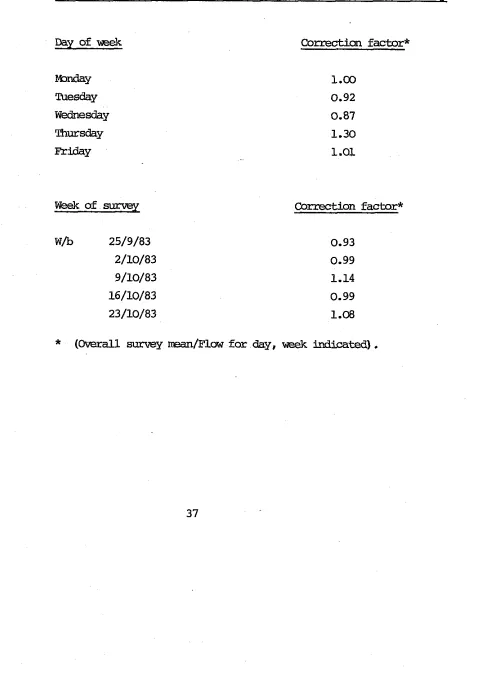
The d a t a f o r t h e O r i g i n and D e s t i n a t i o n Survey was c o l l e c t e d on d i f f e r e n t days o f t h e week, and d i f f e r e n t weeks of t h e y e a r . To s t a n d a r d i s e t h e d a t a a s e r i e s of c y c l e c o u n t s were undertaken throughout t h e s u r v e y p e r i o d (see S e c t i o n s 2.28 and 2 . 2 9 ) . From t h i s d a t a a number of c o r r e c t i o n f a c t o r s were d e r i v e d , by a n a l y s i s o f v a r i a n c e , f o r t h e day o f t h e week, t h e week o f t h e survey, and t h e month o f t h e y e a r . These f a c t o r s a r e g i v e n i n Table 3.1. Only t h e f a c t o r s f o r t h e day o f the week w e r e s t a t i s t i c a l l y s i g n i f i c a n t l y d i f f e r e n t a t t h e 5% l e v e l . For t h i s reason, t h e d a t a was o n l y c o r r e c t e d f o r t h e day o f t h e week and n o t f o r t h e week of t h e y e a r .
3.2.6) T o t a l number
-
o f t r i p s from each census p o i n t--
The o b j e c t i v e o f t h e O r i g i n and D e s t i n a t i o n Survey was t o produce a t r i p m a t r i x f o r an average 24 h o u r working day. For each census p o i n t t h e t o t a l numbers o f t r i p s from e v e r y o r i g i n t o e v e r y d e s t i n a t i o n were r e q u i r e d f o r a 24 hour day.
The raw i n t e r v i e w d a t a gave t h e n e c e s s a r y o r i g i n and d e s t i n a t i o n i n f o r m a t i o n b u t only f o r t h e sample of c y c l i s t s a c t u a l l y i n t e r v i e w e d and o n l y f o r t h e f i v e hour s u r v e y p e r i o d . The raw c y c l e c o u n t d a t a , fran t h e c o u n t c a r r i e d o u t c o n c u r r e n t l y with t h e i n t e r v i e w s , gave t h e t o t a l number o f c y c l i s t s p a s s i n g t h e c e n s u s p o i n t b u t o n l y f o r t h e f i v e hour census p e r i o d .
I t was assumed t h a t t h e o r i g i n s and d e s t i n a t i o n s of t h e sample i n t e r v i e w e d w e r e a n unbiased e s t i m a t e of t h e t o t a l number o f c y c l i s t s counted. T h e r e f o r e t h e t o t a l number o f c y c l i s t s counted w e r e assigned o r i g i n s and d e s t i n a t i o n s i n t h e same p r o p o r t i o n s a s t h o s e o f t h e sample i n t e r v i e w e d .
A s i n t e r v i e w d a t a was o n l y c o l l e c t e d f o r one d i r e c t i o n of flow, it was assumed t h a t t h e t r i p p a t t e r n i n t h e r e v e r s e d i r e c t i o n was a m i r r o r image of t h e d i r e c t i o n surveyed.
A t t h e f i v e census p o i n t s where c o u n t s w e r e c a r r i e d o u t t o