Practice and Prospects for Integrated Coastal Zone
Management (ICZM) in the UK:
Improving Non-Statutory Coastal Governance through
Collaboration
Thesis submitted in accordance with the requirements of the
University of Liverpool for the degree of Doctor of Philosophy
by
Lynne McGowan
Department of Civic Design
i
Abstract
The aim of this thesis is to critically assess the implementation of Integrated Coastal Zone Management (ICZM) in the wider context of coastal planning regimes in order to develop a more effective model of collaboration for coastal governance.
This research is set within the context of a complex system of rights and responsibilities which dominate governance of the UK coastline. Within this system of governance, ICZM stands out as a means of adopting a joined-up approach towards the many different interests in coastal areas – both on the land and at sea. However the implementation of ICZM has traditionally been weak - without statutory powers ICZM has suffered from a voluntary approach to implementation, being delivered through bodies collectively known as coastal or estuary partnerships. Coastal partnerships are highly
participatory in nature, but can only deliver limited outcomes due to the lack of national coastal policies, and deficits in financial and human resources. In addition, as the Marine and Coastal Access Act and Water Framework Directive come into full legal force, with overlapping jurisdictions in the coastal zone, this raises questions for the future role of non-statutory coastal and estuary partnerships.
The research therefore addresses the problems of ICZM in two ways. First, considering ICZM in the wider context of coastal planning regimes, attention is given to the way that the problems of the coast are socially constructed. This is achieved by comparing the social construction of coastal, marine and river catchment problems using the prerequisites outlined by John Hannigan for the social construction of an environmental problem. Whilst identifying limitations in Hannigan’s model regarding the influence of certain conditions in constructing a problem, and the model’s inability to explain progress from problem definition to implementation of a solution, most significantly, it has been found organisations which are able to define a problem also dominate in the proposal and implementation of solutions. Therefore, as the “coastal problem” is subject to ambiguous definitions in which issues of the land and sea are not considered together, this has resulted in weaknesses in addressing coastal problems at the national level.
Secondly, in addressing the ways that ICZM implementation could be improved, the communicative planning approach outlined by Patsy Healey and the model of inter-organisational collaboration developed by Barbara Gray are identified as providing conditions that would enable greater integration of stakeholders within coastal partnerships, through for example open dialogue, joint learning and consensus building, and more importantly, facilitating the integration of ICZM and other coastal governance regimes. Using case studies from ICZM, Marine Planning and River Basin Management, it has been shown that by adapting Hannigan and Gray’s models into a cycle of collaborative policy making, building consensus on the nature of the problem at an early stage in decision making fosters a greater sense of ownership and willingness to participate amongst stakeholders in collaborative arrangements.
Finally, it is recommended that in trying to improve the implementation of ICZM, greater attention is given to the communication of scientific evidence in simpler, more engaging terms to build greater consensus on the nature of coastal problems, and that the model of collaborative policy making is used to help stakeholders understand the benefits of collaborative working and ensure that the right
ii
Contents
Abstract ... i
Contents ... ii
List of Figures, Tables and Maps ... v
List of Abbreviations and Acronyms ... vii
List of Abbreviations and Acronyms Continued ... viii
Acknowledgements... ix
CHAPTER 1: Introducing the Challenge of Coastal Management in the UK ...1
1.1 Research Context ... 1
1.2 The Research Problem/Conceptual Framework ... 5
1.3 Research Aim and Objectives ... 18
1.4 Research Strategy and Thesis Structure ... 19
1.5 Overview of Thesis Structure ... 19
1.6 A Note on Terminology ... 24
CHAPTER 2: the Key to Integration in ICZM - the Need for a Collaborative Approach ... 25
2.1 Introduction ... 25
2.2 Context: On the Meaning of Management ... 26
2.3 On the Meaning of Integration ... 30
2.4 The Critique of Rational Planning and the Communicative Turn ... 39
2.5 Communicative Action and Coastal Planning Regimes ... 48
2.6 Conclusion ... 53
CHAPTER 3: Exploring the Social Construction of Coastal Management Problems ... 55
3.1 Introduction ... 55
3.2 Sociological Perspectives on the Emergence of Environmental Problems ... 56
iii
3.4 Analysis – Drivers for the Social Construction of Different Planning Regimes ... 85
3.5 Conclusions ... 95
CHAPTER 4: A Collaborative Model of Policy Making for Integrated Coastal Zone Management ... 97
4.1 Introduction ... 97
4.2 Models of the Policy Process ... 98
4.3 a Collaborative Perspective on the Policy Cycle ... 118
4.4 A synthesis model of collaborative policy making ... 130
4.5 Conclusions ... 135
CHAPTER 5: METHODOLOGY – Putting Collaboration into Practice: a Framework for Evaluating Collaboration in Coastal Planning Regimes ... 137
5.1 Introduction ... 137
5.2 Data Collection Strategy: a Case Study Approach ... 139
5.3 Review of Coastal Organisations and Initiatives ... 141
5.4 Data Collection ... 154
5.5 Case Study Protocol ... 164
5.6 Pilot Study ... 165
5.7 Conclusion ... 171
CHAPTER 6: Stakeholder Perspectives on the Nature of the “Coastal Problem” ... 172
6.1 Introduction ... 172
6.2 Introduction to Case Studies ... 173
6.3 Findings – Questionnaire Reporting and Interviews ... 182
6.4 Analysis – Problem Recognition ... 184
6.5 Analysis – Factors Contributing to Problem Recognition ... 204
6.6 Conclusions ... 210
CHAPTER 7: Incorporating Stakeholder Perspectives and Improving Integration through Collaboration ... 214
7.1 Introduction ... 214
iv
7.3 Exploring Options ... 234
7.4 Decision Making ... 249
7.5 Structuring and Implementation ... 259
7.6 Conclusions ... 269
CHAPTER 8: Conclusions: Reflections on Collaboration in Coastal Planning Regimes ... 279
8.1 Introduction ... 279
8.2 Research Summary: Review of Aim and Objectives ... 279
8.3 Conclusions ... 285
8.4 Recommendations ... 289
8.5 Reflections on the Methodology ... 297
8.6 Further Research ... 299
8.7 Final Conclusions ... 300
References ... 302
APPENDICES ... 321
Appendix A: List of Coastal Organisations in the UK ... 322
Appendix B: Online Questionnaire ... 335
Appendix C: List of Interviewees ... 343
v
List of Figures, Tables and Maps
Figures
1.1 Geographical and Legal Jurisdictions in the Coastal Zone... 4
1.2 The Framework of Coastal Management in England... 9
1.3 Summary of Thesis Structure... 21
2.1 Example of a tiered coastal management planning hierarchy... 28
2.2 Nature of Property and Government Interests and Institutions in Coastal/Ocean Areas... 34
3.1 Overlapping Coastal Planning Regimes... 62
3.2 The Case for a Coastal Problem: Contributions to the Construction of Claims in ICZM.. 92
3.3 Differing Levels of Agenda... 94
4.1 The Policy Process as a System of Inputs and Outputs... 101
4.2 The ICZM Policy Cycle... 102
4.3 The ICOM Policy Cycle... 103
4.4 The Continuing MSP Planning Cycle... 105
4.5 Cycles of River Basin Management Planning... 105
4.6 The Collaborative Policy Making Cycle... 134
6.1 Questionnaire Response – Scientific Evidence... 187
6.2 Questionnaire Response – Endorsement of Evidence... 187
6.3 Questionnaire Response – Champions/popularisers... 193
6.4 Questionnaire Response – the Media and Dramatic Incidents………. 195
6.5 Questionnaire Response – Economic Incentives... 197
6.6 Questionnaire Response – Outcomes of Previous Initiatives... 201
6.7 Questionnaire Response – Stakeholders Highlighting Problems and Solutions... 203
6.8 Contributions to Claims for Coastal, Marine and Catchment Problems... 213
7.1 Questionnaire Response - Reaching a General Consensus... 218
7.2 Questionnaire Response – Competing Jurisdictions as a Barrier to Integration... 219
7.3 Questionnaire Response – Inclusion of Stakeholders... 225
7.4 Questionnaire Response – Proposal of Partnership Working... 230
7.5 Questionnaire Response – Policy Proposals... 236
7.6 Questionnaire Response – Institutional Arrangements... 236
7.7 Questionnaire Response: Core Goals and Bargaining……….. 240
7.8 Questionnaire Response – Increased Use of Joint Working………. 243
7.9 Questionnaire Response – the Uneven Dispersal of Powers……….. 245
7.10 Questionnaire Response – Consensus and Coordination……….. 251
7.11 Questionnaire Response – Public Sector Sponsors... 254
vi List of Figures Continued.
7.13 Questionnaire Response – Windows of Opportunity……… 256
7.14 Questionnaire Response – Legal Frameworks... 261
7.15 Questionnaire Response – Allocation of Responsibilities………….………. 261
7.16 Questionnaire Response – the Plan Making Process... 264
7.17 Questionnaire Response – Financial Commitment... 266
7.18 Questionnaire Response: Measures Becoming More Commonplace... 267
8.1 The Collaborative Policy Making Cycle, Revised ... 288
List of Tables 4a Problem Solving and Stages of the Policy Cycle... 106
4b Conditions facilitating inter-organisational collaboration... 127
4c Stages of the Policy cycle and collaboration... 131
5a Problem Recognition... 157
5b Consensus Building... 158
5c Exploring Options... 159
5d Decision Making... 160
5e Structuring and Implementation... 161
6a Summary of Questionnaire Completions by Planning Regime. 182 6b Questionnaire Responses for Problem Recognition... 186
7a Consensus Building – Propositions……….. 216
7b Questionnaire Responses for Consensus Building……… 217
7c Exploring Options – Propositions... 234
7d Questionnaire Responses for Exploring Options... 235
7e Decision Making – Propositions………. 249
7f Questionnaire Responses for Decision Making……….. 250
7g Structuring and Implementation – Propositions……… 259
7h Questionnaire Responses for Structuring and Implementation……… 260
Maps A Dorset Coast Forum Area... 147
B Severn Estuary Partnership Management Area... 148
C East Grampian Coastal Partnership Management Area... 149
D Marine Spatial Planning Pilot Area... 152
vii
List of Abbreviations and Acronyms
CCW Countryside Council for Wales
CPRE Commission for the Protection of Rural England CRoW Countryside Rights of Way
DCLG Department of Communities and Local Government DEFRA Department of Environment, Food and Rural Affairs
DETR Department of the Environment, Transport and the Regions DoE Department of the Environment
EA Environment Agency EEZ Exclusive Economic Zone
EIA Environmental Impact Assessment EU European Union
GESAMP Joint Group of Experts on Scientific Aspects of Marine Environmental Protection HELCOM Helsinki Commission (the Baltic Marine Environment Protection Commission) HEP Human Exceptionalist/Exemptionalist Paradigm
ICES International Council for the Exploration of the Seas ICM Integrated Coastal Management
ICZM Integrated Coastal Zone Management IPCC Inter-governmental Panel on Climate Change IUCN International Union for Conservation of Nature
MARPOL Marine Pollution (from the International Convention for the Prevention of Pollution From Ships) MAFF Ministry of Agriculture, Fisheries and Food
MEDI Marine Environmental Data Initiative MMO Marine Management Organisation MP Marine Planning
viii
List of Abbreviations and Acronyms Continued
RBD River Basin District RBM River Basin Management RBMP River Basin Management Plan
RCEP Royal Commission on Environmental Pollution RSPB Royal Society for the Protection of Birds SEPA Scottish Environmental Protection Authority SNH Scottish Natural Heritage
UKCIP United Kingdom Climate Impacts Programme
UNCED United Nations Commission on Environment and Development UNCHE United Nations Conference on the Human Environment UNCLOS United Nations Convention on the Laws of the Sea UNEP United Nations Environment Programme
UNESCO United Nations Educational, Scientific and Cultural Organization WAG Welsh Assembly Government
WCMP Wales Coastal and Maritime Partnership WFD Water Framework Directive
ix
Acknowledgements
Despite having been told on a number of occasions that writing a PhD thesis is something of a solitary experience, this work would not have been possible without the help and encouragement I have received along the way from a number of people. So, as is customary I would like to take this opportunity to express my gratitude to those individuals.
My thanks go first to Sue Kidd for her ongoing support as tutor and PhD supervisor. I would also like to acknowledge the support of Professor Greg Lloyd, who acted as my second supervisor during his tenure at Civic Design, and Professor Cecilia Wong, whose leadership of the Civic Design Postgraduate
community in my early years as a postgraduate student helped me prepare for the intellectual challenges ahead.
Fundamental to my being able to conduct this research was the financial support of the Economic and Social Research Council, so I extend my gratitude to the ESRC also.
Probably one of the hardest tasks in undertaking this thesis was finding a willing group of people to take part in case study interviews, and so I am extremely grateful to all of those individuals who gave their time to speak to me, and in particular Stephen Hull at ABPmer, Jim Claydon, Bridget Betts at Dorset Coast Forum, Ian Hay at East Grampian Coastal Partnership, Jonathan Mullard (formerly of the Severn Estuary Partnership) and Linda Bigland at the Environment Agency who acted as my main points of contact for each case study and helped me track down further contacts in one way or another.
There are many other people that have been an invaluable source of support during thesis writing at the University of Liverpool, including Dr Peter Brown, whose boundless enthusiasm and entertainment has provided an often needed respite from the serious business of thesis writing, and Suzanne Roebuck, Sue Edwards and Jill Gun-Why have all provided administrative and technical support when needed.
A special vote of thanks goes to all the friends that have provided me with laughs, moral support, free drinks and even musical accompaniment from time to time – Matthew Cocks, Tori and Andrew, Olivier Sykes, Alex Lord, Paula and Rob, Chris and Hannah, Alex Nurse, Stephen Ackers, and Andreas Schulze Baeing.
1
CHAPTER 1: Introducing the Challenge of Coastal Management in the UK
1.1 Research Context
The UK’s coastline is a complex and dynamic environment of diverse landscapes, rich biodiversity and natural resources which supports a broad range of human activities. However, this situation also means that the coastal zone is a contested space, which is facing increasing competition for use of its resources and at the same time needing protection from forces for change - natural environmental and manmade pressures which threaten to diminish this resource base.
In response, coastal management in the form of coastal defences, drainage and the construction of man-made harbours has existed since Roman times (Ballinger, 1999 and Fleming, in Barrett, 1992), and the growth in maritime activity from the Sixteenth Century onwards has led to the introduction and increasing use of formalised control over ocean space (Gibson, 1993), developing alongside the regulation of land-based activities.
Although coastal management itself has many definitions, some examples offer an insight into what coastal management is and what it is intended to achieve. Starting with the concept of management, Ehler and Basta describe it as “a set of related activities carried out to achieve desired objectives” (1993:7), and Kay and Alder suggest that coastal management can mean either the day-to-day direction of activities occurring in the coastal zone (operational management), or the overall control of the organisations which oversee those activities (strategic management) (2005:77).
According to Post and Lundin (1996:1), coastal management is “a process of governance”, or, for America’s National Oceanic and Atmospheric Administration:
“a complex interaction of laws, programs and efforts to evaluate trade-offs and make decisions about how to use, conserve and value the resources and opportunities of the coastal zone” (2006:1).
ICZM has also more recently been defined in the UK by the Department for Environment, Food and Rural Affairs (DEFRA) as:
2
process of harmonising the different policies and decision-making structures, and bringing together coastal stakeholders to take concerted action towards achieving common goals. Integrating the many different interests effectively means we can look at the coast in a holistic way.” (DEFRA, 2009:4)
Contemporary challenges for managing the coastal zone may be classified into three main themes: 1. Complex, cumulative problems,
2. Multi-dimensional change, and
3. Escaping territorial and sectoral boundaries. (National Trust, 2006)
1.1.1 Complex, cumulative problems
Besides accommodating the natural processes of environmental change such as erosion and deposition, one of the greatest challenges for the planning and management of coastal zones is the effects of climate change. With sea levels predicted to rise and greater risk of extreme weather events such as storms and floods, it is expected that global warming will change the physical, biological and
biochemical characteristics of the seas, and will reshape the physical landscape and activities that currently take place at the coast. It is, however, currently difficult to be precise about the scale of these effects (UKCIP, 1998, cited in Royal Commission on Environmental Pollution, 2002:136).
Also, the effects of pollution from land based and offshore sources contributes to changes in the coastal environment, through the loss of biodiversity and adverse changes to water quality which can impact on the economy and human health. Despite increasing controls and regulations designed to prevent or limit pollution, the continuing discharge of pollutants from land-based and marine sources such as industrial waste, sewage, oil, heavy metals and agrichemicals, plus marine and beach litter and tipping represents an ongoing concern (see DEFRA, 2010a, Charting Progress 2).
3 1.1.2 Multi-dimensional change
Approximately 16.9 million people live within 10Km of the UK’s coast (Atkins, 2004), and this number is due to increase with population growth, longer life expectancy, increasing affluence and migration (Ibid, p17).
The loss of traditional industries such as ship building and the decreasing popularity of British seaside holidays in the face of overseas competition have had major negative effects for coastal communities in the form of economic depression and social exclusion. For example Blackpool is ranked as the 24th most deprived out of 354 local authority areas in England (House of Commons CLG Committee, 2007). Many coastal towns are characterised by low wage, low skill seasonal employment, plus a demographic trend of outward migration by the young and an increasing elderly population placing additional demands on health and social services.
However, although the general perception of coastal towns is one of decline, the Seaside Towns Research Project found that levels of unemployment are comparable to other non-coastal towns, and that seaside towns have actually seen strong employment growth from 1971-2001, and that social and economic problems are due to in-migration and housing demand outstripping local employment growth (Beatty and Fothergill, 2003:5).
Whilst the tourism industry has therefore remained a major part of the coastal economy, diversification of the economic base into new sectors such as services and ecotourism may provide more positive benefits. However the European Commission (1999a) observes that traditional, low impact uses of the coastal zone are being replaced with more high impact, intensive uses that may be economically attractive in the short term but threaten the long term sustainability of the coasts natural assets. Managing the coastal zone therefore relies on being able to balance the economic, social and environmental dimensions of change.
1.1.3 Escaping territorial and sectoral boundaries
4
regulations (Lloyd and Peel, 2004). Part of this complexity can be seen in Figure 1.1 below, which illustrates the jurisdictions of various local and national organisations across the coastal zone. Figure 1.1: Geographical and Legal Jurisdictions in the Coastal Zone
Source: Based on Atkins (2004), revisions by Author
Key to Organisations
APHFCD - Animal and Plant Health, Fisheries and Countryside Division (Wales)
CCW – Countryside Council for Wales DARD – Department of Agriculture and Rural Development (NI)
DCAL – Department of Culture, Arts and Leisure (NI) DECC – Department of Energy and Climate Change DEFRA – Department of the Environment, Food and Rural Affairs
DETI – Department of Enterprise, Trade and Investment (NI)
DfT – Department for Transport
EA – Environment Agency
EHS – Environment and Heritage Service (NI) JNCC – Joint Nature Conservation Committee MMO – Marine Management Organisation MS – Marine Scotland
SEED – Scottish Executive Energy Directorate SEPA – Scottish Environmental Protection Authority
5
This approach has two main disadvantages. Firstly, land use planning approaches in the past have failed to understand the dynamics of the relationship between water resources and land management, for example the coast of East Anglia is threatened by erosion and flooding despite – and probably because of – investment in sea walls which trap sand and aggravate erosion in other areas (European
Commission, 1999a:8).
Secondly, initiatives for particular sectors or administrative units of planning have not fully considered the effects they may have on other sectors or locations. Nor have they realised the potential to improve the collection and dissemination of environmental and other data that could be achieved by inter-sectoral and inter-organisational collaboration. The need for appropriate scientific data and information to provide an evidence based approach to policy making and local decision making is cited as important for any marine or coastal planning initiatives (see for example DEFRA, 2007a, European Commission, 1999a). Therefore more holistic and integrated approaches to planning for coastal zones, which consider both geographical integration across the land-water interface and sectoral or institutional integration are required.
This brief description of the challenges for coastal management demonstrates that the sustainability of coastal zones represents a “wicked” problem. This phrase, first coined by Rittel and Webber in 1973, refers to planning problems which are not easily definable and do not have definitive solutions due to the complex nature of the political, economic and social systems within which they exist, the unknown ramifications of introducing a solution and the lack of a definable solution – “every wicked problem can be considered to be a symptom of another problem” (1973:165). In this sense, therefore, talk of coastal management “problems” and “solutions” can only refer to symptoms as they manifest at particular times.
1.2 The Research Problem/Conceptual Framework
Having established the need for a strategic framework of coastal management to meet the challenges of sustainable development, Alder and Kay note that coastal management programs have generally
6
Social constructionism, in its traditional sociological sense, is not easily defined but assumes that knowledge is historically and culturally constituted – truth is a product not of objective observation of the world, but of social interactions and processes in which people are engaged with each other (Burr, 2003:5) and their surroundings. In fact the concept of a coastal zone itself is recognised as being based not merely on physical or administrative lines but is socially, culturally and politically constituted (see Kay and Alder, 2005, and Brown et al, 2002).
This research therefore takes the social construction of environmental problems as a conceptual framework for analysing the implementation of coastal planning regimes in the UK. The fundamental assumption of the research is that the definition of an environmental problem, and the formulation and implementation of a solution, is the product of a process of social construction.
Based on this assumption, the research examines the development of coastal planning and management regimes as a response to a socially constructed environmental problem.
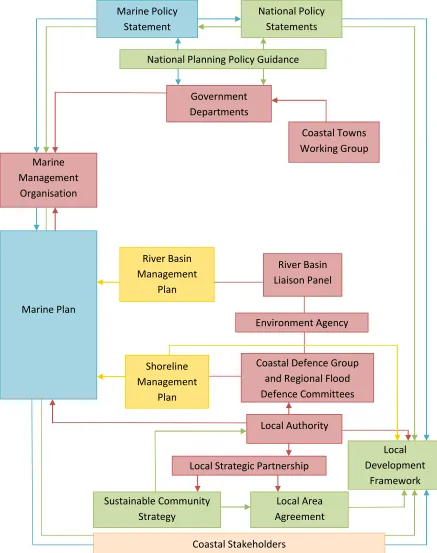
The current framework for coastal management in England is summarised in Figure 1.2 below, and whilst policy and planning arrangements are in a state of flux, particularly following the 2010 General Election and the change of government, the basic elements are shown to include national policy and government departments guiding four main management processes. These are:
Terrestrial spatial planning
Spatial planning in England is governed by policies laid down by the Department for Communities and Local Government, and Planning Policy Statements (PPS) or Planning Policy Guidance Notes (PPGs) guide developments onshore and down to Low Water Mark (LWM) at the coast, with PPG20: the Coast
providing the first set of policy guidance specifically for development in coastal areas, although this has now been superseded by PPS 25: Development and Flood Risk (incorporating the supplement
7
usually incorporated in Local Development Frameworks and their associated development control and local policies, Local Area Agreements1 and Sustainable Community Strategies.
In Scotland, terrestrial planning is governed by the National Planning Framework and Scottish Planning Policy (SPP). SPP provides a simplified set of planning policies, including those for coastal planning, and replaces National Planning Policy Guidance which was first developed to deal with pressures related to the exploitation of North Sea oil and gas in the 1970s, and Planning Advice Note 53:Classifying the Coast for Planning Purposes (Scottish Office, 1998). Statutory planning control under the Town and Country Planning (Scotland) Act 1997 and associated legislation extends to the mean low water mark of ordinary spring tides, and to marine fish farming (Scottish Government, 2010:20) and requires that local
authorities identify coastal areas suitable for development, areas subject to significant constraints and areas unsuitable for development such as isolated coasts.
For Wales, the Wales Spatial Plan and Planning Policy Wales provide the overarching policy for terrestrial planning, and planning policy for coastal areas is supplemented by Technical Advice Note (TAN) 14: Coastal Planning. In producing Local Development Plans, local authorities are expected to consider the landward and seaward pressures on coastal systems of proposed developments, and only propose coastal locations for those developments that need to be on the coast (Welsh Assembly Government, 2010:78).
1 Local Area Agreements were introduced by the New Labour government and are produced by Local Strategic
8 Marine Planning
Under the new Marine and Coastal Access Act, a Marine Management Organisation (MMO) has been established that will have statutory duties for fisheries, offshore renewable energy, aggregates licensing, construction, improving access to the coastline and creating a network of Marine Conservation Zones. The MMO will also be responsible for a system of marine planning, which will provide strategic guidance for use of the marine environment from High Water Mark (HWM) onshore out to 200Nm in a number of specifically defined inshore and offshore plan areas (the proposed boundaries of these are still under consideration).
In relation to the devolved administrations, the MMO will only operate in England – for Wales marine management duties will be undertaken in-house by the Welsh Assembly Government, in Scotland the requirements of the Marine (Scotland) Act will be discharged by Marine Scotland, with a national marine plan to be prepared by the Scottish Government and regional marine plans produced by Marine
9 Government Departments Departments
Coastal Stakeholders Local Strategic Partnership
Local Development
Framework Local Area
Agreement Sustainable Community
Strategy
Coastal Defence Group and Regional Flood Defence Committees Local Authority Shoreline
Management Plan Marine
Management Organisation
Coastal Towns Working Group National Planning Policy Guidance
Marine Policy Statement
National Policy Statements
River Basin Management
Plan Marine Plan
[image:19.612.72.509.104.657.2]Environment Agency River Basin Liaison Panel Figure 1.2: the Framework of Coastal Management in England
Source: Based on DEFRA (2009), revised by author following the 2010 General Election and
the abolition of several bodies including the Infrastructure Planning Commission, Regional
10 River Basin Management
Under the European Union’s Directive 2000/60/EC of the European Parliament and of the Council of 23 October 2000 establishing a framework for Community action in the field of water policy (theWater Framework Directive), Member States are required to reach a target of good chemical and biological status for all inland waters, ground waters and estuaries out to 1 Nautical Mile by 2015. This is to be achieved by through the production and implementation of River Basin Management Plans for defined River Basin Districts. The WFD has been transposed into UK legislation by the Water Environment (Water Framework Directive) (England and Wales) Regulations 2003, Water Environment and Water Services (Scotland) Act 2003 and Water Environment (Water Framework Directive) Regulations (Northern Ireland) 2003.
In the preparation of River Basin Management Plans, each Member State’s waters will be classified (characterised) and a statement of Significant Water Management Issues (SWMIs) will be produced for each River Basin District. The finalised River Basin Management Plan documents, the first of which were published for England and Wales in 2009, will contain a Programme of Measures to deliver
environmental objectives by 2015, which will include work to be undertaken by local and national government, water companies and other organisations. In Directive 2000/60/EC, exceptions have been made for “Heavily Modified Water Bodies” that have undergone major physical alterations for different purposes to reach “good ecological potential” status by 2015.
River Basin Management Plans are produced by the Environment Agency in England, Wales and Northern Ireland, and the Scottish Environmental Protection Agency.
Shoreline Management
Shoreline Management Plans are non-statutory plans to deal with coastal flooding and erosions risks and are prepared by Coastal Groups comprised of coastal local authorities and national environmental bodies such as Countryside Council for Wales, Scottish Natural Heritage and the Environment Agency. Plan boundaries are based on sediment cell units, that is, natural patterns of sediment (sand)
11
SMPs provide an action plan for local authorities to work towards a set of Outcome Measures that have been devised by the government – these include the number of households at risk from flooding or erosion, the contribution of flood management to maintaining habitats, and the number of planning consents given to households in flood risk areas despite Environment Agency objections.
Whilst Figure 1.2 is a far from comprehensive illustration of the institutions, regulations, strategies and initiatives that constitute activities in the coastal zone, and concentrates mainly on the landward side of coastal management, it demonstrates the many levels of government, organisations and decision making elements that contribute to the overall management of the coastal zone.
Amongst the many measures that constitute the framework for coastal management in the UK, this research focuses on one particular form of coastal management, namely Integrated Coastal Zone Management (ICZM). Within the framework of coastal management outlined in Figure 1.2 above, the relatively recent enactment of the Marine and Coastal Access Act in 2009 has prompted debate about the appropriate arrangements for the planning and the management of the UK coast (Stojanovic and Barker, 2008:347), with the role of ICZM being questioned in particular due to a number of problems which are outlined in more detail below.
ICZM has its origins in the USA’s Coastal Zone Management Act, but has been more recently advocated for use by UNCED through the Agenda 21 document (UNCED, 1993) and the European Union’s
Recommendation of the European Parliament and of the Council 2002/413/EC on the Implementation of Integrated Coastal Zone Management (from herein known as ICZM Recommendation 2002/413/EC) which currently forms the basis for ICZM activities in the UK.
The ICZM Recommendation required that Member States first conduct a stock take of the major laws, policies, actors and institutions influencing the management of the coastal zone, and then develop a national ICZM strategy (or several strategies) based on the eight broad principles identified through a Demonstration Programme (1996-99) and outlined in Recommendation 2002/413/EC.
The eight ICZM principles are:
a) a broad overall perspective (thematic and geographic),
12 d) local specificity,
e) working with natural processes and respecting the carrying capacity of ecosystems, f) involving all the parties concerned in the management process,
g) support and involvement of relevant administrative bodies at national, regional and local level, and
h) use of a combination of instruments. (CEC, 2002)
Despite such high level support for ICZM, the implementation of ICZM in the UK has been characterised by a number of problems, which are well documented by authors such as Gubbay, (2002), McGlashan, (2002), the Local Government Association (2002), Ballinger, (1999 and 2005), Atkins (2004), McKenna and Cooper (2006) and Stojanovic and Shipman, (2007). These include:
1.2.1 Lack of statutory status
Although non-binding, the UK government adopted the EU’s ICZM Recommendation 2002/413/EC and national ICZM strategies have been produced for each of the devolved administrations, (see Scottish Executive, 2005, Northern Ireland Department of the Environment, 2006, Welsh Assembly Government, 2007 and DEFRA, 2009). However, these national strategies, like Recommendation 2002/413/EC, are not legally binding and thus only provide a framework for how ICZM principles can be incorporated into existing or future measures for coastal governance, for example through harmonising the activities of different competent bodies in the coastal zone and integrating marine and terrestrial spatial planning (DEFRA 2009:14). This non-formal status also explains why ICZM strategies are absent from the framework of coastal management shown in Figure 1.2.
13
However, the lack of statutory footing for ICZM to date has had several consequences for ICZM practice, which are outlined further below.
1.2.2 The voluntary approach to ICZM Implementation
Without statutory backing, the delivery of ICZM has proceeded via a number of different organisations with varying degrees of support. Taking English Nature’s Estuaries Initiative, launched in 1992, and Scottish Natural Heritage’s Focus on Firths project (launched 1993) as early models of an integrated approach to coastal management, estuary and Firth partnerships and coastal fora alongside other ad hoc bodies were established in response to particular local environmental issues (see Morris, 2008, CoastNet, 2003).
The voluntary manner in which coastal organisations have been established has lead to an uneven geographical spread of organisations around the UK, with a small number of organisations covering the geographically large Firths of Scotland - the original Focus on Firths initiative started with three
partnerships, the Moray Firth, the Solway and Forth Estuary Forum (Allmendinger, Barker and Stead, 2002), and smaller, but more numerous groups around the English coast forming as a result of the Estuaries Initiative (over 40 estuary Partnerships and Management Plans according to Morris, 2008:25).Using “Coastal Partnerships” as a collective term for the range of voluntary coastal
management organisations in existence, partnerships are generally formed from a mixture of interested parties from local government, government agencies and the private sector (Stojanovic and Barker, 08:345). Hewett and Fletcher note that although the exact remit of each partnership varies, commonly they aim to promote a more integrated approach to coastal governance through facilitating
cooperation, conflict resolution, raising awareness and gathering and disseminating information to coastal stakeholders (2009:1).
14
With no formal role in coastal governance (Fletcher, 2007), coastal partnerships rely on funding from partners, and alongside the lack of statutory powers this has been seen by many to be a key constraint to the delivery of projects (CoastNet, 2003: 3). The scarcity of funding for coastal partnerships also often leads to a rapid turnover of project officers, and the loss of “corporate memory” (McGlashan,
2002:226), which subsequently poses problems in terms of maintaining relationships with stakeholders and potential funding partners.
1.2.3 The Democratic Deficit in the Management of Coastal Resources (LGA, 2002)
Linked to the sectoral nature of coastal and marine activities and the role of central government in decision making for such activities, it has been found that there are few opportunities for public
consultation and democratic accountability in coastal management (Stojanovic and Shipman, 2007:382). Whilst the national ICZM Stock Take undertaken by Atkins Consultants in 2004 noted that the
participatory and locally specific nature of coastal partnerships was a relatively successful aspect of ICZM practice, the lack of opportunities to be involved in decisions of a major strategic nature means the ability of coastal partnerships to influence such decisions is restricted.
1.2.4 Data Requirements
As is stated by Midlen (2006), good information is needed to facilitate good management – this
information being fundamental to understanding the pressures on the coast and potential management responses. However despite the proliferation of organisations collecting data on the environment and socio-economic issues for both landward and marine sides of the coastal zone there is no single central body responsible for the dissemination of coastal data. French (2004:117) also notes that “academia, consultants, NGOs and governments often fail to promote information exchange and development of good practice”, a point which is supported by the Local Government Association’s On the Edge – the Coastal Strategy report, which recognised that the data needs of coastal managers could be better met through closer networking between practitioners and research communities (LGA, 2002).
15
order for ICZM to be effectively utilised by the UK government as part of its commitment to marine stewardship and more broad sustainable development goals. Indeed, Stojanovic, Ballinger and Lalwani (2004) demonstrate how many studies have already sought to prescribe measures of “successful” ICZM practice or highlight exemplars of best practice, such as the EU’s own Demonstration Programme of 35 ICZM projects (European Commission, 1999b), Pickaver, Gilbert and Breton (2004), Burbridge (1997), and Olsen, Tobey and Kerr (1997).
One aspect that has been identified as key to better ICZM is the notion of integration, which is intended to remedy the core issues of uncoordinated, sectoral based coastal management and the lack of
overarching strategic plans or policies. In discussing why integration is essential to coastal zone management, Chua (1993) emphasises how integration “provides a broader cohesive perspective”, which assists in the attainment of sustainable development goals (p85).
Cicin-Sain (1993) and Cicin-Sain and Knecht (1998) propose that integration is not a discrete
characteristic of ICZM, rather that it can be viewed as a continuum of varying degrees of more or less integration. Along this scale, categories range from:
Fragmented approach – which represents the least integrated, sectoral-based forms of management,
Communication, Coordination, Harmonisation, and
Integration – this will have a formal basis and is achieved by measures such as the creation of new institutions or redefining the roles of existing institutions.
16
According to Selin and Chavez (1995, in Randolph, 1999:171) conflicts with complex, competing
interests are not well managed by strict, technocratic decision making processes and thus the contested nature of coastal resources and management approaches requires a deeper understanding of the perspectives and value judgements inherent in decision making systems. Davos (1998), recognising that sustainability policies for coastal zones are socially constructed and focused on technocratic and rationally defined “best” policies, calls for a more cooperative form of coastal management which not only seeks to uncover the origin and meaning of values in order to reduce conflict and identify “correct” policies (Davos, 1998) through public discourse, but also maximises and sustains stakeholder
involvement.
This idea of discourse as a means to effect improved coastal management gives rise to a second assumption that is explored in the research; that improved integration and implementation of ICZM is dependent on a continuous discourse between stakeholders on the nature of problems and solutions.
This assumption is explored by reference to collaborative planning. Collaboration finds its expression in ICZM practice through UNCED’s Agenda 21 document, which called for a commitment to achieving sustainable development for the marine and coastal environments, through an integrated policy and decision making process, including all involved sectors, to promote compatibility and a balance of uses (UNCED 1993: paragraph 17.5(a)), and in the EU’s ICZM Recommendation 2002/413/EC ICZM principles, in particular the principles of involving all the parties concerned in the management process, and
support and involvement of relevant administrative bodies at national, regional and local level.
Within the UK, participation in environmental decision making is a well established process, operating mainly through the provisions of the town and country (terrestrial) planning system in respect to proposed developments, and processes such as Sustainability Appraisal and Environmental Impact Assessment.
For coastal partnerships, as has already been stated, their core activities are concerned with facilitating cooperation and resolving conflicts, awareness raising and understanding, and information
dissemination (Fletcher 2007a; Stojanovic and Barker 2008) and this work is undertaken through what is broadly described as a “partnership approach” which has its roots in the concept of governance.
17
stakeholders in a problem engage in an interactive process, using shared rules, norms and structures to act or decide on issues related to that problem (based on Wood and Gray, 1991:146) and recognises that the problem encountered may be insurmountable to stakeholders or organisations working alone. In the case of ICZM, which considers cross-cutting issues of sustainable coastal development, governance arrangements may be particularly complex as they attempt to integrate institutions, legislation, policies, plans and programmes operating at different scales. Partnership working therefore represents an attempt to build consensus around coastal issues and pool the resources of stakeholders with different interests in order to deliver mutually agreed outcomes.
Davos states that “by involving all the stakeholders and integrating their input, co-operative CZM lays the foundations for stakeholders to build a habit of cooperation, a reputation of conforming with collective agreements, a trust that others will cooperate and an appreciation of the greater promise of cooperation over defection (the pursuit of self-interest) for coastal zone sustainability” (1998:381).
18 1.3 Research Aim and Objectives
The overall aim of this research is:
To critically assess the implementation of ICZM in the wider context of coastal planning regimes, in order to develop a more effective model of collaboration for coastal governance.
In order to meet this research aim, the following objectives will be used to structure the research undertaken in this thesis:
Objectives
1. To critically assess the practice of Integrated Coastal Zone Management in the UK and place this in the context of other current planning and management regimes for the coastal and marine environment.
2. To explain the emergence of coastal planning regimes in terms of the social construction of a “coastal problem” in order to understand the differentpolicy responses that may occur.
3. To develop an understanding of how integration may be facilitated by collaboration between stakeholders in coastal organisations.
4. To determine what factors are most important in practice for constructing claims about a coastal problem, and provide a reappraisal of the social construction model proposed by John Hannigan.
5. To evaluate how collaboration is embedded within the plan making processes of coastal organisations and provide recommendations as to how collaborative policy making may be improved.
19 1.4 Research Strategy and Thesis Structure
The aim and objectives outlined above have assisted in designing a research strategy that structures the thesis into conceptual, contextual, theoretical and analytical components which are explained below. In the conceptual and contextual component of the thesis, the research problem (the implementation of ICZM) is identified and set against a conceptual framework of socially constructed environmental problems and policy responses. This is then examined in more depth through the first stage of empirical work - a comparative study examining the social construction of coastal, marine and water catchment problems through a desktop study of associated literature.
The theories examined in this contextual and conceptual phase meet Objectives 1, 2 and 3 and inform the development of further research questions and the theoretical framework and methodology that is to be used in the second empirical stage of the research. The second phase of empirical work utilises a case study approach, which allows for phenomena to be investigated in a highly contextualised setting (Yin, 2003). Furthermore, Denzin and Lincoln (2003) note that case study is a typical narrative form for enquiry founded on an interpretive paradigm such as social construction.
The analysis stage of the thesis brings together the findings of the second phase of empirical work with the theoretical framework in order to answer the research questions and provide an overall evaluation of the collaborative policy making process in coastal planning regimes. This analysis meets Objectives 4 and 5.
1.5 Overview of Thesis Structure
The thesis structure is shown in Figure 1.3, which indicates how each chapter relates to the conceptual, theoretical, empirical and analytical stages of the research and the overall research objectives.
20
Based on the assumption that improved integration and implementation of ICZM is dependent on a continuous discourse between stakeholders on the nature of problems and solutions, Chapter 2 considers first the different types of integration that can or should be achieved by ICZM, and secondly the role of collaboration in the current context of coastal management. Literature on collaborative or communicative planning is reviewed to provide the theoretical underpinnings of the partnership approach that characterises ICZM practice. Collaborative or communicative planning seeks to uncover the meanings and values behind socially constructed policy discourse and as such places the focus of the research on the substantive content of environmental decisions rather than the achievement of coastal management goals.
In Chapter 3, the problems of the coast and the way they are socially constructed are then discussed with reference to John Hannigan’s (1995) model of the social construction of an environmental problem. A comparative study is undertaken of the social construction of coastal, marine and catchment (river basin management) problems in order to ascertain how the social construction of a problem may then influence different policy responses. Marine and catchment problems have been chosen for comparison because their jurisdictions overlap in the coastal zone, and ICZM, Marine Planning and RBMP represent planning regimes that are directly or indirectly influenced by European policies and have broad
sustainability and integration objectives at their core. As well as providing insights into the historical development of coastal, marine and catchment planning regimes, an analysis of the utility of Hannigan’s model raises further questions about the way environmental problems are elevated from the status of a problem requiring attention to an item firmly on the political agenda where solutions may then be proposed and implemented.
Conceptualising collaborative planning as a continual process of constructing an environmental
21 Figure 1.3: Summary of Thesis Structure
Source: Author The application of this framework is elaborated in Chapter 5, which details the methodology developed for the main phase of empirical work. This shows how the proposals made in relation to collaboration may be used as a benchmark for assessing the extent to which collaboration is achieved in current coastal planning regimes against a set of normative propositions. A case study approach to testing this framework is then developed, with case studies selected from a desktop study of coastal organisations
Theoretical
Framework
Conceptual and
Contextual
Framework
Empirical
Phase I
Analysis
Empirical
Phase II
Objective 5
7. FINDINGS AND ANALYSIS II: Incorporating Stakeholder Perspectives and Improving
Integration Through Collaboration
8. EVALUATION AND CONCLUSIONS: Reflections on the Case Studies and Recommendations
Objective 4 Perspectives on the Nature of the “Coastal 6. FINDINGS AND ANALYSIS I: Stakeholder Problem”
5. METHODOLOGY: Putting Collaboration into
Practice: a Framework for Evaluating Collaboration in Coastal Planning Regimes Objective 3 4. LITERATURE REVIEW III: A Collaborative Model
of Policy Making for ICZM
Objective 2 3. LITERATURE REVIEW II: Exploring the Social Construction of Coastal Management Problems Objective 1
1. INTRODUCTION: The Challenge of Coastal
Management in the UK
2. LITERATURE REVIEW I: the Key to Integration in
22
around the UK. The chapter then describes how five case studies have been investigated, using questionnaires and semi-structured interviews with case study stakeholders to collect data.
The next two chapters present and analyse the second phase empirical data, and are broken down into intermediate stages of analysis relating to the main themes of the theoretical framework. Chapter 6 first provides further context for each of the individual case studies which are drawn from Marine Planning, River Basin Management and three from ICZM. It then concentrates on the way in which stakeholders socially construct environmental problems in the initial problem recognition phase of the policy cycle and presents evidence to demonstrate the ways in which the prerequisites proposed by John Hannigan (1995) as necessary for the social construction of environmental problems can be more nuanced than is suggested, and thus not only can the model for the social construction of an
environmental problem be expanded, different factors can be seen to be more decisive in constructing the case for coastal, marine and catchment problems.
The second findings chapter, Chapter 7, then examines the case studies as they advance through the remaining stages of the policy making cycle, describing and analysing the processes of consensus building, exploring options, decision making and implementation for each of the case studies. This chapter therefore provides some insights into the collaborative planning processes taking place within each case study and in particular reveals some important differences in the stages of consensus building and decision making under top-down and bottom-up regimes.
Chapter 8 brings together the final conclusions of the research, considering the findings in the light of the social construction model proposed by John Hannigan and the collaborative policy making
23
24 1.6 A Note on Terminology
Coastal Management, CZM, ICAM, ICM and ICZM
In the wide range of coastal management literature, the planning and management of coastal activities are referred to variously as coastal zone management (CZM), integrated coastal management (ICM), integrated coastal area management (ICAM) and integrated coastal zone management (ICZM). These terms are used somewhat interchangeably. The terms coastal management and ICZM shall be used here – coastal management will be used in referring to the general mix of regulations, plans, policies and institutions that make up coastal management in its broadest sense, and ICZM when referring specifically to the form of coastal management advocated by the European Union and the Department of the Environment, Food and Rural Affairs in England, unless quoting directly from another source.
Marine Planning (MP) and Marine Spatial Planning (MSP)
25
CHAPTER 2: the Key to Integration in ICZM - the Need for a Collaborative
Approach
2.1 Introduction
This chapter builds on the context of ICZM outlined in Chapter One, presenting further background to the evolution of ICZM practice in the UK which contributes to Objective One of the thesis, that is to critically assess the practice Integrated Coastal Zone Management in the UK and place this in the context of current planning and management regimes for the coastal and marine environment. The literature reviewed in this Chapter also outlines the theories that inform a more detailed investigation of the socially constructed nature of coastal policies and collaborative responses.
The literature examined here focuses on the policy documents at international and national levels that provide the key drivers for ICZM, plus academic literature and reports which review how practice has developed from those initial policy drivers and more theoretical perspectives.
The chapter starts with a dissection of the term “management” and what this means in theory for the type of activities undertaken as part of coastal management. This includes the collective process of learning through interaction which contributes to adaptive management of coastal zones.
Different dimensions of “Integration” are then considered, such as institutional, policy, sectoral and spatial integration. Given the first assumption that the definition of an environmental problem, and the formulation and implementation of a solution, is the product of a process of social construction, spatial integration is given special consideration in terms of socially constructed notions of the coastal zone. These dimensions are critically examined with reference to practical examples of the type of integration under discussion.
Given the second assumption, that improved integration and implementation of ICZM is dependent on a continuous discourse between stakeholders on the nature of problems and solutions,
26
This communicative approach is applied to coastal partnerships in describing the rationale for collaboration or partnership working, which includes overcoming the lack of coordination between relevant administrative bodies and increasing stakeholder involvement in formulating and implementing solutions to coastal problems (CEC, 2000:8). Based on the principles of communicative action, a process in which the co-production of knowledge and consensus building on appropriate courses of action can provide more integrated measures to ameliorate coastal problems.
2.2 Context: On the Meaning of Management
As the central object of research in this thesis is ICZM, it is constructive at the beginning of this literature review to provide some further context on the theories which constitute the purpose and activities of ICZM. To this end, the chapter starts with further elaboration on the meaning of management, which was variously defined in the introductory chapter as “a process of governance”, the operational (day to day) and strategic direction of activities, or a complex system of measures and tools used for decision making.
This discussion is then followed by an examination of integration, which is the subject of management actions. An understanding of the different types of integration that may be possible in ICZM thus
provides a benchmark for assessing the extent of integration already existing in coastal planning regimes and the ways in which this might be improved.
2.2.1 Management
In the first chapter, some basic definitions of management were given (e.g. Ehler and Basta, 1993, Post and Lundin,1996) which characterised coastal management as a system and a means of regulating decision making and activities, either in the short or long term. Coastal management also embraces the need for environmental stewardship (compliance with national and international environmental legislation and promoting sustainable development), shared responsibility (operating in a multi-sectoral framework), the precautionary principle and public information (Ballinger, 2002).
27
various cyclical processes such as planning and implementation (implementation is discussed in more detail in later chapters), and management actions.
Scura et al (1992:38) define three types of management actions associated with the production of a Coastal Zone Management Plan, which are:
1. Institutional and organisational arrangements
2. Public intervention to influence private behaviour, e.g. imposition of taxes and levies 3. Direct government intervention or investment
In keeping with Kay and Alder’s (2005) distinction between strategic and operational management, it can be seen that these types of management action are broadly strategic in that they seek to influence the overall shape and direction of the management system, for example creating the optimum
organisational structures for policy design, ensuring there is sufficient political will from public, private and third sector organisations to deliver plans and also, in the case of direct government involvement, providing resources (financial/human) for ICZM programmes, or ensuring that legal requirements are enforced. Management actions that may correspond to the “operational” include decision making tools such as EIA, cost benefit analysis, participatory planning and sectoral or site specific plans, which are implemented at lower levels in the institutional hierarchy.
In 1992 House of Commons Environment Select Committee Report on Coastal Zone Protection and Planning recommended that there should be a hierarchy of Coastal Zone Management Plans from national to regional and local levels, and that the government should consider establishing regional Coastal Zone Management Groups, however these recommendations were rejected. Therefore ICZM practice to date in the UK, with limited formal support from the government, has had only partial success in terms of institutional and organisational arrangements, namely the creation of coastal partnerships and their networks of stakeholders through participatory planning mechanisms such as annual fora. With no statutory weight behind partnerships, public intervention to influence private behaviour has come mainly from other sectoral legislation, for example related to spatial planning and development control, EU Directives on bathing water, birds and habitats.
28
dimensions, thus a strategic ICZM plan which sets the overall direction for a coastal program may in turn cascade into operational plans and management actions (2005:77), in a tiered hierarchy as can be shown below in Figure 2.1.
In this case, the example regional ICZM plan provides the strategic vision for management actions in the coastal zone, such as outlining priorities for the protection of flora and fauna, with more specific
measures being elaborated in a biodiversity action plan, or identifying areas with potential for further sectoral development, e.g. tourism or renewable energy technologies.
Figure 2.1: Example of a tiered coastal management planning hierarchy
Source: Author
In the UK, a tiered system such as this has been absent, with national ICZM strategies for the devolved administrations not being put into place until after local and sectoral plans such as SMPs, now obsolete Local Environment Action Plans (LEAPs) and Biodiversity Action Plans had been produced and many sub-regional and local coastal partnerships had established their own programmes of work, for example the Solent Forum’s Strategic Guidance (1997), and the East Riding ICZM Management Plan (2002). The creation of Marine Planning regions under the Marine and Coastal Access Act may provide this missing part of the hierarchy, but in coming after the range of local level plans already in existence, the
harmonisation of plans and policies may take some time to achieve.
National ICZM
Strategy
Regional ICZM
Plan
Sectoral Plans (E.g. fisheries, offshore energy,
tourism and recreation)
Local Biodiversity Plan
29 2.2.2 Adaptive Management
ICZM may also utilise what is described as adaptive management, which is one of the EU’s key
principles, set out inICZM Recommendation 2002/413/EC. The Recommendationstates that ICZM should be based on
“(c) adaptive management during a gradual process which will facilitate adjustment as problems and knowledge develop. This implies that need for a sound scientific basis concerning the
evolution of the coastal zone” (CEC, 2002).
When management is considered as an adaptive process therefore, it is intended to mean more than the process of monitoring, evaluation and corrective action – it involves learning from experience, experimentation and the formulation of new management methods as new knowledge becomes
available, whether this is about the physical environment of the coast itself or resulting from an iterative approach to policy design and implementation. Olsen (2001) notes that adaptive management also means “actions can and should be taken in the face of uncertainty” (2001:329), however, regard must be given to the precautionary principle (which is included in Recommendation 2002/413/EC as part of the ICZM principle of a long term perspective), and thus the burden of proof faced by decision makers wishing to proceed with incomplete knowledge about the consequences of their actions. In these situations, Tol et al (1996) observe that by postponing decisions “more insight into the aims of actions can be achieved and better instruments and techniques will be developed” i.e. greater learning can take place, but even without action mitigating measures may come too late to assist in achieving goals (1996:50) and so value judgements are needed to prescribe a course of action. The adaptive
30
they begin to develop shared understandings and experiences of coastal problems and more appropriate, consensual solutions.
The next section outlines the different dimensions of integration which may be achieved by, or conversely facilitated by discourse amongst stakeholders.
2.3 On the Meaning of Integration
The types of management actions that occur under ICZM are not exclusive to coastal management – they may be implemented under an array of environmental management and land use or spatial planning programs. However, what does set them apart from other types of environmental
management actions is the degree of integration that is required to enable a functioning, multi-sectoral management system.Tracing the history of ICZM, early attempts at coastal zone management for example in the USA were simply termed “Coastal Zone Management”. It was not until the 1980s that integration became recognised as an explicit feature of coastal zone management and became established as a key characteristic of coastal programs.
Kenchington and Crawford differentiate integration from coordination, explaining that a coordinated system is comprised of independent, generally equivalent components working to a common purpose, whereas an integrated system is complete or unified although it will generally have subordinate
components (1993:111-12). This more accurately reflects the political context within which ICZM occurs – that is, the hierarchy of central-local government and strategic policies – area/sectoral plans.
The same authors also note that the term “integration” had been part of coastal management discourse since the launch of the United Nation’s Regional Seas Programme in 1975, but at that early stage its use was ambiguous. Increasingly it became used to describe the more complex systems of coastal area management that were being developed.
31
However, this explanation of ICZM does not adequately describe the ways in which integration can or ought to occur. For this we need to consider not only the range of activities or agents of ICZM but also the wider sustainable development agenda.
It was the UN Stockholm Declaration of 1972 that first called for integrated resource management in development planning (Kenchington and Crawford, 1993) and as sustainable development has become the dominant paradigm of economic development and global governance regimes one interpretation of integration refers to the conceptual merger of environment and development (Nichols, 99:393),
whereby the twin (and sometimes contradictory) objectives of achieving economic prosperity and the conservation of natural resources are achieved.
In 1992, against the backdrop of the Intergovernmental Panel on Climate Change (IPCC) and the UN Conference on Environment and Development (UNCED) at Rio, integration was again given prominence as ICZM was endorsed by IPCC as “the appropriate framework *…+ to reduce vulnerability to accelerated sea level rise” (Cicin-Sain and Knecht, 1998:36).
More importantly, Chapter 17 of the Agenda 21 document agreed at UNCED made a strong
commitment to achieving sustainable development for the marine and coastal environments, stating that:
“This requires new approaches to marine and coastal area management and development, at the national, sub-regional, regional and global levels, approaches that are integrated and are precautionary and anticipatory in ambit” (UNCED, 1993).
Furthermore, Programme Area A for Integrated Management and Sustainable Development of Coastal and Marine Areas, Including Exclusive Economic Zones, called on states to:
Provide for an integrated policy and decision making process, including all involved sectors, to promote compatibility and a balance of uses (paragraph 17.5(a)).
And for:
Integration of sectoral programmes on sustainable development for settlements, agriculture, tourism, fishing, ports and industries affecting the coastal area (paragraph 17.6(i)).