White Rose Research Online URL for this paper:
http://eprints.whiterose.ac.uk/1428/
Article:
Kumar, R. and Rockett, P. (2002) Improved sampling of the pareto-front in multiobjective
genetic optimizations by steady-state evolution: a Pareto converging genetic algorithm.
Evolutionary Computation, 10 (3). pp. 283-314. ISSN 1063-6560
https://doi.org/10.1162/106365602760234117
Reuse
Unless indicated otherwise, fulltext items are protected by copyright with all rights reserved. The copyright exception in section 29 of the Copyright, Designs and Patents Act 1988 allows the making of a single copy solely for the purpose of non-commercial research or private study within the limits of fair dealing. The publisher or other rights-holder may allow further reproduction and re-use of this version - refer to the White Rose Research Online record for this item. Where records identify the publisher as the copyright holder, users can verify any specific terms of use on the publisher’s website.
Takedown
If you consider content in White Rose Research Online to be in breach of UK law, please notify us by
Steady-State Evolution: A Pareto Converging
Genetic Algorithm
Rajeev Kumar
[email protected]Department of Computer Science and Engineering, Indian Institute of Technology, Kharagpur 721 302, India
Peter Rockett
[email protected]Department of Electronic and Electrical Engineering, University of Sheffield, Mappin Street, Sheffield S1 3JD, UK
Abstract
Previous work on multiobjective genetic algorithms has been focused on preventing genetic drift and the issue of convergence has been given little attention. In this paper,
we present a simple steady-state strategy,Pareto Converging Genetic Algorithm(PCGA),
which naturally samples the solution space and ensures population advancement to-wards the Pareto-front. PCGA eliminates the need for sharing/niching and thus min-imizes heuristically chosen parameters and procedures. A systematic approach based on histograms of rank is introduced for assessing convergence to the Pareto-front, which, by definition, is unknown in most real search problems. We argue that there is always a certain inheritance of genetic material belonging to a population, and there is unlikely to be any significant gain beyond some point; a stopping criterion where terminating the computation is suggested. For further encouraging diversity and com-petition, a nonmigrating island model may optionally be used; this approach is partic-ularly suited to many difficult (real-world) problems, which have a tendency to get stuck at (unknown) local minima. Results on three benchmark problems are presented and compared with those of earlier approaches. PCGA is found to produce diverse sampling of the Pareto-front without niching and with significantly less computational effort.
Keywords
Genetic algorithms, multiobjective optimization, steady-state, Pareto converging, rank histogram, island model.
1
Introduction
or Pareto-optimal solutions (Hwang and Masud, 1980; Pareto, 1896; Steuer, 1986). In this paper, we use all three terms interchangeably.
In simple treatments, multiple objectives are combined in an ad hoc manner to yield a scalar objective, typically by linear combination of the vector elements, and constraints are incorporated with associated thresholds and penalty functions. Though the process results in a simple optimization algorithm, the solution obtained is very sensitive to small changes in weight vector and penalty function.
A wide-ranging review of evolutionary approaches to multiobjective optimization has been given by Fonseca and Fleming (1995a) who discuss their similarities, differ-ences, sensitivity to objective scaling and possible concavities in the trade-off surfaces, and cost landscapes. Since then, many review articles appeared (for a current list of references, see Coello (2001)). Moreover, two recent publications are worth mention-ing. First is an overview of evolutionary algorithms by Whitley (2001), which covers practical issues and common pitfalls. The second is a detailed coverage of multiobjec-tive optimization by Deb (2001). A brief review of multiobjecmultiobjec-tive genetic optimization highlighting the distinctive features of our approach is given in the next section of this paper.
A study identifying typical features of multiobjective test problems such as mul-timodality and deception has also been carried out by Deb (1999). Solutions of many multiobjective (mostly dual objective) analytical functions have been reported by nu-merous researchers, although in most such problem domains the solution space was knowna priori. All of these authors used sharing/mating restrictions in one form or another to achieve genetic diversity on the known Pareto-fronts.
Simultaneously, many real-world problems including NP-complete problems have been attempted through multiobjective genetic algorithms. For example: a gas turbine engine controller (Chipperfield and Fleming, 1996), 3-D system packaging (Larcombe, 1996), pressurized water reactor reload design (Parks and Miller, 1998), microprocessor chip design (Stanley and Mudge, 1995), and 0/1 knapsack problem (Zitzler and Thiele, 1999). Such real-world problems can be classified into two groups: the first whose so-lution is known a priori or can be approximated by some means, and second, those for which the solution space is unknown. For the first class of problems, tolerance limits or achievable percentages of defined goals can give some indication of solutions moving towards goal-convergence, and thus solutions obtained by genetic optimization could be compared. Many metrics are available in the literature (Zitzler and Thiele, 1999; Tan et al., 2001) that measure the diversity of the obtained Pareto-front and the distance between the obtained front and the desired one. Thus, the efficacy of the genetic imple-mentation may be measured and the results obtained by genetic optimization verified. However, for real-world problems where we have neither prior knowledge nor any approximation of the solution space, the issue of convergence is no simple matter.
address in the present work.
In a single-criterion optimization, the notion of convergence (as distinct from op-timality) scarcely needs explanation; we simply seek the best value of the objective, cost, or fitness. Nonetheless, considerable work has been done on understanding the convergence rates of various selection schemes for single objective optimization (B¨ack, 1995; B¨ack and Schwefel, 1993; Eshelman and Schaffer, 1991; Goldberg and Deb, 1991; Miller and Goldberg, 1995; Neri and Saitta, 1995; Thierens and Goldberg, 1994). Work on understanding the statistics of the dynamics has been done by Shapiro et al. (1994). In an elitist genetic algorithm, Bhandari et al. (1996) have shown that an optimal solu-tion can be obtained as the number of generasolu-tions goes to infinity. Aytug and Koehler (1996, 2000) established tighter theoretical bounds on the number of GA iterations at which the search should be terminated. However, Aytug and Koehler’s theoretical bounds are only applicable to single-objective problems and do not address how to maintain diversity in a finite population using optimum and tractable computing re-sources. Rudolph (1998) and Rudolph and Agapie (2000) extended the single-objective theoretical framework to multiobjective optimization and showed that a true Pareto-front can be obtained in a finite number of functions evaluations in a finite but con-tinuous search space. Rudolph’s bound ensures convergence but ignores the equally important issue of maintaining diversity. Here we recall that theVector Evaluated Ge-netic Algorithm(VEGA) (Schaffer, 1985) does converge to some optimal solutions but does not achieve diversity.
In most real search problems, the location of the actual Pareto-front is, by defi-nition, unknown, and the identification of a “best value” of some criterion does not necessarily mean global convergence. In problem domains of low objective dimension-ality, the Pareto-front can be examined for genetic diversity but not for convergence; high-dimensional objective spaces cannot generally be visualized for either diversity or convergence. (Some performance metrics, e.g., volume of space covered, distribu-tion (Tan et al., 2001), can provide informadistribu-tion about diversity alone.) Knowledge of the propagation of the solution front through successive generations of the population, however, can serve as a cue for convergence. With this background, we reformulate the notion of convergence in a multiobjective optimization environment in terms of:
1. Preventing a premature convergence and ensuring a uniform/diverse sampling of the Pareto-front,
2. Monitoring of the evolved population: how much fitter/superior is a given gener-ation than the previous one, and the rate of propaggener-ation towards the Pareto-front, 3. Setting some stopping criterion; where to terminate the evolution of further
gen-erations.
because a large amount of processor time could be wasted producing further genera-tions for an optimization that has already converged; alternatively, there is no way of knowing that a particularly stubborn problem is still far from convergence. The second option is ill-conceived because solutions are nondominated relative to the population sample not the universe of optimal solutions; just because a solution dominates all oth-ers in the current population does not imply that it lies on the desired Pareto-front. In the course of a multiobjective optimization, it is completely normal for solutions that are nondominated at some stage in the computation to become dominated by a supe-rior solution at a later stage.
In this paper, we present a straightforward way of examining convergence of a rank-based multiobjective GA that makes principled comparison of the population states during the computation. In doing so, we attempt to minimize the dependency on heuristically chosen parameters and procedures, both for implementation and measur-ing the performance. We implement a simple, steady-state evolutionary algorithm in a multiobjective environment that produces diverse sampling of the Pareto-front with-out any diversity-preserving mechanisms, e.g., niching, sharing/mating restrictions and/or crowding in a parameter or objective space.
The remainder of this paper is organized as follows. In Section 2, we briefly review multiobjective genetic algorithms and build the problem definition. In Sec-tion 3, we present our simple, steady-state strategy for multiobjective genetic algo-rithms that naturally prevents genetic drift and ensures population advancement to-wards the Pareto-front. We eliminate the need for choosing a domain for sharing, i.e., phenotypic/genotypic and obviously sharing parameter(s). We introduce an optional isolated island approach for encouraging diversity and competition across islands. We test this genetic strategy, which we call thePareto Converging Genetic Algorithm(PCGA), on three benchmark analytical functions as a proof of concept for solving benchmark problems and present the results in Section 4. Along with discussion of the results, a systematic and statistical (albeit heuristic) approach for examining convergence to the Pareto-front is discussed in Section 5. We draw conclusions in Section 6.
2
Related Work
Work on multiobjective genetic optimization dates back to 1985 with the introduction of VEGA, but seminal results on Pareto rank-based selection began with the work of Fonseca and Fleming (1993).
Mathematically, a general multiobjective optimization problem containing a number of objectives to be maximized/minimized along with (optional) constraints for satisfaction of achievable goal vectors can be written as:
M inimize/ M aximize Objective fm(X), m= 1,2, ..., M
subject to Constraint gk(X)≤ck, k= 1,2, ..., K
whereX={xn:n= 1,2, ..., N}is an N −tuple vector of variables
andF={fm:m= 1,2, ..., M}is an M−tuple vector of objectives
2.1 Previous Approaches to Multiobjective Genetic Optimization 2.1.1 Non-Pareto Approaches
The first practical genetic algorithm for finding multiple solutions to a multiobjective problem was Schaffer’s VEGA. In VEGA, the converged population is biased towards the individual optimum objective regions — a phenomenon called speciation. A sim-ilar problem was addressed by Fourman (1985) who assigned different priorities to multiple objectives in lexicographic ordering (Ben-Tal, 1980). Initially, the objective pri-orities were assigned by the user thus biasing the solutions towards the user’s subjec-tive preferences; in another version of the algorithm, priorities were randomly picked. Kursawe (1991) also implemented a multiobjective selection process with similarities to both Schaffer and Fourman in an attempt to reduce the bias against extreme regions of an individual objective, but the deletion of individuals by random objective selection creates a nonstationary population; individuals in the extremes of the objective spaces are liable to be eliminated if an objective at which they happen to perform poorly is selected as the basis for deletion. The population under such a situation adapts to changes rather than converging. Hajela and Lin’s (1992) algorithm used a variable weighted sum method for fitness assignment; weights were genotype encoded and contributed to the diversity. Laughlin and Ranjithan (1997) proposed a neighborhood constraint GA that uses a population approach coupled with the classicalε-constraint method, where all but one of the objectives are converted into constraints one-by-one, and only one objective is optimized at a time. This algorithm is very sensitive to the many parameter settings.
2.1.2 Pareto Rank-Based Methods
Goldberg (1989) introduced the notion of Pareto-optimality for assigning equal proba-bilities of regeneration to all the nondominated individuals in a population and stated the condition for Pareto-optimality as : In a minimization problem, an individual objec-tive vectorFiis partially less than another individual objective vectorFj(symbolically
Fi≺Fj)iff
(Fi ≺Fj)
∆
= (∀m) (fmi≤fmj)∧(∃m) (fmi< fmj)
ThenFiis said to dominateFj. If an individual is not dominated by any other in the
population, it is said to be nondominated.
Goldberg suggested the use of Pareto-ranking and selection to move a population towards the Pareto-front and also proposed the use of additional safeguards in the form of niche formation and mating restrictions — originally used in multimodal optimiza-tion (Deb and Goldberg, 1989) to prevent convergence to a single point.
The major achievement of the Pareto rank-based research is that a multiobjective vector is reduced to a scalar fitness without combining the objectives in any way. Fur-ther, the use of fitness based on Pareto-ranking permits nondominated individuals to be sampled at the same rate, thus according the equal preference to all nondominated solutions in evolving the next generation. The mapping from ranks to fitness values however is an influential factor in selecting mates for reproduction.
Fonseca and Fleming (1993, 1998) implemented their Pareto-ranking version of the
values in a Stochastic Universal Sampling(SUS) algorithm (Baker, 1987). MOGA also uses niche formation to distribute the population over the Pareto-optimal region. Srini-vas and Deb (1994) implemented similar sorting and fitness assignment procedures, which they call theNon-dominated Sorting Genetic Algorithm(NSGA); the minor differ-ences with MOGA are that (i) the Pareto-ranking is exactly that of Goldberg, and fitness values are dummy numbers in decreasing order of nondominated sorting, and (ii) in-stead of performing sharing in the objective domain (Fonseca and Fleming, 1993), they have used sharing on parameter values/decision variables (Deb and Goldberg, 1989). Ritzel et al. (1994) used tournament selection with Pareto-ranking, and the individual ranks decided the winner of tournaments.
Zitzler and Thiele (1999) proposed aStrength Pareto Evolutionary Algorithm(SPEA) that externally stores the nondominated solutions and performs clustering to reduce the size of the external storage; SPEA uses tournament selection for reproduction and fitness sharing. In this algorithm, niches are not defined in terms of distance but Pareto-dominance. Valenzela-Rend ´on and Uresti-Charre (1997) developed a nongenerational GA that uses Pareto-ranking for measuring the fitness and a sharing function for diver-sity.
2.1.3 Pareto but Non-Ranking Approach
Horn et al. (1994) introduced the Niched-Pareto Genetic Algorithm (NPGA) based on Pareto-domination tournaments and sharing instead of sorting and ranking of obtained solutions. In this method, a comparison set of a specific number of individuals is chosen at random from the population at the beginning of each selection process. Two individ-uals are randomly picked from the population and compared with the members of the comparison set for domination with respect to the objective functions. If one of them is nondominated and the other is dominated, the nondominated one is selected. In the case of a tie, the winner is decided by sharing-cum-niche count sampling — a metric that combines both the objective and decision variable domains. Horn et al. found the performance of NPGA to be very sensitive to the settings of several parameters. The behavior is most affected by the size of the comparison set — a well-known problem of tournament-based selection approaches (Goldberg et al., 1989). If a proper size is not chosen, true nondominated points may not be found; a small comparison set may result in a few nondominated points in the population, while premature convergence to a small portion of the Pareto-front may result with a large comparison set.
Knowles and Corne (2000) proposed aPareto Archived Evolutionary Strategy(PAES) in two modes: (1+1)-ES and (µ,λ)-ES. (1+1)-PAES is basically a local search strategy based on a mutation operator and the Pareto-dominance. Nondominated solutions are kept in an archive. Diversity is achieved by a crowding scheme that divides the whole search space into n-dimensional hypercubes fornobjectives, and fitness is assigned in accordance with a population count — the lower the count, the higher the fitness. (µ,λ)-PAES uses tournament selection, and the hypercube size is a critical/sensitive parameter to achieve diversity. A variation of (1+1)-PAES is a multiobjective micro GA proposed by Coello and Toscano (2001) that is similar to PAES but has two population sets.
2.2 A Critical Review of Basic Features of Multiobjective Genetic Optimization
In an attempt to closely analyze the similarities and differences between multiobjective GAs along with their strengths and sensitivities, we abstract the basic features of many algorithms. A multiobjective GA can be designed with the right mix of some or all of the following features.
2.2.1 Population Evolution Strategy and Selection
A classical GA is a generational GA that replaces the whole population at each genera-tion. This contrasts with the steady-state GA, where one member of the population is replaced at a time. In terms ofevolutionary strategy(ES), these two classes can be termed as (µ,λ)-ES and (µ+ 1)-ES, respectively. (In (µ,λ)-ES, offspring replace the parents, but in (µ+λ)-ES, selection picks from both the parents and offspring to create the next gen-eration.) There are different mechanisms for selection (SUS and tournament selection) and different ways to manipulate parents and offspring. De Jong (1975) and De Jong and Sarma (1993) introduced the concept of a generation gapGto distinguish between these two extremes; for generational GAs,G= 1, while for steady-state GAs,G= 1/P wherePis the population size.
In single objective optimization, GENITOR (Whitley, 1989) was the first steady-state algorithm and can be termed as a (µ+ 1)-ES in terms of its selection mechanism. Another (µ+λ)-ES based algorithm is Eshelman’s (1991) CHC algorithm, which is built on the concept that recombination should be the dominant search operator. It was shown that the CHC algorithm exhibits aggressive selection and elitism. Many stud-ies in the past have shown that steady-state operation can generate higher selection pressure than generational GAs. In a recent study, Rogers and Pr ¨ugel-Bennett (1999) showed that genetic drift is another factor that affects the convergence along with the more commonly understood selection pressure, and they showed that the rate of ge-netic drift in steady-state selection is twice that of generational selection. Rogers and Pr ¨ugel-Bennett conjectured both analytically and empirically that a steady-state GA can reproduce the dynamics of a generational GA at half the computational cost. This is consistent with the experience of GENITOR’s researchers that, in practice, steady-state algorithms are often better optimizers than generational GAs.
In this paper, we use a steady-state algorithm for multiobjective optimization. To the best of our knowledge, no such attempt has been made, however, Valenzela-Rend ´on and Uresti-Charre (1997) worked on a nongenerational GA for multiobjective optimization in which they optimize a single objective by aggregating all the multiple objectives using a weighted ranking scheme due to Bentley and Wakefield (1997).
2.2.2 Diversity-Achieving Functions and Operators
Almost all multiobjective optimization implementations explicitly use some diversity preserving mechanism in the form of fitness sharing, mating restriction, density count (crowding), or some preselection operator.
was needed, but this cannot be generalized across all problem domains. Additionally, for effective sharing, one needs to know the niche count, σshareand distance metric
(over some norm), which are known for analytic functions but not generally for real problems. Sharing in objective space in practice means an implicit knowledge of the solutions in some limited sense, which is a paradox. Further, the computational com-plexity of implementing sharing increases with dimensionality. Thus fitness sharing is sensitive to many parameters including population size.
Mating restrictions are similar to fitness sharing where we need to knowσmate.
Results obtained by many researchers are not very encouraging, indeed for some re-searchers, mating restrictions are of no value. For example, Zitzler and Thiele (1999) observed no improvement compared to omitting mating restrictions; similarly, Shaw and Fleming (1996) found no gain. De Jong (1975) introduced a crowding model for multimodal optimization. Knowles and Corne (2000) incorporated density count in their PAES, but this scheme is very sensitive to the hypercube volume that controls the density count. For multimodal function optimization, Cavicchio (1970) introduced the preselection operator later modified by Mahfoud (1992).
In summary, any explicit diversity preserving method needs prior knowledge of many parameters, and the efficacy of such a mechanism depends on successful fine tuning of these parameters. It is the experience of almost all GA researchers that proper tuning of sharing parameters is necessary for effective performance. It is worth noting the “No Free Lunch” theorems (Wolpert and Macready, 1997) — that if an algorithm performs well on a certain class of problems, then it will exhibit degraded performance on the remaining problems.
In this work, we adopt another approach of excluding any explicit mechanism to preserve diversity and allowing a natural selection process to maintain diversity.
2.2.3 Elitism and Secondary Population
In earlier implementations of multiobjective optimization, e.g., VEGA, MOGA, and NSGA, the biggest challenge was how to maintain the older nondominated solutions in the current population. Algorithms such as MOGA and NSGA maintain diversity by sharing and require long runs with the attendant large computing resources. They do not include any elitism strategy, perhaps, in the absence of a convergence metric, due to a fear of premature convergence, which is the disadvantage of elitism in a single-objective GA. Parks and Miller (1998) investigated the efficacy of various elitist selec-tion strategies in a multiobjective implementaselec-tion and concluded that strong elitism improves convergence by preserving all the promising solutions without suffering the disadvantage of premature convergence.
In our work, we adopt a selection strategy that does not lose nondominated solu-tions. Elitism is inherent, which gives faster convergence without losing diversity.
2.2.4 Convergence and Performance Metrics
Gauging convergence with a single objective is almost trivial and has been the subject of much work (Aytug and Koehler, 1996, 2000; Hart, 2001; Rudolph, 1998; Rudolph and Agapie, 2000). We perhaps pioneered the work on assessing the convergence of rank-based multiobjective genetic optimization and proposed an initial framework (Kumar and Rockett, 1997). Since then, many performance metrics have been proposed to quantify the obtained Pareto-front (Zitzler and Thiele, 1999; van Veldhuizen, 1999; Tan et al.,2001; van Veldhuizen and Lamont, 2000; Laumanns et al., 1999). Some of these metrics (generational distance, volume of space covered, error ratio measures of closeness of the Pareto-front to the true Pareto-front) are only applicable where the solution is known. Other metrics (ratio of nondominated individuals, uniform distri-bution) quantify the Pareto-front and can only be used to assess diversity. Thus most of these measures can be divided into two classes: one that measures distance and an-other that quantifies spread. These may be used in comparing the performance of two or more implementations but are problem specific and involve the selection of param-eters. In particular, the relative progress measure of Tan et al. (2001) is noisy and has to be averaged over several generations.
In this work, we gauge global convergence using intra- and inter-island rank his-tograms and optionally adopt a nonmigrating island model.
2.2.5 Subpopulation Strategy
Much work with single objectives has been done using the island GA model with mul-tiple subpopulations (see Cant ´u-Paz (2000) for an overview). The steady-state GENI-TOR algorithm has also been implemented in island mode (Whitley and Starkweather, 1990). Since each island can potentially follow a different solution trajectory, the is-land model can help to promote genetic diversity. It has the advantage that improved solutions may be obtained with reduced effort and with the scope of parallelizing the computations. The island model may have synchronous/asynchronous migration of individuals — most island model implementations involve migration but migration is not mandatory. A timely migration of proper individuals may help speed conver-gence but too frequent migration may result in premature converconver-gence. Here we use a nonmigrating island model, particularly for complex problems, to emphasize global convergence. Such an approach does not add additional parameters and is an optional feature of PCGA.
In our work, we adopt many of the above features in such a way that we obtain a Pareto-front for a completely unknown problem with the twin goal of achieving diver-sity and obtaining convergence with minimal use of parameters and procedures. We stress that we aim forglobalconvergence.
3
Pareto Converging Genetic Algorithm (PCGA)
selection or sharing/mating parameters. Additionally, we remove all subjective deci-sion(s) about prioritizing the objectives.
3.1 Selection
Initially, the whole population of sizeNis ranked using Fonseca and Fleming’s ranking algorithm. In this algorithm, ranking with ties is employed; the rank of an individual is equal to the number of individuals by which it is dominated, and all nondominated individuals are given the same rank. If two individuals have the same objective vector, we lower the rank of one of the pair by one; this way, we are able to remove the dupli-cates from a set of nondominated solutions without loss of generality. For a meaningful comparison of two real numbers in ranking, we restrict the floating-point precision of the objective values to a few units of precision. Fitness is assigned by interpolating from the best individual (rank = 1) to the worst (rank≤N) according to a simple monotonic function to map the individuals onto a conventional roulette wheel for mating selec-tion (Goldberg, 1989). In this work, we have taken fitness as a linear funcselec-tion of tied Pareto ranks. A pair of mates is randomly chosen biased in the sizes of the roulette wheel segments and crossed over and/or mutated to produce offspring. The offspring are inserted into the population set according to their ranks against the whole popu-lation. At this stage, the population set also includes the parents, and the population consists of (N + 2) members, so the two lowest ranked individuals of the population are eliminated, and the size restored toN. In case of a tie, i.e., there are more than two solutions of lowest rank, we resolve this by random selection. The process is iterated until a convergence criterion (discussed in a following section) is satisfied.
Before proceeding, we introduce some terminology specific to the PCGA:
1. Epoch: An epoch is equal toN/2pairwise evolutions from a population of size N. In this way, the total number of offspring generated in an epoch of PCGA is equal to the number of offspring evolved in a single iteration of a generational algorithm. We use the termepochinstead of generationto facilitate quantitative comparison between algorithms. In PCGA, each member of the population can participate in reproduction irrespective of its generational age tag.
2. PCGA Islands: A randomly initialized population is anisland, and another ran-domly initialized population set belongs to another island. We employ this term to emphasize that we are dealing with a sampling of some parent population. All the genetic operations (selection, crossover) are constrained to the bounds of one is-land only. Each isis-land is a nonmigrating in nature, i.e., individuals do not migrate from one island to another as is the case in a conventional island scheme. There is no cross-fertilization among the individuals of two islands; two (or many) islands however can be merged (only) for the purposes of testing for convergence. The merging of islands is optional; all the results presented here and compared with earlier approaches are drawn from a single island, i.e., one initially randomized population only. We discuss later the merits of merging of islands for complex problems.
3.2 Rank Histograms
Rank R an k R at io o f P o p (t ) / P o p (t ) ∪ P o p (t -1 ) 0.5 towards convergence
Max. rank of Pop(t)
Max. rank of Pop(t) ∪ Pop(t-1)
[image:12.612.187.445.138.258.2]Rank R an k R at io o f P o p (t ) / P o p (t ) ∪ P o p (t -1 ) 0.5 (a) (b)
Figure 1: Intra-island rank histogram of a population where the population set consists of (a) both nondominated and dominated individuals and (b) nondominated individu-als only.
An additional rank histogram is defined for comparing and merging the solutions only among islands and is termed aninter-island rank histogram.
3.2.1 Intra-Island Rank Histogram
The intra-island rank histogram entries are generated from the ratio of the number of individuals at a given rank in the current population to that of combined and reranked populations of the current and the preceding epochs. We are interested, for conver-gence, in the shift of the set of nondominated solutions between epochs, hence the ratioing of rank entries. Intra-island rank histograms are shown in Figure 1 for two sit-uations: (a) the sample consists of both dominated and nondominated solutions, and (b) the whole sample consists of nondominated solutions only. The rank ratio of the bin belonging to rank unity should remain at 0.5 in an ideal converged state, although the ratio of other ranks can take any arbitrary positive value. A value lower or higher than 0.5 of the bin corresponding to nondominated rank indicates the amount of shuffling among the nondominated individuals between two successive epochs. A decreasing length of histogram tail denotes the movement of total population towards conver-gence. The histogram of Figure 1(b) shows that the whole population in two successive epochs remains nondominated without any shuffling.
We stress that the situation depicted in Figure 1(b) does not necessarily mean a total con-verged state but rather that improvement in the population with further iterations is improbable. It thus represents a sensible point at which to stop the computation. We shall examine such a situation while presenting and discussing the results.
3.2.2 Inter-Island Rank Histogram
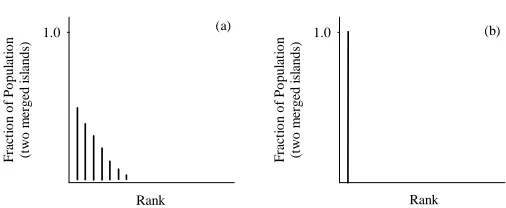
mate-Rank F ra ct io n o f P o p u la ti o n (t w o m er g ed i sl an d s) 1.0 Rank F ra ct io n o f P o p u la ti o n (t w o m er g ed i sl an d s) 1.0 (a) (b)
Figure 2: Inter-island rank histogram on combining two islands: (a) some solutions become dominated and (b) none of the solutions is dominated.
rial should be acquired in the form of another island. Each population sample (island) is run to (intra-island) convergence, the obtained solutions are then merged across is-lands and compared through Pareto-ranking. The shift of the Pareto-front is monitored with an inter-island rank histogram. Clearly, it is only worthwhile comparing the non-dominated solutions from two (or more) islands. We thus form an inter-island rank histogram by merging the nondominated individuals from each island.
In a scenario where some of the nondominated solutions of either of the contribut-ing islands are demoted to becontribut-ing dominated, the inter-island rank histogram is depicted in Figure 2(a). The smaller the entry in the bin corresponding to unity rank and the wider the histogram tail, the larger the shift in the set of best solutions and the greater the reshuffling that has taken place. The desired outcome from merging the nondom-inated members of two or more islands is that none of the nondomnondom-inated solutions is downgraded to dominated status, and all solutions combine to form a similar or better sampled Pareto-front. Here the inter-island rank histogram of the combined solutions indicates unity in the bin corresponding to nondominated rank (see Figure 2(b)).
PCGA can encourage diversity and competition across islands through re-initialization of whole samples and without copying the nondominated set in the cur-rent island. In an elitist genetic algorithm (with generational replacement), the non-dominated individuals of the past generations are copied into the current generation. Copying nondominated individuals in the population has the undesired effect of con-straining genetic diversity, though it has the benefit that nondominated solutions are not lost. Our approach of combining different islands has the benefit of an elitist model in that the nondominated solutions are not lost but at the same time PCGA does not constrain diversity. We suggest that this approach is particularly suited to complex problem domains of multioptimization and leads the solution space towards conver-gence.
3.3 Stopping Criteria
of statistical metrics, e.g., see Fukunaga (1990). By observing the initial behavior of the population on the problem domain and adjusting the parameters of population size, crossover and mutation probabilities, some threshold or probabilistic measure could serve as the stopping criterion. This will give a principled way of examining convergence and stopping the evolution process and is an area of active research. In the present work, we have simply inspected the histograms visually and extracted the heuristics to stop further evolutions within single and multiple islands using intra-rank and inter-rank histograms, respectively.
It has been shown that an infinite number of generations of a simple elitist genetic algorithm can yield an optimal solution (Bhandari et al., 1996). Aytug and Koehler (1996, 2000) established tighter theoretical bounds on the number of GA iterations, and Rudolph and Agapie (2000) found an upper bound on the finite number of function evaluations in a finite search space. However, none of the above ensures diversity. Sec-ondly, it is clearly not a sensible use of computer resources to let a population evolve indefinitely without achieving appreciable gain. Rather, we suggest that a computation should terminate if there is no longer any significant progression towards the Pareto-front. The multi-island population concept is complementary to both (i) a better sam-pling of Pareto-front and (ii) minimizing the computation involved. The computation of a single island population is terminated on reaching a stopping criterion instead of going through a fixed, and possibly very large number of generations. This saving of computer time can be utilized for the computation of multiple islands, which has the potential for parallelism without the complications of synchronous/asynchronous exchanges between islands.
4
Tests on Analytic Functions
We have tested our PCGA algorithm on three problems considered by earlier re-searchers on multiobjective optimization. For fair comparison, we have used exactly the same coding and parameters (as far as is known), though they all used thenumber of generationsfor reporting their results. Instead, we use the comparable termnumber of epochsto quantify our results. An epoch is defined to beN/2pairwise evolutions from a population of sizeN. Hence, the terms “generation” and “epoch” are related to each other from the point of algorithmic complexity and production of the same number of offspring in each generation. (Using the term “generation” instead of “epoch” in PCGA would be misleading from genetic concepts.)
The unbiased initial populations were randomly generated and decoded within the variable space under consideration, and the experiments were repeated many tens of times for functions F1 and F2 and many hundreds of times for the set F3 each with a different initial population. Typical results selected on the basis of their average qualita-tive performance (i.e., visualizing a plot for diverse sampling of the Pareto-front drawn in objective space) are presented in the following sections. Since earlier work does not report spreads of results, we omit such results here because it does not aid comparison.
4.1 Function F1
First, we consider the well-known function of Vincent and Grantham (1981), which was used first by Schaffer in his pioneering work on VEGA and subsequently by many other researchers. This is a two-objective problem of a single variable; we use the nota-tionf11(x)for the first objective andf12(x)for the second, wherexis an independent
variable:
f11(X)
0 25 50 75 100
f12
(X
)
0 25 50 75 100 125
f11(X)
0 2 4 6 8
f12
(X
)
0 2 4 6 8
f11(X)
0 2 4 6 8
f12
(X
)
0 2 4 6 8
f11(X)
0 2 4 6 8
f12
(X
)
0 2 4 6 8
(a) Epoch 0 (b) Epoch 3
[image:15.612.186.447.102.386.2](c) Epoch 13 (d) Epoch 27
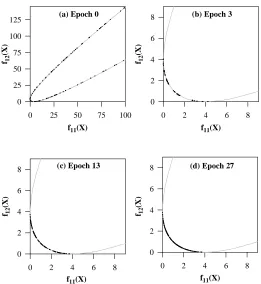
Figure 3: Population (a), (b), (c), and (d) (in objective space) at different stages, i.e., at epochs 0, 3, 13, and 27 for Function F1 (population size = 100, crossover probability = 1.0, mutation probability = 0.0). The population size for plot (d) is 150 (see text for details). Note the scale changes between (a) and the other plots.
and the nondominated region lies within the real-valued range ofxlying between (0.0
≤x≤2.0). The decision variable was encoded as a 32-bit binary integer, which was mapped to the initial range of the variable in (-10.0≤x≤10.0). This is a very simple problem from the perspective of genetic algorithms, and a few solutions already exist in the nondominated region with the randomly initialized population. We tested three different situations: (i) a population size of 100 with zero probability of mutation (as done by Srinivas and Deb (1994)), (ii) a population size of 100 with mutation (for show-ing the speedup in performance and provshow-ing the effectiveness of PCGA), and (iii) a smaller population of 30 (similar to that used by Schaffer (1985) and Horn et al. (1994)).
4.1.1 Population of 100 without Mutation
In this test, the probability of mutation was kept at zero to observe the effectiveness of PCGA alone and for comparing the results with NSGA; the population size was 100 and probability of crossover was 1.0. We also used identical parameters to Srinivas and Deb but without sharing.
Rank
0 5 10 15
R
at
io
0 1 2 3 4 5 12
Rank
0 5 10 15
R
a
ti
o
0 1
Rank
0 5 10 15
R
a
ti
o
0 1 (a) Epoch 3
(c) Epoch 14
[image:16.612.186.446.104.379.2](b) Epoch 13
Figure 4: Intra-island rank histograms (a), (b), and (c) for Function F1 (population size = 100, crossover probability = 1.0, mutation probability = 0.0) at epochs 3, 13, and 14, respectively. The up arrow indicates division by zero, and the down arrow marks the largest rank number in the combined population. Note the scale change between (a) and the other plots.
between epochs 2 and 3. The population at epoch 12 has a few dominated individuals but they are transformed to nondominated by epoch 13 (see Figure 4(b)). At epoch 14, when the population consists solely of nondominated solutions, the intra-island rank histogram (Figure 4(c)) indicates total convergence. The simplicity of this problem is also evident from the observation that all the individuals in the final population are nondominated.
Age (Epoch Number)
0 5 10 15 20 25 30
F
ra
ct
io
n
(
P
o
p
u
la
ti
o
n
)
[image:17.612.226.405.106.246.2]0.00 0.05 0.10
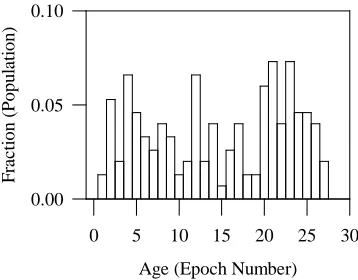
Figure 5: Distribution of the age of appearance of nondominated individuals in the final population for Function F1 (population size = 100, crossover probability = 1.0, mutation probability = 0.0, number of epochs = 27.
improvement beyond 100 generations in the absence of a stopping criterion. This is also one of the merits of PCGA inherent in its termination.
The distribution of the fraction of nondominated solutions generated in each epoch relative to the population after 27 epochs is plotted in Figure 5. Here the age tag of an individual is preserved if the identical individual is evolved again in a later epoch; this way the distribution should be biased towards initial epochs if a larger fraction of nondominated individuals were evolved in the early stages. To the contrary, the population distribution by age in Figure 5 indicates that a significant number of non-dominated individuals are evolved in the latter part of the evolution, thus proving the effectiveness of PCGA up to the last epoch. Although the population only consists of nondominated individuals from epoch 13 onwards (Figure 4(c)), the final population contains a large fraction of nondominated individuals with age tags higher than epoch 13. This behavior demonstrates the capability of PCGA to continuously refine the non-dominated solutions in successive epochs. We reiterate, this particular problem was solved without mutation and without any sharing, and so the selection procedures of the PCGA algorithm alone have produced to the evident diversity.
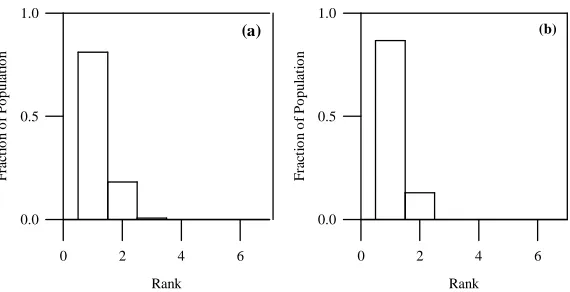
In solving Function F1 with a single population, we obtain a very uniformly sam-pled Pareto-set with only a few small gaps (see Figure 3(d)). In an attempt to demon-strate our approach of multiple populations, we combined the nondominated individ-uals of three independently evolved populations. On merging, the sampling of the Pareto-front is further improved with fewer gaps, and this is reflected in the respective inter-island rank histograms of Figures 6(a) and 6(b). The histogram entry at nondom-inated rank is below the ideal converged state of unity in both cases, and a small his-togram tail exists indicating that further small improvement is possible. In this way, a multiple population approach for sampling new genetic material in the form of another subpopulation helps in expediting the process of obtaining more solutions and faster convergence.
4.1.2 Population 100 with Mutation
Rank
0 2 4 6
F
ra
ct
io
n
o
f
P
o
p
u
la
ti
o
n
0.0 0.5 1.0
Rank
0 2 4 6
F
ra
ct
io
n
o
f
P
o
p
u
la
ti
o
n
0.0 0.5 1.0
(b)
[image:18.612.175.460.105.251.2](a)
Figure 6: Inter-island rank histograms (a) and (b) for Function F1 (population size = 100, mutation probability = 0.0) on merging the first and second subpopulations, and then merging the third subpopulations.
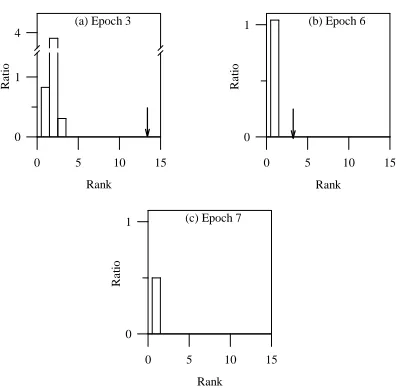
that only six epochs are required for convergence to nondominated solutions. Seven more epochs generated additional nondominated solutions by evolving existing non-dominated solutions only. This demonstrates the effectiveness of PCGA with mutation for increasing diversity, faster convergence and at less computational cost. The corre-sponding intra-island rank histograms at epochs 3, 6, and 7 are shown in Figure 7.
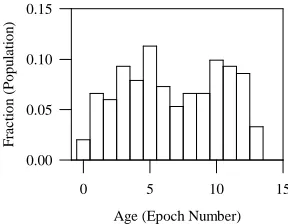
The histograms of Figure 7 also show a faster convergence than that obtained with-out mutation (Figure 4). This is an accepted fact of genetic algorithms, and an appropri-ate mutation probability can be estimappropri-ated through monitoring speed of convergence. The corresponding age-nondominated population distribution is shown in Figure 8, which also confirms the earlier observation that a significant fraction of nondominated individuals in the final population comes from the later stages of processing.
To examine our multiple population approach, three independent subpopulations were merged and the resulting inter-island rank histograms are shown in Figure 9. The rank histogram shows the movement towards convergence with increasing histogram entries for nondominance and smaller tails. A small number of epochs was required to produce a close-to-ideal converged state. This confirms that a population of 100 individuals is probably more than is really needed for solving this simple problem, and only a single population is enough.
4.1.3 Smaller Population
param-Rank
0 5 10 15
R
at
io
0 1 4
Rank
0 5 10 15
R
a
ti
o
0 1
Rank
0 5 10 15
R
a
ti
o
0 1 (a) Epoch 3
(c) Epoch 7
[image:19.612.217.416.138.332.2](b) Epoch 6
Figure 7: Intra-island rank histograms (a), (b), and (c) for Function F1 (population size = 100, crossover probability = 1.0, mutation probability = 0.05) at epochs 3, 6, and 7, respectively. Down arrow marks the highest rank in the combined population.
eter and objective space. Further, NPGA is very sensitive to selection of parameters, while PCGA is not based on any heuristic selection of parameters. Rather, the obvious genetic parameters like population size, crossover, and mutation probability can be fine tuned while observing the progress on rank histograms. In our approach, we are not losing nondominated solutions once they are generated unless and until they become dominated; hence the disadvantage of VEGA is overcome. The PCGA population at epoch 3 may not be much better than that of VEGA at that stage, but the sampling is much improved with a few more epochs. These are the major obvious advantages of PCGA.
The respective intra-island rank histograms are shown in Figure 11. The nature of the histograms is identical to those shown in Figure 4. This confirms the basis of intra-island rank histograms as provided in Section 3.2 and shown in Figure 1. The age-population distribution displays similar features to Figures 5 and 8 in that later evolutions contribute significantly to the nondominated solutions.
The population size of 30 seems to be just sufficient for this problem. Therefore, in competition with other subpopulations, there is a significant improvement on the Pareto-front, which is reflected by a filling of the gaps. The situation in earlier ex-periments with population sizes of 100 was different and not much improvement was noticed on combining different solutions, which reflects the advantages of combining multi-islands for improved solution at the cost of a few more epochs.
Age (Epoch Number)
0 5 10 15
[image:20.612.243.387.107.219.2]F ra ct io n ( P o p u la ti o n ) 0.00 0.05 0.10 0.15
Figure 8: Distribution of the age of appearance of nondominated individuals in the final population for Function F1 (initial population size = 100, crossover probability = 1.0, mutation probability = 0.05, number of epochs = 13.
Rank
0 2 4 6
F ra ct io n o f P o p la ti o n 0.0 0.5 1.0 Rank
0 2 4 6
F ra ct io n o f P o p u la ti o n 0.0 0.5 1.0 (b) (a)
Figure 9: Inter-island rank histograms for Function F1 (initial population size = 100, mutation probability = 0.05). Histogram (a) shows the merging of first and second subpopulations and (b) merging the resultant with the third subpopulation.
4.2 Function F2
Next, we tested PCGA on ann-variable function used by Fonseca and Fleming (1995b) as a minimization problem of two symmetrical objectives:
M inimize f21(x1, ..., xn) = 1−exp
−
n
P
i=1
(xi−1/√n)
2
M inimize f22(x1, ..., xn) = 1−exp
−
n
P
i=1
(xi+ 1/√n)
2
This optimization is harder than F1. Objective functions are defined for any number of variablesn. Individually, the minima off21andf22are defined, for every value ofn,
at:
(x1, x2, ..., xn)≡(1/√n,1/√n,...,1/√n) f or minimum f21
(x1, x2, ..., xn)≡(−1/√n,−1/√n,...,−1/√n) f or minimum f22
Due to symmetry off21andf22, the actual Pareto-front corresponds to all the points
[image:20.612.173.462.285.431.2]X
-1 0 1 2 3
f1
(X
)
0 2 4 6 8
f12 f
11
X
-1 0 1 2 3
f1
(X
)
0 2 4 6 8
f12 f11
[image:21.612.173.461.139.282.2](a) Epoch 3 (b) Epoch 15
Figure 10: Population at epochs 3 and 15 for Function F1 (population size = 30, crossover probability = 1.0, mutation probability = 0.05). Population for plot (b) is 45.
(x1=x2=...=xn)∧(∀i) (−1/√n≤ xi ≤1/√n)
Where appropriate, we have taken the same genetic parameters for PCGA as far as is known (Fonseca and Fleming, 1995b) for a comparison with MOGA:
Number of variables (n) 8
String length (binary code) 16 bits per variable Decoding range of variables [-2.0, 2.0]
Population size 100 Probability of Crossover 1.0 Probability of Mutation 0.05 Mating/Sharing Nil
The degree of difficulty of this problem is evident from the initial population itself, where almost all the points are concentrated on one extreme of the objective space. Though there are two nondominated points in the initial population, they are far away from the actual Pareto-front. The initial population and that at epochs 50 and 100 are shown in Figure 12. The nondominated individuals are plotted with filled black circles, dominated points with grey circles, and the actual Pareto-front is marked with a grey curve. It is very evident from the obtained populations at various epochs that the whole population is progressively moving towards convergence. This is a distinct feature of PCGA and in contrast to other approaches.
Rank
0 5 10
R
at
io
0 1 4
Rank
0 5 10
R
at
io
0 1
[image:22.612.175.459.106.248.2](a) Epoch 3 (b) Epoch 7
Figure 11: Intra-island rank histograms for Function F1 (population size = 30, crossover probability = 1.0, mutation probability = 0.05) at epochs 3 and 7, respectively. Down arrow marks the highest rank in the combined population.
replacement type of genetic strategies such as MOGA.
The corresponding rank histograms display results entirely consistent with previ-ous observations. At epoch 100 there is a small histogram tail confirming the results in Figure 12 that the population has not quite converged.
The population age distribution for this problem is unlike those for previous prob-lems in that nondominated individuals in the final population only start to be gener-ated from epoch 38 onwards — this reflects the challenging nature of the F2 problem. The population state at epoch 50 of Figure 12 shows a significant fraction of nondomi-nated individuals very near to the Pareto-front, but the age distribution plot indicates that the contribution of such individuals to the final population is only 17%. This re-confirms that the PCGA evolution strategy produces better and better offspring in each epoch. It is this ability of PCGA that leads the population towards convergence.
At epoch 100, we have stopped further evolution for comparison with the results obtained with mating restrictions by Fonseca and Fleming (1995b), though the popula-tion could further be improved with some more epochs. Their results without mating restrictions are concentrated in a very small region of the Pareto-front. On comparing Fonseca and Fleming’s results with mating restrictions with the results of PCGA, PCGA achieves diversity without mating restrictions. Continuing with our approach of multi-ple subpopulations, we independently generated another two populations and merged the nondominated solutions from each. The solutions are further improved with a more uniform sampling and gap filling. The inter-island rank histograms also indicate the situation moving towards convergence but more solutions could be obtained for a total filling of the front.
4.3 Function F3
Third, we considered a bimodal functiong(x2)given by:
g(x2) = 2.0−exp
n
− x2−0.2
0.004
2o
−0.8 expn− x2−0.6
0.4
2o
; g(x2)>0
For (0 < x2 < 1), g(x2) is a function with a broad local minima at x2 = 0.6 and a
spike-like global minima at x2 = 0.2. Retargeting this single objective problem to a
f21(x1,...,x8)
0.0 0.2 0.4 0.6 0.8 1.0
f22
(x1
,.
..
,x8
)
0.0 0.2 0.4 0.6 0.8 1.0
f21(x1,...,x8)
0.0 0.2 0.4 0.6 0.8 1.0
f(x22
1
,.
..
,x8
)
0.0 0.2 0.4 0.6 0.8 1.0
f21(x1,...,x8)
0.0 0.2 0.4 0.6 0.8 1.0
f22
(x1
,.
..
,x8
)
0.0 0.2 0.4 0.6 0.8 1.0
(a) Epoch 0 (b) Epoch 50
[image:23.612.173.460.102.369.2](c) Epoch 100
Figure 12: Population (a), (b), and (c) at different stages of evolution, i.e., at epochs 0, 50, and 100, respectively for Function F2 (population size = 100, crossover probability = 1.0, mutation probability = 0.05).
two variablesx1(>0) andx2is:
M inimize f31(x1, x2) =x1 and minimize f32(x1, x2) =g(xx12)
For a fixed value ofg(x2), eachf31–f32plot is a hyperbola (see Figure 13). So for the
two-objectivef31–f32 problem, we get one local and global Pareto-front for the local
and global solutions ofg(x2), respectively. (See Deb (1999) for function characteristics
and the related theorem.) The Pareto-optimal solutions vary inx1value (Figure 13: the
f31 (x1, x2)
0.2 0.4 0.6 0.8 1.0
f32 (
x1
,
x2
)
0 2 4 6 8 10 12 14
f31 (x1, x2)
0.2 0.4 0.6 0.8 1.0
f32 (
x1
,
x2
)
0 2 4 6 8 10 12 14
[image:24.612.173.459.142.277.2](a) (b)
Figure 13: Two typical sets (a) and (b) of populations converging to the local and global minima, respectively; the local and global optimal fronts are shown by grey curves. In (a), the whole population has converged to the local Pareto-front in an average of 19 epochs per run. The population in (b) has converged to the global Pareto-front in an average of 31 epochs per run. The average across both minima was 23.8 epochs.
String length (binary code) 20 bits per variable
Decoding range of variables x1[0.1, 1.0] andx2[0.0, 1.0]
Population size 60 Probability of Crossover 1.0 Probability of Mutation 0.0 Mating/Sharing Nil
We ran the experiments tens of hundreds of times so that we can make generalized observations about the results. For such exhaustive experiments, we did not change the genetic parameters, only the initial populations. Based on the results, we can make the following observations. For each of the runs, the whole population of sixty individuals converged (all nondominated individuals) within the range of 12 to 41 epochs with an average of 23.8 epochs per run. (As with results reported earlier Deb (1999), some of the populations converged to the local Pareto-front and others to global front.) This is a significant improvement over NSGA, which was run for 100 generations in the absence of a convergence criterion. We achieved a superior sampling of the Pareto-fronts to that reported in Deb (1999). Two typical sets of results are shown in Figure 13 (one where the solution converges to the local minimum and the other where global minimum is found). The initial populations in Figure 13 are shown with open square symbols and final populations with the filled circles. In most of the runs, the initial population did not contain even a single individual in the narrow global basin.
multiobjective GAs can have difficulty with even a simple bimodal problem (e.g., Deb (1999, p. 10)). PCGA, however, produces a diverse sampling of the Pareto-front without niching, and these results on F3 are consistent with what we have found for functions F1 and F2 and reported in previous subsections.
5
Discussion
The PCGA algorithm presented in this paper empirically demonstrates two distinctive features. First, it achieves diverse sampling of the Pareto-front without niching. Sec-ond, it introduces the notion of a gauge on convergence. While doing so, at every stage in PCGA, the population is compared in the most general sense. There is no subjective consideration of the priorities of the objectives, nor are they randomly picked (Four-man, 1985; Kursawe, 1991). In the absence of a true scalar fitness, we argue that the only way to compare a parent and its offspring is a rank-based metric. In practice, Pareto-ranks are scaled arbitrarily to fitness values (fitness is a direct measure of reproductive potential of the individuals). Moreover, we use Pareto-ranks, albeit heuristically, for gauging the convergence.
In the following subsections, we discuss the results together with the character-istics of PCGA with regard to how they help achieve diversity without explicitly em-ploying a diversity preserving mechanism.
5.1 Achieving Diversity
PCGA produces only a single pair of offspring in one iteration; it is a steady-state algo-rithm and is elitist in nature. In contrast, almost all the other MO algoalgo-rithms produce an entire new population at a single generation; the fitter individuals get more chances at reproduction, and genetic drift has to be suppressed through some explicit diver-sity preserving mechanism. This approach has the advantage that fitter individuals are liable to produce even fitter offspring, but the demerit that the functional mapping from ranks to fitness is important since it can strongly influence genetic drift. In this work, we have taken fitness as a simple linear function of Pareto-ranks. The effect of the steady-state algorithm on achieving wider sampling is further discussed in Subsec-tion 5.1.2.
Though PCGA does not replace the whole generation in a single step, each pair of offspring is compared against the whole population. This is in contrast to tournament-based selection approaches (NPGA, SPEA, and the algorithm of Ritzel et al. (1994), which needs a comparison set). Such selection approaches are affected by the user-defined size of the comparison set. In a pairwise comparison, if the offspring are com-pared only against their parents, this will result in a tie in most practical situations as is the case with NPGA, and additional safeguards of mating/sharing restrictions have to be employed for resolving the tie.
5.1.1 Progressive Advancement of the Solution Front
Another feature of PCGA’s steady-state strategy is that at every population compari-son, we discard the two lowest ranked individuals. With every evolution, we either get superior offspring or at worst, the same population fitness. Thus, with every evolution, the population advances towards the Pareto-front or in the worst case, remains static. The common genetic operators of crossover and mutation ensure diversity (shown in the results included in this paper).
a sensible approach in a generalized multiobjective optimization. In PCGA, a (erst-while nondominated) solution can only be discarded if it is no longer nondominated. The results of discarding potentially valuable genetic material can be serious and are reported in Srinivas and Deb (1994), where a sufficient population of nondominated solutions at a given evolutionary stage is reduced at a later stage to a few solutions on the Pareto-front, a well-known drawback of Schaffer’s VEGA approach even with mating restrictions. The tournament-based selection approaches are partly affected by this dilemma: the selection is guided by the size of the tournament set and thus con-trols the convergence — nondominated solutions may be eliminated, which results in slow convergence. Nonetheless, for such approaches, mating restrictions do have the potential to suppress genetic drift.
PCGA has elitism built in to the algorithm. In a single-objective optimization, elitism may have the disadvantage of premature convergence, but in the case of mul-tiobjective optimization, Parks and Miller (1998) have shown that elitism improves the performance. Many of the recent algorithms (SPEA, PAES) have adopted an elitist ap-proach to retain the nondominated solutions but use clustering as a post process to control the size of the nondominated set.
5.1.2 Reduced Range of Pareto-Ranks
Initially, when the population is randomly initialized, the range of the ranks is quite large (Figures 4, 7) and the fitter individuals (on the roulette wheel) have better chances of being selected for breeding. PCGA retains the merit that fitter individuals are able to produce better offspring, yet the functional consideration of the mapping is not signifi-cant. As the population is progressively moved towards convergence with the elimina-tion of the weakest pair at each evoluelimina-tion, the dynamic range of the rank is consistently reduced (Figures 4, 7), and each individual has a greater chance of reproduction. The population at different stages of reproduction (number of epochs) shown in different results confirms this behavior for PCGA.
Taking into account the “tied” ranks, this is not the case with generational replace-ment strategies. In a generational GA, in addition to getting better solutions one also produces (and retains in the population) many worse solutions (for example, two very fit parents producing a runt offspring), and thus generational GAs maintain a greater range of ranks. If the rank-to-single-scalar fitness mapping is the same, this greater range of ranks translates into greater range of scalar fitness values, and so there is a tendency (bias) for generational GAs to select only the fittest individuals because they occupy so much of the roulette wheel. Nonetheless, this is in tune with the principles of genetic algorithms that fitter individuals are given better chances of breeding but at the cost of additional mating restrictions. In a steady-state PCGA, the population is always improving (or at least never getting worse) and so the range of ranks is more compressed giving a greater probability of all individuals breeding. PCGA gives all so-lutions a greater chance to breed thus leading to genetic diversity. The dynamics of the two evolutions (steady-state and generational) are different. With increasing numbers of epochs, the mating pool for a steady-state GA contains a compressed range of ranks, while the mating pool for a generational GA has larger range of ranks giving less fit individuals a lesser chance at breeding.
However, the dynamics of steady-state evolution with compressed range of ranks is analogous to explicit mating restriction. (By definition, mating restrictions (Deb and Goldberg, 1989) try to address the fact that individuals too different from each other are less likely to produce fit offspring through mating than similar individuals.) We be-lieve, in PCGA, the compressed range of ranks is inherently producing the same effect as a mating restriction but without user-defined parameters. So, we can say that the PCGA’s selection strategy does not explicitly need any diversity preserving techniques but employs implicit mating restrictions. Similarly, it can be argued that compressed range of ranks is producing the same effects as fitness sharing.
5.2 Comparing PCGA’s Island Model with the Canonical Subpopulation Strategy
Swapping or migration of individuals from one island to another is the key feature of a canonical subpopulation strategy. Subpopulation strategy, commonly known as the island model, distributed or parallel GAs, is used mainly to get superior solu-tions, speed convergence, and parallelize the computing efforts — the success of such a strategy depends on many factors. Usually, the population size in a single island is comparatively small. Small islands are run to convergence (i.e., where the genetic diversity in the small population has disappeared), and then genetic material is syn-chronously/asynchronously mixed/swapped to re-introduce diversity (Braun, 1990; Whitley and Starkweather, 1990; Cant ´u-Paz, 2000). In many cases, however, islands have been found to give no speed-up. Where islands do work, it is known that iso-lated (i.e., no migration) islands can converge to different local optima at which point comparing the island populations can yield valuable information about the dynamics of the process.
We employed subpopulations of significantly larger sizes than is normal with con-ventional islands model although we did not employ any migration. We stress that we use isolated islands not to speed convergence but as a test on the quality of the final solutions; in the process, we are able to escape from local minima (Figure 13).
5.3 Analyzing Computational Load
PCGA has the additional computational overhead of inserting the offspring in the pop-ulation and generating the rank histogram but it requires fewer epochs and eliminates heuristically selected parameters and the associated computations. The overall com-putations in genetic search can be divided broadly in two categories: one involving genetic manipulations, and those of objective evaluations. The genetic computations involve breeding operations, sharing, and ranking. Implementation of sharing in a high-dimensional objective space can be computation intensive. PCGA eliminates the need for sharing but adds additional overheads of inserting offspring into an already ranked list. Ranked generational replacement techniques on the other hand require complete reranking of the population after every iteration. The objective evaluations are problem specific but typically, in real-life problems, dominate the time required for most genetic optimizations.
5.4 Monitoring Convergence
re-duce the computation and memory requirements. Similarly, the other parameters, e.g., probabilities of crossover and mutation, can be fine-tuned and their effects on popula-tion evolupopula-tion can be examined. Monitoring convergence would help not only to avoid wasting CPU time in producing further generations for an optimization that has al-ready converged, but also in knowing whether a particularly stubborn problem is still far from convergence. This is discussed in next subsection.
Although in the present work we have interactively stopped further population evolution using the rank histogram, the process could be automated by incorporating a suitable statistical test on the successive rank histograms. The rank histogram test of convergence introduced here is somewhat analogous to the aims of Fisher’s F-test (Fukunaga, 1990) from standard statistical hypothesis testing, where a number of sam-ples are compared for consistency (the null hypothesis).
5.5 Application to Real Problems
Although the results presented in this paper are for well-known multiobjective bench-mark problems, elsewhere we have reported the successful application of PCGA to a number of real-world optimization problems of complex nature, particularly to prob-lems of NP nature. For example, a classification problem in seven-dimensional objec-tive space for near-optimal partitioning of a pattern space using variable-length, real-number chromosomes is presented in Kumar and Rockett (1998). We have applied PCGA to codebook construction for vector quantization (Kumar, 2000) and commu-nication network design (Kumar et al., 2002). PCGA has also been applied to other applications, e.g., the study of continuous casting mold process (Chakraborty et al., 2001). Taken together with the results presented here, we have grounds to believe that PCGA is applicable to a wide range of multiobjective optimization problems.
6
Conclusions
In this paper, we have presented a novel approach to multiobjective optimization by genetic algorithms. Our PCGA is a steady-state algorithm and uses a (µ+ 2)-ES se-lection scheme along with Pareto-ranking. The algorithm naturally prevents genetic drift while uniformly sampling the Pareto-front and eliminating heuristically selected mating/sharing parameters. A systematic, albeit heuristic, approach based on rank his-tograms for assessing convergence was discussed. PCGA was tested on three bench-mark problems as a proof-of-concept, and the results compared with those of earlier approaches. The Pareto-converging approach is promising for complex problems in-volving optimization on a large number of competing objectives where independent evolution with isolated multiple islands of population can be employed effectively in difficult optimization domains; PCGA has been applied to a number of real-world mul-tiobjective problems of NP-nature (and the results have been reported elsewhere).