
Hyper-Kamiokande Physics Opportunities
Submitted by the Hyper-Kamiokande Working Group
∗to the 2013 Snowmass Process
August 31st 2013
Abstract
We propose the Hyper-Kamiokande (Hyper-K) detector as a next generation un-derground water Cherenkov detector [1]. It will serve as a far detector of a long base-line neutrino oscillation experiment envisioned for the upgraded J-PARC beam, and as a detector capable of observing, far beyond the sensitivity of the Super-Kamiokande (Super-K) detector, proton decays, atmospheric neutrinos, and neutrinos from astro-physical origins. The current baseline design of Hyper-K is based on the highly suc-cessful Super-K detector, taking full advantage of a well-proven technology. Hyper-K consists of two cylindrical tanks lying side-by-side, the outer dimensions of each tank being 48(W)×54(H)×250(L) m3. The total (fiducial) mass of the detector is 0.99
(0.56) million metric tons, which is about 20 (25) times larger than that of Super-K. A proposed location for Hyper-K is about 8 km south of Super-K (and 295 km away from J-PARC) at an underground depth of 1,750 meters water equivalent (m.w.e.). The inner detector region of the Hyper-K detector is viewed by 99,000 20-inch PMTs, corresponding to the PMT density of 20% photo-cathode coverage (one half of that of Super-K).
The Hyper-K project is envisioned to be completely open to the international community. The current working group contains members from Canada, Japan, Korea, Spain, Switzerland, Russia, the United Kingdom and the United States. The United States physics community has a long history of making contributions to the neutrino physics program in Japan. In Kamiokande, Super-Kamiokande, K2K and T2K, US physicists have played important roles building and operating beams, near detectors, and large underground water Cherenkov detectors. This set of three one-page whitepapers prepared for the US Snowmass process describes the opportunities for future physics discoveries at the Hyper-K facility with beam, atmospheric and astrophysical neutrinos.
∗Project contact: Tsuyoshi Nakaya <[email protected]>
The Hyper-Kamiokande Working Group
Boston University (USA):E. Kearns, J.L. Stone
Chonnam National University (Korea): K.K. Joo
Duke University (USA):T. Akiri, A. Himmel, K. Scholberg, C.W. Walter
Earthquake Research Institute, The University of Tokyo (Japan): A. Taketa, H.K.M. Tanaka
ETH Zurich (Switzerland): A. Rubbia
Institute for Nuclear Research (Russia): A. Izmaylov, M. Khabibullin, Y. Kudenko
Imperial College London (UK):M. Malek, Y. Uchida, M.O. Wascko
Iowa State University (USA):I. Anghel, G. Davies, M.C. Sanchez, T. Xin
Kamioka Observatory, ICRR, The University of Tokyo (Japan): K. Abe, Y. Haga, Y. Hayato, J. Kameda, Y. Kishimoto, M. Miura, S. Moriyama, M. Nakahata, S. Nakayama, H. Sekiya, M. Shiozawa, Y. Suzuki, A. Takeda, H. Tanaka, T. Tomura, R. Wendell
Kavli IPMU, The University of Tokyo (Japan): M. Hartz, L. Marti, K.Nakamura, M.R. Vagins
KEK (Japan): M. Friend, T. Ishida, T. Kobayashi, Y. Oyama
Kobe University (Japan): A. T. Suzuki, Y. Takeuchi
Kyoto University (Japan): S. Hirota, K. Huang, A. K. Ichikawa, M. Ikeda, A. Minamino, T. Nakaya, K. Tateishi
Lancaster University (UK):A. Finch, L.L. Kormos, J. Nowak, H.M. O’Keeffe, P.N. Ratoff
Los Alamos National Laboratory (USA):G. Sinnis
Louisiana State University (USA):F.d.M. Blaszczyk, J. Insler, T. Kutter, O. Perevozchikov, M. Tzanov
Miyagi University of Education (Japan): Y.Fukuda
Nagoya University (Japan): K.Choi, T. Iijima, Y. Itow
Okayama University (Japan): H. Ishino, Y. Koshio, T. Mori, M. Sakuda, T. Yano
Osaka City University (Japan): Y. Seiya, K. Yamamoto
Pontif´ıcia Universidade Cat´olica do Rio de Janeiro (Brazil): H. Minakata, H. Nunokawa
Queen Mary, University of London (UK):F. Di Lodovico, T. Katori, R. Sacco, B. Still, R. Terri, J.R. Wilson
Seoul National University (Korea): S. B. Kim
State University of New York at Stony Brook (USA):J. Adam, J. Imber, C. K. Jung, C. McGrew, J.L. Palomino, C. Yanagisawa
STFC Rutherford Appleton Laboratory (UK):D. Wark, A. Weber
Sungkyunkwan University (Korea): C. Rott
The California State University Dominguez Hills (USA): K. Ganezer, B. Hartfiel, J. Hill
Tohoku University (Japan): K. Inoue, M. Koga, I. Shimizu
Research Center for Cosmic Neutrinos, ICRR, The University of Tokyo (Japan): T. Irvine, T. Kajita, I. Kametani, Y. Nishimura, K. Okumura, E. Richard
Tokyo Institute of Technology (Japan): M. Ishitsuka, M. Kuze, Y. Okajima
TRIUMF (Canada): P. Gumplinger, A. Konaka, T. Lindner, K. Mahn, J.-M. Poutissou, F. Retiere, M. Scott, M.J. Wilking
University Autonoma Madrid (Spain): L. Labarga
University of British Columbia (Canada): S.M. Oser, H.A. Tanaka
University of Geneva (Switzerland):A. Blondel, A. Bravar, F. Dufour, Y. Karadhzov, A. Korzenev, E. Noah, M. Ravonel, M. Rayner, R. Asfandiyarov, A. Haesler, C. Martin, E. Scant-amburlo
University of Hawaii (USA):J.G. Learned
University of Regina (Canada): M. Barbi
University of Toronto (Canada): J.F. Martin
University of California, Davis (USA):M. Askins, M.Bergevin, R. Svoboda
University of California, Irvine (USA): G. Carminati, S. Horiuchi, W.R. Kropp, S. Mine, M.B. Smy, H.W. Sobel
University of Liverpool (UK):N. McCauley, C. Touramanis
University of Oxford (UK):G. Barr, D. Wark, A. Weber
University of Pittsburgh (USA):V. Paolone
University of Sheffield (UK):J.D. Perkin, L.F. Thompson
University of Washington (USA):J. Detwiler, N. Tolich, R. J. Wilkes
University of Warwick (UK):G.J. Barker, S. Boyd, D.R. Hadley, M.D. Haigh
University of Winnipeg (Canada): B. Jamieson
Virginia Tech (USA):S. M. Manecki, C. Mariani, S. D. Rountree, R. B. Vogelaar
Exploring CP violation with the upgraded J-PARC Beam
0 1
δ [π]
0 0.05 0.1 0.15 sin22θ13
[image:4.612.305.550.111.285.2]-1 2σ 1σ 3σ 7.5MWyear Hyper-K
Figure 1: Allowed regions in the space of sin22θ13
and δ near the known value of sin22θ13. Blue,
green, and red lines represent 1, 2, 3 σ allowed regions in with the hierarchy known to be normal. In 2011, the T2K [2], MINOS [3],
and Double Chooz [4] experiments showed the first indications of full three-flavor oscillations. In 2012 the Daya Bay [5] and RENO [6] experiments re-ported the first precision measurements of the θ13 mixing angle which drives
three-flavor oscillation. This unexpect-edly large value of θ13 guarantees the
ability to measure the CP violating phase δ. The Hyper-K projects builds on the proven success of the water Cherenkov technique with an upgraded J-PARC beam plus a megaton-scale de-tector.
The J-PARC to Hyper-K experiment will use a proton beam with a∼ 1M W of power to produce both neutrinos and anti-neutrinos with a horn focusing sys-tem. The beam is directed 2.5◦ off-axis
to the 560 kton fiducial volume Hyper-K detector 295 km away. The neutrinos are measured near the production site and then again at the far detector. CP violation will manifest itself in a difference between the measured rate of νµ → νe and ¯νµ → ν¯e transformations
as well as in spectral distortions. The high event rate in the far detector will also allow for precise measurements of neutrino mixing parameters that will continue the worldwide effort to constrain the 3×3 PMNS matrix.
0 20 40 60 1 σ error of δ (degree)
δ=90o
δ=0o
0 1 2 3 4 5 6 7 8 9 10 sin22θ13=0.1
Integrated beam power (MW∙year)
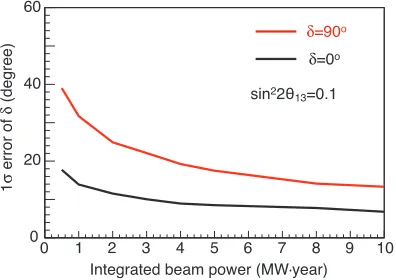
Figure 2: 1σuncertainty ofδ as a func-tion of integrated beam power. The ra-tio of ν and ¯ν running time is fixed to 3:7.
In 10 years of running, split 3:7 between neutrinos and antineutrinos respectively, we expect to collect approximately 2000 to 4000 signal events in each mode. Assuming the mass hierarchy is determined by other means, and that the total systematic er-ror managed to the 5% level, then the CP phase may be distinguished from δ= 0 at 3σ for 74% of the entire range in δ. Figure 1 shows example 1σ contours using the current range of sin22θ13.
[image:4.612.86.284.487.627.2]Exploring Neutrino Properties with Atmospheric Neutrinos
In the late nineties, atmospheric neutrinos measured in the Super-Kamiokande detector provided the first definitive evidence that neutrinos had mass and that the mass states mixed to make the well known flavor states [7]. Atmospheric neutrinos remain an important probe of neutrino oscillations, and the large statistics sample from the one-half megaton Hyper-K will offer an unprecedented opportunity to study them in detail. Atmospheric neutrinos exist in both neutrino and anti-neutrino varieties in both muon and electron flavors. Approximately 1,000,000 events are expected to be collected in a 10 year period. The large value of θ13, along with the neutrino versus anti-neutrino dependent matter
resonance effect in the earth opens up the study of oscillation driven electron neutrino appearance. The oscillation effect in the electron neutrino flux have been analytically calculated [8] as:
Φ(νe)
Φ0(νe)
−1 ≈ P2·(r·cos2θ23−1)
−r·sin ˜θ13·cos2θ˜13·sin 2θ23·(cosδ·R2−sinδ·I2)
+2 sin2θ˜13·(r·sin2θ23−1) (1)
Figure 3: The sensitivity to the mass hierarchy as a function of θ23 with θ13 fixed at sin22θ13 =
0.098 (NH case). where we call the first, second, and third terms the
“so-lar term”, “interference term”, and “θ13resonance term”,
respectively. P2 is the two neutrino transition probability
of νe → νµ,τ which is driven by the solar neutrino mass
difference ∆m221. R2 and I2 represent oscillation
ampli-tudes forCP even and odd terms. For anti-neutrinos, the sign of the δ should be changed. Additionally, the mod-ified probabilities for P2, R2, I2 are obtained by replacing
the matter potential V → −V (see [8] for details). The electron appearance effect along with precision measure-ments of muon disappearance [9] and tau appearance [10] will allow Hyper-K to probe the octant of θ23 oscillation,
the mass hierarchy and CP violation phase.
A full Monte Carlo and reconstruction study using Super-Kamiokande tools has determined that the ex-pected significance for the mass hierarchy determination is more than 3σ provided sin2θ23 >0.4. We expect to be
able to discriminate between sin2θ23 < 0.5 (first octant)
and >0.5 (second octant) at the 3σ level if sin22θ23 is less than 0.99. For all values of δ,
40% of theδrange can be excluded at three sigma assuming that sin2θ23>0.4. All of these
results are obtained using atmospheric neutrinos alone. In combination with the JPARC beam they can be even more tightly constrained. As an example, figure 3 demonstrates the sensitivity to the mass hierarchy as a function ofθ23 withθ13 fixed at sin22θ13= 0.098
Low-Energy Neutrino Physics and Astrophysics with Hyper-K
Hyper-K represents the next generation of highly-successful water Cherenkov technology for observation of low-energy (less than∼50 MeV) neutrinos, including solar neutrinos [11, 12, 13], core-collapse supernova neutrinos [14, 15, 16], and potentially dark matter annihilation neutrinos [17].
Solar Neutrinos: Assuming sufficient depth to overcome cosmic-muon-induced spallation
background, Hyper-K will observe∼115,000 elastic solar 8B neutrino-electron scatters per
year (above its energy threshold and after event selection efficiency, assuming a livetime of 90%), an unprecedentedly large solar neutrino rate. With tight control of systematic uncertainties, Hyper-K will be very sensitive to the solar day/night effect,i.e. the regener-ation ofνe flavor of solar neutrinos passing through the Earth. Within five years, Hyper-K
will determine the solar zenith angle variation amplitude to ∼0.5%– expressed here as a day/night asymmetry, defined as (day−night)/(0.5(day + night))– measuring ∆m2
21 with
a precision comparable to that of current reactor antineutrino experiments, and establish-ing (or refutestablish-ing) the presence of matter effects on neutrino oscillations with a significance exceeding 4σ [18].
1 10 102 103 104 105 106 107 108 109 1010
10-1 1 10 102 103
!–
e+p
!
e+16
O !– e+16 O !+e
-Betelgeuse Antares Galactic center LMC M31
distance(kpc)
[image:6.612.392.537.332.513.2]events/0.74Mega-ton
Figure 4: Expected numbers of SN burst events in HK for each interaction as a function of the distance to the SN [1].
Supernova Neutrinos: Hyper-K is sensitive to
neu-trinos from Galactic core-collapse supernovae (∼250,000 interactions in ∼10 s at the Galactic center a few times/century), nearby supernovae (∼25 interactions at Andromeda; 1/2 interactions for distances<4 MPc with ∼60%/25% probability every few years) and distant su-pernovae (∼100 interactions/year, up to z ∼ 1). With Gd salt doping [19], Hyper-K could also separate ¯νe
in-verse beta reactions from other interactions. A large-statistics Galactic burst offers many unique opportuni-ties (e.g. [20, 21] and references therein). From the time, flavor and energy profile of the neutrinos, we can learn about the neutronization burst, shock wave effects, ex-plosion temperatures, and black hole formation. We may gain information on neutrino parameters, in particular mass hierarchy. Spectral swaps between neutrino flavors will enable the study ofν−ν interactions. In addition to an early alert for even quite distant supernovae, Hyper-K could also achieve precision pointing to a nearby super-nova’s direction. Even a few neutrinos from nearby
ex-tragalactic supernovae will determine the nature of nearby transients whose mechanism is uncertain [22]. The rate and spectrum of distant supernova neutrinos characterize the properties of typical supernova explosions (luminosity and explosion temperature). For distant supernovae, Gd doping is essential to tag ¯νe between 10 and 30 MeV and thereby
References
[1] K. Abe, T. Abe, H. Aihara, Y. Fukuda, Y. Hayato, et al. (2011), 1109.3262.
[2] K. Abe et al. (T2K Collaboration), Phys.Rev.Lett. 107, 041801 (2011), 1106.2822.
[3] P. Adamson et al. (MINOS Collaboration), Phys.Rev.Lett.107, 181802 (2011), 1108.
0015.
[4] Y. Abe et al. (DOUBLE-CHOOZ Collaboration), Phys.Rev.Lett. 108, 131801 (2012),
1112.6353.
[5] F. An et al. (DAYA-BAY Collaboration), Phys.Rev.Lett. 108, 171803 (2012), 1203.
1669.
[6] J. Ahn et al. (RENO Collaboration), Phys.Rev.Lett. 108, 191802 (2012),1204.0626.
[7] Y. Fukuda et al. (Super-Kamiokande Collaboration), Phys.Rev.Lett. 81, 1562 (1998),
hep-ex/9807003.
[8] O. Peres and A. Y. Smirnov, Nucl.Phys. B680, 479 (2004),hep-ph/0309312.
[9] Y. Ashie et al. (Super-Kamiokande Collaboration), Phys.Rev. D71, 112005 (2005),
hep-ex/0501064.
[10] K. Abe et al. (Super-Kamiokande Collaboration) (2012),1206.0328.
[11] J. Hosaka et al. (Super-Kamiokande Collaboration), Phys.Rev. D73, 112001 (2006),
hep-ex/0508053.
[12] J. Cravens et al. (Super-Kamiokande Collaboration), Phys.Rev. D78, 032002 (2008),
0803.4312.
[13] K. Abe et al. (Super-Kamiokande Collaboration), Phys.Rev. D83, 052010 (2011),
1010.0118.
[14] K. Hirata et al., Phys. Rev. Lett.58, 1490 (1987).
[15] M. Ikeda et al. (Super-Kamiokande Collaboration), Astrophys.J. 669, 519 (2007),
0706.2283.
[16] K. Bays et al. (Super-Kamiokande Collaboration), Phys.Rev. D85, 052007 (2012),
1111.5031.
[17] C. Rott, J. Siegal-Gaskins, and J. F. Beacom (2012),1208.0827.
[19] J. F. Beacom and M. R. Vagins, Phys.Rev.Lett.93, 171101 (2004), hep-ph/0309300.
[20] A. Dighe, J.Phys.Conf.Ser. 136, 022041 (2008), 0809.2977.
[21] K. Scholberg, Ann.Rev.Nucl.Part.Sci. 62, 81 (2012), 1205.6003.
![Figure 4: Expected numbers ofSN burst events in HK for eachinteraction as a function of thedistance to the SN [1].](https://thumb-us.123doks.com/thumbv2/123dok_us/8070733.226910/6.612.392.537.332.513/figure-expected-numbers-burst-events-eachinteraction-function-thedistance.webp)
