complete delafossite solid solution
(CuAlO
2)
1−x(CuCrO
2)
xPhillip T. Barton, Ram Seshadri
E-mail: [email protected], [email protected] Materials Department and Materials Research Laboratory University of California, Santa Barbara, CA, 93106, USA
Andrea Kn¨oller
Institut f¨ur Materialwissenschaft, Universit¨at Stuttgart 70569, Germany
Matthew J. Rosseinsky
E-mail: [email protected] Department of Chemistry,
University of Liverpool, L69 7ZD, UK
Abstract. We have prepared the complete delafossite solid solution series between diamagnetic CuAlO2 and the t32g frustrated antiferromagnet CuCrO2. The evolution
with compositionxin CuAl1−xCrxO2of the crystal structure and magnetic properties
has been studied and is reported here. The room-temperature unit cell parameters follow the V´egard law and increase with x as expected. The µeff is equal to the
Cr3+ spin-onlyS = 3/2 value throughout the entire solid solution. ΘCW is negative,
indicating that the dominant interactions are antiferromagnetic, and its magnitude increases with Cr substitution. For dilute Cr compositions, the nearest-neighbor exchange coupling constant JBB was estimated by mean-field theory to be 3.0 meV.
Despite the sizable ΘCW, long-range antiferromagnetic order does not develop until
x is almost 1, and is preceeded by glassy behavior. Data presented here, and that on dilute Al-substitution from Okuda et al., suggest that the reduction in magnetic frustration due to the presence of non-magnetic Al does not have as dominant an effect on magnetism as chemical disorder and dilution of the magnetic exchange. For all samples, the 5 K isothermal magnetization does not saturate in fields up to 5 T and minimal hysteresis is observed. The presence of antiferromagnetic interactions is clearly evident in the sub-Brillouin behavior with a reduced magnetization per Cr atom. An inspection of the scaled Curie plot reveals that significant short-range antiferromagnetic interactions occur in CuCrO2above its N´eel temperature, consistent
with its magnetic frustration. Uncompensated short-range behavior is present in the Al-substituted samples and is likely a result of chemical disorder.
PACS numbers: 75.30.Kz 75.50.Ee 75.20.-g
1. Introduction
CuAlO2 and CuCrO2 are p-type transparent conducting oxides (TCO) that are of significant interest for their intrinsic p-type behavior.[1, 2] CuCrO2 is also a S = 3/2 Heisenberg triangular lattice antiferromagnet (TLA), which makes it a promising candidate for studying magnetic frustration. Recent study of CuCrO2 is spurred by its multiferroic behavior which arises from its spiral spin order,[3] and has been extensively investigated by Kimuraet al.[4]
Neutron diffraction studies have been essential in explaining the magnetism and multiferroic behavior of CuCrO2. The first neutron study by Kadowaki et al. revealed that CuCrO2 has an antiferromagnetic out-of-plane 120◦ spin structure and short correlation length along the c axis.[5] Further study by Poienar et al. narrowed the magnetic structure possibilities to either helicoidal or cycloidal, and investigated the effect of Mg substitution.[6] Soda et al. confirmed a noncollinear helicoidal magnetic structure through triple-axis spin-polarized neutron scattering experiments on a single crystal.[7] Such a magnetic structure also occurs for CuFeO2 under an applied magnetic field or with Al substitution, and was found to give rise to ferroelectricity.[8] This is consistent with a theoretical model proposed by Arima, which shows that a noncollinear helical spin structure and spin-orbit coupling give rise to the multiferroic behavior.[9] Similar to other TLAs, the presence of two magnetic transitions in CuCrO2was revealed by a careful further examination of a single crystal.[10] Additional study of CuCrO2 included inelastic neutron scattering to map out the spin dynamics of the system.[11] The results are consistent with the work of Kimura et al.,[4] and reinforce the critical role of next-nearest-neighbor exchange interactions in stabilizing magnetic order.
The delafossite structure has also been of interest because it hosts both metallic and insulating behavior, as is well exemplified by the metal-insulator transition in a partial solid solution between AgNiO2 and AgCoO2.[12] To investigate the nature of such behavior, the electronic structures of many delafossites have been investigated by density functional theory (DFT) calculations, and particular interest has been paid to the Cu-containing p-type TCOs. Evidence has been shown that these derive their p -type conductivity from Cu vacancies that form because of the easy oxidation of Cu1+ to Cu2+.[13] Additionally, the extent of M-M bonding in delafossites has been examined with DFT for a multitude of different A and B cations.[14, 15] In these studies the authors note that both the A and B site cations contribute to the electronic structure near the Fermi level. They also found that the A site dz2 orbitals are responsible
for the highly disperse bands and may be important for stabilizing metallic ground states. Relevant to the systems of interest here, Scanlon et al. studied the effect of Cr substitution on the electronic structure of CuAlO2.[16]
to the magnetic ground state of CuCrO2.[17] Al substitution blurs the transition, causes the evolution of spin-glass behavior, and causes a crossover from 3D to 2D magnons as evidenced by heat capacity data.[19] It also causes a gradual suppression of the CuCrO2 magnetic peaks in neutron diffraction patterns.
In this contribution, we investigate the complete delafossite solid solution between diamagnetic CuAlO2 and the t32g frustrated antiferromagnet CuCrO2. While many chemical substitutions have been performed on both end-member compounds, this is the first time a complete solid solution has been prepared. This work follows a recent study of a perovskite solid solution,[20] where we used magnetic dilution to probe the ferromagnet SrRuO3. This study is also guided by previous work on magnetic frustration in MCr2O4 spinels, where Cr sits on the pyrochlore B-sublattice.[21, 22] In CuAl1−xCrxO2, the addition of Cr introduces localized spins that are randomly distributed on the B site. These spins begin interacting as their concentration is increased, and frustration arises due to the triangular topology of the delafossite crystal structure. Powder x-ray diffraction and magnetometry results on CuAl1−xCrxO2support that a well-behaved solid solution is formed. Throughout the solid solution,µeff is equal to the Cr3+ spin-only S = 3/2 value. The strength of the mean-field antiferromagnetic interactions markedly increases with Cr content, though glassy long-range order does not occur until x≈ 0.75. Magnetic saturation does not occur in isothermal magnetization sweeps, and antiferromagnetic interactions are evident by the sub-Brillouin behavior of all samples. A scaled Curie plot reveals the presence of short-range interactions that occur due to frustration and chemical disorder.
2. Experimental details
Polycrystalline CuAl1−xCrxO2 pellets were prepared using solid-state reactions at high temperatures. Stoichiometric amounts of Cu2O, Al2O3, and Cr2O3 powders were ground with an agate mortar and pestle, pressed at 100 MPa, and heated in air to temperature for 24 h, and again for 48 h with an intermediate grinding, and then allowed to cool to room temperature. The furnace was heated and cooled at a rate of 2◦C/min, and in accordance with previous preparations, firing temperatures were 1000◦C for CuCrO2[24], 1200◦C for CuAlO2[23], and between the two for intermediate compositions. The pellets were placed on beds of powders of the same composition to avoid reaction with the Al2O3 crucible. Structural characterization by room-temperature laboratory x-ray diffraction was performed on a Philips X’Pert diffractometer with Cu-Kα radiation. Select samples were also examined
Figure 1: (Color online) The left panel displays the ABO2 delafossite crystal structure with A in blue, B in grey, and O in orange. The middle panel shows room-temperature laboratory powder x-ray diffraction data for CuAl1−xCrxO2. The right panel shows a close-up of the (10¯4) peak as it evolves across the solid solution.
Figure 2: (Color online) Unit cell parameters a and c of the 3R delafossite crystal structure for CuAl1−xCrxO2 as determined by Rietveld refinement. Linear fits to the data demonstrate that the V´egard law is followed. Error bars are included, but are smaller than the symbol size for most data points.
3. Results and Discussion
3.1. Structure
[image:4.595.148.444.95.289.2] [image:4.595.186.402.375.572.2]Table 1: Unit cell parameters and cell volume for CuAl1−xCrxO2 obtained from Rietveld refinement of laboratory powder x-ray diffraction data in space group R¯3m (No. 166). Cu sits at (0,0,0), (Al/Cr) at (0,0,0.5) and O at (0,0,z).
x 0.00 0.05 0.15 0.30 0.50 0.75 1.00
a (˚A) 2.856(8) 2.864(0) 2.876(8) 2.897(6) 2.919(8) 2.948(5) 2.973(6)
c (˚A) 16.94(4) 16.95(3) 16.96(3) 16.98(2) 17.01(1) 17.05(6) 17.09(7)
V (˚A3) 138.2(8) 139.0(5) 140.3(9) 142.5(8) 145.0(2) 148.2(8) 151.1(8)
Table 2: Magnetic characteristics of CuAl1−xCrxO2. ΘCW and µeff were obtained by Curie-Weiss analysis. M is the magnetization at 5 K and 5 T, though none of the samples reach saturation under these conditions.
x 0.05 0.15 0.30 0.50 0.75 1.00
ΘCW (K) −24.7 −74.0 −155 −209 −202 −158
µeff (µB/Cr) 3.92 3.78 3.98 3.98 3.80 3.60
M (µB/Cr) 1.16 0.516 0.367 0.202 0.0381 0.0170
rhombohedral 3R delafossite crystal structure, space group R¯3m (No. 166). All of the observed Bragg peaks in laboratory data are accounted for by the 3R structure and support the single phase nature of the samples (Figure 1). The refined unit cell parameters and volume are tabulated in Table 1 and the composition dependence is displayed graphically in Figure 2. Upon substituting Cr into CuAlO2, the a and c parameters increase, as expected based on the Shannon-Prewitt effective ionic radii.[28] Their linear dependence on composition is consistent with the V´egard law and supports that a true solid solution is formed. Select samples (x = 0.05, 0.75, and 1.00) were further characterized by high-resolution powder synchrotron x-ray diffraction, which revealed the presence of small amounts of CuO and Cr2O3 (not shown). The thorough characterization by x-ray diffraction provides strong evidence for the structure and composition of the delafossite solid solution series CuAl1−xCrxO2.
3.2. Magnetism
In CuAl1−xCrxO2, magnetism evolves as we alloy a diamagnet with an antiferromagnet, and is complicated by the geometrically-induced magnetic frustration of the delafossite crystal structure. Important magnetic characteristics of the solid solution, including Curie-Weiss effective moment µeff, theoretical magnetic ordering temperature ΘCW, B
[image:5.595.133.459.284.349.2]From Curie-Weiss analysis, we find that, as expected for octahedral Cr3+, µ eff is nearly equal to the spin-only S = 3/2 value of 3.82 µB throughout the solid
solution. As evidenced by the negative ΘCW, the dominant magnetic interactions are
antiferromagnetic. The magnitude of ΘCW is small for samples with low Cr content,
but it quickly increases with x as Cr-O-Cr superexchange interactions become more prevalent. The nearest-neighbor magnetic exchange coupling JBB can be estimated using a mean-field Heisenberg model according to J = 3ΘkB/[2ZeffS(S + 1)], where
Zeff = 6xis the number of nearest-neighbor interactions. Such analysis reveals that JBB is close to 3.0 meV for dilute Cr compositions and decreases with increasing x. This decrease is a result of the mean-field approximation breaking down as Cr composition increases and next-nearest-neighbor interactions become important. The magnitude of
JBB is similar to previous studies of Cr-O-Cr exchange in structurally similar spinels with edge-sharing octahedra of Cr.[21, 29, 30] A zfc-fc splitting occurs in the x = 0.75 sample below 8 K, which is consistent with splittings seen in low Al content samples studied by Okudaet al.[19] Such behavior is attributed to chemical disorder that results in spin-glass behavior. The dependence of magnetizationM on field for CuAl1−xCrxO2 at 5 K is displayed in Figure 4. None of the samples reach magnetic saturation. All of the M −H traces are sub-Brillouin, indicating significant antiferromagnetic exchange which increases in magnitude with x. Hysteresis is only observed in the glassyx = 0.75 sample, but with a small HC value of 200 Oe.
Curie-Weiss analysis was performed in the high-temperature region where the inverse magnetization was linear, which was dependent on sample, but typically 250 K to 380 K. For the very dilute x = 0.05 sample, a temperature independent term was included in the Curie-Weiss analysis to capture the diamagnetism of the sample. Without this term, the fit was significantly poorer and the results were not consistent with the solid solution, with an extracted µeff and ΘCW of approximately 3.5µB and
+5.6 K.
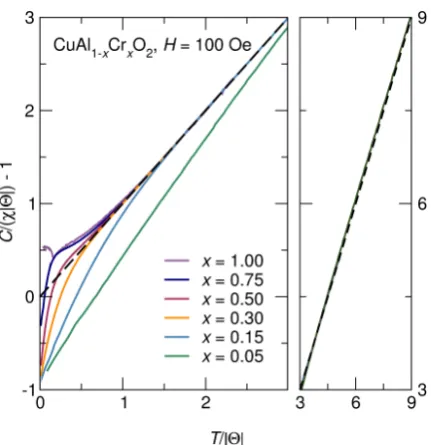
The Curie-Weiss relation χ=C/(T −ΘCW) can be recast according to:
C χ|ΘCW|
+ sgn(ΘCW) =
T
|ΘCW|
(1)
Figure 3: (Color online) Zero-field cooled and field-cooled magnetic susceptibility as collected under a DC magnetic field of 100 Oe.
Figure 4: (Color online) Magnetization as a function of applied DC magnetic field at 5 K. Data were acquired in a loop from 0 T, to 5 T, to −5 T, and back to 0 T, though only the first quadrant is shown as no significant hysteresis was observed.
behavior follows the ideal Curie-Weiss until low temperatures at which they deviate below the line. The x = 0.75 sample displays a more complex behavior, however, as upon cooling it first displays short-range antiferromagnetic interactions, similar to CuCrO2, and only at low temperatures does uncompensated behavior emerge. When taken in combination with the slight zfc-fc splitting and smallHC, this behavior may be
[image:7.595.186.400.87.287.2] [image:7.595.186.402.346.553.2]Figure 5: (Color online) Magnetic characteristics (a) µeff, (b) ΘCW, (c) JBB, and (d)
M(2 K, 5 T) as a function of composition. In (a), the dashed horizontal line indicates the expected S-only value for Cr3+. The dotted lines in the other panels are guides to the eye.
[image:8.595.185.400.80.272.2] [image:8.595.188.404.443.666.2]4. Conclusion
We prepared a complete delafossite solid solution between diamagnetic CuAlO2 and the
t3
2g frustrated antiferromagnet CuCrO2 and characterized its structural and magnetic properties. All observed laboratory x-ray diffraction peaks correspond to the delafossite 3R crystal structure. A true solid solution forms, as evidenced by the adherence of unit cell parameters to the V´egard law and by the magnetic behavior. µeff is equal to the Cr3+ spin-onlyS = 3/2 value throughout the solid solution, while ΘCW is negative
and its magnitude increases with x. JBB was estimated by mean-field theory to be 3.0 meV for dilute Cr compositions. Magnetic saturation does not occur at 5 K and 5 T, and the sub-Brillouin behavior is consistent with strong antiferromagnetic interactions. Inspection of a scaled inverse magnetic susceptibility plot reveals that significant short-range antiferromagnetic interactions exist in CuCrO2 above TN, while uncompensated
short-range behavior are present in the Al-substituted samples. These observations can be explained by magnetic frustration and chemical disorder. The results are relevant for understanding magnetic frustration and for the tuning of physical properties through chemical substitution.
5. Acknowledgements
[1] H. Kawazoe, M. Yasukawa, H. Hyodo, M. Kurita, H. Yanagi, and H. Hosono, Nature 389, 939 (1997).
[2] R. Nagarajan, A. D. Draeseke, A. W. Sleight, and J. Tate,J. App. Phys.89, 8022 (2001). [3] Y. Tokura and S. Seki,Adv. Mater.22, 1554 (2010).
[4] K. Kimura, H. Nakamura, S. Kimura, M. Hagiwara, and T. Kimura,Phys. Rev. Lett.103107201 (2009).
[5] H. Kadowaki, H. Kikuchi, and Y. Ajiro,J. Phys.: Cond. Mat.2, 4485 (1990).
[6] M. Poienar, F. Damay, C. Martin, V. Hardy, A. Maignan, and G. Andr´e,Phys. Rev. B 79, 014412 (2009).
[7] M. Soda, K. Kimura, T. Kimura, M. Matsuura, and K. Hirota, J. Phys. Soc. Jap. 78 124703 (2009).
[8] T. Kimura, J. C. Lashley, and A. P. Ramirez,Phys. Rev. B 73, 220401 (2006). [9] T. Arima, J. Phys. Soc. Jap.76, 073702, (2007).
[10] K. Kimura, H. Nakamura, K. Ohgushi, and T. Kimura,Phys. Rev. B 78, 140401 (2008). [11] M. Poienar, F. Damay, C. Martin, J. Robert, and S. Petit,Phys. Rev. B 81104411 (2010). [12] Y. J. Shin, J. P. Doumerc, P. Dordor, M. Pouchard, P. J. Hagenmuller, Solid State Chem.107,
194 (1993).
[13] D. O. Scanlon and G. W. Watson,J. Mater. Chem.21, 3655 (2011).
[14] R. Seshadri, C. Felser, K. Thieme, and W. Tremel,Chem. Mater. 10, 2189 (1998). [15] H. C. Kandpal and R. Seshadri,Solid State Sci.4, 1045 (2002).
[16] D. O. Scanlon, A. Walsh, B. J. Morgan, G. W. Watson, D. J. Payne, and R. G. Egdell,Phys. Rev. B 79, 035101 (2009).
[17] T. Okuda, N. Jufuku, S. Hidaka, and N. Terada,Phys. Rev. B 72, 144403 (2005).
[18] T. Okuda, Y. Beppu, Y. Fujii, T. Onoe, N. Terada, and S. Miyasaka, Phys. Rev. B 77, 134423 (2008).
[19] T. Okuda, K. Uto, S. Seki, Y. Onose, Y. Tokura, R. Kajimoto, and Masaaki Matsuda, J. Phys. Soc. Jap.80, 014711 (2011).
[20] P. T. Barton, R. Seshadri, and M. J. Rosseinsky,Phys. Rev. B 83, 064417 (2011).
[21] B. C. Melot, J. E. Drewes, R. Seshadri, E. M. Stoudenmire, and A. P. Ramirez,J. Phys.: Cond. Matter 21, 216007 (2009).
[22] D. P. Shoemaker and R. Seshadri,Phys. Rev. B 82, 214107 (2010).
[23] T. Ishiguro, A. Kitazawa, N. Mizutani, and M. Kato,J. Sol. State Chem.40, 170 (1981).
[24] J.-P. Doumerc, A. Wichainchai, A. Ammar, M. Pouchard, and P. Hagenmuller,Mater. Res. Bull.
21, 745 (1986).
[25] H. M. Rietveld,J. Appl. Crystallogr.2, 65 (1969).
[26] J. B´erar and G. Baldinozzi,IUCr-CPD Newsletter 20, 3 (1998). [27] K. Momma and F. Izumi,J. Appl. Crystallogr.41, 653 (2008).
[28] R. D. Shannon and C. T. Prewitt,Acta Crystallogr. B 25, 925 (1969). [29] C. Ederer and M. Komelj,Phys. Rev. B 76, 064409 (2007).