1
Ontology-based Data Access:
A Study through Disjunctive Datalog, CSP, and MMSNP
MEGHYN BIENVENU, CNRS & Universit´e Paris Sud BALDER TEN CATE, University of California Santa Cruz CARSTEN LUTZ, Universit ¨at Bremen
FRANK WOLTER, University of Liverpool
Ontology-based data accessis concerned with querying incomplete data sources in the presence of domain-specific knowledge provided by an ontology. A central notion in this setting is that of anontology-mediated query, which is a database query coupled with an ontology. In this paper, we study several classes of ontology-mediated queries, where the database queries are given as some form of conjunctive query and the ontolo-gies are formulated in description logics or other relevant fragments of first-order logic, such as the guarded fragment and the unary-negation fragment. The contributions of the paper are three-fold. First, we show that popular ontology-mediated query languages have the same expressive power as natural fragments of disjunctive datalog, and we study the relative succinctness of ontology-mediated queries and disjunctive datalog queries. Second, we establish intimate connections between ontology-mediated queries and con-straint satisfaction problems (CSPs) and their logical generalization, MMSNP formulas. Third, we exploit these connections to obtain new results regarding (i) first-order rewritability and datalog-rewritability of ontology-mediated queries, (ii) P/NP dichotomies for ontology-mediated queries, and (iii) the query contain-ment problem for ontology-mediated queries.
Categories and Subject Descriptors: H.2.3 [Database Management]: Languages—Query Languages General Terms: Algorithms, Languages, Theory
Additional Key Words and Phrases: Ontology-Based Data Access; Query Answering; Query Rewriting
1. INTRODUCTION
Ontologies are logical theories that formalize domain-specific knowledge, thereby mak-ing it available for machine processmak-ing. Recent years have seen an increasmak-ing interest in using ontologies in data-intensive applications, especially in the context of intelli-gent systems, the semantic web, and in data integration. A much studied scenario is that of answering queries over an incomplete database under the open world seman-tics, taking into account knowledge provided by an ontology [Calvanese et al. 1998; Calvanese et al. 2007; Cal`ı et al. 2012]. We refer to this asontology-based data access (OBDA).
There are several important use cases for OBDA. A classical one is to enrich an in-complete data source with background knowledge, in order to obtain a more in-complete set of answers to a query. For example, if a medical patient database contains the facts
Meghyn Bienvenu was supported by the ANR project PAGODA (ANR-12-JS02-007-01). Balder ten Cate was supported by NSF Grants IIS-0905276 and IIS-1217869. Carsten Lutz was supported by the DFG SFB/TR 8 “Spatial Cognition”.
Author’s addresses: M. Bienvenu, Laboratoire de Recherche en Informatique, Universit´e Paris-Sud; B. ten Cate, University of California, Santa Cruz; Carsten Lutz, Fachbereich Informatik, Universit ¨at Bremen; F. Wolter, Department of Computer Science, University of Liverpool.
Permission to make digital or hard copies of part or all of this work for personal or classroom use is granted without fee provided that copies are not made or distributed for profit or commercial advantage and that copies show this notice on the first page or initial screen of a display along with the full citation. Copyrights for components of this work owned by others than ACM must be honored. Abstracting with credit is per-mitted. To copy otherwise, to republish, to post on servers, to redistribute to lists, or to use any component of this work in other works requires prior specific permission and/or a fee. Permissions may be requested from Publications Dept., ACM, Inc., 2 Penn Plaza, Suite 701, New York, NY 10121-0701 USA, fax+1 (212) 869-0481, or [email protected].
c
1 ACM 0362-5915/1/01-ART1 $15.00
that patient1 has finding Erythema Migrans and patient2 has finding Lyme disease, and the ontology provides the background knowledge that a finding of Erythema Mi-grans is sufficient for diagnosing Lyme disease, then both patient1 and patient2 can be returned when querying for patients that have the diagnosis Lyme disease. This use of ontologies is central to query answering in the semantic web. OBDA can also be used to enrich the data schema (that is, the relation symbols allowed in the presenta-tion of the data) with addipresenta-tional symbols to be used in a query. For example, a patient database may contain facts such as patient1 has diagnosis Lyme disease and patient2 has diagnosis Listeriosis, and an ontology could add the knowledge that Lyme disease and Listeriosis are both bacterial infections, thus enabling queries such as “return all patients with a bacterial infection” despite the fact that the data schema does not in-clude a relation or attribute explicitly referring to bacterial infections. Especially in the bio-medical domain, applications of this kind are fueled by the availability of com-prehensive professional ontologies such as SNOMED CT and FMA. A third prominent application of OBDA is in data integration, where an ontology can be used to provide a uniform view on multiple data sources [Poggi et al. 2008]. This typically involves mappings from the source schemas to the schema of the ontology, which we will not explicitly consider here.
We may view the actual database query and the ontology as two components of one composite query, which we call anontology-mediated query. OBDA in the above sense is then the problem of answering ontology-mediated queries. The database queries used in OBDA are typically unions of conjunctive queries, while the ontologies are specified in an ontology language that is either a description logic, or, more generally, a suitable fragment of first-order logic. For popular choices of ontology languages, the data complexity of ontology-mediated queries can be CONP-complete, which has re-sulted in extensive research on finding tractable classes of ontology-mediated queries, as well as on finding classes of ontology-mediated queries that are amenable to effi-cient query answering techniques [Calvanese et al. 2006; Hustadt et al. 2007; Kris-nadhi and Lutz 2007]. In particular, classes of ontology-mediated queries have been identified that admit an FO-rewriting (i.e., that are equivalent to a first-order query), or, alternatively, admit a datalog-rewriting. FO-rewritings make it possible to answer ontology-mediated queries using traditional database management systems while datalog-rewritings enable the use of datalog engines. This approach is considered one of the most promising for OBDA and is the subject of significant research activity, see for example [Calvanese et al. 2007; Gottlob and Schwentick 2012; Kikot et al. 2012b; Kontchakov et al. 2010; P´erez-Urbina et al. 2010; Rosati and Almatelli 2010].
The main aims of this paper are (i) to characterize the expressive power of ontology-mediated queries, both in terms of more traditional database query languages and from a descriptive complexity perspective, (ii) to make progress towards complete and decidable classifications of ontology-mediated queries with respect to their data com-plexity, and (iii) to establish decidability and tight complexity bounds for relevant rea-soning problems such as query containment and deciding whether a given ontology-mediated query is FO-rewritable or datalog-rewritable.
As query languages for q, we focus on unions of conjunctive queries (UCQs) and unary atomic queries (AQs). The latter are of the formA(x), withAa unary relation symbol, and correspond to what are traditionally calledinstance queriesin the OBDA literature (note that Amay be a relation symbol from O that is not part of the data schema). These two query languages are among the most used query languages in OBDA. In the following, we use(L,Q)to denote the query language that consists of all ontology-mediated queries (S,O, q) with O specified in the ontology language L andqspecified in the query languageQ. For example,(GFO,UCQ)refers to ontology-mediated queries in which O is a GFO-ontology and q is a UCQ. We refer to such query languages(L,Q)asontology-mediated query languages (or, OBDA languages).
In Section 3, we characterize the expressive power of OBDA languages in terms of natural fragments of (negation-free) disjunctive datalog. We first consider the basic description logic ALC. We show that (ALC,UCQ)has the same expressive power as monadic disjunctive datalog (abbreviated MDDlog) and that(ALC,AQ)has the same expressive power as unary queries defined in a syntactic fragment of MDDlog that we call connected simple MDDlog. Similar results hold for various description logics that extendALC with, for example, inverse roles, role hierarchies, and the universal role, all of which are standard operators included in the W3C-standardized ontology language OWL2 DL. Turning to other fragments of first-order logic, we then show that(UNFO,UCQ)also has the same expressive power as MDDlog, while(GFO,UCQ)
and(GNFO,UCQ)are strictly more expressive and coincide in expressive power with frontier-guarded disjunctive datalog, which is the DDlog fragment given by programs in which, for every atom αin the head of a rule, there is an atom β in the rule body that contains all variables fromα.
An additional contribution of Section 3 is to analyze the relative succinctness of OBDA query languages and equi-expressive versions of datalog. We first argue that
(ALC,UCQ)is exponentially more succinct than MDDlog, with the lower bound being conditional on the assumption from complexity theory that EXPTIME 6⊆CONP/POLY. We then prove that(ALCI,UCQ), withALCIthe extension ofALCwith inverse roles, is at least exponentially more succinct than MDDlog (without any complexity-theoretic assumptions) and at most double exponentially more succinct. This latter result ex-tends from(ALCI,UCQ)to(UNFO,UCQ). Actually, we show that a single-exponential succinctness gap can already be observed between(ALC,UCQ)and(ALCI,UCQ), and leave open whether the additional exponential blowup encountered in our translation of (ALCI,UCQ) to MDDlog can be avoided (we conjecture that this is not the case). We also show that, in contrast to inverse roles, several other standard extensions of ALC do not seem to have an impact on succinctness. Regarding other fragments of FO, we establish that (GNFO,UCQ) is at least exponentially more succinct than frontier-guarded DDlog and at most double exponentially more succinct. The case of
(GFO,UCQ)is a bit different since our translation from frontier-guarded DDlog into
(GFO,UCQ) involves an exponential blowup whereas this direction is polynomial in all other cases.
In Section 4, we study ontology-mediated queries from adescriptive complexity per-spective. In particular, we establish an intimate connection between OBDA query lan-guages, constraint satisfaction problems, and MMSNP. Recall that constraint satis-faction problems (CSPs) form a subclass of the complexity class NP that, although it contains NP-hard problems, is in certain ways more computationally well-behaved. The widely known Feder-Vardi conjecture [Feder and Vardi 1998] states that there is a dichotomy between PTIME and NP for the class of all CSPs, that is, each CSP
NP without inequality (abbreviated MMSNP) was introduced by Feder and Vardi as a logical generalization of CSP that enjoys similar computational properties [Feder and Vardi 1998]. In particular, it was shown in [Feder and Vardi 1998; Kun 2007] that there is a dichotomy between PTIMEand NP for MMSNP sentences if and only if the Feder-Vardi conjecture holds.
In Section 4, we first observe that (ALC,UCQ) and many other OBDA languages based on UCQs have the same expressive power as the query language coMMSNP, which consists of all queries whose complement is definable by an MMSNP for-mula with free variables. In the spirit of descriptive complexity theory, we say that
(ALC,UCQ)capturescoMMSNP. In fact, this result is a consequence of the results in Section 3 and the observation that MDDlog has the same expressive power as coMM-SNP.
To establish a counterpart of(GFO,UCQ)and(GNFO,UCQ)in the MMSNP world, we introduce guarded monotone strict NP (abbreviated GMSNP) as a generalization of MMSNP; specifically, GMSNP is obtained from MMSNP by allowing guarded second-order quantification in the place of monadic second-second-order quantification, similarly as in the transition from MDDlog to frontier-guarded disjunctive datalog. The resulting query language coGMSNP has the same expressive power as frontier-guarded dis-junctive datalog, and therefore, in particular,(GFO,UCQ)and(GNFO,UCQ)capture coGMSNP. We observe that GMSNP has the same expressive power as the extension MMSNP2of MMSNP proposed in [Madelaine 2009]. It follows from our results in Sec-tion 3 that GMSNP (and thus MMSNP2) is strictly more expressive than MMSNP, closing an open problem from [Madelaine 2009].
In the second part of Section 4, we consider OBDA languages based on atomic queries and establish a tight connection to (certain generalizations of) CSPs. This connection is most easily stated for Boolean atomic queries (BAQs), which take the form∃x A(x)withAa unary relation symbol: we prove that(ALC,BAQ)captures the query language that consists of all Boolean queries definable as the complement of a CSP. Similarly, we show that(ALCU,AQ), withALCU the extension ofALC with the universal role, and where queries are unary rather than Boolean, captures the query language that consists of all unary queries definable as the complement of a general-ized CSP, which is given by a finite collection of structures (instead of a single one), enriched in a certain way with a constant symbol.
The results of Section 4 have fundamental consequences for ontology-based data ac-cess. In fact, significant progress has been made in understanding CSPs and MMSNP formulas [Bulatov 2011; Bodirsky et al. 2012; Kun and Nesetril 2008], and the con-nection established in Section 4 enables the transfer of techniques and results from CSP and MMSNP to OBDA. This is investigated in Section 5, where we consider three applications of the results in Section 4.
The second application of the connection between OBDA and MMSNP/CSP concerns query containment, in a rather general form as recently introduced and studied in [Bi-envenu et al. 2012]. It was shown in [Feder and Vardi 1998] that containment between MMSNP sentences is decidable. We use this result to prove that query containment is decidable for many OBDA languages based on UCQs, including (ALC,UCQ) and
(GFO,UCQ). For many OBDA languages based on atomic queries such as(ALC,AQ), we additionally pinpoint the exact computational complexity of query containment as NEXPTIME-complete. The upper bound is obtained by transferring the easy to obtain result that containment between CSP problems is in NP. The lower bound is estab-lished by reduction of a NEXPTIME-complete tiling problem. We also show that, for
(ALCF,AQ), the query containment problem is undecidable.
As the third application, we consider FO-rewritability and datalog-rewritability of ontology-mediated queries. Taking advantage of recent results for CSPs [Larose et al. 2007; Freese et al. 2009; Bulatov 2009], we are able to show that FO-rewritability and datalog-rewritability, as properties of ontology-mediated queries, are decidable and NEXPTIME-complete for (ALC,AQ) and (ALC,BAQ). This result extends to several extensions ofALC. For(ALCF,AQ)both problems again turn out to be undecidable.
In Section 6, we consider the case where the data schema is not fixed in advance. In contrast to the setup assumed in the previous sections, it is thus not possible to disallow any relation symbol from occurring in the data. This case is natural in many OBDA applications, where the data is not under the control of the user. We show that all decidability and complexity results obtained in the previous sections also hold in the schema-free case. In particular, this is true for query containment, FO-rewritability, and datalog-rewritability. We also show that, for all OBDA languages considered in this paper, there is a dichotomy between PTIMEandCONP in the schema-free case if and only if there is such a dichotomy in the fixed-schema case. Via the results from Sections 4 and Sections 5, this yields a connection to the Feder-Vardi conjecture also for the schema-free case.
Related WorkA connection between query answering in DLs and the negation-free fragment of disjunctive datalog was first discovered in the influential [Motik 2006; Hustadt et al. 2007], where it was used to obtain a resolution calculus for reason-ing about DL ontologies and to answer atomic queries (AQs) in the presence of such ontologies. A different approach to reasoning about DL ontologies that also involves disjunctive datalog can be found in [Rudolph et al. 2012]. In contrast to the current pa-per, these previous works do not consider the expressive power of ontology-mediated queries, nor their succinctness and descriptive complexity. A connection between DL-based OBDA and CSPs was first found and exploited in [Lutz and Wolter 2012], in a setup that is different from the one studied in this paper. In particular, instead of focusing on ontology-mediated queries that consist of a data schema, an ontology, and a database query, the work reported about in [Lutz and Wolter 2012] concentrates on ontologies while quantifying universally over all database queries and without fixing a data schema. It establishes links to the Feder-Vardi conjecture that are incompa-rable to the ones found in this paper, and does not consider the expressive power, succinctness, or descriptive complexity of queries used in OBDA. To the best of our knowledge, a connection between OBDA and MMSNP has not been established before. Existing work that is related to our results on query containment, FO-rewritability, and datalog-rewritability in DL-based OBDA is discussed in the main body of the pa-per.
2. PRELIMINARIES
Schemas, Instances, and Queries. Aschemais a finite collection S= (S1, . . . , Sk) of relation symbols with associated arity. A fact overS is an expression of the form
S(a1, . . . , an)where S ∈Sis an n-ary relation symbol, anda1, . . . , an are elements of some fixed, countably infinite set const of constants. Aninstance D overSis a finite set of facts over S. Theactive domain adom(D) of D is the set of all constants that occur in the facts inD. We will frequently use boldface notation for tuples, such as in a= (a1, . . . , an), and we denote the empty tuple by().
A query over Sis semantically defined as a mapping q that associates with every instanceD overSa set ofanswersq(D) ⊆adom(D)n, wheren ≥0is thearityofq. If
n = 0, then we say thatqis aBoolean query, and we write q(D) = 1if() ∈q(D)and
q(D) = 0otherwise.
A prominent way of specifying queries is by means of first-order logic (FO). Specifi-cally, each schemaSand domain independent FO-formulaϕ(x1, . . . , xn)that uses only relation symbols fromS(and, possibly, equality) give rise to then-ary queryqϕ,S,
de-fined by setting for all instancesDoverS,
qϕ,S(D) ={(a1, . . . , an)∈adom(D)n|D|=ϕ[a1, . . . , an]}.
To simplify the exposition, we assume that FO queries do not contain constants. The free variables of an FO query are called answer variables. We use FOQ to denote the set of all first-order queries, as defined above. Similarly, we use CQ to refer to the class ofconjunctive queries, that is, FOQs of the form∃yϕ(x,y)whereϕis a conjunction of relational atoms with the relation potentially being equality. UCQ refers to the class of
unions of conjunctive queries, that is, disjunctions of CQs with the same answer vari-ables. Finally, AQ denotes the set ofatomic queries, which are CQs of the very simple form A(x)withA a unary relation symbol. Each of these is called aquery language, which is defined abstractly as a set of queries. Besides FOQ, CQ, UCQ, and AQ, we consider various other query languages that are introduced later, including ontology-mediated ones and variants of datalog.
Two queriesq1andq2overSareequivalent, writtenq1≡q2, if for every instanceD overS, we haveq1(D) =q2(D). We say that query languageQ2isat least as expressive
asquery languageQ1, writtenQ1 Q2, if for every queryq1∈ Q1over some schemaS, there is a queryq2∈ Q2overSwithq1≡q2;Q1andQ2have the same expressive power ifQ1 Q2 Q1.
Ontology-Mediated Queries.We introduce the fundamentals of ontology-based data access. An ontology languageLis a fragment of first-order logic (i.e., a set of FO sen-tences), and anL-ontologyOis a finite set of sentences fromL.1We introduce various
concrete ontology languages throughout the paper, including descriptions logics and the guarded fragment.
Anontology-mediated queryover a schemaSis a triple(S,O, q), whereOis an on-tology and q is a query over S∪sig(O), with sig(O) the set of relation symbols used inO. Here, we call Sthe data schema. Note that the ontology can introduce symbols that are not in the data schema, which allows it to enrich the schema of the query
q. Of course, we do not require that every relation symbol of the data schema actu-ally occurs in the ontology. We have explicitly included S in the specification of the ontology-mediated query to emphasize that the ontology-mediated query is a query overS-instances, even thoughOandqmight use additional relation symbols.
1Domain independence is not required. In fact, there are many ontology languages in which domain
Table I. Example ontology, presented in (the guarded fragment of) first-order logic and the DLALC
∀x(∃y(HasFinding(x, y)∧ErythemaMigrans(y))→ ∃y(HasDiagnosis(x, y)∧LymeDisease(y)) )
∀x( (LymeDisease(x)∨Listeriosis(x))→BacterialInfection(x) )
∀x(∃y.(HereditaryPredisposition(y)∧HasParent(x, y))→HereditaryPredisposition(x)) )
∃HasFinding.ErythemaMigransv ∃HasDiagnosis.LymeDisease
LymeDiseasetListeriosisvBacterialInfection
∃HasParent.HereditaryPredispositionvHereditaryPredisposition
The semantics of an ontology-mediated query is given in terms ofcertain answers, defined next. Afinite relational structureover a schemaSis a pairB= (dom,D)where
domis a non-empty finite set called thedomainofBandDis an instance overSwith
adom(D)⊆dom. WhenSis understood, we useMod(O)to denote the set of allmodels
of O, that is, all finite relational structures BoverS∪sig(O)such that B |= O. Let
(S,O, q)be an ontology-mediated query withqof arityn. Thecertain answers toqon anS-instanceDgivenOis the setcertq,O(D)of tuplesa ∈adom(D)n such that for all (dom,D0) ∈ Mod(O) with D ⊆ D0 (that is, all models of O that extend D), we have a∈q(D0).
An instanceD is calledconsistentwith an ontology O if there exists a finite rela-tional structure(dom,D0)withD0 ⊇Dsuch that(dom,D0)∈ Mod(O). Note that if an S-instance D is not consistent with O and a query q has arity n, thencertq,O(D) =
adom(D)n.
All ontology languages considered in this paper enjoy finite controllability, meaning that finite relational structures can be replaced with unrestricted ones without chang-ing the certain answers to unions of conjunctive queries [Baader et al. 2003; B ´ar ´any et al. 2010; B ´ar ´any et al. 2012].
Every ontology-mediated queryQ = (S,O, q)can be semantically interpreted as a queryqQoverSby settingqQ(D) =certq,O(D)for allS-instancesD. In other words, we jointly consider the ontologyOand actual queryqto be an ‘overall query’qQ. Taking this view one step further, each choice of an ontology languageLand query language Qgives rise to a query language, denoted(L,Q), defined as the set of queriesq(S,O,q) withSa schema,OanLontology, andq∈ Qa query overS∪sig(O). We refer to such query languages(L,Q)asontology-mediated query languages, orOBDA languagesfor short.
Example 2.1. The upper half of Table I shows an ontologyOthat is formulated in the guarded fragment of FO. Consider the ontology-mediated query(S,O, q)with the following data schema and query:
S={ErythemaMigrans,LymeDisease,Listeriosis,
HereditaryPredisposition,HasFinding,HasDiagnosis,HasParent}
q(x) =∃y(HasDiagnosis(x, y)∧BacterialInfection(y) ).
For the instanceDoverSthat consists of the facts
HasFinding(patient1,jan12find1) ErythemaMigrans(jan12find1) HasDiagnosis(patient2,may7diag2) Listeriosis(may7diag2)
we havecertq,O(D) ={patient1,patient2}.
Table II. First-order translation ofALCconcepts
>∗(x) => (CuD)∗(x) =C∗(x)∧D∗(x) ⊥∗(x) =⊥ (CtD)∗(x) =C∗(x)∨D∗(x) A∗(x) =A(x) (∃R.C)∗(x) =∃y R(x, y)∧C∗(y) (¬C)∗(x) =¬C∗(x) (∀R.C)∗(x) =∀y R(x, y)→C∗(y)
role names, respectively. Despite the potential presence of unary relations, we speak of
binary schemas. We briefly review the basic description logicALC. Relevant extensions ofALCwill be introduced later on in the paper.
AnALC-conceptis formed according to the syntax rule
C, D::=A| > | ⊥ | ¬C|CuD|CtD| ∃R.C| ∀R.C
where A ranges over concept names and R over role names. An ALC-ontology O is a finite set ofconcept inclusions C v D, withC and D ALC-concepts. We define the semantics of ALC-concepts by translation to FO-formulas with one free variable, as shown in Table II. AnALC-ontologyOthen translates into the set of FO-sentences
O∗={∀x(C∗(x)→D∗(x))|CvD∈ O}.
In the lower half of Table I, we show the ALC version of the guarded fragment on-tology displayed in the upper half. Note that, although the translation is equivalence-preserving in this case, in general (and even on binary schemas), the guarded fragment is a more expressive ontology language thanALC. For example, the guarded sentence ∀x∀y(R(x, y)→S(x, x))stating that every individual with anR-successor isS-reflexive is not equivalent to anyALC ontology. Throughout the paper, we do not explicitly dis-tinguish between a DL ontology and its translation into FO.
We remark that, from a DL perspective, the above definitions of instances and cer-tain answers correspond to making thestandard name assumption (SNA)in ABoxes, which in particular implies theunique name assumption. We make the SNA only to facilitate uniform presentation; the SNA is inessential for the results presented in this paper since we do not consider query languages with inequality.
The following example provides some first intuition about how ontology-mediated queries based on description logics relate to more traditional query languages.
Example 2.2. LetO andSbe as in Example 2.1. For q1(x) = BacterialInfection(x), the ontology-mediated query(S,O, q1)is equivalent to the union of conjunctive queries
LymeDisease(x)∨ Listeriosis(x). For q2(x) = HereditaryPredisposition(x), the ontology-mediated query(S,O, q2)is equivalent to the query defined by the datalog program
P(x) ← HereditaryPredisposition(x) goal(x) ← P(x) P(x) ← HasParent(x, y)∧P(y)
but not to any first-order query.
Throughout the paper, for any syntactic objectowe will use|o|to denote the number of syntactic symbols used to write outo, and call|o|thesizeofo. For example, the size |q|of the conjunctive queryq from Example 2.1 is 15, including all parentheses and counting each relation name as one syntactic symbol. This also defines the size|O|of an ontologyO, the size|Q|of an ontology-mediated queryQ= (S,O, q), and so on.
3. OBDA AND DISJUNCTIVE DATALOG
Adisjunctive datalog ruleρhas the form
S1(x1)∨ · · · ∨Sm(xm)←R1(y1)∧ · · · ∧Rn(yn)
with m ≥ 0 and n > 0. We refer to S1(x1)∨ · · · ∨Sm(xm) as the head of ρ, and to
R1(y1)∧. . .∧Rn(yn) as the body of ρ. Every variable that occurs in the head of a rule ρis required to also occur in the body ofρ. Empty rule heads are denoted⊥. A
disjunctive datalog (DDlog) programΠis a finite set of disjunctive datalog rules with a selectedgoal relationgoalthat does not occur in rule bodies and only ingoal rulesof the formgoal(x)←R1(x1)∧ · · · ∧Rn(xn). Thearity ofΠis the arity of thegoalrelation. Relation symbols that occur in the head of at least one rule ofΠareintensional (IDB) relations, and all remaining relation symbols inΠareextensional (EDB) relations. An S0-instance, withS0the set of all (IDB and EDB) relation symbols inΠ, is amodelofΠ
if it satisfies all rules inΠ. We useMod(Π)to denote the set of all models ofΠ.
Every DDlog program Π of arity n naturally defines an n-ary query qΠ over the schemaSthat consists of the EDB relations ofΠ: for every instanceDoverS, we have
qΠ(D) ={a∈adom(D)n|goal(a)∈D0for allD0∈Mod(Π)withD⊆D0}.
Note that the DDlog programs considered in this paper are negation-free. Restricted to this fragment, there is no difference between the different semantics of DDlog studied e.g. in [Eiter et al. 1997].
We useadom(x)in rule bodies as a shorthand for “xis in the active domain of the EDB relations”. Specifically, whenever we use adomin a rule of a DDlog program Π, we assume thatadomis an IDB relation and that the programΠincludes all rules of the formadom(x)←R(x)whereRis an EDB relation ofΠandxis a tuple of distinct variables that includesx.
For simplicity, we generally speak about equivalence of an ontology-mediated queryQand a DDlog programΠ, meaning equivalence of the queriesqQandqΠ.
Amonadic disjunctive datalog (MDDlog) programis a DDlog program in which all IDB relations with the possible exception ofgoalare monadic. We use MDDlog to de-note the query language that consists of all queries defined by an MDDlog program.
Note that, while the data complexity of query evaluation in MDDlog and in many OBDA languages isCONP-complete [Eiter et al. 1997],2there is a significant difference
in combined complexity. For example, the evaluation of queries from(ALC,AQ)is EX
-PTIME-complete, and the evaluation of queries from(ALCI,UCQ)is even 2EXPTIME -complete regarding combined complexity [Lutz 2008]. The following theorem, which we prove here for the sake of completeness, shows that MDDlog has lower complexity. The lower bound proof was suggested to us by Thomas Eiter, please see [Eiter et al. 2007] for closely related results.
THEOREM 3.1. Query evaluation in MDDlog is Πp2-complete regarding combined complexity. The lower bound holds already over binary schemas.
PROOF. The upper bound is immediate: given an MDDlog programΠ, instanceD, and candidate answer tupled, we can showd6∈qΠ(D)by guessing an instanceD0with D⊆D0,adom(D0) =adom(D), andgoal(d)6∈D0, and verifying using an NP oracle that every rule inΠis satisfied inD0.
For the lower bound, we give a reduction from 2QBF validity. Consider a 2QBF ∀x1. . . xm∃y1. . . ynϕ, whereϕis a 3CNF over clausesc1, . . . , ck. We create an MDDlog programΠwhose set of EDB relations consists of unary relationsC1, . . . , Ckand binary relationsV1, V2, V3,andstart, and whose (monadic) IDB relations areX1, . . . , Xm. For
2In the case of ontology-mediated queries, data complexity refers to the setup where both the ontology and
each clause ci, we denote by v j
i (1 ≤ j ≤ 3) the variable appearing in thejth literal of ci, and we let Si denote the set of tuples in {0,1}3 representing the seven truth assignments for(v1
i, v2i, v3i)which satisfyci. We encodeϕusing the instanceDϕdefined as follows:
Dϕ={Ci(abi), V1(abi, b1), V2(abi, b2), V3(abi, b3)|b= (b1, b2, b3)∈Si} ∪ {start(0,1)}
The program Πconsists of a set of rules which select a truth assignment for the uni-versally quantified variables:
Xi(u0)∨Xi(u1)←start(u0, u1) 1≤i≤m
and a goal rule to check whether the selected truth assignment can be extended to a model ofϕ:
goal()← ^
1≤i≤k
(Ci(zi)∧V1(zi, v1i)∧V2(zi, v2i)∧V3(zi, vi3))∧
^
1≤`≤m
X`(x`)
It is straightforward to show that∀x1. . . xm∃y1. . . ynϕis valid iffQΠ(Dϕ) = 1.
We now introduce a characterization of Boolean MDDlog based on colorings of instances and forbidden pattern problems in the style of [Madelaine and Stewart 2007], see also [Kun and Nesetril 2008; Bodirsky et al. 2012]. The forbidden patterns characterization will be used later in this section as a technical tool to prove non-expressibility results. An extension of forbidden pattern problems will also be used later in the paper to characterize non-Boolean MDDlog.
Let Sbe a schema andC a set of unary relation symbols (colors) {C1, . . . , Cn} that is disjoint from S. A C-colored S-instance is anS∪ C-instance D such that for every
d∈adom(D), there is exactly one fact inDof the formCi(d). An instanceD0is called a C-coloringof anS-instanceDifDis the restriction ofD0to the schemaS. Given a setF ofC-coloredS-instances (calledforbidden patterns), we defineForb(F)as the set of all S-instancesDfor which there exists aC-coloringD0 ofDwithF6→D0 for everyF∈ F. The forbidden patterns problem defined byF is to decide whether a givenS-instance belongs to Forb(F). We let FPP denote the set of all forbidden patterns problems and use coFPP to refer to the query language that consists of all Boolean queries qF,S
defined by setting
qF,S(D) = 1 iff D6∈Forb(F),
withFa set ofC-coloredS-instances.
It follows from a result in [Madelaine and Stewart 2007] and Theorem 4.1 in Sec-tion 4 that coFPP queries correspond precisely to Boolean MDDLog queries. We pro-vide a direct proof here as a warm-up to the other proofs in this section.
PROPOSITION 3.2. coFPP and Boolean MDDlog have the same expressive power.
PROOF. First consider a setFof{C1, . . . , Cn}-coloredS-instances, and letΠFbe the MDDlog program that consists of the following rules:
C1(x)∨ · · · ∨Cn(x)←adom(x)
⊥ ←Ci(x)∧Cj(x) for1≤i < j≤n
goal()←ϕD forD∈ F
whereϕDis obtained by taking the conjunction of facts inDand treating the constants
as variables. It can be verified that the queriesqΠ,S andqF,Sare equivalent. Indeed,
Next consider an MDDlog programΠwhose set of EDB relations isSand whose set of non-goal IDB relations isP. We may suppose without loss of generality that there is no rule inΠwhose head and body contain the same atom (such rules are tautologous and can be removed). Define the set of colorsC={CT |T ⊆P}, and letFbe the set of allC-coloredS-instances that can be obtained from a ruleρinΠby:
(1) taking all facts obtained from an EDB atom in the body of ρ by replacing each variablexby a distinct constantdx,
(2) adding a single factCTx(dx)for each variablex, where the subsetTx⊆Pis chosen
such that it contains every IDB relationR for whichR(x)appears in the body ofρ
and omitsRif the atomR(x)appears in the head ofρ.
Intuitively, the forbidden patterns inFthat are obtained from goal rules check for the satisfaction of the body of a goal rule, whereas those derived from non-goal rules check for the violation of such rules. Therefore, an S-instance D belongs toForb(F)just in the case that there is a model ofΠandDin which the goal relation is not derived. The equivalence ofqF,SandqΠ,Sfollows immediately.
3.1. Ontologies Specified in Description Logics
We show that (ALC,UCQ)has the same expressive power as MDDlog and identify a fragment of MDDlog that has the same expressive power as(ALC,AQ). While in both cases, the translation from MDDlog into ontology-mediated queries is linear, the back-wards translations incur an exponential blowup (c.f. the proof of Proposition 3.2 above). The different combined complexity of query evaluation in (ALC,UCQ)and MDDlog queries provides a first indication that this might be unavoidable. To give more con-crete evidence, we argue that, unless EXPTIME⊆CONP/POLY, an exponential blowup
is indeed unavoidable. We additionally consider the extensions of ALC with inverse roles, role hierarchies, transitive roles, and the universal role, which we also relate to MDDlog and its fragments. To match the syntax ofALC and its extensions, we gener-ally assume schemas to be binary throughout this section.3
(ALC,UCQ)and(ALC,AQ).The first main result of this section is the following.
THEOREM 3.3. (ALC,UCQ)and MDDlog have the same expressive power. In fact:
(1) there is a polynomialpsuch that for every query(S,O, q)from(ALC,UCQ), there is an equivalent MDDlog programΠwith|Π| ≤2p(|O|+|q|);
(2) for every MDDlog programΠ, there is an equivalent query(S,O, q)from(ALC,UCQ) with|q| ∈O(|Π|)and|O| ∈O(|Π|).
PROOF. We start by proving Point 1. Thus, letQ= (S,O, q)be an ontology-mediated query from(ALC,UCQ). We first give some intuitions about answeringQwhich guide our translation into an equivalent MDDlog programΠ.
The definition of certain answers toQon an instanceDinvolves a quantification over all models ofOthat extendD. It turns out that in the case of(ALC,UCQ)queries, it suffices to consider a particular type of extensions ofDthat we termforest extension. Intuitively, such an extension ofDcorresponds to attaching tree-shaped structures to the elements ofD. Formally, a relational structure(dom,B)over a binary schema is
tree-shapedif the directed graph(dom,{(a, b)| R(a, b) ∈ Bfor someR})is a tree and there do not exist facts R(a, b), S(a, b) ∈ B with R 6= S. A relational structureD0 is a forest extension of an instance D ifD ⊆ D0 and D0 \D is a union of tree-shaped instances{D0
a |a∈adom(D)}such that
3In fact, this assumption is inessential for Theorems 3.3 and 3.6 (which speak about UCQs), but required
— adom(D0
a)∩adom(D) ={a}withathe root ofD0a and — adom(D0a)∩adom(D0b) =∅fora6=b.
The fact that we need only consider models of Owhich are forest extensions of D is helpful because it constrains the ways in which a CQ can be satisfied. Specifically, every homomorphismhfromqtoD0gives rise to a decomposition ofqinto a collection of componentsq0, . . . , qk where
(i) the ‘core component’ q0 comprises all atoms of q whose variables are sent by hto elements ofD, and
(ii) for eachD0a in the image of h, there is a ‘non-core component’ qi, 1 ≤ i ≤ k, that comprises all atoms ofqwhose variables are sent byhto elements ofD0
a.
Note that the non-core components are pairwise variable-disjoint and share at most one variable with the core component. Also note that each non-core componentqi is a homomorphic pre-image of a tree. In other words, qi can be converted into a tree by exhaustivelyeliminating forks, that is, for all atomsR(y1, x), R(y2, x)∈qiwithy16=y2, identifyingy1withy2.
We now detail the translation of Qinto the MDDlog programΠ. Let sub(O)be the set of subconcepts (that is, syntactic subexpressions) of concepts that occur inO. For example, if we take the ontologyOconsisting of a single inclusion∀R.∃S.¬BvAtD, thensub(O)would contain the following concepts:∀R.∃S.¬B,∃S.¬B,¬B, B, AtD, A, D. Next, we lettree(q)denote the set of all CQs that can be obtained from a CQq0in the UCQqin the following way:
(1) perform exhaustive fork elimination inq0, resulting in a CQqb0;
(2) include in tree(q) any connected component of qb0 that is tree-shaped and has no answer variable;
(3) for every atomR(x, y)∈qb0 such that the restrictionqb0|yofqb
0 to those variables that
are reachable from y (inqb0 viewed as a directed graph) is tree-shaped and has no answer variable, include{R(x, y)}∪qb0|yintree(q), withxas the only answer variable.
To illustrate the construction, suppose that the UCQqcontains the following CQq0:
∃y1· · · ∃y8P(y1, y2)∧S(y1, y3)∧R(y2, y4)∧R(y3, y4)∧S(y4, y5)∧R(y6, y7)∧S(y6, y8)
In Step (1), we unify y2 and y3, leading to the query qb0 with y3 replaced by y2. In Step (2), we include intree(q)the query ∃y6∃y7∃y8 R(y6, y7)∧S(y6, y8). Note that the other connected component ofqb0is not included as it not tree-shaped due to the pres-ence of atoms P(y1, y2) and S(y1, y2). In Step (3), we add four additional queries: ∃y4∃y5 R(y2, y4)∧S(y4, y5),∃y5S(y4, y5),∃y7R(y6, y7), and∃y8 S(y6, y8).
It can be shown that the number of queries in tree(q) is bounded by|q|, see [Lutz 2008] for full details. Moreover, we clearly have|p| ≤ |q|for allp∈tree(q). Setcl(O, q) = sub(O)∪tree(q). Atype(forOandq) is a subset ofcl(O, q). The CQs intree(q)include all potential ‘non-core components’ from the intuitive explanation above. The answer variable of such a CQ (if any) represents the overlap between the core component and the non-core component.
We say that a relational structureB overS0 ∪sig(O)istype-coherent ifP
τ(d) ∈ B just in the case that
τ = {ϕ∈cl(O, q)|ϕBoolean,B|=ϕ} ∪
{ϕ∈cl(O, q)|ϕhas one free variable,B|=ϕ[d]}.
Setkequal to the maximum of2and the width ofq, that is, the number of variables that occur inq. By adiagram, we mean a conjunctionδ(x1, . . . , xn)of atomic formulas over the schemaS0, withn≤kvariables. A diagramδ(x)isrealizableif there exists a type-coherentB∈Mod(O)that satisfies∃xδ(x). A diagramδ(x)impliesq(x0), withx0 a sequence of variables fromx, if every type-coherentB∈ Mod(O)that satisfiesδ(x)
under some variable assignment, satisfiesq(x0)under the same assignment. The desired MDDlog programΠconsists of the following collections of rules:
_
τ⊆cl(O,q)
Pτ(x)←adom(x)
⊥ ←δ(x) for all non-realizable diagramsδ(x) goal(x0)←δ(x) for all diagramsδ(x)that implyq(x0)
Intuitively, these rules ‘guess’ a (representation of a) forest extensionD0ofD. Specifi-cally, the typesPτguessed in the first line determine which subconcepts ofOare made true at each element ofD. Since MDDlog does not support existential quantifiers, the D0a parts ofD0 cannot be guessed explicitly. Instead, the CQs included in the guessed typesPτdetermine those non-core component queries that homomorphically map into theD0a parts. The second line ensures coherence of the guesses and the last line guar-antees thatq has the required homomorphism intoD0. It is proved in Appendix A.1 thatΠis indeed equivalent toQ.
For the converse direction, letΠbe an MDDlog program that defines ann-ary query (n≥0). For each unary IDB relationAofΠ, we introduce two fresh unary relation sym-bols, denoted byAandA¯. The ontologyOenforces thatA¯represents the complement ofA, that is, it consists of all inclusions of the form
> v(AtA¯)u ¬(AuA¯).
In addition the ontology contains the inclusion> vD, for a fresh unary relation sym-bolD, enforcing thatDdenotes the entire domain.
Let qbe the union of (i) alln-ary conjunctive queries that constitute the body of a goal rule, as well as (ii) alln-ary conjunctive queries obtained from a non-goal rule of the form
A1(x1)∨ · · · ∨Am(xm)←R1(y1)∧ · · · ∧Rn(yn)
by taking the conjunctive queryq0(z1, . . . , zn)defined by
¯
A1(x1)∧ · · · ∧A¯m(xm)∧R1(y1)∧ · · · ∧Rn(yn)∧D(z1)∧ · · · ∧D(zn).
Next, we characterize (ALC,AQ) by a fragment of MDDlog. While atomic queries are regularly used in ontology-mediated queries, they also occur in several other forms. In particular, (ALC,AQ) has the same expressive power as the OBDA lan-guage (ALC,ConQ), where ConQ denotes the set of all ALC-concept queries, that is, queries C(x) with C a (possibly compound)ALC-concept. Specifically, each query
(S,O, q) ∈ (ALC,ConQ) with q = C(x) can be expressed as a query (S,O0, A(x)) ∈ (ALC,AQ)whereAis a fresh concept name (that is, it does not occur inS∪sig(O)) and O0 =O ∪ {C vA}. As a consequence,(ALC,AQ)also has the same expressive power as (ALC,TCQ), where TCQ is the set of all CQs that take the form of a directed tree with a single answer variable at the root.
Each disjunctive datalog rule can be associated with an undirected graph whose nodes are the variables that occur in the rule and whose edges reflect co-occurrence of two variables in an atom in the rule body. We say that a rule isconnectedif its graph is connected, and that a DDlog program is connected if all its rules are connected. An MDDlog program issimpleif each rule contains at most one atomR(x)withRan EDB relation; additionally, we require that, in this atom, every variable occurs at most once. An MDDlog program isunaryif its goal relation is unary.
THEOREM 3.4. (ALC,AQ)has the same expressive power as unary connected simple MDDlog. In fact:
(1) there is a polynomialpsuch that for every query(S,O, q)from(ALC,AQ), there is an equivalent unary connected simple MDDlog programΠsuch that|Π| ≤2p(|O|);
(2) for every MDDlog programΠ, there is an equivalent query(S,O, q)from(ALC,AQ) such that|O| ∈O(|Π|).
PROOF. LetQ = (S,O, A0(x))be a query from(ALC,AQ). To define an equivalent MDDlog programΠ, fix unary relation symbolsPCandP¬Cfor everyC∈sub(O). LetS0 be the schema that extendsSwith these symbols. Atypet(x)is a conjunction of atomic formulas of the formPD(x)such that for each subconceptC∈sub(O), eitherPC(x)or
P¬C(x)occurs as a conjunct. Adiagramis a conjunctionδ(x)of atomic formulas over the schema S0 that is of the formt(x), A(x)∧t(x) ort1(x)∧R(x, y)∧t2(y) where A andRare fromSandt,t1, andt2 are types. A diagramδ(x)isrealizableif there is a B∈Mod(O)that satisfies∃xδ(x)and such thatPC(a)∈BimpliesB|=C[a]. Now the MDDlog programΠconsists of the following rules:
^
C∈sub(O)
(PC(x)∨P¬C(x) )←adom(x)
⊥ ←δ(x) for all non-realizable diagramsδ(x)
goal(x)←PA0(x)
Clearly, Π is unary, connected, and simple. It can be shown as in the proof of Theo-rem 3.3 thatQis equivalent toΠ. Because of the atomic nature of AQs, though, the argument is substantially simpler. Details are omitted.
Conversely, letΠbe a unary connected simple MDDlog program. It is easy to rewrite each rule ofΠinto an equivalentALC-concept inclusion, wheregoalis now regarded as a concept name. For example,goal(x)←R(x, y)is rewritten into∃R.> vgoal. Similarly,
goal(x)←R(y, z)is rewritten into> v ∀R.goal}, andP1(x)∨P2(y)←R(x, y)∧P3(x)∧
P4(y)is rewritten intoP3u ∃R.(P4u ¬P2)u ¬P1 v ⊥. LetObe the resulting ontology and letq=goal(x). ThenΠis equivalent to the query(S,O, q), whereSconsists of the EDB relations inΠ.
relations have to be excluded because programs such asgoal(x)←A(x), ⊥ ←R(x, x)
(return all elements inAif the instance contains no reflexiveR-edge, and return the active domain otherwise) also cannot be expressed in(ALC,AQ).
We now observe that the blowup encountered in the translations from ontology-mediated queries to MDDlog in Theorems 3.3 and 3.4 can probably not be avoided.
THEOREM 3.5. There is a family of queries(Qi)i≥0from(ALC,AQ)with|Qi| ≤p(i)
for all i ≥ 0, pa polynomial such that, unless EXPTIME ⊆ CONP/POLY, there is no family of MDDlog programs(Πi)i≥0with
(1) Πi ≡Qifor alli≥0;
(2) |Πi| ≤p0(i)for alli≥0, for some polynomialp0.
PROOF. LetM be a polynomially space-bounded alternating Turing machine (ATM) with input alphabetΣthat solves an EXPTIME-hard problem. The standard EXPTIME -hardness proof for satisfiability inALCshows that for eachi≥0, there is an ontology-mediated queryQi = (Si,Oi, Gi)from(ALC,AQ)withSi ={Aj,σ |j < i, σ∈Σ}, such that
(i) the size ofQiis polynomial ini, and (ii) onSi-instances of the form
Dw={S(a), A0,σ0(a), A1,σ1(a), . . . An−1,σn−1(a)}wherew=σ0· · ·σn−1∈Σ
∗,
we havea∈Qi(Dw)iff inputwis accepted byM.4
Note that MDDlog programsΠcan be evaluated (uniformly) inCONP on instancesDw: to check whetherDw6|= Π, guess an extension of the IDBs that makesgoalempty and check that all rules are satisfied. The latter can be done in polytime since checking homomorphisms into a singleton structure is trivial.
Assume to the contrary of what we have to show that there is a family of MDDLog programs(Πi)i≥0 that satisfies Properties (1) and (2) above. Then the EXPTIME-hard problem L(M)can be solved inCONP/POLY: given an input w∈ Σ∗ of lengthn, give
Πi as an advice to the TM; the TM constructsDw and checks inCONP whetherDw |= Πi.
Extensions ofALC.We consider several OBDA languages that can be obtained from
(ALC,UCQ) and (ALC,AQ)by replacing the ALC ontology language with one of its standard extensions and show that some of the resulting languages still have the same expressive power as MDDlog while others do not. We also analyze the succinctness of the extended OBDA languages. Note that all extensions ofALCconsidered in this sec-tion are fragments of the OWL2 DL profile of the W3C-standardized ontology language OWL2 [OWL Working Group 2009]. Some of the translations used in this subsection are folklore in the area of description logic, and when this is the case we usually confine ourselves to a proof sketch.
We review the relevant extensions of ALC only briefly and refer to [Baader et al. 2003] for more details. ALCI is the extension of ALC with inverse roles, that is, with the operators∃R−.Cand∀R−.Cwhose semantics is defined by the FO-formulas ∃y R(y, x)∧C∗(y) and ∀y R(y, x) → C∗(y), respectively (note the swap of x andy in the R-atom). ALCH extends ALC by admitting role hierarchy statements R v S in the ontology, where R and S are role names; the semantics of these statements is ∀xy(R(x, y)→S(x, y)).Sextends ALCby allowingtransitive rolestatementstrans(R)
in the ontology, which require the role name R to be interpreted as a transitive re-lation. ALCF is the extension ofALC with functional rolestatementsfunc(R), which require the role nameR to be interpreted as a partial function. Finally,ALCU is the extension with theuniversal roleU which is interpreted as the total relationdom×dom
in any relational structure Bwith domaindom. Note thatU should be regarded as a logical symbol and is not a member of any schema.
We use the usual naming scheme to denote combinations of these extensions, for exampleALCHIfor the extension ofALCwith both inverse roles and role hierarchies, andSHI for the extension ofALCHI with transitive roles. InALCHI and its exten-sions, the role hierarchy statements can also refer to inverse roles, as in R v S−, with the obvious semantics. The following result identifies a relevant extension of
(ALC,UCQ)that still has the same expressive power as MDDlog.
THEOREM 3.6. (ALCHIU,UCQ)has the same expressive power as MDDlog. In fact, there is a polynomialpsuch that
(1) for every query(S,O, q)from(ALCHIU,UCQ), there is an equivalent queryQ0 from (ALCHU,UCQ)such that|Q0| ≤p(|O|)·2p(|q|);
(2) for every query (S,O, q)from (ALCHU,UCQ), there is an equivalent MDDlog pro-gramΠsuch that|Π| ≤2p(|O|+|q|).
PROOF. (sketch) To establish Point 1, we use a folklore technique for eliminating inverse roles [De Giacomo and Lenzerini 1994]. Let Q = (S,O, q) be a query from
(ALCHIU,UCQ)and assume w.l.o.g. that
(i) in concept inclusions,Ouses only the operators¬,u, and∃, but neithertnor∀; (ii) the role hierarchy statements inO are closed under inverse, that is, R v S ∈ O
impliesR− vS−∈ O, where(R−)−:=R.
Introduce a fresh role name Rinv for every role nameR used inO(excluding the uni-versal roleU). These fresh symbols are not included in the schemaS. For each concept
Coccurring inO, letC0be the concept obtained fromCby replacing every occurrence of an inverse roleR−byRinv. The ontologyO0 consists of the following:
— all concept subsumptionsC0 vD0 forCvDinO.
— C0 v ∀Rinv.∃R.C0for every existential restriction∃R.Cinsub(O)withRa role name; — C0 v ∀R.∃Rinv.C0 for every existential restriction∃R−.Cinsub(O);
The UCQq0 is obtained fromqby replacing every atomR(x, y)withR(x, y)∨Rinv(y, x) and then distributing conjunction over disjunction. It can be shown that the obtained queryQ0= (S,O0, q0)from(ALCHU,UCQ)is equivalent toQand of the required size.
Point 2 can be established by a straightforward extension of the proof of Theorem 3.3 from(ALC,UCQ)to(ALCHU,UCQ), which requires almost no changes.
Note that the elimination of inverse roles in Point 1 of Theorem 3.6 involves an expo-nential blowup. We now show that such a blowup is unavoidable.
THEOREM 3.7. There is a family of queries(Qi)i≥0from(ALCI,UCQ)with|Qi| ≤
p(i)for all i ≥ 0, pa polynomial such that there is no family of queries (Pi)i≥0 from
(ALCHU,UCQ)withPi≡Qi and|Pi|<2i/3for alli≥0.
R
a0 a1 a2 a3 a4 a5 a6
Y0 Y1 Y2 Y0
R R R R R
Fig. 1. Counting instance of length 3.
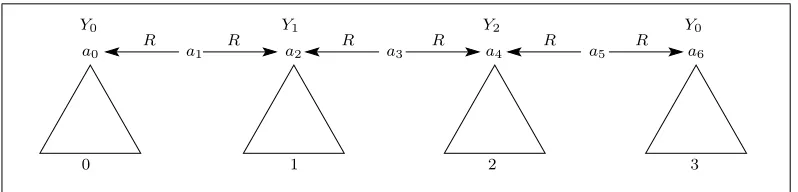
is, a sequence of elements a0, . . . , a2k such that, for0 < i < 2k with i odd, we have
R(ai, ai−1), R(ai, ai+1)∈D. We additionally require that, for0≤i≤2kwithieven,D contains the factYj(ai)wherej =i/2 mod 3. An example can be found in Figure 1. In Appendix A.1, we show the following, which clearly establishes Theorem 3.7: there is a polynomialpsuch that for everyk >0,
(1) there is a query(Qk)k≥1from (ALCI,UCQ)such that|Qk| ≤p(k)and Qk(C`) = 1 for all`≥kand
(2) for every query Q from (ALCHU,UCQ) such that Q(C`) = 1 iff ` ≥ k, we have |Q|>2k/3.
The queriesQk = (S,Ok, qk)from Point 1 are constructed by realizing a counter with exponentially many bits using a family of ontologies and CQs that was introduced in [Lutz 2007; 2008] to prove that query evaluation in(ALCI,UCQ)is 2EXPTIME-hard
regarding combined complexity. Point 2 is established using a pumping argument.
Also note that, when composing Points 1 and 2 of Theorem 3.6, we obtain a double exponential blowup for the translation from(ALCHIU,UCQ)to MDDlog. We believe that this is unavoidable and that the culprit is inverse roles, that is, every translation from (ALCI,UCQ) to MDDlog necessarily incurs a double exponential blowup. The following observation provides some evidence, but leaves open whether the complexity lies in the size of the MDDlog program or in the difficulty of computing it.
THEOREM 3.8. There is no algorithm that translates a given(ALCI,UCQ)query into an equivalent MDDlog program and runs in single exponential time, unless
NEXPTIME= 2EXPTIME.
PROOF. Asingleton instanceis an instance that comprises exactly one element. The combined complexity of deciding whether a Boolean query evaluates to true in a sin-gleton instance is
— in CONP for MDDlog programs (guess an extension of the IDB relations so that goalis made false; due to the instance being singleton, it is then trivial to check in polytime whether all non-goal rules are satisfied);
— 2EXPTIME-complete for queries from(ALCI,UCQ)[Lutz 2008].
If the translation from Theorem 3.8 existed, then we could decide the query evaluation problem in (ALCI,UCQ) by first translating to MDDlog and then using the CONP
procedure.
To prove that certain extensions of (ALC,UCQ)cannot be expressed in MDDlog, we show the following sufficient condition for non-expressibility. The statement refers to the notion of ak-coloring, which is simply defined as aCk-coloring, withCk a fixed set ofkcolors that is disjoint from the considered schema.
[image:17.612.109.504.92.142.2]PROOF. Assume for a contradiction that the S-instances D0 and D1 described in the lemma exist for allk, n > 0, but thatQ is equivalent to some query in MDDlog. Then, by Proposition 3.2, there is a set F of C-coloredS-structures such that for all S-instancesD, we haveQ(D) = 1if and only ifD6∈Forb(F). Letk0=|C|, and letn0be the maximal number of elements in the domain of anyF∈ F. We can assume w.l.o.g. thatC=Ck0.
TakeS-instancesD0 andD1satisfying the conditions of the lemma fork0, n0. Since
Q(D0) = 0, there exists aC-coloringB0ofD0such thatF6→B0for everyF∈ F. There is thus aC-coloringB1 ofD1 such that from every subinstance ofB1with at mostn0 elements, there is a homomorphism toB0. SinceQ(D1) = 1, we know that there must exist someF∈ Fsuch thatF→B1. AsFcontains at mostn0elements, we can compose this homomorphism with the previous homomorphism to obtain a homomorphism ofF intoB0, contradicting the fact thatD0∈Forb(F).
We apply Lemma 3.9 to show that two standard extensions of (ALC,UCQ) have expressive power that is beyond MDDlog.
THEOREM 3.10. (S,UCQ) and (ALCF,UCQ) are strictly more expressive than MDDlog.
PROOF. To separate (S,UCQ) from (ALC,UCQ), we show that the following ontology-mediated queryQ= (S,O, q)cannot be expressed in(ALC,UCQ):Sconsists of two role names R andS, O = {trans(R),trans(S)}, andq = ∃xy(R(x, y)∧S(x, y)). Thus,Qexpresses that there are two elementsaandbsuch thatbis reachable froma
both via anR-path and via anS-path.
We apply Lemma 3.9 to show thatQcannot be expressed in MDDlog. Assume that
k, n >0are given. Letm=n−1andm0=km+2+ 1. DefineD1andD0as follows:
— D1 has elementse, f anda1, . . . , amandb1, . . . , bmand the atomsR(e, a1), R(am, f) andR(ai, ai+1)for1≤i < m, andS(e, b1), S(bm, f)andS(bi, bi+1)for1≤i < m.
— D0has elementse1, . . . , em0 andf1, . . . , fm0 as well asaj1, . . . , ajmfor1≤j ≤m0 and
bi,j1 , . . . , bi,j
m for1≤j < i≤m0. The atoms ofD0consist of: — R(ei, ai1), R(aim, fi), andR(aij, a
i
j+1)for1≤i≤m0 and1≤j < m; — S(ei, bi,j1 )andS(bi,jm, fj)for1≤j < i≤m0, and
S(bi,j` , bi,j`+1)for1≤` < mand1≤j < i≤m0.
It can be checked thatQ(D0) = 0andQ(D1) = 1, as required. Let B0be ak-coloring of D0. Since m0 = km+2+ 1, we can find i, i0 with i > i0 such that the colorings of
ei, ai
1, . . . , aim, fiandei
0
, ai0 1, . . . , ai
0
m, fi
0
coincide. Define ak-coloringB1ofD1by taking the coloring of ei, ai
1, . . . , aim, fi for e, a1, . . . , am, f and the coloring ofbi,i
0
1 , . . . , bi,i 0
m for
b1, . . . , bm.
LetB01be a subset ofB1containing at mostnelements. We define a functionhfrom
adom(B01)toadom(B0)as follows:
— Ife6∈adom(B01), then lethbe the restriction of the following mapping toadom(B01):
h(a`) =ai
0
`,h(b`) =b i,i0
` andh(f) =f i0;
— Iff 6∈adom(B01), then lethbe the restriction of the following mapping toadom(B01):
h(a`) =ai`,h(b`) =bi,i
0
` andh(e) =e i; — Otherwise there existsai0 6∈adom(B
0
1). Then lethbe the restriction of the following mapping toadom(B01):h(e) =ei,h(a`) =ai` for all` < i0,h(a`) =ai
0
` for all` > i0,
h(b`) =bi,i
0
It can be verified thathis a homomorphism fromB0 1toB0.
To separate (ALCF,UCQ)from MDDlog, we first observe that every MDDlog pro-gram Π is preserved under homomorphisms, that is, whena ∈ qΠ(D)andhis a ho-momorphism from D into the instance D0, then h(a) ∈ qΠ(D0). However, this is not the case for the query Q = (S,O, q) from (ALCF,UCQ)where Sconsists of a single binary relation symbol R, O = {func(R)}, and q = A(x). In fact, there trivially is a homomorphismhfromD ={R(a, b1), R(a, b2)}toD0 ={R(a, b)}withh(a) =a, but we have (i)a∈Q(D)sinceDis not consistent withO(that is, due to the standard names assumption, there is no instance inMod(O)that extendsD) and (ii)D0 is consistent withO, thus obviouslya /∈Q(D0).
We now reconsider the OBDA languages studied above, but replace UCQs as the query language with AQs. The next result, in turn, is interesting when contrasted with Theorem 3.10: when(ALC,UCQ)is replaced with(ALC,AQ), then the addition of transitive roles no longer increases the expressive power (but the addition of functional roles still does since the relevant part of the proof of Theorem 3.10 uses only AQs). Moreover, inverse roles do not lead to a double exponential blowup.
THEOREM 3.11. (SHI,AQ)has the same expressive power as unary connected sim-ple MDDlog. In fact, there is a polynomialpsuch that for every queryQ= (S,O, q)from (SHI,AQ), there is an equivalent unary connected simple MDDlog program Π such that|Π| ≤2p(|O|).
PROOF. (sketch) It is sufficient to give an equivalence-preserving translation from
(SHI,AQ)into(ALC,AQ)that runs in polynomial time. This amounts to recalling the following folklore results:
— every query Q = (S,O, q) from (SHI,AQ) can be converted into a query Q0 = (S,O0, q)from(ALCHI,AQ)such thatcert
q,O(D) =certq,O0(D)for allS-instancesD and |Q0| ≤ poly(|Q|); in fact, O0 is obtained from O by replacing each transitivity statementtrans(R)with the concept inclusions∀R.Cv ∀R.∀R.C, for eachC∈sub(O)
[Horrocks and Sattler 1999].
— every query Q = (S,O, q)from (ALCHI,AQ) can be converted into a query Q0 = (S,O0, q) from (ALC,AQ) such that certq,O(D) = certq,O0(D) for all S-instances D and|Q0| ≤poly(|Q|); for the elimination of inverse roles, see proof of Theorem 3.6; we can then replace each role hierarchy statementR vS with the concept inclusions ∀S.Cv ∀R.C, for eachC∈sub(O)[Horrocks and Sattler 1999].
Using the techniques in [Simancik 2012] one can show that, in Theorem 3.11, SHI andSHIU can be extended with all complex role inclusions that are admitted in the description logicSROIQunderlying OWL2 DL.
Note that, by Theorem 3.6, adding the universal role to (ALC,UCQ) does not in-crease the expressive power beyond MDDlog. The situation is different when we con-sider AQs. Specifically, while(ALC,AQ)has the same expressive power as unary sim-ple connected MDDlog, adding the universal role corresponds, on the MDDlog side, to dropping the requirement that rule bodies must be connected. For example, the MDDlog query goal(x) ← adom(x)∧A(y) is not connected and can be expressed in
(ALCU,AQ)using the ontologyO={∃U.Avgoal}and the AQgoal(x).
THEOREM 3.12. (ALCU,AQ)and(SHIU,AQ)both have the same expressive power as unary simple MDDlog. In fact, there is a polynomialpsuch that
(2) for every unary simple MDDlog programΠ, there is a queryQfrom(ALCU,AQ)such that|Q0| ≤p(|Q|).
PROOF. (sketch) For Point 1, we first note that the translations described in the proof of Theorem 3.11 also work in the presence of the universal role (without any modifications) and incur only a polynomial blowup. It thus suffices to establish Point 1 for queries from (ALCU,AQ). Assume that a query Q = (S,O, q)from this language is given. We can translateQinto an MDDlog program as in the proof of Theorem 3.4 with the only difference that diagrams can now also be of the (disconnected) form
t1(x)∧t2(y).
For Point 2, letΠbe a unary simple MDDlog program. As shown in the proof of The-orem 3.4, every connected rule inΠcan be translated into an equivalentALCconcept inclusion. Rules with non-connected bodies can be translated using the universal role. For example,
P1(x)∨P2(y)←A(x)∧B(y) is rewritten intoAu ∃U.(Bu ¬P2)u ¬P1v ⊥.
We briefly discussBoolean atomic queries(BAQs), i.e., queries of the form∃x.A(x), where Ais a unary relation symbol. Such queries are relevant in the context of con-straint satisfaction problems and will pop up naturally in Section 4.2. The following result shows that BAQs behave very similarly to AQs.
THEOREM 3.13. Theorems 3.4 to Theorem 3.12 hold if AQs are replaced by BAQs and unary goal relations by0-ary goal-relation, respectively.
PROOF. We show the required modifications to the proof of Theorem 3.4. The re-maining results are proved by similarly minor modifications and left to the reader. For the translation from(ALC,BAQ)to Boolean connected simple MDDlog, the only differ-ence to the program constructed in the proof of Theorem 3.4 is that rules of the form
goal(x) ←PA0(x)are replaced by rules of the formgoal←PA0(x). Conversely, for the
translation from Boolean connected simple MDDlog to(ALC,BAQ), we use goalas a concept name, translating for example the rulegoal()← R(x, y)∧P(y)to the concept inclusion∃R.P vgoal. As the BAQ, we then use∃x.goal(x).
3.2. Ontologies Specified in First-Order Logic
Ontologies formulated in description logic are not able to speak about relation symbols of arity greater than two.5To address this issue, we consider fragments of first-order
logic as an ontology language that do not restrict the arity of relation symbols, namely the unary negation fragment (UNFO), the guarded fragment (GFO) and the guarded negation fragment (GNFO) [B ´ar ´any et al. 2010; ten Cate and Segoufin 2011; B ´ar ´any et al. 2012]. Note that UNFO and GFO generalize the description logicALC and sev-eral of its extensions in different ways, and that GNFO is a common gensev-eralization of UNFO and GFO. It turns out that(UNFO,UCQ)corresponds to MDDlog and in this sense constitutes a natural counterpart of(ALC,UCQ)on schemas of unrestricted ar-ity. In contrast, both GFO and GNFO turn out to be equivalent in expressive power to a version ofguarded datalog. We start by considering the unary negation fragment. The Unary Negation Fragment. Theunary negation fragment of first-order logic
(UNFO) [ten Cate and Segoufin 2011] is the fragment of first-order logic that consists
5There are actually a few DLs that can handle relations of unrestricted arity. An example is the language
DLRreg presented in [Calvanese et al. 1998].DLRreg has constructors that cannot be captured by any
of those formulas that are generated from atomic formulas, including equality, using conjunction, disjunction, existential quantification, andunary negation, that is, nega-tion applied to a formula with at most one free variable. Thus, for example,¬∃xyR(x, y)
belongs to UNFO, whereas ∃xy¬R(x, y)does not. Note that the translation of ALC-ontologies into FO formulas given in Table II actually produces UNFO formulas.
THEOREM 3.14. (UNFO,UCQ)has the same expressive power as MDDlog. In fact:
(1) there is a polynomialpsuch that for every query(S,O, q)from(UNFO,UCQ), there is an equivalent MDDlog programΠsuch that|Π| ≤22p(|O|+|q|);
(2) for every MDDlog program Π, there is an equivalent query (S,O, q) from (UNFO,UCQ)such that|q| ∈O(|Π|)and|O| ∈O(|Π|).
PROOF. (sketch) Point (2) is a consequence of Theorem 3.3 and the fact that
(ALC,UCQ) is a fragment of (UNFO,UCQ). Here, we provide the translation from
(UNFO,UCQ)to MDDlog. LetQ= (S,O, q)∈(UNFO,UCQ)be given. Every UNFO-formula with at most one free variable is equivalent to a disjunction of UNFO-formulas gen-erated by the following grammar:
ϕ(x) ::=> | ¬ϕ(x) | ∃y(ψ1(x,y)∧ · · · ∧ψn(x,y))
where each ψi(x,y) is either a relational atom or a formula with at most one free variable generated by the same grammar. Note that all generated formulas have at most one free variable and that no equality is used although we allow it in the original definition of UNFO. For the ontologyO, we assume w.l.o.g. that it is asinglesentence generated by the above grammar, rather than a disjunction of such sentences, because
certq,O1∨O2(D)is the intersection ofcertq,O1(D)andcertq,O2(D), and MDDlog is closed
under taking intersections of queries. Letkbe the maximum of the number of variables inO and the number of variables inq. We denote byclk(O, q)the set of all formulas
ϕ(x)of the form
∃y(ψ1(x,y)∧ · · · ∧ψn(x,y))
withy = (y1, . . . , ym),m ≤k, n≤ |O|+|q|, where eachψi is either a relational atom that uses a symbol fromqor is of the formχ(x)orχ(yi), forχ(z)∈sub(O). Note that
clk(O, q)contains all CQs that use only symbols fromqand whose size is bounded by the number of atoms inq. Also the length of each formula inclk(O, q)is polynomial in |O|+|q|, and consequently, the cardinality ofclk(O, q)is single exponential in|O|+|q|. Atypeτis a subset ofclk(O, q). We introduce a fresh unary relation symbolPτ for each typeτ, and we denote byS0 the schema that extendsSwith these additional symbols. As in the proof of Theorem 3.3, we call a structureBoverS0∪sig(O)type-coherentif for all typesτand elementsdin the domain ofB, we havePτ(d)∈Bjust in the case that τ is the (unique) type realized at dinB. Diagrams, realizability, and “implying
q” are defined as in the proof of Theorem 3.3. It follows from [ten Cate and Segoufin 2011] that it is decidable whether a diagram implies a query, and whether a diagram is realizable. The MDDlog programΠis defined as in the proof of Theorem 3.3, repeated here for the sake of completeness:
_
τ⊆clk(O,q)
Pτ(x)←adom(x)
⊥ ←δ(x) for all non-realizable diagramsδ(x) goal(x0)←δ(x) for all diagramsδ(x)that implyq(x0)
In Appendix A.2, we prove that the resulting MDDlog queryqΠis equivalent toQ.
By a straightforward extension of the translation in Table II, one can show that
discussed after Theorem 3.7, there are reasons to believe that(ALCI,UCQ)is double exponentially more succinct than MDDlog. Thus, the same holds for (UNFO,UCQ)
and MDDlog.
The Guarded Fragment and the Guarded Negation Fragment. The guarded fragment of first-order logic(GFO) comprises all formulas built up from atomic formu-las using the Boolean connectives and guarded quantification of the form ∃x(α∧ϕ)
and∀x(α→ϕ), where, in both cases,αis an atomic formula (a “guard”) that contains all free variables ofϕ. To simplify the presentation of the results, we consider here the equality-free version of the guarded fragment. We do allow one special case of equality, namely the use of trivial equalities of the form x=xas guards, which is equivalent to allowing unguarded quantifiers applied to formulas with at most one free variable. This restricted form of equality is sufficient to translate every ALC-ontology into an equivalent sentence of GFO.
We next use our forbidden patterns characterization of MDDlog to show that some
(GFO,UCQ)queries cannot be expressed in MDDlog.
PROPOSITION 3.15. The Boolean query
(†) there area1, . . . , an, b, for somen≥2, such thatA(a1),B(an), andP(ai, b, ai+1)for all
1≤i < n
is definable in(GFO,UCQ)and not in MDDlog.
PROOF. LetSconsist of unary relation symbolsA, Band a ternary relation symbol
P, and letQbe theS-query defined by(†). It is easy to check thatQcan be expressed by the(GFO,UCQ)queryqS,O,∃xU(x)where
O = ∀xyz(P(x, z, y)→(A(x)→R(z, x)))∧ ∀xyz(P(x, z, y)→(R(z, x)→R(z, y)))∧ ∀xy(R(x, y)→(B(y)→U(y)))
It thus remains to show that Q cannot be expressed in MDDlog. We make use of Lemma 3.9. Assume that k, n are given. Let m = k2n + 2n. Define S-instances D1 andD0as follows:
— D1has elementsd1, . . . , dm, eand the atomsA(d1),B(dm), andP(di, e, di+1)for1 ≤
i < m.
— D0has elementsd1, . . . , dm, ande1, . . . , em−1and the following atoms:A(d1),B(dm), andP(di, ej, di+1)whenever1≤i < m,1≤j < m, andj6=i.
It can be checked thatQ(D1) = 1andQ(D0) = 0, as required. Let B0be ak-coloring of D0. Define a k-coloring B1 of D1 by giving all elements of {d1, . . . , dm} the same color as in B0. Choose i withn < i < m−nin such a way that for every sequence
d`+1, . . . , d`+n with` ≥ 0 and`+n < m there exists a sequenced`0+1, . . . , d`0+n with
`0≥0and`0+n < msuch that the coloring ofd
`+1, . . . , d`+ncoincides with the coloring ofd`0+1, . . . , d`0+nandi6∈ {`0+1, `0+2, . . . , `0+n−1}. Such aniexists sincem≥k2n+2n. Finally, giveethe color ofei.
To show thatB1 has the required properties, letB01 be any subset ofB1 having at mostnelements. We define a functionhfromadom(B10)toadom(B0)as follows:
— Ife∈adom(B01), thenh(e) =ei. — Ifd1∈adom(B01), thenh(d1) =d1. — Ifdm∈adom(B01), thenh(dm) =dm.