arXiv:1905.07641v1 [cs.PF] 18 May 2019
A caching system with object sharing
George Kesidis, Bhurvan Urgaonkar, Mahmut Kandemir
Takis Konstantopoulos
School of EECS
Dept. of Mathematical Sciences
Pennsylvania State University
University of Liverpool
University Park, PA, 16802, USA
Liverpool, L69 7ZL, UK
Email:
{
gik2,buu1,mtk2
}
@psu.edu
[email protected]
Abstract
We consider a public content caching system that is shared by a number of proxies. The cache could be
located in an edge-cloud datacenter and the the proxies could each serve a large population of mobile end-users.
The proxies operate their own LRU-list of a certain capacity in the shared cache. The length of objects appearing
in plural LRU-lists is divided among them. We provide a “working set” approximation to quickly approximate
the cache-hit probabilities under object sharing. We also discuss an approach to sharing cache I/O based on token
bucket mechanisms. Also, why and how a proxy may issue mock requests to exploit the shared cache is discussed.
I. INTRODUCTION
We herein consider J proxies that each service a large pool of users/processes making requests for content from a database with N data-objects via a cache of size B ≪ N, e.g., caching as part of a Content Distribution Network (CDN). Each proxy typically operates under a Least Recently Used (LRU) caching policy wherein the most recently queried for data-objects are cached. The J proxies share both cache memory and possibly also upload network-bandwidth to the users. For caching of encrypted data (e.g., owing to copyright protections), a layered encryption strategy (as in block chains, legers) could be used to first encrypt to the network edge and then encrypt to the individual (authorized) users.
There is substantial prior work on cache sharing, including at the network edge in support of mobile end-users, e.g., [14], [25], [21]. At one extreme, the queries of the proxies are aggregated and one LRU cache is maintained for all of them using the entire cache memory. At another extreme, the cache memory is statically partitioned among the proxies (without object sharing), cf. Section IV-C. For example, [9]
describes how cache memory can be partitioned according to a game wherein different proxy utilities increase with cache-hit probability. For a system with a single LRU in the cache, a lower priority (paying less) proxy could have a different tail (least recent object) pointer corresponding to lower amount of allocated memory, but different proxies would then compete for “hot” (higher ranked) objects stored in the cache. To reduce such competition, an interesting system of [11] also has a single LRU maintained in the cache but with highest priority (paying most) proxies having access to the entire cache while lower priority proxies having a head (most recently used object) pointer corresponding to a lower amount of allocated memory.
Now consider a scenario where different proxies may query for the same object. In [22], proxies are assigned a share of cached content based on their demand. Individual data objects are shared among different proxy caches that store them, each according to the LRU policy, i.e., a share of their length is attributed to each proxy’s cache (LRU list). In [22], the cache blocks some requests selected at random to deter a proxy from “cheating” by issuing mock requests for specific content primarily of interest only to its users in order to keep it cached (hot), while leveraging cached content apportioned to other proxies,
i.e., more generally popular content.
In this paper, we consider a caching system where each proxy i somehow pays for or is allocated cache memory (and possibly network I/O as well), thus preventing starvation of any proxy. Objects may be shared among different LRU-lists (each corresponding to a proxy) and a LRU-list miss but physical cache hit is accompanied by a delay corresponding to a physical cache miss. This said, a proxy may make inferences regarding the LRU-lists of others by comparing the cache hits they experience to what they would be without object sharing. Mock queries may change some near-future LRU-list misses to hits (particularly for content not in the physical cache), but will come at the cost of both memory and network I/O resources (possibly causing some near-future cache misses that would have been hits).
II. BACKGROUND ON A(NOT SHARED) CACHE FOR VARIABLE-LENGTH OBJECTS UNDER THE IRM
Assume that the aggregate demand process for objectn∈ {1,2, . . . , N}=: [N]is Poisson with intensity λn. The Poisson demands are assumed independent. Let the total demand intensity be Λ =
PN
n=1λn. So,
this is the classical IRM with query probabilities pn = λn/Λ [1], [5]. First suppose all objects are of
unit length and that the cache has capacity B. The set R of B-permutations of [N] (think of R as the set of injective functions r = (r(1), . . . , r(B)) from [B] into [N]) is the state-space of an LRU Markov chain. The stationary invariant distribution of this Markov chain was found by W.F. King [19]. Let π be this invariant distribution for B =N. In fact, π turns out to be an invariant distribution for more general interarrival distributions so long as the object-querying decisions are independent (i.e., in the language of queueing theory, this is a kind of insensitivity result).
Now suppose the cache capacity is B ≪ PNn=1ℓn, where object n has length ℓn bytes (or in terms
of some other common unit of length), and R is the set of N-permutations of [N]. In state r ∈ R, the number of objects in the cache is given by
K(r) = max
(
K ∈[N] :
K X
k=1
ℓr(k) ≤B
)
. (1)
For K ≤ N, define the K-vectorr(K) ={r(1), r(2), . . . , r(K)}, i.e., the N-vector r truncated to its first
K elements, so a K-permutation of[N]. Thus, the stationary probability that thecache occupancy equals r(K(r)) is
X
ρ∈R:ρ(K(r))=r(K(r))
π(ρ)
By the PASTA (Poisson Arrivals See Time Averages) theorem [26], [2], the hitting probability of object n when the objects are of variable length is
hn =
X
r:r(n)≤K(r)
π(r). (2)
See the byte-hit performance metric of [4]. Because this computation is very complex, a “working-set approximation” (given below) was developed in [10].
III. PARTITIONING CACHE MEMORY
Suppose cache memory is “virtually” allocated so that proxy i receives bi ≤B and
X
i
bi ≤B. (3)
Let P(n) be the set of proxies for which object n currently appears in their LRU-list, where P(n) =∅
if and only if object n is not physically cached. Note that P(n) is not disclosed to the proxies, i.e., the proxies cannot with certainty tell whether objects not in their LRU-list are in the cache, c.f.Section VII. Upon request by proxy i for object n of length ℓn, object n will be placed at the head of i’s LRU list
and all other objects in LRU-list i are correspondingly demoted in rank.
If the request for object n was a hit on LRU-list i, then nothing further is done. If it was a miss on LRU-list i, then
• if the object is not stored in the physical cache then it is fetched from the database, stored in the cache and forwarded to proxy i;
• otherwise, the object is produced for proxy i after an equivalent delay. Furthermore, i to P(n) (as in [22]), i.e.,
P(n) ← P(n)∪ {i}, (4)
then add the length ℓn/|P(n)| to LRU-list i and reduce the the “share” of all other caches containing n
to ℓn/|P(n)| (from ℓn/(|P(n)| −1)).
So, if the query for object n by proxy i is a miss, its LRU-list length will be inflated and possibly exceed its allocation bi; thus, LRU-list eviction of its tail (least recently used) object may be required.
When an object m is “LRU-list evicted” by any proxy, the apportionment of ℓm to other LRU-lists is
increased (inflated), which may cause other objects to be LRU-list evicted by other proxies. A simple mechanism that the cache operator could use is to evict until no LRU-list exceeds its allocated memory is to iteratively:
1) identify the LRU-list will largest overflow (length minus allocation) 2) if this largest overflow is not positive then stop
3) evict its lowest-rank object 4) reassess the lengths of all caches 5) go to 1.
This is guaranteed to terminate after a finite number of iterations because in every iteration, one object is evicted from an LRU-list and there are obviously only ever a finite number of objects per LRU-list.
may store an object if it has roomto try to avoid having to fetch it again from the database in the future. Section VII discusses artificially delaying a response to an LRU-list miss that this a physical cache hit.
In summary, a single proxy i can cause a new object n to enter the cache (P(n) changes from ∅ to
{i}) whose entire length ℓn is applied to its cache memory allocation bi, but a consensus is required for
an object n to leave the cache (P(n)→ ∅). So, the physical cache itself is not LRU. Also, as objects are requested, their apportionments to proxy LRU-lists may deflate and inflate.
Proposition 3.1: For a fixed set of active proxiesiover an interval of timet, this object-sharing caching system will have a higher stationary object hit-rate per proxy compared to a not-shared system of LRU caches, where each proxy i’s LRU cache is of size bi in both cases.
The proof follows by a simple coupling argument to show that for each proxy, the objects in the not-shared system’s cache are always a subset of what’s in the LRU-list of the not-shared system. This follows simply because the size of object n apportioned to the shared system ℓn/|P(n)| ≤ℓn, i.e., ≤ its full size
which is apportioned in the not-shared system.
IV. APPROXIMATING LRU-LIST HIT PROBABILITIES UNDER THE IRM
A. Working-set approximations for shared-object caches under IRM
In this section, we propose an approach to computing the approximate hitting probabilities of the foregoing caching system following the Denning-Schwartz “working-set approximation” [10] for a not-shared cache under the IRM. Note that [12], [13] address the asymptotic accuracy of this approximation. Also see [8].
Let λi,k be the mean request rate for object k, of length ℓk, by proxy i. A simple generalization of the
working-set approximation for variable-length objects is: if minibi ≫maxkℓk then
∀i bi = N X
k=1
hi,kℓk (5)
where
∀i, k hi,k = 1−e−λi,kti (6)
and ti are interpreted as (assumed common) mean eviction times of objects k in LRU-list i, i.e., the time
between when an object enters the cache and when it’s evicted from the cache.
For our shared caching system, only a fraction of an object k’s length ℓk will be attributed to a
particular LRU-list i, depending on how k is shared over (eviction) timeti. For all i, k, let this attribution
be Li,k≤ℓk, i.e.,
∀i, bi = N X
k=1
hi,kLi,k = N X
k=1
(1−e−λi,kti)L
One may take
L(1)i,k = ℓkE
1 1 +P
j6=iZj,k
, (8)
where Zj,k are independent Bernoulli random variables such that hj,k =P(Zj,k = 1) = 1−P(Zj,k = 0).
That is, under the assumption of independent LRU-lists, L(1)i,k is the stationary mean attribution of the length of object k to LRU-list i given that k is stored in LRU-list i. For example, for a system with just J = 2 caches, i.e., j ∈ {1,2},
E 1
1 +P
j6=iZj,k
= 1·(1−h3−j,k) +
1 2h3−j,k
= 1− 1 2h3−j,k.
So, substituting (8) into (7) gives, for i∈ {1,2},
0 =bi− N X
k=1
(1−e−λi,kti)(1−1 2(1−e
−λ3−i,kt3−i))ℓ
k; (9)
a system with two nonlinear equations in two unknowns t1, t2.
Empirically, we found that using (8) under-estimates the object hitting probabilities, i.e., L(1)i,k is too large, significantly when J = 2. To explain this, we argue that object sharing creates a kind of positive association between the LRU-list hit events, because hits in one cause the objects to effectively reduce in size in others, so that they remain in the LRU-lists longer (larger eviction times), thus increasing the hit probabilities in others.
To see why, consider Prop. 4.1 below for Boolean random variablesYj,k indicating thedependentevents
that object k is stored in LRU-list j in steady-state.
Lemma 4.1: F1, F2 be two cumulative distribution functions (CDF) on R such that F1(x)≤F2(x) for
all x∈R. Letg be a decreasing (that is, non-increasing) function. Then
Z
R
g(x)dF1(x)≤
Z
R
g(x)dF2(x).
Proof:LetF−1
i (u) := inf{x∈R: Fi(x)> u},i= 1,2. By change of variables in Lebesgue-Stieltjes
integrals, we have
Z
R
g(x)dFi(x) = Z 1
0
g(Fi−1(u))du.
Proposition 4.1:For an arbitrary object indexk, considerJ ≥2nonnegative random variablesY1,k, . . . , YJ,k
and J independent random variables Z1,k, . . . , ZJ,k such that, for all i, Zi,k and Yi,k have the same
distribution. If for any LRU-list i∈ {1,2, . . . , J} we have
P X
j6=i
Yj,k ≤x !
≤P X
j6=i
Zj,k ≤x !
(10)
then
E 1 +X
j6=i
Yj,k !−1
≤ E 1 +X
j6=i
Zj,k !−1
. (11)
Proof: Simply take g(x) = 1/(1 +x) in Lemma 4.1 . Note that according to (10), P
j6=iYj tends to be larger than P
j6=iZj, similar to positive associations
or positive correlations properties among random variables Yi ≥0 [18], [17], [24].
By Jensen’s inequality,
L(1)i,k ≥ℓk1+P1
j6=ihj,k =:L
∗
i,k (12)
≥ℓk
hi,k
hi,k+Pj6=ihj,k =:L (2)
i,k. (13)
Empirically, we found that using the L∗
i,k may give approximate hitting probabilities only marginally
larger than (8).
But, empirically, we found that using (13) tends to over-estimate the cache hitting probabilities. Note that P
iL
(2)
i,k =ℓk, i.e., L
(2)
i,k models how object k is shared over time by the different cachesi, rather than
the mean object length given that it is stored in the cache. Substituting (8) into (7) gives, for i∈ {1,2, . . . , J},
0 =bi− N X
k=1
hi,kE
1 1 +P
j6=iZj,k
ℓk =:
∂ui
∂ti
=:∂iui (14)
Under (6) and EZj,k = hj,k for independent Boolean Zj,k, equations (14) are a set of J equations in J
unknowns {ti}Jj=1.
Note that for all the above definitions, ∀i, k, Li,k ≤ ℓk, so one expects corresponding hit cache
probabilities to be larger than without object-sharing; recall Prop. 3.1.
B. Existence and uniqueness of solution to the working-set approximation (14)
A basic assumption is that,
∀i bi <
1
J
N X
k=1
i.e., no LRU-list is large enough to hold all of the objects even if the objects were fully shared. Note that if ∀i bi ≥ J1
PN
k=1ℓk, then the total available cache memory (≥ PJ
i=1bi) is sufficiently large to hold all
possible data objects (hence is not a “cache”).
Proposition 4.2: If (15) holds then there are real numberssj ≥0, Sj <∞, such thatsj < Sj and there
exists a unique solution {ti}Ji=1 ∈
QJ
i=1[si, Si] to (14).
Proof: Consider the quantities ui as utilities of a noncooperative J-player game with strategies
{tj}Jj=1 ∈
J Y
j=1
[sj, Sj] =:S
where 0≤sj < Sj <∞. First note that each ui of (14) is continuously differentiable on S.
For a J-dimensional vector t= (t1, . . . , tJ)∈ S let t−i be the (J−1)-vector obtained by eliminating
the entry ti. Since the strategy-space S is compact and the utility functions ui(t) are strictly concave in
ti (since ∂i2ui < 0) a Nash equilibrium exists [3]. Alternatively, we can use Brouwer’s theorem [6] to
establish existence of the Nash equilibrium.
Generally, a Nash equilibrium may occur on the boundary of the strategy-space. However, note here that for an arbitrary t−i,
lim
ti→0
∂iui(ti, t−i) = bi >0 and
lim
ti→∞
∂iui(ti, t−i) = bi− N X
k=1
1 1 +P
j6=i(1−e
−λj,ktj)ℓk
≤bi−
1
J
N X
k=1
ℓk<0, by (15).
Because of this and the strict concavity of ui in ti, if all Sj are sufficiently large and sj ≥0 sufficiently
small, then all ∂iui(t) are unimodal in ti for all t−i such that t ∈ S. As a result, the Nash equilibria are
all interior to S so that the first-order necessary conditions for ui-optimality must all hold, i.e., (14) are
satisfied.
By such unimodality and because strict concavity implies ∂2
iui 6= 0, uniqueness of the solution follows.
By the same argument:
Corollary 4.1: Proposition 4.2 is also true under (12) or (13) as well, the latter with si >0 for all i.
C. Static cache partitioning with shared objects
Consider a caching system as described above with LRU-lists but without object sharing, i.e., the full length of the an object is charged to each LRU list in which it resides. In this case, from any proxy’s point-of-view, the system is just as static cache partitioning mentioned in Section 1. But from the cache’s point of view, there may be room for additional objects in the memory even when PJi=1bi =B because
every object is only store once in the cache. This additional memory could be used to store objects recently evicted from all LRU-lists (as described above), or the cache operator could attempt tooverbookthe cache,
i.e., operate such that PJi=1bi > B. That is, the cache operator would benefit from object-sharing and its
customers (the proxies) would not.
For example, considering the working-set approximation (5) for independent LRU caches without object sharing under the IRM, if the cache operator can estimate
N X
k=1
ℓk(1− J Y
i=1
(1−hi,k))
for a current set of J proxies, then she can admit a new proxy requiring cache memory bJ+1 if
bJ+1 ≤ B −
N X
k=1
ℓk(1− J Y
i=1
(1−hi,k)).
V. NUMERICAL RESULTS ON CACHE
MEMORY SHARING
We ran a number of experiments to test the foregoing approximations of hitting probabilities of the shared-object cache. To approximate, we solved (14) using the Newton-Raphson algorithm; this was simplified by the concavity properties and uniqueness of solution discussed in the proof of Prop. 4.2.
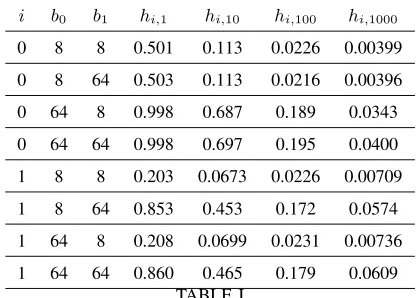
The result of a typical experiment for a cache shared by J = 2 LRU-lists is given in Table I (where hitting probabilities were evaluated by simulation with high confidence) and Table II (where (6) and (14) was used). The experiment involved LRU-lists i= 0,1 of size bi ∈ {8,64} and N = 1000 objects all of
unit length. As a reference, we provide Table IV giving hitting probabilities of isolated caches without data-object sharing.
The “popularity” of a data object n refers to the mean rate λn. at which it is requested. A commonly
used model for popularity is given by the so-called Zipf law:
λn∝ρ(n)−α, (16)
where α > 0 is the Zipf parameter and ρ(n) is the popularity rank of object n, i.e., ρ(n′) = 1 if n′ = argmaxnλn is unique andρ(n′′) =N if n′′ =argminnλn is unique. For example, values 0.64≤α≤0.83
i b0 b1 hi,1 hi,10 hi,100 hi,1000
0 8 8 0.501 0.113 0.0226 0.00399
0 8 64 0.503 0.113 0.0216 0.00396
0 64 8 0.998 0.687 0.189 0.0343
0 64 64 0.998 0.697 0.195 0.0400
1 8 8 0.203 0.0673 0.0226 0.00709
1 8 64 0.853 0.453 0.172 0.0574
1 64 8 0.208 0.0699 0.0231 0.00736
[image:10.612.201.411.52.201.2]1 64 64 0.860 0.465 0.179 0.0609 TABLE I
EMPIRICAL HITTING PROBABILITIES FOR A SIMULATED CACHE UNDER THEIRMOF SIZEB= 1000FOR UNIT-LENGTH OBJECTS
(∀n, ℓn= 1)THAT IS SHARED BY TWOLRU-LISTSi= 1,2RESPECTIVELY WITHZIPF POPULARITY PARAMETERSα0=.75AND
α1=.5. SIMULATION TIME WAS SUFFICIENTLY LONG SO THAT THESE HITTING PROBABILITIES ARE OBTAINED WITH HIGH
CONFIDENCE.
cachei b0 b1 hi,1 hi,10 hi,100 hi,1000
0 8 8 .571 .140 .0264 .00474
0 8 64 .805 .253 .0504 .00916
0 64 8 .996 .630 .162 .0309
0 64 64 .999 .791 .243 .0483
1 8 8 .223 .0767 .0249 .00795
1 8 64 .773 .374 .138 .0458
1 64 8 .393 .146 .0487 .0157
1 64 64 .900 .517 .205 .0701 TABLE II
HITTING PROBABILITIES NUMERICALLY APPROXIMATED USINGNEWTON-RAPHSON TO SOLVE(7)WITH MEAN OBJECT LENGTHS(13)
FOR{ti}J
i=1,AND THEN USING(6),FOR THE SHARED CACHE OFTABLEI.
cache i b0 b1 hi,1 hi,10 hi,100 hi,1000
0 8 8 0.357 0.0756 0.0139 0.00248
0 8 64 0.392 0.08479 0.0156 0.00280
0 64 8 0.983 0.516 0.121 0.0227
0 64 64 0.990 0.557 0.135 0.0254
1 8 8 0.125 0.041 0.0133 0.00421
1 8 64 0.676 0.300 0.107 0.0350
1 64 8 0.136 0.0453 0.0146 0.0046
1 64 64 0.712 0.325 0.117 0.03857 TABLE III
HITTING PROBABILITIES NUMERICALLY APPROXIMATED INSTEAD USING MEAN OBJECT LENGTHS(8)FOR THE SHARED CACHE OF
cachei b0 b1 hi,1 hi,10 hi,100 hi,1000
0 8 n/a .354 .0735 .0133 .00222
0 64 n/a .981 .504 .123 .0200
1 n/a 8 .123 .0403 .0137 .00376
1 n/a 64 .665 .295 .105 .0343 TABLE IV
EMPIRICAL HITTING PROBABILITIES OF ISOLATED(NOT OBJECT-SHARING)CACHES UNDER THEIRMOF SIZEbi,i= 1,2,FOR
UNIT-LENGTH OBJECTS(∀n, ℓn= 1)RESPECTIVELY WITHZIPF POPULARITY PARAMETERSα0=.75ANDα1=.5.
In our typical two LRU-list experiments reported herein, we took the Zipf parameter α0 = 0.75 for
LRU-list i= 0 and α1 = 0.5 for LRU-list i= 1.
First note that the cache-hit probabilities of Table IV are generally lower than those of Table I,i.e., object sharing obviously increases cache-hit probabilities, recall Prop. 3.1. The cache-hit probabilities by working-set approximation of Table II (corresponding to mean object lengths (13)) are larger than those of Table I. The cache-hit probabilities of Table III (corresponding to mean object lengths (8)) are smaller (by ∼30%) than those of Table I. These working-set approximations required orders of magnitude less computation than system simulation with high confidence of Table I. The approximations of Table II are 10-20% higher in most cases, except when the cache-memory sizes are quite different – e.g., “0,8,64” (LRU list i = 0
with b0 = 8 and b1 = 64) and “1,64,8” – the approximation is about 80% higher.
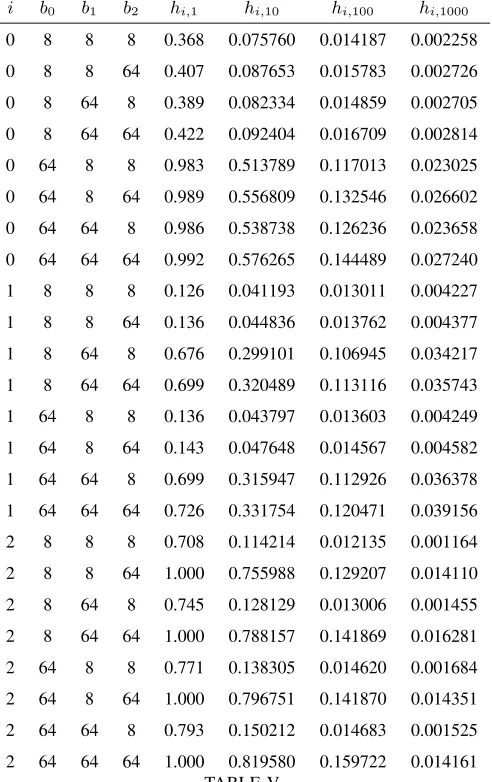
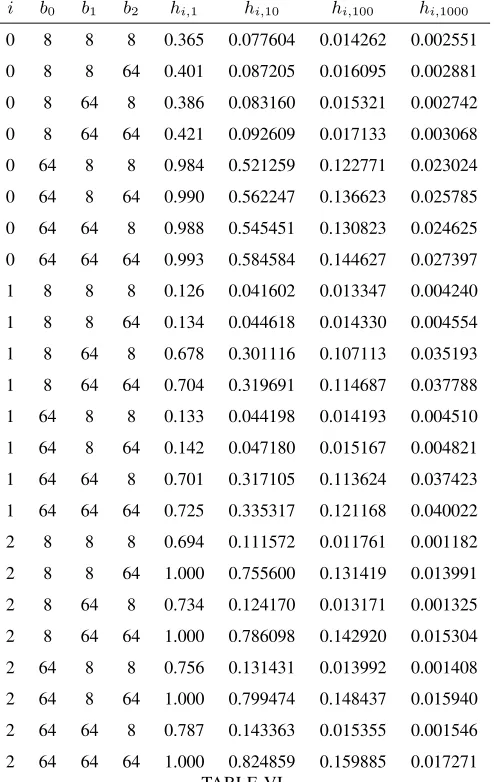
Typical results for a cache shared by three or more LRU-lists are shown in Tables V and VI (for J = 3
LRU-lists). Here we see that the approximation (8) is reasonably accurate.
VI. DISCUSSION OF CACHE I/O SHARING
Let Ri,n be the incident mean-rate that proxy i requests object n having length ℓn. Let λi,n be the
gi-admitted mean request rate, where over any interval of length t, the total length of requests admitted
is at most gi(t). Thus,
∀i, X
n
ℓnλi,n ≤ lim
t→∞
gi(t)
t . (17)
Let the total mean-rate of requests for object n to the cache be
λn= J X
i=1
λi,n. (18)
A proxy does not wish to unnecessarily pay more than it needs for larger demand envelope nor to have its users’ requests blocked (or delayed in order to conform to its demand envelope g). So, assume that gi
i b0 b1 b2 hi,1 hi,10 hi,100 hi,1000
0 8 8 8 0.368 0.075760 0.014187 0.002258
0 8 8 64 0.407 0.087653 0.015783 0.002726
0 8 64 8 0.389 0.082334 0.014859 0.002705
0 8 64 64 0.422 0.092404 0.016709 0.002814
0 64 8 8 0.983 0.513789 0.117013 0.023025
0 64 8 64 0.989 0.556809 0.132546 0.026602
0 64 64 8 0.986 0.538738 0.126236 0.023658
0 64 64 64 0.992 0.576265 0.144489 0.027240
1 8 8 8 0.126 0.041193 0.013011 0.004227
1 8 8 64 0.136 0.044836 0.013762 0.004377
1 8 64 8 0.676 0.299101 0.106945 0.034217
1 8 64 64 0.699 0.320489 0.113116 0.035743
1 64 8 8 0.136 0.043797 0.013603 0.004249
1 64 8 64 0.143 0.047648 0.014567 0.004582
1 64 64 8 0.699 0.315947 0.112926 0.036378
1 64 64 64 0.726 0.331754 0.120471 0.039156
2 8 8 8 0.708 0.114214 0.012135 0.001164
2 8 8 64 1.000 0.755988 0.129207 0.014110
2 8 64 8 0.745 0.128129 0.013006 0.001455
2 8 64 64 1.000 0.788157 0.141869 0.016281
2 64 8 8 0.771 0.138305 0.014620 0.001684
2 64 8 64 1.000 0.796751 0.141870 0.014351
2 64 64 8 0.793 0.150212 0.014683 0.001525
[image:12.612.185.431.53.444.2]2 64 64 64 1.000 0.819580 0.159722 0.014161 TABLE V
EMPIRICAL HITTING PROBABILITIES FOR A SIMULATED CACHE UNDER THEIRMOF SIZEB= 1000FOR UNIT-LENGTH OBJECTS
(∀n, ℓn= 1)THAT IS SHARED BY THREELRU-LISTSi= 0,1,2RESPECTIVELY WITHZIPF POPULARITY PARAMETERSα0=.75,
α1=.5,ANDα2= 1. SIMULATION TIME WAS SUFFICIENTLY LONG SO THAT THESE HITTING PROBABILITIES ARE OBTAINED WITH
HIGH CONFIDENCE.
requests. For example, if the aggregate demand from proxy i is Poisson (so that the mean number of requests in a time interval approximately equals the variance), then
gi(t) =gi(0) +tRi+ 3 p
tRi, (19)
may be selected, where Ri = P
nRi,n is the mean aggregate request rate. For large Ri recall that the
(Poisson distributed) number of requests in an interval of timetapproximatelyNormal(tRi, tRi). Hence, in
selectinggi in (19) we limit the probability of a blocked request to about 1%. Here, gi(0)>0corresponds
i b0 b1 b2 hi,1 hi,10 hi,100 hi,1000
0 8 8 8 0.365 0.077604 0.014262 0.002551
0 8 8 64 0.401 0.087205 0.016095 0.002881
0 8 64 8 0.386 0.083160 0.015321 0.002742
0 8 64 64 0.421 0.092609 0.017133 0.003068
0 64 8 8 0.984 0.521259 0.122771 0.023024
0 64 8 64 0.990 0.562247 0.136623 0.025785
0 64 64 8 0.988 0.545451 0.130823 0.024625
0 64 64 64 0.993 0.584584 0.144627 0.027397
1 8 8 8 0.126 0.041602 0.013347 0.004240
1 8 8 64 0.134 0.044618 0.014330 0.004554
1 8 64 8 0.678 0.301116 0.107113 0.035193
1 8 64 64 0.704 0.319691 0.114687 0.037788
1 64 8 8 0.133 0.044198 0.014193 0.004510
1 64 8 64 0.142 0.047180 0.015167 0.004821
1 64 64 8 0.701 0.317105 0.113624 0.037423
1 64 64 64 0.725 0.335317 0.121168 0.040022
2 8 8 8 0.694 0.111572 0.011761 0.001182
2 8 8 64 1.000 0.755600 0.131419 0.013991
2 8 64 8 0.734 0.124170 0.013171 0.001325
2 8 64 64 1.000 0.786098 0.142920 0.015304
2 64 8 8 0.756 0.131431 0.013992 0.001408
2 64 8 64 1.000 0.799474 0.148437 0.015940
2 64 64 8 0.787 0.143363 0.015355 0.001546
[image:13.612.185.432.53.444.2]2 64 64 64 1.000 0.824859 0.159885 0.017271 TABLE VI
HITTING PROBABILITIES NUMERICALLY APPROXIMATED INSTEAD USING MEAN OBJECT LENGTHS(8),SOLVING(14)AND
SUBSTITUTING INTO(6),FOR THE SHARED CACHE OFTABLEV.
by piecewise linear one implemented by one or more token-bucket mechanisms, e.g., [15], [16]. That is, a token corresponds to a common unit of object/content length (the dimension of ℓn).
For long-term stability, the cache I/O bandwidth C should satisfy
C≥ lim
t→∞
X
i
gi(t)
t ⇒ C ≥
X
n
ℓnλn. (20)
Admission control of new proxies and dynamic pricing could be based on in part on (20).
will be upper bounded by
max
t>0
X
i
gi(t)−Ct.
Instead of blocking out-of-profile requests, one could set-up queues for both in-profile and out-of-profile requests, where the former would obviously have priority over the latter.
Finally, recall the edge-computing context in support of mobile users. If the same object is requested at the same time over a wireless channel, the necessary tokens may be shared among requesting proxies. Again, a problem here is intellectual property protections: content could be encrypted to the cache and then commonly encrypted to a group of authorized mobile subscribers. The cryptographic keys required for the latter may be periodically refreshed to deal with subscriber churn.
VII. DISCUSSION OF PRICING AND MOCK REQUESTS
Obviously, prices charged to proxy i could depend in part on resource reservations (gi, bi). Service
may be organized in tiers, where tier k is associated with demand envelope g =kγ and cache memory allocationb=kβ, andk = 1corresponds to an atomic or base service tier. Though the priceπkof tierk is
obviously increasing with (integer) k, it may be such thatπk/kis decreasing as a kind of volume discount.
Also, costs may be affected by usage – there is precedent for penalizing low utilization, presumably to encourage customers to better characterize their workloads and not be resource wasteful.
Recall that a query by proxy i that is a LRU-miss but a physical cache hit involves an added delay so that the net effect is a physical cache miss. So, from proxy i’s point of view, there is no incentive to “free ride” on other proxies by issuing mock queries so thati’s LRU list is populated primarily by objects that are popular only among its own users. Mock requests will deplete apportioned network bandwidth resources too. Also, if allocated resources are multiples of an “atomic” service tier, a proxy may not be able to purchase just a little more network bandwidth to mitigate this impact of mock requests.
REFERENCES
[1] O.I. Aven, E.G. Coffman, and Y.A. Kogan. Stochastic analysis of computer storage. D. Reidel Publishing Co., 1987.
[2] F. Baccelli and P. Bremaud. Elements of Queueing Theory. Springer-Verlag, Application of Mathematics: Stochastic Modelling and
Applied Probability, No. 26, New York, NY, 1991.
[3] T. Bas¸ar and G.J. Olsder. Dynamic Noncooperative Game Theory. Classics in Applied Mathematics, SIAM, Philadelphia, 1999.
[4] A. Balamash and M. Krunz. An overview of web caching replacement algorithms. IEEE Communications Surveys & Tutorials, 6(2),
2004.
[5] J. Van Den Berg and A. Gandolfi. LRU is better than FIFO under the independent reference model. J. Appl. Prob., 29, 1992.
[7] L. Breslau, P. Cao, L. Fan, G. Phillips, and S. Shenker. Web Caching and Zipf-like Distributions: Evidence and Implications. InProc.
IEEE INFOCOM, 1999.
[8] H. Che, Y. Tung, and Z. Wang. Hierarchical Web Caching Systems: Modeling, Design and Experimental Results. IEEE JSAC, 20(7),
Sept. 2002.
[9] M. Dehghan, W. Chu, P. Nain, and D. Towsley. Sharing LRU Cache Resources among ContentProviders: A Utility-Based Approach .
https://arxiv.org/abs/1702.01823, Feb. 2017.
[10] P.J. Denning and S.C. Schwartz. Properties of the working-set model. Commun. ACM, 15(3):191–198, March 1972.
[11] A. Eryilmaz et al. A New Flexible Multi-flow LRU Cache ManagementParadigm for Minimizing Misses. InProc. ACM SIGMETRICS,
2019.
[12] R. Fagin. Asymptotic approximation of the move-to-front search cost distribution and least-recently-used caching fault probabilities,
1977.
[13] C. Fricker, P. Robert, and J. Roberts. A Versatile and Accurate Approximation for LRU Cache Performance. InProc. International
Teletraffic Congress, 2012.
[14] N. Golrezaei, K. Shanmugam, A.G. Dimakis, A.F. Molisch, and G. Caire. Femtocaching: Wireless video content delivery through
distributed caching helpers. InProc. IEEE INFOCOM, 2012.
[15] J. Heinanen, T. Finland, and R. Guerin. A single rate three color marker. RFC 2697 available at www.ietf.org, 1999.
[16] J. Heinanen, T. Finland, and R. Guerin. A two rate three color marker. RFC 2698 available at www.ietf.org, 1999.
[17] K. Joag-Dev and F. Proschan. Negative association of random variables with applications. The Annals of Statistics, pages 286–295,
1983.
[18] A. Khursheed and K.M.L. Saxena. Positive dependence in multivariate distributions. Communications in Statistics - Theory and
Methods, 10(12):1183–1196, 1981.
[19] W.F. King. Analysis of paging algorithms. In Proc. IFIP Congress, Lyublyana, Yugoslavia, Aug. 1971.
[20] H. Moulin. Dominance Solvability and Cournot Stability. Mathematical Social Sciences, 7:83–102, 1984.
[21] K. Poularakis, G. Iosifidis, A. Argyriou, I. Koutsopoulos, and L. Tassiulas. Distributed Caching Algorithms in the Realm of Layered
Video Streaming.IEEE Trans. Mob. Comput., 18(4):757–770, 2019.
[22] Q. Pu, H. Li, M. Zaharia, A. Ghodsi, and I. Stoica. FairRide: Near-Optimal, Fair Cache Sharing. InProc. USENIX NDSI, Santa Clara,
CA, USA, March 2016.
[23] J.B. Rosen. Existence and uniqueness of equilibrium points for concaven-person games. Econometrica, 33(3):520–534, 1965.
[24] D. Wajc. Negative association: Definition, properties and applications. http://www.cs.cmu.edu/∼dwajc/notes/Negative%20Association.pdf,
Apr. 2017.
[25] Y. Wang, X. Zhou, M. Sun, L. Zhang, and X. Wu. A new QoE-driven video cache management scheme with wireless cloud computing
in cellular networks. Mobile Networks and Applications, 2016.