This is a repository copy of
The way forward for unifying dynamic test-case generation:
The optimisation-based approach
.
White Rose Research Online URL for this paper:
http://eprints.whiterose.ac.uk/46029/
Version: Accepted Version
Article:
Tracey, N, Clark, John Andrew orcid.org/0000-0002-9230-9739 and Mander, Keith (1998)
The way forward for unifying dynamic test-case generation: The optimisation-based
approach. Proceedings of the IFIP International Workshop on Dependable Computing and
Its Applications (DCIA)..
[email protected]
https://eprints.whiterose.ac.uk/
Reuse
Items deposited in White Rose Research Online are protected by copyright, with all rights reserved unless
indicated otherwise. They may be downloaded and/or printed for private study, or other acts as permitted by
national copyright laws. The publisher or other rights holders may allow further reproduction and re-use of
the full text version. This is indicated by the licence information on the White Rose Research Online record
for the item.
Takedown
If you consider content in White Rose Research Online to be in breach of UK law, please notify us by
Automated Program Flaw Finding using Simulated Annealing
Nigel Tracey
John Clark
Keith Mander
Department of Computer Science University of York
Heslington, York YO1 5DD, England.
+44 1904 432727
f
njt, jac, mander
g@cs.york.ac.uk
1
Abstract
One of the major costs in a software project is the construction of test-data. This paper outlines a generalised test-case data genera-tion framework based on optimisagenera-tion techniques. The framework can incorporate a number of testing criteria, for both functional and non-functional properties. Application of the optimisation frame-work to testing specification failures and exception conditions is illustrated. The results of a number of small case studies are pre-sented and show the efficiency and effectiveness of this dynamic optimisation-base approach to generating test-data.
1.1
Keywords
Automatic test-case generation, software testing, formal specifica-tions, exception condispecifica-tions, optimisation techniques, simulated an-nealing.
2
Introduction
Software testing is an expensive process, typically consuming at least 50% of the total costs involved in developing software [3], while adding nothing to the functionality of the product. It remains, however, the primary method through which confidence in software is achieved. Automation of the testing process is desirable both to reduce development costs and also to improve the quality of (or at least confidence in) software. While automation of the testing pro-cess – the maintenance and execution of tests – is taking hold com-mercially, the automation of test-data generation has yet to find its way out of academia. Ould has suggested that it is this automation of test-data generation which is vital to advance the state-of-the-art in software testing [17].
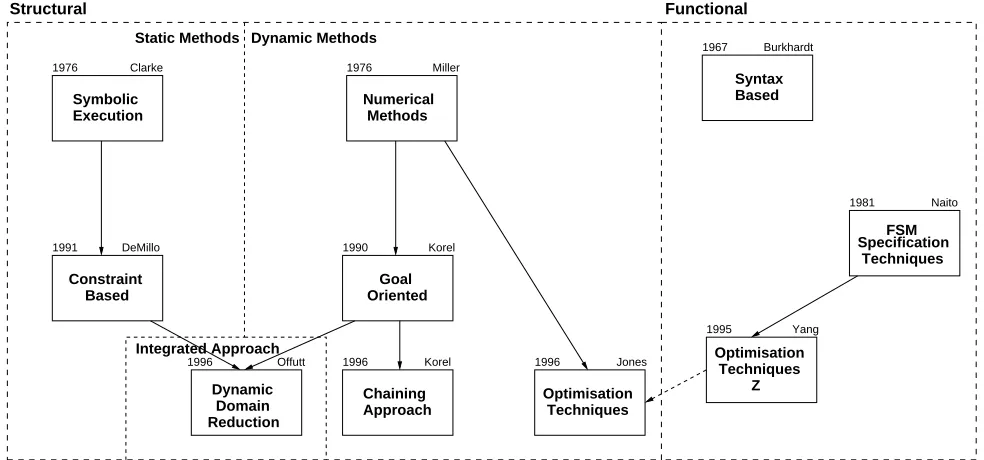
Many techniques for generating test-data have been developed. These can broadly be classified into static and dynamic methods. Static techniques do not require the software under test to be exe-cuted. They generally use symbolic execution to obtain constraints
on input variables for the particular test criterion. Solutions to these constraints represent the test-data. Many of the limitations of the static techniques come from their use of symbolic execution. It is difficult to analyse recursion, dynamic data-structures, array in-dices which depend on input data and some loop structures using symbolic execution. Also, the problem of solving arbitrary con-straint systems is known to be intractable. However, it is often the case that the constraints which arise from real software are in a subset of general constraint systems which can be solved. In con-trast, dynamic methods require that the software under test is ex-ecuted. Dynamic methods generally involve a directed search for test-data which meets a desired criterion. However the computa-tional expense involved in repeated execution can mean that obtain-ing test-data is computationally intractable for complex software with a large parameter space. Figure 1 shows the major approaches presented in the literature [5, 15, 12, 6, 22, 16, 13, 10]. The arrows in the figure indicate the progression of ideas and methods through the various approaches. While the 1980s saw the emergence of for-mal methods as a focus of academic research attention, the 1990s has seen the growth once more of software testing research. This is, possibly, partly due to the realisation that the use of formal meth-ods does not obviate the need for good software testing and also the realisation that software testing can provide a cost-effective means of verification.
All of these previous approaches focus on generating test-case data in a narrow area; they all aim to generate test-data for testing func-tional properties, with most selecting data using structural test-ing criteria. The application of many of these techniques is lim-ited by lack of generality. This lack of generality can be seen in the limited data-types or control-flow structures which some of the techniques can process and also in the limited testing criteria of the others. The aim of the present work is to develop a generalised framework for test-case data generation. The objectives are to au-tomate the generation of test-case data to satisfy both black and white box testing of functional properties and also non-functional properties. This paper focuses on two applications of this general framework: the first relates to falsification of program specifica-tions (functional testing), the second relates to exception condition testing (non-functional testing).
Approach Based
Constraint Goal
Oriented
Reduction Domain
Dynamic Chaining
Integrated Approach Optimisation
Techniques Z
Techniques FSM Specification Static Methods Dynamic Methods
Structural Functional
Execution
Symbolic Numerical
Methods
Syntax Based
Optimisation Techniques
1976 1976 Miller
1991
1996 Offutt 1996 Korel 1990 Korel
1996 Jones
1967 Burkhardt
1981 Naito
Yang 1995
[image:3.595.60.552.70.300.2]DeMillo Clarke
Figure 1: Some Approaches to Automating Test-Case Data Generation
optimisation techniques, specifically simulated annealing1, are in-troduced. Some case-studies are then given to show how simulated annealing manages to generate good test-case data despite the com-plexities and size of the search space.
3
Testing Specification Failure
Dynamic testing of functional properties can be divided into two categories, functional and structural. Structural tests are considered white-box, the underlying code of the software being used to de-termine the test-data. In contrast functional testing is considered black-box, the test inputs and expected outputs are derived solely from the functional specification. To allow functional test-data to be generated automatically it is obviously necessary for the spec-ification to be in a sufficiently formal notation. Testing against a formalised specification has a number of advantages – it has the potential to detect missing functionality, it is independent of the implementation language and it provides scope for an automated test oracle.
For highly safety-critical software system it is often the case that formal proofs must be developed. These proofs must show that the software is a refinement of the formal specification. Producing formal-proofs is a complex, time-consuming and expensive pro-cess. If the putative properties are simply untrue then attempting a proof (which will inevitably fail) is an extraordinarily expensive method to find errors in the software. To demonstrate that a proof will fail it is only necessary to find one test-case which shows the
1Simulated annealing is a very simple optimisation algorithm
to implement, it is for this reason that it has been used during the development and assessment of prototype tools. There is no sug-gestion that is the superior optimisation technique, an investigation as to the merits of other optimisation techniques (i.e. genetic al-gorithms, tabu-search, etc.) for generating test-data is something which is planned for the future.
specification is not satisfied. Indeed it is often stated that a suc-cessful test-case is one which illustrates software error (Dijkstra 1972). For the purposes of investigating an optimisation-based ap-proach to testing specification failure the formal specifications have been specified in a SPARK-Ada proof contexts [18, 2] like nota-tion. These proof contexts consist of a pre- and post-condition for the subprogram. These conditions consist of an Ada expression, ex-tended to allow logical implication and equivalence. Figure 2 shows how the formal specification is expressed as part of the subprogram specification for a simple integer square-root subprogram.
procedure Int Root(N : Integer; Root : out Integer);
,,#pre N >= 0;
,,#post (Root Root<= N) and ,,# (N < (Root + 1) (Root + 1));
Figure 2: Formal Specification Notation
3.1
The Dynamic Approach
To allow a dynamic approach to be used it is necessary to devise an objective function which will guide the search. The solution we are searching for is a test-case which satisfies the pre-condition before execution of the subprogram and the negated post-condition2 after execution. Obviously any particular test-case will either meet this criterion or it will not. However this is not sufficient to guide the search. We therefore need the objective function to return good val-ues for those test-cases which nearly meet the criterion and worse values for those which are a long way away from meeting the crite-rion. For example, consider the constraint X>50. If X=49 then
this constraint is a lot nearer to being true than when X=2
(how-ever it remains a fact that they are both false, we just consider one to be less false than the other!).
The objective function is calculated as follows. Firstly the pre-condition and negated post-pre-condition are converted to Disjunctive Normal Form (DNF). For example the condition A!(B_(C^D))
would become:A_B_(C^D). A solution to any one disjunct
(i.e.:A, B or(C^D)) then represents a solution to the entire
con-dition. All possible pairs of a single pre-condition disjunct and post-condition disjunct are then formed using conjunction. These pairs can be considered as an encoding of one of the possible ways in which the software can fail. The search process attempts to find a solution to each of these pairs in turn. Each term within the pair adds a value to the pairs overall cost according to the rules shown in Table 1 (the value K in the table refers to a failure constant which is always added if the term is not true). If all terms are true then it can be seen that the overall cost will be zero, this becomes the stop-condition for the simulated annealing search.
Term Value
Boolean if TRUE then0 elseK
a=b ifabs(a,b)=0then0
elseabs(a,b)+K
a6=b ifabs(a,b)6=0then0
elseK
a<b ifa,b<0then0
else(a,b)+K
ab ifa,b0then0
else(a,b)+K
a>b ifb,a<0then0
else(b,a)+K
ab ifb,a0then0
[image:4.595.368.507.324.376.2]else(b,a)+K
Table 1: Term Values
Using this objective function simulated annealing can be used to search for test-data to illustrate flawed functionality.
3.2
Simple Example
A simple example will help illustrate how this guides the search process. Consider a simple wrap-round incrementer routine as specified in Figure 3. This simple routine should count from 0 to 10 and then wrap-around back to 0 again.
The first step is to convert the pre-condition and the negation of the
2Satisfying the negation of the post-condition is equivalent to
falsifying the post-condition.
procedure Wrap Inc (N: in out Integer);
[image:4.595.99.251.387.567.2],,#pre N >= 0 and N <= 10; ,,#post (N˜ < 10 -> N = N˜ + 1) and ,,# (N˜ = 10 -> N = 0);
Figure 3: Specification of Wrap-Round Increment Routine
post-condition to DNF. It is then necessary to form all possible pairs of pre-condition and post-condition disjunction. The pre-condition is already in DNF and consists of a single disjunct. The DNF of the negated post-condition consists of two disjuncts (shown in paren-thesis below) hence there are two possible pairings as follows.
N ˜0^N ˜10^(N ˜<10^N6=N ˜+1) (1)
N ˜0^N ˜10^(N ˜=10^N6=0) (2)
Let us consider the second of these pairs. If, say, N=2 then each
term contributes the following to the overall cost (assuming that N after execution will equal 3).
Term Cost Contribution
N ˜0 0
N ˜10 0
N ˜=10 abs(2,10)+K=8+K
N6=0 0
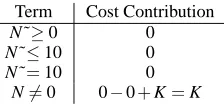
It can be seen that the overall condition is false, however the cost gives a measure of how false. If we now consider N=10 then
each term contributes the following (assuming that the software is implemented correctly and that N after execution will equal 0).
Term Cost Contribution
N ˜0 0
N ˜10 0
N ˜=10 0
N6=0 0,0+K=K
This shows that while the overall condition remains false it is now less false than it was before. Indeed if the software had been im-plemented incorrectly (for example it wrapped-round at 11 not 10 possibly due to>rather thanbeing used) then the cost would
be reduced to 0, hence this would represent a test-case which illus-trated a specification failure. This flawed implementation appears at the end of this paper.
[image:4.595.383.495.442.494.2]We therefore use simulated annealing [1] to find suitable test-cases, and here present a number of examples to demonstrate its effec-tiveness in uncovering implementation errors with respect to the specifications. It is also possible to extend these ideas to search for test-cases which meet other criteria. One such extension is to target the search at finding test-cases which cause exception conditions; this is discussed in the following section. Other extensions include finding violations of safeness conditions, boundary analysis, etc.
4
Testing Exception Conditions
As with specification testing, when testing exception conditions it is usually more interesting to focus on the failure case (i.e. the case where an exception condition arises). Perhaps the most common form of exception condition is that of numeric overflow or under-flow (this is known as aConstraint Errorin Ada). Indeed in a SPARK Ada program aConstraint Erroris the only ex-ception condition which can occur. The remaining exex-ception con-ditions cannot arise because of the rules of SPARK Ada. It is pos-sible to use the SPARK tools to prove thatConstraint Errors cannot arise (the run-time checks [2]). The SPARK Examiner sim-ply inserts additional conditions at appropriate places to ensure that run-time exception conditions cannot occur, the developer then has to prove the resulting conditions. However, as with specification proofs, this can be a complex, time-consuming and expensive way to find errors.
The conditions which may cause exceptions to be raised can be specified in a similar way to the formal specification. These are the negations of the conditions inserted by the SPARK tools as part of the exception-free proof process. The conditions represent the constraints which must be satisfied at a particular point during the execution for an exception condition to occur. Figure 4 shows an example for a simple integer square routine.
procedure Square (N: in Integer; S: out Integer) is begin
,,# exception not (NN >= Integer’First and ,,# NN<= Integer’Last);
S := N N;
end Square;
Figure 4: Exception Condition Notation
4.1
The Dynamic Approach
Again the search for test-case data requires guidance using an ob-jective function. The same obob-jective function as for specification failure testing can be used. However the values used for variables must be those intermediate values at the exact point in the code where the exception condition is stated. For example, converting the exception condition from figure 4 to DNF results in the follow-ing:
:(NNMin Int)_:(NNMax Int)
Assuming the maximum integer is 231 then we can see how this guides the search process for the second disjunct. If N=100 then
the objective function is equal to 231,(100100)=2147473648,
which is a long way from being true. However, if N=46340 then
the value of the objective function decrease to 88048 which is much closer to being true. Indeed, if N=50000 then the objective
func-tion becomes zero indicating that the condifunc-tion has been met and
also that an exception condition will occur. The objective function is further complicated because it also needs to guide the search to test-data which executes the desired statement. Details of this will be presented in a later paper, a summary can be found in [20].
The search space remains large, complex and unlikely to be linear and continuous. It is therefore necessary to use a search strategy which can obtain good result despite these problems. The next sec-tion introduces optimisasec-tion techniques and the specific technique of simulated annealing. Simulated annealing has been used both because of its simplicity and its ability to obtain good results. Fol-lowing this some simple case studies are presented to show the ef-fectiveness of the simulated annealing search in finding test-cases to cause exception conditions.
5
Optimisation and Simulated Annealing
Optimisation techniques make very few assumptions about the un-derlying problem which they are attempting to solve. It is this prop-erty which allows them to be applied to a wide variety of problems. Optimisation techniques are simply directed search method which attempts to find minimal (or maximal) values of a particular objec-tive function. Thus to apply optimisation techniques to a problem it is only necessary to devise an objective function to direct the search. Simulated annealing is one such optimisation technique. It has been used to assess the feasibility of an optimisation-based approach to generalised test-case data generation during this work.
Simulated annealing is based on the idea of neighbourhood search [19]. The ideas were first published in 1953 [14], thirty years later Kirkpatrick [11] suggested a form of simulated annealing could be used to solve complex optimisation problems. The algorithm works by selecting candidate solutions which are in the neighbourhood of the given candidate solution. Better candidate solutions (i.e. with respects to an objective function) are always accepted, how-ever worse candidate solutions are accepted in a controlled manner. The idea is that it is better to accept a short-term penalty in the hope of finding significant rewards longer term. In accepting an inferior solution the search aims to escape from locally optimal solutions. A control parameter (known as the temperature) is used to control the acceptance of inferior candidate solutions. Initially the temperature is high allowing almost unrestricted movement around the search space. The temperature is gradually reduced during the search con-straining the acceptance of inferior candidate solutions. Eventually the process freezes and no inferior solutions can be accepted, re-ducing the search to simple hill climbing. Figure 5 shows the basic outline of the simulated annealing algorithm.
procedure Simulated Annealing is
Current Solution, New Solution : Solution;
Current Cost, New Cost : Float;
Temperature : Float;
Length : Integer;
begin
INITIALISE (Current Solution, Temperature, Length);
,, Start with :-,, Random solution
,, Temperature to allow almost free movement ,, Length to allow some solutions to be accepted
Current Cost := COST (Current Solution);
,, Obtain cost using objective function
loop
for I in 1. . Length loop
New Solution := GENERATE (Current Solution);
,, Generate new solution in the neighbourhood ,, of the current solution
New Cost := COST (New Solution);
if New Cost< Current Cost then
Current Solution := New Solution; Current Cost := New Cost;
,, Accept Solution
else
if (exp ((Current Cost, New Cost) =
Temperature) > Random (0, 1)
then
Current Solution := New Solution; Current Cost := New Cost;
,, Accept Solution
else
,, Do not accept solution
null; end if; end if; end loop;
COOL (Length, Temperature);
,, Reduce the temperature and set the number ,, of solution to examine at the reduced temperature
exit when STOP CRITERION; end loop;
[image:6.595.330.547.109.163.2]end Simulated Annealing;
Figure 5: Simulated Annealing Algorithm
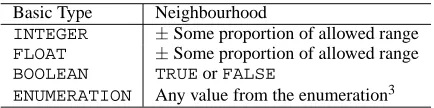
in some respects close to a given candidate solution. Given the rep-resentation of candidate solutions, the neighbourhood can be de-fined as follows for the fundamental Ada types.
Basic Type Neighbourhood
INTEGER Some proportion of allowed range
FLOAT Some proportion of allowed range
BOOLEAN TRUEorFALSE
ENUMERATION Any value from the enumeration3
Methods for quantifying the cost of a candidate solution depend en-tirely upon the software testing problem being addressed. These were discussed in previous sections for the problems of finding specification failures and exception conditions.
The following section shows some simple case studies to illustrate the effectiveness of the optimisation based (using simulated anneal-ing) approach in generating test-case data to illustrate specification failures or exception conditions. The results show that this can be done both effectively and efficiently.
6
Case Studies
6.1
Specification Testing
This section presents the results of using simulated annealing to find test-case data highlighting specification failures for three Ada programs – middle, bubble sort and tomorrow. The incorrect im-plementations of these three routines can be found at the end of this paper.
The specification for the middle routine is shown in Figure 6. It states that given three integer values this routine should return the middle numeric value. However if two of the input values are the same the return value should be the other input value. If all three input values are identical then any return value will satisfy the given specification. The implementation of the routine, however, always returns the first input value when any of the input values are the same. Hence, the desired test-case is one where two of the input values are the same.
function Middle(A, B, C : Integer) return Integer;
,,#pre True;
,,#return M => ((B<A and A<C) -> M=A) and ,,# ((C<A and A<B) -> M=A) and
,,# ((A<B and B<C) -> M=B) and ,,# ((C<B and C<A) -> M=B) and ,,# ((A<C and C<B) -> M=C) and ,,# ((B<C and C<A) -> M=C) and
,,# (B=C -> M=A) and (A=C -> M=B) and (A=B -> M=C); Figure 6: Specification of Middle Routine
The specification for the bubble routine is shown in Figure 7. It states that given an array of input values the routine should sort them into ascending order4. The implementation of this routine,
however, does not perform enough iterations to sort the array when the smallest input values appears as the last element in the input
3No neighbourhood range is used for enumeration types as the
ordering of enumeration literals is not always significant.
4In fact, the specification is too weak because it only states that
[image:6.595.317.556.482.574.2]array. Hence the desired test-case is one where the smallest value in the array is in the last element.
type My Int is Integer range 0. . 1000;
type My Arr is array (1 . .10) of My Integer;
procedure Bubble Sort (A: in out My Arr);
,,# pre True;
,,# post X(1)<= X(2) and X(2) <= X(3) and
[image:7.595.70.282.452.537.2],,# X(3) <= X(4) and X(4) <= X(5) and X(5)<= X(6) and ,,# X(6) <= X(7) and X(7) <= X(8) and X(8)<= X(9) and ,,# X(9) <= X(10);
Figure 7: Specification of Bubble Sort Routine
The specification for the tomorrow routine is shown in Figure 8. Given a date including the day of the week the routine should re-turn the date of tomorrow, accounting for leap years. However the implementation is incorrect in that it considers all years divisible by 4 as leap years (rather than just years divisible by 400 or 4, but not 100). Hence the desired test-case is one where the input date is 28th Feb on a year which is divisible by 100 but not by 400.
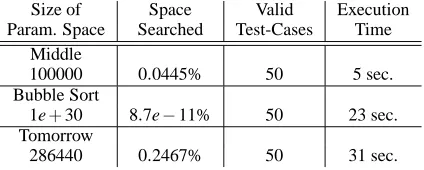
The following table shows the results of using simulated annealing to search for test-data that illustrates a specification failure. The search process was repeated 50 times to give an indication of the robustness of the search. Each search started using a randomly gen-erated initial candidate solution and the following information was recorded; whether the test-case data was a solution (i.e. was a spec-ification failure illustrated), the number of test-cases examined dur-ing the search and the execution time for the search5. The figures below show the average percentage of test-cases examined during each search, the average execution time for each search and also the total number of failure illustrating test-cases produced over the 50 search attempts.
Size of Space Valid Execution Param. Space Searched Test-Cases Time
Middle
100000 0:0445% 50 5 sec.
Bubble Sort
1e+30 8:7e,11% 50 23 sec.
Tomorrow
286440 0:2467% 50 31 sec.
These results demonstrate the effectiveness of the optimisation-based approach to generating test-case data for specification fail-ure testing. For example consider the tomorrow program, there are only 9 test-cases which would highlight the flaw in the given im-plementation. This represents only 0:00314% of the search space.
Considering only the disjunct pair which encodes the flaw in the im-plementation simple random testing requires on average more than 31;000 iterations to illustrate the flaw. In comparison the simulated
annealing search requires on average only 3;000 iterations which is
a significant improvement. Given that this test-generation and exe-cution is entirely automated it could be used as a pre-proof phase to attempt to detect errors before complex proofs are attempted.
6.2
Exception Condition Testing
5The system executes on an Intel Pentium Pro 200MHz machine
running Linux and is coded in Ada 95.
type Day Type is
(Mon, Tue, Wed, Thu, Fri, Sat, Sun);
type Date Type is range 1. .31;
type Month Type is
(Jan, Feb, Mar, Apr, May, Jun,
Jul, Aug, Sep, Oct, Nov, Dec);
type Year Type is range 1900. .3000;
procedure Tomorrow
(Day : in Day Type;
Date : in Date Type;
Month : in Month Type;
Year : in Year Type;
Next Day : out Day Type;
Next Date : out Date Type;
Next Month : out Month Type;
Next Year : out Year Type);
,,#pre (Date = 31 ->
,,# (Month = Jan or Month = Mar or ,,# Month = May or Month = Jul or ,,# Month = Aug or Month = Oct or ,,# Month = Dec)) and
,,# (Month = Feb -> Date <= 29); ,,#post (Day = Sun -> Next Day = Mon) and ,,# (Day== Sun -> Next Day = Succ(Day)) and ,,# (Date = 31 ->
,,# (Next Date = 1 and ,,# (Month = Dec -> ,,# (Next Month = Jan and ,,# Next Year = Year + 1)) and ,,# (Month == Dec ->
,,# Next Month = Succ(Month)))) and ,,# ((((Date = 30 and
,,# (Month = Apr or Month = Jun or ,,# Month = Sep or Month = Nov)) or ,,# (Date = 29 and Month = Feb)) -> ,,# (Next Date = 1 and
,,# Next Month = Succ(Month) and ,,# Next Year = Year)) and ,,# (((Date = 28 and Month = Feb and
,,# ((Year mod 4 = 0 and Year mod 100 == 0) or ,,# Year mod 400 = 0)) ->
,,# (Next Date = 29 and
,,# Next Month = Month and
,,# Next Year = Year)) and ,,# ((Date = 28 and Month = Feb and not
,,# ((Year mod 4 = 0 and Year mod 100 == 0) or ,,# Year mod 400 = 0)) ->
,,# (Next Date = 1 and Next Month = Mar and ,,# Next Year = Year))));
This section presents the results of using simulated annealing to find test-case data which highlights exception conditions for two Ada programs – square and integer square root.
The square routine can be seen in Figure 9. The exception condi-tion under examinacondi-tion occurs when the value of NN is out of
bounds for the typeLarge Integer. Hence the desired test-case is where the value of NN overflows its type range.
type Small Integer is range ,10001. . 10001;
type Large Integer is range ,100000000 . . 100000000;
procedure Square
(N : in Small Integer; S: out Large Integer) is begin
,,# exception (NN) < Large Integer’First or ,,# (NN)> Large Integer’Last;
S := Large Integer(N) Large Integer(N));
[image:8.595.331.544.107.183.2]end Square;
Figure 9: An Exception Condition for Square Routine
The integer square root routine can be seen in Figure 10. The par-ticular exception condition specified in this routine is where the as-signment of S+T to S is out of bounds for the typeMy Natural.
Hence the desired test-case is where the input parameter N causes S+T to overflow its type range.
type My Natural is Natural range 0 . .10 000;
procedure IntRoot (N: My Natural; Root : out My Natural) is
R : My Natural := 0; S, T : My Natural := 1;
begin loop
exit when S > N;
R := R + 1;T := T + 2;
,,# exception (S+T) < My Natural’First or ,,# (S+T) > My Natural’Last;
S := S + T;
end loop;
Root := (My Natural (R));
[image:8.595.52.293.381.510.2]end IntRoot;
Figure 10: An Exception Condition for Integer Square Root Routine
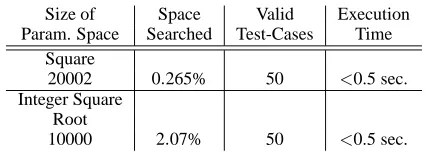
The results of the simulated annealing search for test data are shown below. The system was set to search for test-cases which illus-trated the specified exception conditions 50 times. The figures below show the average percentage of parameter space that was searched, the average search time and also the number of test-case which caused the desired exception that were found.
The following table shows the results of using simulated anneal-ing to search for test-data that illustrates an exception condition. The search process was repeated 50 times to give an indication of the robustness of the search. Each search started using a randomly generated initial candidate solution and the following information was recorded; whether the test-case data was a solution (i.e. was an exception condition caused), the number of test-cases examined during the search and the execution time for the search. The figures below show the average percentage of test-cases examined during each search, the average execution time for each search and also the
total number of exception generating test-cases produced over the 50 search attempts.
Size of Space Valid Execution Param. Space Searched Test-Cases Time
Square
20002 0:265% 50 <0.5 sec.
Integer Square Root
10000 2:07% 50 <0.5 sec.
These results once again demonstrate the effectiveness of the op-timisation based approach to generating test-case data for finding exception conditions. Again the process is entirely automatic re-quiring very little user effort to initiate the search for test-case data. The above examples are for illustration only. The aim is to show how optimisation can be used for exception generation testing. The general use of optimisation is intended to allow us to generate test-data where non-linearity is exhibited. In these examples a simple hill climbing search would have succeeded.
7
Further Work and Generalisations
The results presented above show that it is possible to use opti-misation to automatically generate test-case data both effectively and efficiently. The degree of effort required to find test-case data for the problems presented above is significantly lower than that required by manual test-data generation or tool-supported proof at-tempts. Unsuccessful proof attempts are an extremely expensive way in which to find errors in software. Targeting manual test-ing at flaw findtest-ing in specifications or in run-time conditions is an very difficult task to manage will little guidance on the degree of completion and when to stop. This approach can be applied in a completely automated manner (obviously for specification failure testing effort is required to derive the specification information in a suitable form6) and thus could be applied almost for free before other testing begins.
To further assess the optimisation-based approach to provide a use-ful, generalised framework for automated test-case data generation more work on several fronts is needed. Perhaps the most important is that of gathering empirical evidence as to the effectiveness of the technique. It is essential to evaluate the approach using real, large-scale software to assess how effectively test-cases can be generated.
7.1
Optimisation Techniques
There are a variety of other optimisation techniques which could be examined. A detailed comparison of the various optimisation tech-niques to discover their relative strengths and weaknesses would be required. Tabu-search [8] and genetic algorithms [9] are two such optimisation techniques which are suitable for investigation. Some preliminary work on methods to apply tabu-search and genetic-algorithms has already been carried out (see [21]). However, in-tegration into the prototype tool-set is required to allow a full as-sessment of their performance.
Optimisation techniques will never be able to guarantee their
re-6Note: While this paper presents the idea of finding flaws in full
sults7. However, it may be possible to devise software metrics which can give guidance in a number of areas – to suggest which optimisation techniques will give the best results; to suggest suit-able parameter values for the optimisation techniques; and also to give an indication as to the likely quality of the result.
7.2
Search Efficiency
From the results presented in the previous section it can be seen that the search space (even for simple routines) can be extremely large. It can be seen that the current simple simulated annealing search is more efficient in its search when the parameter space is large (i.e. a smaller proportion of the parameter space is examined). Meth-ods to reduce the amount of the search space examined may still be useful and indeed may allow very complex or higher-level routines to be processed. A number of problem specific enhancements can be made to the various optimisation techniques. For example, the neighbourhood of simulated annealing can be restricted to only al-low variables that contribute to a condition failure to be changed. Careful selection of tabu-move attributes will also increase the effi-ciency of the search.
7.3
Generalisation
For each testing criteria to be addressed it is necessary to consider how to represent it as an optimisation problem. This paper shows an approach for representing specification failure and exception condi-tion generacondi-tion in an optimisacondi-tion framework. These two problems are simply a special case of constraint solving involving a trans-formation of the variable values (i.e. the execution of the software under test). Thus the same objective function can be used to guide the search for general constraint solving. Indeed a tool using the ob-jective function developed for general constraint solving has been integrated into a proof-tool being developed at York [4]. Prelimi-nary work has also been carried out on testing for worst-case exe-cution time (WCET) and stack-usage (see [21], where the objective function is simply a measure of execution time or stack size). There remains a large number of test-data selection criteria worthy of con-sideration. For each criterion it is only necessary to devise an ob-jective function which gives the search process sufficient guidance. This allows virtually any testing criteria to be incorporated into the same generalised framework. In particular structural testing criteria and coverage will form the focus for work in the near future.
8
Conclusions
Many of the approaches for automated software test-data genera-tion presented in the literature are inflexible or have limited capac-ity. They are often limited to particular data-types or control-flow structures and can often only process the lowest level routines.
Optimisation techniques are a flexible and powerful approach to solving difficult problems. To allow the optimisation technique to generate test-data for a new testing criteria it is necessary only to devise a suitable objective function. Because of this it is hoped that it will be possible to build a general framework which can be used to generate test-data for a wide class of testing criteria.
The results presented in this paper are encouraging and justify fur-ther work in the field. The ability to obtain test-data illustrating
7For example, if optimisation fails to find test-data illustrating
a specification failure that does no imply that the software must be correct, it simply means that the search failed to find any such failures.
specification failures or exception conditions automatically could save a significant amount of time and money (time and money which would have been spent on unsuccessful proof attempts) in the development software, particularly safety-critical software where such formal specifications are readily available.
As with all testing approaches, we can only show the presence of faults not their absence. Indeed the failure of the search to find flaw illustrating test-cases does not indicate that the software is correct, only that the search failed. However, given an intensive directed search for flaws, the failure to find flaws does increase confidence in the quality of the software which is after all the aim of testing. The tools we provide for falsification based on heuristic optimisa-tion need not be of high integrity (that is not to say they need not be of a high quality!) even when testing safety critical code. We view them as producing test-cases that can be checked by other means. This is important since the algorithms are stochastic and it is diffi-cult to reason about their efficacy for application to arbitrary code. We envisage them being used within a wider and integrated set of verification and validation tools.
9
Acknowledgements
This work was funded by grant GR/K63702 from the Engineering and Physical Sciences Research Council (EPSRC) as part of the Realising Our Potential Awards (ROPA) scheme in the UK. The authors would also like to express their thanks to the anonymous referees for their constructive and helpful comments.
10
Implementations
This section gives the incorrect implementations for each of the programs presented in the specification failure section. The point at which the implementation is incorrect is highlighted and it is this error which the search process should illustrate by the generation of suitable test-data.
10.1
Wrap-Round Counter
procedure Wrap Inc (N : in out Integer) is begin
,, Error in line below should be >= if N > 10 then
N := 0;
else
N := N + 1;
end if; end Wrap Inc;
10.2
Bubble Sort
procedure Bubble Sort(A : in out My Arr) is begin
for I in 1 . . 8 loop ,, Error loop sould go to 9 for J in 1 . . 9 loop
if X(J) > X(J+1) then
Swap (X(J), X(J+1));
10.3
Middle
function Middle (A, B, C : My Integer) return My Integer is begin
if (A < B and B < C) or else (C < B and B < A) then
return B;
elsif (A < C and C< B) or else (B < C and C < A) then
return C;
elsif (B < A and A < C) or else (C < A and C < B) then
return A; else
,, Error should return unique value ,, when two values are the same return A;
end if; end Middle;
10.4
Tomorrow
procedure Tomorrow
(Day : in Day Type; Date : in Date Type;
Month : in Month Type; Year : in Year Type;
Next Day : out Day Type; Next Date : out Date Type;
Next Month : out Month Type; Next Year : out Year Type) is
begin
Next Day := Day; Next Date := Date;
Next Month := Month; Next Year := Year; if Day = Sun then
Next Day := Mon; else
Next Day := Day Type‘Succ (Day); end if;
if (Month = Dec and Date = 31) then
Next Date := 1; Next Month := Jan;
Next Year := Year + 1;
elsif (Date = 28 and Month = Feb) then
,, Error - should be
,, ((Year mod 4 = 0 and Year mod 100 == 0)
,, or Year mod 400 = 0)
if ((Year mod 4 = 0) or Year mod 400 = 0)
then
Next Date := 29;
else
Next Date := 1; Next Month := Mar;
end if;
elsif (Date = 31 or (Date = 29 and Month = Feb) or
(Date = 30 and
(Month = Apr or Month = Jun or Month = Sep or Month = Nov)))
then
Next Date := 1;
Next Month := Month Type‘Succ(Month);
else
Next Date := Date + 1;
end if; end Tomorrow;
References
[1] E. H. L. Aarts and J. Korst. Simulated Aneealing and Boltz-mann Machines. Wiley, 1988.
[2] J. Barnes. High Integrity Ada: The SPARK Approach. Addison-Wesley, 1997.
[3] B. Beizer. Software Testing Techniques. Thomson Computer Press, 2nd edition, 1990.
[4] J. Clark and N. Tracey. Solving constraints in law 22117. Law/d5.1.1(e), European Commission - DG III Industry, 1997. Legacey Assessment Worbence Feasibility Assessment. [5] L. Clarke. A system to generate test data and symbolically ex-ecute programs. IEEE Transactions on Software Engineering, SE-2(3):215–222, September 1976.
[6] R. Demillo and A. Offutt. Constraint-based automatic test data generation. IEEE Transactions on Software Engineering, 17(9):900–910, 1991.
[7] K. A. Dowsland. Modern Heuristic Techniques for Combi-natorial Problems, chapter 2 – Simulated Annealing, pages 20–69. McGraw Hill, 1993.
[8] F. Glover and M. Laguna. Modern Heuristic Techniques for Combinatorial Problems, chapter 3 – Tabu Search, pages 70– 150. McGraw Hill, 1993.
[9] D. E. Goldberg. Genetic Algorithms in Search, Optimisation and Machine Learing. Addison-Wesley, 1989.
[10] B. Jones, H. Sthamer, and D. Eyres. Automatic structural test-ing ustest-ing genetic algorithms. Software Engineertest-ing Journal, 11(5):299–306, 1996.
[11] S. Kirkpatrick, J. C. D. Gelatt, and M. P. Vecchi. Optimization by simulated annealing. Science, 220(4598):671–680, May 1983.
[12] B. Korel. Automated software test data generation. IEEE Transactions on Software Engineering, 16(8):870–879, 1990. [13] B. Korel. Automated test data generation for programs with
procedures. ACM ISSTA, pages 209–215, 1996.
[14] N. Metropolis, A. W. Rosenbluth, A. H. Teller, and E. Teller. Equation of state calculation by fast computing machine. Journal of Chem. Phys., 21:1087–1091, 1953.
[15] W. Miller and D. Spooner. Automatic generation of floating-point test data. IEEE Transactions on Software Engineering, SE-2(3):223–226, September 1976.
[16] A. J. Offutt and J. Pan. The dynamic domain reduction proce-dure for test data generation.
http://www.isse.gmu.edu/faculty/ofut/rsrch/atdg.html, 1996. [17] M. Ould. Tesintg - a challenge to method and tool developers.
Software Engineering Journal, 6(2):59–64, March 1991. [18] Praxis Critical Systems. Spark-Ada Documentation 2.0, 1995. [19] V. J. Rayward-Smith, I. H. Osman, C. R. Reeves, and G. D. Smith, editors. Modern Heuristic Search Methods. Wiley, 1996.
[20] N. Tracey, J. Clark, and K. Mander. The way forward for uni-fying dynamic test case generation: The optimisation-based approach. In Dependable Computing and Its Applications – To appear. IFIP, 1998.
[21] N. J. Tracey. Test-case data generation using optimisation techniques – first year dphil report. Department of Computer Science, University of York, 1997.