Scaffolding for Social Personalised
Adaptive E-
Learning
By
Lei Shi
A thesis submitted in partial fulfilment of the requirements for
the degree of
Doctor of Philosophy in Computer Science
Supervisor: Dr A. I. Cristea
Content&...&i&
List&of&Figures&...&vii&
List&of&Tables&...&ix&
Dedication.&...&xi&
Declaration&...&xii&
Publications&...&xiii&
Abstract&...&xix&
Abbreviations&...&xxi&
Chapter&1&Introduction&...&1&
1.1# Background#and#Motivations#...#1#
1.2# Research#Questions#and#Objectives#...#6#
1.3# Methodology#...#9#
1.4# Thesis#Outline#...#12#
Chapter&2&Background&and&Related&Work&...&15&
2.1# Introduction#...#15#2.2# Adaptive#EGLearning#...#16#
ii
2.4# Gamification#Techniques#in#EGLearning#...#25#
2.5# Open#Learner#Modelling#...#29#
2.6# UserGCentric#Evaluation#...#32#
2.7# Conclusions#...#46#
Chapter&3&UserGCentric&Requirement&Analysis&...&48&
3.1# Introduction#...#48#3.2# Participatory#Design#and#We!Design#...#50#
3.3# Experiment#Setup#...#53#
3.4# Phase#I:#Design#Session#with#Students#...#54#
3.4.1# Stage#1:#Needs#Collecting#...#55#
3.4.2# Stage#2:#Task#Sequencing#...#56#
3.4.3# Stage#3:#Prototype#Designing#...#58#
3.5# Phase#II:#Application#Synthesis#...#59#
3.6# Additional#Quantitative#and#Qualitative#Feedback#...#60#
3.6.1# Student’s#Previous#Experience#with#EGlearning#Systems#...#61#
3.6.2# Preferences#for#the#New#EGlearning#System#Features#...#62#
3.6.3# Suggestions#on#Designing#a#New#EGlearning#System#...#64#
3.7# Suggestions#on#System#Requirements#...#65#
3.8# Discussions#...#67#
3.9# Conclusions#...#70#
Chapter&4&Initial&Social&Personalised&Adaptive&EGLearning&...&72&
4.1# Introduction#...#72#4.3# Implementation#...#78#
4.3.1# Dashboard#...#80#
4.3.2# Module#Centre#...#81#
4.3.3# Q&A#Centre#...#85#
4.3.4# Requirement#Revision#...#86#
4.4# Evaluation#...#88#
4.4.1# Hypotheses#...#89#
4.4.2# Experimental#Setup#...#96#
4.4.3# Results#...#97#
4.4.4# Discussions#...#102#
4.5# Conclusions#...#108#
Chapter&5&Investigating&Learning&Behaviour&Patterns&...&111&
5.1# Introduction#...#111#5.2# Data#Collection#...#114#
5.3# Data#Analysis#...#114#
5.3.1# Action#Frequency#...#116#
5.3.2# Action#Sequence#...#119#
5.4# Discussions#...#124#
5.5# Conclusions#...#127#
Chapter&6&Gamifying&Social&Interactions&...&129&
6.1# Introduction#...#129#6.2# Contextual#Gamification#Strategies#...#131#
iv
6.2.2# To#Satisfy#the#Need#for#Competence#...#133#
6.2.3# To#Satisfy#the#Need#for#Relatedness#...#135#
6.3# Implementation#...#136#
6.3.1# Overview#of#Topolor#2#...#137#
6.3.2# Applying#the#Contextual#Gamification#Strategies#...#138#
6.3.3# Gamified#Social#Interaction#...#142#
6.3.4# Requirement#Revision#...#147#
6.4# Evaluation#...#150#
6.4.1# Hypotheses#...#150#
6.4.2# Experimental#Setup#...#152#
6.4.3# Results#...#154#
6.4.4# Discussions#...#155#
6.5# Conclusions#...#157#
Chapter&7&Opening&Learner&Data&...&159&
7.1# Introduction#...#159#7.2# Multifaceted#Open#Social#Learner#Modelling#...#161#
7.3# Implementation#...#162#
7.3.1# Visualisation#of#Performance#...#162#
7.3.2# Visualisation#of#Contribution#...#163#
7.3.3# The#PK#Mode#...#164#
7.3.4# Visualisation#of#Learning#Path#...#165#
7.3.5# Visualisation#of#Learning#Activities#...#166#
7.4# Evaluation#...#167#
7.4.2# Experimental#Setup#...#173#
7.4.3# Results#...#173#
7.4.4# Discussions#...#178#
7.5# Conclusions#...#181#
Chapter&8&Conclusions&...&183&
8.1# Introduction#...#183#8.2# Summary#...#185#
8.3# Contribution#...#196#
8.3.1# Contribution#to#Socialisation#of#Adaptive#EGLearning#...#197#
8.3.2# Contribution#to#Gamification#in#Social#EGLearning#...#197#
8.3.3# Contribution#to#Open#Learner#Modelling#...#198#
8.3.4# Contribution#to#Participatory#Design#Methodology#...#199#
8.3.5# Contribution#to#Learning#Behaviour#Analysis#...#201#
8.4# Impacts#...#202#
8.5# Future#Research#...#204#
8.5.1# Learner#Analytics#...#204#
8.5.2# Adaptive#Gamification#...#205#
8.5.3# Private#Data#Explosion#...#206#
Bibliography&...&207&
Appendix&A&System&Requirement&Survey&...&236&
Appendix&B&&Learner&Satisfaction&Survey&(1)&...&241&
vi
Appendix&D&System&Usability&Scale&...&243&
Appendix&E&SubGSystem&Functionalities&Survey&...&244&
Appendix&F&Learner&Motivation&Survey&...&245&
Appendix&G&MultifacetedGOSLM&Features&Survey&...&246&
Appendix&H&Tasks&to&Perform&in&Topolor&...&249&
Appendix&I&User&Guide&for&Topolor&...&253&
Figure 1 The SLAOS framework ... 21
Figure 2 The We!Design framework ... 52
Figure 3 Reasons for using e-learning systems ... 61
Figure 4 SNS websites for collecting learning resources ... 62
Figure 5 Preferences for learning material ... 63
Figure 6 Preferences for learning path ... 63
Figure 7 Preferences for interaction ... 64
Figure 8 System architecture ... 75
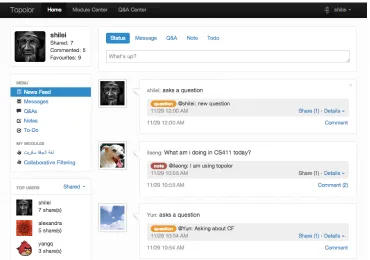
Figure 9 Topolor UI – Dashboard ... 80
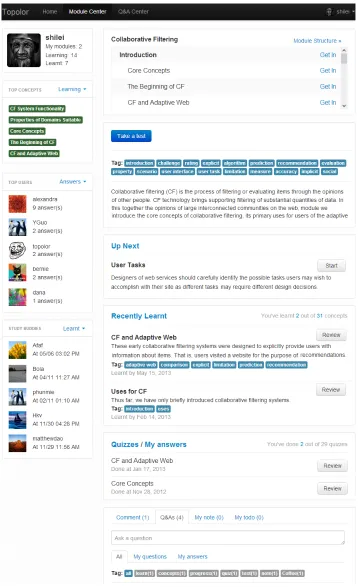
Figure 10 Topolor UI – Module Centre – Index ... 82
Figure 11 Topolor UI – topic recommendation based on tags ... 83
Figure 12 Topolor UI – Module Centre - Topic page ... 84
Figure 13 Topolor UI – Module Centre – Quiz ... 84
Figure 14 Topolor UI – Q&A Centre ... 85
Figure 15 Topolor UI – Q&A Centre (2) ... 86
Figure 16 Social interaction toolset – the status creation tool ... 93
Figure 17 Social interaction toolset – the messaging tool ... 93
viii
Figure 19 The proportions and categorisations of learner actions ... 116
Figure 20 Action frequency of each student ... 117
Figure 21 Correlation of action proportion ... 118
Figure 22 List of action sequences ... 120
Figure 23 Directed Acyclic Graph (DAG) of possible action paths ... 121
Figure 24 New features in Topolor 2: (a) the Home Page; (b) a Topic Page ... 138
Figure 25 Visualised course structure (learning path for a course) ... 139
Figure 26 Immediate feedback when taking a quiz ... 140
Figure 27 Pop-up view of comparison – performance ... 142
Figure 28 Pop-up view of comparison – contribution ... 142
Figure 29 Sharing widget in Topolor 2 ... 143
Figure 30 Filtering widget in Topolor 2 ... 143
Figure 31 Pop-up view when clicking on an avatar ... 146
Figure 32 Leaderboard ... 147
Figure 33 Pop-up view of performance at a course level – activities ... 163
Figure 34 Pop-up view of performance at a topic level ... 163
Figure 35 Pop-up view of contribution, comparison to others ... 164
Figure 36 Profile page (via a smart phone client-side) ... 165
Figure 37 The PK mode: 1-to-1 comparison of contribution of 2 learners ... 165
Figure 38 Pop-up view of learning path ... 166
List of Tables
Table 1 Comparison between different approaches ... 31
Table 2 A sample of questions in a system functionality questionnaire ... 40
Table 3 Rule of thumb for describing internal consistency ... 43
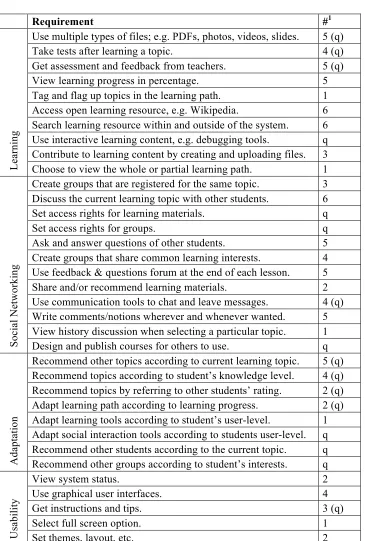
Table 4 System requirements ... 66
Table 5 System requirements – revisited ... 86
Table 6 Tasks performed by the student ... 94
Table 7 Scores of System Usability Scale (SUS) ... 97
Table 8 Scores of sub-system functionality scale ... 99
Table 9 Scores of single tasks scale (social interaction toolset) ... 100
Table 10 Scores of learner perceived satisfaction scales for Topolor ... 101
Table 11 Actions tracked and logged ... 116
Table 12 Possible action paths ... 123
Table 13 System requirements – revisited (2) ... 148
Table 14 Scores of learner perceived motivation questionnaire ... 154
Table 15 Features related to Multifaceted-OSLM ... 169
Table 16 Scores of System Usability Scale (SUS) – Topolor 2 ... 174
Table 17 Scores of system functionality scale – new features in Topolor 2 ... 175
x
Acknowledgements&
I would like to offer my sincerest appreciation to those who gave me the possibility
to study in the Department of Computer Science at the University of Warwick, and
supported me during my three years doctoral research.
First and foremost, I would like to express my deepest gratitude and respect to my
supervisor and mentor Dr Alexandra I. Cristea, for her constant input, direction and
motivation throughout my research and thesis, for her invaluable friendship and
apprenticeship during my stay at Warwick. I have been extremely lucky to have a
supervisor and mentor who led me to the amazing academic world.
Second, I would like to thank Warwick Graduate School, for offering me the
prestigious and competitive Chancellor's International Scholarship that financially
supported me for studying and living in the UK.
Third, I would like to thank my colleagues Karen, George, Jonathan, Malik, Dana,
Alaa, Petch, Reem, Suncica and Yiwei, for their inspiration, encouragement and
support, both in research and in personal life.
Fourth, I would like to thank my housemates and friends Michael, Joseph, Liang,
Xingjie, Zedong, Kezhi, Huanzhou, Chao, Xufeng, Changhui, Yan and Juan for
their company and giving me the happiest time during my stay in the UK.
Last but my no means least, I must thank my mum and dad, for their unconditional
love, belief and understanding. Everything I do, I do in the hope of making them
xii
Declaration
This thesis is submitted to the University of Warwick in support of my application
for the degree of Doctor of Philosophy. I hereby declare that, except where
acknowledged, the work presented in this thesis has been composed by myself, and
has not been submitted elsewhere for the purpose of obtaining an academic degree.
Lei Shi
Signature:!
Below, the publications written during the PhD research are listed, and their
connection to the current thesis is explained. The work presented (including data
generated and data analysis) was carried out by the author. In all of these cases, the
contribution by the author has been greater than 80%.
1. Shi, L., Cristea, A. I., Hadzidedic, S. (2014) The Critical Role of Profiles in Social E-Learning Design. In Proceedings of the 15th Annual
Conference on Information Technology Education (SIGITE 2014), pages
71-76, Atlanta, Georgia, US, October 15-18, 2014. ACM.
2. Shi, L., Cristea, A. I. (2014) Designing Visualisation and Interaction for Social E-Learning: A Case Study on Topolor 2. In Proceedings of the 9th
European Conference on Technology Enhanced Learning (EC-TEL 2014),
pages 526-529, Graz, Austria, September 16-19, 2014. LNCS 8719,
Springer International Publishing.
3. Shi, L. (2014) Defining and Evaluating Learner Experience for Social Adaptive E-Learning. In Proceedings of the 4th Imperial College
Computing Student Workshop (ICCSW 2014), pages 74-82, London, UK,
September 25-26, 2014. OASICS Vol. 28, Schloss Dagstuhl – Leibniz
Center for Informatics.
Papers 1, 2 and 3 present the design and evaluation of Topolor 2 – a social
xiv
4. Shi, L., Cristea, A. I., Hadzidedic, S. (2014) Multifaceted Open Social Learner Modelling. In Proceedings of the 13th International Conference on
Web-based Learning (ICWL2014), pages 32-42, Tallinn, Estonia, August
14-17, 2014. LNCS 8613, Springer International Publishing.
Paper 4 describes a new learner modelling approach. It is the basis of Chapter 7.
5. Shi, L., Cristea, A. I., Hadzidedic, S., Dervishalidovic, N. (2014) Contextual Gamification of Social Interaction – Towards Increasing
Motivation in Social E-Learning. In Proceedings of the 13th International
Conference on Web-based Learning (ICWL2014), pages 116-122, Tallinn,
Estonia, August 14-17, 2014. LNCS 8613, Springer International
Publishing.
6. Shi, L., Cristea, A. I. (2014) Making It Game-Like: Topolor 2 and Gamified Social E-Learning. In Proceedings of the 22nd Conference on
User Modeling, Adaptation and Personalization (UMAP 2014), pages
61-64, Aalborg, Denmark, July 7-11, 2014. Springer International Publishing.
7. Shi, L., Al-Qudah, D. A., Qaffas, A., Cristea, A. I. (2013) To Build Light Gamification upon Social Interactions: Requirement Analysis for the Next
Version of Topolor. In Proceedings of the 6th York Doctoral Symposium
on Computer Science, pages 63-67, York, United Kingdom, October 29,
Papers 5, 6 and 7 present a new gamification approach. They are the basis of
Chapter 6.
8. Shi, L., Cristea, A. I., Awan, M., Stewart, C., Hendrix, M. (2013) Towards Understanding Learning Behavior Patterns in Social personalised adaptive
Personalized E-Learning Systems. In Proceedings of the 19th Americas
Conference on Information Systems (AMCIS 2013), pages 1-10, Chicago,
Illinois, USA, August 15-17, 2013. Association for Information Systems.
9. Shi, L., Cristea, A. I. (2013) Investigating the Impact of Social Interactions in Adaptive E-Learning by Learning Behaviour Analysis. In Proceedings
of the 6th York Doctoral Symposium on Computer Science, pages 88,
York, United Kingdom, October 29, 2013. York Computer Science (YCS).
Papers 8 and 9 investigate learning behaviour patterns within Topolor – a social
personalised e-learning system. They are the basis of Chapter 5.
10. Shi, L., Cristea, A. I., Stewart. C. (2014) Students as Customers: Participatory Design for Adaptive Web 3.0. In The Evolution of the
Internet in the Business Sector: Web 1.0 to Web 3.0. IGI Global.
11. Shi, L., Cristea, A. I., Foss, J. G. K., Al-Qudah, D. A., Qaffas, A. (2013) A Social Personalized Adaptive E-Learning Environment: A Case Study in
Topolor. In IADIS International Journal on WWW/Internet. Vol. 11, No.
xvi
Papers 10 and 11 summarise a new approach of synthesising social interaction and
adaptation in e-learning. They are the basis of Chapter 4.
12. Shi, L., Awan, M., Cristea, A. I. (2013) Evaluation of Social Personalized Adaptive E-Learning Environments: From End User Point of View. In
Proceedings of the 3th Imperial College Computing Student Workshop
(ICCSW 2013), pages 103-110, London, United Kingdom, September
26-27, 2013. Schloss Dagstuhl - Leibniz Center for Informatics.
13. Shi, L., Awan, M., Cristea, A. I. (2013) Evaluating System Functionality in Social Personalized Adaptive E-Learning Systems. In Proceedings of
the 8th European Conference on Technology Enhanced Learning (EC-TEL
2013), pages 633-634, Paphos, Cyprus, September 17-21, 2013. LNCS
8095, Springer Berlin Heidelberg.
14. Shi, L., Al-Qudah, D. A., Qaffas, A., Cristea, A. I. (2013) Social E-Learning in Topolor: a Case Study. In Proceedings of the 7th IADIS
Conference e-Learning 2013 (IADIS-EL 2013), pages 57-64, Prague,
Czech Republic, July 23-26, 2013. IADIS Press.
15. Shi, L., Stepanyan, K., Al-Qudah, D. A., Cristea, A. I. (2013) Evaluation of Social Interaction Features in Topolor – A Social Personalized Adaptive
E-Learning System. In Proceedings of the 13th IEEE International
Conference on Advanced Learning Technologies (ICALT 2013), pages
294-295, Beijing, China, July 15-18, 2013. IEEE Computer Society.
Implementation and Evaluation. In Proceedings of the 16th International
Conference on Artificial Intelligence in Education (AIED 2013), pages
708-711, Memphis, Tennessee, USA, July 9-13, 2013. LNCS 7926,
Springer Berlin Heidelberg.
17. Shi, L., Al-Qudah, D. A., Cristea, A. I. (2013) Designing Social Personalized Adaptive E-Learning. In Proceedings of the 18th ACM
conference on Innovation and technology in computer science education
(ITiCSE 2013), pages 341, Canterbury, UK, July 1-3, 2013. ACM.
18. Shi, L., Al-Qudah, D. A., Qaffas, A., Cristea, A. I. (2013) Topolor: A Social Personalized Adaptive E-Learning System. In Proceedings of the
21st Conference on User Modeling, Adaptation and Personalization
(UMAP 2013), pages 338-340, Rome, Italy, June 10-14, 2013. LNCS
7899, Springer Berlin Heidelberg.
Papers 12 – 18 present the design and implementation of Topolor – a social
personalised adaptive e-learning system, and the system assessments that evaluate
Topolor from various perspectives. They are the basis of Chapter 4.
19. Shi, L., Al-Qudah, D. A., Cristea, A. I. (2012) Exploring Participatory Design for SNS-based AEH Systems. In Proceedings of the 11th IADIS
International Conference WWW/INTERNET (ICWI 2012), pages
242-249, Madrid, Spain, October 18-21, 2012. IADIS Press.
xviii
Proceedings of the 2th Imperial College Computing Student Workshop
(ICCSW 2012), pages 123-128, London, United Kingdom, September
27-28, 2012. OASICS Vol. 27-28, Schloss Dagstuhl – Leibniz Center for
Informatics.
Papers 19 and 20 report the process of gathering end-user’s requirements for the
design and implementation of a social personalised adaptive e-learning system.
This work aims to alleviate the weaknesses and pitfalls of the strong modern trend
of e-learning by capitalising on and taking advantage of theoretical and
implementation advances that have been made in the fields of adaptive
hypermedia, social computing, games research and motivation theories. Whilst
both demand for and supply of e-learning are growing, especially with the rise of
MOOCs, the problems that it faces remain to be addressed, notably isolation,
de-personalisation and lack of individual navigation. This often leads to poor learning
experience. This work explores an innovative method of combining, threading and
balancing the amount of adaptation, social interaction, gamification and open
learner modelling for e-learning techniques and technologies.
As a starting point, a novel combination of classical adaptation based on user
modelling, fine-grained social interaction features and a Facebook-like appearance
is explored. This has been shown to be able to ensure a high level of effectiveness,
efficiency and satisfaction amongst learners when using the e-learning system.
Contextual gamification strategies rooted in Self-Determination Theory (SDT) are
then proposed, which have been shown to be able to ensure learners of the system
adopt desirable learning behaviours and achieve pre-specified learning goals, thus
providing a high level of motivation. Finally, a multifaceted open social learner
modelling is proposed. This allows visualising both learners’ performance and their
xx
is integrated and adapted to learning content. Evidence has shown that this can
provide a high level of effectiveness, efficiency and satisfaction amongst learners.
Two innovative social personalised adaptive e-learning systems including Topolor
and Topolor 2 are devised to enable the proposed approach to be tested in the real
world. They have been used as online learning environments for undergraduate and
postgraduate students in Western and Eastern Europe as well as Middle Eastern
universities, including the University of Warwick, UK, Jordan University, Jordan,
and Sarajevo School of Science and Technology, Bosnia and Herzegovina.
Students’ feedback has shown this approach to be very promising, suggesting
further implementation of the systems and follow-up research. The worldwide use
of Topolor has also promoted international collaborations.
Keywords: social e-learning, adaptive e-learning, personalisation, gamification, open social learner modelling, learning analytic, participatory design, user-centric
AEH Adaptive Educational Hypermedia
AEHS Adaptive Educational Hypermedia System
AH Adaptive Hypermedia
AHAM Adaptive Hypermedia Application Model
AHS Adaptive Hypermedia System
AJAX Asynchronous JavaScript and XML
ALEF Adaptive LEarning Framework
AM Adaptation Model
ARP Adaptation Rule Parser
ATR Action TRacker
CM Concept Model
CSS3 Cascading Style Sheets Level 3
DAG Directed Acyclic Graph
DM Domain Model
EC-TEL European Conference on Technology Enhanced Learning
EDM Educational Data Mining
xxii
GAF Generic Adaptation Framework
GAM Generic Adaptivity Model
GM Goal and Constrains Model
HCI Human-Computer Interaction
HTML5 Hypertext Mark-up Language Version 5
IM Interaction and connection Model
ITS Intelligent Tutoring Systems
KDD Knowledge Discovery in Databases
LAOS Layered WWW AH Authoring Model and their corresponding Algebraic Operators
LBP Learner Behaviour Parser
LM Learner Model
LRS Learning Record Stores
MM Module Model
MOOC Massive Open Online Course
MOT My Online Teacher Adaptive Hypermedia Authoring System
MOT2.0 My Online Teacher 2.0 Social Web Adaptive Hypermedia Authoring and Delivery System
OB-AHEM Object-oriented Adaptive Hypermedia Educational Model
OLM Open Learner Model
OSLM Open Social Learner Model
PD Participatory Design
PHP Hypertext Preprocessor, an open source general-purpose scripting language that is especially suited for web development and can be
embedded into HTML
PK Player Killer, a naming convention taken from games
PM Presentation Model
Q&A Question and Answer
RM Resource Model
SPADEL Social Personalised ADaptive E-Learning framework
SD Standard Deviation
SDT Self-Determination Theory
SLAOS Social LAOS: Social Layered WWW AH Authoring Model and their corresponding Algebraic Operators: A framework for
authoring of Adaptive Hypermedia
SM Socialisation Model
SNS Social Networking Sites
SUS System Usability Scale
xxiv
UCE User-Centric Evaluation
UI User Interface
UM User Model
UMAP Conference on User Modeling, Adaptation and Personalization
UML Unified Modelling Language
UX User Experience
Introduction
1.1
Background and Motivations
The number of Internet users has grown 1080% since 2000, heading to the third
billion in 2014, and causing an evolutionary shift in how people can engage with
the world [200]. The global e-learning market is projected to exceed US$230
billion by 2020, driven by technologies and mechanisms such as HTML5 and
CSS3-based browsers and cloud computing, smart mobile devices, and broadband
Internet [201], and by the next generation of content and its creating and
distributing systems such as using Open Educational Resources (OER) [195],
Learning Record Stores (LRS) [130] and Massive Open Online Courses (MOOCs)
[129]. The feverish market growth and compelling value proposition consistently
promote academic research, industrial innovations, and commercial investments, as
well as governmental endorsement. Education, which seems most unlikely to be
influenced by fashions such as the Internet Industry, has already been facing new
opportunities and challenges brought by the Internet.
Furthermore, the picture is permanently changing: the Internet of today looks
totally different from that of the past, and its thriving user communities have
2
the Web as a normal part of their lives. They normally come with a very good
background in Web 2.0 (as in social [126]) and some Web 3.0 (as in both
personalised and social) systems and platforms, where not only are they content
consumers, but also prolific producers. They write blogs and tweets, and upload
photos, audios and videos to the cloud by billions. They create, comment, share
and categorise the content as frequently as they search, read, listen and watch it.
Social media tools [85] such as Facebook, Google+, Qzone, Renren, Twitter,
YouTube, Youku, Weibo, Tumblr, Pinterest, Instagram and many others have been
penetrating people’s lifeblood like never before, and shortening the time and space
distances, by connecting everything and everybody together. These phenomenan
and trends are driving modern e-learning to support highly efficient connections
and interactions between learners and content, so as to cater for learners’ tastes and
thus achieve a richer learner experience.
Social media tools have been incorporated into recreational and educational
practices, aiming at offering more dynamic, flexible and accessible content, and
promoting active learning for students [119, 152, 187]. A growing number of
colleges and universities are using social media tools to communicate with their
students, deliver learning content, and provide participation and discussion
opportunities in a social and community-based learning paradigm [97, 106, 147].
Indeed, learning is intrinsically a social endeavour [192, 199], and the social facets
of learning have been described in a variety of theoretical frameworks that explain
how people learn [46, 191, 193]. The social learning theory postulates that learning
social context, and can be influenced by intrinsic reinforcement, as a form of
internal reward, such as satisfaction and a sense of accomplishment [7, 8]. Whilst
attempts have been made to bring social activities into e-learning (e.g., Moodle 2.3
promotes ‘social learning’ with wikis, Blackboard 10 facilitates ‘social learning’
with blogs), yet existing e-learning systems stubbornly focus on instructivist [75]
and constructivist [45] approaches, allowing interaction with content alone.
The increasing demand for social and community-based e-learning systems that
provide massive open online learning resources and support diverse connections
and interactions is driving the development of new solutions that can help students
access the most appropriate content and interact with the most relevant peers in the
best way. This indicates that, apart from the elimination of the barriers of time and
space, social e-learning must also personalise the learner experience. It has become
clear that the ‘one-size-fits-all’ approaches are neither effective nor efficient for the
diverse learners of today [116, 146]. Social e-learning requires the ability to deliver
just-in-time and on-demand learner experiences, tailored to individuals, taking into
account their differences such as knowledge, skills, abilities and preferences.
However, the biggest encumbrance to personalise learning is that “scientific,
data-driven approaches that effectively facilitate personalisation have only recently
begun to emerge; learning analytics, for example, is still in the very nascent stage
of implementation and adoption within higher education” [81].
Acknowledging the importance of personalisation in teaching and learning can be
4
Confucius (551 – 479 BC, a Chinese teacher, politician and philosopher) asserted
already that teaching different learners requires flexible and individualised
approaches. Modern psychologists, since the 1950s have also argued that no single
teaching approach could best fit all learners, and have suggested the importance of
adapting instructional procedures to individual differences [42, 44, 66, 80]. More
recently, the research area of adaptive hypermedia (AH) [16] and adaptive
e-learning [17] has been prospering and developing for three decades. It has
produced a plethora of adaptive e-learning systems to support, verify and evaluate
the newly proposed models, system architectures and methodologies that aim at
breaking away from the ‘one-size-fits-all’ mentality [19] and enabling e-learning to
adapt to learners’ individual needs, and thus to provide an adaptive and
personalised learner experience. Note that a social dimension has already been
considered to be integrated into adaptive e-learning, to cater for the needs from the
social e-learning paradigm [21, 40, 165]. However, research on how to efficiently
intertwine social interaction and personalised learning content, and how the novel
adaptive social e-learning can influence learner experience, remains elusive.
Successful social e-learning requires tools to assist learners in directing their own
learning and having a high level of motivation so as to participate in meaningful
interactions [94], similar to popular social software. Motivation is an inner drive,
e.g., the desire and goal that activates, energises and directs behaviours [118]. It
corresponds to physiological processes that influence directions and persistence of
behaviours [118]. In e-learning, motivation plays a significant role – it initiates,
learning goals [1]. Social e-learning allows learners to take a self-motivating role
of participating in determining their own learning paths; it allows for information
discovery, as well as collecting, sharing, and personalisation of information [115],
requiring support of a self-determined approach. Among motivation theories
applied in learning, Self-Determination Theory (SDT) is an empirical one that
focuses on the degree to which individual behaviours are determined and
self-motivated [144]. It states that an individual becomes increasingly self-determined
and self-motivated when three basic innate needs, i.e., autonomy, competence and
relatedness, are satisfied [144]. A social e-learning system that satisfies all these
three basic innate needs is expected to sustainably increase learners’ intrinsic
motivation, leading to an efficient self-determined learner experience [64, 177].
Gamification has been the carrier of utilising and understanding the motivation
benefits of Self-Determination Theory (SDT) in the context of e-learning.
Gamification is the use of gameplay mechanics for non-game applications [134]. It
describes an efficient way of utilising game design elements to engage users and
motivate their activities, in order to solve problems and promote learning [86]. It
has been incorporated into numerous domains such as marketing, work and
educational systems, especially social ones, as a way of creating strong connections
between users and systems, and driving their interactions to increase popularity
[54]. This trend is increasingly catching researchers’ attention – to explore theories
and practices of gamification in social e-learning, aiming at increasing learner
motivation, driving desirable learning behaviours and achieving learning goals
6
mechanics in common, such as achievement, collaboration, discovery, and virality,
so that their combination may have a greater impact on e-learning. In fact,
researchers have already started exploring this combination, reporting its various
influences on the learning process [54, 175].
Whilst both demand for and supply of e-learning are growing, the issues that are
facing it remain, such as isolation, information overload and lack of individual
narrative, often leading to disengagement and poor learner experience. Towards
addressing these issues and thus offering motivating e-learning systems and
achieving rich learner experience, this research aims to take advantage and
capitalise on theoretical and implementation advances that have been made in
various fields such as adaptive learning, social networking, motivation theories and
gamification research, in order to alleviate the weaknesses and pitfalls of a strong
trend in current society, that of e-learning.
1.2
Research Questions and Objectives
The present work combines and develops various techniques and technologies to
answer a research question that can broadly be formulated as the following.
R0.How can we ensure that e-learning systems achieve rich learner experience, in terms of a high level of effectiveness, efficiency,
There are many ways to explore this question, but here we build on the assumption
that it is worth exploring and providing an innovative method of combining,
threading and balancing the amount of adaptation, social interaction, gamification
and open learner modelling for e-learning. This attempts to look at the global
picture by combining the aforementioned subjects arises from the fact that new
generations of learners ‘live’ in social e-systems, with a high level awareness of
game paradigms, and an increased need of control. However, few research projects,
if any, have made this attempt. From this perspective, the original question (R0) is explored further and subdivided into the following three closely related questions,
which are the main focus of the thesis.
R1.How can we synthesise social interaction and adaptation techniques and technologies, in order to ensure e-learning systems provide a
high level of effectiveness, efficiency, satisfaction, and engagement
amongst learners?
R2.How can we implement gamification techniques and technologies, in order to enhance social e-learning systems, and thus provide a high
level of motivation amongst learners?
R3.How can we implement open learner modelling techniques and technologies, in order to enhance e-learning systems, and thus
provide a high level of effectiveness, efficiency and satisfaction
8
Formulating and addressing the following objectives operationalize the process of
answering the research questions.
O1.Reviewing the state of art in the fields of adaptive e-learning, social e-learning, gamification and open learner modelling to investigate
their influence on the e-learning process.
O2.Exploring and understanding the needs of the learners for a social personalised adaptive e-learning system, aiming at gathering the
requirements for the implementation of the research environment.
O3.Based on the hypotheses and conclusions from O1 and O2, developing a social personalised adaptive e-learning system that
fosters a social, personalised and adaptive e-learning experience, and
evaluating it from the perspectives of learner effectiveness,
efficiency, satisfaction and engagement.
O4.Based on the hypotheses and conclusions from O3, building novel gamification strategies upon the initial social personalised adaptive
e-learning system, and examining the impacts of the new
gamification features on learners’ motivation.
O5.Based on the hypotheses and conclusions from O3, extending the previous system with new open learner modelling, and examining its
In summary, O1 serves as background knowledge and inspiration to support research questions R1, R2 and R3. O2 and O3 support research question R1.
O4 and O5 support research questions R2 and R3 respectively.
1.3
Methodology
As stated in sections 1.1 and 1.2, this research work ultimately strives to obtain the
appropriate balance and granularity of adaptation, social interaction, gamification
and open learner modelling techniques and technologies in e-learning. Such
balance and granularity need to be able to ensure a rich learner experience, in terms
of a high level of effectiveness, efficiency, satisfaction, motivation and engagement
amongst learners. A user-centric approach is adopted for the investigation and
validation processes, through a continual process of design, development and
evaluation.
1) Literature Review
The starting point of the work in this thesis is the enunciation of the umbrella
research question defined and developed in the previous section. A systematic
literature review [36], which is presented in Chapter 2, was undertaken to
investigate current thinking and benefits from previous experiences. The review
process began in 2011 and was subsequently updated up to the completion of this
thesis. It focused on the areas of adaptive and social e-learning, gamification and
10
literature review aims to articulate its related definitions, revisit its development
process, summarise its pros and cons, and clarify how this research work further
develops this area.
2) User-Centric Design
The user-centric design (UCD) [124] method is adopted, aiming to retrieve the
learners’, i.e., end-users’, needs, wants and limitations, and eventually optimise the
acceptance and satisfaction of the innovation. Contextual inquiry, prototype testing
and usability testing initiate the design process. This allows analysing end-users’
cognition, characteristics, preferences, etc., as well as the tasks that techniques and
technologies may help them complete. The participatory design (PD) [148]
methodology is applied, so that the end-users’ opinions can be considered from the
early design stages, and thus build more customer-oriented systems [4]. The reason
for this is the assumption that if the systems were designed to provide its end-users
with exactly what they need, these would achieve a high level of user experience.
This could eventually lead users to try other features and content, enabling the
system to collect more usage data, which in turn would lead to a more usable
system, with greater benefits for its users.
3) Iterative and Incremental Development
The Iterative and Incremental development model [98] is adopted in this work. It is
a cyclic process of system development proposed in response to the weaknesses of
(iterative) and in smaller portions at a time (incremental). The process flows in
iterative loops, so that it is always possible to adapt to the adjustment of
requirement and technology. Each of the iterations consists of a well-defined set of
objectives, as well as development disciplines, such as design, implementation and
evaluation. Each of the successive iterations builds upon the previous iteration, in
order to evolve and refine the system. This iterative process allows for taking
advantages of what has been learnt during the earlier iteration of development, as
well as the earlier version of the system. The iterative process of design,
implementation and evaluation of the innovative method of combining, threading
and balancing the amount of adaptation, social interaction, gamification and open
learner modelling for e-learning, is described in Chapter 3 to Chapter 7.
4) Case Study and Evaluation
Several case studies were conducted to gather feedback from the end-users
including learners, tutors and observers, during real-life online learning sessions.
Learners are asked to study online courses using the implemented system, while a
logging mechanism keeps track of distinct learners’ usage data. After the online
learning sessions, they are asked to complete optional and anonymous Likert scale
[103] questionnaires. In addition to the questionnaire data, oral feedback from
some of the learners, tutors and observers is also collected. Various features of the
system are evaluated in terms of effectiveness, efficiency and satisfaction amongst
12
logging data, in order to discover learning behaviour patterns, so as to understand
more deeply how the innovation influence learner experience and engagement.
1.4
Thesis Outline
In total, this thesis contains eight chapters, organised as follows.
Chapter 1, the current chapter, introduces the goals and methodology of the work
conducted for the thesis, including background and motivation, research questions
and objectives, a description of how the research was conducted and an outline of
the thesis.
Chapter 2 elaborates the related work. Firstly, it introduces the state of the art in
adaptive hypermedia and user modelling, including the evolution of the adaptive
hypermedia frameworks and systems. Subsequently it reviews social, gamification
and open learner modelling techniques and technologies in e-learning, investigates
their merits and limitations, and proposes the direction that this research aims to
address. Finally, it presents the user-centric evaluation approach adopted to assess
the design and implementation of the innovation.
Chapter 3 reports the experiment conducted, which applied the participatory design
(PD) methodology, aiming to gather the real-life needs from the learners, i.e., the
end-users. For this purpose, it starts with introducing the PD methodology and the
how the We!Design (PD) framework has been applied. Finally, it suggests the
initial system requirements, resulting from the experiment, and orders them based
on their implementation priority.
Next, Chapter 4 describes the design, implementation and evaluation of the initial
social personalised adaptive e-learning system – Topolor, with the aim of
addressing the gap that current adaptive e-learning systems have only marginally
explored: the integration of social interaction features and adaptation techniques.
Based on the background literature study in Chapter 2 and the system requirements
suggested in Chapter 3, Topolor is built by integrating classical adaptation,
fine-grained social interaction features, and Facebook-like appearance, aiming to foster
effective and efficient social personalised adaptive e-learning experience with high
satisfaction of learners. The evaluation results indicate positive feedback from the
learners, the end-users, and guide the follow-up research, including introducing
gamification (Chapter 6) and open learner modelling (Chapter 7).
Chapter 5 reports on the learning behaviour pattern analysis that aims to gain
significant new insights into learner behaviours and engagement within Topolor,
introduced in Chapter 4. Data mining methods and data visualisation tools are used
to analyse the log data. The analysis of action frequencies and sequences aims to
identify common and individual behaviour patterns. However, deviations from
what is most common are also sought, to grasp a better understanding of learners’
participation and engagement within the system, and provide suggestions on
14
Chapter 6 shows the second version of the social personalised adaptive e-learning
system – Topolor 2, which is developed based on the findings described in Chapter
4 and Chapter 5. It introduces new gamification strategies that are inspired by
Self-Determination Theory (STD) and aim to improve the first version of Topolor with
gamification mechanisms and gamified social interactions. The newly introduced
gamification strategies are expected to promote learners’ intrinsic motivation, and
thus build an efficient self-determined learner experience.
Chapter 7 presents follow-up research, based on the findings described in Chapter
4 and Chapter 5; it consists of learner data visualisation that could potentially
influence effectiveness, efficiency and satisfaction amongst learners. Having learnt
from the open learner modelling techniques and technologies introduced in Chapter
2, which visualise learner model to a learner themself, this chapter proposes a new
approach that can seamlessly and adaptively integrate open learner modelling with
learning content. Thus, its ubiquity and context-awareness can support new
adaptation and personalisation methods for social personalised adaptive e-learning.
This new approach allows the visualisation of both performance and contribution
of learners, reflecting not only their role as a knowledge consumer, but also that of
a knowledge producer, a view which is better integrated with the social web era.
Finally, Chapter 8 concludes the thesis through a review of the general research
progress, and a discussion of the overall research achievements, contributions and
impacts. It also recommends potential directions and areas in which future research
Background and Related Work
2.1
Introduction
This chapter aims to address the research objective O1: “reviewing the state of art in the fields of adaptive e-learning, social e-learning, gamification and open learner
modelling to investigate their influence on the e-learning process”, which serves as
background knowledge and inspiration to support research questions defined in
section 1.2.
Firstly, section 2.2 sketches an overview of adaptive e-learning systems, including
various terminologies, theories and techniques of adaptive hypermedia and user
modelling, focusing on various architectures of adaptive hypermedia frameworks.
Secondly, section 2.3 reviews the use of social techniques in e-learning such as
social navigation, and discusses their advantages and limitations. Thirdly, section
2.4 explores gamification techniques in e-learning. It explains the differences
between full games and serious games, and provides examples of gamification
systems, with special focus on the educational ones. It also introduces motivation
theories that could potentially guide the design of gamification. Fourthly, section
2.5 investigates the existing open learner modelling approaches, analyses their
16
limitations. Fifthly, section 2.6 presents a user-centric approach that will be used to
evaluate the innovation made in this work. Finally, section 2.7 summarises the
literature review, the research background and related work.
2.2
Adaptive E-Learning
Adaptive hypermedia (AH) is a 20-year-old field of research at the crossroads of
hypermedia and user modelling. In contrast to the traditional approach whereby all
users are offered the same content or even directed to the same series of hyperlinks,
AH tailors the offering and direction of the hypertext and hypermedia to an
individual, by modelling, for example, goals, preferences and knowledge. It
updates this model via interaction with the user [18], in order to provide adaptive
navigation and content support. The main goal of AH research is to improve the
personalisation of hypermedia systems, by making them adaptive and adaptable. A
system that adapts to users using implicit inferences based on the interaction with
the users is called adaptive, whilst systems that adapt to users using explicit user
input are called adaptable. AH is one of the basic research areas supporting the
research in this thesis.
As the most popular branch of the AH research area, adaptive e-learning combines
adaptive hypermedia systems (AHS) and intelligent tutoring systems (ITS) [176],
with the aim of breaking away from the ‘one-size-fits-all’ mentality [19], and
producing e-learning systems in which the learning content and the order of
level, learning goal, preferences, stereotypes, cognitive and learning styles [23], in
a given context, and thereby providing a personalised learner experience.
Many conceptual frameworks/models have been proposed since the early 2000s,
aiming to simplify the process of building adaptive systems. Well-known
frameworks include AHAM proposed by De Bra et al. [13], XAHM proposed by
Cannataro et al. [30], LAOS proposed by Cristea and De Mooij [41], the Munich
model proposed by Koch and Wirsing [92], GAF proposed by Knutov [89], and so
on. Later, some conceptual frameworks with a social dimension were proposed,
such as SLAOS [40] and ALEF [174].
AHAM [13] extends the storage layer of the Dexter Model [71], aiming at
providing more functionality than just storing information about the hypertext
structure. AHAM divides the storage layer into three models: the domain model
(DM), the user model (UM) and the teaching model. DM describes the mechanism
by which the information is structured and linked with each other. UM records user
data including knowledge, interest, preference and goals. The teaching model
maintains pedagogical rules that indicate how to combine DM and UM in order to
perform the actual adaptation.
Similarly to AHAM [13], the Munich Reference Model [92] is also based on the
Dexter Model, but includes a user model (UM) and an adaptation model (AM) as
part of the Storage Layer. AM describes adaptation rules which can dynamically
18
The Munich Reference Model is defined by unified modelling language (UML),
taking an object-oriented software engineering point of view, and providing an
object-oriented formalisation for the adaptive e-learning reference model, which
are the main differences from AHAM.
LAOS [41] is built upon AHAM. It introduces a goal and constraints model (GM)
between DM and UM. Goals give a focused presentation, and constraints limit the
space of the search. GM filters useful concepts from domain(s) and arranges them
for the current pedagogical goal, e.g. to construct a course for a group of learners
that should last one semester. GM can filter concepts from more than one DM, and
a DM can generate multiple GMs.
Later, the GAF framework was proposed, aiming at enhancing adaptation
capabilities and including new methodologies and techniques [89]. It introduces
ontologies into DM to provide interoperability in different adaptive applications; a
resource model (RM) to meet the need of open corpus adaptation [21], where
learning resources come from search results in dynamic learning object repositories
or from a web search engine; a context model (CM) to define user and usage
context which capture the context of user behaviour and system usage, in order to
make adaptive applications more sensitive to adapt in many other ways rather than
through a set of predefined rules [91]; and a group model to maintain a
collaborative profile of the user or stereotyping search results so as to rank and
Besides the frameworks mentioned above, many other layered frameworks
(reference models) have also been launched since the early 2000s. XAHM [29] is a
data-centric model based on the class diagrams of UML, which integrates a
graph-based description of navigational properties and an object-oriented semantic
description of the hypermedia, and uses a logical formalism to support run-time
adaptation to user behaviours, technologies and external systems. OB-AHEM [128]
is a high level model that inherits many advantages from the object-oriented
paradigm, which provides the ability to reuse the solutions in navigation, user
modelling, definition and application of adaptive rule. GAM [190] provides the
state-machine mechanism for an adaptation engine including push modelling and
pull modelling in the shape of rules and questions, which can be used in a modular
way to allow for more flexible adaptation systems. FAME [55] proposes a
model-based architecture for adaptive multimodal systems, which provides adaptation
rules for each adaptable component that are encoded in a behavioural matrix, in
order to adapt to user actions, system events and systemic changes.
Some of the frameworks were later extended to accommodate some social features.
For example, ALEF (Adaptive LEarning Framework) [174] combines different
learning activities, such as learning from explanatory texts and additional
interactive content, in the form of short quiz questions and exercises, and benefits
from all the possibilities that Web 2.0 techniques can currently offer, integrating
them with personalised educational resource access. Within ALEF, three principles
are proposed to develop a social personalised adaptive e-learning system: 1) the
20
collaboratively modifying the domain models by the students; 2) the extensible
personalisation and course adaptation based on comprehensive user modelling that
simultaneously employs different adaptive techniques; and 3) the ability for the
students to collaboratively participate in the learning process, interact and create
learning content via different types of annotations that allow for rich interaction
with the learning content.
Another framework that takes into consideration a social dimension is SLAOS
(Social-LAOS) [61]. It is built on top of the LAOS framework [41], extending it by
integrating a social layer, and by blending the authoring and delivering phases (i.e.,
removing the barrier between tutors, learners and authors, all of whom become
authors with different sets of privileges). In such way, learners are able to
collaboratively contribute to the learning content authoring process with different
privileges, which can be set based on their knowledge level. The new social layer
expresses all social activities within an adaptive hypermedia system such as
collaborative authoring (editing content of other users, describing content using
tags, rating, commenting on the content, etc.), authoring for collaboration (adding
author activities such as defining author groups, subscribing to other authors, etc.),
group-based adaptive authoring via group-based privileges, and social annotation
(tagging, rating, and commenting on the content via group-based privileges) [39].
As the SLAOS framework has been the basis for the architecture of the e-learning
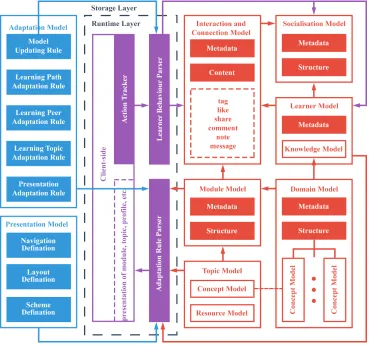
system implemented in this work, here it is described in more detail. Figure 1
Figure 1 The SLAOS framework [39]
• The Social Resource Model stores items that learners are reading at
a particular time, in a module. Its metadata, such as rating and
feedback, represent a social overlay.
• The Social Domain Model represents structured concepts within a
domain map, which permits reusability, as one concept can be used
in more social domain maps.
• The Social Goal Model defines goal and constraints maps, which
are a subset of structured concepts within a social domain map, with
goals and constraints given by lesson constructions.
• The Social User Model contains both free variables, as well as an
overlay over the Social Goal Model, recording a status of the user against the concepts, such as ‘learnt’ or ‘ready-to-learn’, which can
be updated according to the user’s activities, similar to typical user
22
user subscribers, to name a few, which cater for the social aspects of
the users. Furthermore, links between the users of arbitrary nature
within the framework permit various social interactions.
• The Environment Model represents physical devices such as
desktops, laptops and tablets, to allow adaptation to them.
• The Adaptation Model is a set of adaptation rules that form the
connection between the above models, to decide on the presentations (specifications) to be generated in the Presentation Model. It also allows for strategies that update the Social User Model.
• The Presentation Model is an overlay over the conceptual structure,
to decide if, where and how a specific concept (or part thereof) will
be displayed. It also contains a set of definitions of user interface
(UI) components that visualise navigations, layouts and content,
which are generated based on the adaptation strategies within the
Adaptation Model.
These theoretical and technical works have shown that the research focus has
shifted from an individual orientation [6] (on the learner and their cognitive
process) to a social orientation. In comparison with adaptive educational
hypermedia (AEH) and adaptive e-learning systems, social-AEH and social
personalised adaptive e-learning systems have been pushing the research area of
AEH towards fostering diversification of user modelling [10]. The work presented
in this thesis continues this progress and builds on the SLAOS framework, but
2.3
Social Techniques in E-Learning
Learning is intrinsically a social endeavour [7, 192, 199]. Social facets of learning
have been described in a variety of theoretical frameworks about people and their
learning [46, 191, 193]. However, moving from a face-to-face experience into a
computerised domain, the creation of effective and efficient online social learning
remains an unsolved problem. Whilst online exchange via social networking is
immensely popular and an important component of day-to-day life, providing
solutions that foster creation of effective e-learning spaces is not straightforward.
Therefore, in this work, we decide to build our own social personalised adaptive
e-learning systems (sections 4.3 and 6.3), in which the social flavour is naturally
built and more tightly integrated.
The use of social techniques in e-learning systems has become increasingly popular
in the research community. Social techniques can attract learners to interact with
one another, and generate trails for peers to follow. Not only can they promote
learners to produce learning content by themselves, but they also encourage them
to participate in various learning activities within the system [162]. In the social
e-learning paradigm, learners achieve e-learning goals via social interaction, such as
tagging, rating and commenting within learning communities, where they share
knowledge, skills, abilities and learning resources [168]. In such a system,
connectedness and interactivity try to satisfy learners’ basic innate needs, including
autonomy, competence and relatedness [144], and thus can lead to an increase of
24
As a well-known social techniques in e-learning, social navigation has been one of
the first attempts to combine social techniques with adaptive e-learning [20, 50]. A
more recent approach is the social and adaptive e-learning system MOT2.0 [62],
which goes a little further in terms of social features incorporated. It provides
features that allow learners to chat, comment, rate and tag parts of the learning
content. This allows the system to provide adaptive navigation personalisation
techniques, by suggesting content that the learner’s peers recommend, as well as
suggesting appropriate peers to contact. An interesting technique also used by this
system is that of adaptive rights, i.e., rights adapted to the deduced level of the
user. However, this system is still at a level of concept proving, and the granularity
of its adaptation and social interaction, is still quite coarse (e.g., complete topics
are recommended, the peer recommendation is relatively simple, etc.). This work
thus has been the basis and initial inspiration for the work presented in this thesis.
Here, however, much finer-grained adaptation and recommendations as well as
fine-grained social interactions are introduced (see Chapter 4).
Whilst previous systems cater for personal needs within specific learning contexts,
they are often limited in their strategies for adapting to social needs or in their
social features. Some recent works [72, 174, 196] have outlined the need for
creating adaptive and highly interactive integrated learning systems. However,
their works suggest only a limited number of mechanisms for enabling social
interaction. Therefore, there is a gap for extending and evaluating social interaction
tools in adaptive e-learning settings, which is one of the objectives of the work
in the user-system interaction design, as it can shorten users’ reaction time, and
thus reduce their burden of getting used to the system [104]. However, existing
frameworks and systems do not take into account a learner’s familiarity with other
social interaction tools, encountered either in other e-learning systems, or on social
networking websites, such as Facebook and Google+. Therefore the work
presented in this thesis intends to investigate the combination of classical
adaptation based on user modelling and fine-grained social interactions as well as
system appearances that learners are familiar with (see Chapter 4).
2.4
Gamification Techniques in E-Learning
The field of gamification seeks to apply game mechanics and game design
techniques, such as incorporating challenges and rewards to encourage more
engaged participation [86]. Gamification techniques strive to leverage people's
basic desires and needs that revolve around thoughts on competition, status,
self-expression, achievement and community collaboration. In academia, gamification
has been defined as the practice of utilising game design elements in non-game
contexts [49]. Different from a traditional digital game, gamification incorporates
game thinking [194] (game-like approach to aesthetics and usability) and game
elements [2] (elements from computer games, such as avatars, badges, goal
settings, progression bars, countdown, urgent optimism, behavioural momentum,
and appointments) in a non-game system, and aims to achieve some goals such as
26
from serious games [178] that themselves are similar to traditional digital games,
but also have defined purposeful goals, such as learning outcomes.
The aim of gamification is to engage desirable behaviours and to achieve the
designed goals, or to fulfil an experiencing purpose. For instance, Nwplyng1 rewards users for identifying and sharing what music they are listening to with
friends via Facebook and Twitter with badges. Viggle2 rewards users for watching television and sharing their favourite shows with their friends. FuelGood3 gamifies
the driving process and motivates users to reduce their carbon footprint by tracking
users’ driving and offering tips on how to improve gas mileage. Foursquare4 uses
badges and leaderboards to encourage users to visit different places and report
what places they have visited.
In the e-learning area, researchers have been investigating the impact of
gamification on the learner experience, especially its impact on learners’
engagement and motivation. For example, Comtella [33] is a small-scale
peer-to-peer online community for sharing academic papers and class-related
web-resources among students. It has an adaptive reward mechanism to encourage
learners to rate contributions, thus ensuring decentralised community moderation.
1 nwplyng.com 2 viggleinc.com 3 fuelgood.co.uk 4 foursquare.com
5 http://yiiframework.com 6 http://getbootstrap.com
7 https://github.com/aslanshek/topolor
8 PK (Player killing): in a Player(s) Versus Player(s) (PvP) gaming environment,
PK means one player attack another without warning. This can result in a character's death [11].
![Figure 1 The SLAOS framework [39]](https://thumb-us.123doks.com/thumbv2/123dok_us/8055795.224705/46.595.176.421.110.276/figure-the-slaos-framework.webp)
![Figure 2 The We!Design framework [180]](https://thumb-us.123doks.com/thumbv2/123dok_us/8055795.224705/77.595.143.453.112.421/figure-the-we-design-framework.webp)