www.elsevier.com/locate/tcs
Space-aware ambients and processes
IFranco Barbanera
a, Michele Bugliesi
b,∗, Mariangiola Dezani-Ciancaglini
c,
Vladimiro Sassone
daDipartimento di Matematica e Informatica, Universit`a di Catania, Viale A. Doria, 6 I-95125 Catania, Italy bDipartimento di Informatica, Universit`a “Ca’ Foscari”, Via Torino 155, 30172 Venezia Mestre, Italy
cDipartimento di Informatica, Universit`a di Torino, Corso Svizzera 185, 10131 Torino, Italy dECS, University of Southampton, UK
Received 24 February 2005; received in revised form 9 January 2006; accepted 8 November 2006 Communicated by M. Nielsen
Abstract
Resource control has attracted increasing interest in foundational research on distributed systems. This paper focuses on space control and develops an analysis of space usage in the context of an ambient calculus with bounded capacities and weighed processes, where migration and activation require space. A type system controls the dynamics of the calculus by providing static guarantees that the intended capacity bounds are preserved throughout the computation. We investigate various term-level mechanisms to complement the typed control on the dynamics of space allocation and acquisition, and study their consequences on the semantic theory of the calculus.
c
2006 Elsevier B.V. All rights reserved.
Keywords:Distributed systems; Resource control; Ambient calculi; Type-and-effect systems; Behavioural semantics
1. Introduction
Resource control, in diverse incarnations, has recently been the focus of extensive foundational research in
concurrent and distributed systems. Starting with the seminal work in [24], the topics considered include a wide
range of themes, from the control of the location of channel names [33], to the guarantee that distributed agents will access resources only when allowed to do so [13,9,4,12].
Emerging computing paradigms, such as Global Computing, have created new challenges for this research. They envision scenarios in which mobile devices (e.g. smart cards, PDAs, embedded devices) roam across domains and networks in search of computational resources, thus creating the need for the hosting networks and environments to build reliable guarantees of a disciplined, and bounded, usage of such resources.
IF. Barbanera acknowledges support from MIUR project EOS, M. Bugliesi from EU-FET project ‘MyThS’ IST-2001-32617 and from MIUR Project n. 2005015785, M. Dezani-Ciancaglini from EU-FET project DART IST-2001-33477, and from MIUR Project McTafi, and V. Sassone from EU-FET project ‘MIKADO’ IST-2001-32222.
∗Corresponding author. Tel.: +39 041 234 8437; fax: +39 041 234 8419.
E-mail address:[email protected](M. Bugliesi).
0304-3975/$ - see front matter c2006 Elsevier B.V. All rights reserved.
Our interest here is on the analysis of resources in computations of mobile agents, with a specific focus on properties related tospace consumptionandcapacity bounds. We formulate our analysis in one of the most prominent foundational models of mobility, the Ambient Calculus [6], which we extend by introducing a physical, yet abstract, notion of space. We inject this notion directly into the calculus by means of a new process constructor, theslot, which evolves out of the homonym notion of [10]: a slot is to be interpreted as a unit of computation space to be allocated to migrating ambients and, more generally, to running processes.
As in previous, related work on resource analysis (cf. Section7), we employ a type system to control the usage and allocation of space. In our calculus, this is accomplished by a system of capacity types in which the types of ambients establish resource policies in terms of capacity bounds that control the movement and the spawning of processes inside the distributed computational ambients. Then, the typing rules enable us to certify statically that the capacity bounds imposed by such ambients are preserved by the execution of local processes and by the migration of mobile agents.
Distinctive of our approach is the choice of injecting the notion of space directly into the syntax of terms, rather than letting it surface only in the formalisation of the dynamics of their (the terms’) execution. Our choice is deliberate, and typical of the practice to couple language design with type analysis. This coupling is critical in frameworks like Global Computing, where it is ultimately unrealistic to assume acquaintance with all the entities which may in the future interact with us, as is usually done for standard type systems. The open and inherently dynamic nature of the network denies us any substantial form of global knowledge. Therefore, to compensate for that, we introduce syntactic constructs to support the static analysis. In our calculus the possibility of dynamically checking particular space constraints is a consequence of the explicit presence of the slot primitive. Additional, and finer, control on the dynamics of space allocation/deallocation is provided by means of a naming mechanism for slots that we introduce with a refined version of the calculus. As we will show, the new mechanisms provide the calculus with a rich and tractable algebraic theory. The semantics theory of the refined calculus is supported by a labelled transition system, whose associated bisimulation congruence is adequate with respect to (reduction) barbed congruence. Besides enabling powerful co-inductive characterizations of process equivalences, the labelled transition system yields an effective tool for contextual reasoning on process behaviour. More specifically, it enables a formal representation ofopen systems, in which processes may acquire resources and space from their enclosing context.
Structure of the paper. We begin Section2 by giving motivations for the design of the calculus. In Section3 we present the formal description of the new calculus, that we name BoCa (for Bounded Capacities) and illustrate it with a few examples. In Section4we introduce the system of capacity types, and prove it sound. In Section5we introduce the refined calculus, and in Section6we develop its operational and behavioural semantics, based on reduction barbed congruence. We also introduce a labelled transition system for this calculus and prove the resulting notion of labelled bisimilarity sound with respect to reduction barbed congruence. In Section7we discuss related work and we conclude with some final remarks in Section8.
A preliminary version of this paper appeared in [2].
2. Ambients, processes and space
The calculus of Mobile Ambients [6] (MA) introduced the notion of ambients acting at the same time as
administrative domains and as computational environments. Processes live inside ambients, and inside ambients compute and interact. Ambients relocate themselves, carrying along all their contents: their migration, triggered by the processes they enclose, models mobility of entire domains and active computational loci. Two capabilities control
ambient movements: inandout. These are performed by processes wishing their enclosing ambient to move to a
BoCa extends the set of basic constructs from MA with an explicit representation of resource/space, formalised by the slot constructor, noted . To illustrate, the configuration
P||| |||. . .|||
| {z }
ktimes
represents a system which is running processP and which haskresource/space units available to migrating agents
willing to enter, and forP to spawn new local subprocesses. In both cases, the activation of the new components is
predicated to the presence of suitable resources: only processes and agents requiring cumulatively no more thank
units may be activated on the system.
The allocation of resources in BoCa is the result of explicit requests by client processes. Moving ambients must declare their resource requirements by means of tags, as inak[[[ P ]]]; similarly, processes willing to spawn new subprocesses must explicitly signal the cost of the spawning, as ink F P: in both cases, the tagk represents the activation cost of the associated processes at the target site. For mobile agents, migration implies a release of the space required for their computation at the source site and the acquisition of corresponding space at the target context, as formalized by the following reductions ( kis short for |||. . .||| , ktimes):
ak[[[inb...P|||Q]]] |||b[[[ k|||R]]] &&& k|||b[[[ak[[[P|||Q]]] |||R]]]
k|||b[[[P|||ak[[[outb...Q|||R]]] ]]] &&& ak[[[Q|||R]]] |||b[[[P||| k]]].
The action of spawning a new local process is also made explicit in the calculus by the new process formk FP, whose dynamics is defined as follows:
k FP||| k &&& P.
Herek FPis a “spawner” which launchesPprovided that the local context is ready to allocate enough (i.e.,k) fresh resources for the activation. The tagkrepresents the “activation cost” for processP, whilek FPis the “frozen code” ofPwhich has no associated cost.
Clearly, to make sense of the above reductions, the tagkmust provide a sound estimate of the resources needed by the associated processes, a property that we formalize in BoCa by a well-formedness condition which we impose, and assume as a prerequisite, on all processes. The formalization of well-formedness requires, in turn, a precise definition of what is meant by “computational requirements” and “activation costs,” in short, byweightorsize, of processes and agents.
Various choices are at our disposal. One may, for instance, measure the size of a process in terms of the process’ count of ambient occurrences and/or output, as proposed in [7]. Alternatively, the weight of a process may be directly related to the number of its composing threads. Both choices appear controversial, however, as there is no clear-cut argument in favour of either one, and none appears to capture the import of mobility in the computational costs associated with execution.
Rather than committing to any of these solutions we chose to adopt a different, more foundational approach: we
measure the weight/size of a process in terms of the amount of space (i.e. the number of slots) it maypotentially
unleash/release to its hosting environment in the course of the computation. The well-formedness condition can then be defined by requiring that the tags attached to processes be consistent with the weight of their associated processes. Thus, for instance,ak[[[ ]]]andk Fina... will turn out to be well-formed fork=1, asa[[[ ]]]andina... both weigh 1, and ill-formed otherwise.
The adoption of an explicit spawning operator allows us to delegate to the “spawner” the responsibility of resource control in the mechanism for process replication. In particular, we restrict the replication primitive “!!!” to 0-weight processes only. We can then rely on the usual congruence rule that identifies!!!P with!!!P ||| P, and use!!!(k F P)to
realise a resource-aware version of replication. This results in a system which separates processduplicationfrom
w( ) =1 w(000) =0
w(P||| Q) =w(P)+w(Q) w((νννa:W)P) =w(P)
w(k FP) =ifw(P)=kthen 0 else⊥
w(G.P) =w(P)
w(!!!π ...P) =ifw(P)=0 then 0 else⊥
w(Mk[[[P]]]) =ifw(P)=kthenkelse⊥
Fig. 1. Weight functionw:Processes* ω.
This informal description of the calculus is completed by presenting the two constructs that provide for the dynamic allocation of resources. In our approach resources are not “created” from the void, but rather acquired dynamically – in fact, transferred – from the context, again as a result of a negotiation
ak+1[[[put...P||| |||Q]]] |||bh[[[geta...R|||S]]] &&& ak[[[P||| Q]]] |||bh+1[[[R||| |||S]]] put↓...P||| |||ak[[[get↑...Q|||R]]] &&& P|||ak+1[[[ |||Q|||R]]].
3. The calculus
The calculus is a conservative extension of the Ambient Calculus. We presuppose two mutually disjoint sets: N of names, and V of variables. The set V is ranged over by letters at the end of the alphabet, typically x,y,z, whilea,b,c,d,n,mrange overN. Finally,h,kand other letters in the same font denote integers. The syntax of the
(monadic) calculus is defined below, with W an exchange type as introduced in Section 4. As in other variants of
Mobile Ambients, communication in BoCa is synchronous.
Definition 1 (Preterms and Terms). The set ofpretermsis defined by the following productions (wherek≥0):
Processes P ::= |000| P|||P|(νννa :W)P|π ...P | !!!π ...P |Mk[[[P]]]
Messages M ::= a|x|in M |outM |openM |M...M |open|getM |get↑|put|put↓
Guards G ::= M |(x:W)| hMi
Prefixes π ::= G|k F.
A (well-formed)term Pis a preterm such thatw(P)6= ⊥, wherewis the partialweightfunction defined inFig. 1.
We rely on the standard notational conventions for ambient calculi. In particular, we write(x : W)P andhMiP for(x : W)...P andhMi...P, respectively, and similarlyk FPto denotek F...P. We omit types when not relevant; we write a[[[ P ]]]instead of ak[[[ P ]]]when the value of kdoes not matter or can be inferred by the context. Also note that inak[[[ P ]]]the weight tagk refers to the ambient processa[[[ P ]]]andnotto the namea. We use k as a shorthand for ||| . . . ||| (ktimes) (then 0is 00) and0 Gk as a shorthand forG... . . ....G (againk times). Following a well-known approach, we restrict replication to prefixed processes, as this allows for a simplified treatment in the labelled transition system. This restriction is costless: since 0 FP reduces toP for allP of weight 0 (rule (SPAWN) inFig. 2), we can always put a zero-weighted process in prefixed form.
The functionw:Processes* ωmeasures the weight of a process in terms of the number of slots a process may
• a2[[[ inc... ||| b1[[[ ]]] ]]]anda2[[[ ||| b1[[[ ]]] ]]]are both well-formed and of weight 2 (by composing weights at different nesting levels);
• 1 Fina... and 2 Fa2[[[ ||| b1[[[ ]]] ]]]are both well-formed and of weight 0, as unspawned processes do not contribute any weight;
• ak[[[ ]]]andk Fina... are well-formed only fork =1: their weight fork 6=1 is⊥, since the tags used are not consistent with the weight of the associated processes.
While formally convenient, and conceptually intuitive, our definition of process weight conveys the three different concepts associated with the standard allocate/use/free model of memory usage in programming languages. Specifically, an unguarded top-level slot is naturally interpreted as a piece of unallocated memory; spawning a process, in turn, corresponds to allocating new memory to that process, while a slot enclosed in an ambient or protected by a guard represents the usage of memory by that process. In principle, each piece of memory allocated to a process will be disposed by releasing the slots that determined that process’ weight: this is a direct consequence of our notion of well-formedness. On the other hand, the execution of a well-formed process may also end up creating garbage, i.e. allocating memory that is never released. For instance, the process
2 F hMi( |||(νννa)a1[[[ ]]])
is well-formed, and requires two slots to be spawned. Once spawned, however, it will never release the slot allocated to the subprocess(νννa)a1[[[ ]]].
3.1. Dynamics of terms
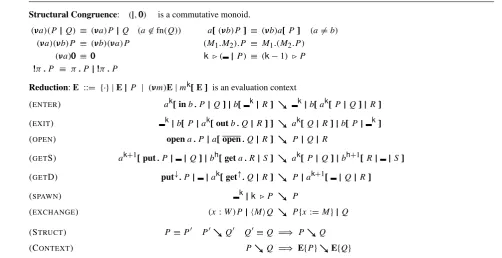
The dynamics of the calculus is given as usual in terms of structural congruence and reduction, both defined in Fig. 2. Unlike other calculi, however, in BoCa these relations are only defined for proper (i.e. well-formed) terms, a fact we will leave implicit in the rest of the presentation. In particular, the congruence!!!π ...P ≡ π ...P ||| !!!π ...P only holds withPa proper term of weight 0. Thus, to duplicate arbitrary processes we need to first “freeze” them under a spawner, i.e. we decompose arbitrary duplication into “template replication” and “process activation”. Rule (SPAWN) allows also for the spawning of processes of weight zero, since we have identified 0with 000.
The notion of structural congruences is mostly standard, with the exception of the lawk F( ||| P)≡(k−1) FP, that is specific to our calculus and regulates the interplay between slots and spawning. When used from left to right, this law transforms the term by removing all the unguarded occurrences of slots that appear directly in the scope of a spawning prefix: in doing that, the rule also redefines the weight of the process under spawning so as to preserve the well-formedness of the term. The process that results from the transformation can be thought of as a kind of normal form of the original process in which all unspawned slot occurrences are guarded or enclosed within an ambient. Process normalization is coherent with our interpretation of slots and spawning: for instance, by normalization one
has 1 F ≡0, which formalizes our intuition that spawning a free slot should indeed correspond to a no-op. More
generally, and more interestingly, normalization enables reductions that would otherwise be blocked. To illustrate, consider the processP=k F( |||P0)and the contextE{·} = · ||| k−1. As given,Pcannot be spawned inE{·}as the
context provides one fewer slots than required byP. However, we can normalizePand obtain the desired reduction
as follows:E{P} ≡E{(k−1) FP0} &&& P0.
The reduction relation&&&formalizes the intuitions discussed in Section2. In addition, we remark that making the weight of an ambient depend explicitly on its contents allows a clean and simple treatment of ambient opening: opening simply does not require resources, it rather may release those enclosed within the opened ambient. Notice also thatopenis the only capability that requires a co-capability: this means that only consenting ambients can be opened.
However, a closer look at the reductions shows that acts as a co-capability for mobility (for non-zero-weighted
ambients).
A few further remarks are in order on the form of the transfer. As it can be seen from rules (GETS) and (GETD), resource transfer is realised as a two-way synchronisation in which a context offers some of its resource units to any enclosed or sibling ambient that makes a corresponding request: the effect of the transfer is reflected in the tags that describe the resources allocated to the receiving ambients.
The format of the putand get capabilities is asymmetric as putoffers slots to any (sibling or child) process
Structural Congruence: (|||,000) is a commutative monoid.
(νννa)(P||| Q) ≡ (νννa)P|||Q (a6∈fn(Q)) a[[[(νννb)P]]] ≡(νννb)a[[[P]]] (a6=b)
(νννa)(νννb)P ≡ (νννb)(νννa)P (M1.M2).P ≡ M1.(M2.P)
(νννa)000 ≡ 000 k F( |||P) ≡ (k−1) FP
!!!π ...P ≡ π ...P||| !!!π ...P
Reduction:E ::= {·} |E|||P | (νννm)E|mk[[[E]]] is an evaluation context
ak[[[inb...P|||Q]]] |||b[[[ k|||R]]] &&& k|||b[[[ak[[[P|||Q]]] |||R]]]
(ENTER)
k|||b[[[P|||ak[[[outb...Q|||R]]] ]]] &&& ak[[[Q|||R]]] |||b[[[P||| k]]] (EXIT)
opena...P|||a[[[open...Q|||R]]] &&& P|||Q|||R (OPEN)
ak+1[[[put...P||| |||Q]]] |||bh[[[geta...R|||S]]] &&& ak[[[P|||Q]]] |||bh+1[[[R||| |||S]]]
(GETS)
put↓...P||| |||ak[[[get↑...Q|||R]]] &&& P|||ak+1[[[ |||Q|||R]]]
(GETD)
k|||k FP &&& P (SPAWN)
(x:W)P||| hMiQ &&& P{x:=M} |||Q (EXCHANGE)
P≡P0 P0&&&Q0 Q0≡ Q =⇒ P&&&Q (STRUCT)
P&&&Q =⇒ E{P} &&&E{Q}
[image:6.544.12.515.70.328.2](CONTEXT)
Fig. 2. Structural congruence and reduction.
these particular formats because they provide adequate balance between expressivity and control of interferences in the protocols for space allocation and distribution. In particular, the current choice makes it easy and natural to
express interesting programming examples and protocols (cf. the memory management example in Section3.2, which
exemplifies the balance of control and flexibility afforded by our choice). It also enables us to provide a simple encoding of named (and private) resources allocated for spawning (cf. the initial discussion in Section5). Secondly, a new protocol is easily derived for transferring resources “upwards” from children to parents using the following pair of dual put and get.
get↓a...P ,(νννm)(openm...P|||m0[[[geta...open]]]), and put↑,put.
Transfers affect the amount of resources allocated at different nesting levels in a system. We delegate to the type system of Section4to control that no nesting level suffers from resource over- or under-flows. More precisely, our
type system associates to each ambient nameatwo non-negative integersn,Nsuch thatn≤ N. The integersnand
Ncan be interpreted, respectively, as the lower and upper bounds for the weight an ambient is allowed to have. In a well-typed term and in all its reducts the weightkof the process inside an occurrence ofaalways satisfiesn≤k≤N (seeTheorem 4).
The reduction semantics itself guarantees that the global amount of resources is preserved, as can be proved by an inspection of the reduction rules. Let&&&∗be the reflexive and transitive closure of&&&. We have:
Proposition 2 (Resource Preservation). Ifw(P)6= ⊥, and P&&&∗Q, thenw(P)=w(Q).
Notice that resource preservation is a distinctive property ofclosedsystems; in open systems, instead, a process may acquire new resources from the environment, or transfer resources to the environment, by exercising theputandget capabilities. We will return to this in Section5, where we study the behavioural semantics of (an extension of) the calculus.
3.2. Examples
it suffices to insert a process!!!openin all ambients. The relevant clauses of the embedding are as follows:
[[[[[[a[[[P]]] ]]]]]] ,a0[[[ !!!open||| [[[[[[P]]]]]] ]]], [[[[[[!!!P]]]]]] ,!!!0 F [[[[[[P]]]]]], [[[[[[(νννa)P]]]]]] ,(νννa)[[[[[[P]]]]]] and the remaining ones are derived similarly; clearly all resulting processes weigh 0.
3.2.1. Parent–child swap
Given that ambients may have non-null weights, in BoCa this swap is possible only in case the father and child ambients have the same weight. We give the details for the case of weight 1: notice the use of the primitives for child to father slot transfer we defined in Section3.1.
b1[[[get↓a...put...ina...get↑|||a1[[[put↑...outb...getb...put↓||| ]]] ]]] &&&∗a1[[[b1[[[ ]]] ]]]. This example will prove useful again to illustrate effect inference in Section4.4.
3.2.2. Ambient renaming
We can represent in BoCa a form of ambient self-renaming capability. First, definespawnk P outsidea ,
exp0[[[outa...open...k FP]]]and then use it to define
abekb...P ,spawnk(bk[[[ k|||opena]]])outsidea|||inb...open...P.
Sinceopenexp||| k|||ah[[[spawnk(bk[[[Q]]])outsidea||| Q0]]] &&&∗bk[[[Q]]] |||ah[[[Q0]]]wherek,hare the weights ofQ andQ0, respectively, we get
ak[[[a bekb...P|||R]]] ||| k|||openex p&&&∗bk[[[P|||R]]] ||| k
wherekis the weight of P ||| R. So, an ambient needs toborrowspace from its parent in order to rename itself. We conjecture that renaming cannot be obtained otherwise.
3.2.3. A memory module
A user can take slots from a memory module MEM MOD using MALLOC and release them back to MEM MOD after their use.
MEM MOD, mem[[[ 256 MB|||
256 MB
z }| {
openm|||. . .|||openm ]]]
MALLOC , m[[[outu...inmem...open...put...getu...openm]]]
USER , u[[[ . . ....MALLOC|||. . ....getmem. . .put|||. . . ]]].
Notice that the format of thegetcapability provides fine control on how the space requests are served by the memory module, while keeping the encoding of the system simple. In particular, if agetrequest were not forced to specify a name, the encoding of the memory module would not guarantee the memory to take back spaces exactly from the users it previously allocated them to.
3.2.4. A cab trip
As a further example, we give a new version of the cab trip protocol from [31], formulated in our calculus. A
CALL(from,client) ,
call1[[[outclient...outfrom...incab...open...infrom... (load0[[[outcab...inclient...open]]] ||| )]]]
TRIP(from,to,client) ,
trip0[[[outclient...open...outfrom...into...done0[[[inclient...open]]] ]]]
CLIENT(from,to) ,
(νννc)c1[[[CALL(from,c)|||openload...incab...TRIP(from,to,c)
|||opendone...outcab...bye0[[[outc...incab...open...outto]]]]]]
CAB ,
cab1[[[ ||| !!!(opencall...opentrip...openbye)]]]
SITE(i) ,
sitei[[[CLIENT(sitei,sitej)|||CLIENT(sitei,sitel)||| · · · ||| ||| ||| · · · ]]]
CITY ,
city[[[CAB|||CAB||| · · · ||| · · · |||SITE(1)||| · · · |||SITE(n)||| ||| ||| · · · ]]] .
The fact that only one slot is available incabtogether with the weight 1 of bothcallandcli entprevents the cab to carry more than one call and/or more than one client. Moreover, this encoding limits also the space in each site and in the whole city.
3.3. Discussion
In its present definition, the calculus provides a simple, yet effective, framework for expressing resource usage and consumption. On the other hand, it is less effective to express and enforcepoliciesfor resourceallocation, and their distributionto distinct, possibly competing, components.
To see the problem, consider again the cab trip example given above. On the one hand, comparing with [31], we
notice that we can deal with the cab’s space satisfactorily with no need for 3-way synchronisations. On the other hand, however, as already observed in [31], this encoding may lead to unwanted behaviours, since there is no way of preventing a client to enter a cab different from the one called and/or the ambientbyeto enter a cab different from the one the client has left.
Policies for resource allocation should provide safeguards against denial-of-service threats, based on the ability of misbehaved agents to attack a host by repeated space transfer requests that could overfill the target host or leave it with no space to spawn its local processes. Similarly, policies for resource distribution should be able to express protocols in which a given resource unit is selectively allocated to a specific agent, and protected against unintended use. To illustrate, consider the following term (and assume it well-formed):
a1[[[inb.P]]] |||b[[[1FQ||| |||d[[[c1[[[outd.R]]] ]]] ]]].
Three agents are competing for the resource unit in ambientb: ambientsaandc, which would use it for their move,
and the local spawner inside ambientb. While the race betweena andcmay be acceptable – the resource unit may
be allocated bybto any migrating agent – it would also be desirable forbto reserve resources for internal use, i.e. for spawning new processes.
In the remainder of the paper we attack both problems. The system of capacity types in Section4provides static guarantees that the resources available at a given site remain within the intended bounds. The mechanism for slot naming, in Section5, yields new and effective primitives for the selective distribution of resources, and for protecting processes against the presence of races for resource acquisition.
4. Bounding resources by typing
of exchanges. The type of capabilities must therefore inform on how a capability may affect the space of the ambient in which it is exchanged and exercised.
4.1. Capacity types
We useZ to denote the set of integers, and noteZ+ andZ−the sets of non-negative and non-positive integers, respectively. We define the following domains:
Intervals ι∈ =,{[n,N] |n,N∈Z+,
n≤N}
Effects ε∈E ,{(d,i)|d∈Z−, i∈Z+}
Thread effects φ∈Φ,E →E.
The intervalsι provide a representation for the capacity bounds that ambients impose on their enclosed processes,
while the effectsεand the thread effectsφhelp characterize the behaviour of processes and capabilities, respectively. The syntax of types is defined in terms of the previous domains as follows:
Message types W ::=Ambhι, ε, χi |Caphφ, χi
Exchange types χ::=Shh|W
Process types Π ::=Prochε, χi.
Ambhι, ε, χiis the type of ambients with weight ranging inι, and enclosing processes withεeffects andχexchanges.
The exchange typesχ are defined exactly as in companion type systems for ambient calculi, and include ambient
types and capability types, with the typeShhindicating no exchange.
The interesting, and distinguishing, part of the type system is in the computation of the types and effects associated with capabilities and processes.Prochε, χiis the type of processes withεeffects andχ exchanges. Specifically, for a processPof typeProch(d,i), χi, the effect(d,i)bounds the number of slots delivered (|d|) and acquired (i) by P as the cumulative result of exercisingP’s transfer capabilities. As for capabilities,Caphφ, χiis the type of (paths of) capabilities that have thread effectφand that, when exercised, unleash processes withχexchanges.
To understand the typing of capabilities, and the nature of thread effects it is useful to start with a simpler idea for computing capability types. A first approach to typing the transfer capabilities is to assign the effects(0,1)to each get, and(−1,0)to eachput. These effects provide a sound (and accurate) estimate of the computational consequences of the corresponding capabilities as, indeed, agetacquires one slot (and delivers none), while aputdelivers one slot (and acquires none). Such estimates are accurate also when the transfer capabilities are composed in parallel, as in that case the most accurate, sound estimate of the effect of the capabilities is obtained as the sum of the composing effects. For instance, for the effect of the parallel compositionput||| geta there is no better estimate than(−1,1), which is the point-wise sum of the effects(−1,0)and(0,1).
On the other hand, if the two capabilities are part of the same thread, then the previous estimate is overly loose. To see the point notice that(−1,0)is a sound (and tighter) estimate forput...geta, as the slot acquired bygetsimply “fills in” for the slot delivered by the previousputor, dually, the effect of theputcompensates the slot acquired by the subsequentget. By the same reasoning,geta...puthas the cumulative effect(0,1).
Generalizing to the case of an arbitrary processP, ifP has effect(d,i), the effect ofput...P will be(d−1,i−1) ((d−1,0)ifi−1<0), i.e. the effect ofP“shifted downwards” by 1. Dually, the effect ofgeta...Pwill be(d+1,i+1) ((0,i+1)ifd+1 >0), i.e. the effect ofP“shifted upwards” by 1. More formally, we may represent these “shifts” by resorting to the following combinators (functions inΦ):
Put=λ(d,i).(d−1,max(0,i−1))
Get=λ(d,i).(min(0,d+1),i+1).
Based on these definitions, if P has effect ε, the effect of put...P andget a...P may be computed as Put(ε)and Get(ε), respectively. The use of functional combinators also allows a rather elegant and concise representation of the cumulative effect of paths of capabilities in terms of functional composition. To illustrate, the cumulative effect of the thread
is represented by the following effect expression (where ◦ denotes function composition in standard order, i.e. f ◦g(x)= f(g(x))):
ε = (Get◦Put◦Put◦Get◦Get◦Get◦Put)((0,0)) = (−1,2).
An alternative, somewhat more direct computation of the thread effect may be obtained by resorting to a graphical presentation of the effects of puts and gets.1Specifically, we think of agetas “one step up” and of aputas “one step
down” in the slot count and represent them graphically as and respectively.
A sequence ofget’s andput’s is then represented by the graph obtained by connecting the steps in the order in which they appear. For the previous example, the effect of the sequence
geta...put...put...geta...geta...geta...put is
The cumulative effect of the sequence is computed by taking the lowest and highest levels of the graph, which in our example are−1 and 2 as expected.
The intuition about an open capability is similar, but subtler, as the effect of opening an ambient is, essentially, the effect of the process unleashed by the open: inopenn.P, the process unleashed byopenn runs in parallel with P. Consequently, open has an additive import in the computation of the effect. To motivate, assume thatn:Ambhι, ε, χi. Openingn unleashes the enclosed process in parallel to the processP. To compute the resulting effect we may rely on the effectεdeclared bynto bound the effect of the unleashed process: that effect is then added to the effect of the continuationP. In analogy with the previous development, we introduce the following combinator:
Open(ε)=λ(d,i).(ε+(d,i)),
where+denotes component-wise sum for effects, defined as follows:(d,i)+(d0,i0)=(d+d0,i+i0). Then, ifPhas effectε0, the composite effect ofopenn.Pis computed asOpen(ε)(ε0)=ε+ε0.
We could make the analysis more precise as done by Levi and Sangiorgi in [18]. In fact, thanks to the presence
of open, we know at which point in its life a given ambient can be opened, so we can give a tight estimate of the
residual effect by then (this is the effect unleashed by opening). We do not pursue this direction as it is orthogonal to our present development and it would complicate the type system.
4.2. The typing rules
The typing rules are collected inFigs. 3and4, where we denote withidΦ the identity element in the domainΦ.
The rules rely on partial orders over intervals and effects. Such orders arise as expected, namely:[n,N] ≤ [n0,N0] whenn0≤nandN≤N0and(d,i)≤(d0,i0)whend0≤dandi≤i0.
The rules in Fig. 3 derive judgements Γ ` M : W for well-typed messages. The environment Γ is a set of
assumptions either of the shapea:Ambhι, ε, χiwitha ∈N or of the shapex:W withx ∈V, where all names and variables are distinct. The rules draw on the intuitions we gave earlier. Notice, in particular, that the capabilitiesinand outand the co-capabilityopenhave no effect, as reflected by the use ofidΦin their type. The same is true also of the
co-capabilityput↓. In fact, the weight of an ambient in whichput↓is executed does not change: the ambient loses one slot, but the weight of one of its sub-ambients increases (cf. reduction rule (GETD)).
The rules inFig. 4derive judgementsΓ ` P :Prochε, χifor well-typed processes. An inspection of the typing rules shows that any well-typed process is also well-formed (in the sense ofDefinition 1). We let0E denote the null
effect(0,0): thus, rules (000) and ( ) simply state that the inert process and the slot are processes with no effects. Rule (prefix) computes the effects of prefixes, by applying the thread effect of the capability to the effect of the process, while rule (par) adds up the effects of two parallel threads. The constructs for input, output and restriction
are standard. Rule (amb) governs the formation of ambient processes. The declared weight kof the ambient must
reflect the weight of the enclosed process. Two further conditions ensure (i) thatkmodified by the effect(d,i)of the enclosed process lies within the interval[n,N]declared by the ambient type (i.e. we getn ≤ k ≤ N), and (ii) that
the effectεdeclared by the ambient type is a sound approximation for the effects released by opening the ambient
(axi om) Γ,M:W `M:W
Γ`M :Caphφ, χi Γ `M0:Caphφ0, χi (path) Γ`M.M0:Caphφ◦φ0, χi
Γ`M:Ambh−,−,−i (get) Γ`getM:CaphGet, χi
(put) Γ`put:CaphPut, χi
(get↑)
Γ `get↑:CaphGet, χi (
put↓) Γ`put↓:CaphidΦ, χi
Γ`M:Ambh−,−,−i (in) Γ`inM:CaphidΦ, χi
Γ`M:Ambh−,−,−i (out) Γ`outM:CaphidΦ, χi Γ`M:Ambh−, ε, χi
(open) Γ`openM:CaphOpen(ε), χi
[image:11.544.37.502.78.273.2](coopen) Γ `open:CaphidΦ, χi
Fig. 3. Good messages.
(000)
Γ`000:Proch0E, χi Γ` :Proch0E, χi( )
Γ `M:Caphφ, χi Γ`P:Prochε, χi (prefix) Γ`M...P:Prochφ(ε), χi
Γ`P:Prochε, χi Γ `Q:Prochε0, χi (par) Γ`P|||Q:Prochε+ε0, χi
Γ,x:W `P:Prochε,Wi (input) Γ `(x:W)P:Prochε,Wi
Γ`M:W Γ`P:Prochε,Wi (output) Γ` hMiP:Prochε,Wi
Γ,a:Ambhι, ε, χi `P:Prochε0, χ0i (new) Γ`(νννa:Ambhι, ε, χi)P:Prochε0, χ0i
Γ`M :Ambh[n,N], ε, χ0i
Γ`P:Proch(d,i), χ0i w(P)=k
[max(k+d,0),k+i] ≤ [n,N] (d−i,min(N−n,i−d))≤ε
(amb) Γ`Mk[P] :Proch0E, χi
Γ`P:Prochε, χi w(P)=k
(spawn) Γ `k FP:Prochε, χi
Γ`π ...P:Proch0E, χi w(π ...P)=0
(bang) Γ` !!!π ...P:Proch0E, χi
Fig. 4. Good processes.
[image:11.544.39.504.148.597.2]unleashed in the opening context. Dually, the upper bound arises when the ambient is opened right after the enclosed process has completed |d| put’s, and is left withi−dget’s. On the other hand, we also know that the maximum
increasing effect released by opening ambients with weight ranging in [n,N] is N−n. Collectively, these two
observations justify the condition (d−i,min(N−n,i−d)) ≤ ε in rule (amb). Notice that the more symmetric form of the previous condition, i.e.(max(n−N,d−i),min(N−n,i−d))≤ε, is not sound, since we could derive {m:Ambh[0,0], (0,0),−i} `m[[[put]]] :Proch0E,−i, while openingmmay cause the loss of one slot.
Rule (spawn) simply checks that the process is well-formed and then defines the effect ofk F P as the effect
of the reduct P. Finally, to prevent the effects of duplicated processes to add up beyond control, with unpredictable consequences, rule (bang) enforces duplicated processes to have null effects.
The following result complementsProposition 2and shows that the capacity bounds on ambients are preserved
during computations, while the effects of processes reduce.
Theorem 3 (Subject Reduction). AssumeΓ ` P : Prochε, χi and P &&&∗ Q. ThenΓ ` Q : Prochε0, χifor some ε0≤ε.
Proof. The proof is by induction on the length of the reduction fromPtoQ. In the inductive case, the reasoning is by a case analysis of the reduction in question. Rule(EXCHANGE)follows from a standard substitution lemma which can be easily proved. The interesting cases are those for rules(GETS),(GETD)and(OPEN). We give a proof disregarding the exchange components of our capacity types, as they are irrelevant for our argument.
LetDbe a derivation for the redex of a(GETS)reduction: Γ `ak+1[[[put...P||| |||Q]]] |||bh[[[geta...R|||S]]] :Proch0Ei.
An inspection of the typing rules(amb), and(par)shows that the type of the redex must indeed be of the form given. InsideDthere must be judgements of the shape:
Γ `a: Ambhι, εi, Γ `P :Proch(d,i)i, Γ `Q:Proch(d0,i0)i,
for someι, ε,i,i0,d,d0. By rules(put)and(prefix),Γ ` P:Proch(d,i)iimpliesΓ `put...P:Proch(d−1,max(i− 1,0))i. Then the application of rule(amb)for deriving
Γ `ak+1[[[put...P||| |||Q]]] :Proch0Ei
has the following conditions:
[max(k+1+d−1+d0,0),k+1+max(i−1,0)+i0] ≤ι,
(d−1+d0−max(i−1,0)−i0,min(N−n,max(i−1,0)+i0−d+1−d0))≤ε,
whereι= [n,N]. The conditions required to apply rule(amb)for the derivation of the judgementΓ `ak[[[P|||Q]]] :
Proch0Eiare
[max(k+d+d0,0),k+i+i0] ≤ι
(d+d0−i−i0,min(N−n,i+i0−d−d0))≤ε.
These last conditions can be shown to follow from the previous ones by routine algebraic manipulations. With a similar reasoning one checks that the judgementΓ `bh+1[[[ ||| R||| S]]] :Proch0Eiis derivable. From this, we have that the judgementΓ `ak[[[P|||Q]]] |||bh+1[[[ |||R|||S]]] :Proch0Eiis derivable, as desired.
For rule(GETD)letDbe a derivation of: Γ `put↓...P||| |||ak[[[get↑...Q|||R]]] :Prochεi.
An inspection of the typing rules –(put↓),( ),(get↑),(prefix),(amb), and(par)– shows that insideDthere must be judgements of the shape:
for someι, ε0,i,i0,d,d0. By rules(get↑)and(prefix),Γ ` Q :Proch(d,i)iimpliesΓ `get↑...Q :Proch(min(0,d+ 1),i+1)i. Then the application of rule(amb)for deriving
Γ `ak[[[get↑...Q||| R]]] :Proch0Ei
has the following conditions:
[max(k+min(0,d+1)+d0,0),k+i+1+i0] ≤ι
(min(0,d+1)+d0−i−1−i0,min(N−n,i+1+i0−min(0,d+1)−d0))≤ε0,
whereι= [n,N]. The conditions required to apply rule(amb)for the derivation of the judgementΓ `ak+1[[[ |||Q|||
R]]] :Proch0Eiare
[max(k+1+d+d0,0),k+1+i+i0] ≤ι,
(d+d0−i−i0,min(N−n,i+i0−d−d0))≤ε0.
These last conditions can be shown to follow from the previous ones by easy algebraic manipulations. From the last judgement and fromΓ ` P:Prochεi, by rule(par)we concludeΓ `P|||ak+1[[[ |||Q||| R]]] :Prochεi, as desired.
For rule(OPEN), letDbe a derivation of: Γ `opena...P|||a[[[open...Q||| R]]] :Prochεi.
InsideDthere must be judgements of the shapeΓ `a : Ambhι, ε0i,Γ ` P :Proch(d,i)i, Γ `Q :Proch(d0,i0)i, andΓ `R:Proch(d00,i00)ifor someι, ε0,i,i0,i00,d,d0,d00. By rule(par)we can derive:
Γ `P|||Q|||R:Proch(d+d0+d00,i+i0+i00)i.
By rules(open)and(prefix)we get:
ε=ε0+(d,i).
The conditions for using rule(amb)in deriving
Γ `a[[[open...Q||| R]]] :Proch0Ei
are:
[max(k+d0+d00,0),k+i0+i00] ≤ι,
(d0+d00−i0−i00,min(N−n,i0+i00−d0−d00))≤ε0,
whereι = [n,N]andk =w(Q||| R). These conditions imply(d0+d00,i0+i00)≤ε0, from which we(d+d0+d00, i+i0+i00)≤ε, and this concludes our proof.
It follows as a direct corollary that no ambient may be subject to over/underflow during the computation. Given that the calculus per se admits no notion of over/underflow these notions are about the soundness of our type system to the extent that the latter is meant to enforces the allocation policies.
We useC[·]to denote an arbitrary context (that is, a term with a “hole”, not an evaluation context as defined in Fig. 2).
Theorem 4 (Type Soundness). IfΓ,a :Ambh[n,N],−,−i ` P : Prochε, χi, P &&&∗ C[ak[[[ R]]]], and the displayed occurrence of a is not in the scope of a binder for a, thenn≤k≤N.
4.3. Typed examples
We illustrate the typing system at work with a typed version of the memory module of Section3.2. We start with themallocambient
MALLOC , m[[[outu...inmem...open...put...getu...openm]]].
Since there are no exchanges, we give the typing annotation and derivation disregarding the exchange component of the types. Let Pmallocdenote the thread enclosed within the ambientm. If we letm : Ambh[0,0], (−1,0)i ∈ Γ, an inspection of the typing rules for capabilities and paths shows that the following typing is derivable for any ambient type assigned tomem:
Γ `outu...inmem...open...put...getu...openm:CaphPut◦Get◦λε ...((−1,0)+ε)i.
From this one derivesΓ `Pmalloc:Proch(−1,0)i, which givesΓ `MALLOC:Proch0Ei. As to the memory module
itself, it is a routine check to verify that the process
MEM MOD , mem[[[ 256 MB|||openm|||. . .|||openm]]]
typechecks withmem:Ambh[0,256 MB], (−256 MB,256 MB)iand withm:Ambh[0,0], (−1,0)i.
For the remaining examples from Section3.2, those that do not use the open and the transfer capabilities are easily seen to typecheck.
The parent–child swap process of Example 3.2.1 can be typed assuming the types Ambh[0,1], (−1,1)i and Ambh[0,2], (−3,2)i for ambientsa andbrespectively. The more demanding type forb is due to the encoding of capabilityget↓ausing an ambient opening. We will show the correctness of this typing as an application of the effect inference in Section4.4.
Finally, in the protocol of Example 3.2.4, one verifies that all the processes typecheck, by taking W1 =
Ambh[1,1],0Ei,W0 = Ambh[0,0],0Ei, by declaring thecwithW1and assuming the following types for the free namescall:W1,cab:W1,tr i p:W0,load :W0,done:W0,bye:W0.
4.4. Inferring effects
We have shown that the type system gives enough flexibility to typecheck interesting protocols. On the other hand, the structure of the types is somehow complex: ideally, one would like to be able to use ambient types only to specify resource-related policies, without having to worry about the effects. Thus, for instance, one would specify the memory module protocol by simply declaringm : Amb[0,0]andmem : Amb[0,256 MB]and leave it to the type system to infer the effect-related part of the types required to ensure that such bounds are indeed complied with.
We look at effect inference below. To ease the presentation, we give an inference system for the combinatorial
subset of the calculus and disregard communications (and hence we do not consider the set of variables V). It is
not difficult to infer effects for the whole calculus following the approach of [3], but it requires the introduction of variables ranging over communication types.
The ambient types give only the rangeιfor the weights of processes inside them, i.e. they have the shape:Amb−hιi. For each nameainN we introduce two integer variablesda,ia. So, in a sense, a pair(da,ia)can be looked at as an effect variablefor the ambienta. Our inference system determines (by a set of inequality constraints) the instances of effect variables which make a process typable.
In the inference system an effect is no longer a pair of integers, but a pair of expressions(e,e0)wheree,e0∈EXP
andEXPare defined by:
EXP::=da|ia|n∈Z |EXP+EXP|EXP−EXP|min(EXP,EXP)|max(EXP,EXP) witha∈N. Of course this implies that thread effects are now functions on expressions, that is:
Effects ε∈E,{(e,e0)|e,e0∈EXP}
d
( ) Γ` :Proch0Ei ⇓ ∅
c
(000) Γ`000:Proch0Ei ⇓ ∅
Γ`M:Caphφi Γ`P:Prochεi ⇓∆ \ (prefix) Γ`M...P:Prochφ(ε)i ⇓∆
Γ`P:Prochεi ⇓∆ Γ`Q:Prochε0i ⇓∆0 \ (par) Γ`P|||Q:Prochε+ε0i ⇓∆∪∆0
Γ,a:Amb−hιi `P:Prochεi ⇓∆ \ (new) Γ`(νννa:Amb−hιi)P:Prochεi ⇓∆
Γ`a:Amb−h[n,N]i Γ`P:Proch(e,e0)i ⇓∆ w(P)=k
\ (amb) Γ`ak[P] :Proch0Ei ⇓∆∪
n≤max(k+e,0), k+e0≤N,
da≤e−e0, min(N−n,e0−e)≤ia
Γ `P:Prochεi ⇓∆ w(P)=k
\ (spawn) Γ`k FP :Prochεi ⇓∆
[image:15.544.39.505.72.401.2]Γ`π ...P:Proch0Ei ⇓∆ w(π ...P)=0 \ (bang) Γ` !!!π ...P:Proch0Ei ⇓∆
Fig. 5. Effect inference.
The rules for messages in our inference system are the same as those inFig. 3, except for the rule (open) which becomes:
Γ `a:Amb−h−i
\ (open).
Γ `opena:CaphOpen(da,ia)i
The inference rules for processes are inFig. 5and the judgements they derive have the shapeΓ `P:Prochεi ⇓∆. This means that in our system, besides providing a process Pwith a process typeProchεi, we produce forP also a set of inequality constraints∆, whose satisfiability implies the typability of the process in our former system. The constraints are of the forme≤e0where the (integer) unknowns are of the formda, ia.
The only rules that contribute to the formation of the constraint set are\(par) and(\amb). Rule\(par)simply joins the sets of constraints of two parallel processes. It is only by means of rule(\amb)that we really produce new constraints. These ones are simply a different way of stating, in our inference setting, the conditions of the(amb)rule of the type system. In our inference system, instead of checking a condition, we simply record it as a constraint whose satisfiability shall be checked at the end of the inference process.
To show that constraint satisfiability is decidable we rely on a few simple transformations of the constraints generated by the inference system. First, we get rid of the occurrences ofmin()andmax()by means of a standard linear programming technique (see for example [23]). Specifically, each constraintmin(N−n,e0−e)≤ iacan be replaced by the following boolean formula:
Similarly each constraintn≤max(k+e,0)is equivalent to the following disjunction of constraints (remember that nis non-negative by definition):
n = 0 ∨ n ≤ k+e.
Thus, all the constraints generated by the inference system can equivalently be expressed in terms of a formula in quantifier free Presburger arithmetic, whose satisfiability is known to be a NP-complete problem.
More precisely, for a process withpoccurrences of ambient constructors andqdifferent ambient names we obtain a formula with`inequality constraints (where 6p≤`≤7psince the value ofnis given) and 2qunknowns.
There are many algorithms and tools for solving the satisfiability problem of a quantifier free Presburger formula. In our case we can observe that:
• We can obtain a formula in disjunctive normal form with 2pdisjuncts, each one consisting of`(where 4p≤`≤5p) inequality constraints. We can solve efficiently these disjuncts using an integer linear programming solver, like for example [25].
• The solution space of our formula can be easily determined by taking into account that the last two inequalities generated by the application of rule(\amb)imply respectivelyda≤0 andia ≥0. Moreover we have−h≤daand ia ≤hwherehis the number ofputandgetcapabilities occurring in the current process. In particular this gives da =ia =0 for all processes not containingputandgetcapabilities. Notice thathis linear in the dimension of the current process, while the general bound of the solution space depends on 2p (since the number of inequality constraints is linear inp), which in our case is exponential in the dimension of the current process. Therefore we can translate our formula to a Boolean formula by encoding each integer variable as a vector of Boolean variables of length log h. The resulting Boolean formula can be checked using a Boolean satisfiability solver, see [1].
We illustrate the inference algorithm on the process of Example3.2.1. First note that the effect of the capability put...ina...get↑isPut◦Get. Then, applying the inference rules we obtain`put...ina...get↑:Proch(−1,0)i ⇓ ∅and {m:Amb−h[0,1]i} `openm...put...ina...get↑:Proch(
dm−1,im)i ⇓ ∅. From{m:Amb−h[0,1]i} `geta...open: Proch(0,1)i ⇓ ∅we derive (valid ground inequalities are not shown)
{m:Amb−h[0,1]i} `m0[[[geta...open]]] :Proch0Ei ⇓ {dm≤ −1,1≤im}. It follows
`(νννm:Amb−h[0,1]i)(openm...put...ina...get↑|||m0[[[geta...open]]]):
Proch(dm−1,im)i ⇓ {dm≤ −1,1≤im},
i.e.,`get↓a...put...ina...get↑:Proch(dm−1,im)i ⇓ {dm ≤ −1,1≤im}, whereget↓ais as defined in Section3.1. Since
`put↑...outb...getb...put↓||| :Proch(−1,0)i,
we can derive
a:Amb−h[0,1]i `a1[[[put↑...outb...getb...put↓||| ]]] :Proch0Ei ⇓ {da≤ −1,1≤ia}. Hence, it follows that
a:Amb−h[0,1]i `get↓a...put...ina...get↑|||a1[[[put↑...outb...getb...put↓||| ]]] :Proch(dm−1,im)i ⇓ {dm ≤ −1,1≤im,da≤ −1,1≤ia}.
By considering in the context a sound assumption forb, i.e.b : Amb−h[0,2]i, a further application of rule (amb) produces the following final set of constraints
{dm≤ −1,1≤im,da≤ −1,1≤ia,1+im ≤2,db≤dm−1−im,min(2,im−dm+1)≤ib} for the whole process
It is easy now to check that the set is satisfiable if we takedm = −1,im =1,da= −1,ia=1,db= −3,ib=2, and that we can thus type the process by assumingAmbh[0,1], (−1,1)iandAmbh[0,2], (−3,2)ifor ambientsaand b, respectively.
The type inference system can readily be extended so as to make it derive also the types of ambients in addition to the effects. In particular, it suffices to consider, for each namea, two additional integer variablesna,Naand replace them respectively forn,Nin rule(amb). This way we obtain a set of constraints where alsonaandNaare unknown. If the constraints can be satisfied, then there is also a solution such that 0≤na≤k≤Na, wherekis the weight of the processP. We do not develop this extension further as we believe that, in order to specify resource control policies, ambient types ought to be given rather than inferred.
As a last remark, we note thatProchεi ⇓∆can be seen as theprincipal typingof the processesPin the sense of [32]. As such, the type system provides for a compositional type analysis, where analyzing a fragment uses only the results for its subfragments, which can be analyzed independently in any order. Compositional analysis is appealing, as it helps with separate compilation and modularity and with making a complete/terminating analysis algorithm.
5. Controlling resource races
In this section we extend the calculus with further, term-level, mechanisms to complement the typing system in providing for a richer and stronger control over the dynamics of space allocation and distribution.
As we observed in Section 3.3, a basic requirement is to provide for the ability by an ambient to reserve
resources for internal use, i.e. for spawning new processes. In fact, reserving private space for spawning is possible with the current primitives, by encoding a notion of “named resource.” This can be accomplished by defining
k
a,a[[[putk.open||| k]]], whereputkstands forput... . . ....put
| {z }
k
, and
k F(a,P) , (νννn)(n[[[(geta)k.k Fopen.P]]] |openn.opena).
Then, assumingw(P)=k, one has that(νννa)( ka |||k F(a,P))“behaves as” P, as desired.2A potential problem with this approach is that 2ais no longer congruent to 1a| 1a. This has the consequence that, e.g., a1| 1a|2 F(a,P) reduces toa[[[open]]] | Pinstead of the expected P, which yields garbage processes, and leaves room for interferences with other processes. It is also possible to encode a form of “resource renaming,” by defining:
{a/b}.P,(νn)(a[[[getb.n[[[outa.open.openb]]] |||put.open]]] |||openn.P).
Then, ab-resource can be turned into ana-resource: {a/b}.P ||| b &&&∗ P ||| a. Observe here that the messages
put.opencould be consumed before ambientn gets out ofa, so that this ambient and process Pmight be blocked.
As an example, consider the process{a/b}.P ||| b |||1 F(a,Q). There is a possible reduction leading to P ||| Q as expected, but there is another one leading to(νννn)(n[[[outa.open.openb]]] |||openn.P)|||b[[[open]]] |||Q.
Encoding a similar form of named, and reserved, resource for mobility is subtler. On the one hand, it is not difficult
to encode a construct for reserving ana-slot for ambients nameda. For example, ambients a andb may agree on
the following protocol to reserve a private slot for the move ofaintob. If we want to use the space in ambientbfor
movingawe can write the process:
(νννp,q)(p[[[inb...getkq...k Fopen...ak[[[Q]]] ]]] ||| b[[[P|||q[[[ k|||putk.open]]] |||openp|||openq]]]) wherekis the weight ofQ.
On the other hand, defining a mechanism to release a named resource to the context from which it has been received is more complex, as it amounts to releasing a resource with thesamename it was allocated to. This can be simulated loosely with the current primitives, by providing a mechanism whereby a migrating ambient releases an anonymous slot, which is then renamed by the context that is in control of it. The problem is that such a mechanism of releasing
and renaming lacks theatomicityrequired to guard against unexpected races for the released resource. Indeed, we
believe that such atomic mechanisms for named resources cannot be defined in the current calculus.
2 Using the labelled transition system defined in Section6.1one can show that these two processes are barbed congruent in the sense of
The reductions for ambient opening and exchanges are as inFig. 2, and the rules (ENTER) and (EXIT) haveρ, η∈ {a,∗}as a side condition. The omitted subscripts on ambients are meant to remain unchanged by the reductions.
ak[[[inb...P|||Q]]]ρ|||b[[[ kη|||R]]] &&& kρ|||b[[[ak[[[P|||Q]]]η|||R]]]
(ENTER)
k
η|||b[[[P|||ak[[[outb...Q|||R]]]ρ]]] &&& ak[[[Q|||R]]]η|||b[[[P||| kρ]]]
(EXIT)
bh+1[[[put...P||| η|||Q]]] |||ak[[[getbη...R|||S]]] &&& bh[[[P|||Q]]] |||ak+1[[[R||| η|||S]]]
(GETS)
put↓...P||| η|||ak[[[get↑η...Q|||R]]] &&& P|||ak+1[[[ η|||Q|||R]]]
(GETU)
k
[image:18.544.73.322.354.410.2]η|||k Fη P &&& P (SPAWN)
Fig. 6. Top-level reductions with named units.
5.1. Named resources and their semantics
To counter the lack of atomicity discussed above, we enrich the calculus with named resources as primitive notions, and tailor the constructs for mobility, transfer and spawning accordingly. Resource units come now always with a tag,
as in η, whereη ∈ N ∪V ∪ {∗}is the unit name. To make the new calculus a conservative extension of the one
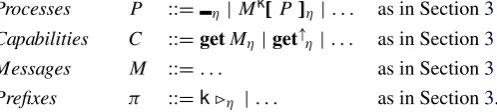
presented in Section3, we make provision for the special tag ‘*’, to be associated withanonymousunits: any process can be spawned on an anonymous slot and any ambient can be moved to it. In addition, we extend the structure of the transfer capabilities, as well as the constructs for spawning and ambient as shown in the productions below, which replace the corresponding ones in Section3
Processes P ::= η|Mk[[[P]]]η|. . . as in Section3
Capabilities C ::=getMη|get↑
η|. . . as in Section3
Messages M ::=. . . as in Section3
Prefixes π ::=kFη |. . . as in Section3.
Again, a (well-formed)termis a preterm such that in any subterm of the formak[[[P]]]ork Fη P, the process P has
weightk. The weight of a process can be computed by rules similar to those of Section3. The anonymous slots ∗
will be often denoted simply as .
An alternative to the present definition of weight for the refined calculus would be to definewη(P)as the number of ηinP, and then requirewη(P)=kin order fork Fη Pto be well-formed. We do not follow such an avenue in the present exposition, as it would complicate the spawning of processes containing slots with different tags.
The dynamics of the refined calculus is again defined by means of structural congruence and reduction. Structural congruence is exactly as inFig. 2, and the top-level reductions are defined inFig. 6.
Ambients acquire tags, as ina[[[P]]]η, as they move. Initially, we may interpret each occurrence of an ambienta[[[ P]]] as denoting the tagged occurrencea[[[P]]]a. To complete a move an ambientamust be granted an anonymous resource
or ana-resource. The migrating ambient releases a resource under the name that it was assigned upon the move (as
recorded in the tag associated with the ambient construct): this solves the problem we discussed at the beginning of Section5. Also note that the dynamics of mobility guarantees the invariant that ina[[[P]]]ηone hasη∈ {a,∗}.
The reductions for the transfer capabilities are the natural extensions of the original reductions of Section3. Here, in addition to naming the target ambient, thegetcapabilities also indicate the name of the unit they request. The choice of the primitives enables natural forms of scope extrusion for the names of resources. Consider the following system:
S , n[[[(νννa)(put...P||| a||| p[[[outn...inm...open...getna]]])]]] |||m[[[openp.Q]]].
Here, the private resource enclosed within ambientnis communicated to ambientm, asS&&&∗(νννa)(n[[[ P]]] |||m[[[Q|||
These definitions suggest a natural form of resource renaming (or rebinding), noted{{{η///ρ}}}k with the following operational semantics
{{{η///ρ}}}k...P||| ρk&&&P||| kη.
We have not defined this capability as a primitive of our calculus since it can be encoded using the new form of spawning as follows, forafresh
{{{η///ρ}}}k...P , (νννa)(k Fρ (ak[[[ kη|||open]]])|||opena...P).
We will make substantial use of resource renaming in the examples of Sections5.2and5.3.
Notice that name rebinding is a dangerous capability, since it allows processes to give particular names to anonymous slots:!!!{{{y///∗}}}. This enables possible malicious behaviour, like stealing all public resources by naming
them with a private name. Such behaviour may be prevented by restricting the spawningk Fη toη ∈ N ∪V. The
inverse behaviour, that is a “communist for yspaces”, is also well-formed and it is often useful (even though not
commendably by everyone). Notice however that it can be harmful too:!!!{{{∗///y}}}.
The possibility of encoding the renaming capability justifies also our choice of tags in the (SPAWN) reduction. As a matter of fact it would seem more reasonable to define this reduction ask Fη P||| kρ&&&P with the side condition
η =ρ or ρ = ∗. This behaviour, however, can be approximated closely enough by putting renaming processes in
parallel with the spawning one, namely{{{η///∗}}} |||. . .||| {{{η///∗}}}
| {z }
k
|||k Fη P.
It is easy to check that the type system of Section4 can be used with no substantial modifications also for the calculus with named slots. The obvious changes required are those which guarantee syntax consistency, as e.g. that thexin x can only be instantiated by a name. In particular, the typing rule for M is:
Γ `M :Ambh−,−,−i
( M). Γ ` M :Proch0E, χi
The typing rule for ∗is exactly that of , since they both denote anonymous slots.
The same properties we proved for the calculus of Section3hold for the variant with named slots discussed in this section.
Theorem 5 (Subject Reduction and Type Soundness). For the processes and reduction relation of this section, we have:
• Γ ` P:Prochε, χiand P&&&∗Q implyΓ `Q:Prochε0, χiwithε0≤ε.
• IfΓ,a:Ambh[n,N],−,−i ` P :Prochε, χi, P&&&∗C[ak[[[R]]]], and the shown occurrence of a is not in the scope of a binder for a, thenn≤k≤N.
However, the presence of named slots allows much finer control on the dynamics of space allocation and acquisition. We illustrate two relevant applications in the next two subsections.
5.2. The cab trip revisited
Named slots allow us to avoid unwanted behaviours when encoding the cab trip example (seeFig. 7). The main
steps of the protocol may now be described as follows:
• Thecabinitially contains one slot namedcallto signal that it is vacant.
• Once the ambientcallreaches acab, it is opened there to drivecabto the client’s site. In addition, openingcall insidecableaves incaba slot with the (private) nameclientof the client. Consequently, only the client whosecall reachedcabmay eventually entercab.
CALL(from,client,bye) ,
call1[[[outclient...outfrom...incab...open...infrom...( client|||openarrived...{{{bye///client}}}...openbye)]]] TRIP(from,to,client) ,
trip0[[[outclient...open...outfrom...int o...arrived0[[[open...done0[[[inclient...open]]] ]]]]]]
CLIENT(from,to) ,
(νννcli ent:W1,bye:W1) (client1[[[CALL(from,client,bye)|||incab...TRIP(from,to,client)
|||opendone...outcab...1 Fcall bye1[[[outclient...incab...open...outto... call]]]]]] ||| {{{∗///client}}}) CAB ,cab1[[[ call||| !!!(opencall...opentrip)]]]||| {{{∗///cab}}}
[image:20.544.61.488.67.217.2]SITE(i) ,sitei[[[CLIENT(sitei,sitej)|||CLIENT(sitei,sitel)||| · · · ||| ||| ||| · · · ]]] CITY ,city[[[C A B|||CAB||| · · · |||SITE(1)||| · · · |||SITE(n)||| ||| ||| · · · ]]]
Fig. 7. Cab trip with named slots.
• Upon completing the trip to destination,cabsets out to complete the protocol: it opens the synchronization ambient arrived, and rebinds the slot named client to the (again private) name of the acknowledgement ambient bye. Openingarrivedalso unleashes the inner occurrence ofdonewhich in turn entersclientto signal that it is time for clientto leavecab.
• At this stageclientexitscaband the protocol completes with ambientbyeenteringcaband being opened there to drivecabout of the destination site with a slot namedcall.
LetW1=Ambh[1,1],0EiandW0=Ambh[0,0],0Ei. As in Section4.3the typing environment containscall :W1,
cab : W1,tr i p : W0,done : W0. In the new encoding, instead, the ambientbyehas type W1and is private to the
client. Furthermore, we add the ambient arrived with type W0, and we do not need the ambientload. Using the
labelled transition system given in Section6we proved properties of the CAB system, including the expected ones
that clients will not be able to board a taxi different from that called and that the ambientbyealways enters the cab the client just left. These properties can be formalised in a natural way. For the first one, for instance, we showed the full bisimilarity between the following processes:
(νννclient,site1,cab)city[[[cab[[[insi t e1...( client||| · · ·)||| · · · ]]] |||site1[[[client[[[incab· · · ||| · · · ]]] ||| · · · ]]] ||| · · · ]]] and
(νννclient,site1,cab)(city[[[site1[[[cab[[[client[[[ · · · ]]] ]]] ||| · · · ]]] ||| · · · ]]])
where· · · stand for various processes easily recoverable by looking at the given encoding.
5.3. A travel agency
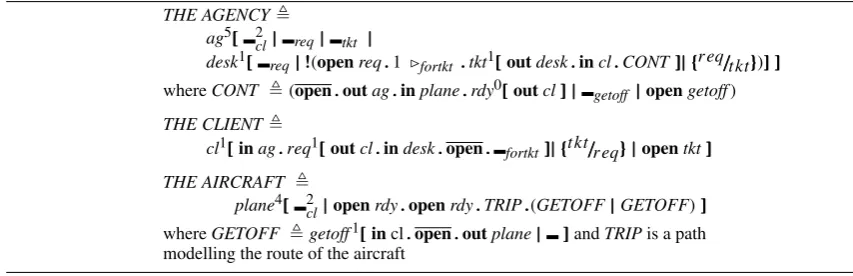
We conclude the presentation with an example that shows the expressiveness of the naming mechanisms for resources in the refined calculus. We wish to model clients buying tickets from a travel agency, paying them one slot (the fortkt inside the client), and then using them to travel by plane. At most two clients may enter the travel agency, and they are served one by one. The three components of the system are defined inFig. 8.
We assume that there exists only one sort of ticket, but it is easy to extend the example with as many kinds of ticket as possible plane routes. What makes the example interesting is the possibility of letting two clients into the agency, but serving them non-deterministically in sequence. Notice that the use of the named slots is essential for a correct implementation of the protocol. When the request goes to the desk, a slot namedtktis left in the client. This slot allows the ticket to enter the client. In this way we guarantee that no ticket can enter a client before its request has reached the desk.
We assume the aircraft to leave only when full. This constraint is implemented by means of therdyambient. The