Volume 2007, Article ID 98181,9pages doi:10.1155/2007/98181
Research Article
Perceptual Image Representation
Matei Mancas,1Bernard Gosselin,1and Benoˆıt Macq2
1Th´eorie des Circuits et Traitement du Signal (TCTS) Lab, Facult´e Polytechnique de Mons, 7000 Mons, Belgium
2Laboratoire de T´el´ecommunications et T´el´ed´etection (TELE), Universit´e Catholique de Louvain, 1348 Louvain-la-Neuve, Belgium
Received 1 August 2006; Revised 8 March 2007; Accepted 2 July 2007
Recommended by Ling Guan
This paper describes a rarity-based visual attention model working on both still images and video sequences. Applications of this kind of models are numerous and we focus on a perceptual image representation which enhances the perceptually important areas and uses lower resolution for perceptually less important regions. Our aim is to provide an approximation of human perception by visualizing its gradual discovery of the visual environment. Comparisons with classical methods for visual attention show that the proposed algorithm is well adapted to anisotropic filtering purposes. Moreover, it has a high ability to preserve perceptually important areas as defects or abnormalities from an important loss of information. High accuracy on low-contrast defects and scalable real-time video compression may be some practical applications of the proposed image representation.
Copyright © 2007 Matei Mancas et al. This is an open access article distributed under the Creative Commons Attribution License, which permits unrestricted use, distribution, and reproduction in any medium, provided the original work is properly cited.
1. INTRODUCTION
The human visual system (HVS) is a topic of increasing im-portance in computer vision research since Hubel’s work [1] and the comprehension of the basics of biological vision. Mimicking some of the processes done by our visual system may help to improve the current computer vision systems. Visual attention is part of a major task of the HVS, which is to extract relevant features from visual scenes in order to react in a relevant manner for our survival.
Several anisotropic filtering techniques are available for still images. These algorithms aim at preserving edges (con-sidered as perceptually valuable) while they lowpass filter the rest of the image. These techniques are widely used in advanced image enhancement and sometimes in pre-processing of some segmentation steps for example. How-ever, several visual attention (VA) models showed that edges were not the only areas in an image which are perceptually important. We propose here a novel and computationally ef-ficient approach of visual attention for anisotropic filtering in both still images and video sequences. This global rarity-based approach better handles spatial and temporal texture and it performs accurate detection of low-contrast defects.
The general idea of our visual attention model is de-scribed in the next section. Sections3and4provide an adap-tation of the rarity-based attention idea to still images and video sequences.Section 5deals with an application of the proposed model to anisotropic filtering of both still images
and videos. Finally, the last section will conclude the work and discuss our approach.
2. VISUAL ATTENTION
depends on the degree of understanding of the environment from previous fixations.
As the definition of preattentive vision is unclear in real-life vision, we will use the term of low-level vision which highlights pop-out regions in a parallel way without com-paring regions in the image. In this article, we will address this reflex low-level vision.
2.1. Biological background
The superior colliculus (SC) is the brain structure which di-rectly communicates with the eye motor command in charge of eye orientation. One of its tasks is to direct the eyes onto the “important” areas of the surrounding space. Studying the SC afferent and efferent paths can provide important clues about how biological systems classify scenes as interesting or not in a preattentive way.
There are two afferent pathways for the SC, one direct path from the retina and one indirect path crossing the lat-eral geniculate nucleus (LGN) and the primary cortex area V1 before coming back to the SC. There are also two efferent paths, one to the eye motor area of course, and the other one to the LGN. Studies on afferent SC pathways [3] showed that the direct path from the retina is responsible of spatial (W cells) and temporal (Y cells) analysis and the indirect path-way is mainly responsible of spatial and motion direction and certainly colour analysis. Both paths may be related to preattentive reflex attention but the indirect path also brings higher-level decisions responsible for attentive vision.
2.2. Attention modelling
Many methods may be found in the literature about visual at-tention and image saliency. Some of them attempt to mimic the biological knowledge as Itti and Koch’s (I&K) method [4]. They define a multiresolution- and multifeature-based system which models the visual search in primates. Le Meur et al. [5] suggested a global architecture close to I&K, but us-ing a smart combination between the different feature maps. Instead of combining simply normalised feature maps, they use some coefficients which give more or less weight to the different features into the final saliency map. In these ap-proaches, only local processes mimicking different cells are used.
Walker et al. [6], Mudge et al. [7], Stentiford [8], and Boiman and Irani [9] base their saliency maps on the idea that important areas are unusual in the image. The saliency of a configuration of pixels is inversely related to their oc-currence frequency. These techniques use comparisons be-tween neighbourhoods of different shapes and at different scales in order to assign an attention score to a region. Itti and Baldi [10] also published a probabilistic approach of surprise based on the Kullback-Leibler divergence also called “net sur-prisal.” These methods have a more global approach and are based on the similarity quantification inside an image or a database.
We think that the local processing done by cells is some-how globally integrated (possibly inside the SC). Our defini-tion will be based on the rarity concept which is necessarily
global. We also think that our visual attention is not driven by a specific feature as some models could assess. Heteroge-neous or homogeHeteroge-neous, dark or bright, symmetric or asym-metric, fast moving or slow moving objects can all attract our visual attention. The HVS is attracted by the features which are in minority in an image. That is why we can say that visual attention is based on the observation of things which are rare in a scene. Beyond the intuition that rarity is a concept of primary importance in computational atten-tion, the work of N¨a¨at¨anen et al. [11] in 1972 on the audi-tory attention provided evidences that the evoked potential (electroencephalogram-based) has an improved negative re-sponse called mismatch negativity (MMN) when the subject was presented with rare stimuli than with frequent ones. Ex-periments were also made using the visual stimuli. Tales et al. [12] concluded to the existence of an MMN response to visual stimuli but the rare stimuli had a different complexity compared to the most frequent ones. Crottaz-Herbette led in her thesis [13] an experiment in the same conditions as N¨a¨at¨anen for auditory MMN in order to find out if a visual MMN really exists. The result was clearly positive with a high increase of the negativity of the evoked potential when seeing rare stimuli compared to the evoked potential when seeing frequent stimuli.
2.3. Rarity quantification
A preattentive analysis is achieved by humans in less than 200 milliseconds; hence rarity quantification should be fast and simple. The most basic operation is to count similar ar-eas (histogram) and provide higher scores to the rarest arar-eas. Within the context of information theory, this approach is close to the self-information. Let us callmia message
con-taining an amount of information. This message is part of a message setM. A message self-informationI(mi) is defined
as:
Imi
= −logpmi
, (1)
wherep(mi) is the probability that a message is chosen from
all possible choices in the message setM(message occurrence likelihood). We obtain an attention map by replacing each messagemiby its corresponding self-informationI(mi). The
self-information is also known to describe the amount of sur-prise of a message inside its message set [14] as it indicates how surprised we should be at receiving that message (the unit of self-information is the bit). We estimatep(mi) as:
pmi
= H
mi
Card(M), (2)
whereH(mi) is the value of the histogramHfor messagemi,
and Card(M) is the cardinality ofM. The quantification of the message setMprovides the sensitivity ofp(mi): a smaller
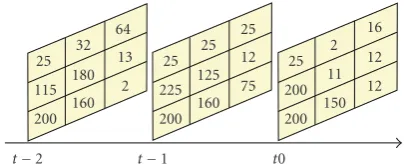
25 32 64 115 180 13 200 160 2 25 25 25 225 125 12 200 160 75 25 2 16 200 11 12 200 150 12
t−2 t−1 t0
Figure1: Example ofmiandMon a three frame sequence of 3×3
images.
3. VISUAL ATTENTION FOR STILL IMAGES
In an image, we can consider in a first approximation thatmi
is the grey-level of a pixel at a given space location andMis the entire image at a given time as shown inFigure 1. If we consider as a message the pixel with the coordinates (2, 2,t0),
we havemi = 11 andM = {25, 2, 16, 200, 11, 12, 200, 150,
12}.
The proposed model is global as the setMis considered as the entire image and the probability of occurrence of each message is computed on the whole set. Nevertheless, compar-ing only isolated pixels is not efficient. In order to introduce a spatial relationship, areas surrounding each pixel should be considered.
Stanford [15] showed that the W-cells which are respon-sible of the spatial analysis inside the SC may be separated into two classes: the tonic W-cells (sustained response all over the stimulus) and the phasic W-cells (high responses at stim-ulus variations).
Our approach uses the mean and the variance of a pixel neighbourhood in order to describe its statistics and to model the action of tonic and phasic W-cells. We compute the local mean and variance on a 3×3 sliding window and our experience showed that this parameter is not of primary importance. To find similar pixel neighbourhoods, we count the neighbourhoods which have the same mean and variance (2). Contours and smaller areas get higher attention scores on the VA map (Figure 2, top row, second image). If we con-sider only local computations as, for example, the local stan-dard deviation or the local entropy (Figure 2, top row, third and fourth image), contours are also highlighted but there are some differences like the camera fixation system or the cameraman’s trousers. The local entropy seems to provide better results but the textured grass area has a too high score. This difference is even more important on textured im-ages. As it contains repeating patterns, its rarity score will be lower. More regular a texture is, less surprising it is and less important the attention score will be [16]. Local computa-tions have a uniform high response for this textured image (Figure 2, bottom row, third and fourth image). In the case of our VA map (Figure 2, bottom row, second image), the response is important only for the white mark or the grey areas which are rare and which consequently attract human attention. Most of the vertical and horizontal separation lines between the bricks are also well highlighted. Achieved obser-vations prove the importance of a global integration of the local processing made by the cells. Rarity or surprise which
obviously attracts our attention cannot be computed only lo-cally, but they need to be estimated on the whole image.
Moreover,Figure 3compares I&K model to the proposed VA map for a visual inspection of an apple. The left image displays the original apple and the low-contrast defect con-tour in red. The I&K model does not manage to locate the defect even after more than 20 fixations and it focuses on the apple edges, whereas the proposed model (right image) pro-vides to the defects the more important attention score after the apple edges. Even if for general purposes I&K model pro-vides consistent results concerning saliency, our rarity-based model outperforms it in detecting abnormalities and defects especially in the case where these defects have a low contrast with their neighbourhood [17] and humans detect them us-ing global rarity or strangeness in the image.
4. VISUAL ATTENTION FOR VIDEO SEQUENCES
Y cells, which are responsible for the motion analysis, have a high temporal resolution but a low spatial one [1]. Thus, the image spatial resolution is reduced and a 3×3 window mean filtering is applied on the resulting image. As Y cells are not sensitive to colour, only the luminance is used.
Messagemis here the grey-level of a pixel at a given spa-tial location and message set M is the history of all grey-levels the pixel had over time. For example, the pixel with the coordinates (2, 2,t0) inFigure 1hasmi = 11 andM =
{180, 125, 11}.
However, if at each frame, the whole pixel history is needed, this may need huge size data to be stored. Hopefully, our ability to forget lets us specify a history size and to take into account only recent frames providing a limit to the set M.
As motion is generally rare in an image where most pixels are quite the same from one frame to another, moving objects will be naturally well highlighted. On the top ofFigure 4, a video frame was annotated with two regions. Region 1 is a flickering light (regular time texture). The second region is a walking person. The middle row ofFigure 4displays a mo-tion estimamo-tion map obtained by the subtracmo-tion of the cur-rent frame from a 200-frame-estimated background using a Gaussian model (GM) [18] and its thresholded map. The bottom row ofFigure 4displays our VA map computed on a 200-frame history and its thresholded map. The GM-based motion map and our VA map were both normalised and the same threshold was used in both cases. The two thresholded maps show that the region 2 is detected by both approaches. Our model seems to detect more largely the walking per-son which is underestimated by the GM method, but it also detects a little part of its shadow. The most noticeable diff er-ence is in the region 1. Our VA model awards little attention score to the flickering light as it has a higher frequency and thus is a less rare event.
Figure2: Left to right: initial image, proposed VA model, local standard deviation, local entropy.
Figure3: Left to right: original annotated defected apple, saccades and fixations in I&K, proposed VA map.
while the memory did not record enough events to see them as less rare, but after 200 frames, the attention score of these two events naturally decreases without the need of any high-level information or inhibition. As the attention map is here only computed in parallel across the visual field and no serial region computation is required, this is a low-level and reflex process. These two examples show that the same behaviour is obtained for temporal or spatial attention: textures, in space or in time, are considered as less important areas because of the global integration of information in space or in time.
5. APPLICATION: ANISOTROPIC IMAGE REPRESENTATION
5.1. An attention-based anisotropic filtering framework
Unlike digital cameras and their uniform sampling acquisi-tion system, humans do not see the world uniformly. The retina receptors are not equally dispatched on its surface, but they are concentrated around the centre of the optical axis in a place called fovea [1]. The image resolution exponentially decreases from the fovea to the retina periphery. The brain gets information about the visual environment by registering several views acquired while the eye fixates some “interesting points.”
Computationally, these interesting points may be consid-ered as the most highlighted areas of the VA map, thus the most salient regions in the image. While the eye fixates the highest-level attention areas, the resolution of the other areas dramatically decreases when going further and further from the fixations. The proposed perception of the visual environ-ment is based on the fact that a mean observer will fixate the higher attention level areas and only then he will have a look at the others.
To mimic this perceptual behaviour, the VA map is first separated into 10 areas (10 is experimentally chosen) sorted by level of saliency. A decreasing resolution function (1/x like) which is quite well correlated with the distribution of the cone cells in the retina is used. To decrease the resolu-tion, a simple idea is to use lowpass filters with an increasing kernel size from the unfiltered most salient areas to the most filtered and least salient areas. The kernel sizeKis defined as
K=α+β
1−1 x
. (3)
Figure4: Annotated frame on top. Middle row: GM-based motion estimation map and thresholded map, Bottom row: our VA map and thresholded map.
Figure5: Annotated frame on top. Middle row: GM-based motion estimation map and thresholded map, Bottom row: our VA map and thresholded map.
Figure6: Left: original image, top row: I&K saliency map and cor-responding anisotropic filtering (β=23,α=0, OT=0), Bottom row: our VA map and corresponding anisotropic filtering (β=23,
α=0, OT=0).
The parameterαcan optionally be used to control the kernel size of the filtering (K) for the most salient regions. The default value is “0” which means that the most salient areas from an image are not filtered at all. Nevertheless, in some applications (e.g., high frequency noise spreads on the entire image) one may want to filter with a certain kernel size even the most important areas.
Finally, a parameter called “observation time” (OT) is also added to the algorithm. When OT=0, the image is vi-sualised as previously described by keeping a good resolution only to the most salient regions. More OT increases, more we model the fact that a viewer has more time to observe the scene, hence after visualizing the most salient areas, he will also have a look at the least salient ones.
Figure7: Anisotropic filtering (β=8,α=0) from left to right: OT=0, OT=2, OT=4 and OT=8.
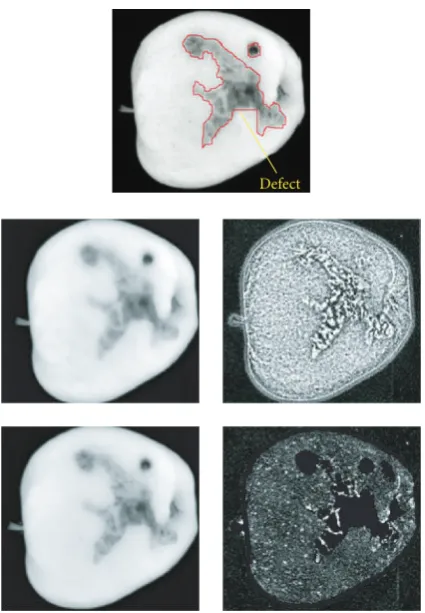
Defect
Figure8: Top: the annotated original image, middle row: PM filter-ing and difference with the original, bottom row: proposed filtering and difference with the original.
difficult to compare several attention models as few of them are publicly available. Therefore, the proposed VA algorithm was chosen because it efficiently highlights the interesting ar-eas and their edges which is important for filtering purposes. This method is also simple to implement and fast which is a critical point especially for video sequences filtering.
5.2. Still images attention-based anisotropic filtering
Figure 7shows the cameraman image in an anisotropic rep-resentation (β = 8). When OT = 0, only the very salient regions have a high resolution, as the rest of the image was
lowpassed. When OT increases, the image resolution is en-hanced in more regions until a uniform high resolution.
If we compare the proposed anisotropic representation with a classical anisotropic filtering as the Perona and Malik (PM) diffusion algorithm [20], there is no significant diff er-ence on an image like the cameraman. An objective compari-son between the different algorithms is difficult and depends on the application of interest. Some papers which compare anisotropic filtering techniques use as a comparison criterion the fact that a filtering technique is “good” if it preserves well the boundaries and provides sharper “objects” edges than the others using several sets of parameters [21]. Based on the sharpness of the edges for a set of natural scene images, the results of the presented algorithm appeared to be equivalent to those of the PM algorithm. Even if for general purpose images, the proposed algorithm has equivalent results with already existing algorithms, it brings improvements for some categories of still images.
Our algorithm leaves the important areas unfiltered while classical approaches may filter the image between the high gradients. This case may be seen in Figure 8. The defect on the apple has an important contrast, so both methods keep the defect edges quite well defined even if the proposed method seems more accurate; but inside the defect, some variations have less contrast, which lead to different results using the PM algorithm and the proposed one. While de-tails inside the defect are lost using the PM diffusion, they remain intact when using the proposed anisotropic filtering. This fact can be verified by the difference between the fil-tered image and the original one. If both methods filter the healthy skin, the PM algorithm also filters the defect and looses plenty of information about it (middle row, last im-age). The proposed algorithm keeps the main information of the defect unfiltered (bottom row, last image) preserving its characteristics.
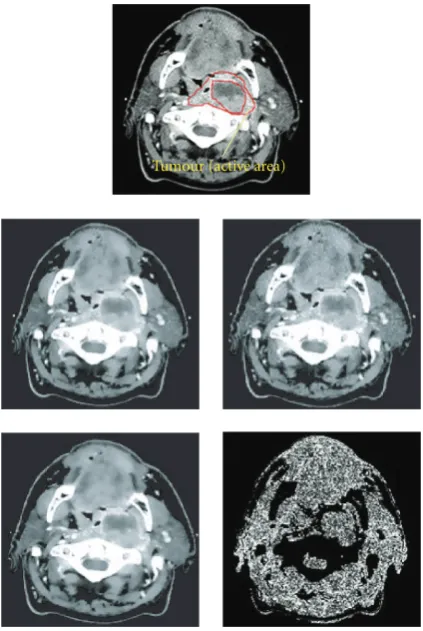
Tumour (active area)
Figure9: Top: the annotated original image, middle row: PM fil-tering (smooth muscles) and PM filfil-tering (good quality tumour), bottom row: proposed filtering and difference with the original.
The ability to keep the entire region of interest unfiltered is an important advantage of the proposed method. Usually, full resolution is needed for regions of interest for further fea-ture extraction in domains like image-based quality control or medical imaging.
5.3. Video sequences attention-based anisotropic filtering
Let us now generalise the image anisotropic representation to video sequences. The maximum operator is used to fuse the spatial and temporal saliency maps of a frame: humans react to the most important stimulus from all the saliency maps (Figure 10).
Figure 11shows in each column for three different video sequences the evolution of the image resolution from a first frame to increasing OT values on the following frames. Hu-mans first look at the moving regions, and then frame by frame they discover the rest of the image. Usually after a cer-tain time, if the background is fixed, the observer will then focus only on the moving objects. If parts of the moving tree or flickering light have a good resolution even when OT=0, this is not due to their temporal attention map (seeFigure 4) but to their spatial saliency map.
The interest of the anisotropic filtering in video se-quences is to enhance an adaptative coding or information transmission method. These methods aim at transmitting first important information with a small compression rate, and then the less important information with a higher com-pression rate. The proposed filtering technique is able to smoothen areas which are less important before the com-pression leading to a higher comcom-pression rate for the same quality factor.
Table 1displays the sizes of the top frames inFigure 11
for the sequences S1, S2, and S3 and the different file sizes, function of the OT parameter after using a JPEG compres-sion with a quality of 90. One can see that for low OT values, the images are naturally twice smaller than the original.
Even if the file size difference for OT = 5 or OT = 8 is less significant, the perceptual difference between the im-ages is small and the difference of compression for a MJPEG video file (25 frames per second) could become significant. Moreover, by varying the OT value, the compression rate be-comes scalable and it is able to adapt to the network in order to provide a realtime transmission, even if sometimes, de-tails considered as less important are smoothed. The main information may remain unfiltered and realtime. For this scheme, classical MJPEG compression algorithm would re-main unchanged: the only need is an anisotropic filtering be-fore the transmission. Here, the transmission “intelligence” is not contained into the compression algorithm but in the preprocessing step.
6. CONCLUSION
We presented a rarity-based visual attention (VA) model working on both still images and video sequences. This model is a reflex one and it takes into account the whole im-age and not only local processing. Mathematically, the model is based on the self-information (1) which expresses how “surprising” information is and its results are close to the ex-pected reaction of a human.
Comparisons were made between the spatial VA map, the gradient amplitude and the local entropy, showing some similarities but also fundamental differences connected to the global computation of our model versus local compu-tations. As spatial textures are repeating patterns, their rarity and their saliency will be lower than the saliency of each of their isolated patterns. The proposed model was also com-pared with a reference publicly available algorithm: the I&K model. For the precise case of low-contrast defects, our VA model outperforms the I&K one.
Figure10: Left to right: the video frame, the temporal VA map, the spatial VA map and the final VA map.
Figure11: Top to bottom: anisotropic representation on several consecutive frames for sequences S1, S2, S3 (β=21,α=0, OT=0, 2, 5, 8 from top to bottom).
these temporal textures are not rare and allow low attention scores to them.
An anisotropic representation based on the retina prop-erties was then provided for both still images and video se-quences. The presented model is particularly well adapted to provide attention maps for filtering and coding as op-posed with I&K model which provides fuzzy saliency maps difficult to use for this particular application. Comparisons with the classical Perona and Malik anisotropic filtering
Table1: JPEG quality 90 compression on original S1, S2, S3 top frames fromFigure 11and on filtered frames using the proposed perceptual representation at different OT values.
OT S1 S2 S3
(original: 6.39 KB) (original: 8.29 KB) (original: 7.47 KB) 0 3.89 KB 3.99 KB 3.39 KB
2 5.19 KB 5.93 KB 5.41 KB 5 6.14 KB 7.58 KB 6.74 KB
8 6.36 KB 8.10 KB 7.29 KB
understanding and even at a low-level processing, important information is more accurately found than with local pro-cessing methods.
The perceptual video images representation that we pro-vide seems to correspond to a human-like approach of our environment with high attention scores on moving objects, but also with a progressive discovery of the background. Ex-amples on several video sequences show this evolution of im-age discovery and demonstrate the ability to provide higher compression rates for the same JPEG quality compression. Scalable video compression can thus be achieved by vary-ing the OT parameter of the anisotropic filtervary-ing prior to the compression step.
Compared to other global attention models described in
Section 2.2, our approach is much simpler and related to the information theory framework. It can be generalised from image to video and even to other signals like sound. More-over, our model does not use multiresolution at this stage and it can be efficiently coded for real-time processing.
ACKNOWLEDGMENT
The authors would like to thank the Multivision group of Multitel research centre, Belgium for the high quality and nu-merous video sequences they provided.
REFERENCES
[1] D. H. Hubel,Eye, Brain, and Vision, Scientific American Li-brary, no. 22, W. H. Freeman, New York, NY, USA, 1989. [2] A. M. Treisman and G. Gelade, “A feature-integration theory
of attention,”Cognitive Psychology, vol. 12, no. 1, pp. 97–136, 1980.
[3] J. W. Crabtree, P. D. Spear, M. A. McCall, K. R. Jones, and S. E. Kornguth, “Contributions of Y- and W-cell pathways to re-sponse properties of cat superior colliculus neurons: compari-son of antibody- and deprivation-induced alterations,”Journal of Neurophysiology, vol. 56, no. 4, pp. 1157–1173, 1986. [4] L. Itti and C. Koch, “A saliency-based search mechanism for
overt and covert shifts of visual attention,”Vision Research, vol. 40, no. 10–12, pp. 1489–1506, 2000.
[5] O. Le Meur, P. Le Callet, D. Barba, and D. Thoreau, “A coher-ent computational approach to model bottom-up visual at-tention,”IEEE Transactions on Pattern Analysis and Machine Intelligence, vol. 28, no. 5, pp. 802–817, 2006.
[6] K. N. Walker, T. F. Cootes, and C. J. Taylor, “Locating salient object features,” inProceedings of the 9th British Machine
Vi-sion Conference (BMVC ’98), vol. 2, pp. 557–566, Southamp-ton, UK, September 1998.
[7] T. N. Mudge, J. L. Turney, and R. A. Volz, “Automatic genera-tion of salient features for the recognigenera-tion of partially occluded parts,”Robotica, vol. 5, no. 2, pp. 117–127, 1987.
[8] F. W. M. Stentiford, “An estimator for visual attention through competitive novelty with application to image compression,” in Proceedings of the 22nd Picture Coding Symposium (PCS ’01), pp. 101–104, Seoul, Korea, April 2001.
[9] O. Boiman and M. Irani, “Detecting irregularities in images and in video,” inProceedings of the 10th IEEE International Conference on Computer Vision (ICCV ’05), vol. 1, pp. 462– 469, Beijing, China, October 2005.
[10] L. Itti and P. Baldi, “A principled approach to detecting sur-prising events in video,” inProceedings of IEEE Computer So-ciety Conference on Computer Vision and Pattern Recognition (CVPR ’05), vol. 1, pp. 631–637, San Diego, Calif, USA, June 2005.
[11] R. N¨a¨at¨anen, A. W. K. Gaillard, and S. M¨antysalo, “Early selective-attention effect on evoked potential reinterpreted,” Acta Psychologica, vol. 42, no. 4, pp. 313–329, 1978.
[12] A. Tales, P. Newton, T. Troscianko, and S. Butler, “Mismatch negativity in the visual modality,”NeuroReport, vol. 10, no. 16, pp. 3363–3367, 1999.
[13] S. Crottaz-Herbette, “Attention spatiale auditive et visuelle chez des patients h´emin´egligents et des sujets normaux: ´etude clinique, comportementale et ´electrophysiologique,” M.S. the-sis, University of Geneva, Geneva, Switzerland, 2001. [14] M. Tribus,Thermodynamics and Thermostatics: An
Introduc-tion to Energy, InformaIntroduc-tion and States of Matter, with Engineer-ing Applications, D. Van Nostrand, New York, NY, USA, 1961. [15] L. R. Stanford, “W-cells in the cat retina: correlated morpho-logical and physiomorpho-logical evidence for two distinct classes,” Journal of Neurophysiology, vol. 57, no. 1, pp. 218–244, 1987. [16] M. Mancas, C. Mancas-Thillou, B. Gosselin, and B. Macq,
“A rarity-based visual attention map: application to texture description,” inProceedings of IEEE International Conference on Image (ICIP ’06), pp. 445–448, San Antonio, Tex, USA, September 2006.
[17] M. Mancas, B. Unay, B. Gosselin, and D. Macq, “Computa-tional attention for defect localisation,” inProceedings of ICVS Workshop on Computational Attention & Applications (WCAA ’07), Bielefeld, Germany, March 2007.
[18] C. R. Wren, A. Azarbayejani, T. Darrell, and A. P. Pentland, “Pfinder: real-time tracking of the human body,”IEEE Trans-actions on Pattern Analysis and Machine Intelligence, vol. 19, no. 7, pp. 780–785, 1997.
[19] A. P. Bradley and F. W. M. Stentiford, “JPEG 2000 and region of interest coding,” in Digital Image Computing: Techniques and Applications (DICTA ’02), pp. 303–308, Melbourne, Aus-tralia, January 2002.
[20] P. Perona and J. Malik, “Scale-space and edge detection using anisotropic diffusion,”IEEE Transactions on Pattern Analysis and Machine Intelligence, vol. 12, no. 7, pp. 629–639, 1990. [21] D. Barash and D. Comaniciu, “A common framework for