A Multi-Dimensional Trust Model for Heterogeneous Contract Observations
Steven Reece and Stephen Roberts
Department of Engineering ScienceUniversity of Oxford Oxford, OX1 3PJ, UK. {reece,sjrob}@robots.ox.ac.uk
Alex Rogers and Nicholas R. Jennings
Electronics and Computer ScienceUniversity of Southampton Southampton, SO17 1BJ, UK.
{acr,nrj}@ecs.soton.ac.uk
Abstract
In this paper we develop a novel probabilistic model of computational trust that allows agents to exchange and combine reputation reports over heterogeneous, corre-lated multi-dimensional contracts. We consider the spe-cific case of an agent attempting to procure a bundle of services that are subject to correlated quality of ser-vice failures (e.g. due to use of shared resources or in-frastructure), and where the direct experience of other agents within the system consists of contracts over dif-ferent combinations of these services. To this end, we present a formalism based on the Kalman filter that rep-resents trust as a vector estimate of the probability that each service will be successfully delivered, and a co-variance matrix that describes the uncertainty and cor-relations between these probabilities. We describe how the agents’ direct experiences of contract outcomes can be represented and combined within this formalism, and we empirically demonstrate that our formalism provides significantly better trustworthiness estimates than the alternative of using separate single-dimensional trust models for each separate service (where information re-garding the correlations between each estimate is lost).
Introduction
Computational models of trust have recently generated a great deal of research interest within the academic literature of multi-agent systems. Such models allow agents to select between various suppliers of services on the basis of their reliability or trustworthiness. To be effective, these mod-els should allow agents (i) to estimate the trustworthiness of a supplier as they acquire direct experience, (ii) to express their uncertainty regarding this estimate, (iii) to exchange their estimates as reputation reports, and (iv) to filter and fuse these reputation reports with their own direct experi-ence to yield more accurate estimates.
While much of the work within this area has used do-main specific or ad hoc trust metrics (see Ramchurn, Hunyh, & Jennings (2004) for a review), a growing body of re-search shows that the desiderata described above may be achieved through grounding computational trust models in probability theory. Specifically, models of this form have
Copyright c2007, Association for the Advancement of Artificial Intelligence (www.aaai.org). All rights reserved.
been presented by a number of researchers, and typically they use a beta distribution to represent an agent’s belief that a supplier will successfully fulfill a single-dimensional con-tract (Jøsang & Ismail 2002; Teacy et al. 2006).
In recent work we have extended such probabilistic trust models to consider cases in which a contract’s success or failure is measured over multiple dimensions (Reece et al. 2007). These cases are common in real-world applications (e.g. within a supply chain where a contract specifies min-imum timeliness, quality and quantity criteria), and in such cases, we would expect there to be correlations between the success or failure of each contract dimension (e.g. suppliers may trade-off failure in one dimension to achieve another; sacrificing quality or shipping a partial order to achieve a delivery deadline). In this context, we have shown that it is essential to explicitly consider these correlations if the expected utility of interacting with any particular supplier is to be accurately estimated. We have presented a for-malism whereby the Dirichlet distribution (a natural multi-dimensional extension of the beta distribution) is used to represent an agent’s correlated beliefs regarding these mul-tiple contract dimensions, and we have described how these beliefs may be communicated between agents as reputation reports, and fused with an agent’s own direct experience.
subsets of the entire bundle (i.e. one agent may only have used audio services provided by this supplier, while another may have experience of procuring both video and audio ser-vices but not data serser-vices). As yet, no principled compu-tational trust model exists that allows an agent to combine these heterogeneous contract observations, while still main-taining information regarding their correlations.
To rectify this shortcoming, in this paper we develop just such a computational trust model. In doing so, we adopt a formalism common within the academic literature of tar-get tracking and data fusion, and we use the Kalman filter to combine these heterogeneous contract observations. This approach is attractive since not only does it provide a solu-tion to the problem at hand, but it also enables other results within the data fusion literature such as the gating of incon-sistent estimates and the elimination of rumour propagation within decentralised information systems to be naturally in-corporated into future computational trust models.
In more detail, we first show that in order to estimate the expected utility of a bundle of services, an agent must use a trust model that allows it to estimate (i) the probability that each service will be successfully delivered, and (ii) the correlations between these estimates. We then build on this model and make the following contributions:
• We develop a benchmark trust model for dealing with heterogeneous contract observations that uses separate single-dimensional trust models (specifically independent beta distributions) for each individual service within the bundle. This approach provides consistent estimates but does not represent correlations between the services.
• We describe a novel formalism that uses the Kalman fil-ter to combine agents’ hefil-terogeneous contract observa-tions while also explicitly representing the correlaobserva-tions between the services. We show how agents can calculate prior trust estimates and reputation reports from their own direct experience, and how these can be fused together to yield posterior trust estimates.
• We empirically demonstrate that by explicitly captur-ing the correlations between the services, our formalism based upon the Kalman filter yields far more precise es-timates of the trustworthiness and expected utility com-pared to the alternative approach of using independent beta distributions. In our experiments the information content of estimates derived from the Kalman filter is typ-ically three times that of estimates derived from the inde-pendent beta distributions.
The remainder of this paper is organized as follows: we first review related work, and then discuss the specific model we consider in this paper. We then describe our formalism us-ing the Kalman filter, and present an empirical validation. Finally, we conclude and discuss future work.
Related Work
A number of researchers have presented probabilistic com-putational trust models for single dimensional contracts. Jøsang & Ismail (2002) describe the Beta Reputation System whereby the reputation of a supplier is compiled from the
positive and negative reports of agents who have interacted with it, and this reputation is represented by a beta distribu-tion. Likewise, Teacy et al. (2005) use the beta distribution to describe an agent’s belief in the probability that a supplier will successfully fulfill its commitments. They present a for-malism based on Bayesian statistics that allows an agent (i) to estimate this probability from its own direct experience, (ii) to communicate these estimates as reputation reports us-ing the sufficient statistics of the beta distribution, and (iii) to combine such reports to provide more accurate estimates. While these models only deal with single dimensional contracts, other researchers have noted the need for multi-dimensional models, and indeed, a number of such models have been published. For example, both Sabater & Sierra (2001) and Griffiths (2005) present multi-dimensional trust models, in which agents form contracts based on multiple variables. Both models provide heuristics to update these dimensions given observations of contract outcomes, and to combine these dimensions into a scalar metric that can be used to select between suppliers.
In earlier work we have combined these approaches within a probabilistic multi-dimensional trust model in which the Dirichlet distribution is used to represent an agent’s correlated beliefs regarding the probability that a supplier will successfully fulfill each contract dimension. We considered an agent that is attempting to estimate the expected utility of a contract, and showed that this leads to a principled means of combining multi-dimensional beliefs into expected utility.
In this paper, we significantly extend this approach by considering the case that the agents’ direct experience repre-sents contracts over heterogeneous dimensions. In this case, the formalism described above can not be used since it is not possible to simply aggregate the observed contract out-comes in this way. Thus, we must develop an alternative approach and here we use the Kalman filter in order to fuse these heterogeneous contract observations.
Expected Utility of a Contract
We start by considering an agent attempting to procure a bundle of services (such as audio, video and data services) from a single supplier. In order to make a rational decision, or to negotiate a price for this bundle, the agent must es-timate the expected utility of a contract with this supplier. Thus, we denote the outcome of a contract as a vector, X, that indicates whether or not each service within the bun-dle was successfully delivered (e.g. X = {oa = 1, ob = 0, oc = 0, . . .}indicates that serviceawas successfully de-livered, while services bandcwere not). Ifu(oa = 1)is the marginal utility that the agent derives if serviceais suc-cessfully delivered1, then the expected utility of the agent
will depend on the probability that this happens,p(oa = 1). However, neither the probabilities, nor the correlations be-tween them, are not known to the agent, and thus, it must use observations of previous contract outcomes to determine a
1
distribution over their possible values. It can then determine an expectation of the expected utility of the contract:
E[E[U]] = ˆp(X)TU(X) (1)
and a variance, describing its uncertainty:
Var(E[U]) =U(X)TP(X)U(X) (2)
where:
U(X) =
u(oa= 1) u(ob= 1) u(oc= 1)
.. .
(3)
Thus, the agent’s estimate of the expected utility is depen-dent on a trust estimate composed of two expressions: a vec-tor estimate of the probability that each service is success-fully delivered:
ˆ
p(X) =
ˆ
p(oa= 1) ˆ
p(ob= 1) ˆ
p(oc= 1) .. .
(4)
and a covariance matrix that describes the uncertainty and correlations in these estimates:
P(X) =
Va Cab Cac . . . Cab Vb Cbc . . . Cac Cbc Vc . . .
..
. ... ...
(5)
where the diagonal terms,Va,Vb andVc, represent the un-certainties inp(oa = 1),p(ob = 1)andp(oc = 1), and the off-diagonal termsCab,CacandCbcrepresent the correla-tions between these probabilities.
Heterogeneous Contracts
The previous section showed that in order to estimate the utility of a contract an agent must calculate a trust esti-mate composed of the vector,pˆ(X), and covariance matrix, P(X). In earlier work we presented a formalism using the Dirichlet distribution that allows an agent to calculate both these expressions from its direct experience of previous con-tract outcomes (Reece et al. 2007). Within this formalism, an agent that has observedNcontract outcomes in total sim-ply records, for each pair of services (e.g.aandb), the num-ber of times that both were delivered successfully,nab
11, the
number of times both were delivered unsuccessfully, nab
00,
and both combinations in which one was successfully de-livered and the other unsuccessfully dede-livered,nab
01andn
ab
10.
These counts over contract outcomes can be communicated as reputation reports, and these reputation reports can be combined by simply aggregating the counts.
However, this formalism is limited to the case that con-tract observations are homogeneous (i.e. all agents observe contracts over the same dimensions). This is the case since there is no way of aggregating the counts over contract out-comes of an agent who has observed two services, with those
of an agent who only observed one service. Thus, in this sec-tion, we present two formalisms that address the more gen-eral case where contract observations are heterogeneous. We first describe a simple benchmark formalism using indepen-dent beta distributions, and then describe our full formalism that uses the Kalman filter.
Inflated Independent Beta Distributions
We can provide a reasonable benchmark formalism for deal-ing with heterogeneous contracts through a simple exten-sion of a single dimenexten-sional trust model. That is, we do not explicitly represent the correlations between the ser-vices within the bundle, but rather, we use independent beta distributions to represent each individual service. Thus, if an agent has direct experience of N previous contract out-comes, in which service a was successfully delivered na times, then the trust estimate, pˆ(X), can simply be calcu-lated using the standard result from the beta distribution2 that:
ˆ
p(oa= 1) = na+ 1
N+ 2 (6)
Similarly, we can calculate the diagonal terms of the covari-ance matrix,P(X), by again using the standard result from the beta distribution that:
Va=
(na+ 1)(N−na+ 1)
(N+ 2)2(N+ 3) (7)
Finally, rather than explicitly calculating the off-diagonal el-ements of the covariance matrix, we can derive a conserva-tive covariance matrix3by simply setting the off-diagonal
el-ements to zero, and multiplying the diagonal variance terms by the number of dimensions in the state vector,X. Thus in the case of two services we have:
P(X) =
2Va 0 0 2Vb
(8)
This process is known as covariance inflation, and reflects the fact that while we do not know the correlations be-tween the services, we know that they may be correlated, and thus, we require a conservative covariance matrix that covers any possible correlation (Hanebeck, Briechle & Horn 2001; Reece & Roberts 2005).
This simple formalism is attractive; by not explicitly mod-elling the correlations between services it allows us to fuse heterogeneous contract observations by simply aggregating the counts (i.e. finding the total number of times servicea was successfully delivered out of the total number of con-tract observations). However, as we shall show later, the lack of explicit correlation information causes it to perform poorly. Thus, in the next section we develop a more sophis-ticated approach using the Kalman filter to fuse heteroge-neous estimates containing correlation information.
2
See Teacy et al. (2005) or Reece et al. (2007) for example.
3
A covariance matrix is consistent (or conservative) when it is not less than the actual distribution of the true trustworthiness,
A Kalman Filter Trust Model
The Kalman filter is a natural choice for our formalism, since within the academic literature of data fusion it is com-monly used to fuse observations over multiple correlated dimensions (Bar-Shalom, Li, & Kirubarajan 2001). This work generally assumes Gaussian distributions. However, the Kalman filter can also be used for non-Gaussian distri-butions (Maryak, Spall, & Heydon 2004), and we describe how it can be applied to Dirichlet distributions in order to fuse heterogeneous trust estimates from multiple agents.
Our Kalman filter trust model operates by fusing an agent’s prior trust estimate (calculated from an agent’s own direct experience of previous contract outcomes) with rep-utation reports that are received from other agents in order to give a posterior trust estimate. As described earlier, these trust estimates are represented by a vector,pˆ(X), and a co-variance matrix,P(X), and the standard form of the Kalman filter provides two equations to update these:
ˆ
pposterior= ˆpprior+K(o−pˆprior) (9) Pposterior=Pprior[1−K] (10)
whereKis the Kalman gain:
K=Pprior(Pprior+R)−
1
(11)
andois an observation with covarianceR, that together rep-resent the reputation reports received from other agents (we discuss the details of these later).
Now, when we have heterogeneous contracts, one or more dimensions of either the prior estimate or the reputation re-ports may be missing. Within the Kalman filter framework we can simply represent these missing contract observations by setting the corresponding diagonal elements of the co-variance matrix to infinity. By doing this we are effectively saying that the estimate for this contract part has no cer-tainty.
Actually, performing these matrix operations involving infinity can be problematic. We can avoid this by using the information form of the Kalman filter whereby an estimate is represented by its precision,Y, which is the inverse of the correlation matrix (i.e. Y =P(X)−1
), and its information estimate, yˆ, which is the product of the precision and the state estimate (i.e.yˆ=P(X)−1
ˆ
p(X)).
In this case, the missing information can be represented by inserting zeros into the precision matrix, and as before, the Kalman filter allow us to combine reputation reports with prior beliefs to yield a posterior information estimate and precision matrix:
ˆ
yposterior = ˆyprior+ ˆyo (12) Yposterior =Yprior+Yo (13)
whereYo =R−1andyˆ=R−1o. The information form of the Kalman filter is particularly useful within multi-agent systems since reputation reports from multiple agents are simply added (in any order) to an agent’s prior estimate. However, the two forms are exactly equivalent, and we can easily switch between the two.
Thus having presented the Kalman filter in the context of a computational trust model, we describe how an agent’s
−0.5 0 0.5
−0.5 0 0.5
oa− p(oa =1)
ob
− p(o
b
[image:4.612.343.514.59.221.2]=1)
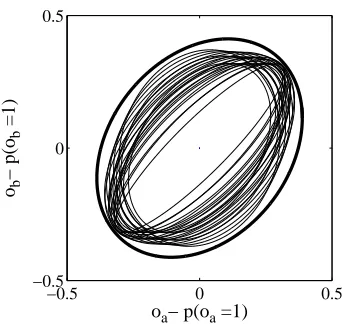
Figure 1: Conservative bounding matrix (shown as a bold ellipse),R∗, constructed from the family of all possible ma-trices,R(shown as plain ellipses).
prior estimate is calculated from its own direct experience, and how other agents can communicate reputation reports calculated from their own direct experience.
Calculating a Prior Belief from Direct Experience: The prior belief of the agent is represented by a trust estimate,
ˆ
p(X), and a covariance matrix,P(X). These can be calcu-lated from an agent’s direct experience using the Dirichlet formalism described in our earlier work (Reece et al. 2007). More specificallypˆ(X)and the diagonal elements ofP(X) are calculated from the counts of contract outcomes (as per equations 6 and 7), while the full details of the Dirichlet dis-tribution are required to calculate the off-diagonal terms of P(X). See appendix A for full details.
This prior explicitly represents the correlations over the subset of services for which the agent has directly observed previous contract outcomes. When the agent has no direct experience of some services, it may simply insert infinity into the relevant diagonal element of P(X)to reflect this lack of information (or alternatively insert zero intoY if the information form of the Kalman filter is being used).
Calculating Reputation Reports: The Kalman filter fuses a prior estimate with an observation,o, whose covari-ance isR. In our computational trust model,o andR to-gether represent a reputation report and are calculated from the direct experience of the originating agent. This calcula-tion is different from that which generatespˆ(X)andP(X), since the covarianceR describes the variability of oabout the true probabilities,p(X), while the covarianceP(X) de-scribes the variability ofp(X)about the estimatepˆ(X). This is a subtle but important difference.
that due to the reasons described above this expression is different from that shown in equation 6.
CalculatingRis more complex. Since we are using the Kalman filter with a Dirichlet distribution (rather than the more common Gaussian distribution), the covariance,R, is itself dependent upon the probabilities that each service is successfully delivered, p(X). These probabilities are not known; indeed, these are what we attempting to estimate. However, the beauty of the Kalman filter lies in its flexibil-ity and we need not worry about finding R exactly. Pro-vided that we can find a conservative matrix,R∗, to use in place ofR, we can guarantee that our estimates will remain consistent. We can build such a conservative covariance matrix forRfrom an agent’s direct experience and a com-monly used method from the data fusion literature: namely covariance inflation (Hanebeck, Briechle & Horn 2001; Reece & Roberts 2005).
The full details of this calculation are presented in ap-pendix B. However, we provide a sketch of the procedure here. Our starting point is the Dirichlet distribution over pos-sible values ofp(X)calculated using the agent’s direct expe-riences (as used above to calculate an agent’s prior estimate). We then sample possible values ofp(X)from this distribu-tion, and generate a family of possible covariance matrices forR. We then use covariance inflation to construct a con-servative covariance matrix from the entire family. In figure 1 we present an example of this process for two services4. We plot the family of possibleRmatrices as ellipses, with the bounding conservative covariance matrix,R∗, in bold.
Example: To illustrate the formalism we consider an ex-ample where agent A is estimating the utility of procuring a bundle of two services,aandb. These two services share a common resource, and thus, the probabilities of them be-ing successfully delivered are positively correlated. AgentA has some direct experience of procuring both services from this supplier, and thus, it can use the Dirichlet distribution to calculate prior estimates ofpˆ(X)andP(X). This prior estimate is plotted in figure 2 as a dotted ellipse.
AgentBhas also interacted with this supplier in the past, but in these interactions it has only observed contract out-comes involving servicea. It communicates these contract outcomes to agentA in the form of an observation vector, o, and a conservative estimate of its covariance, R. This is shown as the dashed-dot ellipse in figure 2. Note that the variance in thebdimension is infinite (the covariance ellipse looks rectangular) reflecting the fact that agentB supplies no information about the reliability of serviceb.
AgentAcan then fuse its own prior estimate with the rep-utation report received from agentB(using the information form of the Kalman filter and inserting the necessary zeros to indicate that agentB provides no information about ser-viceb). The resulting posterior estimate is shown as a solid ellipse in figure 2. Note that although agentB supplies in-formation about serviceaonly, the uncertainty in agentA’s estimate for both dimensions is reduced. This occurs
be-4
We choose two services for this and others examples in this paper since this allows us to plot covariance matrices as ellipses. Our formalism obviously generalises to any number of services.
0.5 0.75 1
0.5 0.75 1
p(o
a =1)
p(o
b
=1)
[image:5.612.343.510.62.221.2]Prior Estimate Reputation Report Inflated Independent Beta Kalman Filter
Figure 2: Kalman filter and inflated independent beta esti-mates for heterogeneous contract observations.
cause agentA’s prior estimate encodes a non-zero correla-tion between the services and the Kalman filter uses this to map the new evidence about serviceaonto serviceb.
This is a key benefit of our formalism. We can compare this result to the benchmark presented earlier that uses inde-pendent beta distributions to describe each separate service (shown as the dashed ellipse in figure 2). Since this bench-mark fails to represent the positive correlations between the services (i.e. the ellipse is not tilted to the right), it yields a highly pessimistic covariance estimate (i.e. the ellipse is substantially larger than that calculated by our formalism based upon the Kalman filter). In the next section we de-scribe metrics that dede-scribe the information content and con-sistency of these estimates, in order to perform a more de-tailed comparison of these two formalisms.
Empirical Evaluation
In order to evaluate the effectiveness of our formalism, we present simulation results in which ten agents, each with their own direct experience of a supplier that provides two services, participate within a reputation system. We assume that one of these agents is attempting to evaluate the trust-worthiness of the supplier in order to calculate the expected utility of interacting with it. As such, the agent must fuse its own direct experience with reputation reports received from the other nine agents. We compare two formalisms:
• Inflated Independent Beta Distributions: We use
in-flated independent beta distributions to represent each ser-vice separately (as described earlier).
• Kalman Filter: We use the formalism based upon the
Kalman filter developed in this paper which explicitly captures correlations between the services.
0 100 200 300 400 0
0.5 1 1.5
2x 10 11
Number of Contract Observations
Expected Information Content
(E[I]) Inflated Indepedent BetaKalman filter
0 100 200 300 400 0.8
1 1.2 1.4 1.6 1.8
Number of Contract Observations
Normalised Standard Error
(NSE)
[image:6.612.70.267.51.378.2]Inflated Indepedent Beta Kalman Filter
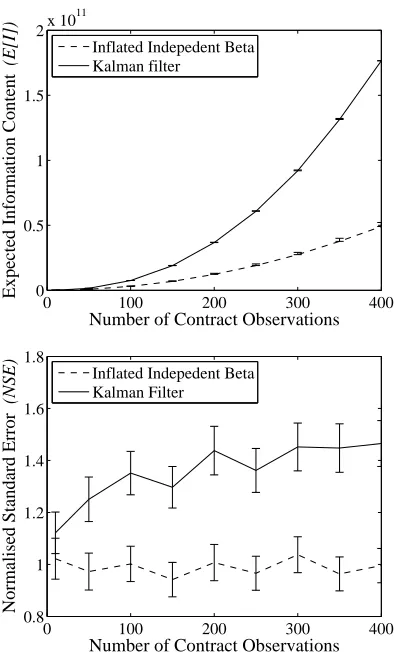
Figure 3: Comparison of the expected information content, E[I], and normalised standard error,N SE, for formalisms using the Kalman filter and independent beta distributions.
observe just one service. We apply our formalisms to calcu-late posterior trust estimates and then calcucalcu-late two metrics. The first is a scalar measure of the information content of the trust estimate; a standard way of measuring the uncertainty encoded within the covariance matrix (Bar-Shalom, Li, & Kirubarajan 2001). More specifically, we calculate the de-terminant of the inverse of the covariance matrix:
I=det(P(X)−1
) (14)
and note that the greater the information content, the more precisepˆ(X)will be. The second metric measures the nor-malised error of the estimate:
E= [ˆp(X)−p(X)]TP(X)−1
[ˆp(X)−p(X)] (15)
We perform 1000 repeated simulation runs and calculate the expectation of these two metrics (and the standard error in these expectations). We note that the expectation of the nor-malised error is commonly termed the nornor-malised standard error,N SE, and it describes the consistency of the estimate. A consistent estimate has a normalised standard error less than the cardinality of the trust estimate; two in this case. A normalised standard error much less than this value indicates that the covariance matrix is too conservative.
Method E[E[U]]±p
Var(E[U]) True Distribution 5.80±0.27 Inflated Independent Beta 5.86±0.53 Kalman Filter 5.82±0.34
Table 1: Estimated expected utility and its standard devia-tion calculated from an agents posterior trust estimate.
In figure 3 we present these results (with the standard er-ror in the expected values shown as erer-ror bars) as the number of contract observations ranges from 10 to 400. We note that the information content of the trust estimates generated by our Kalman filter formalism far exceeds that of those gener-ated using inflgener-ated independent beta distributions (typically by a factor of three). By explicitly representing the corre-lations between the services our formalism generates more precise trust estimates. This increased precision is not re-alised at the cost of producing inconsistent estimates; the normalised standard error of both formalisms is less than two, and thus, they both generate consistent estimates. Fi-nally, we note that as the number of contracts increases, the Kalman filter encodes more precise correlation information, and the difference between the formalisms also increases.
Finally, in table 1 we illustrate the effect that the precision of the trust estimate has on an agent’s estimate of the ex-pected utility of a contract (calculated using the relationships shown in equations 1 and 2 in an example setting where u(oa= 1) = 2andu(ob= 1) = 6). While both formalisms generate estimates of expected utility close to the true dis-tribution, the more precise covariance matrix of the Kalman filter results in a better estimate of the standard deviation of the expected utility (while that of the inflated independent beta distribution is approximately double the true value).
Conclusions
In this paper we addressed the need for a principled prob-abilistic model of computational trust that allows heteroge-neous contract observations to be fused together. Prior to our work no such model existed. We considered the case of an agent procuring a bundle of services subject to correlated failures, and we showed that we could use the Kalman filter to fuse observations from agents who have direct experience of previous contracts for different subsets of these services.
[image:6.612.324.554.65.116.2]Appendices
A. The Dirichlet Distribution
In this section, we describe how an agent may use the stan-dard results of the Dirichlet distribution to calculate the off-diagonal terms withinP(X). For each pair of service (e.g.a andb), we must consider all possible combinations of con-tract outcomes, and thus we define nab
ij as the number of contract outcomes for which bothoa = iandob =j. For example,nab
10represents the number of contracts for which
oa = 1andob= 0(i.e. serviceawas successfully delivered, while servicebwas not).
Now, using the standard Dirichlet notation, we can define αab
ij ,nabij+ 1for alliandjtaking values0and1, and then, to calculate the cross-correlations between the two services aandb, we note that the Dirichlet distribution over pair-wise joint probabilities is:
Prob(pab) =Kab
Y
i∈{0,1} Y
j∈{0,1}
p(oa=i, ob=j)α
ab
ij−1 (16)
where:
X
i∈{0,1}
X
j∈{0,1}
p(oa =i, ob =j) = 1 (17)
andKabis a normalising constant (Evans 1993). From this we can derive pair-wise probability estimates and variances:
E[p(oa=i, ob=j)] = αab
ij α0
(18)
V[p(oa=i, ob=j)] = αab
ij(α0−αabij)
α2
0(1 +α0)
(19)
where:
α0=
X
i∈{0,1}
X
j∈{0,1} αab
ij (20)
and in fact,α0 = N + 2, where N is the total number of
contracts observed. Likewise, we can express the covariance in these pair-wise probabilities in similar terms:
C[p(oa=i, ob=j), p(oa=m, ob=n)] =
−αabijαabmn
α2
0(1 +α0)
(21)
Finally, we can use the expression:
p(oa = 1) =
X
j∈{0,1}
p(oa= 1, ob=j) (22)
to determine the covarianceCab. To do so, we first simplify the notation by definingVab
ij ,V[p(oa = i, ob =j)]and Cab
ijmn ,C[p(oa =i, ob = j), p(oa =m, ob = n)]. The covariance for the probability of positive contract outcomes is then the covariance betweenP
j∈{0,1}p(oa = 1, ob =j) andP
i∈{0,1}p(oa=i, ob= 1), and thus: Cab = C1001ab +C
ab
1101+C
ab
1011+V
ab
11 (23)
Thus, given a set of contract outcomes that represent previ-ous interactions with a supplier, an agent may use the Dirich-let distribution to calculate an estimate of the probability that any service will be successfully delivered, pˆ(X), and the uncertainty and correlations between these probabilities, P(X), may be calculated and used as a prior belief in our Kalman filter trust model.
B. Covariance Inflation
In this section we describe a method whereby an agent can calculate a conservative matrix,R∗, to use in place ofR, in the reputation report that it sends to other agents (see equa-tion 11). The approach uses covariance inflaequa-tion (Hanebeck, Briechle & Horn 2001; Reece & Roberts 2005) to calculate a bounding (i.e. consistent) covariance matrix from a (pos-sibly sparse) set of contract outcomes. Covariance inflation is traditionally used to obtain a consistent covariance ma-trix for a family of covariance matrices when only the cross-terms in the family differ (i.e. the diagonal variance cross-terms are assumed to be known). In this section we extend covari-ance inflation to the case where not only the off-diagonal terms, but also the diagonal variance terms, are unknown (but bounded).
We start by considering that the contract outcome obser-vation covariance matrix,R, is given by:
R=
pa(1−pa) pab−papb pac−papc . . .
pab−papb pb(1−pb) pbc−pbpc . . .
pac−papc pbc−pbpc pc(1−pc) . . .
..
. ... ...
(24)
wherepκ, withκ∈ {a, b, c, . . .}, is the probability that the serviceκis successfully delivered (e.g.pa=p(oa= 1)and pb =p(ob = 1)) andpκν is the probability that servicesκ andν, withκ, ν∈ {a, b, c, . . .}, are both successfully deliv-ered (e.g.pab=p(oa = 1, ob= 1)).
The probabilities within this matrix (e.g. pa andpab) are not known. However, they can be estimated by sampling the distributions (by observing contract outcomes) and then using the Clopper-Pearson method (Clopper 1934) to find confidence intervals over them. These intervals describe a family of possible covariance matricesRfrom which a con-servative covariance matrixR∗can be calculated.
The Clopper-Pearson method calculates confidence inter-vals,IκandIκν, for each of the marginal distributions over pκ and the joint distributions over pκν respectively. The magnitude of the confidence interval is determined by a user specified confidence value. The confidence value is the probability that the interval contains the actual positive con-tract outcome probability. In many applications it is com-mon to choose the95percentile confidence value. For any dimensions labelledκandνthe confidence intervals are de-fined in terms of their upper and lower limits thus:
Iκ,[Iκ,l, Iκ,u] (25)
Iκν,[Iκν,l, Iκν,u] (26)
Our aim is to find a covariance matrixR∗which is consis-tent withRfor all values ofpκandpκν in their confidence intervals. For any covariance matrixR′to be consistent with R, we require that the diagonal elements of R′ to be the largest possible values that the diagonal elements ofRcan take. Thus, we can restate our problem as that of finding a covariance matrixR∗which is consistent with allR′where:
R′=
R′aa pab−papb pac−papc . . .
pab−papb Rbb′ pbc−pbpc . . .
pac−papc pbc−pbpc R′cc . . .
..
. ... ...
and, for allκ, ν∈ {a, b, c, . . .},pκ∈Iκandpκν ∈Iκνand R′
κκ= maxpκ∈Iκ{pκ(1−pκ)}.
To determine the range of values that the cross-terms cκν , pκν −pκpν can take we use equations 25 and 26 to give the limits:
Iκν,u−Iκ,lIν,l≥pκν−pκpν ≥Iκν,l−Iκ,uIν,u (28) However, we can often find tighter bounds. Since R is a covariance matrix then the magnitude of the cross term pκν−pκpν must be less than the square root of the prod-uct of the variancespκ(1−pκ)andpν(1−pν). Since the variances are bounded above byR′
κκandR′ννthen: |cκν| ≤
p
pκ(1−pκ)pν(1−pν)≤
p
R′
κκR′νν (29) Thus, we can obtain the range of possible values for the off-diagonal covariance terms as a function of the Clopper-Pearson intervals. The upperUκνand lowerLκνbounds for each cross-term,Uκν≥cκν≥Lκν, are given by:
Uκν = min{
p
R′
κκRνν′ , Iκν,u−Iκ,lIν,l} (30) Lκν = max{−
p
R′
κκR′νν, Iκν,l−Iκ,uIν,u} (31) To build the observation covariance matrixR∗, we iterate through the contract dimensionsd. Initially,R∗[1] = R′
aa where R′
aa = maxpa∈Ia{pa(1 −pa)}. Each subsequent
iteration d = {2,3, . . .} augments a row and column to R∗[d−1]. Covariance inflation is used at each iteration to incorporate the unknown, but bounded cross-terms:
R∗[d] = (1 +KdSd)R
∗[d−1] E d ET
d
1 + Sd
Kd
R′ dd
!
(32)
where R′
dd = maxpd∈Id{pd(1−pd)}. The scalar Sd is
calculated with the aid of two vectors,Cd(l)andCd(u), that are of sized−1and are obtained from the Clopper-Pearson confidence interval limits:
Cd(l) = [L1d, L2d, . . . , Ld−1d]T (33) Cd(u) = [U1d, U2d, . . . , Ud−1d]T (34) and is given by:
Sd = max v
h
Θ max{abs(Cd(u)−Ed),
abs(Cd(l)−Ed)}R′dd −1i
(35)
whereΘis the sphering matrix ofR∗[d−1],max v is the value of the maximum element in the vector, andmaxand abs are the element wise maximum and absolute operators respectively. Thed−1vectorEdand the scalarKdare cho-sen to minimise the determinant (det) ofR∗
d subject to the constraint thatR∗
dis positive semi-definite. This constraint is a requirement of all covariance matrices. Thus the optimal value for{Kd, Ed}is found using sequential quadratic pro-gramming (Fletcher 1987) to solve the nonlinear program-ming problem:
min Kd,Ed
det(R∗d)subject to eigenvalues(R ∗
d)≥0 (36)
The final result of this iterative procedure is a conservative covariance matrix,R∗, to use in place ofR, in the agent’s reputation report.
Acknowledgments
This research was undertaken as part of the ALADDIN (Au-tonomous Learning Agents for Decentralised Data and In-formation Networks) project and is jointly funded by a BAE Systems and EPSRC strategic partnership (EP/C548051/1).
References
Bar-Shalom, Y., Li, X.-R., and Kirubarajan, T. 2001.
Estima-tion with ApplicaEstima-tions to Tracking and NavigaEstima-tion. Wiley
Inter-science.
Clopper, C., and Pearson, S. 1934. The use of confidence or fiducial limits illustrated in the case of the binomial. Biometrika 26:404–413.
Evans, M., Hastings, N., and Peacock, B. 1993. Statistical
Dis-tributions, John Wiley and Sons, Inc.
Fletcher, R. 1987. Practical Methods of Optimization, John Wiley and Sons, Inc.
Griffiths, N. 2005. Task delegation using experience-based multi-dimensional trust. In Proceedings of the Fourth International
Joint Conference on Autonomous Agents and Multiagent Systems,
489–496.
Hanebeck, U. D., Briechle, K., and Horn, J. 2001. A tight bound for the joint covariance of two random vectors with unknown but constrained cross-correlation. In Proceedings of the IEEE
Con-ference on Multisensor and Integration for Intelligent Systems,
85–90.
Maryak, J. L., Spall, J. C., and Heydon, B. D. 2004. Use of the Kalman filter for inference in state-space models with un-known noise distributions. IEEE Transactions on Automatic
Con-trol 49(1):87–90.
Ramchurn, S. D., Hunyh, D., and Jennings, N. R. 2004. Trust in multi-agent systems. Knowledge Engineering Review 19(1):1–25. Reece, S., and Roberts, S. 2005. Robust, low-bandwidth, multi-vehicle mapping. In Proceedings of the Eighth International
Con-ference on Information Fusion.
Reece, S., Rogers, A., Roberts, S., and Jennings, N. R. 2007. Ru-mours and reputation: Evaluating multi-dimensional trust within a decentralised reputation system. In Proceedings of the Sixth
International Joint Conference on Autonomous Agents and Mul-tiagent Systems. In press.
Sabater, J., and Sierra, C. 2001. REGRET: A reputation model for gregarious societies. In Proc. of the Fourth Workshop on
De-ception, Fraud and Trust in Agent Societies, 61–69.
Jøsang, A. J., and Ismail, R. 2002. The beta reputation system. In
Proceedings of the 15th Bled Electronic Commerce Conference
Teacy, W. T. L., Patel, J., Jennings, N. R., and Luck, M. 2006. TRAVOS: Trust and reputation in the context of inaccurate in-formation sources. Autonomous Agents and Multi-Agent Systems 12(2):183–198.