This is a repository copy of Simulation Training in U.K. General Aviation: An Undervalued
Aid to Reducing Loss of Control Accidents.
White Rose Research Online URL for this paper:
http://eprints.whiterose.ac.uk/90777/
Version: Accepted Version
Article:
Taylor, A, Dixon-Hardy, DW and Wright, SJ (2014) Simulation Training in U.K. General
Aviation: An Undervalued Aid to Reducing Loss of Control Accidents. International Journal
of Aviation Psychology, 24 (2). pp. 141-152. ISSN 1050-8414
https://doi.org/10.1080/10508414.2014.892762
This is an Accepted Manuscript of an article published by Taylor & Francis in International
Journal of Aviation Psychology on 4th April 2014, available online:
http://dx.doi.org/10.1080/10508414.2014.892762.
[email protected] https://eprints.whiterose.ac.uk/
Reuse
Unless indicated otherwise, fulltext items are protected by copyright with all rights reserved. The copyright exception in section 29 of the Copyright, Designs and Patents Act 1988 allows the making of a single copy solely for the purpose of non-commercial research or private study within the limits of fair dealing. The publisher or other rights-holder may allow further reproduction and re-use of this version - refer to the White Rose Research Online record for this item. Where records identify the publisher as the copyright holder, users can verify any specific terms of use on the publisher’s website.
Takedown
If you consider content in White Rose Research Online to be in breach of UK law, please notify us by
Simulation Training in UK General Aviation: An Undervalued Aid to Reducing Loss of Control Accidents
Analysis of data from 1007 UK general aviation (GA) accidents demonstrates the predominant cause of accidents is loss of control, exacerbated by a lack of recent flying experience. These are long-standing problems which can be targeted effectively with simulation training. Discussion on training strategies in commercial aviation reinforces the logic of
I N T R O D U C T I O N
From January 2005 to December 2011 there were 1007 accidents pertaining to UK fixed wing general aviation (GA) analysis of which revealed 49.7% resulted from loss of control (LOC), 69.2% of these occurring during the landing phase. Of 55 fatal accidents, 60% occurred during the cruise and 45.5% were a consequence of LOC.
Current requirements for the issue of a Private Pilot’s License (PPL) state a ‘‘maximum of 5 hours may have been completed in a Basic Instrument Training Device, Flight and Navigation Procedures Trainer or a flight simulator’’(Civil Aviation Authority; CAA, 2012, Section C, p2). This is intended as an instrument appreciation course and does not qualify PPL pilots to fly solely by reference to instruments; it is intended as a contingency measure should pilots find themselves in poor visibility. In commercial aviation, airline pilots are trained extensively in simulators for instrument procedures, emergencies and type ratings, flying their assigned aircraft type in a simulator before transition to the actual aircraft. Every six months they must return to the simulator to practise such scenarios and have their general competence assessed. Failure to reach required standards may result in the revocation or suspension of their license. This intensive use of simulators has a positive impact on
commercial aviation safety and subsequently is accepted by the operators, flight crews, unions and regulators (Allerton, 2002). However, despite the effectiveness of simulation training being well documented and accepted in airline operations, simulators do not command similar respect and use in general aviation (Roscoe, 1982). The operational differences between commercial aviation and GA denote that different levels of simulator complexity are required for each, the three main types being defined according to the CAA (2012) in Table 1.
Table 1
CAA definition of each of the three main levels of simulator used for flight training
Simulator
Basic Instrument Training Device
(BITD)
Ground-based training device which represents the student pilot’s station of a class of aeroplane….providing a training platform for at least the procedural aspects of instrument flight
Flight Training Device (FTD)
Full size replica of a specific aircraft type’s instruments, equipment, panels and controls in an open flight deck area or an enclosed aircraft flight deck….to represent the aircraft in ground and flight conditions….It does not require a force cueing motion or visual system
Full Flight Simulator (FFS)
Full size replica of a specific type or make, model and series aircraft flight deck….to represent the aircraft in ground and flight operations, a visual system providing an out-of-the-flight-deck view and a force cueing motion system
Whilst the learning and training paradigms between flying at PPL level and those specific to commercial flying are acknowledged as being
different, each has the common goal of producing competent, safe pilots; if one can be enhanced from the proven example of another, then for the sake of safety this must be encouraged by the industry.
M E T H O D ; U K P I L O T P O P U L A T I O N
Data was retrieved from the UK CAA concerning the number of registered license holders within the pilot population and which level of licence they hold. This was to determine the proportion of GA and commercial pilots for comparison to accident data. For further comparison to the sample data and to assess the thoughts and opinions of GA pilots in the UK, a survey was compiled and issued online. It was advertised via e-mail to 120 flying clubs and schools throughout the UK requesting they encourage their members to participate producing an estimated 12000 potential respondents (based on an assumed average of 100 members per club, derived from the known number of members at several clubs). Despite incentives and follow-up requests, only 403 pilots took part, representing a response rate of 3.4%.
Considering no other such information exists concerning GA pilot opinions on simulation, the response was considered adequate enough to provide a representative cross section of views.
and license held. Flying experience is divided into three main areas;
currency (how much flying a pilot has done in the previous 90 and 28 days), type experience (how much flying time a pilot has on a particular make and model of aircraft) and total experience (all their flying time to date). Each accident was entered into one of four categories for qualitative
analysis; LOC, airmanship, technical or meteorological. Accidents were also categorised by phase of flight to establish where the frequency of
accidents was greatest.
Given their prevalence in the data, LOC accidents were analysed with comparison to the non LOC categories using t-test statistical calculation. An appraisal of accidents concerning flight from visual flight rules (VFR) into instrument meteorological conditions (IMC) was also warranted, being cited as a major accident causal factor. The results were then evaluated with regard to current literature on use of simulation in GA and commercial training as well as previous studies on LOC and VFR into IMC accidents.
R E S U L T S
Data from the CAA from 1994 to 2008 (CAA, 2001; 2005; 2006; 2009) revealed that within the UK aviation population, the majority of pilots are PPL holders. These include those with a National PPL (a restricted version of the PPL) and collectively shall be referred to as (N)PPL from herein. The data indicates that on average they represent 64.8% of all licensed pilots in the UK, the GA survey concurring with these figures, 72.2% being (N)PPL holders. These pilots were involved in 70.9% of accidents,
Commercial Pilot’s License (CPL) and Airline Transport Pilot’s License
(ATPL) holders respectively accounting for just 11.2% and 9% of all accidents.
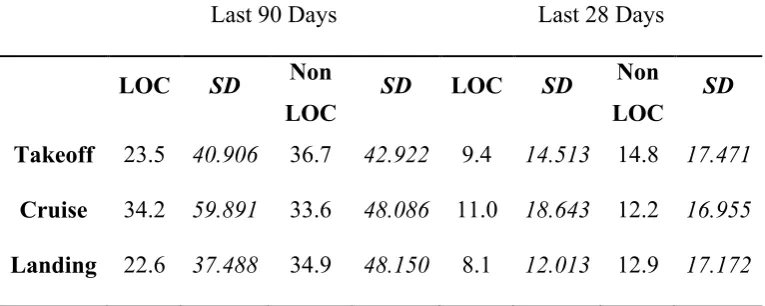
During takeoff, cruise and landing, the three main phases of flight, mean levels of currency were less for LOC accident pilots than for non-LOC accidents, with the exception of the last 90 days in the cruise, (Table 2).
Table 2
Last 90 Days
Last 28 Days
LOC
SD
Non
LOC
SD
LOC
SD
Non
LOC
SD
Takeoff
23.5
40.906
36.7
42.922
9.4
14.513
14.8
17.471
Cruise
34.2
59.891
33.6
48.086
11.0
18.643
12.2
16.955
Landing
22.6
37.488
34.9
48.150
8.1
12.013
12.9
17.172
None of the differences between LOC and non LOC accident pilot
[image:7.595.107.490.73.226.2]currency were significant, with the exception of landing where LOC pilots had significantly less currency than non LOC pilots for both the last 90 and 28 days; Takeoff, last 90 days: t [129] = 1.798, p < .05, last 28 days: t [131] = 1.943, p < .05; Cruise, last 90 days: t [134] = 0.042, p < .05, last 28 days: t [134] = 0.251, p < .05; Landing, last 90 days: t [529] = 3.262, p <.05, last 28 days: t [525] = 3.773, p < .05. Mean total and type experience levels of sample LOC pilots were significantly less than pilots in other accident types (Table 3).
Table 3
LOC versus non LOC mean pilot experience (hours); total and type
LOC
SD
Non LOC
SD
T-Test Result
(
p
< 0.05)
Total experience
1535.9
3786.215
2584.9
4431.403
4.024 (df, 999)
Type experience
168.2
363.571
360.1
827.530
4.727 (df, 989)
D I S C U S S I O N ;
L O S S O F C O N T R O L , A C O N T I N U I N G P R O B L E M
The findings in Table 2 conform to the conclusions of the CAA GA Fatal Accident Review 1985 -- 1994 (CAA, 1997) which determined LOC accidents in VFR ‘‘appear to be the result of basic inexperience’’ and that without experience they were not adequately prepared for unexpected events.
IMC had no rating to permit such flight and suggested that in some cases, a technical failure in this situation may have pushed the pilots beyond the limits of their capabilities. Combined, LOC in both VFR and IMC was
apportioned to 28% of fatal accidents in the CAA review, but was found to be more predominant in a later regulatory review (CAA, 2006) 48.5% of fatal accidents from 1995 to 2004 being cited as due to LOC. Additionally, flight handling skills were found to be the most common causal and/or contributory factor for LOC in VFR, associated with poor initial training or inadequate refresher training, (CAA, 1997).
Of all (N)PPL accidents in the sample, 50.4% were attributable to LOC, whilst 35.4% of CPL and 35.2% of ATPL accidents occurred following LOC. With such a high proportion of (N)PPL accidents involving LOC and mean values for currency being comparatively low, it is evident that LOC is an issue for pilots with a basic license and a low level of recent flying experience.
Although only accounting for 2.5% of the sample accidents, engine failure after takeoff (EFATO) is a commonly practised manoeuvre in training, as is recovery from stalling (a variant of LOC), but the AAIB express concern in one report that ‘‘although many pilots consider their actions should the engine fail during takeoff, it seems that fewer pilots consider their actions in the case of loss of control’’ (AAIB, 2009, p47).
Whilst EFATOs and other simulated engine failure scenarios can be initiated by an Instructor without prior warning and in rela1tive safety, practising stall recovery can be a protracted process, involving a number of safety procedures the pilot is required to follow; it must be performed at or above 3000 feet to allow adequate recovery time, must not be
completed over a populated area or near cloud and must be preceded by a thorough lookout for other aircraft. Even with the most careful
preparation, successful completion of the manoeuvre cannot be guaranteed and at least one fatal accident in the sample was attributed to LOC following stall recovery training.
forces the aircraft into a stall before recovering on the direction of the Instructor. This is wholly unrealistic, stall conditions often evolving
quickly and without the pilot’s knowledge (they may be distracted for example). Once the aircraft stalls, the pilot must not only recognise the stall condition (buffet is an indicator of an impending stall but can easily be masked by light turbulence), but also take immediate corrective action to prevent a full stall and/or spin developing, recovery from which is more difficult to execute than the stall conditions practised in
training. Furthermore, post training, an (N)PPL pilot may fly for years before encountering such a scenario, by which time the skills of stall recovery may have been long assigned to memory and difficult to recall, particularly at such a stressful time. The effects of stress on memory
include restricting an individual’s ability to encode and retrieve
information (Kuhlmann et al., 2005) and adversely affecting aspects of the working memory (Lee, 1999), causing more false alarms and mistakes than in normal situations (Duncko et al., 2009).
Further to stalling, flaring an aircraft is considered by some to be a difficult manoeuvre requiring attention to detail and a healthy respect for the limitations of the aircraft (Aircraft Owners and Pilots Association; AOPA, 2008). The addition of gusty or crosswind conditions increase the level of difficulty; the GA survey revealed 28.6% of respondents declared
the flare to be ‘5’ or greater on a Likert scale of 1 -- 10, 1 being not difficult at all and 10 extremely difficult. This figure increased to 48.9% when asked to rate the same manoeuvre in wind. There are difficulties in training for crosswind landings due to an inability to schedule the right
amount of wind for when it’s needed resulting in many pilots having little idea of how to handle such a situation (Landsberg, 2002). Levelling off and rounding out an aircraft in preparation for the flare also require
experience and repeated practise (Benbassat et al., 2005) experience being what many GA pilots lack (Benbassat & Abramson, 2002). A poorly executed flare can result in a bounce and subsequent LOC, or ballooning which if not properly managed may also end in LOC.
more relevant and transferable pre-flight briefings can be conducted in a simulator rendering the subsequent lesson much more productive and
worthwhile.
L O C I N T H E U N I T E D S T A T E S R E F L E C T S T H E U K
Data from AOPA’s annual Nall report (AOPA, 1997 -- 2011) of accident trends and factors from the previous 15 years reveal LOC in GA accidents is certainly not restricted to the UK, implying it is a worldwide problem.
Classed as ‘manoeuvring’ the statistics show it is an increasing problem in GA in the USA (Figure 1).
Figure 1: Fatal accidents involving LOC from manoeuvring according to
AOPA's Nall reports (1997 – 2011)
This information demonstrates that whilst this paper focuses on UK GA and the potential benefits of simulation in training, the premise can
easily be transferred to GA industries and cultures outside the confines of the UK.
E X P E R I E N C E A N D C U R R E N C Y A L S O I N F L U E N T I A L I N L O C
A pilot’s total flying experience is an assemblage of all the
knowledge and flight time they have accumulated in their flying career and may include a variety of aircraft types, including large airliners. This knowledge and experience can broadly be applied to all aircraft and all
situations although some adaptations will have to be made according to the aircraft being flown, the airfield and associated procedures.
Hours flown on a particular aircraft type are perhaps more valuable,
familiarity with an aircraft’s handling and cockpit layout being beneficial to a pilot in a situation such as a LOC event. Thus greater experience, both overall and type specific, results in greater skill, knowledge and awareness resulting in a reduced accident risk for the pilot, the sample analysis results having proven this to be the case.
Currency is considered a good indicator of a pilot’s level of skill and competence and is necessary to build and maintain decision making expertise, Jensen (1997). GA pilots must fly a minimum of 12 hours within the previous 12 months preceding expiry of their licence, including 6 hours as pilot in command, 12 take-offs and landings and 1 hour with an
Instructor (CAA, 2010, section F1.5), however O’Hare and Chalmers (1999) expressed concern that flying less than 30 minutes per week is insufficient to maintain the standards of proficiency needed in a complex and demanding activity such as flying. This is supported by the sample data in Table 1 demonstrating that takeoff, cruise and particularly landing accident pilots were deficient in currency.
C U R R E N C Y D I F F I C U L T T O M A I N T A I N
The sample data contains some evidence to suggest that recent flying determines the likelihood of pilots being involved in a LOC or weather related accident. Although not statistically important, maintaining currency in the UK is nonetheless a continuing and increasingly difficult struggle and remains an area of concern which needs addressing.
Increasing fuel prices, landing fees, aircraft hire and regulatory fees such as medical renewals mean many GA pilots cannot afford to maintain a good level of currency resulting in either the need to renew or retire.
The authors’ survey found that for 43% of pilots the cost of flying affects
how often they fly all or a lot of the time. Many comments reflected how the cost of flying impacts skill levels and overall GA safety:
‘‘The prohibitively high cost of flying is causing pilots to maintain much lower currency levels than in the past which in some cases leads to error chains and accidents.’’
‘‘High costs mean that many GA pilots do not get enough practise.’’ ‘‘As fuel gets more expensive and hours drop as a result there are
‘out of practise’ safety issues. I would be a better pilot if I flew more but can’t afford to.’’
The use of simulators was also highly advocated for training and practise, 62% and 58.2% of respondents considering there to be room for improved simulation in GA for those two tasks respectively. Particular interest was allocated to the areas of procedures, emergencies and instrument training in a simulator.
Another barrier to maintaining currency in UK GA that could be
overcome through improved simulation is the weather, the survey revealing it affects 54.8% of pilots in the amount they fly. The use of simulators as a substitution when conditions are not conducive to real flying was
supported by some:
(Simulators) ‘‘Would be very valuable on bad weather days.’’
(Simulators would be useful) ‘‘For training & practise when weather conditions are not suitable an absolute bonus’’
‘‘I would use this (simulation), especially when grounded by bad weather at the airfield.’’
(Simulators would be) ‘‘Useful for a PPL to keep current in poor weather conditions.’’
Cost and weather issues combine to produce a situation where pilots are not flying as often as they should to keep in good flying practise, not
because they don’t want to, but because they are unable to. Additional to
LOC training, simulation in UK GA would allow pilots to maintain a
satisfactory level of currency at a lower cost, regardless of the weather.
D E C I S I O N M A K I N G
flawed decision making process. Naturally accidents can still occur when all the right decisions are made, implementation of a decision requiring information input; an engine failure can be managed effectively to the point of touchdown in a field, but the pilot will not necessarily know the condition of the ground, thus cannot make an informed decision on whether or not to use the field for the emergency landing. Subsequently, having made all the right decisions to reach the field, the pilot may be
undermined at the last moment when the ground turns out to be soft and the aircraft inverts on contact.
Making a decision effectively comprises three elements as defined by Wickens and Flach (1988); The first is evaluation of the information available, and the second involves the pilot carefully considering that evaluation. Some cues, such as a weather forecast may be unreliable, making it probabilistic resulting in the theoretically correct decision
potentially producing an unfortunate outcome. The third element is a
cost/benefit assessment; the cost of turning around versus the benefits of continuing and vice versa.
Further to Wickens and Flach (1988), Jensen (1997) cited experience as one of five components of aviation decision making pertinent to both GA and commercial pilots, training being an integral function thereof. It was stated that whilst initial training sets the standard for the pilot’s
future flying and can influence habits and associated flight performance, a solid knowledge base should also be developed early and periodically
refreshed to maintain proficiency.
all student pilots more rigorous instruction, both practical and theoretical, than is currently offered on the subject.
To that extent, simulation can offer good practical training without inciting risk. Given that a scenario requiring decision making beyond the normal scope of flying can be extremely stressful (encountering bad weather en route for example) the use of procedural decision aids and check lists cued by acronyms needs to be avoided as much as possible, stress tending to decrease working memory capacity and cause narrowing of attention (Stokes and Kite, 1999). Instead, simulation may be better used to formulate a mental directory of scenarios from which the pilot can draw upon in stressful situations (Stokes and Kite, 1999). The pilot’s limited spare cognitive capacity will then not detract from the most important task of flying the aircraft as it might otherwise be. These scenarios can be
practised over and again at any time during a pilot’s flying career and may also provide a template from which they might construct good decisions in alternative situations. As alluded to for practical flying skills, use of simulation in this manner is likely to be more effective than simple discussion in the classroom.
In accidents where LOC was cited as a factor, timely decision making
without impeding the pilot’s cognitive capacity to fly the aircraft may
have produced a more favourable outcome and possibly, the accident may never have occurred. Despite this sobering consideration, there is no
specific requirement for decision making to be taught in any pilot training syllabus. Furthermore and particularly in GA, there remains the financial hurdle whereby simulation is not economically viable due to regulation and thus any implementation of decision making instruction would be made
without consideration to the potential effectiveness and use of simulators.
R E G U L A T I O N A F F E C T S F I N A N C E
The regulations governing the use of simulators are presented in
simulation devices and 23 pages relating to the minimum standards for compliance for each level of simulator. These serve to underline Allerton’s (2002) comment on the restrictiveness of the regulations for the
specifications of a simulator making it difficult to advance technology under the guidelines and restricting manufacturing opportunities.
For a club or school to invest in a simulator they need assurances it will be of benefit both to themselves as a business and to their members. The current allowance of five hours for instrument appreciation during training provides no incentive for members or Instructors to use it post qualification and thus no financial motivation for the club to make the investment. Without regulatory provision for use of simulators within GA beyond the five hours currently advocated and with restrictive compliance regulations, the result is a closed loop scenario with no opportunity for clubs or individuals to make use of simulation in UK GA.
GA pilots engage in the industry because they love to fly and would likely concur with the notion that there is no absolute substitute for real flying and so would not wish to foster all their flying hours in a virtual world. However, should they be allowed to make use of and log time in a simulator to maintain currency at an affordable rate, practise procedures or emergency scenarios, recover a wasted days flying due to bad weather, or improve their skills in instrument flying, then there would be a much
stronger case for clubs to invest in a simulator to satisfy the potential demand.
Further to this, the authors support the introduction of frequent checks on GA pilots, similar to those given to commercial pilots, as proposed by Allerton (2002)where simulators are used to perform the checks, the content reflecting situations that are most prevalent in accidents.
There remains the question of transferability of training from
simulation to real flight and whether the authorities and industry can be assured of its effectiveness.
T R A N S F E R O F S K I L L S A S S U R E D ?
applied to GA they would serve to improve the quality of training and safety as a consequence (Allerton, 2002). Commercial pilots perform their simulation tasks in Full Flight Simulator (FFS) devices which accurately depict the cockpit of a specific aircraft type, contain computer programmes to represent the aircraft in ground and flight operations, use a visual system providing an out of flight deck view and a force cueing motion system (CAA, 2012). Research has shown, however, that for some procedures, such as crew coordination, PC-based simulations, when properly designed and executed can be useful training tools (Jentsch & Bowers, 1998) and can provide low-cost, realistic flight education programmes to teach the
fundamentals of CRM and decision making (Duncan & Feterle, 2000). Connolly et al (1989) also believed that effective judgement training can be
accomplished without flight time in an actual aircraft, but in a simulator. Beyond commercial aviation, simulation has proven to be useful in other industries such as medicine. The skills acquired by simulation-based training give an adequate measure of transferability to the operative setting (Sturm et al., 2008) and can be a valuable complement to an aircraft in military combat training (Bell & Waag, 1998). Following an experimental study by Gopher et al. (1994) to test the transfer of skills from a complex computer game to the flight performance of cadets in the
Israeli Air Force, the game was incorporated into the Force’s regular
training program. In driver training, Ivancic & Hesketh (2000) found that learning from errors in a simulator encouraged the adoption of safer driving practises.
compared to a group that received no prior simulation training, but they also commented that mounting evidence suggests PC-based systems to be very cost effective accessories to ab initio training.
Emphasis needs to be on the structure of the training rather than the fidelity of the simulator. As Koonce and Bramble (1998)pointed out, many studies have demonstrated that increased fidelity is not necessary for effective transfer of training. Others refer to evidence that too much or unneeded fidelity can in fact decrease training effectiveness by causing distractions; Orlady and Orlady (1999, p371)quote Prophet to emphasise the point that ‘‘Aviation personnel have concentrated too much on devices - -simulators and trainers -- and not enough on their use…we are hardware oriented, when we should be training oriented.’’
Concurrent with visual fidelity is the concept of motion in simulators and how it improves training transfer. There is evidence that simulator motion does have a small, positive effect on pilot training transfer (Vaden & Hall, 2005), but there is also support for non-motion simulators being useful for training tasks such as slow flight and stall tasks (Anderson & Macchiarella, 2004). Bürki-Cohen et al. (1998) suggested that today’s visual systems are of such high quality, they render motion superfluous.
Overall, simulation is perceived favourably and studies in this area generally agree there is a case for simulation providing training that is transferable to the real aircraft, even from PC-based devices. Rose et al (2000) concluded there is firm scientific evidence of transfer from training in a virtual environment (VE) to real world tasks.
C O N C L U S I O N S
Loss of Control is a major factor in UK general aviation perpetuated by a lack of pilot experience and currency. For some pilots elements such as the weather and cost of flying inhibit their ability to maintain
currency, putting them at increased risk of LOC type accidents.
Currently, training focuses on recovery from induced stalls, little time being invested in prevention. Upon completion of training pilots are not required to undergo any form of refresher training unless their
currency is so poor as to necessitate a license revalidation. Nor are they required to undertake any form of decision making instruction or training. Should a situation occur many years later, pilots may not only have
difficulty in recalling correct recovery procedures, but as the situation will not be a forced one, it will not necessarily replicate the training they did receive, exacerbating the situation.
Landing has been shown to be a particular problem, the addition of
wind having a negative effect on a pilot’s ability to land safely. Training
for such a scenario may be deemed as dangerous due to the possibility and probability of an accident occurring.
Restrictive regulations mean there is no incentive for schools and clubs to invest in simulators, yet the evidence here suggests they could be a valuable tool in reducing accident rates pertaining to loss of control; recognition of and recovery from stalling, landing in difficult wind conditions can all be trained for and repeatedly practised in a simulator in complete safety and at a reduced costs compared to aircraft hire.
Furthermore, pilots could maintain better levels of currency through use of a simulator, if they were able to log the hours flown.
There is a strong reliance on simulation in the commercial sector to maintain pilot competence in normal and emergency procedures and sustain safety levels. It is recommended that the same considerations should be made for the safety of GA pilots and their passengers, not only in the UK, but worldwide.
Principal author Andrew Taylor would like to show his appreciation for the time and guidance given by Dr Dixon-Hardy and Mr Wright in the
compilation of this paper.
REFERENCES
Air Accidents Investigation Branch. (2009). Bulletin 8/2009, EW/G2007/08/30, G-BWYI. AAIB, p47
Aircraft Owners and Pilots Association. (1997 -- 2011). Nall Report: Accident Trends and Factors. Air Safety Foundation, Frederick, MD: Landsberg
Aircraft Owners and Pilots Association. (2008). Mastering Take-offs and Landings. Air Safety Foundation Safety Advisor: Operations and Proficiency No. 6. AOPA
Allerton, D. J. (2002).The Case for Flight Simulation in General Aviation.
The Aeronautical Journal, November 2002, pp. 607-612
Training. Human Performance, Situation Awareness and Automation: Current Research and Trends Vol 2, pp. 180-184
Bell, H. H., Waag, W. L. (1998). Evaluating the Effectiveness of Flight Simulators for Training Combat Skills: A Review. The International Journal of Aviation Psychology, 8(3), pp. 223-242
Benbassat, D., Abramson, C. I. (2002). Landing Flare Accident Reports and Pilot Perception Analysis. The International Journal of Aviation Psychology, 12(2), pp. 137-152
Benbasssat, D., Williams, K. W., Abramson, C. I. (2005). General Aviation Leveloff, Roundout and Accident Rate Analysis. The International Journal of Aviation Psychology, 15(2), pp. 189-203
Bürki-Cohen, J., Soja, N. N., Longridge, T. (1998). Simulator Platform Motion -- The Need Revisited. The International Journal of Aviation Psychology, 8(3), pp. 293-317
Caro, P. W. (1988). Flight Training and Simulation. In: Wiener, E.L., Nagel, D.C. (eds). Human Factors in Aviation. Oxford. Elsevier
Civil Aviation Authority. (1997). CAP 667: Review of General Aviation Fatal Accidents 1985-1994. Safety Regulation Group, Cheltenham: Documedia Solutions Ltd, 1997
Civil Aviation Authority. (2001). Pilot License Holders by age and Sex 1994-2000. Flight Crew Licensing, London: CAA
Civil Aviation Authority. (2005). Pilot License Holders by age and Sex 2004. Flight Crew Licensing, London: CAA
Civil Aviation Authority. (2006). Pilot License Holders by age and Sex 2005 Flight Crew Licensing, London: CAA, London: CAA
Civil Aviation Authority. (2006). Regulatory Review of General Aviation in the United Kingdom, Annex L; Analysis of Fatal UK General Aviation Accidents. General Aviation Regulatory Review Group, London: CAA Civil Aviation Authority. (2009). Pilot License Holders by age and Sex
2008. Flight Crew Licensing
Civil Aviation Authority. (2010). LASORS 2010. Personnel Licensing
Department, Safety Regulation Group. Norwich: The Stationary Office Civil Aviation Authority. (2012). CAP 804, Flight Crew Licensing: Mandatory
Connolly, T. J., Blackwell, B. B., Lester, L. F. (1989). A Simulator-Based Approach to Training in Aeronautical Decision Making. Aviation Space and Environmental Medicine, 60(1), pp. 50-52
Dennis, K. A., Harris, D. (1998). Computer-Based Simulation as an Adjunct to Ab Initio Flight Training. The International Journal of Aviation Psychology, 8(3), pp. 261-276
Duncan, J. C., Feterle, L. C. (2000). The Use of Personal Computer-based Aviation Training Devices to Teach Aircrew Decision Making, Teamwork and Resource Management. In Proceedings of the IEEE 2000 National Aerospace and electronics Conference: Engineering Tomorrow, pp. 421-426
Duncko, R., Johnson, L., Mreikangas, K., Grillon, C. (2009).Working Memory Performance after Acute Exposure to the Cold Pressor Stress in Healthy Volunteers. Neurobiology of Learning and Memory, 91, pp377-381
Gopher, D., Well, M., Bareket, T. (1994). Transfer of Skill from a Computer Game Trainer to Flight. Human Factors, 36(3), pp. 387-405
Ivancic, K., Hesketh, B. (2000). Learning from Errors in a Driving
Simulation: Effects on Driving Skill and Self-Confidence. Ergonomics,
43(12), pp. 1966-1984
Jensen R. S. (1997). The Boundaries of Aviation Psychology, Human Factors, Aeronautical Decision Making, Situation Awareness and Crew Resource Management. The International Journal of Aviation Psychology, 7 (4), 259-267
Jentsch, F., Bowers, C. A. (1998). Evidence for the Validity of PC-based Simulations in Studying Aircrew Coordination. The International Journal of Aviation Psychology, 8(3), pp. 243-260
Joint Aviation Requirements. (2008). JAR-FSTD A; Aeroplane Flight
Simulation Training Devices. Englewood. Global Engineering Documents Koonce, J. M., Bramble, W. J. (1998). Personal Computer-Based Flight
Training Devices. The International Journal of Aviation Psychology,
8(3), pp. 277-292
Kuhlmann, S., Piel, M., Wolf, O. T. (2005). Impaired Memory Retrieval after Psychosocial Stress in Healthy Young Men. Journal of Neuroscience,
Landsberg, B. (2002). Ups and Downs. Aircraft Owners and Pilots
Association, Air Safety Foundation. [Online]. [Accessed 7 February 2011]. Available from:
http://www.aopa.org/asf/asfarticles/2002/sp0212.html
Lee, A. T. (2005). Flight Simulation: Virtual Environments in Aviation. Aldershot. Ashgate Publishing
Lee, J. H. (1999). Test Anxiety and Working Memory. Journal of Experimental Education, 67, pp.218-225
O’Hare, D., Chalmers, D. (1999). The Incidence of Incidents: A Nationwide Study of Flight Experience and Exposure to Accidents and … The
International Journal of Aviation Psychology, 9, 1-18
Orlady, H. W., Orlady, L. M. (1999). Human Factors in Multi-Crew Flight Operations. Aldershot. Ashgate Publishing
Roscoe, S. N. (1982). Research Perspective. In: R. Hurst & L. Hurst (Eds.) Pilot Error; The Human Factors. London. Granada Publishing Ltd, pp. 152-163
Rose, F. D., Attree, E. A., Brooks, B. M., Parslow, D. M., Penn, P. R. (2000). Training in Virtual Environments: Transfer to Real World Tasks and Equivalence to Real Task
Stokes, A., Kite, K. (1999). Grace Under Fire: The Nature of Stress and
Coping in General Aviation. In D. O’Hare (Ed.) Human Performance in General Aviation. Aldershot: Ashgate Publishing Ltd, pp 47-85 Sturm, L. P., Windsor, J. A., Cosman, P. H., Cregan, P., Hewett, P. J.,
Maddern, G. J. (2008). A Systematic Review of Skills Transfer after Surgical Simulation Training. Annals of Surgery, 248(2), pp. 166-179 Taylor, H. L., Lintern, G., Hulin, C. L., Talleur, D. A., Emanuel Jr., T. W., Phillips, S. I. (1999). Transfer of Training Effectiveness of a Personal Computer Aviation Training Device. The International Journal of Aviation Psychology, 9(4), pp. 319-335
Vaden, E. A., Hall, S. (2005). The Effect of Simulator Platform Motion on Pilot Training Transfer: A Meta Analysis. The International Journal of Aviation Psychology, 15(4), pp. 375-393