COMMISSION OFTHEEUROPEAf COMMUNITIES
JOINT RESEARCH CENTRE Ispra Establishment Italy
CONFIDENTIAL COMMUNICATIOI Category 1.3 Nr 3528
tLu
in
¡ ^ > . . . . _ . - - .
EUR 7461
^Sglir^g^^^'^'^"^—·''
Copy m 266
WARNING
The information contained in this document is
communicated confidentially by the Commission of the European Communities to Member States, persons and undertakings and should not be passed on to third parties.
(Euratom-Treaty, Article 13, and Regulation (EEC) No. 2380/74 of the Council of Ministers).
Management
of Nuclear Materials and
Radioactive Waste
ABSTRACT
This document ¡s the progress report of the Programme Management of Nuclear Materials and Radioactive Waste of the Joint Research Centre for the period January —June 1978.
The programme consists of three projects.
The main achievements during the reporting period were the following:
Project 1 : Evaluation of the long-term hazard of radioactive waste disposal The model used to calculate pathways and dose rates to man has been refined.
Experiments have been carried out to determine leaching rates of vitrified high activity waste using water compositions related to specific geological disposal concepts.
Experiments have been set-up to study the interaction of actinides with ground water and geological media following their eventual leaching from vitrified waste. An integral experiment on the monitoring of plutonium contaminated streams has been prepared in collaboration with the Dounreay reprocessing plant.
Project 2 : Chemical separation and nuclear transmutation of actinides
For the chemical separation of actinides from HAW, oxalate precipitation (OXAL process) and solvent extraction by HDEHP and TBP are being investigated. The tests of the flow-sheets on fully active HAW solutions are under way.
On the basis of different strategies considered for actinides transmutation in
nuclear reactors, the work for the design of an actinide fuel element has been started.
Project 3 : Decontamination of reactor components
Studies are being carried out on the chemical decontamination, on the
physico-chemical structure of the oxide layers and on the mechanisms of the decontamination process.
- 3
1. INTRODUCTION
The safe and economic management of the radioactive waste, p r o duced in the exploitation of nuclear energy at an industrial level, r e -q u i r e s a considerable effort of R&D.
The Joint R e s e a r c h Centre (JRC) s t a r t e d work in the field of r a d i o -active waste management in 1973. This p r o g r a m m e is part of the activity of the JRC in the field of Nuclear Safety which includes also the p r o g r a m m e Reactor Safety and the p r o g r a m m e Plutonium Fuel and Actinide R e s e a r c h . The staff allocated to the p r o g r a m m e for 1978
cons i cons t cons of 63 r e cons e a r c h men, correconsponding to about 6% of the total J R C -staff. The p r o g r a m m e is c a r r i e d out at the I s p r a Establishment with a participation of the K a r l s r u h e E s t a b l i s h m e n t .
The JRC p r o g r a m m e Management of Nuclear Materials and Radioactive Waste has been organized into t h r e e p r o j e c t s :
- Evaluation of L o n g - T e r m Hazard of Radioactive Waste Disposal, comprising essentially the identification and the evaluation of the l o n g - t e r m h a z a r d of the p e r m a n e n t storage of radioactive waste in geological formations. This type of storage is considered at p r e s e n t to be the most appropriate to solve the problem of radioactive w a s t e .
- Chemical Separation and Nuclear T r a n s m u t a t i o n of Actinides
The objective is to obtain a b e t t e r appreciation of this advanced strategy for managing radioactive waste by separating the actinides r e s p o n -sible for l o n g - t e r m risk, from the bulk of the fission products and by t h e i r t r a n s m u t a t i o n in nuclear r e a c t o r s .
- Decontamination of Reactor Components
The objective is to study the nature of the contaminated l a y e r s and the application of various decontamination techniques in o r d e r to optimize the decontamination p r o c e d u r e s required for the safe operation and for the decommissioning of nuclear r e a c t o r s .
The C o m m i s s i o n of the E u r o p e a n Communities started in 197 5 an
Indirect Action in this field. In this Indirect Action, which is conducted by m e a n s of contracts with national l a b o r a t o r i e s , various a s p e c t s of waste conditioning technologies a r e studied and a large coordinated a c -tion for the study of waste disposal in various types of geological forma-tions was established.
TABLE OF CONTENTS
page
1. Introduction 3 2. Projects 7
2.1. The Evaluation of Long Term Hazard of
Radioactive Waste Disposal 7 2.1.1. Waste Hazard Analysis 8 2.1.2. Long Term Stability of Conditioned Waste 13
2.1.3. Interaction of Actinides with Environment 18
2.1.4. Actinides Monitoring 20
2.2. Chemical Separation and Nuclear
Transmutation of Actinides 24 2.2.1. Chemical Separation of Actinides 25
2.2.2. Assessment Studies on Nuclear Transmutation
of Actinides 31 2.2.3. Actinide Cross Section Measurements 45
2.3. Decontamination of Reactor Components 4g
3. Conclusions g l
4. JRC Publications 57
'
1.
2. PROJECTS
2.1. THE EVALUATION OF LONG TERM HAZARD OF RADIOACTIVE WASTE DISPOSAL
The l o n g - t e r m h a z a r d of radioactive waste disposal in geological for-m a t i o n s , which is largely due to the p r e s e n c e of actinides, is studied by the b a r r i e r approach based on the evaluation of the b a r r i e r s p r o -vided between the disposed waste and man.
The b a r r i e r s considered a r e the following:
- Segregation provided by disposing the waste in a deep geological formation,
- L o n g - t e r m stability of the waste conditioned in glass and bitumen, - Retention of actinides by geological media,
- Ecological distribution pattern of actinides.
The evaluation of the l o n g - t e r m h a z a r d r e q u i r e s the development and application of waste h a z a r d analytical models and experimental studies for the quantification of the values of the different b a r r i e r s .
In the field of models development we a r e passing from generic models in which the data a r e a r b i t r a r i l y set on the basis of scientific c o n s i d e r -ations, to a m o r e applied type of development in which the data a r e collected on specific experimental s i t e s , not n e c e s s a r i l y linked to any future disposal operation.
Concerning the experimental studies on the l o n g - t e r m stability of the conditioned w a s t e , both radiation damage studies on glasses and studies on the leaching of vitrified and bituminized waste a r e in p r o g r e s s .
OBJECTIVES
The aim of this study is to get a comprehensive view of radioactive waste hazard, with particular emphasis on the quantitative value of the b a r r i e r system placed between waste and mankind. This a i m will be pursued through the development and application of a s s e s s ment methodologies, such as Fault T r e e Analysis for the p r o b a b i l i s -tic a s s e s s m e n t of the value of geological containment, and c r i t i c a l pathway analysis for the determination of environmental levels of radioactive pollution and corresponding dose rates to man.
F o r the first s e m e s t e r of 1978 the planned activities w e r e :
A. Application of Fault T r e e Analysis to specific disposal sites (Belgian clay formations).
B. Refinement of Model 1, used to calculate pathways and dose rates to man ¿ 1 / , through m o r e careful a s s e s s m e n t of waste inventories related to different fuel cycle options, and m o r e detailed leaching models for the different conditioned waste types.
C. Development and application of new data handling techniques, a i m ing at ameliorating the probabilistic analysis of the geological r e -tention b a r r i e r .
RESULTS
A. The Belgian clay formation of Boom was chosen during 1977 for the development of a site-specific application of the Fault T r e e Ana-lysis methodology, to quantify in probabilistic t e r m s the value of this type of geological formation; the n e c e s s a r y geological i n f o r m a -tion has been collected through a close collabora-tion with the C. E . N. of Mol.
Three different Fault T r e e s have been constructed, having as t h e i r "Top E v e n t s " the r e l e a s e s of radioactivity towards groundwater, land surface and a t m o s p h e r e , respectively. About thirty " P r i m a r y E v e n t s " have been identified; their probability levels a r e now being quoted.
B. Three different LWR fuel cycles have been considered, namely: - the once-through strategy,
- uranium recycle only,
- uranium and plutonium recycle.
p r o p e r t i e s and chemical composition, as well as conditioning methods were examined; for each conditioned waste type a rough leaching model was defined, and the corresponding actinide r e l e a s e r a t e s were calculated as a consequence of a flooding a c c i -dent of the r e p o s i t o r y .
The disposal of u n p r o c e s s e d spent fuel elements exhibits the l a r g e s t potential for releasing i m p o r t a n t flows of long-lived alpha-e m i t t alpha-e r s towards thalpha-e alpha-environmalpha-ent; howalpha-evalpha-er, ralpha-etalpha-ention p r o c alpha-e s s alpha-e s in the deep subsoil between the geological formation and the bio-sphere could have, in most c a s e s , the capability of a s s u r i n g a very long delay before r e l e a s e of radionuclides into the environment. T h e r e f o r e , a detailed evaluation of the p a r a m e t e r s controlling the m i g r a t i o n of radioelements in the subsoil has been undertaken.
C. A new data handling technique permitting the t r e a t m e n t of data in the form of probability h i s t o g r a m s , has been developed and applied to Model 1, a l r e a d y described in ¿Ì, Zj'.
With this technique the p a r a m e t e r s affected by large uncertainties can receive distributions of n u m e r i c a l figures, having probability levels a s s o c i a t e d with them; various possible r e s u l t s a r e then ob-tained in the form of a h i s t o g r a m , where different intervals of values a r e indicated with the corresponding probability levels.
An example of an output h i s t o g r a m is shown in Fig. 1, where different r e l e a s e r a t e s of plutonium from bituminized waste a r e a s s o -ciated to different probabilities.
T h e s e techniques have been d e s c r i b e d in two p a p e r s , presented at international conferences /3,4_/.
COLLABORATION WITH EXTERNAL ORGANIZATIONS
The collaboration established with C . E . N . -Mol for a s s e s s i n g the suitability of c e r t a i n clay formations to accommodate waste produced by Belgian nuclear power plants, has already been described above.
A collaboration with l a b o r a t o r i e s involved in the indirect p r o g r a m m e Radiation P r o t e c t i o n is foreseen; p r e l i m i n a r y contacts have been e s t a -blished with some of them, the objective being to provide the n e c e s s a r y data input for the radioisotope distribution models.
of Radioactive Waste) was held at Ispra on May 18-19, 1978. The a i m of the group is essentially to facilitate the exchange of i n f o r m a -tion among experts to point out r e s e a r c h needs for a b e t t e r r i s k eva-luation, and to favour the establishment of common c r i t e r i a for r i s k evaluation.
CONCLUSIONS
The methodologies developed at the J R C - I s p r a for the probabilistic a s s e s s m e n t of the safety of the disposal in a generic geological for-mation a r e well adaptable to r e a l disposal s i t e s .
The application of both probabilistic and deterministic models has
shown that, although the conditioning ways and p r o p e r t i e s of the various waste types need to be better defined, the risk associated to a geologi-cal repository is r a t h e r small, both in t e r m s of event probability and of resulting dose r a t e s to man.
The importance of the soil retention b a r r i e r is great; its efficiency depends on many p a r a m e t e r s which a r e very s c a r c e l y known: a g r e a t deal of investigation should be devoted to this topic.
PLANNED ACTIVITIES
The Fault T r e e Analysis for a repository in clay formations will be completed by the end of 1978, so that a quantitative probabilistic a s s e s s m e n t will be available.
The deterministic study described under item B. will be continued until completion of a Model 2. Wide use will probably be made of the data h i s t o g r a m treating techniques, for both kinds of studies. A c a r e -ful examination of the efficiency of the soil retention b a r r i e r is also planned.
REFERENCES
[\] Management of Nuclear Materials and Radioactive Waste, P r o g r a m m e P r o g r e s s Report of the Joint Research C e n t r e , J a n u a r y -June 1977, No. 3440
11
-[zj BERTOZZI, G. , CARETTA, Α. , SCHNEIDER, Η. , "On the Risk
of Radionuclide Leaching by Groundwater and Biosphere T r a n s port with Input Data Uncertainties Described by Probability D i s
t r i b u t i o n s " , paper presented at the Deutsches Atomforum, Hanover, April 4 - 7 , 1978
[Aj BERTOZZI, G. , CARETTA, Α . , SCHNEIDER, Η . , " P r o b a b i l i s t i c
71.2%
o
9.3E-5
3.8E-4 9.6E-4 1.54E-3
► Release rate
13
-2 . 1 . -2 L o n g - T e r m Stability of Conditioned Waste
OBJECTIVES
The a i m of this study is to obtain information on l o n g - t e r m behaviour of conditioned high- and m e d i u m - l e v e l w a s t e , in the framework of Waste Hazard Evaluation studies.
The planned activities for the first s e m e s t e r of 1978 were the follow-ing:
Completion of the p o s t i r r a d i a t i o n examination of the g l a s s e s , i r r a -diated in the Petten r e a c t o r ,
- Continuation of the glass leaching t e s t s ,
- Extension of the stability tests to bituminized waste,
- Verification of a c c e l e r a t e d tests of radiation damage of vitrified high activity w a s t e .
RESULTS
P o s t - I r r a d i a t i o n Examination of I r r a d i a t e d Glasses
The i r r a d i a t i o n c a r r i e d out in the HFR at Petten was intended to s i m u -late, by the damage caused by fission fragments, the damage produced by the alpha -partie le s. A m a x i m u m of fission density of 4 · 10 ' f i s s i o n s / cm^, which c o r r e s p o n d s to 2 · 10 ¿ displaced a t o m s / c m ^ , was
calcula-ted for the i r r a d i a t e d s a m p l e s .
The m e a s u r e m e n t s of the s t o r e d energy, which w e r e planned for the reporting period, will be completed only in July 197 8, due to the delay in the delivery of the DTA (Differential T h e r m a l Analysis) a p p a r a t u s . A final report on the experiment will be p r e p a r e d .
Glass Leaching T e s t s
The study on the glass leaching is centered on the evaluation of the longt e r m weighlongt loss and on longthe s y s longt e m a longt i c slongtudy of longthe surface layer c o m -position in o r d e r to clarify the leaching m e c h a n i s m .
Additional surface analyses using a different method (spectrographic emission), a r e planned in o r d e r to confirm this effect.
Leaching tests of 4 months duration have been c a r r i e d out at 80°C using water conditioned by percolation through a silica sand (silicon content 10 ppm).
No significant difference in weight loss and surface layer composition was observed in c o m p a r i s o n with similar tests c a r r i e d out with pure w a t e r .
This fact s e e m s to confirm the hypothesis that silicon r e l e a s e is due essentially to a colloidal r e l e a s e .
[image:18.595.100.538.284.480.2]Similar leaching tests with water percolated on clay a r e planned.
TABLE 1 - Variations of some constituents of the surface layer composition (weight %) after leaching tests of 1 y e a r duration at 80 and 50°C
Initial cone.
Final cone, test at 80°C
Final cone, t e s t at 50°C
Si
48
1.6
2 . 9
Na
12
1.4
2 . 0
F e 3.25 1.1 1. 1 Ni 0. 32 0.02 0.02 Ce 0. 76
0 . 2
0 . 4
υ
1. 38 0. 17 0. 7 S m 1. 12 0. 17 0. 7Stability Tests on Bitumen
Some p r e l i m i n a r y t e s t s on bitumen have been initiated in o r d e r to v e r i fy the dependence of leaching on the solubility of the b i t u m e n - i n c o r p o r a ted salt and to clarify the mechanism of the l o n g - t e r m leaching.
F r o m the p r e l i m i n a r y tests it appears clearly that the model of the d i s solving sphere utilized for the glasses is not applicable to bitumen. A model of constant leach rate coupled with a constant surface s e e m s m o r e likely. A s e r i e s of tests have been initiated with the aim of m e a s u r i n g the amount of salt leached and the salt distribution inside the s a m p l e . No significant result has been obtained up till now.
Verification of the_Valid_ity of Accelerated T e s t s of Radiation Damage of Vitrified High-Activity Waste
15
-energy r e l e a s e (150 - 2 50 cal/g) is observed.
The annealing curve shows; two maxima at about 470° and 610°C (see
F i g . 1). The energy s t o r e d during i r r a d i a t i o n may be attributed to atomic defects, S1O2 defective units, both leading to long-range s t r u c t u r a l distortion, a n d / o r to local distortion within the Si-O t e t r a h e d r a caused by leakage or modification of the Si-O bond, connected with ionizing collision.
The energy r e l e a s e d after our i r r a d i a t i o n is much l a r g e r than those obtained in previous m e a s u r e m e n t s / l , 2 / , c h a r a c t e r i z e d by a higher i r r a d i a t i o n t e m p e r a t u r e and much lower damage r a t e s .
Therefore the energy stored during i r r a d i a t i o n of amorphous silica s e e m s to depend strongly on the t e m p e r a t u r e of i r r a d i a t i o n , the dose r a t e and the type of p a r t i c l e .
At low t e m p e r a t u r e and at high dose r a t e s a l a r g e amount of energy is s t o r e d .
A communication was p r e s e n t e d at the International Topical Conference on "The P h y s i c s of S i 02 and its I n t e r f a c e s " , at the T. J. Watson R e
s e a r c h C e n t e r of York Town (Ν. Υ. , USA). The work performed at Ispra was of considerable i n t e r e s t to those scientists dealing with radiation damage in SiO_.
TABLE 2
Samples
S i 02
sio
2sio
2Radiation
<X
Ni + 6
Ni + 6
Energy (MeV) 1.00 46. 50 46. 50 Total dose ( i o n / c m )
i - i o
1 81.6 - 1 01 5
5 - 1 01 5
DPA
v^ 2. 5
0. 16
0. 5
Dose r a t e ( i o n / c m . s)
4 . 6 - 1 01 1
6.9 Ί Ο1 1
COLLABORATION WITH EXTERNAL ORGANIZATIONS
PLANNED ACTIVITIES
F o r the second s e m e s t e r of 1978 the following activities a r e planned:
Radiation Damage on Glasses
Measurement of the stored energy in the glasses i r r a d i a t e d in the HFR Petten. Redaction of the final report.
Leaching Tests
Leaching tests on glasses with water percolated on clay. Leaching tests on bitumen.
Verification of the Validity of Accelerated Tests of Radiation Damage of Vitrified High-Activity Waste
F u r t h e r m e a s u r e m e n t s a r e planned, using high-energy e l e c t r o n s , alpha-partie le s and heavy ions in o r d e r to detect the relative contribu tions, at various dose r a t e , of ionizing collisions to the various phy s i c a l p r o p e r t i e s of g l a s s e s .
Other quantities such as optical absorption will also be m e a s u r e d for a better understanding of the damage and annealing p r o c e s s e s at high dose r a t e s .
REFERENCES
[\J ROUX, Α . , CEA - Ν - 1171 (1969)
[Zj ROBERTS, F . P . , JENKS, G. H. , Β Ο Ρ Ρ , C D . , BNWL - 1944
300 400 500 600 700
ι
Τ C o
2 . 1 . 3 Interaction of Actinides with the Environment
OBJECTIVES
The objective of this study is to obtain an understanding of the i n t e r -action of actinides with geological media and groundwaters following their eventual leaching from vitrified high level waste s t o r e d in geo-logical formations.
F o r the first s e m e s t e r of 1978, the planned activities w e r e :
a) The production of ame r i c i u m - and plutonium-s pike d glasses and the development of methods for the determination of t h e i r physico-chemical forms in leached solutions.
b) Migration experiments with leached solutions through sandy soils and sediments under various simulated environmental conditions. c) Identification of experimental studies needed for a b e t t e r u n d e r
-standing of the interaction between actinides and the b i o s p h e r e , to be c a r r i e d out under the Radioprotection P r o g r a m m e of DG-XII.
RESULTS
a), b) Glasses containing Pu-238 and Am-241 have been produced with the techniques described in the previous P r o g r e s s R e p o r t s . With these glasses the two lines of r e s e a r c h defined in the objectives have been s t a r t e d .
Column experiments (height 200 m m , diam. 26 m m ) with sand grain size between 200 and 400 Aim, a r e at p r e s e n t being c a r r i e d out. In the experimental s y s t e m which was set up, w a t e r flows over c r a s h e d and sieved alpha-bearing glass and then through the column containing the soil. Water of a composition typical of the aquifer overlying the Boom clay formation of Mol, Belgium, has been used. This experiment will be continued for at least a period of 3 months. The b r e a k - t h r o u g h solution is being control-led and, at the end of the experiment, the column will be sliced and the alpha-activity m e a s u r e d in o r d e r to e s t a b l i s h the actinide distribution profile.
19
-This experimental system is at p r e s e n t running and will be (as above) continued for at l e a s t 3 months. The analysis of the distribution of activity in the different components of the chain will give an indication of the size and charge of the chemical species of the actinides liberated from the leached g l a s s .
c) The JRC followed up the initial contacts made with various E u r o -pean l a b o r a t o r i e s ( P r o g r e s s Report J u l y - D e c e m b e r 1977) as well as with the Radiation P r o t e c t i o n P r o g r a m m e of the C o m m i s s i o n . The a i m of this activity is to develop a harmonized s e r i e s of e x p e r i m e n t a l projects within the framework of the Radiation P r o -tection P r o g r a m m e of the DG-XII, B r u s s e l s . Several of these proposals a r e to be considered by the ACPM Radiation P r o t e c tion, scheduled for June 57, 1978. This approach was c o n s i d e r -ed by the JRC and the Radiation P r o t e c t i o n P r o g r a m m e to be the m o s t effective solution to obtain a rapid s t a r t u p of those e x p e r i m e n t a l activities which may contribute to the JRC r i s k a s s e s s -m e n t p r o g r a -m -m e . It is envisaged that the JRC will actively contribute in this framework with the e x p e r i m e n t a l work on the c h e -m i c a l speciation of actinides.
COLLABORATION WITH EXTERNAL ORGANIZATIONS
During the reporting period contact was made with the following natio-nal institutes :
- F i s h e r i e s Radiobiological L a b o r a t o r y , Ministry of Agriculture,
F i s h e r i e s and Food, D i r e c t o r a t e of F i s h e r i e s R e s e a r c h , Lowestoft, United Kingdom,
- Biologische Anstalt Helgoland, Hamburg, Germany,
- C o m m i s s a r i a t à l ' E n e r g i e Atomique: C E N / F o n t e n a y - a u x - R o s e s and C E N / C a d a r a c h e .
CONCLUSIONS AND PLANNED ACTIVITIES
a), b) The e x p e r i m e n t s in p r o g r e s s will be continued and a detailed a n a -lysis of the r e s u l t s obtained from the first run will be c a r r i e d out.
Column e x p e r i m e n t s with sand and clay m i x t u r e s under high lithostatic and h y d r o s t a t i c p r e s s u r e s will be s t a r t e d in o r d e r to s i m u -late, r e a l i s t i c a l l y as possible, the n a t u r a l condition existing in the Belgian clay formations.
2 . 1 . 4 Actinides Monitoring
OBJECTIVES
The study aims at the development of a methodology for plutonium waste monitoring.
In the planning for the reporting period we envisaged:
- to heighten the knowledge contained in chapter II, III, IV of our
guide on Monitoring of Plutonium-Contaminated Solid Waste S t r e a m s
Λ7.
- to write the chapter V of our guide on the Application of Active Neu
tron Assay [\J,
- to test an on-line alpha-monitor for liquid w a s t e .
RESULTS 1) E x p e r t i s e
Chapters II, III and IV of our guide [\J have been submitted to a
judgement by an external scientific institute. This expertise came to the conclusion that the adopted methodological approaches of chap t e r s II and IV a r e fully valid, but some experiments a r e suggested for a b e t t e r determination of the practical limits of some of the theo retical models.
Those experiments concern the removal c r o s s section model for passive a s s a y and the fast and t h e r m a l neutron induced fission effect in passive neutron a s s a y .
As far as chapter III (gamma assay) is concerned, the conclusions will be available in the course of 1978.
2) Applicability of pulse-to-pulse correlations in the time domain (higher order coincidences)
Puls e-to-puls e correlations in the time domain yield information about the neutron emission p r o c e s s . F o r given spontaneous neutron emission p r o c e s s e s , such information can be interpreted in t e r m s of neutron multiplication effects.
21
The study shows the applicability of puls e-to-puls e c o r r e l a t i o n methods_for r a t h e r high values of S > 2 0 % , P-r > 5% (favoured by high V-values).
3) Upgraded r e f e r e n c e monitor for passive neutron a s s a y
A first design of an upgraded reference monitor for passive neu-t r o n a s s a y was elaboraneu-ted. This design aims aneu-t neu-the improvemenneu-t of the neutron detection a s s e m b l y as well as of the e l e c t r o n i c s .
Components for this reference monitor have been o r d e r e d .
4) Integral experiment
An i n t e g r a l experiment on the monitoring of Pu-contaminated waste s t r e a m s in a fuel r e p r o c e s s i n g facility has been organized and p r e -p a r e d . This ex-periment a i m s at the demonstration of our monito-ring concept as outline in the guide [lj. It is scheduled for a d u r a -tion of two y e a r s , beginning July 1978.
5) Active neutron a s s a y
Chapter V dealing with the application of the active neutron technique for plutonium waste monitoring, has been drafted partially.
6) Sample p r e p a r a t i o n
In o r d e r to minimize the m e a s u r e m e n t uncertainty caused by h e t e r o -geneity of w a s t e s , a method of s a m p l e p r e p a r a t i o n by centrifuging has been set up. P r e l i m i n a r y experiments aiming at the definition of the influences of m a t r i x m a t e r i a l s , heavy p a r t i c l e s size and densities have been c a r r i e d out.
7) X - r a y t r a n s m i s s i o n pattern
G a m m a - r a y absorption by heavy m a t r i x m a t e r i a l and plutonium lumps is a s e r i o u s p r o b l e m in passive gamma a s s a y of w a s t e s . E x p e r i m e n t a l investigations on the usefulness of X r a y t r a n s m i s s i o n t e c h -niques for visualization of gamma a b s o r b e r s in solid wastes have been s t a r t e d .
COLLABORATION WITH EXTERNAL ORGANIZATIONS
Contract with EUREX (CNEN, Saluggia, Italy) concerning the testing of on-line a l p h a - m o n i t o r (178-77 PIPGI, May 16, 1977).
Contract with the Institut de Physique Nucléaire (University of Lyon, F r a n c e ) for an e x p e r t i s e on the p r e p a r a t i o n of the guide.
Italy) for the plutonium determination in solid waste.
Contacts with DNPDE (Dounreay, United Kingdom) in view of a colla-boration on the monitoring of the contaminated solid waste s t r e a m s .
CONCLUSIONS
The objectives for the reporting period have been reached as far as the neutron a s s a y techniques a r e concerned. No p r o g r e s s was obtained for verification of the passive gamma reference monitor, because the completion of the apparatus is seriously delayed.
This apparatus will probably be available and operation only by the end of 1978. In view of this, new activities under the heading "sample p r e -paration" and " X - r a y pattern" have been s t a r t e d .
The testing of the on-line liquid alpha monitor in a fuel r e p r o c e s s i n g plant has not yet been s t a r t e d due to delay in the operation of this plant.
The staffing of this p r o g r a m m e activity was improved during the r e p o r -ting period such that the difficulties concerning the establishment of the "Advisory Laboratory for Plutonium Waste Monitoring" (as announ-ced in the P r o g r e s s Report for July-December 1977) can be considered as overcome.
PLANNED ACTIVITIES
F o r the following s e m e s t e r a r e planned:
1) Experimental verification of the validity of the reference monitor for passive gamma a s s a y ,
2) As 1), but for passive neutron a s s a y ,
3) Development of a computerized s y s t e m for puls etopuls e c o r r e l a -tion techniques,
4) An integral experiment will be started in a fuel r e p r o c e s s i n g facility, 5) Writing chapter V of our guide: Application of Active Neutron Assay, 6) Testing of an on-line liquid alpha monitor under operational
condi-tions of a fuel r e p r o c e s s i n g facility,
7) Development of sample preparation techniques,
23
-REFERENCES
[\J "Monitoring of Plutonium-Contaminate d Solid Waste S t r e a m s :
A Guide for Design and Analysis of Monitoring S y s t e m s " , BIRKHOFF, G. , NOTEA, Α. , Chapter I: "Planning of Moni toring S y s t e m s " , EUR 5635e (1976)
BIRKHOFF, G . , BONDAR, L. , NOTEA, L. , SEGAL, Y . : Chapter II: " P r i n c i p l e s and Theory of Radiometric A s s a y " , EUR 5636e (1976)
BIRKHOFF, G. , NOTEA, Α. , Chapter III: "Application of P a s s i v e Gamma Assay", EUR 5637e (1976)
BIRKHOFF, G. , BONDAR, L. , Chapter IV: "Application of P a s s i v e Neutron A s s a y " , in print
2.2. CHEMICAL SEPARATION AND NUCLEAR TRANSMUTATION OF ACTINIDES
If the separation of the actinides from fission products is d e m o n s t r a -ted to be possible, it will open up a number of alternative waste management options in which the disposal of actinides, largely r e s -ponsible for the long-term risk, and fission,products can be consi-dered separately. One option which would provide an ultimate solution for actinide wastes is the transmutation to short-lived isotopes by neutron bombardment in r e a c t o r s .
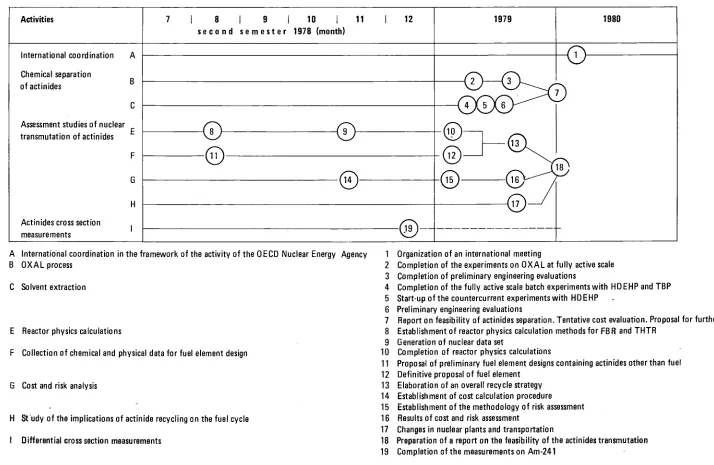
In the framework of the activity of the OECD Nuclear Energy Agency, in the field of radioactive waste, the Commission has been chosen as leading organization for the studies on the chemical separation and nuclear transmutation of actinides.
The activity of the JRC in this field includes experiments on the chemical methods required for actinides separation from HAW and a s s e s s m e n t studies on the possibility of actinides transmutation in nuclear r e a c t o r s .
F o r the chemical separation of actinides from HAW, oxalate p r e c i p i -tation (OXAL P r o c e s s ) and solvent extraction by HDEHP and T B P a r e being investigated.
The a s s e s s m e n t studies include, in addition to the r e a c t o r physics a s p e c t s , the implications of the nuclear transmutation on the nuclear fuel cycle (actinide fuel element design, modifications in the nuclear plants, i n c r e a s e of cost and risk).
In o r d e r to improve the accuracy of the reactor physics calculations a p r o g r a m m e of neutron c r o s s section m e a s u r e m e n t s is c a r r i e d out.
The JRC activities a r e planned in such a way as to have a m a x i m u m of information emerging in the second half of 1979. It i s , in fact, intended to p r e p a r e by the end of 1979 a major report dealing with a c r i t i c a l evaluation of the feasibility of the chemical separation and nuclear t r a n s -mutation of actinides.
25
-2 . -2 . 1 Chemical Separation of Actinides
OBJECTIVES
The activity performed during the reporting period was a continua-tion of the preceding experimental activity aimed at demonstrating, on a laboratory scale, the feasibility of the OXAL, HDEHP and T B P p r o -c e s s e s proposed for the HAW partitioning.
To this purpose during the reporting period it was planned to initiate HDEHP b a t c h - e x t r a c t i o n tests on fully active HAW solutions and counter-c u r r e n t t e s t s on simulated solutions.
The continuation of the OXAL p r o c e s s t e s t s (oxalate precipitation and a c t i n i d e / R E s separation) on real HAW solutions, was also included in the planned activity along with the p r e p a r a t i o n of detailed flow-she ets and flow-diagrams needed for evaluating the engineering implications of each actinide s e p a r a t i o n p r o c e s s .
RESULTS
1. HDEHP E_x_t raction P r o c e s s
The possibility of reducing the acidity of HAW solutions without any previous actinide separation (direct HAW denitration), strongly d e -pends on to -what extent the coprecipitation of actinides during deni-t r a deni-t i o n can be prevendeni-ted or minimized.
An acidity reduction step is in fact required whenever one of the c u r r e n t actinide r e c o v e r y methods, operating under low-acidity conditions, will be applied to HAW raffinâtes for partitioning p u r -p o s e s . Usually, as the -pH will i n c r e a s e , an im-portant fraction of actinides (mainly Pu) will coprecipitate with other hydrolysable m e t a l - i o n s (Mo, Z r , Nb, Fe) p r e s e n t in the HAW solution. In this r e s p e c t the behaviour of plutonium during the preceding denitration t e s t on simulated HAW [\J appeared r a t h e r unexpected and led to a second s e r i e s of e x p e r i m e n t s .
The precipitate formed during the denitration t e s t s was suitably washed with formic acid and redissolved by hydrochloric acid. The fraction of r e s i d u a l plutonium still remaining in the precipitate was in the o r d e r of a few tenths of percent of the initial plutonium amount. The m e a s u r e d values may probably be d e c r e a s e d using nitric acid as washing solution.
-vious s e p a r a t i o n before denitration would b e c o m e u n n e c e s s a r y .
The r e a c t i o n m e c h a n i s m s a r e p r e s e n t l y being i n v e s t i g a t e d .
F u r t h e r d e n i t r a t i o n t e s t s will be p e r f o r m e d on s i m u l a t e d and r e a l HAW s o l u t i o n s .
The HDEHP b a t c h e x t r a c t i o n t e s t s on fully active and acidic w a s t e solutions have been initiated using as a solvent two HDEHP o r g a n i c solutions having the following c o m p o s i t i o n s :
a) 0 . 2 5 M HDEHP + 0. 17 M T B P in dodecane, b) 0 . 2 5 M HDEHP in m e s i t y l e n e .
F o r a l l the e x t r a c t i o n t e s t s the o p e r a t i n g conditions w e r e fixed as follows:
the HAW solution was always p r e v i o u s l y filtered,
an organic to aqueous p h a s e r a t i o of 1, a s t i r r i n g t i m e of 4 m i n and a t e m p e r a t u r e of 2 5°C w e r e employed,
the p h a s e s e p a r a t i o n was a t t a i n e d by décantation.
The f i r s t set of e x p e r i m e n t s c a r r i e d out using both the solvent m i x t u r e s , showed the formation of p r e c i p i t a t e s c l e a r l y visible at the i n t e r p h a s e . As in the c a s e of s i m u l a t e d HAW, such i n t e r p h a s e p r e c i p i t a t e s w e r e eliminated by addition of NaNÛ2·
F o r all the b a c k e x t r a c t i o n t e s t s 0. 8 M oxalic acid was employed a s a s t r i p p i n g solution, the o t h e r operating conditions being equal to those of the e x t r a c t i o n t e s t s .
The p r e l i m i n a r y r e s u l t s obtained from e x t r a c t i o n and b a c k e x t r a c tion t e s t s w e r e s a t i s f a c t o r y . After t h r e e e x t r a c t i o n s t a g e s no p l u t o n i u m activity was detected in both organic and e x h a u s t e d aqueous p h a s e s . After t h r e e s u c c e s s i v e b a c k e x t r a c t i o n s t a g e s , the o v e r a l l plutonium s t r i p p e d from the o r g a n i c was a l m o s t q u a n t i t a t i v e .
2. T B P E x t r a c t i o n P r o c e s s
The r e s u l t s of c o n c e n t r a t i o n d e n i t r a t i o n t e s t s on s i m u l a t e d HAW,
a l r e a d y obtained during the p r e c e d i n g period [ζ], showed that, if
the formation of plutoniumbea ring p r e c i p i t a t e s has to be m i n i m i z e d , the reduction of the HAW acidity m u s t be c a r r i e d out u n d e r w e l l controlled p r o c e s s conditions. The setting up of the suitably equipped g l a s s r e a c t o r v e s s e l has been continued.
27
volume c o n d i t i o n s . Inside the r e a c t o r v e s s e l the level of the s o l u t i o n is kept c o n s t a n t by an a u t o m a t i c a l l y o p e r a t e d addition of both f o r m i c acid and HAW s o l u t i o n s . The acidity is m e a s u r e d by conduc t i m e t r y .
A s e t of c o n c e n t r a t i o n d e n i t r a t i o n t e s t s c a r r i e d out u s i n g s i m u l a t e d HAW s o l u t i o n s , has shown that a HCOOH/HNO3 m o l a r r a t i o of about 0. 7 is needed to provide during and at the end of the p r o c e s s a n i t r i c a c i d c o n c e n t r a t i o n not lower than 5 M / l , as r e q u i r e d to m i n i m i z e
the f r a c t i o n of a d s o r b e d plutonium ¿Zj.
The s e t t i n g up of the equipment will be c o m p l e t e d in the next m o n t h s . Active runs will s t a r t in O c t o b e r N o v e m b e r 1978.
3. OXAL P r o c e s s
E x p e r i m e n t a l t e s t s on s i m u l a t e d HAW s o l u t i o n s , a i m e d at optimizing the a c t i n i d e / R E s s e p a r a t i o n s t e p , have b e e n c o m p l e t e d . As p r e v i o u s ly r e p o r t e d ¿ZJ, a p r o c e s s b a s e d on column e x t r a c t i o n c h r o m a t o graphy (HDEHP s u p p o r t e d on L E V E X T R E L ) h a s been t e s t e d . Two LE VE XT RE L / H U E H P c o l u m n s , containing different a m o u n t s of a d s o r b e r have b e e n u t i l i z e d to r e m o v e plutonium and a m e r i c i u m from the HAW solution, at different acidity conditions r e s p e c t i v e l y .
T y p i c a l r e s u l t s obtained by s i m u l a t e d HAW solutions a r e i l l u s t r a t e d in F i g s . 1 and 2. 99. 7% of plutonium and z i r c o n i u m initially p r e s e n t was fixed on the f i r s t column (·ν0. 7 m l of a d s o r b e r ) a f t e r a d s o r p t i o n and washing s t e p s . Both the e l e m e n t s w e r e quantitatively eluted at 70°C by 1 M oxalic acid ( F i g . 1 ). After deacidification of the HAW solution (pH = 2) a m e r i c i u m and REs w e r e s e p a r a t e d from F P s by a d s o r p t i o n on the second column (^9 m l of a d s o r b e r ) . About 99% of a m e r i c i u m was then eluted by a complexing solution (0. 05 M D T P A + 0. 5 M glycolic acid); 3. 7% and 27% of the initial C e 1 4 4 and E u 1 5 4 a c t i v i t y w e r e d e t e c t e d in the a m e r i c i u m e l u a t e .
B a s e d on t h e s e r e s u l t s the a c t i n i d e f r a c t i o n should not contain m o r e than 5% of the R E s , a s was o r i g i n a l l y a n t i c i p a t e d .
To a t t a i n a h i g h e r d e g r e e of a c t i n i d e / R E s s e p a r a t i o n , if needed, an a d d i t i o n a l p u r i f i c a t i o n s t e p h a s to be f o r e s e e n .
E x p e r i m e n t s a r e s t i l l u n d e r way, in o r d e r to i m p r o v e the p e r f o r m ance of the p r o c e s s .
4. E n g i n e e r i n g I m p l i c a t i o n of Actinide S e p a r a t i o n P r o c e s s e s
sheets in o r d e r to estimate the engineering implications will be initiated in the second s e m e s t e r of this y e a r .
CONCLUSIONS
The activities a r e basically proceeding according to schedule, although the tests on fully active HAW a r e proceeding m o r e slowly than expec-ted. A revision of the planning may eventually be required in the next months.
Special attention was paid to the setting up of both denitration and concentration-denitration p r o c e s s e s which minimize the actinide content of precipitates formed. This effort is motivated by the need of p r e venting as much as possible, during the waste partitioning cycle the p r o -duction of new alpha-bearing waste.
PLANNED ACTIVITIES
During the following six months is planned:
- to initiate denitration tests on real HAW,
- to continue HDEHP batch-extraction tests on real HAW,
- to continue the experimental work on OXAL p r o c e s s by testing on a fully active laboratory scale the actinide/REs separation step,
- to proceed to a first evaluation of the engineering implications of the three flow-sheets.
REFERENCES
/ ! ƒ P r o g r a m m e P r o g r e s s Report on "Management of Nuclear M a t e r i a l s and Radioactive Waste", J R C - I s p r a Establishment, J a n u a r y - J u n e
1977, no. 3440
H O 3 > 3 JO m V, Β-o c m 3 -r+ 3" Λ <Λ r * r-m < m Χ Η m ι -Ι D m I ■σ o o c -t -ι > o 3' α (Β J3 m VI VI
■s Oí α: l-¥ O - i cr < η O c 3 3 ID Χ tí
s
O 3 O O =? » Oí T3 3" < 00 (D ■o CU - i ω r+ O 3 O -♦» -o c Ν10 20
HAW SOLUTION +WASHING(3.5 M HNOa)
0.3 % Pu 0.3 % Zr
I M , OXALIC ACID(70°C)
M
I > >
3 S
=Γ Ξ. o a.
3 ÍS. 3 F m m
li
io Ä
» σ
3 S Q. O
K¡
< 3
m Λ
X S.
3 s
m cf.
Ξ »
il
&
si
3 ■<
3.
! 16 10 g 4 η \ \ \[ - ·
\ \ \ \ \ \ \ \ \ > \ ^ \ \ i^.I I
¡ i
! I
hl
: il
ii :
I
ï *
π
I
ι !
i '·
'I •
J
I \ », \w
— Am
Eu
5 10 15 20 ¡ 25 30 35 40 ^ ! >v 5 0 5 5 6 0 6 5
m H A W ( D H = 2 ) + W A S H I N G ( D H = 2 ) 98.4 %Sr
„ 0.05 M DTPA +0.5M GLYCOLIC ACID
98.1 5% Am 3.7% Ce
N4 M HNOs
" I
27% Eu Column volumes of effluent
OJ
31
-2. -2. 2 A s s e s s m e n t Studies on Nuclear T r a n s m u t a t i o n of Actinides
OBJECTIVES
The a i m of this activity is to evaluate the neutron-physical and techno-logical feasibility and c o s t / r i s k implications of the t r a n s m u t a t i o n of actinides other than fuel in fission power r e a c t o r s and to propose the best suited recycle strategy.
In the p r e s e n t reporting period, p r e p a r a t o r y work regarding the fuel element design, i m p r o v e m e n t of the r i s k source a s s e s s m e n t code and e s t a b l i s h m e n t of collaboration with e x t e r n a l institutes were accentuated.
RESULTS
Selection of Recycle Strategies
Before work on fuel element design could be started, some fundamental decisions on the recycle strategy and the t r a n s m u t a t i o n devices had to be taken. The c r i t e r i a to be observed when selecting possible recycling s c h e m e s w e r e :
1. High t r a n s m u t a t i o n rate per i n c o r e time period in o r d e r to m i n i -mize waste a r i s i n g s during the various processing steps and the inventory of highly hazardous m a t e r i a l .
Consequently, r e a c t o r s with high neutron fluxes, long i n c o r e r e s i -dence t i m e s of fuel elements and high attainable b u r n - u p s should be chosen. Moreover, m i n o r actinides should be i r r a d i a t e d in special regions of the r e a c t o r .
2. Small reactivity penalties due to m i n o r actinides and fission product i m p u r i t i e s introduced into the r e a c t o r .
Consequently, fast r e a c t o r s a r e to be p r e f e r r e d .
3. Availability of the technology at about the y e a r 2000. Consequently, only r e a c t o r s which a r e now in phase of design or a l r e a d y operative a r e taken into consideration. However, developing potential of the various design p a r a m e t e r s which could improve the t r a n s m u t a t i o n s t r a t e g y should be included in the a s s e s s m e n t .
4. Small perturbations of the n o r m a l r e a c t o r operation concerning flux and power distribution.
This means that in c a s e of a heterogeneous recycle s c h e m e , the m i -nor actinide-containing fuel elements should be spread over chosen core zones.
actinide-containing fuel e l e m e n t s . Therefore, only r e a c t o r s with P u - r e c y c l i n g or recycling of U-233 a r e being considered. M o r e over the application of diluting m a t e r i a l s is indicated.
6. The change in fabrication, t r a n s p o r t and r e p r o c e s s i n g technology due to the presence of the minor actinides should be kept small and the implication on the fuel cycle costs should be minimized. Consequently, minor actinides should be contained in a minimum number of fuel elements which, however, before r e p r o c e s s i n g , could be mixed with n o r m a l fuel e l e m e n t s . Recycle through a u r a nium-fed LWR will be excluded.
As a conclusion of these r e q u i r e m e n t s , which a r e partly competing with each other, the following recycle s t r a t e g i e s will be investigated in m o r e detail;
- recycle through the core of a fast b r e e d e r r e a c t o r ( q u a s i - h e t e r o g e neous),
- recycle through a light-water reactor with plutonium recycle (homo geneous),
- recycle through a pebble-bed r e a c t o r with spherical fuel elements (heterogeneous).
Review of P e r f o r m a n c e Data for F u e l Element Design of the F a s t B r e e d e r
In ref. [\J, the performance data of various fast b r e e d e r fuel elements
have been collected. They a r e reproduced in Table 1. The high m a x i mum p e r m i s s i b l e linear power rating, maximum neutron flux and m a x i mum b u r n - u p led to the decision to choose the NA 1 design as reference fast b r e e d e r for transmutation.
Design Work for Minor Actinide-Bearing F a s t B r e e d e r F u e l Pins
Design work for the fuel element is based on the assumption that all geometric p a r a m e t e r s which could influence the t h e r m o - h y d r a u l i c s of the coolant channel, r e m a i n constants. Thus, the outer d i a m e t e r of the pin and the maximum p e r m i s s i b l e linear power rating shall not be varied.
Supposed that the t a r g e t pin with 85% of theoretical density of the oxides, is going to be inserted into the r e a c t o r zone with the highest flux of
ψ = 8. 9 · 10 η / 15 , Ζ
cm . s
TABLE 1 : CHARACTERISTICS OF FBRs
Reactor power (MW)
Temperatures (°C) Dimensions (mm) thermal electric. core inlet core outlet midd wall clad (max) fuel (max) core height coreø clad o.d. clad i.d. rad. gap Subassemblies Pins/subass. Fuel material Pu in zone 1 (% ) Pu in zone 2 (% ) Pu in zone 3 (% ) Cladding material Power rating Linear mean (W/cm) Linear max. (W/cm) f/TlMW/T H.M.) Neutron flux x 1 0 'l s
(n/cm2.s)
core (max) core (mean) Fluence (max) at clad (n/cm2) Burn-up of core fuel (GWD(th)/T) mean max FRANCE PHENIX 5B3 250 400 560 650 700 SUPER PHENIX 2910 1200 395 535 620 700 850 1390 6.6 1000 3660 8.65 103 217
u o2/ ·
Pu02
358 271
U 02/
Pu02
18 25
ss ss
430 450 7.2 3-1023 50 4.6-1023 70 U.K. DFR 72 15 200 350 PFR 600 270 400 562 660 700 CFR 2900 1320 400 662 620 700 6.0 910 1470 5.84 1000 2900 5.84 5.32 U 78 325
U 02/
Pu02
342
325
U 02/
Pu02
ss ss 320
450 450 160 2.5 8.5 11
53 70 70
SNR 300 736 312 377 546 F.R.G. SNR
2 NA1
2500 1200 1000 430 580 GC FBR 2780 1030 273 655 670 2400 950 1780 6.0 (2800) . 2400 955 2860 7.6 6.7 700 8.2 6.0 205 169 U 02/
Pu02
210
331
uo2/
Pu02
ss Incoloy 800 452
460 5GG
143.9 6.0 8.92
6.35 55
87
79
125 100
USSR BN 350 1000 350 300 500 BN 600 1480 600 380 550 680 700 1060 1580 6.1 750 2050 6.9 169 U02 127 Ü Ó j / * Pu02
ss ss
470 530
50 90
JAPAN MONJU 714 300 390 540 700 900 1780 6.5 196 169 U 02/
Pu02 Zircon. 457 4.0 80 U.S.A. EFFBR 200 66 290 430 CR BR 950 360 387 540 AIFO 2400 1002 GEFO 2417 1011 636 640 910 1880 5.84 198 217
U uo2/
Pu02
ss
250 475
116 155.6 4.7
3 - 1 0 "
67.7 104.5 150
FBR 1st cycle
F B R equilibrium
U-LWR
F B R 1st cycle without Np
F B R equilibrium without Np
U-LWR without Np
Np-237
3 . 2 3 - 3
2 . 2 6 - 3
7.27-3
A m -241
4 . 0 6 - 3
2 . 2 8 - 3
6.23-4
5.99-3
3.37-2
2 . 2 9 - 3 A m
-242M
7 . 2 3 - 5
1. 56-4
1. 16-5
1. 07-4
2 . 3 1 - 4
4 . 2 7 - 5 A m
-243
2 . 4 7 - 3
2 . 5 7 - 3
1.53-3
3.64-3
3 . 8 0 - 3
5. 63-3 C m
-242 1.22-4 1.11-4 7. 31-5 1. 80-4 1.64-4
2 . 6 9 - 4 C m
-243
7.83-6
6. 59-5
1.09-6
1. 16-5
9 . 7 4 - 5
4. 00-6 C m
-244
1.78-4
1.33-3
4 . 6 9 - 4
2 . 6 3 - 4
1.97-3
1.73-3 C m
-245
5.68-6
1.74-4
3. 07-5
8.39-6
2 . 5 7 - 4
1.13-4 C m
-246
1.74-7
1.03-4
3.59-6
2 . 5 7 - 7
1.52-4
1.32-5 C m
-247
1.16-5
1.72-5 C m
-248 5. 56-5 8.23-6 Cf-249 4. 52-7 6.68-7
Note that these isotopie concentrations refer to the i r r a d i a t i o n time point z e r o . During i r r a d i a t i o n the composition is changed such that reactivity and specific power of the t a r g e t elements will vary.
35
The p r e s e n c e of the fertile Np-237 leads to a considerable i n c r e a s e of the specific power during an i n - c o r e time period. In addition, the initial l i n e a r power rating r e s u l t s already as considerably high c o m -pared to 566 W / c m permitted.
P r o p o s a l s for the reduction of the power rating a r e discussed in ref. [zj. The g e o m e t r i c a l and performance data'for the pin a r e s u m m a r i
[image:39.595.116.422.188.372.2]-zed in Table 3.
TABLE 3
P e l l e t d i a m e t e r (mm)
Cladding outer diam. (mm) Cladding thickness (u) P o w e r rating (W/cm) B u r n - u p (MWd/t)
Max. wall cladding t e m p .
(°c)
P e l l e t density (%TD)
Max. neutron flux ( n / c m .s) Cladding m a t e r i a l
6 6 . 7 350 566 125,000
620 in - 590 ext 85
8. 92 · 1 01 5
Incoloy 800
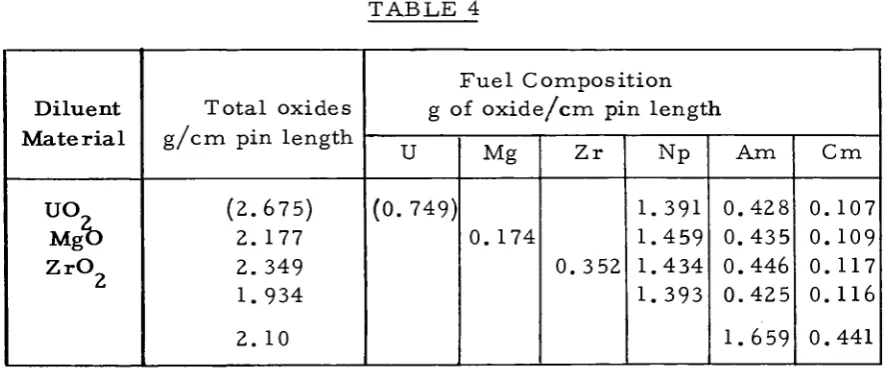
In c a s e the linear power rating is reduced by m a t e r i a l dilution, using a l t e r n a t i v e l y as diluting m a t e r i a l UO^, MgO, or ZrC^, the composi-tions in g r a m s p e r cm of pin length of Table 4 must be chosen in o r d e r not to exceed the m a x i m u m p e r m i s s i b l e linear power rating.
TABLE 4
Diluent
Mate rial
MgC) Z r 02
Total oxides g / c m pin length
(2.675) 2. 177 2. 349 1.934 2. 10 Fuel Composition g of o x i d e / c m pin length
U (0.749) Mg 0. 174 Z r 0.352 Np 1.391 1.459 1.434 1.393 A m 0.428 0.435 0.446 0.425 1. 659 C m 0. 107 0.109 0.117 0.116 0.441
In addition to dilution, the l i n e a r specific power rating can also be r e -duced by different geometric configurations of the pellets. This would
represent the advantage of not introducing any m a t e r i a l other than m i -n o r acti-nides to the r e a c t o r a-nd the fuel cycle facilities. The a-n-nular
pellet configuration, the thicker cladding sheath v e r s i o n and the pellet
[image:39.595.57.501.460.645.2]-nation of thicker cladding and increased porosity may be an optimum s olution.
A selective valuation of these proposals is envisaged in collaboration with the Karlsruhe Establishment of the JRC by investigating:
- t e m p e r a t u r e profiles and levels, - oxygen redistribution,
- t h e r m a l and fission gas s t r e s s to the cladding as well as c o r r o s i o n and embrittlement,
- pellet behaviour under power conditions, - a s s e s s m e n t of fabrication problems,
- construction of phase diagrams for actinides and diluents.
Risk A s s e s s m e n t
A Waste Management Code for the recycling of actinides in a nuclear r e a c t o r has been elaborated and is at p r e s e n t in its n u m e r i c a l t e s t phase. The code p e r m i t s to calculate the actinide a risings for the fol-lowing cases after n cycles of a nuclear power r e a c t o r operation:
1) Actinide Input and Output for the c a s e s called Actinide Recycling (ÀR) and No Actinide Recycling (NAR)
2) Actinide Waste Arisings for the Actinide T a r g e t Elements (TE), the N o r m a l Fuel Elements (NE) for the recycling c a s e and for the fuel elements with no actinide recycling.
The code uses as input data the actinide vectors calculated for the n-th cycle with m o r e sophisticated burn-up codes and calculates the isotopie concentrations built up in the different components of the fuel cycle via vectors specifying the isotopie m a s s flow to waste r e p o s i t o r i e s and or to the surroundings.
Calculated for each component of the fuel cycle a r e the accumulated isotopie vectors (units: g / t H M and g/GWye), the neutron output from spontaneous fission or (<*-n) reactions with oxide (units: n e u t r o n s / t H M and neutrons/GWye ), the actinide decay heat (units: W / t H M and W/GWye), and the inhalation and ingestion hazards (units: m ' a i r / t H M and m^ a i r / GWye and m3 H20 / t H M and m3 H20/GWye respectively).
37
-COLLABORATION WITH EXTERNAL ORGANIZATIONS
- Contract with the A u s t r i a n Academy of Science, Vienna
The work r e g a r d i n g this contract has been successfully accomplished by providing a final report [ij and neutron c r o s s section data for A m - 2 4 3 . The a i m of this contract was to investigate whether sufficient nuclear input data a r e existing to compute reaction c r o s s s e c -tions of a m e r i c i u m and c u r i u m isotopes for fast neutrons by means of t h e o r e t i c a l models for the nucleus, to develop a suitable computer p r o g r a m for calculating ^ ( E ) , ^ ( E ) , and cT _ (E); and to supply these c r o s s sections to A m - 2 4 3 .
The final r e p o r t contains the following i t e m s : description of a m o d i -fied v e r s i o n of the computer p r o g r a m STAPRE for p a r t i c l e - i n d u c e d activation c r o s s sections in which the fission p r o c e s s has been included. Description of the computer p r o g r a m CAPTRE needed to c a l -culate the c r o s s sections for lower neutron e n e r g i e s . Indication of l i t e r a t u r e [AJ regarding s t a t i s t i c a l model p a r a m e t e r s which a r e needed as input p a r a m e t e r s for calculating neutron c r o s s sections for v a -rious m i n o r actinide i s o t o p e s . Listing of t r a n s m i s s i o n coefficients for U-238 derived by means of the I U P I T O R - K / V code which can, in
a f i r s t - o r d e r approximation, be applied also to calculate neutron c r o s s sections for other i s o t o p e s .
By comparing calculated r e s u l t s for <7"f(E) of U-238 with ENDE/B 4 data (see F i g . 5), the c o r r e c t working of the computer p r o g r a m has been proved. F i g . 6 shows the r e s u l t s for ^ E ) of A m 2 4 3 . A s i m i -l a r situation as in the c a s e of the fission c r o s s section of Am-241 was found, where e x p e r i m e n t s of W. Hage et al. as well as model calcu-lations by F . M. Mann, HEDL, d e m o n s t r a t e d that E N D F / B 4 data a r e
much too large for energy ranges below 100 keV. F i g . 7 gives the calculated r e s u l t s for the capture c r o s s section of A m - 2 4 3 , compa-red to the ENDL-76 data set of Saclay. It may be s e e n that the theo-r e t i c a l values a theo-r e patheo-rtly, by a factotheo-r of 5, highetheo-r than the Saclay values.
It is intended to utilize the new data for deriving effective one-group c r o s s sections for different fast b r e e d e r neutron s p e c t r a and to apply them in ORIGEN as well as m o r e refined F B R physics calculations.
- Contract with KFA Jülich
graphite and two further pyrolytic sheaths.
The potential advantages of this r e a c t o r as t r a n s m u t a t i o n device consist in the very high attainable b u r n u p s , the possibility .to r e -cycle minor actinides in separate s p h e r e s which may be distributed homogeneously over the whole core ( i . e . to realize a heterogeneous recycle scheme without perturbing the m a c r o s c o p i c power d i s t r i b u -tion), and a possible re-feed of the s p h e r e s after discharge from the
reactor without r e p r o c e s s i n g .
In addition to the r e a c t o r physics calculations by methods developed at Jülich, information on the fabrication and r e p r o c e s s i n g of s p h e r i -cal fuel elements will be provided. The r e s u l t s of this study will be provided in the middle of 1979.
- Contract with CNEN Casaccia
A one-year study contract is being concluded with the "Dipartimento Ricerca Tecnologica di Base Avanzata" of the CNEN Casaccia with the scope of obtaining refined reactor physics calculations for two FBRs with different hard neutron s p e c t r a . By this the p r e l i m i n a r y calculational r e s u l t s for transmutation r a t e , specific power rating and reactivity effects of minor actinidecontaining fuel elements p e r -formed at Ispra [sj, shall be verified.
Also this study will be terminated in the middle of 1979.
CONCLUSIONS
It is obvious tJhat the recycle s t r a t e g i e s proposed for minor actinides a r e of p r e l i m i n a r y nature which have to be adjusted after having r e s u l t s for cost and risk analysis and m o r e detailed investigations in the fields of reactor physics, fuel element fabrication and r e p r o c e s s i n g .
Due to administrative difficulties the formalization of the contracts for evaluating the pebble-bed r e a c t o r and the fast b r e e d e r has been delayed for half a y e a r . However, it s e e m s still possible to get, by m e a n s of the results still to be provided, a feedback effect on the choice of the
recycle strategy.
PLANNED ACTIVITIES
During the next reporting period the following activities a r e envisaged: - Generation of updated l i b r a r i e s for LWRs and FBRs in o r d e r to be
39
- P r o p o s a l of the m i n o r a c t i n i d e - c o n t a i n i n g fuel pins for LWRs;
P a r a m e t r i c fuel cycle c o s t evaluation;
P r e l i m i n a r y r e s u l t s from the r i s k s o u r c e c o m p u t e r p r o g r a m .
R E F E R E N C E S
/ " i / S C H M I D T , E . , ZAMORANI, E . , " P r o p o s a l for a Minor Actinide Containing F u e l P i n for a F a s t R e a c t o r " , working p a p e r No. 8 (May, 1978)
[Zj ZAMORANI, Ε . , SCHMIDT, Ε . , " P r o p o s a l for Additional Work
C o n c e r n i n g F u e l P i n D e s i g n for a n F B R C o n t a i n i n g Minor A c t i n i d e s " , working p a p e r No. 9 (May, 1978)
[ij STROHMAIER, B . , UHL, Μ. , " F i n a l R e p o r t on the Work P e r
f o r m e d at the "Institut für R a d i u m f o r s c h u n g und K e r n p h y s i k " , u n d e r c o n t r a c t No. 6 4 0 7 6 1 0 SISPC b e t w e e n the E u r o p e a n C o m
m u n i t i e s and the A u s t r i a n A c a d e m y of S c i e n c e , (March, 1978)
[A] LYNN, J. E . , A E R E R 7468
[Sj C A M E T T I , J. , SCHMIDT, E . , "On the Neut r o n P h y s i c al F e a s i
600
+ + + —
X X X —
® ® — ras ··
All actinides from FBR, 1st cycle All actinides from FBR, equilibrium cycle All actinides from U-LWR
Actinides without Np from U-LWR
LPR_MAX_ f£r_NA1_is_566 W/cm
550
100 200 300 400 500 600
— t [ d ] In-core time
41
-Fig. 2 — Annular pellet configuration
Fig. 3 — Pellet configuration with thicker cladding
10
ro
.o c o
CO
( Λ
iS>
o
L.
O
C
o 10
10"
10"
o o c o
o—»-o—< υ u U V
calculation
o ENDF/B-IV
8 9 10
Neutron Energy (MeV)
to
σι I
Κ) ω
> 3
o
co S
r+ θ ' 3
10'
ro
£1 c O
o ω
00
o
o
o
—
DL
ro
CJ
r
-1.0 _
0.01
-\
■\
β 1
o o
c \ o
I 1 >
o
calculation
ENDL-76, M A T N . 7184
c
8 9 10
Neutron Energy (MeV)
45
2. 2. 3 Actinide C r o s s Section M e a s u r e m e n t s
OBJECTIVES
During D e c e m b e r 1977 the A m 2 4 1 fission c r o s s s e c t i o n has b e e n m e a s u r e d applying the fission product d e t e c t i o n method with a q u a s i 4ΥΓ gas s c i n t i l l a t i o n c h a m b e r . The e x p e r i m e n t s have b e e n c a r r i e d out i n the
e n e r g y range of 230 keV -c En < 1170 keV. As n e u t r o n s o u r c e the 3 MeV
Van de Graaff a c c e l e r a t o r of the Institute for Applied N u c l e a r P h y s i c s of the KfK, K a r l s r u h e h a s b e e n u s e d .
The f i r s t p a r t of the y e a r was f o r e s e e n for the a n a l y s i s of the e x p e r i m e n t a l d a t a .
RESULTS
During t h e s e e x p e r i m e n t s the double f i s s i o n c h a m b e r had in i t s t e s t p o s i t i o n a mixed t a r g e t c o n s i s t i n g of (0. 942 + 0. 22) m g U 2 3 5 and of (0. 917 + 0. 12) mg A m 2 4 1 . In the r e f e r e n c e position a U235 t a r g e t of (4. 76 + 0. 10) m g had been u s e d . The t e s t and r e f e r e n c e t a r g e t s i r r a d i a t e d by a m o n o e n e r g e t i c pulsed n e u t r o n b e a m w e r e a t a d i s t a n c e of 48.5 c m and 54. 5 c m r e s p e c t i v e l y from the n e u t r o n g e n e r a t i n g t a r g e t (Li(p, n)Be).
The n e u t r o n pulse d u r a t i o n was s m a l l e r than 0. 8 ns and the n e u t r o n p u l s e frequency 5 MHz. The r e s u l t i n g f i s s i o n product e n e r g y s p e c t r a w e r e r e c o r d e d for two s u b c h a m b e r s , one belonging to the t e s t , the o t h e r to the r e f e r e n c e t a r g e t a s t h r e e d i m e n s i o n a l timeofflight e n e r g y s p e c t r a . F o r the t i m e axis 252 and for the e n e r g y 16 c h a n n e l s w e r e a v a i l a b l e . The n e u t r o n e n e r g y of the Van de Graaff h a s b e e n m o n i t o r e d with a L i g l a s s d e t e c t o r . The e x p e r i m e n t s w e r e p e r f o r m e d a t 4 d i f f e r ent n e u t r o n e n e r g i e s 230 keV, 772 keV, 976 keV and 1170 k e V .
The e n e r g y d e p e n d e n t t i m e o f f l i g h t s p e c t r a w e r e t r a n s f o r m e d into r e a c t i o n r a t e r a t i o s . The A m 2 4 1 to U 2 3 5 f i s s i o n c r o s s s e c t i o n r a t i o was d e r i v e d from the e x p r e s s i o n
W
Rl(
El>V
E2>
W
¿
u
N
u
+
(Γ (E ) & Ν . L UV Ζ' A A
i
«W
¿ UNÜ
£ΑΝΑ
CrU^E2^ E =230 keV
2