City, University of London Institutional Repository
Citation
:
Li, Y., Chen, X., Divall, S. and Zhang, X. (2017). A study into the behaviour of the formation level of an excavation under different unloading patterns in soft deposits. Arabian Journal of Geosciences, 10(19), 437.. doi: 10.1007/s12517-017-3227-2This is the accepted version of the paper.
This version of the publication may differ from the final published
version.
Permanent repository link:
http://openaccess.city.ac.uk/18358/Link to published version
:
http://dx.doi.org/10.1007/s12517-017-3227-2Copyright and reuse:
City Research Online aims to make research
outputs of City, University of London available to a wider audience.
Copyright and Moral Rights remain with the author(s) and/or copyright
holders. URLs from City Research Online may be freely distributed and
linked to.
A study into the behaviour of the formation level of an excavation
under different unloading patterns in soft deposits
Yuqi Li1, *, Xiaohui Chen1, Sam Divall2, Xiaodi Zhang1
1 Department of Civil Engineering, Shanghai University, Shanghai 200072, China
2 Department of Civil Engineering, City University London, London EC1V 0HB, UK
*
Corresponding author: [email protected]
Abstract:The construction of basements in urban areas is often associated with the possible damage to existing structures and services. The varying construction processes inevitably lead to different stress unloading
patterns and therefore the dissipation of these excess pore-water pressures may lead to non-standard deformation
profiles. The three main types of basement construction processes are Layered Excavation (LE), Basin Excavation
(BE) and Island Excavation (IE). The effect of the various unloading patterns has been investigated by a three
dimensional (3D) effective stress analysis method using the developed computer program 3DBCPE4.0. An
excavation of length 50m, width 50m and depth 9m in a certain homogenous and isotropic saturated soft soil was
modelled. This included a diaphragm wall of 800mm thickness embedded 18m deep into the soft soil. The
different excavation deformation profiles under different excavation patterns were related to the different
unloading process, the exposure time of excavation face and the dissipation of negative excess pore-water
pressures. The most favourable process for controlling the horizontal deformation of a retaining wall or the heave
deformation of the formation level is suggested. The ground water potentials within the formation level are also
presented.
1. Introduction
Excavation will cause the deformations of retaining structure, pit base and ground surface,
therefore, numerous investigations on the characteristics of excavation-induced deformations have
been performed. Ou and his research group did a lot of research, they proposed an empirical
method for predicting the spandrel and concave settlement profiles on the basis of a regression
analysis of the field observations of settlement curves (Hsieh and Ou, 1998), studied building
responses and ground movements caused by an excavation using the top-down construction
method (Ou et al., 2000), analysed basal heave of excavations (Hsieh et al., 2008), evaluated basal
heave stability (Do et al., 2013), and investigated extensively the behaviour of excavations with
cross walls (Hsieh et al., 2012; Hsieh et al., 2013; Ou et al., 2013; Wu et al.,2013). In addition,
Zdravkovic et al. (2005), Kung et al. (2007a; 2007b) and Finno et al. (2007) studied the
deformation behaviour of excavation in other aspects.
Excavation will also cause the variation of pore pressure due to unloading. In order to
investigate variation of pore-water pressure induced by excavation, 3D effective stress analysis
based on Biot’s consolidation theory was performed. Osaimi and Clough (1979) investigated
pore-water pressure dissipation during an excavation based on Biot’s consolidation theory.
Benmebarek et al. (2006) analysed the effect of seepage flow on the lateral earth pressures acting
on deep sheet piled wall excavations in cohesionless soil using the explicit finite difference
method implemented in Fast Lagrangian Analysis of Continua (FLAC) code. The distribution
rules of the formation level deformations and excess pore-water pressure were analysed in detail
integrating the time parameter by Li et al. (2008). Borges and Guerra (2014) analysed the
investigated the influence of the diameter of excavation, the embedded length of the wall and the
elastic modulus of the wall material on the behaviour of the formation level.
In actual engineering, there are different excavation patterns according to the surrounding
environment and the stability of excavation. LE is that soil is excavated uniformly from the
excavation, BE is that the soil at the formation level centre is excavated first whereas the soil
around the formation level centre is excavated later, and IE refers to that the soil around the
formation level centre is excavated first whereas the soil at the formation level centre is excavated
later. However, as reported above, little work has focused on the effect of the excavation patterns
(such as IE and BE) on the formation level. Tan and Wang (2013a; 2013b) studied the
characteristics of a circular excavation and its peripheral according to a large-scale deep
excavations by the Island technique. The study compared bottom-up construction of the central
cylindrical shaft first and top-down construction of the peripheral rectangular excavation in
Shanghai’s soft clay. However, they concentrated on formation level shape (central circular and
peripheral rectangular) and the construction method (bottom-up construction and top-down
construction) via the analysis of formation level deformations.
In this study, to explore the effects of excavation patterns on the behaviour of the formation
level, based on Biot’s consolidation theory, a computer program 3DBCPE4.0 was developed by
3D FEM. This was used to perform the coupled analysis of soil mass deformation and pore-water
pressure dissipation. LE, BE and IE were modelled respectively and the results are reported in this
paper.
2. Biot’s 3D consolidation finite element equations
2002) can be written in the following form:
, -* + * + (1)
where [K] is the element consolidation matrix (a symmetric matrix of 32×32 since a mesh of eight
noded hexahedral isoparametric elements is used to discretize a pit geometry in this paper),
* + is the increment column matrix of unknown terms of element node and * + is the
increment column matrix of equivalent load and water runoff of element node.
The sub matrix of the , - matrix is given by:
[ ] [
[ ] [ ]
[ ] ] ( )
(2)
where is the integration constant which ranges from 0.5 to 1.0, [ ] is the sub matrix of
element stiffness matrix, [ ] is the sub matrix of element coupling matrix and is the
component of element seepage matrix (Xie and Zhou, 2002).
The sub matrices of the * + and * + matrices can be expressed respectively as:
* + , - ( ) (3)
* + , - ( ) (4)
where , 𝜐, , and are the displacement increments and the pore-water pressure
increment of the ith element node, respectively, , , and are the equivalent
load increments and the equivalent water runoff increment of the ith element node, respectively.
The seepage effect induced by the water head difference between the inside and the outside
of the formation level cannot be taken into account when analysing excavation deformation and
pore-water pressure using Eq.(1). Thus, a ground water potential is introduced for consolidation
analysis of the excavation. When neglecting the solute potential the ground water potential of a
(5)
where P is the ground water potential of a saturated soil, p is the sum of pressure potential
(hydrostatic pressure) and load potential (excess pore water pressure), i.e. the total pore-water
pressure, the spatial coordinate z is upwards positive, is unit weight of water, and z is the
gravity potential.
The ground water potentials of element node i at time 𝑛 and 𝑛+1 are represented by (𝑛)
and (𝑛+1), respectively. Thus Eqs.(3) and (4) may be written in the following form without
regard to the influence of soil vertical displacement:
* + , (𝑛+1)- ( )
* + [ ′ ′ ′ ′ ] ( )
(6)
(7)
where ′ [ ] (𝑛) , ′ , - (𝑛), ′ [ ] (𝑛) and
′ (𝑛).
Based on the finite element equations derived above, a 3D consolidation finite element
program 3DBCPE4.0 was developed. In order to validate the program, an analysis of
one-dimensional consolidation for homogeneous soft soils under time-dependent loading was
introduced (Li et al., 2008). The soil layer top is pervious and free, and the bottom is impervious
and fixed. Displacements perpendicular to the boundaries are restrained and an impermeable
condition is assigned at the vertical boundaries. Soil parameters are: Poisson’s ratio μ=0.301,
elasticity modulus E=3MPa, vertical permeability coefficient kv=1.0×10 8
m/s, and thickness of
soil layer H=10m. A load curve is shown in Fig.1 where maximum load q0=100kPa and time
t0=70d.
divided into 7 meshes, as shown in Fig.2.
Fig.1 Loading curve
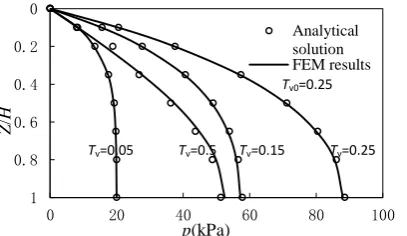
The comparisons of pore pressure, settlement
and average degree of consolidation between the
FEM results and the analytical solution of 1D
consolidation are shown in Figs.3 and 4. The
results of FEM agree very well with those of the
analytical solution, which proves the validity of the
program, so it can be used for effective stress analysis.
Fig.3 Comparison of pore pressure
(a) settlement (b) average degree of consolidation
Fig.4 Comparisons of settlement and average degree of consolidation
0 0.2 0.4 0.6 0.8 1
0 20 40 60 80 100
Analytical solution FEM results 0 10 20 30
0.01 0.1 1
Sct (cm ) Tv Analytical solution FEM results 0 20 40 60 80 100
0.01 0.1 1
U (%) Tv Analytical solution FEM results q q0
t0 t
o
Fig.2 Finite element mesh used for analysis of 1D consolidation
y z o x 1m 1m 1 .5 m 1 .5 m 2 m 1 .5 m 1 .5 m Tv0=0.25 Z / H p(kPa)
Tv=0.05 Tv=0.5 Tv=0.15 Tv=0.25
[image:7.595.332.457.98.348.2] [image:7.595.130.269.111.218.2] [image:7.595.195.399.443.561.2] [image:7.595.103.494.601.735.2]3. Stress-strain relationship of soil
Soil behaviour was simulated using the revised Duncan-Chang model (Duncan and Chang,
1970; Kulhawy and Duncan, 1972) in this paper. The model assumes a hyperbolic stress-strain
relationship and a variable Poisson’s ratio by means of stress-dependent Poisson’s ratio (Kulhawy
and Duncan, 1972).
The initial modulus is defined as:
. /𝑛 (8)
where the modulus number K and modulus exponent n are dimensionless material parameters; σ3
is the minor principal stress; pa is atmospheric pressure expressed in the same pressure units as σ3.
When the stress-strain relationship is employed in incremental form, the tangent modulus
corresponding to any point on a stress-strain curve can be expressed as:
0 + (1 )( )1 . /𝑛 (9)
where c and φ are Mohr-Coulomb strength parameters; σ1 is the major principal stress; and Rf is
the failure ratio.
When (σ1–σ3) is less than its historical maximum, it is assumed that the soil is under
unloading or reloading and the tangent modulus is defined as:
. / 𝑛
(10)
where Kur is the unloading-reloading modulus number and is always greater than the primary
loading modulus number K.
The initial Poisson’s ratio can be expressed as:
. / (11)
(1 ) (12)
where ( )
.
/ 01 ( )( ) 1
; and D, F and G are material parameters.
4. Studies on the behaviour of foundation pit under different excavation patterns
4.1 Numerical example and finite element model
A formation level of length 50m, width 50m and depth 9m in a certain homogenous and
isotropic saturated soft soil is presented. The diaphragm wall of 800mm thickness is embedded
18m deep in soft soil. The groundwater tables inside and outside the excavation were assumed to
locate on the excavated surface and the ground surface respectively. Soil vertical and horizontal
permeability coefficients (i.e. kh and kv) are both 1.0×10⁻⁸m/s and the effective unit weight of soil
γ' is 9.0kN/m3 (Table 1).
Table 1 Soil parameters used during modelling
K n Rf c′ φ′ F G D Kur kh kv γ'
(kPa) (°) (m/s) (m/s) (kN/m3)
150 0.7 0.85 15 35 0.15 0.35 3.5 300 1.0×10⁻⁸ 1.0×10⁻⁸ 9
Two layer struts of reinforce concrete are respectively set at 3m and 6m under the ground
surface. Their cross-sectional dimensions at the first tier and the second tier were 600mm by
600mm and 600mm by 700mm, respectively. The horizontal spaces between the struts within the
excavation at every tier were 8.3m. Given that the influence scope of an excavation and the
symmetry about the formation level centreline, the dimensions of the model in x-, y- and
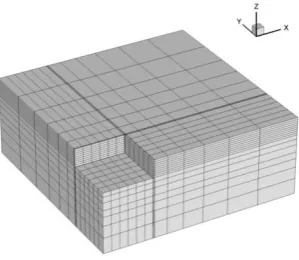
z-direction are 100m (length) by 100m (width) by 40m (depth). Finite element meshes of soil mass
and retaining wall are shown in Fig.5 wherein the element size was fine near the walls where
Fig.5 Mesh of finite elements
The bottom boundary of the excavation model was assumed to be fixed and displacements
perpendicular to the boundaries were restrained at the lateral boundaries. As far as the hydraulic
boundary conditions were concerned, a no-flow condition was assigned at the symmetrical plane
and an impermeable condition was assigned at the vertical boundaries. The bottom boundary of
the model was impermeable whereas the top was permeable and the retaining walls were
double-sided impermeable.
All soil units were discretized using eight-node hexahedral isoparametric elements and was
simulated using the revised Duncan-Chang model. According to the studies of many researchers
(Duncan and Chang, 1970; Kulhawy and Duncan, 1972; Ou et al.,1996; Liao, 2009), the
parameters of hyperbolic model in this paper are listed in Table 1. In Table 1 c' and φ' are the
effective cohesion and the effective internal friction angle of soil respectively. Retaining walls
were modelled with a linear elastic model whose modulus of elasticity and Poisson’s ratio are
25GPa and 0.167 respectively. Retaining wall’s elements were discretized using Wilson
non-harmony elements. A row of 0.1m thick interfaces were used to connect soil mass and
retaining wall elements. The two sides of the retaining wall adopted 3D thin interface elements
which were derived from Yin’s rigid plastic model (Yin et al., 1995) for outer friction angle=1.0°
[image:10.595.234.384.75.205.2]mass elements. Supports were simulated with the linear elastic model with 23GPa elasticity
modulus and discretized using spatial bar elements.
4.2 Construction process under different excavation patterns
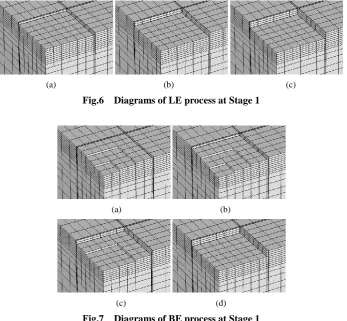
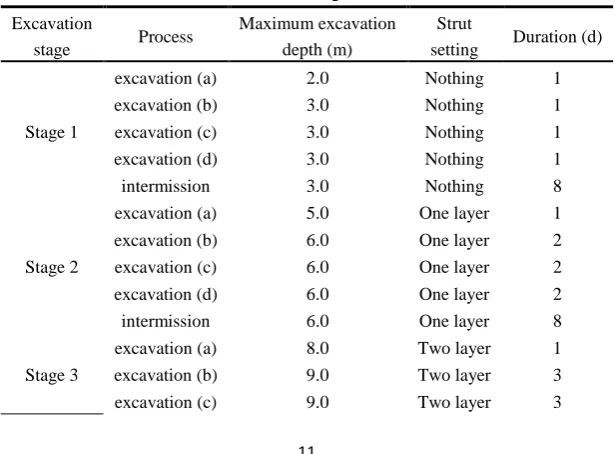
LE, BE and IE all involved three stages and the excavated thickness at every stage was 3m.
Construction at every stage was divided into three or four stages to complete (see Figs.6-8).
Excavation intermissions after every excavation stage were allowed for installation of struts or
casting the formation level base concrete. Excavation duration each stage and the intermission
duration after each stage under the different excavation patterns were also kept the same (as shown
in Tables 2-4).
(a) (b) (c)
Fig.6 Diagrams of LE process at Stage 1
(a) (b)
(c) (d)
[image:11.595.126.474.370.691.2] [image:11.595.176.421.461.680.2](a) (b)
(c) (d)
Fig.8 Diagrams of IE process at Stage 1
Table 2 LE process
Excavation
stage Process
Excavation thickness (m)
Total excavation depth (m)
Strut
setting Duration (d)
Stage 1
excavation(a) 1.0 1.0 Nothing 1
excavation(b) 1.0 2.0 Nothing 1
excavation(c) 1.0 3.0 Nothing 2
intermission 0.0 3.0 Nothing 8
Stage 2
excavation(a) 1.0 4.0 One layer 2
excavation(b) 1.0 5.0 One layer 2
excavation(c) 1.0 6.0 One layer 3
intermission 0.0 6.0 One layer 8
Stage 3
excavation(a) 1.0 7.0 Two layer 3
excavation(b) 1.0 8.0 Two layer 3
excavation(c) 1.0 9.0 Two layer 4
intermission 0.0 9.0 Two layer 10
Note: excavation processes (a), (b) and (c) at the first stage are shown in Fig.6
Table 3 BE process
Excavation
stage Process
Maximum excavation depth (m)
Strut
setting Duration (d)
Stage 1
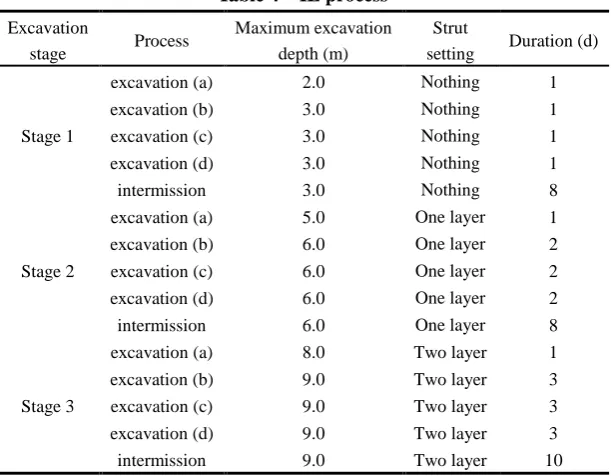
excavation (a) 2.0 Nothing 1
excavation (b) 3.0 Nothing 1
excavation (c) 3.0 Nothing 1
excavation (d) 3.0 Nothing 1
intermission 3.0 Nothing 8
Stage 2
excavation (a) 5.0 One layer 1
excavation (b) 6.0 One layer 2
excavation (c) 6.0 One layer 2
excavation (d) 6.0 One layer 2
intermission 6.0 One layer 8
Stage 3
excavation (a) 8.0 Two layer 1
excavation (b) 9.0 Two layer 3
[image:12.595.182.413.69.257.2] [image:12.595.128.468.313.506.2] [image:12.595.144.452.550.777.2]excavation (d) 9.0 Two layer 3
intermission 9.0 Two layer 10
Note: excavation processes (a), (b), (c) and (d) at the first stage are shown in Fig.7
Table 4 IE process
Excavation
stage Process
Maximum excavation depth (m)
Strut
setting Duration (d)
Stage 1
excavation (a) 2.0 Nothing 1
excavation (b) 3.0 Nothing 1
excavation (c) 3.0 Nothing 1
excavation (d) 3.0 Nothing 1
intermission 3.0 Nothing 8
Stage 2
excavation (a) 5.0 One layer 1
excavation (b) 6.0 One layer 2
excavation (c) 6.0 One layer 2
excavation (d) 6.0 One layer 2
intermission 6.0 One layer 8
Stage 3
excavation (a) 8.0 Two layer 1
excavation (b) 9.0 Two layer 3
excavation (c) 9.0 Two layer 3
excavation (d) 9.0 Two layer 3
intermission 9.0 Two layer 10
Note: excavation processes (a), (b), (c) and (d) at the first stage are shown in Fig.8
4.3 Deformation behaviour of excavation
Excavations will cause the horizontal displacement of retaining walls, ground surface
settlements around the excavation and heave of the formation level. The excavation deformations
under LE, BE, and IE areanalysed and investigated by the comparison of the following:
1) The horizontal displacement of retaining wall,
2) The ground settlement around foundation pit, and
3) The heave of pit base.
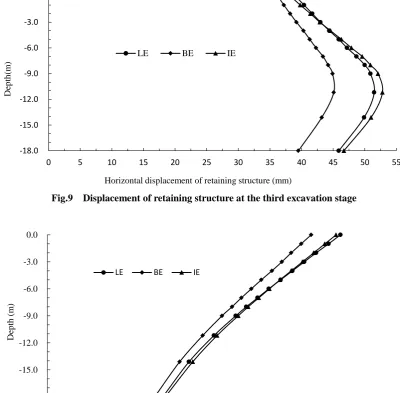
Fig.9 shows the horizontal displacement comparison at the x=0 section and at the third (final)
excavation stage. The maximum horizontal displacements under the different excavation patterns
all occur at approximately 2m under the excavation surface (i.e. 11m under the surface level). In
[image:13.595.146.452.143.381.2]increases by 2.5% compared with LE. The different horizontal displacements of the retaining wall
under the excavation patterns were induced by changing the process of applying the earth pressure
acting on the retaining structure within the excavation. Take the first excavation stage, for example,
the exposure time of the retaining wall within the excavation at the end of the first excavation
intermission is shown in Table 5. The horizontal displacement comparison at the x=0 section and
at the end of the first excavation intermission is indicated in Fig.10. The retaining wall has a
cantilever-type deflection because the excavation was carried out without a strut installation at the
first stage. It can be seen from Table 5 and Fig.10 that the lateral displacements of the retaining
wall under BE are smaller than those under LE and IE. Since the exposure time of the retaining
structure was the shortest under BE (0-2m depth range) the duration that the lateral earth pressure
acting on the retaining wall inside the excavation was zero was the shortest. The moment acting
on retaining wall was induced by the lateral earth pressure outside the excavation at 0-2m depth
range which is larger than the one at 2-3m depth range. The duration that the lateral earth pressure
acting on the 2-3m depth range of retaining wall inside the excavation under IE was zero was
slightly larger than under LE leading to the lateral displacements of the retaining wall under IE
and LE being very close. Therefore, the soil around the retaining structure inside the excavation
under BE was excavated later and the exposure time of the retaining wall decreased. This was
Fig.9 Displacement of retaining structure at the third excavation stage
Fig.10 Displacement of retaining structure at the end of the first excavation intermission
Table 5 Exposure time of retaining wall
Depth range
of retaining wall BE (d) LE (d) IE (d)
0~1m 10 11 11
1~2m 9 10 10
2~3m 8 8 9
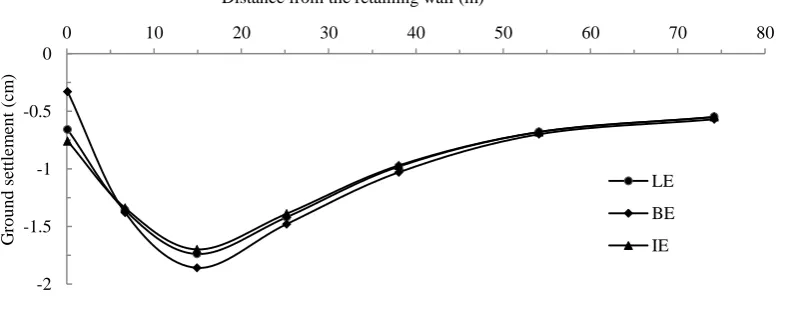
Fig.11 shows the ground surface settlement around the formation level at the x=0 section
under the three different excavation patterns after the third excavation stage. It can be seen from
Fig.11 that the maximum settlement occurred at 15m from the formation level and the settlement -18.0 -15.0 -12.0 -9.0 -6.0 -3.0 0.0
0 5 10 15 20 25 30 35 40 45 50 55
De
p
th
(m
)
Horizontal displacement of retaining structure (mm)
LE BE IE
-18.0 -15.0 -12.0 -9.0 -6.0 -3.0 0.0
0 5 10 15 20 25 30 35 40 45 50 55
D
ep
th
(m
)
Horizontal displacement of retaining structure (mm)
[image:15.595.93.495.74.268.2] [image:15.595.93.494.85.478.2] [image:15.595.98.489.296.514.2] [image:15.595.212.385.574.653.2]profiles were concave (similar to Hsieh &Ou, 1998). The excavation patterns have little influence
on the ground surface settlement. Within 6m from the formation level the settlement values, under
BE, were smaller than those of LE. IE had larger settlements because the wall deflection effects
the soil near the formation level. The wall displacements under BE were smaller than the ones
under LE and IE (Figs.9 and 10) and so the lateral pressures of the soil outside the excavation
under BE were larger. The vertical stress of the soil outside the excavation under the three
construction patterns were approximately the same, i.e. the smaller horizontal displacement means
the larger confining pressure of the soil outside the excavation. This will inhibit the settlement of
the soil outside the excavation thus the ground settlements under BE were smaller than those from
LE and IE. Beyond 6m away from the formation level, the settlement values under BE were the
largest. Settlement values under LE and IE were smaller or approximate the same. This was
because the ground settlements far from the formation level were mainly influenced by the change
of the effective stress from the change in excess pore-water pressure (Figs.17-19). The
distributions of excess pore-water pressure outside the excavation were similar and the negative
excess pore-water pressures under BE were slightly larger according beneath the retaining wall.
Fig.11 Ground settlement at the third excavation stage
-2 -1.5 -1 -0.5 0
0 10 20 30 40 50 60 70 80
G
ro
u
n
d
se
tt
lem
en
t
(c
m
)
Distance from the retaining wall (m)
LE
BE
[image:16.595.106.500.553.708.2]The comparison of formation level basal heave at the x=0 section and under three different
excavation patterns at the third excavation stage is shown in Fig.12. It can be seen from Fig.12
that within 21m from the centre of the formation level the heave values of the base under BE were
the largest. The equivalent values resulting from LE were larger or almost equal and the values
under IE were the smallest. However, within 21-25m from the formation level centre the heave
values under different excavation patterns were very approximate and they all decreased sharply
close to the retaining wall due to the friction between soil and retaining wall. For LE the soil was
excavated uniformly from the excavation and the self-gravity stress was therefore released
uniformly. This leads to the uniform heave of formation level base. For BE the soil at the
formation level centre was excavated first, whereas the soil around the formation level centre was
excavated later, so larger heave values occur at the centre. The process of IE is opposite to BE and
smaller heave occurs at the centre. Compared with the maximum heave value of the formation
level base under LE (within 15m from the pit centre) the BE value increases by 13.6% and under
IE the value decreases by 12%. Therefore, as far as the heave stability of the formation level is
concerned IE is more favourable and BE is least favourable. To further analyse the differences of
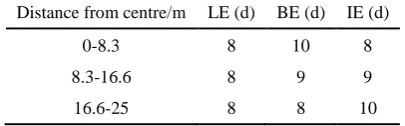
formation level heave from the different excavation patterns the heave and the exposure time of
excavation face at the end of the first excavation intermission were examined (see Table 6 and
Fig.13). The unloading of the soil mass decreases the total stress of the soil beneath the excavation
face and induces negative excess pore-water pressures. The longer the exposure time of
excavation face was the more the negative excess pore-water pressure dissipated, therefore, the
decrease in effective stress beneath the excavation face was greater and the heave of pit base was
the exposure time under BE was the longest and therefore the heave of the base was the largest.
During IE the thick soil layer in the formation level centre was excavated later (as mentioned
above) and the negative excess pore-water pressures dissipated slowly. Therefore, the heave
deformations under IE were smaller than those under LE and BE.
Fig.12 Heave of formation level at the third excavation stage
Fig.13 Heave of formation level at the end of the first excavation intermission
Table 6 Exposure time of excavation face at the end of the first excavation intermission
Distance from centre/m LE (d) BE (d) IE (d)
0-8.3 8 10 8
8.3-16.6 8 9 9
16.6-25 8 8 10
0 2 4 6 8 10
0 3 6 9 12 15 18 21 24 27
He av e o f fo rm ati o n lev el (c m )
Distance from the formation level centre (m)
LE BE IE
0 2 4 6 8
0 3 6 9 12 15 18 21 24 27
He av e o f fo rm ati o n lev el (c m )
Distance from the formation level centre (m)
[image:18.595.97.501.223.386.2] [image:18.595.96.501.434.608.2] [image:18.595.196.399.676.739.2]4.4 Pore-water pressure of excavation
The flow of ground water depends on soil water potential and defined as the sum of excess
pore-water pressure, hydrostatic pressure and the gravity potential. In order to analyse the flow of
ground water inside and outside the excavation, under different excavation patterns, the contours
of the soil water potentials inside and outside the excavation at the x=0 section and at the third
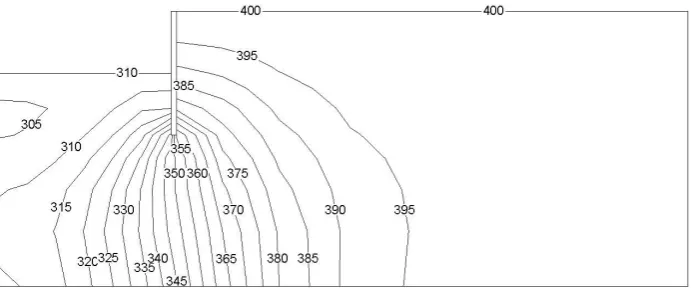
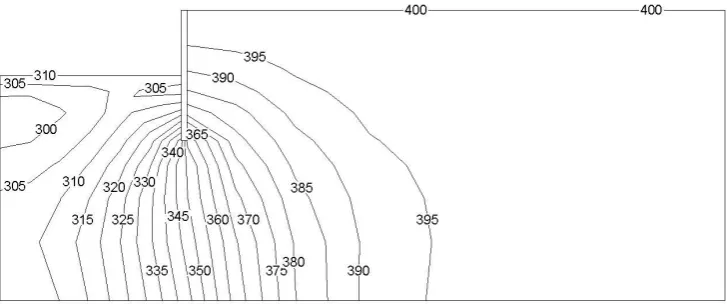
excavation stage are shown in Figs.14-16, where the datum for the elevation head is at the bottom
boundary of model. It can be seen from Figs.14-16 that the soil water potentials outside the
excavation were all larger than the ones inside under the three excavation patterns at the third
excavation stage. Therefore, ground water flows into the excavation from the outside. For BE
ground water not only flows into the centre under excavation face but also observably flows into
the area near to the retaining structure. Since the soil close to the retaining wall was unloaded later
and the soil water potentials were also correspondingly less than the values under LE. Similarly,
the soil at the formation level centre under IE was excavated later and the dissipation of the soil
water potential at the centre was slow. Therefore, the ground water was more apt at flowing into
the excavation at the formation level centre than during LE.
[image:19.595.125.471.560.709.2]Fig.15 Distribution of the soil water potentials under BE (unit: kPa)
Fig.16 Distribution of the soil water potentials under IE (unit: kPa)
Figs.17-19 show the contours of the excess pore-water pressures inside and outside the
excavation under the three patterns at the x=0 section and at the third excavation stage. It can be
seen from Figs.17-19 that at the third excavation stage the horizontal distribution range of the
negative excess pore-water pressures beneath excavation face under LE were the smallest. The
values under BE were the largest and the values under IE were between these two. However, the
vertical distribution range of the negative excess-pore water pressures beneath excavation face
under IE was the largest and the value under LE was the least. The comparison among the values
of negative excess pore-water pressure under different excavation patterns shows that the
[image:20.595.115.479.73.227.2] [image:20.595.114.480.262.414.2]Fig.17 Distribution of excess pore-water pressures under LE (unit: kPa)
Fig.18 Distribution of excess pore-water pressures under BE (unit: kPa)
Fig.19 Distribution of excess pore-water pressures under IE (unit: kPa)
The distribution difference of excess pore-water pressure is related to the unloading process
of the three excavation patterns. The unloading process of LE was uniform and the exposure time
of the whole excavation face was kept the same. This was favourable to the uniform dissipation of
[image:21.595.122.473.76.225.2] [image:21.595.126.470.265.411.2] [image:21.595.124.471.451.598.2]unloading above the excavation face was non-uniform. The unloading under BE was from the
formation level centre to the retaining wall and it was just contrary under IE which is unfavourable
for the dissipation of the excess pore-water pressures. The negative excess pore-water pressures
under BE and IE dissipated slower and their areas were larger. In the process of BE larger negative
excess pore-water pressures were generated in the nearby retaining structure than the values under
LE as the result of the later unloading nearby retaining structure under BE. Moreover, the
process of IE was contrary to the one of BE and so its negative excess pore-water pressures at the
formation level centre were larger than the LE values.
5. Conclusions
3D effective stress analysis of an excavation under Layered, Basin and Island Excavation
processes was performed and reported in this work. This has led to the following conclusions:
(1) The soil around retaining wall was unloaded later under BE which decreased the exposure
time of the retaining structure and induced small horizontal displacements. It is, therefore,
favourable when controlling the deformation of a retaining wall. The soil at the formation level
centre was unloaded later under IE which decreased the exposure time of excavation face and
caused small heave of base and can be considered favourable when controlling any heave
deformation of the formation level.
(2) The settlement of the soil near the retaining wall was related to the wall deflection;
however, the settlement of soil at a reasonable distance from the wall was related to the dissipation
of negative excess pore-water pressure. For example the greater the negative excess pore-water
pressure was then the greater the effective stress of soil was and resulting in larger soil settlement.
were both very similar under the three excavation patterns. Since the order of unloading inside the
excavation was different then the scope of the negative excess pore-water pressure was larger (at
the excavation face) for the soil which was unloaded last.
In this work only the excavation patterns were focused on, however, excavation is an
over-consolidation problem due to unloading. Therefore, over-consolidation problem should be
considered when choosing a constitutive model of soil in future investigations.
References
[1] Hsieh P.G., Ou C.Y., 1998. Shape of ground surface settlement profiles caused by excavation. Canadian
Geotechnical Journal, 35: 1004-1017.
[2] Ou, C.Y., Liao, J.T., Cheng, W.L., 2000. Building response and ground movements induced by a deep
excavation. Geotechnique, 50(3): 209-220.
[3] Hsieh P.G., Ou C.Y., Liu H.T., 2008. Basal heave analysis of excavations with consideration of anisotropic
undrained strength of clay. Canadian Geotechnical Journal, 45: 788-799.
[4] Do T.N., Ou C.Y., Lim A., 2013. Evaluation of factors of safety against basal heave for deep excavations in
soft clay using the finite-element method. Journal of Geotechnical and geoenvironmental engineering,
139(12): 2125-2135.
[5] Hsieh P.G., Ou C.Y., Shih C., 2012. A simplified plane strain analysis of lateral wall deflection for
excavations with cross walls. Canadian Geotechnical Journal, 49:1134-1146.
[6] Hsieh P.G., Ou C.Y., Lin Y.L., 2013. Three-dimensional numerical analysis of deep excavations with cross
walls, Acta Geotechnica, 8:33-48.
[7] Ou C.Y., Hsieh P.G., Lin Y.L., 2013. A parametric study of wall deflections in deep excavations with the
[8] Wu S.H., Ching J.Y., Ou C.Y., 2013. Predicting wall displacements for excavations with cross walls in soft
clay. Journal of Geotechnical and Geoenvironmental Engineering, 139(6):914-927.
[9] Zdravkovic, L., Potts, D.M., St John, H.D,. 2005. Modelling of a 3D excavation in finite element analysis.
Geotechnique, 55(7):497-513.
[10] Kung G.T.C., Hsiao E.C.L., Juang C.H., 2007a. Evaluation of a simplified small-strain soil model for
analysis of excavation-induced movements. Canadian Geotechnical Journal, 44:726-736.
[11] Kung G. T. C., Juang C. H., Hsiao E. C. L., Hashash Y. M. A., 2007b. Simplified model for wall deflection
and ground-surface settlement caused by braced excavation in clays. Journal of Geotechnical and
Geoenvironmental Engineering, 133(6):731-747.
[12] Finno R.J., Blackburn J.T., Roboski J.F., 2007. Three-dimensional effects for supported excavations in clay.
Journal of Geotechnical and Geoenvironmental Engineering, 133(1):30-36.
[13] Osaimi A.E., Clough G.W., 1979. Pore-pressure dissipation during excavation. Journal of Geotechnical
Engineering, ASCE, 105(4): 481-498.
[14] Benmebarek, N., Benmebarek, S., Kastner, R., Soubra, A.H., 2006. Passive and active earth pressures in the
presence of groundwater flow. Geotechnique, 56(3):149-158.
[15] Li Y.Q., Zhou J., Xie K.H., 2008. Environmental effects induced by excavation. Journal of Zhejiang
University SCIENCE A, 9(1):50-57.
[16] Borges J.L., Guerra G.T., 2014. Cylindrical excavations in clayey soils retained by jet grout walls: Numerical
analysis and parametric study considering the influence of consolidation. Computers and Geotechnics,
55:42-56.
[17] Tan Y., Wang D., 2013a. Characteristics of a large-scale deep foundation pit excavated by the central-island
Geotechnical and Geoenvironmental Engineering, 139(11):1875-1893.
[18] Tan Y, Wang D., 2013b. Characteristics of a large-scale deep foundation pit excavated by the central-island
technique in Shanghai soft clay. II: Top-down construction of the peripheral rectangular pit. Journal of
Geotechnical and Geoenvironmental Engineering, 139(11):1894-1910.
[19] Potts D.M., Zdravkovic L., 1999. Finite element analysis in geotechnical engineering: Theory. Thomas
Telford Limited, London.
[20] Xie K.H., Zhou J., 2002. Theory and application of finite element analysis in geotechnical engineering.
Science Press, Beijing (in Chinese).
[21]Duncan, J.M., Chang, C.Y., 1970. Nonlinear analysis of stress and strain in soils. Journal of the Soil
Mechanics and Foundations Division, ASCE, 96(SM5), 1629-1653.
[22] Kulhawy, F.H., Duncan, J.M., 1972. Stresses and movements in Oroville Dam. Journal of the Soil
Mechanics and Foundations Division, ASCE, 98(SM7), 653-655.
[23] Ou C.Y., Wu T.S., Hsieh H.S., 1996. Analysis of deep excavation with column type of ground improvement
in soft clay. Journal Geotechnical Engineering, ASCE, 122(9):709-16.
[24] Liao H.J., 2009. Numerical analysis in geotechnical engineering (2nd Editon). Beijing: China Machine Press.
[25] Yin Z.Z., Zhu H., Xu G.H., 1995. A study of deformation in the interface between soil and concrete.
Computers and Geotechnics, 17(1):75-92.
[26] Wang G.G., 1994. Theoretical Study on Large Strain of Deep Excavation. Ph.D Thesis, Tongji University,