City, University of London Institutional Repository
Citation
:
Ingvarsson, H.R. (2018). Opening opera: developing a framework that allows for the interactive creative processes of improvised theatre in the productions of new music-dramas. (Unpublished Doctoral thesis, Guildhall School of Music & Drama)This is the accepted version of the paper.
This version of the publication may differ from the final published
version.
Permanent repository link: http://openaccess.city.ac.uk/21324/
Link to published version
:
Copyright and reuse:
City Research Online aims to make research
outputs of City, University of London available to a wider audience.
Copyright and Moral Rights remain with the author(s) and/or copyright
holders. URLs from City Research Online may be freely distributed and
linked to.
Opening Opera:
Developing a framework that allows for the interactive
creative processes of improvised theatre in the productions
of new music-dramas.
Helgi Rafn Ingvarsson
DMus (composition)
Guildhall School of Music & Drama
Composition Department
2
Table of Contents
Acknowledgements
... 4
Abstract ... 5
1.1 Personal prelude ... 6
1.2 Real-time paralinguistic manipulation ... 6
1.3 Active accompaniment ... 8
1.4 My experience of two different performance genres ... 8
1.4.1 Improvised theatre ... 9
1.4.2 Keith Johnstone and The Theatre Machine ... 9
1.4.3 Classical singing ... 9
2.1 Creative dynamics and processes ... 11
2.1.1 Collaborative processes ... 12
2.1.2 Interactive processes ... 13
2.2 Recitative and active accompaniment ... 14
2.2.1 The Turn of the Screw ... 15
2.2.2 Curlew River ... 16
2.2.3 Eight Songs for a Mad King ... 17
2.3 Alternative scoring methods for an interactive process ... 18
2.3.1 Stimmung ... 18
2.3.2 Anuras ... 19
2.3.3 The Great Learning ... 20
2.3.4 In C ... 21
2.3.5 Cadenza on the Night Plain ... 23
2.4 A meeting-place: Bringing processes from improvised theatre into operatic
production ... 24
2.4.1 Improvisation and opera: micro and macro ... 26
2.4.2 The operatic score ... 28
2.4.3 The theatre script ... 29
2.4.4 The script-part ... 29
2.5 A note on the audience ... 30
3.1 Suggestiveness ... 31
3.2 An interactive aesthetic ... 32
3.3 Aims ... 33
3.4 A Glacier’s Requiem (excerpt)... 34
3.4.1 Music ... 35
3.4.2 Text... 36
3.4.3 The mobiles ... 37
3.4.4 Aesthetic speculation ... 38
3
3.5 Évariste (excerpt) ... 42
3.5.1 Music & text ... 43
3.5.2 Balinese dance and the conductor ... 48
3.5.3 Director Shirley Keane ... 50
3.5.4 Aesthetic speculations ... 52
3.5.5 Issues with instrumentation ... 54
3.6 Solitude 1 ... 55
3.6.1 The text ... 56
3.6.2 Version 1 ... 57
3.6.3 Version 2 ... 58
3.6.4 Gustav and Michelle: composer’s musical control ... 58
3.6.5 Eliza and Siwan: performance interaction ... 59
3.6.6 Outcome ... 61
3.7 ‘After the Fall’ and the mobile score ... 62
3.7.1 The story ... 63
3.7.2 ‘After’, the mobile score: dissolving the option of synchronisation... 66
3.7.3 Leadership: conductor cues ... 76
3.7.4 Transitions ... 78
3.7.5 Aesthetic speculation ... 80
4.1 Conclusion ... 82
4.2 The compositional aesthetic and a definition of open opera ... 82
4.3 A framework of working methods and considerations that will support future
developments ... 83
Step 1: Considerations for assembling and maintaining a suitable performance team ... 83
Step 2: Script-parts distributed ... 85
Step 3: An introduction to the basics of dramatic improvisation ... 85
Step 4: Dramatic improvisation workshops ... 87
Step 5: Rest of the music distributed ... 90
Step 6: First music-focused phase ... 90
Step 7: A second drama-focused phase ... 91
Step 8: A second music-focused phase ... 91
Step 9: Performance ... 91
Bibliography and works cited ... 92
Appendix ... 94
5.1 List of collaborators ... 94
5.2 Additional material ... 95
4
Acknowledgements
First and foremost, I would like to thank the Guildhall School Trust for supporting me during my doctorate years, 2013-2017. I would not have been able to commence this research, let alone finish it, without their help. I would like to mention and thank Professor Julian Philips especially in this context, who was one of the people crucial in helping me secure the fund’s backing.
The staff at the Guildhall School of Music and Drama were always willing to assist me during these very hectic times. My supervisors Matthew King and Nye Parry formed a great supervision team, and I cannot thank them enough. Their guidance (along with the occasional well timed challenge) was always well judged and informative, but maybe even more important were their encouragements. Conducting doctorate level research is extremely demanding and sometimes punishing, and for those days when you feel that everything is against you and things are not working out, it is good to have supervisors like Matthew and Nye in your corner. Professor Julian Philips, Dr. Biranda Ford, Professor Julian Anderson, Dr. Paul Newland, Professor Laurence Crane, and Professor Roger Marsh (York University) also contributed invaluable guidance to me along the way, and I would like to extend my thanks to them.
Both directly and indirectly my performers and collaborators provided me with critical data and knowledge which helped make this research relevant, and a possibility in the first place. I could not have done it without them. All of their names have been listed in the appendix of this commentary, but the following hold a special place in my heart: soprano Rannveig Káradóttir, flautist Helen Whitaker, writer Rebecca Hurst and director Shirley Keane. Their contributions went above and beyond during, and after, our projects.
5
AbstractOpening Opera explores creative collaboration and dramatic improvisation in new music-dramas. Looking towards the art of improvised theatre, the aim is to achieve a dramatic process in opera which facilitates a flexible kind of dramaturgy, enabling singers and directors to lead and inform certain creative processes that are normally in the hands of the operatic composer and/or librettist alone. By developing particular unorthodox scoring methods, along with specific rehearsal schedule considerations that support these flexible processes, the composer attempts to create not improvised opera, but what could be called an open opera, where the compositional focus is working with a free vocal line with active accompaniment. This framework is one in which the composer provides the parameters and material for dramatic and compositional flexibility, and then ‘takes a step back’ during a collaborative and improvisational process, whilst retaining sufficient leadership and creative authority to realise the overarching structure satisfactorily.
In order to develop said unorthodox scoring methods and processes, the creative team explored and informed structural, dramatic, technical and musical aspects of new material, utilising the performers’ specialised training and experience in an interactive creative process. This exploration brought up questions such as: how to allow an open process such as this one while still attempting to retain overarching artistic control; what are the parameters that the composer will need to determine (i.e. keep 'closed'); and what are the parameters that he must allow to be spontaneous, improvised or open?
By opening up the process in this way, interesting genre specific problems were exposed that are more often than not left implicit rather than explicit by creators of opera. This exploration reveals knowledge beneficial to tutors, composers, librettists, singers, conductors and directors of music-dramas.
This inquiry is primarily grounded in several methods extracted and modified from improvised theatre, opera, and open-scored compositions of the mid-20th century.
The musical and qualitative data discussed in this commentary emerged during the preparation, writing and production of the author’s original music-drama studies. Studies include excerpts from two chamber operas; A Glacier’s Requiem (2013) (or “Bráð” in the original Icelandic1), and Évariste (2014); a short
monodrama study, Solitude 1 (2015); and a chamber opera presented in its entirety, After the Fall (2017).
6
The commentary is divided into four parts.
- PART 1 will introduce the author’s personal reasons for conducting this research, along with giving a brief theoretical framework to the primary methodology.
- PART 2 opens with a definition of collaborative processes, leading into an analysis and contextualisation from opera, ending with references to other relevant vocal and instrumental music.
- PART 3 comprises compositional and performance analysis of original portfolio studies.
- PART 4 concludes with thoughts about a potential compositional aesthetic that might derive from this framework, as well as providing considerations for the performance of future open operas.
PART 1
1.1Personal prelude
The reason for this academic inquiry lies in my long-standing desire for an interactive creative process during the rehearsals of new operatic compositions. I want to be able to develop the dramatic moment in a spontaneous way, in real-time during rehearsals, but the traditional musical score is usually an obstruction to such a process. In other words, I want to work with reactions between, and the relationship of, the characters in my chamber operas, developing their relationships in collaboration with my performers during rehearsals. In my work, I define this process as real-time paralinguistic manipulation.
1.2 Real-time paralinguistic manipulation
How characters are created and developed is not just in what they say (the scripted and/or scored material), but also how they say it and how they react to what others say. As the composer, by granting my performers the licence to vary, for instance, paralinguistics, silences, and pace (individual tempi of written material) I could achieve such character developments.
Let’s imagine two performers on stage. Performer A is portraying an army general, while B is a private soldier. They are following a script, and the two first lines of the written dialogue go like thus:
7
Even though the two lines seem to outline a fairly straightforward and somewhat pleasant exchange between the two characters, these lines have the potential of playing out in near countless different ways dramatically. The performer portraying the general could, for instance, decide to be threatening by use of alpha posture, stern eye contact and loud voice, screaming “please, sit down!” (the “please” maybe elongated, sounding quite ironic in that case), forcing the soldier into submission. How the soldier reacts to this sets the tone for their following relationship. The soldier could shout back in a military manner “thank you, sir” and then sit down, establishing a fairly orthodox, professional relationship between them. However, if the soldier replies quietly before sitting down, muttering to him-/herself like a grumpy teenager would, with the words trailing off, their relationship becomes more complex, and quite comical. Even more complex relationship would be established if the soldier replied in a very calm, quiet and slow voice “thank you, sir”, without sitting down. What has been suggested there is that the general and soldier might not be actual general and soldier at all. Maybe we are witnessing a couple’s roleplaying game.
It is even more interesting if we start over and turn both characters into veteran generals standing in a room, both with the goal of trying to get the other one to be the first one to sit down on a low stool, which would in turn assert the dominance of the one who remains standing, claiming him/her the winner of the social situation, and create a hierarchy between them. Their only written dialogue would be the following two lines, but they could use them as often as they wanted until either one of them wins:
General A: Please, sit down. General B: Thank you, sir. General B: Please, sit down. General A: Thank you, sir.
They are too close in rank (or “status”2) for either one of them to directly order the other to “sit down!”,
but the scene has to end with someone sitting down. This could spur many different versions of manipulation and irritation from the characters. Now the paralinguistic properties of the speech (e.g. speaking tempo, intonational contours), their body language, interruptions, and silences become much more important in conveying subtle shades of meaning.
These examples are only that, examples, but developing those shades of meaning with my performers and directors is exactly what I want to be able to work on in my rehearsals and workshops of my new operatic work, developing these paralinguistic reactions and character developments, allowing us to co-develop characters and their relationships.
To support an ease of reference, I call this dramatic process real-time paralinguistic manipulation.
2“Status” of a character is a combination of what he/she is and what he/she does. “Status is a confusing term
8
If the examples I previously laid out were composed using a traditional score, with the singers’ musical parts fixed temporally (vertically) to all other music happening simultaneously, I as a composer would be pushed to decide on the paralinguistic messages of the characters’ relationships before getting a chance to develop it with the group. This might not sound like a bad thing to some (or even most) composers, and there are of course great composers who produce great pieces that way, but to me, simply because of the way I prefer to work, it feels limiting. I feel it deprives me of potential happy accidents that would otherwise pop up during workshops and rehearsals, which could lend the final performance a certain extra glimmer of exciting immediacy, given that the right framework and processes are in place.
1.3 Active accompaniment
Not only do I wish to work with these specific dramatic parameters as free parameters, but I also wish to find a way to work with them in an active musical setting, with active accompaniment (as I personally choose to call it). Active accompaniment is all accompaniment that does not rest or sustain a note or a chord, during a soloist’s performance (further example given in 2.2.3). Therefore, in my compositions, I am excluding all styles where during the time of a soloist’s performance, the accompaniment rests, or sustains a note or a chord, which is what happens for instance in traditional cadenzas (Michael, 2003, p. 132) and recitatives (more on this in 2.2). Much of my interest, and some of the novelty of this research, is trying to master the balancing act of creating closed active accompaniment with a dramatically open, but still pre-composed, vocal part.
The journey towards achieving this particular interactive creative process unearthed considerations regarding scoring, resulting musical aesthetics, performers’ training, and rehearsal planning.
1.4 My experience of two different performance genres
The original catalyst for my research is based in my experience with two different performance genres, classical singing and improvised theatre, and a quick introduction to my experience of these is important to explaining why I felt the need to then later dig deeper into the possible opening-up of opera.
9
1.4.1 Improvised theatreIn my theatre troupe we would create devised plays, as well as compete nationally in live improvised theatre, better known as Theatre Sports. In the early 2000s I was lucky enough to have outstanding teammates, and with them I won the national title. Theatre Sports is a seemingly unpredictable performance art where opposing teams of four actors challenge one another to perform themed improvised scenes based on (for example) audience suggestions, with ratings given by a panel of three judges. This performance art builds on methods, developed in huge part by Keith Johnstone in the 1950s and 60s, that enable actors to participate in playful and collaborative impromptu improvisations.
1.4.2 Keith Johnstone and The Theatre Machine
“Keith, [William] Gaskill says, started to teach his own particular style of improvisation, much of it based on […] word association, free associations, [and] intuitive responses […]. All his work has been to encourage the rediscovery of the imaginative response in the adult; the refinding of the power of the child’s creativity.” Keith believed that “a director should never demonstrate anything to an actor, that a director should allow the actor to make his own discoveries.” (Johnstone, p. 24) With the use of specific exercises he developed, many with the goal of understanding and applying dramatic status and spontaneity effectively and collaboratively, his group was able to perform without preparing anything, “and everything was like a jazzed-up drama class.” Keith and his collaborators called themselves The Theatre Machine, and the British Council sponsored them to do a tour around Europe. Soon they became very influential. (ibid, p. 27)
These approaches to performance heavily influenced my attitude towards collaborative practises.
1.4.3 Classical singing
10
These early operatic productions in which I partook were good experience for a young singer, but they were also highly traditional. Unlike new works, La Bohéme, The Magic Flute and The Marriage of Figaro have been performed near-countless times and therefore imply strong performance and production traditions. While I still enjoyed the musical and dramatic powers of the operatic pieces, my experiences of improvised theatre made me yearn for a more open process, where an enhanced creative conversation would be taking place between all participants. I felt constrained within the bars of the traditional score. I wanted to explore the drama found in the music in my own way, toss it and turn it, unearth my personal take on it in such a way that I felt could upset the traditional connotations of repertoire opera.
As a result, in this research I have sought to create a framework that allows elements of dramatic improvisation into the production of operatic works. I do not perceive that this would necessarily be a fundamentally better way to make opera, but it would simply be a different approach.
11
PART 2
This part is in three main sections.
- Distinction of collaborative processes. - Analysis of relevant opera and recitatives.
- Analysis of other relevant vocal and instrumental music.
2.1 Creative dynamics and processes
Another way of analysing and understanding the main differences of these two performance arts is to recognise improvised theatre as a collaborative art form, but classical singing as a directive art form (in the form it is taught within conservatoires, more often than not).
A helpful three-stage distinction of these creative dynamics was made by Hayden and Windsor:
“DIRECTIVE: Here the notation has the traditional function as instructions for the musicians provided by the composer. The traditional hierarchy of the composer and performer(s) is maintained and the composer aims to completely determine the performance through the score. […]
INTERACTIVE: Here the composer is involved more directly in negotiation with musicians and/or technicians. The process is more interactive, discursive and reflective, with more input from collaborators than in the directive category, but ultimately, the composer is still the author. Some aspects of the performance are more ‘open’…
COLLABORATIVE: Here the development of the music is achieved by a group through a collective decision-making process. There is no singular author or hierarchy of roles.”
Hayden & Windsor, 2007, p. 33
12
2.1.1 Collaborative processesAt the other end of this continuum, collaborative processes can be found most prominently in e.g. improvised theatre, but also in the works of composers like Michael David Picknett in his devised Apologetics project (2012), and David Young’s Not Music Yet (2012) where an abstract watercolour painting sets vague parameters for improvisation (Kanga, 2014). Despite Picknett and Young being named the composers of their pieces/projects, the nature of the process behind their realisation seems nevertheless to lean heavily on the side of a collaborative process. That is to say, there is no score, and the material is created by the performer or group. As opposed to a pure collaborative or devised process, in these pieces, there is “a director” (the composer), who then reacts to the improvised output. Picknett describes it as directed devising:
“Directed devising is where one person takes on the role of director, with overall responsibility for the process and project. The director takes every decision on the project alone after extensive input from the performers.” (Picknett, 2014, p. 10)
Picknett goes on and cites Heddon and Milling when he says that “devising is a ‘mode of work in which no script - neither written play-text nor performance score - exists prior to the work’s creation by the company.’ ” In other words, the work is entirely created through the process. (Picknett, 2014, p. 12)
Directed devising can also be found in the world of contemporary dance. What follows are examples from the working practises of three different generations of choreographers: Jo Meredith, Wayne McGregor, and Pina Bausch.
Choreographer Jo Meredith describes the process of creating her airport set dance piece Please Wait Whilst We Try To Connect You, premiered at Wilton’s Music Hall in London at the 2014 Strike! festival. She has developed a way of working where she’ll come up with a theme as a starting point of what she wants to explore.
“I usually put the music on and then I improvise [on the theme], and then I get my dancer[s] to feed off what I’ve made. I improvise, they learn through doing the movement. Then what I usually do, based on what my theme is, I’ll then set them creative tasks to try and mine and get the kind of material I am after, from them… […] in order for me to be creative, I feel like I actually almost need to let go of where it will go in the piece, and just make stuff. Cause, otherwise, I feel like I might be trying to make something, and too early on its becoming too specific, and too literal. And if you are too literal, I think you kinda loose something. And if you have that idea of what you wanted at the very beginning and then you just go for that, you’re just missing out on other things I think.”
13
Once the piece starts to take shape, she’ll change things like the focus, who is looking where for instance, to get the material to say what she wants it to say.
Celebrated choreographer Wayne McGregor describes his process like creating a “physical alphabet [with the dancers] that’s different from one piece to the next. Then I create the composition.” (Hale, 2004)
Similarly, “the core of [choreographer Pina] Bausch’s new process [in the 1970’s onwards] was an approach to collaborative creation based on drawing material from her dancers through a process of asking questions. […] The dancers answer the questions through spoken dialogue or movement improvisations, from which Bausch selects material to work on.” (Picknett, 2014, p. 17)
Directed devising has been experimented with within contemporary opera as well. The English group the Voicings Collective explores approaches to composing within the ensemble, transcending the formats of traditional opera making and utilising the skills of a multifaceted group of performers. The company aims to interrogate the democracy of devising: work is created collectively, shaped by the skills, creative practices, stories and unique voices of the individual artists taking part. Each step of the collective creative process (text, music, staging) has a director so to speak (writer, composer, stage director) but their role is only to be catalysts for creation, not to become the authors of the work. The work in the end is the group’s.
Compared to my own work, there definitely is either a written play-text or a performance score present in all my compositions, and they can therefore not fall under the distinction of collaborative or devised works. Although I find collaborativeprocesses fascinating in theory, I found them to be incompatible with my desire to pre-compose the actual musical material (the accompaniment and most parameters of vocal parts) used in my works.
2.1.2 Interactive processes
I do however want to sustain a particular level of dramatic unpredictability in rehearsals, allowing the performer(s) to influence to a greater degree the development of drama, interactions and characters. I wish to encourage, and be able to react to in real-time, types of musical and dramatic events, or happy accidents, which have the chance of occurring once the whole performance team is in the same room, exploring and playing around with different dramatic treatments of pre-composed musical material, while simultaneously being accompanied by active musical accompaniment. A few favourable events could then be accepted into the piece as a whole, informing the composition and drama, and then rehearsed in a fixed/strict manner for public performance. Or, alternatively, should the performance team wish, the process could also be left open for live public performance.
14
Such a process is achieved in musical styles like the traditional recitative, and works like The lady in waiting from Peter Maxwell Davies’ monodrama Eight Songs for a Mad King, Stimmung by Stockhausen, Anuras by Jonathan Cole, Terry Riley’s In C and Captain Jack has the last word from his Cadenza on the night plain string quartet, and Cornelius Cardew’s The Great Learning. These works will be discussed in an upcoming section of this chapter.
2.2 Recitative and active accompaniment
The “dry” secco or simple recitative is an operatic tradition which does indeed have the capacity to support creative interactivity and real-time paralinguistic manipulation, but not active accompaniment. If we consider its traditional dramatic utility then dry recitative is used for moments in opera where the story needs to be moved onwards and the shape of the sung line often imitates elements of speech, as opposed to the more lyrically sung and contemplative aria format. The drama is able to be moved more effectively onwards because musical texture takes a step back, so that text can take clear precedence: i.e. music gives way to text. This is achieved in various ways: e.g. with held note accompaniment which sits still and waits for the vocalists to finish their delivery, with complete rests in the accompaniment where the orchestra or ensemble might only occasionally interjected with short chords and accents in between vocalists’ phrases, or with basso continuo. In that space, the classic score is no longer the same obstacle to the aforementioned dramatic process.
This elbow room from the accompaniment in the score allows the singers (in collaboration with the conductor and director) to freely shape the delivery of drama. It gives space for the possibility of various dramatic renderings. In such cases, with such stripped-back accompaniment, the free manipulation of the pre-composed vocal lines’ paralinguistics and pace is relatively easily achieved. The dry recitative, as a scoring method, does therefore theoretically support the desired interactive dramatic process of real-time paralinguistic manipulation.
However, this inquiry strives to achieve more than just this process in a vacuum. The goal is to achieve active accompaniment alongside this process. The dry recitative does therefore not suffice in this instance. It is not considered to support active accompaniment as it is defined here, since it falls under the
distinction of a musical style where during the time of a soloist’s performance the accompaniment rests, or sustains a note or a chord (see 1.3). On the other hand, where active accompaniment does occur in music that is traditionally scored, the vocal line is temporally stuck. The score in those instances is
detailed in its rhythms’ vertical alignment, leaving no room for real-time paralinguistic manipulation in the performance without upsetting the musical performance.
15
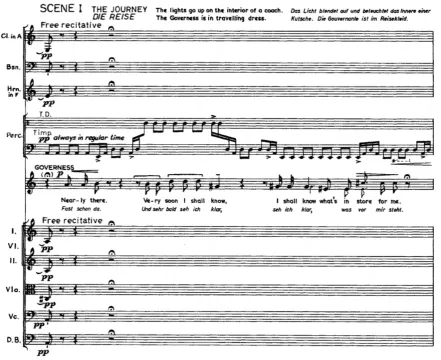
2.2.1 The Turn of the Screw [image:16.595.76.518.165.525.2]In act 1 scene 1 of Benjamin Britten’s The Turn of the Screw (1954) a young governess (soprano) is traveling to Bly house, where she is to take up a new position as carer of two children. On the way there, she is feeling apprehensive about the whole affair.
Figure 1: Act 1 scene 1 from Britten’s The Turn of the Screw.
The soprano is accompanied by timpani, and their vertical alignment is essentially free. The only guide Britten gives is that…
Figure 1: “The quavers marked [with a dashed bracket below] can, if necessary, be repeated to fit with the stage."
16
Meanwhile, the timpani moves on, and then waits for her on one of the last quavers before they both move on to the next phrase. Here, the soprano (and by extension the director) are given the option to be playful with this fermata rest. Their time for stage action during this moment is (theoretically) limitless, but after the first fermata rest the vocal line is notated using accurate note values, which implies that Britten wants it performed with a particular shape – but not overly strictly because this whole section is still marked as free recitative. The soprano should not, and need not, worry that she might be out of vertical alignment with the timpani and can carry on with her free-ish dramatic interpretation of the written vocal line.
2.2.2 Curlew River
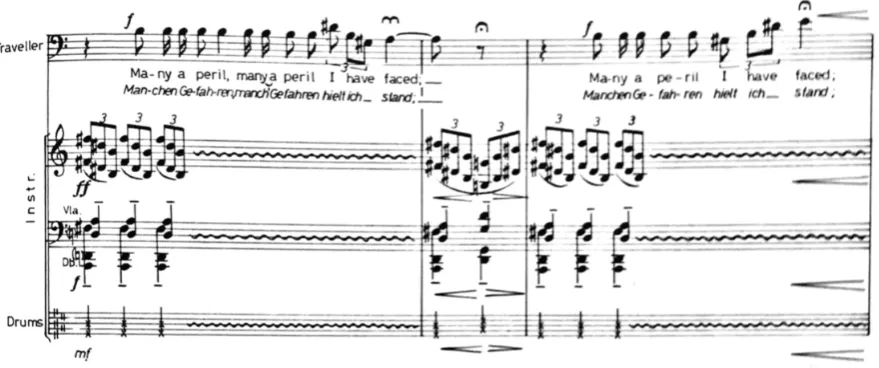
Another Britten opera, Curlew River (1964), contains a famous sign, the curlew sign:
“The sign (curlew sign) over a note or rest shows that the performer must listen and wait till the other performers have reached the next barline, or meeting-point – i.e., the note or rest can be longer or shorter than its written value.”
[image:17.595.80.520.370.554.2]Benjamin Britten, in the introduction to the score of Curlew River.
Figure 2: Curlew River by Benjamin Britten, from page 17 in the full score.
17
time. Each phrase is only a small unit, with the accompaniment interjecting regularly, thereby creating stop signs (or yield signs) for any considerable development of free dramatic action.
The idea behind the curlew sign has the possible potential to support the dramatic process at the focal point of this research, while also supporting active repeated figure accompaniment. However, in the way Curlew River is composed and scored, each free vocal phrase is either too short or the option for micro musical synchronisation is too prominent in the score for dramatic improvisation to have any ideal space (see 2.4.1 for micro musical events, and 3.4 and 3.7 for the option of synchronisation).
2.2.3 Eight Songs for a Mad King
The performance instructions to The lady in waiting, one of the songs (or scenes) in Peter Maxwell Davies’ monodrama Eight Songs for a Mad King (1969), frame the performance as highly interactive. Maxwell Davies gives the flute player license to reflect in real-time on the performance of the baritone:
“The flute has a dialogue with the king, replying to his phases (with mimicking parodying versions of them, freely) and accompanying him with the given figures discreetly, in any order, quite freely.”
[image:18.595.199.404.405.731.2]Maxwell Davies, 1969, p. 12
18
The flautist is able to improvise in a manner influenced by the drama and the composer’s pre-composed framework. Many of the performance instructions are in this fashion, which, along with innovative scoring which detaches the flute’s part from the singer’s, allows the performers to choose, for instance, the order in which to play musical fragments in order to support their interpretation. Such an approach could also be applied to a singer’s part in an opera to allow for broader approach to interpretation.
2.3 Alternative scoring methods for an interactive process
The following pieces are not strictly dramatic or operatic in the traditional sense, nor are some of them even vocal, but they do offer useful, alternative ideas for supporting interactive creative processes by thinking outside the classic score.
2.3.1 Stimmung
[image:19.595.122.480.492.754.2]Stockhausen’s Stimmung for six vocalists (1968) breaks the mould when it comes to scoring. The basic material which is traditionally contained within a single score – text, pitches, rhythms – is segregated and spread over several different documents. Out of these documents, the one which is most reminiscent of a traditional score is the formschema. The formschema shows the structure of the piece and the order of pitch events. In other words, the formschema governs what pitch should be sung, when and by which of the six singers. The text and rhythms to be imposed on these pitches are then contained on separate sheets or modelle. (Stockhausen, 1968) Here the performers, theoretically, are able to become assemblers of musical material, as well interpreters. This idea of separation, or breaking-down of the score elements, can be found in all of the studies presented in PART 3.
19
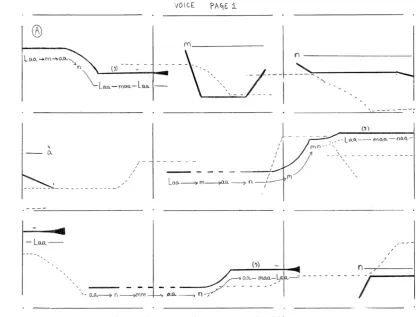
2.3.2 AnurasIn his piece Anuras (2014) for voice and three string instruments in the same register, Jonathan Cole creates a framework for relatively free performance interaction and leadership:
[image:20.595.80.501.264.581.2]“In recent years I've become fascinated in finding ways of involving performers in making decisions during performances. The main reasons for this are an attempt to intensify the listening experiences between performers and also wanting the form of the piece to be spontaneously created within the performance itself. Both of these, I feel, increase the concentration within a performance which communicates itself to listeners as a structure being formed within the present moment.”
Figure 5: First page from the voice part of Jonathan Cole's “Anuras”.
“Each page consists of 9 bars, each of which lasts between 15 and 25 seconds (this amount of time is flexible and can change throughout the piece.) In each bar the individual players music is notated in a thick line, whilst some of the lines of the other performers are also notated [using a dashed line] […] From A [first bar top left] the register of each bar is roughly a minor 6th (no more than) […]
20
until the singer reaches that point in the score before continuing. The location of these moments in the piece should not be decided in advance of the performance. The simplicity and consistency of the notated
material in Anuras allows, I believe, for such overtly dramatic interruptions to become part of the natural
continuity of the music, establishing an opposition to the linear unfolding of material whilst also demanding a high degree of concentration from the performers.”
Jonathan Cole
The singer is able to lead the performance up to a point, with the string trio following her cues, and her expanding or condensing of the bars’ duration (they can follow her line in their parts). But, unlike other pieces mentioned so far, Anuras is a piece without any text, so it could be argued that there is no drama per se to work with. The scoring method - if applied to a piece with text - does however invite the possibility of real-time paralinguistic manipulation.
[image:21.595.140.342.328.563.2]2.3.3 The Great Learning
21
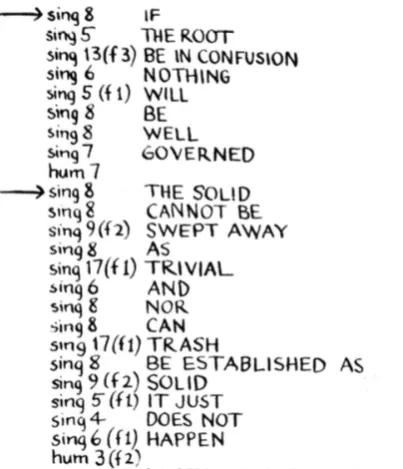
In The Great Learning (1968) Cornelius Cardew uses a type of interactive process for realisation which Michael Nyman calls “people processes”, “…which allow the performers to move through given or suggested material, each at his own speed.” (Nyman, 1999, p. 6) The score is a word score, with no actual pitches or rhythms notated, and functions also as the part from which all performers perform; i.e. the score and part are the same document. Nyman cites Michael Parsons when he describes the process which emerges when each person reads the same notation: “The idea of one and the same activity being done simultaneously by a number of people, so that everyone does it slightly differently, ‘unity’ becoming ‘multiplicity’, gives one a very economical form of notation – it is only necessary to specify one procedure and the variety comes from the way everyone does it differently. This is an example of making use of ‘hidden resources’ in the sense of individual differences (rather than talents or abilities)…” (ibid, p. 6).
Cardew directs each chorus member to choose his own note (silently). For each subsequent line they should individually choose a note that they can hear being sung by a colleague. “Sing 9 (f2) SWEPT AWAY means: sing the words SWEPT AWAY on a length-of-a-breath note (syllables freely disposed) nine times; the same note each time; of the nine notes two (any two) [f2] should be loud; the rest soft.” You are allowed to move around the performance space between lines to better hear the different pitches being produced. You are not allowed to sing the same note on two consecutive lines. “Each singer progresses through the text at his own speed.”
The outcome is something that might be called a sound sculpture. A wall of sound, where an individual sound only occasionally rises out from the fog, before assimilating again into the busy, active, web.
The application of this approach to this inquiry is only implicit, but still present. It simply serves as an example of a piece which helped me think ‘outside the score’, when trying to achieve my own process.
2.3.4 In C
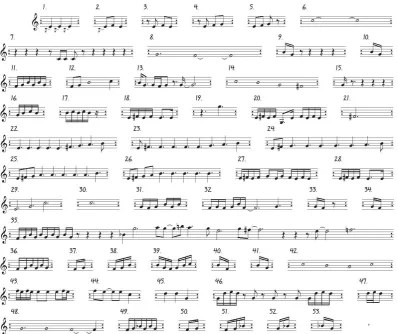
Terry Riley’s In C (1964) is another example of a piece that presents all performers with the same notation.
“All performers play from the same page of 53 melodic patterns. […] Patterns are to be played consecutively with each performer having the freedom to determine how many times he or she will repeat each pattern before moving on to the next. There is no fixed rule as to the number of repetitions a pattern may have…”
22
This influence of ‘one part for all’ has been adopted in Opening Opera in the mobile scores of my chamber opera After the Fall (3.7). In In C, spontaneous events happen, deriving from the choices made by the performers.
“One of the joys of IN C is the interaction of the players in polyrhythmic combinations that spontaneously arise between patterns. Some quite fantastic shapes will arise and disintegrate as the group moves through the piece when it is properly played.”
ibid
[image:23.595.98.497.284.618.2]A considerable number of parameters are left in the hands of the performers. This includes dynamics, tempo and octave transpositions.
23
2.3.5 Cadenza on the Night Plain24
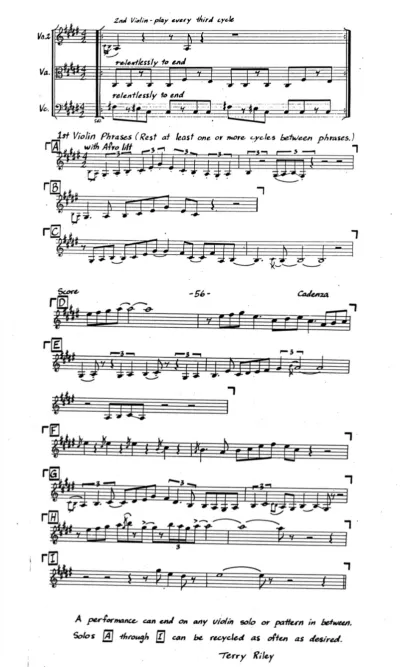
Captain Jack has the last word is the last movement of Terry Riley’s Cadenza on the Night Plain (1984) string quartet. It features very sparse material for the second violin, viola and cello – a single 4/2 bar which is repeated as often as necessary – while the first violin has nine solo mobiles to play, marked A through I. The “performance can end on any violin solo or pattern in between. Solo A through I can be recycled [played] as often as desired.” If the Kronos Quartet recording from 1985 is any indication, the first violin doesn’t have to play the mobiles in the given sequence either, but can jump between them as the soloist sees fit. This gives the soloist added expressive freedom, while the accompaniment keeps on rolling underneath until the soloist’s desired end. The tempo is approximately crotchet = 110, but the score doesn’t indicate whether the soloist should adhere strictly to that tempo or not. David Harrington, the soloist on the 1985 recording, seems to take some liberties with the tempo, which lends the music an exciting glimmer of immediacy, which is also the anticipated outcome of my own desired process.
2.4 A meeting-place: Bringing processes from improvised theatre into operatic production
I wanted to search for a meeting-place for improvised theatre and opera; a space where I could encourage these two art forms to meet. A meeting-place where they could interact, while certain glimmers of their original and exciting identities are kept intact.
The American psychologist Robert Keith Sawyer, an expert on creativity and innovation, defines improvised theatre performance in these terms:
“Improvisational theatre dialogues represent the extreme of unpredictability and contingency results in performance that, at each moment, have a combinatorial complexity: A large number of next actions is possible, and each one of those actions could result in the subsequent flow of the performance going in a radically different direction. At each moment the performer can choose from a wide range of actions that are consistent with the performance up to that point; a performer’s action cannot be predicted by the other performers because there are so many potential creative acts, and the range of potential performances that might emerge multiplies from moment to moment.”
Sawyer R. K., 2003, p. 7
This definition contains three main elements.
In improvised theatre we find:
- the extreme of unpredictability,
25
According to Sawyer, backed up by my own personal experience, here we are presented with one of the most ‘open’, and unpredictable performance arts. But it needs to be noted that even though it is unpredictable at its core, and often seems to be so to the untrained spectator, Johnstone (1979) explains that performers can be trained in particular methods of e.g. status transactions, advancing, accepting, storytelling, free-association, and non-association which helps guide the unpredictability away from becoming an unentertaining mess.
Sawyer’s definition for a scored and conducted performance contrasts strongly with the one of improvised theatre:
“Scored and conducted ensembles […] have an extreme degree of shared structure (the score of the piece, shared understanding about performance practise), and they have a well-specified problem (to perform the piece accurately and with an appropriate interpretation). In this sense, they represent the opposite extreme from [improvisational theatre].”
Johnstone, 1979, p. 176
Here I wish to highlight the following:
- Scored and conducted ensembles represent the opposite extreme from improvised theatre.
Even though we can find a relative amount of performative and interpretive flexibility within the genre and style of traditional operatic performance, the genre does nonetheless inhabit the most ‘closed’ end of the performance spectrum presented by Sawyer. In order to find the meeting place I seek, the research seeks to pull opera closer towards dramatic improvisation, closer towards the “extreme of unpredictability.”
26
2.4.1 Improvisation and opera: micro and macroI will begin by presenting a broad definition of improvisation, and then relate that definition to my inquiry.
I will draw on the distinction made by Dolan, et al (2013) by dividing improvisation into the broad realms of:
the ‘how’ and the ‘what’.
That is to say, improvisation may be represented in two ways…
a) …by means of extemporising notes or words: creating the ‘what’. b) …by an enhanced level of spontaneity at the level of ‘how’.
“Improvisation may be represented by an enhanced level of spontaneity at the level of ‘how’ and not only (or even predominantly) by means of extemporising new notes [the ‘what’] […]. The ‘how’ level refers to aspects of performance such as timing, dynamics, timbre, accentuation and balance between lines in an ensemble.”
Dolan, et al, 2013, p. 3
In other words:
- The ‘what’ is: material.
- The ‘how’ is: treatment of material.
In my ideal meeting place, the composer creates the material and framework, the ‘what’, and then the performers are given extended capacity to apply the ‘how’3. The composer gives them the permission to
play around. Johnstone (1979) introduces playfulness as a very important part of improvised theatre:
“The first time I meet a group I might ask them to mime taking a hat off, or to mime taking something off a shelf, or out of their pocket. I won’t watch them while they do it; I’ll probably look out of the window. Afterwards I explain that I’m not interested in what they did, but in how their minds worked. I say that either they can put their hand out, and see what it closes on; or else they can think first, decide what they’ll pick up, and then do the mime. If they’re worried about failing, then they’ll have to think first; if they’re being playful, then they can allow their hand to make its own decision.”
27
Playfulness can be applied to the improvisation or manipulation of both the how and the what.
It is of course undeniable that ‘playing around’, or applying the ‘how’, is something that takes place in any performance of any opera or any musical work on some level. You could in some cases say that the ‘how’ is simply: ‘interpretation’. At the highest level of operatic production and rehearsal, people are endlessly subverting the written text to create a spontaneous effect. There the singer can be said to be in charge of the material in many ways. Soprano and conductor Barbara Hannigan in a BBC radio interview shared this interesting perspective on how the operatic singer embodies, interprets and dramatizes musical-dramatic roles:
“… I think we [singers] […] cannot help but to bring our own experience into every character, so I always think about the percentage of the composer, the character and the person playing the character making up the sound and the personification of that person on stage, and the relationship that person has with others.”
Hannigan, 2017
Being the embodiment of the music and the text written for the character in question, the singer cannot avoid becoming the vessel for interpretation. Hannigan describes sonic (e.g. dynamic, timbre, accentuation, balance) and dramatic factors as parameters for this embodiment, which encompasses the ‘how’ as defined by Dolan, et al (2013). These are standard parameters to use when ‘subverting the written text’. However, in the studies I present and discuss in part 3 I aim to unearth knowledge which hopefully will contribute to the furthering of dramatic interpretations in new chamber opera.
Let us look again at the parameters of the ‘how’:
- Timing, dynamics, timbre, accentuation and balance between lines in an ensemble.
Let us focus on “timing”.
There is more than one way to think about timing in musical performance. I see it as having at least two levels:
- First: as temporally fixed musical timing, where simultaneous musical events line up vertically with one another on a micro level.
- And then secondly: as poly-timing, where simultaneous musical events’ vertical relationship is much looser, that is, on a macro level.
28
By opening up macro timings of the how to improvisation, I attempt to facilitate a free dramatic process in rehearsal while retaining control of the fundamental musical material. The composer is the creator of the detailed material being used, but a level of improvisation has been permitted in addition to anticipated interpretation, hopefully encouraging creative exploration by the group.
2.4.2 The operatic score
It seems obvious to me, that to achieve macro poly-timing with active accompaniment my performers’ verbal reactions, their text and musical material, must be released from the vertically fixed classic musical score. Several aspects within the genre of traditional opera seem to resist outright such an approach: namely scoring and performer’s training.
Generally speaking, in a traditional operatic production singers and directors can only ‘play around’ with, or interpret, timings in one dimension. In the classic score the singer is usually vertically attached to the rest of the performers of the piece on a micro level, and is often guided by a conductor (or is at least ‘collaborating’ with him/her in real-time). This kind of micro interpretation allows some level of rubato, but still requires adherence to the vertical beat-to-beat or bar-to-bar relationships between each performer’s parts.
One way of allowing the operatic singer to work at the macro level of musical timing is by making alterations to the score layout, namely by detaching (emancipating) the singer’s part from the rest of the fixed score. That way poly-timing emerges, and we have the opportunity to play around with timings on a macro level. Hence, the singer’s temporal relationship with the accompanying score is much looser.
29
2.4.3 The theatre scriptThe conventional theatre script does not assume a singular, or particular, approach to timings. As we read through the script it only presents us with one layer of information at once: usually an actor’s text line or a scene description4. While we read through the standard operatic score however, it presents us with
multiple layers of simultaneous vertical events.
It is not completely unheard of however that experimental theatre scripts include performance instructions that have to do with accurate timings. Samuel Beckett’s Endgame (1957), Happy Days (1961) and Play (1962-3) showcase an above-average amount of performance instructions of which some are directly temporal. While directions like ‘smile, ‘smile broader’, ‘look left’, ‘open/close eyes’ in Happy days have timing implications, there are more specific duration instructions for blackouts (5 seconds) and silences (3 seconds) in Play (Beckett, 1986, p. 308) But, despite numerous performance instructions, the actor is never told how to perform his lines in relation to another simultaneous temporal event, which is what the musical score does. Such a method would generally be considered unorthodox for a theatre script.
Being single-layered, the standard script allows the actor to develop his or her lines, in collaboration with a director (and despite the possibility of local social norm constraints), in any way that serves their vision for the production. The concept of poly-time improvisation in my research is, then, the attempt at transferring that working process from the scripts over to the score.
My attempt at this transferral is embodied in what I call a script-part.
2.4.4 The script-part
The script-part takes a different shape in each of the four studies included in the accompanying portfolio. What they all have in common is a central focus on the vocalist who is relating to an active accompaniment on a macro level. Usually, the material in the script-parts is divided into individual musical mobiles, with each mobile meant to function like a line in a script (in many ways similar to Riley’s Captain Jack has the last word). The script-part will contain some form of musical suggestion, be it rhythm, pitch, timbre or in the form of a suggestion of tonality for each mobile. It should be noted that this is distinct from a purely text based script as will be seen in Solitude 1 (3.6) and in act 2 of After the Fall (3.7). The script-part should, in theory, encourage musical and dramatic poly-time improvisation and exploration in operatic rehearsals and performance. Having a composed set of either chronological or aleatoric musical mobiles, individual singers are not capable of radically changing the course of the drama or the music, but
4The script does contain many layers and types of information, but considering how we read through it from left to
30
they are able to manipulate the timing to allow additional dramatic expressivity in their performance. It is in this script-part that I see the potential for a meeting place.
Later in the development, the exploration of the script-part led to the creation of the accompanying mobile score. More will be said on the mobile score in 3.7.2.
Each exploration using the script-part takes place as an open-form composition in the way that it opens up the sub-structures of the drama without necessarily affecting its conclusion. A sub-structural unit, in terms of a whole opera, can be a whole scene or a section of a scene. It is contrary to super-structure, which in this case is the unalterable story arc, which in traditional terms could be: Exposition – Rising Action – Climax – Falling Action – Denouement. A script-part could then affect the internal assembly of the ‘falling action’ section of the story, but does not change the fact that ‘falling action’ takes place after ‘climax’ and before ‘denouement’.
At the outset, I was interested to see what effect this would have on my compositional aesthetic when the operatic singer and director are allowed to exist in this macro realm of spontaneity and improvisation, less affected by temporal decisions made by other performers5.
2.5 A note on the audience
This research does not specifically concern itself with the audience, but Dolan et al (2013) suggest that although the audience might not explicitly be aware that an improvised compositional element is being utilised in a performance, they still perceive the performance as “more innovative”, “more moving” than a traditionally notated one (2013, p. 31). Despite theirs only being a preliminary pilot study, a live improvised performance was rated higher on every measure by the audience than an earlier prepared performance. “This was true for every piece on every dimension, a highly consistent effect.” (ibid) I find these preliminary results very exciting,6 and hope that the script-part, as well ascreating new avenues for
the singer and director to explore, may also enhance the audience’s experience in this way.
5 The roles of the director and conductor within this are prevalent in e.g. 3.5.3 and 3.5.4.
6Shirley Keane, my director for Évariste (3.5.3) did comment on the audience affect during an email conversation
31
PART 3
PART 3 comprises compositional and performance analysis of portfolio studies, composed during 2013-2017.
Here I present in chronological order my search for a process to create music-dramas that suits my preferred way of working as a composer and performer. In the spirit of practice based research, I spent 2013-2017 composing studies that allowed me to dig deeper into the parameters and processes I was interested in and that I wanted to open up. Not all of these studies made it into this commentary. After having premiered After the Fall (3.7) I managed to realise a framework and process I was happy with, a summary of these can be found in PART 4. It is important to note, that the studies discussed here in PART 3 are only stepping stones towards discovering that complete working framework, but not attempts at realising it per se, as it didn’t yet exist. That includes the leadership techniques and training exercises for performers discussed in PART 4.
3.1 Suggestiveness
The starting point for all of my script-parts presented here was the search for a subject matter or text which then would become the foundation for musical mobiles. I wanted my performers to be able to improvise something reflective, I wanted to appeal to their individual initiative7, so I used fairly abstract (‘open’)
dramatic source material. That is to say, I wanted to facilitate a suggestive dramatic situation (in contrast to a relatively obvious one) which I hoped would allow the singer additional capacity to merge his or her own personal emotional world with the dramatic world suggested in the score, opening up the dramatic world for improvisation and enhanced interpretation8. I wanted the team to find ‘the answer’ together,
rather than the work spelling it out for them. This is in big part inspired by the ideas of Umberto Eco:
“The search for suggestiveness is a deliberate move to ‘open’ the work to the free response of the addressee. An artistic work that suggests is also one that can be performed with the full emotional and imaginative resources of the interpreter. Whenever we read poetry there is a process by which we try to adapt our personal world to the emotional world proposed by the text.”
Eco, 1962, p. 22
7 Eco, 1962, p. 19.
32
3.2 An interactive aestheticThe open opera compositional aesthetic is derived from, and is shaped in many ways, by granting my performers the means and permission in rehearsals to be playful and to make mistakes. Allowing this without losing sight of my musical integrity can be (I learned) a difficult balancing act, but I believe that in that balance lies an interesting musical aesthetic. It is only in part dependent on the actual composition, the artefact, the score. It is a developing interactive creative conversation: between the music, drama and staging; between the composer and the performance team.
In a fully directive process the composer could control the aesthetic to a greater degree, but this being an interactive one, the chosen performance team for the workshops for, rehearsals and performances of the composition will be able to put a greater mark on the aesthetic output. This research is therefore about more than just me and my works in a vacuum. It is also about my performers, directors and writers, and our creative communication.
33
3.3 AimsHere I will present a chronological compositional analysis of my portfolio works. The analysis as a whole aims to:
1) spark speculation regarding a possible compositional aesthetic,
2) lead to a framework of working methods and considerations that will support future developments of mobile scores, script-parts and open operas.
That twofold overarching exploration is divided into four chapters, each exploring a main theme, or a set of specific themes:
1. A Glacier’s Requiem explores:
i. The option of synchronisation: the relationship of calculable ratios between mobiles and accompaniment.
2. Évariste explores:
i. Leadership: Balinese dance and the conductor. ii. The directional style of director Shirley Keane. 3. Solitude 1 explores:
i. My preferred compositional balance between free and controlled. ii. Leadership: soloist’s and accompanist’s communication.
4. After the Fall explores:
i. The option of synchronisation: dissolving the calculable ratios between mobiles and accompaniment.
ii. Leadership: conductor cues.
34
3.4 A Glacier’s Requiem (excerpt)A Glacier’s Requiem explores:
i. The option of synchronisation: the relationship of calculable ratios between mobiles and accompaniment (see 3.4.5).
Characters:
The glacier’s avatar (soprano)
Instrumentation: Flute & Piccolo Bb Clarinet Bassoon Harp Piano Cello
Setting:
The ensemble (or solo piano) is set up on stage right. In not so far distance we see a glacier peak through a misty sunrise. During the first half of the performance, as the sun rises, the mist clears until at the approx. halfway point of the performance we clearly see a beautiful glacier in all its glory. At that point the glacier starts to melt rapidly, and the sun starts to set, until there is nothing left but a barren mountainside by the end of the piece.
After a short intro from the ensemble, the glacier’s avatar (soprano) enters from stage left. She is wearing a long dress, which in textures and colours is reminiscent of Icelandic nature and ice. It drags graciously along the floor as she walks. She is mystical and otherworldly as she shares with us the glacier’s last message to humanity.
A Glacier’s Requiem is a 40-minute-long operatic performance written for soprano and ensemble sextet. It was the first piece in which I experimented with the idea of a script-part. The soprano was Rannveig Káradóttir, who has performed two different versions of the piece in London to date. The first in the Platform Theatre, Central Saint Martins, 29th May 2013; and the second at the Kings Head, Islington on
the 21st September 2014 as one of the shortlisted pieces for the Flourish opera competition, hosted by the
OperaUpClose opera company.
35
scientific references. One of these then became the foundation for the first script-part. We will look at that in more detail in the ‘text’ section of this chapter (3.4.2).
There was no designated director for either of these performances. The minimalistic staging for both shows was developed by the group.
3.4.1 Music
The raw temporal values for the accompaniment were inspired by published meteorological data collected in relation to the rapid melting of Snæfellsjökull-glacier in western Iceland9. I calculated the ratios
between rapid retreats (melting) and one partial re-advance in square kilometres during the period of 1910-2008 and came up with a set of rounded up note values which developed into the main rhythmic motif for the opera. These values also function as bigger yardsticks, once multiplied, for the overarching structure of the opera.
All melodic and harmonic material derives from the analysis of recorded spoken word turned into speech melodies (examples in 3.4.3). In the case of all the speech melodies in all the studies presented here, I start by recording myself and/or others reciting the text in question. I then edit these recordings into little fragments, usually a sentence each. Using a software, Soundplant, I loop each spoken fragment, listening to them in headphones repeatedly, until I start noticing the inherent natural rhythms and pitches of the spoken voice. In the case of A Glacier’s Requiem, all the found text used is linked in one way or another to Snæfellsjökull-glacier. The speech melodies make up the soprano’s material throughout the opera, as well as being used as the foundation for the accompaniment throughout the piece. This method applies to the creation of all vocal material in all script-partscovered in this thesis.
9 “The average ice thickness of Snæfellsjökull-glacier is only 30 m, the area of the ice cap was reduced from 12.5
36
3.4.2 TextThe script, as well as the opera as a whole, is the result of an experimental working process, initiated by Icelandic designer Friðþjófur Þorsteinsson (Frithjofur Thorsteinsson), or ‘Fiffi’, where the creative pathway was reversed from the conventional: music/libretto - staging - design; to: design - music - script. First, Fiffi presented me with stage design ideas, and once I had responded to them with several musical sketches, we made up the script from several different references to folk-lore as well as popular culture. References include the spooky early-14th century Icelandic Saga Bárðar saga Snæfellsáss, and Jules Verne’s
Journey to the Centre of the Earth.
I specified a section, a thought, in the script during which the soprano recites excerpts from the 20th
century Icelandic form-revolutionist poem Tíminn og Vatnið (The Time and The Water) (1956) by Steinn Steinarr (Steinarr, 2014). There I wished to get a chance to develop the dramatic deliverance via poly-time improvisation10 with the soprano in rehearsals and performance. I hoped this would give Rannveig the
opportunity to bring something highly personal and reflective to the role, deepening the experience, making it about something more than just the glacier.
The poem’s content is very abstract, metaphorical and suggestive, allowing for quite an open reading (or singing), but the general themes are the sun, heat, melting, water, decay, and nature. The poem is presented here in both the original Icelandic, and an English translation:
37
3.4.3 The mobiles [image:38.595.89.507.160.216.2]From the speech analysis of Tíminn og Vatnið I created nine musical mobiles. Below is the first mobile, made up of the first three lines of the poem:
Figure 9
The speech’s pitches are rounded to equal temperament. I specified a set of mobiles for the soprano to perform during a particular time interval in the score and the first instance of this can be seen from bar 6 of open section #1:
Figure 10
[image:38.595.92.510.320.615.2]