JOURNALOFVIROLOGY, Sept. 1988, p.3328-3333 Vol. 62, No. 9 0022-538X/881093328-06$02.00/0
Copyright © 1988,AmericanSociety for Microbiology
Mutations in
Rous
Sarcoma
Virus
Nucleocapsid
Protein
p12
(NC):
Deletions of
Cys-His
Boxes
CLAUDE
MtRIC,t*
EVELYNE GOUILLOUD, ANDPIERRE-FRANGOIS SPAHR Departmentof Molecular Biology, UniversityofGeneva, 1211 Geneva4, SwitzerlandReceived25February1988/Accepted 25May 1988
Rous sarcoma virus nucleocapsid proteinp12 (NC) contains two conserved amino acid motifs, the Cys-His boxes, which constitute potentialmetal-binding domains. Totry to understandthe functionofNC and of each of itsCys-His boxes during the viral life cycle, particularlyin viralRNApackaging, we haveusedsynthetic oligonucleotides to delete precisely either the proximal or the distal box, or both Cys-His boxes. The mutant DNAs weretransfected into chicken embryofibroblasts, and the virions produced in a transient assay were characterized biochemically for production of viral proteins and particles, RNApackaging, andinfectivity. The resultsindicated thefollowing. (i) The deletion of either the proximal or the distal box decreases the amount of viral RNA packaged in theparticles and resultsinincomplete 70S dimer formation.(ii)Thedeletionof both boxesinhibits viral RNApackaging. (iii) The deletion of the proximal, but not the distal, box suppresses any detectableinfectivity,while the deletionof the distal, but not the proximal,boxlowersinfectivity 100 to 200 times. The structuralproteins of retrovirusesareencoded by the
gag genewhoseprimary productis apolyprotein precursor.
Pr76, the gag protein precursor of Rous sarcoma virus
(RSV), is a 76,000-dalton protein that yields, upon
proteo-lytic cleavage, the mature MA (p19), plO, CA (p27), NC
(p12),and PR(p15)gag-encodedproteins (19). RSV NC is a
basic protein which is associated withthe 70S RNA in the
core of the virion (2, 7). A small number of NC molecules
can be cross-linked by UV lightto the RNA in the virion,
andwehaveidentified andsequenced theirbinding sites(6).
Nobinding specificity of RSV NC for viral RNA has been
demonstratedin vitro(8, 20, 28, 29).
The primary transcription productofthe integrated
pro-virusis a 35S RNA which codes for the gag and the gag-pol
polyprotein precursors. Splicing of the same RNA also
yields two different subgenomic mRNAs coding for the
envelope glycoproteins and for the transforming protein
pp60src. However,onlythefull-length35S RNA ispackaged
in the viral particles as a 70S dimer. Thus, for the correct
packagingoftheirgenome,retrovirusesneed todiscriminate
against cellular and subgenomic viral RNA. Packaging
se-quences at the RNA level have been described previously (13,14), but theproteinswhich interact with these sequences
have notbeenidentified. Among the gag-encodedproteins,
RSV NC is the best candidate for this role, either as an
individual protein or as aconstituent ofPr76 or one ofits
cleavage intermediates. Withafirstsetof mutations in RSV
NC, wehave shownthat this protein is necessary forviral
RNApackaging and formation ofastable 70Sgenomic dimer
RNA(25).
Almost all the retroviral nucleic acid-binding proteins known so far possess a conserved pattern ofcysteine and
histidine residues (1, 4). These residues constitute what we
have referred to as thecysteine-histidine box (25), which is
defined by the conserved position of four residues, three
cysteines and one histidine; if the proximal cysteine is
designatedasn,there isadistalcysteineatthepositionn+3,
ahistidineatn+8, andathirdcysteine at n+13. Some other
*Corresponding author.
tPresent address: Department ofBiochemistry, Collegeof Phy-siciansandSurgeons, Columbia University,New York, NY 10032.
residues are also highly conserved, particularly a glycine located in front ofthe histidine. Another typicalfeature of these sequences is the presence of one or two aromatic residues, the proximal one atthe positionn+1 orn+2 and
thedistalone at n+9.
OneCys-Hisbox is alsofoundinaDrosophila copiaclone
(26) andinthecoatproteingeneofcauliflower mosaic virus
(5). A similar pattern exists also in the T4 single-stranded
DNA-binding protein coded by gene 32; however, the
se-quence is in opposite orientation, and the histidine is at
position n+9, instead ofn+8 (31).
Byanalogyto the "zincfingers" presentinmany
regula-toryDNA-binding proteins(17),apossiblestructureforthe
Cys-His
box as ametal-binding domain has beenproposed
(1) and it was shown (9) that the box ofthe T4 gene 32product binds a Zn2+ ion with a structural function in
single-strandednucleic acidbinding. Untilnowhowever, the
associationofametalionwith thepurified retroviral nucleic
acid-binding proteinshas notbeen shown.
The nucleic acid-binding proteins of some retroviruses,
like murine leukemia virus, contain one Cys-His box,
whereas mostretroviruses, such asRSV, bovine leukemia virus, visna virus, and the human retroviruses, have two
boxes. This suggests that theseboxesmay constitute
inde-pendent structures with independent functions. However,
the variations observed in their amino acid composition suggestthattheyarenotfunctionally equivalent.Inthecase
ofRSV, for example, there is little homology between the
two boxes; only 6 amino acids out of 14 are conserved,
including the 4 which define the pattern. Moreover, the
proximalboxcontainstwotyrosines, whereas thedistal box
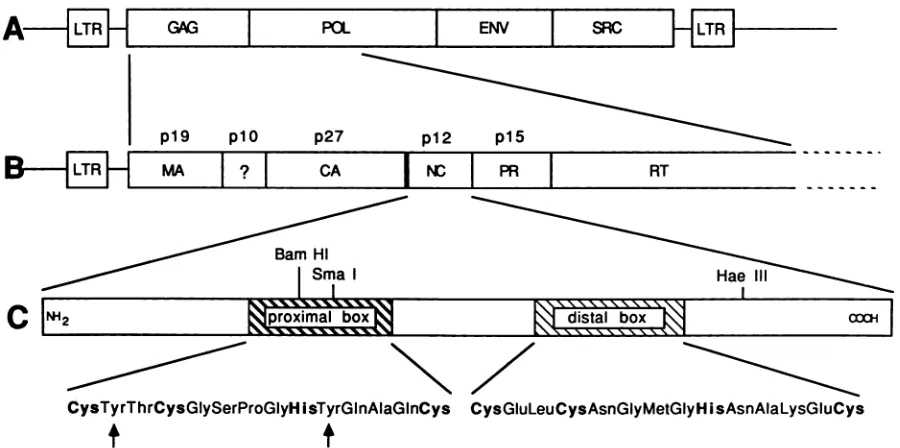
has noaromatic residue(Fig. 1).
TofurtherstudyNC in thereplicative cycle of RSV,and
inparticulartodefine therespectiveroleofthetwoCys-His
boxes in its function, we have used synthetic oligonucleo-tidestodeletepreciselythecodingsequenceof eitheroneof
thetwoboxesorboth. Themutant DNAswere transfected
into chicken embryo fibroblasts, and the viral
particles
producedin atransient assaywerecharacterized
biochemi-cally andforinfectivity.
The following results support the hypothesis deduced
from the sequence comparison between the two boxes.
(i)
3328
on November 10, 2019 by guest
http://jvi.asm.org/
AG~3
p19 plO
MA
I?I
p27
CA NC
SPC
p12 p15
PRI
Bar Hi Sma I
RT
HeII
proximal box
CysTyrThrCysGlySerProGlyHisTyrGInAlaGinCys CysGluLeuCysAsnGlyMetGlyHisAsnAlaLysGiuCys
t
t
FIG. 1. (A)Completegenomeof Pr-Cas alinearprovirus. The regionsencoding thegag,pol,env,andsrcgenes areshown in boxes.LTR, Long terminalrepeat.(B)Enlargement ofgag gene andN-terminal domain ofpol gene.(C) Schematic representation of RSV NC(p12).The sequencesof thetwoCys-His boxes whichwerepreciselydeleted arerepresented underthe two hatchedboxes, withthe conservedcysteine andhistidine residues in boldtype face.The twoaromatic residues in the proximal boxareindicated by thearrows.
The Cys-His boxes are modular elements which play addi-tive roles in viral RNA packaging and 70S dimerstructure
formation. (ii)The proximal box, butnot the distal one, is
absolutely required for infectivity.
MATERIALS AND METHODS
Cell culture. Chicken embryo fibroblasts prepared from
Valoeggs(Lohmann Tierzucht, Cuxhaven, Federal
Repub-lic of Germany) were grown in Dulbecco modified Eagle
medium containing 1 to 5% fetal bovine serum (GIBCO
Laboratories,GrandIsland,N.Y.)at37°Cinanatmosphere
supplemented with5% CO2.
Bacterial strains. Escherichia coliHB101 was grown in L broth and was transformed to ampicillin resistance by the
CaCl2 method (22). E. coli JM101 was kept on minimal
medium supplementedwith 1 mM thiamine-HCl (22).
Oligonucleotide synthesis and purification.
Oligonucleo-tideswere synthesized eitheron aBeckmanSystem I DNA
synthesizer, or on a PharmaciaGene Assembler, oron an
Applied Biosystems 381 A DNA synthesizer and were
deprotected accordingtotheinstructions given bythe
man-ufacturer. They were furtherpurified according to the
pro-cedure describedpreviously (21). Thefollowing
oligonucle-otides were synthesized: CMO, 20-mer 5'GGGCGATCTT
TATGTTCCAT3' (primer for sequencing); CM1, 40-mer
5'CCTGACTTCCGTTTTTTCGGGAGCCCTCGGGCACG
ACCAC3' (proximal box, deletion); CM2, 20-mer 5'ATC
TCCCGGGGATCCACAAG3' (proximal box, selection); CM3, 39-mer 5'GGTTGCCATCCCGCTTTCTTCGCTCA
CGGCTGTTTCCTG3' (distal box, deletion); CM4, 20-mer
5'CTGTTAGCGTTGTGTCCCA3' (distal box, selection). Site-directedmutagenesis. The mutationswereconstructed in the clone AgagBS, a PstI-EcoRI subclone of the clone pAPr-C (12, 25) in thephagemid Bluescribe(+) (Stratagene,
formerly Vector Cloning Systems, San Diego, Calif.). The
AgagBS
plasmid was introduced into the E. coli JM101strain, and single-stranded DNA was obtained upon
infec-tion with M13 VCS strainprovidedin the kit.
Single-stranded DNA purification. The single-stranded
DNAwaspurifiedfrom thepolyethylene glycol-precipitated
bacteriophages bytwophenol extractions, oneether
extrac-tion, and ethanol precipitation in the presence of 0.3 M
sodiumacetate.
Mutagenesis. Themutationswereconstructedbyusingthe method of"priming all the way round" asdescribed
previ-ously (33). The template (1 p.g) and the labeled primer (10
pmol)wereannealedtogetherin 10
RI
of buffercontaining10mMTrishydrochloride(pH 8.0) and 10 mMMgCl2.The tube
containing the sample was placed in asmall beaker of hot
water(80°C) and let cool to room temperature for about30 min. Dried [a-32P]dATP (5 OCi) was taken up with the
annealing mix, and thefollowing substances were added: 1
RI
of 1Ox TMbuffer(100mMTris[pH 8.0],100 mMMgCl2),1
IlI
of 5 mM rATP, 1IlI
of 5 mM deoxynucleosidetriphosphates,1
pul
of100mMdithiothreitol,4pul
ofwater,10U ofT4 DNA ligase
(Anglian Biotechnology,
Colchester, Great Britain), and 2 U of the Klenow fragment ofDNApolymerase (Anglian Biotechnology). After 12 to 14 h of
incubationat 12°C,80 p.l of10 mM Trishydrochloride (pH
8.0)-10 mM EDTA was added to the extension-ligation
reaction, and then 100pl of13%polyethylene glycol
6000-1.6MNaCl. The mixturewasleftonice for 15 min and spun
in a microfuge for 5 min. The supernatant was removed
completely,and thepelletwasdissolvedin180 ,ulofwater.
A
20-pul
quantity of2 M NaOH was added tothe sample,which was left at room temperature for 5 min, and then
placedonice for2min. The sample was then loadedon a5
to 20%sucrose gradientandcentrifuged for 2.5 hat38,000 rpm,4°C,inaSW60rotor(BeckmanInstruments,Inc., Palo
Alto, Calif.). About 20200-pI fractionswerecollected from
thebottomof the tube, neutralized with 1/10th volume of 3 M sodium acetate, and counted. The closed circular DNA ran at about fractions 6 through 10, in front of the single-stranded templateand the unincorporated ATP. Theclosed circular DNA fractionswerepooled, 10
pug
ofcarrier tRNA was added, and the nucleic acids were precipitated withpv"-%=e
%% % % % %X %Xi IEW\
C
I1
OOCHI
LTR
I
lm
&No,
on November 10, 2019 by guest
http://jvi.asm.org/
[image:2.612.82.532.72.296.2]3330 MERIC ET AL.
ethanol. The DNA was suspended in water, and half of it was used, either immediately, or after digestion with a restrictionendonucleasetotransform E. coli HB101 bacteria
made competentby the CaCl2 method (22).
Colony screening. A total of 150 to 200 colonies were screened with oligonucleotides complementary to the
dele-tions.The colonies were transferred to nitrocellulose filters,
whichwere then treated with alkali, neutralized, and baked
at 80°C in vacuo (22). The screening oligonucleotide (150
pmol) was labeled with 10 ,uCi of[y-32P]ATP and T4 poly-nucleotide kinase for 30 min at 37°C in 50 mM Tris
hydro-chloride (pH
8.0)-10
mM MgCl2-3mM dithiothreitol. Themixturewas then diluted with 3 to 10 ml of 6 x SSC ( x SSC
is 0.15 M NaCl plus 0.015 M sodium citrate) and filtered through a0.45-,um-pore-size nitrocellulose filter and stored frozen. The filters were prewet in 6x SSC for 5 min and
prehybridizedfor 5 minat65°Cin asolutioncontaining lOX
Denhardt solution, 6x SSC buffer, and 0.2% sodium dodecyl sulfate, without shaking. The filters were then rinsed in 6x SSC andhybridized in disposable plastic petri dishes, colo-niesface down, for 1 h at roomtemperature.Thefilters were washed with 100 ml of 6x SSC three times for 5 min at room
temperatureand then once at 50'C for 5 min. The filters were
covered with Saran Wrapand autoradiographed. The
plas-mid DNA ofthree to six colonies showing nohybridization was analyzed by restriction enzyme digestion, and one
candidatewas sequenced.
DNA sequencing. The mutated plasmids were sequenced
eitherbyprocedure ofMaxam andGilbert (23) or by Sanger
dideoxy-chain termination usinga synthetic oligonucleotide
complementary to the endofthe RSV NCcoding sequence
(CMO) orone of the screening oligonucleotides (CM4) and
avian reversetranscriptase (32).
Transfection. Chicken
embryo fibroblasts,
eitherfreshly
prepared or frozen in the presence of 15% glycerol, were
used fortransfection after two to sevenpassages.
Transfec-tionwasperformed asdescribed previously (25).
Proteinanalysis. Viral proteinsproducedbythe
transfect-ed cells were analyzed as described previously (25) by
immunoprecipitationandimmunoblotting(3) withpolyclonal
antibodies against RSVNC (p12), MA (p19), and CA (p27)
(24).
Northern (RNA blot) analysis. The viral RNA content of
the produced particles was analyzed by nondenaturing
Northern blotanalysisas described previously (15, 16). Exogenous template reverse transcriptase assay. The test
wasperformedasdescribedpreviously(25) on viruspelleted
from 5 ml ofculture medium (10).
Infectivity. Chicken embryo fibroblasts were plated at a
celldensity of about750,000 cellsper100-mm-diameterPetri
dishtheday beforeuse.Thevirusstockswerefilteredbefore
use through a 0.45-,um-pore-size disposable polysulfone
Acrodisc filter unit (Gelman Sciences, Inc., Ann Arbor,
Mich.) toavoid the transfer of cells. Just before infection,
the cells were treated for 1 h at 37°C in culture medium without serum containing 25
jg
ofDEAE-dextran per ml. The cells were infected with various dilutions of the virus stocks inculture medium without serum for 2 h at 37°C. The culture mediumwas thenchanged for fresh culture medium containing 5% fetal bovine serum. After 2 days (I+2), the serum concentration was lowered to 2%, and 2 days later(I+4),
the serumconcentrationwasloweredto 0%. Six days afterinfection, the culture medium washarvested andana-lyzedfor reverse transcriptase activity and viralproteins.
RESULTS
Deletion of the Cys-His boxes. To remove precisely the
proximal or the distal box, or both Cys-His boxes in RSV
NC,weused thetechnique ofsite-directed mutagenesiswith
synthetic oligonucleotides. To obtain single-stranded DNA
containingthe NCcodingsequence,theSalI-EcoRV gag-pol
subclone of the plasmid pAPr-C (12, 25) in pBR322 was
furthersubcloned intothephagemid Bluescribe(+) byusing
therestriction sites PstI-EcoRI. The Bluescribe vectoris a
pBR322-derived plasmid containingtheM13replication and
packaging sequences that allow the packaging of
single-stranded plasmid DNAintophagecapsidsupon infection of
the E. coli host bythe phage M13.
Twooligonucleotides weresynthesized forthedeletion of
eachCys-His box:onedeletionoligonucleotide
complemen-tary to 20 nucleotides on each side of the box, and one
screeningoligonucleotide complementarytothe sequenceto
be deleted. The mutations were introduced into the Blue-scribe subclonesby usingthe "all the way round" priming
technique, and the closed circular DNA molecules were
purified on an alkaline sucrose gradient (33). The closed
circularDNAwas then introduced into E. coliby
transfor-mation, and the mutantplasmidwas detected by
hybridiza-tion ofthebacterial colonies with thescreening
oligonucle-otides. Inthe case ofthe
proximal
box, the presence ofauniqueBamHIrestriction site in thesequencetobe deleted
allowedus toalso selectdirectly for Pr-C del(1) mutantsby
BamHI digestion ofthe closed circular DNA before
trans-formation.The mutated DNAregionwassequenced,and the
corresponding full-length pAPr-C plasmids were
recon-structedintwocloning steps.
Production of viral particlesunaffected by deletion of Cys-His boxes. To test the mutants, the altered proviral se-quenceswereintroduced into chicken embryo fibroblasts by
DEAE-dextran-mediated transfection, followed by a
glyc-erol shock as previously described (25). The transient
expression ofthe viral sequences was analyzed48 to 60 h
later;theproduced particleswerepelletedbycentrifugation
and analyzed biochemically andforinfectivity. Themutant
Pr-C 1,whichhasaVal-Proinsertion intheproximal boxat
position n+7 and was characterized previously (25), was
included as a control. Viral proteins were detected in the
transfected cells and in the virionseitherby
immunoprecip-itation, followed by immunoblotting(intracellular viral
pro-teins),
or by immunoblotting only(virion proteins)
withpolyclonal
antibodies againstthe gag-encodedproteins
NC(p12),
MA(p19),
and CA (p27).The results showed that the wild type and all mutants
produced
particles containing the same amount ofgag-related proteins; the amount ofmutated
p12 protein
pack-aged intothe virions appearstobeidenticaltothewildtype,
althoughthesignal
corresponding
totheproteinwith thetwoboxesdeletedwasweaker. Thedeletionsin theNC result in
an increased mobility
corresponding
to the size of thedeletion (Fig. 2). The
analysis
of the intracellular viralproteinsdidnotshow any significantdifference between the
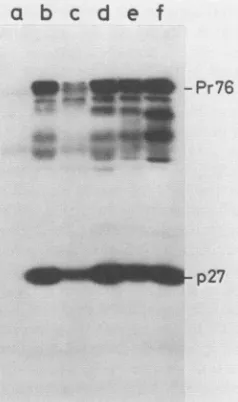
mutants and the wild type (Fig. 3). The lower amount of intracellular gag precursor andcleaved CA (p27) observed for mutant Pr-C 1 is probably due to an artifact of the
immunoprecipitation, since the extracellularamountof viral
proteinsappears normal(Fig. 2 and3, lanes c). Equivalent
amounts of active reverse transcriptase were detected in
pelleted virions (data not shown) by using the exogenous
template assay(10).
Viral RNA content ofthe mutant virions. In view of the J. VIROL.
on November 10, 2019 by guest
http://jvi.asm.org/
DELETIONS OF THE CYS-HIS BOXES IN RSV NC 3331
a
b
c
d
e
f
WEiiiMhimmiium-_ 7~,-p ~D2-2 2
.... .
.106it
p19
-}p12
FIG. 2. Virion gag-encoded proteins produced in a transient
transfection assay. The cells were transfected in the presence of DEAE-dextranand glycerol shocked. The mediumwascollectedas
described in Materials and Methods. Thevirionswerepelletedby centrifugation and analyzed by sodiumdodecyl sulfate-polyacryl-amide gel electrophoresis (18), followed by immunoblotting with polyclonal antibodies against RSV NC (p12), MA (p19), and CA (p27) and 1251-labeled proteinA. Lanes:a,controltransfectionwith noDNA;b,wildtype; c, Pr-C1;d, Pr-C del(1); e, Pr-C del(2); f,
Pr-Cdel(1,2).
abnormalstructureofthe RNApackaged by Pr-C 1 (25), we
have also analyzed the RNA packaging function of the deletionmutant virions by nondenaturing Northern blotting (16, 25). Thedeletion of either the proximalorthe distal box
resulted in the same phenotype; the total amount of viral RNA present in the particle wasidentical in both mutants butappearedlower thaninthe wildtypeorthemutantPr-C
a
b
cd
ef
_ _ _ -Pr7G
[image:4.612.367.505.75.249.2]... p27
FIG. 3. Intracellular viralproteins.The celllysates were immu-noprecipitated with a polyclonal antibody against CA (p27),
fol-lowedby protein A-Sepharose adsorption.The elutedproteinswere
resolvedbysodiumdodecyl sulfate-polyacrylamide gel electropho-resis anddetectedby immunoblottingwithanti-CA(p27)serumand
125I-labeledproteinA.Lanes: a,controltransfection withnoDNA;
b,wildtype;c,Pr-C1;d,Pr-Cdel(1);e,Pr-Cdel(2); f, Pr-C del(1,2).
FIG. 4. ViralRNAcontentof thevirionsproduced inatransient
transfection assay. The virions were pelleted and digested with
proteinase Kinthe presenceof sodiumdodecyl sulfate, the RNA
was phenol extracted, digested with RNase-free DNase 1, size
fractionatedon anondenaturing1% agarosegel,electrotransferred
to a nylon membrane, and hybridized with the nick-translated
pATV-8 plasmid containing the RSV coding sequence. Lanes: a,
control transfection withnoDNA; b, wildtype;c, Pr-C1; d,Pr-C del(1);e,Pr-Cdel(2); f,Pr-Cdel(1,2). Thepositionof the 35S viral
RNAwasdetermined from the cellular RNA, andthe positionof 70S
RNAwasdetermined fromthewild-typevirus in lane b.
1(Fig. 4, lanes dande). Asalready observedinthecaseof this mutant, the 35S RNA, instead ofbeing present in low levels compared with the 70S dimer (lane b) constituted approximately 50% of the viral RNA (lane c). The signals produced by themutantswithtwoboxes deleted, Pr-Cdel(1) and del(2) (lanesd and e), however, appearedmore diffuse
than that of Pr-C 1 (lane c), suggestingthatthe RNA hasa
less well-defined secondary and tertiary structure. The si-multaneousdeletion of thetwoboxes in Pr-Cdel(1,2) almost abolished viral RNApackaging (lane
f),
aphenotypesimilarto that of the deletion p12mutantPr-C 10.8 (25). The lane
was, however, not as blank as the control and seemed to contain some degraded material.
Themutantwithout thedistal Cys-Hisbox still infectious. To monitor the infectivity of the mutants, chicken embryo fibroblastsweretransfected with themutantplasmidsasfor atransientassay.The culture mediumwascollected after 60
h, and various dilutions were used toinfect fresh chicken embryo fibroblasts. After 6 days, the culture mediumwas
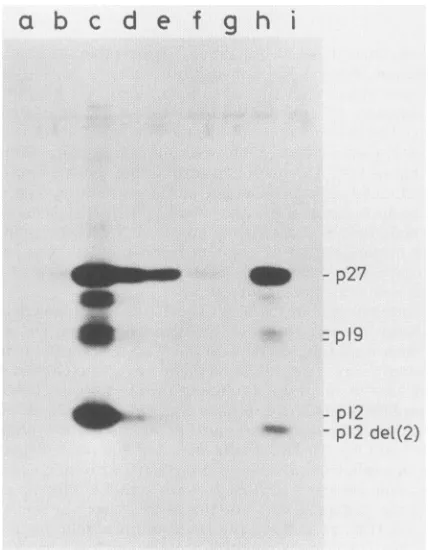
analyzedforreversetranscriptase activityand viralproteins (Table1 andFig. 5).The resultsindicated thatnoreplication
of the mutantslackingeither theproximal or bothCys-His boxes could be detected (Fig. 5, lanesgandi). Themutant having the proximal, but not the distal, box was weakly
infectious (Fig. 5, lane h). Thereverse transcriptase activi-ties (Table 1)and the amount ofproteins indicate that Pr-C del(2)was100to200 times less infectious than the wildtype. Theelectrophoretic mobility of thep12 protein produced 6 days after infection by this mutant was identical to that observed in the transient assay, indicating thatno obvious reversion tothe wild type occurred.
DISCUSSION
In this work, wehave tried to understand the respective contribution of each of the two Cys-His boxes to the
a b c d e
-.
_s
..
_
-. _
._
_
-_._.
_.
:
-f
-70S
-35
SNW
-VOL.62, 1988
on November 10, 2019 by guest
http://jvi.asm.org/
[image:4.612.104.249.77.260.2] [image:4.612.117.236.462.663.2]3332 MERIC ET AL.
TABLE 1. Infectivityofthemutants'
Virus Dilutionat Reversetranscriptase
infection activity (cpm)
Control 58
Wild type 1/10 7,160
1/100 636
1/1,000 118
Pr-C 1 1/1 64
Pr-C del(1) 1/1 63
Pr-Cdel(2) 1/1 401
Pr-Cdel(1,2) 1/1 58
a Chicken embryo fibroblasts were infected with 2 ml of culture medium containing 200, 20, and 2 ,ul of the supernatant from the cells transfected with thewild-type plasmid. In the case of the mutants, 2 ml of undiluted filtered supernatant from the transfected cells was used. Six days afterinfection, the virions were concentrated by centrifugation and the reverse transcriptase activity was measured on the pellets as describedpreviously (10). The values shown in the table were obtained from 1.6 ml of culture medium.
function(s)
of RSV NC (p12). We have used a moleculargeneticapproach andhave constructed straightforward
mu-tations of these conserved motifs, the precise deletion of
either theproximal or thedistal box,orbothCys-Hisboxes.
As observed with other mutations in RSV NC already
characterized (25),thedeletions of the Cys-His boxeshad no
effecton thereleaseoftheviralparticles. Allofthe mutants
Q
b c d
e f
g
h
i
_0
- p27.. p19
mw_
-p12
-pl2 del(2)
FIG. 5. Infectivity of the mutants. Chicken embryofibroblasts weretransfected with themutantplasmidsasfor atransientassay.
The culturemedia was collected after 60 h and was used to infect freshcells.After 6days,the mediumwasanalyzedforthepresence
ofviral proteins by immunoblotting. Lanes: a, mockinfection; b,
infection with 2 ml of medium from themock-transfectedcells; c,
infection with 20 ,uI of the medium harvested from the cells transfected with thewild-type plasmid;d,infection with 2 p.l of the samemedium; e,infectionwith1 ,ulof the samemedium; f,g,h,and
i, infection with 2 mlof medium harvested from cells transfected withPr-C1,Pr-Cdel(1),Pr-Cdel(2),andPr-Cdel(1,2),respectively.
tested yielded virions containing the mature
gag-encoded
proteins and awild-type level ofreversetranscriptase activ-ity. Theseresults indicate that themutations inp12 neitheraffecttheactivation ofp15,the protease,northe maturation
of the
gag-pol
precursor,and donotaffect thestabilityof thegag precursor.UnlikethedeletionmutantPr-C10.8(25),the deleted NCproduced by Pr-Cdel(1,2) ispackagedinto the virions and can be detected on an immunoblot. Accordingto the resultspublished previously, itcanbe concludedthat the
region locatedbetween the twoboxes isnecessary toretain
the matureprotein inthe virion.
The effect of the deletions on the viral RNA packaging
functionsupportsthemodel oftheCys-His boxesas
modu-lar units with additive roles. The deletion of either the
proximalor the distal box resulted in asimilar phenotype,
reduced RNApackaging efficiencyand abnormal structural
maturation ofthe 70S dimer RNA. The effectofthese two
deletions on the structure of the viral RNA is more
pro-nouncedthan the oneobserved in the case of Pr-C 1, which has a Val-Pro insertion in the proximal box. This suggests that theinsertion ofthese twoaminoacids hadonlyalimited disturbing effect on the structure of the proximal box. It is
also possible that the deletions have general long-range
negative effects on the protein which interfere with the
binding of RNA and which explain the lower packaging
efficiencywhenoneof the twoCys-His boxesisdeleted. In
both cases, however, these results show that both boxesare necessary for theformation of a stable genomic dimer. The absenceofpackaging observed when both boxes are deleted suggests that at least one box is necessary for viral RNA packaging and thatthebasic amino acids located outside the
boxesare not sufficientfor thatfunction.
The fact that one mutant is still infectious, although weakly, indicates that a nucleocapsid protein containing only the proximal Cys-His box is able to provide the minimal functions necessary for replication. This result is not
sur-prising in view of the similarities between the various
retroviral Cys-His boxes (1), which suggest that the distal box is a degenerated copy of the proximal one.Indeed, there are more similarities between the proximal boxes than between the distal boxes, and the aromatic amino acids are preferentially found in the proximal boxes. Moreover, ret-roviruses like Moloney murine leukemia virus and feline leukemia virus have NC with only one box motif, which can be classified as aproximal box.
Therelatively low infectivity of Pr-C del(2) ispossiblydue to thedisturbingeffect of some remaining parts of theprotein
thatfunctionedbylinking both boxes and are now useless. It
will be particularly interesting to see if spontaneous dele-tions and point mutations occurring during multiple rounds of infection canproduce a mutant with aninfectivityclose to that of the wild type.
What can we deduce from these results concerning the role of NCduring the replicative cycle and the function of
the Cys-His boxes? In agreement with the mutants already
characterized(25), it appears thatpackagingthe viralRNAis not the. only function of the NC protein. Pr-C del(1) and del(2) have the same RNA packaging phenotype, but only one of these mutants is able to replicate. The occurrence of a major problem during reverse transcription due to the abnormal structure of the RNA is unlikely, since both mutants show thesame defect on anondenaturing Northern blot. As we have already proposed (25), the retroviral NC probably functions in the infection process as a cofactor during reverse transcription. More mutants inside and out-J. VIROL.
41"
lo:
on November 10, 2019 by guest
http://jvi.asm.org/
[image:5.612.61.298.86.189.2] [image:5.612.71.285.351.626.2]side the boxes will, however, be necessary to define pre-cisely thecontributions of the various regions of the protein. Concerning the Cys-His boxes, these results suggest a double role: (i) a structural function allowing the basic residuestobindtothenucleicacid and(ii)abinding function of the box itself, probably mediated by the intercalation of thearomatic residues between the bases, as in the T4 gene 32 product (27, 30). In the case ofmurine leukemia virus NC (plO),the tryptophanresidue at n+9 in the Cys-His box has also been implicated in RNA binding by fluorescence quenching (11). This binding function could becritical during reversetranscription, perhapsfor the unwinding function of the protein. This is, however, only a working hypothesis, and more mutations will be necessary to proveit.
The results obtained so farhavegiven no indicationthat, in vivo, NC is specifically binding to RSV RNA. RSV NC is clearly necessary for packaging, but another viral protein could alsobe involved. The characterization ofvarious point mutations in the Cys-His boxeswill perhaps give an answer tothis question.
ACKNOWLEDGMENTS
We are grateful to A. Sussman and Beckman Instruments Inter-national in Geneva, Switzerland for the synthesis of some of the oligonucleotides used in this work. We thank Pascal Damay for remarkable technical assistance, Otto Jenni for photographs and plates, Pamela Schwartzberg Vinayaka Prasad, and Steve Gofffor critical reading of the manuscript.
One of us (E.G.) gratefully acknowledges the financial support of the Sandoz Stiftung, Basel, Switzerland. This research was supported by grant 3.079.084 from theSwissNational Science Foundation.
LITERATURE CITED
1. Berg, J. 1986. Potential metal-binding domains in nucleic acid binding proteins. Science 232:485-487.
2. Bolognesi, D. P., R. Luftig, and J. H. Shaper. 1973. Localization of RNA tumor virus polypeptides. I. Isolation of further virus substructures. Virology 56:549-564.
3. Burnette, W. N. 1981. "Western blotting": electrophoretic transfer of proteins from sodium dodecyl sulfate-polyacryl-amide gels to unmodified nitrocellulose and radiographic detec-tion with antibody and radioiodinated protein A. Anal. Bio-chem. 112:195-203.
4. Copeland, T. D., M. A. Morgan, and S. Oroszlan. 1984. Com-plete amino acid sequence of the basic nucleic acid binding protein of feline leukemia virus. Virology 133:137-145. 5. Covey, S. N. 1986.Aminoacidsequence homology in gag region
of reverse transcribing elements and the coat protein gene of cauliflower mosaic virus. Nucleic Acids Res. 14:623-633. 6. Darlix, J. L., and P. F. Spahr. 1982. The binding sites of viral
protein p19 onto RSV RNA and possible controls of viral functions. J. Mol. Biol. 160:147-161.
7. Davis, N. L., and R. R. Rueckert. 1972. Properties of a ribonu-cleoprotein particle isolated from Nonidet P-40-treated Rous sarcoma virus. J. Virol. 10:1010-1020.
8. Fu, X., N. Phillips, J. Jentoft, P. T. Tuazon, J. A. Traugh, and J. Leis. 1985. Site-specific phosphorylation ofavian retrovirus nucleocapsid protein ppl2 regulates binding to viral RNA. J. Biol. Chem. 260:9941-9947.
9. Giedroc, D. P., K. M. Keating, K. R. Williams, W. H. Konigs-berg, and J. E. Coleman. 1986. Gene 32 protein, the single-stranded DNA binding protein frombacteriophage T4, is a zinc metalloprotein. Proc. Natl. Acad. Sci. USA 83:8452-8456. 10. Goff, S., P. Traktman, and D. Baltimore. 1981. Isolation and
properties of Moloneymurineleukemia virus mutants: use of a rapid assay forrelease of virion reverse transcriptase. J. Virol. 38:239-248.
11. Karpel, R. L., L. E. Henderson,and S. Oroszlan. 1987. Interac-tions of retroviral structural proteins with single-stranded nu-cleic acids. J. Biol. Chem. 262:4961-4967.
12. Katz,R. A., C. A. Omer, J. H.Weis,S. A.Mitsialis,A.J.Faras, andR. V. Guntaka. 1982.Restriction endonuclease and nucle-otide sequence analyses of molecularly cloned unintegrated avian tumorvirusDNA: structureoflarge terminalrepeats in circlejunctions. J. Virol. 42:346-351.
13. Katz, R. A., R. W. Terry, and A. M. Skalka. 1986.Aconserved cis-actingsequenceinthe 5'leader of aviansarcomavirusRNA isrequiredforpackaging.J. Virol.59:163-167.
14. Kawai, S., and T. Koyama. 1984. Characterization ofa Rous sarcomavirus mutantdefective inpackagingits owngenomic RNA: biologicalproperties ofmutantTK15 andmutant-induced transformants.J.Virol. 51:147-153.
15. Khandjian,E. W. 1986.UVcrosslinking ofRNAtonylon
mem-braneenhanceshybridizationsignals. Mol. Biol.Rep.11:107-115. 16. Khandjian,E.W., and C.Meric. 1986.Aprocedure for northern
blotanalysis of nativeRNA.Anal. Biochem. 159:227-232. 17. Klug,A.,and D. Rhodes.1987. "Zincfingers": anovelprotein
motif fornucleicacidrecognition. Trends Biochem. Sci. 12:464-469.
18. Laemmli, U. K.1970.Cleavage of structuralproteinsduringthe assembly of the head ofbacteriophage T4. Nature (London) 227:680-685.
19. Leis, J., D.Baltimore,J.M.Bishop, J.Coffin,E.Fleissner,S. P. Goff,S.Oroszlan,H.Robinson,A. M.Skalka,H. M.Temin,and V. Vogt. 1988. Standardized and simplified nomenclature for proteins common to allretroviruses.J. Virol. 62:1808-1809. 20. Leis, J., and J.Jentoft. 1983. Characteristics andregulationof
interactionof avian retrovirusppl2 with viral RNA. J. Virol.48: 361-369.
21. Lo, K. M., S. S. Jones, N. Hackett, and H. G. Khorana. 1984. Specific amino acidsubstitutions inbacterioopsin:replacement of a restriction fragment in the structural gene by synthetic
DNA fragments containing altered codons. Proc. Natl. Acad. Sci. USA 81:2285-2289.
22. Maniatis, T., E. F. Fritsch,andJ. Sambrook. 1982. Molecular cloning: alaboratory manual. Cold Spring HarborLaboratory, Cold Spring Harbor,N.Y.
23. Maxam, A. M., and W. Gilbert. 1980. Sequencing end-labeled DNAwithbase-specific chemicalcleavages.MethodsEnzymol. 65:499-560.
24. Meric, C., J.-L. Darlix, and P.-F. Spahr. 1984. It is Rous sarcomavirusproteinp12andnotp19thatbindstightlytoRous sarcomavirus RNA. J. Mol. Biol. 173:531-538.
25. Meric, C., and P.-F. Spahr. 1986. Rous sarcoma virus nucleic acid-binding protein p12is necessary for viral 70S RNA dimer formation andpackaging. J. Virol. 60:450-459.
26. Mount, S. M., and G. M. Rubin. 1985. Complete nucleotide sequenceof theDrosophilatransposable elementcopia: homol-ogy between copia and retroviral proteins. Mol. Cell. Biol. 5: 1630-1638.
27. Prigodich, R. V.,J.Cases-Finet,K. R.Williams,W.Konigsberg, and J. E. Coleman. 1984. 1H NMR (500 MHz) of gene 32 protein-oligonucleotide complexes. Biochemistry23:522-529. 28. Smith, B. J., and J. M. Bailey. 1979. The binding ofan avian
myeloblastosis virus basic 12,000 dalton protein to nucleic acids.Nucleic Acids Res. 7:2055-2072.
29. Sykora, K. W., and K. Moelling. 1981. Properties of theavian viralproteinp12. J. Gen. Virol. 55:379-391.
30. Williams, K. R., and W. H. Konigsberg. 1983. Structure-func-tion relationships in the T4-single-stranded DNA binding pro-tein,p. 82-89. InC.K. Mathews, E. M.Kutter,G.Mossig,and P. B. Berget (ed.), Bacteriophage T4. American Society for Microbiology,Washington, D.C.
31. Williams, K. R., M. B. LoPresti, M. Setoguchi, and W. H. Konigsberg. 1980. Amino acid sequence of the T4 DNA helix destabilizing protein.Proc. Natl.Acad. Sci. USA77:4614-4617. 32. Zagursky, R. J., K.Baumeister, N.Lomax,and M. L. Berman. 1985.Rapidandeasysequencingoflargelinear double-stranded DNAandsupercoiledplasmidDNA.GeneAnal. Tech.2:89-94. 33. Zoller, M. J., and M. Smith. 1982. Oligonucleotide-directed mutagenesisusing M13-derivedvectors: anefficientandgeneral
procedure for theproduction ofpointmutationsin anyfragment ofDNA. Nucleic AcidsRes. 10:6487-6500.