JOURNALOFVIROLOGY, Dec.1991, p.7051-7055 0022-538X/91/127051-05$02.00/0
Copyright ©) 1991,American SocietyforMicrobiology
Vol.65,No. 12
Functional Mapping of the
Human
Immunodeficiency
Virus
Type
1Rev RNA
Binding Domain: New Insights into the Domain
Structure
of
Rev and Rex
ERNST BOHNLEIN, JOHANNES BERGER, ANDJOACHIM HAUBER*
SANDOZResearch Institute, BrunnerStrasse 59, 1235 Vienna, Austria Received 15 July 1991/Accepted 28 August 1991
Expression of human immunodeficiency virus type 1 (HIV-1) structural proteins requires the direct interaction of theviral trans-activator protein Rev with its cis-acting RNA sequence(Rev-response element
[RRE]). Astretchof14aminoacidresidues of the 116-amino-acid Rev protein issufficienttoimpose nucleolar localizationontoaheterologousprotein. Our results demonstrated that thesesameamino acid residues confer
Rev-specificRREbindingtotheheterologous human T-cell leukemia virustypeI Rex protein. In addition,our
resultsindicatedthat amino acids distinct from the nuclear localization signalareimportantforRex-specific
RRE RNA binding.
The regulation
of
gene expression in humanimmunodefi-ciency virus
type 1 (HIV-1)is
critically
dependent on thefunction of
theviral
trans-activator protein Rev (13, 36, 38,40).
Revisa19-kDa
phosphoprotein
(4, 19)which
actsfrom thenucleolus
(5,26, 42)through the recognition of a highly structured target sequence, termed the Rev-response ele-ment(RRE),
presentin viralprimary
transcripts (9, 11, 17, 28, 35, 43).This
Rev-RREinteraction
results in thecytoplas-mic accumulation of unspliced
(gag-pot)
or singly spliced (env) mRNAencoding
theviral
structuralproteins
(12, 15, 18). The exact molecular mechanism of HIV-1 Rev functionstill remains
tobe
resolved (3, 15).However, for
functional
activity,
the Revtrans-activator protein
must comply with severalcriteria: (i)
correctsubcellular localization
to thenucleolus
(5,
26,42),
(ii) specific recognition of
asubstruc-ture
(stem-loop II)
inthe
RRE sequence(8,
10, 20, 29, 33),and
(iii) the
presenceof
anactivation domain for interaction
with a cellular transport
and/or
splicing factor (26, 30, 41).Several studies have tried
toattribute these functions
tospecific domains of the
Revprotein
(5,22,
23,26, 30, 32, 42). Inparticular,
the idea thatthe
Rev RNAbinding
domain mayoverlap with
the Rev nuclearlocalization
signal
(NLS) wasinitially triggered by
astudy onbacteriophage antiterminator
proteins (25).
Theseproteins interact
with RNAhairpins
by anovelrecognition
sequencetermed thearginine-rich motif.
Notably,
the Revamino acid
sequencecontains
asimilar
arginine-rich motif
which has beenshown
tobe responsiblefor
the nucleolaraccumulation of
Rev (5, 21, 42). Inthis
study,
wedirectly demonstrated
that the RevNLS
alsoconfers
RREbinding specificity
to aheterologous
protein.
Forthese
analyses,
weexploited
thefact
that therelated
lentivirus
human T-cell leukemiavirus
type I(HTLV-I)
encodes
afunctionally
equivalent trans-acting protein, Rex,
which is able
toact on the HIV-1 RRE sequence (14, 34).Recently,
wehave
shown thatsubstitution of
thewild-type
Rex
NLS
(Rexamino
acidresidues
2 to 21) by Rev aminoacid residues
33to46resulted inahybrid
protein which
wasphenotypically active
on thefull-length
HIV-1 RRE se-quence(21).Additional
studiesrevealed
that the189-amino-acid
wild-type
Rexprotein interacts
withanRREsubstruc-* Correspondingauthor.
ture (stem-loop IV/V) which is different from the one recognized by thehomologous Rev protein(stem-loop II) (1, 39). These differentcis-acting RNA sequences enabledusto
functionally characterize
ourmutantchimeric
Rev-Rex pro-teins.Synthetic
double-strandedoligonucleotides
were used to delete the HTLV-I wild-type Rex NLS (37) to generate the plasmidRexANLS
and to substitute the RexNLS
by
various sequences coding for the arginine-rich motif of HIV-1 Rev (Fig. 1A). All introduced mutations were verifiedby
DNA sequencing (Sequenase 2.0; U.S.Biochemicals).
Following transfection of COS cells (6), the resultingmutant proteins werecharacterized by
immunoprecipitation
(2)and
immu-nofluorescenceanalysis (2) (Fig.
1B andC)
with either theRev-specific
polyclonal
rabbitantiserum, Revl/20 (7),
ortheRex-specific polyclonal
rabbitantiserum, Rexl73/189
(2). As expected,immunoprecipitation analysis
showed that thewild-type
HIV-1 Rev and thewild-type
HTLV-I Rex proteinsmigrated
atrelativemolecular
masses of 19 and 27kDa,
respectively
(Fig.
1B,
lanes 2 and3) (7,
24).Clearly,
specific
signals
werealso detectablefor the Rev-Rex hybrid proteins(Fig. 1B, lanes 4to7) and the NLS-deficient proteinencoded
by
RexANLS(Fig. 1B,
lane8). No
signal
was detectable in a controlexperiment
expressing
the humaninterleukin-2
gene,which indicates
thespecificity of
the Rexantiserum
used(Fig. 1B, lane 1).
Fluorescence
immunocytochemistry
of
transfectedCOS7
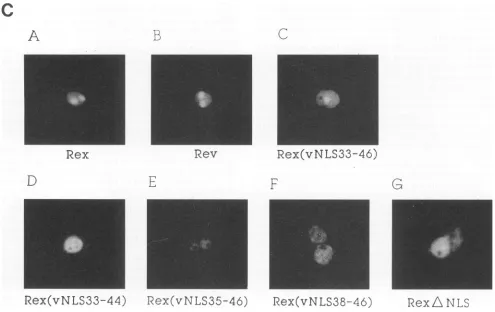
cells revealed differences in the subcellular localization of the various mutant
proteins.
As demonstrated previously(21),
theprotein
encodedby
Rex[vNLS33-46]
wasdirected to the correctnucleolar
compartmentby
a stretch of 14 amino acid residues(Rev
amino acid residues 33 to46)
derived
from the nuclear localization domain of the HIV-1 Rev trans-activatorprotein
(Fig. 1C,
panel
Cversuspanels
A and B). Any
partial deletion of
the RevNLS
sequenceabrogated
the nucleolarlocalization of thehybrid proteins.
The
protein
Rex[vNLS35-46],
which lacks the first two amino acid residuesof the RevNLS,
displayed
clear nuclearstaining
but wasexcluded from nucleoli(Fig. 1C, panel E).
Deletion of three additional Rev NLS amino acid residues
(Rex[vNLS38-46])
abolished nuclearlocalization
since thishybrid
protein
was detected in both thecytoplasmic
and nuclear compartments(Fig.
1C, panel F).
Similar results 7051on November 10, 2019 by guest
http://jvi.asm.org/
in'>
\
-d
W3.:-.
1 33 46 1I '2 2 1
PKTRRRPRRSQRKRPPTP WP
3 46 2 21
I Rex^NL5 ; eSS/ Re S
t~~
-I
-
EM.d
lI-j
-j
Rex[vNLS33-46]
Rex[vNLS33-44]
Rex[vNLS35-46]
were obtained with Rex[vNLS33-44] and the Rex protein encoded by RexANLS(Fig. 1C, panelsD and G).
Ournextexperimentsfocused on thebiological activityof thehybrid Rev-Rex molecules. To test their trans-activation capacity on the HIV-1 RRE, we used the Tat-shift assay (27). The expressionof agenomicversion of the HIV-1 tat generesultsin the formationofthe86-amino-acidformof the Tatprotein encoded by two exons. Because ofthepresence ofaconservedintronic stopcodon,thecotransfection of any functional HIV-1 rev or HTLV-I rex gene results in the appearance of the 72-amino-acid form of Tat protein en-codedby the firsttat exon(1). Substitution of thefull-length RRE sequence in the original genomic tat gene by RRE
Rex[vNLS38-461
2 3 4 5 6 7 8
.
&_ _ _ 29
*I -18,4
-14,3
>>ve;,Po 0+14< .14
KfKa
Ia)
FIG. 1. Structure and expression ofthe molecular clones. (A) Using syntheticdouble-strandedoligonucleotides, the amino-termi-nal arginine-rich motif, which serves as the NLS (37) ofHTLV-I Rex (hatched box), was deleted or substituted by the indicated sequences from the nuclearlocalization domain ofthe HIV-1 Rev trans-activator(crosshatched box). Rex[vNLS33-46]isidenticalto the previous published plasmid Rex[vNLS] (21). (B) Analysis of proteinexpression byimmunoprecipitation experiments. Allgenes used in this study were expressed by thecytomegalovirus immedi-ate-early promoter as describedpreviously(2).Aftertransfectionof COS cell cultures with the indicated DNA, immunoprecipitation analysis wasperformed using anti-Rex(lanes1 and 3 to8)or anti-Rev(lane2) antiserum(6). Precipitated proteins wereresolved on discontinuous sodiumdodecylsulfate-13%polyacrylamide gelsand visualized by autoradiography. Molecular mass standards (in kilo-daltons)areshown on theright.IL-2, interleukin-2. (C)Subcellular localization ofwild-type and mutant proteins byindirect immuno-fluorescence. COS7cell cultures weretransfectedandsubjectedto immunofluorescence with anti-Rex (panels A and C to G) or anti-Rev (panel B)antiserumasdescribedpreviously(2).
A
B
Rex
Rev
Rex(vNLS33-46)
F
G
Rex(vNLS33-44)
Rex(vNLS35-46)
Rex(vNLS38-46)
Rex
AN
LS
7052I
C
C
D
-_nEM
on November 10, 2019 by guest
http://jvi.asm.org/
[image:2.612.53.548.412.724.2]NOTES 7053
RRE ASL II RREASL IV/V
1 2 3 4 5 6 7 8 9 10 II 1213 14 15 16 17 18 1920 2122 23 24
-29
Tat 72aa
/-,t4° °
04%
Qo)@;?,e,-mv.,
stffJ 4.4o
ra-)
K,,, Ko t
Vr;I- 4.4.+
,
A+I+-A- VV-"74
-18.4
-14.3
- 6,2
w?' @Xxt' Va 9 Va.V
FIG. 2. Functionalanalysisofwild-typeRev, wild-type Rex,andmutantRev-Rexproteins.COS cell cultureswerecotransfected with the indicated DNA andsubjectedtoTat-specific immunoprecipitation analysis (2)withamurine monoclonal anti-Tatantibody (21).Toassaythe interaction with different RREsubstructures,indicatorplasmidsharboringthewild-typeRRE(RREwt;lanes 1 to8),anRREstem-loopII deletion(RREASLII;lanes 9to16),andanRREstem-loopIV/Vdeletion(RREASLIV/V;lanes 17to24)wereused. Molecularmassstandards
(inkilodaltons)areindicatedontheright.The 86-amino-acid(aa)and 72-amino-acid forms of Tatareindicatedonthe left.IL-2,interleukin-2.
deletion mutants provided an assay system to dissect the sites of Rev-RRE and Rex-RRE interaction(1). Therefore,
we were able to test our various mutant proteins for their activityonthewild-type RREsequence(RREwt [27]),on a
stem-loop II RRE deletionmutant(RREASLII [1]),andon a
stem-loop IV/V RRE deletion mutant(RREASLIV/V [1]). COS cellcultures were cotransfectedas described previ-ously (2). At60 hposttransfection, the cellswere metaboli-cally radiolabeled with [35S]cysteine and subjected to Tat-specific immunoprecipitation analysis (2) with a murine
monoclonal anti-Tatantibody (21). The results clearly dem-onstrated that the HIV-1 Rev and the HTLV-I Rex
trans-activatorproteins induce the formation of the 72-amino-acid form of the Tatprotein by recognition of different substruc-tures on the HIV-1 RRE sequence (Fig. 2). In agreement with recent studies (1, 39), the Rev protein interacted with RRE stem-loop II while stem-loop IV/V was thetarget site for the Rexprotein (Fig. 2, lanes 10 and 11 versus lanes 18
and 19). As expected, every protein which was unable to localize to the nucleolus (Fig. 1C, panels Dto G) failed in thisassaysystem(Fig. 2,lanes 5to8,13to16,and 21to24), proving the necessity ofcorrectnucleolarlocalization for the trans-acting phenotype. However, the Rev-Rex hybrid
pro-tein,Rex[vNLS33-46], whichwasshowntobe activeonthe
wild-type RRE (21) (Fig. 2, lane 4), displayed both RRE
stem-loop II and RRE stem-loop IV/V binding specificity
(Fig. 2, lanes 12 and 20). Obviously, the stretch of14amino acid residues derived from the Rev trans-activator protein (Rev amino acid residues 33to46) conferredthe HIV-1 Rev RNA binding specificity to the HTLV-I Rex protein. Fur-thermore, these experiments present evidence that amino acid residues located outside of the HTLV-I Rex NLS contributetothebinding of
Rex[vNLS33-46]
toRREASLII. The Rev trans-activator protein specifically recognizes radiolabeled RREtargetRNA inin vitrobindingassays(9).Our in vivo results demonstrated that HIV-1 amino acid residues 33 to 46 are able to confer Rev activity onto a
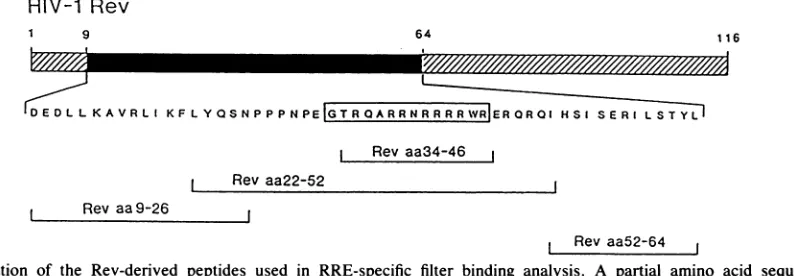
truncated HTLV-I Rexprotein. Todirectly address whether these amino acid residues represent the RNA binding do-main,we performed filter binding experiments using HIV-1
Rev-derived peptides
(Neosystem Laboratories).
These studies indicated that Rev peptides which contain the Rev amino acid residues 33 to46 in full(Rev aa22-52, Fig. 3)orin part(Revaa34-46, Fig. 3) bound radiolabeled RREsense
RNA with significantly higher affinity than RRE antisense RNA (Table 1). Ofnote, recombinant Rev protein bound RRE RNA with three- to fivefold higher affinity than the peptides used in this study (datanot shown). Rev peptides for amino acid residues 9to26 and 52to64(Rev aa9-26and
HIV-1
Rev
9 64 116
L KA VRLI KFLYQSNPPPNPEGTRQARRNRRRRWERROIHSISERILSTYL
Rev aa34-46 I Rev aa22-52
If
Revaa9-26Revaa52-64
FIG. 3. Location of the Rev-derived peptides used in RRE-specific filter binding analysis. A partial amino acid sequence of the 116-amino-acid HIV-1Revprotein is shown. Peptides used in the RREbinding assay(Table 1) areindicated bybrackets. The REV RNA
bindingdomain(Revamino acidresidues 33to46[Revaa33-46]), as determinedbyinvivoanalysis,is boxed. RRE wt
___~~4
W.ffl,
VOL.65, 1991
I
I
on November 10, 2019 by guest
http://jvi.asm.org/
[image:3.612.104.530.62.225.2] [image:3.612.125.522.577.715.2]TABLE 1. RNA filterbinding analysis with Rev-derived peptides'
Amtof %of binding
peptide Revaa34-46 Rev aa22-52
added__
(ng) RRE as RRE as
0 0.0 0.0 0.0 0.0
80 1.8 0.9 0.4 0.0
100 4.6 0.7 0.9 0.2
150 9.1 0.7 2.4 0.2
250 21.0 1.7 12.3 0.8
aThe assay wasperformed asdescribed previously(9). Inbrief, radiola-beledHIV-1 sense(RRE)orantisense (as)RRE RNA washeatedto80'C for 3minandcooledslowlyto roomtemperatureinareaction mixturecontaining 0.1 p.gof 5S RNA per ml from Escherichia coli, 50 F.g of bovine serum albuminperml, 10 UofRNasin (Promega), and phosphate-buffered saline (PBS).VariousamountsofRevpeptideswereadded, and the reaction mixture wasincubatedforanadditional 10min.Finally, thisincubation mixturewas filtered carefully through cellulose-nitrate membranesand washedextensively with PBS. The radioactivity retained on the filters was determined and compared with totalinputactivity.Thegiven values indicate the percentage of binding of radiolabeled senseRRE orantisense RRE RNA tothe various Rev-derived peptides.A value ofzero (0.0) indicates background activity. Rev amino acids 9 to 26 and Rev amino acids 52 to 64 showed only
background activity.
Rev
aa52-64, Fig. 3),
which do notinclude Rev aminoacidresidues
33 to 46,failed
in this assay system(Table
1). Wecharacterized
the RNAbinding
domainof
the Revtrans-activator
protein of
HIV-1using both
invivo
and in vitro assay systems. In contrast to previous studiesusing
mutational
analysis which rendered
the HIV-1 Revprotein
nonfunctional,
we generatedchimeric
Rev-Rexproteins
which
gainedfunction,
thereby directly demonstrating thebiological activity of
thetransferred
HIV-1 Revamino
acid sequences. Theresults of these experiments showed thatadomain of
Revwhich
serves as nuclearlocalization
signal
(21)
also constitutes
the Rev RNAbinding
domain. This stretchof basic amino acid
residues issufficient
toconfer
Rev RNA
binding
specificity
onto a mutant HTLV-I Rexprotein (Fig.
2, lane 20). Thisbinding activity, which
iscrucially important for
Revfunction (22,
23, 26,32),
wasmapped
toamino
acid residues
33 to 46 in the116-amino-acid
Rev
protein.
Inaddition, immunofluorescence experiments
revealed that
this
aminoacid
sequencecouldbefunctionally
dissected
with respect to nuclear andnucleolar
localization.
Deletion of
two aminoacid
residues from the NLSmotif
(Rev amino acid
residues
33 and34)prevented the nucleolaraccumulation of
Rev(Fig.
1C, panel C versus panel E)whichis
absolutely
requiredfor
Revfunction
(5, 26, 42).Therefore,
the
wild-type arginine-rich motif
of the HIV-1 Revprotein
serves atleast two
functions,
nuclearlocalization
and RNAbinding.
Furthermore,
our resultsalso
haveimplications
for the HTLV-I Rex trans-activator protein. The Rex arginine-rich motif (Rex amino acid residues 1 to 19, Fig. 1A) which servesasthe Rex nuclearlocalization signal (31, 37) has also been shown to be important for RNA binding (16). In contrast towild-type
Rev protein (Fig. 2, lane 10), theRex[vNLS33-44]
chimeric protein is functionally active onRREASLII (Fig.
2, lane 12). This result indicates that HTLV-I Rexamino
acid residues located outside of the NLSfunctionally contribute
tothebinding of Rex to RREstem-loop IV/V
since the Rev RNA binding domain is by itselfunable
torecognize this
target RNA sequence (1, 39).Thus, thefunctionally equivalent
HIV-1 Rev andHTLV-I
Rextrans-activatorsdisplayadifferent domain organization with respectto
subcellular localization
and RNArecognition.
Thenuclear localization
signal
of HIV-1 Rev is also the RNAbinding
domain,
while sequenceslocated outside of the Rexnuclear
localization
signal
contribute to the HTLV-IRex-specific
RRE RNArecognition. Currently,
weareconstruct-ing chimeric
Rev-Rexproteins
with mutations in the Rexportion of
thehybrid protein.
Theseproteins
willallowustodefine
relevant amino acid residues in theHTLV-I
Rexprotein which
areimportant
for HIV-1 RREbinding.
Prelim-inary
results indicate that residues located in thecarboxy-terminal
partof Rex contributetothebinding
of theRev-Rex chimeras to the HIV-1 Rev target sequence.However,
additional
mutationalanalyses
will berequired
toprecisely
delineate this Rex
binding
domain.We thank M. H. Malim for the RREASLII and RREASLIV/V plasmids, J. Rusche (Repligen) for recombinant Rev protein,J.-M. Seifert for oligonucleotide synthesis, and M. Ruhl for secretarial support.
REFERENCES
1. Ahmed, Y. F., S. M. Hanly,M. H. Malim, B. R. Cullen, and W. C. Greene. 1990. Structure-functionanalyses oftheHTLV-I Rex and HIV-1Rev RNAresponse elements: insights intothe mechanismof Rex and Rev action. Genes Dev. 4:1014-1022. 2. Bohnlein, S., F. P. Pirker, L. Hofer, K. Zimmermann, H.
Bachmayer, E. Bohnlein, andJ. Hauber. 1991. Transdominant repressors for human T-cell leukemia virus type I Rex and human immunodeficiency virus type 1 Rev function. J. Virol. 65:81-88.
3. Chang, D. D., and P. A. Sharp. 1989.Regulation by HIV Rev depends upon recognition ofsplice sites. Cell59:789-795. 4. Cochrane, A., R. Kramer, S. Ruben, J. Levine, and C. A.Rosen.
1989. The human immunodeficiency virus rev protein is a nuclear phosphoprotein. Virology 171:264-266.
5. Cochrane, A. W., A. Perkins, andC. A. Rosen. 1990. Identifi-cation ofsequences important in the nucleolar localization of human immunodeficiency virus Rev: relevance of nucleolar localization tofunction.J. Virol. 64:881-885.
6. Cullen, B. R. 1987. Use ofeukaryotic expression in the func-tional analysis ofclonedgenes.MethodsEnzymol.152:684-704. 7. Cullen, B. R., J. Hauber, K. Campbell, J. G. Sodroski, W. A. Haseltine, and C. A. Rosen. 1988. Subcellular localization ofthe human immunodeficiencyvirus trans-acting art gene product.J. Virol. 62:2498-2501.
8. Daefler, S., M. E. Klotman, and F. Wong-Staal. 1990. Trans-acting Rev protein of the human immunodeficiency virus 1 interacts directly and specifically with its target RNA. Proc. Natl. Acad. Sci. USA87:4571-4575.
9. Daly, T. J., K. S. Cook, G. S. Gray, T. E. Maione, and J. R. Rusche. 1989.HIV-1 recombinant Rev proteinbindsspecifically totheRev response element in vitro. Nature (London) 342:816-819.
10. Dayton, E., D. Powell, and A. Dayton. 1989. Functionalanalysis of CAR, the target sequence for the Rev protein of HIV-1. Science 246:1625-1629.
11. Dillon, P. J., P. Nelbock, A. Perkins, and C. A. Rosen. 1990. Function of the human immunodeficiency virus types 1 and 2 Rev proteins is dependent on their ability to interact with a structuredregion presentin env gene mRNA. J. Virol. 64:4428-4437.
12. Emerman, M., R. Vazeux, and K. Peden. 1989. The rev gene product of the humanimmunodeficiencyvirusaffects envelope-specific RNA localization. Cell 57:1155-1165.
13. Feinberg, M. B., R. F. Jarrett, A.Aldovini, R. C. Gallo, and F. Wong-Staal. 1986.HTLV-IIIexpression and production involve complex regulation at the levels of splicing and translation of viral RNA. Cell 46:807-817.
14. Felber, B. K., D. Derse, A. Athanassopoulos,M. Campbell, and G. N. Pavlakis. 1989. Cross-activation of the Rex proteins of
on November 10, 2019 by guest
http://jvi.asm.org/
NOTES 7055 HTLV-I and BLV and of the Rev protein of HIV-1 and
nonreciprocalinteractions with their RNA responsive element. NewBiol. 1:318-330.
15. Felber, B., M. Hadzopoulou-Cladaras, C. Cladaras, T. Cope-land,and G. N. Pavlakis. 1989. The rev protein of HIV-1 affects stability and transport of the viral mRNA. Proc. Natl. Acad. Sci. USA86:1495-1499.
16. Grassmann, R., S. Berchtold, C. Aepinus, C. Ballaun, E. Boehnlein, and B. Fleckenstein. 1991. In vitro binding of human T-cellleukemia virus rex proteins to the rex-response element of viraltranscripts. J. Virol. 65:3721-3727.
17. Hadzopoulou-Cladaras, M., B. K. Felber, C. Cladaras, T. Cope-land, and G. N. Pavlakis. 1989. The rev (trslart) protein of humanimmunodeficiency virus type 1 affects viral mRNA and protein expression via a cis-acting sequence in the env region. J. Virol. 63:1265-1274.
18. Hammarskjold, M. L., J. Heijmer, B.Hammarskjold, I. Sang-wan, L. Albert, and D. Rekosh. 1989. Regulation of human immunodeficiency virus env gene expression by the rev gene product. J. Virol. 63:1959-1966.
19. Hauber, J., M. Bouvier, M. H. Malim, and B. R. Cullen. 1988. Phosphorylation of the rev gene product of human immunode-ficiencyvirus type 1. J.Virol. 62:4801-4804.
20. Heaphy, S., C. Dingwall, I. Ernberg, M. J. Gait, S. M. Green, J. Karn, A. D.Lowe,M. Singh, and M. D. Skinner. 1990. HIV-1 regulator of virion expression (Rev) protein binds to an RNA stem-loop structure located within the Revresponse element. Cell 60:685-693.
21. Hofer, L., I. Weichselbraun, S. Quick, G. K. Farrington, E. Bohnlein, and J. Hauber. 1991. Mutational analysis of the humanT-cellleukemia virus typeItrans-acting rex gene prod-uct. J.Virol. 65:3379-3383.
22. Hope,T.J., X.Huang,D.McDonald,and T.G. Parslow. 1990. Steroid-receptor fusion of the human immunodeficiency virus type 1 Rev transactivator: mapping cryptic functions of the arginine-rich motif. Proc. Natl. Acad. Sci. USA 87:7787-7791. 23. Hope,T.J., D.McDonald, X. Huang, J. Low, and T. G. Parslow. 1990.Mutationalanalysis of the humanimmunodeficiencyvirus type 1 Rev trans-activator: essential residues nearthe amino terminus. J. Virol. 64:5360-5366.
24. Kiyokawa, T., M. Seiki, S. Iwashita, F. Shimizu, and M. Yoshida. 1985. p27x-III andp21X-III, proteins encoded by the pX sequence of human T-cell leukemia virus type I. Proc. Nati. Acad.Sci. USA 82:8359-8363.
25. Lazinski, D., E. Grzadielska, and A. Das. 1989. Sequence-specific recognition ofRNA hairpins by bacteriophage antiter-minatorsrequiresaconservedarginine-rich motif. Cell 59:207-218.
26. Malim,M.H., S.Bohnlein,J. Hauber,and B. R.Cullen. 1989. Functional dissection of the HIV-1 Rev trans-activator--deri-vation of a trans-dominant repressor of Rev function. Cell 58:205-214.
27. Malim,M. H., J. Hauber,R.Fenrick, and B.R. Cullen. 1988. Immunodeficiency virusrev trans-activator modulates the ac-tivity of the viral regulatory genes. Nature (London) 335:181-183.
28. Malim, M. H., J. Hauber, S.-Y. Le, J. V. Maizel, and B. R.
Cullen. 1989. The HIV-1 rev trans-activator acts through a
structured target sequence to activate nuclear export of un-spliced viralmRNA.Nature(London)338:254-257.
29. Malim, M. H., L. S. Tiley, D. F. McCarn, J. R. Rusche, J. Hauber,and B.R.Culien. 1990. HIV-1structuralgene expres-sion requires binding of the Rev trans-activator to its RNA target sequence. Cell 60:675-683.
30. Mermer, B., B. K.Felber, M. Campbell, and G. N.Pavlakis. 1990. Identification of trans-dominant HIV-1 rev protein
mu-tants by direct transfer of bacterially produced proteins into human cells. Nucleic Acids Res. 18:2037-2044.
31. Nosaka, T.,H. Siomi,Y.Adachi, M. Ishibashi, S. Kubota, M. Maki, and M. Hatanaka. 1989. Nucleolar targeting signal of human T cell leukemia virus type I rex-encoded protein is essential for cytoplasmic accumulation of unspliced viral mRNA. Proc. Natl. Acad. Sci. USA 86:9798-9802.
32. Olsen, H. S., A. W. Cochrane, P. J. Dillon, C. M. Nalin, and C. A. Rosen.1990. Interaction of the humanimmunodeficiency virus type1Rev protein withastructuredregion in envmRNA isdependentonmultimer formation mediated throughabasic stretch ofamino acids. Genes Dev. 4:1357-1364.
33. Olsen, H. S., P. Nelb6ck, A. W. Cochrane, and C. A. Rosen. 1990. Secondarystructureis themajor determinant for interac-tion ofHIV revprotein withRNA.Science 247:845-848. 34. Rimsky, L. T., J. Hauber, M. Dukovich, M. H. Malim, A.
Langlois, B. R. Culien, and W. C. Greene. 1988. Functional replacement of the HIV-1 Rev protein by the HTLV-I Rex protein. Nature (London) 335:738-740.
35. Rosen, C. A., E. Terwilliger, A. Dayton, J. G. Sodroski, and W. A.Haseltine.1988.Intrageniccis-actingartgeneresponsive sequences of the humanimmunodeficiency virus. Proc. Natl. Acad. Sci. USA 85:2071-2075.
36. Sadaie,M.R.,T.Benter,and F.Wong-Staal. 1988. Site-directed mutagenesis of two trans-regulatory genes (tat-III, trs) of HIV-1. Science239:910-914.
37. Siomi, H., H. Shida,S. H.Nam, T.Nosaka, M. Maki,andM. Hatanaka. 1988. Sequence requirements for nucleolar localiza-tion of human T cell leukemia virustype I pX protein, which regulates viralRNAprocessing. Cell 55:197-209.
38. Sodroski, J. G.,W. C.Goh,C.Rosen,A.Dayton,E.Terwilliger, and W. A. Haseltine. 1986. Asecondposttranscriptional trans-activator gene required for HTLV-IlI replication. Nature (Lon-don) 321:412-417.
39. Solomin, L.,B. K. Felber,and G. N.Pavlakis. 1990. Different sites ofinteraction for Rev, Tev, andRexproteins within the Rev-responsive element of humanimmunodeficiency virus type 1. J.Virol.64:6010-6017.
40. Terwilliger, E., R. Burghoff, R. Sia, J.Sodroski, W. Haseltine, andC.Rosen.1988. Theartgeneproduct of human immunode-ficiency virus is required for replication. J. Virol. 62:655-658. 41. Trono, D., and D. Baltimore. 1990. A human cell factor is
essential for HIV-1 Rev action. EMBO J. 9:4155-4160. 42. Venkatesh, L. K., S. Mohammed, and G. Chinnadurai. 1990.
Functional domains of the HIV-1 rev generequired for trans-regulation and subcellular localization. Virology176:39-47. 43. Zapp, M.,and M. Green. 1989.Sequence-specific RNA binding
by theHIV-1 revprotein.Nature(London) 342:714-716.
VOL.65, 1991