Rochester Institute of Technology
RIT Scholar Works
Theses Thesis/Dissertation Collections
4-7-1987
A study of the brain's transfer function for edge
perception
Charles G. Fink
Follow this and additional works at:http://scholarworks.rit.edu/theses
This Thesis is brought to you for free and open access by the Thesis/Dissertation Collections at RIT Scholar Works. It has been accepted for inclusion in Theses by an authorized administrator of RIT Scholar Works. For more information, please [email protected].
Recommended Citation
A STUDY OF THE BRAIN'S TRANSFER FUNCTION FOR EDGE PERCEPTION
by
Charles G. Fink
A thesis submitted in partial fulfillment of the requirements for the degree
of Master of Science in the Center for Imaging Science in the College of Graphic Arts and Photography of the Rochester Institute of Technology
April 7, 1987
Signature of the Author
Center for Imaging Science
Center for Imaging Science in the College of Graphic Arts and Photography of the Rochester Institute of Technology
April 7, 1987
Signature of the Author
Center for Imaging Science
Accepted by I
0
Center for Imaging Science
College of Graphic Arts and photography Rochester Institute of Technology
Rochester, New York
CERTIFICATE OF APPROVAL
MASTER OF SCIENCE DEGREE THESIS
The Master of Science Degree Thesis
of Charles G. Fink has been examined and approved by the thesis committee as satisfactory
for the thesis requirements for the Master of Science degree
Dr. Willem Brouwer, Thesis Advisor
Optics Professor, E-O Center, Tufts Institute
The Master of Science Degree Thesis
of Charles G. Fink has been examined and approved by the thesis committee as satisfactory
for the thesis requirements for the Master of Science degree
Dr. Willem Brouwer, Thesis Advisor
Optics Professor, E-O Center, Tufts Institute
Dr. Edward Granger
Image Evaluation Instructor, CIS, RIT
A STUDY OF THE BRAIN'S TRANSFER
FUNCTION FOR EDGE PERCEPTION
by
Charles G. Fink
Submitted to the
Center for Imaging Science
in partial fulfillment of the requirements
for the Master of Science degree
at the Rochester Institute of Technology
ABSTRACT
A concept was developed and a computer program was
designed and implemented to model the eye, the brain, and
the perception system. These models were used to study
edge transformation through the human visual system. The eye model was developed using optical spread and neural
sampling data along with different inhibition
distributions. The effects of lateral inhibition on
retinal edge response were studied and hypothetical brain transfer functions were calculated. The results of this
study indicate that no single mechanism or linear model can explain both the sinewave response and edge perception for the human visual system. The eye and brain models were
also used to predict edge perception. The applications and
limitations of computer modeling are demonstrated for both human vision phenomena as well as artificial vision system
ACKNOWLEDGMENTS
The author wishes to express sincere appreciation to Dr. Willem Brouwer for his encouragement and guidance in the development of this thesis and for the opportunity of being his optics teaching assistant. Dr. Brouwer s vast knowledge and inspiration was not only valuable to his students and coworkers but he was also instrumental in restructuring this degree program into what he appropriately named The Center for Imaging Science(CIS) .
In addition, the author would like to thank the following people for their valuable assistance and advice:
Dr. Granger of Eastman Kodak Research Labs and CIS, Dr. Smith, Director Evoked Response Lab, Neuro-Opthalmology, University of Rochester Medical Center and Dr. Williams, Center for Visual Sciences, University of Rochester, for their contribution as thesis committee members and advising in each of their respective fields;
TABLE OF CONTENTS
LIST OF TABLES vii
LIST OF FIGURES viii
1. INTRODUCTION 1
1.1 Optical Qualities of the Eye 4
1.2 Neurophysiology 5
1. 3 Psychophysics 15
1.4 Computer Modeling 18
2. EXPERIMENTAL 25
2. 1 Program Structure 2 5
2. 2 Eye Model 29
2. 3 Perception 3 4
2. 4 Brain Modeling 3 5
2. 5 Sampling 3 7
3. RESULTS 40
3.1 Eye Models 4 0
3.2 Brain Models 56
3. 3 Edge Perception 62
4. CONCLUSIONS 68
5. RECOMMENDATIONS FOR FUTURE WORK 71
APPENDIX A Schematic of the Eye and Physical
Statisitics 74
APPENDIX B Pictures; Ramp, Step and Cornsweet
Edges 77
APPENDIX C Visual System Modeling Program
Menu Summary 79
APPENDIX D Table 3 : Summary of Retina Responses
to Edges as a Function of Changing the
Excitation and Inhibition Ratios 84
APPENDIX E Table 4: Summary of Retina Responses
to Ramp Slopes as a Function of Changing the
Excitation and Inhibition Ratios 86
REFERENCES 88
LIST OF TABLES
Table 1 : Edge Responses for Three Eye Models as a
Function of Adding Progressively More
Inhibition 13
Table 2 : Retinal Edge Response for Three Eye Models... 49
Table 3 : Summary of Retina Responses to
Edges as a Function of Changing the
Excitation and Inhibition Ratios 84
Table 4 : Summary of Retina Responses to
Ramp Slopes as a Function of Changing
Figure 1 :
Figure 2 :
Figure 3 :
Figure 4 :
Figure 5 :
Figure 6 :
Figure 7 :
Figure 8 :
Figure 9 :
Figure 10 Figure 11 Figure 12 Figure 13 Figure 14 Figure 15 Figure 16 Figure 17 Figure 18 Figure 19
Figure 20
Figure 21
Figure 22
LIST OF FIGURES
Lateral Inhibition Schematic 7
Lateral Neural Interaction 9
Eye Model Components and Resulting
Retinal Spread Function 11
Ramp Object and Mach Band Perception 16
Step, Cornsweet Edge and Resulting
Perceptions 17
Box Diagram of Models 18
Box Diagram of Components 2 3
Schematic of Model Components 2 6
Optical Spread at the Retina Surface 3 0
Brain Transfer Function Calculation 35
Adding Spread and Inhibition Functions.... 41
Eye Models as a Function of Inhibition
Shape 43
Eye Models for Gaus and Wider Gaus
Inhibition 45
Eye Models for Combination Inhibition 4 6
Three Eye Models 4 7
Edges and Corresponding Retina Responses
for Increasing Cornsweet Decay Rates 52
Brain Models as a Function of Objects 56
Brain Models Before and After Scaling 57
Brain Models as a Function of Eye Models.. 59
Eye and Brain Models for Combination 60
Predicted Perception 63
Predicted Perception as a Function of
[image:9.544.60.493.72.668.2]SECTION I
INTRODUCTION
This study of the brain's transfer function for edge
perception investigates how edges are transformed through
the visual system. In order to understand the brain's
function in contour perception, we must first model how an
object is optically transformed by the eye and encoded by
the retina. These retinal signals are then transmitted to
higher order processors in the brain resulting in the
perception of the object. The brain, which will be treated
as a "black box"
, will bridge the gap between the encoded
retinal image and resulting perception.
It is proposed that if one studies only a limited
region of perception phenomena, sets certain conditions and
makes some fundamental assumptions, that linear systems
techniques can then be applied to modeling the human visual
system. As a result a model can be developed and a
computer program can be written to study the effects of
lateral inhibition on edge perception.
The initial conditions and assumptions which allow
linear systems modeling of the human visual system will be
briefly outlined. First, only the foveal region will be
modeled and the same average object luminance will be
also be limited to the perception of only monochrome edges,
which are constant with respect to time and stationary in
object space. It is assumed that under these limited
conditions, an eye model incorporating the optical spread,
receptor sampling and one channel of lateral inhibition in
the retina will model the eye's primary function in edge
perception. Finally, it is assumed that this single
channel out of the retina is the only signal into the brain
model to yield the final perception.
This study involves four major scientific disciplines.
First, optical science will provide the tools to determine
the optical spread function of the eye. Human visual
system neurophysiology will provide the background for the
image encoding mechanisms in the retina. Psychophysics
will provide the perception information. Finally, math
modeling, Fourier transforms and convolutions will be
applied in a computer simulation to analyze how edges are
transformed through the visual system and to calculate the
transfer functions for edge perception.
In order to apply the convolution integral, we must
assume that the system is linear and shift invariant.
However, the human visual system is neither linear nor
shift invariant over the perceptible luminance range.
Therefore, the study will be limited to a region where the
visual system is approximately linear and a transfer
The psychophysical data will be from experiments v/ith
tightly controlled viewing conditions. For instance, the
objects will be constant with respect to time to minimize
potential transient effects. The edges will be stationary
in object space to minimize tracking and motion effects.
However, since the human eye is constantly moving, the term
"stationary" is
used relative to the object space not the
retinal image. The perception of scenes and recognition of
objects is extremely complex. To simplify this process
only edges will be studied with this model.
One of the main goals of this study is to better
understand possible visual processes and their effect on
edge perception. However, the study will also have direct
application to the development of artificial vision systems
and integrating optics and "smart sensors"
which
incorporate some degree of focal plane signal
1. 1 Optical Qualities of the Eve
The light from an object passes through the cornea,
aqueous humor, lens, and vitreous humor of the eye before
reaching the retina. Due to the geometry of the eye, the
light must also traverse through the neurons of the retina
before reaching the receptors (See Appendix A for details
on the geometry of the human eye) .
The spread of light in an optical system can be
measured and used to determine the point spread function.
Briefly, the point spread function describes the energy
distribution in the image of a point source after an
optical system, in this case the eye. The research of
R. W. Gubisch has developed a function which
approximates the light distribution at the retina surface
for various pupil sizes.
This information can be used to model the intensity
distribution of a given object at the retina surface. In
order to get the intensity distribution at the retina
receptors, the light spread due to retinal scatter should
also be considered. In the computer model, the receptor
signal is represented by an area of positive response which
will be combined with the negative response due to the
1. 2
Neurophysiology
Neurophysiology provides the retinal signal processing
data. The goal is to use this information to model the
primary function of retinal image preprocessing. The
initial models were based on lateral inhibition, receptor
sampling data and possible neural intensity nonlinearities.
The receptors in the retina, the cones and rods,
convert light energy into neural signals which are then
processed by subsequent retina layers. When light is
incident on a receptor a visual pigment is degenerated and
neural signals are transmitted. The research of
Enroth-Cugell ' and Robson2 indicates that there are linear
and nonlinear channels in the cat retina, therefore neural
nonlinearities must also be considered.
Since the receptors are individual sensors, this is the
point where the retinal image is discretely sampled. The
retina contains rods that respond to all visible light and
cones which have a response that is a function of the
spectral region. The fovea is a region which contains the
highest density of receptors and therefore is the primary
area for edge perception. The fovea receptors are small
cones which have approximately a 30 arc-second
center-to-center separation3'4. This provides a sampling rate of
The study of the retina's multi-layered neural network
will be important in understanding how images are initially
encoded and sent to higher order processors. In the last
twenty years, microelectrode sensing technology developed
an ability to directly measure the electrical potential of
cells and provides some of the preliminary data and
understanding of the possible retinal mechanisms and neural
interactions. Since the human eye can not be probed with
microelectrodes, scientists have measured the neural
interaction of mammals which have a retinal structure
similar to the human eye.
The horseshoe crab, Limulus, is often used in retina
research. The compound eye of the Limulus is relatively
large which makes it very easy to directly measure the
response of single cells to a given stimuli. The Limulus
retina is a three dimensional neural network that exhibits
a local excitatory and extended inhibitory response5,6.
This type of lateral inhibition mechanism is often used to
-j explain Mach bands and other contrast phenomena .
These Electrophysiology experiments appear to have
confirmed early lateral inhibition hypotheses and have lead
to new discoveries of cell responses. The research of
Hartline et al8'9
on the simultaneous neural output of
two or more optic nerve fibers has lead to the measurement
of the lateral inhibition of nerve impulses as well as the
Lateral inhibition is
a decrease in the
signal out of
one cell due to the excitation of
a neighboring cell. The
degree of modulation is
a function of
both cells separation
and the
intensity
of the excitations. it isthrough this
horizontal communication
that neighboring cells
can
influence the output of cells
in other areas of the retina. Figure 1
schematically shows how an edge might be encoded
using a very simple
inhibition model. -1 1.0 OBJECT COMPONENT (""RESPONSE 0.0 0.5 \|/ -1 TOTAL A B C D E F G H B 0.0 0.0 0.0 0.0 0.0 0.0 0.0 -.5 0.0 1.0 -.5
-1 2.0 -1 -1 2.0 -1 1.0 G H -1 2.0 -1 -1 2.0 0.0 0.0 0.0 0.5 0.0 0.0
SYSTEM RESPONSE
~h>
Figure 1 0.5 -0.5Lateral Inhibition Schematic.
The response of a simple
inhibitory
[image:16.544.40.487.66.686.2]The disinhibition phenomena is a decrease or possible
elimination of the inhibition effect
by receptors
surrounding the inhibiting receptors. This phenomena is
due to an area of illumination positioned such that the
lateral inhibition decreases the signal of the cells which
were originally inhibiting the measured cell. As a
result, this decreases the inhibiting cells ability to inhibit.
The net effect is an increase in the signal of the measured
cell due to the cells causing disinhibition. This
disinhibition phenomena has also been observed in the human
visual system11.
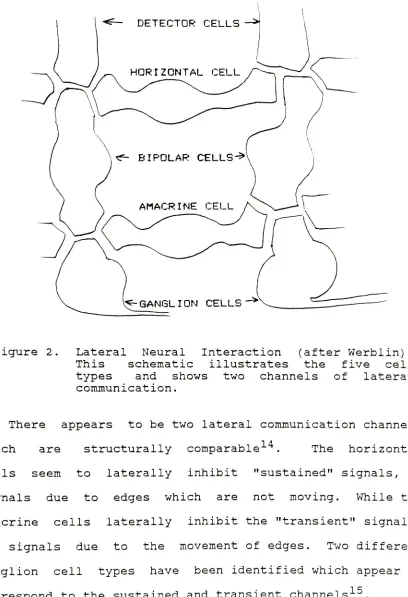
Photomicrographs and Electrophysiology experiments have
lead to the discovery of five basic types of cells,
schematically shown in Figure 2, which are arranged in
three distinct layers12. Werblin measured the cell
potentials of the mudpuppy (Necturus maculosus) with a fine
micropipette electrode allowing him to measure the
electrical characteristics of each cell in the retina using
dye-injection for measured cell identification13. This
data along with electron micrographs can be used to
schematically diagram the communication channels in the
[image:17.544.54.492.85.563.2]Figure 2. Lateral Neural Interaction (after Werblin).
This schematic illustrates the five cell
types and shows two channels of lateral
communication.
There appears to be two lateral communication channels
which are structurally comparable14. The horizontal
cells seem to laterally inhibit "sustained"
signals, or
signals due to edges which are not moving. While the
amacrine cells laterally inhibit the "transient" signals,
or signals due to the movement of edges. Two different
ganglion cell types have been identified which appear to
[image:18.544.72.480.61.658.2]The research of Enroth-Cugell and Robson support the
idea of two distinct retinal output channels at the
ganglion level of the cat retina, which they labeled X and
Y16. Hochstein and Shapley have suggested that the Y
channel contains a linear excitation center, a linear
inhibitory surround and overlapping nonlinear excitatory
subunits17'18. The experiments of Devalois, which
studied the response of single cells in the lateral
geniculate nucleus of the Macaque monkey, discovered that
the non-opponent excitatory cells carry luminosity
information while the opponent cells do not19.
In addition to at least two different output channels,
the retinal cells have a unique neural response and
architecture with potential perception preprocessing and
detection functions. One lateral inhibition channel will
be considered and only stationary edges will be studied,
since this computer simulation has one input and one output
channel.
For the computer model let us assume that on the
average the inhibition acts as a linear region of negative
signals surrounding the input signal, as shown in the
bottom function in Figure 3. If we now add the excitatory
signal after the optical spread of the eye, as shown in the
top function, the result is a neural response as a function
RETINA SPREAD FUNCTION COMPONENTS
OPTICAL, OfHlBmjRr <*RESULTANT
a
a;1
I
OPTICAL
DISTANCE (ARC-UIN)
INHIBITORY RESULTANT
Figure 3. Eye Model Components and
Resulting Retinal Spread Function. The spread function shown
was determined by adding the optical and
inhibitory functions.
The magnitude, shape and spatial extent of neural
inhibition are the main variables in the eye models. The
changes in the shape and spatial extent represent changes
in the strength of the inhibition as a function of distance
from the neighboring cell to the input excitatory signal.
Another important variable is the ratio between the
excitation and inhibition areas which represent the
retina's ability to send intensity information. These
variables will allow us to study some of the possible forms
[image:20.544.58.488.34.660.2]Table 1 shows the shapes of three edges after passing
through the three eye models shown at the top of each
column (More complete tables can be found in Appendices D
and E) . The difference in the three models is due to the
change in the area of the inhibition function. The first
column shows the effects of the optical spread only. In
the second column an area of inhibition is added which has
less area than the excitation. In the final column the
area of inhibition is increased to equal the area of excitation. The first column represents the effect of a
smoothing function and models the appearance of the object at the retinal receptors. The middle retina model is an edge detector which also carries intensity information.
The retinal response in the last column reflects an edge
detecting mechanism, i.e. the only output signal is due to
a detected change in the object. Therefore, this model does not carry intensity information.
The recent research of Cornsweet et al presents the
idea of retina intensity dependent summation . This
concept has also been included as a subroutine in the
computer simulation to allow this option to be compared and
contrasted with inhibition mechanisms.
The multi-layered neural processing of the retina is
complex and is likely to contain the first steps of the
pattern recognition process. The fact that the eye "grows"
[image:21.544.55.489.52.571.2]Table 1. Edge Responses for Three Eye Models as a
Function of Adding Progressively More
it is so difficult to isolate the mechanisms of the eye and
the brain. It also emphasizes how the eye is essentially
an extension of the brain. Since the optic nerve is a
tangible connecting nerve cord and some ganglion response
data has been documented in other animals, this is where
the two systems were separated into retinal encoded images
and perceived images.
The encoded retinal images are sent to higher-order
neural networks in the perception process. This visual
information is first processed in the Lateral Geniculate
Nucleus and then the perceptual process is completed at the
Primary Visual Cortex. All of this post retinal image
processing will be incorporated in a black box, which will
be labeled the "brain".
The brain also appears to be a multi-layered neural
processor. The nobel prize winning research of Hubel and
Wiesel has lead to considerable progress in the mapping of
o-i
the macaque monkey's Primary Visual Cortex . Hubel and
Wiesel have detected cells, which they call "simple cells",
in the higher-order processors which respond best to
certain types of stimuli. These simple cells seem to feed
more complex cells which gives one the idea that there is
some sort of hierarchy of layers which gets more complex at
each step. Bela Julesz distinguishes two parallel
channels, the preattentive and attentive which also implies
These theories about possible brain mechanisms will be
helpful in understanding the functions of higher-order
processors of visual information. These theories will also
help in understanding how the brain might convert retinal
signals into perceived images and assist in the
interpretation of the resulting brain transfer functions.
1. 3 Psychophysics
Once eye models have been developed a variety of object
intensity profiles can be transformed into encoded images.
Next, we need to apply psychophysics data or models in
order to determine the perception of these edges. This
section will discuss some important edge perception
characteristics and their application in calculating the
brain's transfer function.
As emphasized in earlier sections the human visual
system is nonlinear and complex, especially when
recognizing objects within scenes. However, in this study
we will avoid most of these complexities by considering
only edge perception. To minimize intensity nonlinearities
and eliminate pupil size effects, the objects will differ
only in intensity distribution, not absolute luminance. Therefore the object profiles will have the same average
There have been many studies in contrast perception of
the human visual system23-34. It is of particular
interest to study the perception of the ramp, step,
Cornsweet and O'Brien edges. The results of Jeff Pelz's
Masters Thesis, which studied the induced contrast of the
Cornsweet edge versus the step35, will also provide an
important source of perception data. Let us begin by
looking at the Mach band phenomena.
The perception of Mach bands is the result of a ramp
edge, as shown in Figure 4. The appearance of Mach bands
at the high and low contours of the ramp is often used to
illustrate the result of a system with an inhibitory
surround. Note that there is a difference in the shape of
the Mach bands at the high contour versus in the low
contour. This is a type of nonlinearity in the visual
system which can't be modeled with a simple linear
model36
(Reference Table 1) . A photograph of a ramp
intensity profile has been included in Appendix B, page 77,
to demonstrate the Mach band phenomena.
OBJECT PERCEPTION
Figure 4. Ramp Object and Mach Band Perception. This
figure shows the intensity profiles of the
The step and the Cornsweet edge have dramatically different intensity profiles. However the resulting
perception for both objects is a step (for limited
contrasts), as illustrated in Figure 5. This is apparently due to the inability of the human visual system to detect
gradual changes in the Cornsweet edge and therefore only the step portion is perceived. This will yield important
clues to the low frequency response of the visual system.
It miqht also help determine if local retinal processes
carry intensity information (See Appendix B, page 77, for
pictures of the Cornsweet illusion) .
OBJECT PERCEPTION
STEP >
CORNSWEET
EDGE
t>
Figure 5 Step, Cornsweet Edge and Resulting Perceptions. This figure illustrates that the perception of
1-4 Computer Modeling
Once we have information about the retinal output and
the resulting perception, we will have the response of one
component and the system response. We can treat these
systems as "black boxes" to
graphically show the goals of
this study, as shown in Figure 6.
object (x) -y\
Retina
sr(x)
--> Retinal Response(x)
object (x) >
Human Visual System
Retina
sr(x)
Brain
sb(x)
-^Perception (x)
Figure 6. Box Diagram of Models.
(sr(x) and SjD(x) represent each "black box" in
spatial domain, for the retina and brain respectively. )
The goal is to model the retina and then solve for the
"brain black box"
. In this paper the
"brain" is
any post
retinal signal processing. We will also assume that the
lateral inhibition channel out of the retina. In order to
obtain the transfer function for the brain, let us first
review some basic transfer function evaluation techniques.
The convolution integral, optical spread functions, and
Fourier analysis will be applied to study the
transformation of edges through the visual system and
calculate the transfer functions. Briefly, the spread
function is a mathematical representation of how a delta
function, or an infinitely small point source, will spread
when transformed through a system. The spread function can
then be multiplied point by point with the object using the
convolution integral (also known as the superposition
3 7
integral ) shown in Equation 1.
i(x) =
o(x) * s(x) =
/o(x')
*s(x-x') dx' (Equ. 1)
(Where * represents the convolution process
and ' represents the multiplication process.)
This technique allows the image of an object to be
determined mathematically. However, in order to apply this
convolution integral we need a linear shift invariant
system (L.S.I.) . This is true for modeling many artificial
vision systems, but may have limited application in human
vision studies. It is assumed that within a limited region
we can represent the optical spread and lateral inhibition
and, therefore, the convolution integral can be applied.
For a given input
(object(x)), the output (image(x))
can be determined by convolving the object and the system
spread function in the spatial domain, shown in Equation 2.
image(x) =
object(x) * spread(x) (Equ. 2)
For example, when the edges in Appendices D and E are
convolved with the models at the top of each column the
results are the retinal responses (which can also be
considered images) that fill the body of the tables.
The Fourier transform allows one to transform from the
spatial domain to a frequency domain representation. Let
us look at the Fourier transform of the spread function
from spatial domain to frequency domain.
S(f)
~~^
Spread(x) (Equ. 3)
Where represents the Fourier transform and can
be expressed mathematically with the following Fourier
integral38, shown in Equation 4:
S(f) =
J
s(x)e~l27T fx
dx (Equ. 4)
Similarly, image (x) and object(x) can be represented in the
The inverse Fourier transform integral, as shown in
Equation 5, allows one to transform back to the spatial
domain:
+00
s(x) =
ys(f)
ei2Trfxdf (Equ. 5)
- 00
The frequency representation of the spread function,
s(x), is called the transfer function, S(f). The transfer
function describes the optical performance as a function of
frequency components. The transfer function for a perfect
system, for which all frequencies are reproduced perfectly,
would therefore be a constant equal to one. However, this
is impossible for natural systems.
The convolution process, Equation 2, in spatial domain
can also be performed as a multiplication in the frequency
domain.
IMAGE(f) =
OBJECT(f) * S(f) (Equ. 6)
Since this is a point by point multiplication, it is much
faster than the convolution integral and especially
efficient for large arrays. Another important advantage of
using the frequency domain representation is that we can
divide the output by the input. In this case the image can
be divided by the object, yielding the system transfer
By dividing both sides of Equation 6 by the object(f) we
obtain:
IMAGE (f)
S(f) = (Equ.
7)
OBJECT (f)
If we now back-trans form to the spatial domain we have
calculated the spread function for the system.
The Fourier transform will be performed usinq a
discrete Fast Fourier Transf orm(FFT) 39 . The FFT is an
algorithm which allows a computer program to efficiently
transform discrete data. Since the retinal receptors are
individual cells, the continuous intensity distribution at
the retina surface is discretely sampled at this point.
This receptor sampling will be represented by using object
arrays with the appropriate number of data points for the
receptor separation. The sampling rates will be discussed
in more detail in Section 2.5.
The spread function and transfer function relationship
is very important. We have seen from Equation 4 that we
can transform the spread function and obtain the transfer
function. Taking the modulus of S(f) will give us the
modulation transfer function (MTF) , which is commonly used
to specify the frequency response of an imaqing system.
follows for sinewave testing:
x(f)max ~
KfJnin
MTF(f) =
(Equ. 8)
I(f)max + Kf) mm
(Where I(f)Inax and
I(f)min are the maximum and minimum measured intensity values respectively.)
If the retinal output and final perception for a
certain stimulus are known, this would allow the transfer
function to be calculated for the retina and for the entire
visual system for that stimulus40.
SR(f) =
Retinal Response(f)
Object(f)
(Equ. 9)
Sp(f) =
Perception(f)
Object(f)
(Equ. 10)
(Where
SR and
Sp represent the retina and perception modulation transfer functions respectively.)
At this point we assume that the retina and brain
components are linear shift invariant and can be cascaded
to yield the perception, p(x), schematically shown below:
o(x)
'"Brain"
>r.r. (x) -9*
sb(x)
->P(x)
Figure 7. Box Diagram of Components. Where o(x) represents
the object, r.r.(x) the retinal response to the
[image:32.544.51.492.5.722.2]These cascaded L.S.I. systems can be convolved to yield
the system response41, as shown in Equation 11:
sp(x) =
sr(x) *
sb(x) (Equ. 11)
(Where the subscripts p, r, and b represent
the perception, retina and brain, respectively.)
In a system with cascaded components, the convolution of
the spread functions determines the system spread function
(the component transfer functions can be multiplied in
frequency domain) . The brain transfer function can also be
calculated in frequency domain, by dividing the perception
transfer function by the retina transfer function:
sP(f)
SB(f) = (Equ.
12)
SR(f)
The computer model will also allow an object,
perception and eye model to be specified and the resulting
brain transfer function to be calculated. Once a brain
transfer function is calculated it can be used to "predict
perception". If the eye and brain models are held
constant, the system output can be calculated as a function
of input object. For a linear system, only one model is
required to determine the output for all inputs. However
if the system is not linear, the models will change as a
SECTION II
EXPERIMENTAL
This section will present the implementation of visual
system modeling concepts discussed in the introduction.
The emphasis will be on modeling the physical phenomena of
a visual system. The models were then used to develop a
computer program to assist in studying how edges are
transformed through vision systems, with specific
references to the human visual system and applications to
artificial vision systems. The unknowns in this study are
the retinal response and the brain's transfer function.
2. 1 Program Structure
It was proposed that if the retinal response can be
approximated, the brain transfer function can be studied as
a function of the edge objects. This study would require
that an edge profile and the resulting perception are
known. If so, we can then use the optical spread, neural
sampling and neural inhibition models to compute the
retinal response. The "brain" would then be the black box
linking the retinal response and the final perception.
Figure 8 schematically illustrates the important elements
OBJECT EYE IMAGE
"BRAIN*
BLACK
BOX
OBJECT * (SPREAD+SAMPLING+INHIBITION) ^ B. B -^ IMAGE
Figure 8. Schematic of Model Components.
In order to accomplish these objectives, the vision model
was split into five major groups: the object, eye model,
brain model, perception model and perceived image.
The program structure was developed to have general
application in studying a wide variety of imaging systems
and to be directly applied to developing artificial vision
systems. These imaging systems could consist of an optical
component, a discrete sampling function and image plane
preprocessing. The program structure and flow of
information were designed with maximum flexibility to
accommodate both changes during development and future
expansions into a more complex modeling tool. Appendix C
The implementation of the structure began with writing
the menus and breaking the program into logical levels.
The primary functions were defined and an outline was
developed. Then the lowest level functions and utility
routines were identified. These routines were set up with
generic arrays named, function, modifier and result, so
that any calling routine would determine which order the
data would fill these arrays. The middle structure could
then be shifted and changed to adapt to program
developments.
Next the arrays were defined and the flow of
information was developed. These arrays were defined so
the data at each of the important stages would remain
unaltered by subsequent processing. The arrays were:
object, image at the retinal receptors (after the optical
spread) , retina response after the eye (after neural
processing) and the perceived image. The models were
similarly set up in independent arrays: the optical spread
and inhibition functions, the eye model, the brain model
and the perception model.
The arrays all contained 512 elements with the middle
256 points containing all the information and the 128
points on each end of the array for the FFT process. The
objects and images are relatively large compared to the
optical spread and neural processing, therefore these
varied up to 128 points. For instance, the retinal model
default value is 12 8 points. Therefore, when convolving
the eye model across an edge this is equivalent to passing
a 128 point kernel across a 512 point object. This can be
understood by taking Equation 1 and integrating from -64
to 64 for every x from -255 to 256, as shown in Equation
13. The object arrays are defined so that all the
information is contained in the middle 256 points within
the 512 point array which avoids edge problems when
convolving the eye model across the object.
64
i(x) =
o(x) * s(x) =__/o'(x)
'
s(x-x') dx' (Equ. 13)
-64
There are two types of objects: asymmetric and
symmetric intensity profiles. The asymmetric functions can
be bigger and allow a closer look at changes in the image
at each stage. The symmetric functions have the advantage
2.2 Eve Model
In order to solve for the unknown retinal response, we
must develop a model of the eye. The region of the visual
system was restricted by limiting the viewing conditions
and by making a few fundamental assumptions to allow simple
linear models to be developed. The model was first limited
to the foveal region and only monochrome, stationary and
time constant objects were studied. The average luminance
was constant to avoid changes due to pupil changes (e. g.
changes in optical spread) and other neural nonlinearities
over magnitudes of luminance changes. (Note the phrase
"Eye Model"
refers to the combination of the optics and
neural mechanism and that the signal out of the eye is
referred to as the "retinal response", so in some cases the
two are synonymous) .
The object, a one dimensional intensity profile, is
first blurred by the optics of the eye and the neural
scatter. Light propagates through the cornea, aqueous
humor, lens, vitreous humor and retinal neurons before the
receptors transform the light energy into neural signals
(Reference Appendix A) . In the foveal region, the retinal
neurons are "pulled" away so that this area is thinner than
any other portion of the retina, therefore causing minimal
light scatter. Assuming that this scatter in the fovea was
eye, we can use the equation developed by G. Westheimer
(shown in Equation 14) which models42
the data of R. W.
Gubisch43. This equation approximates the light
intensity distribution at the retinal surface. Equation 14
is normalized to unity at the origin and the components and
the resultant are shown in Figure 9 in both spatial and
frequency domain.
f(x) =
0.47exp(-3.3x2) + 0. 53exp(-0. 93 | x| ) (Equ. 14)
Where x is retinal distance in arc minutes.
OPTICAL SPREAD FUNCTION OPTICAL TRANSFER FUNCTION
o. Q.a 0.7 0.0 0.1 0.4 O.J 0.2 0.1 0
-0.1 -0.2 -0.3 -0.4 -OS
-0.0 nininnnnnii Ml) DIM1 1 1 1 1 11 1 III 1 1 11 1 II 1 11 1>IM 1 1 1 1 1 11n1 11
-10 0
DISTANCE(JJIC-UIH)
iiiiniil ImhimnullMiiiiimiiimi uiinuniiiiuiumiiiimim ii n ii miiiimh in
rrutqUMtJCY(CYOJ3/DMGRXK)
Figure 9. Optical Spread Function at the Retina Surface.
Graphical representation of Equation 14 in
spatial and frequency domain; the resultant, f(x) , is the sum of a Gaus and exponential
appropriately scaled to approximate the light
Since the retinal receptors are individual cells, the
retinal image must be discretely sampled. The fovea is the
region of the retina where the high frequency perception is
performed and is therefore crucial in edge perception. The
cones in the fovea are approximately 0.5 arc-minutes in
size. The program default value of 0.3125
arc-minutes/sample was chosen to approximate the retinal
sampling rate and coordinate with the resulting frequency
domain (See Section 2.5 for more details).
After the optical blur, the light energy is converted
to neural signals and is processed by the subsequent
retinal layers. This post receptor neural processing by
the horizontal, bipolar, amacrine and ganglion cells
results in at least two distinct signals to the optic
nerve. The current computer model was used to study the
effects of one channel of neural preprocessing. It was
proposed that limiting the perception region will allow one
linear function to approximately model the retina's
response to edge stimuli.
If we say that the neural inhibition on the average can
be approximated by a symmetric shape, we can generate
functions to describe this process. Keeping the optical
spread model constant, it was possible to study the effects
of changing the shape and spatial extent of the neural
inhibition. If we hold the object and resulting perception
inhibition models and the resulting changes in the "brain"
model. There are four basic neural inhibition equations
available;
-A + a*x (Equ. 15)
-A-exp(-a'x2) (Equ. 16)
-A*exp(-a-|x| ) (Equ. 17)
-A'x4+B'
|x| 3+C*x2+D' |x|+E (Equ. 13)
(Where the capital letters are variables to change the
magnitude and "a" sets the decay rate and all equations
are a function of retinal distance, "x".)
There is also the ability to use any combination of the
above equations. Noticing that Equations 16 and 17
approach zero slowly, the program was modified to allow the
user to shift the neural model to go to zero in the
designated eye model window. The result was an ability to
generate areas of negative response, or inhibition, of
different magnitudes as a function of spatial extent. To
avoid negative average signal intensities, it is necessary
to have the total area of the retinal response equal to or
The program has the ability to allow nonlinearities in
addition to simple linear models. The three points where
nonlinearities could be applied are before the receptors,
at the receptors transduction of light into neural signals
and after retinal neural processing. One example of a
nonlinear equation option is shown below;
In Out =
(Equ. 19)
In+k
where k is a constant. When k is positive the equation
takes the form of a decelerated nonlinear transformation
and when k is negative the nonlinearity becomes
accelerated.
The optical spread and the neural processing are
combined to complete the model of the eye. For the simple
linear model, the spread function and the inhibition are
added. When the nonlinear options are used, more complex
combining techniques are required depending on where the
2. 3 Perception
The perception options allow the user to generate an
image, directly input perception data or use a perception
model to mathematically determine the image. The user can
define a linear model using the existing equations or
insert a new model. The current models, shown in Equations
20 and 21, were developed by the research of D. H.
Kelly . Variables are used where possible to allow the
user to modify these functions.
f2 .
e{ B f} (Equ.
20)
C *
(1 + A f2) * e<"B
*
f> (Equ. 21)
Note that these models are defined in frequency space and
therefore the equations are a function of frequency. If
the user opts to input perception data manually, the
program will also allow the calculation of the
corresponding perception transfer function (as shown in
Equation 10) .
This study concentrates on the perception of three
basic edqes; the step, the Cornsweet edge and the ramp.
The Cornsweet versus step perception data is based on
experiments performed using a Dianza display system
This system was used to investigate the effectiveness of
the Cornsweet illusion and as a result it can be
confidently stated that within a limited contrast range a
Cornsweet edge can't be distinguished from a step function
(note the viewing arrangement was consistent with the
restricted perception conditions presented earlier) .
2.4 Brain Modeling
At this point we can determine a retinal response for
each object input and knowing the resulting perception, we
can link the two with a black box which will be labeled the
"brain". Since linking the retinal response and the
resulting perception would require deconvolution, both
responses are Fourier transformed and the perception is
divided by the retinal response. This is shown graphically
in Figure 10.
Perception(x)
^__^
P(f) =
B(f)
RR(f)
Object(x) * Retina(x) = Retinal Response(x)
Figure 10. Brain Transfer Function, B(f), Calculation. Where
~~
represents the FFT and * the
The process illustrated in Figure 10 immediately
presents a problem if the denominator is zero, causing the
resultant B(f) to go to infinity. A symmetric edge can be
represented by a rectangle function. Since the Fourier
transform of a rectangle is sine(x)/(x), which has periodic
zero crossings, it is critical to avoid these zeros in the
denominator, RR(f) . Since the FFT is a discrete Fourier
transform and represents a sampled version of the function,
the sampling function can be shifted to solve this
"division by zero"
problem.
This problem was resolved by shifting the even,
symmetric object intensity profile by one element in a 512
element array- This effectively shifts the sampling
function and the resulting shift in the frequency domain
avoids the zero crossings (the imaginery component is
negligible, especially in the low frequency region) . As a
result of the shift, B(f) can now be calculated.
Finally, the eye models and brain models were used to
predict perception as a function of object input. The
predicted perception is calculated by convolving the object
with the eye model. This result is transformed into
frequency domain and multiplied by the brain transfer
function yielding the predicted perception. This predicted
[image:45.544.56.492.47.604.2]2 .5 Sampling
The retina receptors are individual cells, therefore
the image at the retina must be discretely sampled. The
center to center receptor separation is approximately 2 to
2. 3 microns which corresponds to an angular separation of
25 to 3 0 arc seconds and a sampling rate of 0.42 to 0.5
arc-minutes/sample. Selecting a sampling rate (Ax) of 0.5
arc-minutes/sample, we can calculate the corresponding
frequency sampling rate.
The Whittaker-Shannon sampling theorem states that;
N(Ax)(Af) = 1.0 (Equ.
22)
The Nyquist limit states that at least two samples are
required to resolve one cycle. Applying this rule and
solving Equation 2 2 for A f, we can determine the
sampling rate in frequency domain:
Af = 1.0
/{ 2 (N) ( Ax)} (Equ. 23)
For N =
512, the maximum size of each array and a sampling
rate of 0.5 arc-minutes/sample we can determine the
sampling rate in frequency domain.
A f = 1-0 /{2
The brain models and retinal transfer functions are
real symmetric functions. Therefore for a perception
model with 128 array elements,
fmax is determined by:
fmax =
( A f) (128/2) = +/" 7-5
cycles/degree
In order to increase the maximum frequency beyond 7 . 5
cycles/degree and improve the resolution in the eye models,
a sampling rate of A x = 0.3125
arc-minutes/sample was
selected, which is equivalent to:
A x = 0.3125
/ 60 = 0.00521 degrees/sample
This results in a A f = 0.1875 cycles/degree and an
fmax = +/~ 12
cycles/degree.
The sampling rate of 0.3125 arc-minutes/sample then is
not the optimum sampling rate of the fovea, but is a more
conservative estimate and may better represent an average
sampling rate of the foveal area. Also the sampling rate
will ultimately determine the high frequency limitation of
the eye and therefore will become an increasingly important
variable when studying the resolution limits of the human
eye.
These equations allow the program user to determine the
sampling rates in the spatial and frequency domain in order
xmax and
fmax must all be contemplated before
developing the eye and perception models.
The program contains variables for all the array sizes
and sampling rates in order to allow maximum flexibility
and to accommodate changes in the region being studied.
For this study it was important to have good resolution in
the eye models to investigate the effects of changing the
inhibition shape and spatial extent. The initial research
also showed that there was significant information in the 7
to 15 cycles/degree region. If it is necessary to study
the higher frequency region, the program can be expanded to
accommodate larger arrays or larger model sizes. It also
became apparent that wider inhibition functions were
required, so the eye modeling arrays were expanded to the
SECTION III
RESULTS
This section is divided into three parts to present the
results of developing the eye models and edge
response, and
calculating the brain models and predicting perception.
There will also be a discussion of the applications and
limitations of the computer program in modeling each
component of the visual system, the entire human visual
system and artificial vision systems. Let us start with
the modeling of the eye.
3 . 1 Eve Models
The eye models were simple combinations of an optical
spread function and a single channel of lateral
inhibition. The optical spread function was kept constant
to study the effects of changing the shape of the
inhibition and the relative areas of the two functions.
Since the spread function was kept constant, the high
frequency response of the retinal transfer function was
relatively constant. This study concentrates on the lower
and middle frequency regions (approximately 2 to 10
cycles/degree) , where the inhibition function has the most
significant influence.
RETINA SPREAD FUNCTION CAUS QiHlBTTWH
RETINA TRANSFER FUNCTION
gaus atmamou
111111111111111llllII IJllll IIII IIHIII! II IIIIllll IIII IIIIIIHIIII II M II IIMI III -10
DISTANCE(ARC-MW)
OPTICALSPREAD INHIBITION
FREQUENCY(CYCLES/DECREE)
RESULTANT
Figure 11. Adding Spread and Inhibition Functions.
The middle functions in both graphs are the
result of adding the spread and inhibition models in spatial and frequency domain.
function and the optical spread function in both the
spatial and frequency domain. This results in a positive
spread which is narrower and a negative extended region on
each side of the central spread function. In frequency
domain the inhibition causes a decrease in the low
frequencies and the DC response of the system. This also
dramatically decreases the area of the retinal transfer
function. If the area of the transfer function is related
to the amount of data transmitted, Figure 11 illustrates
that the inhibition function significantly decreases the
data. In this example, the Gaus inhibitory function was
scaled to have an area equal to the area of the optical
spread or excitation, yielding a system response of zero at
[image:50.544.55.488.66.663.2]Figure 12 shows both the retinal spread functions and
transfer functions for a series of different inhibition
shapes added to the same optical spread function (note the
format of adding an inhibitory function to the excitation
in Figure 12 follows the same format as Figure 11) . All
inhibition functions in these figures were scaled to yield
an eye model which has the same spatial extent, (go to zero
in the same window) an equal area and thus a zero response
at zero frequency. The different inhibition distributions
caused changes in the shapes and the areas of both the
spread functions as well as in the shape and the area of
the transfer functions. The wider, more gradual inhibition
distributions, such as the linear function, had less effect
in reducing both the middle frequencies and the total area
of the transfer function.
This can be understood by looking at the transforms of
the inhibition. The wider inhibition functions yielded the
narrower transforms and were therefore less effective in
the middle frequencies. In contrast, to develop an eye
model with a sharper negative surround requires a narrower
inhibition function. This narrower inhibition in spatial
domain results in a wider transform in frequency space.
The resulting retinal transfer function has a decreased
response in the low frequencies and the maximum frequency
response has shifted into the middle frequency region, e.g.
[image:51.544.55.494.39.661.2]RETINA SPREAD FUNCTION
LOfMAA ummrnon
RETINA TRANSFER FUNCTION utttA* utBoarnoM
0.0 -0.0
-0.7
-0 -0
I -l.t --43J --0.J
-RETINA SPREAD FUNCTION QUA&AAT7C OtaatTtOM
RETINA TRANSFER FUNCTION
0.0
-a *
-0.7 -0.0 -o.e
0.4 -o.j
-O.J
0.1
--O.I~ -01 --O.J
-lmiMiitrui HTTrTTTTTTTTTTTTTTTTTTTTTl
QOAOtUTTC OfBaiTTOM
RETINA SPREAD FUNCTION C4UESLU* ammmatr
nrirriMriirTirnrrrrrrTirrnrrmimiiiinrirnniiiTM irrrirrrrnrrTTrrT
RETINA TRANSFER FUNCTION GAUSSZAJtUfBOSITWI*
DimjtCWfAAC-MUt)
I IMMI MTMTTimM.I! II MilMTirril II (MlII!l It PI
8 JO
rnxQutxcr(crass/BMGttM)
Figure 12 Eye Models as a Function of Inhibition Shape.
[image:52.544.81.471.35.653.2]For artificial vision systems, the change in shape and
spatial extent can be related to physical properties of the
recording device. A similar approach can be used to study
changes in system response as a function of changing the
optical design and resulting optical spread. Next, the
analysis can be expanded to higher frequencies to study
pixel sampling rate effects and the optimization of each
variable on system response.
The eye modeling routine was then expanded to allow
wider inhibitory functions. To study the effects of
changing the spatial extent, two Gaus inhibition functions
were generated using the same variables and changing only
the width. The results are shown in Figure 13. The four
functions displayed reflect the sum of a Gaus and a wider
Gaus function scaled to match the area of the spread
function and to have 10 percent more excitation than
inhibition. The wider Gaus resulted in a wider retinal
spread and the higher transfer function.
The literature indicates that the peak sensitivity of
the human visual system is in the 4 to 7 cycles/degree
region46-49. The inhibition function has the most effect
in the low frequency region. As a result a narrower
inhibition function was developed to shift the peak in the
transfer function into the higher frequency region. The
result is an eye model with sharper negative lobes and
(XAJJ.V1IH)7YN3/SJMdJJiO (lALiniV)TVNOIS latLWO
Figure 13. Eye Models for Gaus and Wider Gaus Inhibition.
The graphs show the retinal responses for equal
optical spread and inhibition areas
[image:54.544.64.491.75.593.2]RETINA SPREAD FUNCTIONS
CAUSANDEXPONENT INHIBITION
RETINA TRANSFER FUNCTIONS
GAUSANDEXPONENTIAL INHIBITION
\
-3
in t. 0. a
DISTANCE(ARC-UINUTES)
EQUAL ARIAS
FREQUENCY(CYCLES/DECREE)
10% EXCITATION
Figure 14. Eye Models for Combination Inhibition. This figure shows the result of the exponential and
Gaus inhibition function with equal area and
10% with more excitation than inhibition.
sharper negative lobes are similar to the results of
Hines50 This inhibition function was developed by
combining the appropriate mixtures of exponential and
Gaussian inhibition functions (it will often be referred to
as "combination" or "combo" for brevity) . Note that for
comparison, the transfer function scale matches Figure 13.
The three eye models shown in Figure 15 cover the range
from gradually changing to more rapidly changing negative
lobes in the eye model and the corresponding range of
responses in the low frequency region of the transfer
functions. Therefore these three models were used to
calculate the brain transfer functions. C-1
The results of Hines
research31
[image:55.544.51.495.83.713.2]RETINA SPREAD FUNCTIONS
0.9
1
<K
I
Q
-0.2 Ii1 1 1 inn i u 1 1 n u i in 1 1 1 ii 1 1 1 1 1 in 1 1 1 1 n ii ii i iii 1 1 u i n 1 1 n 1 1 1 1 1 1 ii 1 1 ii 1 1 1 1 1 1 1 1 11
-10 o 10
DISTANCE (ARC-UIN)
RETINA TRANSFER FUNCTIONS
I
i*
1
4
-2
-1
-o YuT\11 1 1 1 1 1 1 1 1 1 1 1 1 1 1 1 1 1 1 1 1 1 1 1 1 1 1 1 1 1 1 1 1 1 1 1 1 1 1 1 1 1 1 1 1 1 1 1 11 1 1 1 1 1 1 1 111 1 1 1 1 1 1 1 1 1 1 1 1 1 11
0 5 10 15
FREQUENCY (CYCLES/DECREE)
COMBINATION WWSGAUS GAUS
Fiqure 15. Three Eye Models. These three models represent
the range of eye models that were used to
line spread function of the human visual system changes as
a function of retinal position. This suggests that the
lateral inhibition may change shapes and spatial extent
according to changes in optical spread, receptor signal and
perception function. There is also a similarity in the
changes in the shapes of the retinal transfer functions and
the changes in vision models in the contrast sensitivity
data as a function of luminance level found by Van Nes52.
A significant decrease in the amount of data that the
eye sends to the brain can be achieved by adding an
inhibition function. Figure 15 shows how the inhibition
function can significantly decrease the area of the
resulting transfer function. As a result, the data
transmitted will decrease as reflected by the decrease in
the area of the transfer function. Table 2 illustrates the
change in the edge response and demonstrates a decrease in
the data transmitted as a function of the three retina
models for each object. Information theory also supports
this differential mechanism as an efficient encoding
technique. The theoretical research of Huck et al53
has
found that "the optimum edge detection response can be
closely approximated with minimal amount of data processing
if the optical design and the lateral inhibitory algorithm
are properly combined".
Table 2 also shows how the retina response changes as
0.U
i.ujntrwtTvtrvra j/hi/i i,.
"-*-*o*4
A*Q.<W.-VS
H!
%\
^u
to5 <l -rf;
>B
si
to
SI
a:J
-r!
I1
n;
TfT 7 7
c
E E c c
v i
3 =
-=-^-, E
/ E
|
;
fiiunnJmna ao*uao (lAtinm-mtois""'"" 'iAJir7Tv>-rrmrs jjidiAo Table 2. Retinal Edge Response for Three Eye Models.
This table summarizes the dramatic decrease in the signal out of the retina and change in the
[image:58.544.39.508.6.678.2]