Abstract
Purpose – To remove confusion surrounding the terms responsibility and accountability from the general and project management arenas by creating ‘refined’ (with unnecessary elements removed) definitions of these terms.
Design/methodology/approach – A method of deriving refined definitions for a group of terms by ensuring there is no internal conflict or overlap is adopted and applied to resolve the confusion.
Findings – The confusion between responsibility and accountability can be characterised as a failure to separate the obligation to satisfactorily perform a task (responsibility) from the liability to ensure that it is satisfactorily done (accountability). Furthermore, clarity of application can be achieved if legislative and organisational accountabilities are differentiated and it is recognised that
accountability and responsibility transition across organisational levels. A difficulty in applying accountability in RACI tables is also resolved.
Research limitations/implications – Clear definition of responsibility and accountability will facilitate future research endeavours by removing confusion surrounding the terms. Verification of the method used through its success in deriving these ‘refined’ definitions suggests its suitability for application to other contested terms.
Practical implications – Projects and businesses alike can benefit from removal of confusion around the definitions of responsibility and accountability in the academic research they fund and attempt to apply. They can also achieve improvements in both efficiency and effectiveness in undertaking organisation‐wide exercises to determine organisational responsibilities and accountabilities as well as in the application of governance models.
Social implications – Refined definitions of responsibility and accountability will facilitate building social and physical systems and infrastructure, benefitting organisations, whether public, charitable or private.
Originality/value – Clarity resulting in the avoidance of confusion and misunderstanding together with their consequent waste of time, resources and money.
Keywords ‐ responsibility, responsible, accountability, accountable, define, refined definition, RACI Paper type ‐ Conceptual paper
Introduction
The concepts of accountability and responsibility are often confused and many dictionaries define one in terms of the other. This appears to have been a problem that has attracted little academic interest. These concepts impact both project and general management. Confusion of definition can produce great difficulty for practitioners in allocating “universal” accountability and can cause confusion in the application of governance models. This paper explores the concepts of
Definitional
confusion
regarding
accountability
and
responsibility
The importance of definition of terms was recognised by Socrates, Plato and Aristotle, as noted by Smith (2014) who wrote “The definition was an important matter for Plato”, “Concern with
answering the question “What is so‐and‐so?” are at the centre of the majority of Plato’s dialogues” and “Aristotle himself traces the quest for definitions back to Socrates” (Smith 2014). Nearly 2,000 years later, Hobbes wrote “To conclude, the light of humane minds is perspicuous words, but by exact definitions first snuffed, and purged from ambiguity; reason is the pace; increase of science, the way; and the benefit of mankind, the end” (Hobbes 1996, p. 32). Accepting this view, we seek to provide some benefit to management in general and project management in particular by removing ambiguity from the meanings of the terms accountability and responsibility. The need for removing ambiguity has been discussed by McGrath and Whitty (2015) in their examination of the term Governance. In their analysis of dictionary definitions they confirmed that terms such as accountability and responsibility are commonly defined in terms of each other. This indicates confusion in common usage, which impacts upon the general and project management communities. It is also evident from the analysis of the etymology of accountability and
responsibility (reported in Step 8(a) of the analysis of each word below) that the two words have overlapped in meaning for centuries.
Clarity of definition of accountability and responsibility is important in defining roles and responsibilities across organisations generally and within projects that organisations deliver. To demonstrate this, we refer to a 2006/07 attempt to determine accountabilities and responsibilities using a RACI matrix across all management levels of one large Government department, which the authors are not at liberty to name. At the time, the latest (3rd) edition of the Project Management
Body of Knowledge Guide (PMBoK Guide) gave an example of a Responsibility Assignment Matrix (RAM) using the RACI coding ‐ R = Responsible, A = Accountable, C = Consult and I = Inform (Project Management Institute 2004, p. 206). The previous (2nd) version had used the codes P = Participant, A
= Accountable, R = Review required, I = Input required and S = Sign‐off required (PARIS) (Project Management Institute 2000, p. 11). The RACI code was used in the government department’s attempt and started unsurprisingly from the perspective of the controlling legislation. However, once legislative accountability was determined, the question of organisational managerial and business unit accountability immediately arose. If a Director‐General or CEO or project/ program/ portfolio manager is legislatively accountable for everything, whom do they hold to account? Once the A for accountability using the RACI model is allocated, how are formal delegations of authority denoted? And how is organisational accountability shown ‐ to accommodate managers at each level holding their staff accountable? For every task of any nature one can look for who is actually doing the work and who is responsible for ensuring it is done properly. Sometimes this may be the same person and sometimes not. These difficulties resulted in a hiatus in the project that was dependent upon this mapping, with senior executives being confounded and unable to complete the
accountability tables assigned to them. The issue was only resolved by one person retrieving the task, substituting “Accountable” with the word “Approve” and completing the table on their behalf. This difficulty was never documented or published. This attempt to allocate “universal”
organisation. One person’s accountabilities are converted into their staff members’ responsibilities for which they can then be held accountable. Of course, establishing clear roles and responsibilities are vital for the effective functioning of any organisation and of any project, not just for those dealing with organisational change.
The difficulties experienced with the application of one particular code, A for accountable and the existence of so many other coding conventions as noted in Step 8(c) of the definition of
accountability, further indicates definitional confusion surrounding these terms and their application, both generally and within the field of project management.
While the definition problem is universal, we also seek here to determine its relevance to the field of project management beyond the anecdotal evidence presented above. We again adopt a deductive approach and investigate the need for definitional clarity by examining a sample document selected from that field. If we find one that has difficulty with the definitions of these two terms, then the relevance of considering this issue in relation to the project management field is demonstrated. We arbitrarily select PRINCE2 and analyse its use of the term accountability.
AXELOS (2017, p. 338) says “The project Board is accountable to corporate, programme
management or the customer for the success of the project, and has the authority to direct the project within the remit set by corporate, programme management or the customer as documented in the project mandate”. Having asserted this accountability, it goes on to say “The Project Board is not a democracy controlled by votes. The Executive is the ultimate decision maker and is supported by the Senior User and Senior Supplier” (AXELOS 2017, p. 340). This is contradictory; two different entities cannot have accountability for the same thing and a project board cannot have
accountability for something it has no control over. There is clearly a difficulty in PRINCE2 with the difference in definition between accountability and responsibility and this definitional confusion can potentially impact the world‐wide application of its governance model.
Having found this definitional confusion in usage in one such widely used document, which has influenced many others, it serves no further purpose for our endeavour to search for any further instances where confusion exists, and such would be a pursuit in its own right. We will rather examine the academic literature to see what attempts there have been previously to resolve the confusion between these two terms.
Literature
Search
The EBSCO database was searched for responsibility and accountability in any field on 18/5/2013. This identified 48,006 items, indicating the terms are very widely used. Adding “definition” to the search substantially reduced this number to 856 items. Selecting only peer reviewed journals further reduced the count to 514 occurrences of which 426 were non‐duplicates. All were examined and only two were relevant to generic definitions of the terms. Most of the remaining 424 articles analysed corporate social responsibility, or social, legal, environmental, educational, nursing, medical, electoral or other specific areas of accountability. A further search for the same terms in titles only was conducted on 10/6/2017 and no other relevant reference was located.
This highlights a lack of academic work dealing specifically with resolving confusion between the definitions of these terms, resulting in a short reference list. This identifies a gap in the literature which this paper seeks to fill. It is not the purpose of this paper to survey all the different ways in which accountability (and responsibility) may be implemented; it is simply to determine what it is in the first place.
The two that did directly address the issue were Ieraci (2007) and Cornock (2011). Both make the point that Ieraci (2007) expresses most succinctly in noting that “Responsibility involves doing; accountability involves reporting”. Ieraci (2007) gives an editorial perspective in a peer reviewed journal, and while it does not actually define the terms, it lists key concepts relating to responsibility as trust, capability, judgement and choice, none of which conflict with the tentative definition. It similarly lists key concepts relating to accountability as answerability, blame, burden and obligation, which also do not conflict with the definition derived in this paper. (Cornock 2011) also says
“responsibility means to be responsible for an act one undertakes, while accountability simply means to be called to account”. This definition of responsibility is not fully adequate, leaving the definition of responsible unstated but is not in conflict with the definition derived in this paper. The definition of accountability does not include the positive sense of i.e. why one would be called to account, but is nevertheless compatible with the tentative definition.
Both offer further insights on the subject. Ieraci (2007) observed that a society that increasingly seeks to minimise risk, and to avoid blame, swings the pendulum away from trust towards reporting, and:
An overemphasis on reporting discourages action and encourages avoidance. The result can be harm caused by inaction, in seeking to minimise the risk resulting from action. The extremes of an accountability culture in our risk‐averse society sees workers removed from the ‘doing’ to the ‘reporting’. Careers are built on the design, collection, analysis and
reporting of data and incidents. The response to risk is to avoid it, and not to manage it. As a result, opportunities are missed and flexibility is lost. We risk removing judgement and minimising gains, by striving to standardise so as to reduce error.
Cornock (2011) enumerates that taking responsibility does not necessarily mean one will be asked to give an account, as undertaking the action fulfils the responsibility one has. He also points out that for accountability, the account that is required may take different forms, although for it to be true legal accountability, there has to be some formal obligation to give account. He points out that accountability moves beyond responsibility as there is an element of planning, and there is a link between accountability and autonomy. “To be accountable one needs to have authority over the task or role being undertaken…. Without this authority any talk of accountability is lip service” (Cornock 2011). He noted that accountability denotes professionalism and is a higher standard than responsibility. He also states: “It is only responsibility that can be delegated to appropriate others – accountability cannot be delegated” (Cornock 2011).
Research
question
We seek to clarify and resolve this confusion by developing definitions that are applicable generally and not restricted to any single field or to the organisational ambit. We approach this by proposing the following research question:
What is the essence of the terms accountability and responsibility that can define their meaning across all fields of study and without restriction to an organisational ambit?
Our approach and method for addressing this question is explained in the following sections.
Approach
We seek to resolve definitional confusion through scientific analysis using deduction
rather than
induction, as Popper (1979, p. 86) noted “Hume had shown induction invalid”. We therefore do not survey multitudes of current usages of the term that may not have grasped the essence of the difference between them. We seek instead to determine the essential characteristics of the terms and base this on the words of Hobbes (1996):For the errors of definitions multiply themselves, according as the reckoning proceeds, and lead men into absurdities, which at last they see, but cannot avoid, without reckoning anew from the beginning; in which lies the foundation of their errors.
We therefore seek a method that is based on determining essential characteristics.
We note that in their discussion of governance, McGrath and Whitty (2015) also demonstrated the pitfalls of defining single intellectual conceptual terms within the bounds of one single field and in isolation from other terms. They developed a definitional refining method for one particular group of contested terms concerning governance of both organisations and projects, noting that they only did so because of the absence of a pre‐existing method. Their method is based upon determining the essential characteristics of the particular concept.
This presents us with a suitable and non‐normative way of approaching and resolving the confusion surrounding the meaning of the terms accountability and responsibility. Consequently the McGrath and Whitty (2015) definitional refining method will be applied in this paper to address the research question.
The
Definitional
Refining
Method
The McGrath and Whitty (2015) definitional refining method is set out below:
Group rules pre definition:
1. Select the group of terms to be defined. 2. Determine the order of definition as follows:
a. Identify any inconsistencies within the group that may require one term to be defined before another.
b. Where a compound term is to be defined, define the component terms first. c. Where a derivative term is to be defined, define the root term first.
d. Where a term has a noun and a verb form, define the verb first.
Steps to determine a connotative (intensional) conventional definition of each term:
1. Define derivative or component terms using the root or component definitions that have previously been defined by this process or are clear and accepted in their meaning. (This obviates the need to proceed through the remaining definitional steps unless there is other reason to do so, such as confusion in the meaning of the compound or derivative term itself).
2. Survey lexical usage (This and the following two steps may be omitted if there is a known comprehensive academic review of definitions of the term).
3. Analyse this to determine the main contenders for inclusion in the definition (and show these in pale grey highlight).
4. Develop a connotative (intensional) conventional definition. (This may be synonymous, operational or by genus and difference).
5. Report and analyse any known academic review of definitions of the term 6. Remove unwarranted inclusions.
7. Remove divergence of meaning resulting from mixing content and process by removing any reference to content (for generic conceptual terms).
8. Remove any remaining divergence of meaning and for operational definitions, consider the need for additional inclusions, by checking against the following, as appropriate to the particular term:
a. Historical usage
b. Field/ specialty usage ‐ the definition most generic to as many fields as possible will be selected
c. Practitioner usage (via practitioner literature, considering the influence of opinion and marketing)
d. Competing concepts & frameworks (considering the influence of opinion and marketing)
9. Check any resulting definitions by genus & difference against the Copi and Cohen (1990) five rules and discard any which do not satisfy them.
10. Report the adopted derived definition. (Note; this change corrects what appears to have been a typographical error in the source paper, in which all applications of the method used the word “derived”)
Group rules post definition:
1. Cross‐check terms defined in this group for any inconsistency and resolve.
2. Cross‐check any terms defined in this group known to be used interchangeably with other terms outside the group and resolve any inconsistency.
The five rules for checking a definition by genus and difference, sourced from Copi and Cohen (1990, pp. 151‐5) are as follows:
1. States the essential attributes of the species 2. Avoids circularity
3. Neither too broad nor too narrow
4. Avoids ambiguous, obscure or figurative language 5. Affirmative rather than negative.
the derived definition are also shown in pale grey highlight in the Tables in the Appendix surveying lexical usage.
Lexical usage is sourced from the following dictionaries:
1. A range of dictionaries that have been well known for many years that were available (in 2013/ 14) online (Cambridge ; Collins ; Longman ; Macmillan ; Macquarie ; Merriam‐Webster ; Oxford) 2. A range of various online dictionaries (BusinessDictionary.com ; Dictionary.com ;
TheFreeDictionary ; Wiktionary) and
3. The Concise Oxford Dictionary (1964) ‐ as a comparator for how these definitions may have changed over the last 50 years.
Application
of
the
method
The group pre‐definitional steps will first be applied before proceeding to define each term separately. The group post‐definitional step will then be applied and refined definitions finalised before making observations on the application of the method and considering the implications of the proposed refined definitions.
Group
rules
pre
‐
definition
Group pre‐definition rule 1 – Select the group of terms to be defined
McGrath and Whitty (2015) found terms that are commonly confused include accountability and responsibility, together with their adjectival forms, accountable and responsible. Analysis of the dictionary definitions below confirms this. So the group of terms to be selected for definition will be accountability, responsibility, responsible and accountable.
Group pre‐definition rule 2 ‐ Determine the order of definition
Rule
2
(a)
–
Identify
group
term
inconsistencies
To account for the difficulty in distinguishing between responsibility and accountability, the more straightforward responsibility terms will be defined first.
Rule
2(b)
‐
Compound
terms
There are no compound terms in the group.
Rule
2(c)
–Derivative
terms
There are two pairs of words in the group, each with the same root; one a noun and the other an adjective.
Responsible and responsibility have the same stem “responsib” derived from respond, with the suffixes “‐le” forming the adjective and “‐ility” forming the noun and so either could be defined first. It could then be argued that responsibility is really derived from the adjective responsible with a minor respelling to accommodate addition of the suffix “–ity”, denoting a quality or condition (Oxford) (of being responsible) and so responsible should be defined first. However this would lead to a recursive argument – defining the condition of being in that condition, or the quality of having that quality, so again, either could be defined first. But if responsibility is a quality and responsible is a state or condition, or if these were the other way around, then we could chase ourselves around endlessly, piling contention upon contention in linguistic puzzles of dubious relevance to the
whereas responsible is about a person or organisation. So the thing should be described first before ascribing whatever it is to a person or organisation, so that we know what it is we are ascribing. So the noun responsibility will be defined before the adjective responsible.
Accountable and accountability have the same stem “accountab” derived from account, with the suffixes “‐le” forming the adjective and “‐ility” forming the noun and so either could be defined first. It could then be argued that accountability is derived from accountable and consequently,
accountable should be defined first. However this would lead to a recursive argument – defining the condition of being in that condition, or the quality of having that quality, so again, either could be defined first. But if accountability is a quality and accountable is a state or condition, or if these were the other way around, then we could again chase ourselves around endlessly, piling contention upon contention in linguistic puzzles of dubious relevance to the objective of this particular exercise. So an alternative perspective is again required. Accountability is a thing whereas accountable is about a person or organisation. So the thing should be described first before ascribing whatever it is to a person or organisation, so that we know what it is we are ascribing. So the noun accountability will be defined before the adjective accountable.
Rule
2(d)
‐
Define
verb
form
of
term
before
the
noun
form
There are no verbs in the group.
General
The order of definition will therefore be as follows: responsibility, responsible, accountability, accountable.
Group pre‐definition rule 3 – Definitional terms requiring prior definition
There are no other terms outside this group that have multiple meanings and are commonly used in defining these terms.
Define
responsibility
Step 1 Define derivative or component terms
The root of responsibility is “respons” and the stem is “responsib” which are derived from response, whose meaning is not contested and so does not require separate definition.
Step 2 Survey lexical usage
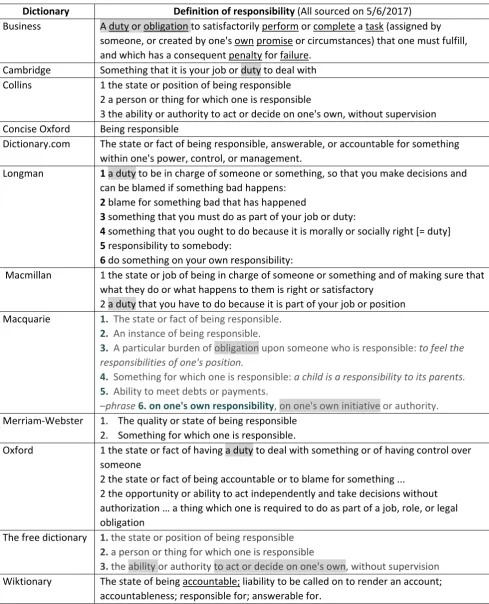
Lexical usage is surveyed in Table 1.Step 3 Analyse lexical usage
Duty is the most common word in Table 1. Duty has a sense of formality. Obligation is also used and has the sense of informality. While duty can also have a moral sense that can be said to be informal, it can be argued that duty is a formalised obligation and does not need to be included. References to blame or penalty do not cover the informal sense in which the word can be used and will be
excluded from this definition and addressed under accountability. Including reference to a task would remove any value judgement about that task or what ranges of activities might be covered, which may be formal or informal. Reference to satisfactorily performing that task would cover the sense of completion, as accepting responsibility may require performance of tasks with no
possible extensions. An ability to act or decide independently on one’s own (initiative) is implied by a person being able to undertake and perform a task satisfactorily.
Step 4 Develop a connotative (intensional) conventional definition
Responsibility will therefore be tentatively defined as an obligation to satisfactorily perform a task.
Step 5 Report academic review of definitions
These have been reviewed in the literature search above and provide no reason to change the definition above.
Step 6 Remove unwarranted inclusions
There are no such inclusions remaining.Step 7 Remove mixed content/ process meanings
None present.Step 8 Reduce divergence/ consider additional inclusions
Checks (a) and (c) are appropriate for this term.Step
8(a)
Consider
historical
usage
The etymology of the word responsibility is as follows:
‘condition of being responsible,’ 1787, from responsible + ‐ity. Meaning ‘that for which one is responsible’ is from 1796. Related: Responsibilities. (Harper 2017, p. R29).
We have determined in Group rule 2(c) not to define in this way as it leads to a circular argument – defining the condition of being in a condition, or the quality of having a quality. However the historical usage does not contradict the tentative definition.
Step
8(c)
Consider
practitioner
usage
This is addressed under “accountability”. It provides no reason to alter the definition.
Step 9 Check against the five rules
This is a definition by genus and difference and satisfies Rules 1 to 5.
Step 10 Report the derived definition
The derived definition is as follows: Responsibility = an obligation to satisfactorily perform a task.
Define
responsible
Step 1 Define derivative or component terms
The root of responsible is “respons” and the stem is “responsib” are derived from response, whose meaning is not contested and so does not require separate definition.
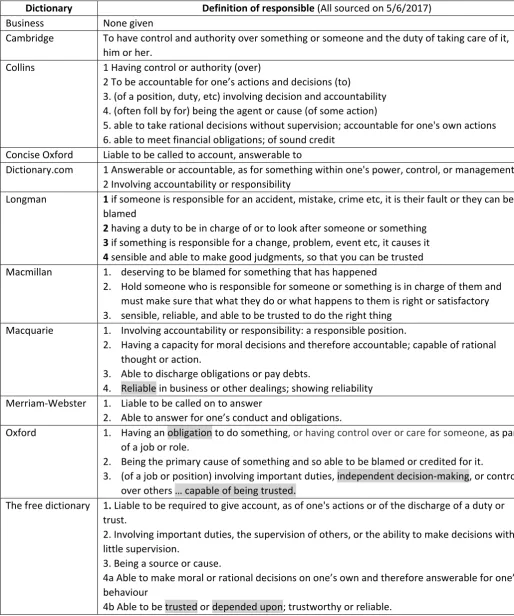
Step 3 Analyse lexical usage
Many of the definitions in Table 2 mix responsibility and accountability and so are unsatisfactory. Others emphasise control, legality or blame, leaving no suitable definition. A person may take on responsibility in circumstances where they have no control over another, as in one person rescuing another from a dangerous situation. Any attempt at an independent definition risks overlap with the definition of responsibility above, which mentions obligation. There are mentions of sensible, reliable and trustworthy in Table 2, but these involve the normative question of whose sense of values will predominate. A person may also have these characteristics yet do nothing in a particular situation, so there needs to be some element of acceptance in the definition.
Step 4 Develop a connotative (intensional) conventional definition
This word will be defined in terms of its noun form as accepting responsibility.Step 5 Report academic review of definitions
These have been reviewed in the literature search above and provide no reason to change the definition above.
Step 6 Remove unwarranted inclusions
There are no such inclusions remaining.Step 7 Remove mixed content/ process meanings
None present.Step 8 Reduce divergence/ consider additional inclusions
Checks (a) and (c) are appropriate for this term.Step
8(a)
Consider
historical
usage
The etymology of the word responsible is as follows:
1590s, ‘answerable’ (to another, for something), from obsolete French responsible (13c., Modern French responsable, as if from Latin *responsabilis), from Latin respons‐, past participle stem of respondere ‘to respond’ (see respond). Meaning ‘accountable for one's actions’ is attested from 1640s; that of ‘reliable, trustworthy’ is from 1690s. Retains the sense of ‘obligation’ in the Latin root word. Related: Responsibly (Harper 2017, p. R29).
This indicates overlap with being accountable. As mentioned already under responsibility, it indicates a divergence of meaning in the mid‐1600s towards reliable and trustworthy with some sense of obligation. This current exercise can be viewed as a progression of that and provides no reason to change the tentative definition.
Step
8(c)
Consider
practitioner
usage
This is addressed under “accountability”. It provides no reason to alter the definition.
Step 9 Check against the five rules
This is an operational definition rather than one by genus and difference and so a check against the five rules is not appropriate.
Responsible = accepting responsibility = accepting an obligation to satisfactorily perform a task.
Define
accountability
Step 1 Define derivative or component terms
Accountability is a derivative of the word account, whose meaning is not contested and so definition by our selected method is not required for this root term. The Oxford dictionary definition of
account is “a report or description of an event or experience” and will suffice. The suffix ‐ity’” denotes the quality of being accountable.
Step 2 Survey lexical usage
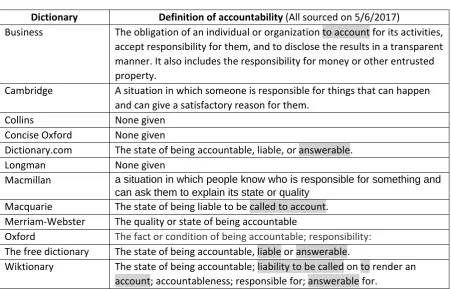
Lexical usage is surveyed in Table 3.Step 3 Analyse lexical usage
Called to account is the most common phrase in Table 3. Several dictionaries give no definition. Several mix accountability and responsibility and so are unsatisfactory. Liability and obligation are also mentioned. Liability will be preferred as it implies obligation anyway and is stronger than obligation. It also covers circumstance where just taking the action is sufficient and the call does not need to be exercised, resulting in the accountable person not actually being called to account. Answerable is also used as frequently in the lexical definitions. It is referred to as meaning liability to be called to account but does not have as strong a connotation of legality as liability does. Liability is stronger than responsibility, carrying some legal force or implication of possible penalty for not doing so, which being called to account comprises and so it clearly distinguishes accountability from responsibility. It also includes the meaning of being made “answerable”. Liability implies being held to account anyway and so even though accountability is derived from the word account, its
definition, provided it is compatible with its root term, does not actually need to explicitly include these words and in this case, it would be tautological if it did.
Step 4 Develop a connotative (intensional) conventional definition
Accountability will therefore be defined in terms of liability. This raises the question of “for what?” and so requires a qualification specifying this, in the same way that responsibility was defined above in terms of a particular task. Accountability will therefore be tentatively defined as liability for ensuring a task is satisfactorily done.
Step 5 Report academic review of definitions
These have been reviewed in the literature search aboveIeraci (2007)Cornock (2011)Ieraci (2007)Ieraci (2007)(Cornock 2011)Ieraci (2007)Cornock (2011)(Cornock 2011)(Cornock 2011) and provide no reason to change the definition above.
Step 6 Remove unwarranted inclusions
There are no such inclusions remaining.Step 7 Remove mixed content/ process meanings
None present.Step
8(a)
Consider
historical
usage
The etymology of the noun accountability is the “ ‘state of being answerable,’ 1770, from accountable + ‐ity. Earlier was accountableness (1660s)” (Harper 2017, p. A7).
This is compatible with the proposed definition and provides no reason to modify it.
The etymology of the adjective account is:
c. 1300, ‘counting,’ especially ‘reckoning of money received and paid, detailed statement of funds owed or spent or property held,’ … From the first often in plural form; sometimes in late Middle English accompt (see account (v.)). Meaning ‘course of business dealings requiring records’ is from 1640s; hence ‘arrangement to keep money in a business, bank, etc.’ (1833), also ‘customer or client having an account’ (1937). Money of account (1690s), that used in reckoning but not circulating as coin or paper, preserves the ‘counting’ sense of the word.
From the notion of ‘rendering an account’ comes the sense ‘statement answering for conduct’ (mid‐14c.) and the general sense ‘narration, recital of facts,’ attested by 1610s. Phrase by all accounts is attested from 1798. From the notion of ‘statement of reasons’ comes on no account ‘under no circumstances’ (1704). Also from c. 1300 in reference to answering for one's conduct, especially at the Last Judgment. Meaning ‘estimation, consideration,’ especially in the eyes of others, is from late 14c. … (Harper 2017, p. A7).
This provides no reason to modify the Oxford Dictionary definition of account accepted above.
Step
8(c)
Consider
practitioner
usage
To common means of ensuring accountability are RAMs and position descriptions (PDs).
There are many coding conventions currently in practitioner use for RAMs with acronyms such as ARCI, CAIRO, DACI, PACSI, PARIS, RACI, RAPID, RATSI (Wikipedia 2017). Some use Accountability while others use Agree, Authority or Approve. Several are variations of the RACI code such as RASCI which includes Support. One has a driver at a higher level, separate from an approver (DACI). One RACI alternative dispenses with any form of accountability synonym, denoting A as assists, having been specifically designed to “avoid potential confusion of the terms accountable and responsible” (Wikipedia 2017). This indicates a need for the exercise carried out in this paper and sheds no light on the definitional question itself.
A small selection of PDs was also reviewed. Five were selected for senior roles in four different public sector organisations listed on the Queensland Government Smartjobs and South‐East Queensland local government websites, the applications for which closed between October 2016 and April 2017. Some listed responsibilities and included accountabilities. Others listed
accountabilities and included responsibilities. This again indicates practitioner confusion regarding definition. Accountabilities were generally referred to by words such as lead and/ or manage with broad outputs or outcomes being nominated. One listed generic “outcomes” (which were
accountabilities) separately to headings covering other responsibilities, with all listed under the heading “Key Responsibilities”. This was the only one that attempted to separate these two concepts.
Step 9 Check against the five rules
The definition is operational rather than by genus and difference and so a check against the five rules is not appropriate. Nevertheless, it does actually satisfy them.
Step 10 Report the derived definition
The derived definition is as follows: Accountability = liability for ensuring a task is satisfactorily done.
Define
accountable
Step 1 Define derivative or component terms
Accountable is a derivative of the word account, whose meaning is not contested and so definition by our selected method is not required for this root term. The Oxford dictionary definition of “a report or description of an event or experience” will suffice.
Step 2 Survey lexical usage
Lexical usage is surveyed in Table 4.Step 3 Analyse lexical usage
Many of the definitions in Table 4 mix accountability and responsibility and so are unsatisfactory. Any attempt at an independent definition of the word risks overlap with the definition of
accountability above. This word will be defined operationally in terms of its parent noun as “having accountability”. The word having is more appropriate than accepting; accountability is legal or organisational with a connotation of compulsion and penalty whereas responsibility is personal and can be optional, without compulsion or penalty. Another acceptable meaning that occurs in many Table 4 definitions is answerable. This will not be adopted here for the same reason that “called to account” is not used, namely that it is implied by liability. Many of the lexical sources explain “giving an account” as “capable of being explained.” This will not be used in our definition as it captures only the after the event quality control aspect of the term and not its proactive sense of ensuring that the particular activity occurs.
Step 4 Develop a connotative (intensional) conventional definition
Accountable will therefore be tentatively defined as having accountability = having liability for ensuring a task is satisfactorily done.
Step 5 Report academic review of definitions
These have been reviewed in the literature search above and provide no reason to change the definition above.
Step 6 Remove unwarranted inclusions
There are no such inclusions remaining.Step 7 Remove mixed content/ process meanings
None present.Step
8(a)
Consider
historical
usage
The etymology of the adjective accountable is " ‘answerable,’ literally ‘liable to be called to account,’ c. 1400 (mid‐14c. in Anglo‐French), from Old French acontable; see account (v.) + ‐able. Related: Accountably” (Harper 2017, p. A7).
Step
8(c)
Consider
practitioner
usage
This is addressed under “accountability”. It provides no reason to alter the definition.
Step 9 Check against the five rules
The definitions are operational and synonymous rather than by genus and difference and so a check against the five rules is not appropriate. Nevertheless, they do actually satisfy them.
Step 10 Report the derived definition
The derived definition is as follows: Accountable = having accountability= having liability for ensuring a task is satisfactorily done.
Group
rules
post
definition
Cross check 1 Consistency within group
The definitional method has not resulted in any inconsistency between terms in this group.
Cross check 2 Consistency with terms outside the group
There is no known overlap of meaning of any of the above group of terms with any other term outside the group that would prevent the definitions being accepted.
Summary
of
definitions
The accepted definitions are as follows:
Account: a report or description of an event or experience The refined definitions are as follows:
Responsibility: an obligation to satisfactorily perform a task
Responsible: accepting responsibility = accepting an obligation to satisfactorily perform a
task
Accountability: liability for ensuring
atask is satisfactorily done.
Accountable: having accountability = having liability for ensuring a task is satisfactorily
done.
These definitions address the research question by identifying and including only the
essential elements of meaning for each of the terms defined.
Observations
on
the
method
and
its
application
On the method
On the application of the method
Following the chosen method has enabled resolution of the confused usage of the terms accountability and responsibility.
It was found that the dictionary definitions of accountability and responsibility were somewhat confused, with these terms having been defined in terms of each other. The practitioner usage was similarly confused. The academic definitions were clearer but still inadequate.
Implications
for
the
refined
definitions
of
responsibility
and
accountability
The confusion between responsibility and accountability can be characterised as a failure to separate the obligation to satisfactorily perform a task (responsibility) from the liability to ensure that it is satisfactorily done (accountability).
Sources of Liability
The refined definition of accountability begs the question “Where does the liability come from?” The discussion of the undocumented example in the section on definitional confusion above indicated that accountability may come from legislative or organisational sources. While accountability arising from any of these sources cannot be delegated whereas responsibility can be, managers at any level will make their staff accountable under some organisational or contractual arrangement for the tasks those staff are allocated responsibility for. So in going down one organisational level, responsibilities are converted into organisational and/ or contractual accountabilities, and so one transitions into the other between levels. It then follows that any attempt to allocate “universal” accountabilities across multiple levels of an organisation in a single table will be fraught with difficulty. Accountability may be a universal concept but determining any particular accountability can only be done relative to a particular task. The transition between legislative and organisational accountabilities is the highest level transition point within a government organisation and there are other management level transitions below that. Furthermore, it is also possible for the source of accountability to be neither legal nor contractual. There can be consequences in social groups, both inside and outside the law, for breaking unwritten codes of conduct to which members will be held accountable by being corrected, ostracised or worse.
So recognition of the existence of multiple sources of accountability (legislative, organisational, employment contract or unwritten code), as well as recognising that responsibility and
accountability transition between organisational levels, provides some clues for usage of the derived definitions, which are independent of all of these various sources and characteristics, yet suitable for application to all of them.
Responsibility Assignment Matrices (RAMs) and Position Descriptions (PDs)
sporadic. This latter format becomes important when somebody leaves or the organisation undertakes a review or undergoes some structural change, requiring existing positions to be evaluated. The RAM format is more detailed and suitable for use as an ongoing management tool that can be applied by senior organisational managers, project managers and team leaders to determine who will do what on various tasks. It provides a means of ensuring all resources and all aspects of tasks are addressed and lends itself to updating as circumstances change and new tasks arise. A well‐maintained RAM is therefore a useful tool to have in updating PDs.
A RAM is a responsibility, not an accountability assignment matrix (AAM)
These considerations have particular implications for how RAMs are applied. As previously noted, difficulties have occurred with usage of RAM coding conventions because of the confusion around the meaning of the two terms responsibility and accountability. This was easily overlooked and the difficulty was irreconcilable when the meanings of these terms were so commonly confused and dictionaries commonly defined them in terms of each other. However with clear definitions of both derived above, this looseness now becomes unacceptable and resolution is now both possible and required.
Given that accountability and responsibility can transition between organisational levels, mixing these concepts together in any one table is problematic and so best avoided. A RAM without some code for responsibility isn’t a RAM ‐ it is something else, some matrix of some other sort, even if its format is the same. We could similarly have an accountability assignment matrix, an AAM, but that would again be a different thing to a RAM, albeit having the same format. It would be a small matrix, as once accountability is allocated, that’s it; it can’t be delegated. Combining these two types of matrices into one is definitionally incorrect and invites confusion, whatever codes are used. So the problem appears to have been two‐fold, one around the definition of the terms in the first place followed by categorising of any matrix that happens to have the RAM format as a RAM and assigning it the same purpose.
RAM Coding conventions and task specification
The main logical problem is therefore the allocation of A for accountability in a RAM. This can be resolved quite simply by the A denoting something else. The obvious candidate is approval, the means used to resolve the problem on the undocumented example mentioned in the above section on definitional confusion above. If a person is accountable for something, they will have the say on how it is done and the authority to approve all the necessary arrangements, as noted in Cornock (2011), within the scope of organisational policy constraints. Accountability means ensuring all necessary tasks are determined and allocated (which proper use of a RAM can accomplish) and then ensuring satisfactory completion (which approval by the accountable person can accomplish). So completing a RAM having a code A for approval satisfies both accountability requirements – it identifies an aspect of a task that needs to be done and provides the means for ensuring accountability without mixing the two concepts up together. This implies that any RAM should include A and R. Without an R it’s not a RAM. And without an A (or some equivalent code) for approval, it does not serve the purposes of accountability.
unnecessary and avoidable difficulty. It appears this mistake occurred between the second and third PMBOK editions ‐ Project Management Institute (2000) and Project Management Institute (2004). The resulting confusion could only be resolved by first having rigorous non‐overlapping definitions and then going back to first principles retracing the steps and working through the implications. In summary, use of A for approval rather than accountability in the RACI set of RAM codes would clear up definitional confusion around both the terminology and the purpose of a RAM.
An important aspect of doing this is that the nature of the task needs to be carefully and
appropriately specified as e.g. a project manager or director on a large project in the public service may have the authority to approve all the delivery arrangements for that project, but will still have an expenditure delegation limit and not have authority to submit directly to Cabinet for higher expenditure or changed budgetary allocation. If the senior person does not have the authority to approve the task then they are not the accountable person and the task needs to be expressed in terms over which that person does have control. So in the circumstance just mentioned, the project manager or director would have the authority to have the cabinet submission prepared and to approve its technical content for submission, but not to actually submit it as it may have implications for areas that the project manager or director does not control. That requires a separate activity by another person who does have the authority to do it. This highlights the dangers in seeking
“universal” application of various interpretations of the term accountability (or any term for that matter) compared to simply seeking a universal definition of its essence. The former is seeking universality of labelling rather than of meaning. Universal definition of terms can produce clarity whereas universal application of different understandings of a term cannot.
So if the A in the RACI code is taken to mean approve, as occurred in the undocumented example mentioned above, the concept of accountability is converted into a responsibility, suitable for allocation within RAM, which is, after all, is a responsibility assignment matrix ‐ a functional tool for allocating responsibility, not a tool for philosophically debating the concept of accountability or for using it just because it sounds so much more impressive than responsibility. Some tasks cannot be regarded as complete until whoever is responsible for doing it has completed it and the person with the necessary authority has approved it. This satisfies one of the important uses of a RAM – to ensure nothing is overlooked. If it risks confusion over various aspects or sources of accountability, then it is not achieving one of its purposes. This also acknowledges that approval requires time and needs to be allowed for in any time schedule. The remaining codes C = consult and I = inform are not contentious and are useful for tasks impacting others, require time which can affect completion date and so similarly contribute to the outcome of ensuring nothing is overlooked.
This work has also found no reason why these four codes could not be supplemented on an as‐needs basis with codes such as S where others may need to support or assist, Q where product quality is measureable and needs to be certified, or V for verifier on particularly large contracts.
Blurring of boundaries
innovative ideas. It is a deliberate networking technique, not a means of definition. Nevertheless it illustrates a more general difficulty with definition.
Concepts that are clearly and uniquely defined can actually overlap in application, creating an illusion of what could be called blurriness. Consider the terms global and international, as mentioned by Archibugi and Iammarino (2002). Anything global is also international but not everything
international is global. According to the Oxford Dictionary, global means “relating to the whole world; worldwide” whereas international means “existing, occurring, or carried on between nations”. A term such as global warming refers to the whole of the earth and so the usage of the term global in that phrase is clearly valid. But if we look at a company whose products appear in many countries, does this mean that if we can find one country where its products are not sold that the company is not global? To avoid this difficulty we might, for example, agree that a company could be classified as global if its products are sold on every continent. However in doing so, we would be defining a phrase such as “commercially global”, rather than the single word global. This would be legitimately qualifying the usage of a term within a particular environment. However if we subsequently take it outside that environment, forget that we have qualified it and attempt to equate the meaning of a single word (global) with that of a phrase (commercially global) , its usage can easily be considered blurred. There is no confusion about what global means whereas there can be contention regarding what commercially global might mean. Omitting the assumed or silent qualifiers of a word can result in confusion that could be called blurriness. But this is not the same sort of blurriness as mentioned in Etzkowitz and Leydesdorff (1998); it is blurriness born of omission rather than desire for inclusion.
General
Through providing greater clarity of both definition and application, the findings of this definitional refining exercise have the potential to benefit recruitment, selection and induction process, providing a clearer basis for motivating and rewarding employees and even assisting with staff termination processes. Clarity around both the definition and the way RAMs can be used will hopefully assist in increasing usage of the RAM, facilitating the updating of PDs. This can also result in greater clarity in contracts, potentially reducing disputes during and after project delivery, leading to improved project and organisational delivery performance.
Conclusions
Colloquial and management uncertainty over meaning of the terms responsibility and accountability has been demonstrated. The McGrath and Whitty (2015) definitional refining method was applied to address the research question and did provide essential and non‐overlapping definitions for all four terms, suitable for use across multiple fields. The confusion between responsibility and
accountability was characterised as a failure to separate the obligation to satisfactorily perform a task (responsibility) from the liability to ensure that it is satisfactorily done (accountability). This paper dealt solely with the question of definition and made no comment on any other normative aspects of responsibility or accountability as applied to any field.
Following determination of non‐overlapping definitions, the following observations were made:
and responsibilities into tasks for which they hold their staff accountable for satisfactory performance.
2. Sources of accountability can be legislative, organisational, contractual or informal.
3. The commonly used statement that accountability cannot be delegated while responsibility can be was confirmed with the proviso that this specifically refers to only one managerial level or one piece of legislation or single employment contract.
4. Designation of the A in a RAM RACI coding system for approval rather than accountability avoids definitional confusion and provides a means of ensuring accountability.
5. If accountability is to be allocated in a table that has the RAM format, it would be better labelled as an accountability assignment matrix (AAM) to avoid definitional confusion. 6. The above modified RAM RACI convention contains generic codes that would all need to be
allocated to at least some task in any one RAM and these codes can be supplemented with additional codes on an as‐needs basis.
7. A well‐maintained RAM can provide a valuable source for updating PDs when recruitment becomes necessary.
8. Universal definition of a term can produce clarity when universal attachment of the term as a label for different understandings of it does not.
Adoption and use of the refined definitions developed in this paper, together with alteration of the “A” in the RAM RACI code from accountability to approve, can provide clarity of meaning, avoiding uncertainty, confusion and misunderstanding. This can benefit the community in general and project management practitioners and researchers in particular, saving time, resources and money.
Through providing greater clarity, these findings also have the potential to improve project delivery through benefiting organisational recruitment, selection and induction process, providing a basis for motivating and rewarding employees and assisting with staff termination processes. They can also potentially result in greater clarity in contracts, potentially minimising disputes during and after project delivery.
Successful application of the definitional refining method also indicates its potential suitability for application to other contested terms.
Appendix
Table 1
Definitions of “responsibility”
Dictionary Definition of responsibility (All sourced on 5/6/2017) Business A duty or obligation to satisfactorily perform or complete a task (assigned by
someone, or created by one's own promise or circumstances) that one must fulfill, and which has a consequent penalty for failure.
Cambridge Something that it is your job or duty to deal with Collins 1 the state or position of being responsible
2 a person or thing for which one is responsible
3 the ability or authority to act or decide on one's own, without supervision Concise Oxford Being responsible
Dictionary.com The state or fact of being responsible, answerable, or accountable for something within one's power, control, or management.
Longman 1 a duty to be in charge of someone or something, so that you make decisions and can be blamed if something bad happens:
2 blame for something bad that has happened
3 something that you must do as part of your job or duty:
4 something that you ought to do because it is morally or socially right [= duty] 5 responsibility to somebody:
6 do something on your own responsibility:
Macmillan 1 the state or job of being in charge of someone or something and of making sure that what they do or what happens to them is right or satisfactory
2 a duty that you have to do because it is part of your job or position Macquarie 1. The state or fact of being responsible.
2. An instance of being responsible.
3. A particular burden of obligation upon someone who is responsible: to feel the responsibilities of one's position.
4. Something for which one is responsible: a child is a responsibility to its parents. 5. Ability to meet debts or payments.
–phrase 6. on one's own responsibility, on one's own initiative or authority. Merriam‐Webster 1. The quality or state of being responsible
2. Something for which one is responsible.
Oxford 1 the state or fact of having a duty to deal with something or of having control over someone
2 the state or fact of being accountable or to blame for something ... 2 the opportunity or ability to act independently and take decisions without authorization … a thing which one is required to do as part of a job, role, or legal obligation
The free dictionary 1. the state or position of being responsible 2. a person or thing for which one is responsible
3. the ability or authority to act or decide on one's own, without supervision
[image:20.595.75.565.163.768.2]Table 2
Definitions of “responsible”
Dictionary Definition of responsible (All sourced on 5/6/2017) Business None given
Cambridge To have control and authority over something or someone and the duty of taking care of it, him or her.
Collins 1 Having control or authority (over)
2 To be accountable for one’s actions and decisions (to)
3. (of a position, duty, etc) involving decision and accountability 4. (often foll by for) being the agent or cause (of some action)
5. able to take rational decisions without supervision; accountable for one's own actions 6. able to meet financial obligations; of sound credit
Concise Oxford Liable to be called to account, answerable to
Dictionary.com 1 Answerable or accountable, as for something within one's power, control, or management 2 Involving accountability or responsibility
Longman 1 if someone is responsible for an accident, mistake, crime etc, it is their fault or they can be blamed
2 having a duty to be in charge of or to look after someone or something 3 if something is responsible for a change, problem, event etc, it causes it 4 sensible and able to make good judgments, so that you can be trusted Macmillan 1. deserving to be blamed for something that has happened
2. Hold someone who is responsible for someone or something is in charge of them and must make sure that what they do or what happens to them is right or satisfactory 3. sensible, reliable, and able to be trusted to do the right thing
Macquarie 1. Involving accountability or responsibility: a responsible position.
2. Having a capacity for moral decisions and therefore accountable; capable of rational thought or action.
3. Able to discharge obligations or pay debts.
4. Reliable in business or other dealings; showing reliability Merriam‐Webster 1. Liable to be called on to answer
2. Able to answer for one’s conduct and obligations.
Oxford 1. Having an obligation to do something, or having control over or care for someone, as part of a job or role.
2. Being the primary cause of something and so able to be blamed or credited for it.
3. (of a job or position) involving important duties, independent decision‐making, or control over others … capable of being trusted.
The free dictionary 1. Liable to be required to give account, as of one's actions or of the discharge of a duty or trust.
2. Involving important duties, the supervision of others, or the ability to make decisions with little supervision.
3. Being a source or cause.
4a Able to make moral or rational decisions on one’s own and therefore answerable for one’s behaviour
[image:21.595.72.587.145.762.2]5Based on or characterised by good judgement or sound thinking.
Wiktionary 1. Answerable for an act performed or for its consequences; accountable; amenable, especially legally or politically.
2. Capable of responding to any reasonable claim; able to answer reasonably for one's conduct and obligations; capable of rational conduct.
3. Involving responsibility; involving a degree of personal accountability on the part of the person concerned.
4. Being a primary cause or agent of some event or action; capable of being credited for something, or of being held liable for something.
5. Able to be trusted; reliable; trustworthy.
Table 3
Definitions of “accountability”
Dictionary Definition of accountability (All sourced on 5/6/2017)
Business The obligation of an individual or organization to account for its activities, accept responsibility for them, and to disclose the results in a transparent manner. It also includes the responsibility for money or other entrusted property.
Cambridge A situation in which someone is responsible for things that can happen and can give a satisfactory reason for them.
Collins None given Concise Oxford None given
Dictionary.com The state of being accountable, liable, or answerable. Longman None given
Macmillan a situation in which people know who is responsible for something and can ask them to explain its state or quality
Macquarie The state of being liable to be called to account. Merriam‐Webster The quality or state of being accountable
Oxford The fact or condition of being accountable; responsibility: The free dictionary The state of being accountable, liable or answerable.
Wiktionary The state of being accountable; liability to be called on to render an account; accountableness; responsible for; answerable for.
[image:23.595.73.525.136.425.2]
Table 4
Definitions of “accountable”
Dictionary Definition of accountable (All sourced on 5/6/2017) Business In gen