City, University of London Institutional Repository
Citation
:
Makri, S. & Blandford, A. (2012). Coming across information serendipitously -
Part 1: A process model. Journal of Documentation, 68(5), pp. 684-705. doi:
10.1108/00220411211256030
This is the draft version of the paper.
This version of the publication may differ from the final published
version.
Permanent repository link:
http://openaccess.city.ac.uk/14402/
Link to published version
:
http://dx.doi.org/10.1108/00220411211256030
Copyright and reuse:
City Research Online aims to make research
outputs of City, University of London available to a wider audience.
Copyright and Moral Rights remain with the author(s) and/or copyright
holders. URLs from City Research Online may be freely distributed and
linked to.
City Research Online:
http://openaccess.city.ac.uk/
[email protected]
Coming across information serendipitously: Part 1 – A process
model
Purpose: This research sought to gain a detailed understanding of how researchers come across information serendipitously, grounded in real-world examples. This research was undertaken to enrich our theoretical understanding of this slippery phenomenon.
Design/methodology/approach: Semi-structured Critical Incident interviews were conducted with 28 interdisciplinary researchers. Interviewees were asked to discuss memorable examples of coming across information serendipitously from their research or everyday life. Our data collection and analysis process followed many of the core principles of Grounded Theory methodology.
Findings: The examples provided were varied, but shared common elements (they involved a mix of
unexpectedness and insight and led to a valuable, unanticipated outcome). These elements form part of an empirically-grounded process model of serendipity. In this model, a new connection is made that involves a mix of unexpectedness and insight and has the potential to lead to a valuable outcome.
Projections are made on the potential value of the outcome and actions are taken to exploit the connection, leading to an (unanticipated) valuable outcome.
Originality/value: Our model provides researchers across disciplines with a structured means of understanding and describing serendipitous experiences.
Keywords: serendipity, serendipitous, chance, information discovery, encountering
Classification: Research paper
Note: This is an author version of an accepted journal article. The page numbers on the final publisher version will not match those in this document. Please check Emerald’s Web site for the definitive, citable version.
1.
Introduction
This article reports on an empirical study of researchers’ experiences of ‘coming across information serendipitously’ as part of their research and in everyday life. The study was conducted to enrich our theoretical understanding of the phenomenon. However, gaining a rich understanding of serendipity is not easy as it is a highly slippery concept. Just as we think we have pinned down a precise definition of it, we realise that its essence has escaped us.
The slippery nature of the phenomenon has meant that most existing definitions fail to incorporate something important about the experience of serendipity. For example the most recent (11th) edition of
the Oxford Concise Dictionary defines the term as “the occurrence and development of events by
chance in a happy or beneficial way,” Cunha et al. (2010) define it as “the accidental discovery of
something that, post hoc, turns out to be valuable” (p. 320) and Cooksey (2004) suggests that serendipity is “the happy convergence of the mind with conditions” (p. 25) and argues that knowledge is created by someone noticing thesignificance of an observation or piece of information and making a mental connection as a result (rather than from the observation or information itself). The dictionary definition and the definition by Cunha et al. incorporate unexpectedness and positivity, but not mental effort, whilst Cooksey’s definition incorporates positivity and mental effort, but not unexpectedness. McCay-Peet and Toms (2010) suggest that a particularly useful definition is that of Fine and Deegan (1996), who define it as “the unique and contingent mix of insight coupled with chance” (p. 436). As with the previously cited definitions, however, there is still something important missing from Fine and Deegan’s definition - something positive that arises from this unexpectedness and insight (i.e. a valuable outcome).
The slippery nature of the phenomenon poses a problem for research in the area; it makes serendipity difficult to study and it makes it difficult for researchers to make strong claims about the nature of the phenomenon because the goalposts are always moving; different people have different understandings of serendipity and these understandings are likely to change and perhaps evolve as they are challenged by new (and different) experiences. By now, readers are probably wondering why we would want to seek to understand a phenomenon that seems intrinsically difficult to understand - why it is worth delving into ambiguity in search of greater clarity. The answer is simple; because serendipity is an important part of our lives, but we do not understand it properly yet. We do not believe that the complex nature of the phenomenon should prevent us from gaining a better understanding of it. Indeed, Cunha et al. (2010) share our viewpoint and argue that although serendipity is elusive and difficult to capture empirically, “such difficulties should serve to stimulate
interest rather than discourage it” (p. 320). Our interest in this area was motivated by a desire to gain a detailed understanding of serendipity, based on concrete real-world examples. We wanted to provide a detailed, theoretical description (rather than definition) of the phenomenon in order to help researchers from a variety of disciplines to understand more about it and to reduce some of the ambiguity inherent in the term’s definition and usage.
2.
Existing models of serendipity
Although the study of serendipity is still an emerging research area, there have been several studies that have examined aspects of this phenomenon in an information research context (e.g. Erdelez, 1995; 1997; 1999; 2004, Foster & Ford, 2003, McBirnie 2008a; 2008b, Watson, 2008, Toms & McCay-Peet, 2009). We review these studies in detail in a companion article (see Makri & Blandford, 2012). Here, we focus on work that has resulted in the creation of existing models of serendipity. We review existing models from the information research literature and discuss the extent to which they were useful as theoretical ‘lenses’ on our interview data.
The first of these models was proposed by McCay-Peet and Toms (2010), who adapted work by Cunha (2005) to describe the process of serendipity. They suggest that:
1. While searching for a solution to an information task (Task A)… 2. and with certain precipitating conditions and a serendipity ‘trigger’…
4. and an unexpected solution is found – either to Task B (a different information task to Task A) or to Task A (which they refer to as ‘arriving at the right destination by the wrong boat’).
The examples from our interviews loosely followed this model. All involved an element of unexpectedness (akin to the ‘unexpected solution’ in McCay-Peet and Tom’ model) and a bisociation (which we refer to in this article as a ‘connection’). However, our interviewees found it difficult to answer specific questions about the nature of the connection and what might have triggered it – perhaps because noticing an environmental trigger and making a mental connection are processes that happen ‘in the head’ rather than ‘in the world’ and are inherently difficult to describe. Our interviewees also mentioned several factors which ‘enabled’ serendipity (similar to McCay-Peet and Tom’s ‘precipitating conditions’). These included being relaxed, alert, in a good mood and willing to deviate from the current task.
Another model of serendipity was developed by Rubin et al. (2011), who searched for blog entries on GoogleBlog based on terms they thought might bring back examples of serendipity. Based on this data, Rubin et al.’s model suggests that the act of noticing perceptual cues in the environment, combined with an element of chance (i.e. accident or perceived lack of control) and a prepared mind
(based on previous experience or a prior concern) can lead to a fortuitous outcome (i.e. a perceived gain or happy ending). Although we might consider serendipity to be an experience that includes each of these facets, Rubin et al.’s model includes the notion of serendipity separately – as a ‘reframing of events,’ implying that an experience can only be considered serendipitous upon reflection.
Our interview data fit Rubin et al.’s model fairly well; indeed, there are several similarities between the facets of this model and the three common elements from our examples – an amount of unexpectedness (which corresponds to the facet of ‘chance’ identified by Rubin et al.), an amount of insight (which loosely corresponds to Rubin et al.’s ‘act of noticing’ and ‘prepared mind’) and a valuable, unanticipated outcome (which loosely corresponds to Rubin et al.’s ‘fortuitous outcome’ – especially when considered as a ‘perceived gain’). We found Rubin et al.’s model particularly useful for describing the essence of serendipity (and for teasing out similarities and differences between our examples). However, we also hoped to demystify the experience of serendipity by describing it as a
process rather than a combination of necessary facets; in effect we wanted to get as close as possible to a ‘recipe’ for serendipity and found this model particularly useful for providing us with a potential ‘list of ingredients’ to look out for when analysing our data.
A model which was particularly useful in aiding us to describe serendipity as a process was created by Lawley and Tompkins (2008) (see figure 1). In their model, ‘E’ is an event which, with hindsight, is deemed to be serendipitous. E-1 is a time before the event and E+1 is a time after the event etc. The event is described as ‘unplanned,’ ‘unexpected’ and ‘anomalous’ and with “potential for long-term
value” (p. 3). At E-1, the person experiencing the event has a prepared mind that is ready to
recognise unexpected potential. At E+1, the potential for the positive future significance of E is recognised through a forward-facing evaluation. At E+2 an action is carried out which “aims to amplify
the potential for positive significance of E” (p. 3). Sometime later, at E+3, “there are consequences of
the action, and of other things that are happening, which further amplify the benefit of E” (p. 3). This process of recognising the potential significance of E and taking actions to ‘seize the moment,’ which further amplify the potential significance, is repeated until finally, after more time still (at E+4), “the
scale of the positive significance of the original event becomes apparent - at which time serendipity can be said to have taken place” (p. 3). The authors highlight that this is a backward-facing and subjective evaluation “because evaluating whether something is ‘positive’ depends entirely on the perspective of the evaluator” (p. 3) and that whilst some individuals might recognise the scale of the positive significance of the events, others might not. The dashed lines in figure 1 indicate that the process of evaluating the effects of serendipity can further prepare the mind to recognise and act on future serendipitous events. Lawley and Tompkins (2008) suggest that “serendipity is ‘the whole
Figure 1: Lawley and Tompkins' perceptual model of serendipity. Reproduced with permission.
Lawley and Tompkin’s (2008) model provided us with much leverage in understanding and describing our interview data; we were able to describe much of our data in terms of the above perceptual processes. However, where Rubin et al.’s model provided the essence of serendipity but not structured process, it can be argued that Lawley and Tompkin’s model describes the process of serendipity thoroughly, but is less thorough in describing the essence of it (i.e. the properties of an event that is, in hindsight, considered serendipitous). That said, the essential features of serendipitous experiences as identified in our study are present in their model; an event that is later deemed to be serendipitous involves an amount of unexpectedness and, as noted by Lawley and Tompkins, insight
(a ‘prepared mind’) is required to notice the potential value of the event. Although the notion of a
valuable outcome is not explicitly modelled, it is implied - by the assertion that the event should have ‘long-term value.’ We found the iterative loop present in the model (indicated by a solid line in figure 1) particularly useful for helping us to conceptualise how a serendipitous experience unfolds and a similar loop is present in our model - recognising that actions are often taken to maximise the chances of experiences resulting in a valuable outcome and that this is achieved through a cyclic process of projecting the potential value of the outcome, taking some action to try to realise this value and reflecting on the value afterwards. We experienced most difficulty interpreting our data in light of this model when attempting to separate the notion of ‘event’ from ‘outcome.’ Whilst it was clear from the model that an event must always come before an outcome, sometimes these appeared to overlap. For example, consider coming across a useful article for one project when searching the Internet for information on another project entirely. Here both the event and outcome might be considered as ‘coming across a useful article.’ This is why our model (described fully in section 4) is not centred on events but mental connections.
3.
Methodology
Research Domain Abbreviation Research domain is a mix of… N° of
interviewees Architectural Design AD Architecture and design 5 Civil, Environmental and
Geomatic Engineering CEGE Various engineering disciplines 1 Computational Musicology CM Computing, history and music 3 Digital Humanities DH Computing and information studies 3 Energy Demand Reduction
and the Built Environment EDR
Energy studies, architecture and civil
engineering 2
Financial Computing FC Computing, mathematics and finance 1 Health Informatics HI Computing, information studies and
healthcare 2
Mathematics and Physics in the Life Sciences and Experimental Biology
MPLS Mathematics, Physics and Biology 1
Security and Crime Science SCS Computer security and crime science 5 Urban Design UD Design, civil engineering, architecture
and public policy planning 4 Virtual Environments, Imaging
and Visualisation VEIV Computing and architecture 1
Total = 28
Table 1: Breakdown of interviewees’ research domains.
Interviewees were recruited primarily by e-mail, but also by asking interviewees to encourage their colleagues to take part. We chose to contact 1) graduate students who were undertaking courses that involving individual research and 2) research and academic staff who were actively engaged in research. This is because previous studies had suggested that serendipity is often an important part of research (see Foster and Ford, 2003; Watson, 2008; McBirnie, 2008a; 2008b; McCay-Peet and Toms, 2010). We hoped that people who conducted their own original research would be able to provide us with a variety of examples of experiencing serendipity both in their work lives and in everyday life (and this turned out to be the case). In our e-mails, we informed potential interviewees of the purpose of our interviews and what they would involve. We did not provide interviewees with a definition of serendipity either in our e-mail or during the interviews as we did not want to limit the variety of examples elicited or to influence the interviewees’ understanding of the term.
Each interview began with 5 minutes of warm-up questions aimed at breaking the ice and eliciting the interviewee’s understanding of the phenomenon. They were asked to explain what they understood by the term ‘serendipity’ and whether they had thought much about coming across information serendipitously before hearing about the interview. They were also asked whether and how frequently they come across information serendipitously and how they thought this compared with other people.
component lasted around 35 minutes.
The interviews concluded with around 10 minutes of wrap-up questions aimed solely at getting interviewees to reflect on the nature of serendipity. These questions were intentionally vaguely-worded in order to ensure they were not leading. We asked whether interviewees thought they were ‘more likely to come across information serendipitously in some situations rather than others and whether there is anything that increases or decreases the likelihood’ of coming across information serendipitously. We also asked interviewees to comment on the best and worst aspects of serendipity. Finally, we asked interviewees whether their understanding of serendipity had changed during the course of the interview and, if so, why. The interviews lasted around 50 minutes each on average. All 28 interviewees discussed at least one example of coming across information serendipitously, with many also choosing to discuss additional examples (although often in less detail).
Although the interviewees were asked to provide examples of coming across information
serendipitously, many of the examples only involved indirect information acquisition. In particular, several involved meeting new people (e.g. a girl at a bar in Moscow that would later become the interviewee’s close friend, a new partner on a social networking site). Although these examples did not involve actively acquiring information, all had an informational component; the interviewee who made a friend at the Moscow bar informed the girl (who needed a job in Moscow) that her company was hiring. The interviewee who met his partner on a social networking site found out that the girl attended his university and was therefore easy to meet. Although we did not expect the interviewees to interpret ‘information’ so broadly, this benefited our study by allowing us to understand the nature of serendipity rather than solely the information-related aspects.
Our data collection and analysis process followed many of the core principles of Grounded Theory (see Glaser and Strauss, 1967; Corbin and Strauss, 2008). Our process was ‘grounded’ in the sense that our findings emerged from the data by ‘listening’ to it and through a process of ‘constant comparison’ – where we continually compared data across interviewees to gain a detailed understanding of the phenomenon of serendipity. We also took an evolving theoretical sample, where we contacted researchers from new disciplines as the interviews progressed in order to ensure a broad variety of examples (plus examples from both research and everyday life). Whilst some of our interview questions were adapted from previous studies and therefore guided by a prior knowledge of the literature, we were careful to use this prior knowledge to enlighten rather than constrain our interpretation of the interview data. We therefore did not use prior knowledge to expressly shape or package our findings, but to help us ask questions of our findings as they emerged. Indeed, this argument extends to our use of existing serendipity models and frameworks (discussed in the next section). We used this existing work as ‘theoretical lenses’ on our data – not with the purpose of shoehorning our data to fit existing models but in order to gain an appreciation of the many different ways it is possible to describe the experience of serendipity. In essence, we followed the inductive process of relating the examples of serendipity from our interview data to existing models and frameworks as a means of supporting and advancing our deductive grounded analysis.
During data analysis, we became aware of the potential to develop a model of serendipity and therefore we decided it was more important for us to identify key elements of serendipitous experiences (i.e. a mix of unexpectedness and insight and a valuable, unanticipated outcome) than a single ‘core’ element that aimed to describe the essence of serendipity. Although we effectively stopped short of generating a theory, we still describe our approach as Grounded Theory (rather than a grounded analysis) because, according to Corbin and Strauss (2008), developing a theory is not an essential component of Grounded Theory. They suggest that “a researcher need not go all the way to
theory development. He or she could stop after concept identification and development and do a very nice descriptive study, adding elements of context and process, as he or she feels competent to do”
(p. 162).
4.
Our empirical model of serendipity
4.1 Overview of model
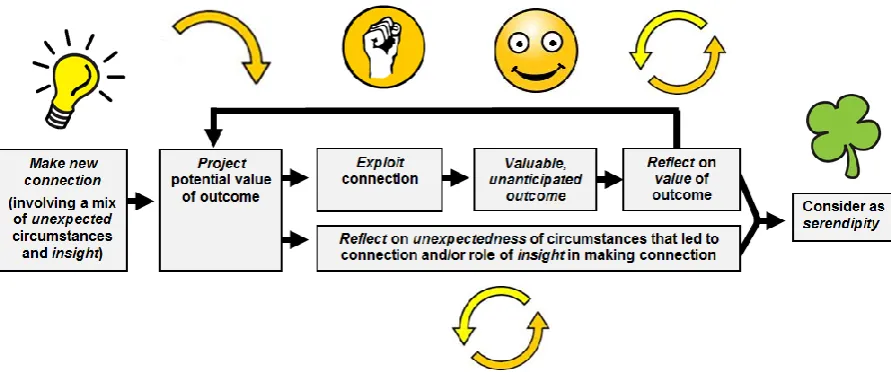
Our empirically-grounded process model of serendipity (figure 2) focuses on the mental connection that is sparked by circumstances that are to some extent unexpected. A new connection is made
between an informational or non-informational need and a ‘thing’ (e.g. person, event, place, information, object) with the potential to address the need. The circumstances that led to the connection are subsequently (and subjectively) considered to have involved an amount of
unexpectedness. The making of the connection itself is subjectively considered to have involved an amount of insight.
The connection results in an idea that has the potential to lead to a valuable outcome. Forward-facing
projections are made on the potential value of the outcome. Actions are then taken to exploit the connection and these actions lead to a valuable outcome which addresses the need (but was not anticipated as a way of addressing it). Although already considered valuable to some extent, the full extent of the value of the outcome becomes apparent over time - through an iterative process of projecting further value to be gained from the connection, continuing to exploit the connection and
reflecting on the value of the outcome. Backward-facing reflections are also made on the
unexpectedness of the circumstances that led to the connection being made and/or the insight
[image:8.595.74.520.310.496.2]involved in making the connection itself. After reflecting on both the value of the outcome and the involvement of unexpectedness/insight, the experience can be considered as serendipity.
Figure 2: Our empirically-grounded process model of serendipity
4.2 Make new connection
A new mental connection (known as a bisociation – see Cunha, 2005) is made between a need and something that has the potential to address that need. This need may be an information need (e.g. to find out more about a particular topical area) or a non-informational need (e.g. to find love). The need might be an existing need; it might have been previously acknowledged (and efforts may or may not have already been made to address it). But this is not necessarily the case – it may be an unconscious need that might only become apparent at the time the connection is made. This is explained by one of our interviewees through an example of being given a bicycle by a next-door-neighbour:
“If I really wanted a bike or needed a bike and one day I came home and my next door neighbour said to me, I’m moving to New Zealand I would like to give you my bike, that’s immediately obvious and recognisable as, what a lucky chance, what serendipity. But I might not know that I needed a bike and take it off your hands so as not to be rude. And if two weeks later the London public transport system more or less collapses, that’s darn lucky I had that bike.” – SCS5
A person (both previously acquainted and non-acquainted – i.e. family, colleagues, friends, friends-of-friends, strangers).
An event (such as a conference, meeting, party etc.)
A place (a geographical location, such a as particular town, street, building etc.)
Information. This information may come from a person or from physical or digital sources.
A (non-informational) object (which could be anything from a particular piece of technology to an item of apparel, to something from nature).
The connection might be spurred by one of these things happening now (e.g. meeting or becoming aware of a person, attending an event, encountering some information, visiting or becoming aware of a place, becoming aware of or using an object). It might also occur based on memory of one of these things (a familiar or previously met person, previously encountered information, a previously familiar or visited place, a previously familiar or used object). For example, one interviewee was asked to write an original essay on the topic of sustainability in Urban Design and thought back to an event she had attended in the past (the Thessaloniki Documentary festival), where she had seen a Canadian musician take “the masterpieces of Bach and he deconstructed them and recomposed them
somehow and made some variations.” (UD4). This gave her the idea to deconstruct and recompose an old city such as Athens in a similar way and to use this as the basis of her essay.
The circumstances that led to the connection being made are subjectively considered to have involved an amount of unexpectedness. The making of the connection itself is subjectively considered to have involved an amount of insight. Interestingly, when asked about their understanding of the term ‘serendipity’ at the start of the interview, all of our interviewees suggested that it involved a degree of unexpectedness (describing it using the word unexpected and other related words such as accidental, lucky and fortuitous) and most highlighted an element of positive benefit, usefulness or value associated with the outcome. This was also the case in McBirnie’s interviews (see McBirnie, 2008a; 2008b). However, whilst some of McBirnie’s interviewees implied a degree of sagacity was involved,
none of our interviewees mentioned the role of insight or sagacity even though we were able to identify a degree of insight in virtually all the examples provided.
Most of the time, the need will not be actively pursued at the time the connection is made (or for connections that involve thinking back to things from memory, at the time the thing was originally encountered). Consider, for example, the examples from our interviews of finding information relevant for one research project while searching for information on another project entirely, or meeting someone with similar research interests whilst attending a conference that was seemingly unrelated to those interests. However, sometimes connections involving a mix of unexpectedness and insight can occur while actively pursuing the need (consider, for example, finding information from a previously unfamiliar domain that provides a useful theoretical angle for current work in-progress whilst conducting a general Internet search in the area).
The new connection results in an idea about how the thing might address the need and potentially lead to a valuable outcome. One of our interviewees commented:
“All it takes is that click. It's that cognitive connection to be made and then something that seemed like the hardest thing in the world becomes the easiest thing in the world. Einstein must have gone ‘oh!’”– SCS2.
Although this idea is always had at the time the connection is made (it happens as a result of the connection), the connection between the need and the thing with potential to address the need might not be made at the time the thing is encountered. The connection might be made at the time, sometime later (as with the Thessaloniki Documentary festival example), or not at all - resulting in a missed connection opportunity.
The making of this connection can be enabled by being open and prepared and inhibited by being
their comfort zones. The notion of a ‘prepared mind’ has been discussed by several researchers (see Foster and Ford, 2003; Lawley and Tompkins, 2008; Rubin et al., 2010) and although it is difficult to pinpoint exactly what prior knowledge and experiences facilitate a new connection to be made, it is clear that a degree of ‘mental priming’ is necessary to spark the connection. As asserted by one of our interviewees:
“I don’t know what was the path in my brain that led me back to that, but there was a path.” – AD4.
4.3 Project potential value of outcome
Once the connection has been made, forward-facing projections are made of the potential value of the outcome. The potential value of the outcome may or may not be apparent at the time the connection is made - it might become apparent later, as explained by this interviewee:
“Suddenly I’ll come across something which I might not think is relevant at the time, but it will just... yes, it will turn into something useful, maybe once I’ve spoken to someone else or something it will all sort of suddenly fall into place.” – HI2
Therefore these projections can take place at any time from the moment the new connection is made until such time where the value of the outcome has become completely apparent. It is also possible for the potential value of the outcome to be considered to be more or less valuable than previously thought upon later reflection, as explained by one of our interviewees:
“The same events, you may see as one thing and later on you come to more knowledge. Suddenly, the same events have the opposite interpretation.” – VEIV1
The subjective perception of the value of the outcome will stabilise over time.
4.4 Exploit connection
Once it has been determined that the connection has the potential to result in a valuable outcome, actions are performed aimed at exploiting the connection (i.e. maximising the value arising from it). These actions will vary across situations, but will involve taking an active role – for example following up on a potentially useful person-based connection, or sharing or making use of encountered information. For example, one interviewee (FC1) heard a song he liked by an unsigned artist whilst watching an episode of US comedy series Scrubs (he considered this unexpected because the song was sombre and Scrubs usually featured upbeat music). After hearing the song, he looked at the name of the artist in the show’s credit sequence, found the artist’s webpage on the Internet, downloaded the song and bought the artist’s album (which turned out to be worth “quite a lot of
money” as it was a limited edition.
Maximising the value from the connection can be enabled by being willing and able to exploit such connections and inhibited by being unwilling and unable. Interviewees commented that they were more willing to exploit connections when they were in a good mood and feeling relaxed and unwilling when they were in a bad mood, stressed, tired or time-pressured as explained by interviewees UD1, AD4 and SCS2:
“If you're smiling for example more things will happen to you as more people will approach you, whereas if you're crabby and look like you hate the world no one is going to ask you to do something random.” – UD1
“When you don’t feel happy then you more easily fall into your own world and pay less attention to other things.” – AD4
This is related to McBirnie’s (2008a, 2008b) concept of a ‘serendipity filter,’ where her interviewees mentioned ‘shutting themselves off’ to serendipitous experiences when under pressure. A missed opportunity in exploiting the connection fully (or at all) is likely to result in the outcome not being considered to be particularly valuable.
4.5 Result in valuable, unanticipated outcome
These actions result in an outcome that addresses the need, but was notpreviously anticipated as a way of addressing it. In examples where the need was being actively pursued at the time the connection was made (such as the examples from our interviews of finding a useful theoretical angle to frame work in-progress or meeting a potentially useful work contact), although the broad nature of the outcome might be anticipated, the specific nature will not have been anticipated.
The outcome is subjectively considered to be to some extent valuable, for example by being:
Knowledge-enhancing (i.e. providing a new insight or perspective that pushed the boundaries of existing knowledge). When asked about the best aspects of serendipity, one interviewee responded “the way that you can feel your mind expanding as you take in new things” (SCS2).
Impactful (i.e. with a large and/or long-lasting impact). One interviewee, for example, wanted to find out about corruption in the Education System of a particular West African country for her Master’s dissertation and through a chain of referral and social networking managed to interview the Deputy Education Minister and gain a useful insight into corruption through some ‘sneaky’ interview methods. She commented that “my entire three months was spent with just one serendipitous action after another, which is why I managed to get such a good research project and such a good mark” (SCS2).
Timely (i.e. happening at the ‘right time’). For example, one interviewee met someone at a
conference who shaped the direction of her PhD and this happened “at that point in time when I
was expected to be developing my proposal for my research” (SCS1).
Time-saving. When asked about the best aspects of serendipity, one interviewee replied
“time-saving advancement in research” (HI2). Another explained how a serendipitous experience can provide a sudden ‘jump’ in understanding: “I think it’s an unexpected increase in your understanding immediately. So, most things you spend months trying to do and understand. Sometimes, serendipity can... it’s like a jump” (MPLS1).
The value of the outcome might become apparent at the time the connection is made or sometime in the future. Whilst this will often happen in a short timescale, sometimes it can take a considerable amount of time:
“There’s also a type of serendipity where something happens and you don’t realise until months or years later that... only much later does whatever happened have some beneficial effect.” - VEIV1.
Upon later reflection, the outcome might be considered to be more or less valuable than previously thought - based on subjective perception of the current value and expectation of the likely future value. As explained by another interviewee, it is only possible to recognise the full extent of the value of the outcome once the value has stabilised over time. Referring to an example of meeting a girl at a bar in Moscow who would later become her ‘absolute best friend,’ this interviewee commented:
“It’s weird isn’t it that we met that night and we both really liked each other but I think it’s not until you’ve reached a certain kind of established sense of, okay this is quite an important part of my life that you then start to pinpoint the moment because otherwise it would be every time you met someone.” – SCS5.
4.6 Reflect on value of outcome, unexpectedness and insight
becomes completely apparent. Backward-facing reflections are also made on the unexpectedness of the circumstances that led to the connection being made and the insight involved in the connection being made. These reflections can be made any time after the connection is made.
4.7 Consider as serendipity
At some point in time after reflecting both on the value of the outcome and the nature of the circumstances that led to the connection being made, the experience is considered as serendipity. This stage in our process model, along with the previous stage, is theoretically rather than empirically-grounded. This is because interviewees found it too abstract to ‘reflect on their process of reflection,’ as illustrated by this researcher:
“I don’t know that I’d use the word serendipity, but I did think of it as being a lucky side…I think quite often, just that slightly random encounter… I don’t know whether I realised immediately what it was that I was seeing. Once I saw that there was a story, I think I did, but initially it was just something’s happened. It’s hard to be more specific than that” – CM3.
We believe that a degree of reflection is necessary in order to consider an experience as serendipitous, supported by a comment by DH1:
“Serendipity doesn’t exist until you have hindsight, until you’ve gone through it and thought about it” – DH1.
When asked whether they had thought much about serendipity before hearing about the interview, most interviewees suggested they did. But they implied that the labelling of their experience was more unconscious than conscious:
“There are no big, flashing lights which go ‘this is serendipitous,’ but I guess there’s the emotional link with feeling happy. But is there something going serendipity, serendipity? No.”- EDR1.
“I’m not sure I would have used the word serendipity but I definitely came back and it felt different. It didn’t feel like I had just met somebody at a conference and had been talking about interesting research. It felt like that meeting was going to change something, and I’d gone in a different direction.” – SCS1.
Therefore we believe that considering an experience as serendipity is more likely to involve a vague realisation based on an appreciation of the influence that the connection has had on the value of the outcome rather than a conscious labelling of the experience as ‘serendipitous.’
A missed opportunity in reflecting on the value of the outcome is likely to result in the value of the outcome not being completely understood or appreciated. A missed opportunity in reflecting on the unexpectedness of the circumstances that led to the connection being made or the involvement of insight in making the connection is likely to result in the role of unexpectedness or insight not being completely understood or appreciated. Either of these missed opportunities can prevent the experience from being considered as serendipitous.
4.8 Summary and potential value of model
5.
Examples of serendipity discussed in relation to our model
We now discuss three examples of serendipity from our interviews in relation to our model to illustrate its potential for describing and reasoning about serendipitous experiences in a structured way. We chose these particular examples because they include both informational and non-informational needs (the first of which was being pursued at the time the connection was made). They also involve connections to different ‘things’ - not only to information, but also to people. Finally, each example is from a different research domain. This illustrates that our model can be used to describe serendipitous experiences across a variety of domains. As our model is grounded in examples of serendipity from everyday life as well as from research, it can be used to reason about and describe a broad range of serendipitous experiences.
5.1 Example 1: Thesis for my thesis
In this example, the interviewee (CM2) was in the process of writing up his Master’s thesis on digital music encoding methods and cultural practice. The deadline was approaching and he was struggling to find an angle for his thesis work. While looking for general information on the thesis topic, he came across an academic article by a social scientist called Bruno Latour on ‘inscriptions’ (which the interviewee described as ‘the process of writing things down’). This article was particularly useful for structuring the interviewee’s Master’s thesis and formed ‘the backbone’ of his thesis.
Described using our model, the interviewee had a need to find a theoretical angle to frame his Master’s thesis and came across Latour’s academic article on inscriptions (i.e. some information). The interviewee was aware of the need (he commented that “in this particular context I knew that I needed a connection and that I needed a structuring framework”). The interviewee was actively pursuing the need by searching the Internet around his broad thesis topic (although he was not sure exactly what theoretical angle he was looking for). Therefore his need can be considered as rather vague.
The interviewee made a mental connection between the need for a theoretical angle and the information he came across on inscriptions. There was an amount of unexpectedness involved in the circumstances that led to the connection being made; the interviewee was previously unfamiliar with Latour’s work (indeed, it was from a discipline that was he was previously unaware of – Science Studies). He was also searching the Internet around his broad thesis topic rather than for anything in particular (i.e. there was no apparent relationship between his search and the Latour article). There was also an amount of insight involved in making the connection itself – in relating Latour’s notion of
‘inscription’ to his thesis findings. The connection, which was made a few days after coming across the article rather than at the time, resulted in the idea to use Latour’s work as a theoretical angle to
frame these findings.
The interviewee projected that the Latour article and the notion of inscriptions in particular might be useful for framing his thesis and took actions to maximise the value that might be gained from coming across the article; he read the article thoroughly and made potential links between the concepts in the article and his specific findings. Then he continued to exploit the connection by drafting an argument that related the concepts in the article to his findings. This resulted in a valuable, unanticipated outcome. Even though the interviewee was actively pursuing the need for a theoretical angle to frame his thesis at the time the connection was made, he did not know exactly what type of angle he wanted to find and therefore did not anticipate Latour’s notion of inscriptions as a way of addressing this
need. The interviewee commented that “the idea of inscriptions hadn’t been something that I had
thought of until I found this article.”
The outcome was valuable as coming across the article was knowledge-enhancing - it provided the interviewee with a new perspective on his thesis findings as explained in this quotation:
The outcome was also impactful (according to the interviewee, “it turned out that this article was
actually really useful for structuring my Master’s and the whole sort of underlying narrative of the thesis ended up being on the idea of inscription and how inscription was important in the process of making music encodings”). Coming across the article (and the resultant outcome) was also both
timely (as the deadline for submitting the thesis was looming and the interviewee was struggling to find a suitable theoretical angle) and time-saving (as coming across the article put an end to the interviewee’s search for a suitable angle).
5.2 Example 2: Daily dose of tubeworms
This interviewee (AD2) was thinking about how to design a joint university faculty building for sustainability and architecture. The aim of the building design was to ‘try to bring together’ researchers from the two related disciplines. The interviewee wanted to design the movement within the building to provide many different paths between rooms so that “you had to walk past a series of
exhibitions and possible inspirations on your way to your office every single day.” Related to her interest in sustainability, the interviewee also asked herself whether there was a way to “harvest the energy that people produce” naturally, just through their existence.
Whilst sitting in the studio and after a long day of thinking about how to design the building, the interviewee was watching the US news-based comedy programme ‘The Daily Show.’ The interviewee explained that she frequently watched this particular television show - where the host “tears apart
everyone whether you’re Conservative or Liberal” and talks to a guest towards the end of the show. In this particular show, the guest was a geologist who had found the wreckage of the RMS Titanic. When asked about his most significant (rather than best known) finding, the geologist described finding large ecosystems at the bottom of the Pacific Ocean where giant tubeworms had a symbiotic relationship with creatures that would capture sulphur that had escaped from the earth’s crust and live inside the tubeworms. The interviewee found this particularly inspiring as “this all had to do with
energy and sustainability.” The interviewee translated the concept of the tubeworms’ symbiotic relationship with the creatures into a metaphor to guide her building design. She used this metaphor to design the building based on a symbiotic, sustainable concept where spaces within the building
“live off each other” –where “if you had taken something and cut it off, you were cutting off some of
the life source.”
Described in terms of our model, the interviewee had a need to design the joint university faculty building to bring together researchers from the two different disciplines and came across some
information on the symbiotic relationship that exists between tubeworms and the creatures that live inside them, whilst watching The Daily Show. As with the previous example, the interviewee was aware of the need but, unlike the previous example, she was not actively pursuing it when she came across the information (she ‘always watched’ the show while in the studio for entertainment purposes). This need can be considered to be partly well-defined and partly vague.
The interviewee made a mental connection between the need to design the building based on the notion of symbiotic relationships and the information she came across about the symbiotic relationship that exists between tubeworms and the creatures that live inside them. There was an amount of unexpectedness involved in the circumstances that led to the connection being made as The Daily Show does not regularly include factual content (it is a comedy show first and foremost). The host asking the geologist on the show about his most important finding (rather than about discovering the wreckage of the Titanic) might also be considered somewhat unexpected. The interviewee commented:
“Who would have ever thought that that night, I would have just happened to have been watching Jon Stewart and being at the studio late at night?” – AD2.
There was also an amount of insight involved in making the connection – in identifying the symbiotic relationship between the tubeworms and the creatures that lived inside it as a potential design metaphor for the joint faculty building. This connection resulted in the idea to use the tubeworms’ symbiotic relationship with the creatures that lived inside it as a metaphor for designing the building.
the connection by sketching several ideas for symbiotic building designs and discussing the notion of symbiotic relationships with one of her friends, who also had an architectural background:
“I remember driving home that night and pulling over about three or four times to write down things in my sketchbook. I had to get up early the next day to go to a friend’s house for a St. Patrick’s Day celebration. I ended up pulling out my sketchbook and reading to my friend all these different things.” – AD2.
The connection made by the interviewee resulted in a valuable, unanticipated outcome. The outcome was unanticipated as even though the interviewee was hoping to think of a way to design the building to ‘bring people together,’ she had not previously considered adopting symbiotic relationships as a design metaphor. The outcome was valuable as her knowledge was enhanced – not only by the new
design metaphor idea, but also the idea of harvesting energy that is produced naturally - simply through an organism’s existence. The outcome also had a large impact; the interviewee commented “I
would have never found the passion to do the project that I did had I not stumbled upon that.” The outcome was also timely as she happened to watch that particular episode of The Daily Show at a time when she needed inspiration for her building design and time saving as it put an end to her search for a way to design the building. The interviewee stated that after she reflected on coming across the tubeworm information and said to herself “wow, what a coincidence that this happened
today!”
5.3 Example 3: Conference connection
When the interviewee (SCS1) started her PhD, she was interested in working in the area of child sex trafficking. She was researching the broad subject on the Internet and came across a website on ‘internal’ child trafficking, which was created by a woman who was head of a Non-Governmental Organisation (NGO). As she was only previously aware of international (rather than internal) trafficking, the interviewee thought to herself “what on earth is this woman going on about? That’s not what trafficking is! Trafficking is crossing international borders!” The website she found challenged her existing conceptions about child trafficking and she told herself that she should do more research on internal trafficking. Before she had the chance, the interviewee attended a conference on International Trafficking in Brussels. Although she planned to meet and talk to various people at the conference, she was not aware that the head of the NGO who had written about internal child trafficking would be there. At the conference, the interviewee sat next to a woman at lunch and struck up a conversation about internal trafficking. When the woman introduced herself as the head of the NGO, the two had a ‘fantastic conversation’ and the interviewee commented that her “entire research project and now my PhD is based on that meeting.”
This example can be described using our model as a chain of two serendipitous experiences. The first experience involved the interviewee having a vague need to define a refined focus for her PhD, which she knew she wanted to be in the broad area of child trafficking. She came across some information – a website created by the head of an NGO that introduced the term of internal trafficking. The interviewee was gathering general information in the area of child trafficking on the Internet when she came across the website (some might regard this as actively pursuing the need, others might not). The interviewee made a mental connection between the need to refine her PhD area and the website, which introduced the concept of ‘internal’ child sex trafficking – a concept which the interviewee was previously unaware of. The circumstances that led to the connection involved some unexpectedness
as the interviewee was conducting a general Internet search in the area of trafficking and, as with the first example was not looking for any information in particular. Making the connection involved some
insight in the form of identifying internal child trafficking as a possible direction for refining her PhD focus. In this quotation, the interviewee implies the involvement of a mix of both unexpectedness and insight in the circumstances that led to the connection being made:
“It was almost a chance meeting in that I happened to be sitting next to her, and I happened to have looked up her website the week before, and I happened to be at that particular conference. So, there was a lot of things that went into play. But I think it was more the fact that I was open to it than it was fate.” – SCS1.
The interviewee projected the potential value of further exploring this research area and began to
internal trafficking in more detail. However, as she did not do so straight away, it appeared as though she had missed the opportunity to fully exploit the connection. However, the interviewee “couldn’t
quite get it [the idea of internal trafficking] out of my head” and ‘finding out more about ‘internal’ child trafficking became a newneed that remained at the back of her mind, waiting to be addressed. When she sat next to the head of the NGO at a conference lunch, the interviewee made a second mental
connection – this time between the need to find out more about internal trafficking and the person she had sat next to and struck up a conversation with. These circumstances were also unexpected as the interviewee did not know the woman would be at the conference, as she explained:
“There were lots of other people there that I could have spoken to and lots of other people that I was planning on speaking to, she certainly hadn’t even come into my radar.” – SCS1.
Without knowing each other, they had also coincidentally sat together at lunch and struck up a topic on internal trafficking (as opposed to another topic). Making the connection involved an amount of
insight in relating the head of the NGO to the website on internal trafficking the interviewee had come across previously. As asserted by the interviewee:
“If I hadn’t known anything about internal sex trafficking, I might have sat next to her at lunchtime and talked about, we’ve come to Brussels, Eurostar, or where are you staying?” – SCS1.
The interviewee made a projection about the potential value of meeting the head of the NGO and, over a period of time, took several actions to exploit the connection. These included having extended discussions with the woman at the conference about the potential for refining her PhD topic in the area of internal trafficking and for future collaboration. The interviewee also met the woman again once they were both back in the UK to plan the specifics of their collaboration (on Christmas Eve, in order to ‘keep that excitement up’):
“I came back unable to think about anything… and I ended up going to her house on Christmas Eve. We just ended up having this crazy conversation. It was so surreal; I would never normally do that kind of thing. But we needed to cement something before the Christmas break just so that we were both assured of what was going on, to keep that momentum going, to keep that excitement up.” – SCS1.
The connection made by the interviewee resulted in several valuable, unanticipated outcomes – not only the interviewee adopting internal trafficking as the refined focus for her PhD, but also several other knock-on outcomes such as being introduced to useful internal trafficking research contacts by the head of the NGO and being encouraged by her to speak at a conference on internal trafficking. These outcomes were unanticipated as, prior to discovering the website, the interviewee had not been aware of the topic of internal child trafficking. The outcomes were valuable as not only did talking to the woman enhance her knowledge on internal trafficking, but internal trafficking became the focus for her PhD (a large and long-lasting impact). Meeting the woman was also timely as the interviewee was in the early stages of her PhD research and looking to refine her area of study. She commented that meeting the woman “fed in at the right time, she just used the right words and it just
hooked me completely. It was right at the start of my research project so I was open to do that kind of thing.” Finally, meeting the woman was time-saving as it put an end to the interviewee’s search to
refine her PhD area. The interviewee reflected that the unusual circumstances which led to her meeting the head of the NGO gave the encounter ‘more weight’ and made it ‘more exciting, compelling her to adopt internal trafficking as her refined PhD topic:
The latter part of the interviewee’s chain of serendipitous experiences (where she meets the head of the NGO at the conference) along with the experiences described in our other two examples are summarised in table 2:
Example: Connection
made between Need: and Thing with potential to address need: Resulting in Idea with potential to lead to valuable outcome: Exploited by
Actions taken to exploit connection: Resulting in Valuable, unanticipated outcome:
Thesis for my thesis
To find a theoretical angle for framing Master’s thesis. Latour’s article on inscriptions.
To use Latour’s work to frame Master’s thesis.
Interviewee read article in detail and made links to Master’s work, drafted argument that related Latour’s work to thesis findings.
Latour’s work as theoretical angle for Master’s thesis.
Daily dose of tubeworms
To design a joint university faculty building to bring together researchers from 2 different disciplines.
Information from The Daily Show on the symbiotic relationship between tubeworms and creatures that live inside them.
To use ‘symbiotic relationships’ as a metaphor to design the building.
Interviewee sketched ideas for symbiotic building designs, discussed symbiotic relationships with architecture friends. Novel building design based on symbiotic relationships metaphor.
Conference connection
To find out more about the topic of internal child trafficking.
Head of NGO that interviewee sat next to at conference lunch.
To adopt internal child trafficking as a refined focus for PhD research.
Interviewee discussed the topic with head of NGO both during and after conference.
Adopted internal trafficking as refined PhD topic, was introduced to new internal trafficking contacts, spoke at an internal trafficking conference.
Table 2: Summary of ‘Thesis for my thesis,’ ‘Daily dose of tubeworms’ and ‘Conference connection’ examples structured by the stages in our serendipity model.
6.
Conclusion
Our model has the potential to help researchers describe and reason about serendipitous experiences and to help individuals who experience serendipity to better understand and reflect on their experiences. We hope this will ‘open their eyes’ to potential serendipitous opportunities. Indeed, several of our interviewees commented that reflecting on their experiences in interview was likely to make them more ‘prepared’ for making and exploiting future serendipitous connections.
Unlike existing models, ours captures both the process and essence of serendipity. It therefore provides a ‘recipe’ for serendipity that helps us better understand the phenomenon. Whilst there are likely to be several useful ways of describing serendipity (several good ‘recipes’), the strength of our model comes from the fact that it is grounded in rich empirical data. Studying serendipity empirically is important in order to ensure that our understanding of the phenomenon is grounded in reality. Our model also differs from existing models as it focuses on properties of the connection that is made rather than on the circumstances surrounding the connection. This allows serendipitous experiences to be described thoroughly, whilst remaining sensitive to the slippery nature of the phenomenon.
domains, should embrace rather than ignore the slippery nature of the phenomenon - and focus on gaining a broad, but detailed understanding of it rather than trying to pin it down.
Acknowledgements
We would like to thank our interviewees for participating, James Lawley for his insightful comments on an early draft and the reviewers for their highly valued feedback. This work is supported by EPSRC project EP/H042741 (see www.serena.ac.uk).
References
Cooksey, E.B. (2004). Too Important to Be Left to Chance – Serendipity and the Digital Library. Science and Technology Libraries, 25(1), pp. 23-32.
Corbin J. & Strauss, A. (2008). Basics of Qualitative Research (3rd Ed.): Techniques and Procedures
for Developing Grounded Theory. Sage Publishers. London, UK.
Cunha, M.P. (2005). Serendipity: Why Some Organisations are Luckier than Others. FEUNL working paper series, Universidade Nova de Lisboa.
Cunha, M.P. (2010). On Serendipity and Organizing. European Management Journal 28(5), pp. 319-330.
Erdelez, S. (1995). Information Encountering: An Exploration beyond Information Seeking. Unpublished PhD Thesis. Syracuse University, NY.
Erdelez, S. (1997). Information Encountering: A Conceptual Framework for Accidental Information Discovery. In Vakkari, P., Savolainen, R. & Dervin, B. (Eds.). Information Seeking In Context. Proceedings of Research in Information Needs, Seeking and Use in Different Contexts. Tampere, Finland, 1996 (pp. 412-421). Los Angeles, CA. Taylor Graham.
Erdelez, S. (1999). Information Encountering: It’s More Than Just Bumping into Information. ASIS&T Bulletin 25(3), pp. 25-29.
Erdelez, S. (2004) Investigation of an Opportunistic Acquisition of Information in the Controlled Research Environment. Information Processing and Management, 40, pp. 1013-1025.
Erdelez, S. & Rioux, K. (2000a). Sharing Information Encountered for Others on the Web. The New Review of Information Behavior Research, 1(Jan), pp. 219-233.
Erdelez, S. & Rioux, K. (2000b). Sharing tools on Newspaper Web Sites: An Exploratory Study. Online Information Review 24(3), pp. 218-228.
Fine, G.A. & Deegan, J.G. (1996). Three Principles of Serendip: Insight, Chance, and Discovery in Qualitative Research. Qualitative Studies in Education 9(4), pp. 434-447.
Flanagan, J.C. (1954). The Critical Incident Technique. Psychological Bulletin 51(4), pp. 327-358.
Glaser, B. & Strauss, A. (1967). The Discovery of Grounded Theory: Strategies for Qualitative Research. Chicago, IL. Aldine.
Foster, A. & Ford, N. (2003). Serendipity and Information Seeking: An Empirical Study. J.Doc., 59(3), pp. 321-340.
Makri, S. & Blandford, A. (2012). Coming Across Information Serendipitously: Part 2 – A Classification Framework. To appear in J.Doc.
McBirnie, A. (2008a). Seeking Serendipity: The Paradox of Control. Aslib Proceedings: New Information Perspectives, 60(6), pp. 600-618.
McBirnie, A. (2008b). A Model of Serendipity in Information Seeking. Unpublished MSc Thesis, Thames Valley University, UK.
McCay-Peet, L. & Toms, E.G. (2010). The Process of Serendipity in Knowledge Work. In Proceedings of the 3rd Symposium on Information Interaction in Context, pp. 377-382. New Brunswick, NJ. ACM
Press.
Rubin, V.L., Burkell, J. & Quan-Haase, A. (2011). Facets of Serendipity in Everyday Chance Encounters: A Grounded Theory Approach to Blog Analysis. Information Research, 16(3), paper 488. [Available at http://InformationR.net/ir/16-3/paper488.html - accessed 17/01/12].
Toms, E.G. & McCay-Peet (2009). Chance Encounters in the Digital Library. Lecture Notes in Computer Science 5714, pp. 192-202.