DEVELOPMENT OF TECHNOLOGY MATURITY FRAMEWORK IN MANAGING MANUFACTURING IMPROVEMENT FOR INNOVATION
PROVIDERS
Olga Uflewska, Dr TC Wong, Dr Michael Ward Design Manufacture & Engineering Management
University of Strathclyde Glasgow, UK
[email protected], [email protected], [email protected]
ABSTRACT
Readiness measurement frameworks have been used in different sectors of industry for many years. Many companies described them as essential when considering product development processes. Unfortunately, most of these frameworks cannot be directly applied in research centre environment for two reasons: too complicated, and not relevant to research centres‟ nature of work (Gove and Uzdzinski, 2013; Lind et al., 2013; Mankinsab, 2009). In addition, innovation providers have to consider global megatrends and the way they influence the community especially the manufacturing sector. For example, an increasing demand for customised nano- and macro- technologies has been observed and this trend has created a great impact on technological innovations and directions that research projects will follow in the coming years. This study focuses on manufacturing sector as this sector is mostly affected by the megatrends (Hajkowicz, 2015; Korn Ferry Hay Group, 2016; Ernest & Young, 2015). As existing industrial frameworks are not applicable at research centres, there is a need for developing new framework that would help not only with monitoring technology development processes, but also with decision-making processes. In fact, the majority of research centres in the UK often use road-mapping to evaluate and decide what would be their next actions. However, road-mapping was sometimes described as unreliable and hard to validate (Kostoff & Schaller, 2001). Anew framework would therefore be a better alternative. Preliminary studies suggested that there is a need for a new research centre-oriented framework, hence called technology maturity (Dombrowski et al., 2016; Gove & Uzdzinski, 2013). Moreover, given the importance of megatrends to the manufacturing sector, technology maturity, is found crucial when developing new technological solutions and considering so-called „valley of death‟, i.e. the transition from the innovation stage to the competitive manufacturing stage. Therefore, the main goal of this paper is to develop a conceptual maturity framework and support research centres to enter Industry 4.0 by overcoming some of the modern engineering issues such as „valley of death‟.
2 ABBREVIATIONS
AFRC: Advanced Forming Research Centre; FOM: figure of merit; HVM: High Value Manufacturing; IMRL: Innovative Manufacturing Readiness Level; IP: intellectual property; MCRL: Manufacturing Capability Readiness Level; MRL: Manufacturing Readiness Level; NASA: National Aeronautics and Space Administration; R&D: Research and development; SME: Small and Medium-Sized Enterprises; TRA: technology readiness assessment; TRL: technology readiness level;
INTRODUCTION
Technology Readiness Levels (TRLs) have been used in various sectors for many years. The first definition of TRLs was proposed by NASA researcher – Mr Stan Sadin, who developed them “as part of the effort to develop a „systems-technology model‟ for the Agency” (Mankins, 2009). The original scale contained seven levels and was later changed into a nine-level scale. (Mai, 2012) described TRLs as “a type of measurement system used to assess the maturity level of a particular technology. Each technology project is evaluated against the parameters for each technology level and is then assigned a TRL rating based on the projects progress”. The aim of this paper is to answer the question: should research centres be assessed by technology readiness? Should there be another type of assessment, such as technology maturity level, that is more applicable to research centres?
In order to answer the above question, this paper is structured as follows: Section 1: What are Technology Readiness Levels
Section 2: What is Technology Readiness and Technology Maturity Section 3: Existing Methods of Determining Technology Readiness Levels Section 4: Aspects Needing Research Attention
Section 5: Process of Gathering Data Section 6: Analysis
Section 7: Results Section 8: Discussion Section 9: Conclusions
WHAT ARE TECHNOLOGY READINESS LEVELS?
3
Table 1: TRLs and their definitions, (Mai, 2012)
Many different versions of modern readiness levels were derived from the original TRLs introduced by NASA, e.g. TRLs calculator software for Turkish defence industry (Altunok and Cakmak, 2010), Manufacturing Capability Readiness Levels (MCRLs) used by Rolls-Royce (House of Commons, 2013), TRLs used in the Department of Defence (US) (DoD) (Brown, 2010), System Readiness Levels (SRLs) (Sauser et al., 2006), Innovative manufacturing readiness levels (IMRLs) (Islam, 2010). That is why these TRLs are now considered as a starting point of new TRL-based methods.
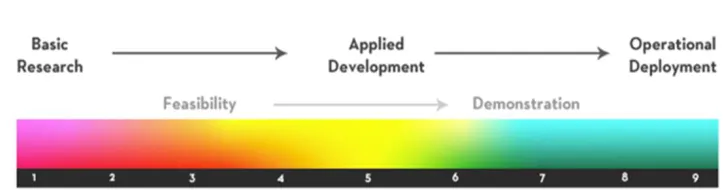
A visual representation of TRL scale is shown in Figure 1 which makes it easier to communicate to investors/clients what stage of development process technology has reached, and how many (and what kind of) stages it still has to go through, and what is the focus of each of the stages. Specifically, TRL 1 means that “scientific research is beginning and those results are being translated into future research and development”, and TRL 9 is “a technology that has been proven during a successful mission” (Mai, 2012).
Figure 1: Technology Readiness Levels, (Florida Atlantic University, 2013)
[image:3.595.111.474.573.668.2]4
and know how much time (as well as what resources) it would take to advance to a certain level of TRL. Moreover, it would also influence the financial site of a process as clients need to evaluate how big the investment could be, or what the impact of a technology would be.
Furthermore, “as a result of current trend towards product miniaturisations, product designers and technology managers demand for a comprehensive classification of micro- and nano-manufacturing technologies” (Islam, 2010). And so, “TRLs have proved to be highly effective in communicating the status of new technologies among sometimes diverse organisations” (Mankins, 2009), but also in providing deeper understanding “of the relative maturity and attendant uncertainties and risks” (Islam, 2010). Hence, the readiness assessment has a crucial role “within the systems engineering decision making process” (Tetlay & John, 2009).
What is more, by visually presenting the process, it is also possible to highlight which levels could be particularly difficult. By using TRLs it is possible to identify where „valley of death‟ usually occurs, and what should be done to overcome it. Therefore, TRLs help to prepare for next stages of development process and to validate if all the up-to-date tests have performed properly. It also helps to address potential risks and find alternative solutions (if needed).
Especially industrial companies have described TRLs as extremely useful or even significant when assessing development of technologies. However, research centres have not been so „enthusiastic‟ about the use of the scale. Based on the preliminary interviews and observations, research centre representatives agreed that industrial frameworks are often too complex and consume too much time. Unfortunately, none of the reviewed literature sources supports that view point. Due to the evidence from literature, the hypothesis is proposed: „readiness‟ is not as important to research centres, as it is to industrial companies, so there could be another aspect that is more important and useful to innovation providers, i.e. „maturity‟ of technology. Superficially this position is easy to accept given companies typically commit projects to customers and markets and therefore have a strong vested interest in the readiness of underpinning technologies. Research centres on the other hand are at least one step removed from this customer process and are both less likely to feel the immediate pressure to deliver, and have a much stronger interest in generic capability.
WHAT IS TECHNOLOGY READINESS AND TECHNOLOGY MATURITY? In addition, the difference between technology readiness and technology maturity will be defined in this paper. Interviews with research centres‟ representatives will be used in order to examine what is more significant for innovation providers and their work: maturity or readiness. By consolidating literature sources and interviews‟ outcomes, features of a new conceptual framework will be proposed.
5
technology has to be „matured‟ before it is „ready‟ to be applied. So, „readiness‟ can be defined as follows:
“Readiness refers to time. Specifically it means ready for operations at the present time” (Nuclear Decommissioning Authority, 2014), or
“Readiness, in the situation of a software environment (yet equally true for hardware), to be a measure of the suitability of a product for use within a larger system “in a particular context”, i.e., with respect to specific requirements. Depending on its application, a product deemed to be mature may possess different degrees of readiness” (Seablom & Lemmerman, 2012).
Furthermore, „maturity‟ is described as follows:
“Maturity is therefore regarded as a part of readiness (...), the system must first be fully „mature‟ before it can be „ready‟ for use” (Tetlay & John, 2009) “Maturity is the verification within an iterative process of the system
development lifecycle and occurs before (…) readiness” (Tetlay & John, 2009).
Both ideas could be characterised as context-specific. For that reason, both („readiness‟ and „maturity‟) would be validated according to initial requirements. Therefore, it could be assumed that „readiness‟ is based on user requirements, and will be validated based on those requirements. Hence, once technology is „ready‟, it means that it achieved those requirements. Thus, it should “answer the question did you build the right thing?” (Tetlay & John, 2009).
At the same time, „maturity‟ would be measured against technical specifications, which often come before user requirements. Therefore, if technical requirements are fulfilled, it could be stated that a certain level of maturity was reached. Hence, “it answers the question did you build it right?” (Tetlay & John, 2009).
In short, a matured technology may not be „ready‟ for use if it does not have features required by clients. And that is why, „maturity‟ always comes before „readiness‟; and it is also a reason why „maturity‟ is (or should be) more important to innovation providers then „readiness‟ as innovative technology is not always developed to meet certain user requirements.
EXISTING METHODS OF DETERMINING TECHNOLOGY READINESS LEVELS
Different versions of TRL-based frameworks (based on the original NASA TRL scale) have been developed and applied in various industry sectors to meet certain user requirements. Especially in the manufacturing sector, research centres often need to work with companies that use those TRL-based frameworks, so it is useful to understand the four mostly used frameworks by industry. Table 2 presents a short summary of four frameworks: TRLs, MRL (Manufacturing Readiness Levels), MCRLs (Manufacturing Capability Readiness Levels) and IMRLs (Innovation Manufacturing Readiness Levels). By putting them all together it is possible to see their key advantages, disadvantages and also where those frameworks can be used. Frameworks included in Table 2 are based on original TRLs developed by NASA, and because of that they would have common drawbacks.
6
7
8
ASPECTS NEEDING RESEARCH ATTENTION
This section describes seven issues related to existing TRL-based methods. Based on literature ((Hicks et al., 2009), (Sauser, et al., 2006), (Olechowski et al., 2015), (Islam, 2010), (Tetlay & John, 2009), (Mankinsab, 2009), etc.) similar problems have been noticed in different frameworks (as presented in Table 2). By using information from previous section, it was possible to point out certain shortcomings of existing frameworks.
Complexity & Time Consuming Issues of TRL-based framework
Usually there is a very high level of detail required to complete the examination of each of readiness levels: “operators use TRL (…) for tracking readiness of all equipment for installation. Every nut and bolt of every equipment is included in an Excel sheet. You can imagine such a spread sheet will become very large” (Olechowski et al., 2015). Hence, when creating (and using) the new maturity framework, a more healthy approach should be adopted as it is simply impossible to include all the existing aspects of a technology, and to measure each one of them. It would be very time consuming and it would “prevent its straight-forward application to a given domain where a wide range of technologies are developed concurrently” (Islam, 2010). Such framework should focus on the most important information (i.e. keep it simple), but at the same time make sure to gather accurate information.
Integration of Technology into a System
Understanding of a whole system plays an important role that seems to be undermined. For example, “TRLs relate to individual technologies. They do not suggest that the individual technologies can be integrated and will work together” (Nuclear Decommissioning Authority, 2014). In addition, once technologies are integrated together, there is another issue of aging of single components. “For example, in the case of software which typically receives regular upgrades the standard NASA-derived TRL metrics would remain at a level of nine irrespective of any future upgrades, refinements or product modifications. This inability to reflect the product lifecycles and arguably the technology lifecycle is in stark contrast to the emerging philosophies surrounding lifecycle management” (Hicks et al., 2009). That also leads to the use of a technology in a „real world‟: “often real world context are not always appreciated until (…) the system is introduced and used, (…) this could be thought of as a failure in system understanding” (Tetlay & John, 2009). Those aspects should be considered if the aim is to have a matured and reliable technology.
Impact of New Technology on Future Applications
9
out how long it should take for technology to be delivered, as well as how beneficial it would be, i.e. what would be its impact (local and/or national).
Valley of Death
[image:9.595.100.496.295.462.2]Valley of death was described as a “difficulty of getting (new) technology from TRL 4 to 7; in this area the investment required is high, but the certainty of success remains low” (House of Commons, 2013), which was also mentioned when considering MRLs. Figure 2 captures the concept of valley of death. In addition, if certain issues are not sorted by reaching TRL 4 (e.g. certain risks are neglected), technology is more likely to fail as the issues would only expand and affect other aspects of technology. Hence, the management of technology is very important and should be executed properly from the very early stages of a project. If a project is managed well (which is also connected to issues related to manufacturing technology management), it means that valley of death could be avoided; if it is not - a project would become unsuccessful and could bring negative impact to innovation providers.
Figure 2: Technology Readiness Levels and Valley of Death, (Mayfield, 2014)
Applicability and Practicality of TRL-based Frameworks
10 Management of Manufacturing Technologies
Finally, one of the aspect that certainly needs more research attention is the management of technologies, in particular “less attention is paid to management of manufacturing technologies” (Fernandez, 2010). Hence, more research should be dedicated to that aspect due to the fact that a lot of elements of technology development process depend on the way technology is managed. And so, often, the failure or success of a research project would depend on the management of resources before and during development process. Thus, by having a well-defined structure that would help with technology management, a technology would have more chances to be developed successfully and to overcome valley of death, i.e. to be able to use in an operational deployment environment, and hence be able to commercialise it further according to clients‟ requirements. Therefore, by having a better management framework, it will be possible to find balance between the practicality applicability of a technology. It means that it will also help with understanding of the purpose of a technology and its function, as well as risks related to its application. “TRLs are a measure of technical risk where the proposed technology is being introduced into an operating plant at the present time. Care must be taken in interpretation if the technology is being developed for introduction at a future date. TRLs, by themselves, may not always relate clearly to risk, cost and schedule. For instance a technology at a low TRL can mature more quickly than those at high TRLs” (Nuclear Decommissioning Authority, 2014). Hence, by not having accurate approach, subjectivity of findings (of TRL scale) could be one of the disadvantages that could lead to further miscommunication/misunderstanding.
Subjectivity in assessing technology readiness
Even though this aspect was not introduced in Table 2, it is important to have an objective tool that would deliver reliable outcomes. (Sauser, et al., 2006) mentioned that “TRL does not accurately capture the risk involved in the adopting of a technology” into a real operational environment. It might be due to the fact that “the requirement for a readiness-based approach in manufacturing results from the need to be specific” (Ward et al., 2011) and TRLs represent a general approach. Hence “direct application of TRLs in manufacturing is open to interpretation” (Ward et al., 2011). Also, (Cronford and Sarsfield, 2004) pointed out that TRLs are subjective when assessing maturity, due to absence of basic instructions for completing the assessment. Hence, the risk of delivering inaccurate and incorrect findings is greater and may harm the development process (Azizian et al., 2009). Furthermore “to be most effective, the overall R&D organization (and its customers) should seek to conduct more or less formal TRAs, employing the TRLs, and not just individual managers evaluating their own options. Within the US Department of Defence, such formal TRA's have in recent years become policy” (Mankinsb
, 2009).
PROCESS OF GATHERING DATA Participants - Background
11
Research Centre (AFRC) that collaborates with University of Strathclyde (Glasgow, Scotland). Some participants came from „non-Catapult‟ centres, but those research centres are also connected to the manufacturing sector.
The two manufacturing companies were chosen based on nature of their business, their involvement with development process, their reputation and fact that they are international manufacturers and have many opportunities to work with a variety of innovations. Most importantly, those two companies were chosen because they both use their own internal readiness measurement process. Due to the confidentiality agreement names of the companies, research centres (apart from AFRC) and the participants will not be mentioned.
Data was collected between 23rd of June and 25th of July 2016. Interviews took place at AFRC or at University of Strathclyde. In total 12 participants took part in those interviews: three participants came from industry and nine came from research centres. Most of the data was collected during face-to-face interviews, however when that was difficult to arrange (due to the location of other research centres/companies) – telephone interviews were organised. Participants were interviewed by one person, and no third party was present when interviews took place. Data provided in next sections are anonymous. That is why quotes from various participants are included in next sections but they are not referenced. All the interviews were audio-recorded, and all participants signed consent form.
Survey
The interviews contained 30 fixed questions. All the questions were based on the findings from literature sources, i.e. if literature presented some knowledge gaps, questions were organised in a way to find out more about that specific aspect. Half of the questions were open-ended questions, while the other half contained closed questions with Likert-scales. Closed questions intended to provide one of the proposed answers, and so that would make analysis easier, and also it was simpler to compare answers amongst all participants. Each interview lasted between 45 and 60 minutes (on average).
The aim of the survey was to obtain knowledge in regards to work of research centres and how they currently manage their technology development processes. Questions also intended to assess the knowledge in regards to TRLs (or any other TRL-based scale), as well as to what extend participants are aware of valley of death.
Another part of survey aimed to find out more about modern challenges of research centres and if a new framework can help to overcome some of those challenges. Finally, participants were asked about reasons why a technology management framework has not been implemented successfully before (to a research centre or to all HVM Catapults).
12 ANALYSIS
Industrial Participants
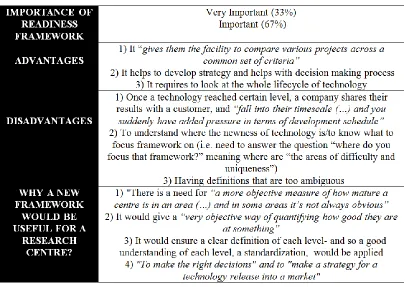
Company A and Company B are both well-established manufacturing companies. One representative from Company A occupies a senior engineering position, and two participants from Company B occupy senior managerial positions and worked as „manager trainee‟. Therefore, the experience of working with readiness measurement frameworks varied from 6 months to 11 years. Hence, having participants with a variety of experiences had an influence on the answers provided during interviews. All three industrial representatives agreed that readiness measurement process is either „important‟ (67%) or „very important‟ (33%), due to the possibility of comparing “various projects across a common set of criteria” and the fact that framework also helps to make sure “that the business makes the right strategic decisions”.
When asked if such framework would be useful at a research centre the opinions were divided: 2/3 answered that it would be „useful‟ or „very useful‟ and 1/3 answered that it would „depend‟. A framework would be considered „useful‟ because there is a need for “a more objective measure of how mature a centre is in an area (…) and in some areas it‟s not always obvious” but “there is still that concern about the IP”.
Then, industrial representatives were asked about what is the most difficult part when working with a framework. The following issues were mentioned:
adjusting to customer's timescale (i.e. once a technology reached certain level, a company shares their results with a customer, and “fall into their timescale (…) and you suddenly have added pressure in terms of development schedule”)
understanding where the newness of technology is/to know what the framework should focus on (i.e. need to answer the question “where do you focus that framework?” meaning where are “the areas of difficulty and uniqueness”?)
getting through TRL 4 to 6
Participants also talked about what advantages and disadvantages frameworks they know (or work with) bring, as well as helpfulness of a framework to all HVM Catapult centres. Answers were included in Table 3.
Industrial participants were also asked about which challenges (faced by modern research centres) a framework could help with; each answer received equal „support‟ i.e. 20%. The following challenges were mentioned:
developing their technologies while keeping an eye on what the disruptive technologies are coming out of the various markets
understanding customer requirements demonstrating results/findings appropriately understanding what are their areas of expertise sustainability
13
[image:13.595.93.503.137.424.2]that it is „very important‟. The reasons why they considered „maturity‟ to be more significant are described in the next section.
Table 3: Summary of key results – Industrial Representatives‟ Perspective
Research Centre Participants
Nine participants were interviewed in total; six of them came from HVM Catapults. Even though, most of the participants had not had an experience of using readiness framework as a tool, participants were aware of various readiness frameworks (either from project management perspective or from their previous experience). However, when asked how long had they been working with readiness framework (directly or indirectly) the answers varied from about 18 months to 15 years.
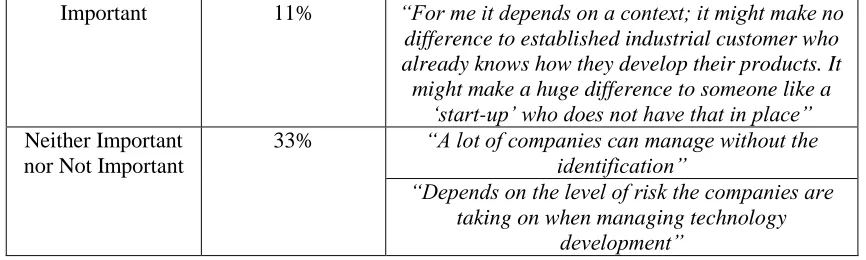
Firstly participants were asked if they considered a readiness measurement process an important process. The results are presented in Table 4.
Table 4: Importance of Readiness Measurement Process – Research Centre Representatives‟ Perspective
ANSWERS PERCENTAGE EXPLANATION
Very Important 45% “It‟s absolutely key to be able to carry out a
development of technologies in a structured fashion”
“It gives a common language so that as long as the levels are well defined anyone can talk to
anyone else about their product or their manufacturing position and R&D programme”
Quite Important 11% “it is not only about the technology readiness
[image:13.595.83.512.615.763.2]14
Important 11% “For me it depends on a context; it might make no
difference to established industrial customer who already knows how they develop their products. It might make a huge difference to someone like a
„start-up‟ who does not have that in place”
Neither Important nor Not Important
33% “A lot of companies can manage without the
identification”
“Depends on the level of risk the companies are taking on when managing technology
development”
[image:14.595.82.515.73.203.2]Participants were also asked about advantages and disadvantages of readiness measurement framework. Next they were asked about the usefulness of such framework at research centre, and what spectrum (which levels) should new framework cover. Table 5 contains answers to those questions.
Table 5: Summary of key results – Research Centre Representatives‟ Perspective
Afterward, participants were asked about implementation of such framework: 45% said it would „not be difficult‟, 33% said it would be „neither difficult nor easy‟. 22% said that they could not answer the question. For those who answered „neither difficult nor easy‟, they gave the following reason for giving that answer:
15 “change is always a challenge”,
“if the framework were light touch and easy and quick to use – it would be very easy; if it is a very detailed long assessment, it would be very difficult”.
Next, participants were asked why such framework has not been implemented successfully before. Table 6 presents the summary of the answers. The two most mentioned reasons were: “no need for a framework that combines technical and business aspect” and that “the benefits and the purpose of previous frameworks were not shown”. Therefore, when creating a new framework, its transparency and outcome have to be clearly shown in order to make sure that the framework would be used again. Also, that answers gives some insight into what features future framework should contain or not.
[image:15.595.86.513.359.466.2]As mentioned before, not all of the participants use TRL-based frameworks (or original TRL scale) in their daily tasks. However, the answers provided suggest that even though participants, who do not use those frameworks, are aware of their existence and benefits. It means that the process of implementation could be easier as some people already understand what TRLs are.
Table 6: Reasons why previous frameworks failed implementation stage – Innovation Providers‟ Perspective
ANSEWRS PERCENTAGE
No need to implement framework that gives business and technical element
38 %
Previously proposed frameworks struggled to show purpose and benefits 38% Customers usually define what method/framework research centre will
use
12%
There is not enough knowledge/training in regards to technology management tools
12%
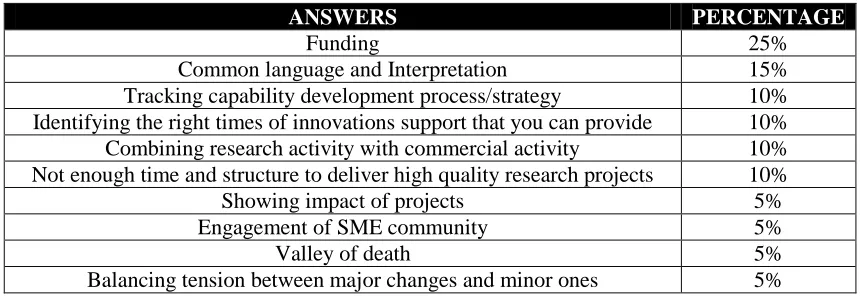
Participants were also asked about challenges a modern research centre struggle with; the answers were listed below in Table 7.
Table 7: Modern Challenges – Innovation Providers‟ Perspective
ANSWERS PERCENTAGE
Funding 25%
Common language and Interpretation 15%
Tracking capability development process/strategy 10%
Identifying the right times of innovations support that you can provide 10%
Combining research activity with commercial activity 10%
Not enough time and structure to deliver high quality research projects 10%
Showing impact of projects 5%
Engagement of SME community 5%
Valley of death 5%
Balancing tension between major changes and minor ones 5%
[image:15.595.83.515.542.690.2]16
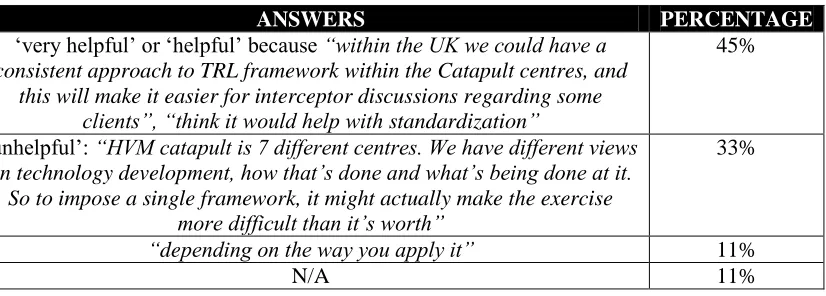
[image:16.595.99.512.149.297.2]Then participants were asked if it would be helpful if the framework was applied to all HVM Catapult centres. The answers are shown in Table 8 below.
Table 8: Would it be helpful if a framework was applied to all HVMC centres -Innovation Providers‟ Perspective
ANSWERS PERCENTAGE
„very helpful‟ or „helpful‟ because “within the UK we could have a consistent approach to TRL framework within the Catapult centres, and
this will make it easier for interceptor discussions regarding some clients”, “think it would help with standardization”
45%
„unhelpful‟: “HVM catapult is 7 different centres. We have different views on technology development, how that‟s done and what‟s being done at it.
So to impose a single framework, it might actually make the exercise more difficult than it‟s worth”
33%
“depending on the way you apply it” 11%
N/A 11%
[image:16.595.83.512.421.491.2]Next participants were asked why HVM had not developed a common framework yet. Majority answered that it is due to the fact that when meeting clients, original TRL scale is used when discussing development process of a technology. The summary of the answers is presented in Table 9.
Table 9: Why HVM Catapults have not developed a common framework yet -Innovation Providers‟ Perspective
ANSEWRS PERCENTAGE
Use of TRL 50 %
Independent Catapult Auditor 17%
Difficulty to standardised all different approaches 17%
Evolution of each centre 16%
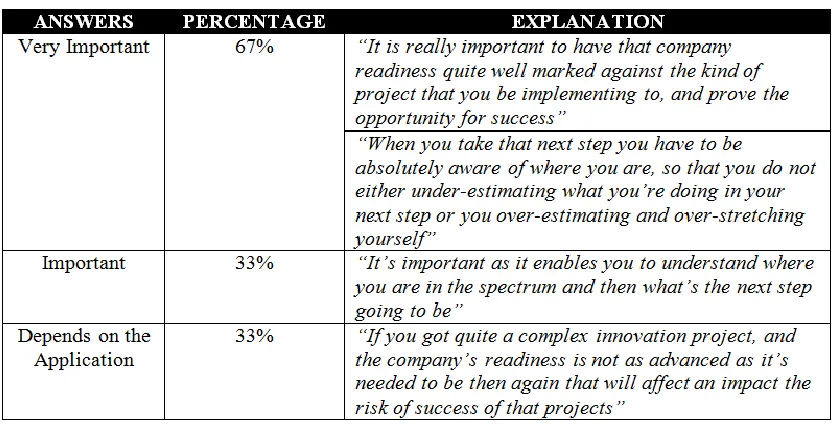
Finally participants were asked about the importance of „maturity‟ and „readiness‟. Findings are presented in Table 10 and 11 below.
[image:16.595.94.513.569.747.2]17
Table 11: Importance of Readiness -Innovation Providers‟ Perspective
On the other hand, when research centre representatives were asked about „readiness‟, 67% said it is „very important‟ and 33% said „important‟. Therefore, there was no hesitation when discussing importance of „readiness‟, however there was still some doubt about „maturity‟.
RESULTS
This section aims to highlight key findings or observations derived from the Analysis part. Previous section highlighted findings based on the participants‟ workplace (either industrial company or research centre). This section presents combined answers from all twelve participants. The purpose of this section is to show evidence that there is in fact a need for a new framework that could be used for managing technology development process at research centres in the manufacturing sector. Moreover, by discussing with participants benefits of already existing frameworks, it was also easier to detect which features of current frameworks could be kept and which should be avoided.
In order to clearly show collected evidence, this section was divided into the following sub-sections:
Difference between technology maturity and technology readiness Deliverables of existing frameworks help to achieve
Obstacles that affected successful implementation of previous readiness frameworks at research centres
Modern challenges of research centres in the manufacturing sector Features of a new maturity framework
18 Difference between readiness and maturity
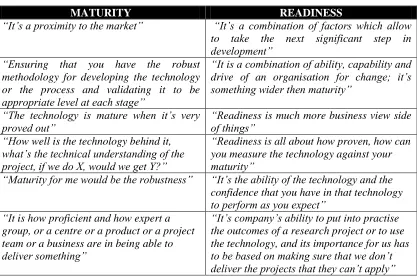
[image:18.595.94.511.201.478.2]The comparison between „maturity‟ and „readiness‟ was already described (by literature). However, it was also important to investigate how participants understand those two concepts, if they consider those two as totally different aspects or not. And so, participants were asked to describe concept of „maturity‟ and „readiness‟ in their own words. Table 12 includes description of „maturity‟ and „readiness‟ by industrial and research centre participants.
Table 12: Definitions of Maturity and Readiness
MATURITY READINESS
“It‟s a proximity to the market” “It‟s a combination of factors which allow to take the next significant step in development”
“Ensuring that you have the robust methodology for developing the technology or the process and validating it to be appropriate level at each stage”
“It is a combination of ability, capability and drive of an organisation for change; it‟s something wider then maturity”
“The technology is mature when it‟s very proved out”
“Readiness is much more business view side of things”
“How well is the technology behind it, what‟s the technical understanding of the project, if we do X, would we get Y?”
“Readiness is all about how proven, how can you measure the technology against your maturity”
“Maturity for me would be the robustness” “It‟s the ability of the technology and the confidence that you have in that technology to perform as you expect”
“It is how proficient and how expert a group, or a centre or a product or a project team or a business are in being able to deliver something”
“It‟s company‟s ability to put into practise the outcomes of a research project or to use the technology, and its importance for us has to be based on making sure that we don‟t deliver the projects that they can‟t apply”
Participants were also asked why those two concepts are important. Table 13 compares the reasons that were given when participants were asked why both – „maturity‟ and „readiness‟ were important.
Table 13: Maturity and Readiness – Why are they important?
MATURITY READINESS
“It is about a level of risk, so if you are describing the mature technology to a company that has never used it before, then that would indicate to them a reduction in the level of risk of adoption because it has been proven out”
“When you take that next step you have to be absolutely aware of where you are, so that you do not either under-estimating what you‟re doing in your next step or you over-estimating and over-stretching yourself”
“Moving from one level to the next, it needs to be in terms of meeting certain criteria, so that is possibly the hardest part of the process”
“You need to match the ability, the capability and drive of a company to the activity of innovation, R&D and implementation”
“The concept of maturity underpins all sorts of that discussions”
[image:18.595.92.511.563.762.2]19
“It requires clear set of criteria” “If no one is able to implement a project then project will have no value”
“It is how proficient and how expert a group, or a centre or a product or a project team or a business are in being able to deliver something”
“Readiness is more subjective because it depends on the research centre”
It was also interesting to notice that industry representatives all considered „maturity‟ to be „very important‟, while with „readiness‟ not everyone said it was „very important‟. For a research centre, majority of participants (67%) answered that „readiness‟ is „very important‟ and only 56% answered that „maturity‟ is „very important‟. What is more, not all participants who answered that „maturity‟ is „very important‟ also said the same about the concept of „readiness‟, i.e. 25% who said that „maturity‟ is „very important‟ did not say that „readiness‟ is „very important‟. They describe importance of „maturity‟ as “paramount in everything that we do” and the importance of „readiness‟ as “the sequence of and timing of when we are going to use something” and as a somewhat tool that “enables you to understand where you are in the spectrum and what the next step is going to be”. Hence, not everyone who considered „maturity‟ as „very important‟ thought the same of „readiness.‟ What is more, it could be assumed that „maturity‟ is an internal part of „readiness‟ and it takes place before technology is „ready‟.
Moreover participants, who answered „depends‟ to importance of „maturity‟, explained it by saying that “based on what they need- it was the right thing at the right time - actual maturity of the technology might be a more mature thing, but it‟s not necessarily a high-tech solution.” Hence, it depends how applicable technology actually is, or what is the potential to implement such technology. Therefore, „maturity‟ could be considered as a quality or impact that technology gives, (which involves its applicability or potential to be implemented in the future) or performance that is obtained by it. Also, it could be connected to level of risk associated with a certain maturity stage, which could be considered as more valuable to a client. Thus, it might be considered that „maturity‟ aspect is much more important for a research centre than „readiness‟, especially considering the fact that a research centre works with a multiple industrial partners and it could be more important for it to develop a mature technology that could be customised later on (at commercial stage) by individual industrial partners. Consequently, it might be possible that a framework that a research centre needs is the one that would measure maturity of a technology, instead of the readiness.
Deliverables of existing frameworks
According to respondents, already existing frameworks help greatly with:
structuring the developemnt of a product of process across the whole lifecylce determinining what kind of imporvement technology „needs‟ at the moment justyfing what type of resources/materials would be needed
providing a common language with a customer
20
acknowledged by all participants, there are still certain reasons why readiness frameworks have not been successfully implemented in research centres.
Obstacles toward the implementation of readiness framework
[image:20.595.87.510.237.332.2]Despite the fact that various benefits of current readiness framework were indicated by participants, it is useful to know „why readiness measurement process has not been implemented successfully before at a research centre?‟ Table 14 shows the answers given by all participants.
Table 14: Obstacles that prevented successful implementation of a readiness framework at a research centre
ANSWERS PERCENTAGE
Struggled to show purpose and benefits of it 34%
No need to implement framework that gives business and technical element
33%
Unwillingness from technical team to change 11%
Not enough knowledge/training in regards to those processes 11%
Customers define what research centre will use 11%
The first two answers (i.e. „struggled to show purpose and benefits of it‟ and „no need to implement framework that gives business and technical element‟) were parameters that should be considered when building a new framework. Actually those aspects are connected with each other, and so the purpose of future framework should clearly show what parameters would be measured and what will be the outcome of the new framework. That is also connected to transparency of the new framework and the function that it would have. Transparency is in fact another issue that was mentioned by literature (Mankinsa, 2009), and so it is important to implement that aspect within new framework.
However, the last three answers (i.e. „Unwillingness from technical team to change‟, „Not enough knowledge/training in regards to those processes‟, „Customers define what research centre will use‟), mentioned factors that would influence the use of new framework, but there are not connected to the design- aspect of a framework. Those are factors that could only be influenced by involvement of senior management team and, perhaps, organisation changes, as well as knowledge exchange workshops (in order to introduce new framework to researchers)(Cameron et al., 2015).
Nevertheless, the last answer in Table 14, i.e. „customers define what research centre will use‟, would not be an issue when considering collaboration with SMEs and/or other research centres, or even when working on internal projects. As discussed before, most of research centres do not use any technology management framework (most of them try to use road-mapping approach (based on the answers from interviews), and SMEs are usually not capable to produce their own technology management framework (based on the answers from interviews).
21
and it could attract new clients to a research centre. In addition, a broader spectrum could help with „seeing the bigger picture‟ and making sure that the important steps are taken.
Modern challenges of research centres in the manufacturing sector
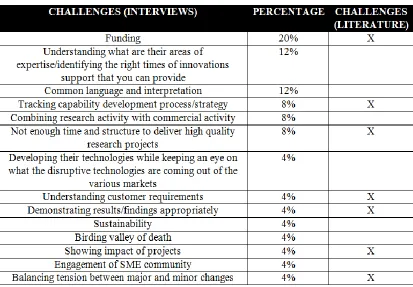
[image:21.595.94.507.285.572.2]Furthermore, challenges of modern research centres were also discussed with participants. A connection between „what is lacking‟ and „what could a new framework help with‟ will then be also made to justify the conceptual design of the framework. In relation to challenges, there is also a question of new framework helping with a general work of a research centre, or should a new framework only help with challenges that are linked to technology development process. Table 15 summarizes challenges discussed by all the participants, as well as those ones that were also mentioned in the literature.
Table 15: Challenges of modern research centre – Combined Answers
Based on the challenges provided in Table 15, and also considering opinions of experts, it was decided that a conceptual framework that would measure maturity of capability of a research centre would bring more benefits than a framework that measures only maturity of technology. That kind of framework that includes maturity as an input would also help to deal with challenges that modern innovation providers face nowadays (e.g. understanding the area of expertise).
22
aspects are not reaching their maturity, and why their capability is low (as qualitative inputs could be changed into numerical level of maturity and then calculated into a weighted outcome which would be a capability of each individual input). That would also determine what the overall performance of a research centre is and how individual capabilities influence performance development.
23
24 Features of a new conceptual framework
Throngate‟s postulate stated that “it is impossible for a theory (…) to be simultaneously general, accurate and simple and as a result organizational theorists inevitably have to make trade-offs in their theory development” (Lundberg & Young, 2005). Furthermore, as described in previous sections, many industrial frameworks are in fact accurate (very specific and detailed) but are also general in their approach. In addition, none of those frameworks have been implemented in research centre and used as „research centre‟s framework‟ or used as a basis for new framework for innovation providers. Therefore, another general and accurate framework would not be useful for a research centre. However, a simple and accurate framework could bring some benefits, as increased competitiveness and productivity, if it is implemented properly. By having a simple framework, there would be more likely to create a framework that is also user-friendly and easy to work with. Another „overwhelming‟ approach could only add time and effort to every-day tasks, which is something that should be avoided.
Most importantly, the outcome of the framework should indicate how mature a capability of a research centre is. Based on the opinions of participants, maturity seems to be more important in regards to technology development/management and it could have bigger impact. Also, maturity of different inputs (skills, equipment, etc.) would influence the performance of a research centre.
Furthermore, the success of a framework would depend on various factors, most important ones being
“Utility: will it do what is needed functionally? Usability: will the users actually work it successfully? Likability: will the users feel it is suitable?” (Shackel, 2009)
Flexibility: is framework flexible enough to use different types of information?
Applicability: is it possible to apply framework at seven research centres? Precision: how precise is the outcome provided by the framework?
[image:24.595.92.507.641.708.2]Hence, those aspects would be evaluated when framework is applied by innovation providers. Case studies will be used at AFRC (and later on at other HVM Catapults) in order to evaluate the missing features and also to verify the reliability of the conceptual framework. Afterwards necessary changes will be applied and the framework would be implemented again. Such process would be repeated till accurate and reliable results are provided. The framework development process is presented in Figure 4 below.
25
Therefore, future work will be based on another set of interview with representatives of each of the HVM Catapults. Interviews were already arranged and they took place between 15th and 27th of February 2017. New survey containing 51 questions was used; hence a structured interviews approach was applied. Also, survey was divided into five sections:
Section 0: Introduction Section 1: Valley of Death Section 2: Success Factors
Section 3: Technology Development Issues and Research Centres‟ Capability Section 4: Road-mapping Process
On average, each interview lasted between 60 and 90 minutes (on average). New survey contained more questions as it was more detailed and its purpose was to determine what aspects/factors are responsible for delivering successful projects at a research centre, and if those factors could be included in the new conceptual framework. By asking more specific questions it will be possible to
analyse inputs (i.e. what aspects should be measured by a new framework), what new framework should do (i.e. what should be the function of new
framework),
what the output should be (i.e. deliverables of the framework)
what would be the impact of the outcome delivered by the framework (i.e. why it is important to have that outcome).
By answering those questions, it will be possible to design a conceptual maturity framework, and afterwards consider test trials at one of the research centres.
DISCUSSION
The aim of this paper was to examine why TRL-based frameworks have not been applied successfully at research centres before, even though they are used constantly in various manufacturing industries. It was found that industrial frameworks are in general too detailed, as well as context specific for a particular technology or the nature of business. Because of the complexity of those frameworks, they are not applicable elsewhere. They have been created only to successfully complete management of various technologies but in a specific set of criteria relevant to a particular company. Hence, those frameworks are very context specific, and so objectives (also financial ones) could be considered as factors that drive those industrial projects. On the other hand, innovation providers have different set of factors that drive research project forward. But, it is also significant for research centres to deliver successfully developed technologies to their clients. And, just like different companies, every research project would take into consideration different success factor that vary depending on the nature of the project. At the same time, a technology must reach a high quality level, if it is going to be applied further. Thus, technology maturity could be one of the success factors that actually drive the performance of innovation providers and helps to overcome valley of death. Especially those projects that innovation providers work on have to present high level of maturity. Hence, maturity level should be included when evaluating capability of a research centre. However, if such framework will be applied, there will be other challenges that need to be considered:
26
input parameters have to be carefully considered and measured appropriately, a mathematical model needs to be adapted well enough so people do not abuse
the framework to show higher capability,
target setting have to be performed carefully so it encourages productivity and increases effectiveness of innovation providers.
Furthermore, there is also an issue if it would be possible to create a framework applicable to all HVM Catapult centres in the UK. On one hand, there could be issues concerning development of such framework. Just like in the industry sector, each industrial framework is created for specific company, i.e. it (a framework) concentrates around the nature of business and organization of a particular company. But, each company also manages a great number of various technologies that go through their own TRL-based framework. Thus, a framework with certain fundamental features could be created, and depending on the nature of research centre adjustments could be applied. If each centre would use a framework, which was created considering common aspects, a certain standardisation of research centres would take place. And so, it would be possible to compare capability of each HVM Catapults based on the maturity level they achieved.
In addition, companies (also SMEs) that want to collaborate with HVM Catapults could easily decide which of the Catapults would be the best partner for a certain type of project. Moreover, it would help to observe which research centre „struggles‟ at certain processes and what could be done to improve it, and to increase its competitiveness. Therefore, an explanation for future funding could be justified. This paper also highlighted the importance of research centres in manufacturing sector in the UK, but also showed what kind of challenges those innovation centres struggle with. The most repeated ones were the problem with managing technologies, i.e. overcoming valley of death: “bridging research and technology commercialisation and de-risking this process” (House of Commons, 2011). In addition, it was showed that there is in fact “the need for technology management FOMs that concern the riskiness of a new technology development. There is a real need for practices and metrics that allow assessment of anticipated research and development uncertainty” (Makninsb
[image:26.595.82.513.589.732.2], 2009). Therefore, Table 16 summarises key results obtained during this research project.
Table 16: Summary of Key Findings
KEY FINDINGS
Industrial frameworks are in general too detailed and complex to use at research centres Maturity has bigger value to research centres than readiness
New framework has to focus on practicality and future applicability of a technology New framework should contain optional features that will be used depending on the nature of
technology developed by research centre
A framework will provide standardisation basis for all HVM Catapults and their capabilities A framework will show which research centre is better at certain processes and which one
need improvement (i.e. justification for future funding)
27
[image:27.595.84.515.134.576.2]Furthermore by considering answers from interviews, basic features of conceptual framework and expected benefits that it will provide were indicated in Table 17.
Table 17: Features of Conceptual Framework and Expected Benefits
FEATURES BENEFITS
Standardised terminology Gives a common language not only in one research centre but across HVM Catapults
All aspects are described in the same way hence it is easier to understand results when discussing them with clients or when applying for funding Prevents any miscommunication
Use of weighted capability & other mathematical approaches
Gives objective results
Presents output as a number hence easy to understand what is the capability of a research centre
Indicates how research centre is improving on a year to year basis
All HVM Catapults are evaluated in the same way Possible to map the outcome on the TRL/MRL
scale
Access to necessary documents Indication of what else needs to be added/what evidence are still missing
Calculating “known” to
“unknown” ratio Identification of what the uncertainties are and how it influences the project Possible to obtain individual
capabilities
Focus is not only on „negative aspects of a projects‟ (like in the case of TRLs or MRLs) but also on „positive aspects‟ i.e. high capabilities
Provides reason why a project is managed by using certain approach
Inputs can be modified Possibility to calculate new capability once evidence is provided that modifications have been made
Uses logical approach by allowing to see what happens with inputs
and capabilities are calculated
Easy learn it and to make it intuitive Does not require many steps
Easy to repeat
Includes financial aspects Helps to justify necessary funding
Assists with discussing investments with partners
CONCLUSIONS
28
understand why industrial approaches could not be implemented in research centres. Furthermore, interviews also delivered information about what modern research centres struggle with the most, and what a new conceptual framework could help with, in order to increase research centre‟s productivity. Interviews also provided reasons to justify why a new framework should focus on maturity instead of readiness, and what is the difference between readiness and maturity. The features and structure, as well as format, of a new framework still have to be carefully considered in order to create a framework that is practical, precise and applicable, but also delivers level of capability as an outcome. Thus, next stage of research would focus on conceptual design of such a tool for innovation providers in the manufacturing sector. The main goal of the conceptual maturity framework would be to allow research centre to enter Industry 4.0 and help them to overcome some of the modern engineering issues, e.g. „valley of death‟ but also digitalisation of manufacturing processes. However, it should be mentioned that findings of this research are limited to availability of participants, i.e. depending if research centres representatives can take part in the interviews. Findings also depend on the total number of participants, but also how much time they could dedicate to discuss this research gap. Outcomes of this research would also depend on the experience of the participants. Furthermore, once the technical aspects of framework are outlined, the test trials will have to take place to verify new framework. Hence, the willingness of research centres to test new framework would be a key aspect in this research.
To summarize, the key findings presented in this paper were:
The concept of technology maturity is more important to innovation providers than the concept of technology readiness
Maturity will be one of the inputs measured by the new framework
There is a need for a new framework that would measure capability of a research centre, and so highlight its area of expertise but also areas that need improvement
29 REFERENCES
Altunok, Taner and Cakmak, Tanyel (2010). A technology readiness levels (TRLs) calculator software for systems engineering and technology management tool. Advances in Engineering Software, 41(5), 769–778
Azizian, Nazanin, Sarkani,Shahram and Thomas Mazzuchi, Thomas (2009). A Comprehensive Review and Analysis of Maturity Assessment Approaches for
Improved Decision Support to Achieve Efficient Defense Acquisition. Proceedings of the World Congress on Engineering and Computer Science Vol II, WCECS San Francisco, USA, 1-5
Cameron, Esther and Green, Mike (2015).Part 1: The Underpinning Theory. Making Sense of Change Management: A complete guide to the models, tools and techniques of organizational change, 4th edition, ISBN: 978-0-7494-7258-0, 17-19, 22-24, 37-39. Cornford, Steven and Sarsfield, Liam (2004). Quantitative methods for maturing and Infusing Advanced Spacecraft Technology. IEEE Aerospace Conference Proceedings, 663-681
Brown, Bradford (2010). Introduction to Defence Acquisition Management. 10th Edition, Published by the Defence Acquisition University Press Fort Belvoir, Virginia, ISBN: 978-0-16-084076-0, 11
Dombrowski, Uwe, Intra, Carsten, Zahn Thimo, Zahn and Krenkel, Philipp (2016). Manufacturing strategy – A neglected success factor for improving competitiveness. Procedia CIRP, 9-14,
Ernest & Young (2015). Megatrends 2015: Making sense of a world in motion. Ernest & Young: Building a better world. Accessed: December 2016. Available online at http://www.ey.com/Publication/vwLUAssets/ey-megatrends-report-2015/$FILE/ey-megatrends-report-2015.pdf
Fernandez, Joseph A. (2010). Contextual Role of TRLs and MRLs in Technology Management. National Security Studies and Integration Centre. Sandia National Laboratories, USA, 10-13
Florida Atlantic University (2013) Ocean Energy Industry, Southwest National Marine Renewable Energy Centre, Accessed: August 2016. Available online at: http://coet.fau.edu/ocean-energy/ocean-energy-industry.html
Gove, Ryan and Uzdzinski, Joe (2013). A Performance-Based System Maturity Assessment Framework. Procedia Computer Science, 16, 688–697
Hajkowicz, Stefan (2015). A moment of serendipity (and seven megatrends). Global Megatrends: Seven Patterns of Change Shaping Our Future, CSIRO Publishing, ISBN: 9781486301409, 33-42
30
House of Commons, Science and Technology Committee (2011). Technology and Innovation Centres, Second report of session 2010-2011, Published on February 2011, 13-23
House of Commons, Science and Technology Committee (2013). Bridging the valley of death: improving commercialisation of research, 8th report of session 2012-2013, Published on March 2013, Written evidence submitted by Rolls-Royce,
Manufacturing Capability Readiness Level (MCRL), page Ev183
High Value Manufacturing Catapult website (2017). Accessed on 07/02/2017, Available online at: https://hvm.catapult.org.uk/
Islam, Nazrul (2010). Innovative manufacturing readiness levels (IMRLs): a new readiness matrix. International Journal of Nanomanufacturing, Online ISSN: 1746-9406, 6(1),362-375
Korn Ferry Hay Group, (2016). The Six Megatrends You Must Be Prepared For, Report, Available online: http://www.haygroup.com/en/campaigns/the-six-global-megatrends-you-must-be-prepared-for/
Kostoff, Ronald N. and Schaller, Robert R. (2001). Science and technology roadmaps. IEEE Transactions on Engineering Management, 48(2), 132-143
Lind, Frida, Styhre, Alexander and Aaboen, Lise (2013). Exploring university-industry collaboration in research centres. European Journal of Innovation Management, 16(1), 70 – 91
Lundberg, Craig C. and Young, Cheri A, (2005). Throngate‟s Criteria and Their Trade-offs, Foundations for Inquiry: Choices and Trade-offs in the Organizational Sciences, Stanford Business Books, ISBN: 0-8047-4153-0, 211-212
Mai, Thuy (2012). Technology Readiness Level, NASA website, Accessed August 2016, Available online at:
https://www.nasa.gov/directorates/heo/scan/engineering/technology/txt_accordion1.ht ml
Malone, Patrick, Smoker, Roy, Apgar, Henry and Wolfarth, Lawrence (2011). The application of TRL metrics to existing cost prediction models: A Practitioners Guide to Applying Cost Correction Factors to Technology. IEEE Aerospace Conference,1-9 Mankinsa, John C. (2009). Technology readiness and risk assessments: A new
Approach. Acta Astronautica, 65(9–10), 1208–1215
Mankinsb, John C. (2009). Technology readiness assessments: A retrospective. Acta Astronautica, 65(9–10), 1216–1223
Mayfield, Andrew (2014). Introducing the High Value Manufacturing Catapult Centres. High Value Manufacturing Catapult. HVM Catapult website
31
NASA (2012). Technology Readiness Levels. NASA website. Accessed February 2017, Available online at
https://www.nasa.gov/directorates/heo/scan/engineering/technology/txt_accordion1.ht ml
Olechowski, Alison, Eppinger, Steven D. and Joglekar, Nitin (2015). Technology Readiness Levels at 40: A study of State-of-the-Art Use, Challenges and
Opportunities. IEEE, Portland International Conference on Management of Engineering and Technology (PICMET), 2084-2093
Sauser, Brian, Verma, Dinesh, Ramirez-Marquez, Jose and Gove, Ryan (2006). From TRL to SRL: The Concept of Systems Readiness Levels. Proceedings of the
Conference on Systems Engineering Research (CSER), Los Angeles, CA, USA, 1-9 Seablom, Michael S. and Lemmerman, Loren A. (2012).Measuring technology maturity and readiness for mission infusion. IEEE International Geoscience and Remote Sensing Symposium (IGARSS), 5646-5649
Shackel, B., (2009). Usability – Context, framework, definition, design and evaluation,interacting with Computers 21, 339-346 (Originally published in B. Shackel; S.J. Richardson (Eds.), Human Factors for Informatics Usability, 21-31) Tetlay, Abideen and John, Philip (2009). Determining the lines of system maturity, system readiness and capability readiness in the system development life cycle. 7th Annual Conference on Systems Engineering Research (CSER), 1-8