German Edition: DOI: 10.1002/ange.201706064
Metalation
International Edition: DOI: 10.1002/anie.201706064LiTMP Trans-Metal-Trapping of Fluorinated Aromatic Molecules:
A Comparative Study of Aluminum and Gallium Carbanion Traps
Ross McLellan, Marina Uzelac, Alan R. Kennedy, Eva Hevia,* and Robert E. Mulvey*
Dedicated to Professor Snieckus on the occasion of his 80th birthday
Abstract: Fluoroaromatic scaffolds pose a challenge to lithiation due to low stability of lithiated intermediates. Here we apply trans-metal-trapping (TMT) to a series of key fluorinated aromatics. In TMT, LiTMP performs the metal-ation, while an organometallic trap intercepts the emergent carbanion. This study contrasts the trapping abilities of iBu2AlTMP and Ga(CH2SiMe3)3, structurally mapping their TMT reactions and probing relative stabilities of metalated fluoroaromatic intermediates by NMR studies. Results show the installed Al@C(aryl) bonds are more prone to decompo-sition by benzyne formation and Li-F liberation, than the Ga@C(aryl) species. The latter are thus better for onward reactivity as demonstrated in cross-coupling reactions with benzoyl chloride that produce ketones.
I
n 2017, we witness the centenary of the advent of organo-lithium chemistry by Schlenk and Holtz.[1]Since thenorgano-lithium reagents have played leading roles in the synthesis of organic compounds especially through metalation (C@H to C@metal) applications.[2] Fluorinated aromatic compounds
represent a special challenge to organolithium reagents on account of the instability of metalated intermediates.[3]This
point and the profound complexity involved (e.g., benzyne formation, autometalation, cascade processes) are exempli-fied in SchlosserQs classic report of multiple hydrogen/lithium interconversions induced by lithiation of 1,3,5-trifluoroben-zene.[4] Significantly, fluoroaromatic compounds are rarely
found in nature,[5] meaning that nearly all aryl fluorides
utilized in pharmaceutical manufacture (as synthetic building blocks) must be generated synthetically. Incentivized by the growing importance of fluorinated aromatic compounds in active pharmaceutical ingredients (where it is estimated that 20–25% of forthcoming drugs contain at least one F atom),[6,7]
we pondered whether emerging metalation methodologies
could improve on the performances of the classical organo-lithium reagents. Notable advances to this end have been made with respect to either reaction rate or regioselectivity. Collum and co-workers demonstrated a rate enhancement on lithiating various fluorinated aromatics using lithium diiso-propylamide in THF at@7888C by adding catalytic quantities of LiCl.[8] Knochel and co-workers disclosed that specific
aryllithium species can be selectively trapped from a mixture of isomers by transmetalation with a substoichiometric quan-tity of dichlorozirconocene.[9] Here we approach these
challenging metalations through trans-metal-trapping (TMT), where two non-interacting organometallic reagents work in tandem (Scheme 1).[10] The first stage of TMT
harnesses the bulky amide base, LiTMP (TMP= 2,2,6,6-tetramethylpiperidide) to deprotonate a substrate (these metalations can exist in equilibria lying towards starting materials). The second stage utilizes a bulky, soluble Lewis acidic organometallic trap to rapidly intercept and stabilise emergent carbanions, thereby driving equilibria toward metalated products. Still in its infancy, TMT has only been reported with a handful of organic/organometallic substrates usingiBu2AlTMP as the trap[11a,b]and with a series of diazines
using a Ga(CH2SiMe3)3trap.[11c]We also note that KnochelQs
Group used a similar Al reagent,iBu2AlCl, to trap aromatic
carbanions after lithium halogen exchange, though this proceeded with LiX elimination and thus gave neutral Al species as opposed to the ate species discussed here.[12]Here,
in applying TMT to challenging fluorinated aromatic sub-strates we present the first comparative study between Al and Ga traps, structurally mapping TMT reactions both crystallo-graphically and spectroscopically, elucidating the complex reaction pathways that diminish the effectiveness of the Al trap, and establishing that the greater carbophilicity and, or the reduced fluorophilicity of the Ga trap makes its products Scheme 1. Generic concept of trans-metal-trapping (TMT).
[*] Dr. R. McLellan, Dr. M. Uzelac, Dr. A. R. Kennedy, Prof. E. Hevia, Prof. R. E. Mulvey
WestCHEM, Department of Pure and Applied Chemistry University of Strathclyde, Glasgow, G1 1XL (UK) E-mail: [email protected]
Supporting information and the ORCID identification number(s) for the author(s) of this article can be found under:
https://doi.org/10.1002/anie.201706064.
the preferred candidates for performing follow on reactions with electrophiles.
Initial TMT studies focused on the LiTMP/iBu2AlTMP
system with a range of fluorinated aromatic substrates. Reaction of 3-F-anisole with LiTMP and iBu2AlTMP in
hexane at@7888C gave a solid that1H NMR analysis confirms
contains metalated substrate (in the 2-position) as indicated by three new resonances between 6.94 and 6.19 ppm.19F and 7Li NMR spectra support formation of one product,
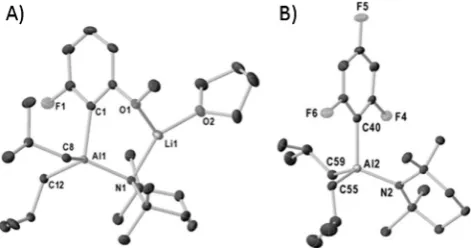
display-ing one resonance in each case. X-ray crystallography revealed this product to be the contacted ion pair 1
[2-{(iBu)2Al(m-TMP)Li·THF}-3-fluoroanisyl] (Figure 1A),
confirming regioselective ortho-metalation of 3-F-anisole. Al bonds to the 2-position of the substrate (C1@Al1 2.0872(17) c).
Solvated by the MeO oxygen atom and a THF molecule, Li further bonds to am-TMP ligand. TwoiBu groups complete the distorted tetrahedral Al coordination. Demonstrating generality, substrate scope was extended to fluoroarenes containing 2–4 fluorine atoms (Scheme 2): 3,5-difluoroanisole (giving [4-{(iBu)2(TMP)Al}-3,5-difluoroanisyl][Li(THF)4],
2), 1,3,5-trifluorobenzene (giving [2-{(iBu)2
(TMP)Al}-1,3,5-F3-C6H2][Li(THF)4], 3), and 1,2,4,5-tetrafluorobenzene
(giving [3-{(iBu)2(TMP)Al}-1,2,4,5-F4-C6H1][Li(THF)4], 4).
Due to the lack of a suitably positioned Lewis basic group on the substrate, all three adopt solvent-separated ion pair (SSIP) structures (Figure 1B shows the anion of 3) with a Li(THF)4 countercation (see the Supporting Information
for details). Note, the C(aryl)–Al distances reveal an increas-ing trend with additional F substituents from1–4(1 2.0872-(17) c;22.076(4) c; 32.090(3) c;42.106(4) c). Thus it is anticipated that as the F content increases the carbanionic
charge decreases, and in theory the trapping step should become less facile. Unfortunately full characterization of2–4
was hampered by poor yields and propensity of crystals to decompose into oils.
The moderate yields of1–4prompted more investigation. Using1as a representative example, the1H NMR spectrum
of its reaction filtrate revealed four aromatic resonances each integrating to one H, consistent with an asymmetric 1,3-disubstituted anisole. From this we suggest that a secondary competing process is occurring. After initial metalation with LiTMP, rapid loss of aluminate LiAlF(TMP)iBu2occurs to
generate a benzyne intermediate and TMPH, which can add across and trap the incipient benzyne affording 1-(3-methoxy-phenyl)-2,2,6,6-tetramethylpiperidine (I; confirmed by aque-ous work-up and 1H and13C NMR spectra of the resulting
oil). Importantly, this process could not be arrested even at cryogenic temperatures. A control reaction between 1 and TMPH in C6D6in a J. Young NMR tube established thatIcan
be prepared via this pathway (see the Supporting Informa-tion). However, we cannot rule out the possibility that an autometalation process may also be contributing to the formation of the TMP-substituted product. LiTMP is more nucleophilic than neutral TMPH, thus any present in solution (due to variations in stoichiometry or rapid generation of the benzyne before the LiTMP has all reacted) could also react with the benzyne, whereupon the generated lithiated species could deprotonate a second substrate molecule.
The decomposition pathways were probed further. Reac-tion between 3-F-anisole, LiTMP, andiBu2AlTMP·THF was
monitored over time in a J. Young NMR tube in C6D6at room
temperature. Initially the1H NMR spectrum displayed signals
corresponding to1and coproductI, albeit after forming the metalated compound slowly decomposes. Confirming that coproduct TMPH, or potentially some unreacted LiTMP, is necessary for formation ofI, the1H NMR of1was recorded
over 48 h. During this time resonances of1are essentially lost, and crucially no resonances corresponding to I emerge. Decomposition of1was confirmed operate via formation of a benzyne intermediate as demonstrated in an intentional trapping experiment by reacting either1or the in situ reaction mixture with 1,3-diphenylisobenzofuran in hexane (Scheme 3). After filtration a solid was collected and identi-Figure 1. A) Molecular structure of1.B) Structure of aluminate anion
in3. Hydrogen atoms are omitted for clarity and thermal ellipsoids at 30% probability.
Scheme 2. Synthesis of2–4.
[image:2.595.54.290.249.373.2]fied by NMR spectroscopy as the known Diels–Alder cyclo-addition product 1-methoxy-9-10-diphenyl-9-10-epoxyan-thracene in 86% (from 1) or 49% (in situ mixture) yield. That1, an aryl aluminum decomposes via benzyne formation is interesting albeit not entirely unknown. A related process was seen during the sodium mediated ortho-zincation of chlorobenzene using [TMEDA)·Na(m-TMP)(m -tBu)Zn-(tBu)].[13] Metalation of fluoroarenes using the LiTMP/ iBu2AlTMP TMT system is thus more complex than seen
with other non-fluorobenzene-based systems. Specifically, trapping appears too sluggish to prevent benzyne formation and autometalation side reactions even at low temperature. Further, even metalated products are unstable in relatively innocent hydrocarbon solvents suggesting that the propensity of the aluminated species to eliminate Li-F as part of an aluminate has a particularly deleterious effect on C-Al bond stability.
Next, N,N,N’,N’’N’’-pentamethyldiethylenetriamine (PMDETA) was added to the reaction mixture containing LiTMP, iBu2AlTMP, and a fluoroaromatic (3-F-anisole,
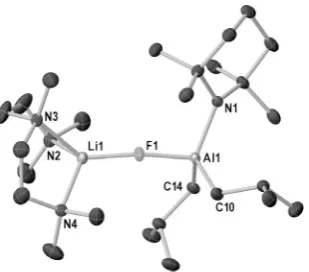
fluorobenzene, or 1,3,5-trifluorobenzene). We reasoned that the donor would draw Li away from the carbanionic centre, hastening transmetalation with Al. With 3-F-anisole, [PMDETA·Li(F)Al(iBu)2TMP],5was obtained (Scheme 3).
X-ray crystallography revealed a CIP aluminate containing am-F (expelled from the metalated anisole) between metal ions (Figure 2). Note that 5 can alternatively be made by adding PMDETA to 1 in hexane, whereas it cannot be accessed via co-complexation of LiF, PMDETA, and the Al trap.
Importantly,5establishes that TMT can be used not only to trap carbanions but also to trap novel monomeric modifications of high lattice energy salts, that is, species that usually exist as polymeric or network lattices. This study unequivocally maps out structurally and spectroscopically the varied reaction pathways available to metallo-fluoroarenes, by trapping both organic and inorganic components of decomposition alongside that of the target metalated product. Clearly the new TMT-installed Al@C bonds are sensitive enough to facilitate decomposition by benzyne formation and concomitant ate elimination.
Next we turned to the gallium trapping reagent (Ga-(CH2SiMe3)3). Reaction of LiTMP and Ga(CH2SiMe3)3with
fluorobenzene in hexane at@7888C for one hour, followed by PMDETA addition gave a precipitate, that was recrystallized in 67% yield. An X-ray diffraction study of these crystals revealed 2-Ga(CH2SiMe3)3-1-F-C6H4·Li(PMDETA), 6 (see
the Supporting Information) proving that, as expected, fluorobenzene was selectively metalated ortho to the F substituent (Ga1@C1 2.051(3) c). Interestingly, this distance is shorter than the Al–CAr distances in 1–4, signifying
enhanced Ga carbophilicity. The F atom interacts with a Li·PMDETA unit (F1@Li1 1.867(6) c), resulting in a CIP structure. The1H NMR spectrum of6in C
6D6displayed four
aromatic resonances consistent with the solid-state arrange-ment. The 19F NMR spectrum displays a singlet at @111.35 ppm whereas the7Li NMR spectrum has two singlets
at 0.52 and @0.22 ppm with a broad featureless hump in-between suggestive of a fluxional process.
Reaction scope was extended to 1,3-difluorobenzene (giving 2-Ga(CH2SiMe3)3-1,3-F2-C6H3·Li(PMDETA), 7,
63%), 1,3,5-trifluorobenzene (giving (2-Ga(CH2SiMe3)3
-1,3,5-F3-C6H2·Li(PMDETA), 8, 58%), and
1,3,4,5-tetrafluorobenzene (giving (2-Ga(CH2SiMe3)3-1,3,4,5-F4
-C6H1·Li(PMDETA),9, 70%). In each case NMR data share
the fluxional characteristics of6, and are in agreement with regioselective ortho-metalation of the fluorinated arenes. Complexes6–9all crystallize as mixtures of two conformers as evidenced by NMR data in C6D6, though in [D8]THF they
all adopt a single SSIP arrangement (see the Supporting Information for spectroscopic characterization). Each “galla-tion” proceeds in good isolated yield and leads to stable crystalline solids, in contrast to that observed with Al. Crystal structures of8(Figure 3) and9(see the Supporting Informa-tion) enabled a comparison of CAr@Ga distances, which
elongate with increased fluorination of the aromatic ring (6
Ga@C1 2.051(3) c, 8 Ga@C1 2.086(4) c, and 9 Ga1@C1 (2.093(3) c), in line with a reduced carbanionic character of the metalated carbon atom. Notably, 6–9 are the first structurally characterized examples prepared by metalation. The solution stability of gallated fluoroarene6was probed by monitoring its1H NMR spectra in C
[image:3.595.96.251.426.562.2]6D6over time against
Figure 2. Molecular structure of5. All hydrogen atoms are omitted for clarity and thermal ellipsoids drawn at 30% probability.
[image:3.595.340.508.551.709.2]ferrocene as an internal standard. In contrast to the alumi-nated fluoroarenes, ca. 77% of6is intact after 48 h, and 65% after 160 h, highlighting the profound synthetic advantage of the Ga trap over Al for stabilization of sensitive fluoroar-omatic anions. Furthermore a sample of8in [D8]THF shows
little sign of decomposition, even after 6 days, signifying that donor solvents enhance the stability of these systems, and evidence points to SSIP constitutions of these gallated structures. A related factor regarding the stability enhance-ment of the gallium complexes is the greater fluorophilicity of aluminum. Thus formation of Al@F bonds is promoted, hastening decomposition. A similar effect was reported by the group of Gessner in the stabilization of fluorine carbenoids with the heavier alkali metals.[14]
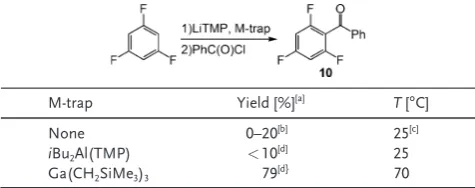
The final piece of this comparative study was to quantify how the distinct properties of these Al and Ga TMT systems would affect onward reactivity in an organic application. We chose a Pd(PPh3)4-catalyzed cross-coupling reaction between
the metalated TMT products of 1,3,5-trifluorobenzene with benzoyl chloride (Table 1). Note that LiTMP on its own proved ineffective in this reaction over a variety of conditions.
The aluminated product3gave poor yields of ketone10(6– 8%) with19F NMR spectra of isolated solid from the quench
reaction in [D8]THF solution implying several F-containing
side products. In contrast, the analogous gallated product8
reacted with benzoyl chloride more efficiently affording a best yield of 10 of 80% as quantified by NMR studies using ferrocene as internal standard. Hydrolysis at the onset of the reaction, presumably through moisture contamination, appears to be the only side reaction (see the Supporting Information for experimental details). Though Huang and co-workers have previously prepared ketones in good yield from benzoyl chloride and assorted lithium tetraorganogallates without a catalyst, the transferred nucleophiles were much less sensitive than the fluorinated examples probed here.[15]In
our case reactions were more efficient with the catalyst. Note, however, that examples of organogallium participation in organic synthesis is relatively uncommon,[16]and furthermore,
in cross-coupling chemistry it is exceptionally rare.[15,17]
In conclusion, this study has (i) shown the ability of TMT to generate and stabilize sensitive fluoroaromatic carbanions,
(ii) extended TMT for the trapping of molecular forms of inorganic salts, (iii) unravelled key complex decomposition pathways involved in metalation of fluoroarenes, and (iv) established the greater robustness of arylgallium intermedi-ates versus arylaluminum species thus opening potential new synthetic uses for the heavier group 13 metal.
Acknowledgements
We thank the European Research Council (ERCStG, Mix-MetApps) and the EPSRC (EP/N011384/1) for their generous sponsorship of this research. Data supporting this research are openly available from https://doi.org/10.15129/ccd3e405-545a-494a-84ff-0a85986070a3.
Conflict of interest
The authors declare no conflict of interest.
Keywords: aluminum · carbanions ·
fluoroaromatic compounds · gallium · metalation
How to cite:Angew. Chem. Int. Ed.2017,56, 9566–9570
Angew. Chem.2017,129, 9694–9698
[1] W. Schlenk, J. Holtz,Ber. Dtsch. Chem. Ges.1917,50, 262 – 274. [2] a) J. Clayden in Organolithiums: Selectivity for Synthesis, Elsevier, Oxford, 2002; b) V. Snieckus,Chem. Rev. 1990, 90, 879 – 933; c) F. Mongin, M. Schlosser,Tetrahedron Lett.1996,37, 6551 – 6554; d) M. Schlosser,Angew. Chem. Int. Ed.2005,44, 376 – 393;Angew. Chem.2005,117, 380 – 398; e) R. Chinchilla, C. N#jera, M. Yus,Chem. Rev.2004,104, 2667 – 2722; f) R. E. Mulvey, F. Mongin, M. Uchiyama, Y. Kondo,Angew. Chem. Int. Ed.2007,46, 3802 – 3824;Angew. Chem.2007,119, 3876 – 3899; g) V. Werner, T. Klatt, M. Fujii, J. Markiewicz, Y. Apeloig, P. Knochel,Chem. Eur. J.2014,20, 8338 – 8342.
[3] a) P. L. Coe, A. J. Waring, T. D. Yarwood,J. Chem. Soc. Perkin
Trans. 21995, 2729 – 2737; b) R. J. Harper, Jr., E. J. Soloski, C.
Tamborski,J. Org. Chem.1964,29, 2385 – 2389.
[4] M. Schlosser, L. Guio, F. Leroux,J. Am. Chem. Soc.2001,123, 3822 – 3823.
[5] X.-H. Xu, G.-M. Yao, Y.-M. Li, J.-H. Lu, J. Lin, X. Wang, C.-H. Kong,J. Nat. Prod.2003,66, 285 – 288.
[6] a) J. Wang, M. S#nchez-Roselll, J. AceÇa, C. Del Pozo, A. E. Sorochinsky, S. Fustero, V. A. Soloshonok, H. Liu,Chem. Rev.
2014,114, 2432 – 2506; b) S. Purser, P. R. Moore, S. Swallow, V. Gouverneur,Chem. Soc. Rev.2008,37, 320 – 330.
[7] M. F. Kuehnel, D. Lentz, T. Braun,Angew. Chem. Int. Ed.2013, 52, 3328 – 3348;Angew. Chem.2013,125, 3412 – 3433.
[8] L. Gupta, A. C. Hoepker, K. J. Singh, D. B. Collum, J. Org.
Chem.2009,74, 2231 – 2233.
[9] A. Castelll-Micl, S. A. Herbert, T. Leln, T. Bein, P. Knochel,
Angew. Chem. Int. Ed.2016,55, 401 – 404;Angew. Chem.2016,
128, 409 – 412.
[10] D. R. Armstrong, E. Crosbie, E. Hevia, R. E. Mulvey, D. L. Ramsay, S. D. Robertson,Chem. Sci.2014,5, 3031 – 3045. [11] a) W. Clegg, E. Crosbie, S. H. Dale-Black, E. Hevia, G. W.
[image:4.595.52.290.338.432.2]Honeyman, A. R. Kennedy, R. E. Mulvey, D. L. Ramsay, S. D. Robertson,Organometallics2015,34, 2580 – 2589; b) M. _nge-les Fuentes, A. R. Kennedy, R. E. Mulvey, J. A. Parkinson, T. Rantanen, S. D. Robertson, V. Snieckus,Chem. Eur. J.2015,21, 14812 – 14822; c) M. Uzelac, A. R. Kennedy, E. Hevia, R. E.
Table 1:Metalation reactions (using Al and Ga traps), and subsequent cross-coupling with benzoyl chloride and Pd(PPh3)4.
M-trap Yield [%][a] T[88C]
None 0–20[b] 25[c]
iBu2Al(TMP) <10[d] 25
Ga(CH2SiMe3)3 79[d} 70
Mulvey,Angew. Chem. Int. Ed.2016,55, 13147 – 13150;Angew.
Chem.2016,128, 13341 – 13344.
[12] T. Klatt, K. Groll, P. Knochel,Chem. Commun.2013,49, 6953 – 6955.
[13] D. R. Armstrong, L. Balloch, W. Clegg, S. H. Dale, P. Garcia-_lvarez, E. Hevia, L. M. Hogg, A. R. Kennedy, R. E. Mulvey, C. T. OQHara, Angew. Chem. Int. Ed. 2009, 48, 8675 – 8678;
Angew. Chem.2009,121, 8831 – 8834.
[14] S. Molitor, K.-S. Feichtner, V. E. Gessner,Chem. Eur. J.2017,23, 2527 – 2531.
[15] Y. Han, L. Fang, W.-T. Tao, Y.-Z. Huang,Tetrahedron Lett.1995, 36, 1287 – 1290.
[16] M. Yamaguchi inMain Group Metals in Organic Synthesis,Vol. 1 (Eds.: H. Yamamoto, K. Oshima), Wiley-VCH, Weinheim,2004, pp. 307 – 322.
[17] a) J. Blum, D. Gelman, W. Baidossi, E. Shakh, A. Rosenfeld, Z. Aizenshtat, B. C. Wassermann, M. Frick, B. Heymer, S. Schutte, S. Wernik, H. Schumann,J. Org. Chem.1997,62, 8681 – 8686; b) D. Gelman, H. Schumann, J. Blum,Tetrahedron Lett.2000,41, 7555 – 7558; c) S. Mikami, H. Yorimitsu, K. Oshima, Synlett
2002, 1137 – 1139.