Schema.org as a Description Logic
Andre Hernich
1, Carsten Lutz
2, Ana Ozaki
1and
Frank Wolter
11
University of Liverpool, UK
2University of Bremen, Germany
{andre.hernich, anaozaki, wolter}@liverpool.ac.uk
[email protected]
Abstract
Schema.org is an initiative by the major search en-gine providers Bing, Google, Yahoo!, and Yandex that provides a collection of ontologies which web-masters can use to mark up their pages. Schema.org comes without a formal language definition and without a clear semantics. We formalize the lan-guage of Schema.org as a Description Logic (DL) and study the complexity of querying data using (unions of) conjunctive queries in the presence of ontologies formulated in this DL (from several per-spectives). While querying is intractable in general, we identify various cases in which it is tractable and where queries are even rewritable into FO queries or datalog programs.
1
Introduction
The Schema.org initiative was launched in 2011 and is sup-ported today by Bing, Google, Yahoo!, and Yandex. In the spirit of the Semantic Web, it provides a collection of ontolo-gies that establish a standard vocabulary to mark up website content with metadata (https://schema.org/). In particular, web content that is generated from structured data as found in rela-tional databases is often difficult to recover for search engines and Schema.org markup elegantly solves this problem. The markup is used by search engines to more precisely identify relevant pages, to provide richer search results, and to enable new applications. Schema.org is experiencing very rapid adop-tion and is used today by more than 15 million webpages including all major ones [Guha, 2013].
Schema.org does neither formally specify the language in which its ontologies are formulated nor does it provide a for-mal semantics for the published ontologies. However, the pro-vided ontologies are extended and updated frequently and fol-low an underlying language pattern. This pattern and its mean-ing is described informally in natural language. Schema.org adopts a class-centric representation enriched with binary re-lations and datatypes, similar in spirit to description logics (DLs) and to the OWL family of ontology languages; the cur-rent version includes 622 classes and 891 binary relations. Partial translations into RDF and into OWL are provided by the linked data community. Based on the informal descrip-tions at https://schema.org/ and on the mentioned transladescrip-tions,
Patel-Schneider [2014] develops an ontology language for Schema.org with a formal syntax and semantics that, apart from some details, can be regarded as a fragment of OWL DL. In this paper, we abstract slightly further and view the Schema.org ontology language as a DL, in line with the for-malization by Patel-Schneider. Thus, what Schema.org calls a
typebecomes a concept name and apropertybecomes a role name. The main characteristics of the resulting ‘Schema.org DL’ are that (i) the language is very restricted, allowing only inclusions between concept and role names, domain and range restrictions, nominals, and datatypes; (ii) ranges and domains of roles can be restricted todisjunctionsof concept names (pos-sibly mixed with datatypes in range restrictions) and nominals are used in ‘one-of enumerations’ which also constitute a form of disjunction. While Point (i) suggests that the Schema.org DL is closely related to the tractable profiles of OWL2, be-cause of Point (ii) it does actually not fall into any of them. There is a close connection to the DL-Lite family of DLs [Calvaneseet al., 2007], and in particular to the DL-LiteHbool variant [Artaleet al., 2009]. However, DL-LiteHbool admits existential restriction, negation, conjunction, and free use of disjunction whereas the Schema.org DL allows no existential quantification and includes nominals and datatypes. We use the termschema.org-ontologyto refer to ontologies formu-lated in the Schema.org DL; in contrast, ‘Schema.org 2015’ refers to the concrete collection of ontologies provided at https://schema.org/ as of end of April, 2015.
Our main aim is to investigate the complexity of query-ing data in the presence of schema.org-ontologies, where the data is the markup that was extracted from webpages. While answering queries over such data is the main reasoning task that arises in Schema.org applications and the Schema.org initiative specifies a format for the data in terms of so-called
We start with the observation that evaluating OMQs is in-tractable in general, namelyΠp2-complete in combined com-plexity andCONP-complete in data complexity. In the main part of the paper, we therefore have two aims: (i) identify large and practically useful classes of OMQs with lower combined and data complexity, and (ii) investigate in how far it is possi-ble to obtain afull classificationof each schema.org ontology or each OMQ according to its data complexity. While the utility of aim (i) is obvious, we note that aim (ii) is also most useful from a user’s perspective as it clarifies the complexity of everyconcrete ontology or OMQthat might be used in an actual application. Apart from classical tractability (that is, PTIME), we are particularly interested in the rewritability of OMQs into first-order (FO) queries (actually: UCQs) and into datalog programs. One reason is that this allows to implement querying based on relational database systems and datalog en-gines, taking advantage of those systems’ efficiency and matu-rity. Another reason is that there is significant research on how to efficiently answer UCQs and datalog queries in cluster com-puting models such as MapReduce [Afrati and Ullman, 2011; 2012], a natural framework when processing web-scale data.
For both aims (i) and (ii) above, we start with analyzing
basicschema.org ontologies in which enumeration definitions (‘one of’ expressions) and datatypes are disallowed. Regard-ing aim (i), we show that all OMQs which consist of a basic schema.org-ontology and a CQqof qvar-size two (the restric-tion ofqto quantified variables is a disjoint union of queries with at most two variables each) are datalog-rewritable in polynomial time and can be evaluated in PTime in combined complexity. This result trivially extends to basic schema.org-ontologieswithdatatypes, but does not hold for unrestricted schema.org-ontologies. In the latter case, we establish the same tractability results for OMQs with CQs that do not con-tain any quantified variables.
Regarding aim (ii), we start with classifying each single schema.org-ontologyOaccording to the data complexity of
allOMQs(O, q)withqa UCQ. We establish a dichotomy between AC0 and CONP in the sense that for each ontol-ogy O, either all these OMQs are in AC0 or there is one OMQ that isCONP-hard. The dichotomy comes with a trans-parent syntactic characterization and is decidable in PTIME. Though beautiful, however, it is of limited use in practice since most interesting ontologies are of the intractable kind. Therefore, we also consider an even more fine-grained classi-fication on the level of OMQs, establishing a useful connec-tion to constraint satisfacconnec-tion problems (CSPs) in the spirit of [Bienvenuet al., 2014b]. It turns out that even for ba-sic schema.org-ontologies and for ontologies that consist ex-clusively of enumeration definitions, a complexity classifica-tion of OMQs implies a soluclassifica-tion to the dichotomy conjecture for CSPs, a famous open problem [Feder and Vardi, 1998; Bulatov, 2011]. However, the CSP connection can also be used to obtain positive results. In particular, we show that it is decidable in NEXPTIMEwhether an OMQ based on a schema.org-ontology and a restricted form of UCQ is FO-rewritable and, respectively, datalog-FO-rewritable. We also es-tablish a PSpace lower bound for this problem.
Detailed proofs are provided in the full version at http://cgi.csc.liv.ac.uk/∼frank/publ/publ.html.
2
Preliminaries
LetNC,NR, andNIbe countably infinite and mutually disjoint
sets of concept names, role names, and individual names. Throughout the paper, concepts names will be denoted by A, B, C, . . ., role names byr, s, t, . . ., and individual names bya, b, c, . . ..
A schema.org-ontology consists of concept inclusions of different forms, role inclusions, and enumeration definitions. Aconcept inclusiontakes the formAvB(atomic concept inclusion), ran(r) v A1t · · · tAn (range restriction), or dom(r)vA1t· · ·tAn(domain restriction). Arole inclusion
takes the formrvs.
Example 1. The following are examples of concept inclusions and role inclusions (last line) in Schema.org 2015:
MovievCreativeWork ran(musicBy)vPersontMusicGroup
dom(musicBy)vEpisodetMovietRadioSeriestTVSeries siblingvrelatedTo
We now define enumeration definitions. Fix a setNE ⊆ NI
ofenumeration individualssuch that bothNEandNI\NE
are infinite. Anenumeration definitiontakes the formA≡ {a1, . . . , an}withA∈NCanda1, . . . , an∈NE.
Example 2. An enumeration definition in Schema.org 2015 isBooktype≡ {ebook,hardcover,paperback}.
AdatatypeD= (D,∆D)consists of adatatype nameDand a non-empty set ofdata values∆D. Examples of datatypes in Schema.org 2015 areBoolean,Integer, andText. We assume that datatype names and data values are distinct from the symbols inNC∪NR∪NI and that there is an arbitrary but
fixed setDTof datatypes such that∆D1∩∆D2 =∅for all
D16=D2∈DT.
To accommodate datatypes in ontologies, we generalize range restrictions torange restrictions with datatypes, which are inclusions of the formran(r) v A1 t · · · tAn with
A1, . . . , Anconcept names or datatype names fromDT.
Example 3. A range restriction with datatypes in Schema.org 2015 isran(acceptsReservation)vBooleantText
Aschema.org-ontologyOis a finite set of concept sions (including range restrictions with datatypes), role inclu-sions, and enumeration definitions. We denote byNC(O)the
set of concept names inO, byNR(O)the set of role names
inO, and byNE(O)the set of enumeration individuals inO.
Adata instanceAis a finite set of
• concept assertionsA(a)whereA∈NCanda∈NI;
• role assertionsr(a, b)wherer ∈NR,a∈ NIandb ∈
NI∪SD∈DT∆D.
We say thatA is a data instancefor the ontology O if A
contains no enumeration individuals except those inNE(O).
We useInd(A)to denote the set of all individuals (including datatype elements) inA.
Let O be a schema.org-ontology. Aninterpretation I = (∆I,·I)forOconsists of a non-empty set∆Idisjoint from
S
D∈DT∆D and with∆I∩NE=NE(O), and a function·I
that maps
• every concept nameAto a subsetAIof∆I,
• every role namerto a subsetrIof∆I×∆I,DT, where
∆I,DT= ∆I∪S
D∈DT∆D;
• every individual namea∈(NI\NE)∪NE(O)to some
aI∈∆Isuch thataI=afor alla∈NE(O).
Note that we make the standard name assumption (and, there-fore, unique name assumption) for individuals inNE.
Individ-ual names fromNEthat do not occur inOare not interpreted
byIto avoid enforcing infinite domains.
For an interpretationI and role name r, setdom(r)I =
{d | (d, d0) ∈ rI}andran(r)I = {d0 | (d, d0) ∈ rI}. To achieve uniform notation, setDI = ∆Dfor every datatype (D,∆D)inDTand dI = dfor everyd ∈ ∆D, D ∈ DT.
For concept or datatype namesA1, . . . , An, set(A1t · · · t
An)I=AI1∪ · · · ∪AIn. An interpretationIfor an ontologyO
satisfiesa (concept or role) inclusionX1vX2∈ OifX1I⊆
XI
2, an enumeration definitionA ≡ {a1, . . . , an}ifAI =
{a1, . . . , an}, a concept assertionA(a)ifaI ∈ AI, and a
role assertionr(a, b) if(aI, bI) ∈ rI. These satisfaction relationships are denoted with “|=”, as inI |=X1vX2.
An interpretationI forO is amodel ofO if it satisfies all inclusions and definitions inOand amodelof a data in-stanceAforOif it satisfies all assertions inA. We say thatA
issatisfiablew.r.t.OifOandAhave a common model. Let αbe a concept or role inclusion, or an enumeration definition. We say thatαfollows fromO, in symbolsO |=α, if every model ofOsatisfiesα.
We introduce the query languages considered in this pa-per. A term t is either a member of NI∪SD∈DT∆D or
anindividual variabletaken from an infinite setNV of such
variables. Afirst-order query (FOQ)consist of a (domain-independent) first-order formulaϕ(~x)that uses unary predi-cates fromNC∪ {D|(D,D)∈DT}, binary predicates from
NR, and only terms as introduced above. The unary datatype
predicates are built-ins that identify the elements of the respec-tive datatype. We call~xtheanswer variablesofϕ(~x), the remaining variables are calledquantified. A query without answer variables isBoolean. Aconjunctive query (CQ)is a FOQ of the form∃~y ϕ(~x, ~y)whereϕ(~x, ~y)is a conjunction of atoms such that every answer variablexoccurs in an atom that uses a symbol fromNC∪NR, that is, an answer variablex
is not allowed to occur exclusively in atoms of the formD(x) withDa datatype name (to ensure domain independence). A
union of conjunctive queries (UCQ)is a disjunction of CQs. A CQqcan be regarded as a directed graphGqwith vertices
{t | tterm inq}and edges{(t, t0) | r(t, t0)inq}. IfGq is
acyclic andr(t1, t2), s(t1, t2)∈qimpliesr=s, thenqis an
acyclic CQ. A UCQ isacyclicif all CQs in it are.
We are interested in querying data instances A using a UCQq(~x)taking into account the knowledge provided by an ontologyO. Acertain answer toq(~x)inAunderOis a tuple ~aof elements ofInd(A)of the same length as~xsuch that for every modelIofOandA, we haveI |=q[~a]. In this case, we writeO,A |=q(~a).
Query evaluation is the problem to decide whether
O,A |=q(~a). For the combined complexity of this problem, all ofO,A, q, and~aare the input. For the data complexity, onlyAand~aare the input whileO andqare fixed. It of-ten makes sense to combine the ontologyOand actual query q(~x)into anontology-mediated query (OMQ)Q= (O, q(~x)), which can be thought of as a compound overall query. We show the following by adapting techniques from [Eiteret al., 1997] and [Bienvenuet al., 2014b].
Theorem 5. Query evaluation of CQs and UCQs under schema.org-ontologies isΠp2-complete in combined complex-ity. In data complexity, each OMQ(O, q)from this class can be evaluated inCONP; moreover, there is such a OMQ (with
qa CQ) that isCONP-complete in data complexity.
An OMQ(O, q(~x))isFO-rewritableif there is a FOQQ(~x) (called anFO-rewritingof(O, q(~x))) such that for every data instanceAforOand all~a∈Ind(A), we haveO,A |=q(~a) iffIA |= Q(~a) where IA is the interpretation that corre-sponds toA(in the obvious way). We also consider datalog-rewritability, defined in the same way as FO-rewritability, but using datalog programs in place of FOQs. Using Ross-man’s homomorphism preservation theorem [Rossman, 2008], one can show that an OMQ(O, q(~x))withOa schema.org-ontology andq(~x)a UCQ is FO-rewritable iff it has a UCQ-rewriting iff it has a non-recursive datalog UCQ-rewriting, see [Bi-envenuet al., 2014b] for more details. Since non-recursive datalog-rewritings can be more succinct than UCQ-rewritings, we will generally prefer the former.
3
Basic schema.org-Ontologies
We start with consideringbasicschema.org-ontologies, which are not allowed to contain enumeration definitions and datatypes. The results obtained for basic ontologies can be easily extended to basic schema.org-ontologies with datatypes but do not hold for schema.org-ontologies with enumeration definitions (as will be shown in the next section). In Schema.org 2015, 45 concept names from a total of 622 are defined using enumeration definitions, and hence are not covered by the results presented in this section.
We start with noting that the entailment problem for ba-sic schema.org-ontologiesis decidable in polynomial time. This problem is to check whetherO |=αfor a given basic schema.org-ontologyOand a given inclusionαof the form allowed in such ontologies. In fact, the algorithm is straightfor-ward. For example,O |=ran(r)vA1t · · · tAnif there is a
role namesand a range restrictionran(s)vB1t · · · tBm∈
Osuch thatOR |=r vsandOC |=Bj vA1t · · · tAn
for all1≤j ≤m, whereORandOCdenote the set of role
inclusions and atomic concept inclusions inO.
Theorem 6. The entailment problem for basic schema.org-ontologies is inPTIME.
A r r B
s
r r r
s s
s s
· · ·
b0 bm
[image:4.612.53.299.52.130.2]a
Figure 1: Data instanceAm.
in polynomial time, and thus such OMQs can be evaluated in PTIMEin combined complexity. We aim to push this bound further by admitting restricted forms of quantification.
A CQqhasqvar-sizenif the restriction ofqto quantified variables is a disjoint union of queries with at mostnvariables each. For example, quantifier-free CQs have qvar-size0and the following queryq(x, y)has qvar-size1:
∃z1∃z2
^
v∈{x,y}
(producedBy(z1, v)∧musicBy(v, z2))
The above consequences of the work by Grau, Kaminski, et al. can easily be extended to OMQs where queries have qvar-size one. In what follows, we consider qvar-size two, which is more subtle and where, in contrast to qvar-size one, reasoning by case distinction is required. The following example shows that there are CQs of qvar-size two for which no non-recursive datalog rewriting exists.
Example 7. LetO ={ran(s)vAtB}and consider the following CQ of qvar-size two:
q(x) =∃x1∃x2(s(x, x1)∧A(x1)∧r(x1, x2)∧B(x2))
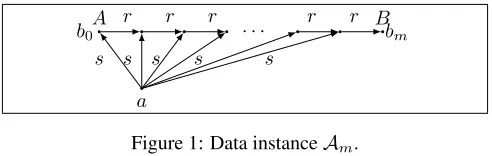
It is easy to see thatO,Am|=q(a)for every data instance
Amwithm≥2as defined in Figure 1.
By applying locality arguments and using the data instances
Am, one can in fact show that(O, q(x))is not FO-rewritable
(note that removing oner(bi, bi+1)fromAmresults inq(a)
being no longer entailed).
Theorem 8. For every OMQ (O, q(~x)) with O a basic schema.org-ontology andq(~x)a CQ of qvar-size at most two, one can construct a datalog-rewriting in polynomial time. Moreover, evaluating OMQs from this class is in PTIMEin combined complexity.
Applied to Example 7, the proof of Theorem 8 yields a datalog rewriting that consists of the rules
P(x1, x2, x)←s(x, x1)∧X1(x1)∧r(x1, x2)∧X2(x2)
where theXirange overA,B, and∃y r(y,·), plus
IA(x1, x)←P(x1, x2, x)∧A(x1)
IB(x2, x)←P(x1, x2, x)∧B(x2)
IA(x2, x)←P(x1, x2, x)∧IA(x1, x)
IB(x1, x)←P(x1, x2, x)∧IB(x2, x)
goal(x)←s(x, x1)∧IA(x1, x)∧r(x1, x2)∧IB(x2, x).
The recursive rule forIA(the one forIBis dual) says that if
the only option to possibly avoid a match for(x1, x2, x)is to
color(x1, x)withIA, then the only way to possibly avoid a
match for(x1, x2, x)is to color(x2, x)withIA(otherwise,
sinceran(s)vAtB∈ O, it would have to be colored with IBwhich gives a match).
Theorem 8 can easily be extended to basic schema.org-ontologies enriched with datatypes. For schema.org-ontologiesOthat also contain enumeration definitions, the rewriting is sound but not necessarily complete, and can thus be used to compute approximate query answers.
Interestingly, Theorem 8 cannot be generalized to UCQs. This follows from the result shown in the full version that for basic schema.org-ontologiesOand quantifier-free UCQsq(x) (even without role atoms), the problemO,A |=q(a)is coNP-hard regarding combined complexity for data instancesAwith a single individuala. We also note that it is not difficult to show (and follows from FO-rewritability of instance queries in DL-LiteHbool[Artaleet al., 2009]) that given an OMQ(O, q(~x)) withOa basic schema.org-ontology andq(~x)aquantifier-free
UCQ, one can construct an FO-rewriting in exponential time, and thus query evaluation is in AC0in data complexity.
We now classify basic schema.org-ontologiesOaccording to the data complexity of evaluating OMQs (O, q) with q a UCQ (or CQ). It is convenient to work withminimized
ontologies where for all inclusionsF vA1t · · · tAn ∈ O
and alli≤n, there is a modelIofOand ad∈∆Isuch that dsatisfiesFuAiu
u
j6=i¬Aj(defined in the usual way). Every
schema.org-ontology can be rewritten in polynomial time into an equivalent minimized one. We establish the following dichotomy theorem.
Theorem 9. LetObe a minimized basic schema.org-ontology. If there existsF vA1t · · · tAn∈ Owithn≥2, then there
is a Boolean CQq that uses only concept and role names fromOand such that(O, q)isCONP-hard in data complexity. Otherwise, a given OMQ(O, q)withqa UCQ can be rewritten into a non-recursive datalog-program in polynomial time (and is thus inAC0in data complexity).
The proof of the second part of Theorem 9 is easy: if there are noF vA1t · · · tAn∈ Owithn≥2, thenOessentially is
already a non-recursive datalog program and the construction is straightforward. The proof of the hardness part is obtained by extending the corresponding part of a dichotomy theorem forALC-ontologies of depth one [Lutz and Wolter, 2012]. The main differences between the two theorems are that (i) for basic schema.org-ontologies, the dichotomy is decidable in PTIME(whereas decidability is open forALC), (ii) the CQs inCONP-hard OMQs use only concept and role names from
O(this is not possible inALC), and (iii) the dichotomy is betweenAC0 and CONP whereas forALC OMQs can be complete for PTIME, NL, etc.
By Theorem 9, disjunctions in domain and range restrictions are the (only!) reason that query answering is non-tractable for basic schema.org-ontologies. In Schema.org 2015, 14% of all range restrictions and 20% of all domain restrictions contain disjunctions.
(up to FO-reductions), a famous open problem that is the sub-ject of significant ongoing research [Feder and Vardi, 1998; Bulatov, 2011].
Asignatureis a set of concept and role names (also called
symbols). LetBbe a finite interpretation that interprets only the symbols from a finite signatureΣ. Theconstraint satis-faction problem CSP(B)is to decide, given a data instanceA
overΣ, whether there is a homomorphism fromAtoB. In this context,Bis called thetemplateof CSP(B).
Theorem 10. For every templateB, one can construct in polynomial time an OMQ(O, q)withOa basic schema.org-ontology andqa Boolean acyclic UCQ such that the comple-ment of CSP(B) and(O, q)are mutually FO-reducible.
Theorem 18 below establishes the converse direction of The-orem 10 for unrestricted schema.org-ontologies and a large class of (acyclic) UCQs. From Theorem 18, we obtain a NEXPTIME-upper bound for deciding FO-rewritability and datalog-rewritability of a large class of OMQs (Theorem 19 below). It remains open whether this bound is tight, but we can show a PSPACElower bound for FO-rewritability using a reduction of the word problem of PSPACETuring machines. The proof uses the ontologyOand data instancesAmfrom
Example 7 and is similar to a PSPACElower bound proof for FO-rewritability in consistent query answering [Lutz and Wolter, 2015] which is, in turn, based on a construction from [Cosmadakiset al., 1988].
Theorem 11. It isPSPACE-hard to decide whether a given OMQ (O, q)withO a basic schema.org-ontology andq a Boolean acyclic UCQ is FO-rewritable.
4
Incoherence and Unsatisfiability
In the subsequent section, we consider unrestricted schema.org ontologies instead of basic ones, that is, we add back enumer-ation definitions and datatypes. The purpose of this section is to deal with a complication that arises from this step, namely the potential presence of inconsistencies.
A symbolX∈NC∪NRisincoherentin an ontologyOif
XI=∅for all modelsIofO. An ontologyOisincoherentif some symbol is incoherent inO. The problem with incoherent ontologiesOis that there are clearly data instancesAthat are unsatisfiable w.r.t.O. Incoherent ontologies can result from the UNA for enumeration individuals such as inO={A≡ {a}, B≡ {b}, AvB}, which has no model (ifa6=b) and thus any symbol is incoherent inO; they can also arise from interactions between concept names and datatypes such as in
O0 ={ran(r)vInteger,ran(s)vA, rvs}withA∈N
C,
in whichris incoherent since∆I∩∆Integer=∅in any model
IofO0. Using Theorem 6, one can show the following.
Theorem 12. Incoherence of schema.org-ontologies can be decided in PTime.
We now turn to inconsistencies that arise from combining an ontologyOwith a particular data instanceAforO. As an example, considerO ={A ≡ {a}, B ≡ {b}}andA =
{A(c), B(c)}. Although O is coherent, Ais unsatisfiable w.r.t. O. Like incoherence, unsatisfiability is decidable in polynomial time. In fact, we can even show the following stronger result.
r
r r r r
· · ·
a1 a2
A A A
b1 b2
A
bm
[image:5.612.316.558.52.109.2]bm−1
Figure 2: Data instanceA0
m.
Theorem 13. Given a schema.org-ontologyO, one can com-pute in polynomial time a non-recursive datalog programΠ
such that for any data instanceAforO,Ais unsatisfiable w.r.t.OiffΠ(A)6=∅.
In typical schema.org applications, the data is collected from the web and it is usually not acceptable to simply report back an inconsistency and stop processing the query. Instead, one would like to take maximum advantage of the data despite the presence of an inconsistency. There are many semantics for inconsistent query answering that can be used for this purpose. As efficiency is paramount in schema.org applications, our choice is the pragmatic intersection repair (IAR) semantics which avoidsCONP-hardness in data complexity [Lemboet al., 2010; Rosati, 2011; Bienvenuet al., 2014a]. Arepairof a data instanceAw.r.t. an ontologyOis a maximal subset
A0 ⊆ Athat is satisfiable w.r.t.O. We userep
O(A)to denote the set of all repairs ofAw.r.t.O. The idea of IAR semantics is then to replaceA withT
A0∈rep O(A)A
0. In other words,
we have to remove fromAall assertions that occur in some minimal subsetA0 ⊆ Athat is unsatisfiable w.r.t.O. We call such an assertion aconflict assertion.
Theorem 14. Given a schema.org-ontologyOand concept nameA(resp. role namer), one can compute a non-recursive datalog programΠsuch that for any data instanceAforO,
Π(A)is the set of alla ∈ Ind(A)(resp.(a, b) ∈ Ind(A)2)
such thatA(a)(resp.r(a, b)) is a conflict assertion inA.
By Theorem 14, we can adopt the IAR semantics by simply removing all conflict assertions from the data instance before processing the query. Programs from Theorem 14 become exponential in the worst case, but we expect them to be small in practical cases. In the remainder of the paper, we assume that ontologies are coherent and thatAis satisfiable w.r.t.Oif we query a data instanceAusing an ontologyO.
5
Unrestricted schema.org-Ontologies
We aim to lift the results from Section 3 to unrestricted schema.org-ontologies. Regarding Theorem 8, it turns out that quantified variables in CQs are computationally much more problematic when there are enumeration definitions in the ontology. In fact, one can expect positive results only for quantifier-free CQs, and even then the required constructions are quite subtle.
Theorem 15. Given an OMQ Q = (O, q) with O a schema.org-ontology andqa quantifier-free CQ, one can con-struct in polynomial time a datalog-rewriting ofQ. Moreover, evaluating OMQs in this class is inPTIMEin combined com-plexity. The rewriting is non-recursive ifq=A(x).
The following example illustrates the construction of the data-log program. LetO={A≡ {a1, a2}}andq() =r(a1, a2).
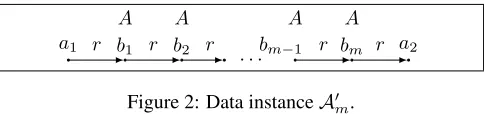
Observe thatO,A0
m |= q()for every data instanceA0m
de-fined in Figure 2. Similarly to Example 7, one can use the data instancesA0
A datalog-rewriting of(O, q()) is given by the program Πa1,a2which contains the rules
goal() ← r(a1, a2)
goal() ← r(a1, x)∧pathA(x, y)∧r(y, a2) pathA(x, y) ← r(x, y)∧A(x)∧A(y)
pathA(x, y) ← pathA(x, z)∧pathA(z, y).
Given a data instanceA, the program checks whether there is anr-path froma1 toa2 inAwith inner nodes inA. If
b0, b1, . . . , bnis such a path, then in all modelsIofOandA
there is ani < nwith(bIi−1, bIi) = (a1, a2), henceI |=q().
Otherwise, we obtain a modelIwithI 6|=q()by assigning a1to all individual namesbwithA(b)∈ Athat are reachable
froma1by a path with inner nodes inA, and an individual
6
=a1to all other individual names inA.
We now modify the datalog program to obtain a rewriting of the OMQ(O, q0(x, y))withq(x, y) = r(x, y). First, we include inΠrthe rulesA(a1)←true,A(a2)←true, and
goal(x, y) ← r(x, y)
goal(x, y) ← A(x)∧A(y)∧V
1≤i,j≤2Rai,aj(x, y)
We want to use the latter rule to check that (1) in every model, xandyhave to be identified with an individual in{a1, a2},
and (2) for alli, j ∈ {1,2}, all models that identifyxandy withaiandajsatisfyr(ai, aj). Notice thatr(x, y)is false in
a model ofOandAiffAdoes not containr(x, y)and (1) or (2) is violated. To implement (2), we add the rules:
Rai,aj(x, y) ← neq(x, ai) Rai,aj(x, y) ← neq(y, aj)
Rai,aj(x, y) ← goal(ai, aj)
neq(a1, a2) ← true neq(a2, a1) ← true.
The first row checks admissibility of the assignmentx, y7→
ai, aj: ifxis one of the enumeration individuals in{a1, a2}
andai 6=x, then there is no model that identifiesxwithai,
hence the statement (2) above is trivially true. Similarly fory andaj. It remains to add rules 3 and 4 fromΠa1,a2 and
goal(ai, aj) ← r(ai, x)∧pathA(x, y)∧r(y, aj)
for1≤i, j≤2andi6=j.
Theorem 15 is tight in the sense that evaluating CQs with a single atom and a single existentially quantified variable, as well as quantifier-free UCQs, is coNP-hard in data complexity. For instance, let O = {dom(e) v A, ran(e) v A, A ≡ {r, g, b}}. Then, an undirected graph G = (V, E) is 3-colorable iffO,{e(v, w)|(v, w)∈E} 6|=∃x e(x, x). Alter-natively, one may replace the query byr(r, r)∨r(g, g)∨r(b, b). In fact, one can prove the following variant of Theorem 10 which shows that classifying OMQs with ontologies usingonly
enumeration definitions and quantifier-free UCQs according to their complexity is as hard as CSP.
Theorem 16. Given a templateB, one can construct in poly-nomial time an OMQ(O, q)whereOonly contains enumer-ation definitions andqis a Boolean variable-free UCQ such that the complement of CSP(B) and(O, q)are mutually FO-reducible.
We now turn to classifying the complexity of ontologies and of OMQs, starting with a generalization of Theorem 9 to unrestricted schema.org-ontologies.
Theorem 17. LetObe a coherent and minimized schema.org-ontology. If O contains an enumeration definition A ≡ {a1, . . . , an} with n ≥ 2 or contains an inclusion F v
A1t · · · tAnsuch that there are at least two concept names
in{A1, . . . , An}andO 6|=F v At
t
(D,∆D)∈DTDfor any
AwithA ≡ {a} ∈ O, then(O, q)is coNP-hard for some Boolean CQq. Otherwise every(O, q)withqa UCQ is FO-rewritable (and thus inAC0in data complexity).
Note that, in contrast to Theorem 9, being in AC0does not mean that no ‘real disjunction’ is available. For example, forO={ran(r)vAtB, A vC, B vC, C ≡ {c}}and
A={r(a, b)}we haveO,A |=A(b)∨B(b)and neitherA(b) norB(b)are entailed. This type of choice does not effect FO-rewritability, since it is restricted to individuals that must be identified with a unique individual inNE(O). Note that, for the
hardness proof, we now need to use a role name that possibly does not occur inO. For example, forO={A≡ {a1, a2}}
there exists a Boolean CQqsuch that(O, q)is NP-hard, but a fresh role name is required to constructq.
We now consider the complexity of single OMQs and show a converse of Theorems 10 and 16 for schema.org-ontologies and UCQs that areqvar-acyclic, that is, when all atomsr(t, t0) with neither oft, t0a quantified variable are dropped, then all CQs in it are acyclic. We usegeneralized CSPs with marked elementsin which instead of a single templateB, one considers a finite setΓof templates whose signature contains, in addition to concept and role names, a finite set of individual names. Homomorphisms have to respect also the individual names and the problem is to decide whether there is a homomorphism from the input interpretation to someB ∈Γ. It is proved in [Bienvenuet al., 2014b] that there is a dichotomy between PTIMEand NP for standard CSPs if, and only if, there is such a dichotomy for generalized CSPs with marked elements.
Theorem 18. Given an OMQ(O, q)withOa schema.org-ontology andqa qvar-acyclic UCQ, one can compute in ex-ponential time a generalized CSP with marked elementsΓ
such that(O, q)and the complement of CSP(Γ) are mutually FO-reducible.
The proof uses an encoding of qvar-acyclic queries into con-cepts in the description logicALCIU O that extendsALC
by inverse roles, the universal role, and nominals. It extends the the template constructions of [Bienvenuet al., 2014b] to description logics with nominals. It is shown in [Bienvenuet al., 2014b] that FO-definability and datalog definability of the complement of generalized CSPs with marked elements are NP-complete problems. Thus, we obtain the following result as a particularly interesting consequence of Theorem 18.
Theorem 19. FO-rewritability and datalog-rewritability of OMQs(O, q)withO a schema.org-ontology andqa qvar-acyclic UCQ are decidable inNEXPTIME.
6
Practical Considerations
resulting querying problems from various angles. From a practical perspective, a central observation is that intractability is caused by the combination of disjunction in the ontology (in domain/range restrictions and, with{a, b} ≡ {a} t {b}, in enumeration definitions) and quantification in the query. For practical feasibility, one thus has to tame the interaction between these features.
One may speculate that professional users of Schema.org such as the major search engine providers take a pragmatic ap-proach and essentially ignore disjunction. However, the results in this paper show that one can do better without compromis-ing tractability when the query contains no quantified variables (Theorem 15). For basic ontologies, it is even possible to han-dle some queries with quantified variables (Theorem 8); in fact, we believe that the restriction to qvar-size 2 is a mild one from a practical perspective. It is also interesting to observe that the datalog-rewritings constructed in the proofs of these two theorems are sound if applied to unrestricted CQs and can be seen as tractable approximations that go beyond simply ignoring disjunction.
Another practically interesting way to address intractabil-ity is to require suitable forms of completeness of the data. For example, whenever the data contains an assertionr(a, b) and there is a range restrictionran(r) v A1t · · · tAn in
the ontology, one could require thatAi(b)is also in the data,
for somei. This could be easily implemented in existing Schema.org validators that webpage developers use to ver-ify their annotations. If all disjunctions are ‘disabled’ in the described way, tractability is regained.
References
[Afrati and Ullman, 2011] F.N. Afrati and J.D. Ullman. Opti-mizing multiway joins in a map-reduce environment. IEEE Trans. Knowl. Data Eng., 23(9):1282–1298, 2011.
[Afrati and Ullman, 2012] F.N. Afrati and J.D. Ullman. Tran-sitive closure and recursive datalog implemented on clus-ters. InEDBT, pages 132–143, 2012.
[Artaleet al., 2009] A. Artale, D. Calvanese, R. Kontchakov, and M. Zakharyaschev. The DL-Lite family and relations.
JAIR, 36:1–69, 2009.
[Bienvenuet al., 2013] M. Bienvenu, C. Lutz, and F. Wolter. First-order rewritability of atomic queries in Horn descrip-tion logics. InProc. of IJCAI, 2013.
[Bienvenuet al., 2014a] M. Bienvenu, C. Bourgaux, and F. Goasdou´e. Querying inconsistent description logic knowl-edge bases under preferred repair semantics. InAAAI, pages 996–1002, 2014.
[Bienvenuet al., 2014b] M. Bienvenu, B. ten Cate, C. Lutz, and F. Wolter. Ontology-based data access: A study through disjunctive datalog, CSP, and MMSNP.ACM Trans. Database Syst., 39(4):33, 2014.
[Bulatov, 2011] A.A. Bulatov. On the CSP dichotomy con-jecture. InCSR, pages 331–344, 2011.
[Calvaneseet al., 2007] D. Calvanese, G. De Giacomo, D. Lembo, M. Lenzerini, and R. Rosati. Tractable reasoning
and efficient query answering in description logics: The DL-Lite family. J. Autom. Reasoning, 39(3):385–429, 2007. [Cohen and Jeavons, 2006] D. Cohen and P. Jeavons. The
complexity of constraint languages, Ch. 8. Elsevier, 2006. [Cosmadakiset al., 1988] S.S. Cosmadakis, H. Gaifman, P.C. Kanellakis, and M.Y. Vardi. Decidable optimization prob-lems for database logic programs (preliminary report). In
STOC, pages 477–490, 1988.
[Eiteret al., 1997] T. Eiter, G. Gottlob, and H. Mannila. Dis-junctive datalog.ACM Trans. Database Syst., 22(3):364– 418, 1997.
[Feder and Vardi, 1998] T. Feder and M.Y. Vardi. The compu-tational structure of monotone monadic SNP and constraint satisfaction: A study through datalog and group theory.
SIAM J. Comput., 28(1):57–104, 1998.
[Glimm and Kr¨otzsch, 2010] B. Glimm and M. Kr¨otzsch. SPARQL beyond subgraph matching. InISWC, volume 6496 ofLNCS, pages 241–256. Springer, 2010.
[Grauet al., 2013] B. Cuenca Grau, B. Motik, G. Stoilos, and I. Horrocks. Computing datalog rewritings beyond horn ontologies. InIJCAI, 2013.
[Guha, 2013] R.V. Guha. Light at the end of
the tunnel? Invited Talk at ISWC 2013,
https://www.youtube.com/watch?v=oFY-0QoxBi8. [Kaminskiet al., 2014a] M. Kaminski, Y. Nenov, and
B. Cuenca Grau. Computing datalog rewritings for dis-junctive datalog programs and description logic ontologies. InRR, pages 76–91, 2014.
[Kaminskiet al., 2014b] M. Kaminski, Y. Nenov, and B. Cuenca Grau. Datalog rewritability of disjunctive data-log programs and its applications to ontodata-logy reasoning. In
AAAI, pages 1077–1083, 2014.
[Larose and Tesson, 2009] B. Larose and P. Tesson. Univer-sal algebra and hardness results for constraint satisfaction problems. Theor. Comput. Sci., 410(18):1629–1647, 2009. [Lemboet al., 2010] D. Lembo, M. Lenzerini, R. Rosati, M. Ruzzi, and D. Fabio Savo. Inconsistency-tolerant semantics for description logics. InRR, pages 103–117, 2010. [Lutz and Wolter, 2012] C. Lutz and F. Wolter. Non-uniform
data complexity of query answering in description logics. InKR, 2012.
[Lutz and Wolter, 2015] C. Lutz and F. Wolter. On the rela-tionship between consistent query answering and constraint satisfaction problems. InICDT, 2015.
[Patel-Schneider, 2014] P.F. Patel-Schneider. Analyzing schema.org. InISWC, pages 261–276, 2014.
[Rosati, 2011] R. Rosati. On the complexity of dealing with inconsistency in description logic ontologies. InIJCAI, pages 1057–1062, 2011.
[Rossman, 2008] B. Rossman. Homomorphism preservation theorems.J. ACM, 55(3), 2008.
Appendix
A
Proofs for Section 2
Theorem 5 Query evaluation of CQs and UCQs under schema.org-ontologies isΠp2-complete in combined complex-ity. In data complexity, each OMQ(O, q)from this class can be evaluated inCONP; moreover, there is such a OMQ (with qa CQ) that isCONP-complete in data complexity.
Proof. The upper bounds are straightforward. For example, for theΠp2-upper bound regarding combined complexity, given a data instanceAforOandq(~a), guess a modelIwith domain
Ind(A), check in polynomial time whetherIis a model ofO
andAand call an NP-oracle to checkI 6|=q(~a).
For the Πp2-lower bound, we give a reduction from 2QBF validity. Consider a 2QBF ∀x1. . . xm∃y1. . . ynϕ,
where ϕ is a 3CNF over clauses c1, . . . , ck. We
con-struct a schema.org-ontology O and Boolean CQ q with concept names X1, . . . , Xm, and C1, . . . , Ck, role names
V1, V2, V3, r1, . . . , rm, and enumeration individuals {0,1}.
For each clauseci, we denote by vji (1 ≤ j ≤ 3) the
vari-able appearing in thejth literal ofci, and we letSi denote
the set of tuples in{0,1}3representing the seven truth
assign-ments for(v1
i, vi2, v3i)which satisfyci. Define the ontologyO
by setting
O = {ran(ri)vE, E≡ {0,1} |1≤i≤m} ∪
{ran(ri)vXi |1≤i≤m}
The ontology ensures that for any data instanceAcontaining ri(fi, di)in any modelI ofO andAwe have0 ∈ XiI or
1∈XiI. Thus, intuitively,Oensures that a truth assignment is selected for variablexi. We encodeϕusing the data instance
Aϕdefined as follows:
Aϕ = {Vj(abi, bj)|b= (b1, b2, b3)∈Si, j= 1,2,3} ∪
{Ci(abi)|b= (b1, b2, b3)∈Si} ∪
{ri(fi, di)|1≤i≤m}
Now the CQqchecks whether the selected truth assignment can be extended to a model ofϕ.qis defined as the conjunc-tion of
^
1≤i≤k
(Ci(zi)∧V1(zi, vi1)∧V2(zi, v2i)∧V3(zi, v3i))
and
^
1≤`≤m
X`(x`)
It is straightforward to show that∀x1. . . xm∃y1. . . ynϕis
valid iffO,A |= q. The NP lower bound regarding data complexity is proved, for example, in the CSP encoding of
Theorem 10. o
B
Proofs for Section 3
Theorem 6The entailment problem for basic schema.org-ontologies is in PTIME.
Proof. We show thatO |= ran(r) v A1t · · · tAn iff (∗)
there exists a role name ssuch that OR |= r v sand a
range restrictionran(s) v B1 t · · · tBm ∈ O such that
OC |= Bj v A1t · · · tAn for all1 ≤ j ≤ m, where
OCis the set of atomic concept inclusions inO. Other basic
schema.org-inclusions are consider similarly.
Clear, if (∗) holds, thenO |=ran(r)vA1t · · · tAn.
Con-versely, assume that (∗) does not hold. Define an interpretation
Iwith∆I ={a, b}by setting
• (c, d)∈sIiffc=aandd=bandOR|=rvs;
• c∈AIfor all concept namesA;
• for everyswithOR|=rvsandran(s)vB1t · · · t
Bm∈ OpickBjsuch thatOC6|=BjvA1t · · · tAn.
Letb∈BIfor all concept namesBwithOC|=Bjv
B.
It is readily checked thatIis a model ofOwithb∈ran(r)I andb6∈AI1∪ · · · ∪AIn. o
We use the following notation. Amatchπfor a quantifier-free CQq=q(~x, ~a)in an interpretationIis a mapping from the set of termsterm(q)ofqto∆Isuch that the following holds:
• π(a) =aIfor alla∈NI; • IfA(t)∈q, thenπ(t)∈AI;
• Ifr(t, t0)∈q, then(π(t), π(t0)∈rI. If this is the case, we writeI |=πq.
Given a data instanceAand datalog programΠ, we denote byIΠ,Atheminimal interpretationthat is a model ofAand satisfies all rules inΠ. Note that∆IΠ,A=Ind(A).
We prove the following result as a preparation for the proof of Theorem 8.
Proposition 20. For every ontology-mediated query
(O, q(~x))withOa basic schema.org-ontology andqa CQ of qvar-size at most one, one can construct in polynomial time a non-recursive datalog-rewriting of(O, q(~x)).
Proof. Let q(~x) = ∃~yq0(~x, ~y,~b), Let~x = x1. . . xk,~y =
y1, . . . , ym, and~b=b1, . . . , bn. LetIAandIrbe IDB
predi-cates for any concept nameAand role namerinq, and include inΠO,basicthe following rules:
• IA(x)←B(x), for allBwithOC|=B vA;
• IA(x)←r(y, x), for allrwithO |=ran(r)vA;
• IA(x)←r(x, y), for allrwithO |=dom(r)vA;
• Ir(x, y)←s(x, y), for allswithOR|=svr.
Now letq00(~x, ~y)result fromq0(~x, ~y)by replacing everyA(t)
inq0byIA(t)and everyr(t, t0)inq0byIr(t, t0). DefineΠ
by adding toΠO,basicthe rulegoal(~x)←q00(~x, ~y).We show
thatΠis a rewriting of(O, q(~x)).
To prove this, we require some preparation. LetObe a basic schema.org-ontology andΠbe a datalog program containing allΠO,basic. LetAbe a data instance and considerIΠ,A. Then
we consider the following variantJΠ,AofIΠ,Ain which we transfer the extensions ofIAandIrto the concept namesA
and role namesr, respectively:
• rJΠ,A =IIΠ,A
r for all role namesr;
• AJΠ,A =IIΠ,A
A for all concept namesA.
Observation 1LetObe a basic schema.org-ontology andΠ be a program containingΠO,basic. LetAbe a data instance.
For a setX ⊆Ind(A)letAa,a∈X, be concept names such
thata6∈AJΠ,Afor alla∈X. Then there exists a modelJ of
OandAwith
• ∆J = ∆JΠ,A;
• rJ =rJΠ,Afor all role namesr;
• AJ ⊇AJΠ,A for all concept namesA;
such thata6∈AJa for alla∈X.
Using Observation 1, we now show thatΠis a rewriting of (O, q(~x)).
Clearly, if~a ∈ Π(A), then O,A |= q(~a). Conversely, assume that~a 6∈ Π(A). Let~a = a1, . . . , ak. Consider the
minimal modelIΠ,AofA. We haveIΠ,A 6|= goal(~a). Let q−0 be the result of removing fromq0all atomsA(t)withA
a concept name. LetH be the set of all matchesπofq−0 in
JΠ,Awithπ(xi) =aifor1≤i≤k.
IfHis empty then expandJΠ,Ato a modelJ ofOby leav-ing the interpretation of role names fixed and settleav-ingAJ =
Ind(A)for all concept namesA. ThenJ 6|=∃~y q−0(~a,~b)and soJ 6|=q(~a). Thus,O,A 6|=q(~a), as required.
IfH is not empty, letH(t) ={π(t)|π∈H}for any term tinq. Note thatH(t)is a singleton{tI}ift=aiort=bi.
Claim 1. There exists a termtinqsuch that for alla∈H(t) there exists a concept nameAwithA(t)∈q0anda6∈AJΠ,A.
Proof of Claim 1. Assume no suchtexists. Then choose for every termtinqa memberatofH(t)such thatat∈AJΠ,A
for allA(t)inq0. Define a mappingπ0from the set of terms
ofttoJΠ,Aby settingπ0(t) =at. Using the condition thatq
has qvar-size at most1, it is readily checked thatπ0is a match
forqinJΠ,Awithπ(xi) =aifor1≤i≤k. It follows that
IΠ,A |= q00(~a)and soIΠ,A |=goal(~a). We have derived a contradiction.
Consider now a termtfromq0such that for everya∈H(t)
there exists a concept nameAa withAa(t) ∈ q0 and a 6∈
AJΠ,A
a . By Observation 1 there exists a modelJ ofOandA
with
• ∆J = ∆JΠ,A;
• rJ =rJΠ,Afor all role namesr;
• AJ ⊇AJΠ,A for all concept namesA;
such thata6∈AJa for alla∈X. It follows thatJ 6|=q(~a)and
soO,A 6|=q(~a), as required. o
Theorem 8 For every ontology-mediated query (O, q(~x)) withOa basic schema.org-ontology andqa CQ of qvar-size at most 2 one can construct in polynomial time a datalog-rewriting of(O, q(~x)).
Proof. Assume Oand q(~x) = ∃~yq0(~x, ~y,~b). We employ
the programΠO,basicfrom the proof of Proposition 20. Also,
for two setsX1andX2of concept names we use a program
ΠX1tX2 with intensional predicateIX1tX2(x)such that for
any data instanceAanda∈Ind(A),
O,A |= ^
A∈X1
A(a)∨ ^
A∈X2
A(a)⇔ΠX1tX2|=IX1tX2(a).
Denote bymCCthe set of maximal connected components
{v, w} of quantified variables v 6= w in q. We assume a fixed ordering v, w of any member of mCC. For any quantified variable v in q we set Xv = {A | A(v) ∈
q0}. Let ~zv,w be the variable in ~x∪~y without v, w and
take, for each{v, w} ∈ mCC, the IDBsPv,w(v, w, ~zv,w,~b),
Xv,w(v, ~zv,w,~b), andYv,w(w, ~zv,w,~b). Insert in the rewriting
Πthe programΠO,basicas well as all rules
Pv,w(v, w, ~zv,w,~b)←q00 ∧IXvtXw(v)∧IXvtXw(w)
where q00 results from q0 by removing all unary atoms
A(t)from q0, replacing all r(t, t0) by Ir(t, t0), and where
{v, w} ∈ mCC. Intuitively,Pv,w(v, w, ~zv,w,~b)collects the
potential matches forv, w. If, in addition, Xv(v, ~zv,w,~b)
and Yv,w(w, ~zv,w,~b) hold, then one has actually found a
match forv, w. We model the propagation of the ‘colors’ Xv,w(v, ~zv,w,~b) andYv,w(w, ~zv,w,~b) by inserting in Πfor
any{v, w} ∈mCC
Xv,w(v, ~zv,w,~b) ← Pv,w(v, w, ~zv,w,~b)∧
^
A∈Xv
IO,A(v)
Yv,w(w, ~zv,w,~b) ← Pv,w(v, w, ~zv,w,~b)∧
^
A∈Xw
IO,A(w)
Xv,w(w, ~zv,w,~b) ← Pv,w(v, w, ~zv,w,~b)∧Xv,w(v, ~zv,w,~b)
Yv,w(v, ~zv,w,~b) ← Pv,w(v, w, ~zv,w,~b)∧Yv,w(w, ~zv,w,~b)
The first of the two recursive rules says that if the only op-tion to possibly avoid a match forv, wis to color(v, ~zv,w,~b)
withXv,w, then the only way to possibly avoid a match for
v, w is to color(w, ~zv,w,~b)with Xv,w (because otherwise
one would have to color(w, ~xv,w,~b)withYv,w). The
sec-ond recursive rule can be understood analogously withX and Y swapped. Finally we insert inΠthe following goal-rule
goal(~x) ← q000, whereq000 is obtained fromq0 by replacing
allr(t, t0)byIr(t, t0), allA(t)that do not participate in any
{v, w} ∈mCCbyIA(t), and for all{v, w} ∈mCCallA(v)
byXv,w(v, ~zv,w,~b)and allA(w)byYv,w(w, ~zv,w,~b),
respec-tively.
The program Π is as required. Assume q(~x) =
∃~y q0(~x, ~y,~b). Let ~x = x1. . . xk, ~y = y1, . . . , ym, and
~b=b1, . . . , bn. It is straightforward to show that if~a∈Π(A),
thenO,A |=q(~a).
Conversely, assume that ~a 6∈ Π(A). Then IΠ,A 6|=
∃~yq000(~a, ~y,~b). LetH be the set of all matches π ofq00 in
JΠ,Awithπ(xi) =aifor1 ≤i ≤kand such that for any
{v, w} ∈mCCwe have(π(v), π(w), π(~x),~b)∈PIΠ,A
v,w . IfH
If H is not empty, let for any connected component
{v, w} ∈mCC,H(v, w) ={(π(v), π(w) |π∈H}and let for any termtthat does not participate in any{v, w} ∈mCC, H(t) ={π(t)|π∈H}.
Claim 1. (a) there exists a termtinqthat does not participate in any{v, w} ∈mCCsuch that for alla∈H(t)there exists a concept nameAwithA(t)∈q0anda6∈I
IΠ,A
A or (b) there
exists{v, w} ∈mCCsuch that for all(a, b)∈H(v, w)either (a, ~a,~b)6∈XIΠ,A
v,w or(b, ~a,~b)6∈Yv,wIΠ,A.
The proof is similar of Claim 1 is similar to the proof of Claim 1 in Proposition 20.
Now, if (a) holds we can proceed similarly to the proof of Proposition 20 and construct a modelIofOandAsuch thatI 6|=q(~a). If (b) holds, then we can construct a model
I ofOand Awith I 6|= q(~a)by picking {v, w} ∈ mCC
such that for all(a, b)∈H(v, w)either(a, ~a,~b)6∈XIΠ,A
v,w or
(b, ~a,~b)6∈YIΠ,A
v,w and ensuring that for every(a, b)∈H(v, w)
we either havea6∈AIfor someA∈X
vorb6∈AIfor some
A∈Xw. o
B.1
Proofs for Rewritings of UCQs
Proposition 21. For basic schema.org-ontologies O and quantifier-free UCQsq(x)with one variable it is coNP-hard to decideO,A |=q(a)even for instance dataAwith only one individuala.
Proof.The proof is by reduction of satisfiability of proposi-tional formulas in CNF. Letϕ=V
i≤ncibe a conjunction of
propositional clauses in variablesv1, . . . , vm. We represent
the formulaϕin a basic schema.org-ontologyOas follows:
• the concept namesAjandAj,j≤m, are used to encode
a positive or a negative literal, respectively, on variable vj;
• to represent the clauses c1, . . . , cn we use role names
r1, . . . , rn and define a range restriction for each role
with the concept names corresponding to the literals of the clause. For example, ifc1=v1∨ ¬v2then we define ran(r1)vA1tA2.
Then, for a data instanceA ={r1(a, a), . . . , rn(a, a)}and
q(x) = (A1(x)∧A1(x))∨ · · · ∨(Am(x)∧Am(x))we have
thatO,A |=q(a)iffϕis unsatisfiable. We constructedOand qover a single variablexsuch that, on data instances with a single individuala, decidingO,A |=q(a)is coNP-hard.
o
Evaluating a datalog rewriting over a data instance with a sin-gle individual is tractable. Thus, if there is a datalog rewriting of(O, q(x)), then it cannot be constructed in polynomial time.
B.2
Proof of Theorem 9
We show the following result.
Theorem 9LetObe a basic minimized schema.org-ontology. Then there exists a Boolean CQqin the language ofOsuch that(O, q)is coNP-hard in data complexity iff there exists
FvA1t · · · tAn∈ Owithn≥2. Otherwise every(O, q)
withqa UCQ is FO-rewritable in polynomial time.
Observe that if there exists noF vA1t · · · tAn∈ Owith
n≥2, when we can rewrite every(O, q)withqa UCQ using the rewriting given in Proposition 20.
In the converse direction we modify a hardness proof given in [Lutz and Wolter, 2012]. The modification is required since we want to show thatqcan be chosen in such a way that only concept and role names inOare used. This is not the case in the proof given in [Lutz and Wolter, 2012].
AssumeOis minimized and there existsF vA0t · · · t
Ak ∈ O with k ≥ 1. Then F ∈ {dom(r),ran(r)} and
we assume w.l.o.g. thatF = ran(r). We want to construct a Boolean CQ q in the language ofO such that(O, q) is coNP-hard in data complexity. To this end, we first construct a Boolean UCQ with these properties and then discuss the modifications required to obtain a Boolean CQ.
The construction of the queries is based on a reduction of the complement of2 + 2-SAT, a variant of propositional satisfiability introduced by Schaerf [Schaerf, 1993]. A2 + 2 clause is of the formc = (u0∨u1 ∨ ¬u2∨ ¬u3), where
each oful,l≤3, is a propositional letter or a truth constant
0,1. A2 + 2formula is a finite conjunction of2 + 2clauses. Now,2 + 2-SAT is the problem of deciding whether a given 2 + 2formula is satisfiable. It is shown in [Schaerf, 1993] that 2 + 2-SAT is an NP-complete problem.
Assumeϕ=c0∧ · · · ∧cnis a 2+2-formula in propositional lettersv0, . . . , vmand letci=ui0∨ui1∨ ¬ui2∨ ¬ui3fori≤n.
Our first aim is to define a data instanceAϕand a Boolean
UCQqsuch thatϕis unsatisfiable iffO,Aϕ|=q. To start we
represent the formulaϕin the data instanceAϕas follows:
• the individual namesv0, . . . , vmrepresent variables and
the individual names0,1represent truth constants;
• the individual namesci
landbilare used to encode the four
literals of each2 + 2clauseci, wherei≤nandl≤3;
• fori≤nandl≤3we use the assertions
r(cil, bil), r(bil, uil), r(cil, uil)
and
r(ci0, ci1), r(ci1, ci2), r(ci2, ci3)
to associate the literals ci
l of a clause ci to the
vari-able/truth constantui l.
We further extendAϕto enforce a truth value for each variable
vi,i ≤m. To this end, add toAϕthe data instancesAi =
{r(fi, ai)}fori ≤ m. Intuitively,Ai is used to generate a
truth value for the variablevi, where we interpretvias true if
the queryA0(ai)is satisfied and as false if any of the queries
Aj(ai),1≤j ≤k, is satisfied. Finally we extendAϕby
• linking variablesvitoai by adding assertionsr(vi, ai)
for alli≤m;
• to ensure that 0 and1 have the expected truth values, add the individuals00and10with the assertionsA0(00)
andA1(10). Also, add toAϕthe assertionsr(1,10)and
bi
0 bi1 bi2 bi3
ci
0 ci1 ci2 ci3
10 00
a1
a0
v0 v1 0 1
A0 A1
[image:11.612.114.238.52.166.2]A0 A1
Figure 3: Encoding of a clauseci=v
0∨v1∨ ¬0∨ ¬1.
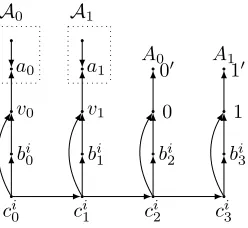
Figure 3 illustrates the encoding of a clauseci =v0∨v1∨
¬0∨ ¬1. Consider the Boolean UCQ (we omit existential quantifiers and do not distribute conjunctions over disjunc-tions)
q0=
^
0≤i≤2
r(xi, xi+1)∧
^
0≤i≤3
ψi
where
• ψi=r(xi, zi)∧r(zi, yi)∧r(xi, yi)∧ffi(yi)fori= 0,1
and
• ψi=r(xi, zi)∧r(zi, yi)∧r(xi, yi)∧tti(yi)fori= 2,3
and
where
tti(yi) = r(yi, wi)∧A0(wi)
ffi(yi) = r(yi, wi)∧(
_
1≤j≤k
Aj(wi))
ThenO,Aϕ|=q0iffq0is not satisfiable, as required. Note
that the ‘triangles’ usingbi
linAϕand usingziinq0are used to
ensure that in a match forq0inAϕthe only possible matches
for(w0, w1, w2, w3)are (ai0, ai1, ai2, ai3)withr(uij, a i
j)∈ Aϕ,
j≤3,i≤n. In the equivalence proof this is required since we can have inclusions such asdom(r)vAi∈ Ofori≤n
inOwhich force allAito be true in every individual in the
domain ofAi.
We now show how to improve the result from Boolean UCQs to CQs. To this end we change the encoding of ‘false’ fromffi(yi)to
ff0i(yi) =
^
1≤l≤k
r(yi, yi0)∧r(yi0, w i
l)∧Al(wli)
To ensure the match condition discussed above we also modify
tti(yi)to
tt0i(yi) =r(yi, yi0)∧r(yi0, wi)∧A0(wi)
We modifyAϕcorrespondingly:
• fori≤m, remove fromAϕthe assertionsr(vi, ai);
• remove fromAϕthe assertionsA0(00)andA1(10);
• add toAϕthe assertionsr(00,000),r(10,100),A0(000)and
A1(100);
• for1≤j≤k, add toAϕthe assertionAj(ej)for fresh
individual namesej;
v0
A0
a0
d0
1 d
0
j d0k
ek
ej
e1
A1 Aj Ak
. . . .
. . . . d0
[image:11.612.360.510.52.175.2]0
Figure 4: Modified encoding ofv0occurring in a clauseci=
v0∨v1∨ ¬0∨ ¬1.
• fori≤mandj≤k, add toAϕthe assertionsr(vi, dij)
for fresh individual namesdi j;
• fori ≤ mand1 ≤ j ≤ k, add toAϕ the assertions
r(di
0, ai),r(dij, ai)and
r(dij, e1), . . . , r(dij, ej−1), r(dij, ej+1), . . . , r(dij, ek).
This finishes the modified construction. Figure 4 illustrates the modified encoding ofv0in a clauseci=v0∨v1∨ ¬0∨ ¬1.
B.3
Proof of Theorem 10
When studying the complexity of CSP(B)one can assume w.l.o.g. thatBis a core, that is, every automorphism is an isomorphism. It is useful to further assume that the template
Badmits precoloring, that is, for each b ∈ ∆B there is a concept namePb such thatd ∈ PbB iffd = b[Cohen and
Jeavons, 2006]. It is known that for every templateB, there is a templateB0 that admits precoloring such that CSP(B) and CSP(B)are mutually FO-reducible [Larose and Tesson, 2009].
Theorem 10For every templateBthere exists a OMQ(O, q) whereOis a basic schema.org-ontologyOandqa Boolean acyclic UCQ such that the complement of CSP(B) and(O, q) are mutually FO-reducible.
Proof. Assume a template B over signatureΣof concept and role names is given such that for eachb∈∆Bthere is a concept namePb such thatd∈ PbB iffd= b. Take a fresh
role namesand the concept namesPb,b∈∆B, and set
O={ran(s)v
t
b∈∆BPb}
Define a UCQqas the disjunction of (we omit existential quantifiers)
• Pa(x)∧r(x, y)∧Pb(y)for allr∈Σsuch that(a, b)6∈
rB;
• Pa(x)∧B(x)for allB∈Σsuch thata6∈BB;
• Pa(x)∧Pb(x)for alla6=b.
(⇒)Assume a data instanceAcontaining assertions using symbols inΣonly is given. LetA0be the union ofAand all s(a, b)such thata, b∈Ind(A). We show:
Claim 1.A → BiffO,A06|=q.
Assumehis a homomorphism fromAtoB. Define a model
Iby setting
• ∆I =Ind(A);
• a∈PI
b iffh(a) =b;
• (a, b)∈rIiffr(a, b)∈ A, for allr∈Σ;
• a∈BIiffB(a)∈ A, for allB∈Σ\ {Pb|b∈∆B};
• (a, b)∈sIfor alla, b∈Ind(A).
It is readily checked thatIis a model ofOandA0such that
I 6|=q. Thus,O,A06|=q, as required.
Now assume thatO,A0 6|=q. LetIbe a model ofOand
A0such thatI 6|=q. Defineh(a) = bifa∈PI
b. Using the
condition thatI 6|=qone can show thathis well defined and aΣ-homomorphism fromAtoB.
(⇐)Assume a data instanceAforOis given. Remove fromA
all assertions involving individualsasuch that neitherPb(a)∈
Afor anyb ∈ ∆Bnors(a0, a) ∈ Afor anya0 and add the assertionss(a, a)for the remaining individualsa. Clearly we haveO,A |=qiffO,A0|=qfor the resulting data instance
A0. LetA00be the restriction ofA0toΣ. One can show that
O,A0|=qiffA006→ B, as required.
o
B.4
Proof of Theorem 11
We show the PSPACElower bound for FO-rewritability in ba-sic schema.org-ontologies using a reduction of the word prob-lem of polynomially space-bounded Turing machines. Similar reductions have been used to establish PSPACE-hardness of boundedness in linear monadic datalog [Cosmadakiset al., 1988], of certain FO-rewritability problems in ontology-based data access [Bienvenuet al., 2013], and of FO-rewritability problems in consistent query answering [Lutz and Wolter, 2015]. Let M = (Q,Ω,Γ, δ, q0, qacc, qrej) be a DTM that
solves a PSPACE-complete problem andp(·)its polynomial space bound. Here,Qis the set of states,Ωis the input alpha-bet,Γthe tape alphabet,δ: (Q×Γ)→ {L, N, R} ×Q×Γ the transition function,q0 ∈Qthe initial state, andqaccqrej
the accepting and rejecting state, respectively. We assume that the transition function is total except onqaccandqrejwhere
it is undefined for every tape symbol. The tape is assumed to be two-side infinite. We make the following additional as-sumptions onM. We assume thatM never writes the blank symbol and with theleft (resp. right) end of the tapewe mean the first tape cell to the left (resp. right) of the head labeled with a blank. We also assume thatM always terminates with the head on the right-most tape cell and that it never attempts to move left on the left-most end of the tape. Finally and most importantly, we assume that, when started in any (not necessarily initial) configurationC, then the computation of M terminates (this assumption is justified in [Lutz and Wolter, 2015]).
Now let M be a TM that satisfies the conditions above and letx∈Ω∗be an input toM of lengthn. Our aim is to
construct a basic schema.org-ontologyOand Boolean UCQq such that(O, q)isnotFO-rewritable iffMacceptsx.
A fundamental idea of the reduction is that whenM accepts x, then(O, q)is not FO-rewritable because any FO-rewriting would have to query for longer and longer paths that represent the accepting computation ofMonx, repeated over and over again; this clearly contradicts thelocalityof an FO-query. In the reduction, we use a very simple ontology
O={ran(s0)vBtB0}
whereB, B0 are concept names. To understand the source for non-FO-rewritability that we build on, consider the OMQ (O, q)with qb = B(x)∧r(x, y)∧B0(y) (see also Exam-ple 7). Non-FO-rewritability is witnessed by path-shaped data instances of the form
Am := {r(b1, b0), r(b2, b1), . . . , r(bm, bm−1)} ∪
{B0(b0), B(bm)} ∪
{s0(ai, bi)|0< i < m}.
In fact, it can be verified thatT,Am |= qbfor all m > 0,
but whenever we drop an assertion fromAmresulting in data
instanceA0
m, thenT,A0m 6|=q. We are going to modify theb
above paths so that they describe a (repeated) accepting com-putation ofM onx. To this end, the tape contents, the current state, and the head position are represented using the elements ofΓ∪(Γ×Q)as monadic relation symbols. Each constant on the path represents one tape cell of one configuration, the binary relationRis used to move between consecutive tape cells, the binary relationSis used to move between successor configurations inside the same computation, and the binary relationT is used to separate computations. To illustrate, suppose the computation ofM on x = ab consists of the two configurationsqabandaq0b.1 The corresponding path of lengthmthat describes this computation (repeatedly) is
B0(b0), r(b1, b0), s(b2, b1), r(b3, b2), t(b4, b3),
r(b5, b4), . . . , r(bm, bm−1), B(bm)
with the additional assertions (a, q)(c) for c = b0, b4, b8, . . ., b(c) for c = b1, b5, b9, . . ., a(c) for c =
b2, b6, b10, . . ., and(b, q0)(c)forc=b3, b7, b11, . . .. We now
assemble the UCQq. To ensure that every individual on the path is labeled with at least one symbol fromΓ∪(Γ×Q)(and since we now have three relationsr, s, tinstead of only a sin-gle one), we modify the queryqbfrom above. While doing this, we also ensure thatt-steps can only occur exactly after the accepting state was reached (we omit existential quantifiers):
(r-pr) B(x)∧A(x)∧r(x, y)∧A0(y)∧B0(y), for allA∈
Γ∪(Γ×Q)and allA0 ∈Γ∪(Γ×(Q\ {qacc, qrej}));
(s-pr) B(x)∧A(x)∧s(s, y)∧A0(y)∧B0(y), for allA∈ Γ∪(Γ×Q)and allA0 ∈Γ∪(Γ×(Q\ {qacc, qrej}));
(t-pr) B(x)∧A(x)∧t(x, y)∧A0(y)∧B0(y)for allA ∈
Γ∪(Γ×Q)and allA0 ∈Γ× {qacc}.
1
If we simply use the disjunction of the above three queries as the UCQ in our query evaluation problem, then that problem is not FO-rewritable. This is witnessed by paths as above in which every element is labeled with some role symbol from Γ∪(Γ×Q). However, these labeled witness paths need not represent proper computations ofM onxsince the transition relation need not be satisfied, there need not be any state, etc. We fix these problems by including additional CQs in the UCQ qthat discover ‘defects’ in the computation. These queries rule out labeled path that do not describe proper computations as witnesses for non-FO-rewritability of the defined query evaluation problem: paths with defects are ‘yes’-instances, but can be identified by an FO-query. In fact, the following queries do not mentionBandB0and thus are derived from
O ∪ Aif and only if they have a match inA. They thus do not require any rewriting. The first set of additional CQs ensures that every tape cell has a unique label.
(uni) A(x)∧A0(x)for all distinctA, A0∈Γ∪(Γ×Q).
The next CQ enforces that there is not more than one head position per configuration:
(h1) V
0≤l<i{r(xl, xl+1)}∧(a, q)(xi)∧V0≤l<jr(yl, yl+1)∧
(a0, q0)(yj), for alli < j < p(n),(a, q),(a0, q0)∈Γ×Q,
andx0=y0.
and that there is at least one head position per configuration:
(h2) r(x0, x1)∧. . .∧r(xp(n)−2, xp(n)−1)∧a1(x0)∧. . .∧
ap(n)−1(xp(n)−1), for all sequencesa0, . . . , ap(n)−1 ∈
Γ.
We ensure that configurations have at most lengthp(n)using the CQ
(l1) r(x0, x1)∧. . .∧r(xp(n)−1, xp(n)).
We also ensure that configurations are not shorter thanp(n) (with the possible exception of the first configuration, which can be shorter):
(l2) ρ(x0, x1)∧r(x1, x2)∧. . .∧r(xi, xi+1)∧ρ0(xi+1, xi+2)
for alli < p(n)−1andρ, ρ0∈ {s, t}.
We now enforce that the transition function is respected and that the content of tape cells which are not under the head does not change. Let forbid denote the set of all tuples (A1, A2, A3, A)withAi ∈Γ∪(Γ×Q)such that whenever
three consecutive tape cells in a configurationcare labeled withA1, A2, A3, then in the successor configurationc0ofc,
the tape cell corresponding to the middle cellcannotbe labeled withA:
(con) r(x0)∧r(x0, x1)∧ . . .∧r(xi−1, xi)∧ s(xi, y0)∧
t(y0, y1)∧. . .∧
r(yp(n)−i−3, yp(n)−i−2) ∧ A3(yp(n)−i−2) ∧
r(yp(n)−i−2, yp(n)−i−1)∧
A2(yp(n)−i−1) ∧ r(yp(n)−i−1, yp(n)−i) ∧
A1(yp(n)−i)
for all0≤i < p(n)and(A1, A2, A3, A)∈forbid.
It remains to set up the initial configuration. Recall that wit-ness instances consist of repeated computations ofM, which ideally we would all like to start in the initial configuration for inputx. It does not seem possible to enforce this for the first computation in the instance, so we live with this com-putation starting in some unknown configuration, relying on our assumption thatM terminates also when started in an arbitrary configuration. Then, we utilize the final statesqacc
andqrejto enforce that all computations in the instance
ex-cept the first one must start with the initial configuration for x. LetA(0)0 , . . . , A(0)p(n)−1 be the monadic relation symbols that describe the initial configuration, i.e., when the inputxis x0· · ·xn−1, thenA
(0)
0 = (x0, q0),A (0)
i =xifor1≤i < n,
andA(0)i =xi is the blank symbol forn≤i < p(n). Now
take
(in) V
0≤l<ir(xl, xl+1)∧t(xi, xi+1)∧A(x0)for all0≤i <
p(n)andA6=A(0)i .
The queryqis the UCQ defined by taking the union of all Boolean CQs given above. The following lemma establishes the correctness of our reduction.
Lemma 22. (O, q)isnotFO-rewritable iffM acceptsx.
Proof. “if”. Assume thatM acceptsx. By using standard locality arguments (e.g., Hanf’s Theorem), it is enough to show that there exist arbitrary largekand instancesAkwith
domain{a0, b0, . . . , ak, bk}such that
• for alli, j≤k: ifρ(bi, bj)∈Ik for someρ∈ {r, s, t},
theni=j+ 1orj=i+ 1;
• The assertions involvings0inAkare exactlys0(ai, bi)
for0< i < m;
• O,Ak |=q;
• O,A 6|= q, where Ais the disjoint union of the data instancesA0
kandA k
k, whereA 0
k is obtained fromAkby
removing all facts involvingb0andAkkis obtained from
Akby removing all facts involvingbk.
Assume k > 0 is given. Let C1, . . . , Cm be a sequence
of configurations of lengthp(n)obtained by sufficiently of-ten repeating the accepting computation ofM onxso that
|C1|+· · ·+|Cm| ≥k. We can convertC1, . . . , Cminto the
desired witness data instanceAk in a straightforward way:
introduce one individual name for each tape cell in each con-figuration and computation, userto connect cells within the same configuration,sto connect configurations, andtto con-nect computations, and the symbols fromΓ∪(Γ×Q)to indi-cate the tape inscription, current state, and head position. We obtain instance data satisfying the conditions above by identi-fying the individuals withb0, . . . , bkassuming thatb0stands
for the first cell of the first configuration ofC1. Finally add the
assertions{B0(b
0)} ∪ {B(bk))} ∪ {s0(ai, bi)|0< i < k}to
obtainAk. It can be verified thatAkis as required. To see that
O,Ak |=qobserve that in any modelIk0 ofAk there is some
iwith0≤i < k such thatB0(bi)∈ Ik0 andB(bi+1)∈ Ik0.
To see thatO,A 6|= q for the disjoint unionAofA0 k and
Ak