Universities of Leeds, Sheffield and York
http://eprints.whiterose.ac.uk/
This is an author produced version of a paper published in
Human Movement
Science.
White Rose Research Online URL for this paper:
http://eprints.whiterose.ac.uk/8657/
Published paper
Pettit, L., Charles, J., Wilson, A.D., Plumb, M.S., Brockman, A., Williams, J.H.G.
and Mon-Williams, M. (2008)
Constrained action selection in children with
developmental coordination disorder.
Human Movement Science, 27 (2). pp.
286-295.
Constrained action selection in children with developmental
coordination disorder
Lewis Petitt
1, Jennifer Charles
1*, Andrew D. Wilson
1, Mandy S. Plumb
1,
Anne Brockman
2, Justin H.G. Williams
1& Mark Mon-Williams
11.
College of Medicine and Life Sciences
University of Aberdeen
Aberdeen
Scotland
UK
AB24 2UB
2.
Department of Paediatric Occupational Therapy
Royal Aberdeen Children‟s Hospital
Aberdeen
Scotland
UK
* Corresponding author
Telephone: (44) 1224 274392 Fax: (44) 1224 273426 Email: [email protected]
Running header: Constraining action selection
Acknowledgements: This research was partially supported by grants from Action Medical
Abstract
The effect of advance („precue‟) information on short aiming movements was explored in
adults, high school children and primary school children with and without developmental
coordination disorder (n = 10, 14, 16, 10, respectively). Reaction times in the DCD group
were longer than in the other groups and were more influenced by the extent to which the
precue constrained the possible action space. In contrast, reaction time did not alter as a
function of precue condition in adults. Children with DCD showed greater inaccuracy of
response (despite the increased RT). We suggest that the different precue effects reflect
differences in the relative benefits of priming an action prior to definitive information
about the movement goal. The benefits are an interacting function of the task and the skill
level of the individual. Our experiment shows that children with DCD gain a benefit from
advance preparation in simple aiming movements, highlighting their low skill levels.
This result suggests that goal directed RTs may have diagnostic potential within the
clinic.
Keywords: Movement, DCD, duration, reaction time, action.
1. Introduction
Goal-directed actions are a fundamental aspect of human movement. They can range
from flicking on a light switch to hitting the correct sequence of keys whilst playing the
piano – in other words they can require varying levels of skill. This paper focuses on the
process of action-preparation in a simple aiming movement: selecting the appropriate
effectors (limbs, joints and muscles) and determining how working point(s) need to move
over time to achieve a goal under the prevailing conditions. Reaction times (RT) can
provide insights into some of the fundamental processes associated with action
preparation. Hick (1952) discovered that RT increases as a function of the number of
possible responses (this is known as the stimulus-response uncertainty effect). More
recently, however, doubts have been raised as to the generality of Hick‟s law. Kveraga,
Boucher and Hughes (2002) found that human saccades were unaffected by stimulus
response uncertainty. Wright, Marino, Belovsky and Chubb (2007) have reported that
short aiming hand movements can be unaffected by stimulus-response uncertainty.
Wright and colleagues asked participants to make short (12.7 to 17cm) movements to
eight locations distributed in a semicircle on a computer screen. Although participants
were presented with displays of either two or six potential targets, the authors found that
the latency of the aimed hand movements was independent of uncertainty. Taken
together, these studies suggest that constraining the possible action space speeds up
action selection but the effect is not present with well learned movements (e.g. saccades
One tool to investigate the role of action selection in a task is through the provision of
advance information (a „precue‟) which has the potential to produce faster RTs when
object location is cued in advance of the imperative stimulus to move (Rosenbaum, 1980;
Goodman & Kelso, 1980; Mon-Williams, Tresilian, Bell, Coppard, Jobling, & Carson,
2001; Mon-Williams, Tresilian, Bell, Coppard, Nixdorf, & Carson, 2005; Olivier,
Audiffren, & Ripoll, 1998). The precue effect has been used to study motor preparation
in developmental disorders. LeClair, Pollack, and Elliot (1993) asked participants with
Down Syndrome (DS) to make simple aiming movements to near or far targets. The
results showed that although participants with DS had longer RTs than controls, both
groups decreased RT when they were provided with partial advance information. In
contrast, Mon-Williams et al. (2001) reported that participants with DS did not show a
partial precue advantage in a prehension task. Mon-Williams et al. (2005) employed the
same paradigm to investigate precue use in children with developmental coordination
disorder (DCD). Again, children with DCD utilised complete precue information but did
not benefit from partial precue information (in contrast to controls).
The findings reviewed in the preceding two paragraphs paint a somewhat complex
picture. Adolescents with DS show a partial precue advantage when carrying out a simple
aiming task but not a more complex prehension task. Normal adults show a partial precue
advantage when carrying out a complex Hick‟s type task and prehension but not a simple
aiming task. These results suggest that the benefits of precue information are a function
of an individual‟s skill level and the task, with these two factors interacting. We suggest
that this pattern is best understood by considering the benefits conferred when
actions may not be beneficial to an individual with low levels of skill because the
remaining action space is still too large. Conversely, a reduction in the number of
possibilities in a simple action may not provide much benefit to a highly skilled
individual - either because the space is already sufficiently constrained or because the
benefits have become too small to outweigh the cost of priming an action in advance. If
this interpretation is correct, it suggests that children with DCD might show a partial
precue effect in a simple aiming movement despite the fact that they show no such effect
in a prehension task (Mon-Williams et al 2005).
We decided to test whether children with DCD would show a precue effect in a simple
aiming task. Participants were required to make aiming movements to one of eight
possible targets under four conditions which differed in terms of the amount of advance
precue information provided; no information, low, moderate, or high quality
information. Targets were arranged in a semi-circle at a distance of 10 cm from the
starting point. The work of Wright et al. (2007) suggests that there should be little effect
of stimulus response uncertainty in adults at such short target distances (<12 cm). It was
anticipated, however, that the provision of advance information would be advantageous
(and decrease RT) in young children. Moreover, this effect should be even greater for
children with known movement difficulties (DCD).
2. Method
2.1. Participants
Participants comprised four separate groups; a) neurologically intact adults, b)
children, and d) children clinically diagnosed with developmental coordination disorder
(DCD). The adult group consisted of 10 undergraduates from the University of Aberdeen
aged between 21 and 25 years (5 males and 5 females) who volunteered to participate in
the study. The high school sample consisted of 14 children recruited via a local high
school, aged between 13 and 16 years (8 males and 6 females). The primary school group
comprised 10 children recruited via a local primary school, aged between 7 and 10 years
(4 males and 6 females). The DCD group consisted of 16 children (13 males and 3
females), aged between 7 and 13 years (m=10). All children in this group clinically met
DSM-IV criteria for DCD and scores on the Movement ABC (MABC) were below the
1st percentile. These children were recruited via the Occupational Therapy department at
the Royal Aberdeen Children‟s Hospital. The other experimental groups were not
formally tested for IQ or motor performance, but none had a history of any sensory,
motor or neurological problems. The teachers and parents reported that the control
children were performing at an age appropriate level in physical, educational and social
settings. In addition, all participants were reported to have normal or corrected to normal
vision.Participants (and parents where appropriate) provided their informed consent prior
to their inclusion in the study. The study was approved by a University ethics committee
and was performed in accordance with the ethical standards laid down in the Declaration
of Helsinki.
2.2. Apparatus
participants were seated at a wooden table positioned at a minimum distance of 4 feet
from metal objects so as to avoid interference with the electromagnetic field. Movements
were sampled at 100 Hz and were recorded for 10 seconds. The data were first filtered
using a dual-pass Butterworth second order filter with a cut-off frequency of 16 Hz
(equivalent to a fourth order zero phase lag filter of 10 Hz), and, the tangential speed of
the marker was computed. These data were used to determine the onset and offset of the
movement using a standard algorithm (threshold for movement onset and offset was 5
cm/sec). These signals were also used to determine the final spatial location of the index
finger. Custom analysis routines were used to compute the dependent variables of interest
in this study. RT was calculated as the delay between imperative stimulus onset and
movement onset and movement time was taken as the time from the onset of movement
until the offset of the movement. The final finger position was recorded in Cartesian (x,y)
coordinates and used to determine a root mean square error from the target location.
The experimental stimuli were presented on a laptop with the screen positioned along the
horizontal plane. The laptop sat on a table at a distance of approximately 20 cm from the
seated participant so that participants could perform aiming movements comfortably on a
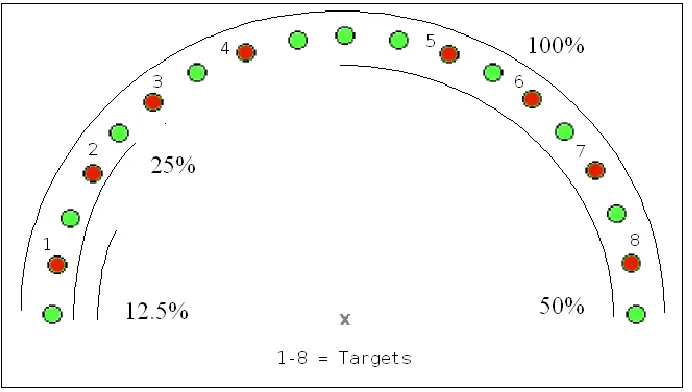
horizontal surface. Stimulus presentation consisted of a central cross that was surrounded
by 19 green precue circles arranged in a semi-circle (see Fig. 1). The precue circles were
equidistant from the central cross (distance from centre = 105 mm, diameter of circles =
7.5 mm). Eight of the circles were possible target locations (every second circle with the
precue circles and the appearance of a red target circle. The electromagnetic recording
equipment and the stimuli presentation were electronically time-locked.
[Insert Fig. 1 about here]
2.3. Procedure
The experimental task required participants to make simple aiming movements to one of
the eight target locations presented in four different precue conditions: no-, low-,
moderate-, and high-quality advance information: see Fig. 1. Two aiming movements
were made to each target in each precue condition, resulting in each participant
completing 64 trials in total. The order of trials (target location and precue condition) was
fully randomised for each participant.
Participants were seated in front of the laptop display, with their midline in line with the
central cross. First of all, participants viewed a preliminary “ready” screen that displayed
the central cross where they placed the index finger of their preferred hand (as
determined by the hand used for writing). The experimenter then electronically triggered
stimulus presentation and the kinematic recording. The next screen then displayed a
semi-circular array of green circles. Participants were instructed to observe the display
(and possible subsequent displays) until they saw a single red circle, which was their
target. On presentation of the imperative stimulus, participants were instructed to move
their index finger to it as quickly and as accurately as possible. The red target circle
remained on the screen until the next trial was initiated. Once the movement recording
experimenter started the next trial. All participants were given several practice trials
before test trials commenced.
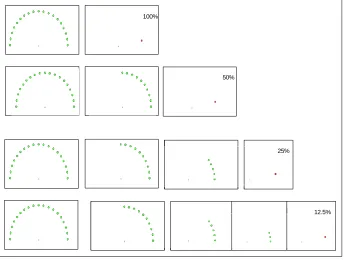
[Insert Fig. 2 about here]
All precue displays were presented for 1500 ms, however the number of precue displays
varied across advance information conditions (see Fig 2): In the no advance information
condition, only one precue screen was presented and this consisted of the full 19 green
circles (100%). This display was immediately followed by presentation of one of eight
possible imperative target circles. In the low quality advance information condition, the
100% precue screen was presented, followed by a display in which the number of green
circles was reduced to 50% (thus indicating in which half of the screen the target would
be presented). This display was immediately followed by the presentation of one of 4
possible targets. In the moderate quality advance information condition, the 100% and
50% screens were presented, followed by a display in which the number of green circles
was reduced to 25% (indicating in which quarter of the semi-circle the target would
appear). This display was immediately followed by the presentation of one of two
possible targets. In the high quality advance information condition, the 100%, 50%, and
25% precue screens were presented, followed by a display in which the number of green
circles was reduced to three (providing full precue information about the target location,
as the target was always the centre dot). This display was followed by the presentation of
the single red imperative target.
3.1. Data reduction and inferential analyses
For each experimental group, mean reaction time, movement time, and final spatial
location (for the adult group only) was calculated from trials at each target position in
each precue condition. Trials in which participants had made an obvious error or had
moved before presentation of the target were eliminated from the data set. One
participant in the DCD experimental group made too many erroneous movements to
produce reliable data, and so had to be removed from the analyses. The adult data were
first entered into repeated measures ANOVA with target position and precue condition as
within-subjects factors. Separate ANOVAs were conducted for each dependent variable.
Subsequently, all data were entered into a mixed factor ANOVA using target position and
precue condition as within-subject factors and experimental group as a between-subjects
factor. Separate ANOVAs were conducted for each dependent variable.
3.2. Adults
Reaction time was unaffected by precue condition [F (3,27) = 0.20, p = 0.90, eta squared
= 0.02], revealing that there was no advantage of advance information. There was no
effect of precue condition on movement time [F(3,27) = 1.38, p=0.27, eta squared = 0.13]
demonstrating that both the preparation and execution of the movements were unaffected
by the provision of advance information. The data from the 50% precue condition were
analysed separately to explore whether there was an effect of target position in this
condition. There was no effect of target position on reaction time [(F(7,63) = 0.91, p =
0.50), eta squared = 0.09]. Likewise, target position had no significant effect on
3.3. All experimental groups
The RT data showed a significant interaction between group and condition [(F(9,135) =
2.84, p<0.05), eta squared = 0.16], revealing that experimental groups were affected
differently by precue condition.The effect of precue on reaction time was explored by
conducting ANOVAs on the individual groups.Further analyses revealed that the high
school children‟s RTs were unaffected by condition [(F(3,39) = 0.30, p=0.83), eta
squared = 0.02] in the same way as reported earlier for adults. In contrast, primary
school children exhibited a significant effect of precue condition [(F(3,27) = 5.79,
p<0.01), eta squared = 0.39], and this effect was also found in children with DCD
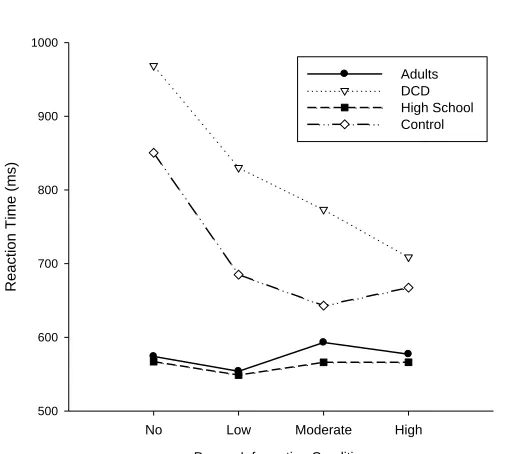
[(F(3,42) = 5.55, p< 0.01), eta squared = 0.28]. Fig. 3 shows that children with DCD are
affected most by the provision of precue information; as precue quality increases, their
reaction times decrease in a linear fashion. In order to formally test this effect, we used
linear regression to determine the reduction in RT as a function of information for each
individual child. We then used one-way ANOVA to test the RT reduction between the
primary school children and the DCD population. This analysis showed a reliable group
difference between these populations (F(1,24) = 5.35, p<0.05).
[Insert Fig. 3 about here]
The movement time data did not reveal a significant interaction between group and
condition. Movement time was unaffected by precue condition [(F(3,135) = .02, p =
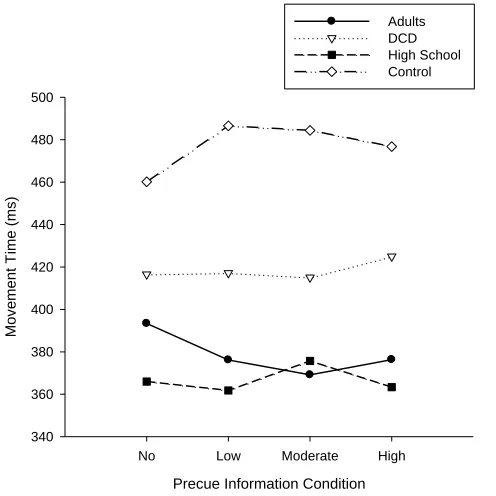
However, movement time was significantly affected by group, [(F(3,45) = 7.35, p<0.01),
eta squared = 0.33] (see Fig. 4). Overall, primary school children took significantly
longer to complete movements than adults [(F(1,18) = 8.35, p=0.01), eta squared = 0.32]
and high school children [(F(1,22) = 14.9, p<0.01), eta squared = 0.40]. Children with
DCD took significantly longer than high school children [(F(1,27) = 8.34, p< 0.01), eta
squared = 0.24] but actually exhibit significantly faster movement completion times than
control primary school children [(F(1,23) = 4.47, p<0.05), eta squared = 0.16].
[Insert Fig. 4 about here]
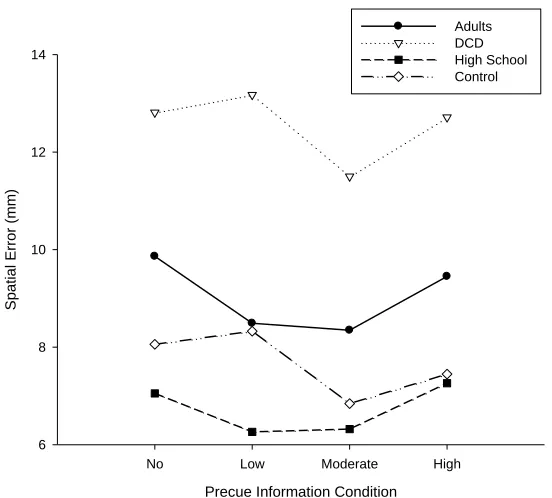
The reason that the children with DCD showed shorter movement times became apparent
in the spatial error data where there was no interaction but a significant effect of group
was found [(F (3,42) = 13.82, p<0.01), eta squared = 0.50] (see Fig. 5). Children with
DCD produced significantly more spatial error than adults [(F(1,23) = 7.79, p=0.01), eta
squared = 0.25], high school children [(F (1,26) = 35.1, p<0.01), eta squared = .57] and
control primary school children [(F(1,21) = 15.26, p<0.01, eta squared = 0.42]. The
difference between high school children and adults was also significant [(F(1,21) = 6.4,
p<0.05), eta squared = 0.23]. No significant effect of precue condition was observed for
spatial error [(F (3,126) = 1.60), p=0.19,eta squared = 0.04].
[Insert Fig. 5 about here]
4. Discussion
The current study investigated the effect of advance information on simple aiming
children and children with DCD. The results showed no effect of precue condition on the
adults‟ reaction times. It is not possible to determine whether the lack of an effect
represents a ceiling effect (i.e. whether the no information reactions were at some upper
limit so it simply wasn‟t possible to respond faster) or a floor effect (i.e. where faster
reactions were possible with advance preparation but the costs of such a strategy
outweighed the benefits). In either case, the interpretation is the same – the advance
information did not provide a large enough benefit to reduce RT. These results constitute
a violation of Hick‟s law (i.e. RT was not a function of response uncertainty). This result
is consistent with the work of Kverga et al. (2002) and Wright et al. (2007) who showed,
respectively, that eye saccades and short aiming movements violate Hick‟s law. In other
words, RTs for well learned and highly practiced movements are unaffected by the
number of possible target locations. It follows that Hick‟s law is restricted to movements
(responses) where constraining action selection is useful to the achievement of the goal.
In these terms, Hick‟s law relates to stimulus-response-selection benefits.
In the introduction, we suggested that response-selection benefits are a function of the
task and the skill level of the individual. It is known that adults show a partial precue
effect in a prehension task whilst adolescents with DS and children with DCD do not
(Mon-Williams et al 2001; Mon-Williams et al 2005). LeClair, Pollack, and Elliot (1993)
showed that a DS population do show a partial precue effect in a simple aiming task.
Thus, we predicted that individuals with lower skill levels would show a partial precue
effect in a simple aiming task. In line with this prediction, a significant RT advantage was
number of potential targets from eight to four (i.e., in the 50% condition). Thereafter, the
control primary school children displayed no further RT advantage despite the provision
of increasingly specific information. In contrast, children with a known movement deficit
(DCD) displayed a linear decrease in RT as the quality of the advance information
increased. In other words, increasing the precue information allowed the necessary action
to be selected more quickly. Notably, this effect even occurred between the moderate and
high quality information condition where the number of possible target locations was
reduced from two close targets to only one. The current experiment therefore helps
clarify the complex picture drawn by previous results, by demonstrating that children
with DCD can benefit from partial pre-cue information (contra Mon-Williams et al,
2005) if the benefits outweigh the costs. This trade off is relative to skill level, and
aiming is clearly easier than prehension.
Children with DCD were overall less skilled in producing these simple aiming
movements, as indexed by by the low spatial accuracy at the end of their movements.
Inspection of the signed spatial errors revealed that the children tended to land short of
the actual target location. The same instruction was provided to all of the groups (move
as quickly but as accurately as you can) but it is possible that the kinematic differences
are a function of how the children with DCD interpreted the task. Likewise, differences
associated with the significance of the task are likely to explain why the high school
children showed higher performance levels (shorter duration with higher spatial
accuracy) than a group of undergraduate students. It is always difficult to disambiguate
and the significance associated with a task (Tresilian et al., 2005). Nevertheless, it is
notable that only the DCD population consistently failed to achieve the core goal of
ending the movement with their finger in contact with the imperative target.
We would suggest the paradigm reported in this manuscript provides a very efficient
manner of identifying children with DCD. The children with DCD showed RTs that
differentiated them from all of the (randomly selected) control children. This observation
opens up the exciting prospect that simple clinical kinematic assessment techniques could
be used to identify children at risk of motor problems within educational or clinical
References
Bard, C. & Hay, L. (1993). Ontogenetic study of visual-manual coordination.
Canadian Journal of Psychology, 37, 390-413.
Brown, J.V., Sepehr, M., Etlinger, G., & Skreczek, W. (1986). The accuracy of aimed movements to visual targets during development – the role of visual information.
Journal of Experimental Child Psychology, 41, 443-460.
Brenner, E. & Smeets, J.B.J. (1997). Fast responses of the human hand to changes in target position. Journal of Motor Behavior, 29, 297-310.
Goodman, D. & Kelso, J. A. S. (1980). Are movements prepared in parts? Not under compatible (naturalized) conditions. Journal of Experimental Psychology: General,
109, 475–495.
Henderson, S.E. & Sugden, D.A. (1992). Movement assessment battery for children. The Psychological Corporation. New York: Brace and Jovanovich.
Hick, W.E. (1952). On the rate of gain of information. Quarterly Journal of Experimental Psychology, 4, 11-26.
Kveraga, K., Boucher, L., & Hughes, H.C. (2002). Saccades operate in violation of Hick‟s law. Experimental Brain Research, 146, 307-314.
LeClair, D. A., Pollack, B. J., & Elliott, D. (1993). Movement preparation in adults with and without Down syndrome. American Journal of Mental Retardation, 97, 628– 633.
Losse A., Henderson, S.E., Elliman, D., Hall, D., Knight, E. and Jongmans, M. (1991) Clumsiness in children - do they grow out of it? A 10-year study. Developmental Medicine and Child Neurology, 33, 55-68.
Mandich, A., Buckolz, E., & Polatajko, H. (2003). Children with developmental coordination disorder (DCD) and their ability to disengage ongoing attentional focus: More on inhibitory function. Brain and Cognition, 51, 346–356.
Mon-Williams, M., Tresilian, J. R., Bell, V. E., Coppard, V. L., Jobling, A., & Carson, R. G. (2001). The preparation of reach to grasp movements in adults with Down Syndrome. Human Movement Science, 20, 587–602.
Mon-Williams, M., Tresilian J.R., Bell, V.E., Coppard, V.L., Nixdorf, M. & Carson, R.G. (2005). The preparation of reach to grasp movements in adults, children and children with developmental coordination disorder. The Quarterly Journal of Experimental Psychology, 58, 1249-1263.
Newham, C. & McKenzie, B.E. (1993). Cross modal transfer of sequential visual and haptic shape information by clumsy children. Perception, 22, 1061-1073.
Olivier, I., Audiffren, M., & Ripoll, H. (1998). Age-related differences in the preparatory processes of motor programming. Journal of Experimental Child Psychology,
69, 49–65.
Rösblad, B. (1997). Roles of visual information for control of reaching movements in children. Journal of Motor Behavior, 29, 174-182.
Rosenbaum, D.A. (1980). Human movement initiation: Specification of arm, direction, and extent. Journal of Experimental Psychology: General, 109, 444–474.
Smyth, T. R. (1991). Abnormal clumsiness in children: a defect of motor programming?
Child Care, Health and Development, 17, 283–294.
Thelen, E., Corbetta, D., Kamm, K., & Spencer, J.P. (1993). The transition to reaching: Mapping intention and intrinsic dynamics. Child Development, 64, 1058-1098.
Tresilian, J.R., Mon-Williams, M., Coppard, V.L., & Carson, R.G. (2005). Developmental changes in the response to obstacles during prehension. Journal of Motor Behavior, 37, 103-110.
Vu, K.P.L. & Proctor, R.W. (2004). Mixing compatible and incompatible
mappings: Elimination, reduction, and enhancement of spatial compatibility effects.
Quarterly Journal of Experimental Psychology A: Human Experimental Psychology, 57,
539–556.
Wilson, P. H., Maruff, P., & McKenzie, B. E. (1997). Covert orienting of attention in children with developmental coordination disorder. Developmental Medicine and Child Neurology, 39, 736–745.
Zoia, S., Castiello, U., Blason, L., & Scabar, A. (2005). Reaching in children with and without developmental coordination disorder under normal and perturbed vision.
Figure Captions
Figure 1. Stimuli presentation and precue conditions
100% Condition – Target Probability = 1:18 (no advance information);
50% Condition – Target Probability = 1:9 (low quality advance information);
25% Condition – Target Probability = 1:5 (moderate quality advance information;
12.5% Condition – Target Probability = 1:3 (high quality advance information).
Figure 2. Sequence presentation in the four precue conditions
Figure 3. Effect of precue condition on reaction time across experimental group
Figure 4. Movement time across experimental group
100%
50%
25%
[image:23.612.76.420.164.424.2]12.5%
Precue Information Condition
No Low Moderate High
Reac
tion
T
ime
(ms
)
500 600 700 800 900 1000
[image:24.612.76.338.168.395.2]Adults DCD High School Control
Precue Information Condition
No Low Moderate High
Mov
eme
nt
T
ime
(ms
)
340 360 380 400 420 440 460 480 500
Adults DCD High School Control
[image:25.612.76.324.163.411.2]Precue Information Condition
No Low Moderate High
Spat
ial
Error (mm
)
6 8 10 12 14
Adults DCD High School Control
[image:26.612.76.352.162.411.2]