Rochester Institute of Technology
RIT Scholar Works
Theses Thesis/Dissertation Collections
2009
Project management: a simulation-based
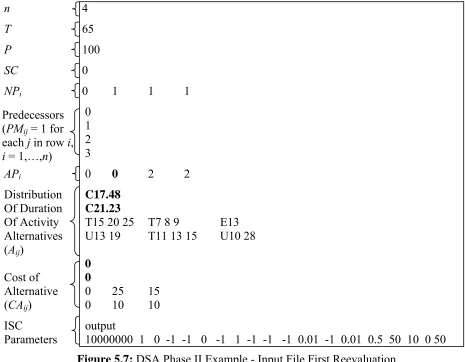
optimization method for dynamic time-cost
tradeoff decisions
Radhamés A. Tolentino Pena
Follow this and additional works at:http://scholarworks.rit.edu/theses
This Thesis is brought to you for free and open access by the Thesis/Dissertation Collections at RIT Scholar Works. It has been accepted for inclusion in Theses by an authorized administrator of RIT Scholar Works. For more information, please [email protected].
Recommended Citation
Rochester Institute of Technology
PROJECT MANAGEMENT: A SIMULATION-BASED OPTIMIZATION METHOD FOR DYNAMIC TIME-COST TRADEOFF DECISIONS
A Thesis
Submitted in partial fulfillment of the requirements for the degree of
Master of Science in Industrial Engineering
in the
Department of Industrial & Systems Engineering Kate Gleason College of Engineering
by
DEPARTMENT OF INDUSTRIAL AND SYSTEMS ENGINEERING
KATE GLEASON COLLEGE OF ENGINEERING
ROCHESTER INSTITUTE OF TECHNOLOGY
ROCHESTER, NEW YORK
CERTIFICATE OF APPROVAL
M.S. DEGREE THESIS
The M.S. Degree Thesis of Radhamés A. Tolentino Peña
has been examined and approved by the
thesis committee as satisfactory for the
thesis requirement for the
Master of Science degree
Approved by:
____________________________________ Dr. Michael E. Kuhl, Thesis Advisor
ABSTRACT
Project managers face difficult decisions with regard to completing projects on time and
within the project budget. A successful project manager not only needs to assure that the project
is completed, but also desires to make optimal use of resources and maximize the profitability of
the project. The goal of this research is to address the time-cost tradeoff problem associated with
selecting from among project activity alternatives under uncertainty. Specifically, activities that
make up a project may have several alternatives each with an associated cost and stochastic
duration. The final project cost is a result of the time and cost required to complete each activity
and lateness penalties that may be assessed if the project is not completed by the specified
completion time. In an effort to optimize the project time-cost tradeoff, a dynamic,
simulation-based optimization method is presented. In particular, the method minimizes the expected project
cost due to lateness penalties and the activity alternatives selected. The method is designed to be
implemented in two phases. The first phase, referred to as the static phase, is implemented prior
to the start of the project. The static phase results in the expected cost for the recommended
project configuration including the alternative selected for each activity and the distributions of
the project completion and total project cost. The second phase, referred to as the dynamic phase,
is implemented as the project progresses. The dynamic phase allows the project manager to
reevaluate the remaining project and activity alternatives to dynamically minimize the expected
total project cost. The method provides an optimal solution under the assumptions of traditional
crashing implementations and a heuristic solution for the generalized problem. An experimental
performance evaluation shows the effectiveness of the method for making project management
decisions. Finally, the method is fully implemented in computer software and integrated into a
TABLE OF CONTENTS
1. INTRODUCTION...1
2. PROBLEM STATEMENT ...4
3. LITERATURE REVIEW ...7
3.1 Project Management: Project Scheduling ... 7
3.2 Project Management: Time-Cost Tradeoffs ... 12
3.3 Discrete Optimization via Simulation ... 17
3.4 Discussion ... 18
4. OPTIMAL CRASHING METHODS FOR TRADITIONALLY DEFINED PROJECT MANAGEMENT PROBLEMS ...21
4.1 Assumptions Considered in the OTCM Method ... 24
4.2 OTCM Phase I: Optimal Crashing Method Applied Prior to the Start of the Project ... 24
4.3 OTCM Phase I Example ... 27
4.4 OTCM Phase II: Dynamic Crashing ... 32
4.5 OTCM Phase II Example ... 34
4.6 OTCM Optimization Program and OTCM Project Simulator ... 43
4.6.1 OTCM - Input Files ... 46
4.6.2 OTCM - Simulation Model ... 47
4.6.3 OTCM - Optimization Engine ... 50
4.6.4 OTCM - Project Simulator ... 51
4.6.5 OTCM - Integration of OTCM Program Components and the Project Simulator ... 52
4.7 OTCM Experiments ... 53
4.7.1 OTCM Experimental Case 1 ... 56
4.7.2 OTCM Experimental Case 2 ... 66
4.7.3 OTCM Experimental Case 3 ... 75
4.7.4 Summary of Experimental Performance Evaluation ... 83
4.8 Summary of OTCM ... 83
5. DYNAMIC SELECTION OF ACTIVITY ALTERNATIVES ...84
5.1 Assumptions Considered in the DSA Method ... 87
5.2 DSA Phase I: Selection of Alternatives Prior to the Start of the Project ... 88
5.3 DSA Phase I Example ... 91
5.4 DSA Phase II: Dynamic Selection of Alternatives during the Project Execution ... 95
5.5 DSA Phase II Example... 98
5.6 DSA Optimization Program and DSA Project Simulator ... 102
5.6.1 DSA - Input Files ... 105
5.6.2 DSA - Simulation Model ... 106
5.6.3 DSA - Optimization Engine ... 109
5.7 DSA Experiments ... 112
5.7.1 DSA Experimental Case 1 ... 115
5.7.2 DSA Experimental Case 2 ... 123
5.7.3 Summary of Experimental Performance Evaluation ... 131
5.8 Summary of DSA ... 131
6. MS PROJECT INTERFACE ...133
6.1 OTCM Interface ... 135
6.2 DSA Interface... 142
6.3 Summary of OTCM and DSA MS Project Templates ... 148
7. CONCLUSIONS & RECOMMENDATIONS FOR FUTURE RESEARCH ...149
7.1 Conclusions ... 149
7.2 Recommendations for Future Research ... 151
REFERENCES ...152
APPENDICES ...155
Appendix A. Industrial Strength COMPASS Input Parameters ... 155
Appendix B. Input Files for OTCM Experimental Performance Evaluation... 157
Appendix C. Input Files for DSA Experimental Performance Evaluation ... 164
Appendix D. OTCM/DSA MS Project Template – User Manual ... 169
1. INTRODUCTION
Project management is a methodology used by many companies to help maximize
performance and competitiveness. Projects and their execution require resources which may
include people, equipments, materials, and energy. Project management, which is characterized
by techniques intended to provide a better use of project resources (Kerzner, 2003), can
positively impact the profitability of a company.
An important aspect of project management is risk management. Different types of risk
are present in any given project. This research focuses on the schedule/time risk and associated
costs. The schedule/time risk is a result of the uncertainty associated with completing project
activities on time and the potential late completion of the project. In general, late project
completion can have negative effects for the company such as penalty costs, budget overruns,
compromised project performance, customer dissatisfaction, lost market share, or lost revenue. If
a project is running late project managers might be able to bring the project back on track by
reducing the duration of the project’s activities through “the deployment of additional resources
or other means” (Eisner, 2002). For the purpose of this research, projects having activities with
multiple completion alternatives (activity alternatives) of varying completion times and costs are
considered. These activity alternatives could include outsourcing certain tasks, working
overtime, bringing in additional resources, and others. Although the activity alternatives may
reduce the project completion time, thus avoiding or reducing penalty costs, the incorporation of
these alternatives into the project may have additional cost. Furthermore, the duration of each
activity alternative may be uncertain. Provided that an estimate of the activity alternative
duration and the associated uncertainty can be obtained, the duration uncertainty can be taken
activity’s duration is commonly represented by a stochastic probability distribution. Given these
conditions, the objective of a project manager is to address the time-cost tradeoff associated with
selecting from among the activity alternatives, in order to choose the set of activity alternatives
that minimize the cost or maximize the profitability of the project. Without loss of generality,
this thesis frames this problem with the objective of minimizing total cost.
A conceptual representation of the time-cost tradeoff for a typical scenario involving a
planned project with a set of preferred (base) activity alternatives that has potential for being
completed late (resulting in a penalty), and may benefit from considering other activity
alternatives is illustrated in Figure 1.1. As various combinations of activity alternatives are
considered, the duration of the project may be reduced as well as the total cost of the alternatives
chosen plus the lateness penalty cost. For some combinations of activity alternatives, diminishing
returns may be realized until a point where the total cost may begin to increase. That is, some
combination of activity alternatives, although the combination would further reduce the
completion time of the project, the cost of using these sets of alternatives would cost more than
the penalty cost that would result from the project being late. Thus, the objective is to determine
the optimal set of activity alternatives associated with the point (indicated by the arrow) where
the total cost will be minimized. Determining the optimal time-cost tradeoff is the focus of this
research.
The rest of this thesis is organized as follows. Chapter 2 presents the problem statement
and states the goals of this research. Chapter 3 presents a review of the literature relevant to the
research which includes project scheduling, approaches to solving variations of the time-cost
tradeoff problem, and based optimization. Chapter 4 presents a dynamic
stochastic time-cost tradeoff problem. Chapter 5 introduces a simulation-based optimization
method for the generalized dynamic time-cost tradeoff decision for project management. Chapter
6 illustrates the integration of the methods into Microsoft Project. Finally, Chapter 7 presents the
conclusions drawn from this research, as well as recommendations for future work.
Reduction in Project Duration
A
lt
er
na
ti
ves
+
P
en
al
ty
C
os
t
Figure 1.1: Relationship between Reduction in Project Duration and the Total Cost (Alternatives + Penalty).
2. PROBLEM STATEMENT
The goal of this research is to address the time-cost tradeoff problem associated with
selecting from among project activity alternatives under uncertainty. Specifically, activities that
make up a project may have several alternatives each with an associated cost and stochastic time
duration. The final project cost is a result of the time and cost required to complete each activity
and lateness penalties that may be assessed if the project is not completed by the specified
completion time. Therefore, a method is needed to evaluate the combination of activity
alternatives and their associated cost and to compare the resulting project completion times and
associated penalty costs to select the configuration that will minimize the total cost.
In an effort to optimize the project time-cost tradeoff, dynamic, simulation-based
optimization methods are investigated. The following are key objectives for this research:
• Develop a dynamic simulation-based optimization method for the traditionally defined
stochastic time-cost tradeoff problem: The traditionally defined stochastic time-cost
tradeoff problem focuses on projects in which the duration of the activities can be
reduced by integer time units having a constant cost per unit, and a penalty cost is
assessed if the project is completed late. Solving the traditionally defined time-cost
tradeoff problem involves identifying the activities whose duration is to be reduced and
the amount of the reduction (referred to as the crashing configuration) in order to
minimize the expected project cost due to lateness penalties and the cost of reducing the
activities duration. The method to be developed for solving this problem should be
capable of evaluating projects in the (static) planning phase (before the start of the
project) to determine the optimal crashing configuration that minimizes the average
as the project progresses. The information provided by the method to the project
managers should include the optimal crashing configuration and statistics associated with
the optimal solution (estimated average project cost, estimated project cost variance, and
a confidence interval on the average project cost), as well as an empirical distribution of
the project completion time and project cost for any potential crashing configuration.
• Develop a dynamic simulation-based optimization method for the generalized stochastic
time-cost tradeoff decision problem: The generalized stochastic time-cost tradeoff
problem focuses on projects in which the activities may have several alternatives each
with an associated cost and stochastic duration with the objective of determining the
configuration of alternatives that minimizes the expected project cost due to lateness
penalties and the cost of the alternatives selected. The method designed to solve this
problem should be capable of providing an optimal configuration of alternatives before
the start of the project and dynamically reevaluating the project throughout its execution.
The output of the method should include the optimal configuration of alternatives and
statistics associated with the optimal solution (estimated average project cost, estimated
project cost variance, and a confidence interval on the average project cost), as well as an
empirical distribution of the project completion time and project cost for any potential
configuration of alternatives.
• Implement the simulation-based optimization methods in a project management software
tool: The methods that are designed to solve the traditional and the general stochastic
time-cost tradeoff problems should be easy to apply to real projects in order to facilitate
their use. Consequently, the methods should be integrated into a commercially available
which the methods can be applied. This implementation can allow the users to manage
their projects and utilize the simulation-based optimization tools for addressing the
time-cost tradeoff problem in a single application. Furthermore, the software tool should allow
for both the static (before the start of the project) and dynamic (during project execution)
use of the optimization methods. Finally, the software tool should provide the project
manager with the recommended activity alternative configuration, as well as the
supporting statistics and data to aid in their time-cost tradeoff decisions.
With the development of these robust, dynamic, and user-friendly simulation-based
optimization methods, project managers may be able to improve the use of their resources and
reduce the risk of late completion, thus contributing to a high level of customer satisfaction, and
3. LITERATURE REVIEW
This chapter summarizes the current body of knowledge that is relevant to the research
conducted for this thesis, including project scheduling techniques, deterministic and stochastic
approaches to the time-cost tradeoff problem, and discrete optimization via simulation. The
potential contribution that this research can provide to the current literature is discussed at the
end of the chapter.
3.1 Project Management: Project Scheduling
The Critical Path Method (CPM) and the Project Evaluation and Review Technique
(PERT) methods have been used since the 1950s to assist in scheduling project activities. CPM is
a deterministic approach to calculate the completion time of a project, and PERT is a
probabilistic approach that considers uncertainty in activity durations to determine the
completion time of the project, and that can be used to estimate the probability to complete the
project by a given time (Wiest and Levy, 1969). CPM was originally developed for the type of
projects for which the information from previous similar projects could be used to estimate the
duration of the activities of the new project (such as construction projects), whereas PERT was
originally developed mainly for research and development projects, for which it is difficult to get
an estimate of the duration of each stage of the project (Wiest and Levy, 1969). In addition, CPM
is interested in the tradeoff between project cost and project completion time, and PERT is
interested in dealing with the uncertainty in activity durations (Wiest and Levy, 1969). Although
the original versions of CPM and PERT have some differences, they also have significant
similarities, and with time they have been commonly considered as one technique called
One of the common features between CPM and PERT is the way in which the completion
time of the project is estimated, which is using a project network to find the critical path of the
project. The project network is a graphical representation of the project, which shows the
dependence relationships between the activities of the project. From the project network one can
determine all of the network paths (set of project activities that connects the start and the end of
the project). CPM and PERT considers the length (time required to complete the activities on a
path) of the critical path as the estimated project duration. The critical path is the path with the
largest length; note that a project might have multiple critical paths. Hillier and Lieberman
(2001) show the procedure used by PERT/CPM to identify the critical path. The steps of the
procedure are:
• Determine the earliest start time (ES) and the earliest finish time (EF) of each activity.
This process starts at the beginning of the network and goes through all of the activities
until the end of the project network. This process is known as a forward pass. For each
activity EF is equal to ES plus the activity duration, and ES is equal to the largest EF
among the activity predecessors.
• Determine the latest start time (LS) and the latest finish time (LF) of each activity, by
making a backward pass through the network (opposite of making a forward pass). For
each activity LS is equal to LF minus the activity duration, and LF is equal to the smallest
LS among the activity successors.
• Determine the slack of each activity. The slack indicates the amount of time by which an
activity might be delayed without delaying the project completion time. For each activity
In calculating the critical path of the project, CPM considers that the duration of each
activity is known, whereas PERT (which considers uncertainty in activity duration) uses an
estimate of the expected duration of each activity. PERT deals with uncertainty by considering
three estimates of the activity duration [most likely (m), optimistic (o), pessimistic (p)], and
assuming that the distribution of the activity duration follows a beta distribution (Hillier and
Lieberman, 2001). Under that assumption the mean (µ) and the variance (σ2) of the beta distribution that represent the activity duration can be approximated, respectively, by:
6 4m p
o+ +
=
µ and
2 2
6 ⎟⎠ ⎞ ⎜
⎝ ⎛ −
= p o
σ
.
Although PERT considers the mean and variance of each activity to describe its duration and
uncertainty, only estimates of the expected duration are considered to calculate the critical path,
ignoring the variances, thus making a deterministic analysis (Ahuja et al., 1994).
When there is uncertainty associated with the activity durations, it is important to know
the probability of completing the project by a certain time. PERT/CPM makes the following
assumptions to calculate this probability (Hillier and Lieberman, 2001):
• The mean critical path will be the path with the largest length. The mean critical path “is
the path through the project network that would be the critical path if the duration of each
activity equals its mean”.
• The durations for the activities in the mean critical path are statistically independent.
• The project duration follows a normal distribution.
From these assumptions it is possible to determine the mean project duration (µp), and the
variance of the project duration ( 2
p
σ ), which are needed to compute the probability of
mean critical path, and the variance of the project duration is equal to the sum of the variances of
the activities that form the mean critical path. Since the project duration is assumed to be a
normally distributed variable (X), the standard normal variable (Z) can be obtained using the
expression:
σ µ
−
= X
Z .
The probability of completing the project by time x is then P(X≤x) = P(Z≤z), where
σ µ
−
= x
z .
A drawback of PERT stated by MacCrimmon and Ryavec (1964) is that when multiple
paths can be followed to complete a project, the calculated project duration “is always less than,
and never greater than, the true project mean.” This bias is identified as the “merge event bias”
and is most evident when the path durations are similar to each other. Conducting a stochastic
simulation study where the true properties of the distributions of activity duration are considered
can provide a better estimate of the expected completion time of the project (Ahuja et al., 1994).
Simulation of project networks has been used to improve the effectiveness of the
traditional PERT analysis. Williams (2004) indicates that Monte Carlo simulation of project
networks is now a common tool used by project managers. Simulating a project network
involves sampling an activity time from the probability distribution representing the duration of
each activity, and using the sampled activity duration to determine the critical path. Several
simulation-based project scheduling approaches are summarized in the next paragraphs.
The research of Lu and AbouRizk (2000) presents a CPM/PERT simulation model that
incorporates the discrete event modeling approach and a simplified critical activity identification
method. Lu and AbouRizk (2000) stated that “in the classic CPM analysis, earliest start time
must be documented for every activity”. The ES and EF are calculated in a forward pass through
the project network and the LS, LF, and TF are calculated through a backward pass. TF is used to
determine the criticality of an activity. The simulation model that Lu and AbouRisk (2000)
presents only performs a forward analysis of the network; with this forward pass an entity arrival
time (AT), a batched entity departing time (DT) and a waiting time (WT) are calculated, instead
of ES and EF. The critical activity identification method presented by Lu and AbouRizk (2000)
uses the WT to calculate the criticality of each activity, which is represented by the criticality
index (CI); thus, all the information required to calculate the CI is collected during the forward
pass. The criticality index of an activity obtained through a simulation model “is defined as the
number of simulation runs in which the activity is critical, divided by the total number of
simulation runs” (Lu and AbouRisk, 2000).
Dong-Eun Lee (2005) presents a software tool, called Stochastic Project Scheduling
Simulation (SPSS), which can be used to determine the probability associated with the
completion of the project by a target date specified by the user of the software. The software has
the capability to simulate activity durations with several probability distribution functions, such
as normal, uniform, exponential and triangular distributions. SPSS also calculates activity
criticality indexes.
Lee and Arditi (2006) describe a new simulation system, called Stochastic
Simulation-based Scheduling (S3), which is an improvement over SPSS. The drawbacks of PERT are also
referenced in that publication, and it is stated that “compared with the simulation method, PERT
leads to and optimistically biased project duration, since PERT inherently ignores all subcritical
mean duration and also determine the minimum number of simulation runs necessary to achieve
reliable results.
Pritsker (1986) and Simmons (2002) also describe simulation models that evaluate
project networks. These simulation models provide a histogram of the project completion time
distribution, which can be used to perform risk analysis.
3.2 Project Management: Time-Cost Tradeoffs
When scheduling a project there are certain key dates that the project manager must
consider, such as the target completion time desired by the customer, and the deadline for the
project to be considered as completed early. Usually, if the project is completed after the target
completion time, a penalty due to lateness is assessed, and if the project is completed before the
deadline for early completion, a bonus is realized. In some cases the project manager may realize
that with the current resources it is not possible to complete the project by the early completion
deadline, or by the target completion time. However, there are cases were the duration of certain
project activities can be reduced (using measures that have an additional cost) in order to avoid
penalties due to lateness or to receive bonuses for early completion. Since business decision are
generally made based on cost, in cases like the one previously described the project manager has
to evaluate the tradeoff between the reduction in project duration and the additional cost
associated with that reduction, to determine if it make economic sense to expedite the completion
of the project.
A method for addressing the time-cost tradeoffs present in a project is the CPM method
of time-cost tradeoffs (Hillier and Lieberman, 2001); from this point forward this method will be
configuration with the lowest cost that reduces the project estimated duration to a preferred
value. The crashing configuration indicates which activities should be crashed and by how much
should they be crashed. Hillier and Lieberman (2001) indicate that crashing an activity is to take
measures (involving an additional cost) to reduce the duration of an activity, such as working
overtime, bringing in additional temporary help, or using special equipment. Rosenau and
Githens (2005) state crashing is “spend[ing] more money on the project in order to speed up
accomplishment of scheduled activities”. To apply the CPM crashing method it is required to
have the crashing potential of each activity, which represents the maximum reduction of time
allowed by the activity (note that the crashing potential cannot be greater than the estimated
duration of the activity in order to avoid negative activity time), as well as the crashing cost per
time unit. The method assumes that reducing the duration of an activity that belongs to the
critical path by 1 unit reduces the duration of the project by 1 unit. The CPM crashing method
generally assumes that the crashing cost increases linearly as the crashed amount increases. The
CPM crashing method is generally implemented using linear programming (Hillier and
Lieberman, 2001).
The CPM crashing method has one major limitation which is the fact that it only
considers the estimated average duration of the activities, ignoring the uncertainty related with
the duration of the activities. Considering uncertainty is important because it allows having a
better understanding of the real impact that a crashing configuration will have on the project
duration. Since only the estimated average activity durations are considered, when a project is
crashed the expected completion time of the project (which is the mean of the distribution that
represents the completion time) is approximated to the desired target. Therefore, the probability
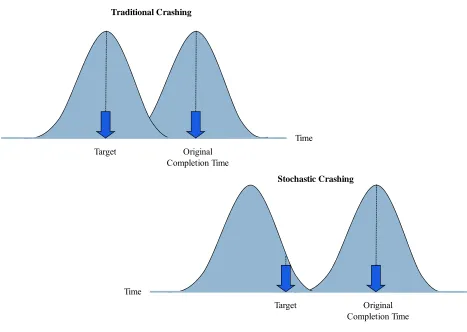
critical paths the probability may be smaller (Haga and Marold, 2004). If the probability
distributions that represent the activity durations are considered in the crashing process, it is
possible to shift the distribution of completion time to a point where the probability for late
completion is relatively low.
Original Completion Time Target
Time
Original Completion Time Target
Time
Traditional Crashing
[image:20.612.72.539.193.525.2]Stochastic Crashing
Figure 3.1: Traditional Crashing vs. Stochastic Crashing.
As a way to overcome the limitations of the CPM crashing method, several
simulation-based crashing methods that address the time-cost tradeoff problem have been developed (Bissiri
and Dunbar, 1999; Gutjahr et al., 2000; Haga, 1998; Haga and Marold, 2004; Haga and Marold,
2005), but in general the literature about this topic is limited (Herroelen and Leus, 2005). The
project cost (lateness penalty plus crashing cost). The next paragraphs summarize some of these
methods.
Bissiri and Dunbar (1999) present a method to crash a project network, which suggest the
use of simulation to obtain the average time of each activity, the critical path, and the near
critical paths. A near critical path in this model is a path which length is smaller than the original
completion date but it is larger than the target completion date after crashing. After the path
information is collected a linear program is applied to determine the optimum crashing strategy.
This method works in a very similar way to the traditional CPM crashing method because it
considers average activity times and looks for a solution in a deterministic manner.
Gutjahr et al. (2000) introduces a stochastic branch-and-bound crashing method, which
objective is to select the set of measures that will reduce the duration of the project, avoiding or
reducing penalty costs, in the most cost-efficient way. Specifically, it is assumed that there is a
group of measures that can be implemented, and each measure may reduce the duration of one or
more activities in the project by a given amount. Each measure is associated with a binary
variable which indicates if the measure is chosen or not.
Haga (1998) along with Haga and Marold (2004), and Haga and Marold (2005) present a
series of papers involving heuristic crashing methods for project management utilizing
simulation.
Haga and Marold (2004), proposed a simulation-based method that deals with the
time-cost trade-off involved with crashing a project. The authors state that “the complete distribution
of project completion time needs to be considered when crashing”. The method that they
proposed is a two steps approach. The first step is to apply the traditional PERT method to crash
its limit to determine if crashing that activity further reduces the average total cost of the project.
In this research, the authors considered two sources that can increase the cost of the project,
which are crashing costs and overrun costs. The approach that Haga and Marold (2004) followed
tries to optimize the cost of the project, thus if the penalty for late completion is smaller than the
crashing cost of the activities this method may suggest to allow the project to be completed late.
One improvement opportunity identified in this research is that the method presented does not
provide a way to monitor the crashing recommendations that it proposes, which can result in
unnecessary crashing of activities. The approach presented in Haga and Marold (2004) is a
heuristic that doesn’t consider interactions between different activities; essentially it conducts a
one-at-a-time evaluation of the crashing potential of the activities to determine which activities
should be crashed.
As a continuation of the Haga and Marold (2004) research, Haga and Marold (2005)
developed a simulation-based method to monitor and control a project. The output of this method
is a list of dates at which the project manager “should review the project to decide if activities
need to be crashed”. These dates are called crashing points, and they are determined by a
backward run through the project network. Although the concept explained in this research is
very useful, the proposed method requires a large amount of simulation time to evaluate a large
project network and “if the network does not have a single dominant critical path, the algorithm
will likely tend to overly crash the project” (Haga and Marold, 2005). In addition, before the
project starts, this method determines which activities might be crashed.
The methods discussed in this section provide a foundation for solving the time-cost
3.3 Discrete Optimization via Simulation
When dealing with the stochastic time-cost tradeoff problem, the project managers are
interested in identifying the optimal crashing configuration that minimizes the project cost. Since
the simulation-based crashing methods currently described in the literature are heuristic, there is
an opportunity to develop a method capable of providing an optimal solution to the stochastic
time-cost tradeoff problem.
In the context of simulation, discrete optimization is designed to “maximize or minimize
the expected value of a simulation output random variable whose distribution depends on a finite
vector of controllable decision variables” (Xu et al., 2007). In the case of the stochastic time-cost
tradeoff problem the objective is to minimize the expected value of the project cost which
depends on a vector of integer variables that represent the crashing amount of each activity
Various solution methods for discrete optimization via simulation are presented in the
literature, “including globally convergent random search (GCRS) algorithms, locally convergent
random search (LCRS) algorithms, ranking and selection (R&S), and ordinal optimization (OO)”
(Xu et al., 2007). For additional details please refer to Xu et al. (2007).
One of the most recent algorithms for discrete optimization via simulation is Industrial
Strength COMPASS (ISC). ISC is “a particular implementation of a general framework for
optimizing the expected value of a performance measure of a stochastic simulation with respect
to integer-ordered decision variables” (Xu et al., 2007). ISC is derived from the Convergent
Optimization via Most Promising Area Stochastic Search (COMPASS) framework developed by
Hong and Nelson (2006) for locally convergent, discrete optimization-via-simulation (DOvS).
As indicated by Xu et al. (2007), ISC provides convergence guarantees and statistical inference.
realistic problems in a reasonable amount of time; however, they lack the convergence
guarantees and statistical inference that ISC provides.
ISC is an initial effort to close the gap that commercial OvS software have in terms of
convergence guarantees, thus it has limitations (Xu et al., 2007):
• Problems with multiple objectives are not supported;
• Only integer-ordered decision variables are considered;
• Only linear-integer inequality constraints are considered; and
• Recommended for problems with up to 10 decision variables.
Although these limitations exist, ISC can be applied to a large segment of discrete simulation
optimization problems.
The optimization procedure implemented by ISC is divided in three phases:
• Global Phase: explores the entire solution space, and identifies sub-regions with potential
good solutions;
• Local Phase: evaluates each sub-region and converges to local optimal solutions; and
• Clean Up Phase: selects the best solution among the local optima identified in the Local
Phase, and estimates its value with the precision specified by the user.
Since the stochastic time-cost tradeoff problem is a problem suitable for DOvS, ISC is a
good candidate for an optimization engine.
3.4 Discussion
While reviewing literature relevant to the time-cost trade-off problem in project
management, certain opportunities for improvement have been identified. One opportunity is
nature and provide a solution to the problem, but do not guarantee optimality. To address this
opportunity a simulation-based crashing method (presented in Chapter 4) is developed in which a
simulation model interacts with an optimization engine to obtain an optimal solution. Another
opportunity is that the simulation-based methods that are presented in Section 3.2 are designed to
solve only a portion of the problems that project managers may face. To expand the current
literature a method is developed (and presented in Chapter 5) to solve a generalized version of
the stochastic time-cost tradeoff problem, which relaxes the assumptions considered by the
traditionally defined time-cost tradeoff problem.
From the methods presented in Section 3.2, the methods that are more closely related (in
terms of the solution the method provides) to the methods presented in this thesis are Haga and
Marold (2004, 2005). Table 3.1 summarizes these methods and the ones presented in this thesis.
Regarding the traditionally defined time-cost tradeoff problem, in the case of a single
critical path the method of Haga and Marold (2004) provides an optimal solution in the static
phase, which is prior to the start of the project. For the dynamic phase (throughout the project
execution) Haga and Marold (2005) provides a heuristic solution; essentially the method
provides, prior to the start of the project, a set of completion times (crashing points) for the
activities by which the activities should be completed, and then, during the project, the project
manager needs to decide if the activities will be completed by those points; if the project
manager decides that the activities won’t be completed by the crashing points, the activities
should be crashed. For the case of multiple potential critical paths Haga and Marold (2004)
provide a heuristic solution for the static phase. The dynamic solution (Haga and Marold 2005) is
The first method developed and presented in this thesis (OTCM), which is focused on the
traditionally defined time-cost tradeoff problem, provides (for the static evaluation) an optimal
solution for the cases of single or multiple critical paths. For the dynamic phase OTCM is a
heuristic solution because the user specifies the times for the dynamic reevaluations. If the
project is continuously reevaluated the solution would be optimal.
Table 3.1. Summary of Different Approaches to the Time-Cost Tradeoff Problem (CP ≡ Critical Path).
Static Method (Haga & Marold, 2004) Dynamic Method (Haga & Marold, 2005)
Static Method Dynamic Method
Single CP; Integer
Crashing; Linear Costs Optimal Heuristic (OTCM) Optimal
Heuristic (OTCM) Multiple CP; Integer
Crashing; Linear Costs Heuristic Heuristic (OTCM) Optimal
Heuristic (OTCM) Single/Multiple CP;
Varying Mean of Base Alternative; Non-linear, ordered Costs
- - Heuristic
(DSA)
Heuristic (DSA)
Single/Multiple CP; Varying Distribution of Base Alternative; Non-linear, not ordered Costs
- - Heuristic (DSA) Heuristic (DSA)
In addition, a method that more accurately represent the situations that the project
manager might encounter has been developed. The method (DSA) relaxes the assumptions
traditionally associated with the alternatives associated to each activity. DSA is a heuristic
because the optimization engine used is not designed to guarantee optimality for these cases. If
4. OPTIMAL CRASHING METHODS FOR TRADITIONALLY DEFINED
PROJECT MANAGEMENT PROBLEMS
Although the intention of this research is to solve the generalized time-cost tradeoff
problem, the initial methods that are developed and presented are for the traditionally defined
application of crashing methods to project management. Given that much of the current literature
(e.g. Bissiri and Dunbar, 1999; Gutjahr et al., 2000; Haga and Marold, 2004) focuses on the
traditional definition of crashing and assuming that this definition adequately describes a portion
of the projects to which project management techniques are applied, optimal crashing methods
for this traditionally defined scenario are presented in this chapter. The methods developed for
the generalized time-cost tradeoff problem are presented in Chapter 5.
Project management problems involving crashing are traditionally defined as follows.
Given a project defined by individual activities, their precedence relationships, and stochastic
activity durations, a project network can be developed. An example of such a project (Sample
Project) having 11 activities is described in Table 4.1; Figure 4.1 illustrates the project network
where the nodes represent the activities and the arcs (edges) represent the precedence
relationships. In this type of project, crashing is defined as “spend[ing] more money on the
project in order to speed up accomplishment of scheduled activities” (Rosenau and Githens,
2005). The crashing potential of an activity is the maximum number of time units by which an
activity’s time can be reduced. In this traditional definition, activities are typically crashed in
integer time units up to the crashing potential, and the associated crashing cost is assumed to be
linear (that is, each time unit by which the activity is crashed has the same cost). For each
activity in the example, the maximum crashing potential is specified in Table 4.1 along with the
a linear function of the quantity of time by which the project is late. For example, a project that is
due at time 70 with a lateness penalty of 40 per time unit would have the following penalty
function, ⎩ ⎨ ⎧ > − ≤ = 70 τ if ), 70 τ ( 40 70 τ if , 0 ) τ , (T PF .
The objective of the traditionally defined problem is to determine the activities to crash
in order to minimize the average project total cost, where the total cost is defined as crashing cost
plus any penalty due to lateness.
Table 4.1: Sample Project Specifications.
Activity Duration Crashing Unit Crashing Activity Predecessors Minimum Mode Maximum Potential Cost
1 - 8 10 12 3 6
2 1 6 10 14 3 3
3 1 6 8 10 3 5
4 3 10 15 20 3 4
5 2 12 17 22 3 5
6 2,4 3 5 7 3 8
7 5 6 9 12 3 5
8 6 4 6 8 3 5
9 4 11 13 15 3 2
10 7,8,9 13 15 17 3 8
11 10 5 7 9 3 7
The purpose of this first stage of the research is to develop static and dynamic
simulation-based analysis methods for the traditionally defined time-cost tradeoff problem that are capable
of evaluating project networks to answer the following questions:
• Which activities should be crashed in order to minimize the average project cost?
• To what extent should the activities be crashed?
• Should the crashing configuration be changed throughout the project?
The method presented in this section is named the Optimal Traditional Crashing Method
(OTCM). The overall OTCM procedure is presented in two phases. Phase I considers the
evaluation of the project prior to the start of the project. This phase will produce an optimal
crashing strategy with respect to information available prior to the start of the project. During
Phase II, which is applied as the project progresses, dynamic reevaluations of the project are
performed in order to consider the known durations (and sunk costs) of completed activities and
the effect of the uncertainty of the durations of the remaining activities, and to determine the
optimal crashing strategy from that point forward.
In the next sections, Phase I and Phase II of the OTCM procedure are presented.
Although the two phases are designed to be used together to maximize the benefit of the method,
Phase I can be applied independently from Phase II at the start of the project with Phase II being
4.1 Assumptions Considered in the OTCM Method
The OTCM method is designed taking the following assumptions into account:
1) Crashing an activity is defined as reducing the activity time by an integer number of time
units, thereby shifting the location of the distribution and maintaining the shape
(variance, skewness, etc.) of the activity time distribution;
2) Activity times are independent;
3) Activity time distributions can be estimated, using a probability distribution that will not
result in negative activity times when crashing is applied. Using the beta distribution or
the triangular distribution to represent activity times is common in the field of project
management (Lee and Arditi, 2006; Lu and AbouRizk, 2000; Haga and Marold, 2004)
and this convention is kept for the OTCM examples and experiments. The probability
distribution of each activity, in this case, is defined by three estimates consisting of the
optimistic (minimum), most likely, and pessimistic (maximum) duration times;
4) Crashing costs are known or can be estimated very accurately;
5) Penalty costs for late completion, represented by a linear function, are defined before the
start the project; and
6) Precedence constraints are assumed to be strictly defined (a successor activity cannot
begin until all the predecessors have been completed).
4.2 OTCM Phase I: Optimal Crashing Method Applied Prior to the Start of the Project The objective of Phase I of the method is to obtain the optimal crashing configuration
prior to the start of the project that will minimize the expected total project cost with respect to
the uncertainty associated with the duration of each activity is considered, which is represented
by probability distributions.
Phase I involves the following procedure:
• Defining the project in terms of the activities, predecessors, activity times, crashing
potential of each activity in the network and the related costs, and the penalty cost
function;
• Constructing a simulation model of the project network;
• Utilizing a stochastic simulation optimization tool such as Industrial Strength COMPASS
(ISC) to determine the optimal project crashing configuration;
• Evaluating the effect of not crashing the project (original crashing configuration) and the
effect of implementing the optimal crashing configuration with the OTCM project
simulator;
• Implementing the optimal crashing solution; and
• Proceeding to Phase II (optional).
The first step of the process is to specify the parameters that define the project network
and the optimization problem. The parameters include the number of activities, the probability
distribution associated with the completion time of each activity, the predecessors of each
activity, the maximum completion time by which no penalties are applied, the maximum amount
by which an activity can be crashed (crashing potential), and the cost of crashing each activity.
Note that the crashing potential of activities determines the solution space and complexity of
optimization the problem (e.g. if there are 15 activities in a project and each one could be crash
by 0, 1, or 2 units, thus each having a crashing potential of 2, the number of possible crashing
A simulation model of the project network is constructed after the input parameters are
provided. The simulation model represents all the activities in the project and the precedence
relationships that exist among them. The model is used to evaluate the various crashing
configurations that could be implemented in the project. Evaluating a crashing configuration
involves running a specified number of replications (instances) of the project network, under the
crashing configuration that is being considered, in order to estimate the average project cost
resulting from that configuration. Running a replication of the simulation model representing the
project network involves sampling an activity time from the probability distribution representing
the duration of each activity, reducing the sampled duration according to the crashing
configuration that is being considered, calculating the start time and completion time of each
activity taking into account that precedence relationships must be enforced, calculating the
completion time of the project, calculating the penalty for late completion (if any), and finally
computing the project cost, which consists of the lateness penalty and the crashing cost.
Once the simulation model has been designed, and the crashing potential for each activity
on the network has been identified, it is possible to run the optimization (OTCM program). The
simulation-based optimization engine for the OTCM method is designed to optimize the
performance measure generated by the simulation model, given that the performance measure
depends on integer decision variables. The optimization engine also provides convergence
guarantees within a precision level specified by the user. The stochastic optimization is
responsible for minimizing the average cost subject to constraints that indicate that the crashing
amount of each activity cannot be greater than its crashing potential. The engine searches the
solution space for potential optimal solutions. Once a potential solution (crashing configuration)
specified number of instances of the project for the crashing configuration sent by the
optimization engine and calculates the cost of the project in each instance; the number of
instances to be evaluated is determined by the optimization engine. The cost of each evaluated
instance of the project is sent to the stochastic optimization engine which tests the configuration
for optimality. The optimization engine continues the evaluation of potential solutions until the
optimal solution has been identified. At that point, the optimal solution is reported, which
includes the crashing configuration that minimizes the average project cost and statistics
associated with the optimal solution (sample mean of project cost, sample variance of project
cost, and a 95% confidence interval on project cost).
After obtaining the optimal solution, the OTCM project simulator is used to evaluate the
impact that implementing the original or the optimal crashing configuration has on the project
cost. The output of the project simulator includes statistics about the project completion time and
project cost (sample mean, sample variance, and a 95% confidence interval), and provides the
data required to plot the distributions of project completion time and project cost under both
crashing configurations (original vs. optimal). Using these pieces of information, the project
manager can decide if the optimal crashing configuration will be implemented. The project
manager also decides if Phase II will be applied.
4.3 OTCM Phase I Example
To illustrate Phase I of the OTCM method, the Sample Project discussed in Section 4 is
used. The details are shown again here for convenience in Table 4.2 and Figure 4.2. In this
example, the project network consisting of 11 activities has multiple potential critical paths and
activity in this project has a crashing potential of up to 3 time units. The respective estimates of
the minimum, most likely, and maximum activity times used to fit a beta distribution to the
activity durations, and the crashing costs per unit are shown in Table 4.2. The target completion
time of the project is time 70, and the equation defining the penalty cost for late completion is
⎩ ⎨ ⎧ > − ≤ = 70 τ if ), 70 τ ( 40 70 τ if , 0 ) τ , (T PF
where τ is the resulting completion time of the project. Figure 4.3 depicts the input file used in this example (see Section 4.6.1 for a detailed discussion of input file parameters).
Table 4.2: OTCM Phase I Example - Project Specifications.
Activity Duration Crashing Unit Crashing Activity Predecessors Minimum Mode Maximum Potential Cost
1 - 8 10 12 3 6
2 1 6 10 14 3 3
3 1 6 8 10 3 5
4 3 10 15 20 3 4
5 2 12 17 22 3 5
6 2,4 3 5 7 3 8
7 5 6 9 12 3 5
8 6 4 6 8 3 5
9 4 11 13 15 3 2
10 7,8,9 13 15 17 3 8
11 10 5 7 9 3 7
n 11
T 70
P 40 SC 0
NPi 0 1 1 1 1 2 1 1 1 3 1
0 1 1 3 2
2 4 5 6 4
7 8 9 10
CPi 3 3 3 3 3 3 3 3 3 3 3 B8 10 12
B6 10 14 B6 8 10 B10 15 20 Activity B12 17 22 Duration B3 5 7 Distribution B6 9 12 (Ai) B4 6 8
B11 13 15 B13 15 17 B5 7 9 6 3 5 4 5 Crash Costs 8 (CCi) 5 5 2 8 7 ISC output
Parameters 999999 1 0 -1 -1 0 -1 1 -1 -1 -1 0.01 1 0.01 0.5 50 10 0 50
Figure 4.3: OTCM Phase I Example - Input File. Predecessors
(PMij = 1 for each j in row i,
The OTCM program was used to obtain the optimal crashing configuration which is to
crash activity 2 two time units, and activity 9 one time unit, with an estimated average project
cost of 14.55 and an associated project cost variance of 435.56 (the OTCM program ran 22,686
replications to compute these estimates). The 95% confidence interval on the average project
cost when the solution provided by Phase I is implemented is:
[14.28 ≤ µ0≤ 14.82].
The original project without crashing and the project with the optimal crashing configuration are
each simulated 50,000 times with the OTCM project simulator to produce the distribution of
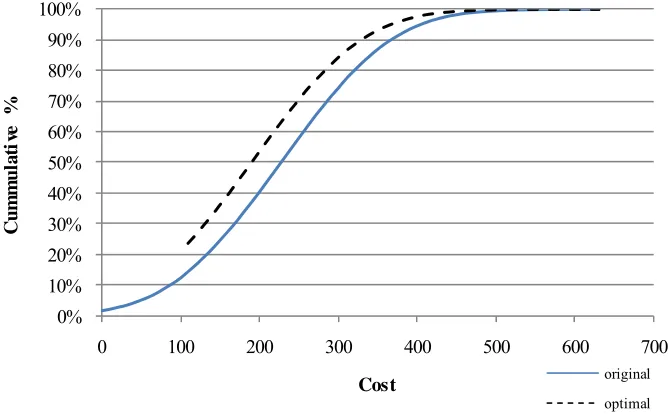
completion time (Figure 4.4) and the cumulative distribution of the total project cost (Figure
4.5). In addition, Table 4.3 provides the average and standard deviation of the project duration
and project cost.
0% 2% 4% 6% 8% 10% 12% 14% 16% 18% 20%
58 60 62 64 66 68 70 72 74 76 78
P
r
ob
ab
il
it
y
Duration original
optimal
0% 10% 20% 30% 40% 50% 60% 70% 80% 90% 100%
0 50 100 150 200 250 300 350
Cu
m
m
u
la
ti
v
e
%
Cost original
optimal
Figure 4.5: OTCM Phase I Example - Original versus Optimal Project Cost.
Table 4.3: OTCM Phase I Example - Summarized Comparison between No Crashing and Optimal Crashing.
Duration Cost
Average Std. Dev. Average Std. Dev. Original 69.22 2.11 20.41 38.73 Optimal 67.85 2.06 14.35 20.43
To provide statistical evidence about the cost reduction produced by the Phase I method
over no crashing, using paired data a 95% confidence interval is built on the difference between
the average cost of the project when no crashing is applied and the project when the solution
provided by Phase I is implemented:
[5.85 ≤ µ01,50000 ≤ 6.28].
These results indicates that there is a significant difference between the average cost of no
crashing versus the average cost of implementing the Phase I solution, and indicates that when
4.4 OTCM Phase II: Dynamic Crashing
In Phase I, prior to the start of the project, an initial optimal crashing configuration is
obtained by analyzing the entire project network. This initial optimal crashing configuration
considers the uncertainty associated with the duration of all the activities of the project. As
activities are completed, the uncertainty associated with their duration is eliminated. Thus the
overall uncertainty about the project completion time is reduced; as a result the initial optimal
solution might change. The purpose of the Phase II (dynamic) method is to determine the optimal
crashing configuration for the remaining activities.
In addition to the general assumptions of the OTCM method, the following assumptions
are applied to Phase II:
• The reevaluations points occur just prior to starting an activity that has been
recommended for crashing previously. The initial reevaluation points are assumed as the
crashing points identified in Phase I;
• The resources required to crash an activity are available at the moment of making a
crashing decision, i.e. the lead time to acquire or change the resources is 0; and
• The remaining time for activities in progress is known or can be estimated very
accurately.
Due to the first assumption, Phase II is a heuristic. In order for Phase II to be optimal
throughout the project, the project network should be constantly evaluated. Constantly evaluating
the project is not practical and cost prohibitive, thus, in this research it has been assumed that the
project is reevaluated when the start time of an activity identified to be crashed is encountered
(the intention of the reevaluations in this case is to verify if the activity still needs to be crashed
the activity doesn’t need to be crashed or needs to be crashed by a smaller amount). In addition,
the first assumption indicates that if no activities should be crashed, according to the solution
provided by Phase I, there is no need to implement Phase II. However, although not tested here
the project manager could decide implementing Phase II at any time after the start of the project,
in order to determine if crashing would make economic sense due to the duration of activities
previously completed, or as changes are made to the project plan.
The OTCM Phase II procedure involves:
1. Updating the project information to reflect the current status of the project;
2. Updating the simulation model of the project network;
3. Reevaluating the remaining project network using the OTCM program (as described in
Phase I) when an activity that requires crashing is encountered;
4. Evaluating the effects of implementing the previous crashing configuration and the new
optimal crashing configuration with the OTCM project simulator;
5. Implementing the project network under the new crashing configuration and continuing
until either:
a) the next activity that requires crashing is encountered and go to step 1; or
b) the project is complete.
Note that for each iteration of steps 1-4 of the dynamic crashing procedure, a new
crashing configuration for the remainder of the project will be identified that takes into account
the sunk activity times and costs associated with the activities in progress and the activities that
have been completed.
The first step in the procedure that Phase II follows is to update the information that
potential is set to 0 and their duration is represented by their actual (in the case of completed
activities) or estimated (in the case of activities in process) duration (instead of by a probability
distribution). For the activities that haven’t started the crashing potential, the crashing cost, and
the probability distribution of completion time are considered to be equal to the values used in
Phase I. Also, Phase II considers the same target completion time and the same penalty function
used in Phase I (note that since the project information is updated before each reevaluation it is
possible to include information different than the one provided in Phase I or in previous Phase II
reevaluations). The updated information is input into the simulation model to guarantee that the
simulation model is an accurate representation of the project network.
After the simulation model is updated the optimization process, as described in Phase I, is
applied. Then, the optimal crashing configuration provided by the OTCM program and the
previous crashing configuration are evaluated with the OTCM project simulator. As in Phase I,
the project manager uses the output of the OTCM project simulator to decide whether or not to
implement the solution provided by the Phase II reevaluation. This process continues until
another reevaluation point is encountered or until the project is complete.
4.5 OTCM Phase II Example
The Sample Project used to illustrate Phase I is now used to demonstrate Phase II of the
OTCM method. Recall, that the Sample Project consisted of 11 activities with the project details
outlined in Table 4.2 and the corresponding project network shown in Figure 4.2. The optimal
crashing configuration obtained when Phase I of the OTCM was applied to the Sample Project
specified that activity 2 should be crashed two time units and activity 9 should be crashed one
if any of the activities that start at the project starting time are recommended by Phase I to be
crashed, the crashing should be applied.) To facilitate a direct comparison among project
implementations with no crashing applied, using the result of OTCM Phase I only, and the full
implementation of the OTCM method (Phases I and II), one instance of the Sample Project is
simulated. The resulting activity times without any crashing applied are shown in Table 4.4.
After the project begins, the OTCM Phase II procedure specifies that the project
reevaluation points (the points at which the crashing configuration is reevaluated) will occur just
prior to starting activities that have previously been identified by the OTCM method to be
crashed. In the Sample Project, at time 10.88 which corresponds to the completion time of
activity 1, the first activity that Phase I specified to crash is encountered. Consequently, the time
just prior to the start of activity 2 will serve as the reevaluation point. Figure 4.6 depicts the
status of the project up to the first reevaluation point.
Table 4.4: OTCM Phase II Example - Sample Project Instance. Activity Duration
1 10.88 2 7.32 3 8.15 4 17.91 5 15.75 6 4.87 7 7.95 8 4.86 9 13.35 10 15.82 11 6.54
To implement the reevaluation, the OCTM program is invoked with an input file that
reflects the current project status. This input file is shown in Figure 4.7. The bold entries indicate
Project, the crashing potential for each of the remaining activities remains the same throughout
the project. However, any changes to the project parameters including the activity durations and
crashing potential can be updated at any time and included in the reevaluation.) Thus, the
updates to the input file needed for this reevaluation include changing the crashing potential of
activity 1 to 0 and entering the actual duration of activity 1 as a constant time of 10.88 (indicated
as C10.88 in the input file, where C denotes a constant).
Legend:
Completed & Not Crashed
In process & Not Crashed
Completed & Crashed
In process & Crashed
Not Started
Evaluation Point 2
3
4
7
6 5
8
9
10 11
1
Figure 4.6: OTCM Phase II Example - Network Status by First Reevaluation Point.
Upon running the OTCM program, a new crashing configuration is obtained for the
remaining activities. Table 4.5 shows the resulting crashing configuration which specifies that
activity 2 is to be crashed two time units (this in consistent with the result of Phase I), and since
the project is lagging due to a longer than expected duration of activity 1, the crashing
configuration also specifies crashing activity 9 by two time units (rather than 1 time unit as
specified by Phase 1). Table 4.6 indicates the new estimate of the average project cost (Sample
which are 19.06 and 601.48, respectively. In addition, the number of simulated instances of the
project used to obtain the estimates, 30,856 replications, is also listed.
n 11
T 70
P 40
SC 0
NPi 0 1 1 1 1 2 1 1 1 3 1
0 1 1 3 2
2 4 5 6 4
7 8 9 10
CPi 0 3 3 3 3 3 3 3 3 3 3 C10.88
B6 10 14 B6 8 10 B10 15 20 Activity B12 17 22 Duration B3 5 7 Distribution B6 9 12 (Ai) B4 6 8
B11 13 15 B13 15 17 B5 7 9 6 3 5 4 5 Crash Costs 8 (CCi) 5 5 2 8 7 ISC output
Parameters 999999 1 0 -1 -1 0 -1 1 -1 -1 -1 0.01 1 0.01 0.5 50 10 0 50
Figure 4.7: OTCM Phase II Example - Input File First Reevaluation. Predecessors
(PMij = 1 for each j in row i,
Table 4.5: OTCM Phase II Example - Crashing Configuration Provided by First Reevaluation.
Activity
1 2 3 4 5 6 7 8 9 10 11 Crash
Amount 0
2
0 0 0 0 0 02
0 0Table 4.6: OTCM Phase II Example - Summary of Solution Provided by First Reevaluation. Replications 30,856
Sample Mean of Cost 19.06 Sample Variance of Cost 601.48
Upon implementing the specified crashing amount of 2 time units for activity 2, the
project proceeds until the next reevaluation point in encountered. This occurs just prior to the
start of activity 9 which is realized at time 36.94. By that time activities 1 through 5 have been
completed, activity 7 is in progress, and the remaining activities haven’t started. Figure 4.8
shows the status of the project up to the second reevaluation point. The input file of the OTCM
program is updated once again to reflect the current project status. The update includes setting
the crashing potential of activities 1 through 5 to 0 and replacing the probability distribution that
previously represented their duration by their actual duration; since activity 7 is in progress its
crashing potential is also set to 0 and its duration (assumed to be accurately estimated) is
considered to be a constant time of 7.95. In addition, the input file is updated to include the sunk
cost of crashing activity 2; since activity 2 was crashed twice and the crashing cost per time unit
of activity 2 is equal to 3, the sunk cost is equal to 6. After updating the input file the OTCM
program is executed, and a new crashing configuration is obtained. Table 4.7 shows the new
crashing configuration which indicates that activity 9 is to be crashed three time units (even more
than previously indicated by the first reevaluation), and since the project continues to run behind
Table 4.8 shows the new estimates for the average project cost and the project cost variance
which are 24.84 and 23.19, respectively (545 instances of the project were simulated to obtain
these estimates).
Legend:
Completed & Not Crashed
In process & Not Crashed
Completed & Crashed
In process & Crashed
Not Started
Evaluation Point
6 8
9
10 11
1
5
3
4
7 2
Figure 4.8: OTCM Phase II Example - Network Status by Second Reevaluation Point. Table 4.7: OTCM Phase II Example - Crashing Configuration Provided by Second
Reevaluation.
Activity
1 2 3 4 5 6 7 8 9 10 11 Crash
Amount 0
2
0 0 0 0 01 3
01
Table 4.8: OTCM Phase II Example - Summary of Solution Provided by Second Reevaluation. Replications 545
Sample Mean of Cost 24.84 Sample Variance of Cost 23.19
Activity 9 is crashed three time units as indicated by the crashing configuration, and the
project continues. The new reevaluation point is encountered at time 41.81, which corresponds to
9 is in progress, therefore the input file required for the next reevaluation is updated to indicate
that the crashing potential of these activities is equal to 0 and that their durations are represented
by a constant time. The crash cost of activity 9 is 2 per time unit, and since it was crashed three
times the cost of crashing activity 9 is 6; this cost is added