Lessons Learned from
the Connexions Pilots
R
E S E A RC H
Peter Dickinson
Research Report
No 308
Lessons Learned from
the Connexions Pilots
Peter Dickinson
GHK Economics and Management Ltd
The views expressed in this report are the authors' and do not necessarily reflect those of the Department for Education and Skills.
Acknowledgments
This project was a GHK team effort and could not have been undertaken without the contribution of Eleanor Breen, Matthew Chiles, Anna Davis, Jennifer Gramolt, Ed Martin, Manisha Patel and Ilka Rzymann.
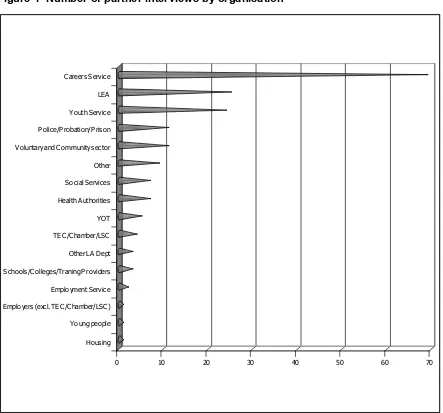
We would also like to thank Tim Shiles (DfES Analytical Services), Jen
Mullis, (DfES CSNU), and other members of the CSNU for their comments and suggestions on the Final Report and throughout the life of the project.
Finally, we would also like to appreciate the Connexions Pilot Coordinators and their staff for their invaluable assistance in organising the monthly reports, and partner, PA, client and case study interviews.
Peter Dickinson
Contents
1
INTRODUCTION...1
1.1 Background ...1
1.2 Action research ...2
1.3 Methodology...2
1.4 Structure of the report...4
2
THE DEVELOPMENT, NATURE AND STRUCTURE OF STRATEGIC
PARTNERSHIPS ...5
2.1 Introduction ...5
2.2 Strategic objectives ...5
2.3 Developing the Partnerships ...10
2.3.1 Pilot proposals...10
2.3.2 Composition of the Strategic Partnerships...11
2.3.3 Cultural impacts...24
2.3.4 Communication...25
2.3.5 Legal structures...29
2.3.6 Funding...30
2.4 Local Management Committees ...33
2.4.1 Membership of LMCs ...33
2.4.2 The roles and responsibilities of LMCs ...38
2.5 Conclusions...43
2.6 Recommendations ...44
3
PILOT CONNEXIONS SERVICES ...46
3.1 Introduction ...46
3.2 Pilot services ...46
3.2.1 Level of Activity...46
3.2.2 The Starting Point...46
3.2.3 Services offered...47
3.2.4 Defining Purpose and Need ...50
3.2.5 Targeting Sub-Groups of Young People ...51
3.3 Multi-Agency Working ...52
3.3.1 Multi-Site Working ...55
3.3.2 Referral Mechanisms ...58
3.3.3 Equal opportunities...58
3.4 Other Service Delivery Issues ...59
3.4.1 Assessment ...59
3.4.2 Marketing...61
3.5 Good practice case study – the Young People’s Support Service in Hull...62
3.5.1 Introduction...63
3.5.2 Background ...63
3.5.3 The development of the YPSS ...63
3.5.4 Recruitment ...65
3.5.5 The YPSS...65
3.5.6 Clients’ views of the YPSS ...67
3.5.7 Involving young people in design and delivery...67
3.5.8 YPSS management...67
3.5.9 Multi agency working...68
3.5.10 The YPSS in Bransholme...68
3.5.11 Staff views on the advantages of working in the YPSS ...70
3.5.12 Key learning points...73
3.5.13 Key Issues Concerning Service Development And Delivery ...73
3.6 Conclusions...77
3.7 Recommendations ...78
4
PERSONAL ADVISERS...79
4.1 Introduction ...79
4.2 Service delivery and the role of the Personal Adviser...79
4.2.1 Defining the role of the Personal Adviser...79
4.2.2 Recruitment of Personal Advisers...85
4.2.3 Training and development...89
4.2.4 Working with specific sub groups...93
4.3 Multi-agency working ...95
4.3.1 Management and supervision ...96
4.3.2 Developing consistent provision...101
4.3.3 Conclusions ...101
4.4 Survey of Personal Advisers ...102
4.4.1 Introduction...102
4.4.2 Profile of Personal Advisers ...102
4.4.3 Multi- agency working...105
4.4.4 Service delivery – referrals...108
4.4.5 Service delivery – assessment and delivery ...110
4.4.6 The role of the Personal Adviser...112
4.4.7 Personal Adviser training ...114
4.4.8 Information and communication ...115
4.5 Good Practice Case Study: the Role of the Personal Adviser – North East Lincolnshire Connexions Service part of the Humberside Pilot ...116
4.5.1 Background ...116
4.5.2 Developing the role of the Personal Adviser ...117
4.5.3 Recruitment ...117
4.5.4 The location of Personal Advisers...118
4.5.5 Management of Personal Advisers ...118
4.5.6 Partnership Agreements...119
4.5.7 Personal Adviser training, development and support...119
4.5.8 The role of the Link Personal Adviser ...119
4.5.9 The Social Services Personal Adviser ...120
4.5.10 The EWS and YOT Link Personal Adviser...120
4.5.11 The Mental Health, Substance Misuse and Counselling Link Personal Adviser .120 4.5.12 The Housing and Leisure Link Personal Adviser ...121
4.5.14 The role of the schools based Personal Adviser...122
4.5.15 The added value of the school based Personal Adviser...123
4.5.16 Key learning points...124
4.6 Conclusions...126
4.7 Recommendations ...127
5
VIEWS OF CLIENTS ...128
5.1 Introduction ...128
5.2 Profile of clients ...128
5.3 Involvement in and awareness of the Pilot Connexions Programme ...129
5.4 Usefulness of the service...130
5.5 Client views of the service ...133
5.6 Impacts of the service ...134
5.7 Conclusion...137
5.8 Impacts of the Connexions Service ...138
6
INVOLVING YOUNG PEOPLE...141
6.1 Introduction ...141
6.2 Priority given to involving young people ...141
6.3 Methods used ...144
6.4 Incentives and support for involving young people ...152
6.5 Added value and further development ...153
6.6 Involving young people case study: Oldham...154
6.6.1 Introduction...154
6.6.2 Achievements ...155
6.7 Conclusions...157
6.8 Recommendations ...158
7
CONNEXIONS IN SCHOOLS AND COLLEGES ...159
7.1 Introduction ...159
7.2 Context...159
7.3 Involvement of schools, colleges and other training providers in the Connexions Service...160
7.4.1 Initial concerns...161
7.4.2 Pilot activities...162
7.5 The role of the Personal Adviser...165
7.5.1 The relationship between the Personal Adviser/Connexions and other professionals and services…. ...168
7.5.2 Training and support ...170
7.5.3 Pilots’ assessment of the Personal Adviser role in schools, colleges and training providers…...171
7.5.4 Added Value ...172
7.5.5 Key Learning Points ...172
7.6 Good Practice Case Studies ...173
7.6.1 Good practice case study: Working in schools and colleges – Lewisham Connexions Pilot……… ...173
7.6.2 Good practice case study: The role of the Personal Adviser in schools and colleges in Cornwall and Devon ...178
7.7 Conclusions...183
7.8 Recommendations ...184
8
WORKING WITH SUB-GROUPS OF YOUNG PEOPLE ...186
8.1 Introduction ...186
8.2 Background ...186
8.3 Working with sub-groups of young people...189
8.3.1 Introduction...189
8.3.2 Young people with learning difficulties and/or disabilities ...189
8.3.3 Homeless young people...191
8.3.4 Young offenders ...194
8.3.5 Good Practice Case Study: delivering the Connexions service to young offenders – Huntercombe YOI Pilot ...196
8.3.6 Young refugees and asylum seekers...203
8.3.7 Young Black and Minority Ethnic people...205
8.3.8 Teenage mothers and young carers ...207
8.3.9 Good Practice Case Study: Teenage Parents Project – Torbay, part of the Cornwall & Devon Connexions Pilot ...208
8.3.10 Young users of drugs and harmful substances...217
8.3.11 Disaffected young people...217
8.4 Case studies of Pilot work with other specific groups of young people ...218
8.4.1 Raising aspirations ...218
8.4.2 Care leavers ...220
8.4.3 Gifted and Vulnerable...221
8.4.4 At risk...222
8.5 Conclusions...223
8.6 Recommendations ...225
9
TACKLING RURAL ISSUES ...226
9.1 Introduction ...226
9.3 Case study of rural issues: the North Cornwall and Northern Devon Rural Outreach
Project. ...228
9.3.1 Introduction...228
9.3.2 Service delivery ...228
9.3.3 Key issues ...228
9.3.4 Key learning points...229
9.3.5 Project client case studies...229
9.4 Conclusions...231
9.5 Recommendations ...232
10
QUANTIFYING NEED...233
10.1 Introduction ...233
10.2 The Mapping Tool ...234
10.3 The mapping process ...235
10.4 Main mapping issues...236
10.4.1 Geography...236
10.4.2 Fragmentation/inconsistency/different purposes...237
10.4.3 Access to and availability of data and information ...237
10.4.4 Methods of collecting information...238
10.5 Conclusions...240
10.6 Recommendations ...240
11
CONNEXIONS CUSTOMER INFORMATION SYSTEM ...242
11.1 Introduction ...242
11.2 Identifying and addressing customer information system issues ...242
11.3 Good Practice Case Study: Teenage Parents Project – CCIS case study: Greater Merseyside Pilot...246
11.3.1 Introduction...246
11.3.2 Mapping exercise ...246
11.3.3 Development of a website ...247
11.3.4 Consulting young people...248
11.3.5 Data protection legislation ...248
11.4 Conclusion...249
11.5 Recommendations ...249
12
USE OF EVIDENCE-BASED PRACTICE...250
12.1 Introduction ...250
12.2 Use of evidence-based practice in the Pilots...250
12.2.1 Use of evidence-based practice in Lincolnshire...251
12.4 Recommendations ...254
13
CONCLUSIONS AND RECOMMENDATIONS ...255
13.1 Conclusions...255
13.1.1 Introduction...255
13.1.2 Strategic Partnerships ...255
13.1.3 Services...255
13.1.4 Personal Advisers ...256
13.1.5 Views of clients...257
13.1.6 Involving young people...257
13.1.7 Connexions in schools, colleges and training providers ...258
13.1.8 Working with sub-groups of young people ...259
13.1.9 Rural Issues...262
13.1.10 Quantifying Need...262
13.1.11 Connexions Customer Information Systems...263
13.1.12 Evidence based practice ...263
13.2 Recommendations ...264
13.2.1 Introduction...264
13.2.2 Strategic Partnerships ...264
13.2.3 Services...264
13.2.4 The role of Personal Advisers ...264
13.2.5 Involving young people...265
13.2.6 Connexions in schools, colleges and training providers ...265
13.2.7 Working with sub-groups of young people ...266
13.2.8 Rural Issues...266
13.2.9 Quantifying Need...266
13.2.10 Connexions Customer Information System...266
13.2.11 Evidence based practice ...267
Tables
Table 1 Connexions Service Pilots matrix ... 7
Table 2 Development of the proposal and partnership structures an example... 11
Table 3 Board membership by Pilot area... 19
Table 4 Pilot’s key issues concerning the development of the Strategic Partnerships ... 21
Table 5 Pilot’s good practice pointers concerning the development of the Strategic Partnerships ... 22
Table 6 Pilot’s key good practice pointers concerning communications within the Pilots .... 26
Table 7 Pilot’s key issues concerning communications within the Pilots ... 27
Table 8 Membership of LMCs... 36
Table 9 Two LMC models ... 40
Table 10 Pilot’s key good practice pointers concerning LMCs ... 42
Table 11 Pilot’s key issues concerning LMCs... 42
Table 12 If you had your time again what things would you have done differently?... 43
Table 13 Pilot services... 48
Table 14 VCS involved in Connexions Service... 54
Table 15 Delivery of Connexions services at drop-in centres... 56
Table 16 Key issues concerning service development and delivery... 73
Table 17 Good practice pointers towards effective practice concerning the development of the Strategic Partnerships ... 75
Table 18 Definition of the role of the Personal Adviser... 79
Table 19 Role of the Personal Adviser - the view from one workshop ... 80
Table 20 Key issues concerning the role of the Personal Adviser... 83
Table 21 Good practice lessons concerning the role of the Personal Adviser... 84
Table 22 Number of staff working for the Connexions Pilots ... 85
Table 23 Organisation staff were recruited from... 85
Table 24 Personal Advisers' terms and conditions ... 88
Table 25 Personal Advisers person specification ... 88
Table 26 Personal Adviser case notes ... 93
Table 27 Has the Connexions Service improved... 111
Table 28 Improvements in aspects of the role of the Personal Adviser... 113
Table 29 If there was one thing you could change... ... 116
Table 30 An idealised Personal Adviser development model... 125
Table 31 How clients rate aspects of the service... 133
Table 32 Priorities for the involvement of young people in the design and delivery of aspects of the Connexions Service ... 142
Table 33 Intensity of involvement of young people in the design and delivery of aspects of the Connexions Service ... 143
Table 34 Methods used to elicit the views of young people on various aspects of the Connexions Service ... 146
Table 35 Advantages and disadvantages of different ways of involving young people ... 147
Table 36 Specific methods of involving young people ... 151
Table 37 Examples of incentives for involvement... 152
Table 38 Training and support measures for the involvement of young people ... 153
Table 39 Pilot’s Good practice pointers concerning the involvement of young people... 156
Table 40 Pilot’s key issues concerning the involvement of young people ... 157
Table 41 Good practice pointers concerning the management of Connexions and Personal Advisers in Schools, colleges and training providers ... 163
Table 42 Main issues concerning the management of Connexions and Personal Advisers in Schools, colleges and training providers... 164
Table 44 Main issues concerning the role of the Personal Adviser in schools, colleges and
training providers... 168
Table 45 Good practice pointers concerning the relationship of Personal Advisers with other professionals and services already in schools, colleges and training providers 170 Table 46 Main issues concerning the relationship of Personal Advisers with other professionals and services already in schools, colleges and training providers 170 Table 47 Satisfaction with delivery of Connexions in schools, colleges and training providers ... 172
Table 48 Key learning points for developing Connexions Services in schools, colleges and training providers... 172
Table 49 Focus of services on groups of young people ... 188
Table 50 Key issues/learning points concerning the involvement of young people... 240
Table 51 Good practice concerning the involvement of young people ... 240
Table 52 Good practice pointers concerning the development of CCIS ... 245
Figures
Figure 1 Number of partner interviews by organisation ... 4
Figure 2 Numbers of Local Authorities and Careers Services covered by the Pilots... 12
Figure 3 Representation of organisations on Connexions Boards... 17
Figure 4 Model for developing Connexions Partnerships ... 24
Figure 5 Developing a communications strategy ... 29
Figure 6 Level of DfEE funding by Pilot area ... 31
Figure 7 Number of LMCs in each Pilot ... 34
Figure 8 Membership of LMCs... 34
Figure 9 Comparing the membership of LMCs and Boards... 35
Figure 10 The triangle of need in Coventry and Warwickshire ... 50
Figure 11 Sub groups of young people targeted by Connexions services... 52
Figure 12 Partner organisations involved directly or indirectly in the delivery of Connexions services... 53
Figure 13 Location of Personal Advisers ... 55
Figure 14 Idealised model for developing Connexions services... 77
Figure 15 Personal Adviser training in March ... 90
Figure 16 Service delivery management structures... 97
Figure 17 Example of the key elements of a Service Level Agreement... 98
Figure 18 Previous organisation ... 103
Figure 19 Location of Personal Advisers ... 104
Figure 20 Organisations colleagues were recruited from ... 106
Figure 21 Multi- agency working ... 107
Figure 22 Are management and team structures helping you perform your job... 107
Figure 23 Example of a referral system in a school... 109
Figure 24 Main issues clients want advice and guidance on ... 110
Figure 25 Economic status of clients ... 128
Figure 26 Name of service... 129
Figure 27 How did you hear about Connexions?... 130
Figure 28 Content of the service... 131
Figure 29 What clients talked about with their Personal Advisers ... 132
Figure 30 Impacts of the service... 135
Figure 31 Compared to other sorts of advice and assistance received in the past is your current support... ... 137
Figure 32 Involvement of young people in the Connexions Service ... 145
Figure 33 Hub and spoke model for involving young people ... 151
Figure 34 Amount of time school, college and training provider-based Personal Advisers spend in their respective institutions ... 166
1 Introduction
1.1 Background
1. There has been increased recognition and policy response to the issues associated
with young people and their effective transition to a productive and fulfilling adult life. Over the past few years, a number of individual initiatives have been put in place to address issues of attainment in schools, effective information, advice and guidance, and engaging the wider community in working with young people. Underpinning all this work has been the principle of inter-agency working and coherent responses both to the needs of the group as a whole and to tailoring services around individual young people’s specific needs.
2. The Connexions Strategy and associated Service is a significant move - offering a
potential step change in the delivery of services for young people. The design of
Connexions, its objectives and key principles build on many of the lessons learned to date but, most radically, it attempts to create a new delivery structure that encompasses the fundamental principle of a connected and coherent service for young people.
3. The Connexions Strategy sets out to create a step change in participation and
attainment through the teenage years. It aims to ensure that increasing numbers of young people have access to the services they need, follow appropriate and high quality learning opportunities and make a successful transition from adolescence to adulthood and working life. The Connexions Service will:
¾ Offer help, support and advice to all young people aged between 13 and 19;
¾ Particular assistance will be targeted at the disadvantaged or disaffected;
¾ Provide coherent support to young people over time and across service boundaries;
¾ Help young people deal with the problems they face whether they relate to learning or a
wider set of issues;
¾ Broker support for young people from specialist agencies as and when needed.
4. The service will be delivered through a network of Personal Advisers linking in with
specialist support services. Advisers will be drawn from a range of existing public, private, and voluntary and community sector organisations. These organisations will come together to form new Connexions Partnerships to develop and coordinate the delivery of support services for young people. The Partnerships will follow the administrative boundaries of the Learning and Skills Councils (LSCs). They will be complemented by Local Management Committees (LMCs), established either on local authority boundaries or by functional split, which will ensure the required range of services is in place (although in practice two Pilots did not have any LMCs).
5. 12 Partnerships began delivering the Connexions Service from April 2001, and 3
more started in September 2001. 13 Pilots were established in 2000 to begin exploring how these new services will operate in practice. The key principles of the Connexions Service are:
¾ Raising aspirations - setting high expectations of every individual;
¾ Meeting individual need - and overcoming barriers to learning;
¾ Taking account of the views of young people - individually and collectively, as the new
service is developed and as it is operated locally;
¾ Inclusion - keeping young people in mainstream education and training and preventing
¾ Partnership - agencies collaborating to achieve more for young people, parents and communities than agencies working in isolation;
¾ Community involvement and neighbourhood renewal - through involvement of
community mentors and through Personal Advisers brokering access to local welfare, health, arts, sport and guidance networks;
¾ Extending opportunity and equality of opportunity - raising participation and achievement
levels for all young people, influencing the availability, suitability and quality of provision and raising awareness of opportunities;
¾ Evidence based practice - ensuring that new interventions are based on rigorous
research and evaluation into ‘what works’.
1.2 Action
research
6. A great deal of resource was invested in the Connexions Service Pilots - over
£7million. In order to get the maximum return from this investment the Department for
Education and Employment (DfEE)1 funded an action research project, undertaking
formative evaluation and passing the findings to both the DfEE and Pilots as they progressed to help develop both policy and the Pilots on the ground.
7. Many of the Pilots attempted to undertake a range of Connexions activities while
others focused more on one particular activity i.e. Connexions Customer Information Systems. It is important to note that no Pilot attempted to undertake the full range of Connexions Services
8. The Pilots proved an invaluable testing bed for the development of the Service from
which many important lessons have been learned, leading to a number of policy
developments. The impact of the research is still being used in policy development. Much good practice has already been identified and disseminated – this report will add to that.
1.3 Methodology
9. There was an agreed division of labour between the local and national evaluators.
The local evaluators were responsible for researching the following strands or aspects:
¾ Connexions Customer Information Systems;
¾ Tackling rural issues;
¾ Working with specific sub groups of clients;
¾ Delivering Connexions in schools and colleges, and;
¾ Use of evidence based practice (at the local level).
10. The national evaluators focused on:
¾ Strategic planning at the Pilot level;
¾ Multi agency networking of Personal Advisers;
¾ Integration of multi agency teams;
¾ Integrated delivery at the local level;
¾ Involving young people;
¾ Quantifying need, and;
¾ Use of evidence based practice (at the national/strategic level).
11. The action research programme to date focused on the development of the strategic
partnerships, the development of services, the role of the Personal Adviser, and the
perceptions of clients of Connexions Service Pilots. We have used a variety of methods for capturing information about the objectives, developments and progress of the Pilots:
¾ Interviews with key staff in the Connexions Service National Unit (CSNU) and
Government Offices (GOs);
¾ Interviews with the Pilot Coordinators and other key partners;
¾ Interviews with Personal Advisers;
¾ Interviews with clients;
¾ Developing and analysing Pilot monthly reports;
¾ Reports produced by local evaluators;
¾ Desk research, reviewing a range of literature that has been produced by the Pilots
(proposals, research documents etc.), the CSNU and other organisations.
12. In addition, an important part of the national evaluator’s role has been coordinating
the work of the local evaluators and the development of a Performance Management Framework.
13. Interviews have so far been held with 181 lead and other key partners from a wide
range of organisations. This represents about two-thirds of all the partners involved in the
Connexions Pilots (excluding repeat visits). Three rounds of interviews took place: an initial meeting with Pilot Coordinators in August, a broader range of interviews with Pilot
Coordinators and key partners between October and November 2000, and again in March and April 2001.
14. Figure 1 shows the organisations of partners that have been interviewed (Pilot
Coordinators have been interviewed twice). Interviews have been held mostly with Careers Service, LEA and Youth Service partners, although we have spoken with partners from the Police/Probation/Prison Service, voluntary and community sector (VCS) and health
authorities. These interviews were mostly conducted face-to-face but some were undertaken over the ‘phone.
15. In addition, face-to-face interviews have been completed with 81 Personal Advisers
Figure 1 Number of partner interviews by organisation
0 10 20 30 40 50 60 70
Careers Service
LEA
Youth Service
P olice/P robation/P rison
Voluntary and Community sector
Other
Social Services
Health Authorities
YOT
TEC/Chamber/LSC
Other LA Dept
Schools/Colleges/Traning P roviders
Employment Service
Employers (excl. TEC/Chamber/LSC)
Young people
Housing
Source: Interviews with Pilot Coordinators, GHK
16. Arranging Personal Adviser and client interviews has been problematic, especially in
the early days of the Pilots. Many Pilots did not have Personal Advisers or clients in place when we were undertaking the first round of interviews (most Personal Advisers were only in post by November). It was also very difficult to arrange interviews through the Pilots
especially with clients who are disaffected and defined as hard-to-help. In some cases interviews were arranged but the clients did not turn up.
17. The Interim Report of this project (February 2001) was presented to Pilot
representatives, local evaluators and CSNU representatives at a Conference in May 2001. The conference included a series of workshops focusing on key aspects of the Connexions service e.g. the development of strategic partnerships, the Connexions service in schools etc. Views and comments on these aspects arising from this conference have been included in this Final Report.
1.4 Structure of the report
18. The rest of the report is divided into the following sections:
Section 3 – looks at the services that Pilots have developed.
Section 4 – looks at the role of the Personal Adviser, based on interviews with Partners and Personal Advisers.
Section 5 – reports on the client interviews.
Section 6 – reports on the involvement of young people in the design and delivery of Connexions services.
Section 7 – reports on the development of the Connexions Service in schools, colleges and training providers.
Section 8 – focuses on the delivery of services to particular sub groups of young people. Section 9 – examines rural issues.
Section 10 – looks at quantifying need.
Section 11 – reports on the development of Connexions Customer Information Systems. Section 12 – examines the use of evidence-based practice.
Section 13 – provides the main conclusions and recommendations.
2 The Development, Nature and Structure of Strategic
Partnerships
2.1 Introduction
19. A great deal of time, effort and expertise was exercised in the 13 Pilot areas on
developing a partnership structure that represented key interests and could manage the delivery of Connexions Services. This section reports on the key issues that arose from partnership activities: their structure and composition; the decision making process; legal structures; management roles and responsibilities; geographical issues; the involvement of young people and the voluntary and community sector (VCS); relationships with existing partnerships; funding; and national guidance.
20. The information in this section is based on interviews with the lead and other partners
throughout the project, Pilot’s proposals and contracts, interim, final and other reports from local evaluators, and all of the monthly reports. Strategic Partnerships were also the focus for two workshop sessions on ‘Lessons Learned’ and ‘The Development Agenda’ at the Interim report Workshop held in May 2001.
2.2 Strategic
objectives
21. The Pilots were charged with undertaking a wide variety of trial initiatives that would
inform the development of the Connexions Service proper from April 2001. The objectives of the Pilots, as specified in their contracts, were therefore left deliberately open. This was to be true pilot or experimental activity. The lack of prescription was a cause of concern for some people (see below) but it did enable a range of management and delivery models to be explored.
22. To illustrate this, the objectives of one Pilot undertaking a wide variety of work were
to:
¾ Undertake research with partner organisations to identify evidence-based activities that work with 13-19 year olds and develop those activities that work, improve or abandon those that do not and disseminate good practice;
¾ Build knowledge of effective working practices into all staff training and development in the Pilot and across the partnership. This will form an essential element of the development of the role of the Personal Adviser and will be achieved via partner consultation and agreement.
23. This openness was typical of the Pilot contracts. The Pilots were originally asked to
Table 1 Connexions Service Pilots matrix
Strands Cornwall
& Devon Coventry & Warks Central London Durham Herts Humber-side combe Hunter- Lewi-sham Lincs Mersey-side Oldham South Central South Yorks
Connexions Customer
Information Systems
{ z z { z z z z { {
Involving Young People in the Design and Delivery
z z z z z z z z z z z z z
Multi-agency networking of Personal Advisers
z z { z z z { z { { z z z
Strategic Planning
at the Pilot Level z z z z z z z z z z z z z
Integrated delivery at the local level
z z { z { { z z { z z {
Integration of multi
agency teams z z z z z z z z z { z z z
Tackling rural issues { { { { {
Working with specific sub-groups of clients
z z z z z z z z z z
Quantifying Need – mapping
z z z z z z z z z z z z z
Use of
evidence-based practice z z { z z z z z z z z
Working with Schools/Colleges
z z z z z z z z z z z
Key: { Piloting some of the strand zPiloting all of the strand
24. Pilots then developed proposals for a range of services and activities that would explore all or a sub-set of these strands. It is important to point out that the Connexions Pilots were pilots in the true sense exploring particular strands not the full Service.
25. The only requirement of all Pilots was they would all explore management and
working arrangements, involving young people, and they would all conduct the mapping exercise. Beyond these three strands Pilots were free to choose which elements of the Connexions Service they would like to trial. Part of the rationale behind this approach was that the final shape of the Connexions Service proper would develop over time and that the Pilots would provide valuable information to guide this process.
26. However, Pilots reported that they were not always clear which strands they were
piloting (it was often not specified in contracts and proposals), and there was further confusion over what the strands meant (there does not appear to be a singular definition) and what were the dividing lines between different strands. For example, what does
integrated delivery at the local level mean and how does it differ from the integration of multi-agency teams and the multi-multi-agency networking of Personal Advisers?
27. One consequence of this openness and lack of prescription may have resulted in a
lack of clarity on the primary objectives for the Connexions Service. In the first round of interviews, 58 Pilot Coordinators and key partners were asked what they thought were the strategic objectives of the Connexions Service. Thirty-one partners either did not provide an objective for Connexions or said that they did not know or referred to a specific operational detail (e.g. terms and conditions of Personal Advisers) rather than an objective per se.
28. The largest number of respondents felt that the chief objectives of the Connexions
Service were to develop multi-agency working and to provide a service that is targeted towards specific sub groups of young people (in the main disaffected or hard-to-help). The next most common response was that the Connexions Service should be universal, meeting
the needs of all young people. Promoting and achieving the aim of social inclusion, and
striking a balance between a universal and a targeted response, were the next most frequently mentioned objectives.
29. The responses indicated the lack of a clear and consistent view across partners of
the objectives that underpin the Connexions Service.
30. In the current round of interviews, undertaken in March, Pilot coordinators and other
key partners were asked the question ‘What does the Connexions Service mean to you?’
31. The responses again pointed to a lack of clarity as to what the Connexions Service is
about. Responses included elements of what Connexions is about, for example, partnership working, providing Personal Adviser support to young people, reducing duplication of effort etc. But there was no consistent response that indicated agreement of what the primary objectives of the Connexions service are, and this was what was found during the first round
of interviews.2
32. This confusion was reportedly due to a variety of reasons: the freedom given to the
Pilots to test out management and delivery mechanisms; poor local communications; poor understanding of objectives even when adequately communicated; a focus on services rather than the overarching vision; that Connexions is aspirational so the pragmatic
operationalisation of this vision in reality differs from the objectives; and, people putting their own perspective on clear and well communicated objectives. However, respondents in over half of the Pilots believe it was because of: a lack of a clear statement of objectives for the
Connexions Service from the DfEE; or that they appeared to change over time; or that they were not well communicated.
33. The objectives of the Connexions Service are currently being finalised at a national
level and should be available in June 2001. It is imperative that efforts are undertaken to communicate the objectives thoroughly within the Pilots and Phase Ones, but also more widely. Partners believed that initiatives like New Deal had a high profile and were well understood, not just by managers and practitioners working within the programme but much more widely by partner organisations and the wider public. They felt that Connexions should have the same profile.
34. The approaches to Connexions in the Pilots are perhaps summed up in the following
quotes:
“There are two views, one that it is reinventing the wheel and the other that it is the start of a new dawn.”
“The idea of Connexions is brilliant: it is enabling us to do what we always wanted to do.”
"Because of the timescales, all Connexions is, is a series of projects. Everyone is happy because the projects have been divided up between them. We have reinforced the project mentality on the ground - which is a bad thing. We are not getting across a significant understanding of what Connexions is i.e. a new, universal integrated service."
35. But perhaps the following, more balanced view, better reflects the opinions of people
involved in the Connexions Pilots:
“People are interested in Connexions (there is a lot of enthusiasm around) but there are some sticky bits, particularly about the details. Connexions has been a loose and flexible vision but with no framework to operate in. For example, how will it affect job roles, such as, the careers adviser? It is the uncertainty that gets to people. A few more steers would have been helpful. Having a vision has its advantages e.g. to provide flexibility for innovation but a clearer steer would have been helpful.”
36. We feel that having clear and well-understood objectives of the Service is essential to
pointing the Pilots in the right direction when developing their individual services. It will help to lead to more consistency in the definition of the important components of the service, such as, the role of the Personal Adviser, what is a universal service, what is multi- agency
working, the extent of the involvement of young people in service design and delivery etc. It is imperative therefore that clear and consistent overarching objectives for Connexions are developed and effectively communicated to a wide audience of partners and others.
Key learning point For DfEE:
¾ Develop and agree clear, coherent objectives for the Connexions Service that are
effectively and widely communicated.
For Pilots:
¾ Ensure that the Connexions Service objectives are agreed, understood and effectively
2.3 Developing the Partnerships
2.3.1 Pilot proposals
37. This research project was commissioned after the Pilots’ proposals had been
accepted and (most) of the contracts had been signed, so we are not in a position to comment on this process. Nevertheless we were interested in the way that the Pilots had organised partners to focus on the development of the pilot service in their area.
38. In a lot of discussions with partners, the balance between representation and
effectiveness was raised several times (see below). In terms of developing the Pilot Connexions proposal, the emphasis was clearly on the latter. All the Pilots felt that the timescales were very tight and this limited the extent, nature and effectiveness of
consultations with young people and other agencies, particularly those beyond the statutory sector (e.g. the VCS).
39. In nine Pilots, one or two people were given the task of writing the proposal. Here,
there was usually little disagreement that the lead organisations or lead people should be from a department of the local authority and the Careers Service. The decision as to which organisation should lead on the proposal was a result of pragmatism (e.g. an organisation that covered the entire Connexions area); relative political weight (e.g. in some areas the local authority was the clear lead, in others the Careers Service was); or, a neutral choice (for example, the lead organisation in one area was chosen because it was next in line to sit as the revolving Chair in a pre-existing partnership). In only one Pilot did either the local authority or the Careers Service have to be brought to the table.
40. Once written, the proposal was then distributed to other key partners (mostly within
the statutory sector, especially the Youth Service, LEAs and Careers Service) for them to comment.
41. In four Pilots a formal ‘Task’ or ‘Action’ group was formed to develop the proposal.
These Task Groups all included people from local authority departments (especially the Youth Services) and the Careers Services, in one a YOT representative was also involved.
42. Once the draft had been written, the next stage was to broaden the circle of
involvement. In the vast majority of cases this meant sending the draft proposal out for comments. When comments were returned the core people would consider them and develop the final proposal to be sent for DfEE. In some cases there were formal workshops to which people were invited to discuss the proposal but these were not common.
43. The involvement of young people in the development of the proposals was severely
limited. The VCS was involved in most areas, but the extent of their involvement varied enormously. The extent to which young people and/or the VCS were (or could be) involved in the proposal within the timescale depended on whether there already existed formal consultative forums or a clearly identifiable lead person or organisation.
44. Table 2 shows how the initial ‘start-up’ group in one Pilot came together and then
Table 2 Development of the proposal and partnership structures an example
A ‘start-up’ group initiated the work and developed the bid and the first meeting took place in May 2000. This group comprised the TEC, Social Services, Youth Services, the LEA, Careers Services, Police and Health Services. From this core group a more inclusive Management Group emerged, the first meetings of which took place in June 2000.
A large Management Committee emerged from this with over 40 people invited to attend. This group, while clearly representative of a wide range of organisations, was too large to be effective.
We held our first stakeholder conference in June with specific objectives in mind. The conference was to reach as broad a range of organisations and professionals as possible in the area to inform them of the aims of the Connexions Service, to consult with them about the plans and to discuss the recruitment and selection of Personal Advisers. There was also the aim to make voluntary and statutory organisations aware of the potential to be involved in making bids to provide services within designated Pilot areas.
Source: Hertfordshire Local Evaluators Report
45. The vast majority of partners across the 13 Pilots were satisfied with their role in the
development of the proposal. This was because partners felt that the best was done given the extremely tight timescales. Most respondents said that they appreciated that one organisation needed to take the lead and that they had been adequately consulted. There were very few dissenting voices. In one Pilot one Youth Service partner said that their organisation was not involved and that it was a Careers Service dominated exercise. In another area two Careers Service partners complained that it had been a local authority dominated exercise.
46. The main concerns were the short timescales (see above) and the national guidance,
reported by at least one partner in all of the Pilots. The short timescales exerted enormous pressure on the Pilot Coordinator(s) and limited the extent and effectiveness of consultation. The national guidance was criticised for being insufficient or not prescriptive enough, and the point was made that key elements of the Guidance changed. Three Pilots were concerned that initial guidance seemingly excluded Careers Services from the Partnerships but, when this was reversed, they had then to include representatives of the Careers Services into discussions.
47. The lack of prescription caused concern because it gave people little to focus on and
little to communicate to other partners. It made initial discussions too broad and it made it difficult to explain Connexions to others.
Key learning points For DfEE:
¾ National guidance needs to be clearer, more timely and consistent.
¾ Tight timescales limit broader involvement and wider consultation.
For Pilots:
¾ Given a history of tight timescales for responding to policy and funding opportunities –
what systems and processes need to be in place to effect speedy responses.
2.3.2 Composition of the Strategic Partnerships
48. By June 2000, all of the 13 Pilots had been chosen and were being established
was to develop the management structures that would oversee the delivery of Connexions Services in that area.
49. The areas that the Strategic Partnerships covered varied considerably in terms of
their geographical spread, population size, urban/rural profile, levels of deprivation, number of local authorities and status of the Careers Service company or companies
50. Figure 2 shows the number of local authorities (excluding District Councils) and
Careers Services covered by each of the Connexions Pilots.3 Central London, Humberside
and Greater Merseyside are the most complex areas and had the largest numbers of local authorities and careers companies in their areas. None of the Pilots crossed an LSC boundary.
51. There was some debate and negotiation over the geographic coverage and
boundaries of some Connexions Partnerships – in Coventry and Warwickshire, Durham and Lincolnshire – but the issue has not been very contentious. However, in South Yorkshire there was a clear desire on the part of Sheffield that it should have constituted one Connexions Partnership in its own right.
Figure 2 Numbers of Local Authorities and Careers Services covered by the Pilots
0 1 2 3 4 5 6 7
Number Central London
Cornw all & Devon Coventry & Warks Durham Hertfordshire Humberside Huntercombe Lew isham Lincolnshire Merseyside Oldham South Central South Yorks
Local Authorities Careers Services
Source: Interviews with Pilot Coordinators and key partners, GHK
52. Another geographic issue has concerned organisations whose coverage has
extended beyond the defined Connexions area. In one Pilot, a large VCS organisation was redrawing its internal operational divisions to make them coterminous with both Connexions and the LSC boundaries. In another area, the Pilot covered two Probation service areas, one of which covered another area as well. Matters were resolved by one service taking a strategic view but involving its sister organisation in operational issues.
53. Local authorities and Careers Service companies were the basic building blocks of
Partnerships in all of the Pilot areas. This was acceptable to all interviewees because it was the Careers Services and Youth Services that would be most affected by Connexions. The
relationship between local authorities and Careers Services was a critical element in how smoothly the core Partnerships were developed. In about three-quarters of the areas, local authorities were heavily involved in Careers Service companies as shareholders. The presence of private sector careers companies, and their role in the Connexions
Partnerships, has been an important issue in two Pilot areas.
54. The relationship between Careers Services and local authorities was an issue in all
but four of the Pilots. The main points for discussion were the lack of involvement of the Youth Services; confusion over the involvement of the Careers Services in the partnership; mutual suspicion to some degree; and implications of the legal status of the Careers Service company. To illustrate:
¾ In one Pilot area the LEA representative said that there was a struggle over partnership
and ownership issues, commenting that ‘there is lots of suspicion but also a lot of enthusiasm’. Within the same Pilot, the Careers Service representative felt that the local authorities were ‘too many, too small and too parochial’.
¾ A Careers Service interviewee in another Pilot said that they were disappointed with the
role of the Youth Service. Their perception was that after losing schools, colleges, and Careers Services the local authority was feeling marginalized. The Youth Service was the only service they still provided to young people and this was being threatened by Connexions.
¾ In one area, the Careers Service felt marginalized as the local authorities had several
departments represented on the Board but the Careers Service only had one place.
¾ One Pilot had not included the Careers Service initially in Connexions. The rationale for
this partly centred on the issue of vested interests – the extent to which Board members could be both partners and providers/contractors to the partnership.
55. However, it must be stressed that in most Pilot areas there was a very good
relationship between these two core partners based on a strong history of partnership working. Where this was not the case, it was a major issue. However, the issue has been resolved in all cases.
56. A further important basis for the development of the Partnership and the Service
(especially where more than one local authority was concerned) was the extent of Partnership working that already existed in an area. All but two Pilots identified a long history of partnership working in their area especially around combined efforts to secure funding from a variety of sources. Interviewees mentioned Lifelong Learning Partnerships, ESF, New Start, Objective 1, Health Action Zones, Education Action Zones, Adult
Information and Guidance, Learning Gateway, SRB, SureStart, Excellence in Cities, and Education Business Partnerships (EBPs). In addition there were economic development partnerships, regular meetings between local authority Chief Executives and Directors, and other operational relationships that have also benefited Connexions such as the work of Careers Services in schools and within outreach communities. Furthermore, one Pilot’s proposal was able to link the objectives of the Connexions Service with overall local authority, LEA, Youth Service, Crime Prevention, Careers Service and Health Authority strategic objectives.
57. The pre-existence of Partnership working meant that partners were already involved
in multi-agency service management and delivery within and across local authority
boundaries. One partner said that there were many familiar faces on the Connexions Board and another referred to the ‘usual suspects’.
58. Existing partnership meant that some Pilots were already developing Personal
59. The strength of Partnership working either between local authorities or between the Careers Service companies and the local authorities varied within Pilots as well as between them. Some LMC areas were much further down the partnership path as a consequence of prior joint work, and in two cases, the Youth Service and Careers Service were very close to merger.
60. Most Pilots said that existing Partnerships had helped the development of the Pilot.
Not only did people have awareness and understanding of partner agencies but also it helped in the development of specific aspects of the Connexions Service e.g. the use of caseload managers in the development of Personal Adviser networks was based on work with the Learning Gateway in that area.
61. Two Pilots were cautious in commenting on the value of previous partnership
working. One said that it could be difficult in bringing new partners when existing relationships were strong and another said that it might confuse the objectives. The practicalities of partnership working were also raised. Connexions meetings were an addition, and had to fit into the existing networks’ meetings.
62. The development of Connexions Partnerships was also dependent on the relevance
of Pilot activities and the Connexions vision to the partners so that they wanted to ‘buy into it’. There was also a willingness of people to work together even when negotiations became difficult. We know of no examples where partners walked out of discussions, and this personal and organisational commitment should not be underestimated.
63. The choice of the lead organisation was dependent in most cases on which
organisation was best placed to hold the contract and how much resource they were able to devote to the Pilot. The Careers Services in most areas was felt to the natural choice
because it was ‘their budgets that were the only funding that were going into the Pilots’. In
some a local authority was chosen as the lead - a solution that was acceptable to all.
64. The Careers Service was the lead organisation in eight Pilots, the local authority in
four and the Prison Service in one (this was because of the Pilot based at Huntercombe Young Offenders Institution).
65. The development of the Pilots’ Boards involved resolving a series of tensions4:
¾ Effectiveness versus representation – how large does the Board need to be to ensure
that all appropriate organisations are represented? How large should the Board be to serve as an effective decision making body?
¾ Bottom-up or top-down development – should one first define need and the service
functions and then develop the management structures/strategic vision from there or vice versa.
¾ Which organisations to include and which to exclude – for example, which VCS agency
to involve. Is it necessary to have a representative from the Youth Justice System, the Police and YOTs etc. each individually represented, or is it adequate to have one local authority Chief Executive or the Chief Executive and the Directors of the LEA and Social Services?
¾ Autonomy of LMCs or centralisation – what is the relative balance of power between the
LMCs and the Board?
4 Throughout this report we shall refer to the highest decision making body in the Pilots as the Board although
¾ Balance of power between the executive and the Board – what is the relative balance of power between the key individuals in the Pilot (e.g. Chief Executives of Careers companies/Chief Education Officers) and the Board
¾ Level of representation within organisations – what grade, and which individual within
each organisation should sit on the Board?
66. The ways in which these tensions have been resolved, has defined the management
structure in each Pilot area.
Effectiveness versus representation
67. The size of the Boards varies considerably from more than 20 to fewer than five.
This was not necessarily related to the size of the Pilot area or the number of local authority areas. For example, one Pilot covering one local authority had a Board including 19
representatives whereas another Pilot covering four local authorities had five Board members.
68. It was felt by some that the larger the Board the less effective would be the decision
making process.
“The early implementation team was too small and too exclusive. However, its size has enabled rapid decision making and a focus on action.”
69. However, the progress of the Pilots does not appear to be related to the size of the
Board but rather the complexity of the issues and the history of partnership work and viewpoints of the partners.
70. Nine Pilots had developed or utilised additional partnership tiers to broaden
representation. Six Pilots had a broader range of groups on their LMCs in a deliberate attempt to widen representation. Four Pilots had developed dedicated Strand or Task Groups that focused on the development of specific initiatives. The use of alternative tiers not only achieved wider representation but also bought the expertise of appropriate
organisations much closer to service delivery. For example, some Connexions services worked closely with Foyers. Few Pilots saw the need to have Housing Associations represented on their Boards, but by utilising LMCs or Strand Groups they could embrace organisations such as Housing Associations that are essential and closely involved in service delivery.
71. Whichever organisation is represented at whatever level, it is important to be open
and honest about what the terms of involvement are. If people are involved on a
consultative basis, to consult on decisions made elsewhere then this involvement should not be presented as ‘participation’.
Bottom-up or top-down
72. The advantage of the bottom-up approach was that the Partnership defined the need
and the tasks first and developed the structures later. In this way, it was more likely to develop a service that fitted in with what young people were experiencing:
“We identified the structure of the LMCs then composed the Board from the LMC Chairs and then identified ‘appropriate stakeholders’. We are working on the details of the LMCs and the services, the strategic vision will come later.”
73. The proponents of the top-down approach felt that it was necessary to define the
adopted a bottom-up approach and the remainder a top-down approach. It is too early to suggest which approach is the more effective, although one partner in a Pilot adopting the
‘bottom-up’ approach commented “practitioners went into a lot of detail before the strategy
had been agreed and this wasted a lot of time”.
74. Whichever method was adopted it has been pointed out that there was often a gap in
the middle e.g. at line manager level. There was a need to invest more in communication and participation at this level. In some instances, Senior Managers may be well briefed about and involved in Connexions but fail to communicate this effectively within their own organisations.
Respective power of the LMCs and Boards
75. There were differing views as to where the balance of power should lie between the
Board and the LMCs. Two Pilots (that covered more than one local authority area) were not planning on having any LMCs in their areas. But in most, it was felt that each local authority area should have an LMC and that the LMC would be the organisation that defined and delivered Connexions services. The rationale behind this was that local authority based LMCs would be closest to deliverers and to the decision-making associated with delivery.
76. The role of the Board was seen very much as focusing on strategic planning, overall
Pilot management, being the accounting body and responsible for performance
management. However, the roles of each were still very much in development and views were not consistent across or within Partnerships as yet. This was illustrated in two Pilots where the views of partners on the LMCs differed as to the relative weights given to the Boards and the LMCs.
77. LMCs fall somewhere along the spectrum between being simply advisory bodies at
the local level all the way through to being implementation bodies that are interested in taking on an executive role. Where the LMC falls within this spectrum depended partially on their composition – large groups that attempted to incorporate representation from all the local stakeholders were less able to take on advisory roles. Smaller groups however were able to take on executive tasks, but may then refer to a larger representative group/council. Geography also influences membership and role.
78. It was suggested that LMCs in more rural areas found it difficult because of the
distances involved to have a large group of stakeholders that could meet frequently. Such an arrangement was more feasible in an urban area. Another issue for rural areas was the degree to which there was the institutional development of stakeholders in order for them to become involved in the process.
Which organisations to include?
79. As Figure 3 shows there were a wide range of organisations represented on the
Boards, from Careers Services, Youth Services and LEAs through to health authorities, housing associations, the Police and various VCS organisations. If each Board included the full representation of organisations involved in Connexions to date, then each Board would
have had at least forty members5.
80. A total of 177 organisations were included on the Boards of 13 Connexions Pilots.
Seventy-seven members were representatives from local authorities mostly the Head of the LEA, the Youth Service or the Chief Executive of the local authority. Local authorities were represented on every Pilot Board and the LEAs on all but one. Careers Service
representatives sat on all of the Pilot Boards, totalling 24 people.
5 By ‘represented’ we mean that these organisations had been provided with a seat on the Pilot Board
Figure 3 Representation of organisations on Connexions Boards
0 5 10 15 20 25 30 35 No. of P ilots = 13
Connexions Careers Service LEA Youth Service Social Services Other LA Dept Schools/Colleges/Traning P roviders P olice/P robation/P rison YOT Health Authorities Voluntary and Community sector TEC/Chamber/LSC Employers (excl. TEC/Chamber/LSC) Young people Employment Service Housing Other Not known
No . o f reps No . o f P ilo ts
Source: Interviews with Pilot Coordinators and key partners, GHK
81. The Police/Probation/Prison service and the VCS each had 11 representatives
across six Pilots. Schools/colleges/training providers had ten Board members;
TECs/LSCs/CCTEs, Health Authorities and YOTs also had seven or more members.6
82. Table 3 shows the Board membership by individual Pilot area. It shows the variation
in the number and types of organisation that sat on the Boards. Seventy percent of these 13 Pilots had more than ten representatives.
83. The table’s two right hand side columns total the number of representatives of each
organisation across the 13 Pilot Boards and the number of Pilot Boards organisations sat on.
For example, LEAs had a total of 31 representatives on the 13 Pilot Boards and 12 Pilot Boards had at least one LEA representative on it.
84. The different composition of Strategic Boards was mostly related to the nature of
previous Partnership working, the type of services that Pilots were developing and a strategic view of the nature of the Connexions Board. Some Pilots saw the Board as more sharply focused than others, and that non-core agencies (i.e. not Careers Service nor local authority) were best represented via other means e.g. Stakeholder Conferences, LMCs or Task Groups.
85. Partners were asked if they felt that any groups were not represented on their Board
but should be. Whilst some people mentioned agencies as disparate as libraries and Drugs Action Teams (DATs), there were six groups of people or organisations that several partners felt most strongly about. These were elected members, employers, schools and colleges,
6 When we refer to TECs throughout this report we also include Chambers of Commerce, Training and
young people, the VCS and ethnic minority members. The involvement of schools, colleges and training providers, and young people will be discussed in detail in later Sections.
¾ Partners in three Pilots felt that elected members needed to be included because they
provided a direct and accountable link to the local community. And because they were the ultimate authority for Youth Services, Social Services and LEAs. One Pilot has deliberately involved elected members on the LMCs and another on the Board. However, elected members tend not to be included as Board members. In another case, members for one of the local authorities were kept informed of the Connexions work through the formal LA committee reporting cycle.
¾ There was much discussion about the involvement of the VCS. Five Pilots had VCS
representatives on their Boards. The most frequent question asked of the VCS, by partners in six Pilots, was who represents the VCS? In large part this was due to the size and complexity of these organisations. One Pilot counted 600 organisations in their area and another counted 200. VCS organisations are involved in delivering a variety of services to distinct sub groups of young people. They also range widely in terms of size and resources. Some are part of a wider national network or large institution whilst others are a one or two person operation. In addition, the VCS was not just seen as a deliverer of services but also as an advocate for sub-groups of young people. So can Partnerships have just one VCS representative on the Board or are several needed to cover this diversity? In some areas, it was felt that there was a clearly identifiable suitable VCS agency, for example, the London Youth Forum – which has 480 affiliated youth groups in Greater London. But in others there was no obvious choice.
¾ The inclusion of VCS agencies on other tiers within the Pilots e.g. LMCs and Task
Groups was one way of addressing this issue. For example, if a strand were piloting services to young homeless people then a VCS housing organisation would sit on the Strand Task Group. One VCS partner also raised the issue of the capacity of VCS organisations to become involved given how small some of them can be. The suggestion was that the VCS might need some development support and funding to be able to participate effectively. In one Pilot area at least, the Board was developing
capacity building projects for the VCS.7
¾ An issue raised at the workshop was the inclusion of BME members on LMCs, Strategic
Partnerships and other management and delivery structures. How can one offer a convincing service to BME young people if ethnic minorities are not represented on the key decision making structures? Ethnic monitoring should be introduced as soon as possible to ensure adequate representation of BME people.
¾ Four Pilot Boards included employer representatives. However, in most cases these
were from a TEC or CCTE. But it was an issue whether they are truly employer representatives. Only in one Pilot was a private sector employer on the Board.
7 The use of public funds for capacity building in the VCS is not a new phenomenon. We know that this has
Table 3 Board membership by Pilot area
Central
London Corn & Devon Cov & Warks Durham Herts Humb-erside Hunter-combe sham Lewi- Lincs Mersey-side Oldham South Central South Yorks No. of Reps. No. of Pilots
Connexions8 0 0 1 0 0 1 1 0 0 1 0 0 0 4 4
Careers Service 1 2 2 1 1 3 1 1 1 4 2 1 4 24 13
Total local authority, of which:
5 10 6 6 2 8 1 1 4 9 7 4 12 75 13
LEA 3 4 2 3 1 3 0 1 2 5 1 4 2 31 12
Youth Service 2 0 0 1 0 3 1 0 1 1 1 0 5 15 8
Social Services 0 0 0 1 0 1 0 0 0 0 1 0 0 3 3
Other LA Dept 0 6 4 1 1 1 0 0 1 3 4 0 5 26 9
Schools/Colleges/
Training Providers 0 0 2 0 2 2 0 1 0 0 2 0 1 10 6
Police/Probation/
Prison 2 3 0 0 1 1 3 0 0 0 0 0 1 11 6
YOT 0 0 0 1 1 1 2 0 0 2 0 0 0 7 5
Health Authorities 1 1 0 1 2 2 0 0 0 0 0 0 1 8 6
VCS 1 0 0 1 1 3 0 0 0 0 2 0 3 11 6
TEC/CCTE/LSC 0 2 1 2 1 1 0 0 0 0 1 0 1 9 7
Employers (excl. TECs) 0 1 0 0 0 0 0 0 0 0 0 0 0 1 1
Young people 0 0 0 0 0 0 0 0 0 0 2 0 0 2 1
Employment Service 0 1 0 0 0 1 0 0 0 0 1 0 0 3 3
Housing 0 1 0 0 0 0 0 0 0 0 0 0 0 1 1
Other 0 0 2 0 0 1 2 0 0 1 3 0 0 9 5
LA Dept. not specified 2 0 0 0 0 0 0 0 0 0 0 0 0 2 1
Total 12 21 14 12 11 24 10 3 5 17 20 5 23 177 13
Source: Interviews with Pilot Coordinators and key partners, GHK
86. Several partners also raised issues about the representation of local authorities:
¾ Who represents the local authority on Connexions Service Boards? We have spoken of
some people’s desire to have elected members more involved (see above) but there was also a wide range of local authority departments’ representatives and range of senior officers sitting on the Boards, from Principal Youth Officers to Chief Executives. On some Boards there were several local authority representatives covering three departments.
¾ A related issue was how many votes a local authority should have: whether it should be
one vote per authority or one per Board member. This was felt to be more of an issue for the future once the legal structure of the Connexions Service was under discussion.
¾ One final point was which hat could or would a local authority representative wear? One
LEA partner said that they formally represented the LEA but they also chaired a YOT. So could one say that that the YOT was also represented on the Board? Furthermore, do representatives sit on the board to represent their source organisations or do they (as they would on a board of a private company) have an obligation to represent the interests of the company (however it may be legally formulated).
The relationship between the executive and the Board
87. In all of the Pilots there were a small, key group of people that served as the
Executive i.e. they carried out the highest level of Pilot management in between Board meetings. In all cases these involved senior people within the Careers Service and/or the local authority. The number of individuals ranged from two to six. These people
represented the effective decision making authority within the Pilots. They would decide on important issues and present them to the Board for discussion and ratification. This function was generally seen as an effective means of managing the Pilot.
88. No one criticised the existence of such groups but rather their relative weight to the
Board. In most Pilots, the Board performed much like a legislature and was the ultimate decision making body. In these cases the management of the discussion was paramount especially where the Boards were large. In two Pilots, the membership of the Board and executive were very similar and so debate between the two bodies tended not to be opened out.
89. All areas were developing effective communications mechanisms and various
decision-making tiers, but in one or two areas debate was more closely managed than in others.
Levels of representation within organisations
90. The level of representation of people within the same organisation varied
considerably between areas. For example, in one Pilot the Chief Executive of the local authority would sit on the Board whilst in others it would be an officer with a more operational focus. This issue mostly concerned local authority representati