Research and Information Service
Briefing Paper
Paper 62/12 23rd March 2012 NIAR 945-11
Caroline Perry
Science, Technology,
Engineering and Mathematics
(STEM)
1
Introduction
Research indicates that there is likely to be an increasing demand for graduates qualified in STEM within the growing sectors of the Northern Ireland economy in the coming years.1 In addition, an Independent Review of Economic Policy in 2009 highlighted the important role of skills in raising productivity and competitiveness, and recommended that the local education system should make preparations to meet increased demand for STEM graduates.2
This Briefing Paper provides an overview of developments relating to STEM here, including the uptake of STEM subjects, STEM strategy and initiatives and
commitments within the previous and current Programmes for Government.
1
Oxford Economics (2009) Forecasting Future Skill Needs in Northern Ireland Lisburn: Oxford Economics
2
2
Policy background
A Review of Science, Technology, Engineering and Mathematics (STEM) was
commissioned by the Department of Education (the Department) and the Department of Employment and Learning (DEL) and formally began in June 2007.
The Report of the STEM Review was published in 2009.This report highlighted an ‘ongoing decline’ in certain STEM subjects, noting that the way in which young people combine STEM subjects at A-Level reflects a cultural bias towards professions such as medicine. Other issues highlighted in the report included:3
Between 10% and 18% of STEM students in local universities drop out at the end of the first year and 26% of NI domiciled students who graduate in STEM courses in the UK each year choose not to live and work here after graduation;
STEM has not been as high on the policy agenda here as in other regions of the UK and Ireland;
There is a potential shortfall in the supply of those qualified in STEM subjects compared to the likely demand;
The lower numbers in these subjects will present a particular barrier to growth in the private sector.
The report highlighted a continual decline in interest in STEM subjects beginning in the latter years of primary education. It suggested a number of reasons for this, including primary teachers lacking the knowledge and skills to deliver an effective science and technology programme, and the perceived difficulty of these subjects at Key Stage 4.
3
Uptake of STEM subjects
The Department of Education has provided statistics on the numbers of pupils
undertaking STEM subjects at GCSE and A level for the purposes of this paper. With regard to the number of entries to GCSE STEM subjects as a percentage of all GCSE subject entries, there has been a very slight upward trend in the proportion of GCSE entries in STEM subjects. In 2010/11 STEM subjects made up 37% of all GCSE subject entries.4
The following figure illustrates the percentage change in the numbers of pupils studying individual STEM subjects at GCSE over the past five years. While the figure should be treated with some caution, as it does not reflect the overall number of GCSE entries, it provides an indication of overall trends within individual subjects.
3
Department of Education and Department of Employment and Learning (2009) Report of the STEM Review Bangor and Belfast
4
Figure 1: Percentage change in GCSE entries in STEM subjects in NI post-primary schools 2004/05 – 2010/11
Source: Data provided by the Department of Education, 20th March 2012
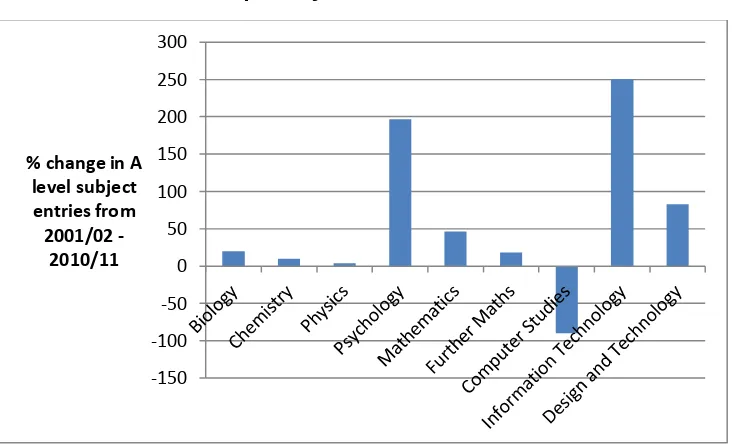
In terms of the percentage of year 14 pupils with an entry in one or more STEM subjects at A level, this figure has remained relatively consistent over the past ten years. In 2010/11, STEM subjects made up 40% of all A level subject entries. The following figure illustrates the percentage change in the numbers of pupils studying individual STEM subjects at A level over the past ten years. As with Figure 1, it provides an indication of overall trends within individual subjects.
Figure 2: Percentage change in A level entries in STEM subjects in NI post-primary schools 2001/02 – 2010/11
Source: Data provided by the Department of Education, 20th March 2012
-60 -40 -20 0 20 40 60 80 100 120
% change in GCSE entries from 2004/05 to
2010/11
-150 -100 -50 0 50 100 150 200 250 300
% change in A level subject entries from 2001/02 -
[image:3.595.100.471.521.743.2]4
STEM strategy and initiatives
Success through STEM, the 2011 strategy for these subjects, forms Government’s response to the Report of the STEM Review. The Strategy sets out a number of recommendations, including the following for the Department:
Address the disparity in STEM performance amongst schools: including through the implementation of Every School a Good School; professional development for teachers; and better targeting of STEM and business education activities;
Make STEM learning more enquiry-based: including through a focus on this in commissioning new resources for schools;
Increase the focus on the core sciences and mathematics: including through ensuring a clear focus on attainment in mathematics from Key Stage 1 to GCSE; and by supporting opportunities for pupils to participate in
competitions, exhibitions and other events;
Develop a STEM Continuing Professional Development framework: by ensuring the provision of professional development opportunities for teachers designed to promote effective STEM teaching; and by providing opportunities for additional professional development for A level teachers of ICT and Computing;
Increase the emphasis on STEM careers advice and guidance: including implementing a STEM Careers Strategy; and
Increase the number of applications for physical sciences and
mathematics places in Initial Teacher Education courses: the Department is to ensure that the provision of STEM-related places matches the needs of schools.
Department of Education actions
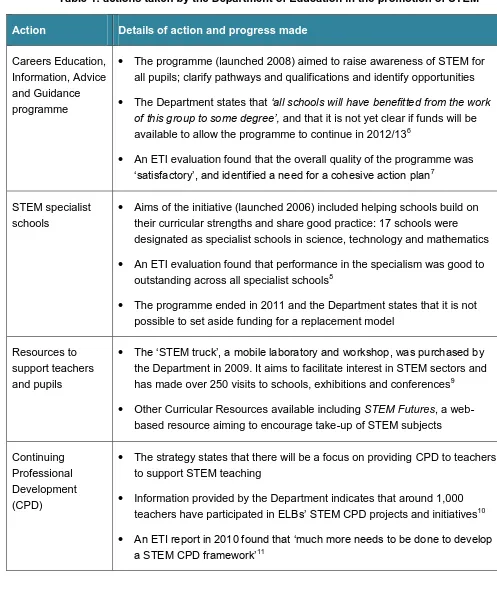
The 2010 Success through STEM Strategy highlights the actions taken by the Department to promote STEM. For example, it notes that the revised curriculum includes a clear focus on numeracy and a specific focus on science and technology, and that the Entitlement Framework will provide increased choice in the range of courses available to young people aged 14 and above. Other actions and details of progress made against them, where available, are outlined in the following table.5
5
Table 1: actions taken by the Department of Education in the promotion of STEM
Action Details of action and progress made
Careers Education, Information, Advice and Guidance programme
The programme (launched 2008) aimed to raise awareness of STEM for all pupils; clarify pathways and qualifications and identify opportunities
The Department states that ‘all schools will have benefitted from the work of this group to some degree’, and that it is not yet clear if funds will be available to allow the programme to continue in 2012/136
An ETI evaluation found that the overall quality of the programme was ‘satisfactory’, and identified a need for a cohesive action plan7
STEM specialist schools
Aims of the initiative (launched 2006) included helping schools build on their curricular strengths and share good practice: 17 schools were designated as specialist schools in science, technology and mathematics
An ETI evaluation found that performance in the specialism was good to outstanding across all specialist schools8
The programme ended in 2011 and the Department states that it is not possible to set aside funding for a replacement model
Resources to support teachers and pupils
The ‘STEM truck’, a mobile laboratory and workshop, was purchased by the Department in 2009. It aims to facilitate interest in STEM sectors and has made over 250 visits to schools, exhibitions and conferences9
Other Curricular Resources available including STEM Futures, a web-based resource aiming to encourage take-up of STEM subjects
Continuing Professional Development (CPD)
The strategy states that there will be a focus on providing CPD to teachers to support STEM teaching
Information provided by the Department indicates that around 1,000 teachers have participated in ELBs’ STEM CPD projects and initiatives10
An ETI report in 2010 found that ‘much more needs to be done to develop a STEM CPD framework’11
6
Information provided by the Department of Education, 20th March 2012
7
Education and Training Inspectorate (2010) An Evaluation of the progress of the Science, Technology, Engineering and Mathematics (STEM) Careers Education, Information, Advice and Guidance Programme
8
Education and Training Inspectorate (2010) Third Evaluation Report of the Specialist Schools Programme
9
Minister for Education response to an Assembly Question by Mr Mervyn Storey MLA, 13th January 2012
10
Information provided by the Department of Education, 20th March 2012
11
The Department also provides funding to Sentinus, a not for profit educational charity which works with schools and colleges to deliver programmes promoting STEM. To date, Sentinus has received funding of £400,000 annually to deliver a portfolio of STEM-based programmes to schools.12 In 2010/11 Sentinus programmes were availed of by 58,500 pupils.13 It is not yet known whether funding will be available beyond March 2012 for this programme.
5
Programme for Government commitments
Programme for Government 2008-11
This Programme for Government (PfG) set one goal and two Public Service
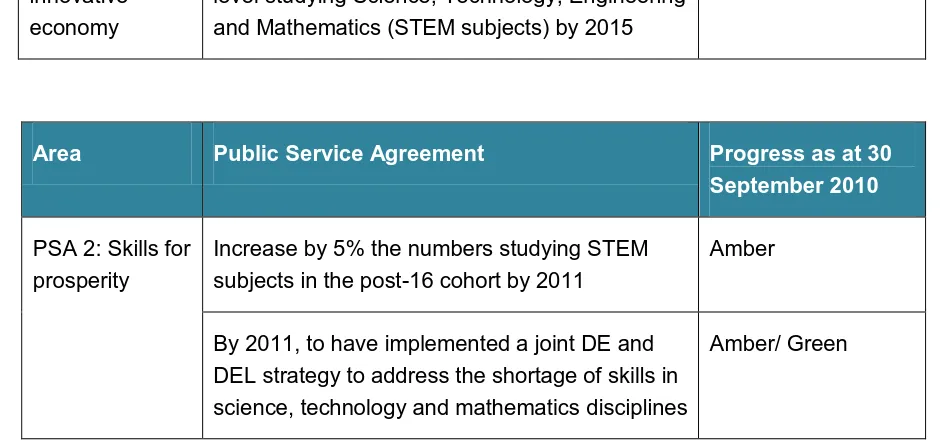
[image:6.595.83.553.467.688.2]Agreements (PSAs) relating to STEM subjects. A delivery report assessing the extent to which this PfG had met its targets and goals at September 2010 was published in February 2012. The goals and PSAs were assessed using a scale of Red, Amber, Amber/Green or Green.14
Table 2: PfG 2008-11 relating to STEM and progress made
Area Goal Progress as at 30
September 2010
Priority 1: Growing a dynamic and innovative economy
Increase by 25% the numbers of students, particularly those from disadvantaged communities, at graduate and postgraduate level studying Science, Technology, Engineering and Mathematics (STEM subjects) by 2015
Amber
Area Public Service Agreement Progress as at 30
September 2010
PSA 2: Skills for prosperity
Increase by 5% the numbers studying STEM subjects in the post-16 cohort by 2011
Amber
By 2011, to have implemented a joint DE and DEL strategy to address the shortage of skills in science, technology and mathematics disciplines
Amber/ Green
12
Information provided by the Department of Education, 20th March 2012
13
Minister for Education response to an Assembly Question by Mr Peter Weir MLA, 16th December 2011
14
Programme for Government 2011-15
The agreed PfG for this mandate included a commitment to increase uptake in STEM subjects, as highlighted in the following table.15
Table 3: PfG 2011-15 relating to STEM
Priority Commitment Milestones/ outputs
2012/13 2013/14 2014/15
1: Growing a sustainable economy and investing in the future
Increase uptake in economically relevant Science, Technology, Engineering and Mathematics (STEM) places (DEL)
233 additional places
467 additional places
700 additional places
6
Conclusion
This paper highlights policy and strategy in relation to STEM here. A number of areas could be given further consideration in this regard. For example, initial progress made by the Department against the STEM Strategy could be explored (a STEM One-Year-On report is due to be published imminently).
Consideration could also be given to current and previous STEM initiatives conducted by the Department, and the extent to which they are achieving/ have achieved their intended outcomes and value for money.
Finally, consideration could be given to the Programme for Government commitment to increase uptake in STEM subjects, and the Department’s role in supporting this. The progress against the 2008-11 PfG in increasing by 25% the numbers of students at graduate and postgraduate level studying STEM subjects could also be considered.
15