1
Understanding student experiences in university Learning Centres
Linda Galligan
University of Southern Queensland
This paper discusses a conceptual framework, based on Valsiner’s human development theory, to assist in the identification and analysis of learning change issues. Learning change is particularly important in a student’s first year and often observed in Learning Centres. The hub of this framework is analysing micro-processes made explicit by a sequence of student actions within a rich field of stimuli. The paper argues that the theory provides a useful tool to investigate the way adult learners think and develop, which in turn enhances educational practice in the context of Learning Centres at university.
Learning Centres are particularly rich environments to investigate student development, particularly in first year when many students realise they need to switch to a new way of thinking and learning. In this learning centre environment, a student, in a one-on-one setting with a teacher, navigates through a particular self-identified issue through a series of tasks to improve understanding. The student actions and reflection on these actions within these tasks are of interest, as they give the teacher clues to unfolding learning. Yet research into these actions is surprisingly sparse. This paper identifies research that has been undertaken in this area, and proposes that Human Development Theory has something to offer to identify and analyse learning change issues. It then outlines the theory, highlights a model of decision making, and provides an example in practice. Finally, it proposes that this framework can be added to a Learning Centre’s approach to teaching and evaluation as it provides evidence of success of student learning.
Learning development is complex and according to Shay (2012), the nature of this development is still not a fully-fledged field of study. In a review of student learning research in 2009, Haggis identified literature on how students learn in higher education, but found that, while suitable frameworks in psychology and sociology existed, it wasn’t being used in higher education. Instead there was a concentration in a narrow field of perspectives and methodologies, such as deep and surface learning, which provided few answers as to why students take such an approach (Haggis, 2009). While interaction between the student, content, and environment is important in identifying approaches to learning, as highlighted by Biggs (2007), extending the scope to new fields, may offer “radically new perspectives” (Haggis, 2009 p. 289). Socio-cultural learning theories were thus proposed by Haggis, to investigate learning in higher education particularly when looking at fleeting moments and “coming to know”. In 2009, Haggis concluded that “there is as yet little research that attempts to document different types of dynamic interaction and process through time in relation to ‘learning’ situations in higher education” (p. 389).
2 (Barnett, 2011 p. 11). What is happening in that liminal space? This next section outlines Valsiner’s theory which takes such a developmental approach.
In recent years, Valsiner’s Human Development Theory and related zone theory (1997), has been used in a number of contexts, particularly in mathematics education (e.g. Galbraith & Goos, 2003). The genesis of this particular approach presented in this paper has been reported (Galligan, 2008, 2010) in the context of adult nursing students learning mathematics. This paper now asks if this approach is useful within an academic learning centre environment, beyond mathematics, where many students present with uneven understanding of the expectations and norms of academia.
The general structure to investigate developing concepts in this environment is to observe the initial, intermediate and final state of an event (e.g. solving a problem), in particular on the unfolding of the intermediate forms, and the coming-into-(and out of)-doubt. Changes in forms are often triggered within a rich environment such as a Learning Centre.
In addition to the environment, understanding where students are (before the learning experience or concept development), where they are going and how they are going to get there is also of critical importance. The path along this journey is not direct. There are many points along the way where students stop. These ‘nodes of stuckness’ may result in the staying at this point (or moving backwards) or staying until a trigger helps them to move forward. The pathway may become more familiar each time a concept is revisited, as long as there is active recognition of parts of the concept that were unfamiliar, parts that are now more in focus and parts that are still to be made clear, and being comfortable with that doubt. To understand what is happening in these nodes where development takes place, Valsiner focuses on the actualised possibility (observed in performing) that may “reorganise a set of possibilities for the next developmental actualisation of possibilities” (Valsiner, 1987, p. 177). He argues for a microgenetic1 study which investigates the whole set of possibilities that may or may not actualize. In a class, a student suddenly discovers how something works but it is within a system around a normal task. For the student it is a major breakthrough, but for the teacher it may be seen to be wrong or trivial (Valsiner, 2008).
It is beyond the scope of this paper to explain Valsiner’s theory in detail or the methodology (based on Vygotsky’s Method of Double Stimulation). However, the essence is the investigation and analysis of actions. From any action are a set of possible future actions. The actual development emerges from the negotiation process within this set of possibilities and includes self-regulation and internalisation. The focus of the analysis places students into a relatively structured situation to study the processes. The hesitant behaviour (between acting and not acting and getting students to report on their behaviour) can be recorded as a series of microgenetic problem-solving sequences (Valsiner 2000). These sequences are placed within a longer time scale which may explain some of a student’s ontogenetic2 development. The study also places the researcher in the same situation and the researcher (or teacher) can be changed in the process.
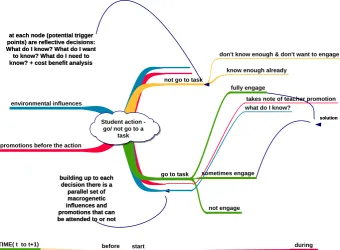
In addition, macrogenetic3 influences and promotions can impact on learning. Figure 1 shows the proposed model of a student, in the environment of doing a task, who may interact with
1 Microgenetic study – an empirical strategy that triggers, records and analyses the immediate process of
emergence of new phenomena (Valsiner, 2000) that may only last milli-seconds.
2
Ontogenetic – entire sequence of events involved in the development of an individual
3 the teacher, materials, other colleagues and/or themselves, with microgenetic points (‘nodes’) of student decision making occurring which can change the trajectory of student learning.
Figure 1. Formal model of student solving part of a problem
The lines of influences and promotions would occur all along the lines, but are only shown at the beginning. Within this model other sets of microgenetic points occur within the task. These decision points help to decide future learning. If a student decides on the same path, then this begins to form a student’s ontogenetic approach to learning.
Within particular moments in time there may be other decisions around a task in these moments. A particular action that is still uncertain and may be reflected. However, within this action and reflection may be other related actions and reflections each of which can impact on the action to produce a new action that can influence the becoming person. A series of these microgenetic episodes, highlighting a particular microgenetic process can be built to inform an ontogenetic picture of student academic development.
Building up a picture of the student through the macrogenetic processes can be gleaned through interview, surveys and observation. In previous research, one such example was built up of a nursing student “Tania” (described more fully in Galligan, 2010). Other qualitative and quantitative data, depending on the context (such as previous success, evidence of concept understanding), was also collected. In the example of Tania I recorded six Learning Centre sessions over one semester and one session in the next semester. I identified a number of mathematics issues that were causing concern, one of which was fractions.
In Session 1, within a discussion on 1.42
70 , Tania had issues with fractions. She says she is not
sure what fractions are, but she is already approaching it from deeper level of wanting to know (line 46):
about actions to be taken, what others think and future anticipations
Student action - go/ not go to a
task
promotions before the action environmental influences at each node (potential trigger points) are reflective decisions: What do I know? What do I want to know? What do I need to know? + cost benefit analysis
building up to each decision there is a
parallel set of macrogenetic influences and promotions that can be attended to or not
not go to task
know enough already
don't know enough & don't want to engage
go to task
not engage fully engage
sometimes engage
TIME( t to t+1) before start during
solution
takes note of teacher promotion what do I know?
Student action - go/ not go to a
task at each node (potential trigger
points) are reflective decisions: What do I know? What do I want to know? What do I need to know? + cost benefit analysis
building up to each decision there is a
parallel set of macrogenetic influences and promotions that can be attended to or not
4
ACTION INTERPRETATION
Teacher: So if I had instead put 1.4 over 4 900, does that look like a fraction now? (line 45)
Teacher suggests goal area
Tania: Now is that classified as a fraction or is that classified as something else?... I don’t know because I don’t understand fractions. But I’m assuming so from the little bit I’ve learnt that it’s a fraction (line 46).
The object, 1.4
4900, is at this moment the
concept of fraction (not the operation of division). (Background memories and feelings). Reflection on this action.
Tania: Anything with that line means a fraction (line 47).
The physical line (the “vinculum”) is now in her new meaning reserves (full concept of fraction still to be formed)
She is already getting a better feeling for fractions (from line 67). Teacher: But if I just have 3 over 49, is that also
a bit of a mystery?
Teacher suggests a new goal area
Tania: Now it makes sense that 3 divided by 49 but if I’d looked at that a week ago I wouldn’t have thought 3 divided by 49 – I would have looked at 3 and I would have looked at 49 and thought well what am I supposed to do? (line 67)
Background memories and feelings that have already changed. Uniting fraction and knowledge of fraction into one structure
There was also evidence of deeper thinking (line 206). Here in a discussion on 28 60
, while the calculation is 60 divided into 28, often it may be useful to divide the 28 into the 60 to get a feel for the number, in this case nearly half. The conflict involved in doing the two different calculations are still sitting in her mind, “which way will I do it”? And this is overlaid by a conflict between an intuitive notion of a half and the notion of trying to divide a larger number 60 into a smaller number 28, which, to her mind “doesn’t work”.
Tania: …Because the amount of 28s that go into 60 are nearly half.., I wasn’t sure if it was the other way around and yet 60 going into 28 just doesn’t work. (line 206).
Immediate interaction with the fraction and what it means, compared to initial interaction, a new action appears to be forming
Echoes of this indecisiveness were still seen in the next semester when she has a problem:
Tania: ×5
400 1
SR Okay so 5 divided by 400. Is
that how you do it or is it 400 divided by 5. 400 divided by 5 is it? (Line 101)
The initial action of not seeing what a fraction is has moved from the periphery. Another action still appears uncertain.
By Interview 4 she is more confident and provides evidence of numerate thinking. In a statement relating to 10/20..., with no hesitation and with confidence she said: “half that would be point 5” (session 4, line 34).
5 Learning about learning is complex. The microgenetic individual-socioecological frame outlined in this paper can be a tool to uncover learning change issues. The description and example in the paper provides a perspective that may be useful for teachers in Learning Centres, and other rich learning environments, to help answer the question of how students are learning. This approach recognises the dynamic nature of learning, the multitude of decisions that a student needs make while learning and the influence of both a students’ macrogenetic processes on learning and the teacher. Both the teacher and the learner can put constraints and promotions on the learner which can assist or inhibit learning. In Tania’s case, while her background included some negative influences, her own self-scaffolding and her positioning within the learning helped her become more numerate.
References
Barnett, Ronald. (2011). Learning about learning: a conundrum and a possible resolution. London Review of Education, 9(1), 5-13. doi: 10.1080/14748460.2011.550430
Biggs, John B. (2007). Teaching for quality learning at university : what the student does (3rd ed. ed.): Open University Press.
Galbraith, P., & Goos, M. (2003). From description to analysis in technology aided teaching and learning: A contribution from Zone theory. In L. Bragg, C. Campbell, G. Herbert & J. Mousley (Eds.), Mathematics education research: Innovation, networking, opportunity. Proceedings of the 26th annual conference of the Mathematics Education Research Group of Australasia. Melbourne: Deakin University.
Galligan, L. (2008). Using Valsiner. In M. Goos, R. Brown & K. Maker (Eds.), Navigating currents and charting directions: Proceedings of the 31st annual conference of the Mathematics Education Group of Australasia Inc (Vol. 1, pp. 211-218). Sydney: MERGA.
Galligan, L. (2010). Becoming more numerate: The journey of Tania. In L. Sparrow, B. Kissane & C. Hurst (Eds.), Shaping the future of mathematics education: Proceedings of the 33rd annual conference of the Mathematics Education Research Group of Australasia (pp. 193-201). Sydney: MERGA.
Galligan, L. (2013). A systematic approach to embedding academic numeracy at university. Higher Education Research & Development, 32(5), 734-747. doi: 10.1080/07294360.2013.777037 Haggis, Tamsin. (2009). What have we been thinking of? A critical overview of 40 years of student
learning research in higher education. Studies in Higher Education, 34(4), 377-390. doi: 10.1080/03075070902771903
Roth, Wolff-Michael, & Lee, Yew-Jin. (2007). “Vygotsky’s Neglected Legacy”: Cultural-Historical Activity Theory. Review of Educational Research, 77(2), 186-232. doi:
10.3102/0034654306298273
Shay, Suellen. (2012). Educational development as a field: are we there yet? Higher Education Research & Development, 31(3), 311-323. doi: 10.1080/07294360.2011.631520
Valsiner, Jaan. (1987). Culture and the development of children's actions: A cultural-historical theory of developmental psychology. New York: John Wiley & Sons.
Valsiner, Jaan. (1997). Culture and the development of children's actions: A theory of human development (2 ed.). Chichester: John Wiley & Sons.
Valsiner, Jaan. (2000). Culture and human development: An introduction. London: Sage. Valsiner, Jaan. (2008). Open intransitivity cycles in development and education: Pathways to