IT convergence technologies are being utilized in various fields. Human-oriented contents are continuously being developed to enjoy higher quality life through IT convergence technologies. Health care services resulting from the development of various smart IT devices in the health and medical field make more efficient health management possible for people. This study proposes a cloud-based ontology context mining method using deep-learning in health care. The user’s static data and context data are saved in cloud, which is a high performance computing resource through ontology modeling and context mining is used to collect user health data with high similarity. The collected health data are applied to the algorithms and back propagation of artificial neural networks and deep-learning is conducted to provide more accurate health care prediction service. Furthermore, upon conducting a performance analysis to verify the validity of the learned user health data, it was found that the prediction accuracy that applied the proposed method was approximately 17% higher.
Key words: Cloud Computing, Deep Learning, Healthcare, Ontology, Context Mining
I.INTRODUCTION
The rapid development of the IoT industry recently has promoted the application of medical data management and network systems in the health care industry. Among them, the medical industry is one of the fields in which the technologies are being applied in the fastest and largest scale [1]. Today’s society is faced with the fourth industrial revolution due to the development of IT convergence technologies and entry into an information society. Humans have continuously developed research in the health and medical sector with the goal of living healthy lives and this has become more apparent through various health care services. Recently, hospitals have gone beyond the past patient information management system by using big data analysis technologies. Hospitals are now processing and analysing personal health records (PHR) based on IoT such as tablets and smart devices, thereby offering high quality
Revised Manuscript Received on May 9, 2019.
Ji-Won Baek, Department of Computer Science, Kyonggi University,
154-42, Gwanggyosan-ro, Yeongtong-gu, Suwon-si, Gyeonggi-do, 16227, South Korea
Kyungyong Chung, Division of Computer Science and Engineering,
Kyonggi University, 154-42, Gwanggyosan-ro, Yeongtong-gu, Suwon-si, Gyeonggi-do, 16227, South Korea
Jonghun Kim, Department of Software Convergence Engineering, Inha
University, 100 Inha‑ro, Michuhol‑gu, Incheon 22212, South Korea
Hoill Jung, Department of Computer Software, Daelim University College,
29, Imgok-ro, Dongan-gu, Anyang-si Gyeonggi-do, 13916, South Korea. (correspond author)
*E-mail: [email protected]
and when data is accumulated, issues arise in which there is lacking storage space or significant slowing of computing speeds. In order to address this issue, cloud computing is used to collect linear and nonlinear data in the server and then computes the similarity and adjacency between the mutual properties of objects to group them and provide integrated management [3-4]. By applying this, it is possible to provide advanced services such as potential health risk prediction service, solidification customized health improvement, preventive medical service for senior citizen welfare, early discovery of emergency patients, and to improve national health using a health platform that can collect, save and analyse massive amounts of medical big data. In addition, it is possible to improve medical service quality through user health status evaluation and risk prediction models through data mining and deep-learning in the cloud environment [5-7]. Therefore, this study proposes cloud-based ontology context mining using deep-learning in health care. It uses personalized data that integrates existing user health passive data and IoT-based user context data for ontology modeling and context mining to group users. Furthermore, deep-learning is conducted using the log data and health care data of grouped users. Back propagation of the neural network structure used in deep-learning is used to revise the weight and the accuracy of more precise predictions are computed. Moreover, performance assessment of F-Measure is conducted in the aspect of learning rate and accuracy to verify validity for the proposed method.
Composition of this study is as follows. Chapter 2 examines the context recognition ontology model and cloud computing and Chapter 3 describes the cloud-based ontology context mining method using deep-learning in healthcare. Chapter 4 conducts performance evaluations and Chapter 5 is the conclusion.
II.RELATEDWORKS
2.1 Ontology Context Model
The ontology model is a tool that shows the concept and correlation. In particular, when expressing or explaining the daily life of humans, ontology is very efficient for digitalizing it or to show the data structure through computers. Figure 1 shows a healthcare-based
Fig 1. Health-based ontology model for semantic network.
Various recent context recognition studies commonly use ontology-based modeling methods and tools that support ontology are used to proclaim and express ontology language such as ontology web language, framework, etc. Ontology summarizes the concepts and relationships in biomedicine, bioinformatics, etc. and provides annotation information. It is also used frequently for sharing with human or computing agents. It also makes it possible to use domain knowledge or enables standardized analysis through a knowledge base using succession and knowledge binding or using computers. Ontology has become a core technology for context recognition modeling with the advent of semantic webs [7-8].
2.2 PHR based Cloud Computing Model
Cloud computing is a computing system that uses the backbone server to use services related to the storage of data
and intelligent information systems [9-11]. This study collects dissimilar big data from various contact points and use high-performance cloud computing in which processing and analysis is possible. Nonlinear and linear data are integrated and processed from the collected medical big data, which are stored in cloud for managing the medical information. Efficiency for data search and management can be enhanced by grouping and it is possible to configure systems accessible by different hospitals through cloud computing. Also, efficient medical information management that overcomes existing weaknesses is available during data transfer and various emergencies at the hospital. Figure 2 shows a PHR based cloud computing model.
Fig 2. PHR based Cloud Computing Model.
III.CLOUDBASEDONTOLOGYCONTEXT MININGUSINGDEEPLEARNINGIN
HEALTHCARE
3.1 Cloud based Ontology Context
There can be various users, places, devices and services in the context information collection environment and service components must be able to exchange context information through the same semantic understanding. Context information modeling is necessary to use data categorized as context information. Context information uses the user as ontology to model as internal, external and service context information [12-13]. Furthermore, in order to enhance the modelled context information inference performance, physical dissimilar devices are integrated into a single virtual storage with software that offers virtualization functions. In
[image:2.595.143.455.405.571.2]Figure 3 Entropy Weighting K-means Algorithm-based User Groups
The Entropy Weighting K-Means algorithm [10] measures the similarity of the mean values of the data and cluster and then groups data taking into consideration the entropy weight in the K-Means algorithm, which is a method for reassigning users in appropriate clusters [11-14]. At this time, the mean value uses the average value for the data vector of the cluster and using such algorithm, the grouped user information is encrypted to provide advanced services. This group’s data in a physically limited storage space to process more information for more efficient management.
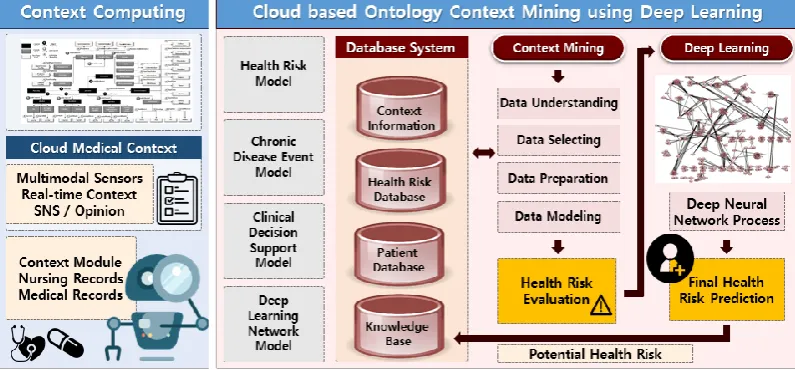
User context data saved in cloud shows groups with higher user similarity. The user context data can express each individual data as a vector, which is a sequential pair of numbers, and using the numerical relationship of two vectors, it is possible to find its semantic relationship. Artificial Neural Network (ANN), which imitates the human brain, can be applied in this vectoring work [17]. Cloud-based ontology context mining data digitizes its similarity relations through grouping per user, and it can thus be applied in the artificial neural network. Therefore, back propagation algorithms of artificial neural networks are applied to the cloud-based ontology context mining group data for deep-learning. Figure 4 shows the structure of cloud-based ontology context mining using deep learning.
Figure 4 Structure of Cloud-based Ontology Context Mining using Deep learning
IV.PERFORMANCEEVALUATION
4.1. Context Recognition Model Environment
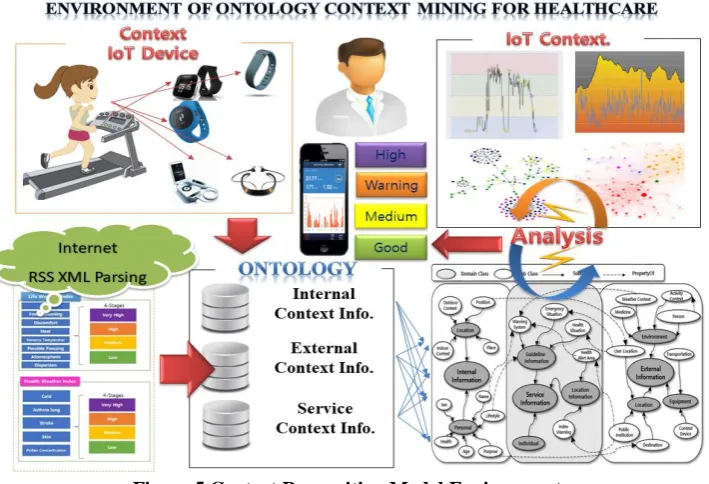
IoT is a spatial connection network between objects with intelligent relations that can send and receive information through sensor networks via mutual cooperation between things in an environment separated as humans, things and services. IoT-based context recognition technologies are used to collect context data according to the user’s contexts for health care services. It collects user-environment information using IoT-based context recognition for
Figure 5 Context Recognition Model Environment
The IoT-based context information inferred from the collected data uses ontology [7-8] for modeling, which is a preceding study, to provide health care services to users. Ontology makes up the user-oriented internal, external and service classes and expresses the hierarchical relationship between classes in OWL format.
4.2. Performance Evaluation
The following experiments are conducted to assess the performance of the proposed method. The test data used are 23,125 records of web cloud context log data acquired over approximately three months from 139 users through IoT devices and 4,659 static records, which are the raw data from the national health and nutrition survey [19]. Performance evaluation first uses context information according to users and health care raw data records for deep-learning and evaluates performance according to learning rates. Second, the accuracy of predictions of use and non-use of the proposed method is assessed. Back propagation performance for computation in cloud-based ontology context mining using deep-learning showed difference in performance based on composition of learning rate. Therefore, before evaluating the accuracy of the prediction value, performance of back propagation according to learning rate is evaluated first to make it possible for more accurate predictions. Figure 6 shows the performance evaluation results of the deep neural network.
Figure 6 Performance Evaluation Results according to Learning Rates
Evaluations showed that learning rates from 0.001 to 90 or more learning times were the most effective. In order to verify accuracy according to whether or not cloud-based ontology context mining (CbOCM) using deep-learning proposed in the second test were applied, accuracy, recall ratio, and F-measure were compared and assessed [20-24]. After fixing the predicted risk rate for measurements, the inferred value for each inputted question and the value that should actually be inferred are compared and F-measure analysis [7, 23-24] is carried out. Figure 7 shows the results of F-measure according to the number of group.
Figure 7 Results of F-Measure according to the Number of Group
V.CONCLUSION
This study proposed a cloud-based ontology context mining method using deep-learning in health care. The proposed method uses IoT devices to utilize user context information that can be acquired in everyday life and comprised the ontology. In addition, it was modeled to allow user-oriented services
[image:4.595.313.536.473.614.2]deep-learning for more precise predictions and its validity was verified through performance assessment.
ACKNOWLEDGMENT
This work was supported by the National Research Foundation of Korea(NRF) grant funded by the Korea government(MSIP; Ministry of Science, ICT & Future Planning) (No.2018R1C1B5047242). Additionally, this work was supported by Kyonggi University’s Graduate Research Assistantship 2019.
REFERENCES
1. Kim, H. K., Jung, E. Y., Kang, H. W., Park, D. K. Data Mapping and Development Guideline for PHR System Establishment Using CDM. The Journal of Korean Institute of Information Technology. 2016;14(1): 113-141.
2. Wang, S. L., Chen, Y. L., Kuo, A. M. H., Chen, H. M., Shiu, Y. S. Design and Evaluation of a Cloud-based Mobile Health Information Recommendation System on Wireless Sensor Networks. Computers & Electrical Engineering, 2016;49: 221-235.
3. Center for Health Industry Information & Statistics. Weekly Healthcare Industry Trends. Korea Health Industry Development Institute. 2015;155: 1-2.
4. Robert, M. Yucal, S. Alexander, S., Consistent discovery of frequent interval-based temporal patterns in chronic patients’ data. Journal of Biomedical Informatics. 2017;75: 83-95.
5. Otto, C., Milenkovic, A., Sanders, C. System Architecture of a wireless body area sensor network for ubiquitous Health Monitoring. Journal of Mobile Multimedia. 2006;1(4): 307-326.
6. Wright A. P., Wright, A. T., McCoy, A. B., Sitting, D. F. The use of Sequential Pattern Mining to Predict Next Prescribed Medications. Journal of Biomedical Informatics. 2015;53: 73-80.
7. Kim, S. H., Chung, K. Medical Information Service System based on Human 3D Anatomical Model. Multimedia Tools and Applications. 2015;74(20): 8939-8950.
8. Yoo, H., Chung, K. PHR based Diabetes Index Service Model using Life Behavior Analysis. Wireless Personal Communications. 2017;93(1):161-174.
9. Chung, K., Park, R. C. P2P Cloud Network Services for IoT based Disaster Situations Information. Peer-to-Peer Networking and Applications. 2016;9(3):566-577.
10.Cho, C. S., An, D. U., Jeong, S. J., Lee, S. W. (2003). K-means Clustering Method according to Documentation Numbers. International Conference on Electronics, Information, and Communication, ICEIC2003, 2003;1557-1560.
11.Song, C. W., Jung, H., Chung, K. Development of a Medical Big-Data Mining Process using Topic Modeling. Cluster Computing. 2018; DOI 10.1007/s10586-017-0942-0
12.Jung, H., Chung, K., Mining based Associative Image Filtering using Harmonic Mean. Cluster Computing. 2014: 17(3): 767-774.
13.Jung, H., Chung, K. Life Style Improvement Mobile Service for High Risk Chronic Disease based on PHR Platform. Cluster Computing. 2016;19(2): 967-977.
14.Hwang, I. Two Phase Hierarchical Clustering Algorithm for Group Formation in Data Mining. Korean Management Science Review. 2002;19(1): 189-196.
15.Kumar, J., Goomer, R., Singh, A. K. Long Short Term Memory Recurrent Neural Network (LSTM-RNN) Based Workload Forecasting Model for Cloud Datacenters. Procedia Computer Science. 2018;125: 676-682.
Text Mining from Health Big Data. Wireless Personal Communications. 2019:105(2):691-707.
22. Chung, K., Yoo, H., Choe, D., Jung, H. Blockchain Network based Topic Mining Process for Cognitive Manufacturing. Wireless Personal Communications. 2019;105(2):583-597.
23. Kim, J. C., Chung, K. Mining based Time-Series Sleeping Pattern Analysis for Life Big-data. Wireless Personal Communications. 2019;105(2):475-489.
![Fig 1. Health-based ontology model for semantic network. and intelligent information systems [9-11]](https://thumb-us.123doks.com/thumbv2/123dok_us/8197465.259812/2.595.143.455.405.571/health-based-ontology-semantic-network-intelligent-information-systems.webp)