Percussion and Computer in Live
Performance
Charles Martin
B.Sc. (Hons)
May 2009
A thesis submitted in partial fulfilment of the degree of Master of Music
School of Music
Statement of Originality
I declare that the material contained in this thesis is my own work except where another source has been acknowledged. This thesis has not been submitted to any other institution for the award of a degree.
Contents
Contents v
Abstract vii
Acknowledgements ix
1 Introduction 1
1.1 The computer in live performance . . . 2
1.2 Challenges of performance with computer . . . 5
1.3 The role of the computer . . . 6
2 Percussion and Fixed Electronic Sounds 9 2.1 For Marimba and Tape - Wesley-Smith (1983) . . . 9
2.2 Losing Touch - Campion (1994) . . . 10
2.3 Six Japanese Gardens - Saariaho (1995 - 2005) . . . 11
2.4 ‘Shackled’ to the Accompaniment . . . 13
3 Amplified Percussion and Effects 19 3.1 Duet for Vibraphone and Computer (2008) . . . 20
3.2 Augmenting the Instruments . . . 22
4 Percussion and Interactive Computer 25 4.1 ‘Duet’ in Duet for Vibraphone and Computer . . . 25
4.2 Cognition - Cormick/Forster/Martin (2008) . . . 27
4.3 Cort Lippe’s works for percussion and computer (1998 - 2007) . . 29
4.4 Interactivity, a true duet? . . . 31
4.5 The computer as an instrument . . . 33
5 Conclusions and Future Directions 37 5.1 The computer part’s influence on performance . . . 37
5.2 Future revisions for the author’s works . . . 39 5.3 Concluding Remarks . . . 40
Abstract
This thesis seeks to articulate a performer’s perspective of the interactions be-tween percussion and computer in performance. A selection of compositions for percussion and computer will be used to explain how understanding the role of the computer can inform the player’s technical and musical choices and is vital to convey a cohesive performance. Two of the compositions are the author’s own work. Discussion of both the creation and performance of these works will sug-gest how using the computer with percussion extends the musical possibilities in a solo performance and allows implicit connections with practitioners of other art-forms.
Acknowledgements
I wish to acknowledge the guidance of my primary supervisor, Dr. Alistair Rid-dell. He has taught me a huge amount in a short time and I look forward to our future discussions. I also thank my secondary supervisors and percussion instructors, Associate Professor Gary France and Dr. Mary Broughton. Their comments and insight about this thesis have been invaluable.
In particular, Gary France has supported my musical endeavours for over five years. He has had a profound influence on my approach to performance and research and for this I thank him sincerely.
My friends and colleagues in the percussion area at the ANU School of Music have always made work fun: Christina Hopgood, Chi-Hsia Lai, Veronica Walshaw, Michael Stevens, Yvonne Lam, Izac Sadler, Ana Napier and Adam Dickson among many others. More recently they have turned a blind eye to the strange music emerging from that practice room. In the Department of Mathematics, Simon Kitson and Lance Gurney have always supported and claimed to have enjoyed my work. Thanks to you all.
I thank the talented artists in my cross art-form ensemble The Last Man to Die: Hanna Cormick and Benjamin Forster. This would not have been much of a thesis without the works we created together. The mastery they have in their respective fields continues to amaze me. I also thank Michael Bailey, David Shaw and the others involved in The Hunting Season 2008 and Boho Interactive for their assistance and contributions.
Finally I thank Christina and my family for their patience and support.
Chapter 1
Introduction
A persistent goal of computer music research has been to combine the sounds available to computer musicians with traditional instruments on stage. For much of the history of computer and electronic music, the only option has been to represent the electronic part as a fixed recording which is played back alongside the live musicians. In the last thirty years, the computer has become the central tool of electronic music and it has been possible to create music for instrument and computer with a much greater level of interactivity. At the same time, electronic music has taken off in popular culture and a spectacular variety of electronic instruments and techniques have emerged [7].
Due to these developments, more and more compositions for percussion and computer have become available. Even in this limited context the computer is complex and endlessly versatile. It is capable of playing a wide spectrum of roles in music from subtle backdrops to an orchestra of sounds all controlled by one player. Due to this variability, works for computer and instrument usually require a special level of engagement from the player with regard to the technical setup on stage and the musical relationship between the computer and instrument. Coupled with percussion, where complicated setups and custom instruments are the norm, there are yet more special considerations to be made.
This thesis seeks to articulate a performer’s perspective of the interactions between percussion and computer in performance. A selection of compositions for percussion and computer will be used to explain how understanding the role of the computer can inform the player’s technical and musical choices. Such an understanding is vital to convey a cohesive performance. Two of the compositions,
Cognition [29] andDuet for Vibraphone and Computer [28], are the author’s own work. Discussion of both the creation and performance of these works will suggest
how using the computer with percussion extends the musical possibilities in a solo performance and allows implicit connections with practitioners of other art-forms. To understand the musical relationship between the percussion performer and computer instruments it will be useful to consider some technological aspects of computer music. Current computer systems for creating music will be explained, as well as new advances in interface design that allow the player to control and perform on computer instruments more effectively.
[image:12.595.72.482.295.556.2]1.1
The computer in live performance
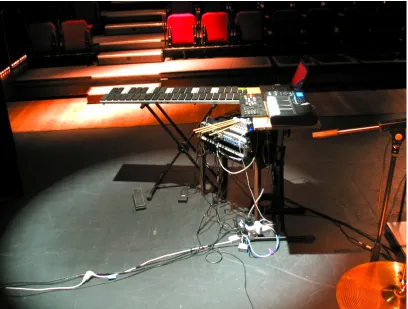
Figure 1.1: A complicated percussion and computer setup.
This thesis is a discussion of works for percussion and computer. Here, the
computer part is defined as that part of the composition involving any use of electronic instruments, effects, amplification or automated accompaniment that does not involve a second human performer1.
The reason for using the term computer rather than electronics is that the computer has become the central tool for electronic music. Performing a work
1.1. The computer in live performance 3 for percussion and electronics may once have required large amounts of electronic equipment for processing the percussion sound, creating synthesised sounds and playing back pre-recorded sounds. The work of these large devices can now be done by a computer2.
The computer not only replaces existing electronic devices, but adds the ca-pacity to control them throughout a performance. We shall see in Saariaho’s work,
Six Japanese Gardens for multipercussion and computer, that the computer is programmed to turn effects on and off as well as play different backing recordings throughout the piece. Even more interesting, computers can be programmed to analyse the sound from a microphone over the percussion instruments, detecting pitches and attacks. Furthermore, the computer could ‘compose’ its own part, according to a programmed algorithm.
In this way, compositions for percussion and computer use the computer part not only to play back prerecorded material, but also to engage in sophisticated interaction with the player. The interaction can be as simple as subtle process-ing of the sound of the percussion part or as complex as real-time algorithmic composition3.
Consider the standard equipment required for works with percussion and com-puter. The computer is normally a laptop connected to an external sound card that has multiple independent channels of sound input and output as well as MIDI4 inputs and outputs. The computer plays sound through a loudspeaker
system which could be a large installation in the room or a smaller speaker sys-tem near the live performer.
The live performer might also have headphones or a small monitor speaker to hear the sound of the computer more directly. This could be a different mix of sounds than the main loudspeakers and might include a click track5. Some compositions for percussion and computer include visual cues for the percussionist on the computer screen. This cue might show what section of the composition the computer is playing or some other information about the performance.
2Papers by Puckette [38] and Esler [12] outline their projects to update complicated works for live instrument and electronic sounds using a single computer part that replaces the obsolete hardware.
3The computer part creates its own music following rules (the algorithm) set down by the composer.
4Musical Instrument Digital Interface, the standard protocol for representing musical in-structions in electronic devices. MIDI messages look something like “play a C at 80% loud-ness... now stop the C and play a D...”. MIDI represents musical instructions rather than actual sounds [8].
For real-time interaction between the percussion and computer parts there must be an interface allowing the computer to ‘observe’ the live performer. Often, microphones or piezo-electric pickups6 are used on the percussion setup, allowing
the computer to analyse, process and react to the live sound.
Other interfaces sense the performer’s actions more directly. Keyboard instru-ments connected to computers via MIDI are ubiquitous, but there are electronic versions of many other instruments that communicate with the computer using MIDI signals. MIDI pickups, electronic drums, mallet percussion instruments and pedal controllers are all commercially available. The goal of these electronic instruments is to translate the expert technique of the player on an acoustic in-strument into data that the computer can transform into sound, visualisations or use for other novel purposes.
Some electronic instruments are not based on any existing acoustic instru-ment, Michel Waisvisz researched an instrument called The Hands [49, 48] from the early 1980s. These large gloves sent MIDI data about the motion of the fingers and hands to control a computer music system or synthesiser.
More recently, powerful computers have allowed researchers to use real time video analysis in performance. Chi-Hsia Lai’s Hands On Stage[17, 18] is a square drum-like surface with a camera to detect the position and motion of her hands while contact microphones detect the sound of striking, scratching or rubbing the surface. The collected data is interpreted into control of computer instruments as well as a projected visualisation.
Since it is easy to program computers to interpret any type of data as musical instructions or inspiration, researchers and musicians have experimented with sending non-musical information to the computer during performance as a basis or influence for their music. This information might be audio or video from the audience, or something as perpendicular to performance as weather data from the internet. Gaye, Maz´e and Holmquist experimented in 2003 with interpreting as music the data sensed while a ‘musician’ walked through a city. In their paper,
Sonic City: the urban environment as a musical interface [15] they outline the data that was mapped to musical parameters:
...day vs. night, loud vs. quiet, cold vs. hot... walking straight, left, right... pollution level, lighting...
1.2. Challenges of performance with computer 5 One of the goals of Sonic City was “playful interaction” with an everyday expe-rience. Other non-instruments are used to strengthen interactive links with the performers and audience or for creating sound-art based on non-musical concepts.
1.2
Challenges of performance with computer
listener
accompanist //
3 3 percussion o o 7 7
Figure 1.2: Interactions on stage in a traditional duet
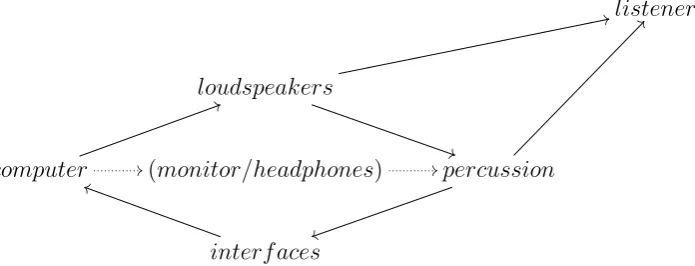
Performing works for computer and percussion is complicated and presents unique technical and musical challenges. Musicians know that the interaction between two musicians, illustrated in figure 1.2, is far from simple. Figure 1.3 shows the typical interactions on stage between live percussion and computer. The situation in figure 1.3 presents technical challenges because the computer’s mode of creating sounds, the loudspeakers, are physically and technically sepa-rated from the interfaces through which it observes the percussionist, its ‘eyes and ears’. listener loudspeakers 2 2 ) ) computer 5 5 /
/(monitor/headphones) //percussion
[image:15.595.121.469.493.626.2]? ? u u interf aces i i
Figure 1.3: Interactions on stage between percussion and computer.
and musical disconnectedness can translate into a performance where the audience feels that the actions of the performer have no strong relation to the sounds that are being produced.
Furthermore, it can be difficult for the performer (and composer) to co-ordinate and choose appropriately from the range of different technologies that could be involved in mounting such a performance. Computer errors that ruin the performance are not a particularly serious problem, but uncomfortable or ill-suited interfaces and loudspeakers of the wrong kind or in the wrong place are. In performances with sophisticated interaction between percussion and com-puter, there is a risk that the connection between the two parts will not be understood by the audience. Schloss, a percussionist who has explored the use of new electronic instruments and computers in live performance for many years, comments that “Cause-and-effect is important, at least for the observer”. In later chapters it will be seen that the player can emphasise the idea of cause-and-effect in between the percussion and computer parts.
The challenge of effective performance while pursuing interesting sounds and interactions of computers is one of the central streams of current computer music research7. By looking at works for percussion and computer we will see that
understanding the role of the computer and its interaction with the percussion part suggests technical and musical solutions to these challenges.
1.3
The role of the computer
One of the goals of this thesis is to question what role the computer plays in pieces for percussion and computer. Some compositions, such as Wesley-Smith’s,
For Marimba and Tape [50], have a computer part that acts as a musical accom-paniment. Other computer parts are much less well defined. In the author’s own work, Duet for Vibraphone and Computer [28], the computer sometimes acts to augment the vibraphone sound, for example, by simulating the strange resonance of an impossible concert hall. Other times, the computer part has its own voice, reacting to the notes played on the vibraphone in a quite unpredictable way. For the analysis to follow, it will be useful to define the roles that the computer can play.
1.3. The role of the computer 7 between percussion and computer is beyond the scope of this thesis, but the following definitions can accurately describe the relationship in the works to be discussed.
1. Backdrop. The computer part creates a backing soundscape that comple-ments the solo part using sounds rather than notes. Croft’s example is of “the horn on a stormy coast, or the flute in the rainforest”.
2. Accompaniment. The computer is providing traditional accompaniment to the solo part. A good example of this relationship is in Wesley-Smith’sFor Marimba and Tape [50]. The accompaniment might be in the form of a fixed recorded medium, that is, a tape part, or follow the the solo player by means of some method of score-following8.
3. Reactive / Duet. The computer reacts to the solo part, either by produc-ing some original response or a modified proliferation of the solo sound. Cort Lippe uses this relationship in his compositions for percussion and computer9.
4. Augmentation. The computer processes and amplifies the sound of the per-cussion part. The main digital sound processing methods here are well known: reverb effects, echoes (delay effects), resonators and frequency fil-ters. Other exotic effects or unique implementations are possible as in the author’s work Duet for Vibraphone and Computer which dramatically transform the sound of the percussion part.
5. Instrumental. The sounds the computer creates are directly controlled by the percussion performer. Either the computer acts as an extension of the solo percussion instrument or the performer is using a specific interface to control only the computer (for example, an electronic drum set). In Cogni-tion [29], the computer had this relationship with the electronic percussion instruments played by the author.
Of course, these relationships are extreme examples and in a composition, the relationship between solo instrument and computer often falls in between several of them and the balance may change throughout a work. If this is the case, what aspects of a work for percussion and computer determine the role the computer plays? In the following chapter we will see that there are common techniques
Chapter 2
Percussion and Fixed Electronic
Sounds
Compositions with fixed electronic sounds use a recorded computer part that does not change or react to the percussion part during performance1. In this case, the
computer can only have two roles: backdrop or accompaniment. Unlike a human accompanist, fixed electronic accompaniments have a fixed tempo to which the performer must adhere. The burden of keeping up with a fixed accompaniment is addressed by a number techniques allowing the percussionist to better interact with the computer part.
Three compositions using fixed electronic sounds will be introduced in this sec-tion. Wesley-Smith’sFor Marimba and Tape [50] and Campion’sLosing Touch [6] have fixed electronic sounds, using a single stream of pre-recorded sounds for the computer part. Saariaho’sSix Japanese Gardens [43] includes some sections with significant pre-recorded sounds from the computer, but is a more complex case as the playback of sound files is controlled by the player during the performance.
2.1
For Marimba and Tape - Wesley-Smith (1983)
For Marimba and Tape [50] is a well established composition in the Australian percussion repertoire and despite being 26 years old, it is often treated as an example of ‘modern technology’ in live performance. Wesley-Smith used the Fairlight Computer Musical Instrument [13] to generate the accompanying part.
1Historically, a fixed electronic part has been called a ‘tape part’. This refers to the analogue or digital audio tape containing the fixed part. Modern performances of such works generally play the ‘tape part’ using a digital recording based on a computer.
As the title suggests, the main idea of the composition is the interplay of the live marimba part with the synthesised backing.
The solo and accompanying part are tightly integrated and the composition has a fast and virtuosic feel. Overall, the marimba part seems to imitate the style and sound of music for synthesiser. Wesley-Smith uses the whole of range of the 4.3 octave marimba2 to match the vast pitch sweeps and mechanical articulation
of the Fairlight.
In the synthesised part, Wesley-Smith used a mix of ‘notes’ with similar du-ration and attack properties as marimba as well as more exotic sounds from the Fairlight. In many phrases, the marimba part plays all the attacking sounds while the tape contains echoes or more resonant sounds. The tape part has silent spaces where the marimba part is supposed to occur, but since it has no score, it is challenging for the percussionist to play exactly in synch. When playing For Marimba and Tape, there is very little room for error and the player is completely at the mercy of the tape part’s tempo.
2.2
Losing Touch - Campion (1994)
Losing Touch [6] is written for vibraphone with a fixed electronic part. The fixed part is produced in stereo and includes a third click track to be sent through headphones to the player. The score gives the player the option of amplifying and applying a reverb effect to the vibraphone.
Campion aims to confuse the listener. In his interview with Makan [25] he explains that “the score was produced from transcriptions of processed MIDI data”, using “rhythmic templates like cookie cutters... to extract lines”. The result is that the electronic and live parts are profoundly entwined. The timbre of both parts is also very similar, the composer says that he used re-synthesis of spectral models of the vibraphone to achieve “sonic-coherence”.
Campion purposefully exploits the tension between a live player and tem-porally fixed electronic sounds. By using a click track he forces a “fiction of cooperation” between the two parts which he breaks in the closing bars of the work where the click stops. The percussionist then uses a bass bow to play a se-quence of notes on the vibraphone in free rhythm, defying the continuing stream of electronic sounds.
2.3. Six Japanese Gardens - Saariaho (1995 - 2005) 11 The musical result in Losing Touch is a eerie, inhuman sound. This is partly due to Campion’s compositional process, he used mathematical models of prob-ability to control “the rhythm, the harmonic unfolding, and the spatialisation”. It is also due to his use of the vibraphone, which has a naturally stark tone that Campion twists with matching sounds from the computer.
The click track is inLosing Touch can be seen as a ‘short-circuit’ of the normal communication between soloist and accompanist since it allows an insight into the computer part that is hidden from the audience. Although it allows the player to adhere to the computer part more easily it highlights the percussionist’s loss of musical freedom. For interactions between the computer and percussion part that restore freedom to the player while still using fixed electronic recordings, we will look to Saariaho’s Six Japanese Gardens.
2.3
Six Japanese Gardens - Saariaho (1995 - 2005)
Six Japanese Gardens [43] is written for multipercussion and computer running the Max/MSP [30] programming environment. The performer is asked to add mi-crophones to the setup, feeding the signal into the computer and to include the sustain pedal from a MIDI keyboard also running into the computer. Distributed with the score is a Max/MSP program which plays accompanying sounds dur-ing the composition and applies effects to the live percussion sound. The score includes special markings indicating that the player should click the pedal to advance the accompanying sounds and effects throughout each movement of the work.
By including a pedal to control the pace of the work, Saariaho allows the player to interact with the computer, rather than simply reacting to it. Since the player is in control of progressing through each movement, the computer part can be a mix of rhythmic accompaniments synchronising with the performer, and atmospheric or ‘environmental’ style accompaniments. In the latter, the player can have more rhythmic and expressive freedom. One of the movements even has no pre-recorded sound with the computer part consisting only of an artificially long reverberation of the live percussion.
Figure 2.1: Percussion setup for Six Japanese Gardens, including computer screen for monitoring the Max/MSP patch during performance.
possible when the computer is able to keep track of the performer’s pace through the work. Using a pedal as another ‘instrument’ for the performer to play is a simple and effective solution to this problem. As Rocha mentions, percussionists, unlike many other instrumentalists, are accustomed to playing pedals and adding them to multipercussion setups [10]. This makes the pedal a practical choice of interface in this work.
2.4. ‘Shackled’ to the Accompaniment 13 speaker system) does not make the work sound artificial, in fact it allows the sound of the performance to be controlled to a very high degree.
My personal experience of playing this work was that although the use of a pedal to advance the computer part was convenient and simple to set up, it was an imperfect solution in practice. The particular pedal I used provided little mechanical feedback compared to a bass drum pedal or even a piano or vibraphone pedal. The pedal had a very light spring and little distance between the up and down positions making it hard to tell by feel that it was pushed down and easy to trigger by accident.
Puckette has discussed the importance of mechanical feedback [40] and con-cludes that “for controlling articulation, only physical feedback is fast enough”, this is partly a comfort to players who are trained to react to particular mech-anisms and partly practical - “muscular feedback can work on time scales far below those possible on auditory feedback”. Given that clicking the pedal often triggered a percussive sound from the computer, I would have preferred to use a bass drum pedal or strike a drum pad with a sensor instead. To a percussionist, these actions have a well defined articulation and would have made the computer part feel more like another instrument in the setup.
Another limitation with this work was the partnership of multipercussion with prerecorded sounds. Part of playing multipercussion is the creation of a unique sound by choice of each percussion instrument in the setup. As such, I would ex-pect that my version ofSix Japanese Gardens would sound quite different to any other version by another player. Since every version has the same prerecorded accompaniments it is much harder for the player to present a unique performance of this work. This situation is ironic given the usual assumption that a com-position for instrument and computer uses the computer to extend the timbre possible on the instrument. In the context of multipercussion, the fixed timbres in the computer’s recorded part are a disadvantage.
2.4
‘Shackled’ to the Accompaniment
BothFor Marimba and Tape andLosing Touch have computer parts with a clear accompaniment role that are tightly integrated with the live percussion part. In
shackle(s) the performer to a click-track to ensure synchronisation and aid the illusion of integration. I found that keeping the density of events high, self-similar and constantly moving helped form a unified perceptual scene. [25]
In For Marimba and Tape, Wesley-Smith also aims for rhythmic coherence, although there is no click track to help the player achieve this in performance. A difference between the works is the timbral relationship between the live in-strument and computer. As was discussed in section 2.2, the computer part of
Losing Touchemulates and extends the sound of the vibraphone part. In contrast,
For Marimba and Tape’s accompaniment revels in the uniqueness and variety of sounds possible with digital synthesis.
So, what does it mean for the player and the audience that these compositions have fixed electronic sounds? A common complaint about fixed electronics is, as Campion says, that the musician cannot escape the tempo of the computer part. Certainly this can be a difficult challenge to the performer both technically, learn-ing to keep up with the computer part, and artistically, havlearn-ing to abandon control over tempo. However, from the audience’s perspective the end result should be the illusion of a single performer interacting perfectly with the accompaniment. In this way, the use of fixed electronic sounds is something of a compromise be-tween the the performer’s freedom and the composer’s intent [10]. In fact, it could be seen as half-way between instrumental music and the “honesty” [44] of tape music that is completely created by the composer as a fixed recording.
Saariaho’sSix Japanese Gardens also uses an accompaniment of pre-recorded electronics in several movements. The level of interaction is not completely one way as Saariaho asks the player to integrate a MIDI pedal into their percussion setup to advance the computer part through the composition. In the third move-ment of the work, Dry Mountain Stream, the score (figure 2.2) shows where the player should click the pedal, causing the computer to play the next sound file. Some of these sound files consist of only one percussive event, a mixture of gongs and chanting monks, other files are accompaniments to the solo part which are composed in strict tempo that the player must match.
2.4. ‘Shackled’ to the Accompaniment 15
Figure 2.2: Score for ‘Dry Mountain Stream’ from Six Japanese Gardens, a guide for the electronics part is shown on the lowest staff in each system. The ‘∨’ marks indicate pedal clicks.
doubling the pedal with a MIDI drum pad in future performances. With the drum pad, the gesture of playing the accompaniment could become more clear to the audience. Why not ‘perform’ this action, rather than hide it with an inconspicuous pedal?
Six Japanese Gardens also contains sections where the computer part acts as a backdrop to the live percussion. Saariaho created detailed and striking sound-scapes from the sounds of chanting monks and ceremonial instruments as well as environmental sounds of Buddhist temple gardens in Kyoto, Japan. Although the computer part in these sections is musical in the sense of ‘organised sound’3,
it merely complements and provides context for the percussion part rather than being directly related, thus it functions as a backdrop rather than accompani-ment.
Of course, when using a pedal or any other interface to control the playback of fixed sounds, the relationship between the live instrument and computer part moves from purely accompaniment towards reactive or even instrumental. There have been many experiments in creating computer systems that are able to follow the live performer rather than the other way around. This area of research is called score following [33]. The simplest and probably most widespread method of score following is use of a pedal as in Six Japanese Gardens. Other methods have involved detection of certain pitches or rhythms which, as described by McNutt [32] and Puckette [40], are possible but can be very difficult to achieve accurately in live performance.
Another interesting aspect of compositions with fixed computer parts is that the fixed part is normally completely realised by the composer, not the player. As indicated in section 2.3 in discussing Six Japanese Gardens, pre-realised record-ings are a limiting factor to percussionists who are free to choose the particular sounds and instruments they use4. Since compositions with fixed electronics
usu-ally have no score for the fixed part, the performer has little opportunity to create a new computer part that honours the composer’s intention.
However, there are exceptions. Space Model by Marta Ptaszy´nska [36] is a work for multi-percussion in three movements. Ptaszy´nska requires the player to prepare a recording of each of the first two movements. When the work is performed, the second movement is played over the top of the first and the third played over the first and second together. Potentially, this could also be achieved by recording live during the performance. Steve Reich’s Counterpoint
series of compositions are for instrument and multi-tracked recording of the same instrument. I recorded and performed Electric Counterpoint [42] on marimba (originally for electric guitar and bass) in 2007 [27].
Preparing and recording a fixed computer part is far more work than preparing only the live percussion part. The attraction of this time-consuming activity is that the performer will have a unique and personalised version of the composition as well as a thorough understanding of how the fixed computer part relates to the live percussion part.
This chapter introduced the most important consequence of a fixed computer part for the performer: both For Marimba and Tape and Losing Touch shackle the percussionist to the tempo of the computer part. Although the click track
Chapter 3
Amplified Percussion and Effects
The second main technique of using computer with percussion is where the com-puter amplifies and modifies the sound of the percussion instruments without
necessarily adding additional unique sounds. Croft calls this relationship “envi-ronmental” [9], referring to the relationship between an instrument and the room it is played in. Just as the room determines the reverberance and can change the tonal quality of instruments, so we can use digital signal processing to change an instrument’s sound. Processes to emulate particular rooms are commonly used but similar processes can be applied to prolong or alter sound in ways that no room would.
In Six Japanese Gardens the use of different reverberation effects is a critical part of the sound of the composition. The percussion part is also lightly amplified. In the first movement, Tenju-an Garden of Nanzenji Temple, Saariaho uses a standard reverberation effect. The percussion part of this section features a slow pulse of percussion sounds while the computer part is background sound files. The reverberation effect helps gives the percussion a fuller sound and smoothes the aural gap between the live percussion and computer sound coming from the speakers. In the fifth movement, Moss Garden of Saihoji Temple, there is no computer part accompanying the slow, polyrhythmic blend of crotales and a trio of stone, wood and metal instrument (I used terracotta and steel plates and a low wood block). The computer does use an ‘infinite reverb’ effect that prolongs part of each sound indefinitely. This effect is not intended to make up for deficiencies of the performance space or to help blend the live percussion with the computer, rather, it is intended to change the percussion sound to one that is quite unnatural. In this case, the effected sound does not completely replace the sound of the percussion instruments but complements and extends it.
This is similar to how effects were used in the author’s work Duet for Vibra-phone and Computer. In this improvised work, effects were not just a blanket modification of the percussion sound, but selectively used as an extended tech-nique.
3.1
Duet for Vibraphone and Computer (2008)
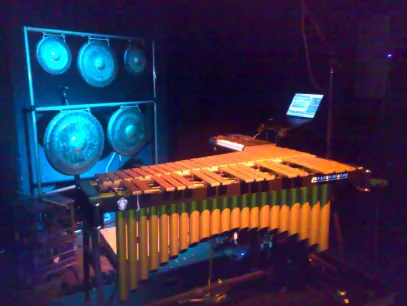
Duet for Vibraphone and Computer [28] was an improvised work performed at the Street Theatre in October 2008 as part of their Made in Canberra season. The work was originally created as an accompaniment to four short, silent, dra-matic works called Face, Stomach, Brain and Body and thus the work needed to consist of four sections that sounded strikingly different using only vibraphone, a small set of gongs and computer. In each section, different effects and computer interactions were available to add different timbres during improvisation. The instrumentation for the four setups were as follows:
1. Face - amplified and processed vibraphone
2. Stomach - amplified and processed gongs
3. Brain - vibraphone with computer accompaniment
4. Body - amplified and processed vibraphone with computer accompaniment
The computer was running Apple Logic Studio [3] (Logic), Ableton Live [1] and Pure Data [41, 37]. Audio was captured by a condenser microphone above the vibraphone and behind the gongs, the audio signal was sent to the computer through an Edirol UA-25 audio interface [11]. An M-Audio Axiom 25 [24] key-board controller, hidden behind the vibraphone, was also used to control the software on the computer.
The computer component of the work was a number of effect chains running in Logic, pre-recorded vibraphone and gong sounds ready to be played in Ableton Live, and a custom program written in Pure Data using Miller Puckette’s pitch and attack detecting algorithmsfiddle~andbonk~[39]. The Pure Data program triggered vibraphone phrases in Ableton Live when certain pitches were played on the acoustic vibraphone. It also controlled the panning of the vibraphone phrases based on strong note attacks from the acoustic vibraphone.
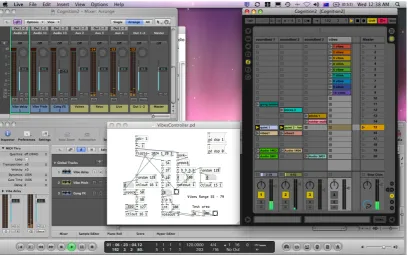
3.1. Duet for Vibraphone and Computer (2008) 21 Live is good for arranging and playing back prerecorded sounds during perfor-mance. Pure Data is a programming environment for computer music. It allowed MIDI data to be moved between the three applications easily and actions in Ableton Live and Logic Studio to be connected to buttons on the Axiom 25 key-board controller. Additionally, it includes Miller Puckette’s sophisticated pitch and attack detecting algorithms. The screenshot, figure 3.1, shows these three applications running during performance.
Figure 3.1: The computer screen during performance. On the left is Logic Studio’s mixing window, on the right is Ableton Live and the white window in the middle is the author’s program in Pure Data
A pair of Mackie SRM450 loudspeakers for diffusing the computer part were positioned at either side of my setup at the same distance from the audience and set at approximately head height. The volume was set carefully so that the
recorded vibraphone and processed sounds were equal to the acoustic vibraphone sound.
Figure 3.2: The performance setup including the vibraphone, gongs, computer and controller keyboard.
appropriately matched to the other dramatic and visual performances occurring in the space.
3.2
Augmenting the Instruments
Using amplification and effects as part of the improvisation in Duet for Vibra-phone and Computer was a process of augmenting and extending the sound of the vibraphone. This is similar to the percussionist’s process of using new kinds of mallets or other unusual techniques of sound production. Two recent examples of this process without use of a computer are Daryl Pratt’s composition Villa Mon-tezuma [35] and the performances of Dale Gorfinkel and Robbie Avenaim [5, 4].
3.2. Augmenting the Instruments 23 and Avenaim’s performances go further. Using the motor of the vibraphone and other electro-mechanical additions to move balls, compact discs and other objects against the bars they experiment with even stranger sounds. These two performances use a sequence of different extended techniques for vibraphone as a backbone for improvisation. Not only were different mallets and styles of playing used throughoutDuet for Vibraphone and Computer, but digital sound processing was also used to broaden the sequence of different timbres available.
In the first movement of the work, Face, Logic Studio was processing the vibraphone sound with a number of effects. Subtle pitch shifts and filters were applied which, when combined with the acoustic vibraphone sound, produced eerie sonorities. Another effect was ‘reverse’ reverb where the attack of each sound was heard without any support from the computer and then the computer produces a blooming reverberation of each note. These effects could be switched on and off using MIDI signals from the controller keyboard.
These effects were used with a similar intent and result as using different mallets and implements, modifying the sound of the vibraphone. When computer effects are used in this way the relationship between the instrument and computer is something like augmentation, rather than Croft’s definitions of environmental or instrumental. Certainly, in the case of Duet for Vibraphone and Computer
and Moss Garden of Saihoji Temple in Six Japanese Gardens, the effects aim to do more than just reproduce an acoustic environment, but probably less than act as a new instrument played in parallel with the live percussion. ‘Augmentation’ suggests that the sound of the effects is complementary and extensional to the sound of the live instrument, which was the case in both Duet for Vibraphone
and Moss Garden of Saihoji Temple.
Another way in which amplification and effects can augment the live per-cussion part is by actively altering the audience’s experience of the instrument. Nathaniel Bartlett encloses the audience in an array of eight loudspeakers, one in each upper and lower corner of the room. When he performs on marimba he is able to diffuse the sound around the audience, not just towards them [14]. Stockhausen’s composition for vibraphone, Vibra-Elufa [45] asks that the player amplify the vibraphone through two sets of two loudspeakers at either side of the audience. In both of these cases, the amplification and effects can drastically change the way the percussion sound is presented to the audience by augmenting a single instrument into a whole room of sound.
Chapter 4
Percussion and Interactive
Computer
This chapter is concerned with works that have a truly ‘live’ computer part. In these works, aspects of the computer part are generated during the performance and are influenced by the sound and actions of the live percussionist. Works with this property are often said to be for ‘percussion and live electronics’. The term ‘interactive computer’ is used since the computer not only performs the role of electronic effects and tape recorders, but is capable of sophisticated analysis of the percussion part and algorithmic generation of its own part.
Six Japanese Gardens is an example of a composition with interactive com-puter. The timing of sound files and the application of effects in the computer part is determined by the player clicking the MIDI pedal. Although the interac-tion is simple, it still involves an algorithm governing the acinterac-tions attached to each pedal click. In this chapter, works will be introduced with more sophisticated in-teractions that allow the computer to have its own voice, be directly controlled by the percussionist and connect implicitly to practitioners of other art-forms.
4.1
‘Duet’ in
Duet for Vibraphone and Computer
In the final movement, Brain, of Duet for Vibraphone and Computer (see section 3.1) there were no effects on the acoustic vibraphone. The computer part in this section was a program in Pure Data that created a counterpoint, constructed from vibraphone sounds, to the live improvisation. The interaction was simple compared to a duo improvisation between two human performers but an effec-tive performance still depended on learning to interact meaningfully with the
computer.
The original intention of the computer part was that the computer would play a prerecorded phrase every time particular notes were struck on the vibraphone. The Pure Data program would ‘listen’ to the vibraphone sound and analyse the pitch using fiddle~. The result would be a number between 0 and 127 on the MIDI note scale (where 60 is middle C, 61 is middle C# and so on). In fact, playing middle C on the vibraphone would result infiddle~reporting something like 59.97, not 60. To mitigate the effect of this inaccuracy, the possible pitches on the vibraphone were divided into ten zones with each zone controlling one prerecorded phrase.
fiddle~’s output was transformed to an integer (i.e. no decimal places) be-tween 1 and 10 using arithmetic in the Pure Data program. Pure Data would then send a MIDI message to Ableton Live instructing it to play the correspond-ing recordcorrespond-ing. This setup allowed me to play each of the ten prerecorded phrases by playing notes in the appropriate zone on the vibraphone.
A critical flaw in this program emerged during the lead up to performance. It had been created and tested while wearing headphones so the sound of the computer accompaniment had been isolated from the microphone. When the loudspeakers were set up, the microphone would be listening and reacting to the computer accompaniment as well as the acoustic vibraphone sound. The result was that when a note was played on the vibraphone, the computer would play a recorded vibraphone phrase and then, detecting the sound of those notes, stop playing the phrase while starting another and so on.
Serendipitously, the subsequent sequence of awkwardly joined part-phrases were a good match to the jarring dramatic performance that would be occurring on stage. The addition of jarring cuts in the panning emphasised this sound. This was achieved by programming Pure Data to instruct Ableton Live to pan the audio output a random amount when it heard a sufficiently loud attack. A balance between the computer hearing itself and the vibraphone sound was achieved by adjusting the settings in the Pure Data program and the microphone position.
4.2. Cognition - Cormick/Forster/Martin (2008) 27 playing a single short sharp note I could force the computer to change phrase and pan the audio output. This would make the interaction clear to the audience as the strong performance gesture was obviously connected to changes in the accompaniment.
InDuet for Vibraphone and Computer, the computer analysed the sound of the percussion part and the resulting data was used to construct a reacting musical part. As was discussed in section 1.1, this analysis data can be repurposed. The author’s work, Cognition [29], explored not only music for percussion and computer, but connecting percussion with spoken voice and movement as well as visual art.
4.2
Cognition - Cormick/Forster/Martin (2008)
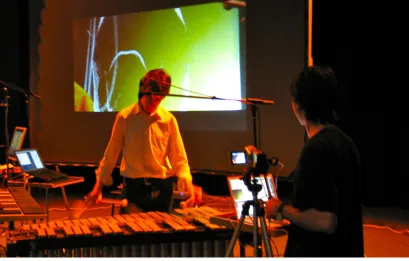
Cognition [29] is an audio/visual composition that was created during a residency at Belconnen Arts Centre during the Hunting Season 20081. It was a cross
art-form work that used the specialisations of the three creators: Charles Martin - live percussion and computer music; Benjamin Forster - computer generated visuals; and Hanna Cormick - movement, spoken voice. Part of the aim of the work was to use recently possible technology to implicitly link the three performers. This mode of performance was connected with the theme of the work, that computer technology is increasingly integrated into our lives in subtle and inescapable ways.
The stage was divided into two areas, one containing a percussion setup and one prepared for Cormick to perform movement and deliver short dramatic per-formances. A large projection screen was directly behind the stage. It was crucial in this work that the lighting be carefully controlled so that the projection was visible at all times.
The area where Cormick performed was prepared with multiple conventional vocal microphones while the floor had integrated contact microphones. The per-cussion setup included an acoustic drumset as well as a MalletKat MIDI con-troller2 a small keyboard controller3 with integrated rotary encoders and finger
drum pads and a modified computer keyboard. All of these instruments were connected to one computer running the Ableton Live and Pure Data computer music environments.
1Supported by the Foundation for Young Australians and Belconnen Community Services 2Manufactured by Alternate Mode [2].
Figure 4.1: The stage setup for Cognition, as performed at Belconnen Theatre. The percussion setup was to the right, movement and spoken voice in the centre and visuals to the left.
Forster was positioned at the front of the stage with the projector. His setup consisted of a computer running his own unique visualisation software written for the Apple Mac OS X platform. He had a video camera on tripod as well as audio connections. Some translation of MIDI and audio data was handled using a program written in the SuperCollider [31, 46] computer music environment.
4.3. Cort Lippe’s works for percussion and computer (1998 - 2007) 29
Figure 4.2: The percussion setup for Cognition including the MalletKat MIDI controller, M-Audio keyboard controller, modified computer keyboard and laptop.
exert some control over the others was the sense of an ensemble where no art-form was more important than the others.
4.3
Cort Lippe’s works for percussion and computer (1998
- 2007)
Cort Lippe is a well established expert in the field of interactive computer music, having been involved in this field at IRCAM4 in Paris during the development of
the Max language in the mid 1980s [30]. His three works for percussion areMusic for Hi-Hat and Computer [21] (1998), Music for Marimba and Computer [22] (2004) and Music for Snare Drum and Computer [23] (2007).
In each of these compositions the computer part is a program written in
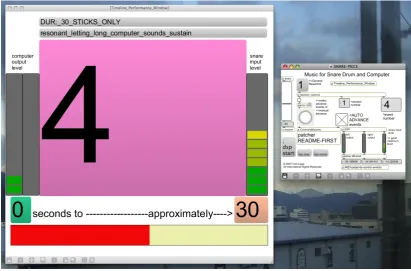
Max/MSP. The compositions are divided into many short sections, usually be-tween 10 and 30 seconds, and the computer performs specific actions in each section. Progression through the sections is controlled either by a computer op-erator, a footswitch, or in the case of Music for Snare Drum and Computer, automatically according to Lippe’s specified timings. The computer part ‘listens’ to the live percussionist through one channel of audio captured by a microphone.
[image:40.595.70.482.326.597.2]In each composition there is a high level of interactivity between the com-puter and performer. The comcom-puter’s actions in each section could be to play synthesised sounds, prepared sound files, or some effected or resynthesised sound of the percussion instrument. The computer is able to use pitch and dynamic information from the live instrument as a basis for some aspects of the synthesis algorithms or other actions that Lippe has used.
Figure 4.3: Screenshot of the Max/MSP program for Music for Snare Drum and Computer. The performer’s display (left window) shows the section of composi-tion that the computer is playing, the playing instruccomposi-tions from the score, input and output volume levels, and the prescribed timing with an animated progress bar.
em-4.4. Interactivity, a true duet? 31 phasised due to the nature of each percussion instrument. In the case of Music for Marimba and Computer Lippe is able to use the pitch of notes in the marimba part as the basis of some actions for the computer. Although the hi-hat used in
Music for Hi-Hat and Computer is a non-pitched instrument, this only means that it has no clear fundamental pitch. Spectral analysis of the hi-hat sound reveals useful information that changes depending on how open or closed the cymbals are, and how the cymbals are played with particular implements. Lippe uses this information throughout the work. The interactivity ofMusic for Snare Drum and Computer is defined by detection of the snare drum’s extremely clear attacks which which the computer can react to precisely.
By forming these technological links, Lippe is also using the the computer part as more than just as an accompaniment. Since the computer part depends on the percussionist for certain pieces of musical information it can act as an equal part of a duet. Conversely, some sections become an extended solo where the computer part is augmenting the sound of the percussion instrument rather than reacting with new musical material. As Schloss writes [44], a “one-to-one relationship between gesture and result” is usually the most important criterion for making performance with computer effective. In the case of the compositions
Music for Hi-Hat, Marimba and Snare Drum and Computer, Lippe carefully uses aspects of each instrument to build such a relationship.
4.4
Interactivity, a true duet?
In each composition presented in this chapter, the computer gathers information from the percussionist and uses it as a basis for creating sounds in real-time. The information gathered is sound from microphones, which the computer analyses or processes, as well as control data from MIDI instruments or other sensors which can be used directly to play a computer instrument or be otherwise interpreted for some different purpose.
This reactive process obeys the cause-and-effect rule of Schloss [44] discussed in section 1.2. However, another of his rules is that “too much magic is fatal (boring)”. That is, to perform an interactive duet the relationship between the notes playws on vibraphone and the notes that the computer plays must be made clear to the audience. In bothCognition andDuet for Vibraphone and Computer
I developed performance strategies to inform the audience of this relationship. For example, the section with responding computer was preceded by silence and I deliberately began with a strong gesture and a single note that will be detected by the computer. This first gesture, as well as a sparse start to the improvisation, helped the audience understand the relationship between the computer sounds and notes I played on the vibraphone.
In both Cognition and Duet for Vibraphone and Computer, the audience’s understanding of the relationship between the live player and the computer part is a key element of effective performance. If it is important to the work for the actions of the player to inform those of the computer, it must be important that the audience also understands this. If not, the ‘live’ness of the performance will be wasted. Indeed, Schloss laments the situation of a juggling troupe using com-plicated sensors to create music from their performance, “the audience, confused, thought they were juggling to a tape!” [44]. Although the performance is differ-ent, juggling and not percussion, the problem is the same, subtle interaction with technology may be lost on the audience.
As a creator of both Cognition and Duet for Vibraphone and Computer, I was able to design the computer part and the improvisation to emphasise to the audience this relationship between the percussion and computer parts. However, when playing Lippe’s music for percussion and computer, in particular, Music for Snare Drum and Computer, the player must obtain an understanding of the relationship between the two parts before being able to communicate this to the audience.
4.5. The computer as an instrument 33 the sophisticated role that Lippe has set for the computer in each section.
4.5
The computer as an instrument
Although at the end of Cognition the computer had a reactive relationship with the percussion part, at the start of the work the relationship was instrumental. In this situation, the interface between the computer and percussionist was just as vital to conveying the interaction taking place to the audience. In the opening section of Cognition, the actor delivered a monologue and the computer part played vocal sound files relating to the speech. At first, only the first hint of a syllable is played, then each sound file is slowly allowed to play through. Finally the sound files started to overlap and became a cacophony of voices.
To achieve this, the computer was controlled directly using the MalletKat, an electronic mallet percussion instrument that can output MIDI signals to the computer and offers an extremely high level of expressive control over computer instruments and synthesisers. Since the computer was played directly with an electronic instrument, the relationship was clearly instrumental and the computer and percussion parts were completely integrated. Each note on the MalletKat triggered a unique vocal sound file but the sound file was played through only if the note on the MalletKat was physically held down or played while pressing a sustain pedal. The computer was set up to play at least the first 50 milliseconds of each sound file so that normal playing without holding the notes or pressing the pedal had a percussive but recognisably vocal sound.
In general, the effectiveness of an instrumental relationship between percus-sion and computer relies on the accuracy and expressive quality on the interface between the performer and the computer. In my experience, the MalletKat proved to be a finely crafted instrument and it is easy to be expressive with standard mallet percussion technique as long as the computer instrument allows it.
and tuning that bring out these aspects of the instrument and strengthen the relationship with the computer part.
The same is true for Music for Hihat and Computer. Hihats that produce many interesting overtones when struck in different ways could be preferable to those with a more focused sound. It is easy to see that whether the player interacts with the computer via an electronic or an acoustic percussion instrument, good choice of instrument and playing technique can bring out the relationship between the percussion and computer parts to the audience.
Returning to Music for Snare Drum and Computer, the player is offered an interesting choice for controlling the computer’s progression through each section. As described in section 4.3, the composition is divided into short sections with the actions of the computer varying between each one. Lippe advises that either an assistant change sections (acting rather like a page-turner), the performer change sections with a MIDI pedal or the computer change sections automatically after a certain timing has passed. This choice is crucial because it changes the relationship between the percussion and computer.
The first case is an established practice in compositions for instrument and computer, described by Rocha [10] and McNutt [32]. In this case, the assistant ‘plays’ the computer, albeit in a rudimentary way. Since the work is partly improvised with variable length for each section, the percussionist would then really be interacting with the human assistant and not the computer, using some gestural or musical cue to indicate the end of each section. In the second case, where the percussionist uses a pedal to change sections, this communication is with the computer. The act of clicking the pedal is the cue to the computer that each section has finished. In the third case where the computer advances through the sections automatically, a progress bar is displayed on the screen so that the percussionist can plan their performance of each section. In this case the computer conducts the player5.
In this chapter, we have seen that works for percussion and interactive com-puter usually incorporate comcom-puter parts with a reactive or instrumental rela-tionship. Since the relationship between the computer and performer is more sophisticated than in works for percussion and fixed electronics and for ampli-fied percussion and effects, the audience should have some understanding of the connections that are at work. By looking atDuet for Vibraphone and Computer,
Chapter 5
Conclusions and Future
Directions
“...technology has equal
leverage with the written score when interpreting
electroacoustic music.”
Robert Esler [12]
The aim of this thesis was to articulate a performer’s perspective on the unique interactions in pieces for percussion and computer. In doing so, it has become clear that in pursuit of an effective performance of a work the performer requires an understanding of the interactions between the percussion and computer parts and the role of the computer part. The conclusion is that the potential for the computer part to extend the possibilities for solo percussion and connect with other art-forms is traded off against the requirement for the player to understand the computer’s role and behaviour in a particular composition. As we have seen, the computer part can vary dramatically between works, so this requirement can be challenging.
5.1
The computer part’s influence on performance
When playing works for percussion and computer, the player has both technical and musical decisions to make. The first decision is how to setup the physical elements of the computer part. The player needs to address the loudspeaker placement, whether to amplify the percussion part through the same speakers as
the computer part and, if required, what kind of interfaces (pedals, pads, micro-phones or other sensors) to use and how to integrate them into the percussion setup. The second question is a musical one: Is there a playing style for the percussion part that works best with the computer part?
With regards to setup, the various techniques of interaction between the per-cussion and computer part have been discussed in depth, but this interaction can be ruined by dislocation of the sound from the loudspeakers. Whether to use loudspeakers built into the performance venue or to include free-standing speak-ers as part of the setup significantly changes the overall sound of a performance. Although there are practical considerations, the choice is strongly influenced by the relationship between the percussion part and computer. In Losing Touch
the fixed electronics part is designed to blend in with the vibraphone and so smaller speakers directly behind the player could work well. On the other hand,
Six Japanese Gardens presents a much broader soundscape and a more ‘cine-matic’ experience with more widely positioned speakers would be appropriate. The marimba and computer expert, Nathaniel Bartlett goes to the extreme of touring with his own eight speaker array that completely encompasses the audi-ence with strictly controlled sound [14] and allows him a high degree of freedom in communicating the marimba and computer parts to the audience.
The choice of how to set up interfaces for musical communication with the computer can make or break effective performance. As the creator of Cognition
andDuet for Vibraphone and Computer, I was able to choose exactly the interface I wanted for particular purposes, whether it was a MalletKat controller, MIDI knobs, faders, pads or pedals. I even modified a computer keyboard to a layout that facilitated triggering cues in Cognition while in a dark theatre. For works that are not performed by the composer, the performer is sometimes caught interpreting the composer’s instructions which can be vague or demand obsolete hardware. In Six Japanese Gardens, the relationship between the computer part and the live percussion sometimes becomes instrumental, where a MIDI drum pad might be more appropriate than a pedal. The performer is given this kind of choice explicitly in Music for Snare Drums and Computer with Lippe allowing either the player or an off-stage helper to advance the computer part or even the computer itself with appropriate timings built into the Max/MSP patch. As I have mentioned, this choice actually changes the relationship between the computer and the player.
5.2. Future revisions for the author’s works 39 reach pedals 1 and 8 simultaneously. She comments that “composers and per-formers need to be patient, flexible and creative in such situations” [32]. When choosing an interface for the computer part, the composers intention needs to be balanced against the practicalities of performing the work.
Understanding the role of the computer part not only informs the choice of setup, but also the musical choices of the live performer. In Duet for Vibraphone and Computer, I improvised in specific ways to stimulate and control the reactive computer part. Lippe gives particular instructions in the score ofMusic for Snare Drum and Computer of how the computer part reacts to the snare drum sound. This allows the percussionist to play in ways that emphasise or suppress this part according to flow of the performance. For works that rely on the computer to detect pitches of notes in the live part, Puckette and Settel mention that “We are never sure to what extent the pitch follower’s output will resemble the stream of notes actually player by the performer” [40]. Understanding this relationship allows the player the chance to alter their playing to be clearer for the computer. McNutt remarks that in playing Manoury’sJupiter [26], she learned “to alter my tone... in order to cue my invisible partner more effectively” [32].
Clearly, the relationship between computer and live percussion can help in-form some of the technical and musical decisions required for playing this kind of composition. My experience and analysis of works in this thesis would suggest that the performer’s commitment to reconciling these decisions with the partic-ular computer part in a composition is directly related to the effectiveness of a performance.
5.2
Future revisions for the author’s works
Although several successful performances of Duet for Vibraphone and Computer
andCognition took place during 2008, there are some aspects of these works that could be improved in the future. In Duet for Vibraphone and Computer three computer music applications were used on one computer during performance. Although this meant that the best features of each application were available, some problems were encountered due to the software conflicting during the per-formances. One solution is to consolidate the computer part onto one software platform, perhaps using only Pure Data for performance1. To improve the
musi-cal content, more forms of interaction with the computer would be useful. This
would broaden the combinations of interactions, effects and backing recordings that can be used in improvisation.
InCognition the focus of the computer part was creating implicit interactions between the three performers (percussion, spoken voice, movement and visuals). Although Hanna Cormick’s part was connected to the other two via the vocal microphone, video camera and contact microphones in the floor, more subtle sensors would increase the useful data provided to the other parts. Possibilities include connecting heart-rate sensors, location or proximity sensors or even an electroencephalograph2to the musical and visual parts via MIDI or OSC3. Making
these extra connections would suit the theme of the performance and Cormick’s speciality of mask theatre.
5.3
Concluding Remarks
Effective performance of music for percussion and computer requires the per-former to take some responsibility for the computer part. Cort Lippe wrote in 1996:
I would like to be able to send a piece to the performer over the internet in software form, and expect them to be able to rehearse in their own home with their own real-time interactive DSP system as easily as they can rehearse tape and instrument pieces [20]
In 2009, this is exactly how I rehearse and perform works like Six Japanese Gar-dens and Music for Snare Drum and Computer. Being able to rehearse and deeply understand the computer part is something that has only recently been possible outside the composer’s studio. Furthermore, it is only in the last 10 years that it has been practical to distribute compositions including the software for a live computer part. Previously the composer would “arrive in town a day or two before the performance” and “assemble... local and flown-in gear” [40], a situa-tion that Puckette emphasises is not desirable. However, even now, the available repertoire of compositions for percussion and computer (excluding works with only fixed electronic sounds) is small and the published repertoire is miniscule.
To me, this situation is an exciting opportunity, it is easier than ever before for composers to distribute music for percussion and computer and the powerful
2An electroencephalograph detects electromagnetic signals emitted by brain cells.
Bibliography
[1] Ableton live website [online]. URL: http://www.ableton.com/live/.
[2] Alternate mode website - MIDI mallet percussion instruments [online]. URL: http://www.alternatemode.com/.
[3] Apple logic studio website [online]. URL: http://www.apple.com/
logicstudio/ [cited 29th April 2009].
[4] R. Avenaim and D. Gorfinkel. Performance on “set”, 17th august 2006, 2006. Sound Recording. URL: http://www.abc.net.au/tv/set/.
[5] R. Avenaim and D. Gorfinkel. Sonic systems laboratory, 2006. Sound Recording. URL: http://www.splitrec.com/index.php?go= sonicsystemslaborato.
[6] E. Campion. Losing touch for vibraphone and fixed electronic sounds, 1994. Score for vibraphone and fixed electronic sounds.
[7] N. Collins and J. d’Escriv´an, editors. The Cambridge Companion to Elec-tronic Music, volume 1. Cambridge University Press, 2007.
[8] D. M. Cottle.Computer Music with Examples in Supercollider 3. Distributed by the author, 2006. URL:http://fileserver.music.utah.edu/cottle/
alta/ [cited 29th April 2009].
[9] J. Croft. Theses on liveness. Organised Sound, 12(1):59–66, 2007.
[10] F. de Oliveira Rocha. Works for percussion and computer-based live elec-tronics: aspects of performance with technology. PhD thesis, Schulich School of Music, McGill University, Montreal, Canada, 2008.
[11] Edirol website (recording and computer music devices) [online]. URL:http:
//www.edirol.com/ [cited 29th April 2009].
[12] R. Esler. Digital autonomy in electroacoustic music performance: Re-forging Stockhausen. In Proceedings of the International Computer Music Confer-ence, pages 131–134, New Orleans, USA, 2006.
[13] Wikipedia article: The Fairlight Computer Musical Instrument [online]. URL: http://en.wikipedia.org/wiki/Fairlight_CMI.
[14] K. Gartner. Nathaniel bartlett: Modern marimba3 - combining marimba and computer generated sounds. Percussive Notes, 46(2):14–15, April 2008.
[15] L. Gaye, R. Maz´e, and L. E. Holmquist. Sonic city: the urban environment as a musical interface. In Proceedings of the 2003 conference on New Interfaces for Musical Expression (NIME’03), pages 109–115, 2003.
[16] S. Jord`a. The Cambridge Companion to Electronic Music, chapter 5. Inter-activity and live computer music, pages 89–106. Volume 1 of Collins and d’Escriv´an [7], 2007.
[17] C.-H. Lai. Hands on stage [online]. 2008. URL: http://www.laichihsia. com/project/hos.
[18] C.-H. Lai. Hands on stage, a performance media space. Master’s thesis, Australian National University, Canberra, 2009.
[19] L. Landy. Understanding the Art of Sound Organization. The MIT Press, Cambridge, Massachusetts, 2007.
[20] C. Lippe. Real-time interactive digital signal processing: A view of computer music. Computer Music Journal, 20(4):21–24, 1996.
[21] C. Lippe. Music for hi-hat and computer. Distributed by the composer, 1998. Score for hihat and live electronics. URL: www.music.buffalo.edu/ lippe/music4/hihat/.
[22] C. Lippe. Music for marimba and computer. Distributed by the composer, 2004. Score for marimba and live electronics. URL: www.music.buffalo. edu/lippe/music4/marimba/.