Abstract: This study aims to develop a decision support system to predict the production of rice, corn, and goat of CARAGA region. Multiple linear regression analysis was used in deriving models that were used to calculate the predicted production. The derived models were used in the system development.
Interviews and observations were conducted to the rice, corn and goat farmer participants to determine their best practices in rice, corn and goat production. Interviews were also conducted to the Department of Agriculture technical staff to determine their issues and problems encountered in using the existing system. The responses of the participants are presented thematically.
Using a survey evaluation questionnaire, IT professionals evaluated the developed system to determine the extent of compliance based on ISO 25010 software quality assurance standards. Agile methodology particularly SCRUM method was employed in managing the task during system development. The results on the evaluation of the system developed on its extent of compliance based on ISO 25010 software quality assurance standards revealed that IT professionals accepted it unconditionally.
IT professionals enumerated suggestions to further enhance the features and performance of the system. Among the suggestions were remarks on output, label of buttons, error message and acronym of the system.
Keywords
I. INTRODUCTION
Agriculture is an economic activity that is highly dependent upon weather and climate in order to produce the food and fiber necessary to sustain human life. Sunlight, temperature and rainfall are the main drivers of agricultural production; hence, agriculture is directly affected by climate change. Climate change and agriculture are interrelated since changes in temperature, atmospheric carbon dioxide (CO2), and the frequency and intensity of extreme weather could have significant impacts on crop yields.
Philippines being a tropical and agriculture-based country is expected to be highly affected by climatic change. CARAGA region is considered as one of the poorest region of the country and was also identified as one of the most sensitive regions to climatic irregularities, particularly flooding. As projected by PAGASA, flooding is expected to escalate in the next 20 years due to the increased performance of northeast monsoon.
For the farmers in the region, yield prediction is an important agricultural problem. In the past, yield prediction was performed by considering farmer's previous experience
Revised Manuscript Received on April 12, 2019.
Myelinda A. Baldelovar, Surigao del Sur State University Tagbina Campus, Surigao del Sur, Philippines.
Dr. Maria Visitacion Gumabay, Saint Paul University Philippines,
Cagayan 3500, Philippines.
Dr. Jesus Pizarro, Saint Paul University Philippinea, Philippiness.
on a particular crop and livestock but with the occurrence of climatic changes at present this method seems no longer applicable. Farmer’s lack of knowledge about uncertainties in the weather conditions and seasonal rainfall conditions and other factors leads to decrease in the production of the crops and livestock particularly, goat.
Because of these reasons, the researcher is interested to determine the production of rice, corn and goat using climatic parameter predictors using multiple linear regression analysis. Moreover, it aims to provide a learning agent that can aid in making decisions to make farming more efficient and profitable through technology. In addition, it also helps us understand the impact of climatic parameters on crops and goat production in order to adapt new methods and practices and develop technologies that can increase crops and livestock production. Through predictive analysis, it will help the farmer to minimize the input factors and output can be maximized thus, producing higher yield.
II. RELATED LITERATURE AND STUDIES
In this chapter a comprehensive review of available related literature is made concerning predictive analysis on main crops and livestock production in relation to climatic parameters.
Predictive Analysis and Models
According to Moor et al (2014), predictive analytics includes various techniques from machine learning, data mining techniques that are derived from different historical information and currents factors to make smarter decision about the future events. Kumar et al (2015) states that predictive analysis model is to consider previous year data, making smarted decision about the future in present. This model encompasses different patterns from historical facts to analyze the future predictions.
Analytical Methods Used in Predicting Crop Production in Relation to Climate Change
Machine Learning (ML) deals with problems where the relation between input and output variables is not known or hard to obtain. The “learning” term here denotes the automatic acquisition of structural descriptions from examples of what is being described. Unlike traditional statistical methods, ML does not make assumptions about the correct structure of the data model, which describes the data. This characteristic is very useful to model complex
Main Crops and Goat Production Decision
Support System Using Climatic Parameter
Predictors
PREDICTORS non-linear behaviors, such as a function for crop yield
prediction. ML techniques most successfully applied to Crop Yield Prediction (CYP). Supervised Learning algorithm consists of a target / outcome variable (or dependent variable) which is to be predicted from a given set of predictors (independent variables). Using these set of variables, we generate a function that map inputs to desired outputs Tillman et al, (2011).
Two commonly used approaches for predicting crop yield responses to climate variability include process-based modeling and statistical modeling. Process-based crop models are powerful tools for crop yield predictions, particularly at the field scale, because they simulate physiological processes of crop growth and development in response to environmental conditions and management practices (Lobell et. al, 2010).
Agricultural Decision Support Systems
DSS can be applied to all processes in agriculture. For management problems in farms, intelligent DSSs in agriculture have been introduced to monitor and to assist farmers to make decisions in a timely manner. Other studies have been undertaken to design DSSs for agricultural systems. Other work by Tamayo et al. (2010) implemented DSS for fertilization, crop growth control and prediction of diseases. Only two types of sensors, temperature and humidity were utilized in their system for measuring maximum and minimum ambient temperatures, soil temperatures and humidity.
III. CONCEPTUAL FRAMEWORK
Multiple Linear Regression Model
This study adapted the Multiple Linear Regression (MLR) Analysis model formulated by Vhora et al. (2017). Regression analysis was used to analyze the relationship between the response variable and explanatory variables. The variables considered for analysis are rainfall, humidity, pressure, minimum and maximum temperature. From these historical climatic data, how much production the famer will about to expect will be predicted. Formally, the mathematical model for Multiple Linear Regression, given n observations:
Yi = β0 + β1x1 + β2x2 + ... βnxn.
For i =1, 2,…n.
Here, Y is Dependent Variable β0, β1, β2…. βn are the Coefficients
X1, X2,…Xn are the Independent Variable
Applying these variables in the model formulated by Vhora et al. (2017) the regression model is given below.
Y= o +1(RH) +2(RF)+3(MAXT)+4(MINT) + 5(VP)….. (1)
Where,
Y : Production of Crop/Goat (MT) ; RH : Relative Humidity (mm); RF : Rain Fall (mm) ;
MAXT: Maximum Temperature (Degree C ) MINT : Minimum Temperature (Degree C) ; VP : Vapor Pressure (HPa)
FEEDBACK
Figure 1. Paradigm of the Study
As shown in the figure above, the study was focused on the development of decision support system for main crops and goat production using climatic parameter predictors. The main crops include particularly rice and corn. The developed decision support provides the users predictions on rice, corn and goat production using climatic parameter predictors. The climatic parameters are humidity, rainfall, pressure, monthly average of minimum and maximum temperature. Through feedback, further modifications can be made to the inputs.
IV. STATEMENT OF THE PROBLEM
This study aims to provide a learning agent that can aid in making decisions to make farming more efficient and profitable through technology. Specifically, it sought to answer the following:
1. What are the current practices of the DA-CARAGA participants with respect to rice, corn and goat production?
2. What are the problems /issues encountered in the existing system?
3. What regression model has the greatest influence on crop production and goat production?
4. What proposed system can be developed to address the identified problems and issues in the existing system?
5. What is the extent of compliance of the developed system with the ISO 25010 Software Quality Assurance Standards in terms of: Functional Sustainability; Performance Efficiency; Compatibility; Usability; Reliability; Security; Maintainability; Portability;
6. What enhancement can be done to improve the proposed system?
V. SCOPE AND LIMITATION
The research focused only on the prediction of rice, corn and goat production for CARAGA region. Six year (2012-2017)
Best practices in crops and livestock production
Issues and problems encountered in the existing system related to crops and goat production record keeping
Data sets
Rice Production
Corn Production
Goat Production
Average of the minimum temperature
Average of the maximum temperature
Humidity
Pressure
Rainfall
Analysis of issues and problems encountered in the existing system related to crops and goat production record keeping
Multiple Linear Regression Analysis
SCRUM Model Development Methodology
Product Backlog
Sprint Planning
Sprint Execution
Daily Scrum
Sprint Review
Sprint Retrospective
data on crop and livestock production as well as climatic parameters were collected from Philippines Statistics Authority and PAGASA government agencies respectively. The dataset for crops and goat production contains details on the quantity of goat production per quarter, per year, and province, crops production contains details in metric tons per province, year and quarter. The climatic parameters consist of monthly average of minimum and maximum temperature, pressure and rainfall.
VI. METHODOLOGY
Research Design
This research made use of descriptive quantitative method and system development using Agile methodology particularly the SCRUM model. This research also used multiple linear regression analysis in deriving mathematical models that were used in the developed system to predict the production of rice, corn, and goat.
Participants of the Study
Participants of the study are employees from Department of Agriculture, IT Professionals, Rice and Corn Farmers and Goat Raisers. Participants’ participation is on the basis of informed consent.
Instrumentation
Questionnaires
The questionnaire used in the study is anchored on the ISO 25010 software quality standards.
Interview
The interview questions asked to the farmers and DA participants are the best practices on rice and corn and goat production. Department of Agriculture participants were also interviewed about their problems and issues encountered in the existing system.
Statistical Software Package
The software used for data analysis was Minitab 18. It is a statistical software package used for statistical treatments of data.
VII. SYSTEM ARCHITECTURE
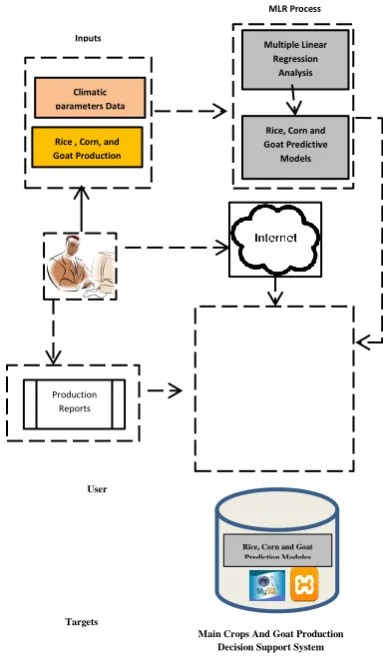
[image:3.595.328.520.53.382.2]As shown in figure 2 below, the inputs in developing models are the rice, corn, and production data which were gathered from Philippines Statistics Authority and climatic parameters data which were gathered from Philippine Atmospheric Geophysical and Astronomical Services Administration (PAGASA). Using multiple linear regression analysis, these data were used in the model development. The developed models were models for rice, corn and goat which were used in the development of the decision support system for crops and goat production using climatic parameter predictors to predict its production. Reports on production of rice, corn and goat as well as the production predictions were generated from the developed decision support system. This system is web-based.
Figure 2. The System Architecture
VIII. RESULTS AND DISCUSSION
This chapter presents the analysis and interpretation of the results of the study.
1. Current Practices of Rice, Corn and Goat Production
An interview was conducted to the goat raisers, rice farmers, corn farmers and Department of Agriculture technical experts. Below are the information gathered on the best practices on rice and corn farming and goat raising.
Rice Production
Irrigated and Rainfed Lowland
It was known that land preparation for rice farming usually is done mechanically using tractors. Hybrid varieties that are available in the market are the varieties used the participants. For seed preparation, dapog and wetbed methods are utilized. Transplanting and direct seeding are the planting methods used by farmers. Farmers utilized irrigation system and others are dependent on rainwater as source of water for their fields. Only few submit soil for soil analysis before application of fertilizers. Farmers made use of inorganic fertilizer. Herbicides were used to suppress weeds. For pest management, active ingredients were used.
Production Reports
Climatic parameters Data
Rice , Corn, and Goat Production
Multiple Linear Regression
Analysis
Rice, Corn and Goat Predictive Models MLR Process
Inputs
Rice, Corn and Goat Prediction Modules
User
Targets
PREDICTORS Rainfed Upland
For land preparation in upland rice farming, all of the participants do the manual cultivation practice. “Mamintana” is the variety used by the upland rice participants. The practiced method for sowing upland rice is dibbling. This is done by digging holes and sows 5-8 seeds in it and covers them with soil. Upland rice farming is dependent on the occurrence of rain. Farmers made use of vermicast as organic and inorganic fertilizer. Birds are one of the destroyers of upland rice. To get rid of birds, farmer erected scarecrows randomly in the field.
Corn Production
Land Preparation
Most of the participants practiced “kaingin” and only few utilized plowing and harrowing the land. It was known by the researcher that many of the farmers in Agusan del Sur area are using the GMO variety known as “sige-sige” while participants fom Surigao del Sur used the “tinigib” variety. For planting, direct seeding is employed. Only few practiced soil analysis before using fertilizers. Inorganic fertilizers were applied. Most of the participants practiced manual weeding. For pest eradication, pesticides were applied. Detasseling is also practiced to keep away from pests.
Goat Production
Goats are kept in a shelter made of wood and roofing is made of galvanized iron. Tethering and cut-and-carry methods were used for feeding the goats. Only few of the participants practiced deworming and for reproduction, some practiced in-breeding. For raisers with more than 20 heads tagging is practiced in for goat identification.
2. Problems / Issues Encountered in the Existing System With the current set up of DA’s record keeping, they identified some issues that they encountered. These are retrieval of data, security of files, access of data, and consolidation of data.
3. Regression analysis& Results
Table 1. Regression analysis between rice production and climatic parameters
Predictor t-value p-value
Pressure 0.94 0.360
MinTemp 2.41 0.025
MaxTemp 0.71 0.484
Humidity -0.17 0.868
Rainfall -0.138 0.180
As shown in table 1 above, minimum temperature is the only climatic parameter that has the greatest influence on rice production This means that there is a significant positive relationship between rice production and minimum temperature. The regression model that has the greatest influence on rice production is given below.
Yrice = - 2395476 + (132512*MINT)
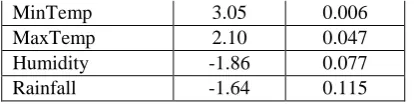
Table 2. Regression analysis between corn production and climatic parameters
Predictor t-value p-value
MinTemp 3.05 0.006
MaxTemp 2.10 0.047
Humidity -1.86 0.077
[image:4.595.325.533.50.102.2]Rainfall -1.64 0.115
Table 2 above shows the regression analysis between corn production and climatic parameters. Results revealed that minimum and maximum temperature influences the corn production. This means that there is a significant positive correlation between corn production minimum temperature and maximum temperature. The regression model that has the greatest influence on corn production is given below.
Ycorn = - 234401 + (2124*MINT) + (2124*MAXT)
Table 3. Regression analysis between goat production and climatic parameters
Predictor t-value p-value
Pressure 0.20 0.845
MinTemp -1.10 0.284
MaxTemp -1.44 0.164
Humidity 1.80 0.291
Rainfall 2.41 0.025
Results in table 3 above shows that among the climatic parameters, only rainfall influences the goat production. This implies that there is a relationship between goat production and rainfall. The regression model that has the greatest influence on goat production is given below.
Ygoat = 27930 + (4.92*RF)
4. Extent of compliance of the developed system with the ISO 25010 Software Quality Assurance Standards
Table 12. Summary of the IT Professionals Evaluation on the Extent of Compliance with ISO 25010 Quality
Standards
Compliance with ISO 25010 Quality Standards
Criteria Mean Description
Functional Suitability 4.20 Accepted unconditionally Performance
Efficiency 4.70
Accepted unconditionally
Compatibility 4.50 Accepted unconditionally Usability 4.40 Accepted unconditionally Reliability 4.60 Accepted unconditionally
Security 4.80 Accepted unconditionally
Maintainability 4.90 Accepted unconditionally Portability 4.40 Accepted unconditionally
Overall Mean
Category Mean 4.53
Accepted unconditionally Accepted unconditionally
5. Enhancement to Improve the Developed System
IX. CONCLUSION
Agriculture is a field that has been lacking the mass adoption of technology and its advancements. The adaptation of technology towards better productivity in agriculture has been slow and further research is needed to expedite it towards precision agriculture. Farmers need to be up to the mark with the international techniques. Agricultural products yield prediction is a significant component of national food security assessment and food policy making. One of the yield prediction techniques in agriculture is predictive analysis which is a yield monitoring concept. Implementation of this concept should help farmer to produce higher yield. With this concept, input factors can be minimized and output can be maximized in precise way. The developed main crops and goat production decision support system can help farmers to predict their production output considering the climatic parameters. By using the developed system, farmers’ can do right things at the right time.
X. RECOMMENDATIONS
Based on the findings and conclusion of the study, the following are recommended:
1. Conduct intensive seminars and trainings on other new methods on weed and pest control both in rice and corn farming.
2. Orientation on soil analysis citing its importance in farming may be conducted to the farmers.
3. The developed system may be enhanced by deriving new models considering other factors relevant to rice and corn production as well as goat raising.
4. Strengthen the DA campaign for climate-smart farming strategies to help the farmers in their production.
5. The Agriculture faculty members of higher education may integrate the results and findings of the study in their discussions.
6. The future researchers may considering other factors that can affect the growth and production of rice, corn, and goat.
7. The Department of Agriculture CARAGA region officials may adopt the developed system to improve their record keeping system.
8. Conduct trainings to the Department of Agriculture-CARAGA region staff to facilitate the adoption of the developed system.
REFERENCES
1. Moor,H., Hylander, K., Norberg, J. (2014). Predicting
climate change effects on wetland ecosystem services using species distribution modeling and plant functional traits.
2. Kumar, Rakesh, M.p. Singh, Prabhat Kumar, and J.p.
Singh (2015). "Crop Selection Method to Maximize Crop Yield Rate Using Machine Learning Technique." 2015 International Conference on Smart Technologies and Management for Computing, Communication, Controls, Energy and Materials (ICSTM).
3. Lobell DB, Schlenker W, Costa-Roberts J (2011)
Climate trends and global crop production since 1980. Science 333:616–620.
4. Tamayo, R. A. C., Ibarra, M. G. L., & Macias, J. A. G.
(2010). Better crop management with decision support systems based on wireless sensor networks. Paper presented at the Seventh International Conference on
Electrical Engineering Computing Science and
Automatic Control, Chiapas, Mexico.
5. Tillman D, Balzer C, Hill J, Befort B.(2011). Global food