International Journal of Innovative Technology and Exploring Engineering (IJITEE) ISSN: 2278-3075,Volume-8 Issue-12, October 2019
Abstract: The critical issue of Intelligent Transportation Systems (ITS) applications is obtaining the near real time information of travel times. This paper proposes a dependable model for predicting car travel time on urban roads in Greater Cairo using buses as probes. The GPS receivers, which are installed on test vehicles and buses, used to collect real travel time data along the urban roads. The travel times of bus and car are compared in order to recognize similarities and differences between the trip profiles of test vehicles and buses. According to the comparison results, the model is developed and validated using Artificial Neural Network (ANN) for estimating car travel time using buses’ travel time with acceptable level of accuracy equals 10.53%. Keywords : ANN, Travel time, urban roads, bus as probe
I. INTRODUCTION
ITS can be defined as transportation systems that applies advanced technologies of electronics, communications, computers and detecting in all kinds of transportation systems in order to improve safety, efficiency and traffic situation through transmitting real-time information. The ITS applications became central for relieving traffic jam. An important element of such schemes is a system to collect, estimate, and spread traffic information to users in real-time. There are many examples of ITS applications such as, Advanced Traveler Information Systems (ATIS), Automatic Vehicle Identification (AVI) and Advanced Traffic Management Systems (ATMS).
Travel time information is a key performance measure for traffic analysts, public agencies, and planners. It is used extensively for network-wide analysis and evaluation. There is a growing interest in techniques for collecting reliable travel time data as well as models and methods that can be used to analyze and disseminate it to end-users (e.g. a traveler) via real-time.
This paper aims to use transit vehicles as probes for collecting travel time information on some urban routes in Greater Cairo. It is important to examine the potential for using buses as probe vehicles for getting average route travel times.
Revised Manuscript Received on October 05, 2019.
Akram S. Kotb , Construction and Building Eng. Department, Faculty of Engineering and Technology, Arab Academy for Science & Technology & Maritime Transport, Cairo, Egypt.. Email: [email protected]
II. LITERATUREREVIEW
The travel time prediction problem especially on urban roads has been a topic of the research for a long time. The initial motivation for developing these models was for their use in traffic management and certainly the travel time is the most important measure of performance of a transportation system. In recent years, the interest in predicting travel times has increased with the activities related to ITS. A large number of studies is being conducted. Some Studies are used the probe vehicles (these are vehicles equipped with GPS) to estimate travel time. Du (2005) developed a model to estimate the average link travel time for each individual road link in a network by using GPS raw data for, starting from identifying trip ends in continuous data stream, to converting point data to link-by-link data and finally estimating link travel time for the whole road network. The average absolute error for aggregate whole routes was 16.8% which is consistent with the error levels in previous work where relatively more probes were used on smaller portions of overall networks.
Other traffic studies are based on mobile sensors, one of these studies is Hao (2013) who developed the mobile sensor based arterial traffic modeling methods combining proper transportation domain knowledge (such as traffic flow theories or principles) and advanced machine learning and optimization techniques. Domain knowledge described the systematic patterns of arterial traffic flow that should be respected, while learning and optimization techniques were used to reconstruct such patterns from mobile data and estimate parameters of the patterns when needed.
On other hand, various studies have been implemented to examine the validity of using transit vehicles as probes. Cathey and Dailey (2002) defined such a system (transit vehicles as probes) to measure travel time and speed. In addition, Cathey and Dailey (2003) proposed a system to predict travel time and speed using collected data from busses. The results of two above mentioned studies indicated that there was difference between the measured and predicted values of median speed about 12.8 kph.
Ann Modeling For Predicting Car Travel Time
using Bus As Probe.
Tantiyanugulchai and Bertini, (2003) studied the variance in measured travel time and speed of bus as probe to the corresponding values obtained from vehicle equipped by GPS. The results of this study indicated that there was a difference in speed and time between the test vehicle and bus ranging from 3% to 66% according to the number of bus stops.
Chakroborty and Kikuchi (2004) compared the bus travel time (BTT) with automobile travel time (ATT) and suggested a regression model to predict ATT based on BTT. The results showed errors in the predicted model.
Vanajakshi, et al. (2008) presented the background work required for implementing Advanced Public Transportation System (APTS) in Indian traffic conditions using buses as probe vehicles. This study was one of the first approaches to predict travel time under such traffic scenario where GPS data was collected from three consecutive buses traveling in the route corroborating the prediction algorithm based on the Kalman Filter technique, consequently the results are promising.
Pu, et al. (2009) proposed a generic real-time estimation framework and present two case studies in examining the real-time sensitivity of bus probes to non-transit vehicle traffic conditions on signalized urban streets. They concluded that the framework represents a possible logical solution of implementing real-time bus probes by utilizing both historical bus-car speed relationships and real-time bus travel information.
Uno, et al. (2009) investigated the using of bus as probe data to measure the variation of travel time on urban roads. The main point, taken into consideration, in this study is the elimination of acceleration, deceleration, and stopping times from the measured bus travel time.
El Esawey and Sayed (2011) used buses as probes for neighbor links travel time estimation. Neighbor links were defined as nearby links that share similar characteristics and are subject to the same traffic conditions within a road network. They proposed a general framework to integrate historical link travel time data and sparse bus travel time data for travel time estimation on a network. Specifically, the purpose was to estimate travel times on links that are not covered by existing sensors, using their travel time relationships with neighbor links. Neighbor links travel time estimation accuracy, using bus probes data, was assessed using the Mean Absolute Percentage Error (MAPE). The value was 15.4% which is an accepted accuracy level in view of the considerable travel time fluctuations in the study area. Gao, et al. (2013) predicted the next bus arrival time from the real-time data collected from the probe bus fleet by using the Kalman Filter technique. The experimental results showed that this model provides a higher level of veracity and reliability of travel time forecasting in the case of frequently changing traffic conditions.
(Pulugurtha, et al., 2014) examined the relationship between car and bus travel time as most buses operating in urban areas are equipped with AVL units. The role of key influential factors on the ratio between the two travel times was also evaluated and examined to assess the use of buses as probe vehicles.
Elsokkary (2015) proposed two models to estimate travel time on urban roads in Greater Cairo using buses as probes. Travel time data were collected using GPS receivers installed on test vehicles and buses that travel along the same urban routes. The average estimation error of the two models did not exceed 17.6% for each run.
Jaya Krishna Jammula, et al. (2018) developed an ANN and a regression model to compare the predicted travel times with the collected data on a road length of 14 km length by using a probe vehicle equipped by GPS and video camera . Two combinations of ANN models using single hidden layer, different numbers of neurons and epochs have been compared. The travel time of different modes has been compared and the effect of vehicle composition on travel time has been analyzed. The ANN model performs better than the regression model.
In summary, using buses as probe vehicles to predict the average automobile travel times on urban corridors in Cairo is a beneficial idea due to a large number of buses run on the most used arterials (the ones that are of greater importance in terms of average automobile travel time prediction). Generally, they have higher frequencies during peak hour and most buses can be equipped by the transit agency with GPS for predicting the bus arrival time. These characteristics of bus routes and schedules make them ideal as probe vehicles.
III. DATACOLLECTION
International Journal of Innovative Technology and Exploring Engineering (IJITEE) ISSN: 2278-3075,Volume-8 Issue-12, October 2019
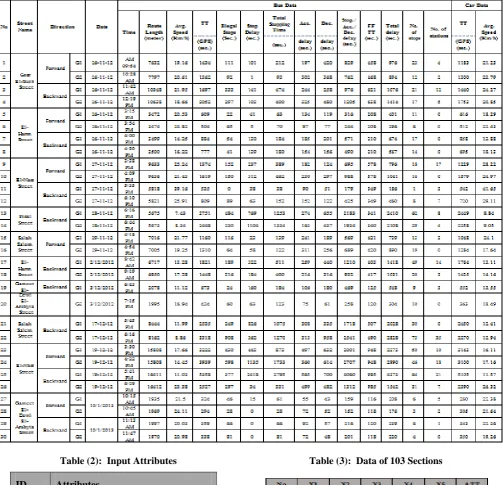
Table (1): Data of 30 Trips
Table (2): Input Attributes ID Attributes
X1 Bus Velocity
X2 Stops Delay Time
X3 Bus Acceleration Time
X4 Bus Deceleration Time
X5 Bus Final Time
[image:3.595.55.559.74.559.2] [image:3.595.317.558.546.834.2]IV. ANN MODEL DEVELOPMENT Artificial Neural networks (ANN) models consist of processing units arranged between a set of successive layers and connected by a system of weights as shown in Figure (1). ANN models have the ability of detecting the approximate mapping between a set inputs and outputs. In this study, the model is built using NeuroSolutions Software [V6.03] through five main steps.
A. Database Sets
The data is divided into Learning set, Verification set and Validation set. Both of learning and verification sets are used during the network processing with different job. The learning set is used to conclude the relationship between input parameters and outputs. The verification set is used to monitor the error performance during the network learning. The validation set is used to ensure the generalization behaviour of developed model. Having a database of 103 cases; it is decided to use about 75% (76 cases) of database for learning, 15% (15 cases) for verification and 10% (12 cases) for validation.
B. Network Architecture
A supervised feed-forward neural network employing Tanh Function as an activation function is considered a reliable network to be utilized. The network consists of three successive layers as shown in Figure (1). An input layer includes five nodes representing the model input parameters. One hidden layer consists 46 nodes. An output buffer consists of one node representing the automobile travel time in seconds.
C. Network Learning
Network learning refers to the iterative process involving presentation of learning set to the network (Salem, 2008). The network assessment of results is based on the Mean Absolute Error (MAE) that represents the overall average error of the set and calculated as shown in Equation (1).
International Journal of Innovative Technology and Exploring Engineering (IJITEE) ISSN: 2278-3075,Volume-8 Issue-12, October 2019
Figure (2) presents a detailed view of the 76 cases regarding to the learning set with MAE equals to 10.16% which is considered acceptable error.
D. Network Verification
Network verification refers to the corrective process of network performance based on the results of evaluation data-set. It is a fundamental issue after the learning phase. As, if the learning and verification results are reliable, then the network is ready to be validated. Figure (3) presents a detailed view of the 15 cases regarding to the verification set with MAE equals to 9.88% which is considered acceptable error.\
E. Network validation
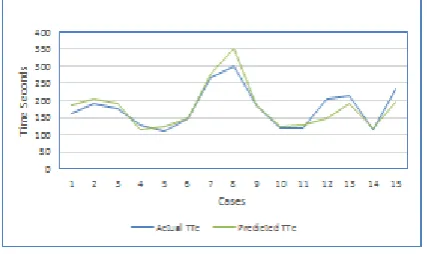
An essential aspect in developing an estimation model is to examine its accuracy and validity (Salem, 2008). In this study, a validation set of 12 cases is used to measure the validity for the verified network. The assessment of validation data-set is also based on MAE. Figure (4) presents a detailed log of the cases regarding to the validation set with MAE equals to 11.55% which is considered acceptable error.
V.GRAPHICALUSERINTERFACE(GUI)MODULE A visual basic application (VBA) module in Excel 20130 is programed for model. The module simplifies the implementation and the use of model in a user-friendly interface. It accepts inputs from user and estimate the Automobile total travel time as shown in Figure (5). The module can be updated to be usable in different roads by adding new section to the available database and re-optimizing the network.
VI. CONCLUSIONS
Travel time information is the most important element in ITS applications. In the past, inductance loops, cameras and other sensors have been used to obtain travel time data. This research suggests the use of transit vehicles as probes to collect travel time data on some urban roads in Cairo. This purpose is achieved by comparing the bus travel time with that of an automobile of the same link. This is collected by equipping GPS data loggers in each one, and suggesting an Artificial neural network model developed by using NeuroSolutions Software [V6.03] to predict the automobile travel time based on the travel time of the bus with acceptable level of accuracy that can be applied to real-life traffic problems, such as: congestion management. The model is provided dependable predictions with weighted average error equals 10.53% and considered a valid model to be used in real life applications. As practical aspect, a GUI module is built based on the model to facilitate and automate the process of estimating the (ATT).
REFERENCES
1. Chakroborty, P., and Kikuchi, S. “Estimating Travel Times On Urban
Corridors Using Bus Travel Time Data” [Conference] // Transportation Research Board 83rd Annual Meeting. - Washington, D.C. : [s.n.], 2004.
2. Du, J. “Investigating Route Choice And Driving Behavior Using
GPS-Collected Data” [Book]. - Connecticut : [s.n.], 2005.
3. El Esawey, M., and Sayed, T. “Using Buses As Probes for Neighbor
Links Travel Time Estimation In An Urban Network” [Conference] // Transportation Research Board 90th Annual Meeting. - Washington, D.C. : [s.n.], 2011.
4. Gao, He, Li, J., and Yang, F. “Bus Arrival Time Prediction Based on
Probe Bus Fleet” [Book Section] // “Improving Multimodal Transportation Systems-Information, Safety, And Integration (ICTIS)” / book auth. Yan Xinping [et al.]. - China : AMERICAN SOCIETY OF CIVIL ENGINEERS (ASCE), 2013.
5. Hao, P. “Urban Arterial Real-Time Performance Measurement Using
[image:5.595.63.277.338.465.2]6. Jaya Krishna Jammula , Rajesh Bera , and Kodavanti Venkata Raghavendra Ravishankar “Travil Time Prediction Modeling in Mixed Traffic Conditions”// International Journal for Traffic and Transport Engineering, 2018, 8(1): 135 - 147
7. Pu, W., Lin, J., and Long, L. “Real-Time Estimation Of Urban Street
Segment Travel Time Using Buses As Speed Probes” [Conference] // Transportation Research Board 88th Annual Meeting. - Washington, D.C. : [s.n.], 2009.
8. Pulugurtha, S., Puvvala, R., Pinnamaneni, R., Duddu, V., and Najaf, P.
“Buses As Probe Vehicles For Travel Time Data Collection On Urban Arterials” [Book Section] // “T&DI Congress” / book auth. Varma Amiy and Gosling Geoffrey D.. - China : AMERICAN SOCIETY OF CIVIL ENGINEERS (ASCE), 2014.
9. Sokkary, M. “Using Transit Vehicles as Probes for travel Time
Estimation on Urban Roads” [M.Sc. Disseration], AASTMT, 2015.
10. Uno, N., Kurauchi, F., Tamura, H. and Iida, Y."Using Bus Probe Data
for Analysis of Travel Time Variability" [Journal]. - [s.l.] : Intelligent Transportation Systems, 2009. - 13.
11. Vanajakshi, L., Subramanian, S., and Sivanandan, R. “Short Term
Prediction Of Travel Time For Indian Traffic Conditions Using Buses As Probe Vehicles” [Conference] // Transportation Research Board 87th Annual Meeting. - Washington, D.C. : [s.n.], 2008.
AUTHORSPROFILE