Mobile Government
Ibrahim KushchuInternational University of Japan
Yamato-machi, Minami Uonuma-gun, Niigata 949-7277 JAPAN Tel: +81 257 791464
[email protected] http://www.mgovlab.org M. Halid Kuscu
Mobile Government Consortium International 3927 Nobel Drive Suite 141 La Jolla 92122 USA Tel: (858) 625-7986
[email protected] http://mgovernment.org/
1. Introduction
E-government efforts benefit from the use of most innovative forms of information and communication technologies, particularly web-based Internet applications, to improve governments’ fundamental functions. These functions are now using mobile and wireless technologies and creating a new direction for eGovernment: mobile government. Mobile Government (mGovernment) may be defined as a strategy and its implementation involving the utilization of all wireless and mobile technology, services, applications and devices for improving benefits to the parties involved in eGovernment including citizens, businesses and all government units (Kushchu 2003).
mGovernment is an inevitable natural extension of eGovernment. Despite its early stage, mGovernment has a substantial influence on the generation of a set of complex strategies and tools for eGovernment efforts and on their roles and functions. The number of people having access to mobile phones and mobile internet connection is increasing rapidly. The mobile access - anywhere any time is becoming a natural part of daily life, and the governments now have to transform their activities according to this demand of convenience and efficiency of interactions for all parties.
The coming age of mGovernment raises several questions. An interesting one is: will mGovernment replace the eGovernment activities? Despite its significance mGovernment cannot be seen as replacing eGovernment and in many cases it will be complementary to eGovernment efforts. The conventional eGovernment provides services through wired network with interactive and relatively intelligent web applications. The value of mGovernment comes from the capabilities of applications supporting mobility of the citizens, businesses and internal operations of the governments. For example, supporting law enforcement agents who are on patrol is a distinctive advantage of mobile government services over conventional eGovernment implementations. Wireless applications may enable greater mobilization of the government officials with ability to handle real-time information concerning crimes, accidents, safety, access to records in a timely manner, and other public service issues.
2. Some Mobile Government Applications and Services:
The technology and the services are rapidly taking its place in various m-government implementations. Some of the early adopters of m-government services include law enforcements, fire fighting, (Easton, 2002) emergency medical services, education, health and transportation (Yu, 2004), immigration, border and coastal security, disaster response and management. The tables below provide examples from each
group of applications, where the application is developed, and a brief description.
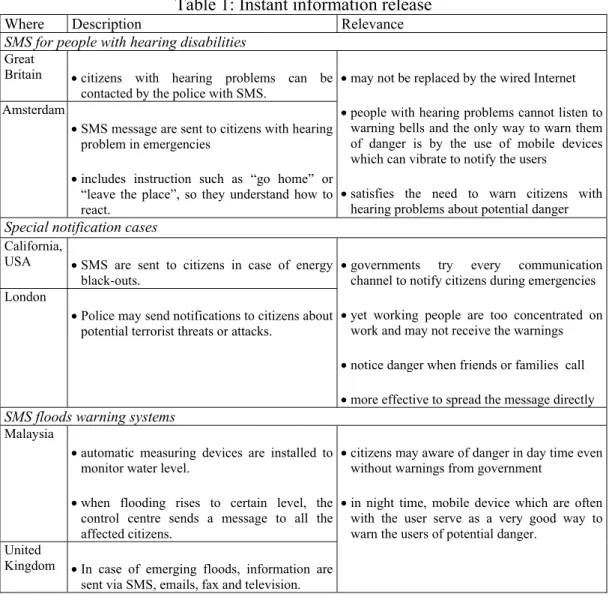
Instant Information release: Mobile devices are often carried by users and are always turned on. This characteristic enables mobile devices to serve as a warning or reminder to users with quick and specific information release (Table 1).
Table 1: Instant information release
Where Description Relevance
SMS for people with hearing disabilities Great
Britain •citizens with hearing problems can be contacted by the police with SMS.
Amsterdam
•SMS message are sent to citizens with hearing problem in emergencies
•includes instruction such as “go home” or “leave the place”, so they understand how to react.
•may not be replaced by the wired Internet •people with hearing problems cannot listen to
warning bells and the only way to warn them of danger is by the use of mobile devices which can vibrate to notify the users
•satisfies the need to warn citizens with hearing problems about potential danger Special notification cases
California,
USA •SMS are sent to citizens in case of energy black-outs.
London
•Police may send notifications to citizens about potential terrorist threats or attacks.
•governments try every communication channel to notify citizens during emergencies •yet working people are too concentrated on
work and may not receive the warnings •notice danger when friends or families call •more effective to spread the message directly SMS floods warning systems
Malaysia
•automatic measuring devices are installed to monitor water level.
•when flooding rises to certain level, the control centre sends a message to all the affected citizens.
United
Kingdom •In case of emerging floods, information are sent via SMS, emails, fax and television.
•citizens may aware of danger in day time even without warnings from government
•in night time, mobile device which are often with the user serve as a very good way to warn the users of potential danger.
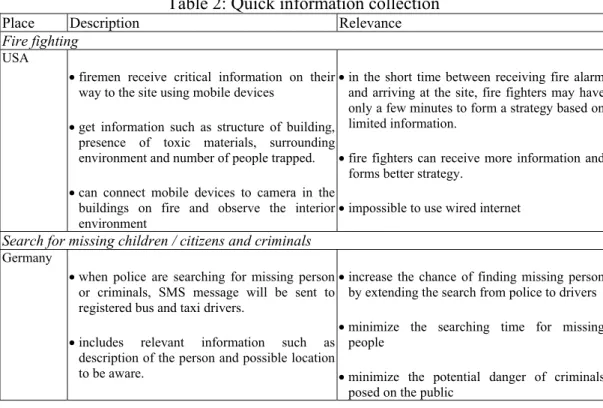
Quick information collection: The ability of accessing information while on the move is one of the major characteristics of mobile government applications. This allows officers and civil servants to collect the necessary information quickly to provide more efficient and effective service to the public. The necessary information is not downloaded to mobile devices but real-time accessed. Examples are shown in Table 2.
Table 2: Quick information collection
Place Description Relevance
Fire fighting USA
•firemen receive critical information on their way to the site using mobile devices
•get information such as structure of building, presence of toxic materials, surrounding environment and number of people trapped. •can connect mobile devices to camera in the
buildings on fire and observe the interior environment
•in the short time between receiving fire alarm and arriving at the site, fire fighters may have only a few minutes to form a strategy based on limited information.
•fire fighters can receive more information and forms better strategy.
•impossible to use wired internet Search for missing children / citizens and criminals
Germany
•when police are searching for missing person or criminals, SMS message will be sent to registered bus and taxi drivers.
•includes relevant information such as description of the person and possible location to be aware.
•increase the chance of finding missing person by extending the search from police to drivers •minimize the searching time for missing
people
•minimize the potential danger of criminals posed on the public
Mobile transactions:Transactions are essential parts of doing business. Currently, many companies are exploring the possibility of adopting mobile commerce, and some governmental organizations have already taken the initiative to utilize this opportunity (Table 3).
.Table 3: Mobile transaction
Place Description Relevance
Mobile automobile parking Sweden
•registered driver can log in and log out a parking space using a mobile phone.
•fee is automatically charged to the driver’s account
•receipt is sent via SMS
•drivers can skip the painful process of carrying loose changes and searching around for the nearest parking machines
•the convenience and time saving create a better experience
Tax declaration Norway
•pre-filled tax declaration form is mailed to the citizen in advance
•if the person has nothing to change in the form, he can send a SMS message with specific code and complete the entire tax declaration procedure.
•simplify the tax declaration
•is feasible in e-government context, but mobile technology improves users’ experience because they can complete the whole process even during his way to office.
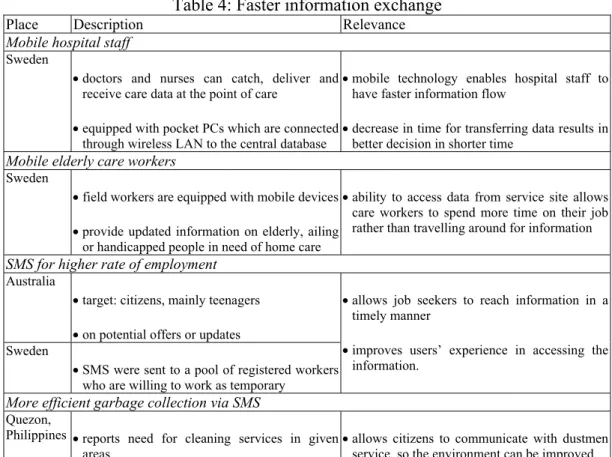
Fast information exchange: In many case the speed of information exchange is important but not critical. These applications are seen as enhancing the convenience for users (Table 4).
Table 4: Faster information exchange
Place Description Relevance
Mobile hospital staff Sweden
•doctors and nurses can catch, deliver and receive care data at the point of care
•equipped with pocket PCs which are connected through wireless LAN to the central database
•mobile technology enables hospital staff to have faster information flow
•decrease in time for transferring data results in better decision in shorter time
Mobile elderly care workers Sweden
•field workers are equipped with mobile devices •provide updated information on elderly, ailing
or handicapped people in need of home care
•ability to access data from service site allows care workers to spend more time on their job rather than travelling around for information SMS for higher rate of employment
Australia
•target: citizens, mainly teenagers •on potential offers or updates Sweden
•SMS were sent to a pool of registered workers who are willing to work as temporary
•allows job seekers to reach information in a timely manner
•improves users’ experience in accessing the information.
More efficient garbage collection via SMS Quezon,
Philippines •reports need for cleaning services in given
areas. •allows citizens to communicate with dustmen service, so the environment can be improved.
Fighting against crime:To fight better against crime, the law enforcement need citizens’ cooperation to provide information. The reports from citizens can increase the chance for police to arrest suspects, find missing people, and better investigate the cases. Table 5 shows some examples.
Table 5: Fighting against crime
Place Description Relevance
Reporting crime Manila,
Philippines •can report suspicious activities via SMS •receive SMS messages on the increase in
crime rate in particular region Italy
•a couple of thieves are caught after photos of criminal act were taken by others and sent as MMS to the police.
•encourage people to report criminal activities by simplified procedures, easier channel and faster response from the
•improved the participation in crime prevention from citizens
3. Distinctive Characteristics of mGovernment
mGovernment involves a strategy and implementation of governmental services through a mobile platform to provide its users, both citizens and civil servants, the benefit of getting services and information from anywhere at anytime. (Kushchu, 2003). The use of mobile technologies and applications differentiates mGovernment from any other developments in the public sector using new technologies, including eGovernment. Based on various studies on mobile government applications (Yu, 2004), and their use in practice (Cilingir, 2004), a number of differentiating factors can be identified in
terms of better precision and personalization in targeting users and in delivering content, more convenient accessibility and availability, and a larger and wider user base.
• More convenient accessibility and availability (power of pull):
o mGovernment enhances the adoption of online governmental services by citizens through the improved convenience it offers. Citizens can use the online governmental services not only “anytime” but also “anywhere”.
o Mobile devices are always on. This is different from personal computers where most mobile devices are always switched on. Usually, these devices stay at an inactive state, but applications can “wake up” the device.
o Mobile devices are designed to be carried around. As mobile devices are always carried around by the user, applications can be designed to provide instant information to the users. An example is to send out warnings during emergencies.
• Better precision and personalization in targeting users and delivering content (power of push): o A computer can be shared among different users, but mobile devices are designed to be
used by a single user. This means that personalized information can reach the same user at any time through that one specific device.
o mGovernment increases the acceptance, adoption and the usage of online governmental services by reaching the citizens through a more personal, familiar and friendly device.
• Larger and wider user base (power of reach):
o mGovernment reaches a larger number of people through mobile devices, which often far exceeds the wired internet user community.
o mGovernment reaches a variety of audiences, including people who have no training or experience with computers and the internet, but are active users of mobile communication.
4. Major Issues in mGovernment
The Drivers of mGovernment: There are various technological and non-technological driving forces for mGovernment. These forces will put severe pressure on the new and existing eGovernment efforts to move towards adoption of mobile applications and services. Some of these forces include:
• increasing mobile infrastructure and mobile device penetration in Europe and in the World,
• evolution of mobile internet technologies, standards and protocols towards faster and more sophisticated applications, and
• adoption of mobile internet applications and services by individuals and businesses.
The Transition from eGovernment to mGovernment: mGovernment is building upon eGovernment efforts, and there are basically two important issues related to the transition from and the relationship between eGovernment to mGovernment:
• M-government is inevitable. The major forces influencing mGovernment adoption include: (a) current technological advances in the areas of wireless World Wide Web and the Internet, (b) benefits to be gained from value added business models stemming from these developments, and (c) the citizen’s rising expectations for a better and convenient government services.
• M-government will be complimentary to eGovernment. Some of mGovernment services are replications of eGovernment services on the mobile platforms. However, the real value of mGovernment efforts come to surface with those services and applications which are only possible using wireless and mobile infrastructure.
The synergy between eGovernment and mGovernment may be of concern especially for those countries that are already gone ahead in making substantial investments in eGovernment implementations. Now that mGovernment is inevitable, extending activities to wireless devices and networks will enable these countries to be more proactive in their operations and services by providing real-time and up-to-date information to the officials on the move and by offering citizens a broader selection of choices of interaction. For these countries, mGovernment implementations are emerging as one of the additional value-added features for the integrated and flexible data communication and exchange mechanism among government units. They may use more advanced wireless applications such as location-based information exchanges. These emerging applications are expected to stimulate mGovernment by enhancing location-based services such as fire fighting and medical emergencies. If requested, these technologies may be used to transfer location-specific information to mobile device users (i.e., information about traffic conditions or the weather).
How about the implications for those countries that have not yet started or are at the early stages of eGovernment strategy and implementation processes? These countries may have more advantages depending on type of the issues faced by the governments. In developing countries mobile government applications may become a key method for reaching citizens and promoting exchange of communications especially when used in remote areas. In such countries with insufficient conventional telecom infrastructures and greater acceptance of mobile phones, ability of reaching rural areas may be considered as an important feature of mGovernment.
Implementation Issues: Implementing mGovernment will also bring a series of challenges. Some of the typical challenges for eGovernment are naturally shared by the mGovernment efforts. Lanwin (2002) states some of these challenges. Among them, we will visit those which are most relevant to mGovernment including infrastructure development, privacy and security, legal issues, mobile penetration rate, and accessibility.
• Developing wireless and mobile networks and related infrastructure: For mGovernment to flourish, the information technology infrastructure must be present. This infrastructure is both physical and ‘soft’. The physical infrastructure refers to the technology, equipment, and network required to implement mGovernment. Equally important are soft infrastructures such as institutional arrangements and software that make m-government transactions possible. Even though m-government is in its initial stage, various software are available for m-government services. PacketWriter, Pocket Blue, and Pocket Rescue are a few examples of m-government applications developed by Aether systems (for more information, please visit http://www.aethersystems.com/webfiles/industries/government/#roi).
• Promoting mobile penetration and increasing accessibility: The success of mobile government will depend largely on the number of its users: the citizens. But socio-economic factors such as income, education level, gender, age, handicap, language differences and regional discrepancies will affect the citizens’ attitude towards mobile government. In order to increase citizen participation and provide citizen-oriented services, governments need to offer easy access to mGovernment information in alternative forms, possibly, using video and voice communications (3G).
• Protecting privacy and providing security for the data and interactions: Privacy and security are the most significant concerns citizens may have about mGovernment. The general fear is that their mobile phone numbers will be traced, when they enter into transactions or send their opinions and inquiries to the government. The government and related parties must overcome the mistrust, and assure mobile users that people’s privacy is protected and that the information will not be sold to third parties.
• Regulating and developing legal aspects of mobile applications and use of the services: Many countries around the world have not yet adopted legislations for data and information practices, which spell out the rights of subjects (citizens) and the responsibilities of the data holders (government). In some cases, the law does not recognize mobile documents and transactions. There is yet no clear legal status for government’s online publications, insufficient regulations and laws for online form fillings, digital signatures, and on online taxable transactions.
5. Conclusions
The recent developments in business models, services and technologies of the WWW and Internet created new dimensions on the interactivity, mobility and intelligence of the web based solutions. As e-business evolves towards m-e-business (Sadeh, 2002), eGovernment seems to follow the trend with a few but significant mobile government (mGovernment) applications. Millions of mobile phone users, equipped with Internet connections, will put severe pressure on the government to extend appropriate eGovernment services into the mobile platform. It is now inevitable for eGovernment professionals, practitioners, and researchers to acquire necessary skills to face the new move towards mGovernment. There already exist various mGovernment applications and business models in the areas of law enforcement, education, transport, health and firefighting. mGovernment business models will typically follow an enhanced version of eGovernment models (Abramson and Means, 2001) where appropriate. We will see applications enabling governments to perform better:
a) in serving the citizens using mobile information and communication models;
b) in doing business with the citizens and other government and business organizations using mobile transactions models;
c) in integrating various government units and officials through mobile portals; and
d) in promoting active participation in the government affairs establishing m-democracy models. The existing technological foundations, applications and services support the idea that mGovernment will be a significant part of eGovernment efforts. The policy makers and IT professionals need get ready
to embrace these developments and participate in the ways to enhance eGovernment activities through mGovernment.
As this brief overview suggests, mGovernment is in its early stage of development. The developments in e-business and m-business areas are influencing mobile technology adoption by governments. In parallel, the existing research in mGovernment field often focuses on a few applications (Easton 2002) and mobile business issues as they relate to eGovernment (Holmes 2001). There is now a growing need to examine mGovernment related issues from the perspectives of their own and build a framework for the study of mGovernment efforts. Recently established Mobile Government Consortium International (MGCI – www.mgovernment.org) and the research resources site www.mGovlab.org are two leading groups aiming to build and guide the developments in mobile government research and practice. The interest to the mGovernment field is growing significantly from mainly three groups: IT and Telco’s, Government organizations, and the academia. Series of conferences (i.e. International Conferences on Mobile Government) are providing a forum for exchange of ideas among these groups.
References
Abramson, Mark and Means, E. Grady (Editors), (2001), E-government 2001, Rowman and Littlefield Publishers, Inc., New York.
Cilingir, Demir and Kushchu, Ibrahim (2004), “E-Government and m-Government: Concurrent Leaps by Turkey”, to appear in European Conference on E-Government (ECEG 2004), Trinity College, Dublin Easton, Jaclyn, (2002), Going Wireless: transform your business with wireless mobile technology, HarperCollins, USA (pp. 187-196)
Ghyasi, A. Farshid and Kushchu Ibrahim (2004) " m-Government: Cases of Developing Countries”, to appear in European Conference on E-Government (ECEG 2004), Trinity College, Dublin
Kushchu, I. and Kuscu, H (2003) “From E-government to M-government: Facing the Inevitable” in the proceeding of European conference on E-Governemnt (ECEG 2003), Trinity College, Dublin.
Holmes. D ( 2001), eGov: eBusiness Strategies for Government, Nicolas Brealey.
Lanwin, Bruno, (2002) A Project of Info Dev and The Center for Democracy & Technology: The E-government handbook for developing countries. [online] http://www.cdt.org/egov/handbook/2002-11-14egovhandbook.pdf
Sadeh, Norman, (2002), M-Commerce: Technologies, Services and Business Models, John Wiley and Sons, Inc, Canada and USA.
Yu, Betty and Ibrahim Kushchu (2004), “The Value of Mobility for e-Government”, submitted to European Conference on E-Government (ECEG 2004), Trinity College, Dublin