Rochester Institute of Technology
RIT Scholar Works
Theses Thesis/Dissertation Collections
5-18-2012
Evaluation of natural plant powders with potential
use in antimicrobial packaging applications
Yujie Cheng
Follow this and additional works at:http://scholarworks.rit.edu/theses
This Thesis is brought to you for free and open access by the Thesis/Dissertation Collections at RIT Scholar Works. It has been accepted for inclusion in Theses by an authorized administrator of RIT Scholar Works. For more information, please [email protected].
Recommended Citation
R
⋅⋅⋅⋅
I
⋅⋅⋅⋅
T
Evaluation of Natural Plant Powders with
Potential Use in Antimicrobial Packaging
Applications
By
Yujie Cheng
A Thesis Submitted in Fulfillment of the Requirements for the Degree of Masters of Science
Department of Materials Science and Engineering College of Science
Rochester Institute of Technology Rochester, NY
May 18, 2012
Committee Approval:
K. S. V. Santhanam Date
Director of Materials Science and Engineering Thesis Advisor
Changfeng Ge Date
Abstract
This study investigates the antimicrobial effects of vanillin, turmeric and curcumin in
packaging coating application. Regent alcohol and DMSO were introduced as two
solutions for the three antimicrobial agents. The coating solutions involving these three
antimicrobial agents are: vanillin/ Reagent alcohol (10, 5, 2.5 and 1.25% (w/w)),
vanillin/DMSO (10, 5, 2.5, 1.25, 0.625 and 0.3125% (w/w)), turmeric/ Reagent alcohol
(10, 5, 2.5 and 1.25% (w/w)), turmeric/DMSO (10, 5, 2.5, 1.25, 0.625 and 0.3125%
(w/w)), curcumin/ Reagent alcohol (10, 5, 2.5 and 1.25 (w/w)) and curcumin/DMSO (10,
5, 2.5, 1.25, 0.625 and 0.3125% (w/w)). The antimicrobial activity effects of the
aforementioned coating solutions were investigated for five types of common pathogens
and food spoilage bacteria: Staphylococcus aureus and Listeria monocytogenes
representing gram-positive bacteria; Shigella sonnei, Salmonella typhimurium as well as
E.coli O157:H7 representing gram- negative bacteria. Significant antimicrobial effects
for gram-positive bacteria were observed for curcumin and turmeric in their Reagent
alcohol and DMSO solutions. It is also noticed that E.coli O157:H7 was more sensitive
over vanillin/ Reagent alcohol solution, however, Listeria monocytogenes was more
sensitive over vanillin/ DMSO solutions. The factors that influence the solution’s
antimicrobial activity were studied. Turmeric is chosen as the antimicrobial agent to be
incorporated into polymers. In order to study the antimicrobial effect as packaging
application, two types of the polymer based turmeric products were evaluated. They are
Acknowledgements
I would like to express my sincere gratitude to all people that helped me during my
project. I would like to thank my advisor, Professor K. S. V. Santhanam and Associate
Professor Changfeng Ge for their support, guidance and encouragement. I warmly thank
to Associate Professor Jeffrey Lodge, for his assistance with microbiological techniques
and many times answered questions related to this study.
I am grateful to Mr. Kai Lei for his assistance with the development of the LDPE based
turmeric pellets and turmeric coated BOPP films. I thank all the laboratory staff,
especially Leslie Gregg for all her technical support and friendship.
I express my deepest thanks to my parents, uncle, brother and sister for the support and
Publications Arising from this Work
Journal Papers
Yujie Cheng, Changfeng Ge, Jeffrey Lodge & K.S.V.Santhanam. (2011). Evaluation
Study of Vanillin, Curcumin and Turmeric with Potential Use in Antimicrobial
Table of Contents
Abstract ... i
Acknowledgements ... ii
Publications Arising from this Work ... iii
1 Introduction ... 1
1.1. Background ... 1
1.2. Active packaging ... 2
1.3. Antimicrobial packaging ... 4
1.4. Antimicrobial agents ... 5
1.5. Antimicrobial packaging system ... 7
1.6. Aims ... 9
1.7. Scope of work ... 10
2 Literature review... 11
2.1. Progress in antimicrobial packaging ... 11
2.2. Types and uses of antimicrobial agents ... 13
2.3. Natural plant products as antimicrobial agents ... 15
2.3.1. Antimicrobial activity in plant essential oils ... 16
2.3.2. Antimicrobial activity in plant extracts from roots and seeds ... 17
2.3.3. Properties and uses of vanillin ... 18
2.3.4. Properties and uses of turmeric ... 20
2.3.5. Properties and uses of curcumin ... 22
2.4. Development in polymers and packaging ... 23
3 Materials and methods ... 26
3.1. Antimicrobial agent in solutions ... 26
3.1.1. Materials and methods ... 26
3.1.2. Antimicrobial testing ... 28
3.2.1. Materials and methods ... 29
3.2.2. Antimicrobial testing ... 30
3.2.3. Data analysis ... 31
4 Results and discussion ... 32
4.1. Antimicrobial agent in solutions ... 32
4.1.1. Antimicrobial Effects of Vanillin, Turmeric and Curcumin in Reagent alcohol Solution ... 33
4.1.2. Antimicrobial Effects of Vanillin, Turmeric and Curcumin in DMSO Solution ... 40
4.1.3. Comparison of the antimicrobial activity of agents in Reagent alcohol and DMSO 46 4.1.4. The influence of concentration on antimicrobial activity over each bacterial 51 4.1.5. The Minimum Inhibitory Concentration (MIC) ... 52
4.1.6. Combination of powder and solvent ... 53
4.2. Polymers containing antimicrobial agents ... 53
4.2.1. Turmeric containing LDPE discs ... 53
4.2.2. Turmeric coated BOPP films ... 54
5 Conclusions and Future work ... 59
5.1. Conclusions ... 59
5.1.1. Effect of natural powders ... 59
5.1.2. Effect of solvents ... 60
5.1.3. Combination of powder and solvent ... 62
5.1.4. Effect of turmeric incorporated polymer ... 62
5.2. Future work ... 63
5.2.1. Solvent properties ... 63
5.2.2. Antimicrobial susceptibility of bacteria by survival analysis ... 63
5.2.3. Polymer incorporated antimicrobial agents ... 63
Reference ... 65
1
Introduction
In this chapter a brief review of the developments in food packaging and new food
packaging technologies are presented with a special emphasis on antimicrobial packaging.
The concept of active packaging is introduced with an emphasis on antimicrobial
additives from natural plants extract. Additionally, current studies on natural plants
extract with antimicrobial activity and the future development in antimicrobial packaging
are also discussed.
1.1. Background
Food quality and safety are major concerns in the food industry. Many food
contaminations are due to undesirable microbes such as bacteria and yeast. During
distribution and transportation, the quality of food products can deteriorate biologically,
chemically and physically (Han, 2005). One main role of food packaging materials is to
control the mass and flavor lost during transportation as well as to extend the shelf life
until consumption. Therefore, the food industry wants packaging materials that contribute
to extending the shelf life and maintaining the quality and the safety of the food products.
Year after year, packaging technology has broader applications and has become better.
food packaging was to focus on lightweight, source reduction and energy saving in the
1970s. People were more concerned about the effectiveness and cost of packaging
materials initially. However, from the 1980s to the present, most developments in the
area of food technology have become more complicated, which not only relates to cost
and functionality but also environmental issues and food safety.
Nowadays, many novel packaging technologies have arisen, which is leading to higher
standards of regulation, hygiene, health and safety. The most remarkable new functional
packaging systems include modified atmosphere packaging (MAP), active packaging and
edible films/coating (Han, 2005). Among those technologies, active packaging, which has
the same basic function as traditional packaging systems, has changed the condition of
packaged food products and is designed to improve safety and/or enhance sensory
properties in food and beverages, while protecting our environment.
1.2. Active packaging
Active packaging is an innovative concept that can be defined as a mode of packaging in
which the package, the product, and the environment interact to prolong shelf life or
enhance safety or sensory properties, while maintaining the quality of the product
(P.Suppakul et al., 2003). The term “active packaging” was first applied by Labuza in
1987 (Rooney, 2005) and was introduced as recently as two decades ago. Labuza and
Breene in 1988 defined active packaging as technologies, which involve interactions
Active packaging is designed to perform a role other than to provide an inert barrier
between the product and the outside environment, using the possible interactions between
food and package in a positive way to improve product quality and acceptability (Preeti et
al., 2011). Various kinds of active substances can now be incorporated into the packaging
material to improve its functionality and give it new or extra functions including oxygen
scavenging, antimicrobial activity, moisture scavenging, ethylene scavenging, ethanol
emitting, etc. (Preeti et al., 2011). The decision to consider active packaging is usually
based on factors including economic advantage, process engineering limitations,
time-dependent processes, secondary effects and environmental impacts (Rooney, 2005).
Some of the driving forces in active packaging have been directed toward enhancing a
limiting characteristic of packaging materials, however, others have brought a novel
function to such technology to allow protection and/or preservation of the food (Boca
Raton, 2007).
Food packaging technology has been developed over the past few decades to satisfy
consumer demands relating to more natural forms of preservation, and methods to control
packaging and storage for assurance and food safety. Active packaging is certainly one of
the most impressive innovations in this particular field. Such importance is related to the
area of fresh and extended shelf life of food products as originally described by Labuza
and Breene in 1989. Some new definitions on active packaging materials were also
presented by the European Union in 2004.They defined active packaging material as a
surrounding the food (Regulation, 2004). Nowadays, the commercial viability of active
packaging is not only derived from an increased distributional life of the produce but also
results from the logistical benefits including reduced wastage, cheaper packaging overall
and easier handling (Boca Raton, 2007).
1.3. Antimicrobial packaging
Antimicrobial packaging is a form of active packaging technology, which is based on
antimicrobial agents that are immobilized with the polymeric structure or incorporated in
plastic resins, before film casting (Kim et al., 2008). Similar to but more specific when
compared with active packaging, antimicrobial food packaging acts to reduce, inhibit or
retard the growth of microorganisms that may be present in the packed food or packaging
material itself (Appendini & Hotchkiss, 2002). The driving force behind this
development is the sporadic outbreak of contamination found in our daily food products
(Nicholson, 1998).
Antimicrobial packaging technology can be classified into two types: (1) those that
contain an antimicrobial agent that are released slowly from the packaged materials to the
food products surface and (2) those that are effective against surface growth of
microorganisms and do not migrate into the food products. The target for an
antimicrobial packaging can also be focused in two fields: (1) pathogen inhibition to
provide enhanced food safety and (2) shelf life extension as well as to protect the loss of
This novel technology is widely used in the food industry, especially when it is
incorporated into a polymer. In most, but not all, solid or semisolid food products,
microbial growth occurs mainly at the surface (Brody et al., 2001). Thus elimination of
microbial growth on the food product surface is considered to be one of the effective
ways of improving the storage stability of packaged foods and their shelf life (Lee et al.,
2008). However, during the past few years, most of the antimicrobial agents in
commercial food packaging were artificially synthetized. Due to negative effects from
artificial preservatives, attention is shifting towards alternatives that the consumers
perceive as natural and in particular, plant extracts, including their essential oils and
essences (Smith-Palmer et al., 1998). For this reason, naturally derived antimicrobial
agents are becoming more important since they possess a perceived lower risk to the
consumer. Recently, people have given more emphasis on the research of such next
generation food packaging materials derived from natural plants with antimicrobial
activity.
1.4. Antimicrobial agents
An antimicrobial agent is a chemical preservative that can be incorporated into a
packaging material to add antimicrobial activity to it (Han, 2000). Various antimicrobial
agents could be incorporated into conventional food packaging systems and materials to
create new antimicrobial packaging systems. They could generally be divided into three
The most commonly used chemical antimicrobial agents are the various organic acids.
Organic acids, including benzoic acid, lactic acid and mixture of organic acids, are
widely used as chemical antimicrobial agents because their antibacterial efficiency is well
understood and cost effective. Other chemical antimicrobial agents like acid salts, alcohol
and fatty acids also have been used historically. When antimicrobial agents are
incorporated into a polymer, the material limits or prevents microbial growth (Han, 2000).
Most of the commonly used polymers such as LDPE could be incorporated with
antimicrobial agents in food packaging. Potassium sorbate incorporated with LDPE has
been applied in cheese packaging (Han, 1996); Benzoic acid anhydride incorporated with
PE has been used in fish fillet packaging (Huang et al., 1997) (Aaron L. Brody et al.,
2001). This early work has been followed by a much more divergent field of research into
antimicrobial packaging in general for applications in food packaging technology.
Natural antimicrobial agents, which are naturally derived or occurring in nature, have
been isolated from plants and animal sources. Considering the consumers’ demand for
chemical preservative-free food products, food manufacturers are now using naturally
derived antimicrobial agents to replace the traditional chemical ones. There are many
advantages to using natural plants as antimicrobial agents: firstly, it is cheap especially
for use in underdeveloped nations with little access to expensive western medicines;
secondly, natural spice without any chemical synthetic products should be safer and have
fewer side effects. Thus, it is possible and effective to coat these natural plant powders on
packaging materials in order to extend the shelf life of products. For example, some
thyme, vanillin, and grapefruit seed extract. Although these natural plants agents were not
applied in the food industry as early as synthetized agents were, they were already known
as the main source of new leads for antimicrobial remedies and pharmaceutical
development by ancient civilizations (Abdallah, 2011). In commercial packaging systems,
naturally derived antimicrobial agents incorporated with polymer or paperboard could
reduce the safety risk, which originates from chemical antimicrobial agents, effectively
and significantly.
1.5. Antimicrobial packaging system
Most food packaging systems consist of the packaging materials, the food, and the
headspace in the package. Suppose the void volume of solid products is assumed as
headspace, most food packaging systems can be represented as either a package-food
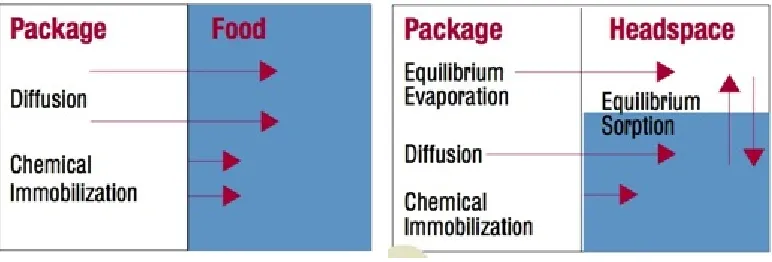
system or a package-headspace-food system. Patterns of migration and action in
antimicrobial food packaging systems are illustrated in Figure1.5.1 (a) and (b). Diffusion
between the packaging materials and products at the interface is the main migration
phenomena in the food packaging system. The migration also can be achieved by gas
phase diffusion from the packaging layer to product surface.
There are five types of antimicrobial packaging including:
(1) Addition of pads containing volatile antimicrobial agents into packages;
(4) Immobilization of antimicrobials to polymers by ion or covalent linkages;
(5) Use of polymers that are inherently antimicrobial.
[image:15.612.114.500.183.314.2](a) Direct contact (b) Direct and indirect contacts
Figure 1.5.1 Food packaging systems and migration phenomena (Han, 2000)
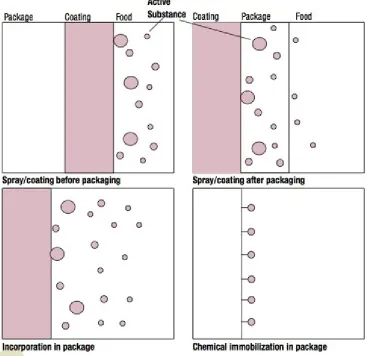
The mechanism of antimicrobial migration is critical for food packaging systems. Figure
1.5.2 shows the mass diffusion mechanism of an antimicrobial agent with different
applications. Antimicrobial agents are incorporated into the packaging materials initially,
Figure 1.5.2 Migration of active particles (Han, 2000)
1.6. Aims
In view of the development history of active packaging and antimicrobial packaging, as
well as environmental and general health benefits imparted by natural antimicrobial
• Evaluate the antimicrobial effects of three natural plant powders (vanillin,
turmeric and curcumin) solutions with two kinds of solvent: Reagent alcohol and
Dimethyl sulfoxide (DMSO).
• The inhibitory effects of all solutions were investigated on Mueller Hinton agar
plates against five types of common bacteria: E.coli O157:H7, Staphylococcus
aureus, Shigella sonnei, Salmonella typhimurium, and Listeria monocytogenes.
• Compare the results and find minimum inhibitory concentration (MIC) for each
solution.
• Apply natural plant powders on LDPE resin and BOPP films to produce low cost
and no toxins antimicrobial packaging materials.
1.7. Scope of work
The natural plant powders: Vanillin, Turmeric and Curcumin were chosen for the
antimicrobial activity study. Samples were prepared by half fold dilution method using
Reagent alcohol and DMSO respectively. The minimum inhibitory concentration (MIC)
for each solution on different bacteria was studied. The relationship between
concentration and antimicrobial effectiveness was analyzed and some assumptions were
proposed. A comparison of antimicrobial activity among each solution was also
illustrated. Turmeric powder was selected to incorporate into LDPE resin and coating on
2
Literature review
This chapter reviews the recent progress in antimicrobial packaging and provides a
detailed discussion on the antimicrobial studies of antimicrobial agents derived from
natural plants. The sources of natural spice, their antimicrobial activity and possible
future applications in food packaging as well as other benefits are reviewed. A review of
blending antimicrobial agents to LDPE resin as well as BOPP films with antimicrobial
agents coating is also presented.
2.1. Progress in antimicrobial packaging
Packaging plays a significant role in the food supply chain, and it has to satisfy many
demands and requirements. The basic functions of traditional packaging include
protection, containment, convenience and communication. However, in recent years,
consumer demands for minimally processed and naturally preserved food, increased
regulatory requirements, and concern for products quality and safety. Previously,
traditional packaging materials were considered as “passive” one, which means their
function to protect the product against contamination is mainly based on an inert barrier
(Lee et al., 2008).
The first use of the term “active packaging ” was proposed by Labuza (1987), who
defined active packaging as a kind of technology which perform some desired function
packaging technology has shifted from passive to active due to the development of novel
packaging methods such as active packaging.
Antimicrobial packaging is a form of active packaging. Antimicrobial food packaging
materials have to extend the lag phase and reduce the growth rate of microorganisms in
order to extend shelf life and to maintain product quality and safety (Han, 2000). Such a
system can be constructed by using antimicrobial materials and/or by incorporating
antimicrobial agents into the packaging system. The development and application of
antimicrobial packaging has been recently reviewed (Appendini & Hotchkiss, 2002).
The most common and successful commercial application of antimicrobial packaging in
the food industry should be sachets that are enclosed loose or attached to the interior of a
package (Appendini & Hotchkiss, 2002). Carbon dioxide emitters as sachets, which
include ascorbic acid and sodium hydrogen carbonate, can inhibit the growth of
gram-negative bacteria and moulds on vegetables, fruits as well as fish, meat and poultry
(Ahvenainen, 2003). On the other hand, incorporation of antimicrobial agents directly in
to polymers has been commercially used in drug delivery, food packaging and
biomedical devices. For example, packaging films like antimicrobial preservative
releasers including organic acids as well as spice and herb extracts can prevent the
growth of spoilage and bacteria on meat, fish, bread, cheese, fruit and vegetables
2.2. Types and uses of antimicrobial agents
There are many different types of antimicrobial agents, which can be used in a wide
variety of applications in the food, pharmaceutical and cosmetic industries. Several types
of antimicrobial agents have been tested for antimicrobial packaging applications
including organic acids, fungicides, bacteriocins, proteins, enzymes, inorganic gases, and
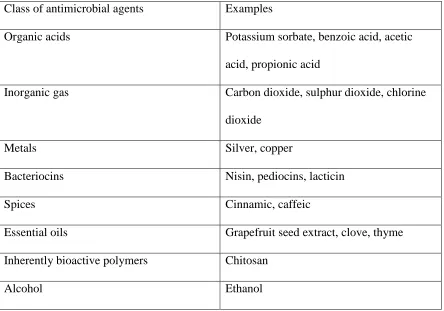
metals. Table 2.1 lists some typical antimicrobial agents used in food packaging (Han,
[image:20.612.86.530.347.658.2]2000; Appendini & Hotchkiss, 2002).
Table 2.1 Examples of some typical antimicrobial agents used in food packaging
Class of antimicrobial agents Examples
Organic acids Potassium sorbate, benzoic acid, acetic
acid, propionic acid
Inorganic gas Carbon dioxide, sulphur dioxide, chlorine
dioxide
Metals Silver, copper
Bacteriocins Nisin, pediocins, lacticin
Spices Cinnamic, caffeic
Essential oils Grapefruit seed extract, clove, thyme
Inherently bioactive polymers Chitosan
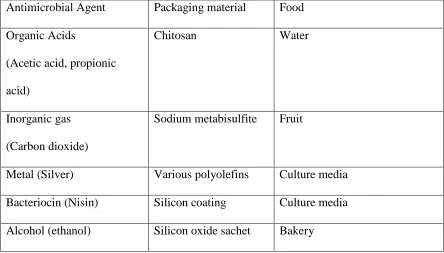
A summary of some typical applications of antimicrobial packaging systems is presented
in Table 2.2. Some common antimicrobial agents for food products are such preservatives
as organic acid, inorganic gas, metal, bacteriocins and alcohol. Organic acids
incorporated with chitosan, such as acetic acid and propionic acid have been studied as
antimicrobial chemicals for the packaging of water (Ouattara et al., 1999). Carbon
dioxide, which is a kind of inorganic gas, has been studied as a preservative for the
packaging of fruit (Sacharow, 1988). Other materials including silver (Ishitani, 1995),
nisin (Daeschel, 1992) and ethanol (Smith et al., 1987), have been tested as antimicrobial
[image:21.612.84.528.431.684.2]agents in food packaging.
Table 2.2 Examples of typical applications of antimicrobial packaging
Antimicrobial Agent Packaging material Food
Organic Acids
(Acetic acid, propionic
acid)
Chitosan Water
Inorganic gas
(Carbon dioxide)
Sodium metabisulfite Fruit
Metal (Silver) Various polyolefins Culture media
Bacteriocin (Nisin) Silicon coating Culture media
2.3. Natural plant products as antimicrobial agents
Nowadays, the most commonly used commercial preservatives in the food industry are
chemical preservatives. Although the chemical preservatives, synthetic and
semi-synthetic, have been widely accepted in the modern era, the undesirable side effects
cannot be neglected. With the increasing demand for food safety and health standards,
consumers have become more concerned about the presence of chemical residues in the
food products (Charu et al., 2008). Due to the negative impact from chemical
preservatives, attention has been shifted to natural plant extracts, including their powders
and essential oils (Smith-Palmer et al., 1998).
Natural plants, which have antimicrobial agents, have been widely used in
ethno-medicine around the world dating back to a thousand years ago. In the first century A.D.,
Dioscorides wrote De Materia Medica, which offers descriptions of approximately 30
healing plants. However, since the development of antibiotics in the 1950s,
the production of antimicrobial agents derived from plants has been rarely needed
(Marjorie, 1999). Currently, the use of natural plants with antimicrobial activity have
come back into our lives: essential oils such as Cinnamomum zeylanicum, Thymus
vulgaris and Origanum vulgaris were studied as antimicrobial solutions in paper
packaging (Rodr ıguez et al., 2007). Antimicrobial compounds from plants can be
and Essential Oils, Alkaloids, Lectins and Polypeptides, Mixtures and Other Compounds
(Marjorie, 1999). Our study focuses on plant essential oils and extracts.
2.3.1. Antimicrobial activity in plant essential oils
Essential oils offer a promising alternative to the synthetic preservatives used in food
products. H.J.D. Dorman and S.G. Deans (2000) evaluated antimicrobial activity of six
plant volatile oils against twenty-five common microorganisms. They conclude that the
volatile oils showed considerable inhibitory effects against all tested bacteria.
Smith-Palmer et al. (1998) studied the antimicrobial properties of twenty-one plant essential oils
against five common food-borne pathogens. This work highlighted that Gram-positive
bacteria were more sensitive to inhibition by plant essential oils than the Gram-negative
bacteria. Besides the previous study on antimicrobial activity of different plants essential
oils, some research focused on certain essential oils was evaluated. Charu Gupta et al.
(2008) screened ten herbal oils for antimicrobial activity using an agar well diffusion
technique against ten common bacteria. They discovered that only cinnamon oil and
clove oil showed a broad range of antimicrobial activity. The MIC is 1.25%(v/v) for
cinnamon oil against Listeria monocytogenes and E. coli, and 2.5%(v/v) for clove oil
against Staphylococcus epidermidis respectively. A. Rodr ıguez et al. (2007) had assessed
the antimicrobial activity of clove, cinnamon and oregano essential oils, and applied these
essential oils on paraffin-based “active coating” for paper packaging materials. It has
been shown that no inhibition of tested Gram-positive bacteria (Listeria monocytogenes
coating with cinnamon essential oil showed inhibitory activity against Gram-negative
bacteria (E.coli (ATCC 29252), Salmonella typhimurium (CECT 4000)). It was also
found that the percentage of essential oils added to the coating materials have a
significant impact on their antimicrobial activities. Sudsuda Vanit et al. (2010) reported
that pure clove oil possesses better antimicrobial inhibition on tested bacteria (E.coli
(DMST 4212), Staphylococcus aureus (DMST 8840), Bacillus cereus (DMST5040)) than
clove oil in starch matrixes. Natural plant essential oils showed promising antimicrobial
activity against several species of bacterial food-borne pathogens including E.coli,
Listeria monocytogenes, and Staphylococcus aureus (Burt, 2004). Furthermore, Sara Burt
(2004) highlighted some Gram-positive organisms are generally more sensitive to
essential oils than Gram-negative organisms, which agrees with the previous study by
Smith-Palmer et al. (1998).
2.3.2. Antimicrobial activity in plant extracts from roots and seeds
Plant extracts from roots and seeds are also reported to have wide-ranging bioactivity as
antimicrobial agents. Daljit S. Arora and Jasleen Kaur (1999) compared the sensitivity of
some human pathogenic bacteria and yeasts to various spice extracts. They discovered
that only garlic and clove were found to possess antimicrobial activity, and garlic extracts
inhibited Staphylococcus epidermidis (MTCC 435) and Salmonella typhimurium (MTCC
531) significantly. Prashant Tiwari et al. (2011) analyzed the antibacterial sensitivity of
bacteria diseases. Recently, antibacterial and antifungal activity of root and root callus
extracts of Trianthema decandra L. in different solvents were tested against both
Gram-positive and Gram-negative bacteria (Radfar et al., 2012). In this work, significant
antimicrobial activity was observed in root callus extract of chloroform, ethyl acetate and
ethanol with a MIC of 3.12 to 12.5 µg/ml. It is also reported that antibacterial activity was
more in root callus extract than root extract.
The antimicrobial effect from plant seed extracts, especially grape seed extract was
demonstrated in recent studies (T. Sivarooban et al., 2008; Bledar Bisha et al., 2010).
Antilisterial effect of grape seed extracts was evaluated using multiple tools (Bledar
Bisha et al., 2010), and the results suggested that grape seed extract has significant
antimicrobial effect against Listeria spp. at relatively low concentrations. T. Sivarooban
et al. (2008) studied the antimicrobial properties of soy protein isolate (SPI) films
containing grape seed extract (1% w/w), nisin (10,000IU/g), ethylenediaminetetraacetic
acid (EDTA 0.16% w/w), and their combinations. The grape seed extract, nisin and
EDTA incorporated with SPI film is effective to inhibit the growth of Listeria
monocytogennes, E. coli O157:H7 and Salmonella typhimurium, which has potential
application in ready-to-eat food products.
2.3.3. Properties and uses of vanillin
The natural product of the extracts of vanilla, vanillin is a phenolic aldehyde that has
received considerable attention as a possible antimicrobial agent (Suwarat et al., 2009;
property of vanillin is due to its phenolic compound in chemical structur
chemical structure of vanillin is shown in Figure 2.3.3.
Vanillin has been selected as an antimicrobial agent for coating paperboard intended for
packaging bakery products. Suwarat Rakchoy
effects of vanillin solutions and investigated MIC of the solution against selected bacteria
including E.coli (DMST 4212)
cereus (DMST 5040) by agar well diffusion method. Three types of vanillin coating
solutions were prepared and evaluated, including vanillin/DMSO (10,5,2.5,1.25%(w/w)),
vanillin/ ethyl alcohol (10,5,2.5,1.25%(w/w)) and vanillin/chitosan
(10,5,2.5,1.25%(w/w)). Furthermore they
paperboard with bakery products, and the results showed that the shelf life was extended
compared with the uncoated paperboard (Suwarat Rakchoy
solution significantly inhibit all te
the combination of substances in the solution and the solution concentration. property of vanillin is due to its phenolic compound in chemical structure, and the
chemical structure of vanillin is shown in Figure 2.3.3.
Figure 2.3.3
Vanillin has been selected as an antimicrobial agent for coating paperboard intended for
packaging bakery products. Suwarat Rakchoy et al. (2009) evaluated the inhibitory
effects of vanillin solutions and investigated MIC of the solution against selected bacteria
(DMST 4212), Staphylococcus aureus (DMST 8840) and Bacillus
by agar well diffusion method. Three types of vanillin coating
solutions were prepared and evaluated, including vanillin/DMSO (10,5,2.5,1.25%(w/w)),
vanillin/ ethyl alcohol (10,5,2.5,1.25%(w/w)) and vanillin/chitosan
(10,5,2.5,1.25%(w/w)). Furthermore they assessed the shelf life of vanillin coated
paperboard with bakery products, and the results showed that the shelf life was extended
compared with the uncoated paperboard (Suwarat Rakchoy et al., 2010). Vanillin coated
solution significantly inhibit all tested bacteria, and the antimicrobial effect depends on
the combination of substances in the solution and the solution concentration. e, and the
Vanillin has been selected as an antimicrobial agent for coating paperboard intended for
(2009) evaluated the inhibitory
effects of vanillin solutions and investigated MIC of the solution against selected bacteria
Bacillus
by agar well diffusion method. Three types of vanillin coating
solutions were prepared and evaluated, including vanillin/DMSO (10,5,2.5,1.25%(w/w)),
assessed the shelf life of vanillin coated
paperboard with bakery products, and the results showed that the shelf life was extended
, 2010). Vanillin coated
sted bacteria, and the antimicrobial effect depends on
In order to achieve an economical method for producing antimicrobial packaging,
Jurmkwan et al. (2008) incorporated vanillin directly into chitonsan-methyl cellulose
based films with polyethylene glycol 400 (PEG) as a plasticizer. Furthermore, they
analyzed the impact of different vanillin concentration on mechanical properties, water
vapor and oxygen permeability, opacity and thermal properties of the coating films. The
results indicated that both vanillin and PEG concentration affected all the tested
properties of chitosan-methyl cellulose based film.
2.3.4. Properties and uses of turmeric
Turmeric, a bright yellow-orange substance, obtained from the root of the plant Curcuma
longa, has long been used as a traditional spice in both China and India. Turmeric is
mostly used in flavored milk drinks, cultured milk and desserts to obtain lemon and
banana colors in dairy products. In previous research, turmeric has been shown to have
anti-HIV activity (Marjorie, 1999), wound-healing (Ishita et al., 2004) as well as
antimicrobial activity (Seher et al., 2006). Turmeric contains protein (6.3%), fat (5.1%),
minerals (3.5%), carbohydrates (69.4%) and moisture (13.1%) (Ishita et al., 2004). The
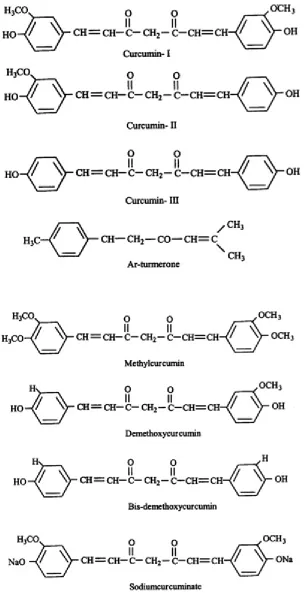
main components of turmeric are: curcumin (60%), desmethoxycurcumin,
monodemethoxycurcumin, bisdemethoxycurcumin, dihydrocurcumin and cyclocurcumin
(Priyanka et al., 2010). The Structure of the main curcuminoids of turmeric is shown in
P. S. Negi et al. (1999) extracted turmeric oil from the mother liquor using hexane at
60 °C, and then studied the antimicrobial activity by pour plate method. The results of the
study show that turmeric oil possessed antibacterial activity against tested bacteria
including Staphylococcus aureus and E.coli. Another antimicrobial study conducted by
Seher et al. (2006) on methanolic extract of turmeric powder showed that turmeric
powder was most effective on Staphylococcus aurues (COWAN 1) and had a slight effect
on Listeria monocytogennes (SCOOT A). However, it was not effective on E. Coli
(ATCC 25921).
2.3.5. Properties and uses of curcumin
Curcumin is the most biologically active constitute of turmeric. The characteristic yellow
color of turmeric was isolated in the 19th century and was named curcumin (Araújo & LL
Leon, 2001). Curcumin has been shown to exhibit antioxidant, anti-inflammatory,
antimicrobial, antitumor activities (Ishita et al., 2004; Araújo & LL Leon, 2001; Preetha
et al., 2008; Marjorie, 1999) and anti-cancer activities (Reason Wilken et al., 2011). The
chemical structure of curcumin (Figure 2.3.5.) was determined by Roughley and Whiting
in 1973 (Araújo & LL Leon, 2001).
Bhavani Shankar and Sreenivasa Murthy (1979) evaluated the activity of turmeric
fractions on the growth of some bacteria in vitro. In this work, both curcumin and the oil
fraction were tested against several bacteria like Staphylococcus and Lactobacillus.
However, curcumin only inhibited Staphylococcus aureus in the range of 2.5mg/ml to
50mg/ml (CAC Araújo and LL Leon, 2001).
Antimicrobial activity of indium curcumin against S. aureus (ATCC 25923) and
S.epidermidis (ATCC 14990) as well as minimum inhibitory concentration (MIC) has
been reported (Tajbakhsh et al., 2008). It was reported that curcumin inhibits the growth
of varieties of microbes such as viruses, bacteria and some pathogenic fungi (Chai, et al.,
2005). Other studies on indium curcumin and microcapsule curcumin evaluated the
antimicrobial effects for particular bacteria (Tajbakhsh et al., 2008; Wang et al., 2009).
2.4. Development in polymers and packaging
As antimicrobial agents are incorporated into a polymer, the material inhibits microbial
growth. Such applications could be effectively used for foods products, not only in the
form of films but also as containers (Han, 2000).
The selection of an antimicrobial agent is often limited by the incompatibility of that
agent with packaging material or by its heat instability during the extrusion process
LDPE resin to produce antimicrobial packaging materials that inhibited the growth of
yeast on agar plates. Such a master batch was prepared, by mixing the LDPE resin and
potassium sorbate powder, and extruded and pelletized (Pérez-Pérez et al., 2006). Andrea
Carolina Valderrama Solano and Cecilia de Rojas Gante (2011) developed LDPE films,
which were incorporated with known concentrations (1%(w/w) and 4%(w/w)) of natural
essential oils of oregano and thyme directly by extrusion. The resulting films showed
inhibitory activity against Escherichia coli O157:H7, Salmonella typhimurium, and
Listeria monocytogenes. Panuwat Suppakul et al. (2006) studied the properties of LDPE
based films containing either linalool or methylchavicol as antimicrobial additives. The
results showed that, this incorporation of either linalool or methylchavicol by a single
screw extruder into LDPE based film change some characteristic of the packaging
material slightly. Abel Guarda et al. (2011) reported that BOPP films, with a coating of
microcapsules containing 10% of carvacrol and 10% of thymol as natural AM agents,
exhibited antimicrobial activity against E.coli O157:H7 and Staphylococcus aureus
(ATCC 25923) in agar plate test.
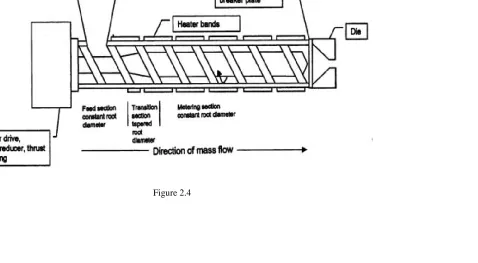
Figure 2.4 (Lee et al., 2008) shows a single screw extruder that consists of an electrically
heated metal barrel, a hopper for feeding the resin usually in pellet form, a motor for
rotating a screw, and a die where the polymer melts exits. The heat from the barrel is
responsible for softening the surface of the resin pellets making them stick to each other,
while the rotating screw is responsible for melting the resin pellets and forcing the
3
Materials and methods
3.1. Antimicrobial agent in solutions
3.1.1. Materials and methods
1) Antimicrobial agents
Turmeric powders were purchased from nuts.com. Vanillin (94752, Fluka) and Curcumin
(C1386, Sigma) were obtained from Sigma-Aldrich Co. LLC. U.S.
Typical properties of the agents are presented in Appendix A.
2) Solvents
The solvents used in the experiment were: (i) Reagent alcohol (R8382, purchased from
Sigma-Aldrich Co. LLC. U.S.). (ii) Dimethyl sulfoxide (DMSO, 276855 anhydrous,
≥99.9%, purchased from Sigma-Aldrich Co. LLC. U.S.).
3) Preparation of solution
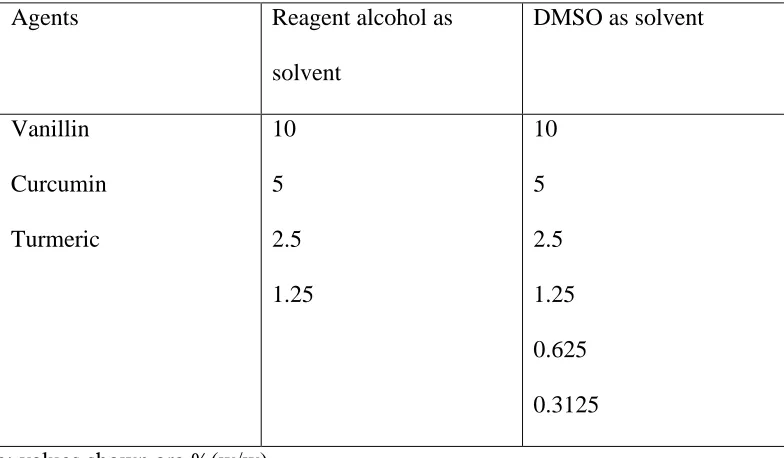
In this experiment, three types of solutions were prepared for Reagent alcohol and DMSO
respectively, using a series of half-fold dilutions. There were four concentrations for each
Reagent alcohol solution and six concentrations for each DMSO solution. Details of
Table 3.1.1 Solution’s composition and concentration prepared in antimicrobial test
Agents Reagent alcohol as
solvent
DMSO as solvent
Vanillin
Curcumin
Turmeric
10
5
2.5
1.25
10
5
2.5
1.25
0.625
0.3125
Note: values shown are %(w/w)
4) Microorganisms
Five types of common pathogenic and food spoilage bacteria were selected. They are (a)
positive bacteria: Staphylococcus aureus and Listeria monocytogenes; (b)
gram-negative bacteria: Shigella sonnei, Salmonella typhimurium, E. coli O157:H7. The
Department of Biotechnology and Molecular Bioscience, Rochester institute of
technology, NY, U.S, provided all bacterial strains.
5) Media and culture plates
3.1.2. Antimicrobial testing
The antimicrobial activities of vanillin, turmeric and curcumin solutions were determined
by agar plate diffusion method. Each type of bacteria was streaked onto Mueller-Hinton
agar plates. Sterilized cotton swabs were dipped in the bacterial culture in nutrient broth
and then swabbed on the agar plates uniformly. Using blank antibiotic assay discs of
6mm in diameter impregnated with 40µl of vanillin, turmeric and curcumin solutions and
was placed on the surface of the agar respectively. The solutions diffused out from the
antibiotic assay disc into the agar. Then, the plates containing the testing samples were
incubated for 24 hours at 35.5°C. Control samples were performed triplicate on each
bacteria with 40µl solvent. Vanillin, turmeric and curcumin solutions were performed
triplicate for different concentrations. In order to obtain comparable results, all prepared
solutions were applied under the same conditions and the same incubation environment.
3.1.3. Data analysis
The antimicrobial activities of all solutions were detected as clear zones around the
antibiotic assay discs, and the diameters of the clear zones measured by a ruler in
millimeters (mm). If the solution is effective against bacteria at a certain concentration,
no colonies will grow wherever the concentration in the agar is greater than or equal to
that effective concentration. This region is called the “zone of inhibition.” Thus, the size
clear zone around the antibiotic assay disc, the more effective the solution is. The
minimum inhibitory concentration (MIC) was defined as the lowest concentration of
solutions that completely inhibit the growth of each bacterial strain being tested (Wang et
al., 2009).
3.2. Antimicrobial agent in polymers
3.2.1. Materials and methods
1) Polymers
The polymers that were used to prepare the master batch and coating films for present
study were low-density polyethylene resin (LDPE, NA 214-000, Lyondell Company) and
biaxially oriented polypropylene (BOPP) film (Bicor™ 100 SLP, ExxonMobil).
Typical properties of the polymers are presented in Appendix A.
2) Antimicrobial agents
Turmeric powders were purchased from nuts.com.
Typical properties of the agents are presented in Appendix A.
3) Adhesive and preparation of coating solution
Adhesive and coating solutions only used in BOPP films. Adhesive was prepared by
using Ethyl Acetate, 555 (Dow Chemical Company) and 536B (Dow Chemical Company)
The turmeric powders were blended with polymer resin LDPE into a master batch in
concentration of 2.5% (w/w). 600 grams of resin was added to the mixer with 7.5 grams
of turmeric powders. The blended material was fed into a single screw extruder, with the
working temperature at 305°F. Material was first cooling immediately by water after
exited the die, then ground in a knife mill to produce pellets (5mm×3mm×2mm). The
pellets were collected separately in ten containers every three munities. In order to obtain
comparable results, all pellets used in antimicrobial testing was melted and reshaped into
discs of approximately 6mm in diameter and 1mm in thickness.
5) Blend preparation and film coating
The turmeric powders were blended with prepared adhesive (Ethyl Acetate, 555,536B)
made a mixture concentration of 5%(w/w). 3.85g turmeric powders were added to the
prepared adhesive, forming a total of 80.77g coating solution.
BOPP film (22mm×40mm) coated by draw down machine (EZ Coater EC-100, Fairfield.
Ohio, U.S.A.), with 3.5ml of the coating solution covering the entire film and was dried
at 120°C-130°C in oven for 24 hours. Then the film was cut into test samples
(13mm×13mm).
3.2.2. Antimicrobial testing
The antimicrobial activities of turmeric containing LDPE discs and turmeric coated
BOPP films were determined by agar plate diffusion method. Each type of bacteria was
bacterial culture in nutrient broth and then swabbed on the agar plates uniformly.
Turmeric containing LDPE samples were chosen randomly from each container made up
totally ten samples on each agar plate. The active agents in the discs diffused out from the
tested samples into the agar. Then, the plates containing the testing samples were
incubated in an appropriate incubation chamber for 48 hours and 72 hours at 36°C.
Control samples for turmeric containing LDPE discs were pure LDPE resin discs, and
performed triplicate in this study. Testing was only done once in this study.
Turmeric coated BOPP films sample were randomly chose from all cut samples. The
active agents in films diffused out from the tested samples into the agar. Then, the plates
containing the testing samples were incubated in an appropriate incubation chamber for
72 hours at 36°C. Control samples for turmeric coated BOPP films were pure BOPP
films. Testing was only done once in this study.
3.2.3. Data analysis
The antimicrobial activities of all tested samples were detected as clear zones around the
antibiotic assay discs, and the diameters of the clear zones measured by a ruler in
4
Results and discussion
This chapter examines the antimicrobial activity of natural plant powders in solutions
with different solvents and concentration. Antimicrobial effectiveness of the blends of
LDPE resin and natural plants agent, as well as BOPP film with natural plants agent
coating are also demonstrated.
4.1. Antimicrobial agent in solutions
In this study, turmeric and curcumin powders could not compeletely be solubilized in
reagent alcohol. The insoluble particles in the solution might possibly prevent the
migration of solution that contained antimicrobial agents, this results in a smaller inhibit
zone with higher solution concentration (Cheng et al., 2011). DMSO was used as an
alternative solvent in the experiment. DMSO was a solvent was used in many previous
studies: Antimicrobial properties of vanillin/DMSO solution were evaluated and
compared with vanillin/chitosan solution and vanillin /ethyl alcohol solution (Rakchoy et
al., 2009); DMSO made up solution to ensure a better solubilization of curcumin and
indium curcumin (Tajbakhsh et al., 2008).
In this study, DMSO is chosen as solvent of natural plant powders in antimicrobial
activity testing, and the results were compared with our previous work that used reagent
4.1.1. Antimicrobial Effects of Vanillin, Turmeric and Curcumin in Reagent
alcohol Solution
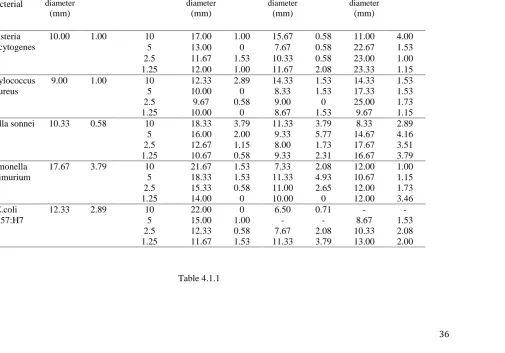
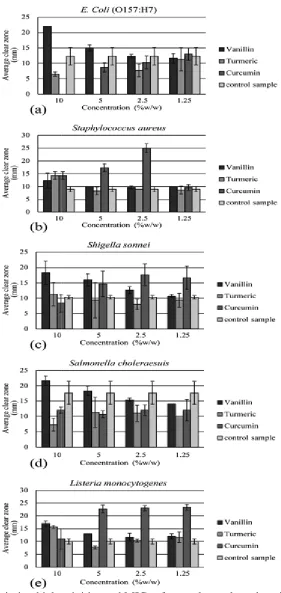
The average diameter and standard deviation (STDEV) of clear zone of inhibition on
control samples, vanillin/reagent alcohol solution, turmeric/reagent alcohol solution and
curcumin/reagent alcohol solution are illustrated in Table 4.1.1. A comparison of
antimicrobial activity of different solution over particular microorganisms is shown in
Figure 4.1.1 (a)-(e). Furthermore, clear zone diameters for three types of solution over
five microorganisms are also illustrated in Figure 4.1.2 (a)-(e).
If indistinct clear zone of inhibition was observed in the test, the diameter is marked as
“-”. Besides, standard deviation is “-” illustrated that there were no distinct clear zone of
inhibition observed in three replicates.
According to the results in Table 4.1.1, vanillin/reagent alcohol solution is more effective
over E.coli O157:H7 with a minimum inhibitory concentration (MIC) at 2.5%(w/w). The
results agree with previous studies on the effect of vanillin/alcohol solution in inhibiting
E. coli (Rakchoy et al., 2009). In addition, vanillin/reagent alcohol solution has
significant effectiveness on Shigella sonnei and Listeria monocytogenes with the MIC at
2.5%(w/w). Whereas the same solution has slight less antimicrobial activity on
Staphylococcus aureus and Salmonella typhimurium. The results contradict previous
Staphylococcus aureus (DMST 8840).
Turmeric/reagent alcohol solution has a weak antimicrobial activity on Staphylococcus
aureus and Listeria monocytogenes with the MIC at 10%(w/w). This finding is in the
agreement with Chaudhary et al. (2010) who reported the turmeric alcohol extract has
antibacterial activity against Gram-positive bacteria. However, turmeric/reagent alcohol
solution has no significant antimicrobial effect on E.coli O157:H7, Shigella sonnei and
Salmonella typhimurium. While the antimicrobial activity of turmeric/reagent alcohol has
some antimicrobial effective on Gram-positive bacteria, it appears no significant
antimicrobial effect on Gram-negative bacteria.
As the most biologically active constitute of turmeric, curcumin has significant
antimicrobial activity over Staphylococcus aureus and Listeria monocytogenes.
According to the results, the MIC of curcumin/reagent alcohol solution was valued at
2.5%(w/w) for Staphylococcus aureus, but was only 1.25%(w/w) for Listeria
monocytogenes. However, based on the results, curcumin has moderate effect on Shigella
sonnei with a MIC at 1.25%(w/w), and no significant effect on E.coli O157:H7 and
Salmonella typhimurium. In summary, the results indicated that the selected
Gram-positive bacteria had higher sensitivity than the selected Gram-negative bacteria. Both the
results from turmeric/Reagent alcohol and curcumin/Reagent alcohol are agree with
Smith-Palmer et al. (1998) who reported that Gram-positive bacteria were more sensitive
to inhibition by plant agents than the Gram-negative bacteria. Bhawana et al. (2011)
cell membrane constituents and structure.
In general, increasing its concentration should intensify the antimicrobial activity of
certain powder/reagent alcohol solution. From the results, vanillin/reagent alcohol
solution had increasing antimicrobial effect over all five bacterial strains when the
concentration increased. Vanillin/Reagent alcohol solution showed a good agreement
with this concentration and effectiveness relation. However, the data from turmeric and
curcumin demonstrated that a decreasing concentration of solution results in an increased
antimicrobial activity. This could be caused by poor solubility of turmeric or curcumin in
reagent alcohol. The insoluble particle in turmeric or curcumin reagent alcohol solution
might possibly prevent the migration of solution that contained antimicrobial agents.
Therefore, when the solution was diluted in lower concentration, less insoluble particles
Table 4.1.1 Bacterial
Control sample Concentration
(%w/w)
Vanillin Turmeric Curcumin
Average diameter (mm)
STDEV Average
diameter (mm)
STDEV Average
diameter (mm)
STDEV Average
diameter (mm)
STDEV
Listeria monocytogenes
10.00 1.00 10 17.00 1.00 15.67 0.58 11.00 4.00
5 13.00 0 7.67 0.58 22.67 1.53
2.5 11.67 1.53 10.33 0.58 23.00 1.00
1.25 12.00 1.00 11.67 2.08 23.33 1.15
Staphylococcus aureus
9.00 1.00 10 12.33 2.89 14.33 1.53 14.33 1.53
5 10.00 0 8.33 1.53 17.33 1.53
2.5 9.67 0.58 9.00 0 25.00 1.73
1.25 10.00 0 8.67 1.53 9.67 1.15
Shigella sonnei 10.33 0.58 10 18.33 3.79 11.33 3.79 8.33 2.89
5 16.00 2.00 9.33 5.77 14.67 4.16
2.5 12.67 1.15 8.00 1.73 17.67 3.51
1.25 10.67 0.58 9.33 2.31 16.67 3.79
Salmonella typhimurium
17.67 3.79 10 21.67 1.53 7.33 2.08 12.00 1.00
5 18.33 1.53 11.33 4.93 10.67 1.15
2.5 15.33 0.58 11.00 2.65 12.00 1.73
1.25 14.00 0 10.00 0 12.00 3.46
E.coli O157:H7
12.33 2.89 10 22.00 0 6.50 0.71 - -
5 15.00 1.00 - - 8.67 1.53
2.5 12.33 0.58 7.67 2.08 10.33 2.08
Figure 4.1.1Antimicrobial activities and MICs of control sample and vanillin, Turmeric, Curcumin in Reagent alcohol
Antimicrobial activities and MICs of control sample and vanillin, Turmeric, Reagent alcohol solutions. (a) E. Coli O157:H7, (b) Staphylococcus aureus Antimicrobial activities and MICs of control sample and vanillin, Turmeric,
Figure 4.1.2 The illustration above shows zones of inhibition around antibiotic assay discs saturated with 40 µl of vanillin, turmeric and curcumin solutions respectively. (a) E.
Table 4.1.2
Bacteria Control sample Concentration (% w/w)
Vanillin Turmeric Curcumin
Average
diameter (mm)
STDEV Average
diameter (mm)
STDEV Average diameter (mm)
STDEV Average diameter (mm)
STDEV
Listeria monocytogenes
0 0 10 29.67 0.58 4.33 1.53 4 0
5 25 1 8.67 1.15 6.67 0.58
2.5 19 0 7.67 0.58 6 0
1.25 10.33 0.58 8 0 6.67 0.58
0.625 - - - - 7 0
0.3125 - - - - 7.67 0.58
Staphylococcus aureus
0 0 10 8.67 0.58 5.67 1.53 4 1
5 5.33 0.58 7 1 6.33 0.58
2.5 - - 8.33 0.58 6.33 0.58
1.25 - - 8 0 8.68 0.58
0.625 - - - - 7.33 0.58
0.3125 - - - - 8 1
Shigella sonnei 0 0 10 6 0 4 1 4 1
5 3.67 0.58 6.67 0.58 5.67 0.58
2.5 - - 6.33 0.58 6 0
1.25 - - 6 0 6.33 0.58
0.625 - - 5.67 0.58 7.33 2.31
0.3125 - - 5.33 0.58 7 0
Salmonella typhimurium
2.33 0.58 10 5.33 1.53 2.67 0.58 3.33 0.58
5 4 0 5.33 1.15 5.67 0.58
2.5 5 0 5.66 0.58 6 0
1.25 5 0 7 0 8 1
0.625 5.33 0.58 7.33 0.58 7 0
0.3125 5 0 5.33 0.58 7 0
E.coli O157:H7 2.00 1.73 10 4.33 0.58 7 1 4 0
5 4 0 7.67 0.58 6.33 0.58
2.5 - - 6.33 0.58 6.67 0.58
1.25 - - 7 0 7.33 0.58
0.625 - - 6 0 6.33 0.58
4.1.2. Antimicrobial Effects of Vanillin, Turmeric and Curcumin in DMSO
Solution
The average diameter and standard deviation of clear zone of inhibition on control
sample, vanillin/DMSO solution, turmeric/DMSO solution and curcumin/ DMSO
solution are illustrated in Table 4.1.2. The STDEV in Table 4.1.2 is much smaller when
compared with Table 4.1.1, which means the results from Table 4.1.2 are more reliable.
Moreover, as observed in the study, all tested powders were dissolved uniformly in
DMSO. Thus, DMSO is considered as a better solvent for selected agents than Reagent
alcohol. A comparison of antimicrobial activity of each solution over particular bacteria
is represented in Figure 4.1.3 (a)-(e). Furthermore, clear zone diameter for three types of
solution over selected bacteria is also illustrated in Figure 4.1.4 (a)-(e).
In Table 4.1.2, if there was no distinct clear zone of inhibition observed in the test, the
diameter marked as “-”. Standard deviation marked as “-” illustrated that there were no
distinct clear zone of inhibition observed in three replicates.
Different bacteria species showed variable sensitivity. Of the different agents tested for
their antibacterial effect, vanillin/DMSO solution was the most susceptible to inhibited
the growth of Listeria monocytogenes with the MIC at 1.25%(w/w). The result agrees
with earlier observation (Yujie Cheng et al., 2011), but showed a lower MIC than
Shigella sonnei to a moderate extent with the MIC at 5%(w/w). In addition, the same
solution has slight less antimicrobial activity on Salmonella typhimurium and E.coli
O157:H7, with the MIC at 0.3125%(w/w) and 5%(w/w) respectively. The results
contradicts previous study on the antimicrobial effect of vanillin/ DMSO solution in
inhibiting E.coli O157:H7 by Rakchoy et al. (2009) who reported that vanillin/DMSO
solution was more effective over E.coli O157:H7 with the MIC at 2.5%(w/w). However,
the results are in good agreement with pervious research from Rakchoy et al. (2009) who
reported vanillin/DMSO solution was more effective over Staphylococcus aureus.
According to the results, turmeric/DMSO solution has a significant antimicrobial activity,
with the MIC at 1.25%(w/w), towards Gram-positive bacteria: Listeria monocytogenes
and Staphylococcus aureus. The results showed that turmeric in DMSO solvent possessed
more antimicrobial activity than in Reagent alcohol. On the other hand, Gram-negative
bacteria including Shigella sonnei, Salmonella typhimurium and E.coli O157:H7 were
sensitive to turmeric/DMSO solution and showed moderate sensitivity. The MIC of
turmeric/DMSO solution is 0.3125%(w/w) on all tested Gram-negative bacteria.
Curcumin/DMSO solution possessed antibacterial activity against all tested bacteria.
Amongst those tested bacteria, Listeria monocytogenes, Staphylococcus aureus and
Shigella sonnei had a higher sensitivity on curcumin/DMSO solution than Salmonella
tested bacteria even though the concentration of solution decreased to the minimum in the
experiment.
(a)
(b)
(c)
(e)
Figure 4.1.3 Antimicrobial activities and MICs of control sa curcumin in DMSO solutions. (a)
Shigella sonnei, (d) Salmonella
Antimicrobial activities and MICs of control sample and vanillin, turmeric, solutions. (a) E. Coli O157:H7, (b) Staphylococcus aureus
Salmonella typhimurium, (e) Listeria monocytogenes
(a)
(b)
(c)
(d)
(e)
Figure 4.1.3 The illustration above shows zones of inhibition around antibiotic assay discs saturated with 40 µl of vanillin, turmeric and curcumin solutions respectively. (a) E.
Coli O157:H7, (b) Staphylococcus aureus, (c) Shigella sonnei, (d) Salmonella
4.1.3. Comparison of the antimicrobial activity of agents in Reagent alcohol and
DMSO
The measured clear zone of inhibition diameter after subtracts control sample effects for
each tested Reagent alcohol solution is illustrated inTable 4.1.3. The negative diameter
indicated control samples showed greater antibacterial effect than tested solution. Based
on the previous study (Cheng et al., 2011), there are two possible reasons for such
abnormal status. First, the poor solubility of powders in Reagent alcohol prevents
effective particle diffusing in the medium. Second, the large Standard Deviation in the
test affected the final results.
After subtract antibacterial effect from Reagent alcohol, curcumin/Reagent alcohol
solution inhibited the growth of bacteria with Listeria monocytogenes being the most
susceptible and Salmonella typhimurium the least. For turmeric/Reagent alcohol solution,
even not as effective as curcumin/Reagent alcohol solution, still had a slight effect on
Listeria monocytogenes. Vanillin/Reagent alcohol solution showed moderate
Bacteria Concentration (%w/w)
Reagent alcohol Average diameter (mm)
Vanillin Turmeric Curcumin
Listeria monocytogenes 10 7 5.67 1
5 3 -2.33 12.67
2.5 1.67 0.33 13
1.25 2 1.67 13.33
Staphylococcus aureus 10 3.33 5.33 5.33
5 1 -0.67 8.33
2.5 0.67 0 16
1.25 1 -0.33 0.67
Shigella sonnei 10 8 1 -2
5 5.67 -1 4.34
2.5 2.34 -2.33 7.34
1.25 0.34 -1 6.34
Salmonella typhimurium 10 4 -10.34 -5.67
5 0.66 -6.34 -7
2.5 -2.34 -6.67 -5.67
1.25 -3.67 -7.67 -5.67
E.coli O157:H7 10 9.67 -5.83 -
5 2.67 - -3.66
2.5 0 -4.66 -2
1.25 -0.66 -1 0.67
Table 4.1.3
[image:54.612.70.723.120.460.2]The measured clear zone of inhibition diameter after subtracted control sample effects for
each tested DMSO solution are illustrated in Table 4.1.4. Compared with vanillin/DMSO
solution, turmeric/ DMSO solution and curcumin/DMSO solution showed a greater
inhibitory effect at lower concentrations on all tested bacteria. However, when the
solution’s concentration was above 1.25%(w/w), vanillin/DMSO solution had a stronger
inhibition effect on Listeria monocytogenes than turmeric/ DMSO solution and
curcumin/DMSO solution did.
DMSO, which used as cell protector for bacteria storage in the laboratory, nearly has no
antimicrobial effect against all tested bacteria. Comparing Table 4.1.1 and Table 4.1.2, all
tested powder solutions in Reagent alcohol showed larger diameter of inhibition zone
than in DMSO. It seems that natural powder agents in Reagent alcohol possessed greater
antimicrobial activity than in DMSO. However, the control samples with pure DMSO did
not inhibit Listeria monocytogenes, Staphylococcus aureus and Shigella sonnei, and only
showed slightly effect on Salmonella typhimurium and E.coli O157:H7 (Table 4.1.2). On
the other hand, there was more than 10mm inhibition diameter effect from all tested
control sample with pure Reagent alcohol (Table 4.1.1). Thus, vanillin as well as turmeric
and curcumin in their DMSO solutions reflected their actual antimicrobial effect against
selected bacteria.
DMSO can solubilize the powders better than Reagent alcohol. In general, since DMSO
has good solubility for selected powder, increasing the certain agent solution’s
selected powders were uniformly dissolved in DMSO. However, only vanillin powder
could dissolve uniformly in both Reagent alcohol and DMSO. Turmeric/Reagent alcohol
solution and curcumin/Reagent alcohol solution existed insoluble particles in our
previous study (Cheng et al., 2011). Based on the results, vanillin/DMSO solution
showed increasing antimicrobial activity over selected bacteria strains as the
concentration increased. However, data from turmeric/DMSO solution and
curcumin/DMSO solution demonstrated a decreasing concentration of solution resulted in
a first increased followed by decreased antimicrobial activity on certain concentration.
We supposed that insoluble particles in the certain solution at higher concentration
Table 4.1.4
Bacteria Concentration
(%w/w)
DMSO
Average diameter (mm)
Vanillin Turmeric Curcumin
Listeria monocytogenes 10 29.67 4.33 4
5 25 8.67 6.67
2.5 19 7.67 6
1.25 10.33 8 6.67
0.625 - - 7
0.3125 - - 7.67
Staphylococcus aureus 10 8.67 5.67 4
5 5.33 7 6.33
2.5 - 8.33 6.33
1.25 - 8 8.68
0.625 - - 7.33
0.3125 - - 8
Shigella sonnei 10 6 4 4
5 3.67 6.67 5.67
2.5 - 6.33 6
1.25 - 6 6.33
0.625 - 5.67 7.33
0.3125 - 5.33 7
Salmonella typhimurium 10 3 0.34 1
5 1.67 3 3.34
2.5 2.67 3.33 3.67
1.25 2.67 4.67 5.67
0.625 3 5 4.67
0.3125 2.67 3 4.67
E.coli O157:H7 10 2.33 5 2
5 2 5.67 4.33
2.5 - 4.33 4.67
1.25 - 5 5.33
0.625 - 4 4.33
4.1.4. The influence of concentration on antimicrobial activity over each bacterial
In summary, the results indicated that the selected bacteria’s variable sensitivity depends
on different solutions. If we subtracted the additional effect from control sample, the
largest inhibition zone diameters for the selected bacteria should be showed in Table
4.1.5.
Bacteria Solution Concentration
(%w/w)
Inhibition zone diameters (mm) Listeria
monocytogenes
Vanillin/DMSO 10 29.67
Staphylococcus aureus Vanillin/DMSO 10 8.67
Shigella sonnei Vanillin/Reagent alcohol
10 8.00
Salmonella typhimurium
Curcumin/DMSO 1.25 5.67
E.coli O157:H7 Vanillin/Reagent alcohol
[image:58.612.86.527.295.453.2]10 9.67
Table 4.1.5
Selected bacteria can be effectively suppressed by using the particular solution with the
largest inhibition zone diameter. However, agent’s cost as well as antimicrobial activity
should take into account when it comes to commercial use and industrial application. In
general, optimum option must have lower cost with effective function for particular
application. Thus, the Minimum Inhibitory Concentration (MIC) is an important index in