Retrospective Theses and Dissertations Iowa State University Capstones, Theses and Dissertations
1993
Quantitative evaluation of material composition of
composites using X-ray energy-dispersive NDE
technique
Jason Ting
Iowa State University
Follow this and additional works at:https://lib.dr.iastate.edu/rtd
Part of theBiomedical Engineering and Bioengineering Commons, and theEngineering Mechanics Commons
This Thesis is brought to you for free and open access by the Iowa State University Capstones, Theses and Dissertations at Iowa State University Digital Repository. It has been accepted for inclusion in Retrospective Theses and Dissertations by an authorized administrator of Iowa State University Digital Repository. For more information, please [email protected].
Recommended Citation
Ting, Jason, "Quantitative evaluation of material composition of composites using X-ray energy-dispersive NDE technique" (1993).
Retrospective Theses and Dissertations. 263.
'
--Quantitative evaluation of material composition of composites using X-ray energy-dispersive NDE technique
by
Jason Ting
A Thesis Submitted to the
Graduate Faculty in Partial Fulfillment of the
Requirements for the Degree of
MASTER OF SCIENCE
Department: Interdepartmental Program:
Aerospace Engineering and Engineering Mechanics Biomedical Engineering
Co-majors: Engineering Mechanics Biomedical Engineering
Approved:
Iowa State University Ames, Iowa
1993
1
.~·l.·:·n·.
·~
1
·~~
11
DEDICATION
To My Father and Mother
TABLE OF CONTENTS
Page
ACKNOWLEDGMENTS v
I. INTRODUCriON
1.1 Need for QNDE in composite studies I ~ l ;
1.2 Review of previous studies 3 ~' :·· .
1.3 Scope of the research 6
2. TIIEORY
2.1 Introduction 10
2.2 Optimization of energy choices 13
3. INSTRUMENT CHARACTERIZATION
3.1 High-purity germanium detector 19
3.2 Collimators 22
3.3 Positioner and controller program 25
3.4 X-ray source 27
3.5 HP-gennanium digital detector calibration 27
3.6 Amplifier pile-up-rejector 27
4. SAMPLE DESCRIPTION
4.1 Introduction 31
4.2 Graphite-epoxy composite 31
4.3 Bone-Plexiglas composite 33
4.4 Aluminum-aluminum corrosion composite 36
5. LINEAR ATTENUATION COEFFICIENT MEASUREMENTS
5.1 Linear attenuation measurement for solids 39
5.2 Linear attenuation measurements for powders 46
lV
5.3.1 Graphite-epoxy composite
5.3.2 Bone-Plexiglas composite
5.3.3 Aluminum-aluminum corrosion composite
6. RESULTS AND DISCUSSIONS
46
53
53
6.l . .Introduction 56
· 6.2 Graphite-epoxy composite measurements 56
6.2.1 Optimization study 56
6.2.2 Graphite-epoxy composite results and discussions 57
6.3 Bone-Plexiglas composite measurements 67
6.3.1 Optimization study 67
6.3.2 Bone-Plexiglas composite results and discussions 70
6.4 Aluminum-aluminum corrosion composite measurements 76
6.4.1 Optimization study
6.4.2 Aluminum-aluminum corrosion composite
results and discussions
7. CONCLUSIONS
REFERENCES
76
76
85
ACKNOWLEDGMENTS
I would like to thank my major professor Joe Gray for his enthusiasms and
continual support for believing in my research work.
I would also like to acknowledge Terry Jensen for his immaculate care for research
wisdom that has helped propel this work.
I would like to acknowledge all the people who have helped me along the way in
this thesis. To name just a few: Liz Sewik, Vivekend Kini, Sarat Kakumanu, Dave Hsu,
Vinay Dayal, Don Thompson, Mike Hughes, Dick Wallingford, Rick Powell, Thadd
Patton, Libby, Linda, Kim, Susana, Terri, Sara, Connie, lynne.
I would also like to thank my friends Elias, Paul, Bijju, Shabana and Teresa who
have made my studies at Iowa State University more enjoyable.
This work is sponsored by the FAA-Center for Aviation Systems Reliability,
operated by the Ames Laboratory, USDOE, for the Federal Aviation Administration under
Contract No. W-7405-ENG-82 with Iowa State University and NIST under cooperative
agreement #70NANB9H0916.
Government has assigned document number to my thesis IS-T 1640
' ;;
1
1. INlRODUCTION
1.1 Need for ONDE in composite studies
In a wide range of situations the need for characterization of material properties of
man-made and natural materials arises. These situations can include inspection during fabrication of
material, and in-sexvice inspection of mechanical parts as they wear and near their design life.
The need to characterize the material of interest involves all aspects of material performance, such as: the strength of the material, fracture toughness, density, hardness, material
uniformity, and conductivity, etc. We present here a technique that is capable of quantitatively
determining composition, density and material uniformity. It should be pointed out that no one
technique can measure all properties of interest.
The development of new materials for commercial usage is brought about by increasing
demand for high strength, high fracture toughness, light weight, and low cost of materials.
Very few manufacturing processes can be standardized to guarantee the quality of the product.
If these new materials are to meet the design requirements, some form of testing of the finished
products will certainly be necessary. Therefore, the challenge to the field of nondestructive evaluation (NDE) is to expand beyond simple flaw detection into material characterization for
the purpose of estimating mechanical and physical properties of the new materials. In this
thesis, a new quantitative NDE x-ray technique is presented that meets this challenge.
Nondestructive material characterization for material variations can be used to achieve higher
reliability in the manufacturing processes, and also can lower life-cycle cost of the product with
in-sexvice NDE inspections. As perfonnance demands for new advanced materials increase, the
manufacturing quality control will become more stringent. Recently, material characterization
the world aircraft fleet is becoming older, the material characterization for the purpose of
corrosion detection is extremely important in order to extend the design-life of older aircraft.
The advanced materials that are of interest in this study are composite materials. There
are many types of composites used in structures. The most widely used are low-density
composites consisting of high strength fibers, like glass and carbon, in combination with
thermoset resins such as polyesters and epoxies. This is particularly true for aerospace and
automobile industries. Many conventional alloys in the manufacturing of aircraft and
automobiles and other items are increasingly being replaced by composite materials. The
common composites used are metal-matrix composites and graphite-epoxy composites. This is
mainly because the directional strength and the fracture toughness of the composite products
can be tailored to match the required performances of the mechanical part for load-bearing
purposes; while, at the same time, the composite products can be tailored to minimize the
weight and cost of the material.
Jn NASA Aircraft Energy Efficiency (ACEE) program [14,20,22], which spanned the
mid-70's and into the 80's, applications of advanced composites were demonstrated in
secondary and non-load-bearing primary structures for conunercial transport airplanes. Thus,
as a result, as much as 5% of the structures in newer aircraft such as Boeing 757 and 767 and
the Airbus 320 are being converted from conventional alloys to graphite-fiber-reinforced-epoxy
composites. This is accompanied by weight saving of more than 20% for some airplane
secondary structures such as 727 elevator and DC-10 rudder, and primary structures such as
737 horizontal stabilizer and DC-10 vertical fin [29]. More recently, aircraft such as the Lear
Fan is made almost exclusively of composite materials- about 90% graphite-epoxy composite.
Therefore, over the past decade and a half, extensive research and application development
have produced high performance graphite-epoxy composites with demonstrated material
3
As aircraft industry advances, the industry pushes the application-envelop of composite
materials. More graphite-composites are beginning to replace metal alloys in primary
load-bearing structures. Thus, there is a demand for more stringent quality control of the composite
and for better understanding of the material characteristics of the product The benefits of
composite materials are sometimes offset as it is difficult to control the manufacturing quality of
the composite products. Composite products, and particularly fiber-reinforced plastics, often
contain defects as a result of normal manufacturing procedures. ln the final composite product,
it is common to find matrix-rich regions and matrix-starved regions and voids. These defects
affect the mechanical properties of the composite products. For example, l% material variation
in graphite-epoxy composite product results in 3% loss of composite strength. It is common to
find material variation of up to 10-15% in graphite-epoxy composite products. Therefore,
quantitative NDE is necessary for manufacturing quality control as well as for in-service
damage detection of composite products.
The application of composites is very broad. Similarly the definition of composite will
be very broad in this thesis work. We define the term composite as any physical system that is
composed of two or more components distinguishable at the macro-level. We will study three
different composite systems in this thesis. They are: graphite-epoxy composite system,
bone-Plexiglas composite system, and a composite system of a metal and its corrosion product. The
emphasis of this thesis is with two-component systems. Nevertheless
composite-systems with more than two components can be handled in the same manner discussed herein.
1.2 Review of previous studies
For traditional nondestructive evaluation by ray, conventional radiography using
x-ray films and image intensifiers may be useful in certain cases. These techniques can be used to
that a monoenergetic beam can be used for composite material characterization [30], provided it
is a two-component composite, the total thickness of the composite is known and that the
thickness remains constant. An alternative method known as energy-dispersive x-ray is
presented in this thesis to measure material composition avoiding the need to have a constant
total sample thickness. The idea behind the x-ray energy-dispersive technique is based upon the
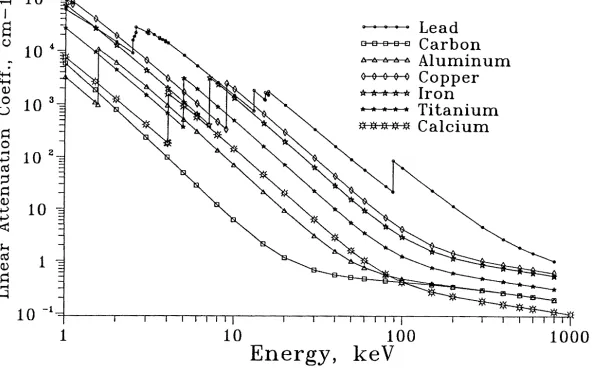
fact that elements and compounds have characteristic x-ray attenuation as a function of x-ray
energy is shown in Fig. 1.1, and, that the rule-of-mixture holds for x-ray absorption
measurements. This technique permits us to measure material composition in materials having
two or more components. The energies have to be chosen because of the energy dependence of
the elemental linear attenuation coefficients. For photon energy below 100 keY there is an
important contribution to the attenuation coefficient from the photoelectric process, which leads
to a strong dependence of the attenuation coefficient for each element on the atomic number, Z.
At much higher x-ray energy, up to approximately 10 MeV, Compton scattering dominates.
This energy range gives sensitivity, not to atomic number, but to the density of the material [9].
Previous work [16] to measure quantitative resin contents in graphite-epoxy composite
using a x-ray radiography film technique has demonstrated that the technique is inaccurate.
Martin concluded that x-ray films have insufficient sensitivity to detect a small change in
composite density. In addition to this, the x-ray attenuation coefficients of graphite and
epoxy-resin are similar at all energies, so there is not enough contrast in the two material coefficients
to detect the differences on films.
It has been suggested that measurements just made above and below the photoelectric
absorption edge of a selected element would greatly enhance the contrast both in
film-radiography [2,12] and in tomography [23]. Rudich et al. [25] developed a high flux x-ray
tube for high output operation at 6 -25 ke V range for inspection of light elements such as
..--4
10
5I
s
C)-.
~ ~ Q.)10
40
10
3u
~
0
:;i
10
2cd
~
~
2
10
.p..)
<
~ cd (J.) ~ •1""'4 ....:I1
1
· · · Lead
o a a a o
Carbon
6 6 6 6 a
Aluminum
o o o o o
Copper
*
* * *
*
Iron
• • • • *
Titanium
~ }(( }(( )i(
*
Calcium
10
100
Energy, keV
Figure 1.1. Linear attenuation coefficients of several elements
[image:11.792.110.703.59.435.2]the photoeletric absorption K-edges, to increase the contrast and resolution to improve flaw
detection. But the locations of the K-edge for carbon, aluminum and calcium are below 5 keV,
thus such a technique is not feasible. In addition, care must be taken when working near the
absorption edge of elements. Kerur et al. have shown that the rule-of-mixture breaks down
when measurements were made at about 471 eV near the K-edge for chromium (8].
The main problem encountered when inspecting light elemental material such as
graphite-epoxy composite is that the x-ray attenuation coefficients of graphite-fibers and
epoxy-resin are similar, as both materials have same basic elemental composition of carbon polymers.
Even then, single energy measurements by Shull et al. have shown promise in quantitative
characterization of porosity in graphite-epoxy composites [26].
The energy-dispersive method has been used in clinical studies for measuring bone
mineral and bone density [5,17, 18,21]. All these studies were made with radioisotope x-ray
sources. This restricted the choice of energies used in this energy-dispersive method. This
problem can be addressed by the use of a x-ray generator and monochromator to select the
desired energies. The use of a monochromator reduces the radiation dosage directly from the
x-ray generator. Our study focus on the choices of x-x-ray energies by using a x-x-ray generator, but
we will not address the use of a monochromator. Instead, the energy discrimination and
resolution are resolved with the use of a germanium detector coupled to a multichannel
analyzer.
1.3 Scope of the research
The purpose of this work is to develop a nondestructive evaluation technique by using
x-rays that can quantitatively determine material composition, for material characterization, in
composites. Such information can then be used to estimate the material properties such as the
7
The fact that elements and compounds have characteristic x-ray attenuation that depends
on x-ray energy makes x-ray a natural tool for material characterization. Indeed, the advantages
of this energy-dispersive technique over other x-ray detector systems such as fihns and
fluoroscopy are its increased sensitivity to photon energy and photon intensity. The technique
presented in this thesis work uses a germanium detector coupled to a multichannel analyzer that
allows us to measure the photon intensities and photon counts with respect to energies.
Therefore there is an abundant choice of energies for selection.
X-ray transmission methods can not distinguish the sequencing in which the
components are ordered in a composite product. Thus, in this thesis, the word composite will
not strictly refer to engineered structural composites such as graphite-epoxy composites or
metal-matrix composites. We will restrict ourselves to studying two-component composites,
and we will refer the word composite to any material that has two or more components.
Tirree composite samples studied in this thesis fall into three categories of general
interest; they are: ( 1) a composite system of two materials with similar elemental compositions
and material densities represented by graphite-epoxy composite, (2) a composite system of two
materials with different elemental compositions and material densities represented by bone and
Plexiglas, and (3) a composite system of two materials having approximately the same
elemental compositions with different material densities represented by aluminum 2024 and its
corrosion component. aluminum hydroxide.
The first composite system in this study is a composite of graphite-fibers and
epoxy-resin matrix. Both materials have carbon as their main chemical constituent. Thus their x-ray
linear attenuation coefficients are expected to be similar. The purpose of this study is to
detennine the sensitivity of this technique to measure the material variation in the composite
samples for detennining their fiber-to-resin ratios. Graphite-epoxy composites are increasingly
metal alloys. Due to manufacturing variability graphite-epoxy composites often contain material
variation in fiber-to-resin ratio. This defect affects the mechanical strength of the composite.
This problem is addressed in this work and x-ray method is developed to measure the
non-unifonnity in composites.
The second composite system is a composite of bone and Plexiglas. We have used
Plexiglas to simulate human tissue. Bone is essentially made of calcium phosphate and
hydroxyappatite, while Plexiglas is made of acrylic; thus the x-ray attenuation coefficients and
material densities are different for the two materials. The bone-Plexiglas composite samples are
used to simulate osteoporosis in a human bone. Osteoporosis is a common bone disease in
adults, where, the bone can lose as much as 40% density [21]. Osteoporosis usually results in
loss of bone material, weakening the bone-strength. Although the osteoporosis usually takes
months or years, early detection of bone loss can in many cases give information to avoid
physical stresses that can result in bone fracture. The purpose of this study is to evaluate the
sensitivity of this energy-dispersive technique in detecting the onset of osteoporosis by
detecting the changes in bone density.
The third composite system is a composite of aluminum 2024 metal alloy and its
corrosion product The x-ray mass attenuation coefficients for the metal and its corrosion
product are essentially the same, but the linear attenuation coefficients are different for the two
components because their densities are different Metal corrosion is of interest in this work,
because metal corrosion is a growing concern in aging aircraft. The purpose of this portion of
the study is to detect small loss in thickness using this x-ray technique. This information will
help detennine the sensitivity attainable using through transmission as a preliminary evaluation
for the on going future development of a scatter energy-dispersive technique. The
back-scatter technique can be used as an in-service technique for the detection of metal corrosion in
9
The theory of this energy-dispersive technique is presented. The equations described
will be used for the calculations of the results. Since this technique is energy dependent, an
optimization study is conducted to help select the two energies of choice for each of the
composite systems studied. The error estimation is include as part of the optimization study
because it predicts the uncertainties in our experimental measurements. The instrument
verification and experimental procedures are then described. X-ray beam collimation for the
detector and generator will be presented. and their significance will be discussed. This will be
followed by linear attenuation measurement procedures for solids and powers. A novel
technique was developed in this study to measure the linear attenuation coefficients of
powders. Then we will present sample descriptions of the three composite systems we have
mentioned earlier. This is followed by the results and discussions of the experimental
measurements. Experimental material characterization to measure thicknesses and densities of
the components in the composites are presented. Predicted and experimental results are then
2. THEORY
2.1 Introduction
The physics upon which this technique is based depends on the fact that the x-ray
attenuation is a function of both the photon energy and the elemental composition of the
material. When a well-collimated narrow beam of photons passes through a homogeneous
sample of thickness L, the ratio of the transmitted beam intensity I, emerging from the target
along the incident beam direction, to the incident beam intensity 10 is given by Lambert's law,
I
_!!. = exp(!lL)
I (1)
This equation assumes that no scattered photons reach the detector, and ll is the linear
attenuation coefficient of the element (ll has unit of cm-1 ). The linear attenuation coefficient is
related to the mean-free-path t by the expression
(2)
The mean free path of a photon, of a given energy traveling in an element, is the
average distance that the photon can travel without interacting with the element. The mass
attenuation is an alternate expression for the attenuation coefficient of an element. The mass
attenuation coefficient ~ ( ~ has unit of cm2/gm), involving the density p, is given by the
expression,
,,
I
l
I~
i.ll
: J
L
t
h
!
,,11
(3)
When the material consists of a chemical compound or of a homogeneous mechanical
mixture such as a composite, the linear attenuation coefficient is given by the weighted sum of
the linear coefficients of the components. This is known as the rule-of-mixture. Thus,
(4)
where ~ is the linear attenuation of the i-th element and wi is its proportion by weight For a
chemical compound with the chemical formula (Zl)a1(Z2)a2 ... (Zn)an, where Zi's are the
atomic number of the elements, the weighting factor for the i-th element, Zi, is given by
(5)
where Aj's are the atomic weight of the element, and aj's are the number of atoms of the
element in the chemical formula [10].
By using Lambert's law and the rule-of-mixtures, we can obtain sufficient information
to determine the constituent materials of the composite by measuring the attenuation of the
initial x-ray beam at a number of selected energies as the beam passes through the composite.
Therefore, the x-ray attenuation in materials can be expressed in the following general form
using Lambert's law and the rule-of-mixtures,
''
!
(6)
where i denotes the components in the composite, and j denotes the energies at which the
parameters are measured. 10(Ej) is the incident beam intensity, I(Ej) is the transmitted beam intensity, Xi is the thickness of component i, and J.l.i(Ej) is the linear attenuation coefficient of
component i measured at Ej.
We need a minimum of two energies to study a two component composite. This gives
us the following two equations,
(7a)
(7b)
where
(8)
The linear attenuation coefficients for elements, or compounds, can be either obtained
from experimental measurements or can be obtained from XCOM predictions [3]. Then, by
taking the attenuation measurements of the initial beam at selected energies, we have sufficient
13
XI = ~(El) 112 (E2)-~(E2) 112 (El) . llt(Et) 112(E2)-!lt(E2) ll2(E1)
x
2 = ~CE2) !11 (Et)-~(Et) llt (E2) llt(Et) Jl2(E2)-!lt(E2) !l2(Et)
(9a)
(9b)
Though the work presented here studies two component composites, this does not
exclude the capability of this x-ray technique for studying composites with more than two
components. To study such composites, one needs to measure the attenuation of the beam at
more energies along the x-ray spectrum according to the number of components.
In making these measurements one has the choice of energies to use. There are many
constraints such as x-ray penetration through material, measurement time and maximum energy
of the x-ray source that may influence the energy selections. Thus within these constraints, one
wishes to optimize the accuracy of the thickness detennination. In next section we will derive
the expressions for quantitatively assessing the accuracy of the technique outlined above for a
two component composite.
2.2 Optimization of energy choices
The energy dependence of this technique makes it necessary to define an optimum
energy pair for a two-component composite. An optimum energy pair in Eq.9 will give the
minimum uncertainty for the calculated thicknesses, Xi's. We can derive an expression from
Since this dual energy technique is based on calculating the material thicknesses using
the linear attenuation coefficients of the materials, any source of error in the linear attenuation
coefficients will appear ultimately as error in the thickness determinations. Therefore, we will
first derive an expression to evaluate the uncertainty in the experimentally measured linear
attenuation coefficients. The expression for calculating the linear attenuation coefficients is
given as,
(10)
In general, in error-propagation analysis we do not know the actual errors in any of the
parameters used in the calculations. What we may know instead is some characteristic of the
uncertainty or estimated error of each parameter, such as the standard deviation for each
parameter. The statistical derivation of the error-propagation analysis is found elsewhere [4].
The uncertainty of the measured linear attenuation coefficient, cr
11, can be expressed as the sum
of the uncertainties of photon intensity measurements and the caliper thickness measurement of
the absorbing material, as follows,
(ll)
,.,_• ·'·
15
(12)
We can also express the uncertainty of the calculated thicknesses from Eq. 9 as a sum
of the uncertainties of each of the parameters. Equations 9a and 9b are each a function of six
independent parameters. Hence, we can express the approximation for the standard deviation
for X 1 and X2 as,
(13a)
(13b)
Substituting the partial derivatives into Eq.13 and dividing by Eq. 9, we arrive at the
and,
(14b) where
We have shown in our previous study [27] that the uncertainties due to beam
fluctuations can be neglected when more than a million photons are counted. In our experiment
we integrated the incident and transmitted x-ray beam intensities over time to achieve high
counting statistics of over a million counts, and hence we ignored the uncertainties contributed
by the beam intensities in our analysis. The dominating fundamental source of error comes
17
these linear attenuation coefficient uncenainties are dominated by the caliper thickness
measurements of the absorber. Thus, out of the six original influencing parameters in Eq. 14,
we are left with four significant parameters in our error propagation analysis. These parameters
are the linear attenuation coefficients of the two materials at the two choices of energies.
The optimum energy-pair, predicted by the error-propagation analysis for the minimum
uncertainty, can be found when the two energies are farthest apart fonn one another, even for
cases where the linear attenuation curves intersect one another. The low energy should be
taken, if possible, where the difference in the linear attenuation coefficients is the greatest
between the two materials. This gives maximum contrast for discriminating between the two
materials. The high energy measurement should be made where the difference in the linear
attenuation coefficient between the two materials is the least. Measuring at the high energies
effectively detennines the total thickness of the composite, because the attenuation coefficients
of most materials are similar at these energies. Additional constraints in the choice of energies
are experimental constraints, such as the time required to accumulate high counting statistics
and the ability to accurately measure the attenuation coefficients at the two energies of choice.
Care must be taken in selecting the low energy, E 1, and high energy, Ez. The upper
ray energy of the optimum energy pair is naturally constrained by the power output of the
X-ray generator. In addition, measurements made in the upper x-X-ray energy range are constrained
by the contrast between the transmitted and incident beam intensities, which can be explained
through Eq. 11. At high energies the linear attenuation coefficients are low for all elements,
therefore the difference between the incident and transmitted beam intensities becomes small.
This means the value of ~ is small, and the uncertainty contribution due to 10 and I can be as
large as the uncertainty in the caliper thickness measurement: all this gives rise to large
uncertainties in the linear attenuation coefficient measurements. In contrast. at low energies, the
linear attenuation coefficients are large, consequently, the uncertainties due to the transmission
ratio are small. At low energies the uncertainty in the linear attenuation coefficient is sensitive to
the caliper thickness measurement, X. A large absorber thickness will minimize the uncertainty
due to caliper thickness measurements, but it may introduce low transmission beam intensities.
Thus, an absorber thickness should be chosen to closely approach the optimum transmission
ratio, (10/I), of 3 at the low energies [24].
•i
H
il19
3. INSTRUMENT CHARACTERIZATION
3.1 High-purity germanium detector
All the measurements made in this study have been perlormed using a High-Purity
gennanium detector (HP-gennanium detector) coupled to a multichannel pulse-height analyzer
(MCA). The HP-germanium detector is a semiconductor x-ray detector. The detector converts
x-ray photons into electrical pulses; the amplitude of the electrical pulse generated in the
HP-germanium detector is proportional to the x-ray energy deposited by the photons. The electrical
pulses from the germanium crystal are fed into a preamplifier and then to an amplifier that
boosts the amplitude of the pulse to a positive volt signal ranging from 0 to 10 volts. The
shaping time of the amplifier is set to 1 j.l.Sec to enable high counting rate. The output signal
from the amplifier is suitable for use with a multichannel analyzer. The MCA is initialized to
accept 5 keY to 160 keY with 2014 channels. This enables the MCA to monitor the pulse
counts for each channel number for a preset count time.
HP-germanium detector is unlike many other detectors because it is cooled to liquid
nitrogen temperature of 72 K. The inconvenience in maintaining this constant cryogenic
temperature is outweighed by the benefit of the energy resolution obtained from the germanium
detector. This sensitivity is not obtainable using x-ray detectors such as Nal or Csl. The
HP-gennanium detector has an energy discriminating resolution of 0.57 keY FWHM (Full Width at
Half Maximum) at 60 keY, as shown in Fig. 3.1, whereas the energy resolution of a common
x-ray detector such as Nal is about 5.4 keY FWHM for the same energy (see Fig. 3.2).
U)
+>
~
~
0
10000
Am 241
60 keV
u
~
0
+>
0
5000
,..q
~
0~~~~~~~~~~,~~~~~~~~~~TTTIIIIIIII
40.0
50.0
60.0
70.0
Energy, keV
[image:26.792.89.745.57.442.2]lfJ.
..,_~
~
~
15000
0 10000
u
~
0
..,_~
0
5000
~
~
Am 241
60 keV
Q~~~~~~~~~~~~IITTIIIIIIITTTIIIIIIn
40
50
60
70
Energy, keV
Figure 3.2. Sodium iodide detector resolution of Americium 241 isotope at 60 keV
-·-·" -- ---·-". ~·· -···· ·' ,.~- .
-- •. :
-~ ;::::::=~:~;;;<:~~:;;;;:~:=~¥~~r~~~~=:=~:2~~E3~~?~H;<~c?:~~i~;:(:":~=":=:::=. ~~
I
--.···~·-·-._
. . . ·.:_. ;.;;.:;::--:--. '~. '
[image:27.792.106.703.47.445.2]3.2 Collimators
Collimators in the experimental setup are used to define the narrow pencil beam
configuration that is necessarily assumed from Lambert's law. The collimation setup also
suppresses the background due to scattered x-rays from non-essential objects in the x-ray
vault. Thus the collimation defmes the volume of the object probed by the x-ray beam.
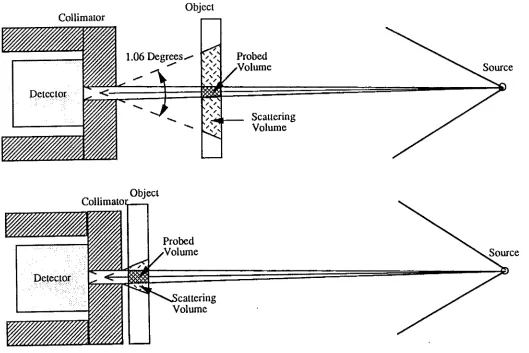
The HP-germanium detector is shielded in a quarter inch thick lead box as shown in
Fig. 3.3. A collimator hole of 350 micron diameter defines the diameter of the probed volume
on the sample. This also reduces the intensity of incident, and scattered, photons reaching the
detector. The detector collimation reduces the intake of scattered photons to be within a
cone-arc of 1.06 degrees, approximately.
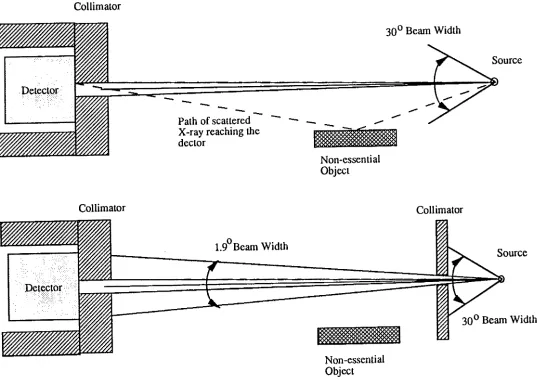
It is important to shield the non-essential objects, that would typically be illuminated by
the x-ray generator, scattering incident x-rays that may reach the detector. Non-essential object~
lying between the source and the detector are shielded from the beam by the source-collimation
as indicated in Fig 3.4. The source-collimator essentially eliminates x-ray scattering from
non-essential objects that would typically be illuminated by the x-ray source by reducing the
cone-beam from 30 degrees to 1.9 degrees. It is also important to note the presence of the
detector-collimator and the positioning of the object between the source and the detector; because, in
some cases the coherent and incoherent scattering may reach the detector, giving too high a
value for the transmitted intensity. The detector-collimator determines the volume of the object
probed. Even so, the detector also picks up signals of scattered x-rays from the
scattering-volume in the object. One can reduce much of this scattering scattering-volume by positioning the object
closer to the detector. A smaller collimation hole can equally reduce the scattering volume on
the object, but this would also proportionally reduce the incident X-ray beam intensity. If a
radioactive isotope source were used it would be necessary to balance the collimator size for the
detector while maintaining sufficiently high incident x-ray beam intensity for statistical
Object
Probed
Volume
[image:29.792.116.645.94.447.2]Scattering Volume
Figure 3.3. Detector collimation and its influence on the probed and scattered volume on
Collimator
-Path of scattered X-ray reaching the dec tor
1.9° Beam Width
-Non-essential Object
Non-essential Object
Source
-Collimator
30° Beam Width
[image:30.792.142.679.83.466.2]25
purposes. By using an x-ray generator as the source, we can overcome this statistical limitation
by increasing the current generating the x-ray beam.
3.3 Positioner and controller program
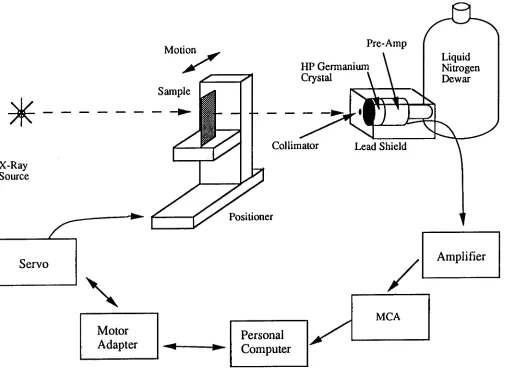
The block diagram of the experimental setup of the electronic communication between
the PC and the detector and positioner is shown in Fig. 3.5. The positioners (Daedallnc.) are
used to move the sample object during an experiment by precision stepper motors
(Compumotor Inc.). The motors are controlled with a DELL 386 PC using a Compumotor
PC-23 indexer board placed in the computer. The indexer board sends commands to, and receives
positioner status from, the motor adapter. The adapter in turns sends commands to the motor,
through a motor servo, instructing how much the motor should rotate for a given travel
distance. The stepper motor has stepping resolution of l 00,000 steps per inch. This gives us a
precision if 10 1.1. inch to move the sample back and forth on the positioner.
A typical experimental measurement in this study takes up to 24 hours to acquire
sufficient statistics of over a million counts for the beam intensities, I and 10 . By moving the
object in and out of the x-ray beam, the program can monitor the x-ray beam instability over
time. The two beam intensities are integrated over time to obtain the transmission ratios.
Therefore a controller program was developed to automatically move the sample on the
positioner in and out of the x-ray beam at preset time intervals to collect the transmitted and the
incident beam intensities, respectively. The controller program was developed to allow the
operator to interactively create an energy bin array with tailored energy bin sizes. The
positioner movement and data acquisition from the MCA are controlled using the PC with a
C++ driver program called "MCA_2."
;.
Sample
*---~
X-Ray Source
Servo
--
-Motor
Adapter
...
Personal ComputerFigure 3.5. Germanium digital detector instrumental setup
Dewar
Amplifier
/ L . - - - - . - - - 1
[image:32.792.133.643.67.438.2]27
.1,_4 X-Ray source
The x-ray source used in this work is a Ridge HOMX 160A microfocus generator with
a 10 micron focal spot size approximately. The generator provides a Bremsstrahlung spectrum
to measure the attenuation coefficients. The energies of the spectrum are resolved using the
MCA. The generator is capable of operating at energies up to 160 ke V and with beam currents
of up to 2 mA. It should be mentioned that this energy sensitive technique was also
successfully demonstrated with the use of radioisotope sources [27]. Therefore the microfocus
capability is not a required feature for the x-ray generator; indeed, any radiation sources could
have been used for this study.
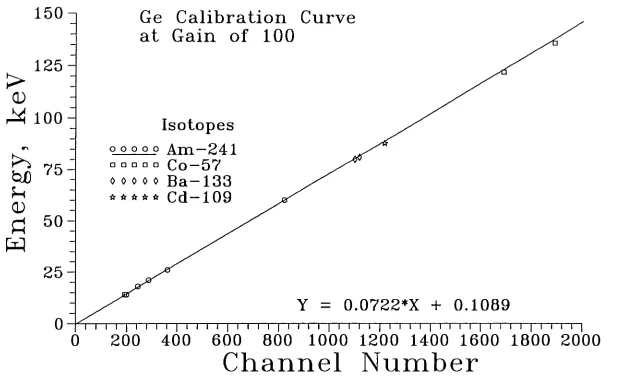
3.5 HP-Germanium digital detector calibration
Calibration of the HP-gerrnanium digital detector with the MCA setup is necessary to
correlate the MCA channels to the x-ray energies. We used radioactive isotopes to calibrate the
detector system. Radioactive isotopes emit well-defined x-ray energies and these energies show
up as sharp peaks on the MCA spectrum. Thus, a linear detector calibration curve can be
developed with sufficient number of radioactive isotopes as plotted in Fig 3.6. The present
energy sensitivity of the MCA in this study is 12 channels per keV.
3.6 Amplifier pile-up reiecter
X -ray spectral distortion is often found during high counting rates. This spectral
distortion caused by signal pile-up usually occurs when two or more x-ray photons strike the
detector at close time intervals. In such instances, the germanium detector electronics is unable
to resolve each signal generated by the photons. Thus the electrical signals are summed into
one larger signal. This count rate limitation is strictly related to the number of input counts per
125
>
Cl)~
100
25
at Gain of 100
Isotopes
o o o o o
Am- 2 41
o o o o o
Co-57
ooooo Ba-133
*****
Cd-109
Y
=
0.0722*X
+
0.1089
o~~~~~~~~~~~~~~~~~~~~~~~~~~
0
200
400
600
800 1000 1200 1400 1600 1800 2000
Channel Number
Figure 3.6. HP-Germanium digital detector calibration curve
N
[image:34.792.91.721.62.445.2]29
Bremsstrahlung spectrum will show more photon counts at higher energies than in reality. This
is a problem because this x-ray energy-dispersive technique is energy sensitive. The Canberra
amplifier used here has an efficient pile-up rejecter (PUR). The PUR provides an output logic
pulse for the associated multichannel analyzer to suppress the spectral distortion caused by high
-. ~ ' .. ; . '
rn
~
60000
§
40000
0
u
~
0
~
0
s:
20000
Without PUR
With PUR
Difference
o4+~~~~~~~~~~~~~~~~~~
0
10
20
30
40
Energy,
50
60
Kev
Figure 3.7. The influence of pile-up-reject on MCA spectrum
31
4. SAMPLE DESCRIPTION
4.1 Introduction
Three different composite systems were investigated in this study. The first composite
system is a graphite-epoxy composite, consisting of two materials, graphite-fibers and
epoxy-resin, having very similar elemental compositions and densities. The second composite system
is a bone-tissue composite, consisting of two materials having very different elemental
compositions and densities. The third is a composite system of aluminum 2024 metal and its
corrosion product composed of two materials with similar elemental composition, but very
different densities. The following subsections describe the materials used in the composites and
the quantitative composition of each of the components used in the composite samples.
4.2 Graphite-epoxy composite
Graphite-fiber-reinforced-epoxy composite (graphite-epoxy composite) is increasingly
replacing metal alloys because the selective directional strength of the composite can be tailored
to match the required strength performances for load bearing; while, at the same time, the
composite material is lighter than metal alloys having comparable strength.
The graphite-epoxy composite used in this study is made from Magnarnite 8551-7
uniaxial prepreg sheets manufactured by Hercules Inc. This composite is considered to be the
next-generation composite because this amine-cured epoxy-resin is doped with micro-spheres.
This makes the composite more impact resilient The graphite fiber in Magnamite 8551-7 is a
synthetic polyacrylonitrile (PAN-based) graphite fiber known as IM-7 fiber. Samples of
neat-epoxy-resin were provided by Hercules Inc. for linear attenuation coefficient measurements.
We were also able to obtain some graphite fibers, but the graphite fibers have diameter of 5
'
''·
:I
~m, and this made the linear attenuation coefficient measurement difficult. The determination of
the linear attenuation coefficients for the materials is deferred to Section 5.
A sample of Magnamite composite was fabricated at Iowa State University's
Aerospace Engineering and Engineering Mechanics departmental composite laboratory. The
lay-up and curing procedure for the Magnamite composite follows that described in the
International Encyclopedia of Composites [13]. The composite lay-up is 0/90 with a total of 23
layers. The final thickness of the composite is 0.457 em after curing.
A coupon from the Magnamite composite, size 2.5 em by 2.5 em, by 0.457 em thick,
is analyzed to determine the effective total thickness of the IM-7 fibers and epoxy-resin in the
23 layers. This was needed for comparison with the x-ray measured thickness values. A corner
of the composite coupon was chosen for analysis. The assumptions are that the fiber-to-resin
ratio variation at the localized corner of the coupon is small, and that the fibers are
perpendicular to the side-faces of the corner.
The two adjacent surfaces to the corner were polished to produce surfaces that exposed
the ends of the fibers. We took black-and-white photomicrographs at layers that have exposed
fiber-ends. The photomicrographs are taken at a magnification of 300. Two arrays, of 6
columns by 12 rows, and 6 columns by 13 rows, of photomicrographs are taken of the two
polished surfaces on either side of the selected corner. The two arrays covered an area of 0.310
em by 0.457 em, approximately, on either side of the corner.
An image processing technique is used to detennine the fiber-to-resin ratio in each
photomicrograph. The black-and-white photographs are digitized using a camera-digitizer; the
image is acquired through a PC based image acquisition software. The digitized data are
transferred to an image analysis software based on a Macintosh computer. A black-and-white
thresholding technique is used to determine the fiber-to-resin ratio in each photomicrograph.
The fiber-to-resin ratios ofthe micrographs are averaged in 12 columns in the thickness
1.
. '
33
direction. The variation in the fiber-to-resin ratios is 1.4% across the 12 columns. This verifies
that the fiber-to-resin variation is indeed small in a localized region for this composite coupon.
The averaged percentage of fiber and resin, by area, for the 12 columns is 55.5% and 44.5%
respectively. Thus the effective total thicknesses for graphite IM-7 fibers and epoxy-resin are
0.254 em and 0.203 em respectively.
The fiber-to-resin ratios in the composite samples are varied by adding known
thicknesses of neat-epoxy-resin to the composite coupon. The compositions of the samples are
shown in Table 4.1.
Table 4.1. Composition of graphite-epoxy composite samples
Total thickness of Total thickness of
Composite# Fiber-to-resin ratio epoxy-resin , em fiber, em
1.249 0.203
±
0.008 0.254±
0.0082 1.025 0.248 0.254
3 0.989 0.257 0.254
4 0.908 0.271 0.254
5 0.803 0.316 0.254
6 0.704 0.361 0.254
7 0.515 0.493 0.254
4.3 Bone-Plexiglas composite
In this part of the work, we applied this x-ray energy-dispersive technique to evaluate
its sensitivity for detecting the onset of osteoporosis. Osteoporosis is the most common of all
bone diseases in adults, especially in old age. Usually in osteoporosis the osteoblast cell
activity is less than normal, and consequently the rate of bone deposition is depressed. Thus in
osteoporosis the rate of bone loss is greater than the rate at which bone is deposited, this gives
an over all net loss of bone material. Osteoporotic process is typically slow, occurring over
periods of months or years, thus the variation due to bone loss can be very small. Early
detection of bone loss can give information ro avoid physical stress that can result in bone
fractures.
If we classify the body parts of a human in terms of their respective densities. we can, in general, view the human body as a two component composite consisting of bone and
soft-tissues (flesh). ln this study we wish to determine the thicknesses of flesh and density of bone
in our samples using this x-ray energy-dispersive technique for detecting the onset of
osteoporosis.
We made our own samples to simulate body parts of a human subject We used dense
bone samples from a cow to simulate human bone in our study. A cattle femur bone was cut to
produce parallel surfaces where the thicknesses are known. The density of the cattle bone
sample is 2.077 gm/cm3. This is determined from mass and volume measurements of the bone
sample. Plexiglas is used to simulate soft-tissue in this study. Plexiglas is chosen because it
will not decompose like meat at room temperature during our long data acquisition time. In
addition, Plexiglas is commonly used as a standard calibration material, for the same reason
mentioned above, in medical X-ray CAT scan to simulate soft-tissue.
Two sets of samples are made to simulate two different parts of a human patient. One
set of samples has the bone and Plexiglas thicknesses of 0.808 em and 0.925 em respectively.
This set of samples simulates the fingers of the patient Another set of samples simulates the
calf of the patient The thicknesses of the second set of samples of bone and Plexiglas are
2.400 em and 1.834 em respectively. Two sets of samples were investigated to determine the
accuracy of this x-ray technique to detect the onset of osteoporosis on different body parts with
different thicknesses. During osteoporosis, the outer diameter of the bone does not change;
only the density of the bone changes. Similarly, then. we can have the outer dimensions of the
.':}
35
Table 4.2. Composition of bone-Plexiglas composite samples
% Osteoporosis Bone density, Thickness of Thickness of Sample# (% bone loss) gm/cm3 bone, em Plexiglas, em
a) Sample set 1
1 0.0 2.077 0.808
±
0.001 0.925±
0.0012 20.4 1.653 0.643 0.925
3 27.9 1.496 0.582 0.925
4 34.6 1.358 0.528 0.925
b) Sample set 2
1 0.0 2.077 2.400
±
0.001 1.834±
0.0012 34.6 1.358 1.569 1.834
3 46.9 1.102 1.274 1.834
4 56.5 0.903 1.044 1.834
5 68.6 0.653 0.754 1.834
removing known thicknesses of bone from the samples, we can effectively change bone
density, simulating osteoporosis. The density samples have compositions shown in Table 4.2.
In our study, we assume that we can obtain the total cross-sectional thickness on a
body part of a patient by a caliper. There can be a simple caliper-like mechanism that measures the thickness of the body part whilst the same mechanism holds the body part steady during
x-ray measurements. Thus the total thickness of the body part, X total• is given as,
(15)
where Xb and Xf are the thicknesses of bone and flesh respectively.
For the purpose of measuring the bone density, we can express Lambert's equation
(16)
where ~(Ei) is the beam attenuation measured at energy Ei. llf (Ei) is the linear attenuation
coefficient of flesh, measured at energy Ei, Xf is the thickness of flesh, jlb(Ei) is the mass
attenuation coefficient of bone measured at energy Ei, and tb is the area-weight of bone
(area-weight has units of gm/cm2). We can use Eq. 16 in the same way as the dual energy technique
described in Section 2. Instead of obtaining the thicknesses of Plexiglas and bone from the
calculation, we detennine the thickness of Plexiglas and the area-weight of the bone. We can
then subsequently determine the density of the bone, Pbone• using the following equation,
't
p
=
b
bone
X
1
- Xf
tota
(17)
4.4 Aluminwn-aluminum corrosion composite
NDE techniques are ideal for detecting corrosion during aircraft maintenance because
access to corroded areas is frequently limited or impossible due to intervening structures.
Corrosion is a concern in aircraft skin of aging aircraft that are still in use. Aircraft skins are
generally made of 2024 aluminum alloy sheet metals that are 40 mils thick. The goal of this
portion of the work is to detect the material loss of less than 10% in aircraft aluminum skin
using this energy-dispersive technique. NDE inspection techniques are often conducted from
one side of the structure- the outer surface of the aircraft. Although, this x-ray
energy-dispersive technique requires access to both sides of the aircraft skin structure, the long tenn
goal is to develop a Compton backscatter technique for quantitative determination of corrosion.
'·
37
Table 4.3. Composition of aluminum-aluminum corrosion composite samples
Aluminum Aluminum % Material loss 2024 thickness hydroxide thickness SamEle# in Al2024 (mils) (mils)
1 0.0 40.00±0.50 0.0
2 1.3 39.50 0.50 ± 0.50
3 3.8 38.50 1.50
4 5.5 37.80 2.20
5 6.5 37.40 2.60
6 10.0 36.00 4.00
7 15.0 34.00 6.00
8 23.8 30.50 9.50
9 26.3 29.50 10.50
10 36.3 25.50 14.50
II 38.8 24.50 15.50
12 50.0 20.00 20.20
Therefore, it is desirable to determine the sensitivity attainable using a more conventional
transmission set up before implementing a more complicated backscatter technique.
Aluminum 2024 metal and its corrosion product can be viewed as two materials in a
composite system. The composition of aluminum 2024 alloy consists of 93.6% AI, 4.4% Cu,
0.5% Mn and 1.5% Mg [15]. The corrosion process of aluminum 2024 is simply the oxidation
of the aluminum metal. We assume that the corrosion product is formed under a basic pH
condition, thus the corrosion product can be approximated by aluminum hydroxide (Al(OH)3).
In this study, we made our own aluminum-aluminum corrosion samples having the
composition shown in Table 4.3. The corrosion simulation samples are made by machining
away a channel 0.5 inch wide and 0.5 inch long of known thickness of aluminum 2024 metal
from a total thickness of 40 mils. A microscope cover-glass is glued over the face of the
"!
'
I
channel. Then, the space beneath the cover-glass is ultrasonically packed with aluminum
hydroxide powder. The thickness of the cover-glass is approximately 8 mils. During beam
attenuation measurements on the corrosion samples, another cover-glass with identical
thickness is used to attenuate the incident beam. This is done to compensate the attenuation
39
5. LINEAR A ITENUA TION COEFFICIENT MEASUREMENT
5.1 Linear attenuation measurement for solids
In its passage through a material, a beam of photons may as a result of interactions be
either absorbed or scattered. There are three types of interaction in the typical range of energies
found in x-ray NDE inspection (10-350 keY): photoelectric absorption, elastic scattering
(Raleigh scattering) and inelastic scattering (Compton scattering). A combination of such
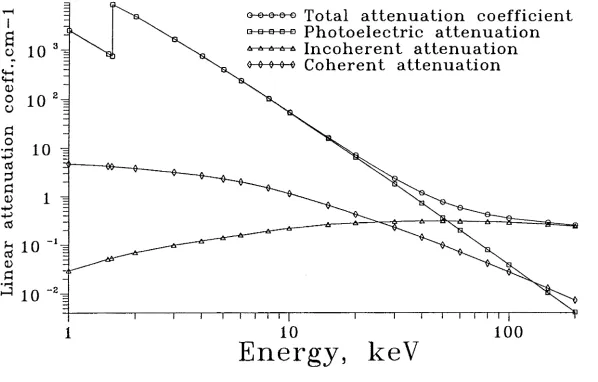
interactions gives the total linear attenuation coefficients as shown in Fig.5.1. Absorption may
be thought of as the disappearance of a photon from the beam, and scattering as a combination
of absorption and emission. The details of these processes can be found in the literature [Y].
The total attenuation coefficient of a material is then the probability that a photon being removed
from the beam in the absorber, and they are a function of energy.
One can measure the linear attenuation coefficient at a particular energy by using
radioactive isotope sources. By plotting the transmitted beam intensity as a function of
thickness, at a particular energy, one can obtain the linear attenuation coefficient by curve
fitting an exponential line to the data. Figure 5.2 shows a plot of transmitted beam intensities
through aluminum as a function of thickness for three different isotope energies. The
exponential slopes are the linear attenuation coefficients for the three energies. This process of
measuring attenuation coefficients is tedious. The linear attenuation coefficients can be
measured much more easily and quickly using a Bremsstrahlung source and a germanium
detector. One can obtain a continuous linear attenuation coefficient curve across the x-ray
spectrum with a single measurement for the incident and transmitted beam intensities. The
experimental setup for this measurement was described in section 3.1.
~~
:
tj I: I ~ : :;
. '. t (\
:'if
\rf
' ~
§
10
3~
.
~ ~
Q)
0
10
2C)
1
Figure 5.1.
--..
~·~·~ ... -.. -.. ---··· .
6 6 6 6 .e.
Incoherent attenuation
o
11 11o
~Coherent attenuation
10
100
Energy, keV
[image:46.792.102.700.76.458.2]·, ··. \,:
10
5Isotope, Energy
ooooo
Co-57 (122+136 keV)
ooooo
Cs-137 (662 keV)
6 6 6 6 6
Ba-133 {81 keV)
10
43
0.0
1.0
2.0
3.0
4.0
5.0
Thickness of aluminum,
Figure 5.2. Measured aluminum linear attenuation coefficients using radioactive
isotopes
--·--· --·--· . . ··~ ... ·-- . ·-·· ... .. . -- .
-__
,"7:::~~;-::~~,~~:1.2::::2~~f~x~••?#tftE~~:~:_~;c_;::;;.s:~:::::·:=:~-;
__ _
6.0
em
We have relied on the values for linear attenuation coefficient measured by us because
there are differences in the values of attenuation coefficients in the literature [ 11 ]. Typical
referenced attenuation values have uncertainties of 5% to 10% [ 19]. Deslattes has suggested
that one should not rely on international tables for attenuation coefficients to better than 10%
[6]. In addition, it is important that the transmission attenuation measurements be made with
the same experimental setup as for the beam attenuation coefficient measurements. This is
because differences in beam attenuation due to beam geometry can greatly effect the energy-dispersive measurements. In particular, one should not use "broad" beam attenuation
coefficients for calculation with "narrow" beam transmission measurements, and vice versa.
In accordance with Lambert's law, the experimental setup requires narrow
"pencil-beam" geometry, i.e., both the source and detector being well collimated. The positioning of
the absorber immediately in front of the detector was chosen because it effectively minimized
the scattered radiation, from the absorber, from reaching the detector. Thus the accuracy of the
linear attenuation coefficient and beam attenuation measurements, for the absorber will be
dependent on how much of the small angle scattering is registered as part of the transmitted
beam intensities.
The collimated x-ray beam is recorded with the HP-germanium detector connected to a
multichannel pulse-height analyzer. The absorber was placed between the x-ray source and the
detector, with the absorber surface perpendicular to the x-ray beam. If a thick absorber is placed in the beam, the transmitted beam intensity will be low and a relatively long time will be
required to accumulate sufficient counts. In fact, for undesirable low transmissions, the
magnitude of the transmitted beam may be comparable to the background. On the other hand, if
a very thin absorber in used, the transmitted beam intensity approaches that of the incident
beam intensity, and the transmission ratio becomes unfavorable. In our experiment some
intermediate transmission ratio was employed. The absorber thickness was chosen to give a
43
transmission (lofl) value of 1.1 to 5, thus closely approaching the optimum attenuation
condition with transmission ratio of 3 [24].
The value of the linear attenuation coefficient was calculated using the caliper measured
thickness of the absorber, according to Eq. 10. A correction for air displaced by the absorber
thickness is negligible for solid absorber, because the magnitude of the air attenuation is
negligible compared to the solid. Rather, the main uncertainty in our linear attenuation
measurements is from measuring the thickness of the absorber specimens using a caliper. From
equation 12 we find that the uncertainty in the absorber thickness is the dominating term for
low energy X-rays, because the transmission ratio is high at these energies. On the other hand,
the contribution due to the absorber thickness and beam intensity measurements can be nearly
equal for high energy X-rays when the transmission ratio is small at these energies [7].
A series of measurements with the absorber in and out of the beam was taken to obtain
the transmitted beam and incident beam intensities respectively. Each set of intensities was
recorded for a preset live-time at an averaged count rate of 8 kHz or less. Figure 5.3 indicates
the measured attenuation coefficient is slightly count rate dependent. This observation was also
made by Gerward in his attenuation measurements [7]. Thus the detector system is operated in
the upper-most linear region of the detector count-rate curve, at about 8 kHz as shown in Fig.
5.4. The stability of the X-ray generator is monitored with the scanning program "MCA_2."
The results of our measurements did not indicate any fluctuations larger than those that can be
accounted for by the usual Poisson statistics. The background correction in the data was not
required in our attenuation measurements, because the background radiation is registered in the
incident and the transmitted beams. Therefore the background radiation will be subsequently
2 3
Intensity, Io
ooooo
7,500 Hz
o s s e o
10,000 Hz
6 6 o 6 c.
15,000 Hz
o
0 0 0o
30,000 Hz
* * • •
*
XCOM
7 8 g
10
100
Energy, keV
N100
9~ ~
~
6""
()..)
+>
cO
~
2"'
+>
109
~
0-.
7 8+>
6~
50
4~
3u
2~
1
1
30 keV
60 keV
90 keV
1:1 Input/Output ratio
5 6 7 8 9 2 3 4 5 6 7 6 9
10
100
Pulse Input, Rate, kHz
5.2 Linear attenuation measurements for powders
There is an intrinsic difficulty in determining the attenuation coefficient of powders
because it is difficult to determine the thickness that should be used in calculating attenuation
coefficients. In this thesis work, we have developed a novel technique to measure the
attenuation coefficients for the powders. The powder is first ultrasonically packed into a glass
vial. The glass vial was thin and the diameter of the vial was uniform. A thin glass vial
attenuates less than a thick glass vial; thus one can maintain the high counting statistics in the
transmitted x-ray beam. We calculated the packed density of the powder by measuring the mass
of the powder in the vial and the volume of the vial. Then by taking an identical glass vial of
the same dimensions, we measured the incident and transmitted x-ray beams through the empty
and packed vials, respectively, to obtain the transmission ratio.
The major uncertainties for the linear attenuation coefficient measurements for the
powders come from the caliper measurements of the inner diameter of the vial and the
packed-density of the powder in the vial. The inner diameter of the vial is used to calculate the linear
attenuation coefficient of the packed powder. Thus we encounter the similar caliper thickness
uncertainty as we did for measuring the attenuation coefficients for solids. In addition to this,
we also have uncertainty due to the packed density measurements. It is also possible that the
packed density of the powder in the vial is non-uniform. Therefore care must be taken in
making the dimensional measurements for the linear attenuation calculations.
5.3 Experimental linear attenuation coefficient measurements
5.3.1 Graphite-epoxy composite
There is no published linear attenuation data for the composite IM-7 fibers. This is
because the individual fibers are only 5 microns in diameter. Therefore, we are not able to
47
described in section 5.1. It is difficult to measure the total thickness of a bundle of fibers to
calculate the linear attenuation coefficients. Although we can generate the mass attenuation
coefficients for the IM-7 fiber based upon its chemical composition using XCOM, we do not
know the density of the IM-7 fibers; therefore we can not convert the mass attenuation
coefficients to the linear attenuation coefficients. Therefore, an indirect technique has to be used
to determine the linear attenuation coefficients for the IM-7 fibers. The indirect method uses the
linear attenuation coefficients of epoxy-resin and the beam attenuation of the characterized
Magnamite composite coupon to extrapolate the linear attenuation coefficients of the IM-7
fibers, using Eq. 7. The extrapolated linear attenuation coefficients for the IM-7 fibers and the
measured linear attenuation coefficients for epoxy-resin are tabulated in Table 5.1, and they are
plotted in Fig. 5.5.
We were able to obtain three woven composite samples of IM-7, AS4 and Carbolon,
graphite fibers. IM-7 and AS4 are PAN-based graphite fibers, which differ with Carbolon,
which is a pitch-based graphite fiber, as defined based on manufacturing technique. The fibers
are essentially carbon based fibers with slightly different elemental compositions. The
pitch-based graphite fibers are derived from petroleum carbon polymer precursors, while the
PAN-based fibers are made from synthetic carbon polymer precursors. The fibers can differ in fiber
density, even among the PAN-based fibers. Although we are still unable to determine the
effective total thickness of the fiber in the bundles of woven fiber samples, we did measure the
effective-attenuation coefficients for the three graphite samples. This is a measure of the
transmission ratio divided by the thickness of the fiber bundle. The thickness includes the air
space between the woven fibers.
We determined the degree of confidence in our extrapolated linear attenuation
coefficient for IM-7 graphite fibers by dividing it by the effective-attenuation coefficients of
each of the three fiber samples. The slopes of the ratios, as a function of energy, would be
;
lr~: ···~
jl:
j. . '
:· ·' ,-{