3-1-1990
Relations between elastic constants Cij and texture
parameters for hexagonal materials
Yan Li
Iowa State University
R. Bruce Thompson
Iowa State University
Follow this and additional works at:
http://lib.dr.iastate.edu/ameslab_pubs
Part of the
Engineering Mechanics Commons
,
Materials Science and Engineering Commons
,
and the
Structures and Materials Commons
The complete bibliographic information for this item can be found at
http://lib.dr.iastate.edu/
ameslab_pubs/4
. For information on how to cite this item, please visit
http://lib.dr.iastate.edu/
howtocite.html
.
Relations between elastic constants Cij and texture parameters for
hexagonal materials
Abstract
Ultrasonic techniques have recently been applied to the texture characterization in polycrystalline aggregates
of hexagonal crystals. The basis of this application lies in the relations between the elastic constants
ijof the
aggregates, which can be inferred from ultrasonic wave velocity measurements, and the orientation
distribution coefficients. This communication presents such relations for aggregates which possess
orthotropic material symmetry and hexagonal crystal symmetry for Voigt, Reuss, and Hill averaging methods
in a unified and concise representation.
Keywords
elastic constants, hexagonal lattices, polycrystals, agglomeration, texture, ultrasonic waves, elasticity
Disciplines
Engineering Mechanics | Engineering Science and Materials | Materials Science and Engineering | Structures
and Materials
Comments
The following article appeared in
Journal of Applied Physics
67 (1990): 2663–2665 and may be found at
http://dx.doi.org/10.1063/1.345479
.
Rights
hexagonal materials
Yan Li and R. Bruce Thompson
Citation: J. Appl. Phys. 67, 2663 (1990); doi: 10.1063/1.345479 View online: http://dx.doi.org/10.1063/1.345479
View Table of Contents: http://jap.aip.org/resource/1/JAPIAU/v67/i5
Published by the American Institute of Physics.
Related Articles
Nondestructive characterization of a TiN metal gate: Chemical and structural properties by means of standing-wave hard x-ray photoemission spectroscopy
J. Appl. Phys. 112, 114501 (2012)
Obtaining material identification with cosmic ray radiography
AIP Advances 2, 042128 (2012)
Effect of macroscopic relaxation on residual stress analysis by diffraction methods
J. Appl. Phys. 112, 064906 (2012)
A multi-detector, digitizer based neutron depth profiling device for characterizing thin film materials
Rev. Sci. Instrum. 83, 073303 (2012)
Nondestructive two-dimensional phase imaging of embedded defects via on-chip spintronic sensor
Appl. Phys. Lett. 100, 252406 (2012)
Additional information on J. Appl. Phys.
Journal Homepage: http://jap.aip.org/
Journal Information: http://jap.aip.org/about/about_the_journal
Top downloads: http://jap.aip.org/features/most_downloaded
Information for Authors: http://jap.aip.org/authors
Relations between elastic constants
Cij
and texture parameters
for hexagonal materials
Van U and R. Bruce Thompson
Ames Laboratory, Iowa State University, Amej~ Iowa 50011
(Received 15 September 1989; accepted for publication 6 November 1989) Ultrasonic techniques have recently been applied to the texture characterization in polycrystalline aggregates of hexagonal crystals. The basis of this application lies in the relations between the elastic constants
Cij
of the aggregates, which can be inferred from ultrasonic wave velocity measurements, and the orientation distribution coefficients. This communication presents such relations for aggregates which possess orthotropic material symmetry and hexagonal crystal symmetry for Voigt, Reuss, and Hill averaging methods in a unified and concise representation.There has been increasing interest in characterization of texture in hexagonal materials in recent years. 1,2 Texture, or
preferred orientation of grains, is often quantitatively de-scribed by the orientation distribution coefficients (ODCs) or W1mn in Roe's notation.
3
,4 These are, in essence, the
coeffi-cients of an expansion of the crystallite orientation distribu-tion funcdistribu-tion in terms of a series of generalized spherical harmonics. Now, ultrasonic techniques are being applied to texture measurement of hexagonal materials because of their nondestructive nature.5•6 The foundation of application of
ultrasonic techniques to the determination of texture in polycrystalli.ne aggregates of hexagonal crystals lies in the relations between the elastic constants
C
ij of the aggregates,which can be inferred from velocity measurements, and the ODes. This note presents such relations for aggregates which possess orthotropic material symmetry and hexagon-al crysthexagon-al symmetry.
In general, the elastic constants
C;i
and the elastic com-pliancesSij
of a textured material can be formally expressed asCIj
=
C~+
!1Cij'Sij = S;~
+
!1Sij'(1)
(2) where
C\;
and S~ are elastic constants and compliances of the corresponding isotropic (texture-free) polycrystaUine aggregates satisfying the C71 - C~2 = 2C~4 and S7I- S72 = 1S~4 isotropy conditions. !1Cij and 6.Sij are the differences due to the presence of texture; they are functions of W1mn for 0 < 1<4. For aggregates of hexagonal crystallites, W200, Wno, W400, W42 (), and WHO are the only five
indepen-dent members of these ODCs which are nonzero.
The explicit relations described by Eqs. (l) and (2) depend on the averaging procedures. Voigt, Reuss, and Hill averaging methods are the three commonly employed in tex-ture study owing to their simplicity. The relations between the elastic constants
Cij
and W'mn for the Voigt averaging method were developed by Sayers.7 These reiations, al-though explicit in principle, rely on the equations given in the appendix of the paper by Smith and Dahlen. s We also independently developed theCij-
Wlmn relations using themethod described by Morris.9 A comparison with the results
by Sayers reveals that Sayers' expressions can be further
sim-plified to ours if a print error in the expression for Y III I in the
appendix of Smith and Dahlen's paper is corrected, The cor-rect expression for Y! I! I is
Y
=
3';:X)c+
6<,.20('+
6,,22c+
3y40c+
y42C+
y44c.l~li fs
rs
rs·
s . I i ' STo many users of these relations, this error might not be obvious, and further errors might be introduced as a conse-quence of applying these relations. One of the primary pur-poses of this communication is to correct that error by expli-citly presenting the resulting relations in a form believed to be particularly convenient.
The relations between elastic compliances S;j and W!mn
for the Reuss averaging method were also derived and pub-lished by Sayers,1O following the procedures outlined by Morris.9
Practically speaking, ultrasonic velocities are more easily expressed in terms of elastic stiffnesses rather than elastic compliances; and the Hill averaging method, which is the arithmatic mean of the Voigt and Reuss averaging meth-od, is found to give most acceptable accuracy among the three. Hill II did not explicitly propose such an averaging method for aggregates of hexagonal crystallites. The defini-tion for Hill's averaging method here is a natural extension from that for aggregates of cubic crystallites, which was pro-posed by Hill. For this reason, it is often more convenient to invert the Sij- Wlm " relations in Eq. (2) for the Reuss averag-ing method to the C;j -Wlrn" relations. This can be
mathemat-ically described as
c
=s-
I = (So+
6.S)-I = (SOCI+
SO-I6.S)J-'.(3) In the application of ultrasonics to texture characterization, the anisotropy of the poly crystalline aggregates is sometimes small. Under this weak anisotropy assumption,
IIS
o-lasil
< < 1.0. Therefore, the inversion process in Eq.(3) can be carried out analytically, arriving at expressions that resemble Eq. ( 1 ) in form, Similar work was done for the cubic materials by Hirao et 01.12 At the end of this note, a
comparison table will be given to show the results of the analytical inversion for a given set of W1mn •
In the following, explicit expressions for both eva;gt and
C
Reuss are summarized in a unified and conciserepresenta-tion where the contriburepresenta-tions of W2mO and W4mO can be
e
22 = C11+
4n-"'(4A1a z+
B/32)'e
33 = C~I+
4~(4AJa3+
B/33) ,e
23=
C?2+
41T2(2Apl + B/34) ,C
l3 = C?2+
4~(2A2a2+
B/3s),e
l2 = C?2+
4~(2A2a3+
B/36) ,e
44=
ct
+
4r,2(A3al+
B/34),C
S5 = C~4+
4~(A3a2+
B/3s) ,e
66 = C~<j.+
4~(A3a3 -r BfJ6)'with
and
al = :r6(~OW200 - 2~Bw220),
G 2 =
rt
o
h/IOw
200+
2~5W220)'a
3 = - ~~OW2()O'/31
= ~(3~W4()O -4,fSW
42()+
2~5W440)' /32 = ~(3~W4(J()+
4,fSW
420+
2$5 W440 ) ,/33
=
yfu.J2
W400'f34 = -
Wsc.
12W
4oo+
v/sW
420 ),~- ~
/35 = -
r&
(\12 W40() - V5W420)'/36
=T63(,jiw
4()o -2"i35W
440 ),(4)
(4a)
(4b)
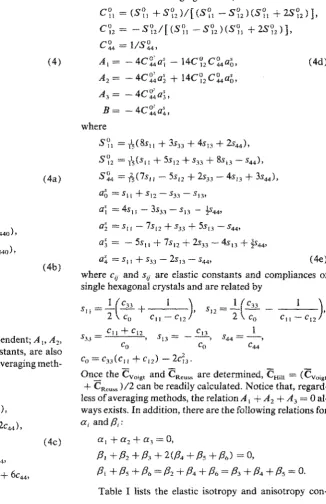
where eij and
CZ
are averaging method dependent; A I' A2 ,A3 , and B. which are elastic anisotropy constants, are also averaging method dependent. For the Voigt averaging meth-od,
C?I = -Is(8clI
+
3C33+
4c\3+
8C44),C?2
=
-Is(Ctl+
5el2+
C 33+
SCD - 4C44 ) ,C~4 = fo(7c11 - 5e n
+
2C33 - 4c 13+
12c44 ),Al = a~
=
4cll - 3C33 - CLl - 2c44,Az
=
a~ = C II - 7CI2+
C33+
5e n - 4c44 ,A3 = a~ = - SCII
+
7c12+
2C33 - 4c13+
6C44 , B = a~ = ell+
e33 - 2CD - 4e44•TABLE I. Elastic isotropy and anisotropy constants (in GPa).
Material Method Co I l C~2
Ti Voigt 163.93 75.53
Hill 162.86 76.07 Reuss 161.78 76.60
Zr Voigt l45.68 76.16
Hill 145.18 72.28 Reuss 144,68 72.39
Zn Voigt 134,81 41.59
Hill 120.68 38.77 Reuss 106.55 35.94
2664 J. Appl. Phys., Vol. 67, No.5, 1 March 1990
(4c)
CO 44
44.20 43.40 42.59 36.76 36.45 36.14 46.61 40.96 35.31
C?l = (S?l
+
S?2 )/[ (S?1 - S~2 ) (S?1+
2S12) ],C~2 = -S?2/[(S~1 -S?2)(S~l +2S~2)]'
C~4
=
l/S~4'Al
=
-4C~:a~ -14C?2C~4a~,A2 = - 4C~:a~
+
14C?2 C~4a~,A3 = - 4C~:a~,
B= - 4C~:a~,
where
S?I
=
-Is(8511+
3533+
4513+
2S44 ),S?2
=
-(S(SI1+
5S12+
S33+
8s13 - S44)'S~4 = rs(7S11 - 5512
+
2S33 - 4s13+
3S44 ),a~ =SII +SI2-S33-SI1'
a;
= 4sl1 - 3S33 - SI3 - !S44'a~ = SII - 7S12
+
S33+
5s(3 - S44'a~
= -
5s11+
7s12+
2S33 - 4s13+
~S44'a~ = S 11
+
S33 - 2s 13 - S44'(4d)
(4e)
where cij and S'j are elastic constants and compliances of
single hexagonal crystals and are related by
Slj
=~(C33
+
1 ),SI2=~(~
_ 1 ),2 Co CII- CI2 2\co cll-el2
Cil
+
e
l2 Cn 1S33 = sl3
= - - ,
S44= - ,
Co Co C44
Co
=
C33(C11+
C12 ) - 2C;3'On~ the CYO;gt and CReuss are determined, CHill
=
(CYOigt+
CRellss )/2 can be readily calculated. Notice that,regard-less of averaging methods, the relation A I
+
A2+
A3 = 0al-ways exists. In addition, there are the following relations for
ai and/3i:
a I
+
Gz+
a, = 0,{3,
+
f32+
{33+
2(f34+
f35+ PrJ =
0,/31
+
{3s+
{36 = f32+
{34+
(36 = /33+
(34+
{35 = O. Table I lists the elastic isotropy and anisotropycon-A, A2 A, B
- 62.00 - 145.00 207.00 23.00 - 61.80 - 141.81 203.61 16.69 - 61.60 - 138.61 200.21 10.38
- 55.80 - 6.60 62.40 42.40 '- 49,05 - 5.22 54.27 38.99 - 42.30 - 3.85 46.14 35.59
345.40 100.70 - 446.10 - 31.60 417.33 17.46 - 434.79 -76.66 489.25 - 65.78 -, 423.47 - 121.73
Y. Li and R. B. Thompson 2664
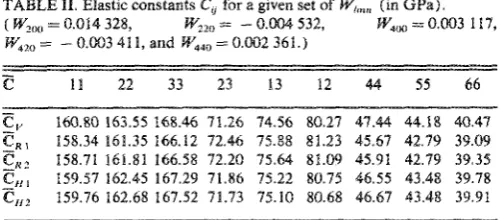
[image:5.611.226.553.51.556.2] [image:5.611.40.562.589.746.2]TABLE II. Elastic constants Cij for a given set of WI,"" (in GPa).
(W2()() = 0.014 328, W220 = - 0.004 532, W4(K) = 0.003117, W.20 = - 0.003411, and W440 = 0.002 361.)
C II 22 33 23 13 12 44 55 66
Cv 160.80 163.55 168.46 71.26 74.56 80.27 47.44 44.18 40.47
CR \ 158.34 161.35 166.12 72.46 75.88 81.23 45.67 42.79 39.09
CR~ 158.71 161.81 166.58 72.20 75.64 81.09 45.91 42.79 39.35
CHI 159.57 162.45 167.29 71.86 75.22 80.75 46.55 43.48 39.78
C
m 159.76 162.68 167.52 71.73 75.10 80.68 46.67 43.48 39.91stants for Voigt, Reuss, and Hill averaging methods for three common hexagonal materials. The single crystal elastic con-stants of these materials used in the computations are from Ref. 13. Table
n
lists the elastic constants Cij for a given setof W1mn of a Ti plate sample. The rolling history and
chemi-cal composition of this Ti sample are unknown since it was purchased directly from a local vender. The W1mn of this sample were obtained from neutron diffraction. 14 In this
ta-ble,
C
v an~C
R , are the el~stic constantsS\ computed fromEqs. (4), CR , are the elastic constants C!, obtained by
nu-~er~ally in~rtiE.g
Sij' C
R , andC
H , arethe
meanv~Iues
of CV-CR and CV-CR " respectively. One can see that CR andC
R ,ar~
reasonably close; consequently, so areC
li , and'CR ,.One of the distinguished advantages for the representa-tions in Egs. (4) is the apparent resemblance to the
C
ij -W1mllrelations for the cubic materials which were published in Ref. 12 and applied widely. In particular, realizing
W200 = W22() = 0 for cubic materials, we can obtain the
C
ij-W1mn relations for the cubic materials by mUltiplying
Pi
inEqs. (4b) by 3/2. The factor 3/2 is the consequence oflow-er-order symmetry for cubic crystallites.
Ames Laboratory is operated for the U. S. Department of Energy by the Iowa State University under Contract No. W -7405-Eng-82. This work was supported by the Director for Energy Research, Office of Basic Energy Sciences.
lM. J. Philippe, F. Wagner, and C. Esling, in Proceedings afthe Eighth International Conference on Textures of Materials, edited by J. S. Kallend
and G. Gottstein (The Metallurgical Society, Warrendale, PA, 1988), p. 837.
2T. M. Holden, R. R. Hosbons, J. H. Root, and E. F. Ibrahim, Materials Research Society Symposium Proceedings (Materials Research Society,
Pittsburgh. 1989), Vol. 142.
'R. -J. Roe. J. App!. Phys. 36,2024 (1965).
4R. -J. Roe, J. App!. Phys. 37. 2069 (1966).
'Y. Li and R. B. Thompson, Materials Research Society Symposium Pro-ceedings (Materials Research Society, Pittsburgh. 1989), Vol. 142, p. 83. 6y. Li, R. B. Thompson, and S. S. Lee, in Review of Progress in Quantitative
NDE 9, edited by O. D. Thompson and D. E. Chimenti (Plenum, New Yark, 1990) (in press).
7C. M. Sayers, Ultrasonics 24,289 (1986).
"M. L. Smith and F. A. Dahlen. J. Geophys. Res. 78, 332! (1973).
0p. R. Morris, 1. App!. Phys. 40, 447 (1969).
10c.
M. Sayers, J. Nucl. Mater. 144, 211 (1987). "R. Hill, Proc. Phys. Soc. A 65,349 (1952).12M. Hirao, K. Aoki, and H. Fukuoka, J. Acoust. Soc. Am. 81, 1434 (1987).
I3R. F. S. Hearmon. in Landolt-Bornstein: Numerical Data and Functional Relationships in Science and Technology, Vol. III/l (Springer, Berlin,
1966), p. 12.
"c.
M. Sayers (private communication).High-power, broad .. band InGaAsP superluminescent diode emitting
at
1.5
I-Lm
Yoshio Noguchi, Hiroshi Yasaka,Osamu Mikami, and Haruo Nagaiil
)
NIT Opto-electronics Laboratories. 3-1 Illorinosato Wakamiya, Atsugi-shi, Kanagawa 243-01. Japan
(Received 5 September 1989; accepted for publication 13 November 1989)
An InGaAsP superluminescent diode operating at 1.5 f.lm wavelength is successfully developed using a buried bent absorbing waveguide structure and antireflection coating to suppress lasing mode. Optical characteristics such as high output power (5 mW at 200 rnA), broad-band spectral width (60-70 nrn), short coherence length (about 30 pm), and low spectral modulation depth (less than 10%) are achieved. Injection current dependence of emitting wavelength and spectral width are also investigated.
Superluminescent diodes (SLDs) have been receiving increasing attention for applications in short and medium distance optical communications. Optical characteristics such as elimination afmodal noise in fiber systems, immuni-ty to optical feedback noise, and high coupling efficiency in fibers are of particular interest. SLDs are also a key device in optical fiber gyroscope and optical time domain reflecto-metry (OTDR) applications. U The broad-band
character-.) Present address: Anritsu Corporation. 1800 Onna, Atsugi-shi, Kanagawa 243. Japan.
istics ofSLDs can reduce Rayleigh backscattering noise and polarization noise in fiber gyro systems, and short coherent length ofSLDs can improve spatial resolution in OTDR ap-plications.
In the past few years, several papers have been published on GaAIAs SLDs emitting at 0.8 p.,m. 3-5 and InGaAsP SLDs
at 1.3 ,um wavelength.8
-:O However, there have not been any
reports on InGaAsP SLDs operating at 1.5 f.lm wavelength. The 1. 5-,um SLDs are often more desirable than 0.8- and
[image:6.611.71.323.39.149.2]