ON THE EXPANSION OF SPACE AND HOW TO
MEASURE IT
Firmin J. Oliveira1,† ID
1 East Asian Observatory / James Clerk Maxwell Telescope; [email protected] or
† Current address: P. O. Box 10882, Hilo, Hawaii 96721
Abstract:We describe the effect of the expansion of space on the wavelength of the light beam in a
1
Fabry-Pérot interferometer. For an instrument such as the Laser Interferometer Gravitational-Wave
2
Observatory (LIGO), which has high sensitivity and a long period of light storage, the wavelengthλL 3
of laser photons are redshifted due to the expansion of space in each cavity by an amountδλgiven
4
byδλ/λL =H0τs ≈8.8×10⁻²¹, whereH0≈2.2×10⁻¹⁸s−1is the Hubble constant andτs ≈4 ms 5
is the light storage time for the cavity. Sinceτsis based on the cavityfinesseF which depends on 6
the laser beam full width at half maximum (FWHM)δωof each cavity, we show that a difference in
7
finesses between the LIGO arm cavities produces a signalhH(t)at the anti-symmetric output port 8
given byhH(t) =2a1H0
1
δωX(t)−
1
δωY(t)
, whereδωX(t)andδωY(t)are the beam FWHM at timet, 9
respectively, for theXandYarm cavities anda1is a beam proportionality constant to be determined
10
expermentally. Assuminga1≈1, then for cavity beams FWHM ofδω(t)≈(523.2±31)rad. s−1the
11
output signal has the range|hH(t)| ≤1×10⁻²¹, which is detectable by advanced LIGO. 12
Keywords:universe expansion; Hubble constant; cavity finesse; cosmological redshift; strain
13
1. Introduction 14
The Hubble expansion of the universe[1] should be observable in a local frame via the expansion of space. Although gravity in the Galaxy is strong enough that it keeps all massive objects bounded, and material objects are held together by gravitational and electromagnetic forces, photons have a vacuum speed√ c ≈ 3×1010cm s−1which is greater than the escape velocity for the Galaxy (ve =
2GM/R≈p
2G×1.5×1012M/ 8 kpc≈1.3×108cm s−1). Therefore it is reasonable to inquire
whether the wavelength of photons moving freely in a vacuum anywhere in the Galaxy will be redshifted by the expansion of space. Because General Relativity (GR) is based on fields, all phenomena are determined by local effects alone. Thus the expansion of the universe, a global effect, is described by the local expansion of space at each point in the universe. In the Friedman-Lemaître-Robertson-Walker (FLRW)[2–5] cosmological model, the isotropic expansion of space is measured by the scale factorR which is a solution to the Friedman equation
R˙
R
2
= 8πG 3 ρ−
kc2
R2 +
Λc2
3 , (1)
where ˙R=dR/dtis the time derivative of R,Gis Newton’s gravitation constant,ρis the local matter density,k={−1, 0, 1}is the curvature constant andΛis the cosmological constant. In an interferometer cavity, such as in the Laser Interferometer Gravitational-Wave Observatory (LIGO)[6], there is a high vacuum, so the matter density composed of molecules and photons is assumed negligible, implying ρ ≈ 0, and the curvature is assumed flat withk = 0. Then only theΛterm remains in (1) and its solution takes the form
R(t) R(te)
=e
√
Λ/3c(t−te)=1+√Λ/3c(t−t
e) + (Λ/6)c2(t−te)2+..., (2)
wherete≤t,teis the time of emission of the light andtis the time of observation of the light. It can be
shown[3] that the cosmological redshiftzof the wavelength of light is given by (2), 1+z=R(t)/R(te).
Fort−te = ∆ta small time interval, we drop all second order and higher terms from (2), and the
expression for the cosmological redshift takes the form
z= R(t) R(te)
−1≈√Λ/3c∆t. (3)
It can be shown[7,8] that the Hubble constantH0is related toΛby
H0≈
√
Λ/3c. (4)
From (3) and (4), we can expect a change in light wavelengthδλgiven by
δλ λL
=z≈√Λ/3c∆t≈H0∆t, (5)
whereλLis the initial wavelength (laser nominal wavelength). From cosmological observations[9] we 15
use a value ofH0≈67.8 km s−1Mpc−1.
16
2. How the expansion of space affects the light in an interferometer 17
The two perpendicular armsLxandLyof a LIGO facility[6] are each of lengthL=4 km. At the
ends of each arm are suspended test mirrors which are highly reflective, allowing photons from the input laser to be stored coherently in the cavity between the mirrors. The system has afinesse[10] of F ≈450, implying an amplification ofA≈300, equivalent to increasing the effective length of each arm to
Le =A L≈1200 km. (6)
The effective travel timeτsof a photon traveling at vacuum speedcwithin an arm cavity, undergoing
multiple reflections, ignoring latencies at the reflection surface of each test mirror, is given by
τs = Le
c ≈4 ms. (7)
If the cavity field is not replenished, τs is the time for the field intensity to be attenuated by 1/e.
Substituting∆t=τsfrom (7) into (5) we obtain the maximum wavelength changeδλmaxgiven by
δλmax
λL
=H0τs≈
2.2×10⁻¹⁸s−1(0.004 s)≈8.8×10⁻²¹. (8)
When a gravitational wave interacts with the LIGO instrument the strainhof the wave is related to the change in LIGO arm lengthsLxandLygiven by[6]
δL(t) =δLx(t)−δLy(t) =h(t) L. (9)
From the measured strain of the GW150914 event, (9) implies that
| δL(t)
L =h(t)| ≤1.0×10
−21. (10)
However, from (8), in any 4 ms time interval the cavity photons will have a range of drift given by 0≤δλ/λL ≤8.8×10⁻²¹with an average drift of≈4.4×10⁻²¹. The average drift in phase of cavity
arm cavities will be out of phase with the detector reference frequencyωL =2πc/λL, whereλLis the
nominal laser wavelength. From (5) we get, for 0≤t≤τs,
ω(t) =ωL(1−H0t), (11)
which is a linear sweep in the cavity frequency each time period τs. When a gravitational wave 18
modulates the instrument, the measurement of the disturbance at the output detector will have both
19
the cavity and wave signals intermixed.
20
3. Condition for resonance in a Fabry-Pérot cavity 21
From (Ref. [11], Eq. 9 and Eq. 10), the equation for the dynamics in a Fabry-Pérot cavity is given by
E(t) =taEin(t) +rarbe−2ikδL(t)E(t−2T), (12)
wheretis the time,tais the transmissivity of the input test mirrora,rais the reflectivity of input test
mirrora,rbis the reflectivity of end test mirrorb,Ein(t)is the input field amplitude,E(t)is the cavity
field amplitude,i=√−1,k=ω/cis the wave number whereωis the nominal laser frequency,δL(t) is the variation in the cavity length and
T=L/c (13)
is the time for light to travel once along the nominal distanceLbetween the cavity test mirrorsaandb. AssumingδL(t) =0 and Laplace transforming (12) yields the basic cavity response function
H(s) = ¯E¯(s) Ein(s)
= ta 1−rarbe−2sT
, (14)
where over-bars denote Laplace transforms. If we consider the effect of the universe expansion upon the frequency of the laser light in the cavity, for one round trip time 2T, the shift is toward lower frequency given by
δωH=−2H0Tω. (15)
Including this shift effect into the cavity frequency control system, which corrects the laser frequency to compensate for changes in the cavity such as movements of the mirrors , from (Ref. [11], Eq. 20), for one round trip of the light in the cavity,
δω(t)−δω(t−2T) =−2
ω
c
d
dtδL(t)−2H0Tω, (16)
wherev(t) =dδL(t)/dtis the relative velocity of the mirrors. Use (13) to substitute forc= L/Tin (16) and transform it to the Laplace domain, yielding
C(s)δω¯(s)
ω =−
δL¯(s)
L −
H0
s , (17)
where
C(s) =1−e
−2sT
2sT (18)
is the normalized frequency-to-length transfer function. The cavityfree spectral range
δωf sr =
πc
determines the spacing between zeros ofC(s). A control system maintains resonance in the cavity by adjusting the input frequencyωbyδω(t). If these frequency changes are much less than the cavity free spectral range thenC(s)≈1 and (17) reduces to
δω¯(s)
ω ≈ −
δL¯(s)
L −
H0
s . (20)
4. A toy model for an output signal from LIGO due to the expansion of space 22
We introduce a toy model of the laser light in the LIGO cavities which can produce a signal at the anti-symmetric port due to phase differences between the LIGO arms caused by the control system as it compensates for changes in the cavity laser frequency due to mirror movements. The control system maintains cavity resonance by shifting the cavity frequency byδωadj(t)according to (20), neglecting
the expansion term, at regular time intervals based on the cavity round trip time 2T=2L/cand the storage timeτs. By (11), the maximum frequency shift during the storage time due to the universe
expansion is
δωHmax=ωL(1−H0τs)−ωL =−ωLH0τs (21)
where
τs = 2T F
π , (22)
where the finesse is given by[12]
F = δωfsr δω ≈
π(rarb)1/4
1−√rarb
. (23)
Here the cavityfree spectral rangeis given by (19) andδωis the laser beam full width at half maximum (FWHM). Assume that the frequency variationδωHadj in a cavity given by (21) creates a coherent
sub-beam which is imbedded in the main beam, having a subbeam central frequency
ωH=ωL−
|δωHmax|
2 (24)
and a FWHM beamwidth of
δωH≈a1|δωHmax|, (25)
wherea1is a beam proportionality constant to be determined experimentally. Since the cavity laser
23
power is constantly being maintained for resonance by adjustmentsδωadj(t)to the cavity input beam, 24
the subbeam centered onωHis also indirectly being maintained by effective adjustmentsδωHadj(t)as 25
older photons exiting the mirrors are replenished by newer photons from the main beam.
26
The phase change associated with the cavity subbeam beamwidthδωH, from (21), (22) and (25),
for a period of one round trip time 2Tin the cavity is expressed by
∆φH=δωH(2T) =a1(ωLH0τs)
2L
c
=a1ωLH0
2LF
πc
2L c
. (26)
Although both LIGO arms are locked simultaneously[13], it is reasonable to assume that each cavity is tweaked with a different frequency changeδω(t)to stabilize the cavity resonance. This changes the cavity beamwidth FWHM, which affects the cavity finesse (23), resulting in frequency shifts in the subbeam central frequencyωHand the subbeam beamwidthδωHdue to the expansion of
space, ofδωHXfor armXandδωHYfor armY. For armX, by (26), the phase change for the subbeam
beamwidthδωHX(t)per round trip cycle time 2Texpressed as a function of timetis given by
∆φHX(t) =δωHX(t) (2T) =a1ωLH0
2LF X(t)
πc
2L c
whereFX(t)is the finesse of the armXcavity at timet. Similarly, for armY, the phase change for the
subbeam beamwidthδωHY(t)per round trip cycle is given by
∆φHY(t) =δωHY(t) (2T) =a1ωLH0
2LF Y(t)
πc
2L c
, (28)
whereFY(t)is the finesse of the armYcavity at timet. Taking the differential of the phase differences
between armsXandYby subtracting (28) from (27) we obtain
∆φHXY(t) =∆φHX(t)−∆φHY(t) =a1ωLH0
4L2 πc2
(FX(t)− FY(t)). (29)
From (19) and (23) we get the difference between the cavity finesses
FX(t)− FY(t) =
πc L
1 δωX(t)
− 1
δωY(t)
. (30)
Substituting (30) into (29) we obtain for the subbeam phase differential between the cavities
∆φHXY(t) =
4a1LωLH0
c
1 δωX(t)
− 1
δωY(t)
. (31)
Dividing both sides of (31) by(2LωL/c)yields the output signal due to the expansion of space
hH(t) = ∆
φHXY(t)
2LωL/c
= (2a1H0)
1 δωX(t)
− 1
δωY(t)
. (32)
Since the LIGO anti-symmetric port is zero when the interferometer is in its resonant "locked" state, if
27
the control system is not compensating for the frequency sweep due to the expansion of space then the
28
subbeam induced signal (32) would be detectable at the anti-symmetric port.
29
Assumea1 ≈1. With 2H0 ≈4.40×10⁻¹⁸s−1and for a signal range between±1×10⁻²¹, this
implies from (32) that
| 1
δωX(t)
− 1
δωY(t)
| ≤2.273×10⁻⁴s rad−1. (33)
LIGO’s FWHM beamwidth can be estimated from (19), δω = δωfsr/F ≈ 2.355×10⁵/450 ≈
30
523.2 rad. s−1. For example, withδωX(t1) ≈554.2 rad. s−1andδωY(t1) ≈492.2 rad. s−1, for some 31
timet1, (33) is satisfied. In general, if the LIGO beamwidth FWHM varies asδω≈(523.2±31)rad. s−1
32
which is equivalent toδν≈(83.3±4.9)Hz, a variation of about±6 %, then the output signalhH(t) 33
would vary within±1×10⁻²¹. This range of variance forδωis comparable to the design frequency
34
noise limit of±5 % (10 % maximum) for advanced LIGO[14].
35
5. Discussion 36
Since the control system maintains the cavity resonance by correcting the input laser frequency, the signal output given by (32) would be proportional to the control systemservoingof the cavity frequency in each LIGO arm. This suggests that by servoing the laser beam frequency for each cavity in a known manner byδωXadj(t) for theXcavity and δωYadj(t)for theY cavity, generating laser beamwidthsδωX(t)andδωY(t), respectively, a predictable signalhH(t)due to the expansion of space
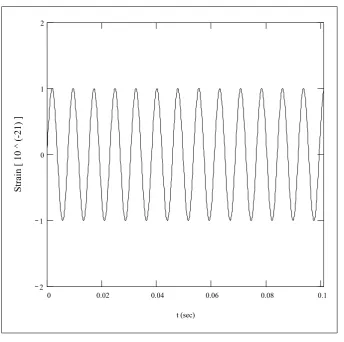
would be generated at the output port. In Figure1is shown the predicted outputhH(t)when the
beamwidths in theXandYcavities are modulated at a rate of f = 1/2τs ≈130.8 Hz by the sin(x)
function
δω(t) =∆ω+31 sin(πt/τs+φ0), (34)
where∆ω=523.2 rad. s−1,φ0=0 for theXarm beam andφ0=πfor theYarm beam.
6 of 7
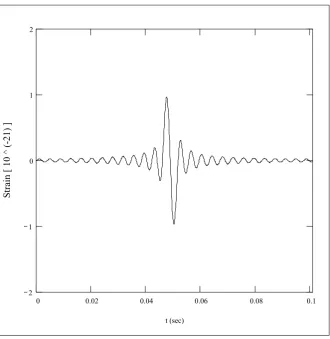
In Figure2is shown the predicted outputhH(t)when the beamwidths in theXandYcavities are
modulated by the sinc(x)function at a rate off =1/τs≈261.6 Hz centered on timetp=0.05 s given
by
δω(t) =∆ω+60 sinc(2π(t−tp)/τs+φ0), (35)
whereφ0=0 for theXarm subbeam andφ0=πfor theYarm subbeam.
38
Whether or not the local expansion of space is real is uncertain. But an experimental facility such
39
as LIGO can provide answer.
40
L
π.cv 4.247 10
6 =
0.06 deltawfwhm. =31.394
dw t p( , ) deltawfwhm 31 sin π
tau_s t . p .
tau_s=3.822
185
deltawfwhm =0.354 h2 t( ) 1
dw t( ,π)
1
dw t 0( , )
h2 t( )
t
0 0.02 0.04 0.06 0.08 0.1 0.12 0.14 0.16 0.18 4.6 10 4
2.3 10 4 0 2.3 10 4 4.6 10 4
h3 t( ) 1021.A0.h2 t( )
0 0.02 0.04 0.06 0.08 0.1
2 1 0 1 2
t (sec)
S
tr
ai
n
[
1
0
^
(
-2
1
)
]
3
Figure 1. Predicted expansion of space signal output due to modulation of X and Y arms cavity beamwidths byδω(t) =523.2+31 sin(821.9t+φ0), whereφ0=3.142 for the X beam and 0 for the Y beam.
41
1. Hubble, E.: A Relation between Distance and Radial Velocity among Extra-Galactic Nebulae. Proc. Natl. Acad. 42
Sci. U.S.A.15(3) 168-173 (1929). doi:10.1073/pnas.15.3.168 43
2. Friedman, A (1999). "On the Curvature of Space". Gen. Relat. Gravit. 31(12) 1991-2000 (1999). 44
doi:10.1023/A:1026751225741 45
3. Lemaître, G.: A homogeneous universe of constant mass and increasing radius accounting for the radial 46
velocity of extra-galactic nebulae. Mon. Not. R. Astron. Soc.91(5) 483-490 (1931). doi:10.1093/mnras/91.5.483 47
4. Robertson, H. P. (1935), Kinematics and world structure, Astrophys. Journ., 82 284–301 (1935). 48
doi:10.1086/143681 49
5. Walker, A. G. (1937), "On Milne’s theory of world-structure", P. Lond. Math. Soc., Series 2,42(1) 90–12 (1937). 50
doi:10.1112/plms/s2-42.1.90 51
0 0.02 0.04 0.06 0.08 0.1 2
1 0 1 2
t (sec)
S
tr
ai
n
[
1
0
^
(
-2
1
)
]
dw3 t tp( , ,0)
t
0 0.05 0.1
7.443609 10 6 7.44360902 10 6 7.44360904 10 6
2 L. .H0.omegaL
cv 1.039 10 7
=
8
Figure 2. Predicted expansion of space signal output due to modulation of X and Y arms cavity beamwidths byδω(t) =523.2+60 sinc(1643.8(t−0.05) +φ0), whereφ0=3.142 for the X subbeam and 0 for the Y subbeam.
6. Abbott, B. P., et al.: Observation of gravitational waves from a binary black hole merger. PhysRevLett.116
52
061102 (2016). doi:10.1103/PhysRevLett.116.061102. arXiv:gr-qc/1602.03837 53
7. Weinberg, S.: Cosmology. Oxford University Press, New York (2008) 54
8. Carmeli, M. and Kuzmenko, T.: Value of the cosmological constant in the cosmological relativity theory. Int. J. 55
Theor. Phys.41(1), 131-135 (2002). arXiv:astro-ph/0110590 56
9. Planck Collaboration, Ade, P. A. R., et al.: Planck 2015 results XIII. Cosmological parameters. Astron. & 57
Astrophys.594(A13) (2016). doi:10.1051/0004-6361/201525830 58
10. The LIGO Scientific Collaboration. Aasi, J., Abbott, B. P. et al.: Advanced LIGO. Class. & Quant. Grav.32(7) 59
(2015). doi:10.1088/0264-9381/32/7/074001. arXiv:gr-qc/1411.4547 60
11. Rakhmanov, M., Savage, Jr., R. L., Reitze, D. H. and Tanner, D. B.: Dynamic resonance of light in Fabry-Pérot 61
cavities. Phys. Lett. A305, 239-244 (2002) doi:10.1016/S0375-9601(02)01469-X. arXiv:optics/0110061 62
12. Lawrence, M. J., Willke, B., Husman, M. E., Gustafson, . E. K. and Byer, R. L.: Dynamic response of a 63
Fabry-Pérot interferometer. J. Opt. Soc. Am. B16(4) (1999) S0740-3224(99)00404-X 64
13. Staley, Alexa. (2015).Locking the Advanced LIGO Gravitational Wave Detector: with a focus on the Arm Length 65
Stabilization Technique(Doctoral dissertation). Retrieved from ProQuest Dissertations and Theses. (Accession 66
Order No. AAT 3722011) 67
14. Mueller, C. L., et al.: The advanced LIGO input optics. Rev. Sci. Instrum. 87(1), 014502 (2016) 68