International Journal of Innovative Technology and Exploring Engineering (IJITEE) ISSN: 2278-3075, Volume-8 Issue-12, October 2019
Integrating Wireless Sensor Networks with
Cloudcomputing
G K Venkata Narasimha Reddy, B Lakshmi Narayana Reddy, E Suresh Babu, P Veera Prakash
Abstract wireless sensor network (WSN) is an unmistakable innovation for a long while. In most genuine applications, the immense measure of information assembled utilizing sensors are required to be put away and be made accessible for whenever, anyplace get to. However, WSNs are made out of asset obliged gadgets which absence of abilities to store gigantic lump of information and perform ensuing preparing of the information. WSNs can be increased by cloud condition which offers such administrations. Thus, a Sensor-Cloud structure is imagined in this proposition coordinating remote sensor connect with cloud condition. The coordinated system is appropriate for versatile and unavoidable figuring applications empowering Internet of Things (IoT) and planned to be utilized in genuine applications. Creating countries need proportionate social insurance conveyance answers for serve gigantic populace. This proposition features the issues identified with medicinal services conveyance that might be tended to utilizing the incorporated system. It might be utilized for empowering individuals, networks, medicinal services associations to gather and transmit wellbeing data as and when required so as to improve social insurance administrations for the provincial and urban populace. Inside the IoT empowered structure, few difficulties are recognized for examination. This theory stresses on difficulties including remote sensors and gives specialized answers for these difficulties. WSNs ordinarily work on IEEE 802.15.4 standard utilizing exclusive conventions which includes structure and the board unpredictability when combined with Internet. This postulation furnishes answer for coordinate sensor worldview with cloud condition which depends on
Internet. Execution of 6LoWPAN based hubs empowers consistent correspondence over the systems including Internet.
I. INTRODUCTION
“"The Internet of Things (IoT) is the system of physical items or things implanted with gadgets, programming, sensors, and system availability, which empowers these articles to gather and trade information." Internet of Things (IoT) is characterized as Things having characters and virtual characters working in keen spaces utilizing canny interfaces to associate and impart inside social, ecological, and client settings. Thus, IoT is known as the Future Internet [1]. IoT empowered articles speak with one another to get to data over the Internet, and collaborate with clients making savvy, inescapable and constantly associated situations.
Revised Manuscript Received on September 05, 2019.
Dr. G K Venkata Narasimha,Reddy Professor, Department Of CSE
Dr. B Lakshmi Narayana,Reddy Professor, Department Of CSE Dr. E Suresh Babu, Assistant Professor Of CSE NIT Warangal, Telangana.
Mr. P Veera Prakash, Assistantprofessor Of CSE,Srinivasaramanujan Institute Of Technology, Ananthapuramu, India
In this way, IoT makes the idea of inescapable figuring and pervasive registering a reality by permitting objects of our regular day to day existence like autos, clothes washers, coolers, a heart-beat observing gear put on a patient's body and even books outfitted with sensors to speak with people and PCs over the system for running different cutting edge applications [2]. So as to make the system that empower articles to gather and trade information, there is a prerequisite for direct joining of the physical world with the PC based frameworks. The articles must be exceptionally recognized, detected and controlled remotely. Such detecting exercises are required to create enormous measure of information that should be put away and prepared. Along these lines, the two noteworthy elements of IoT are Wireless Sensor Networks (WSN) which encourage the undertakings of detecting and activation and Cloud Computing Environments which encourage stockpiling of detected information and their preparing. Wireless sensor network (WSN) has now turned into a broadly utilized innovation. It has potential applications in each part of human life. It is a system of modest sensor hubs which have restricted computational abilities. Simultaneously, distributed computing has come up as a promising innovation to give computational power and capacity according to the clients' prerequisites. Cloud may supplement the WSN worldview with required capacities. Be that as it may, coordination of the two advances is a non-insignificant errand and postures different new difficulties before the researchers and technologists. This theory centers around a portion of these difficulties and attempt to advance the effective arrangements.
1.1 Wireless sensor network
With the assembly of innovations, for example, sensor gadgets, remote systems administration, and low-control installed handling, wireless sensor network (WSN) has risen as a registering stage which can be adequately utilized for applications that gather and procedure information from the physical world [3]. Normally, WSN involves huge number of ease, low power sensor hubs which are furnished with correspondence and calculation abilities. They enable the physical condition to be estimated at high goals and extraordinarily increment the amount of certifiable information and data for different applications. Little remote sensors estimating clinical parameters can be joined with the living creatures and can be utilized for securing wellbeing related information..
1.1.1 Challenges in WSN
Sensor systems are not quite the same as regular PC organizes because of its asset obliged nature.
Thus, when contrasted with regular PC systems, it has couple of testing issues. Little sensor hubs have restricted memory, battery power and
Following are the a few angles that the WSN ought to have the option to address. IP availability In the greater part of the IoT applications, the small hubs are required to be associated with Internet. It is an intricate thing as a result of the executives multifaceted nature and bundle transformations as per distinctive convention prerequisites. To handle this test, IP based remote sensor system is required to be executed. Steering Power utilization in WSN is a significant factor. As sensor hubs have exceptionally constrained vitality, directing plans ought to be planned in such a way, that vitality productivity can be accomplished. Vitality proficiency may reflect through adjusted vitality utilization.
Information gathering Data accumulation from various minor sensors is a wild assignment. Information accumulation might be utilized. It is a method which empowers in-arrange handling of information, sifting the information according to the application's necessity and furthermore dispenses with engendering of copy parcels. Information accumulation strategies lessen the power utilization, just as increment the system lifetime. In addition, information might be lost because of obstruction among them. Handling this issue is another huge test.
1.2 Cloud computing
Ongoing advancement in distributed computing has raised intrigue worldwide among scholastics and businesses. Cloud gives an execution domain where assets like amazing PCs, databases and so on situated at geologically disseminated destinations and now and then additionally possessed by various associations are associated and shared by the customers or associations in community oriented way. Distributed computing is an influential idea that empowers the conveyance of coordinated and very much kept up capacities to the end client through creation of capacities and administrations frequently system based. It offers an administration arranged design with diminished data innovation overhead for the end client, more noteworthy adaptability and decreased all out expense of proprietorship. Distributed computing offers three administration models, and four organization models. Following is a rundown of the three principle kinds of administrations that can be offered by the cloud :
• Software as a Service (SaaS) - It is a product conveyance model which empowers a buyer to get to applications from different customer gadgets however the purchaser does not have any specialist to control fundamental cloud framework. • Platform as a Service (PaaS) - It empowers purchasers to create, run and oversee applications with no issue to oversee hidden cloud foundation.
• Infrastructure as a Service (IaaS) - It gives virtualized computational assets rather than physical framework. As per utilization, proprietorship, the executives of the cloud framework, there are four arrangement models:
• Private cloud - The cloud foundation is provisioned for restrictive use by a solitary association.
• Community cloud - It is utilized and claimed by various associations that have shared interests.
• Public cloud - It is provisioned for open use by the overall population.
• Hybrid cloud - It is a structure of at least two particular cloud frameworks (private, network, or open) that stay extraordinary elements, yet are bound together by institutionalized or restrictive innovation.
WSNs are additionally starting to be utilized to screen bumble bee provinces. The hubs of a WSN can be utilized to get information from the sensors checking the ecological states of an apiary (temperature, mugginess, CO2, and so on.) and even its weight [14]. The hubs interface and convey through a passage that can send the information from the bits to a base for capacity and handling. This has expanded the highlights of the observing frameworks, prompting what is as of now known as exactness apiculture. WSNs are an outstanding option for dispersed and remote detecting. These sorts of systems offer solid potential for beekeepers, because of the way that they meet a few noteworthy prerequisites: (I) they are an insignificantly intrusive strategy because of the little size of the hubs and sensors; (ii) they can be operational in remote regions for an extensive stretch of time because of their low vitality utilization; and (iii) they permit ongoing observing.
II. LITERATURE REVIEW
Gathri. K and v. Ananthanarayan exhibited an edge work for coordination of WSNs with cloud. Information from all the conveyed sensors is amassed in to single message and sent to the cloud for putting away. There is a need limiting the way to send the information to the base station. New idea of calculation is required for that.
KhandakarEntenamUnayesAhamed and Mark A Gregory proposed a foundation to incorporate the distributed computing model with WSN. This system gives approaches for overseeing client, get to control, and capacity of information. Detected information structure sensor in WSN goes to information vault and information handling unit through entryway. Pointless information will be prepared for cutting. The organized information is sent to the information vault for capacity. Information alongside list put away in distribute/buy in merchant. Membership will be made by Request Subscriber. At whatever point the information is mentioned Event Matcher will discover map between membership demands and distributed information. At that point mapping is finished. Distribute/buy in dealer will bring information from information archive and enable the information to client through cloud's UI. Anyway there is need of improvement of philosophy for information preparing, stockpiling and recovery of information.
Peng Zhang et al., proposed a design by incorporating WSNs with cloud. Here, a cloud goes about as a virtual sink and gathers detecting information from various focuses and for preparing gathered information, handling programming is utilized in the cloud. WSNs are isolated into zones. Size of sensors is sensible, at that point sink will send by the directions to sensor hubs.
International Journal of Innovative Technology and Exploring Engineering (IJITEE) ISSN: 2278-3075, Volume-8 Issue-12, October 2019
Band width cost is decreased by including information with the assistance of pressure system called Hadop. Ace hub is associated with the web and is the passageway.
Chunsheng Zhu et al., concentrated on incorporating WSNs and portable distributed computing. Here, sensors in WSN gather the information and offer it to cloud. From the cloud versatile client will utilize the information. For the cloud, source is WSN and the information requester to cloud is versatile client. Here TPSS Scheme is utilized for incorporating WSN with versatile cloud. It incorporates Time and Priority-based Selective Data Transmission for Wireless sensor systems door to transmit chosen detected data to cloud and need - based rest planning calculation for Wireless sensor system to limit the vitality usage with the goal that it can gather and transmit.
Javier Barbaran and Manuel Diaz Bartoome Rubio displayed a casing work for coordinating remote sensor in the cloud. The fundamental thought of the system is the idea of virtual channels which characterize correspondence among physical and virtual sensors. Those channels trade messages between the virtual sensors and the cloud with less intricacy, less figuring and less battery usage.
SajidHussian Shah et al., proposed engineering that incorporates a remote sensor system to the web utilizing cloud. Long range goal is imparted by utilizing short range interchanges convention. There is need of greater security in joining of remote sensor system to the web utilizing cloud which is particularly fundamental for spotlight on basic issues.
Samersamarah proposed a forecast model for coordinating remote sensor systems and cloud. The motivation behind information forecast model is to send fine itemized abridged information to information driven focus' by limiting additional heap on the sensors hubs for improving the presentation of WSNs through decreasing the part of information to be sent to the cloud framework. Anyway still there is need of a few predication models to improve the exhibition of the WSNs when coordinating with cloud. Sanjit Kumar Dash et al., [11] studied utilizations of WSNs and distributed computing and examined a few issues of distributed computing and sensors arrange, to get single virtual remote sensor organize through distributed computing by brushing WSNs of various applications under one rooftop.
Sanjit Kumar et al., explored the plan and difficulties for sensor mists and proposed a system for coordination of sensor cloud. The thought in their casing work is WSNs of various applications are joined together as single through cloud thinking of it as has particular virtual WSN. In any case, the achievement of the sensor cloud for the most part relies upon the ability of the sensor system and cloud, expanding the similarity in the strategies and calculation. Nathalie Milton et al., exhibited an engineering utilizing which detected information of various condition can be gotten to by the various clients for their necessities. Structure of unavoidable framework contains Hypervisor, Autonomic Enforcer and Volunteer Cloud director parts. Hypervisor obligation is to communicated direction, recover the information from the independent sensors or from WSNs, reflection of gadgets which are associated and
spoken with the assistance of connector. Correspondence among hubs and cloud is by the Autonomic Enforcer. Volunteer Cloud director concentrated the sensors in a cloud Environment. There is a need of abnormal state of deliberation of detecting innovations and tending to the instability of mobiles through volunteer based strategies. Meikle et al. utilized gadgets adjusts associated with a 12-bit goals datalogger to survey the development of the heaviness of a bee sanctuary. The framework was controlled by a sunlight based board. They recorded the heaviness of two hives hourly.
The improvement of the exhibition and size of the microcontrollers has permitted the advancement of minimal effort bee sanctuary checking frameworks dependent on Arduino®, Make®, Sparkfun®, and Adafruit®. A case of an Arduino-based observing framework is that proposed by Sánchez et al.. The framework put away the temperature and relative stickiness information in a microSD memory card by methods for an Excel database. The beekeeper expected to go to the bee sanctuary province and download the substance of the SD memory card for each hive to his/her PC to have the option to process those information later on..
III. APPLICATIONS OF WSN
Earth/Environmental observing It has advanced to cover numerous applications WSN to earth science investigate. This incorporates detecting volcanoes, seas, icy masses, backwoods and so forth a portion of the significant regions are recorded beneath.
Air Quality Monitoring: The level of populace noticeable all around must be estimated habitually so as to shield individuals and the earth from any sort of harms because of air contamination. In risky environment, ongoing observing of destructive gases is a significant procedure in light of the fact that the climate can change quickly changing key quality parameters.
Inside Monitoring: Observing the gas levels at defenseless regions needs the use of top of the line, complex gear, competent to fulfill mechanical guidelines. Remote inside checking arrangements encourage monitor huge territories just as guarantee the gas focus degree.
Outside Monitoring: External air quality checking needs the utilization of exact remote sensors, downpour and wind safe arrangements just as vitality procuring techniques to guarantee broad freedom to machine that prone to have extreme access.
Air Pollution Monitoring: Wireless sensor systems have been conveyed in a few urban areas to screen the grouping of hazardous gases for residents. These can take points of interest of the specially appointed remote connections as opposed to wired establishments, which additionally make them progressively versatile for testing readings in various territories.
Woodland Fire Detection: A system of sensor hubs can be introduced in a timberland to recognize when a flame has begun. The hubs can be furnished with sensors to measures temperature, mugginess and gases which are delivered by flame in the trees or vegetation.
Avalanche Detection: An
framework utilizes a remote sensor system to recognize the slight developments of soil and changes in different parameters that may happen previously or during an avalanche. Through the information accumulated it might be conceivable to know the event of avalanche some time before it really occurs.
Water Quality Monitoring: Water quality observing includes dissecting water properties in dams, streams, lakes and seas, just as underground water saves.
Catastrophic event Prevention: Wireless sensor systems can successfully act to forestall the results of cataclysmic events, similar to floods. Remote hubs have effectively been conveyed in waterways where changes of the water levels must be observed progressively.
Mechanical Monitoring Machine Health Monitoring: Wireless sensor system have been created for hardware condition-based upkeep (CBM) as they offer critical cost investment funds and empower new usefulness. In wired framework, the establishment of enough sensors is regularly constrained by the expense of wiring. Beforehand unavailable areas, pivoting hardware, unsafe or confined zones, and versatile resources would now be able to be come to with remote sensors.
Information Logging: Wireless sensor systems are likewise utilized for the gathering of information for observing of ecological data, this can be as basic as the checking of the temperature in an ice chest to the degree of water in flood tanks in atomic power plants. The measurable data would then be able to be utilized to indicate how frameworks have been functioning. The upside of WSNs over regular lumberjacks is the "live" information feed is conceivable. Modern Sense and Control Applications: In ongoing exploration countless remote sensor organize correspondence conventions have been created. These new viewpoints are considered as an empowering influence for future applications in mechanical and related remote sense and control applications, and in part supplanting or improving ordinary wire-based system by WSN procedures. Water/Waste Water Monitoring: Monitoring the quality and level of water incorporates numerous exercises, for example, checking the nature of underground or surface water and guaranteeing a nation's water framework to support both human and creature.
Horticulture: Using remote sensor arranges inside the agrarian business are expanding normal utilizing a remote system liberates the rancher from the support of wiring in a troublesome situation. Gravity feed water frameworks can be checked utilizing weight transmitters to screen water tank levels, back to a focal control place for charging. Water system mechanization empowers increasingly effective water use and decreases squander.
Detached Localization and Tracking: The utilization of WSN to the inactive restriction and following of non-helpful targets (i.e., individuals not wearing any tag) has been proposed by misusing the unavoidable and ease nature of
such innovation and the properties of the remote connections which are built up in a coincided WSN foundation.
Keen Home Monitoring: Monitoring the exercises performed in a brilliant home is accomplished utilizing remote sensors implanted inside regular articles shaping a WSN. A state change to articles dependent on human control is caught by the remote sensors system empowering action bolster administrations. Region Monitoring: The WSN is created over a district where some wonder is to be observed. A military model is the utilization of sensors identifies adversary interruption; a regular citizen model is the geo-fencing of gas or oil pipelines..
IV. PROPOSED ALGORITHM
4.1 HONEY BEE FORAGING ALGORITHM
International Journal of Innovative Technology and Exploring Engineering (IJITEE) ISSN: 2278-3075, Volume-8 Issue-12, October 2019
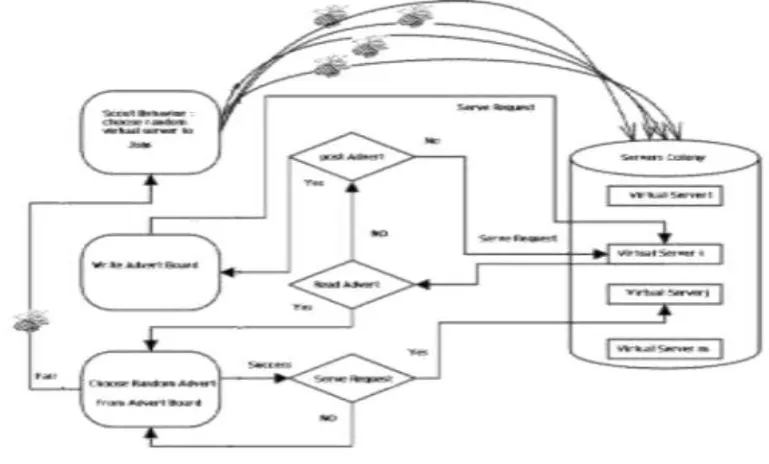
Fig. 1: Algorithm The calculation begins with the n scout honey bees being
set haphazardly in the pursuit space. The wellness of the locales visited by the scout honey bees are assessed in stage 2.
1. Instate populace with arbitrary arrangements.
2. Assess wellness of the populace.
3. While (ceasing foundation not met)/Forming new populace.
4. Select locales for neighborhood search.
5. Enlist honey bees for chose destinations (more honey bees for best e locales) and assess fitnesses.
6. Select the fittest honey bee from each fix.
7. Dole out outstanding honey bees to look haphazardly and assess their fitnesses.
8. End While.
In stage 4, honey bees that have the most elevated fitnesses are picked as "chose honey bees" and locales visited by them are picked for neighborhood search. At that point, in stages 5 and 6, the calculation behaviors look in the area of the chose locales, doling out more honey bees to look close to the best e destinations. Searches in the area of the best e destinations which speak to all the more encouraging arrangements are made progressively itemized by enrolling a greater number of honey bees to tail them than the other chose honey bees. Together with exploring, this differential enlistment is a key activity of the Bees Algorithm.
[image:5.595.90.475.475.707.2]4.2 The Load Balancing algorithm with Honey Bees Strategy
A load balancing algorithm dependent on honey bee conduct (LBA_HB) is proposed. Its principle objective is convey remaining task at hand of various system interfaces in the manner that maintain a strategic distance from underutilization and over use of the assets. This can be accomplished by dispensing the approaching assignment to a virtual machine (VM) which meets two conditions; number of errands as of now handling by this VM is not exactly number of undertakings as of now preparing by different VMs and the deviation of this VM preparing time from normal handling time of all VMs is not exactly an edge esteem.
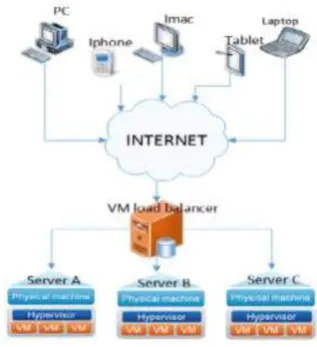
[image:6.595.328.518.54.181.2]Burden adjusting is the way toward appropriating outstanding tasks at hand and figuring assets in a distributed computing condition. It enables undertakings to oversee application or remaining task at hand requests by designating assets among numerous PCs, systems or servers. Burden adjusting is frequently used to stay away from the bottleneck, with the goal that few attributes of burden adjusting can be accomplished, for example, equivalent division of assignments over all hosts, assistance in accomplishing administration quality, improve by and large execution of the framework, lessen reaction time, and improve asset use The accompanying figure demonstrates the heap balancer of virtual machines (VMs). It relegates different errands to VMs that execute them at the same time by a way that ensures a harmony between these VMs. The essential objective of burden adjusting in a cloud situation is to adjust the remaining task at hand of the hosts in extent to their abilities, which is estimated as far as their processor speed, accessible memory space, and data transmission.
Figure.2 Virtual Machine Load Balancing
[image:6.595.317.530.255.425.2]V. HARDWARE RESULTS DESCRIPTION NODE
Figure 3.UcoBee Version 1 wireless node.
[image:6.595.55.214.452.626.2]The square chart of the remote hub is appeared in Figure 4. The accompanying squares can be recognized: Waspmote module, XBEE PRO module, connector board, microSD memory card, battery, and outside power supply.
Figure.4. Uco Bee block diagram.
System Installation and Results
This framework is being utilized in 20
Apismelliferaiberiensis honey bee settlements situated in an exploratory apiary in the University of (Córdoba. Spain; 37_55033.50 0 N, 4_43026.10 0 W). A hub has been introduced on every colony. The states were shaped during spring 2016. The honey bees were housed in Langstroth bee sanctuaries set on backings 50 cm over the floor, as appeared in Figure 5.
Figure. 5. Photograph of the apiary.
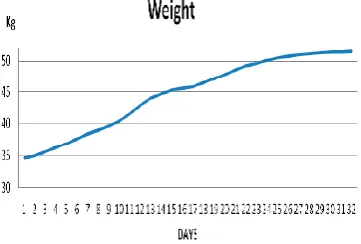
Figure 6 demonstrates the normal advancement of the heaviness of four hives more than 32 days. From Day 26 ahead, it is conceivable to see that the heaviness of the bee sanctuaries balances out, and this is deciphered as the finish of the blossoming time frame, inferring that the beekeeper would now be able to expel
[image:6.595.314.523.572.665.2]International Journal of Innovative Technology and Exploring Engineering (IJITEE) ISSN: 2278-3075, Volume-8 Issue-12, October 2019
[image:7.595.56.237.61.183.2]Figure 6.Average evolution of the weight (kg) of four beehives over 32 days.
Figure 7.Average temperature per day of four hives over 32 days. Temperatures were registered atambient (AT)
and three areas inside the beehives: boom area (T1), area with honey/pollen reserves ofin the periphery of the
brood comb (T2), and in honeycombs (T3). Figure 7 demonstrates the temperature information enlisted during the examination (32 days). The information demonstrate the encompassing temperature outside the apiaries (AT) and temperatures recorded in various zones of the colonies: (T1) center of brood territory; (T2) zone with nectar/dust holds in the outskirts of a similar brood brush; and (T3) honeycombs isolated from the brood brushes. The information compare to the every day normal temperature of four hives. Natural temperature influenced the temperatures inside the colony, in spite of the fact that it has been noticed that the sensors set amidst the brood territory recorded higher and progressively stable mean temperatures inside the hives.
VI. CONCLUSION
We have structured a minimal effort, dependable colony checking framework dependent on a WSN to quantify the temperature, relative dampness, and weight of apiaries continuously and non-rudely. Dissimilar to other bee sanctuary observing frameworks, WBee plays out the synchronized obtaining of tests from all hives of an apiary. Reconciliation of WSN and Cloud Computing will give advantages to associations and the exploration network. Associations will profit by using Cloud stockpiling and an upgraded system for handling, stockpiling and recovery of WSN age information. The proposed WSN Cloud Computing structure will give an ideal way to deal with client the executives, get to control, stockpiling and recovery of conveyed information. WSNs hold the
guarantee of numerous applications in the zone of checking and control frameworks. Numerous properties of the earth can be seen by the checking framework with the coming of shoddy and little sensors. Every one of these applications are intended for the particular purposes, and along these lines keeping up information transport unwavering quality is one of the real concern and the most significant test. To address the unwavering quality, to overview the different existing methods; every one of them has its own special attempting to guarantee the dependability. A portion of the methods use retransmission component while others utilize excess data for guaranteeing the unwavering quality. Maybe a couple of the above goals might be considered later on by the specialists. Future work will incorporate further advancement of the information handling, stockpiling and recovery approach.
REFERENCES
1. I.F.Akyildiz, W.Su, Sankara, Subramaniam, E.Cayirci “Wireless
Sensor Networks: A Survey” Elsevier Science B.V, pp: 394-422, December 2001.
2. PrashantTiwari, VarunPrakashSaxena, Raj GavravMishra,
DevendraBhavsarMishra,”Wireless Sensor Networks: Introduction, Advantages, Applicaons and Research Challenges”, HCTL open international journals of Technology innovations and Research, pp: 2321-1814, vol14, April 2015.
3. Rajeev Piyare, Seong Ro Lee,”Towards Internet of Things (IOTs):
Integration of Wireless Sensor Network to cloud Services for Data Collection and Sharing”, International Journal of computer Networks and Communication (IJCNC), Vol 5, No 5, pp: 59-72, September 2013.
4. Gayathri K, V. Ananthanarayanan,” Design of Several and Efficient
Wireless Sensor Network with Integration to Public Cloud for Big Data Analytics”, International Journal of Recent development in Engineering and Technology, Vol 3, IJRDET, pp: 190-196, July 2014.
5. KhandakarEntenamunayesAhamedand Mark A Geogory,”Integrating
Wireless Sensor Networks With Cloud computing”, Seventh International Conference on Mobile Ad-hoc and Sensor Networks, MSN 2011, Beijing, China, December 16-18, 2011.
6. Peng Zhang, Zheng Yan, Hanlinsun,”A Novel Architecture Based on
cloud computing for Wireless Sensor Network”, Proceedings of the 2nd International conference on Computer Science and Electronics Engineering (ICCSEE 2013).
7. ChungshengZhu, ZhengguoSheng, victor.M.Leung, Lei Shu and
Laurence.T.Yang, Toward Offering More useful Data Reliably to Mobile Cloud from Wireless Sensor Network, IEEE Trans, Emerging Topics In computing, Vol 3, No 1, pp: 84-94, March 2015.
8. Javier Barbaran, Manuel Diaz, Bartolome Rubio,” A Virtual
Channel-based Framework for the Integration of Wireless Sensor Networks in the Cloud”, IEEE, Future Internet of things and Cloud (FiCloud), pp: 334-339, 2014/8/27.
AUTHORS FROFILE
[image:7.595.52.261.220.356.2]Dr. B. Lakshmi Narayana Reddy, is working as Professor of CSE at Srinivasa Ramanujan Institute of Technology, Ananthapuramu, India. His research areas include Wireless Networks, Image Processing.
Dr. E. Suresh Babu, is working as Assistant Professor of CSE at NIT Warangal, Telangana. His areas of interest are: Wireless Networks, Security, Cryptography, Internet of Things.