Open Access
Technical Note
Development of a broad-host-range
sacB
-based vector for
unmarked allelic exchange
Christopher J Marx
Address: Department of Organismic and Evolutionary Biology, Harvard University, 3083 Biological Laboratories, 16 Divinity Avenue, Cambridge, MA 02138, USA
Email: Christopher J Marx - [email protected]
Abstract
Background: Although genome sequences are available for an ever-increasing number of bacterial species, the availability of facile genetic tools for physiological analysis have generally lagged substantially behind traditional genetic models.
Results: Here I describe the development of an improved, broad-host-range "in-out" allelic exchange vector, pCM433, which permits the generation of clean, marker-free genetic manipulations. Wild-type and mutant alleles were reciprocally exchanged at three loci in
Methylobacterium extorquens AM1 in order to demonstrate the utility of pCM433.
Conclusion: The broad-host-range vector for marker-free allelic exchange described here, pCM433, has the advantages of a high copy, general Escherichia coli replicon for easy cloning, an IncP
oriT enabling conjugal transfer, an extensive set of restriction sites in its polylinker, three antibiotic markers, and sacB (encoding levansucrase) for negative selection upon sucrose plates. These traits should permit pCM433 to be broadly applied across many bacterial taxa for marker-free allelic exchange, which is particularly important if multiple manipulations or more subtle genetic manipulations such as point mutations are desired.
Findings
Background
The availability of genome sequences for hundreds of bac-teria has helped reduce the disparity between the quality of physiological analyses available for these organisms and those possible for more traditional model organisms. Although genome-enabled approaches such as proteome and transcriptome analysis are now feasible for a great many systems, many of these non-traditional model organisms still have only limited genetic tools available for genetic manipulations. One particularly important tool is an allelic exchange vector to perform reverse genetic analysis. This generally involves homologous recombination of a selectable marker, such as an
antibi-otic resistance cassette, into the desired site on the chro-mosome. Issues arise, however, when the planned number of genetic manipulations outnumbers the number of markers available, or if the effect of mutations such as nucleotide substitutions, is desired.
Generating more genetic multiple manipulations than the number of markers requires a more sophisticated approach than just homologous recombination. One strategy used successfully in Escherichia coli is to use a com-bination of in vivo restriction of a donor plasmid with a transiently-expressed, highly active recombination system based on Lambda Red recombinase [1]. The goal here is to perform recombination in the complete absence of selec-Published: 26 February 2008
BMC Research Notes 2008, 1:1 doi:10.1186/1756-0500-1-1
Received: 29 January 2008 Accepted: 26 February 2008
This article is available from: http://www.biomedcentral.com/1756-0500/1/1
© 2008 Marx; licensee BioMed Central Ltd.
tion at a frequency sufficiently high (>1%) to be screened for directly. Although this is a rather powerful system, it is unclear whether Lambda Red can be utilized outside of some taxa within the γ-proteobacteria. Attempts to intro-duce antibiotic markers into chromosomal loci the α -pro-teobacterium used in this work, Methylobacterium extorquens AM1, failed to produce any desired recom-binants (Marx, unpublished). A second option for gener-ating multiple mutations is to excise the markers utilized with an in vivo, site-specific recombinase system. Options that have been employed to this end include the recombi-nase/recognition site pairs cre/lox [2] and Flp/FRT [3]. Although broad-host-range systems like this have been developed (for example [4]), there remain some disad-vantages. Notably, although the selectable marker itself is removed, recombination between the two, collinear recombinase recognition sites leaves behind a single copy of this site. Depending on the system in use, the minimal scar left behind is the recombination recognition sites of 34 (loxP) and 48 (FRT) bp in length. Additionally, multi-ple cloning sites between the two regions of homology cloned into the donor vector will also be left behind in the scar after marker removal. The introduction of scars is a particular problem when trying to cleanly assess the phys-iological effect of mutations that are more 'subtle' than knockouts or insertions, for example, a point mutation that results in an amino acid substitution in the encoded protein.
A third option for multiple genetic manipulations, which also avoids leaving behind undesired scars, is to use an "in-out" system (Figure 1[5]). The basic idea behind these techniques is to first employ positive selection to select for single crossover integration of the entire donor vector due to recombination between a cloned region spanning the desired mutation in the vector and the corresponding chromosomal site. In the second step, negative selection is used to select for isolates that have recombined out the vector sequence. If the second recombination event excis-ing the vector occurs on the same side of the introduced mutation as the first recombination event that introduced it onto the chromosome, the original chromosomal locus will be restored unchanged. If the second recombination event occurs on the opposite side of the introduced muta-tion, however, this results in excision of the original allele and the new mutation remains. As such, negative selec-tion results in colonies with both resulting final states, as well as some percentage of false-positives that are resistant but have not excised the vector. As long as the false posi-tives do not dominate, and the recombination rates to each side of the introduced mutation are reasonably bal-anced, screening of a modest collection of resulting recombinants will generate the desired unmarked muta-tion.
An "in-out" allelic exchange vector for generating unmarked mutations therefore must be able to be intro-duced into the recipient organism, be incapable of vegeta-tive replication, and bear appropriate markers for posivegeta-tive and negative selection. Positive selection is generally accomplished using any number of antibiotic resistance genes, whereas comparably fewer options for negative selection generally exist. The most commonly used tech-niques are to use streptomycin (Sm) sensitivity, which comes as a pleiotropic effect of expressing the tetracycline (Tc) efflux pump [6], or sucrose-sensitivity that results from expression of levansucrase, encoded by sacB [7]. Levansucrase activity is lethal in the presence of sucrose for most gram-negative bacteria. This paper presents a fac-ile, broad-host-range "in-out" system based on sacB that has been specifically designed to allow facile unmarked allelic exchange in a wide variety of bacterial taxa. In order to test this system, allelic exchange has been performed at three different loci in M. extorquens AM1 [8,9].
Results and Discussion
Construction of the "in-out" allelic exchange vector pCM433
In order to generate a facile system for marker-free allelic exchange across a wide variety of bacterial species, the loxP-flanked kanamycin (Km) resistance cassette of the broad-host-range marker-recycling vector, pCM184 [4] was first excised and replaced with a synthetic linker that introduced three new restriction sites to the extensive multiple-cloning sites. Subsequently, a fragment from pDS132 [10] bearing sacB and cat (encoding levansucrase and chloramphenicol (Cm) acetyltransferase, respec-tively) was introduced, generating pCM433 (Figure 2). It may be noted that initial attempts were made to take advantage of the potential negative selection (Sm sensitiv-ity) afforded by expression of the Tc efflux pump present on pCM184. Sm sensitivity was found to be enhanced in tet bearing cells, but the sensitivity was too modest to be utilized effectively for negative selection (Marx, unpub-lished results).
Allelic exchange at three loci in M. extorquens AM1
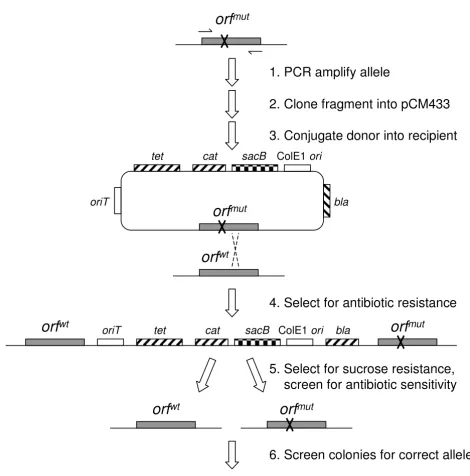
Strategy for pCM433-based "in-out" allelic exchange Figure 1
Strategy for pCM433-based "in-out" allelic exchange. Scheme depicted for the example of introducing a mutant allele with a point mutation (orfmut) in place of the wt allele (orfwt). PCR amplification of orfmut with primers complementary to the boundaries of the coding sequence, followed by cloning of the resulting fragment into pCM433, results in the desired orfmut donor plasmid. This donor can then be conjugated into the orfwt recipient strain, for which selection of one of the three encoded antibiotic resistances (Ap, Cm, Tc) will result in strains that have experienced recombination at the desired allele, and incorporation of the donor plasmid into the chromosomal locus. Although the recombination is drawn here to have occurred to the right of the point mutation, resulting in the orfwt upstream, recombination to the left of the point mutation would situate
orfmut upstream. Selection for sucrose resistance, and screening for antibiotic sensitivity results in clean exchange of the orfmut allele or reversion to orfwt. Finally, isolates bearing clean, single copies of the locus can be screened to identify a strain bearing the desired allele.
orf
mutorf
wtorf
muttet
cat
sacB
ColE1
ori
bla
oriT
1. PCR amplify allele
2. Clone fragment into pCM433
4. Select for antibiotic resistance
3. Conjugate donor into recipient
5. Select for sucrose resistance,
screen for antibiotic sensitivity
orf
wtorf
mutoriT
tet
cat
sacB
ColE1
ori
bla
orf
wtorf
mutIn all cases, constructs were made to convert the allele from wild-type (wt) to mutant, and the reciprocal rever-sion of mutant to wt. To accomplish this, both the ances-tral, wt allele and the deletion (ΔhprA, ΔmptG) or insertion (crtI502, generated by insertion of ISphoA/hah-Tc into crtI, followed by Cre-mediated excision of all but 132 bp of the IS [14]) alleles were amplified by PCR, cloned into pCR2.1, sequenced, and then introduced into pCM433. Each of these donor plasmids were then introduced into the appropriate target strain via triparental conjugations and plated onto Tc plates (also containing Rif for counter-selection against E. coli). TcR transconjugants were obtained at a frequency of 10-6 to 10-7. In some cases, even these single-crossover recombinants that contained both the wild-type and mutant alleles exhibited a phenotype. For example, the pool of single-crossover intermediates from either pCM441 (wt crtI allele) inserted into the white CM502 strain or pCM440 (defective crtI502 allele) inserted into the pink CM501 strain each contained TcR colonies of both colors. As such, one pink and one white isolate from the conjugation into each background were isolated (CM1263 (white) and CM1264 (pink) from CM502, and
CM1265 (pink) and CM1266 (white) from CM501). A polar effect of pCM433 insertion into this site was clearly observed. Irrespective of whether the wt allele was being introduced into the mutant, or vise versa, strains with the wild-type allele upstream, proximal to the gene's pro-moter (as determined by PCR analysis for strains CM1264 and CM1265), were pink, carotenoid-containing colo-nies, whereas the other strains (CM1263 and CM1266) had the crtI502 allele upstream of pCM433 and were white.
In order to select for recombinants that have excised the vector, suspensions of TcR isolates were diluted and plated onto plates containing various levels of sucrose (2.5, 5, and 10% w/v). At all sucrose levels sucrose-resistant colo-nies were obtained at a frequency of 10-4 to 10-5. These colonies were then screened for Tc sensitivity (indicating the expected loss of the pCM433-based construct), as well as the expected mutant phenotype (inability to grow on methanol for ΔhprA and ΔmptG, white colonies (versus pink) for crtI502). These were confirmed via PCR analysis using primers situated outside the region of the locus where recombination occurred. In the cases presented
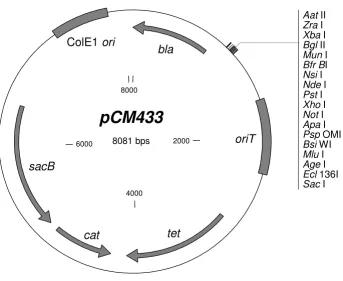
[image:4.612.134.478.91.372.2]Broad-host-range allelic exchange vector pCM433 Figure 2
Broad-host-range allelic exchange vector pCM433. Plasmid map of pCM433 [GenBank:EU118176] indicating the availa-ble restriction sites in the multiple-cloning site, as well as key plasmid features: bla (encodes betalactamase; ApR), oriT (IncP
ori-gin of conjugal transfer), tet (encodes Tc efflux pump), cat (encodes Cm actetyltransferase), sacB (levansucrase; confers sucrose sensitivity), and ColE1 ori (high copy E. coli origin of replication). Plasmid map was generated using Clone Manager 7 (Sci Ed Central).
pCM433
8081 bps 2000
4000 6000
8000
AatII
ZraI
XbaI
BglII
bla
oriT
tet
cat
sacB
ColE1
ori
MunI
Bfr BI
NsiI
NdeI
PstI
XhoI
Not I
ApaI
PspOMI
BsiWI
MluI
Age I
Ecl136I
here, differences in the size of amplified products sufficed to distinguish the alleles used, but primers designed to distinguish single-nucleotide substitutions (or sequenc-ing) have been used in subsequent studies (Chou and Marx, unpublished). Overall, a false positive rate of sucroseR, TcR strains generated here in M. extorquens AM1 was 26% (105/402). It should be noted, however, that the range of frequencies varied from 0% to 78% for different construct/recipient pairs. This is likely related to the rate of recombination for the flanking regions of each locus as compared to the rate of generating sucrose-resistance from other mechanisms. For all three loci, wild-type alleles were replaced by mutant alleles, and vise versa. In subse-quent work, dozens of allelic exchanges including the introduction of single-nucleotide substitutions have been successfully performed utilizing this system (Chou and Marx, unpublished).
Conclusion
The broad-host-range vector for marker-free allelic exchange described here has several features that greatly facilitate its use in various systems. First, unlike a number of similar vectors, such as pDS132 from which much some of the construct derives [10], pCM433 relies upon a pUC-derived ColE1 replicon, such that it can be main-tained and easily purified in high quantities (5–10 μg DNA from 1.5 ml liquid culture) in any desired E. coli strain. Second, pCM433 contains a polylinker containing a substantially larger number of restriction sites than com-parable tools we are aware of [3,10], facilitating the intro-duction of cloned DNA fragments. Third, the presence of three antibiotic markers on pCM433 permits use in a wide range of organisms in which they are applicable. Finally, pCM433 maintains features typically found in other broad-host-range systems such as the presence of an IncP oriT that allows conjugation to be utilized for delivery into the recipient strain.
Limitations for the use of this allelic exchange system are that it will not work in enterics where the ColE1 replicon is maintained vegetatively, and negative selection by using sucrose to select against cells expressing sacB must be effective. In this regard, the observed false positive rate observed in M. extorquens AM1 of 26% was sufficiently low to have allowed the facile exchange of alleles at three different loci, all of which generated the expected changes in phenotype. Potential causes for the variability in the false positive rate observed with some constructs include differences in the relative rates of homologous recombi-nation between the transiently duplicated genomic locus, or local differences in rates of sacB mutation (point muta-tions or transposition) that result in SucR without the expected homologous recombination. Another considera-tion that should be kept in mind with "in-out" systems is that the intermediate genotype created by a
single-crosso-ver event between the fragment cloned into pCM433 and the chromosomal locus must be viable (see Figure 1). Because of this, it may be useful to clone intact gene prod-ucts where lethality of resulting strains is expected, but this alone will not necessarily prevent potential polar effects. As long as at least one of the two potential inter-mediate states is viable, however, removal of the entire vector sequence during the second recombination event (selected for by sucrose) results in single-copy, unmarked loci, removing any concerns of polarity. This marker-free system should therefore permit allelic exchange in a wide variety of organisms, many of which otherwise lack the well-developed genetic systems of more intensively-stud-ied model systems. This will be particularly important for studying the phenotypic effect of more subtle genetic manipulations such as point mutations.
Methods
Media, growth conditions, and genetic techniques
M. extorquens AM1 strains were grown at 30°C on agar plates with "Hypho" minimal salts medium [15]; E. coli were grown at 37°C on Luria-Bertani agar [16]. Substrates and antibiotics were used at the following concentrations: methanol (125 mM), succinate (15 mM), sucrose (5% w/ v unless otherwise stated), 50 μg/ml Ap (ampicillin), 20
μg/ml Cm, 50 μg/ml Km, 50 μg/ml Rif (rifamycin), 35 μg/ ml Sm, and 10 μg/ml Tc.
Tri-parental conjugations were performed by mixing the E. coli strain with the donor plasmid, the M. extorquens AM1 recipient strain, and an E. coli strain with the helper plasmid pRK2073 [17]. This mixture was grown overnight on permissive Nutrient agar [16] plates at 30°C before introducing some of the mix (either by streaking with a loop or by washing with Hypho and re-plating) onto selective medium containing an appropriate C source, Rif for counter-selection against E. coli [9], and the selective antibiotic (Tc for pCM433-based donors; neither Ap nor Cm works effectively in M. extorquens AM1, Marx, unpub-lished). Sucrose selection was accomplished by suspend-ing a loop of a given strain in 100 μl Hypho (approximately 109 ml-1) and plating 50 μl of a 10-2 dilu-tion of this suspension onto Hypho plates containing an appropriate C source (generally succinate) and 5% sucrose. Resulting strains were tested for Tc sensitivity, additional expected phenotypes (depending on the locus and allele being exchanged), and additionally, the chro-mosomal organization of all strains constructed was con-firmed through PCR analysis. DNA concentrations were determined using a ND-1000 spectrophotometer (Nano-Drop).
Construction of plasmids and generation of strains
NdeI and SacII, and the remaining 5.4 kb vector backbone was ligated together with a synthetic linker designed to introduce three additional, unique cloning sites into the final vector (PstI, XhoI, and NotI). The linker was formed by boiling, and then slowly re-annealing at room temper-ature, a mixture of two oligos, CM-link1f (tatgctgcagctc-gagcggccgc) and CM-link1r (ggccgctcgagctgcagca), which were designed to have complementary overhangs to NdeI and SacII. The resulting plasmid, pCM432, was then trans-formed into the dam dcm E. coli strain, C2925H (ara-14 leuB6 fhuA31 lacY1 tsx78 glnV44 galK2 galT22 mcrA dcm-6 hisG4 rfbD1 R(zgb210::Tn10) TcSendA1 rspL136 (SmR)
dam13::Tn9 (CmR) xylA-5 mtl-1 thi-1 mcrB1 hsdR2, New
England Biolabs), enabling digestion at an otherwise methylated, and therefore blocked, MscI site. The 2.7 kb XbaI-XmaI fragment of pDS132 [10] containing sacB and cat was then purified, blunted with Klenow enzyme, and ligated with the MscI-digested pCM432 vector to generate pCM433 (see Figure 2). A construct with the sacB-cat frag-ment in the opposite orientation, pCM433r, was also obtained. All plasmids and strains used are referenced in Table 1.
A series of constructs and strains were generated in order to test the ability of pCM433 to enable unmarked allelic exchange at three distinct loci in the M. extorquens AM1 chromosome. Donor constructs for allelic exchange at the mptG locus were generated by first amplifying a region including mptG from CM501 (an isolate of wild-type, RifR M. extorquens AM1 [9]), or the corresponding region from the ΔmptG strain, CM508 (an isolate of CM253.1 [18]), each of which were ligated into pCR2.1 (Invitrogen) to generate pCM411 and pCM424, respectively. These PCR-amplified inserts (and all other alleles described below that were cloned into pCR2.1) were sequenced to confirm no PCR errors were introduced during amplification. The 2.1 kb ApaI-BamHI fragment of pCM411 containing the mptG region was then introduced into pCM433 that had been digested with ApaI and BglII, resulting in the donor vector pCM436. Similarly, the 1.3 kb SacI-XhoI fragment of pCM438 with the ΔhprA region was cloned into the same sites of pCM433 to generate the donor vector pCM439. This allowed the use of pCM436 (containing the wild-type mptG allele) to reverse the lesion found in CM508, while pCM437 (ΔmptG allele) was introduced into CM501 to do the opposite, generating the deletion in a single step.
Similarly, donor constructs for allelic exchange at the crtI locus were generated by first amplifying a region includ-ing crtI (encodes phytoene desaturase) from the pink CM501 strain, or the corresponding region from the white crtI::ISphoA/hah (i.e. crtI502) strain, CM502 (an isolate of AM1-W [14]). These fragments were ligated into pCR2.1 (Invitrogen) to generate pCM417 and pCM426,
respec-tively. The 1.6 kb BamHI-NsiI fragment of pCM411 con-taining the crtI region was then introduced into pCM433 that had been digested with BglII and NsiI, resulting in the donor vector pCM440. Similarly, the 1.7 kb BamHI-NotI fragment of pCM426 with the crtI502 region was cloned between the BglII and NotI sites of pCM433 to generate the donor vector pCM441. This allowed the use of pCM440 (containing the wild-type crtI allele) to reverse the lesion found in CM502, while pCM441 (crtI502 allele) was introduced into CM501 to do the opposite, generat-ing the insertion allele.
Finally, for the third locus, hprA, an antibiotic-resistance free deletion strain was generated initially using a previ-ously developed cre-lox system [4]. In contrast to the sys-tem described here using pCM433, the process to generate the ΔhprA strain was substantially more involved (and resulted in leaving behind a loxP scar). First, the regions upstream and downstream of hprA, were amplified sepa-rately and cloned into pCR2.1 (Invitrogen) to generate pCM428 and pCM429, respectively. The 0.5 kb upstream region was then excised from pCM428 using BglII and NotI and ligated into the same sites of pCM184 to gener-ate pCM430. Into this plasmid, the 0.6 kb ApaI-SacI frag-ment from pCM429 was cloned into the same sites to generate the donor plasmid pCM431. As previously described [4], this plasmid was introduced into both the wild-type (pink) M. extorquens AM1 strain, CM501, as well as the otherwise isogenic white strain with a crtI502 allele, CM502, leading to the isolation of the hprA::kan strains CM1122 and CM1123, respectively. pCM157 (expressing Cre recombinase) was introduced into these two strains to catalyze the excision of the kan cassette, and was subse-quently cured, ultimately resulting in the antibiotic-resist-ance free ΔhprA strains CM1203 and CM1204 used below.
Availability and requirements
Nucleotide sequence accession number and plasmid database information
The sequence of pCM433 has been deposited [Gen-Bank:EU118176] and the plasmid has been deposited with Addgene (http://www.addgene.org/ Christopher_Marx, Plasmid 15670).
Authors' contributions
CJM designed and carried out all experiments and drafted the final manuscript.
Acknowledgements
I thank Dominique Schneider for sending pDS132, and Jessica Berger, Melissa Derby, and Lela Sims for their technical assistance. This work was supported by the National Science Foundation (IOB-0612591), the Clark/ Cooke Fund, the William F. Milton Fund, and Harvard University.
References
1. Herring CD, Glasner JD, Blattner FR: Gene replacement without selection: regulated suppression of amber mutations in Escherichia coli. Gene 2003, 311:153-163.
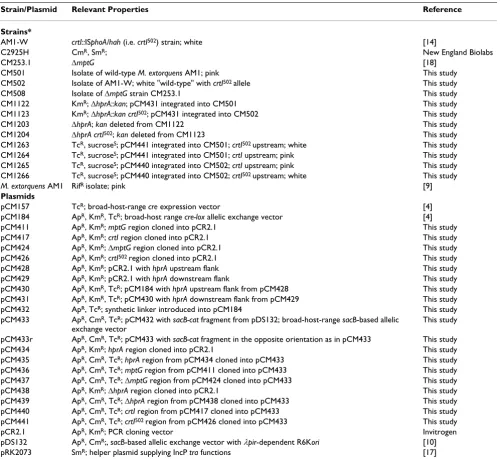
[image:7.612.58.558.99.558.2]2. Ayres EK, Thomson VJ, Merino G, Balderes D, Figurski DH: Precise deletions in large bacterial genomes by vector-mediated excision (VEX). The trfA gene of promiscuous plasmid RK2 is Table 1: Methylobacterium Strains and Plasmids Used in This Study
Strain/Plasmid Relevant Properties Reference
Strains*
AM1-W crtI::ISphoA/hah (i.e. crtI502) strain; white [14]
C2925H CmR, SmR; New England Biolabs
CM253.1 ΔmptG [18]
CM501 Isolate of wild-type M. extorquens AM1; pink This study CM502 Isolate of AM1-W; white "wild-type" with crtI502 allele This study
CM508 Isolate of ΔmptG strain CM253.1 This study CM1122 KmR; ΔhprA::kan; pCM431 integrated into CM501 This study
CM1123 KmR; ΔhprA::kan crtI502; pCM431 integrated into CM502 This study
CM1203 ΔhprA; kan deleted from CM1122 This study CM1204 ΔhprA crtI502; kan deleted from CM1123 This study
CM1263 TcR, sucroseS; pCM441 integrated into CM501; crtI502 upstream; white This study
CM1264 TcR, sucroseS; pCM441 integrated into CM501; crtI upstream; pink This study
CM1265 TcR, sucroseS; pCM440 integrated into CM502; crtI upstream; pink This study
CM1266 TcR, sucroseS; pCM440 integrated into CM502; crtI502 upstream; white This study
M. extorquens AM1 RifR isolate; pink [9]
Plasmids
pCM157 TcR; broad-host-range cre expression vector [4]
pCM184 ApR, KmR, TcR; broad-host range cre-lox allelic exchange vector [4]
pCM411 ApR, KmR; mptG region cloned into pCR2.1 This study
pCM417 ApR, KmR; crtI region cloned into pCR2.1 This study
pCM424 ApR, KmR; ΔmptG region cloned into pCR2.1 This study
pCM426 ApR, KmR; crtI502 region cloned into pCR2.1 This study
pCM428 ApR, KmR; pCR2.1 with hprA upstream flank This study
pCM429 ApR, KmR; pCR2.1 with hprA downstream flank This study
pCM430 ApR, KmR, TcR; pCM184 with hprA upstream flank from pCM428 This study
pCM431 ApR, KmR, TcR; pCM430 with hprA downstream flank from pCM429 This study
pCM432 ApR, TcR; synthetic linker introduced into pCM184 This study
pCM433 ApR, CmR, TcR; pCM432 with sacB-cat fragment from pDS132; broad-host-range sacB-based allelic
exchange vector
This study
pCM433r ApR, CmR, TcR; pCM433 with sacB-cat fragment in the opposite orientation as in pCM433 This study
pCM434 ApR, KmR; hprA region cloned into pCR2.1 This study
pCM435 ApR, CmR, TcR; hprA region from pCM434 cloned into pCM433 This study
pCM436 ApR, CmR, TcR; mptG region from pCM411 cloned into pCM433 This study
pCM437 ApR, CmR, TcR; ΔmptG region from pCM424 cloned into pCM433 This study
pCM438 ApR, KmR; ΔhprA region cloned into pCR2.1 This study
pCM439 ApR, CmR, TcR; ΔhprA region from pCM438 cloned into pCM433 This study
pCM440 ApR, CmR, TcR; crtI region from pCM417 cloned into pCM433 This study
pCM441 ApR, CmR, TcR; crtI502 region from pCM426 cloned into pCM433 This study
pCR2.1 ApR, KmR; PCR cloning vector Invitrogen
pDS132 ApR, CmR;, sacB-based allelic exchange vector with λpir-dependent R6Kori [10]
pRK2073 SmR; helper plasmid supplying IncP tra functions [17]
*All M. extorquens AM1 strains are also RifR [9]. Antibiotic resistances are indicated as follows, Ap (ampicillin), Cm (chloramphenicol), Km
Publish with BioMed Central and every scientist can read your work free of charge
"BioMed Central will be the most significant development for disseminating the results of biomedical researc h in our lifetime."
Sir Paul Nurse, Cancer Research UK
Your research papers will be:
available free of charge to the entire biomedical community
peer reviewed and published immediately upon acceptance
cited in PubMed and archived on PubMed Central
yours — you keep the copyright
Submit your manuscript here:
http://www.biomedcentral.com/info/publishing_adv.asp
BioMedcentral essential for replication in several gram-negative hosts. J Mol
Biol 1993, 230:174-185.
3. Hoang TT, Karkhoff-Schweizer RR, Kutchma AJ, Schweizer HP: A broad-host-range Flp-FRT recombination system for site-specific excision of chromosomally-located DNA sequences: application for isolation of unmarked Pseudomonas aerugi-nosa mutants. Gene 1998, 212:77-86.
4. Marx CJ, Lidstrom ME: Broad-host-range cre-lox system for antibiotic marker recycling in gram-negative bacteria. Bio-Techniques 2002, 33:1062-1067.
5. Hamilton CM, Aldea M, Washburn BK, Babitzke P, Kushner SR: New method for generating deletions and gene replacements in Escherichia coli. J Bacteriol 1989, 171:4617-4622.
6. Maloy SR, Nunn WD: Selection for loss of tetracycline resist-ance by Escherichia coli. J Bacteriol 1981, 145:1110-1111. 7. Gay P, Le Coq D, Steinmetz M, Ferrari E, Hoch JA: Cloning
struc-tural gene sacB, which codes for exoenzyme levansucrase of Bacillus subtilis: expression of the gene in Escherichia coli. J Bacteriol 1983, 153:1424-1431.
8. Peel D, Quayle JR: Microbial growth on C1 compounds: 1. Iso-lation and characterization of Pseudomonas AM1. Biochem J
1961, 81:465-469.
9. Nunn DN, Lidstrom ME: Isolation and complementation analy-sis of 10 methanol oxidation mutant classes and identifica-tion of the methanol dehydrogenase structural gene of Methylobacterium sp. strain AM1. J Bacteriol 1986, 166:581-590. 10. Philippe N, Alcaraz JP, Coursange E, Geiselmann J, Schneider D: Improvement of pCVD442, a suicide plasmid for gene allele exchange in bacteria. Plasmid 2004, 51:246-255.
11. Chistoserdova LV, Lidstrom ME: Cloning, mutagenesis, and physiological effect of a hydroxypyruvate reductase gene from Methylobacterium extorquens AM1. J Bacteriol 1992, 174:71-77.
12. Chistoserdova L, Vorholt JA, Thauer RK, Lidstrom ME: C1 transfer enzymes and coenzymes linking methylotrophic bacteria and methanogenic Archaea. Science 1998, 281:99-102. 13. Scott JW, Rasche ME: Purification, overproduction, and partial
characterization of beta-RFAP synthase, a key enzyme in the methanopterin biosynthesis pathway. J Bacteriol 2002, 184:4442-4448.
14. Van Dien SJ, Marx CJ, O'Brien BN, Lidstrom ME: Genetic charac-terization of the carotenoid biosynthetic pathway in Methy-lobacterium extorquens AM1 and isolation of a colorless mutant. Appl Environ Microbiol 2003, 69:7563-7566.
15. Attwood MM, Harder W: A rapid and specific enrichment pro-cedure for Hyphomicrobium spp. Antonie Van Leeuwenhoek 1972, 38:369-377.
16. Sambrook J, Fritsch EF, Maniatis T: Molecular Cloning: a Labora-tory Manual. 2nd edition. Cold Spring Harbor, NY, Cold Spring Harbor Laboratory; 1989.
17. Figurski DH, Helinski DR: Replication of an origin-containing derivative of plasmid RK2 dependent on a plasmid function provided in trans. Proc Natl Acad Sci USA 1979, 76:1648-1652. 18. Marx CJ, Chistoserdova L, Lidstrom ME: